Catalogue > Search
Results for : Tout le catalogue

Kwang-ju Son
Characters Revisited
Experimental doc. | 4k | color | 18:14 | Korea, South | 2016
The filmmaker begins to view CHARACTERS, her first feature film made in 2011, not from the outside as a product to be consumed, but from the inside, as an engaged performance of consciousness in and through which the story is both lost and regained in the actual process of filmmaking itself. Exploring the paradoxical boundary between two worlds, she focuses on the basic conditions of existence, identity and survival of an individual in a fictional world.
Since 2003 when she received the M.F.A. in Film/Video/New Media from the School of the Art Institute of Chicago, Kwang-Ju Son(b.1970) has presented her varied short projects of both film and video, at diverse venues & international film festivals.

Guston Sondin-kung
STUXNET in Denmark
Video | 4k | color | 4:37 | USA, Denmark | 2015
The Video work STUXNET in Denmark tells a hallucinatory realist fable about an unnamed intelligence officer who has participated in the cyber warfare attack against the Iranian Nuclear plant in Natanz from a hotel room in Copenhagen. What unfolds through the story is a dialogue about the fictive side of documents, participation and complicity in remote warfare, the trap of paranoia and the unattainable desire to be completely immune to mass surveillance. This video is based upon the real events of what has been termed the STUXNET virus, a cyber warfare weapon that was developed by a consortium of different government bodies as a way to disrupt the enrichment of uranium at the Iranian Nuclear plant in Natanz from 2010-2012. Cyber security experts have tracked the virus and discovered that one of the main control servers was located outside the city of Copenhagen, Denmark. It has been suggested by security analysts that because the control servers were located in Denmark then there would have been a forward operating command and control center set up in the country that was active during the time of the attack. An intelligence officer following standard operating procedure would have established this in a hotel and worked cloaked in what is referred to as a “security tent” that is specifically designed to create an electromagnetic shield around its exterior so as to disrupt any listening or watching devices.
Guston Sondin-Kung is a visual artist born in the USA and currently living in Copenhagen, Denmark. He works in a project-based manner primarily in the mediums of film/video, installation and writing. His artwork explores how historical narratives, memory, and ideology are constructed and influence our perception and thinking. Informed by marxist theory, psychoanalysis, postcolonial theory and feminism he is invested in deconstructing the complex intersections of race, class, and gender from a transnational perspective in order to pose alternative narratives and forms of representation. In addition to art institutions, he regularly presents his artworks and artistic research in academic, activist, educational and film festival contexts.

Paul Sonntag, Luzie Loose
A New Normal
Experimental film | 4k | color | 17:10 | Germany | 2019
A NEW NORMAL is a stereoscopic essay film that examines the question how to go on when everything has changed. A young man leaves his apartment in an old high-rise and wanders through deserted landscapes. Something is waiting for him out there, but what drives him forward is his desire to leave everything behind, even himself. A narrator recounts fragments and experiences of an everyday life following catastrophe. They bear no resemblance with the journey of the young man, but cannot be cleanly separated from them either. Stories start out as banal episodes about grocery shopping or commuting to work but reveal various strategies to engage with a profound crisis of identity. The 3D images are both an artistic and a narrative choice: they serve as a window into his thoughts and attempts to develop a new sense of normalcy.
Luzie Loose (born 1989) and Paul Nungeßer (born 1991) both grew up in post-wall Berlin of the 1990s. Luzie studied communications at Universität der Künste in Berlin while Paul majored in Photography and Architecture at Columbia University in New York. Their paths crossed for the first time in 2017 at Filmakademie Baden-Württemberg, where Luzie graduated in 2018, directing her first feature-length fiction film Swimming. The film premiered at Busan International Film Festival and won the Hof gold award for best directing debut. Paul is studying cinematography since 2016 at Filmakademie. His films have been shown at various festivals, including Dok.Fest & Filmfest Munich, Achtung Berlin and Max-Ophüls-Prize. A NEW NORMAL is the first collaboration between the two filmmakers and celebrated its world premiere at Filmfest Munich. Paul and Luzie live and work in Berlin.

Paul Sonntag, Luzie Loose
A New Normal
Experimental film | 4k | color | 17:10 | Germany | 2019
A NEW NORMAL is a stereoscopic essay film, that examines the question how to go on when everything has changed. A young man leaves his apartment in an old high-rise and wanders through deserted landscapes. Something is waiting for him out there, but what drives him forward is his desire to leave everything behind, even himself. A narrator recounts fragments and experiences of an everyday life following catastrophe. They bear no resemblance with the journey of the young man, but cannot be cleanly separated from them either. Stories start out as banal episodes about grocery shopping or commuting to work but reveal various strategies to engage with a profound crisis of identity. The 3D images are both an artistic and a narrative choice: they serve as a window into his thoughts and attempts to develop a new sense of normalcy.
Luzie Loose (*1989) and Paul Sonntag (*1991) grew up in post-wall Berlin. Luzie studied at UdK Berlin while Paul received a BA from Columbia. Their paths crossed at Filmakademie BW, where Luzie graduated in 2018, with her first feature Swimming, which won several awards. Paul has been studying cinematography since 2016. His films have been shown at various festivals around the world. A NEW NORMAL is the first collaboration between the two and celebrated its world premiere at Filmfest Munich.
Ian Soroka
Nevada: Of Landscape and Longing
Experimental doc. | 16mm | color | 15:0 | USA | 2011
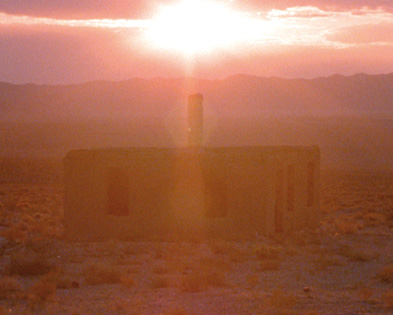
NEVADA: Of Landscape and Longing is a reminiscence of a journey to the desert state of Nevada in the summer of 2009. It is a portrait of contemporary Nevada, which documents the region as a place of extremes. On the one hand, it is a land of notorious desolation and silence, while on the other it is a capital of excess, artifice, and paragon of the American economic collapse. Through the voyeuristic camera of outsiders, the film explores the death of the American frontier through Nevada, a place where contemporary notions of progress are wrestling with the West?s wild landscape and mythology.
Ian Soroka is a filmmaker and multimedia artist who was born in Brooklyn, New York and raised in the mountains of western Colorado, USA. He studied cinema and philosophy at the University of Colorado in Boulder (2009) and at the Film and Television School at the Academy of Performing Arts in Prague, Czech Republic (FAMU Int. 2008). His work has previously exhibited at Rencontres Internationales (2008-9), the Albuquerque Film Festival (2009), Insideout Gallery (2009). In 2009, Soroka was awarded the prestigious Princess Grace Foundation fellowship. He lives and works in Brooklyn, New York.

Ian Soroka
Nostalgia
Experimental film | 16mm | color | 6:46 | USA, Czech Republic | 2008
Nostalgia is a specific emotion that represents a patchwork of memories stitched together to create an idealized past. Through reflections of the banality of everyday life, Nostalgia explores the creation of filmic emotion and atmosphere. It seeks to construct a ?film? environment to allude not only to something inherently human but also to a collective emotional history.
Ian Soroka was born New York City and raised in the Mountain region of Colorado, USA. He has Accreditation from FAMU International: Film and TV School of the Academy of Performing Arts in Prague and is currently working towards a degree at the University of Colorado in Boulder.
Ricardo Soto
Florería y Edecanes
Experimental doc. | hdv | color | 43:0 | Mexico | 2011
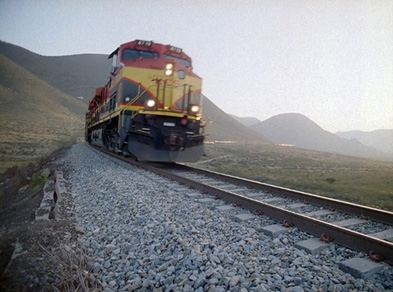
Where is the end of Mexico and beginning of the United States? By means of a contemplative and experimental approach this documentary pose the present panorama and everyday life in northeast Mexico and south of Texas. A pursuit to find an own identity, through atmospheres and ambient states in a region whe a river divides the third and first world of a whole continent.
Jaiziel Hernández Máynez was born march 9, 1987 in Saltillo, Coahuila in a family of industrial workers. At age of 18, he entered the Centro de Capacitación Cinematográfica in Mexico city, where he studied the cinematography bachelor. He has made the cinematography of short films like Felipe (2009) winner of Garcia Bross/Studio 5 de Mayo special prize in the Morelia int Film Festival 2009. Currently he is developing a documentary project about the affected people of the drug war that is happening right now in Mexico.
Belmin Soylemez
Bugun Istanbul ne kadar guzel
Experimental video | dv | color | 5:30 | Turkey | 2005
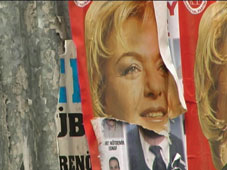
On the eve of the local elections, Istanbul is dressed with a stage-set built of posters, banners and flags. This set covers the city like a uniform. Different neighbourhoods with different socio-cultural and architectural characteristics become indistinguishable. Rallying buses stroll through the city playing campaign songs. It is a kind of temporary frenzy; a paradox: the ones who promise a better look for the city are the ones who distort its face. Inseparable from the stage set are the actors. They appear with plastic smiles and slogans, some demanding, some emotional. It seems as though we vote for poster people instead of real candidates. Slogans cover not only the main roads but also side streets, shop windows, trees, construction sites, apartment blocks, lampposts, rubbish bins and even traffic signs.
Belmyn Söylemez was born in Istanbul. She has worked as a copywriter, editor, director, and producer. Her short films and documentaries have received many awards in national and international festivals, and have been shown on TV Channels such as ARTE, SVT (Sweden), YLE (Finland), and SBS (Australia). Her films have also participated in exhibitions such as "Call me Istanbul", ZKM Karlsruhe, Germany (2004), and "Free Kick" - the 9th Istanbul Biennial, 2005. She is also a member of the Filmist Collective and is currently working on the script of her first feature film, as well as a photography project called "Foam". Hasmet Topaloglu (Haþmet Topaloðlu) was born in 1968. He studied business administration but spent more time in cinémathèques and on short-film production than in the classroom. In 1993 he started working as a TV-journalist at Turkey's ATV, a national television channel. He worked for three different national television channels over a period of ten years as a reporter, a producer, and a presenter. His focus was mainly on human stories, features, and TV documentaries. Topaloglu was also a film critics for the daily papers in the early 90's and 2002-2003. Since 2002 he has been working as a freelance director/producer. He is currently making a video documentary on the Turkish Punk Group "Rashit".
Patrik Söderlund
Impivaara - A New World
Experimental fiction | 4k | color | 26:2 | Finland | 2024
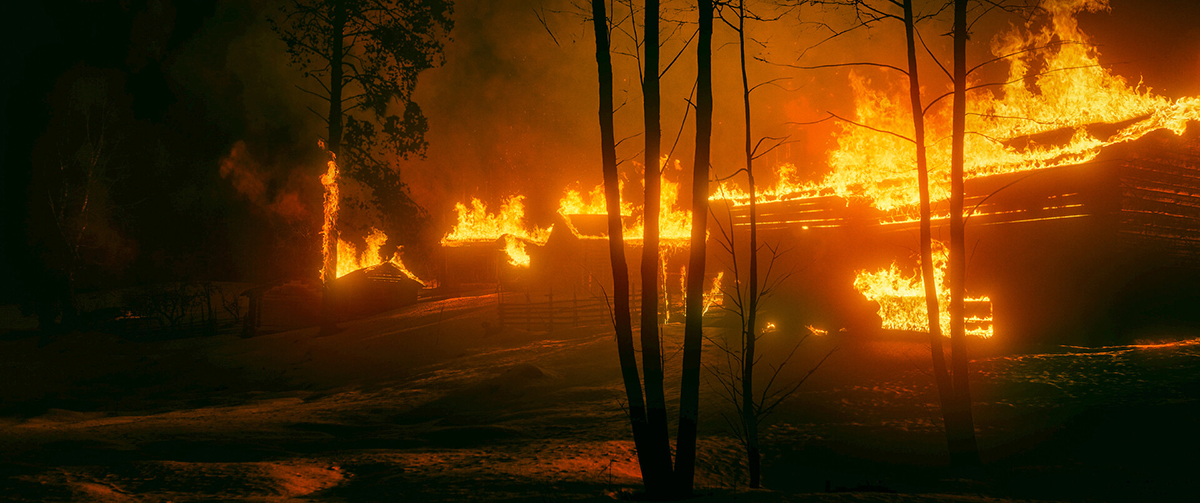
Brothers escape to the virgin forests of Impivaara to create a new world. An experimental imagining of Finnish national author Aleksis Kivi’s novel Seven Brothers (1870) for the 21st Century, focusing on the energetic basis of a Northern welfare state and a possible future emerging from the climate crisis.
Writer and Director Patrik Söderlund is the founding member of artist duo IC-98. With backgrounds in visual arts and cultural studies, Söderlund’s and Visa Suonpää’s 25-year collaboration as IC-98 has produced artist publications, site and context specific projects and interventions, animated moving image installations and various public commissions. IC-98 received the Finnish State Art Prize in 2009 and represented Finland at the Venice Biennale in 2015 with Abendland (Hours, Years, Aeons), which was picked by Sundance Film Festival in 2016. Their work has been shown extensively at museums, biennials and festivals in Europe, Asia and the Americas. Though their practice is essentially conceptual, IC-98 is best known for animations, which combine classical drawing and digital effects, depicting landscapes shaped by long time durations, natural and human histories and climate. The landscapes are always devoid of humans but completely shaped by their actions. Mythical, material, factual and ctional elements are weaved together into visual narratives, which – though deeply political and meticulously researched, scripted and executed – are presented as open-ended poetic reveries, which leave room for the viewer to make her own conclusions. IC-98's work since 2010s addresses the environmental crisis and artistic-political methods of finding solutions to it. The projects seek to replace anthropocentric worldview with modes better suited to take into consideration the interrelationships, dependencies and myriad temporal rhythms of all animate and inanimate nature.
Gustav Sparr
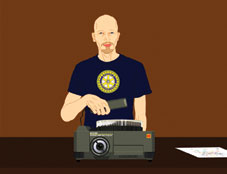
Slide Projector: I.D. Roles Project
Animation | 0 | color | 27:46 | Sweden | 2006
A cast of clones are trapped inside a seminar room and subjected to a kind of presentation or slideshow. The slideshow features over a hundred images of board games, and seems to trigger, via a small mysterious ball of light, the audience of clones to sift through their notes and act out small, possibly internal or dreamlike, dramas. As the film progresses the identies start to get tangled and conflict arises, characters want to jump out of the system or structure, while some, seemingly in power, try to control the situation and preserve the order of things. The film unfolds and is driven trough the association and manipulation of symbols: One board game leads to the next and one identity refers to another in a sequential series of mind games that eats its own tail. The sub-stories of the film deal playfully and somewhat loosely with evolution, science, existentialism, and society, as well as mysticism and hierarchies. It is part of a larger artwork and film cycle begun in 2003 and scheduled for completion in 2007.
Gustav Sparr was born in 1977, grew up in the region of Stockholm, and currently lives and works in Umeå, Sweden. After having gradually shifted from sculpture, painting, and digital illustration, his work currently focuses on animation. References from popular culture, esotericism and scientific writings have been filtered through a rather direct visual language that hides many underlying and unorthodox connections of ideas. The most obvious framework or manifestation of these thought-experiments is through the both limiting and enriching world of board games and childlike acts, which are deciphered, re-interpreted and re-coded. The animations and images are concerned with questions about identity, self-image, structures, symbols, loops, surfaces, topology, vessels of information, lifeforms, and how thoughts and ideas are born and relate and mutate. Basically it's about the brain...

Isabell Spengler, Antonia Baehr, Jule Flierl - Filmed in a visual installation by Nadia Lauro
Die Hörposaune
Experimental fiction | 0 | color | 29:38 | Germany | 2022
Die Hörposaune (The Hearing Trombone) film / installation by Isabell Spengler, Antonia Baehr, Jule Flierl, Germany 2022 filmed in a visual installation by Nadia Lauro short synopsis Through a floating camera motion, the film invites us to enter a world with its own logic, passing through sensitive membranes, liquefied borders and openings between inner and outer spaces. Here we attend a reading circle or vocal performance in memory of the counter tenor and queer icon Klaus Nomi, one of the first public figures to die within the AIDS pandemic. Daydream-like, as if to save them from oblivion, the film delves into the guts of fantastical, queer body imaginations - with spit, panting, oral sounds, singing, and vulva-like paper flower arrangements, whereby anatomical representations are reinterpreted.
Isabell Spengler (director) is a film/video artist from Berlin. In her films, installations and performances she analyzes and mediates diverging constructions of realities, imaginary worlds and their representation. Since 2005 she has created a series of conceptual Expanded Cinema works in dialogues with other artists. /www.isabellspengler.net Antonia Baehr (director) is a choreographer living in Berlin. Her pieces explore, among other things, the fiction of the everyday and the theater. She has worked with scores for many years - as a way to connect and collaborate. Baehr is producer of horse whisperer and dancer Werner Hirsch (performer in Die Hörposaune). /www.make-up-productions.net Jule Flierl (director) is a dance and voice artist from Berlin. She develops practices that conceive of the voice as a dancer. She revives the legacy of Valeska Gert, avant-garde dancer from 1920's Berlin, who first conceptualized the term ToneDance: to dance with one's voice. Her practice unsettles the relationship between seeing and hearing. /juleflierl.weebly.com Nadia Lauro (visual installation) is a visual artist and designer based in Paris, who works across contexts including scenic spaces, landscape architectures, museums. She conceived set designs, environments and visual installations with strong dramaturgical power, thus generating new ways of seeing and being together. /https://nadialauro.com

Isabell Spengler
Permanent Residents
Experimental film | 16mm | color | 9:32 | Germany, USA | 2005
The film "Permanent Residents" combines extreme costume design with staged documentation of everyday activities in the urban space of Los Angeles. The costumes point to a collective imaginary world, which consists of the floating signifiers of pop-icons, myths, and social fictions. The protagonists of the film communicate in a non-verbal language across spatial distances. Their simultaneous movements at different locations merge into a choreography, which draws our attention to musical and abstract visual aspects in the design of our environment. A portrait of the city's influence on its residents.
Isabell Spengler, born in Berlin (Germany), studied experimental film at the Universität der Künste in Berlin (Meisterschülerin 1999) and at the California Institute of the Arts in Valencia (MFA 2001). She was a recipent of a DAAD grant and a Eastman Kodak stipend. She currently teaches film at the Universität der Künste in Berlin. Her filmography includes "Psychic Tequila Tarot" (1998), "Transformation in the Land of Enchantment" (2003), and "The Natural Life of Mermaids" (2004). Her films have received awards at the NoBudget Festival in Hamburg, the Gera International Short Film Festival, and the Göttinger Low Budget Film Festival. Her work has recently been exhibited at Los Angeles Film Forum, Cirrus Gallery, Los Angeles; the Australian Center for Photografy, Sydney; the Museum Ludwig, Cologne; and at KunstWerke Institute for Contemporary Art, Berlin.
Isabell Spengler, Larry Peacock
Syncpoint
Experimental film | 16mm | color and b&w | 3:54 | Germany | 2007
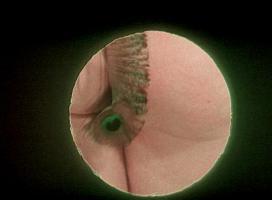
Translating a musical stage performance by the group "Larry Peacock" into the language of film, SYNCPOINT combines film images created directly on film leader with those created through normal exposure of 24 frames per second with a 16mm film camera. Central to this experimental music video is the image of the synchronization-point as a hole, derived from the film-technical synchronization method of punching a hole into the first exposed and keycode-numbered frame of a roll of film prior to its transfer to video. The image of the hole does not only mark a point in time, but is in connection with the photographically captured (percussion-) actions of the performers perceived either as a round mask of censorship or as a filled, dot-shaped image. Purposefully designed and random synchronicities between the visual and accustic events allow for a variety of interpretive connections. Larry Peacock is a feminist project with and about the performativity of electronic/pop music, reflecting gender politics and the role of the audience. The project not only destabilizes the normativity of binary gender categories, but also art categories such as ?high` and `low`, ?dance?, ?concert-performance?, and ?choreographic work?.
Isabell Spengler, born in Berlin, studied experimental film at the Universität der Künste in Berlin and at the California Institute of the Arts in Valencia. She was a recipent of a DAAD grant and a Eastman Kodak stipend. She currently teaches film at the Universität der Künste in Berlin. Her filmography includes "Psychic Tequila Tarot" (1998), ?Transformation in the Land of Enchantment? (2003), ?The Natural Life of Mermaids? (2004) and ?Permanent Residents? (2005). Her work including films, video installations and photography has recently been exhibited at Los Angeles Film Forum; Cirrus gallery, Los Angeles; Cerealart, Philadelphia; Taxter & Spengemann, New York; KunstWerke - Berlin e.V. - Institute for Comtemporary Art; Internationale Filmfestspiele Berlin (Berlinale 2007) and at the Museum Ludwig, Cologne, Germany. distribution & further information: http://www.fdk-berlin.de/en/arsenal-experimental/kuenstler/isabell-spengler.html
Lisa Spilliaert
Spilliaert
Experimental doc. | 4k | color | 29:10 | Belgium | 2022
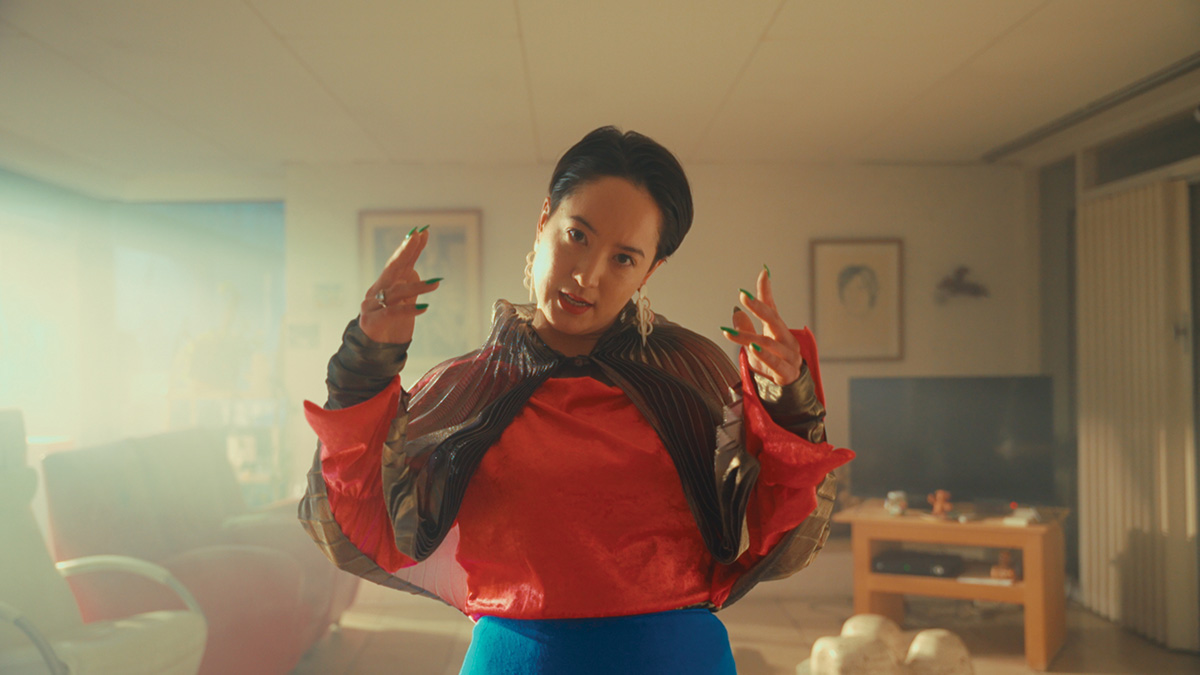
In Spilliaert, filmmaker Lisa Spilliaert inquires into her blood relationship with the renowned Belgian artist Léon Spilliaert (1881-1946). Is she predestined to an artist’s life by this kinship, which may or may not be fictitious? She reveals herself as a rapping, fanatical genealogist who probes into the origins of her artistry.
Lisa Spilliaert lives and works in Ghent (BE). She was born in Tokyo in 1990 to a Japanese mother and a Belgian father. After spending her youth in Tokyo, she moved to Bruges at the age of 17. Her fascination for genealogy and the continuous alternation between her Eastern and Western cultural background are recurring motifs in her work, which is mostly of an autobiographical nature. Her videos blur life and work and lend universal appeal to her personal story.

Giuseppe Spina
Variazioni luminose nei cieli della città
Experimental film | mov | color | 6:20 | Italy | 2019
A silent film composed of digital scans and blow-ups of Guido Horn D’Arturo’s photographic plates depicting Bologna’s skies.
Giuseppe Spina is an Italian filmmaker based in Bologna. His films have been screened at numerous international festivals, including International Film Festival Rotterdam, EMAF and Annecy’s IAFF. He is the co-founder of Nomadica, an international network of artists and intellectuals focused on experimental cinema.

Andy Spitz
Voices across the fence
Documentary | dv | color | 26:0 | South Africa | 2002
Mozambique?s civil war saw hundreds of thousands of refugees fleeing the bitter post independence carnage, jumping the fence and crossing the Kruger National Park, into South Africa. Nearly two decades later, the fence is still a physical and psychological barrier dividing families. Through the use of video messages filmed and transported between the two countries, Voices Across The Fence provides a glimpse into the lives of those who left and of those who remained behind. Ongoing communication across the fence between family members in South Africa and Mozambique is extremely difficult, and messages by word of mouth are the dominant form. The most common alternative for connecting is for people to risk their lives on a 2-3 day walk across the Kruger National Park. This walk exposes them to dangerous wild animals, dehydration and arrest by border police. Through this programme, an alternative communication opportunity was provided. In August 2000 and November 2001 video messages were recorded amongst Mozambican refugees living in the Bushbuskridge area of South Africa. The messages were then driven the cross border journey to relatives and friends in villages of the remote Massingir district of Mozambique. These were screened and replies videod and brought back to South Africa. This documentary presents the messages exchanged between families who were once separated by war and are now divided by changing times.
Simon Spitzer
In This Silence I Believe
Experimental film | hdv | color | 17:28 | Austria | 2022
The essay film "In this silence I believe" gives us an ambient impression of the nightlife in a city disco. The guests provide the focus for documentary observations and the resulting investigation of a subculture. With an alienated sound design, the familiar elements at the club are viewed in an experimental cinematic way.
Born 1988 in Vienna, Austria. After visiting Vienna Filmakademie, he started visiting Artuniversity/ Timebased Media in Linz. Besides his own films, he is also working for other directors in differen departments.

Juan Diego Spoerer, Håkan Engström
La Sombra de Don Roberto
Documentary | dv | color | 27:0 | Chile | 2007
A boy travels any given day to saltpeter office with his family, the old known city of ?enclavada? in the desert inside Antofagasta. There he walks along the old buildings?the years have passed, and just like the wind erases the days and hours from yesterday. The boy is now a grown up, a lonely old man, and that old man decides to move to Chacabuco.
Juan Diego Spoerer is independent director and professor of documentary cinema in Chile. Håkan Engström is engineer of producing sound and of National Radio Sweden. Altogether, they have made a twenty of documentary wireless for National Radio of Sweden, Engström in the production and Spoerer like director. In 1999 Spoerer it receives the National Prize of Journalism of Sweden, by a series of documentary on Chile and, it obtains the second place of the Prix Europe of documentary in Berlin.

Gustavo Spolidoro
De Volta ao Quarto 666
Documentary | dv | color | 15:10 | Brazil | 2009
What is the future of cinema? In 1982, in Cannes, Wim Wenders invited many moviemakers to answer this question. 26 years later, the question remains, but Wenders is now on the other side of the camera.
Inspired by his father, a cinemaniac, Gustavo Spolidoro started to explore the world of film early on and inspired by filmmakers like Rogério Sganzerla and Woody Allen started his career as a director.
Marie Sprincl
Wild Wild Beast
Experimental fiction | hdv | color | 18:45 | Czech Republic | 2023
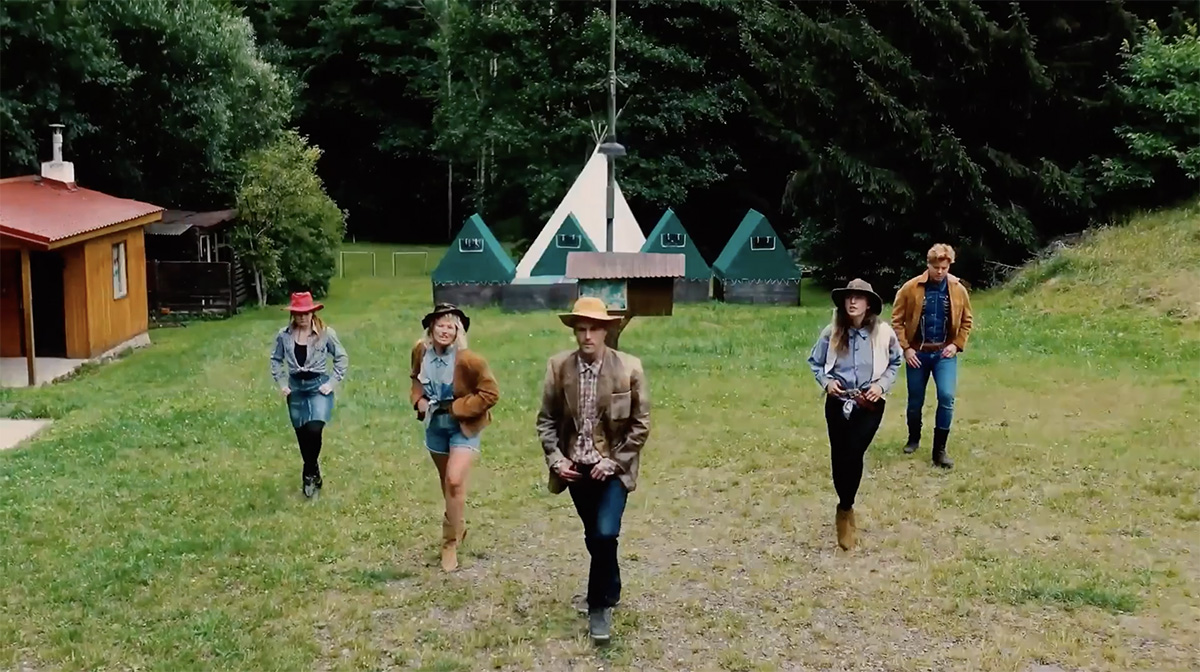
In a transhuman world inhabited by centaurs, the fates of the main characters intersect as they enter timelessness, as if they had entered a desert storm. The rural way of life mixes with bizarre elements of soap opera and acid western, weaving together a rambling and dreamlike world of uncertainty. Struggling to cope with the challenges of an ever-changing reality, the Centaurs embody a state of confusion between despair and hope. The audiovisual work WILD WILD BEAST operates with the situational material of the theatre group D'Epog. It is a reconstruction and recontextualization of all the unused scores that the theatre group D'Epog has been developing for a long time.
Marie Šprincl is a director, editor and visual artist. She has over 10 years of experience in creating music videos, showreels, films and other audiovisual outputs. She has worked on films that have been shown at Czech and international film festivals.

Alcaeus Spyrou
Anina
Video | hdv | color | 19:51 | Greece, United Kingdom | 2017
A container ship is not an inanimate object. The ship that travels thousands of miles on the high seas is full of life, stories, tragedy and hope. The harbours reached, the industrial landscape one encounters, the cargo that floats in an endless ocean. Anina is a psycho-geographic film-essay, documenting the ethnographic tendencies of the industrial landscape and its malevolent stature over the individual. The shipping industry’s ever-shifting landscape, affecting even this interaction you are having with this text, crafts its own mythology.
Alcaeus Spyrou (b.1991, Elbasan, Albania) is a visual artist working with the cinematic image. He was born on the day the fall of the Hoxha dictatorship in Albania. The conflict that ensued, forced his family to seek refuge in Athens, Greece. The frequent displacement and oscillation between the two topographies, would focus Alcaeus’s gaze towards the shifting landscape of migration. In his practice, Alcaeus utilizes a psychoanalytical scope on cinema to deconstruct the inter-dependent nature of the medium. Through this process, he searches for new dialects of the cinematic language. By combining the two antithetical genres of fiction and non-fiction he establishes connections with the alienated environment. He informs the mythologies of contemporary migration that reveal collective trauma as the substance of our intricate relations to the other.