Catalogue > Search
Results for : Tout le catalogue

Antoine Sement
Sleep
Animation | | color | 1:0 | France | 2005
??Sleep?? makes reference to the eponymous video by Andy Warhol. Playing the role of John Giomo, I live my sleep as a refuge good for inaction. So forth, I avoid physical constraints and the productivity logics of the current world. The irruption of the tutelary figure of Warhol won?t last to break this quiet alienation, shaking me and asking me to wake up and work (?Wake up, it?s time to work and be famous?). By reflection game, a forgotten Art History sneaks in the repetitive logic by a linear conception of progress. The cylindrical specificity of the video could also foreshadow the dreamed back of welfare intercity unrelenting between repression and regression in a nightmare like atmosphere.
Born in 1979 in Versailles. After having an education in literature, option in plastic arts in high school, I integrated the Ecole des Beaux Arts of Rouen where I obtained my Diplôme National Superieur d?Expression Plastique this year. The work I developed uses drawing and video animation to illustrate the theme of doubt and difficulty to create. Making grotesque games with the art history, I give a free hand to interpretations of my incertitude and inhibitions. When I left the Beaux Arts, I took part in the exhibition ?Sommeil? a the Chapelle du Genêteil in Château-Gontier.

Semiconductor, Jarman + Gerhardt
200 Nanowebbers
Experimental video | dv | color | 2:49 | United Kingdom | 2005
For ?200 Nanowebbers?, Semiconductor have created a molecular web that is generated by Double Adaptor?s actual music. Via custom-made scripts, the melodies and rhythms spawn a nano scale environment that shifts and contorts to the resonance; revealing glimpses of tiny developing and interacting particles. As the layers of sound build and self destruct, the web constructs more complex elements that warp with the music?s pace and energy.
Semiconductor make Sound Films which reveal our physical world in flux; cities in motion, shifting landscapes and systems in chaos. Since 1999 UK artists Ruth Jarman and Joseph Gerhardt have been exploring many processes of digital animation to produce experimental films and live animation. Central to these works is the role of sound, which becomes synonymous with the image, as it creates, controls and deciphers it; exploring resonance, through the natural order of things. Finely crafted digital work is combined with analogue processes that tailor the randomness and errors within computer systems as co-conspirator. These works are exhibited in galleries, festivals, cinemas and biennials worldwide; in addition they are presented as surround sound installations. Recent exhibitions include; Venice Biennale; EMAF Germany, Lyon Museum of Modern Art; France and Inhabituel; Milan. Semiconductors latest contribution to the genre of live cinema is their dedicated live performance software Sonic Inc; a real-time 3D sculpting tool, where creations are realised by specific sound inputs and user interaction, producing dynamic audio created, and controlled environments on the fly. Recent performances include: Transmediale; Berlin, Tate Britain; London and Images Festival; Toronto. Currently, they are based at the Space Science Laboratories at UC Berkeley making research for future art work.
Marinella Senatore
how do u kill the chemist
Video | dv | color and b&w | 8:10 | USA | 2009
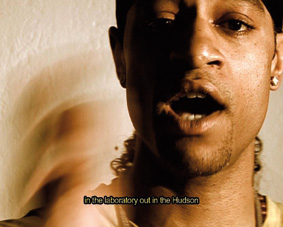
In 1957, Bassil killed the quemist Adrian Ghole in his laboratory, in Hudson city (NY). He prepared his plane with care, calculating every details: came to the Gole?s laboratory, kill him with chloroform, break the glass of his watch at 6:49, take the improtant formula of the quemist, run away with his car and get down into the river; the erosion activity of the water could cancel every elments could be associate with him. Everything runs perfect and Bassil was convenced that in the World just 1 person on a million was like him but he didn?t calculate than when pass on the bridge, a police, crow, firecrackers and applauses waiting for him: he was the million car who pass the bridge and he wins 1 million of dollars The day after his photos will appared on the news pape? the murderer in the murdered?s car.. just few hours later, Ghole?s car get down into the bridge? but Bassil was inside.
Marinella Senatore is a teacher, film director and director of photography and has been also working with drawing, painting and installation. Her first steps towards the visual arts came after a degree at Rome`s Centre for Experimental Cinematography. The films of the artist from Campania always present a thorough study and arrangement of lights on the set, which also become the source for sculptural installations (Memeland) and photographic series (Places). The characters of the stories told by Senatore embody nuances of her private life on which dreaming landscapes are inserted. Lately the artist has chosen to work on sets with non professional actors and technicians, and to embrace the richness and the generosity of ordinary people. Sets have become accessible place for everyone, whose mechanisms are consciously unveiled in the filmic production (for instance in Manuale per i Viaggiatori, 2007). The `behind the scenes` are included as a major part of the script, while corality and the idea of a laboratorium are at the core of a research that is not afraid to questions the world through the people inhabiting it. Marinella Senatore chooses to tell stories and by doing so in keeping alive and valuing both individual and collective memory.

Noe Sendas
Lady Macbeth
Experimental video | dv | color | 7:0 | Portugal | 2003
NOÉ SENDAS Lady Macbeth Written by Joao Pinharanda Noé Sendas, in his video, quotes the Shakespearean characters of Macbeth and his wife. Using an obsessive photographic self-representation, the artist brings us face to face with the limits of visibility and representation, with the limits of the ethical and political existence of Man. In the visual montage the face, in forced expressions of pain and fear, is often duplicated by mirrors (that function as water mirrors) and sends (it/us) back an image from which we cannot free ourselves. Moments of darkness and of intense video flashes follow at a random pace, independent of the continuous sonority established by the stage dialogues of the theatre piece. In these, Noé Sendas mixes the lines from the two cinema versions of Macbeth: by Orson Welles and by Polanski. The sea is heard, the distressing cries of the sea-birds and the dialogue of the characters on the brink of breakdown. Lady Macbeth tries unsuccessfully to wash off the blood they were stained with following the succession of murders on which their Power was based. Metaphor becomes reality.
Noé Sendas (Brussels, 1972) studied at Ar.Co, in Lisbon, his education also involve periods of study at foreign schools, like the Royal College of Arts, in London and the school of the Art Institute of Chicago, as well as residencies (particular note should be given to the one in the Kunstlerhaus Bethanien). Halfway through the nineties he began presenting his work, and the last two years have witnessed the blossoming of his career. His participation in several exhibitions, especially in En garde! Porto 2002-03), a solo exhibition with an anthological matrix that allowed an understanding of the artists trajectory and realized a personal inclination previously only indicated. Sendas resorts to different means of expression: video, sculpture, sound, drawing and sound. Explicit and implicit references to artists and literary, cinematic, or musical creations are part of his raw materials. Quotes from Shakespeare and Beckett are present, for example, as well as different movie directors-Godard among them-and Coltrane. Specific concerns about the reflection and practice of visual arts can also be added to his repertoire. These include: the body, as an entity that is simultaneously theoretical and material; the observer?s perception mechanisms; or the discursive potential of exhibition methods. Sendas?s creative process is rooted in an intellectual device based on an association of materials of different origins. However, the subjacent logic isn?t merely one of appropriation, but the definition of a new authorship. This methodology shares elective affinities with strategies employed by DJs and with a common instrument in current pop music, the sampler, since it configures an appropriation of themes that will be used to construct new sounds rather than an eventual collage.

Noe Sendas, X
THE INDIFFERENT
Experimental video | dv | color and b&w | 12:34 | Portugal | 2008
This video work is a re-edition of very short fragments taken from several films, based on a simple apprehension: the time for the deepest emotion is often not coincident with its related event. A man walks in a street goes into a building, runs away through onto the main street, and stops in a garden square, just to go back to the same street and making his actions a perfect loop. The usage of color and black & White film allows to differentiate between what is ?real? and what are projections/dreams/ghosts.
NOÉ SENDAS (1972) Short Biography Noé Sendas (born in Brussels, 1972, lives and works in Berlin) began presenting his work halfway through the nineties. His participation in several exhibitions, especially in ?En Garde!? (Culturgest, Porto 2002-03), Sendas resorts to different means of expression: video, sculpture, sound, drawing and sound. Explicit and implicit references to artists and literary, cinematic, or musical creations are part of his raw materials. Quotes from Shakespeare and Beckett are present, for example, as well as different movie director?s -Godard among them- and Coltrane. Specific concerns about the reflection and practice of visual arts can also be added to his repertoire. These include: the body, as an entity that is simultaneously theoretical and material; the observer?s perception mechanisms; or the discursive potential of exhibition methods. Selected Solo Exhibitions: 2008 ?The Hunter? Cristina Guerra Contemporary art, Lisbon; 2007 ?The Collector?, EDP Foundation, Lisbon; 2006 ?Private Eye?, Invaliden I, Berlin; 2005 ?Neither?, Barbara Blickensdorff Gallery, Berlin; 2004 ?Lady Macbeth?, Project Room ARCO, Madrid; 2003 ?Ophelia?, CAV-Visual Art Centre, Coimbra Pt; 2002 ?En Garde!? Culturgest Oporto, Pt; 2001 ?Noé Sendas?, Haagsmeent Museum, Hague; 2000 ?Noé Sendas 1999-2000? Kunstlerhaus Bethanien, Berlin; 1999 ?Continuous Session? CAM-Calouste Gulbenkian Foundation, Lisbon Selected Group Exhibitions: 2008 ?Difference what difference?? Art Forum, Berlin; 2007 ?Iberoamertica?, Casa America, Madrid; 2006 ?En Voyage?, Le Plateau, Paris; 2005 ?Del Zero al 2005 Perspectivas del arte en Portugal? Marcelino Botin Foundation, Santander, Spain; ?Portugal: Algumas Figuras?, Alameda Art Laboratory (LAA), Mexico City. 2003 ?Outras Alternativas: Nuevas Experiencias Visuais en Portugal?, MARCO, Museu de Arte Contemporãnea de Vigo; 2002 ?Arte Portugués: Argumentos de Futuro?, MEIAC Collection, ICO Foundation, Madrid; 2001 ?Situation Zero?, Yerba Buena Center, S. Francisco; 2000 ?The Mnemosyne Project? Encontros de Fotografia 2000, Coimbra, Portugal; Tage Der Dunkelheit und Des Lichts Kunst Museum Bonn, Bonn, Germany; 1998 Ein Leuchtturm ist ein trauriger und glucklicher Ort , Akademie der kunst, Berlin

Noe Sendas
Take Off
Experimental video | dv | color | 4:2 | Portugal | 2005
The starting point of this work is the battle between a fictional character's visions and fears versus memories in a plane during take off. It combines a collection of photographs and original footage of a plane crash with a re-filmed and re-edited fragment of the last sequence of Michael Powell's Peeping Tom. The Metaphors of Fear Written by Nuno Crespo We might take refugee in an image when we feel we are in danger, giving it the power to minimize the pain, to soften our imagination, this is something that has always been known: the old catharses concept can prove it. Certain objects that have this quality become talismans and have the power to untie internal knots: the ones felt in one's chest or in one's heart - we might call these internal knots fear, anguish, or strange feelings that one does not know how to deal with but wants to untie and dominate. It's the fear of being in a plane, of its unexpected metallic and roaring noises, to be in it, in the sky, something not so appropriated for an earthly body to whom the earth is its natural habitat. With the take off the fall becomes present, the fall into an unknown land where only destiny with its mysterious and invisible powers is able to determine and to anticipate. To crystallize these fears and anguishes into an image belongs to the field of the arts, and results in the construction of meaning to which we can tribute certain evidences, or if we prefer, illuminations: as a result, to become aware of one's fear can become a deeper understanding of one's own intimacy. Fear presents itself as an aesthetic category - to find its mirror image will always be an incomplete task: no image can correspond to it entirely; it is always a mediation trial, being more precise, a domestication tryout. The strategy of not overrunning fear, but to go along living with it, is the artist's task. What makes Noé Sendas keep working is the dynamic and always incomplete process, the not knowing when and if the roaring motor of the plane stops, to give form to the suspicion that something might happen.
Noé Sendas was born in Brussels in 1972 and studied at Ar.Co, in Lisbon. His education also involves periods of study at foreign schools such as the Royal College of Arts, in London, and the school of the Art Institute of Chicago, as well as residencies, particular note given to the one in the Kunstlerhaus Bethanien. Halfway through the nineties he began presenting his work, and the last two years have witnessed the blossoming of his career. He has participated in several exhibitions, a notable one being En Garde!, Porto 2002-03, a solo exhibition with an anthological matrix that allowed an understanding of the artist's trajectory and realized a personal inclination previously only indicated. Sendas uses various means of expression, including video, sculpture, sound, drawing, and sound. Explicit and implicit references to artists and literary, and cinematic or musical creations are part of his raw materials. He employs quotes from Shakespeare and Beckett as well as from different movie directors, Godard and Coltrane among them. Specific concerns about the reflection and practice of visual arts can also be added to his repertoire. These include: the body, as an entity that is simultaneously theoretical and material; the observer's perception mechanisms; or the discursive potential of exhibition methods. Sendas's creative process is rooted in an intellectual device based on an association of materials of different origins. However, the subjacent logic isn't merely one of appropriation, but the definition of a new authorship. This methodology shares elective affinities with strategies employed by DJs and with a common instrument in current pop music, the sampler, since it configures an appropriation of themes that will be used to construct new sounds rather than an eventual collage.

Leniko Sennoma
Augen Ohne Blick
Experimental film | mov | color | 81:3 | Germany | 2025
Eyes Without Gaze is an experimental film that challenges conventional storytelling, inspired by Chantal Akerman’s focus on atmosphere and space over direct action. Blending animation, 16mm, poetry, video art, video clips, and digital formats, it constructs a fragmented, dreamlike narrative. The film explores life under patriarchal capitalism, folklore, and symbolism, while depicting sexual violence without retraumatization, presenting survivors as autonomous individuals seeking justice. At its center is Maria, a Greek immigrant navigating financial hardship, desire, and a search for justice. Inspired by “Vasilisa the Beautiful,” her journey toward a mysterious needle leads her to confront a man from her past and a fateful choice.
Leniko Sennoma is a Berlin-based film and installation artist whose work challenges the boundaries between reality and dream. Their art focuses on themes such as social justice, intersectional feminism, and the dismantling of systemic oppression. They combine techniques of lucid dreaming and archetypical symbolism to question the status quo of neoliberal information society. Their art is an ongoing search for possibilities of collective liberation, the dismantling of systemic oppression, and the creation of political collaboration. By developing an audiovisual-metaphorical language that works with the synchresis of image, sound, and material aesthetics, they create hypnotic environments that appear simultaneously gentle and eerie. Influenced by their studies in epistemology, theoretical, feministic, analytical philosophy and film theory, their works play with the consciousness of the viewer, generating a broad spectrum of associations, emotions and contrasts. Sennoma’s video-/installations and short films have been shown in numerous galleries, museums and festivals across continents, including Zilberman Gallery Berlin Germany, Gallery 062 Chicago USA, Gallery SA-KURA Nagoya Japan, Inflamável Film Festival Santa Caterina Brazil and Internationale Kurzfilmtage Oberhausen, Germany.

Shireen Seno
To Pick a Flower
Experimental doc. | hdv | color and b&w | 16:57 | Philippines | 2021
My mother used to tell me that our dining table was as old as I am. I wonder how old the tree was when it was cut down to be turned into our table. I am fascinated in this kind of transmutation from the natural world to the human one, and how a tree takes on new lives long after it has been cut down. This video essay incorporates archival photographs from the American Colonial Era in the Philippines (1898–1946), exploring the sticky relationship between humans and nature and their entanglements with empire. Taking plants and trees as starting points, it aims to reflect on the intertwined roots of photography and capitalism in the Philippines.
Shireen Seno is an artist and filmmaker based in Manila whose work addresses memory, history, and image-making, often in relation to the idea of home. A recipient of the 2018 Thirteen Artists Award from the Cultural Center of the Philippines, she is known for her films which have won awards at Rotterdam, Shanghai, Olhar de Cinema, Vladivostok, Jogja-Netpac, and Lima Independiente and have screened at festivals including New Directors/New Films, Yebisu International Festival of Art & Alternative Visions, NYFF Currents, and institutions such as Tate Modern, UCCA Center for Contemporary Art, NTU Center for Contemporary Art Singapore, National Museum of Modern and Contemporary Art, Korea, and Portikus.

Shireen Seno
A Child Dies, a Child Plays, a Woman is Born, a Woman Dies, a Bird Arrives, a Bird Flies Off
Video | hdv | color | 4:46 | Philippines | 2018
"A child dies, a child plays, a woman is born, a woman dies, a bird arrives, a bird flies off", is a voyeuristic glimpse of both local birds and migratory ones that make the Philippine marshlands their home for a time.
Shireen Seno is a lens-based artist whose work addresses memory, history, and image-making, often in relation to the idea of home. She was born to a Filipino family in Japan, where she spent most of her childhood. She has had two solo exhibitions and is a 2018 recipient of the 13 Artists Award from the Cultural Center of the Philippines. Her photo zine Trunks, produced while in residency at Objectifs Centre for Photography and Filmmaking, has been exhibited widely. She started out in film shooting stills for Lav Diaz before going on to direct her debut feature, Big Boy (2012), shot entirely on Super 8. It premiered at Rotterdam and won Best First Film at the Festival de Cine Lima Independiente. Her second film, Nervous Translation (2018), is about a girl who finds out about a pen that can translate the thoughts and feelings of nervous people. It premiered in Hivos Tiger Competition in Rotterdam and won the NETPAC Award for Best Asian Film. Other awards include: Critics’ Prize at Olhar de Cinema - Curitiba International Film Festival, Asian New Talent Award for Best Script Writer at Shanghai International Film Festival, Jury Special Mention at Pacific Meridian International Film Festival of Asia-Pacific Countries in Vladivostok, and Silver Hanoman at Jogja-Netpac Asian Film Festival. It also screened at MoMA as part of New Directors/New Films, Tate Modern as part of their Artists’ Cinema program, and at the Tokyo Photographic Art Museum for Yebisu International Festival for Art & Alternative Visions.

Anne Katrine Senstad
The Locker Plant Projections
Experimental video | hdv | color | 8:21 | Norway, USA | 2011
The Locker Plant Projections is part of a site specific projection video series of my video-installation piece Colour Kinesthesia. The Projections of the abstract colors and the act of projecting in itself become the vehicle for the merging of colors with the environment and that existential and poetic narrative of enlightening our surroundings. In this piece the known Donald Judd building in Marfa, TX - The Locker Plant, is subject to the projections, as well as the South Western Texas Railroad and local trees. In merging the movement of colors with an archetypal architectural form, passing people and natural life activity during the night, we experience an added level to the notion of spatial relations, time and volume. The music of J G Thirlwell, known from Foetus, Manoriexia and Wiseblood - creates a cinematic mood to the minimalist references. The Locker Plant is a former butcher and meat packing plant, one of a group of buildings Donald Judd acquired in Marfa, TX - it is now part of The Chinati foundation.
Anne Katrine Senstad is a multidisciplinary Norwegian artist who lives and works in New York. She works with light, installation, photography, video, site specific and land art. She was educated at Parsons School of Design and The New School for Social Research in New York. She is currently working with the internationally renowned architecture firm Snøhetta, where she has been awarded the public art commission for their first completed U.S. building ? a performing arts center in Bowling Green, Ohio, The Wolfe Center for the Arts at BGSU. Senstad will be creating a monumental mural consisting of 39 photographic, aluminum and Plexiglas panels extending over 28 feet high and 86 feet long (8 x 28 meters). The monumental mural piece entitled The Eternal is scheduled to officially open December 2011. She has exhibited widely internationally at Zendai Moma in Shanghai, ThisisNotAgallery in Buenos Aires, Utsikten Kunstsenter and Stiftelsen 3,14 in Norway, Bjorn Ressle Gallery, Gallery Nine5 and Elga Wimmer Gallery in NY, Pink Gallery in Seuol and KK Projects in New Orleans amongst others. Her work is represented in Gallery, Institutions, corporate and private collections.
Kevin Sepp
GOODBYE REGINA
Experimental doc. | 16mm | color | 8:48 | Germany | 2025
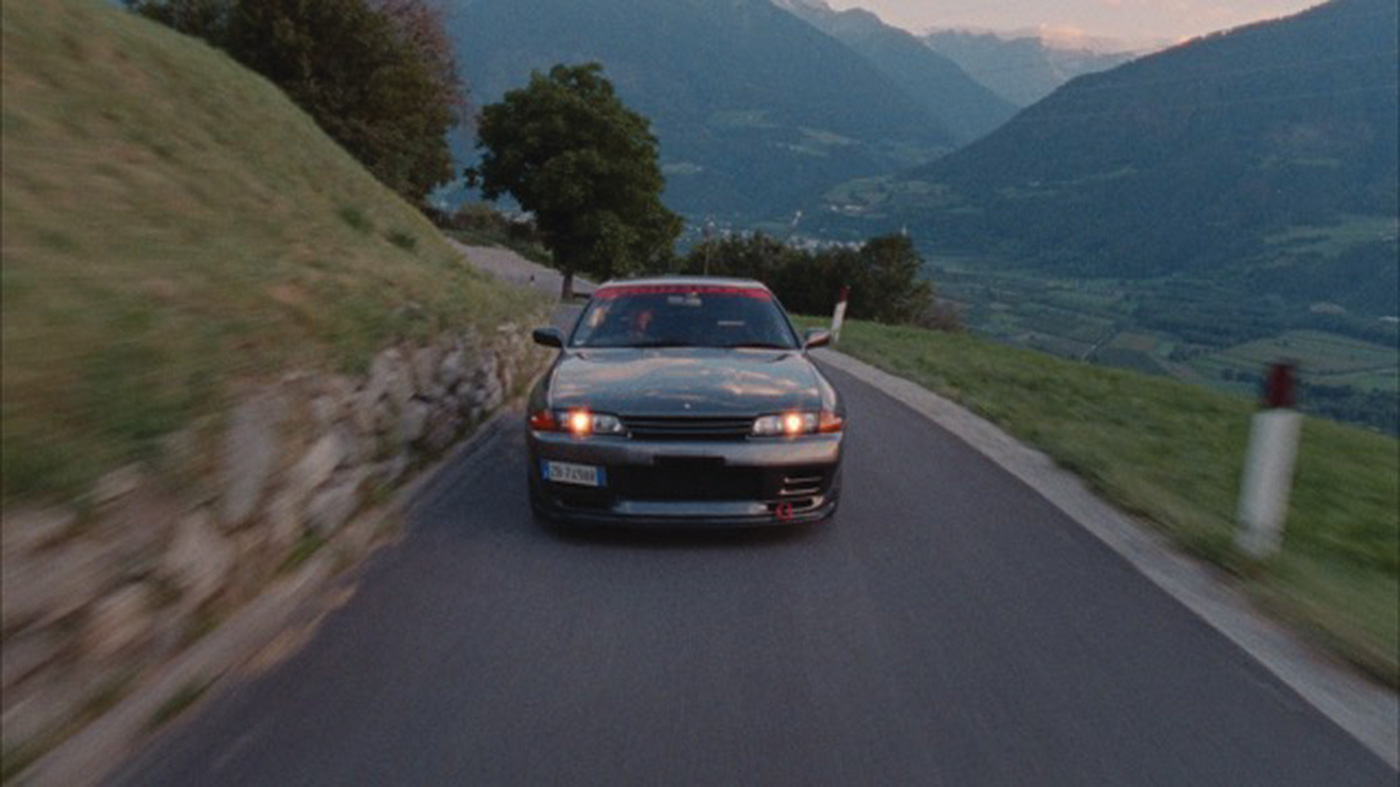
The Italian Alpine region of South Tyrol is not known for its tuning scene, but it does exist. A small group of young men have found each other to express their love of their home in their own way. Their Japanese sports cars glide oddly through historic villages, along the Alpine slopes and through breathtaking nature. GOODBYE REGINA is a farewell letter from the director to his grandmother, who grew up in these mountains. It explores the connection between the old and the new, without juxtaposing the two. In a landscape where seemingly nothing changes, the machines seem to be part of the creatures that emerge from this nature. The result is some kind of nature documentary, a collection of impressions away from the tourist postcard images.
Kevin Sepp is a director and editor based in Berlin. Coming from a humanities background, he is a self-taught filmmaker whose interest in short, visually rich storytelling led him to work in commercial film. Alongside commissioned projects, he continues to explore new possibilities through independent work. Collaborations with musicians and other artists strongly influence his sense of sound on screen and shape the atmosphere of his work. His films have been featured at festivals such as the Berlin Commercial and Berlin Music Video Awards, as well as on platforms like Directors’ Library, Sleek Magazine and Crack Magazine.

Katia Sepulveda
Songwashing
Video | hdv | color | 5:0 | Germany | 2018

Stratos Serafeimidis
a short film about an egg
Fiction | mp4 | color | 5:44 | Greece | 2022
The film is about the director's attempt to stage a play, a series of unexpected events has inexplicable results for the actors. At the same time, the egg is constantly lurking between the directors and the actors.
Stratos Serafimidis(1997) was born and live in Drama,Greece.He studied at the Department of Visual Arts and Art Sciences of the School of Fine Arts University of Ioannina. He has participated in group exhibitions and in various research projects.Currently, he is studying in M.A in Digital Arts at Athens School of Fine Arts.He lives and works in Athens,Greece.

Gleb Sereda
Kros
Experimental film | 0 | color | 52:0 | Russia | 2023
This is a metaphorical story about two young skaters who are trying to make sense of themselves in the world.

Marta Serna
BLACK WINGS
Animation | dv | color | 2:7 | Spain | 2010
BLACK WINGS Black Wings is the third video that complete ?Power Trilogy?. The main theme is the transference to the character of the spiritual and magic nature that bestows on it special powers, focussing on mental and crerative facets. Story tells about a black crow flying over the sky. Down on earth, a little girl is waiting for him. The bird goes down to alighted on her arm. Between them exist a secret language. The girl turns her body and gives back to spectator. We don?t know what?s happend, but suddenly she is very convulsioned and begans to grow a smooth down on her shoulder blade. In a few seconds, she has a new couple of sparkling black wings.She is ready to take off? Black Wings is connected to one of the most ancient wishes of human been: Possibility of fly. The black crow is the driver of the transference. The bird gives her the opcion to explore the world of the ideas, dreams, fantasy, illusions?..the stranger world of imagination and creativity.
Biographical note Marta Serna. Visual artist. Graduated from Complutense University of Madrid (1993) with a degree in Fine Arts, majoring in Painting. She also studied Classical Dance at the Royal College of London, Spanish Dance at the Royal Conservatory of Córdoba and Oriental Dance. She has created stage sets for films, theatre and television, and has taken part with diferent dance companys In worshops and performances, including Contemporary Stage. As a visual artist she is concentrated on illustration, traditional animation video, mural Installations in vinyl and plastics sculptures . She has shown her work in Spain, U.K, Mexico and USA. Now she is currently working with Espacio Marzana Gallery in Bilbao, Spain. Serna?s latest solo exhibition are ? Winter Tale? Espacio Frágil, Madrid., ?Black Sparkle?, Espacio Marzana, Bilbao and ?Black Wings?, Domus Artium, Salmanca, all in Spain (2010). ?Dark Delicate?, Cubo Azul Gallery, León (2009). ?Cruel but Fair?, Rosa Santos Gallery, Valencia and ? Blood Breath?, NO-ID Gallery, London (2008). ?Havoc Amazing Cosmic Trip?, Proyect 142, London ( 2007). And Colectives like ?Merrie Melodies?, Domus Artium, Salamanca (2010) ? ARCO 2009 Premios Creación Artística Comunidad de Madrid? ?Bloody Boots? ARCO 2008, and the visual proyect ?Bloody Little Creatures? for the goup The Cure in London.
Marta Serna
BLOODY BOOTS
Animation | dv | color | 1:10 | Spain | 2008
BLOODY BOOTS Bloody Boots is a traditional animation video and the first one about ?Power Trilogy?, whose mission is to reflect on our human, animal, artificial and spiritual nature and on the ritual of compensation we have to undertake to ensure that we adapt to our surrounding environment. The story tells about a normal pair of boots turns, by the vital and regenerator effect of blood, in autentic magic object of power. The blood that flows from earth transform the boots in protectives and magics. The ?new? boots gives the girl a big power. Now she is mentally and physically prepared to croos any territory. The blood is portrayed as the vital fluid that serves as a conduit for the realisation of the ritual and confers a special power on the object. Blood gives people a human condition and bestows an inheritance, a genetic nature. The content of the video is anchored in the earthly, working wih the human.
Biographical note Marta Serna. Visual artist. Graduated from Complutense University of Madrid (1993) with a degree in Fine Arts, majoring in Painting. She also studied Classical Dance at the Royal College of London, Spanish Dance at the Royal Conservatory of Córdoba and Oriental Dance. She has created stage sets for films, theatre and television, and has taken part with diferent dance companys In worshops and performances, including Contemporary Stage. As a visual artist she is concentrated on illustration, traditional animation video, mural Installations in vinyl and plastics sculptures . She has shown her work in Spain, U.K, Mexico and USA. Now she is currently working with Espacio Marzana Gallery in Bilbao, Spain. Serna?s latest solo exhibition are ? Winter Tale? Espacio Frágil, Madrid., ?Black Sparkle?, Espacio Marzana, Bilbao and ?Black Wings?, Domus Artium, Salmanca, all in Spain (2010). ?Dark Delicate?, Cubo Azul Gallery, León (2009). ?Cruel but Fair?, Rosa Santos Gallery, Valencia and ? Blood Breath?, NO-ID Gallery, London (2008). ?Havoc Amazing Cosmic Trip?, Proyect 142, London ( 2007). And Colectives like ?Merrie Melodies?, Domus Artium, Salamanca (2010) ? ARCO 2009 Premios Creación Artística Comunidad de Madrid? ?Bloody Boots? ARCO 2008, and the visual proyect ?Bloody Little Creatures? for the goup The Cure in London.
Marta Serna
CAT POWER
Animation | dv | color | 1:44 | Spain | 2009
CAT POWER Cat Power, the second video of ?Power Trilogy?, is the title that served as a source of inspiration for the underlying argument of the video: a girl gains the confidence of a little kitten by petting and them??eats it! In just a few seconds she gets a new projecting appendix. Cat Power refers to the recovery of wild untamed power through a ritual of appropiation. The central character appropiates the intuitive and wild part of the animal. The death of the cat is not in vain, it is necessary to recover a lost and forgotten wild nature. A mutation is produced. Both, human and animal coexist in the same body. They are no longer who they used to be and have become a new hybridised being gifted with new characteristics that make it more complete and fit for survival. The conduit in that video is the cat, whose sacrifice transmits a savage instinct and nature to the central character. This video explores the atavistic underpinnings of intuition.
Biographical note Marta Serna. Visual artist. Graduated from Complutense University of Madrid (1993) with a degree in Fine Arts, majoring in Painting. She also studied Classical Dance at the Royal College of London, Spanish Dance at the Royal Conservatory of Córdoba and Oriental Dance. She has created stage sets for films, theatre and television, and has taken part with diferent dance companys In worshops and performances, including Contemporary Stage. As a visual artist she is concentrated on illustration, traditional animation video, mural Installations in vinyl and plastics sculptures . She has shown her work in Spain, U.K, Mexico and USA. Now she is currently working with Espacio Marzana Gallery in Bilbao, Spain. Serna?s latest solo exhibition are ? Winter Tale? Espacio Frágil, Madrid., ?Black Sparkle?, Espacio Marzana, Bilbao and ?Black Wings?, Domus Artium, Salmanca, all in Spain (2010). ?Dark Delicate?, Cubo Azul Gallery, León (2009). ?Cruel but Fair?, Rosa Santos Gallery, Valencia and ? Blood Breath?, NO-ID Gallery, London (2008). ?Havoc Amazing Cosmic Trip?, Proyect 142, London ( 2007). And Colectives like ?Merrie Melodies?, Domus Artium, Salamanca (2010) ? ARCO 2009 Premios Creación Artística Comunidad de Madrid? ?Bloody Boots? ARCO 2008, and the visual proyect ?Bloody Little Creatures? for the group The Cure in London.

Marta Serna
Misty Eyes
Animation | dv | color and b&w | 1:10 | Spain | 2011
Presentation of the work and sinopsis Marta Serna?s current work is driven by her interest in the chaotic states of the mind, dreams, lethargy,myths,the boundary between reality and fiction, the subconscious adn their influence on human behaviour. In 2011, she developed the proyect ? Misty Eyes & Mourning Stones?, alluding firstly to the English expression of having the eyes blurred, as with tears, and secondly to the shiny, jet black jewels and stones used during the Victorian era, wich were primary elements in the mourners? attire between the seventeenth and nineteenth centuries. The combination of both expressions evokes the feeling of mourning and crying for oneself. The origin of the proyect is a restless interest for the chaotic state of the mind, when it feels confused and dreams with the possibility of getting rid of our internal mist. This leads to an open reflection about a mental space torn between lucidity and darkness, a lethargic state of the brain with magical, enchanted and supernatural connotations. The videos that I presented to Rencontres Internationales are part of this work. The first one, ?Misty Eyes? (2011),is a reflection about the nature of evil, whether it si produced by oneself or by our environment. The protagonist, combining human and animal characteristics, seems to be unprotected and lost, abandoned in the middle of nowhere and plunged into the immensity of the mist. When the landscape starts to become clear and the blur fades away, we can finally see that the mist comes from her mouth,plunging the forest into darkness again. She is held in her own environment and wilderness.
Marta Serna. Visual artist. Graduated from Complutense University of Madrid (1993) with a degree in Fine Arts, majoring in Painting. She also studied Classical Dance at the Royal College of London, Spanish Dance at the Royal Conservatory of Córdoba and Oriental Dance. She has created stage sets for films, theatre and television, and has taken part with diferent dance companys In worshops and performances, including Contemporary Stage. As a visual artist she is concentrated on illustration, traditional animation video, mural Installations in vinyl and plastics sculptures . . She likes drawing disfunctional caracters without scene and checking the roles of power on childhood. The mission on her work is to reflect on human, animal, spiritual and artificial natures and on the ritual of compensation we have to do to adapt ourselves to the surrounding environment. She has shown her work in Spain, U.K, France, Germany, Bulgary, Yugoslavia, Lebannon, Jordan, Algeria Mexico and USA. Now she is currently working with Asm28 Gallery in Madrid and Espacio Marzana Gallery in Bilbao, Spain. Serna?s latest solo exhibition are: ? Misty Eyes & Mourning Stones? Galeria Asm28 , Madrid ( 2011), ?Winter Tale? Espacio Frágil, Madrid . ?Black Sparkle?, Espacio Marzana, Bilbao, and ?Black Wings?, Domus Artium, Salamanca, all of them in Spain (2010). ?Dark Delicate?, Galeria Cubo Azul, León (2009) ?Blood Breath?, NO-ID Gallery, London, and ?Cruel butFair?, Galeria Rosa Santos, Valencia (2008) ?Havoc Amazing Cosmic Trip?, Proyect 142, London (2007) ?Havoc Oddity?, Galeria Cubo Azul, León. 2006) And collectives like ? The Noise of Bubbles?, Red Bull Academy, Matadero, Madrid. ?Gráfica. 30 Artists from young Spain? Cervantes Institute of Lebanonn, Jordan, Bulgary, Algiers, (2012 ). ?Rencontres Internationales?, with the video proyection ?Power Trilogy?? at Pompidou in Paris , Haus der Kulturen der Welt in Berlín and the Auditorio del Ministerio de Cultura in Madrid (2011_2010) ?Merrie Melodies?, Domus Artium, Salamanca (2010) ?Premios Creación Artistica Comunidad de Madrid?, ARCO 2009 ?Bloody Boots?, ARCO 2008, and the visual proyect ?Bloody Little Creatures? in London for the musical group The Cure. In 2008 receives the Prize of Artístical Creation for the Madrid Community for the creation of traditional video animation Cat Power.

Marta Serna
SnakeBoy
Animation | hdv | black and white | 0:34 | Spain | 2014
SnakeBoy is the first video of the serie Immaculate Dreams. It’s an animated portrait of a real person who creates a fictionalised version of himself, in what represents a journey through his own dreams. It features SnakeBoy riding a snake as a cowboy, truly enjoying being in control of the situation. Immaculate Dreams is about the possibility of turning a dark or unpleasant journey into something luminous and flawless through the exorcism of staging. The main characters will have to stage some of their dreamlike experiences in order to carry out their own “animated portrait of their dreams” and hence portraying themselves in a more intimate, personal way.
Marta Serna. Visual artist. Graduated from Complutense University of Madrid (1993) with a degree in Fine Arts, majoring in Painting. She also studied Classical Dance at the Royal College of London, Spanish Dance at the Royal Conservatory of Córdoba and Oriental Dance. She has created stage sets for films, theatre and television, and has taken part with diferent dance companys In worshops and performances, including Contemporary Stage. As a visual artist she is concentrated on drawings and illustration, traditional animation video, mural Installations in vinyl and plastics sculptures . She has shown her work in Spain, U.K, France, Germany, Bulgary, Yugoslavia, Lebannon, Jordan, Algeria Mexico and USA. Serna’s latest solo exhibition are: “SnakeBoy”Open Studio, Madrid (2014),”Abecedario para Monstruitos” Rita Castellote Gallery, Madrid(2012)” Misty Eyes & Mourning Stones” Gallery Asm28 , Madrid ( 2011), “Winter Tale” Espacio Frágil, Madrid . “Black Sparkle”, Espacio Marzana, Bilbao, and “Black Wings”, Domus Artium, Salamanca, all of them in Spain (2010). “Dark Delicate”, Galeria Cubo Azul, León (2009) “Blood Breath”, NO-ID Gallery, London, and “Cruel butFair”, Rosa Santos Gallery, Valencia (2008) “Havoc Amazing Cosmic Trip”, Proyect 142, London (2007) “Havoc Oddity”, Cubo Azul Gallery, León. 2006) and the visual proyect “Bloody Little Creatures” in London for the musical group The Cure. In 2008 receives the Prize of Artístical Creation for the Madrid Community for the creation of traditional video animation Cat Power.

Toni Serra, Ali ABU
Last night dikr
Experimental doc. | dv | color | 7:0 | Spain, Morocco | 2005
Inspired by a poem of the same name by Najmudin Kubra, a Sufi master of the XII century, "Last Night Dikr", a 'documentary of the author', shows the route of a thirsty group of men searching for water in the desert plains of Morocco. Minute after minute, image after image, this trail, full of metaphors and symbols, seems to lead us to this interior world that, according to the poet, every human being carries within himself. A man with a naked torso, with a gaping open chest, invites us to know ourselves, to understand ourselves and our desires. "Last Night Dikr" is a beacon, a compilation of documents destined to help, to steer the traveller on the path of spirituality.
Toni Serra lives in both Duar Msuar, Morocco, and Barcelone. He studied the history of art philosophy at the Universidad de Barcelona, and video and photography at the School of Visual Arts in New York. Toni Serra is the director of archives of the OVNI, l'Observatoire de la Vidéo Non Identifiée. His works question the excess of images, simulations, and the spectacular. Getting rid of uneccessary material, he reveals to the spectator what has remained dissimulated until today. Parallel to "Retroyou" by Joan Leandre, he developed "Babylon Archive", a project of archaeology media. He has compiled diverse cycles of videos, such as "Malestar a les Ciutats" and "TransArab ? Nou Vídeo Àrab", as well as the video program of MACBA 1996-97. In 2002 he received the Prix d'Arts Plastiques of the City of Barcelona for his installation "Fes Ciutat Interior", and in 2004, le Prix du Patrimoine de Catalogne for the project "Arxius" from the OVNI.

Ilan Serruya
Reunión
Documentary | mov | color | 65:0 | Spain | 2018
“Reunion” is the encounter between a father and a son. A moment marked by landscape, distance and silence. Ilan is cutting his own hair. He is getting ready to travel to Reunion Island. There lives his father, Raphael. An island is a piece of land surrounded by water on all its parts. A reunion is the act of making two or more things coincide at one point, sometimes colliding with one another. This meeting between the father and the son is distinguished by the absence of words, by everyday gestures, by different body postures, by the expression of their faces and by the few sentences that articulate an attempt to resume what seems to be an impossible dialogue. Raphael smokes on the chair, studying his son with his eyes. He is breathing hard. Among them, a camera acts as an intermediary. It observes them together and separately. It is a mediation device: it restrains the dialogue, registers the look on their faces and records the silence. The camera favors the meeting to take place. It protects them from the past and places them only in the present. We do not know the reasons that led them to this situation, nor the time that happened since they last saw each other. We only know that they are there, in Reunion. A path in the forest. Roots in the ground. Fog and cracks.
Ilan Serruya grew up between the cities of Mar del Plata (Argentina) and Seville (Spain). He studied Fine Arts (Universidad Complutense de Madrid), holds a degree in Film Editing (Instituto del Cine de Madrid) and Master LAV (Audiovisual Laboratory of Creation and Contemporary Practice). His search as a visual artist go into focusing on to autobiographical events, and his works often reveal some found domestic material. His feature film “Reunion” (2018) was selected for Input 2018 -Space for tutoring and advising film projects organized by (S8) Mostra de Cinema Periférico-. “Reunion” had its world premiere at Doclisboa (International competition) and its Spanish premiere at Seville European Film Festival (Endless Revolutions competition). The world premiere of “What is a zeide for?” (2018) was held by Filmadrid International Film Festival. His short film “The lost distance” (2016) participated in cinema screenings at Guadalajara (Mexico), Rome (Italy), Prague (Czech Republic) or festivals like Una casa: Muestra de cine documental autobiográfico (Spain).