Catalogue > Search
Results for : Tout le catalogue
Daniela Schulz
Fluxus GERD-ner
Documentary | dv | color | 3:13 | Germany | 2007
For 66year-old german video-pioneer Gerd Conradt life shows new dimensions whilst gardening like other pensioners of his age. He turns his small garden into a nourishing and flowering GERD-EN OF FLUX öeaving soil for upcoming generations of artists. The film is to understand as a homage to gerd?s 66th birthday, edited to his favorite song by Jimmy Cliff on i-Movie. His friends celebrating him in real or on reel are: Kai Hoffmann, Veit loup, Wolfgang Lorenz, Hartmut Jahn, Lutz Gregor, Kain Karawahn etc...

Jana Schulz
Home Series. Ashley Temba
Video | mp4 | color | 5:58 | Germany | 2021
In her videos, Schulz provides a candid approach to her subjects through careful camerawork, ever- oscillating between proximity and distance. These slow observations demand significant concentration on the subject matter, for instance in her 'Home Series', in which she portrays men in their apartments. Here Schulz asks strangers if they would be open to develop a relationship in which the camera functions as the main instrument of communication. By doing so, she breaks the tension of subject/object relations, race and gender. As time goes by, we see these men in their apartments pondering over their lives, while further intimacy is being developed with the artist.
Jana Schulz (*1984 in Berlin) received her MFA in 2018 from the Academy of Fine Arts Leipzig. Recent exhibitions, film screenings, residencies and prizes include Galerie Eigen+Art Leipzig (2022), KW Institute for Contemporary Art Berlin (2021), Videoart at Midnight Berlin (2021), Center for Contemporary Photography Melbourne (2020), Kunsthalle Bremerhaven (2020), Eigen+Art Lab Berlin (2020), Rencontres Internationales Paris/Berlin (2020), Anca Poterasu Gallery Bucharest (2019), Galerie Eigen+Art Leipzig (2019), Kunsthalle Wien (2018), Museum der Bildenden Künste Leipzig (2018), BPA// Berlin Program for Artists (2020 – 2021), International Studio & Curatorial Program New York (2019), Marion Ermer Preis (2018) and Villa Aurora grant (2018) awarded by Studienstiftung des deutschen Volkes.

Jana Schulz
Golden Boys (Igdir, Maravilla, Monterey Park)
Video | hdv | color | 17:33 | Germany | 2018
Der Titel Golden Boys leitet sich von den Golden Boy Promotions in Los Angeles ab. Sie nehmen junge Boxer unter Vertrag und organisieren monatlichen Kämpfe in der Stadt. Mit Golden Boys assoziiere ich eine Band, eine Gang oder eine andere Männergemeinschaft. Ich sehe das Boxen als eine Art Gemeinschaftsritual, junge Männer trainieren in kleinen Gruppen und sind als Sparringpartner körperlich eng verbunden. Mich interessiert ihr Zusammenschluss als eine Abgrenzung von ihrer Umgebung und als Eintritt in eine eigene Gegenwelt. Der Soziologe Loic Wacquant schreibt in seinem Buch Leben für den Ring. Boxen im amerikanischen Ghetto, dass die Sporthalle einer Entbanalisierung des Alltags gleicht. Mittels Trainingsroutine und Körpermodellierung bietet sie Zugang zu einer anderen Welt, in der sich Abenteuer, männliche Ehre und Prestige mischen. Gleichzeitig ist das Boxen eine der einsamsten und individuellsten Sportarten. Jeder steht allein im Ring, in minimaler Bekleidung. Der Körper ist das Kapital des Boxers, er wird eingesetzt im Kampf und unterliegt dabei einem hohen Verletzungsrisiko. Es ist eine Aufführung des Körperlichen auf erhöhter Bühne, umringt von Zuschauern. Hierin spiegelt sich die Sehnsucht wahrgenommen zu werden und der Wunsch, unsterblich zu sein. Boxen ist ein Kampf um Anerkennung. Wenn du ins Profigeschäft einsteigen willst, musst du es dorthin schaffen. In den USA, da bist du als Boxer noch wer, erzählt mir ein Protagonist aus Golden Boys Igdir. In dem Video begleite ich eine Gruppe junger Boxer aus Berlin zu Vergleichskämpfen in die Türkei. Die ersten beiden Szenen zeigen Alen Rahimic bei der Rasur, die ein Ritual vor jedem Amateurkampf ist. Den Amateurboxern ist es versagt mit Bart in den Ring zu steigen, weil er eine Verletzung im Gesicht verdecken kann. Im weiteren Verlauf sieht man die Jugendlichen bei ihren nächtlichen Treffen in der Hotellobby, die zu dieser späten Stunde von einem halb öffentlichen zu einem privaten Ort und somit zu einem Freiraum für die Gruppe wird. In Golden Boys Maravilla beobachte ich Andre Perez, Martin Urias und Raymond Otanes wie sie mal für mal eine steil ansteigende Straße in East Los Angeles hinauf rennen. Das road work ist Teil des Trainingsprogramms kurz vor ihrem Kampf in Mexiko. Am Ende der Straße steht – unscharf – eine Gruppe Männer, die an eine Gang denken lässt, die mit ihrer Präsenz das Viertel markiert und die Jüngeren vor äußeren Einflüssen abschirmt. Es sind die Trainer und Väter, die einer Kontrollinstanz gleich, ihre Zöglinge überwachen und hüten.We wanna keep them off the streets. Das Boxen soll ihre Söhne von der Straße fern halten. Gleichzeitig machen sie sich die Straße auf eine andere Weise zu eigen. Sie ist ihr Trainingsfeld. In Golden Boys Monterey Park ist Rico Ramos, ehemaliger Weltmeister im Bantamgewicht, einziger Protagonist. Er befindet sich in einer ‚gewohnten Ausnahmesituation‘, hat seine Wohnung und sein soziales Umfeld verlassen und lebt bei seinem Coach im Trainingscamp. In dieser letzten Phase vor dem Kampf wird sein Körper zur Rüstung und Waffe geformt. Mich interessiert der Moment der Isolation. Ramos sitzt wochenlang alleine vor dem Fernseher zwischen den drei täglichen Trainingseinheiten im Gym. Hier beobachte ich die Bewegungen des Körpers, Gestik und Mimik. Auf der Tonebene sind Stimmen und Musik aus dem Fernseher zu vernehmen. Es sind Fragmente, die eine Soundcollage ergeben, die zwischen Realität und Künstlichkeit changiert, ähnlich dem Körper im Raum, der sich in dem bunt aufflackernden Fernsehlicht bewegt. Das Boxen zeige ich in dem dreiteiligen Video nie explizit, vielmehr schwebt es wie ein Versprechen über den Köpfen der Protagonisten und ist verbindendes Element.
Jana Schulz (*1984 in Berlin) lebt und arbeitet in Berlin und Leipzig. 2018 schloss sie ihr Meisterschülerstudium bei Prof. Tina Bara an der Hochschule für Grafik und Buchkunst Leipzig ab. 2020 ist sie Teilnehmerin des Berlin Program for Artists, 2019 war sie mit einem Stipendium der Kulturstiftung des Freistaates Sachsen am International Studio & Curatorial Program in New York. 2018 erhielt sie das Villa Aurora Stipendium der Studienstiftung des deutschen Volkes und den Marion Ermer Preis. Schulz‘ Arbeiten wurden unter anderem im Eigen+Art Lab Berlin, bei Eigen+Art Leipzig, in der Anna Poterasu Gallery Bukarest, in der Kunsthalle Wien, im Museum der Bildenden Künste Leipzig und im Kunstquartier Bethanien Berlin gezeigt. Kommende Ausstellungen sind im Center for Photography Melbourne und im Kunstverein Bremerhaven. In ihren medienübergreifenden Arbeiten setzt sie sich mit Formen zwischenmenschlicher Kommunikation auseinander. In einer prozessualen Arbeitsweise beobachtet sie Strukturen und Dynamiken innerhalb sozialer Gruppen, reinszeniert einzelne Szenen und erweitert ihren dokumentarischen Ansatz um fiktive Elemente.

Ani Schulze
Merchants Freely Enter
Experimental video | 4k | color | 12:5 | Germany | 2017
The video Merchants Freely Enter explores new technologies to capture images and their impact on sight, representation and control on western landscape and nature. The picture and sound collage navigates through a world of an arcane imagination (costumes and masks), archaic appropriation (agriculture) and digital empowerment (drone mounted cameras). Similar to a visual archaeology of the future- the film calibrates the sight into an ongoing interplay between attraction and rejection.
Ani Schulze’s work has been shown in various screening programs, solo and group exhibitions, notably at Kölnischer Kunstverein, Cologne; Kunsthalle Schirn, Frankfurt; Oberhausen Short Film Festival; Galerie Nagel Draxler, Cologne; Extra City Kunsthal, Antwerpen; CEAAC, Strasbourg; Kunsthalle Darmstadt; Kunstverein Braunschweig; MMK- Museum für Moderne Kunst, Frankfurt and Museum für Neue Kunst, Freiburg. She received grants and residency opportunities by following institutions: Schloss Ringenberg, Kunststiftung NRW, Sitterwerk Sankt Gallen, RAVI Liège, AIR Antwerpen, MFJKS NRW, CEAAC- Centre Européen d`Actions Artistiques Contemporaines, Fondazione Bevilaqua La Masa. She received the innogy VISIT award to realize the project ‘Ancient Circuits’ in 2019.
Alex Schuurbiers
Placeholder
Experimental film | super8 | color and b&w | 7:46 | Netherlands, Belgium | 2025
Placeholder is an attempt at holding it together in the face of absence; of a mother, of a memory, of something tangible. Hands holding rocks, hands gripping other hands. Images oscillate between dreams and recollection, distorted and transformed over time.
Alex Schuurbiers (she/her) is an artist from the Netherlands living and working in Belgium. Her practice focuses on the texture of analogue film as an active contributor to her storytelling: embedded in the past like a memory and tangible in the present like emotion. She is also the founding member of Ursula, a collective of women working with the moving image.
Alex Schuurbiers
Song of Homecoming
Experimental doc. | super8 | color | 15:37 | Netherlands, Belgium | 2023
Filmmaker Alex Schuurbiers became captivated by a small house on a French island, a mystical place hidden between the incessant force of wind and waves. In the experimental documentary Song Of Homecoming, she talks to the house and its inhabitant in an attempt to find kinship and connection.
Alex Schuurbiers (she/her) is a photographer and filmmaker from the Netherlands living and working in Antwerp, Belgium. After years of writing short stories and shooting portraits, she started combining text with moving images for the short film En Vagues, which premiered at Courtisane, Gent in 2023. Inspired by the work of Jean Epstein, it was shot on 8mm on Ouessant, a small rocky island off the coast of Brittany. She created the miniature Handwerk at LABOBXL filmed on a Bolex, hand-developed and edited on a Steenbeck, after which she fell even more in love with the medium. In early 2023 she finished Where I lay my head to rest, a personal cine-essay about modern day femininity and close collaboration with cinematographer Ans Mertens. Song of Homecoming is her first foray into more documentary-based experimental filmmaking. She is also the founding member of Ursula, a collective of women working with the moving image based in Antwerp.

Remco Schuurbiers
The enchanted Sea
Experimental video | dv | color | 3:0 | Netherlands, Germany | 2005
Remco Schuurbiers est originaire des Pays-Bas, il vit et travaille actuellement à Berlin. Son travail se situe aux confins de la vidéo et de l'audio numérique, créant ainsi des compositions, installations et performances abstraites. Il travaille souvent sur des projets en collaboration avec des artistes de la scène électronique et produit des performances audiovisuelles, compositions ou improvisations. Par ailleurs, il travaille en tant que photographe, et co-organisateur du 'Club Transmediale' et de 'The art of pingpongcountry'. Depuis peu, il travaille en collaboration avec le compositeur hollandais Huib Emmer sous le pseudonyme 'Datenreport' et également avec Radboud Mens pour l'?uvre "Pulse".
Remco Schuurbiers, Radboud MENS - RA/RE
Pulse
0 | dv | | 30:0 | Netherlands, Germany | 2005
Cette performance de Radboud Mens (son) et Remco Schuurbiers (vidéo) est une composition multimédia improvisée, fondée sur le dialogue entre les deux artistes. Les connexions numériques systématiques image/son s`opposent dans cette performance à une recherche de structures d`équivalences intuitives. Le matériau sonore et visuel de Pulse est un matériau numérique auto-généré. Il part de formes géométriques minimales les plus basiques et de sons basses fréquences, et se développe lentement en une texture hypnotique et de grande complexité. www.art-action.org
Remco Schuurbiers, Remco PACKBIERS
Sichtbar Archiv
Performance | dv | color | 60:0 | Netherlands, Germany | 2006
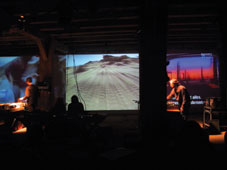
The development of the Internet and the flood of information attached to it give increasing value to archives and close-circuit collections. In the live installation "Sichtbar Archiv", the Dutch artists Remco Packbiers and Remco Schuurbiers unite their personal archives of image recordings and sounds to create a joint performance. Four monitors, four video-cassette recorders, and four mono turntable records are in a block of wood especially made for the occasion. The VHS video images and the sounds of the records are mixed live, superposed, opposed, and then reunited in a new collage. The installation's 'analogical' structure, the technical use of the instruments, as well as the interaction between the artists do not disappear in the perfection of the digital worlds, but are actually part of the installation. The film transposes two systems in a new spontaneous, intuitive, and associative context, and allows the public to see one hundred years of images and sounds.
Born in Holland, Remco Schuurbiers lives and works in Berlin. His work consists in abstract compositions, short video films, installations, and live video performances. He works on projects with musicians in the field of Contemporary Electronic Music, producing composed or improvised audiovisual performances. He also works as a photographer, is one of the organizers of club transmediale, and is co-organizer of the event/project "The Art of Pingpongcountry". Together with director Ivan Stanev he creates films and theater plays. In his PA Dual-project, Remco Packbiers uses 4 to 8 mono record players. His aim is to find the perfect musical fragment at the right time in the right musical environment. His masterful mixing skills utilise a whole range of musical genres like Grass Roots, Rare Grooves, Folk Music (Ethnic), Lock Grooves, Spoken Word, Contemporary music, Electro-Acoustic, Avant-Hop, Dub-Step, Breakcore, and Noise.
Rolf Schuurmans
Tuning
Experimental video | dv | color | 2:17 | Netherlands, Belgium | 2005
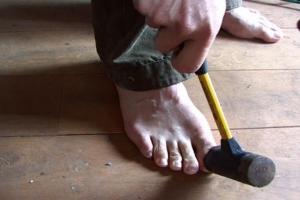
Somebody is playing with a hammer on his foot.
Rolf Schuurmans was born in Holland in 1972, and now he works and lives in Antwerpen, Belgium. He makes sculptures, music/sounds, and films/video, sometimes in combination. Lately his focus has been on film.

Hannes Schüpbach
Instants
Documentaire exp. | 16mm | color | 16:0 | Switzerland | 2012
Instants arrive and take place for us and in us. Like the girl appearing in a gust, as a goddess of winds, whose movements settle into a gesture, a suite of still images. Between the instants relations unfold, the evident as well as the invented. The hand that halts in writing sentence after sentence implies a loop, a stepping back. There, what has been felt takes form. The jolts, abrasions, and stops in the arrival of images make up this body of instants from which language flows. —Hannes Schüpbach (Translation: Elizabeth Tucker)
Hannes Schüpbach was born in Winterthur (Switzerland) in 1965. He is a visual artist and writer. Since 1999 Schüpbach has completed ten silent films. However, his artistic practice with elements of the cinematographic dates back to 1990, with spatial installations and serial paintings that can be experienced through movement. In the exhibition Stills and Movies at Kunsthalle Basel, 2009, a number of his large, connected series of paintings were shown for the first time. The exhibition also highlighted the conceptual interconnections between installations, performances, and films by Schüpbach; they all entice movement and unfold through memory. Cat.: Hannes Schüpbach: Cinema Elements, Films, Paintings, and Performances 1989–2008, Zurich: Scheidegger & Spiess, 2009, distributed in North America by Chicago University Press. His films have been presented at Museo Nacional Centro de Arte Reina Sofía, Madrid, Harvard Film Archive, Cambridge, Tate Modern, London (2009); CCCB Barcelona, Kunstmuseum Bern (2011); Centre Pompidou, Paris, Kunsthalle Vienna, LUX/ICA Biennial of Moving Images, London, Kunstmuseum Winterthur (2012); Arsenal, Berlin, School of the Art Institute of Chicago (“Conversations at the Edge”), Toronto International Film Festival, Whitechapel Gallery, London (2013); International Film Festival Rotterdam, Literaturhaus Zürich (2014).

Dagmar Schürrer
Galaxy
Experimental video | mov | color | 3:48 | Austria, Germany | 2020
The narrator in the moving image work GALAXY is technology itself. The story is generated by an algorithm and offers an interpretation of the brief meeting of the two characters Touch and Long Swipe, an encounter of love and disappointment. Small deviations in the language and the narrative logic reveal our social imprint of how stories are expected to be told and how technology is programmed to follow these perceptions. The mise en scéne is a computer-generated galaxy of objects and images reminiscent of the organic, but dismembered and fragmented, reflecting on the possibility of creating new worlds and stories in digital space by following a subjective system of ordering.
Dagmar Schürrer is a media artist based in Berlin, Germany. The digital image, found and generated, is her material to form a visual language beyond analogue perception. She assembles found footage, digitally generated objects and animations, text, drawings and sound to form intricate video sound montages, presented on screen, as installations or combined with new technologies such as augmented reality. She holds a degree in Fine Art from Central Saint Martin´s College in London, UK. Her work has been exhibited internationally, amongst others at the New Contemporaries at the ICA London, the Moscow Biennale for Young Art, at the Museum of Waste in Changsha, China, the Transmediale Vorspiel in Berlin and LUX moving image London. Her videos have been screened at numerous festivals: SUPERNOVA in Denver, Seattle Film Festival, the Athens Digital Arts Festival, the Horn Experimental Film Festival in Israel, Tricky Women Festival in Vienna, or the Diagonale Film Festival in Graz. In recent years she received the Goldrausch Scholarship of the Senate of Berlin and was shortlisted for the Berlin Art Prize and the Tenderpixel Award in London.

Jonathan Schwartz
A Mystery Inside of a Fact
Experimental film | 16mm | color and b&w | 16:0 | USA | 2016
It arrives, in a fog, with songs, through dance or majestic animals or faces (gliding on the street), in shapes of light, maybe on a large bird of prey’s flight—gesture skyward. Some origins can be difficult to pinpoint, others blink back—infinitely.
Jonathan Schwartz makes short films that circulate primarily in an experimental and non-fiction film context. Films are generally constructed from fragmented collections and findings, from both exterior and interior spaces. His films have exhibited in many festivals including New York Film Festival "Views from the Avant-Garde" and “Projections”, TIFF "Wavelengths", Rotterdam, Ann Arbor, Images, Media City, Recontres Internationales, Exis, TIE, and others. Recent solo screenings include Austrian Film Museum, UnionDocs, Cinema Project, and San Francisco Cinematheque. He holds an MFA from Massachusetts College of Art, lives in Brattleboro, Vermont and is an associate professor at Keene State College.
Jonathan Schwartz
A logic sore
Experimental film | 16mm | color | 3:0 | USA | 2006
a logic sore lines drawn for structures, for community, for notes collected like anagrams. the radio sounds like an invitation to scramble all belongings and float them through the air as jets. or ?The Bridge Between Matter & Spirit is Matter Becoming Spirit? (soleri) this film is part of an 11 film project ? treating each as a song ? an album totaling 331/3 minutes - referencing the note that 331/3rpm was created in conjunction with projected image to prolong sounds response time to image time ? prior, the phonograph needed to be turned over in middle of a film reel ? an interruption. An interruption; each of the 11 films are shot as in camera rolls (30.5 meters/no edits) ? then, sound is a response. Or an echo. a logic sore is an anagram for arcologies.
Jonathan Schwartz, (boston usa) works primarily in film and sound. He has made works culled from family audio recordings, travels to far lands, wonderings in familiar lands, collage materials, and exaggerated sound recordings. Some these works have shown in Europe, usa, and Canada in places such as bfi London Film Festival, Rotterdam Film Festival, New York Film Festival, TIE ? experimental cinema exposition. The project of the 16mm film/ lp record in 11 parts/songs will be finished in the end of 2007.

Jonathan Schwartz
copper green
Experimental film | 16mm | color | 3:0 | USA | 2008
an old photo of student teacher population - a transference of ideas - language games/code phrases. a song is sung - popular and bright - borrowed by alex and the droogs - behavior modification- found on the street, a man accompanies a cd player - a cover up. ` I`m singing in the rain Just singing in the rain What a glorious feelin` I`m happy again I`m laughing at clouds So dark up above The sun`s in my heart And I`m ready for love ` initial conversation came via boston based `neptune` - inquiring into a visual supplement to track 6, copper green.
jonathan schwartz- mostly boston (usa) based- works primarily in film and sound. some works have shown in new york film festival - views form the avant-garde, rotterdam film fiestival, recontres intl, bfi London Film Festival, ICA, TIE, Harvard Film Archive, Images Fetsival, and more.

Jonathan Schwartz
Sunbeam hunter
Experimental film | 16mm | color | 3:0 | USA | 2005
all for the prevention of violence, check the manual, it might die in the seventies. the distance is now your compass so follow the shadows to your resting spot. or I was wondering if sincerity could override irony and flood out some emotions passed. of past situations: it was said that 331/3 rpm was created in conjunction with early cinema - to prolong sound for image. then- all for the extension of time, check the echo, it might disappear into the clouds. the photographs are now your compass so follow the land to your old imagined worlds. or I was wondering if this picture in my hand could conjure the past to emotions present. of present situations: this 3 minute film is one of 11 which create an album of films totalling 331/3 minutes ? to prolong connection to pasts. then- of future situations: all for the prevention of violence.
Jonathan Schwartz, (Boston, USA) works primarily in film and sound. He has made works culled from family audio recordings, travels to far lands, wanderings in familiar lands, collage materials, and exaggerated sound recordings. Some these works have shown in Europe, the USA, and Canada, in places such as bfi London Film Festival, TIE ? experimental cinema exposition, AntiMatter. He is currently finishing a 16mm film/ lp record in 11 parts/songs.

Jonathan Schwartz
The Crack-Up
Experimental film | 16mm | color | 18:0 | USA | 2017
THE CRACK-UP “ the ability to hold two opposed ideas in the mind at the same time, and still retain the ability to function. One should, for example, be able to see that things are hopeless and yet be determined to make them otherwise ” (F. Scott Fitzgerald, The Crack-Up, 1936) Glaciers take time and glaciers hold time immensely, with sorrow and not sorrow, worry and not worry. There is a light that casts on and cast out from within, `a persistent body of dense ice that is constantly moving under its own weight` and slowly dissolving, it sounds enormous, urgent.
Jonathan Schwartz lives in Vermont (usa) where his creative practice includes 16mm films, things that look like list-making and collecting as a mode of research, and teaching film/associative thinking. He has had solo screenings Austrian Film Museum, UnionDocs, SF Cinematheque, Cinema Project, TIFF/Free Screen, and more. His work has been included in many film festivals including New York, Ann Arbor, Rotterdam, Toronto, Punto de Vista, Recontres Internationales, Exis, and more.
Herbert Schwarze
Als unsere Lieder noch wild & gefährlich waren
Experimental film | dv | color | 6:30 | Germany | 2005
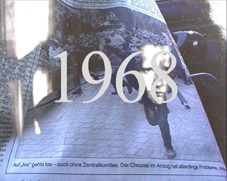
Mélange d'époques, karaoké:en 1968, Heintje chante la vieille chanson régionale "Mama"...Fondu enchaîné: un enfant de neuf ans regarde, maussade, quelque chose à la lentille, pendant que, dans la rue, les étudiants se révoltent. Un autre tube de cette époque, "Es fährt ein Zug nach Nirgendwo", conduit au groupe "Fehlfarben", qui montent sur scène en 2003 à Berlin et évoquent 1982: " Quand la réalité te dépasse, tu n'as plus d'ami, pas même l'alcool". Le punk allemand au meilleur de lui-même, qui dicte le tempo du film. Un voyage linéaire de 1945 à aujourd'hui avec de nombreux sauts dans le temps: les années 1848 dans le lied de Schuman, là-dessus un mirador qui rappelle le mur de Berlin - il se trouve près d'un container Toys'r us...des paysages allemands, symbole de la fin des utopies, chagrin d'amour, o Marie, jamais, plus jamais Auschwitz, mais des bombes sur Belgrade...du petit garçon à l'homme nu qui est allongé sur la plage dans la position de Christ...Es fährt kein Zug nach Nirgendwo...: (fr = "Il n'y a pas de train vers nulle part..."): Mélange d'époques. Karaoké. C'était au temps...
Herbert Schwarze, Allemagne né en 1959. De 1988 à 1993 études à la DFFB à Berlin. Cinéaste, dramaturge et régisseur. Membre de la commission de sélection des journées internationales du court-métrage d'Oberhausen, Allemagne. vit à Berlin. Filmographie DAS BLEIBT DAS KOMMT NIE WIEDER (1988-1992) GRETCHEN 2000 (1994) HUNGER NACH MEHR (mit Jutta Doberstein) (2001) UND IMMER WIEDER GEHT DIE SONNE AUF (2000-2005) und andere

Herbert Schwarze
Und immer wieder geht die Sonne auf
Experimental doc. | | color | 82:0 | Germany | 2005
THE SUN WILL RISE AGAIN TOMORROW What was it like ? yesterday? The song by Jürgen Marcus opens with what is lost: Yesterday. The Beatles knew already, that Yesterday never returns that even today it is nearly impossible to remember, what it actually felt like. Yesterday consist of a landscape, a view, a smell and the melody of the summer, when the local football club won the regional championship? Yesterday is the time that will not return, a place, one can not come home to ? simply because it has disappeared. In any other country but Germany one would call this Yesterday the home country (Heimat). Throughout the 1990ies postwar Germany finally came to an end. The industries of the Wonder Years were closed and taken down, except for a few, which were declared listed Monuments, where the now booming entertainment industries settled. Those monuments stand tall, lonely among a sea of single-storeyed business centres and shopping malls. Viewing platforms for the audience of structural changes: the locals. THE SUN WILL RISE AGAIN TOMORROW is a serious offer, to read and percieve today?s landscapes through the songs of yesterday, including all those great emotions, the German pop song conveys. Those pop songs have never lost validity, they still describe a life of indistinct and futile longing. A new love is like a new life, Juergen Marcus sings ? and all those, who have never stopped believing in this, are welcome, to join in the songs. THE SUN WILL RISE AGAIN TOMORROW is a karaoke-movie. Jutta Doberstein
Herbert Schwarze, Germany born 1959 in Augsburg, Germany. 1988 ? 1993 filmstudies at the German Film and Television Academy, Berlin. Currently working as a filmmaker, programme curator and dramatic advicer; member of the selection committee for the International Short Film Festival Oberhausen, Germany. Lives in Berlin.
Stefanie Schwarzwimmer
Seedless Fruits
Experimental film | 4k | black and white | 30:0 | Austria, Germany | 2024
Tanja speaks English and small talk. Thorsten likes to eat „pocket coffee“ Tillmann loves team building events. He recently found one of the three door openers needed to escape from the chamber of horrors while visiting an „escape room“ together. Thorsten is „top tax rate“ Tanja is „Veganuary“ Tillmann is the first to be dismissed. Seedless Fruits is about the founding of a new company whose product or service remains unknown. We glide through an imposing company headquarters that gradually becomes more and more cracked. It is a satirical commentary on the abysses of neoliberal office worlds and alienated labour in a self-perpetuating construct of value creation without content.
Stefanie Schwarzwimmer (*1990 in Linz) is a multimedia artist who lives and works in Berlin. From 2012 to 2018, she studied art and digital media at the Academy of Fine Arts Vienna under Constanze Ruhm. Her graduation film Silent Revolution was awarded the Academy Prize. Schwarzwimmer completed the Berlin Programme for Artists in 2017 and was a participant in the Goldrausch programme in 2022. Her work has been exhibited internationally in solo and group exhibitions, including at Kunsthal Charlottenborg in Copenhagen (2020), at Deborah Bowmann in Brussels (solo exhibition, 2021), at Kasseler Kunstverein (2022), at Oberösterreichischer Kunstverein (solo exhibition, 2024) and in solo screenings at Kunstverein der Rheinlande und Westfahlen Düsseldorf as part of the ‘Another Eye’ series (2024) and at KW Berlin as part of a ‘Pogo Bar’ event (2024).

Maya Schweizer
from the classroom
Art vidéo | dv | color | 6:0 | France, Germany | 2008
From the classroom, is a split screen projection that consists of found images from YouTube. The left image shows dancing girls from the classroom that have apparently been filmed by their friends during their break. On the right image one sees a blackboard with a diary-style text written on it. The text describes the route a woman takes everyday to work.
http://www.mayaschweizer.com/site/DOWNLOADS/Mschweizerbio.pdf Born 10 january 1976 in Maisons-Alfort, France Lives in Berlin ----- February 2007 Universität der Künste, Berlin, Germany Master Degree January 2005 Universität der Künste, Berlin, Germany Diploma April 2003 Universität der Künste, Berlin, Germany Fine art School, Berlin In the class of Lothar Baumgarten and Katharina Sieverding. 2000-2002 Hochschule für Grafik und Buchkunst, Leipzig, Germany School of visual arts, Leipzig June 1998 Licence, Degree of Visual arts 1998-1995 Université d ́Aix-en-Provence Visual arts. June 1995 Bachelor ́s degree, option Visual arts, Aix-en-Provence, France Residency Programm, Prizes : 2008 Villa Aurora, Artits Grant from the Goethe-Institut Los Angeles 2008-2010 Karl-Hofer Stipendium, Grant from the Karl-Hofer Gesellschaft, Berlin 2006 First Prize of the German Programm Kurzfilmtage Oberhausen 2006 Grant from the DAP, (Department of the visual arts), Paris, France 2005-2006 Residency and Film Project with Clemens von Wedemeyer at the Contemporary Art Center of in Bretigny, France Realisation and Production of the film Rien du tout (nothing at all) with Clemens von Wedemeyer.