Catalogue > Search
Results for : Tout le catalogue

Teresa Solar Abboud
Los Embajadores
Video | dv | color | 6:45 | Spain | 2010
Teresa Solar Abboud
You have been tracking us
Video | dv | color | 2:26 | Spain | 2009
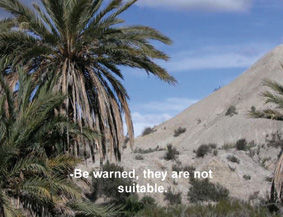
You have been tracking us, is a video work that reconstructs one of the scenes of the movie Lawrence of Arabia (directed by David Lean in 1962), the scene is the one that has an oasis as background, where the little army of Lawrence has stopped to rest. The video has been shot at the same spots of Tabernas? Desert (Almería, Spain) where the scene was orginally shot, copying the movements of the camera, in order to analyze the landscape that the cinematographic industry produced and, afterwards, left behind. The production team of the movie created the oasis for the shooting and did not remove the palm trees afterwards, so the trees have managed to survive and they still remain alive, 40 years after; this particular condition creates an interesting situation, where fictional elements have produced a?real? landscape. The video works with images aesthetically close from documentaries, but follows the shots ant the movements of the original scene, creating a contradictory and strange landscape.
Teresa Solar has studied Fine Arts at the Universidad Complutense, in Madrid and has obtained an MA in Contemporary Art at the European University of Madrid. She has been selected in different national contests such as ?Momentos de paisaje 09? (CDAN) and has participated in various exhibitions like ?Yo no tengo razón? (Off Limits, Madrid, 2009) and LOOP Festival (Barcelona, 2009). Since 2008 she has been investigating the relationships between touristic and cinematographic industry and landscape. Nowadays she is producing a new project in Cairo, Egypt.

Isabelle Solas
EN UN TEMPS SUSPENDU
Documentary | hdcam | color | 14:27 | France | 2012
Au c?ur de Bordeaux demeure l?imposante Bourse du travail, lieu témoin d?une époque où la valeur travail et la lutte des classes étaient moteurs de la construction de la société. Sa façade égratignée, ses étages désertés sont autant de signes que le temps est passé, emportant avec lui la vivacité de l`idéal du Front Populaire. Un groupe visite le bâtiment, le patrimoine semble pousser l`action syndicale aux oubliettes, pourtant le lieu dévoile peu à peu ses habitants, bien vivants et animés par des problématiques sociales on ne peut plus actuelles.
Isabelle Solas est réalisatrice et cadreuse. Suite à des études en anthropologie et en langues orientales, elle intègre la prestigieuse Ecole du Doc de Lussas, en 2005, où elle réalise Dorsale sur le proche Atlantique, et rencontre les différents acteurs issus de ce "village documentaire". Depuis, elle travaille comme cadreuse pour d`autres réalisateurs (Gilles Kerpen, Galés Moncomble, Anna Feillou). Elle réalise son premier long métrage Inventaire en 2009, diffusé à l`Utopia à Bordeaux, et au festival Traces De Vies 2009. Elle se consacre ensuite à la réalisation de films engagés, Anastasie, portrait d?une sans-papier, La Presqu?Île, portrait d?un SDF (Programmation au Festival Traces de Vie 2011), et Voisins, Rencontres et jardins cachés, documentaire sur la question du logement social à Begles, programmé en 2010 au Festival Traces de Vie. Elle travaille également comme vidéaste avec le collectif "Monts et Merveilles", autour d`expériences artistiques et participatives, dans Soupe 3, et Cocktail Manoir, en collaboration avec Florent Ghys, contrebassiste et compositeur, elle réalise des vidéos musicales, 4, et Déviation. Elle travaille actuellement sur un nouveau projet de moyen métrage documentaire en coproduction avec France 3, intitulé PAS DE NOSTALGIE, CAMARADES avec la société Sister productions.

Isabelle Solas
PAS DE NOSTALGIE CAMARADES
Documentary | hdv | color | 52:0 | France | 2015
In the heart of Bordeaux, the imposing Trade Union Center is still standing, reminding us of a time where class conflict and the value of work were the building blocks of society. The crumbling walls and abandoned floors are a clear sign that time has gone by, leaving behind a lifeless ideal for the Popular Front. A group is touring the building as the weight of the architectural heritage seems to doom union action to oblivion. However, the Trade Union Center starts to reveal its inhabitants, bursting with energy and actively involved in burning social conflicts.

Jan Soldat
Protokolle (Protocols)
Experimental doc. | hdv | color | 20:0 | Germany | 2017
We all have dreams. What happens, however, when those longings radically intrude the taboo that society and culture impose upon us? A hair-raising psychological documentary by Jan Soldat portrays three men whose concealed fantasies will evoke disgust and shock in some viewers. The protagonists wish to be slaughtered, dismembered, and eaten. A more insightful audience member may find references to famous cannibalistic films (“Cannibal Holocaust,” “The Silence of the Lambs,” “Grimm Love”).
Born in Karl-Marx-Stadt (now Chemnitz) in 1984. He has been making short films at Chemnitzer Filmwerkstatt since 2006. He studied film and television directing at the Konrad Wolf College of Film and Television in Potsdam-Babelsberg. He has presented his film many times at Berlinale and the International Film Festival Rotterdam. He won the CineMAXXI Award for best short film at the 8th Rome Film Festival.
Federico Solmi
Chinese Democracy and the last day on earth
Video | hdv | color | 10:22 | Italy | 2012
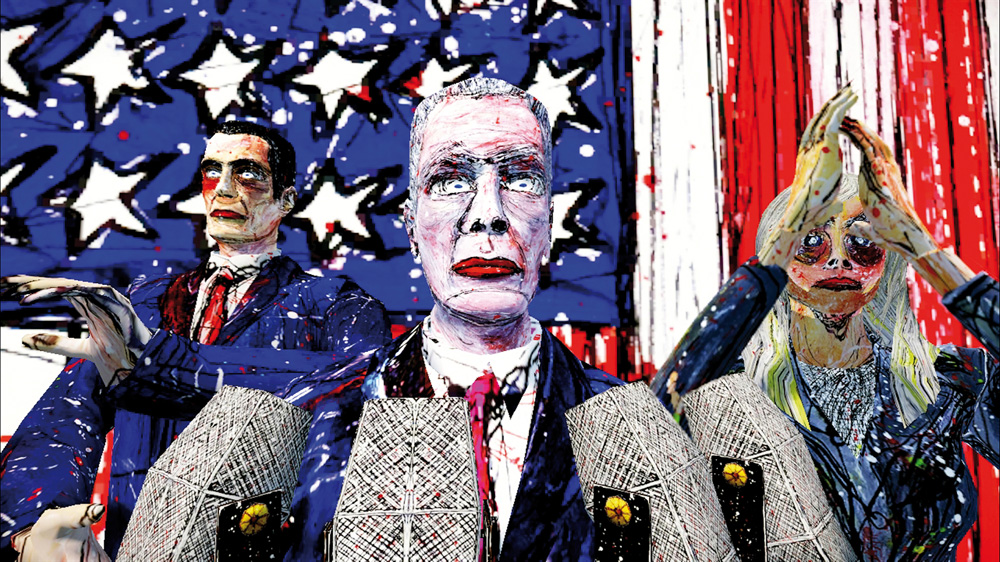
In Chinese Democracy and the Last Day on Earth Federico Solmi aims to lampoon the contemporary society and the self–destructive nature of mankind. In contrast with their playful faux-naïve aesthetics, the videos indict a male dominated, hierarchal world controlled by corrupt, arrogant dictators, politicians, businessmen as forces behind the disintegration of ethical and moral values.
BIOGRAPHY Federico Solmi (Italy, 1973) currently lives and works in New York. His exhibitions, which often combine articulate installations composed of different media such as video, drawings, mechanical sculptures and paintings, use bright colors and a satirical aesthetic to portray a dystopian vision of our present day society. Irreverent, surrealistic, the videos and the works by Federico Solmi are as he is: extravagant, rowdy and ironic. They are satires about the evilness and the vices that affect contemporary society and mankind. The artist uses images culled from the video game industry, pop culture, and the Internet and collages them with a historical influence to produce original artworks about the seemingly disparate subject at hand. The universe that Solmi likes to represent is the exaltation of a present that is crumbling apart. His work is a criticism of a system that approves and trusts without questioning the fragile foundation on which our culture and post-modernist society is based. In the year 2009, Federico Solmi was awarded by the Guggenheim Foundation of New York with the John Simon Guggenheim Memorial Fellowship in the category Video & Audio. Solmi`s works has been exhibited in several international Biennials, such as First Shenzhen Animation Biennial in China (2013), the 54th Venice Biennial (2011), and Site Santa Fe Biennial in New Mexico (2010). His works have been exhibited and screened in the following museums and institutions for contemporary art: Centre De Pompidou, Palais De Tokyo, Paris; Drawing Center, New York; Reina Sofia National Museum, CA2M Centro De Arte Dos De Mayo (upcoming), Italian Cultural Institute, Madrid; Haus der Kulturen der Welt, Berlin; Herzliya Museum of Contemporary Arts, Israel; OCT Contemporary Art Terminal, Shanghai; Australian Center of Moving Images, Melbourne; Victoria Memorial Museum, Calcutta, India; Palazzo Delle Esposizioni, Rome, Palazzo Delle Belle Arti, Naples, Italy Solmi`s video have been screened in several film and video festivals around the world including the Kassel Documentary film and video festival; Tina B, Prague; Les Rencontres Internationales, Paris, Madrid, Berlin; The London International animation festival; Loop Barcelona and others. Federico Solmi has given lectures on his work in several universities and art schools in the United States and Europe, including Yale University in New Haven, School Of Visual Arts in New York, and Accademia di Belle Arti Brera and Universita` Cattolica in Milan.
Federico Solmi
Douche Bag City
Animation | dv | color | 8:0 | Italy, USA | 2009
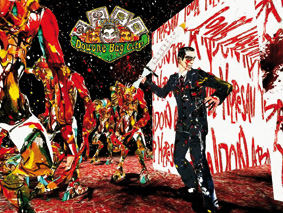
Douche Bag City is a video installation of 24 drawing animated film. It was conceived by the artist to be a satire about the current world economic crisis. The main character ?Dick Richman? is a greedy, dishonest, and selfish Wall Street employee who has been banished to live in Douche Bag City. Douche Bag City is a hopeless place, where the greedy villains of society are imprisoned for their atrocities committed against the community. The video is made of several chapters. In the final version of the installation, 24 videos/episodes will be playing simultaneously; each episode represents a mission for the main character. The ultimate goal of the protagonist ? Dick Richman? is to survive different challenges, but the drawing animated /video games are set by the artist in a way that the main character ?Dick Richman? cannot win. For each video I used a combination hand-made drawings, video game technologies, 3D and 2D animation. The installation was made in collaboration with Russell Lowe, an Australia-based 3D artist and professor at the New South Wales University in Sidney.
Federico Solmi was born in Bologna, Italy in April 1973 and currently lives and works in New York. His exhibitions, which often combine articulate installations composed of different media such as video, drawings, mechanical sculptures and paintings, use bright colors and a satirical aesthetic to portray a dystopian vision of our present day society. Irreverent, surrealistic, and sexually explicit, the videos and the works by Federico Solmi are as he is: extravagant, rowdy and ironic. They are satires about the evilness and the vices that affect contemporary society and mankind. In the year 2009, Federico Solmi was awarded by the Guggenheim Foundation of New York with the John Simon Guggenheim Memorial Fellowship in the category Video & Audio. Federico?s work has been featured in the following museums and Institutions for Contemporary art; Santa Fe Biennal (upcoming June 2010), Centre Pompidou, Paris, Drawing Center, New York; Haus der Kulturen der Welt, Berlin, National Center for Contemporary Art, Moscow, CA2M Centro de Arte Dos de Mayo, Madrid, Australian Center of Moving Images, Melbourne, Victoria Memorial Museum, Calcutta, India, Contemporary Art Center of Rouboix, Palazzo Delle Arti, Naples, Palazzo Delle Esposizioni, Rome, Italy.

Federico Solmi
King Kong and the End of the World
0 | dv | color | 4:27 | Italy, USA | 2006
KING KONG AND THE END OF THE WORLD - 2005 - 2006 King Kong and the End of the World is a sensational and sarcastic drawing animated film, based on the original 1933 King Kong movie. In this version, King Kong (played by the alter ego of the artist) destroys New York City, using the Guggenheim Museum as a weapon, then he climbs to the top of the Empire State Building where he pees, eats wall street brokers for lunch, and fights the Statue of Liberty in the arena of Time Square. The artist uses King Kong as an allegory of the art world and the money-frenzy culture of the city. In this world, art is struggling against its role as a commodity. Ideas around the nature of money, technology, the natural and ?man-made? come together in the painstaking hand drawing of every frame. When he is finally killed, King Kong triggers a cataclysmic earthquake that destroys the earth or as it?s called by the artist ?the world of assholes?. All that is left is for Federico and his wife Jennifer to repopulate a better mankind using a baby making machine.
Federico Solmi was born in Bologna, Italy in April 1973 and currently lives and works in New York. His exhibitions, which often combine articulate installations composed of different media such as video, drawings, mechanical sculptures and paintings, uses bright colors and a satirical aesthetic to portray a dystopian vision of our present day society. Power is often the nemesis in his worlds, manifesting itself in the elliptical layers of the Guggenheim Museum (King Kong and the End of the World, video 2006), the shiny Prada shoes of the Pope (The Evil Empire, video 2007), and the personal obsession to be as famous as the giant letters that spell out ?Hollywood?. The artist uses images culled from the video game industry, pop culture, and the Internet and collages them with a historical influence to produce original artworks about the seemingly disparate subject at hand. What results from the combination of all these elements is art that is humorous, absurd, and scathingly critical of our contemporary society. .

Federico Solmi
American Fables
Video | mp4 | | 7:40 | Italy, USA | 2020
Inspired by the legacies of real historical events and manufactured myths, American Fables, re-imagines through video vignettes some of the most celebrated moments in American History. I have long been influenced by the comically one-dimensional and inaccurate accounts of history common to most US textbooks, where ethnocentric perspectives create propagandistic narratives of American exceptionalism. Continuously, I find myself fascinated by the subjectivity of history, its vulnerability to partisan ideals and nationalism, rendering historical accounts more akin to folktales than facts. This inspired me to create my own library of counterfeit and re-imagined American History in an effort to submit my own voice into the ever expanding campaign of misinformation entrenched in Western rhetoric.
Federico Solmi (Italy, 1973) currently lives and works in New York. Solmi’s work utilizes bright colors and a satirical aesthetic to portray a dystopian vision of our present-day society. His exhibitions often feature articulate installations composed of a variety of media including video, painting, drawing, and sculpture. Solmi uses his art as a vehicle to stimulate a visceral conversation with his audience, highlighting the contradictions and fallibility that characterize our time. Through his work, Solmi examines unconscious human impulses and desires in order to critique Western society's obsession with individual success and display contemporary relationships between nationalism, colonialism, religion, consumerism. By re-configuring historical narratives across eras, he creates social and political commentary works which disrupt the mythologies that define American society. Scanning his paintings into a game engine, Solmi’s videos confront the audience with his own absurd rewriting of past and present, merging dark humor and sense of the grotesque with new technologies. He creates a carnivalesque virtual reality where our leaders become puppets, animated by computer script and motion capture performance rather than string.

Federico Solmi
The Bacchanalian Ones
Experimental VR | 0 | color | 0:0 | USA | 2021
The Bacchanalian Ones, VR Experience for Oculus Quest 2 Inspired by ancient mythology, modern myth, and contemporary celebrity culture, The Bacchanalian Ones compares the historical myth with a satirical mash-up of the powerful self-absorbed who preen and wallow in a banal spectacle of their own creation. In a fantastically opulent setting of unrestrained hedonism, political, religious, and military leaders with ghoulish, bouffonesque appearances are surrounded by social elite sycophants like the devotees of the cults of Bacchus and Dionysus. Solmi’s phantasmagoric world of whirling space, jerking movement, and oscillating facades that strive to overwhelm the viewer’s visual field is pushed to extremes in a new interactive Virtual Reality installation. This work invites the visitor to enter the Bacchanal by donning a VR mask and manipulating two hand-held controllers in order to pick the perspective of one of his historical avatars. Newly empowered, and emboldened, the visitor is able to control the narrative, allowing them to experience the debauchery up close and personal through their embodiment of the avatar.
Federico Solmi was born in Bologna, Italy in 1973. Since 1999 he has lived and worked in New York. Solmi’s work utilizes bright colors and a satirical aesthetic to portray a dystopian vision of our present-day society. His exhibitions often feature articulate installations composed of a variety of media including virtual reality experiences, video installation, painting, drawing, and sculpture. Solmi uses his art as a vehicle to stimulate a robust conversation with his audience, highlighting the contradictions and fallibilities that characterize our time. In 2009, Solmi was awarded by the Guggenheim Foundation of New York with the John Simon Guggenheim Memorial Fellowship in the category of Video & Audio. Solmi’s work was included in the 100-year anniversary exhibition of The Phillips Collection, Seeing Differently, and in the Smithsonian National Portrait Gallery’s traveling exhibition, Outwin 2019: ‘American Portraiture Today,’ as well as the inaugural exhibition of the Ocean Flower Museum Island in Hainan Province, Danzhou, China. From 2016 to 2019 Federico Solmi was visiting Professor at Yale University School of Art, and Yale School of Drama, New Haven CT. Solmi was appointed guest critic at the Yale University School of Art for 2022.
Federico Solmi
Song of Tyranny
Animation | hdv | color | 6:0 | Italy, USA | 2012
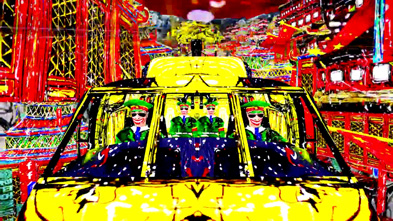
"A Song of Tyranny", is the first video episode of the Trilogy entitled Chinese Democracy and The Last Day On Earth, a project by Federico Solmi, which was commissioned by the Guggenheim Foundation of New York after the artist was awarded the John Simon Guggenheim Fellowship for video. In this swarming animation, the artist investigates the self destructive nature of mankind through the examples of political dictatorship and authoritarian behaviors. Beyond the apparent Manichean character of such a vision, the video is articulated as a fictitious portrayal or the hagiography of an imaginary leader of the mid-21st century, idolized by his crowd of subjects. Solmi`s playful aesthetics integrate a series of visual metaphors to present viewers with a comedic-grotesque parabola on power and its excess. This sarcastic and irreverent tone allows Solmi to target the epitome of human folly, greed, and thirst for power, preventing a simple reproduction of the dichotomic good versus evil. A Song of Tyranny, centers on the protagonist in the phase of becoming a dictator while he is permeated with values and models that will influence his successive actions and decisions in the process of rising to power. Solmi?s complex technique combines traditional hand drawn animation with digital models, utilizing computer gaming engines. The result is an absolutely unique hand-made texture within a real-time 3D framework, created in collaboration with Australian based 3D artist, Russell Lowe.
Federico Solmi (Italy in 1973), currently lives and works in New York. His exhibitions, which often combine articulate installations composed of different media such as video, drawings, mechanical sculptures and paintings, use bright colors and a satirical aesthetic to portray a dystopian vision of our present day society. Irreverent, surrealistic, and sexually explicit, the videos and the works by Federico Solmi are as he is: extravagant, rowdy and ironic. They are satires about the evilness and the vices that affect contemporary society and mankind. The artist uses images culled from the video game industry, pop culture, and the Internet and collages them with a historical influence to produce original artworks about the seemingly disparate subject at hand. The universe that Solmi likes to represent is the exaltation of a present that is crumbling apart. His work is a criticism of a system that approves and trusts without questioning the fragile foundation on which our culture and post-modernist society is based. In the year 2009, Federico Solmi was awarded by the Guggenheim Foundation of New York with the John Simon Guggenheim Memorial Fellowship in the category Video & Audio. Solmi?s videos were featured in the 54th Venice Biennial, in the exhibition entitled ?Italians do it better?. His work was included in the year 2010 at the Site Santa Fe Biennial, an exhibition curated by Sarah Lewis and Daniel Belasco. His work has been exhibited in the following museums and Institutions for Contemporary art; Centre Pompidou, Paris, Reina Sofia National Museum, Madrid, Drawing Center, New York; Haus der Kulturen der Welt, Berlin, CA2M Centro de Arte Dos de Mayo, Madrid, National Center for Contemporary Art, Moscow, Australian Center of Moving Images, Melbourne, Victoria Memorial Museum, Calcutta, India, Contemporary Art Center of Rouboix, Palazzo Delle Arti, Naples, Palazzo Delle Esposizioni, Rome, Italy. In addition, his video animations have been screened in several film and video festivals, such the Kassel Documentary film and video festival, Tina B, Prague, The London International animation festival, Loop Barcelona, IndieLisboa, Lisbon, Impakt Film and Video festival, Utrecht.

Federico Solmi
The Ballroom
Animation | hdv | color | 5:41 | Italy, USA | 2016
THE BALLROOM With his typical sardonic and irreverent approach, Federico Solmi has orchestrated a masquerade between history’s most feared and beloved leaders in his latest work, ‘The Ballroom’. In the installation, videos display surreal vignettes of a lavish ballroom party that converge multiple narratives of gluttony, gossip, and over the top exuberance. The follies of each overly ambitious leader result in a chaotic festival of drinking, smoking, dancing, and feasting. A vain display of ridiculous costumes, shining with medals and jewelry, promote a visual disorder that coalesces with the indulgent antics of these powerful figures. Rather than reimagining history, the leaders enter into our conceited present-day celebrity culture. They call to fault our own complacency and perpetuation of skewed historical myths and perspectives.
Solmi’s elaborate installations combine 3D animation and video game technology with paintings, drawings, and kinetic sculptures. Bright colors and a satirical aesthetic portray a dystopian vision of our present day society. Through an intricate process in which technology and hand-painting merge into an organic whole, his unique approach renders the most loathed aspects of modern life. With garish imagery and mesmerizing movement, Solmi expresses a harsh criticism toward the system that approves and trusts without questioning the fragile foundation on which our culture and post-modernist society is based. Federico Solmi, (lives and works in New York). In the year 2009, Federico Solmi was awarded with the John Simon Guggenheim Memorial Fellowship in the category of Video & Audio by the Guggenheim Foundation of New York. He is currently a visiting Professor at Yale University School of Art, New Haven (CT). Solmi has been featured in solo museum exhibitions at the Haifa Museum of Art, Israel (2016) Museo de Arte Contemporaneo del Zulia, Maracaibo Venezuela (forthcoming), and the Centro Cultural Matucana 100, Santiago, Chile (2015). His work has been included in several international Biennials, including the Frankfurt B3 Biennial of Moving image (2015), the First Shenzhen Animation Biennial in China (2013), the 54th Venice Biennial (2011), and the Site Santa Fe Biennial in New Mexico (2010).
Alexandru Solomon
Cameras do not record such things
Documentary | digital | color | 23:40 | Romania | 2024
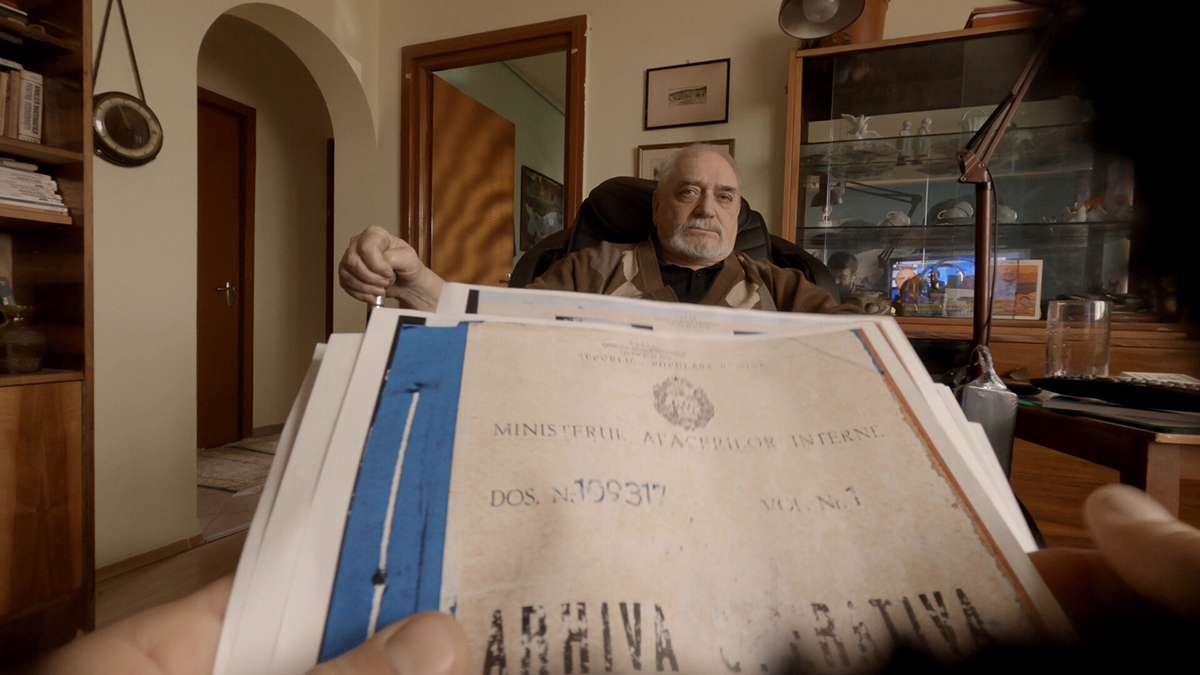
The documentary filmmaker is filming an old Securitate officer with a hidden camera. He suspects that, 60 years ago, the officer had followed and photographed a famous monk turned civilian - a real character, now about to be sanctified. The former spy is now being spied upon, but things turn out badly.
In the early 1990s, Solomon emerged as a young director of photography and he started making documentaries aside from filming feature films. Solomon was among the first Romanian film-makers who committed themselves to a then compromised genre; today, he is one of the leading political film-makers from Romania and active on the international documentary scene. His recent work triggered public debates about the function of documentary film within the public sphere and contributed to re-establishing documentary film as an arena for reframing Romania’s recent history. Solomon’s previous work, “The Great Communist Bank Robbery” (2004), broadcast on Arte and as part of BBC4’s prestigious Storyville series, was awarded Best Film at the History Film Festival in Pessac, France and the Prize for Social Values at Documenta Madrid. His ‘Cold Waves’ (2007) is a chilling slice of political history that played for 12 weeks in Romanian theatres. It deals with the love and hate story between Radio Free Europe, the Romanian audiences and the communist regime. “Kapitalism - our secret recipe” (2010), speaks of the rise of a new ruling class in the East (produced for Arte and RTBF with Media support). “Tarzan’s Testicles” (2017), premiered in Karlovy Vary, is a film about utopias & a metaphoric drama that threads the similar destinies of monkeys & men.
Elian Somers
Ecumenopolis
Video installation | 4K | color | 19:40 | Netherlands | 2022
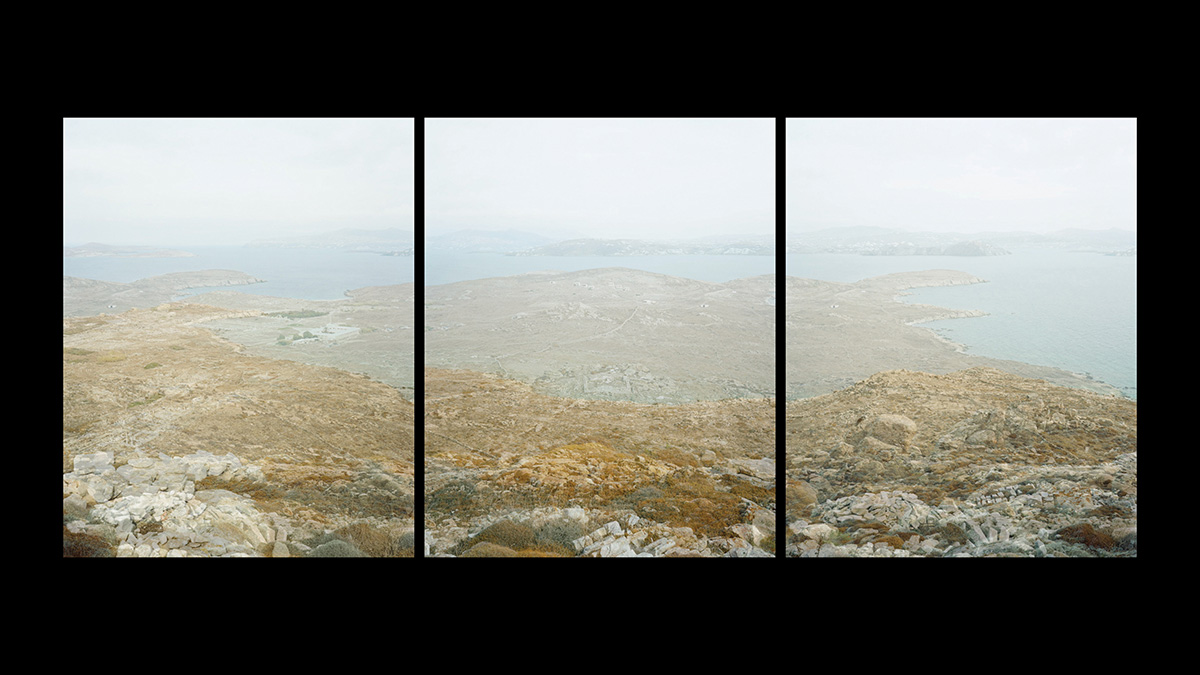
The work Ecumenopolis departs from a specific aspect of the Cold War: the efforts on both sides, East and West, to extend their spheres of influence by means of art and culture. As a counterpart to Socialist Realism, the United States advanced modernist art as a vehicle for spreading Western values. This Cultural Cold War also took place on the front of architecture and urbanism. Against this geopolitical background, Ecumenopolis zooms in on Greek architect-urbanist Constantinos Doxiadis and his role as a cultural agent of change. In the 1950s and 60s, Doxiadis developed many key projects across the Middle East, Asia and Africa, and was responsible for the modernist master plans of Riyadh, Baghdad and Islamabad, the capital of Pakistan. Parallel to these influential commissions, he worked on his own mission: a visionary urbanist theory which he named ekistics, the science of human settlements. Its ultimate aim was a blueprint for a future city that would encompass the entire world: Ecumenopolis. In the work Ecumenopolis a voice-over narrates about Doxiadis’ mission and his interdisciplinary network of inspirational fellows, the Delians, which he gathered annually on a boat in the Aegean Sea to contribute to his mission. The camera hovers around the island of Delos and its ancient city where Doxiadis would take them. In order to envision the urban future, they were to travel back in time. As the story unfolds, two different perspectives are interweaved on Doxiadis and his Delians, drawing both on official archives celebrating his architecture as a practice beyond politics, and on alternative sources that trace a more complex context - the context of the Cultural Cold War.
Elian Somers (NL, 1975) is a visual artist based in Rotterdam, the Netherlands. Her works have been shown at various art venues, a.o. Stedelijk Museum Bureau Amsterdam (SMBA), Amsterdam; Pennings Foundation, Eindhoven; Foam, Amsterdam; TENT, Rotterdam; Kunsthalle Wilhelmshaven, Wilhelmshaven (DE) and MK Galerie, Berlin (DE). The works have also been regularly published as artist books, and in art, photography and architecture magazines. The book One and Another State of Yellow (Fw: Books) was published in 2017, and the book Border Theories (Fw: Books) in 2013. The work Ecumenopolis (A Stone from the Moon, 2015-2022) was selected for the International Film Festival Rotterdam, IFFR 2024. Elian Somers’ projects have been financially supported by the Mondriaan Fund, Amsterdam, Culture Fund, Amsterdam, and CBK Rotterdam.

Francisca Somigliana
Diamante
Experimental fiction | 4k | color | 7:29 | Argentina | 2020
"Diamante" is built as a game of reflections on the basis of a fact: a jewelry theft committed in Russia in 2018 allegedly committed by a criminal organization called Pink Panther.
Francisca Somigliana (Buenos Aires, 1992) studied Image and Sound design. She did the Film Program (2017) and the Artist Program (2020/21) of the Universidad Torcuato Di Tella. She was selected in 2019 to participate in the Biennial of Young Art. She participated in different shows and screenings such as Space between (CCR), Today I have permission to lie (UTDT), Program 2016 (Dahaus Studio), Satellite XIII (CHELA) and Cinematographic images and their path to freedom (UTDT)
Helene Sommer
Das Gelaende
Experimental video | dv | color | 7:56 | Norway, Germany | 2005
The initial purpose of the trip was to observe the construction of an indoor tropical amusement park, but the intentions and interests change as the already existing landscape becomes inevitable. "Das Gelände" follows the construction of an indoor tropical amusement park in a former airship hangar, localized on what was previously a Soviet military base in the GDR. In the video, the history of the landscape is being uncovered at the same time as the construction of an artificial indoor landscape is being observed. As facilities change functions, the layers of history become apparent. The visible recycling of the landscape triggers the question of whether the amusement park trivializes, camouflages, or clarifies the place's history. The video consists of images from web cameras downloaded over a period of 9 months, in addition to photos and video collected during the construction period. A narrative is conveyed through subtitles, leaving only the sound of the landscapes.
Helene Sommer was born in 1978 in Oslo, Norway, where in 2003 she graduated from the National Academy of Fine Arts. She works with various media such as video, photo, text, and installations, and currently lives and works in Berlin and Oslo.
Helene Sommer
Great Piece of Turf
Video | hdv | color | 25:0 | Norway, USA | 2011
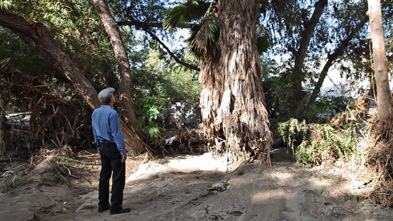
The video Great Piece of Turf explores place through the narratives of plants. A piece of uncultivated, urban land in Los Angeles was mapped out by collecting the histories of its plants with the help of local biologists and botanists. The place is by a former freight switching facility and the Los Angeles River. Whether a weed from China brought during the Gold rush, a palm tree introduced in an attempt to create a vision of paradise or a native hallucinogenic - narratives are revealed reflecting the interwoven and fragmented layers of history and space. Sampled material from a range of sources such as educational films, commercials, television, documentaries and movies is included. The title is borrowed from Albrecht Dürers watercolor (Das große Rasenstück) from 1503 which is a study of a seemingly random group of wild plants.
Helene Sommer (b. Oslo, 1978) graduate from the Academy of Fine Arts in Oslo in 2003. In her works - which often takes the form of collages and compilations involving installation, video, text and photo - a common denominator is an interest in recontextualization, documentation and classification in relation to image production within subjects such as history and science. She has recently exhibited places such as Kunstnernes Hus (Oslo), Space for Art and Industry (NY), Kunstnerforbundet (Oslo), Motorenhalle Dresden, Grazer Kunstverein (Graz), De Appel (Amsterdam), University of Oslo, Neuer Berliner Kunstverein (Berlin), Chert Gallery (Berlin), Fotogalleriet (Oslo)

Helene Sommer
Persistence of vision
Art vidéo | dv | color | 11:0 | Norway | 2007
?Persistence?* of vision is based upon an amateur film and video archive from a 90 year old man, from 1950 to present day. The focus is on his travels- from NY to South America during the 50s, Japan in the 60s, Egypt in the 70s to Spanish retirement villages during the 90s. By deconstructing and reassembling the material a new travelogue is created where time and place blends. ?Persistence of vision?* investigates how memory and perception function in regards to history and the act of documenting. The use of the camera as a way of seeing.
Helene Sommer was born in 1978 in Oslo, Norway. She studied Fine Arts at the National Academy of Fine Arts in Oslo. As an artist she works mainly within the fields of video, photo, text and installation. She has over the last year shown several places in Europe. She was recently a resident artist at Platform Garanti in Istanbul, and is currently a fellow at the Akademie Schloss Solitude in Stuttgart, within the discipline of Film/Video/New Media.

Helene Sommer
Sagn om jord
Video | mov | color | 16:3 | Norway | 2021
In “Sagn om jord” (Legends of Earth) the point of view is from a distant future. The sci-fi inspired narrative is set in the region of Hardanger in Norway, where the landscape has vanished. An excavation uncovers films revealing images from today’s Hardanger: a research station where they research mainly fruit production, a salmon farming facility and a slate quarry. These are the first images of the lost landscape to appear. ?A woman attempts to make the visual fragments of an estranged world comprehensible and locate them in an imaginary landscape. The film explores how the management of natural resources shapes our surroundings and the connections between landscape, language, history and image production. The region where the story is set is visually an iconic part of Norway, representing ideas and histories of nationalism and identity. By playing with the sci-fi genre as a way to create estrangement and make the familiar surreal, possibilities and ideas of what shapes a landscape opens up. The soundtrack is from the Norwegian Broadcasting Corporation’s tv-serie “Blindpassasjer” from 1978, which was the first sci-fi series produced in Norway.
Helene Sommer (b. 1978) is a Norwegian visual artist. She graduated from the National Art Academy in Oslo in 2003 and has since exhibited her work in galleries, museums and in festivals in numerous places. In her practice she is interested in the multiple levels of translation, interpretation and rhetorical devices that are involved in all storytelling. Through video, collage, text and installation she wishes to question the way we understand and relate to our surroundings and its history. A common denominator has been an interest in overlooked perspectives within history and science. Her works are often based upon a precise montage of an extensive selection of archival material in combination with her own production. See www.helenesommer.net for more information about her work.

Wichanon Somumjarn
The Young Man Who Came From the Chee River
Experimental fiction | hdv | color | 16:38 | Thailand | 2015
Golf, a man who works as a debt claimer in Khonkaen. He wakes up early to work as usual. He meets many people including a desperate man in debt who falls critically ill. Golf is forced by the situation to weigh up between his professional duty and sense of moral.
Wichanon Somumjarn was born in Khon Kaen in 1982. While he was in the final year of studying engineering, he made a short film titled Phee Hong Nam (W.C.) The short won Honorable Mention at the Siam Cement Group Young Thai Artist Award 2005 in the film category. He then decided to leave his formal studies to pursue his dreams in the field of cinema. Wichanon was a participant in Asian Film Academy (AFA), Pusan International Film Festival 2009. In February 2010, Wichanon had also attended the Berlinale Talent Campus # 8 at the 60th Berlin International Film Festival, Germany. In November 2010, Wichanon had also attended the Next Master Tokyo Filmex 2010, Japan. His short film, Four Boys, White Whiskey and Grilled Mouse has been a major success on the international film festival circuit. It won Best Fiction award at the prestigious Tampere Film Festival in Finland in 2010. In April the Following Year, There was a Fire, is Wichanon’s first feature. In January 2012, it was selected for Tiger Awards Competition at International Film Festival Rotterdam 2012. Now Wichanon is developing his second feature called “Beer Girl”.
Kwang-ju Son
Amusement Epitome
Experimental doc. | dv | color | 2:46 | Korea, South | 2006
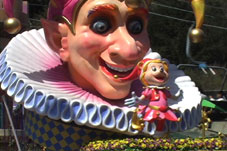
A weekday afternoon in the EverLand, one of the largest amusement parks in Korea.
Born 1970 in Korea, Kwang-Ju Son is a two-time award-winning filmmaker at the Pusan International Film Festival. She has presented her short films in major festivals including Pusan, Rotterdam, and Oberhausen. She is currently working as a resident artist at the Rijksakademie in Amsterdam, Holland.