Catalogue > Faire une recherche
Résultats pour : Tout le catalogue

Peter Downsbrough
A]PART
Vidéo | dv | noir et blanc | 11:50 | USA, Belgique | 2009
A]PART is the first publication in the brand new CKA _ EDITIONS series, run by Christian Kieckens. It constitutes the third collaboration between Brussels-based American artist Peter Downsbrough and Brussels architect Christian Kieckens. Sharing the same sensibilty for both industrial architectural heritage and public space in general, former joint-ventures involved the industrial `Amylum` site in the centre of Aalst (culminating in the 1996 exhibition and photo/text publication Densities) and Brussels? city centre, where Kieckens took on the technical and logistical side of the public commissioned work AND /MAAR, OP AND /POUR, ET (2000-03). Downsbrough?s passion for industrial architecture takes many forms. More often than not, ?preservation? means survival in the form of a film or photo series. His films and photos always capture an industrial or (sub)urban reality that will sooner or later vanish or be subject to redevelopment ? be it late Seventies Manhattan or the industrial zones around Kent, UK. For now, and for the foreseeable future, this seems not to be the fate of Citroën`s impressive, prototypical modernist interbellum garage at Place d?Yser in Brussels ? the subject of Downsbrough`s latest film. The building, once threatened with demolition, will hopefully be there for some time to come, and Downsbrough pays homage to the building and its architects, Belgians Alexis Dumont and Marcel Van Goethem, who cooperated with French architect Maurice Ravazé. By publishing this work, architect Kieckens pays tribute to them as well. The black-and-white film underscores the building`s basic logic and rhythm. The garage consists of two parts, garage and showroom, and Peter Downsbrough films both in a playful yet formally precise way. This includes trade-mark Downsbrough idiosyncrasies, like suddenly letting in short diegetic environmental sounds, or superimposing words, e.g. IN TIME, at the beginning of the film. Typical `car movements` are alternated with proper cinematic movements like pannings; sometimes, an image freezes, and film becomes film still, photo. Shot from the passenger seat of a car driving down the distended corkscrew ramp, the film shows the garage?s interior and views through its windows onto the urban setting below. Downsbrough In a way, the building is filmically taken apart by Downsbrough: from top to bottom (including close-ups of the stained garage floor) it is visually analysed and scrutinised. Yet the physicality of the building also imposes its framing rules on the film; `rules` the artist evidently plays with ? as before. Towards the end of the film, we witness a gay, somewhat absurd dance of cars at the roundabout in front of the building, a picture reminiscent of the famous last scene of Jacques Tati`s fillm Trafic. Still, A]PART ? elegant, heedful and spare ? has a darker side too: it is both ode and elegy. A part. In time. Apart in time. In paying attention to all the minute details of the space and its immediate surroundings, the work symbolically preserves the Citroën building-as-film. However, it also shows how space itself (every space, not just a filmed one) is formed as well by an `attention`. Created by circumstances of history, society and perception, it will in the end always be subjected to the workings of time. (Steven Tallon)
Peter Downsbrough (1940, New Brunswick, N.J.) studied architecture and art. Around the mid-1960?s, after several years of work and exploring materials, including cardboard, wood, steel, lead, neon tubing, an evolution took place which resulted, in 1970, in the work with the Two Pipes (outside), Two Dowels (inside) and Two Lines (on paper). At the same time, he also started taking photographs to document these pieces. By taking photographs from different angles and distances, he gradually started taking photographs of ?cuts? that already existed in the urban landscape. Some of these photographs were used in books, some appeared in magazines, but it wasn?t until 1980 that they showed up in exhibitions. From 1977 on, Downsbrough realized several videos as well as audiotapes. A record was made in 1978 and released in 1982. Looking to expand the vocabulary, he developed a series of works using dice. In 1980, on the Spectacolor Board on Times Square, New York, he realized a piece, a 30 second spot shown once every hour for four days, and documented it in a short film, ?7 come 11?. Around 1980, he also started using regular postcards, initially by applying two lines, later to be followed by the use of words. The work with maquettes as a means of exploring space and structure started around 1983. The first commissioned public work was a wall piece realized in Rennes, France, 1990. The film ?Occupied? was produced in 2000, ten years after it was conceived. Since then, several films, shot with a digital camera, have been published as dvd?s. Today, all these disciplines occupy the field of his activities. An overview exhibition, curated by Marie-Thérèse Champesme, opened on June 24, 2003, at the Paleis van Schone Kunsten, Brussels. It was accompanied by an extensive catalogue and traveled to two other venues.
Peter Downsbrough
AS] IN
Art vidéo | dv | couleur | 3:35 | USA, Belgique | 2007
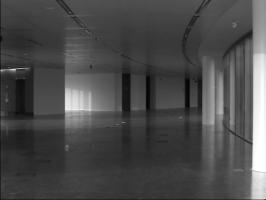
Des bureaux vides dans la zone de Zaventem, près de l'aéroport de Bruxelles. Aucune présence humaine, excepté les voitures passent ou les bureaux voisins que l'on aperçoit par la fenêtre. Avec de fluides mouvements de caméra, des travellings et des panoramiques, Downsbrough scrute l'environnement et explore les relations potentielles qui peuvent en émerger : intérieur et extérieur, vide et inhabité, horizontal et vertical, surfaces sombres et surfaces claires. La géométrie de l'espace, renforcée par le recours à des images en noir et blanc, détermine également celle de l'écran. Dans l'?uvre de Downsbrough, la façon de considérer l'espace, de même que l'espace, est profondément politique. Ses vidéos mettent l'accent sur les limites, l'ordre et les règles que le système social nous impose et s'intéressent à nos modes d'appropriation de l'espace, nous rappelant que tout "placement" est en même temps une "mise en ordre".
Peter Downsbrough est né en 1940 aux Etats-Unis. Son oeuvre - sculpure, graphisme, photographie, vidéo, film, livre - est née d'un intérêt pour l'architecture et explore la relation complexe entre architecture, langage et typographie pour ne garder que l'essentiel. La forme est réduite à des lignes, les couleurs sont presque inexistantes. Dans ses vidéos, le mouvement et le langage sont envisagés dans leur rapport au temps et à l'espace : tous deux représentent et déconstruisent l'architecture moderne urbaine et industrielle. Il se produit en parallèle un détournement linguistique : en insérant et en interposant des blocs de mots comme AND, AS ou IN, Downsbrough fait de sa vidéo une sorte de "phrase" qui fonctionne également comme un "lieu" pouvant accueillir le spectateur. Les oeuvres de Peter Downsbrough ont notamment été présentées au Reina Sofia (Madrid), au SMAK (Ghent), au Paleis voor Schone Kunsten/Palais des Beaux-Arts (Bruxelles) et au Musée Sztuki (Lodz).
Peter Downsbrough
And Here
Vidéo expérimentale | dv | couleur | 24:0 | USA, Belgique | 2007
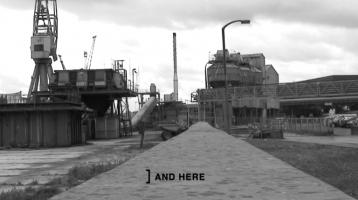
"] AND HERE" est un projet vidéo filmé dans l'environnement urbain et industriel du North Kent. Il se compose d'images de centres villes, de la plate forme de transport de containers de l'île de Grain, des caravanes de l'île de Sheppey, etc. Ce projet est une commande de la Faversham Society en réponse aux changements rapides entraînés par le Thames Gateway North Kent Development, un programme de rénovation s'étendant Dartford à Teynham dans le Sud de la région. Contrairement aux précédents films de Downsbrough, l'espace est ici clairement identifié : les endroits visités par l'artiste peuvent théoriquement être reportés sur une carte. Cette oeuvre souligne avant tout un aspect du travail de Downsbrough (que l'on retrouve également dans d'autres films) qui consiste à offrir un témoignage matériel de l'histoire et de lieux qui sont en train de disparaître. Une autre différence vient du fait que ce film est en noir et blanc et en couleur : les spectateurs concentrés pourront à certains moments distinguer deux secondes en couleur ! Il s'agit de son plus long film (24 min.) depuis "The Other Side" en 1979. Dans les oeuvres de Downsbrough, le spectateur est en général confronté à un même type de "mondes". Comme auparavant, ce film est fait d'espace ? un espace représenté concrètement et mentalement ? de typographie et de blocs de mots : le titre "]AND HERE" ou des mots comme AS, qui découlent des précédents films de Downsbrough. Le film alterne plans fixes, travelling et images tournées depuis l'intérieur d'une voiture, auxquelles on peut facilement rattacher des scènes de "AND[BACK " tournées depuis une voiture et inversement. Ici, Downsbrough ne filme pas que des sites industriels mais aussi des villes et des villages du Kent. Avec leurs bâtiments en briques typiques et leurs pubs, ces lieux et ces habitations ? contrairement à la force de déplacement formellement et géo-économiquement uniformisante de l'espace industriel ? sont identifiables comme appartenant au Sud-Est de l'Angleterre et, plus particulièrement, au Kent. Mais la principale différence par rapport à ses précédents projets, qui pourrait être annonciatrice d'une nouvelle tendance chez Downsbrough, réside non pas dans l'utilisation de texte et d'images (ou d'images textuelles) mais dans celle du son. Pour "] AND HERE", Downsbrough utilise une musique spécialement commandée pour l'occasion et jouée par Xavier Garcia Bardon et Benjamin Franklin, deux membres du groupe bruxellois Buffle. Downsbrough avait déjà utilisé la musique dans ses premières vidéos avec des groupes comme The Spinners ou Talking Heads mais ici, outre le fait de créer un certain atmosphère, la musique joue le rôle d'un élément structurel et structurant. Tout comme les images, la musique est souvent interrompue soudainement ? le morceau le plus long ne dure qu'une minute. Comme dans la plupart des cinémas narratifs, il y là aussi une confrontation et un dialogue entre le son/la musique et l'image/la typographie. La musique, similaire aux images structuralistes du cinéma de Downsbrough, se situe entre shoegaze, post-rock et improvisation et insiste fortement sur la texture, notamment à travers des effets obtenus avec la pédale de la guitare et l'utilisation du traitement numérique. On note également un côté industriel dans cette musique qui reflète et renforce les paysages industriels filmés par Downsbrough.
Peter Downsbrough est né en 1940 aux Etats-Unis. Son oeuvre - sculpures, graphismes, photographies, vidéos, films, livres - est née d'un intérêt pour l'architecture et explore la relation complexe entre architecture, langage et typographie pour ne garder que l'essentiel. La forme est réduite à des lignes, les couleurs sont presque inexistantes. Dans ses vidéos, le mouvement et le langage sont envisagées dans leur rapport au temps et à l'espace : tous deux représentent et déconstruisent l'architecture moderne urbaine et industrielle. Il se produit en parallèle un détournement linguistique : in insérant et en interposant des blocs de mots comme AND, AS ou IN, Downsbrough fait de sa vidéo une sorte de "phrase" qui fonctionne également comme un "lieu" pouvant accueillir le spectateur. Les oeuvres de Peter Downsbrough ont notamment été présentées au Reina Sofia (Madrid), au SMAK (Ghent), au Paleis voor Schone Kunsten/Palais des Beaux-Arts (Bruxelles) et au Musée Sztuki (Lodz).
Peter Downsbrough
ET- [
| hdv | couleur et n&b | 9:11 | USA, Belgique | 2009
ET[- opens with a silent black-and-white close-up of a vertical rod shuttling back and forth across a mechanical loom. The short sequence could be mistaken for footage from an early 20th-century propaganda film. Cut sharply to the next scene, also in black and white and taken from a fixed position but unmistakably contemporary. Reflected in a polished, slightly distorting surface, cars are seen entering a gated parking lot. That image is overlaid on the lower left by the film's title, printed in black, and is accompanied by a burst of ambient sound: the dull rumble of traffic. Cut abruptly to a silent close-up in color -- a kind of industrial interior still-life-- then cut again to black and white: a steel door opens vertically onto a cavernous corridor where mini-forklifts scurry about. The rest of the film, which zig-zags between exterior and interior views, is in black and white. Two more jarring spurts of ambient sound are heard and a second word, LA, appears, in white and preceded by a closed bracket, just before the final fade-out and credits. The reflected scene over which ]LA is superimposed is much like the one seen in the film's title image. ET[- has all the characteristics of a signature piece by Peter Downsbrough. The mostly silent, almost entirely black-and-white film is a visual exploration of constructed form, in this case, a modern factory building, a sprawling reflective box situated next to a busy road in a semi-rural setting. The blind facade of pleated, polished stainless-steel mirrors the constant flux of its surroundings and seems to dissolve into them. Inside is a different story: a universe of crisp, hard-edged geometries, gleaming surfaces and clinical precision. Giant spools, looms and bolts of material are stacked, aligned and otherwise arranged in perfect order. Fully automated machines revolve, throb, swivel and tick, each in its own rhythm and speed in the film's eerie silence. Eerie too is the absence of humans. Except for the two forklift operators, whose tiny vehicles occasionally career by like wind-up toys in a madcap adventure, there isn't a soul in sight. The camera surveys the factory's outside features and inner workings with slow pans, and it fixes on details with a steady gaze, shifting its focus constantly from interior to exterior, and its pacing from smooth, stately pans to rapidly cut fixed shots -- a visual interweaving that mimics the manufacturing processes taking place in the factory itself. If the final product is shown wrapped up and ready to go, we don't necessarily recognize it as such. However, we do witness its departure in trailer trucks as they pull out from the factory's loading docks, bound for the highway. That part of the drama, too, is seen reflected in the building's skin. - Sarah McFadden -
Peter Downsbrough
I, Y, AND
| dv | couleur et n&b | 6:30 | USA, Espagne | 2010
Peter Downsbrough (1940, New Brunswick, N.J.) studied architecture and art. Around the mid-1960?s, after several years of work and exploring materials, including cardboard, wood, steel, lead, neon tubing, an evolution took place which resulted, in 1970, in the work with the Two Pipes (outside), Two Dowels (inside) and Two Lines (on paper). At the same time, he also started taking photographs to document these pieces. By taking photographs from different angles and distances, he gradually started taking photographs of ?cuts? that already existed in the urban landscape. Some of these photographs were used in books, some appeared in magazines, but it wasn?t until 1980 that they showed up in exhibitions. From 1977 on, Downsbrough realized several videos as well as audiotapes. A record was made in 1978 and released in 1982. Looking to expand the vocabulary, he developed a series of works using dice. In 1980, on the Spectacolor Board on Times Square, New York, he realized a piece, a 30 second spot shown once every hour for four days, and documented it in a short film, ?7 come 11?. Around 1980, he also started using regular postcards, initially by applying two lines, later to be followed by the use of words. The work with maquettes as a means of exploring space and structure started around 1983. The first commissioned public work was a wall piece realized in Rennes, France, 1990. The film ?Occupied? was produced in 2000, ten years after it was conceived. Since then, several films, shot with a digital camera, have been published as dvd?s. Today, all these disciplines occupy the field of his activities. An overview exhibition, curated by Marie-Thérèse Champesme, opened on June 24, 2003, at the Paleis van Schone Kunsten, Brussels. It was accompanied by an extensive catalogue and traveled to two other venues.
Peter Downsbrough
IN [ TO
Vidéo | hdv | noir et blanc | 2:47 | USA, Belgique | 2012
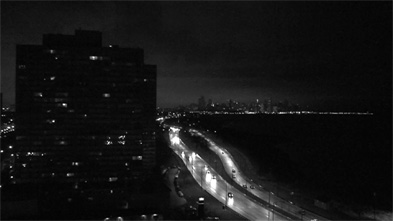
The silent, ultra-short black-and-white video IN [ TO is shorter than a video clip: it clocks in at 2 minutes, 47 seconds. It was made with material shot exclusively for the film, plus footage filmed `on the occasion`, while Downsbrough was working on other projects. One sees images from (South) Chicago, Brussels and Kent respectively, but since everything is filmed at night, only viewers who are familiar with the location will easily identify the spots. Here, the purpose is not to be specific about a site, to identify a place, or to document a certain location. Rather, Downsbrough gives an overall feeling of some quasi-archetypical `city at night`. The city is shot both as cityscape, from a distance, e.g. from outside the window of a Brussels apartment private building, or from nearer-by: a zoom-in from inside of the same building. IN [ TO contains many elements that define former Downsbrough films, both content-wise ? urbanism, cars, freeways and ring roads ? and formally: clean, `structural` framing, abstraction, the use of graphically inserted words. Here, as before, a phrase or a word game, almost hidden, can be discerned ? it might or might not be a key to the film. First, there?s the title of course, IN [ TO. Only at the very end, when the image is fading, the word TIME lights up, shortly. It seems like an indication of what time does: fading out light. Into time, the light fades out. A stream of cars passes by, only their head lights are visible. Everything else is dark, except for the horizon, with the outlines of distant buildings and hundreds of lights flickering: lit windows, neon publicity, street lights. At the film`s very end, a point of view shot from inside a car shows a road at night: Kent ? but it might be any city, or in between cities. To the left, trees; to the right, light posts; in front, the beam of the headlights, some other cars` rear lights. Then the image fades. TIME. The image`s gone. IN ] TO, with reversed bracket. Credits. - Steven Tallon -
Peter Downsbrough (1940, New Brunswick, N.J.; lives in Brussels) initially studied architecture but decided early on to work as a sculptor. Taking photographs of his trademark Two Pipes lead to taking photographs of ?cuts? that already existed in the urban landscape. Initially used in his books, they were shown in exhibitions from 1980 on. After having realized a few videos around 1978, Downsbrough took up filming again when he got a digital camera in 2002. In 1980, on the Spectacolor Board on Times Square, New York, he realized a 30-second spot shown once every hour for four days, and documented it in a short film, ?7 come 11.? His ongoing research of time, space and structure is further articulated through lines and letters in maquettes, wall and room pieces, and public commissions. Exhibitions include POSITION, 2003, curated by M.-T. Champesme, Palais des Beaux-Arts, Brussels (B), Espace de l?Art Concret, Mouans-Sartoux (F) and Muzeum Sztuki, Lodz (PL); Mamco, Genève (CH); FRAC Bourgogne, Dijon (F); SMAK, Ghent (B) and PETER DOWNSBROUGH: THE BOOK(S), curated by M. Küng, deSingel, Antwerp (B) which will have a second venue at Fabra i Coats, Barcelona (E) in the beginning of 2013.

Peter Downsbrough
THE [ AS
Vidéo | hdv | noir et blanc | 10:12 | USA, Belgique | 2016
Peter Downsbrough (1940, New Brunswick, N.J.) fait des études d’achitecture et d’art. Au milieu des années 1960, après quelques années de travail et d’exploration de divers matériaux, notamment le carton, le bois, l’acier, le plomb et les tubes de néon, sa pratique a évolué et trouve une forme différente, en 1970, dans les oeuvres "Two Pipes" (outside), "Two Dowels" (inside) et "Two Lines" (on paper).A la même époque, il commence à prendre des photographies de ses pièces. En prenant en photo sous différents angles et avec différentes distances, il commence graduellement à se concentrer sur les "coupes" existantes du paysage urbain. Certaines de ses photographies ont été publiées dans des livres, d’autres apparaissent dans des magazines, mais elles n’ont pas été exposées avant 1980. A partir de 1977, Downsbrough réalise plusieurs vidéos et des cassettes audio. Il a fait un disque en 1978 qui est sorti en 1982. Cherchant à étendre son vocabulaire pictural, il développe une série d’oeuvres avec des dés. En 1980, sur le Spectacolor Board de Time Square à New York, il réalise une pièce, un spot de 30 secondes s’allumant une fois l’heure pendant quatre jours, une performance qu’il documente dans un court-métrage « 7 come 11 ». Autour de 1980, il commence également à utiliser des cartes postales, en y dessinant deux lignes, suivi ensuite par l’utilisation de mots. Le travail avec des maquettes comme un moyen d’explorer l’espace et la structure commence vers 1983. Downsbrough a réalisé sa première commande publique à Rennes (France) en 1983 pour un espace mural. Le film "Occupied" a été produit en 2000, dis ans après qu’il a été conçu. Depuis, plusieurs films, tournés avec une caméra numérique, ont été édités en DVD. Aujourd’hui toutes ces disciplines font partie de son champ d’activité. L’intérêt de Downsbrough pour l’architecture industrielle prend beaucoup de forme. Plus souvent, la "préservation" signifie la survie formelle d’un film ou d’une série photo. Ses films et ses photos capturent toujours une réalité industrielle ou (sub)urbaine qui disparaîtra un jour où l’autre ou sera sujet à des réaménagements ‘ comme c’est le cas dans le Manhattan de la fin des années 1970 ou dans les zones industrielles de Kent, en Angleterre.

Peter Downsbrough
AND TO
Vidéo | hdv | noir et blanc | 3:1 | USA, Belgique | 2018
We don`t know where we are. We`re in a car, looking at other cars, roads, structures, tunnels – wasteland. Position? The Global Positioning System informs us, with its horde of satellites, orbiting Earth. Guiding us with its synthesised voice, transporting us, `translating` us. Telling us what to do. `After 250 meters, keep to the right on the Brudermühlstraße, then keep to the left.` (And so on, and so forth.)
Brussels-based Peter Downsbrough (born New Jersey, USA, 1940) has developed a highly distinctive, strongly cohesive body of work that includes sculpture, drawings, photographs, films, videos, books, wall pieces and room pieces, architectural maquettes, and sculptural interventions in public space. Frequently heightening his famously sparse visual vocabulary with an equally sparse linguistic component—often just a single word—Downsbrough calls attention to a vast landscape of structures both physical and social, cultural and political—that shape modern life.
Philipp Döring
Deutschland im Sommer
Fiction | 16mm | couleur | 13:20 | Allemagne | 2006
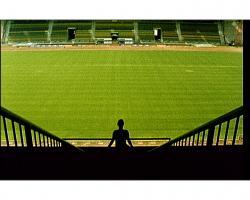
Germany, in the summer 2006: a woman is roaming around, torn between images of her past in the Red Army Faction and the flood of pictures of the world football championship. Her loneliness grows between the huge "public viewing" places and the giant screens, when talking to officials, and finally standig in front of the grave of Baader, Ensslin and Raspe. By associative montage the film tries to portray from ?behind the mirror? what Germany looked like in the Summer 2006.
Philipp Doering was born November 28th, 1977, in Freiburg, Germany. After high school one year of civil services in Hamburg. He studied German, Slavistics and Cognitive Science at the University of Freiburg, Germany. Since 2004 he studies film directing at the Film Academy Baden-Wuerttemberg in Ludwigsburg, Germany.
Philipp Döring
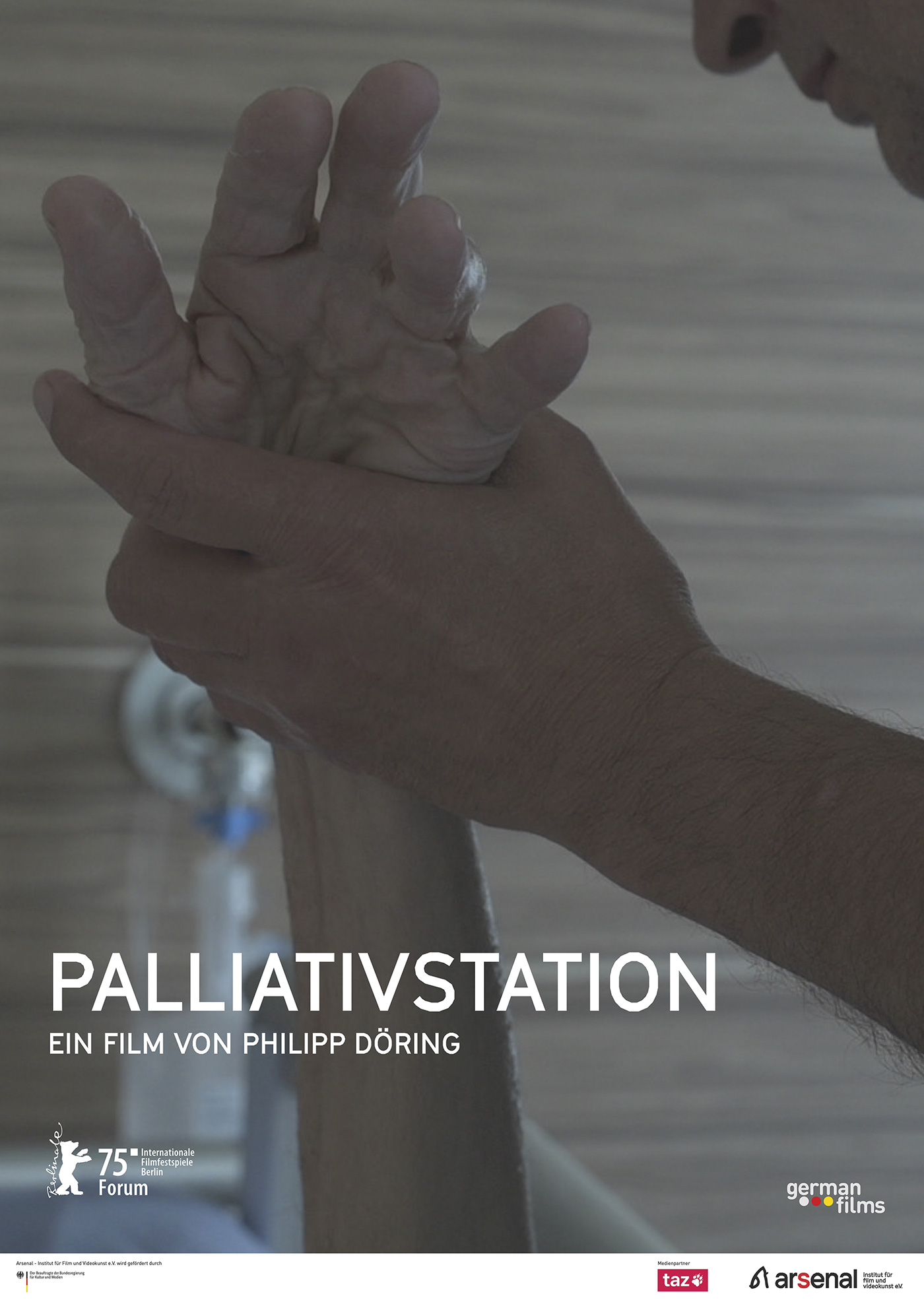
Palliativstation
Documentaire | hdcam | couleur | 245:33 | Allemagne | 2025
A film about people facing death. The film follows the everyday routines at the Palliative Care Unit at the Franziskus Hospital in Berlin. How do fatally ill patients face death? And how can you help them fill their remaining time with as much quality of life as possible?
Born 1977 in Freiburg. After high school, he first studied linguistics, then film at the Filmakademie in Ludwigsburg. His graduation film AM ANDEREN ENDE (At the Other End) received the First Steps Award for best film school film of the year, as well as the Deutscher Kamerapreis (German Cinematography Award). He realized several other short films, produced clips for NGOS, and worked for Luk Perceval at various theaters. Despite his love of long films, he makes a living from short clips for social media. PALLIATIVSTATION is his first feature-length documentary.
Philipp Döring
Kalypso
Fiction | dv | couleur | 15:20 | Allemagne | 2006
un court-métrage sur le thème de la séparation.
Philipp Döring est né le 28 Novembre 1977 à Freibourg, Allemagne. Après un baccalauréat à Bamberg il effectua un an de service civil à Hambourg, puis fit des études germaniques, slaves et de science cognitive à l´Université de Freibourg. Depuis 2004 il étudie la réalisation cinématographique à la Filmakademie Baden-Württemberg à Ludwigsburg, Allemagne.
Christoph Draeger
Black september
Vidéo expérimentale | dv | couleur | 1:0 | Grèce, USA | 2004
Robert Aliaj Dragot
Spring & Stalin
Doc. expérimental | dv | couleur | 8:30 | Albanie | 2006
"Spring & Stalin" is based on 27,000 stills photographed from the archives of the National Television in Tirana. The movie is accompanied by a poem from the writer, Ismail Kadare, which was published in "The teacher and the Art", 1953, p. 49- 53. It is a reflection on the mentality and nature of the transition period in the artist's home country. Kadare's poem is intentionally recited by an anonymous fictional voice that has no clue about poetry, not even about language, and it reads in a mechanical and computer-like manner, with a low rhythm and almost sleepy voice, which later on generates a chaotic tension to an growing stressed babbling. All this pandemonium unfolds the idea of false propaganda and governmental elite hypocrisy that in fact displays doubt in these images, which are not believed and understood even from those who see them. Here, the goal is not to stigmatize Kadare's work, but the veiling of that happy and idyllic in disguise reality, after which was hidden the drama of the persecuted people, unable to have the freedom of speech and the freedom of individuality; a people who tried to survive in a oppressed and isolated society.
Robert Aliaj Dragot, not only began as a painter, but his painting was also the point of departure for all the other activities he has manifested. At the end of 90's, after a long career as a pop star singer, he nearly stopped music altogether to go back to his first career as an art painter. Now many years later in Brussels, he is focused especially on a multimedia research, experimenting with photography, moving images, animations, sounds, and painting without losing the picturesque quality. His attention is divided between a critical curiosity of the artistic scene in Europe and a renewed interest for the shockingly fast therapeutic change that the Albanian state underwent.

Sam Drake
Suspicions About the Hidden Realities of Air
Doc. expérimental | 16mm | couleur et n&b | 9:9 | USA | 2025
Fragments d’archives d’événements presque trop sinistres pour être crus : des tests secrets d’irradiation menés par le gouvernement des États-Unis sur ses propres citoyens durant la guerre froide. Le film se confronte aux difficultés de documenter l’invisible, de saisir ce qui n’est que vagues et fréquences. Tourné sur pellicule périmée, c’est à travers l’image contaminée et un paysage sonore complexe que l’invisible se manifeste. Pendant la guerre froide, le gouvernement américain a développé un programme d’expériences radiologiques clandestines sur des êtres humains, utilisant ses propres citoyens comme sujets de test. Suspicions About the Hidden Realities of Air est une exploration elliptique de cet épisode historique sombre, circulant entre vastes paysages et corps humains individuels. Des fragments d’archives et des images en 16 mm — tournées sur pellicule expirée — évoquent les lieux de nombreux sites d’essais à travers les États-Unis. Des paysages urbains nocturnes, des scènes délavées du désert américain et des détails en gros plan de l’Amérique rurale s’entrelacent avec une voix off et des textes à l’écran renvoyant aux témoignages sur les effets persistants de cette période de tests secrets.
Sam Drake (née à Dayton, Ohio) est une cinéaste basée à Milwaukee, Wisconsin. Son travail a été présenté dans des festivals et lieux tels que le Museum of Modern Art, l’International Film Festival Rotterdam, Media City Film Festival, CROSSROADS, le Museum of the Moving Image, Alternative Film/Video, Collectif Jeune Cinéma, Non-Syntax Experimental Image, Winnipeg Underground Film Festival, Transient Visions Festival of the Moving Image et Antimatter. Elle a également assuré la programmation de l’Union Cinema et du Mini Microcinema, et enseigne actuellement à l’Université du Wisconsin–Milwaukee.

Sam Drake
Terminal Island
Doc. expérimental | 16mm | couleur | 12:51 | USA | 2024
Tracing a space between real and phantasmatic ecological dread, Terminal Island presents a multi-sensory portrait of a landscape in peril, an ambivalent lament for LA’s vanishing palms and a sermon on Doomsday infrastructure delivered to no one.
Sam Drake (USA) is a filmmaker based in Milwaukee, WI. Working with 16mm film and found media, her work embraces collage as a framework for interrogating contemporary life and landscapes. She received a BFA in Film from Wright State University, and an MFA from the University of Wisconsin-Milwaukee in Cinema Arts. Her work has been exhibited at film festivals and venues including International Film Festival Rotterdam, Doc Fortnight (MoMA), Media City Film Festival, ExiS, Edinburgh International Film Festival, Curtas Vila do Conde, CROSSROADS, Non-Syntax Experimental Image, Alchemy Film & Moving Image Festival, Collectif Jeune Cinéma, Winnipeg Underground Film Festival, Transient Visions Festival of the Moving Image, and Antimatter. She is currently a lecturer in Film, Video, Animation and New Genres at the University of Wisconsin-Milwaukee.
Veronika Dräxler
Traces of Life / How to Kill
Vidéo expérimentale | 4k | couleur | 15:45 | Equateur, Finlande | 2025
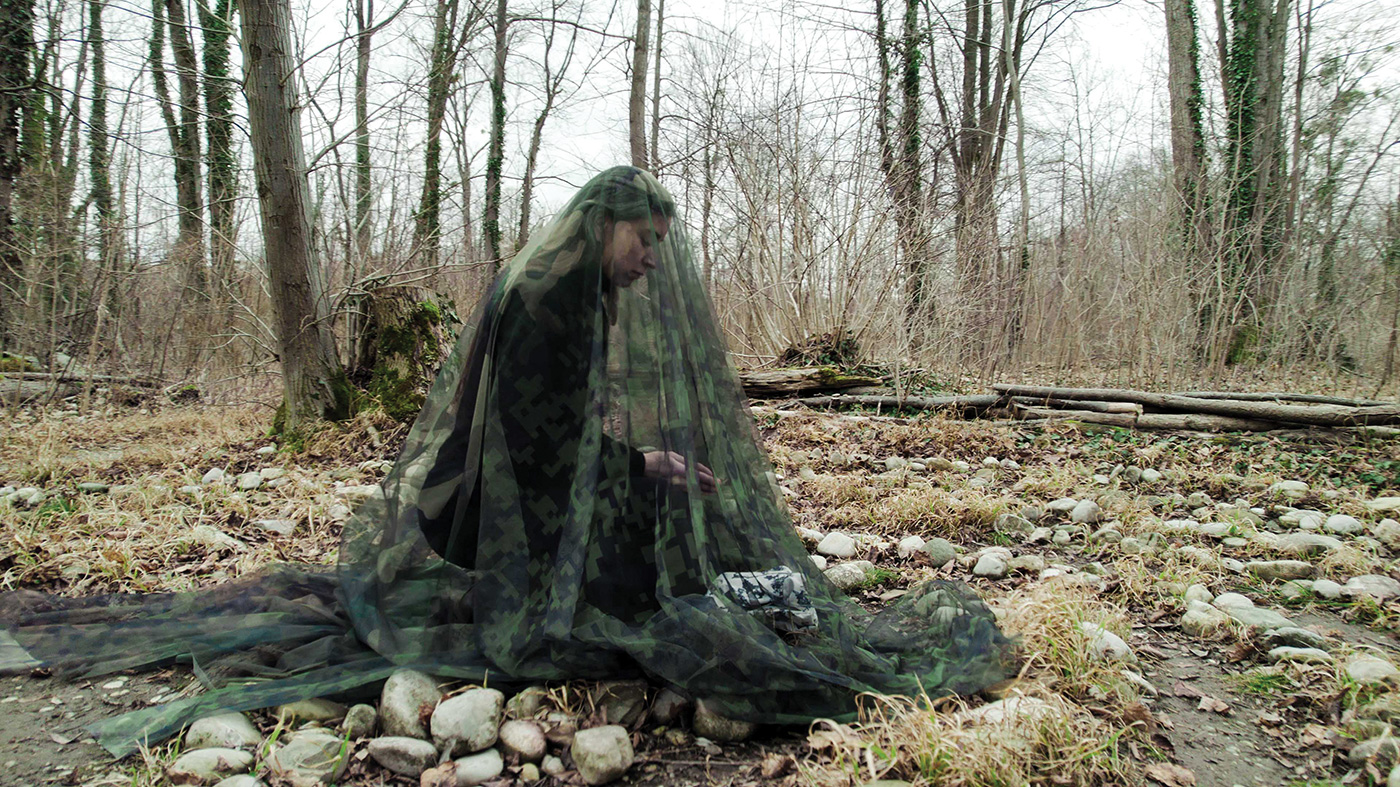
Traces of Life / How to Kill se déploie comme une trilogie poétique dans laquelle trois figures féminines — toutes incarnées par l’artiste — traversent des paysages marqués par la guerre, la mémoire et la survie. Des forêts glacées de Finlande au jardin de pierres en spirale en Allemagne, jusqu’aux ruines urbaines désertées de La Défense à Paris, le corps devient un réceptacle de mémoire, affrontant la violence par le geste et le silence. En tissant la performance, le film et des fragments de la Convention des Nations Unies sur le génocide, Veronika Dräxler compose un langage visuel de résistance — une méditation intime sur les traces que la guerre laisse dans le temps humain et géologique.
Veronika Dräxler est une artiste franco-équatorienne d’origine allemande, dont le travail explore la manière dont les corps et les paysages deviennent des archives vivantes du traumatisme, de la mémoire et de la survie. Travaillant entre Paris et Munich, sa pratique se déploie entre performance, essai et film expérimental, en interrogeant les traces visibles et invisibles de la violence historique, du déplacement et de la résilience. Par une approche interdisciplinaire et fondée sur la recherche, elle examine comment les histoires de conflit et de soin façonnent les identités, les architectures et les récits collectifs. Formée auprès de Klaus vom Bruch et d’Andrea Fraser à l’Académie des Beaux-Arts de Munich, puis diplômée comme Meisterschülerin d’Anna Anders à l’Université des Arts de Berlin, elle est actuellement doctorante au sein du programme SACRe à l’ENS–PSL à Paris. Sa thèse, intitulée Femme Sulfureuse, étudie la diplomatie féminine invisible, la politique de la mémoire et le corps résistant à l’intersection de l’art, de l’histoire et du cinéma. Ses œuvres ont été présentées au Museo Pumapungo (Équateur), à a.topos (Venise), à la Manifesta 11 (Zurich), au Kunstverein Grafschaft Bentheim, au ZKM Karlsruhe et au Festival Turicine (Quito). Elle a bénéficié du soutien de l’Union européenne, du Ministère bavarois des Sciences et des Arts, de la Stiftung Niedersachsen et de German Films, et a été distinguée par le Gouvernement fédéral allemand en tant que Kultur- und Kreativpilotin Deutschland.
Fabian Driehorst, Frédéric schuld
Hohenpeissenberg
Installation vidéo | 35mm | couleur | 0:0 | Allemagne | 2011
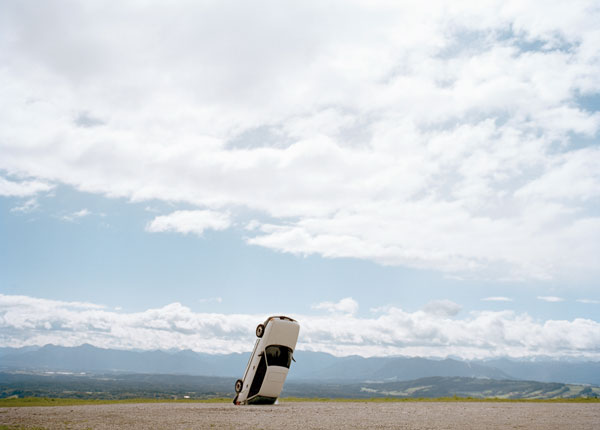
A car is burning in front of the Alps and swallows it`s smoke. Two screens, one scene: one backwards, one forward. The impact on the ground of the car falling from the sky and flying back to it is the point of synchronization of both film- channels. The car is disappearing and exploding loop after loop. The sound channels of both projections forward and backwards access into each other creates a collage of sound.
SHORT BIO Fabian & Fred: Fabian Driehorst & Frédéric Schuld studied together at Academy of Media Arts, Cologne (KHM) till October 2011. Hohenpeissenberg is one of a couple of works they created together in and alongside their studies at Academy of Media Arts. Frédéric worked as a designer for multimedia and Fabian worked as cameraman, editor and director of film productions. They work together as creative duo called Fabian&Fred. Fabian Driehorst (born 17.02.1982, Gifhorn) 2004-2011 freelance cameraman, director, editor 2006-2011 studied Film and Art at the Academy of Media Arts (KHM), Cologne 2011 founded creative atelier Fabian&Fred 2012-2013 scholarship of AV-Gruenderzentrum for Fabian&Fred 2011 till now Director, Author, Producer of art- and film projects. Frédéric Schuld (born 20.06.1985, Dusseldorf) 2004-2011 freelance designer for multimedia and film 2006-2011 studied Film and Art at the Academy of Media Arts (KHM), Cologne 2011 founded creative atelier Fabian&Fred 2012-2013 scholarship of AV-Gruenderzentrum for Fabian&Fred 2011 till now creative director of art- and film projects.

Driessens & Verstappen
Deep Dive
Création numérique | 0 | couleur | 7:35 | Pays-Bas | 2016
Deep Dive offers an endless zoom into a picture, revealing an infinitely detailed imaginary world that emerges from the original image. While zooming, the image is constantly being refined in real-time, and the viewer can steer this process by tracking points of interest with the cursor. Each new `dive` starts with a randomly downloaded picture from the online WikiMedia archive.
The artists couple Driessens & Verstappen have worked together since 1990. They attempt an art in which spontaneous phenomena are created systematically. Art that is not entirely determined by the subjective choices of a human being, but instead is generated by autonomously operating processes. In addition to working with natural processes, the couple develops computer programs for artificial growth and evolution. An important source of inspiration are the self-organising processes in nature which continuously create original forms. Works of Driessens & Verstappen are in collections a.o. Centre Pompidou Paris, Stedelijk Museum Amsterdam, Museum Boijmans van Beuningen Rotterdam. They exhibited at museums and galleries a.o. Kröller-Müller Museum Otterlo, IVAM Institute Valencia, Neue Pinakothek München, Eyebeam New York, Young Projects Los Angeles. The artists couple gave presentations at conferences such as Siggraph Los Angeles, Second Iteration Melbourne. In 1999 and 2001 they have won the VIDA award with their Tickle robot projects in an international competition for Art & Artificial Life. In 2013 the couple received the Witteveen+Bos Art+Technology Award for their entire oeuvre. Driessens & Verstappen are represented by DAM gallery Berlin.
Driessens & Verstappen
E-volved Formulae
Installation multimédia | 4k | noir et blanc | 10:1 | Pays-Bas | 2024
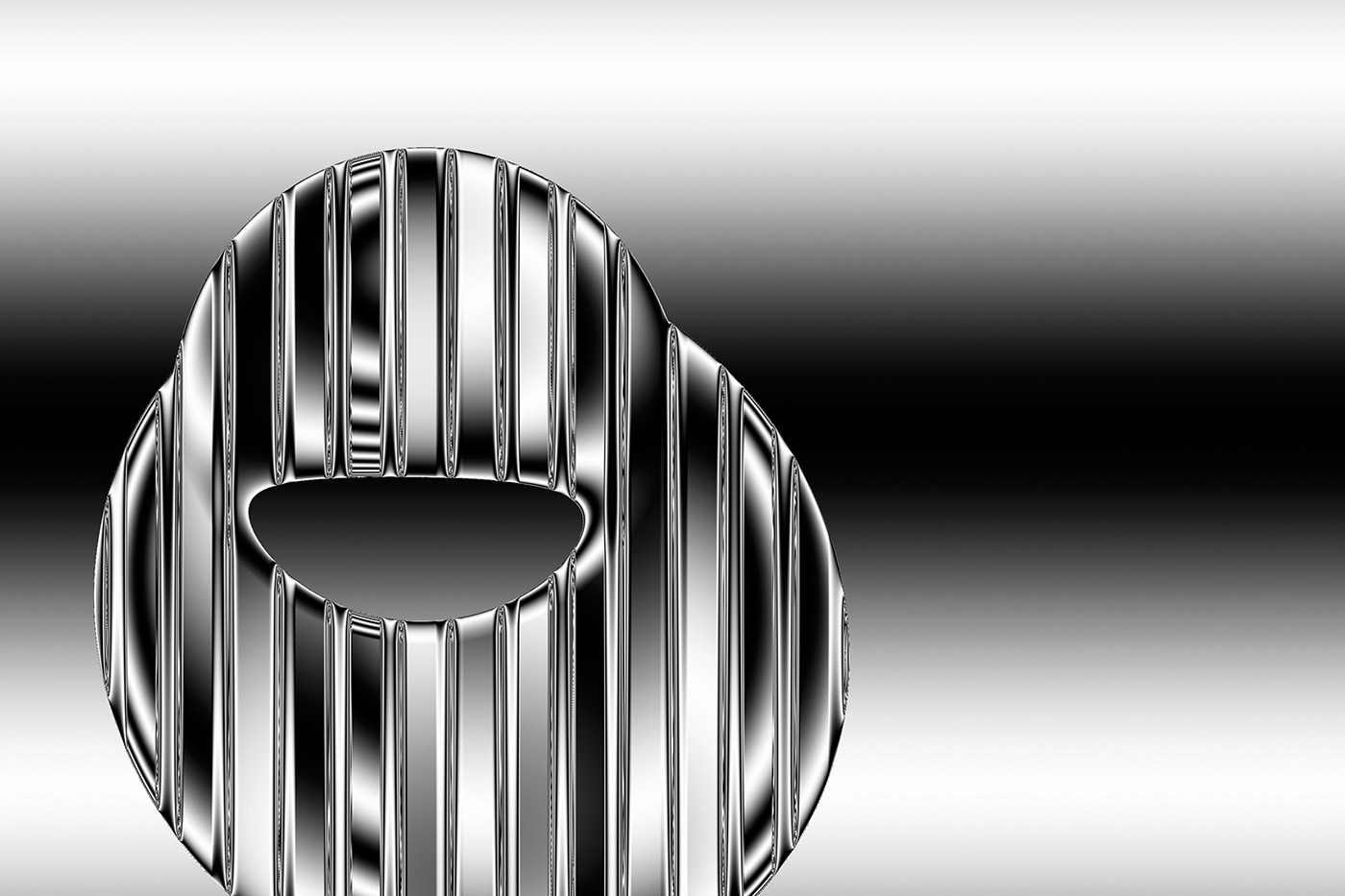
Le logiciel de génération d’images Formulae E-volver est développé par les artistes. Les éléments constitutifs du programme sont toutes sortes d’opérateurs mathématiques de base. À partir de ces éléments, l’ordinateur peut composer une infinité de formules valides. À chaque itération, un petit ensemble de formules est généré puis visualisé à l’écran. Le spectateur compare ces images animées entre elles et les évalue. En retour, le logiciel tient compte de ces évaluations lorsqu’il compose de nouvelles formules. Les formules affichées longtemps à l’écran ont davantage de chances de se croiser, permettant à leurs propriétés visuelles d’être mélangées puis transmises aux générations suivantes. Le processus commence par une « soupe primordiale » qui produit des images relativement simples. Sur la base des préférences personnelles de l’utilisateur, ce système évolue progressivement vers des animations complexes et intrigantes. Les résultats finaux, les E-volved Formulae, sont enregistrés puis affichés sur un grand écran ou projetés. Ils révèlent la grande variété d’images issues de ces processus évolutifs successifs.
Le couple d’artistes basé à Amsterdam, Erwin Driessens (1963, Wessem) et Maria Verstappen (1964, Someren), travaille ensemble depuis 1990. Après leurs études à l’Académie des beaux-arts de Maastricht puis à la Rijksakademie d’Amsterdam, ils ont développé conjointement un œuvre multiforme composé de logiciels, de machines et d’objets. Leur recherche porte sur les possibilités qu’offrent les algorithmes physiques, biologiques et informatiques pour la génération d’images. Une source d’inspiration essentielle réside dans les processus auto-organisés observables dans la nature. Dans la série Morphoteques (collections de formes), ils mettent en évidence les variations formelles pouvant émerger d’un processus génératif spécifique. Dans d’autres travaux, les transformations de formes sont produites en temps réel à l’aide d’une machine. Dans leurs projets logiciels et d’intelligence artificielle, ils développent une nature artificielle se déployant sous d’innombrables variations. Driessens & Verstappen ont participé à de nombreuses expositions aux Pays-Bas et à l’étranger, notamment au Stedelijk Museum d’Amsterdam, au Museum Boijmans Van Beuningen de Rotterdam, au Centre Pompidou (Paris), à l’IVAM Institut de Valence, au musée Kröller-Müller (Arnhem), au Garage Museum (Moscou), au CaixaForum (Barcelone) et à Eyebeam (New York). Le duo donne régulièrement des conférences et présentations dans des universités, écoles d’art, festivals et symposiums, parmi lesquels Siggraph Los Angeles, Sonic Acts Amsterdam ou encore Second Iteration Melbourne. En 1999 et 2001, leurs projets de robots Tickle ont reçu le premier prix au concours VIDA Telefónica de Madrid. En 2013, ils ont reçu le prix Witteveen+Bos Art+Technology pour l’ensemble de leur œuvre. Les artistes sont représentés par la galerie DAM à Berlin.

George Drivas
Empirical Data 2.0
Fiction expérimentale | hdv | noir et blanc | 30:0 | Grèce | 2019
"Empirical Data 2.0" est basé sur l'expérience personnelle d’immigration en Grèce de David Malteze, un acteur d’origine géorgienne, et sur sa trajectoire depuis son entrée dans le pays jusqu'à ses débuts d'acteur. Sur une moitié de l'écran, le protagoniste, David Malteze, joue son propre rôle, lors de ses premiers pas professionnels il y a dix ans. La reconstitution de la vie réelle de l'acteur est opposée à un monologue qu’il tient sur l'autre moitié de l'écran.
George Drivas est né à Athènes (Grèce). En 2017, il a représenté la Grèce à la 57e Biennale de Venise (Italie). Ses œuvres ont fait l'objet de diverses expositions individuelles, notamment à l'AnnexM / Megaron, Athènes (Grèce) [2020]; au National Museum of Contemporary Art, Athènes (Grèce) [2018 et 2009]; et à La Galleria Nazionale, Rome (Italie) 2017]. Il a reçu un hommage au Lumen Quarterly Festival, Pékin (Chine) [2017-2018], et au Festival international du film d'Athènes (Grèce) [2014]. Ses œuvres ont également été présentées dans le cadre d’expositions collectives et de festivals, notamment "back forward rewind", au Media Art Lab, Moscou (Russie); "Imagined Communities", à la 21e Biennial of Contemporary Art_Videobrasil, São Paulo (Brésil) [2019-2020]; "Resilient Futures", au CACT – Contemporary Art Center of Thessaloniki, Thessalonique (Grèce) [2018]; "ANTIDORON - the EMST Collection", à la documenta 14, Kassel (Allemagne) [2017]; "As Rights Go By", au Q21 International, MuseumsQuartier Wien, Vienne (Autriche) [2016], et au Festival du nouveau cinéma, Montréal (Canada) [2015]; "future past - past future", à la Transmediale, Berlin (Allemagne) [2014]; "Art Projections", à la Thessaloniki Biennale of Contemporary Art, Thessalonique (Grèce) [2013]; "Hybrid Stories", au National Museum of Contemporary Art, Athènes (Grèce) [2013]; "Melancholy in Progress", au Hong-Gah Museum, Taipei (Taiwan) [2012], au FILE – Festival Internacional de Linguagem Eletrônica, Centro Cultural FIESP – Federação das Indústrias do Estado de São Paulo (Brazil) [2012], et au Center on Contemporary Art, Seattle (USA) [2012]; "Polyglossia", au Onassis Cultural Centre, Athènes (Grèce) [2011]; "Digital Wave", au Thessaloniki International Film Festival, Thessalonique (Grèce) [2009]; "Young Greek Artists - In Present Tense", au National Museum of Contemporary Art, Athènes (Grèce) [2008]; et "Media Art Forum", au XXVII Moscow International Film Festival, Moscou (Russie) [2006].

George Drivas
Laboratory of Dilemmas
Vidéo | 4k | couleur | 10:38 | Grèce | 2017
Laboratory of Dilemmas is a narrative video installation based on Aeschylus’ theatre play Iketides (Suppliant Women), which poses a dilemma between saving the Foreigner and maintaining the safety of the Native. Addressing current global sociopolitical issues, the work deals with the anguish, puzzlement, and confusion of individuals and social groups when called upon to address similar dilemmas. Aeschylus’ Iketides (Suppliant Women) is the first literary text in history that raises the issue of a persecuted group of people seeking for asylum. The Suppliants have left Egypt to avoid having to marry their first cousins and arrive at Argos seeking asylum from the King of the city. The King is then faced with a dilemma. If he helps the foreign women, he risks causing turmoil among his people and going to war with the Egyptians, who are after the Suppliants. But if he doesn’t help them, he will break the sacred laws of Hospitality and violate the principles of Law and Humanism, leaving the Suppliants to the mercy of their pursuers. Laboratory of Dilemmas focuses on the play’s dilemma through the excerpts of an unfinished documentary in the form of found footage about a scientific experiment. This experiment was never completed for unknown reasons, however the found excerpts of the unfinished documentary reveal today, after so many years, details of the experiment, as well as the hopes of the professor who envisioned it and the disagreements with his co-researchers.
George Drivas a étudié les sciences politiques et l’administration publique à l’Université Kapodistrian d’Athènes, avant de poursuivre sa formation avec un master en film et médias à l’université libre de Berlin. Il réside actuellement à Athènes. L’artiste réalise des vidéos combinant textes, vidéos et photographies. Il fait de la photographie un outil de surveillance, semblant toujours se cacher de ses sujets. A travers les thèmes qu’il aborde - l’aliénation, l’inclusion sociale, la promesse, ou la déception – il cherche à faire émerger les relations interpersonnelles d’une société sous surveillance. Il a été récompensé par de nombreux prix, dont celui du meilleur film expérimental au festival du film grec de Londres (2010), et une mention spéciale au festival de films et vidéos expérimentaux du Musée d’art contemporain de Macédoine (Grèce, 2009). Il a également obtenu un second prix au VIIème Media Art Forum, au XXVIIème festival international du film de Moscou en 2006, ainsi qu’au Zebra International Poetry Film Festival de Berlin (2002). Exposé notamment à « Antidoron – The EMST Collection » à Kassel en Allemagne (2017), son travail a été présenté par de nombreuses institutions, en Grèce (Musée national d’art contemporain d’Athènes en 2013 et 2009, Festival international du film d’Athènes en 2014, Biennale d’art contemporain de Thessalonique en 2013) ; au Festival du nouveau cinéma de Montréal (2015), à la Transmediale (Berlin, 2014) ; au Hong-Gah Museum de Taiwan (2012) ; au festival international Electronic Language FIESP au Cultural Center de Sao Paulo (2012), ou encore au Centre d’Art Contemporain de Seattle (2012).