Catalogue > Search
Results for : Tout le catalogue
Karel Doing
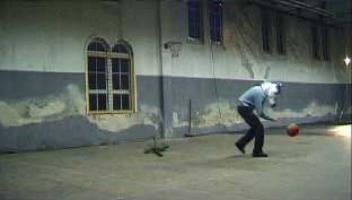
Happy Horse 1 & 2
Experimental video | dv | color | 4:30 | Netherlands | 2004
Sportive activities in which a horse tries his luck.
Duro Toomato was born in Croatia in 1960. He works as a visual and performance artist and filmmaker. He lives and works in Amsterdam.

Karel Doing
The King of Nogaria
Experimental doc. | super8 | color and b&w | 5:0 | United Kingdom | 2018
A speculative parable about a gentle autocrat of a non existent country. After running into trouble he starts a new life in the shadows of his kingdom. The film is a collage of super 8 footage from the artist`s personal archive gathered over the years.
Karel Doing is an independent filmmaker with a particular interest in Utopia. He has been creating films, performances and installations for almost 30 years, building a diverse oeuvre that balances between dream and reality and combines documentary with materiality. His work has been shown widely in cinemas, clubs, museums and galleries. He is currently based in Cambridge, UK.
Dimitris Dokatzis
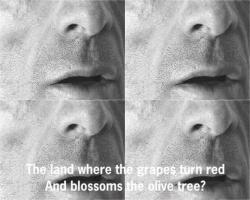
That time
Art vidéo | dv | black and white | 8:39 | Greece | 2003
Curriculum Vitae Né à Athènes en 1958. A étudié les Beaux-Arts à l´Ecole d´Art Byam de Londres entre 1978 et 1982, et le cinéma à l´Ecole Internationale du Film de Londres entre entre 1982 et 1984. Il a tenu huit expositions solo à Athènes, Thessalonique et Corfou, et a participé à de nombreuses expositions collectives (Metaichmion `80-`90, Gallerie Municipale, Athènes 1989 / Assault on the Senses, Fondation DESTE, House of Cyprus, 1991 / Sculpture Biennale, Skironeio Museum, 1992 / Art Athina, 1993, 1994, etc).

Júlio Dolbeth, Steinbrüchel
AM/FM
Experimental video | dv | black and white | 2:0 | Portugal | 2005
AM-Fm, 2 bands of communication, 2 characters dissolving into each other. I felt the sound like a growing tree.
Julio Dolbeth, lives and works in Porto, Portugal. Teaches Communication Design at the Faculty of Fine Arts, University of Porto. Degree in Graphic Design. MFA in Multimedia-Art untitled ?Artificial Skin?. Works as Graphic Designer, Illustrator and Video Artist. Regular collaborator with DifMagazine (Portugal).
Mischa Dols
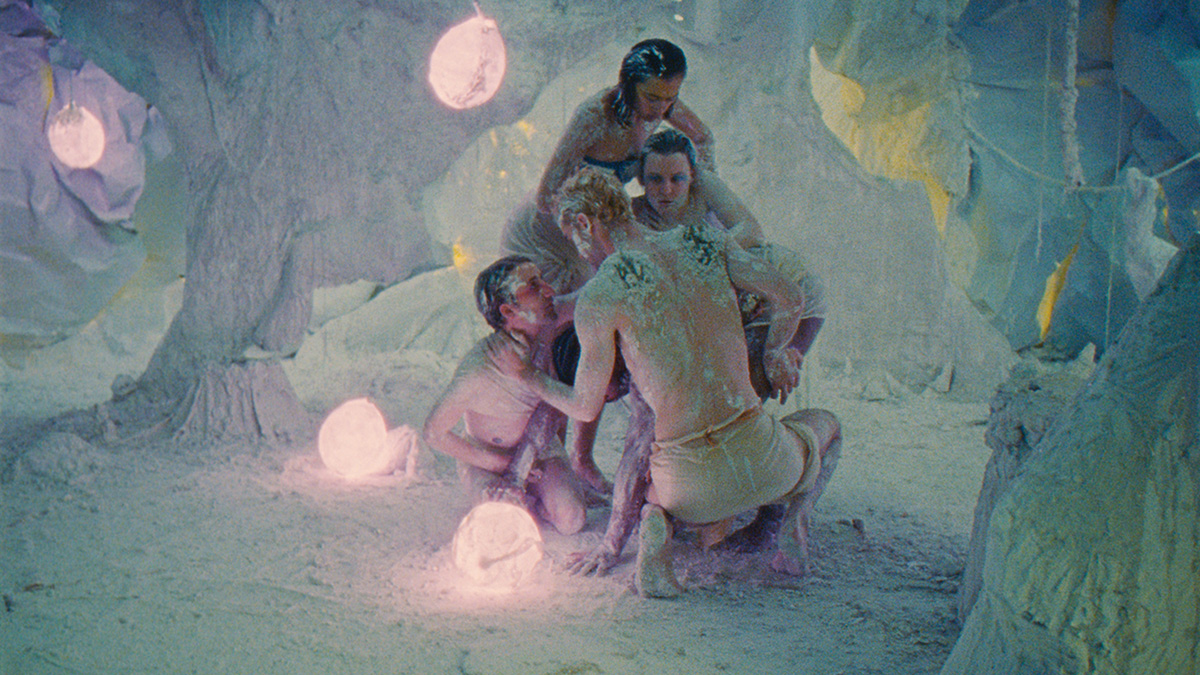
Online Bodies
Experimental film | 16mm | color and b&w | 19:47 | Netherlands, Belgium | 2022
Online Bodies seeks to explore the manifestation of the body in virtual spaces. The film consists of seven short non-causal parts, each showing a different angle on the online body. The film passes along bodies in transition: a deepfaked porn actor, a 3D model that wishes to be reproduced, a group of genetically modified humans that live inside an alien, four friends discussing cyborg modifications, a body that cannot get up an escalator. Collectively, they highlight the space in between the physical and virtual.
Mischa Dols (1996) is an experimental filmmaker born in Amsterdam. After graduating from LUCA school of arts in Brussels, they have a practice converging cinematic and online visual languages.
Yana Dombrowsky-m
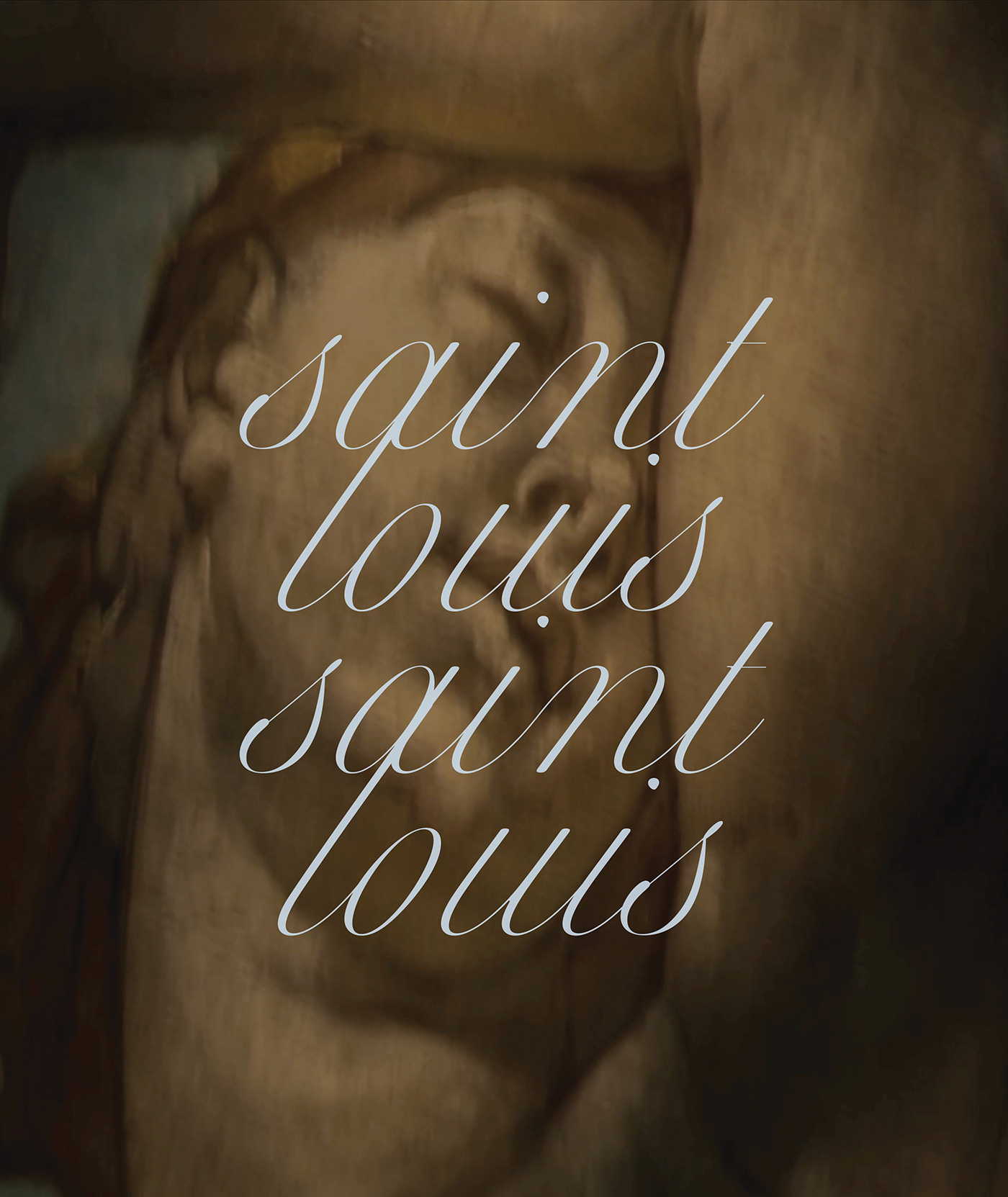
Saint Louis Saint Louis
Experimental doc. | 0 | color | 26:44 | France | 2024
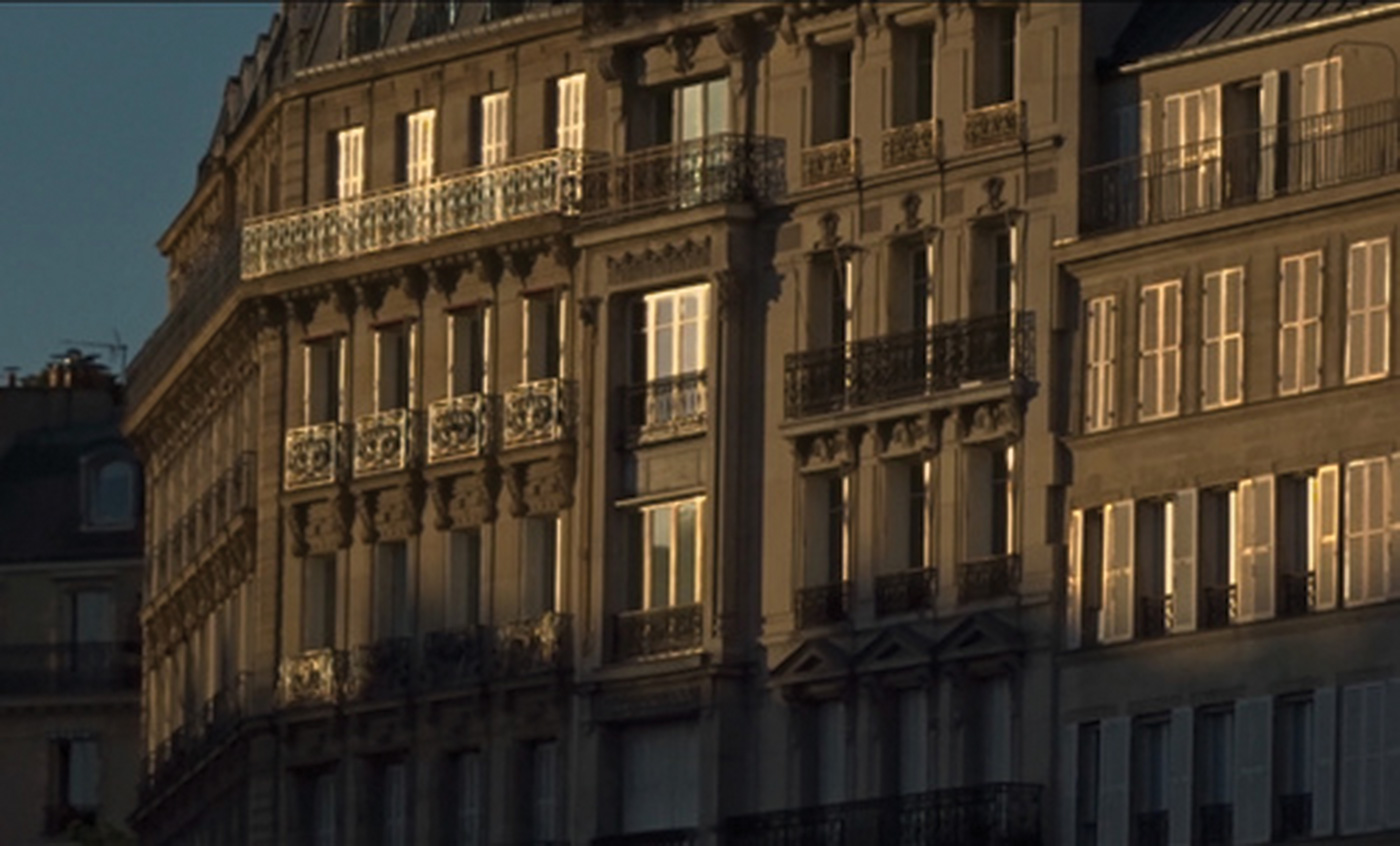
In the 21st century, you returned to the archipelagos Saint Louis of Sénégal, and Saint Louis of Paris to unearth vestiges of signares—women once at the centre of Occidental French West African commerce and society. Through the night, through the whispers of your aunts and nieces, through the institutions that house present-day French “patrimoine (cultural heritage),” you fell into a spiral between colonial presents and the past.
Yana Nafysa Dombrowsky-M’Baye is a pluridisciplinary researcher and educator from T?maki Makaurau, Aotearoa. Her matrilineal ancestry traces to Senegal and France, while her patrilineal lineage is of Polish and Czech descent. Through iterative and ritualistic processes, Yana’s practice is a poetic inquiry into the material and immaterial conditions of belonging, approaching artistic practice as archaeological gesture, unearthing the spectral, often erased presence of intercultural identities embedded in sites marked by colonial history and personal heritage.At present, Yana is at the Cité Internationale des Arts Paris, participating as one of ten internationally selected artists in the In Situ program, which will conclude March 2026.
Yana Dombrowsky-m’baye
saint louis saint louis
Experimental film | mp4 | color | 26:45 | New Zealand, France | 2024
In the 21st century, you returned to the archipelagos Saint Louis of Sénégal, and Saint Louis of Paris to unearth vestiges of signares—women once at the centre of Occidental French West African commerce and society. Through the night, through the whispers of your aunts and nieces, through the institutions that house present-day French “patrimoine (cultural heritage),” you fell into a spiral between colonial presents and the past.
Yana Nafysa Dombrowsky-M’Baye is a pluridisciplinary researcher and educator from T?maki Makaurau, Aotearoa. Her matrilineal ancestry traces to Senegal and France, while her patrilineal lineage is of Polish and Czech descent. Through iterative and ritualistic processes, Yana’s practice is a poetic inquiry into the material and immaterial conditions of belonging, approaching artistic practice as archaeological gesture, unearthing the spectral, often erased presence of intercultural identities embedded in sites marked by colonial history and personal heritage. At present, Yana is at the Cité Internationale des Arts Paris, participating as one of ten internationally selected artists in the In Situ program, which will conclude March 2026.
Jan Domicz
To My Friends. Next Room (Hotel Monterey)
Video | dcp | color | 8:57 | Poland | 2021
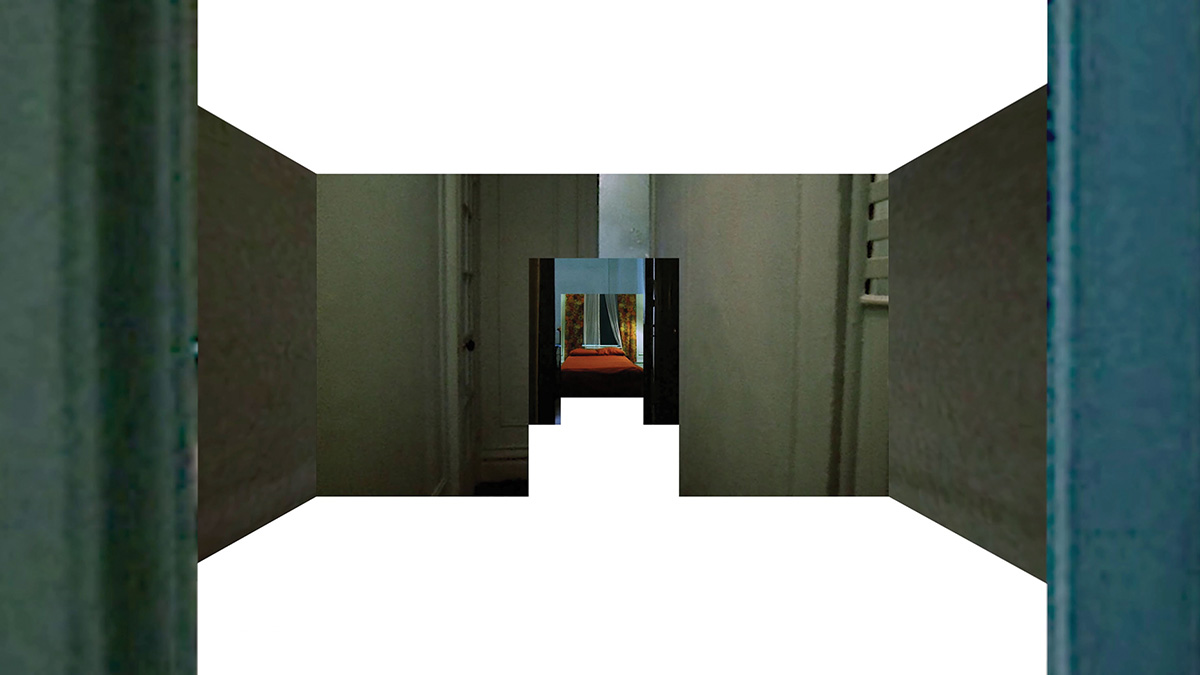
Film is made out of rooms (scenes) and a corridor (timeline). It tells a story about creation of a utopian commune. The fate of which is closely intertwined with the history of the place it occupies, the economy and the director's vision. The typology of the apartment occupied by the protagonists turns out to be more durable than the need to change the function of this place. Architecture, social status and structure of the film become closely intertwined. All camera shots used in the film come from the 1973 movie „Monterey Hotel” by Chantal Akerman.
Jan Domicz (1990. Opole/Poland) visual artist, author of videos, objects and exhibitions. In his works, he uses the narrative potential of both architectural and social space. His works were shown at the Architecture Biennale in Venice and at Museum für Moderne Kunst in Frankfurt, Museum of Modern Art in Warsaw, Arsenal Gallery in Pozna?, Neuer Essener Kunstverein and SALTS in Basel. Domicz is a graduate of the Staedelschule in Frankfurt and the University of Arts in Poznan. He is represented by Gallery Wschód in Warsaw. In addition to artistic practice, he has been running the quasi-curatorial project Office for Narrated Spaces since 2017. He works and lives in Warsaw.

Lisa Domin
Car Care
Experimental doc. | 16mm | color and b&w | 11:45 | Germany | 2015
Cars were invented. Now they exist. We care about them. Therefor they drive. They still exist. I can see them. It’s like a glimpse to the past. Actually they don’t exist any more. This way of transport is still alive only with the help of enormous effort. Soon they won’t be here any more. The sound won’t be here. The smell won’t be here. But so far they are here, like dinosaur. There are different types. During the last century different cars were developed on different continents. Dreams got a shape. Or they are used pragmatical. Are these still the same old story of desires which are driving around then?
lives and works since 2012 in Dortmund, Germany before in Budapest, Istanbul and Berlin studies 2011-2012 „Meisterschülerin“ of Dörte Eißfeldt 2004–2009 Diploma Fine Arts, University of Art, Braunschweig, DE classes of Hannes Böhringer (Art Philosophy), Prof. Dörte Eißfeldt (photography and film), Guy Ben-Ner (Performance) 2007 visiting student at Moholy-Nagy University of Art and Design, Budapest, HU
Chus Dominguez
CATALOGO DE ESCENARIOS PARA LA MUERTE DE PIER PAOLO PASOLINI
Video installation | hdcam | color and b&w | 48:0 | Spain, Italy | 2011
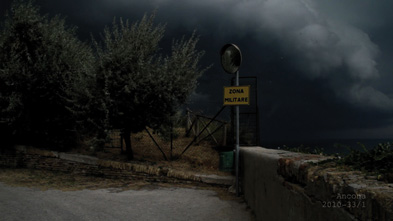
Following the trip Pasolini made in 1959 along the entire coast of Italy as a reporter for the magazine Sucesso, were located different places as possible scenarios for his death. Understanding cataloging as a tool that allows us to organize knowledge for recovery, this catalog offers the viewer the possibility of redemption of the rebellious individual or the questioning of our acceptance of the critical difference.
Chus Domínguez (León -Spain- 1967) Visual artist who uses video and film as tools and documentary as language. Work with elements coming directly from reality to construct a narrative from them are among experimental and poetic. Their video-and film pieces have toured international festivals.
Chus Dominguez
PIXELACION LABORAL
Experimental video | dv | | 6:0 | Spain | 2011
Architecture is a hunt for harmony in the chaos, a way of putting order in the universe through the creation of regular angles. The severity of the forms of a Francoist building ? the Universidad Laboral in Gijón ? is distilled and decomposed into its patterns
Chus Domínguez (León -Spain- , 1967) Visual artist who uses video and film as tools and documentary as language. He works with elements coming directly from reality to develop artistic works between documentary, experimental film and poetry. His video and film pieces have toured numerous international festivals.
Johanna Domke
Crossing Fields
Art vidéo | | color | 12:14 | Germany, China | 2007
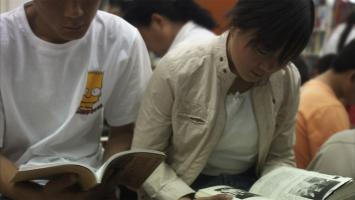
?Crossing fields,? emphasizes upon the private use of commercial space and documents reading people in a bookstore. The video was filmed in a bookshop in Beijing, as this phenomenon is broadly common in mayor cities in China. Due to obsolete libraries, bookstores function as an open source of knowledge, which attracts crowds of people to spend their free time in the sometimes gigantic bookstore complexes. But instead of buying the books people spend entire days, sitting and reading thronged together, spread around the store. As the management approves this, the reading people?s private use of space is becoming prevalent to the commercial activity in the store. Johanna Domke is interested in this kind of anarchic use of space and the depiction of stasis evolving within the situation. Winding its way through the statue-like readers the camera captures with close and intimate images the ambiguity of their presence. Being physically present they sojourn at the same time in the fictive sphere of their reading. The immobile appearance of the readers leaves the impression that the camera is moving within a frozen moment of time.
After studying art at the Muthesius Academy for Art and Design in Kiel, Johanna Domke went on to graduate studies at the Royal Art Academy in Copenhagen and the Malmö Art Academy, Sweden, where she got her MA in 2004. In 2003 she received the ZKM International Media Art Award, Audience Prize, for her single-channel piece ?Let the wind blow? and the Brockmann Prize from the Stadtgalerie Kiel. 2004 she got the Edstranska Grant for Graduating Students. Since then Domke has broadly exhibited her work in renowned art institutions, such as Casino Luxembourg, Göteborg Konstmuseum, KIASMA Museum of Contemporary Art, Helsinki and international film festivals such as Film festival Oberhausen, Locarno Film Festival, Videonale at the Bonner Kunstmuseum and VIPER, Basel.
Johanna Domke
Cuers
Art vidéo | | color | 18:5 | Germany | 2008
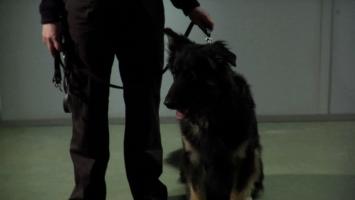
Johanna Domke?s film Cuers is inspired by Franz Kafka?s The Trial and the filmic universe of Orson Welles. The audience is taken on a fleeting and meandering journey through different sites in public space, where people are exposed to long waiting. The individual is presented as a singular being, confronting structures of public space. The particular situations are represented in an inspirational manner shifting in and out of each other. Time and space is dissolved in kaleidoscopic pictures, which emphasizes how we physically as well as mentally have trouble adjusting to our anonymous environment. ? Cuers? seeks to create a mental space through abstraction and subversion of the familiar.
After studying art at the Muthesius Academy for Art and Design in Kiel, Johanna Domke went on to graduate studies at the Royal Art Academy in Copenhagen and the Malmö Art Academy, Sweden, where she got her MA in 2004. In 2003 she received the ZKM International Media Art Award, Audience Prize, for her single-channel piece ?Let the wind blow? and the Brockmann Prize from the Stadtgalerie Kiel. 2004 she got the Edstranska Grant for Graduating Students. Since then Domke has broadly exhibited her work in renowned art institutions, such as Casino Luxembourg, Göteborg Konstmuseum, KIASMA Museum of Contemporary Art, Helsinki and international film festivals such as Film festival Oberhausen, Locarno Film Festival, Videonale at the Bonner Kunstmuseum and VIPER, Basel.
Johanna Domke
Let the wind blow
Art vidéo | 0 | color | 3:19 | Germany, Costa Rica | 2003
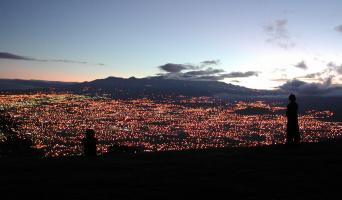
On top of a windy hill, two motionless human figures overlook a valley with a teeming big city. One is standing up, the other sits on the ground, the distance between them too large to evoke a sense of togetherness. The clouds race across the sky, the night falls like a brick and thousands of lights gleam at once in the valley before dawn breaks, the sun flies up and a new day begins. All the while, the two figures remain absolutely still before the unfolding scenery. Only the wind blows in their clothes and their hair.
Johanna Domke, born 1978 in Kiel, Germany, lives and works in Copenhagen, DK and Berlin,D. She is a german artist based in Copenhagen and Berlin. After studying Fine Art at the Muthesius Academy for Art and Design in Kiel, Johanna Domke went on to graduate studies at the Royal Art Academy in Copenhagen and the Malmö Art Academy, Sweden, where she got her MA in 2004. In 2003 she received the ZKM International Media Art Award, Audience Prize, for her single-channel piece ?Let the wind blow? and the Brockmann Prize from the Stadtgalerie Kiel. 2004 she got the Edstranska Grant for Graduating Students and the Assistent Grant from the Swedish Arts Council. Johanna Domke`s work has been broadly shown in exhibitions, video festivals and art fairs in Europe and the US. She is represented by Gallery Art Agents in Hamburg.
Johanna Domke
Søen i spejlet
Experimental fiction | 16mm | black and white | 20:22 | Germany, Denmark | 2009
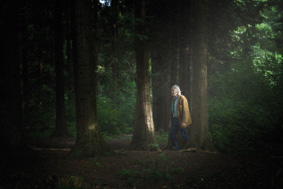
?Søen i spejlet? is the re-enactment of a former boarding school tradition in Denmark. Once a year the students of Sorø Academy held a ritual out in the woods, burning effigies of their teachers on a bonfire. The narrative of the film evolves around the character of a former student that revisits the place of his school days meeting with a group of young students. What first seems to be the fictionalization of the former student´s memory, becomes more and more the documentation of the staging of the ritual ? the alumni himself being the director. But as soon as the ritual sets off, all turns to a different state of realness, as the anger and emotion of the young students boil up to an uncanny level of authenticity.
After studying Fine Art at the Muthesius Academy for Art and Design in Kiel, Johanna Domke went on to graduate studies at the Royal Art Academy in Copenhagen and the Malmö Art Academy, Sweden, where she got her MA in 2004. She received the ZKM International Media Art Award, Audience Prize, for her single-channel piece ?Let the wind blow? and the Brockmann Prize from the Stadtgalerie Kiel. 2004 she got the Edstranska Grant for Graduating Students. Since then Domke has broadly exhibited her work in renowned art institutions, such as Casino Luxembourg, KIASMA Museum of Contemporary Art, Helsinki, Berlinische Galerie and international film festivals such as Film Festival Oberhausen, Locarno Film Festival, Videonale at the Bonner Kunstmuseum and the Kunstfilmbiennale.
Johanna Domke
Stultifera Garden
Experimental fiction | | color | 12:5 | Germany | 2008
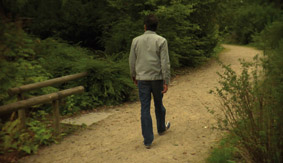
Stultifera Garden deals with an overlapping structure of the public and the private. The film is set in a park ? a place were city dwellers recover from busy urban life. At the same time it is a place implementing the ?elsewhere? - an un-ruled territory for individuals who are in conflict with society or the human milieu in which they live. It is also a place for individuals whose behaviour is deviant with the respect to the mean or the required norm. As in earlier works, Domke uses a travelling camera to approach the parks diverse character, emphasizing polarities as observing and being watched, high and low culture, control and non-control. The incessant pan evolves from a classic park scenario towards a dystopic, mazy structure of trails. The camera experiences different milieus of the park not directly examining them but portraying them with an inexplicit openness. She accesses milieus that formed architectonical structures in the shrubs, such as cruising areas and drug trafficking points. She discovers places that became functionalised entities - for teens as a get-away, for elderly as a meeting point - each and everyone with their own character and history. Without stating explicit action or narrative Stultifera Garden is more interested to explain that a park is a place for the other, where all these milieus and facets function along side. Intruding as an omniscient eye, Domke is constructing the real to establish the fictitious.
After studying art at the Muthesius Academy for Art and Design in Kiel, Johanna Domke went on to graduate studies at the Royal Art Academy in Copenhagen and the Malmö Art Academy, Sweden, where she got her MA in 2004. In 2003 she received the ZKM International Media Art Award, Audience Prize, for her single-channel piece ?Let the wind blow? and the Brockmann Prize from the Stadtgalerie Kiel. 2004 she got the Edstranska Grant for Graduating Students. Since then Domke has broadly exhibited her work in renowned art institutions, such as Casino Luxembourg, Berlinische Galerie, KIASMA Museum of Contemporary Art, Helsinki and international film festivals such as Film festival Oberhausen, Locarno Film Festival, Videonale at the Bonner Kunstmuseum and Kunstfilmbiennale, Köln.
Johanna Domke
Sleepers
Art vidéo | dv | color | 13:40 | Germany, United Kingdom | 2006
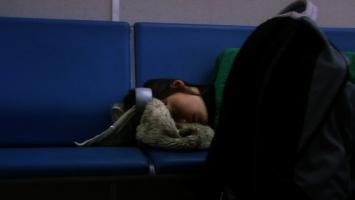
?Sleepers? takes place at Stansted Airport in London in the very late night and portrays sleeping people with slowly panning camera moves. The slow takes emphasise with the passenger?s tiresome waiting for an early morning flight. Within this physical location Domke grips a real, temporal situation that shows the airport as a form of standstill. The video follows a sequence of sleeping people in a transit situation. But even if they are in transit they undergo a present standstill that deludes oneself into a void, where one is not quite sure how the situation will progress. With the interest of this kind of void Johanna Domke evolves her artistic praxis within the time-based media of film and the photographic still image, which on a conceptual level can be seen as a distortion of time and movement. A hybridisation, that opens up for other relations and references.
Johanna Domke was born in 1978 in Kiel. After studying Fine Arts at the Muthesius Academy for Art and Design in Kiel, Domke went on to study at Malmö Art Academy, Sweden and the Royal Danish Art Academy in Copenhagen, where she received her MA in 2006. In 2003 Domke received the Audience Prize at the ZKM International Media Art Award for her work Let the wind blow, as well as the Brookmann Prize from Stadtgalerie Kiel. In 2004 Johanna Domke was awarded the Edstranska Stiftelsen?s Grant for Students in Sweden. Since then, her work has been shown in major institutions in Europe and elsewhere, including the Hasselblad Center, Gothenburg; Göteborg Konstmuseum, Gothenburg; KIASMA Museum of Contemporary Art, Helsinki; Casino Luxembourg, Luxembourg and Bonner Kunstmuseum, Bonn. Furthermore, her works have been screened at film festivals such as European Media Art Festival 2003/2008 Osnabrück; Locarno Film festival 2006, Locarno; Oberhausen Film Festival 2007, Oberhausen and Rencontres Internationales 2005/2007, Berlin and Paris. Domke lives and works in Copenhagen and Berlin.
Arnaud Dommerc
le cochon
| | color | 55:0 | France | 2010
During three days, in the mountains of Corsica, men slaughter and process the pig.
Arnaud Dommerc was born in 1971. He has been teaching cinema at the Paris 8 Universty since 2001. He has worked since 2007 as assistant with Jean-Marie Straub (Le genou d?Artémide, Itinéraire de Jean Bricard, Le Streghe, O Somma Luce, Joachim Gatti, L?Inconsolable, L?Héritier). His last film We?ll nerver go to Buti was selected in competition at the FID 2008 and at the Rencontres Paris / Berlin / Madrid 2009.

Arnaud Dommerc
NOUS N'IRONS PAS A BUTI
Documentary | dv | color | 38:0 | France | 2008
From Cannes to Buti, from Livorno to Livia, looking for Jean-Marie Straub. About cinema and theatre in May... and love also.
Born 1971 in Tarbes. Childhood in the countryside, South-west of France. Law studies. His first film "Solo Tu" (56 `), directed in 1997 with Anne Benhaïem, was selected by the main important international film festivals like Rotterdam, Karlovy Vary, Dublin, Bombay, Rome, Bergamo, or the ACID program in Cannes... "Solo Tu" came out in theatres in France on September 30, 1998 and received enthusiastic reviews. Also, it received the Special Mention of the Jury of the Price George and Ruta Sadoul 1998. Prize winner in 1998 of the Louis Lumière Grant ? Villa Médicis for a project on the american filmmaker and poet Jonas Mekas, he concurently works as a part-time lecturer at the Paris 8 University (directing anf editing workshop) since October 2001. Assistant Director on many films, he particularly collaborates with Jean-Marie Straub ("The Knee of Artemide", "Intinéraire de Jean Bricard", "Le Streghe" as well as Jean-Marie and Arnaud Larrieu ("Le voyage aux Pyrénées", forthcoming "The last days of the world"). In addition, he achieves a singular experience as producer within the company he created in 2001 : ANDOLFI.
Charles Domokos, Neil Reichline, Bob Silverthorne, Charles Attila Domokos
Heroes of Conscience - U.S. Non Violence Actions
Experimental doc. | 16mm | black and white | 95:0 | USA | 2009
HEROES OF CONSCIENCE: THE U.S. ?NON-VIOLENCE? PEACE MOVEMENT (FRENCH, SPANISH & GERMAN PREMIERE PROGRAM) DAVID HARRIS, POLITICAL PRISONER (25 min) (1971; 16mm; b&w; DVD) ?David Harris, Political Prisoner? was made at the height of the anti-Vietnam War Resistance movement in the United States. The film records the logic of Resistance through interviews with U.S. political activist David Harris and through the final speech Harris made before he was sent to federal prison. This film was used as an organizing tool for the Resistance. Harris, who married folk singer Joan Baez before he went to jail, was the leading spokesperson for the Resistance and his words and actions still resonate today in an increasingly violent world. The film aired on KCET TV in Los Angeles and on other PBS stations around the U.S. along with an interview by director Taylor Hackford after Harris was released from U.S. federal prison. Filmmaker Neil Reichline made a number of films on anti-war and non-violent themes. He also has worked extensively as a Director of Photography. Neil Reichline: Filmmaker ____________________________ THE RESISTER (30 min) (1971; 16mm; b&w/sepia; DVD) Bill Garaway, a Los Angeles draft resister, receives a five year prison sentence and is released on bail while he files a court appeal. This film is a document of the intellectual and emotional climate of the early nineteen-seventies time period. It is a study of the changes the U.S. anti-war movement goes through in the six-month period Bill Garaway is out on bail waiting the results of his court appeal. This film is the story of an activist?s efforts to remain committed to non-violence amidst increasing violent political action. ?The Resister? documents six months in the life of Bill Garaway as he waits out his appeal on a draft evasion conviction. It is the story not only of Garaway, but an entire generation of young people who began by protesting Vietnam and have ended up creating a counterculture.? (Kevin Thomas, ?Los Angeles Times? review) San Francisco Film Festival, 1971; Broadcast on PBS /KQED-TV, San Francisco. Charles Domokos, Filmmaker ____________________________ TOGETHER AT THE INSTITUTE FOR THE STUDY OF NON-VIOLENCE (35 min) (1970; 16mm; b&w; DVD) This film documents the early days of one of the first American organizations to put Gandhi?s non-violent political ideas into practice in the United States. Singer, Joan Baez, and political activist, Ira Sandperl, organized the ?Institute for the Study of Non-Violence" to channel progressives? frustration into political action. The Institute organized draft resisters against the U. S. armed forces during the Vietnam war era. The film follows several draft resisters as they prepare to go to prison to serve sentences for non-cooperation with the U.S. armed forces. The narration also examines the role American Universities, such as Stanford University, play in co-operating with the military-industrial complex continuing to foster a war-based economy in the U.S. Bob Silverthorne: Filmmaker
?David Harris: Political Prisoner:? Author: Neil Reichline. Neil Reichline is a Cinematographer and Fine Arts Still Photographer who lives in Los Angeles. ?David Harris? is Neil Reichline?s first film. ?The Resister?; Author: Charles (Attila) Domokos. Charles Domokos is a Filmmaker who lives in Los Angeles, California. ?Together at the Institute for the Study of Non-Violence;? Author: Bob Silverthorne. Bob Silverthorne is a Sound Mixer who lives in Washington, D.C.
Hadrien Don Fayel
Le coeur parlait (portrait de Jean Touzet)
Experimental doc. | dv | color and b&w | 22:0 | France | 2008
During the first thirty years of his life, Jean Touzet explores various artistic fields while taking turns as an actor a pianist, conductor with Jean Vilar. When he gets an offer to pump life into the Cannes Festival, it is in an artistic way that many questions of an administrative nature are settled. It is undoubtedly thanks to that he succeeds in making the festival an unusual event, an ?original creation?.
After six years of training in visual art and two years in Art Semiology /Anthropology, Hadrian Gift Fayel devotes himself to the study of photographic images for two years and afterwards cinema (graduating as assistant producer with the Free Academy of French Cinema in 2007). He masks two short-films strips: ?That which by his dreams guides the world, through others seeks its way? (4 minutes) in 2007 and ? the Human Function? (4 minutes 20) in 2008, Co-produced with Perrine Liévois. In 2007, He produces ?Echoes?, feature film carried out by Perrine Liévois. In 2008, he produces a numerically termed documentary: ?The Heart Spoke (portrait of Jean Touzet)?