Catalogue > Search
Results for : Tout le catalogue
Martine Dempsey
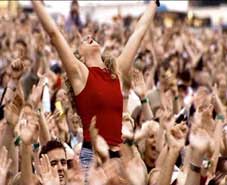
Why Are They All Going Mad?
Art vidéo | dv | color | 2:4 | United Kingdom | 2004
In my videos I have been using appropriation as a sort of blue print or ?toolbox? from which to mine. In the same way the DJ samples and remixes music, I am interested in methods of reproducing and recontextualising images. Rather than seemly creating something from scratch, I am interested in editing and shaping what already exists in the world. Through exploring the use of found footage the role of the director is replaced with that of the editor. I actively manipulate the medium through looping, erasing and compressing moving images. I am interested in manipulating moving images in a way that `work for us` rather than passively `working on us`. I use this methodology in my video Why Are They All Going Mad? This work hints at the notion of the sublime ? the kind of pleasure that can only be experienced indirectly, that which defies logic and rationality.
Born 1967, England Living and working in London BA (Hons) Fine Art Chelsea College of Art and Design, London

Dafei Deng
Dark Utopia 2
Video | hdv | color | 6:22 | China | 2014
This is a piece of works done according to my poem written in early 2014 (the following is the content). Letting every sentence of the poem burn at night at someplace outside the Fifth Ring Expressway, including the crossroads, the entrance to the village, the dam, the end of the roads, the demolition ruins, and the uninhabited villages?The poem is filled with plaint, depression, and hopelessness, burning at the places outside the Fifth Ring Expressway where the migrant workers live, the so-called antizens agglomeration area. In the daytime, the places are so noisy with tumultuous crowds in a harsh, dirty restaurants, inferior buildings, and frequent crimes. When Beijing, the great city, is expanding itself, this is a corner that might be easily forgotten. There are always many trucks carrying sandy soil and cement coming and going, for everything there is in a temporary and rough and mobile state, waiting for demolition at any time. The plaintive sentences are burnt in the fire, of some romance. However, the fire has the power to transform things: it burns the old things, but along with the burning, the seriousness and solemnity of the images and sounds of the poem are sublimated. In the darkness, these burnt sentences are not only whoops of one after another, but also the numerous sparks that have been devoured by the big city. They remind us of the A Single Spark Can Start a Prairie Fire, the works of great men.(writen by Deng Dafei)
DENG Dafei (b. 1975, Jinzhou, Liaoning Province, China) and HE Hai (b. 1974, Zhengzhou, Henan) currently live in Beijing, China and are co-collaborators under the name The Utopia Group. Using residencies as their primary vehicle to create artworks together, their yearlong project Family Museum, in 2008, at the Zendai Art Museum, Shanghai practiced the concept of "art venue outside of the gallery system" and earned them much acclaim. DENG Dafei received an MFA in 2005 from the China Academy of Fine Art, Beijing, China and a BA in Art Education from Northeast Normal University, Changchun, Jilin, China. He was given the Shenzhou 19 Astronaut Award at the VIDEO Beijing Film Academy Multi-Media Festival and The Invisible Sword Award at the Yokohama Media Art Festival. He has shown in numerous exhibitions including: In Interaction, Yokohama Media Art Festival, 2007; 2nd Doland Exhibition of Young Artists, Doland Art Museum, Shanghai, 2006; Opening the Door and Seeing the Luck: International Hangzhou Contemporary Art Exhibition, Beicangmen Art Center, Wuxi, China, 2006; Long March Capital, Long March Art Space, Beijing, 2006; Fortune Video, Common Place, Hangzhou, China, 2006; Rule and Possible, Zhejiang Province Museum, Hangzhou, China, 2005; Seeing inside from Physical Body: Chinese Performance Art Document, Macao, 2005; Launch, Long March Art Space, Beijing, China, 2005; OBSESSION ? Turkey Video Festival, X Gallery, Istanbul, Turkey, 2005; Follow Me: Chinese Contemporary Art Exhibition, Mori Museum, Tokyo, Japan, 2005; Transparent Box, SOHO, Beijing, 2005; Double Reading, Directions Art Gallery, Hangzhou, China, 2005. HE Hai received an MFA in Fine Art from Donghua University, Shanghai, a BA in Graphic Design from the Beijing Institute of Fashion Technology, as well as MA and BA degrees in Visual Art from the University of Marc Bloch, France where he is currently a Doctoral Candidate. He won the Annual Prize for the Best Exhibition in 2006 at the Looking up Luck show. He has shown in numerous exhibitions including: Shenzhen Mobile, Hangzhou Exhibition Center of Peace, Hangzhou, 2009; Two Points, Palazzo Frisacco, Tolmezzo, Italy, 2008; Family Museum Project, Shenzhen Free Art Creation Base, Shenzhen, 2008; Intrude: Art Life 366, ZenDai MOMA, Shanghai, 2008; Opening the Door and Seeing the Luck: International Hangzhou Contemporary Art Exhibition, Beicangmen Art Center, Wuxi, China, 2006; Looking up the Luck: International Hangzhou Contemporary Art Exhibition, Feng Shan Art Space, Hangzhou, 2006; Gift, Museum of Normal Institute of Hangzhou, Hangzhou, China, 2005; Body Measure, Place de Palait Universitaire, Strasbourg, France, 2005.
Gaelle Denis
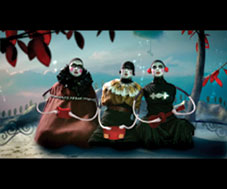
City paradise
Animation | 0 | color | 5:58 | France, United Kingdom | 2004
When Tomoko arrives in London, she has no idea that she will soon discover a mysterious secret hidden beneath the city... London is a big city, and for those new to it, can sometimes seem quite scary. But Tomoko, who arrives from Japan to learn English, accidentally discovers a mysterious secret city underground, inhabited by friendly little aliens and beautiful blossoms. After she has found it though, everything changes...
Gaëlle Denis, 30 years old, was born and educated in France until 2000, when she moved to London to study for an MA in animation direction at the Royal College of Art. Part of the course involved a 4 month period at the Kyoto University of Arts in Japan, and eventually culminated in her award winning short film, "Fish Never Sleep". The film won the prize for Best European Animation from Cinanima Espihno in Nov 2002 and a BAFTA for Best Animated Short film in 2003, as well as the special jury prize at the Hiroshima Animation Festival and numerous other international film festival awards. In 2004 she joined Passion Pictures and directed her newest short film 'City Paradise' which was made in conjunction with the AIR (Artist In Residence) Scheme. It has also won several awards including the Jury Award in Annecy and the Innovation Award in Aspen. City Paradise was also nominated for a BAFTA. Gaëlle is currently working on various commercials at Passion Pictures and has just finished her first live action short film, "After The Rain".
Claire Denis
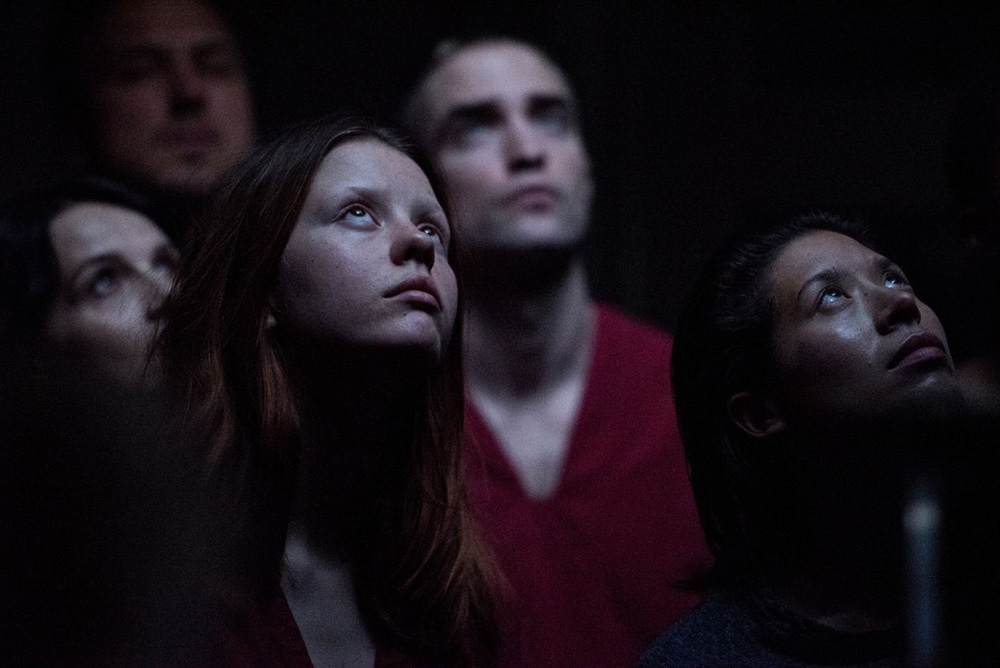
High Life
Fiction | 4k | color | 110:0 | France | 2018
Deep space. Monte and his daughter Willow live together aboard a spacecraft, in complete isolation. A man whose strict self-discipline is a shield against desire, Montefathered her against his will. His sperm was used to inseminate the young woman who gave birth to her. They were members of a crew of prisoners –death row inmates. Guinea pigs sent on a mission. Now only Monte and Willow remain. Through his daughter, he experiences the birth of an all-powerful love. Together, father and daughter approach their destination –the black hole in which time and space cease to exist.
Claire Denis is director and screenwriter, renowned for films including Chocolat, Beau Travail, Trouble Every Day, 35 Shots of Rum, and Bastards. Born in Paris, Claire Denis lived in a number of African countries until the age of 12. Having returned to France, she studied at the IDEHEC (Institut des Hautes Etudes Cinématographiques), where she met cinematographer Agnès Godard, who would later work on the majority of her films. She began her professional life in the cinema as assistant to major directors like Robert Enrico, Wim Wenders, Costa Gavras and Jacques Rivette. She later worked with Jim Jarmusch on his film Down by Law.In 1987, Claire Denis wrote and directed her first film, Chocolat. A semi-autobiographical story of racial tension in the colonial Africa of the 1950s at the moment of independence, the film premiered In Competition at the 1988 Cannes Film Festival, was nominated at the César Awards and met with widespread critical acclaim in the US. In 1996, she was awarded the Golden Leopard at the Locarno Film Festival for Nenette and Boni. Beau Travail (1999), Trouble Every Day (2001), Vendredi soir (2002), 35 Shots of Rum (2008), White Material (2009), and Bastards (2013) – presented in Un Certain Regard at the Cannes Film Festival in 2013 –, followed. In 2017, Claire Denis returned to Cannes when Bright Sunshine In, featuring Juliette Binoche, Xavier Beauvois, Nicolas Duvauchelle, Alex Descas and Gérard Depardieu, screened as the opening film in Directors’ Fortnight. Her latest film, High Life, starring Robert Pattinson and Juliette Binoche, has been released in November 2018. Claire Denis has co-written the majority of her films with Jean-Pol Fargeau, but has also collaborated on scripts with Emmanuèle Bernheim (Vendredi Soir), Marie NDiaye (White Material) and Christine Angot (BrightSunshine In).

Marlene Denningmann
Wunschkonzert
Experimental fiction | 4k | color | 12:28 | Germany | 2016
From the smallest towns into the big, wide web: the promise of fulfillment is an omnipresent one. A field trip to provincial Germany and the core of a society of globalized desires.
Marlene Denningmann is a filmmaker and video artist based in Hamburg and Berlin. She is co-founder of VETO Film.
Kieron Dennis
oo oo wow wee (nostalgia is coming back)
Experimental video | | color | 5:0 | United Kingdom | 2004
"Oo oo wow wee" (nostalgia is coming back) is a expressive video poem that uses a range of acoustic and visual signs to create an experimental narrative. The film echoes a stream of consciousness where thoughts and images collide, connecting and disconnecting meaning. The video uses a complex layering of still image sequences merging subjects such as hairdresser signs, bikes and fireworks.
Harm Dens, Meltse van Coillie
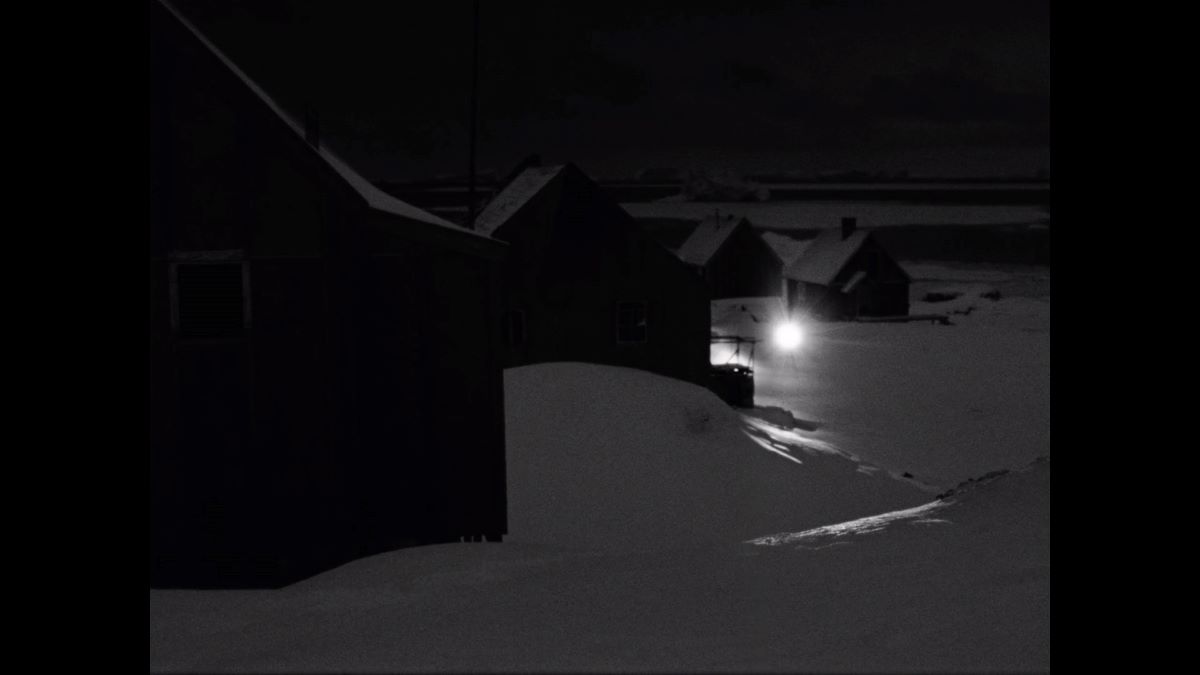
Nocturnus
Experimental fiction | 16mm | color | 21:0 | Belgium | 2023
In the darkness of the polar night, a scientist tries to shed light on a remarkable phenomenon: an Arctic village in hibernation.

Shrutiman Deori, Dharmendra Prasad
Aadara
Experimental film | 4k | color | 29:52 | India | 2024
When cracked seasons passes through the materials and life’s goal then how long a dream can sustain? How long urgencies can take to transfer into pleasing weathers of now? How long a season can sustain in the desertification of care? Aadara - a Bhojpuri sub season of 16 days at the time of monsoon is the beginning of the paddy plantation and rains in the Bhojpur region of India. The title is referred from the presence of season which symbolises life and dreams through cyclic toil. The work is an audio visual/seasonal conversation between the agrarian urgencies of Nadaon village in Bihar and the extracted forests and contaminated water bodies of Rani forest of Brahmaputra valley. The crucial goal of the work is to place the viewer into the friction between multi-layered fragments of times and ecologies by creating a space of contemplation.
Dharmendra Prasad- Rolling through orality, toil, winds, dimensions, horizon and deteriorating seasons and sites, Dharmendra Prasad harvests imagination, memories, times, change and toil, that are stored as residue in the backyard of life's goal. Through the medium of need, time, toil and soil Dharmendra's practice gets cultivated and tilledup in the form of installations, videos, paintings, photography, texts, events, and travelogue and beyond. Born in-between stories, discrimination, hierarchies, chaos and silence, full of winds and dusts, without any address, Dharmendra practices between the fields of Gangatic plains to the villages, water bodies and rainforests of northeast India, and in extension co-founding the Guwahati based Anga Art Collective. Shrutiman Deori is a filmmaker based out of Guwahati, North East India. He has worked on documentaries, narrative films as well as video art installations. While for the most part he works as a cinematographer, Shrutiman has also directed films that have received critical acclaim in film festivals around the world including International Documentary Film Festival Amsterdam(IDFA) and Camden international Film Festival. He is the recipient of IDFA Bertha Fund 2023 for his ongoing feature documentary "Shadows of the Forest". He works in the audio-visual medium wherein he explores the politics of indigeneity , community and environment. Shrutiman studied sound engineering from School of Audio engineering, Chennai and was also selected for the cinematography mentorship program by the Indian Society of Cinematographers(ISC).

Thomas Depas
Hasbannium
Experimental fiction | 16mm | color | 0:0 | Belgium | 2018
A kid on an overboard, a camgirl setting up the show, a stranger sneaking trucks, while a gamer’s spleen resonate in a virtual dungeon. Hasbannium is a series of impressionist evocations drawing elliptic sequences in a metaphorical desert, an experimental fiction which has it’s root in Hesbaye, an agricultural region in Belgium with open horizons, devoid of forests or rivers. Through these landscapes, a choral film comes into being, with figures seeking out a humanity that reinvents itself in a universe of signs and meanings that are increasingly confused. The result is an impressive evocation of the temptation to disappear in which absence to self and world sketches out granular motifs.

Bieke Depoorter, Mattias De Craene
Dvalemodus
Experimental doc. | 4k | color | 9:0 | Belgium, Germany | 2017
In states of endless slumber, people endure the stifling dark. Powerful forces of nature rage relentlessly, sometimes soothing and sometimes menacing. The roar of the factory thunders on without halt, steadily eroding the surrounding landscape. Sluggish shapes seemingly abide the desolate waste around them. These Mountains, these waves and our people, carry the darkness, lies and slowness within. For he who can`t take no more only laughter can bring salvation.
Bieke Depoorter was born in 1986 in Kortrijk, Belgium. She received a Master’s Degree in Photography at the Royal Academy of Fine Arts in Ghent in 2009. Her early colour photography work is the result of a unique approach: she captures the privacy of people whom she meets by chance and she gets to invite her into their homes. She captures indescribable, fragile and intense moments, always with kindness. Depoorter finalized her first short film Dvalemodus in 2017, which she directed together with musician Mattias De Craene. The film talks about the everlasting darkness in a small village in the Northern Norway. When she was just 25 years old, she joined the Magnum agency, of which she became a nominee in 2012 and a full member in 2016. In 2017 she won the Prix Levallois. Mattias De Craene was born 1989 in Belgium. He is a saxophone player and composer. His musical language is often described as unique and genre-defying. He is often linked with the free improvisational scene, and is also a founding member of several bands, such as Nordmann. In an everlasting quest of making abstract things more specific, he has recently started to combine music with visual arts.
Sarah Derendinger
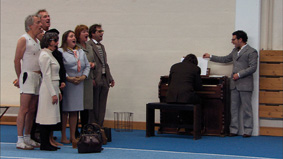
Familientreffen ? Marthaler Theater im Grand Hotel
Documentary | dv | color | 60:0 | Switzerland | 2009
Teppiche werden eingerollt, Möbel zugedeckt. Ein Grand Hotel in den Schweizer Bergen geht in Zwischensaison. Doch Regisseur Christoph Marthaler und seine Theaterfamilie rauben dem Hotel den Schlaf. In den wochenlangen Proben lassen die Schauspieler Geister aus der hundertjährigen Hotelgeschichte aufleben. Die skurrilen Einzelgänger finden sich in ihren Liedern zusammen. Theatermusiker und Sohn der Hotelfamilie Jürg Kienberger reflektiert mit selbstironischer Leichtigkeit die Entstehung der Marthaler-Inszenierung. Ein musikalisch poetisches Fest zwischen Heiterkeit und Melancholie.
Biographie Geboren 1965 in Luzern. 1985 Fotografinnendiplom an der HGK Bern. 1988-93 Studium an der HGK Basel, Diplom Fachbereich Audiovisuelle Gestaltung. Arbeiten als Videokünstlerin für Ausstellungen, Opern und Theaterstücke. Seit 2001 freischaffende Autorin und Regisseurin für Fernsehen und Film. Teilnahme an verschiedenen internationalen Film ? Videofestivals.1991 Basler Nachwuchsförderpreis für «Splitsch Splatsch Rosengewitter». 2009 Newcomer Preis Visions du Réel für «Familientreffen.
Derive Imaginaire
| | | 180:0 | France | 0
.
.

Ruben Desiere
Kosmos
Documentary | hdv | color | 60:47 | Belgium | 2014
“It will be difficult to continue this story of mine. I don`t even know if it is a story. It is difficult to call this a story, this constant... clustering and falling apart... of elements...” - From Kosmos by Witold Gombrowicz Up until November 2013, the Gesù convent in Brussels was home to around 250 people including a number of Roma families originating from Slovakia. Over the months leading up to their impending eviction, Ruben Desiere worked with a number of the inhabitants to create a film. Kosmos is loosely based on the book of the same name by the Polish author Witold Gombrowicz. It focuses on the family of Kevin Mroč who had been living at Gesù for three years, and also features two newcomers, Mižu Balász en Rastjo Vaňo.
Ruben Desiere (1990, Belgium) received a Master in cinema in 2014 at the School of the Arts – KASK (Ghent) with the film Kosmos.

Robbrecht Desmet
Am Egelsberg
Experimental film | 16mm | color and b&w | 26:0 | Belgium | 2014
Am Egelsberg is shot in Krefeld, a town in the Ruhr area in Germany. In the rolling landscape around this former industrial city, Robbrecht & Daem architects realized a striking pavilion, a temporary objet d’architecture based on a design for a golf course clubhouse by Mies van der Rohe, dating from 1930, which was never built. The film plays with the idea that the model leads the gaze towards the landscape but by doing so actually looks back at itself. The huge frames, windows without glass, ‘pull’ the landscape ‘inside’. But our gaze is also thrown back ‘inside’, via the textures and drawings in the wooden plates. These plates remind one of the original marble stone plates that Mies had in mind. The walls become screens as ‘masks’, as André Bazin wrote, ‘whose function is no less to hide reality than it is to reveal it’. The spaces in the film, through the device of the model, become extensions of cinematic space, (far) beyond the boundaries of the image. The 360° degree panorama that is at the heart of the film, showing the landscape without the model, unites ‘before’ and ‘after’ in the present. This film tries to be an imaginative, geo-temporal map of the intimate relationship between cinema and architecture.
Robbrecht Desmet (°1985) is a filmmaker. He studied Cinema and Fine Arts at the Sint Lukas College of Art & Design in Brussels. His films are portraits of landscapes, places and spaces that are in one way or another a substantial part of the memory of a specific artwork. His filmmaking is dedicated to a documentation of the life and afterlife of these artworks, their meaning and their history. His work was presented in screenings and exhibitions as Beyond The Picturesque (S.M.A.K. & Artcinema OFFoff), Documented Now! (de Brakke Grond, Amsterdam), Splav Meduze (Centre for Contemporary Art Celje) and filmfestivals like International Filmfestival Hamburg, Festival for Experimental Film in New York, ISELP Festival du Film sur l’Art Brussels and Courtisane Festival, International Film Festival Rotterdam and BFI London Film Festival. He has participated in residency programs such as Capacete Int. in Rio de Janeiro and Sao Paolo (Br), SIC SoundImageCulture workspace and FLACC workspace for visual artists (Genk, Belgium). He is a lecturer Film Studies at LUCA School of Arts in Brussels. Desmet is currently working on a new film under the working title Close Up in collaboration with Brussels based production platform Auguste Orts.
Robbrecht Desmet
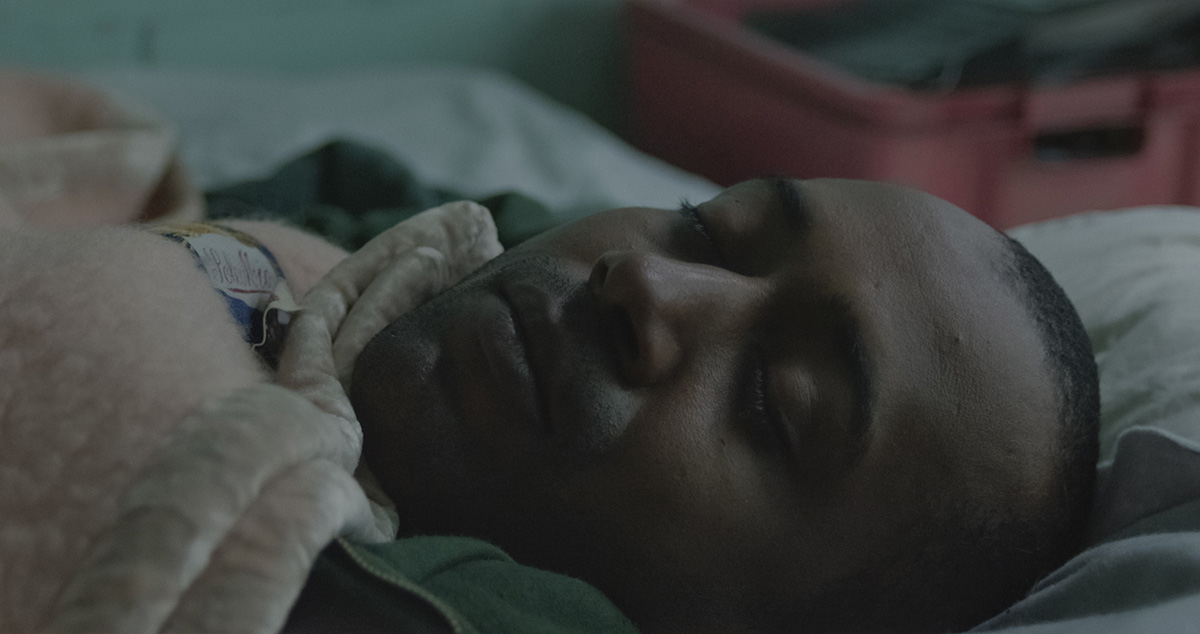
Het open oog
Documentary | hdv | color | 69:0 | Belgium | 2021
Behind the concrete walls of a former cardboard factory in Brussels, scenographer Jozef Wouters presented the stage performance Underneath Which Rivers Flow in March 2019. Filmmaker Robbrecht Desmet closely followed the creation process of this most anticipated piece of theatre of the Brussels live arts scene. The performance was a collaboration with open art house Globe Aroma and was created with a diverse group of non-professional performer-participants from all corners of the world. It was programmed by Kaaitheater, one of the leading Brussels theatres, Kaaitheater, and premiered during the renowned performance festival Performatik. In May 2019 it was staged again during the international Kunstenfestivaldesarts. The play received a five star review in the Flemish newspaper De Standaard as well as a critical reading in the magazine for culture and criticism Rekto:Verso. The massive warehouse, covering more than a thousand square meters, was to be demolished soon after the group had moved. The very surface that served as its stage is now a public park, welcoming passers-by, young globetrotters, soccer players, dreamers, dealers, thieves, tourists and strollers alike. With a small crew of film professionals and film students, Robbrecht Desmet captured both rehearsals and performances, gradually focussing on the moment of public presentation of the piece rather than on its genesis. Only months later he started to shape his observations into a calm meditation on being a spectator, streetwise institutionalism and the cosmic desire for making art. The film, taking its title (The open eye) from the name ascribed to the wooden grandstand created for the piece, attentively navigates between participation and observation, inside and outside, politics and aesthetics, the public and the private.
Robbrecht Desmet (°1985) lives in Brussels. He studied film and fine arts at Sint Lukas Brussels. His work has been shown at filmfestivals such as BFI London Film Festival, International Film Festival Rotterdam, Rencontres Internationales, Courtisane Festival, Kurzfilm Festival Hamburg, Brussels Art Film Festival, and in screenings and exhibitions Beyond The Picturesque (S.M.A.K. & Artcinema OFFoff), Documented Now! (de Brakke Grond, Amsterdam), An Evening with Auguste Orts (Beursschouwburg, Brussels). He teaches Film Studies at the film department of the LUCA School of Arts in Brussels. He is currently finishing a PhD in the arts, The World is Really There.
Gabriel Desplanque
Messieurs,
Experimental fiction | super8 | color | 5:0 | France | 2005
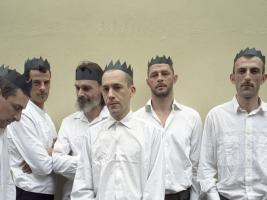
This video is a series of slow panoramic shots displaying a group of mustached men in their forties, wearing their Sunday attire in a historic place. Behind them are empty pedestals as though they have just descended; they are gathered in a semi circle and stare at the camera when it gets closer to them. Trivial at the beginning, the actions they perform become more and more significant and strange, using common psychoanalytic symbols, and paced by a child's instrument that beats the tempo, a sort of metronome that gets carried away. The rhythm of the video extends between the very slow scrolling of the panoramic shots and the frantic rhythm of the child's toy, which creates a sort of constrained urgency. The accessories they use, the disguises, and the connections that take effect create just as many situations that put their own materiality in danger before the camera because the actors do not seem to have real autonomy, and can be more compared to puppets, executing absurd actions that are beyond them. Their motions form a choreography of play, desire, and strangeness that can only end with the rupture of the panoramic shot, the only guarantee of the precarious equilibrium of this dance.
Gabriel Desplanque was born in 1981 in Aix en Provence. Obtained a diploma in modern litterature in 2001 from the DNAP aux Beaux Arts in Toulouse in 2006, as well as a diploma in Arts décoratifs de Paris section Photographie. Has a particular interest in photography and contemporary dance. Select Exhibitions include: photographic work, "i magiques" at the Festival de Langon, organised by Gabriel Bauret, at the contemporary photography festival in 2006; at the Maison Rouge on the occassion of the diplômes des Arts Décoratifs in June 2006. Publication includes a critique written for the Journal des Laboratoires d'Aubervilliers in December 2005. Other mentions include: living scenery for Jennifer Lacey and Nadia Lauro's show at the Georges Pompidou Centre in October 2005; Prize-winner of the Voix off competition at the festival of Arles for a projection of photos, from July 5-10, 2005; Prize-winner of the Leica "inter-écoles" competition in November 2005; exhibition in London in November 2005; Training at the Laboratoires d?Aubervilliers with Loïc Touzé et Jan Peters from August 22 to September 2, 2005.
Juan Desteract
Souviens-toi
Experimental video | mov | black and white | 1:31 | France, Argentina | 2022
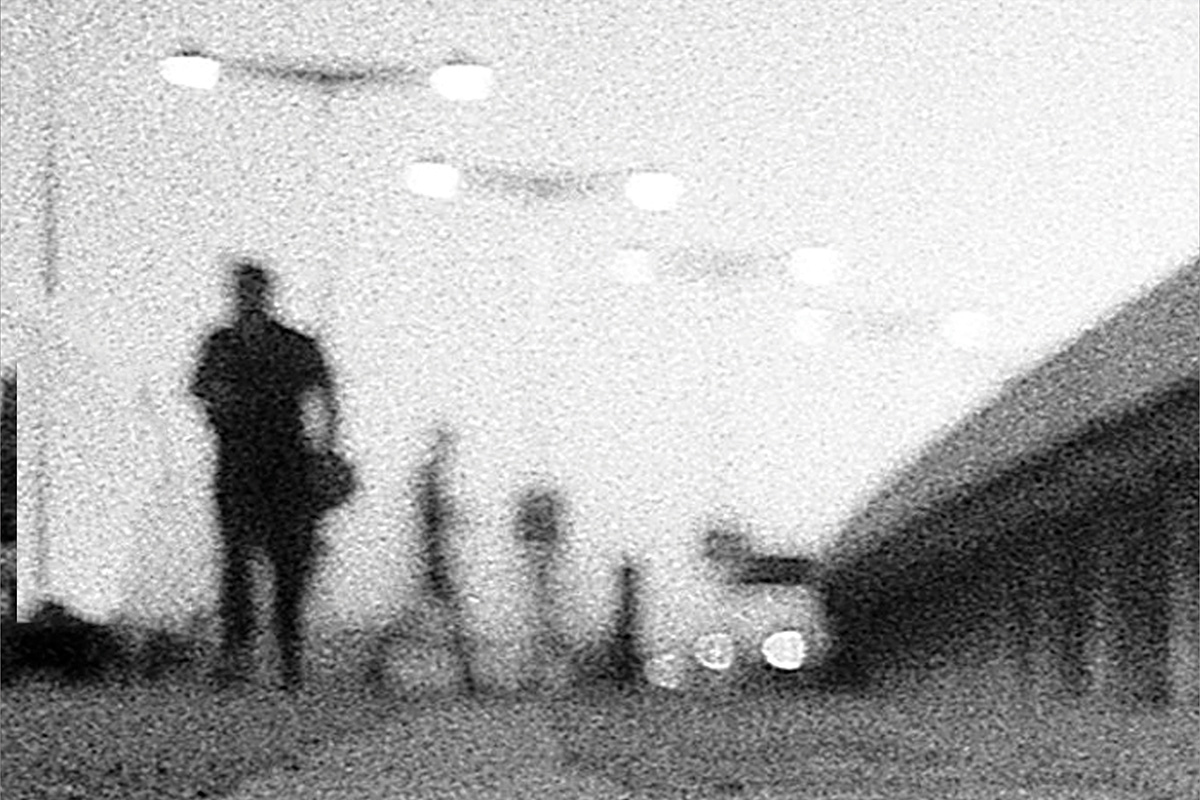
La persistance d’une image fatidique et le besoin de s'y accrocher impliquent le dédoublement d’un souvenir. Ce dernier se trouve ainsi suspendu entre les multiples versions d’un même évènement, entre les représentations d’un passé et un présent déjà vécu, entre figuration et abstraction, entre mouvement et immobilité, entre film et photographie. Des impressions intrusives d'autres vies se superposent au souvenir, nous exposant ainsi à une réalité surveillée où nous nous demandons qui voit et que voir.
Juan Desteract est né à Saint-Germain-en-Laye (France) en 1997. Il vit actuellement à Buenos Aires, en Argentine. Il a étudié le design graphique à l’Université de Buenos Aires. Il a poursuivi sa formation en photographie et arts visuels au cours de divers séminaires, ateliers et résidences artistiques à Buenos Aires. Parallèlement, il s'est formé en écriture, composition musicale puis en improvisation musicale. A partir de 2021, il participe à des expositions collectives dans des espaces artistiques et des musées d'art contemporain en Argentine, au Chili, Uruguay, Espagne et en France. Son travail associe des disciplines diverses telles que la post-photographie, l'audiovisuel expérimental, le design graphique et l'improvisation musicale, en se focalisant sur certains traits distinctifs du cinéma structurel et du réemploi d’archives. Depuis 2020, Juan travaille dans le domaine du design graphique en tant que Professeur à l’Université de Buenos Aires et en tant que graphiste au Musée d'art moderne de Buenos Aires.

Alexis Destoop
Northern Drift
Experimental doc. | 4k | color | 56:30 | Belgium | 2020
Northern Drift is set in the sparse, yet occupied wilderness of the Norwegian-Russian borderland in the European High North, home to the indigenous Sami culture. The area became an industrial development site in the late 19th century. It is not only a region whose landscape still bears visible traces of the conflicts of the last century, but also one that has come to play a key role in an ongoing Northward expansion fueled by the sense that climate change will make the north an untapped economic goldmine. Resulting from long-term research conducted in the shadow of the protocols and restrictions around the political border, Northern Drift takes the form of an investigation whose object is never quite revealed. Assembled from personal experiences, collected testimonies and local stories, the film presents a journey across the contentious Norwegian-Russian borderland. Exploring the persistence of frontier imaginaries, the film is at once travelogue, anthropological document and retro-futuristic sci-fi, blending these tropes into a re-imagined geography through and a poetic exploration of a labyrinthine zone where past and future are confounded.
Alexis Destoop’s work explores the workings of the image and narrative, the experience of time, and the processes of identification and memory. His practice covers the expanded field between photography and film and has been influenced by his experience in the performing arts as well as his studies in art history and philosophy. Referencing classical representations of the human figure, his earlier works focus on duration and performativity. In recent years his situated practice has focused on transitional environments where ecological pitfalls, economical aspirations, geopolitical tensions and colonial histories coalesce. Rather than treating landscape as a sublime natural object, he approaches it as a thoroughly human construct – with stratified meanings and histories. This explains the decision to attend to contentious zones where global and local processes and interests collide and intertwine, and where it becomes possible to rethink notions of centre and periphery, self and other. Blending fact and fiction, history and speculation, Destoop offers a fragmented, subjective cartography of the transitory states that constitute our present era.
Irineu Destourelles
New Words for Mindelo's Urban Creole
Video | hdv | black and white | 10:24 | United Kingdom | 2014
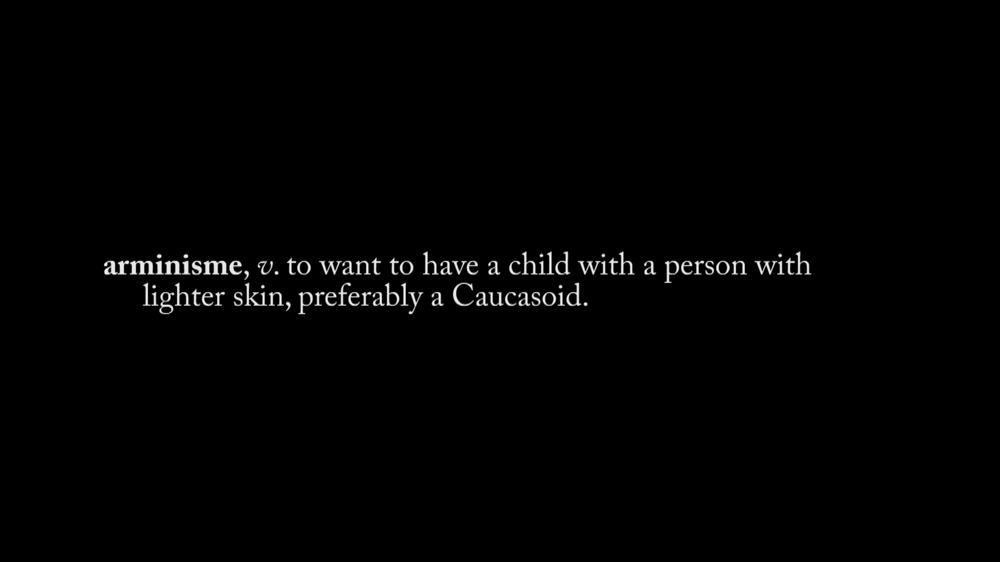
A text-based video that displays neologisms derived from Greek mythology as well as the names of colonial administrators and military officers who are integral to Portuguese colonial history. These words created by Destourelles propose to encapsulate and reflect current ongoing social practices in the city of Mindelo in Cape Verde (a former Portuguese colony in West Africa), since the advent of democracy and globalization in 1990. `New Words for Mindelo`s Urban Creole` explores how established and emerging social practices propelled by globalization are ambivalently acknowledged, struggling to be written into the local creole language as word concepts.
Born in Cape Verde, Irineu Destourelles trained at the Willem de Kooning Academy, Rotterdam and at Central Saint Martins, London. Destourelles makes videos, paintings, photographs and text-based works from found and original material in an attempt to reveal the ambivalence within the montage of personal identity. In particular, his interest in the paradoxical nature of post-colonial and post-imperial identity constructions has drawn him to explore the perpetuation of dominant 19th century desires and fears in contemporary society. His works recirculate these desires and fears in their various guises, highlighting issues of self-loathing and the drive to objectify others by means of images and words. Irineu Destourelles lives and works in Edinburgh.

Lili Reynaud Dewar
TGMFS
Experimental doc. | 4k | color | 36:0 | France, USA | 2016
"In her first film, the artist brings together elements of science fiction and rap with discourses on emancipation and colonialism in an installation that pushes against the boundaries of its space. A film that depicts the before and during of a performance in Memphis, Tennessee. On a shell-shaped concrete stage a woman recites excerpts from a socialist-feminist manifesto while four local stand-up-comedians improvise alongside her. This chorus of voices is further accompanied by a noise-musician. Reynaud Dewar chose the place of the performance for its particularly controversial and diverse background. The metropolis, situated on the Mississippi delta, is on the border between the affluent Midwest and the poorer South of the United States. This city was the epicenter of the American slave trade and the later Civil Rights Movement. The latter culminated in the Sanitation Strike of 1968, which was further intensified by the assassination of Martin Luther King, Jr. after he took an active role in these demonstrations. Memphis is also an iconic location in the history of American music in the United States. It is widely known for its Blues music and as the final resting place of Elvis Presley. In more recent years, the city has evolved into a vital center of rap culture in the US. Working alongside the local comedians, Reynaud Dewar uses this specific historical and socio-political backdrop to negotiate the appropriation of a certain cult object. A central element of the film is the so-called grill—a jewelry worn over the teeth, which is typically made of precious metals. In Black music, especially in rap and hip-hop, the grill functions as a sort of relic and status symbol. Through her adoption of these objects as a white, European artist, Reynaud Dewar knowingly raises provocative questions of cultural appropriation, impression, and transformation, as well as the legitimization of these acts. The connective link in this work is Donna Haraway’s 1985 text, A Cyborg Manifesto. This treatise—a feminist essay that employs, albeit in a partly ironical sense, a cyborg as a metaphor for the dissolution of conservative borders between humans, machines, and animals—propagandizes a state of chimerical fusion in which normative categories like class, gender, or race are discarded.
Bertrand Dezoteux
Le Corso
Animation | 0 | color | 14:0 | France | 2008
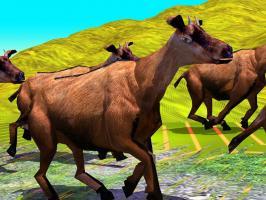
At the beginning of this project, I wanted to make a rural video, without any anthropomorphism, as if it had been shot from the point of view of an animal. This statement is obviously stupid (animals don?t make either video, or 3D), and the movie becomes similar to an animal documentary. The camera seems to be held by an amateur, who tries to follow the furious race of the impassive creatures. Their characters are taken from different races (cattle, cat, insect), but these beasts seem to observe some rules, some rituals. Their behaviours deal with primitive intelligence (getting in a circle and turning round), and their reactions are linked with our recent past (the Creutzfeldt-Jakob disease).
Born in 1982 in Bayonne (France), Bertrand Dezoteux is a young basque artist who repeatedly leaves his native country. He first moved to Angoulême (2001 ? 2003) to study the graphic novel. Then, in 2004, he learned the rigorous art of Korean Painting in Pusan. He finally got his diploma (DNSEP) in Strasbourg in 2006. There, he worked with the Bulgarian artist Plamen Dejanoff, who commissioned 5 collages. These pictures were exhibited in The MuMok of Vienna, then in the gallery La Chaufferie, in Strasbourg, where one of the collages mysteriously disappeared. Bertrand Dezoteux finished his studies in Le Fresnoy, studio national des arts contemporains. He currently continues to observe, as an amateur anthropologist, the behaviours of the homo digitalus.