Catalogue > Search
Results for : Tout le catalogue

Pilvi Takala
If Your Heart Wants It (Remix)
Video | hdv | color | 15:21 | Finland, USA | 2002
Taking place annually in Helsinki, SLUSH is a three-day super event that aims to invigorate the tech-startup community by bringing together entrepreneurs with venture capitalists in a party-like environment. If your heart wants it (remix) is grounded in research Takala conducted at the 2018 edition of SLUSH. Together with an interdisciplinary team and camera crew, they fabricated a startup in order to gain entry.
Pilvi Takala (b. 1981) lives and works between Berlin and Helsinki. Her video works are based on performative interventions in which she researches specific communities in order to process social structures and question the normative rules and truths of our behaviour in different contexts. Her works show that it is often possible to learn about the implicit rules of a social situation only by its disruption. Her work has been shown in MoMA PS1 and New Museum, Kiasma, Palais de Tokyo, Kunsthalle Basel, Manifesta 11, Witte de With, and the 9th Istanbul Biennial. Takala won the Dutch Prix de Rome in 2011 and the Emdash Award and Finnish State Prize for Visual Arts in 2013.
Ho Tam
In the Dark
Experimental video | dv | black and white | 6:0 | Canada | 2004
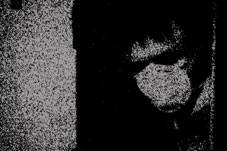
Made in the year after SARS crisis, the video re-visits the images collected from the Toronto media. For the record, Toronto (Canada) was the only non-Asian city that was significantly affected by the epidemic. The city was stigmatized by some isolated cases that began from a carrier back from a visit in Asia. Through all black and white re-photographed pictures, all we can see is the darkness of a time passed, a city under attacks and assaults, politicians scrambling for words of comfort, citizens living in a state of fear, distrust, paranoia and shame. How are we to make from those few months that seemed to last forever? As if we were in the dark ages, at the time we thought we would never come out of it again. The video, by referencing the weaknesses within human nature, indirectly refers to the problematic media attention in a world we have created. If the media is the message, the video questions its biases and truthfulness? In order to re-create this uncomfortable time, the mediated and degraded images and the audio purposely resonate each other to reveal the sense of self-doubt, disgust and the feeling of almost approaching a state of abjection. The project was shot in low light situation using a consumer camcorder and therefore creating the resulting unstable signals that the camcorder was set to detect and contain (unsuccessfully in this case). In such a way, the video almost parallels the medical scientific process in the present day bacterial warfare. Using video technology in the production process but referencing the languages of experimental films, In the dark also pays homage to the avant-garde filmmaker Stan Brakhage (1933 - 2003), who passed away about the same time as the SARS outbreak.
Ho Tam was born in Hong Kong and educated in Toronto, Canada and worked in advertising firms and community psychiatric facilities before turning to art. He works in a diverse mix of disciplinary including painting, video, photography, print and public art and has exhibited in various cities across North America. His first video, The Yellow Pages, was commissioned by the public arts group PUBLIC ACCESS for an installation/projection at the Union Station of Toronto in 1994/95. Since then Tam has produced over 15 experimental videos. His work is included in the traveling exhibition Magnetic North: Canadian Experimental Video organized by Walker Art Center, Minnesota. Tam currently teaches at the University of Victoria. He is a graduate of Whitney Museum Independent Studies Program, Bard College (MFA) and recipients of various fellowships and artist`s grants.

Marion Tampon-lajarriette
Natura Naturata
Video | hdv | color | 8:34 | France, Switzerland | 2018
With this film, the artist continues to unfold her body of works held in the context of Art, Archeology or Natural History Museums, where their visitors and their collections are moved to another genre often inspired by Sci-Fi or Fantasy. In Natura Naturata, she filmed a pluri-generational group of gymnasts in the Museum of Natural History of Geneva, moving and resting among the collections of crystals, animals and corals. In the soundtrack composed by Leo Hofmann, voices are whispering or singing fragments of the text Monadology and Sociology by 19th century french philosopher and sociologist Gabriel Tarde. So the film proposes to give an unstable shape and rhythm to this Tarde conception of the « universal phenomena across cosmic, natural and social worlds » where « The whole is always smaller than its parts ». All the images were filmed in the permanent galleries of the Museum of Natural History of the city of Geneva. Thanks for the support and participation.
Marion Tampon-Lajarriette (b.1982 in Paris) lives and works in Geneva. She received an MFA from the École Nationale Supérieure des Beaux-Arts de Lyon (France) in 2007 and an MA in Arts and New Media from the Haute École d’Art et de Design de Genève (HEAD) in 2008. She has had numerous solo exhibitions, including: Museo Villa Pia (Lugano, 2019); Les Brasseurs (Liège, 2015); Mois de la Photo Festival (Paris, 2012); Loop Art Fair (Barcelona, 2008). Her work has also been shown at the Palais de Tokyo, Paris; MAMCO, Geneva; Swiss Institute, New York City; Capture Photography Festival, Vancouver; and is part of the permanent collection at MAMCO, Geneva; MEP, Paris; NMNM, Monaco; the Francois Pinault Foundation; among others. In 2016-2017 she was awarded a residency at the Swiss Institute in Rome, and took part in the Swiss Art Awards in Basel. In 2013, she was awarded the Société des Arts grant and the FCAC-Geneva grant and residency in New York City. The artist’s second monograph, Echos, will be edited in March 2020 by Casa Grande (331 pages, texts by Mark Lewis, Lucille Ulrich, Valeria Venditti). She is represented by Galerie Laurence Bernard in Geneva.
Marion Tampon-lajarriette
Une Histoire déjà racontée
Experimental video | dv | color | 6:0 | France | 2005
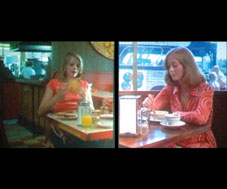
The artist's activity mainly consists of revisiting great movies, the ones that are very present in our collective memory, acting on the unity of their image or their temporal linearity (here : to substitute and entirely re-record the original soundtrack; to have the two secondary female roles meet; to stay in a place unrelated to the action ... ). In the already existing movie's well defined setting, she tries to open other possible space-times and other logics in the very interstices of its narrative progression, and to find other ways to enter and navigate inside one precise tale, on paths that would look more like that of the passerby who walks with no set aim in a Universe void of meaning or order, void of landmarks and limits. This activity of re-appropriation is therefore based on the artist's position of "receiver", reacting to a "Great Tales Cinema" which displays a very powerful representation of the World as an orderly, hierarchic territory, where Good and Evil as well as Right and Wrong are still told apart, where History moves only one-way (the figure of the hero, destiny, the scenario ... ). Here protagonists themselves explore fiction as they explore life, groping their way through because there isn't just one way but an infinite number...
Marion Tampon-Lajarrirtte was born sometime during the 80´s. Somewhere else she studied arts at the Villa Arson. Still elsewhere she started a series of eloquent video portraits and mute postcards, thanks to a scholarship from the Medialab-Centro Cultural Conde Duque. Later she continued her studies at the Fine Arts School of Lyon and elsewhere a Masters in New Media at the HEAA, Geneva. She shoots or re-appropriates film, writes or blends, makes photographs or reframes.
Fiona Tan
A Lapse of Memory
Experimental video | 35mm | color | 27:10 | Indonesia, Netherlands | 2007
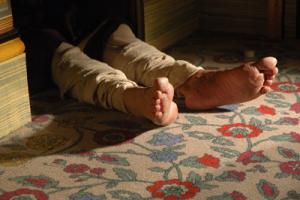
A confused, old man - Henry - lives alone in a deserted building which looks a lot like a palace. He has not been outside in years. His days pass as if removed from time, in voluntary exile from the rest of the world. The camera registers his simple daily routine and his careful but eccentric rituals. As much he resembles to a large extent the building which he occupies. Indeed Henry is only one of the protagonists of this film. The second protagonist is the building itself: the Royal Pavilion in Brighton (UK). In a spoken monologue a play unfolds between reality and fiction. Word and image, movie and documentary entangle and point beyond the boundaries of ?East? and ?West?.
Fiona Tan (1966) was born in Indonesia and lives in The Netherlands. She studied at the Rietveld Academie and the Rijksakademie in Amsterdam. Her film and video installations and photographic works have gained international acclaim and have been exhibited all over the world. Presentations of her work have included at the Venice Bienniale, at Documenta 11, the Yokohama Triennale, the Berlin Biennale and also at the Istanbul Biennial and the Sydney Biennial. Her work is included in collections such as the Tate Modern, Stedelijk Museum Amsterdam, the Don Rubell Collection, Schaulager and the Goetz Sammlung.
Tsuneko Taniuchi
Marianne Tsuneko /Tsuneko Marianne
Art vidéo | dv | color | 3:50 | France | 2002
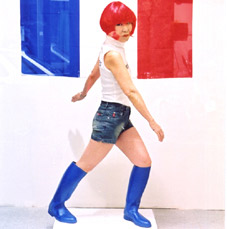
Micro-event n°18 / Marianne Tsuneko / Tsuneko Marianne : The video realized during the performance of ?Marianne Tsuneko / Tsuneko Marianne?, in Window, Paris 2002. I was in the window of ?Window?, dressed with a white shirt on which was written ?Marianne?, on the front side, and Tsuneko on the back side. Instead of the Phrygian hat, I had a red wig and blue boots. On the wall, behind me, was hanging the French flag. And I was dancing on the Marseillaise. In the street, were bystanders and artistic faith procession exhibition audience which happened during the presidential election, before April 27th, 2002.
French plastic artist form Japan, she?s born in Hyogo, Japan. She lives and works and Paris since 1987 exploring visual arts, notably interactive performance, named ?Micro?évènement?. She creates also videos, installations and photography. By these ?Micro-évènements?, Tsuneko Taniuchi is attached to present the social conditioning, the status of excluded, the feminine condition and the nature of the contemporary exchanges.

Antti Tanttu
Noli Timere
Animation | 0 | black and white | 6:29 | Finland | 2022
Noli Timere is a work about the experience and emotion of fear or anxiety. What is common or private in those feelings and what do they have in common? The work contemplates on the collective fear and its elements. ?
Antti Tanttu was born in Malaga, Spain and currently lives and works in Helsinki. He studied at the Academy of Fine Arts in Helsinki between 1984–89. His works often deal with issues such as solitude, absence and longing. Tanttu has participated in solo and group exhibitions since 1986 in e.g. Gallery Heino in Helsinki, Sara Hildén Art Museum in Tampere, Finland and Norrtälje Kunsthalle in Sweden, as well as in festivals and events around the world.
Rebecca Taouk
Au Fil de l'Eau
Documentary | dcp | color | 22:45 | Lebanon | 2024
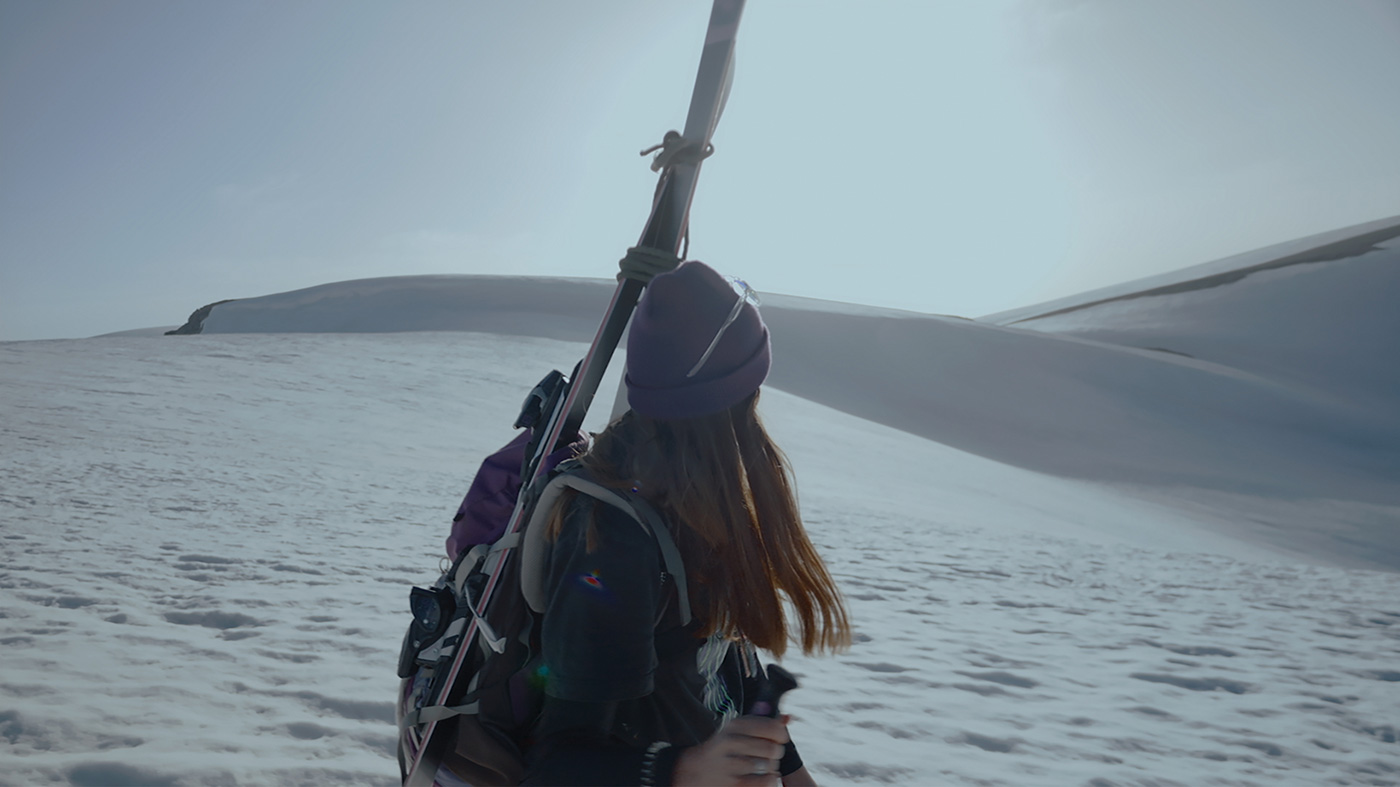
Flowing from Lebanon’s highest peak to the sea, water carries stories of connection and transformation. Along the Water takes a contemplative journey through the lives of Samir, Hisham, Antoine, and Ghiwa, whose bonds with nature, through the sea, rivers, and mountains, reflect a shared need to protect it. Through a transformative lens, the film captures the profound sensibility of their relationships with the natural world.
Rebecca is a Belgian-Lebanese filmmaker based in Brussels. She holds a master’s degree in documentary filmmaking from Docnomads (2020). Her cinematographic research explores themes of body, grief, identity, and connection. Her latest project, Au Fil de L’eau, emphasizes the importance of protecting nature and water through a contemplative journey, following the flow of water.
Julian Tapprich
Coming Soon
Video | hdv | color | 7:30 | Switzerland, Austria | 2011
Julian Tapprich?s video work Coming Soon is based on the trailer for Michael Haneke?s film, ?La pianiste (The Piano Teacher)?. Tapprich examines the referentiality of trailers. The trailer to "La pianiste" does not only refer to a story but also contains a self-referential element. In a scene with a Schubert soundtrack the pianist (Isabelle Huppert) announces a letter which arrives immediately and is once again read out to her. Tapprich picks up this closed circuit: the letter is repeatedly announced and continually extended by new literary texts. By mixing the literary texts with those of the trailer the mood and tone of voice of the narrator are in a state of permanent change ? a form of disassociation that refers to the abbreviated nature of image, text and sound in trailers.
Julian Tapprich, born 1982 in Zurich, Switzerland. Since 2003 studies of comparative literature in Vienna and Paris. Since 2007 studies of photography at the university of applied arts in Vienna.

Alejandro Telemaco Tarraf, Alejandro Telémaco Tarraf
Piedra Sola
Documentary | 4k | color | 72:0 | Argentina | 2020
‘Piedra Sola’ is inspired by the Andean Cosmovision, where the past is thought to be ahead and the future behind. The film portrays a small community living in the altitudes of the Argentinian Puna, whose livelihoods are still governed by their sacred union with Pachamama. Piedra Sola is an honouring of these people as keepers of vital knowledge both in the local and universal context. The film, as an alchemical journey between time and dimension follows the mystical journey of a native llama herder and his encounters with his ancestors and the changing form of the puma.
Alejandro Telémaco Tarraf is an Argentine filmmaker. He studied cinema at Buenos Aires University and cinematography at SICA. His work has screened at international film festivals including Rotterdam, BAFICI, AFI Fest, Ficunam, Busan, Visions Du Reel, Institute of Contemporary Arts (ICA) London amongst others. In 2014 he was selected for the 9th Buenos Aires Talents programmed by Berlinale Film Festival and in 2015 he was selected as an audiovisual artist as part of Biennale of Young Artists, Buenos Aires. In 2020 he premiered his first feature film “Piedra Sola” as part of the Tiger Competition at IFFR.
Paul Tarragó
Paul and the Badger - Episode 1
Fiction | dv | color | 11:15 | United Kingdom | 2005
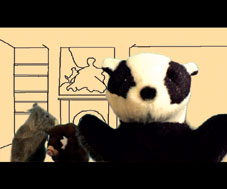
The sight of a model skeleton unearths a memory in Badger that he has repressed all these years. It prompts him to demand some pretty delicate answers to some pretty tricky questions about life, death, and self-sacrifice from his good friend Paul. "The Badger Series" (2005-6) consists of four episodes of a simulated television programme, equal parts moral instruction and narrative play, mediated through the forced fit of an experimental filmmaker as children?s entertainer.
Paul Tarragó is an artist film and video maker, drilling away with moving images in South London. His work? A mix of underground experimentation and metafiction, tugging at the leash of film language but with narrative often held close at hand. This can frequently be seen on the international circuit, including recent screenings at the European Media Art Festival, ArtSway Gallery, and the New York Underground Film Festival. His work will be appearing in the EMAF tour 2006/7. For the past 13 years he has also been an activist with the Exploding Cinema - a filmmaker- run collective dedicated to open access screenings and originating alternative methods of exhibition. When not working artistically he spends his time and earns his living teaching.
Paul Tarragó
Paul and the Badger - Episode 2
Art vidéo | dv | color | 9:30 | United Kingdom | 2006
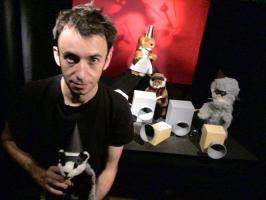
Badger and the Squirrel relay the world through a lens. The Badger series (2005-6) consists of four episodes of a simulated television programme, equal parts moral instruction and narrative play, mediated through the forced fit of an experimental filmmaker as children?s entertainer. Many more details as to how and why (and when) at www.wemakeourowntv.com
I`m an artist filmmaker, beavering away with moving images down is South London. My work? A mix of underground experimentation and metafiction, tugging at the leash of film language but with narrative often held close at hand.

Patrick Tarrant
Frankston
Experimental doc. | 16mm | color | 21:16 | Australia | 2020
Frankston is a study of the place I grew up, a satellite of Melbourne with affordable housing, nature-strips and beach views. The downright ordinary nature of the opportunities and festivities afforded by Frankston, and the ambivalence one can feel going back there, nonetheless give rise to a new aesthetic: the suburban symphony. In this case the symphony is rendered in strange hues and luminescences as though affirming Robin Boyd’s depiction of ‘the Australian ugliness’ in 1960, where he claims that “taste has become so dulled and calloused that anything which can startle a response on jaded retinas is deemed successful.”
Patrick Tarrant (Melbourne, 1969) is an Associate Professor in filmmaking at London South Bank University who has written on feature-length portrait films such as Where Does Your Hidden Smile Lie?, Two Years At Sea and Manakamana. Patrick has made video portraits and observational city films, while developing a hybrid filmmaking method that brings digital video and a 16mm film projector together (in The Take-Up, The Trembling Giant & Another Self Portrait ). Patrick has had films screened at the Hong Kong, Cork and Melbourne International Film Festivals, and was nominated for Best Short Film at the 2016 London Film Festival.
Thomas Taube
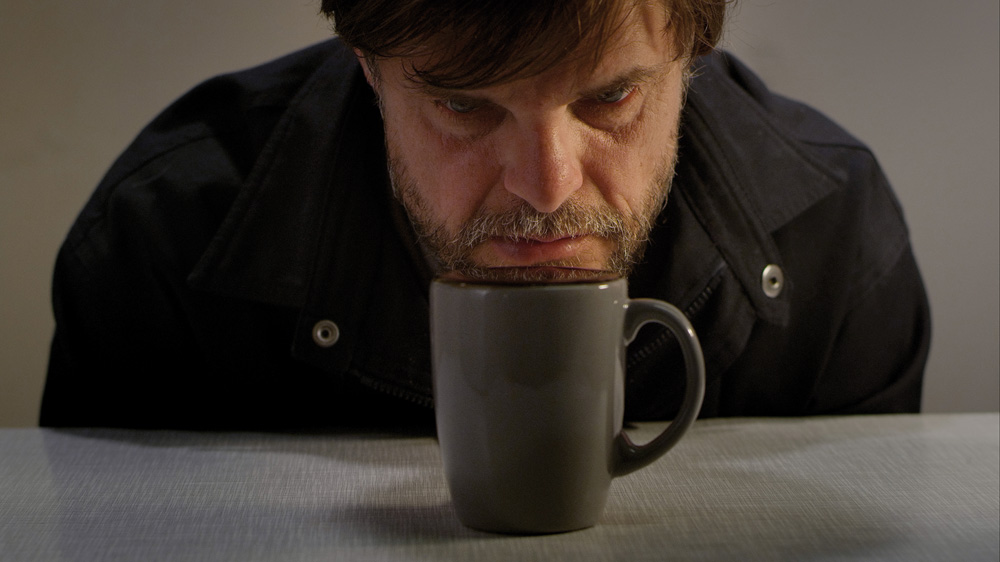
Dark Matters
Experimental fiction | hdv | color | 19:15 | Germany | 2014
The Film is based on interviews with questions considering the night, which were held with night watchmen in Tokyo, Moscow, Kabul, Tirana, Yaoundè, St. Louis, Monterey and Teheran. Actor Lars Rudolph plays a character who is trapped or saved in a zone were the relation between inner and outer space is uncertain.
I started my studying career in 2007 when I got enrolled to the Humboldt-University in Berlin to start theology. But since my wish to become an artist was stronger than to get educated as a theological philosopher I applied parallel to the beginning of the theological study at the Academy of Visual Arts in Leipzig where I got accepted and where I started in 2008. From 2008 to 2010 at the Basic Study with Prof. Christin Lahr, from 2010 to 2013 during my main study period in the class of Prof. Günther Selichar. I participated in various group-exhibitions and gained different stipends such as a production grant by the Austrian National Television (ORF III). My film "Sorry that I asked" was broadcasted nationwide,in May 2013. In 2013 Prof. Clemens von Wedemeyer started his professorship at the Academy of Visual Arts Leipzig and I continued my Study in his class (Class-Name: expanded cinema). In July 2014 I graduated with my diploma including a honour distinction. Since 2010 I am additionally a guest student in the class of Prof. Candice Breitz at the HBK Braunschweig. I was born the 19th of April, 1984 in Munich. After my school career I got educated as a graphic designer.

Thomas Taube
Narration
Experimental fiction | 4k | color | 45:19 | Germany | 2016
NARRATION links issues of social relevance, such as the systematic exploitation of workers on arab building sites, with questions of awareness and the perception of (constructed) narratives in our everyday lives. Different languages and associated concepts – such as imagination and seeing – are interleaved into a well arranged field of associations. In Taube`s work the "flow of images" becomes a symbol for the flux of visual concepts and the impossibility of them ever coming to a halt. The impact of the film is also due to the performance of its protagonists, who, at times far from playing a role, represent and reflect their own actions: the actor comes to represent the narrator on a stage.
Thomas Taube is a German video artist who is living and working in Leipzig. He studied from 2008 to 2014 at the Academy of Visual Arts (HGB) Leipzig and graduated from Prof. Clemens von Wedemeyer class with an honourable distinction. He is currently a „Meisterschüler“ of Clemens von Wedemeyer. From June until December 2016 Taube was resident at the ISCP in New York. The residency was sponsored by the Cultural Foundation of the Free state Saxony (KDFS). His video works are concept-based films which question obvious and seemingly self-evident circumstances of our daily lives.

Thomas Taube
THE NARRATOR
Experimental fiction | 4k | color | 5:46 | Germany | 2015
A narration is a narrative of fictitious events. A narration is a fictional memoir of non- fictional events. A narration is the mental order of fictional and non- fictional events in a comprehensible way for the individual order. What elements are necessary to form a story? What things need to be in a narration and if they are, in which order. Of which degrees of importance does the events has to be to find their place in our memories? The work NARRATION consists of six different scenes which thematise and build the different aspects and essential parts which together form a narration. The Setting | The Approach | The Past | The Narrator | The Event| The Construct The work NARRATION will be a concept based film and be released March 2016. It will consists of six different settings and narrations which together, in concept, form one story and give the work it‘s title. The Narrator will be the Epilog of the Film NARRATION.
Thomas Taube is young german video artist who is living and working in Leipzig. He studied from 2008 to 2014 at the Academy of Visual Arts (HGB) Leipzig and graduated at Prof. Clemens von Wedemeyer with an honour distinction. He is currently a Meisterschüler of Clemens von Wedemeyer. His video works are concept-based films which question obvious and seemingly self-evident circumstances of our daily lives, such as the night in "Dark Matters" (2014) or Television in "Sorry that I asked" (2013). Thomas Taube has released his first book "Das Surren der Bildmaschine" (2015) at Spector Books, Leipzig.

Thomas Taube
Occident
Experimental film | 4k | color | 30:48 | Germany | 2020
The world as we know it began in California in the last quarter of the century. The development of the high-speed motion photography becomes a lens for a larger story about the transformation of time and space. It is the base for what becomes later Hollywood and Silicon Valley both that most powerfully defined contemporary life says Rebecca Solnit. However, the world as we know it was also shaped by the European colonialism at the end of the 15th century. It defines our contemporary perspective on our so called norm and the relation amongst each other. It is also the origin of the cause why we are able to live how we live. It is the base for the division between the privileged and the others. Occident was the name of a horse, which motions became famous. Occident is also the definition of how the west differentiate itself from the rest of the world. It is the spine of what seems to be the normative and leads to the reason why it is not us, who drowns in the sea, who fabric our textiles, who dig for our resources or who work in zones to extract toxic materials which are seemingly gone for long, but in reality are still around us as the people who are in touch with it. We live in a reality of present absent materials which are around us and defines the relation between a system’s different extensions.
Thomas Taube is a video artist living and working in Jena. He studied with Clemens von Wedemeyer and Candice Breitz. In his works, Thomas Taube detaches the medium of film from its linear and stringent narrative structures. With multi-channel installations, associative, reflective and surreal sequences Taube works against conventional cinematographic codes. Abolishing the immediacy of the medium through epic elements and discontinuous montage, his works aim to distinguish between seeing, observing, experiencing, and reflecting. His works are shown nationally and internationally in institutions such as the Museum der bildenden Künste Leipzig or the Center for Contemporary Photography Melbourne, in galleries and festivals, for example in the German Competition of the Internationale Kurzfilmtage Oberhausen or at Les Rencontres Internationales Paris/Berlin. He won the prize of the Leipziger Jahresausstellung 2015, the Marion Ermer Prize 2016 and received various scholarships such as the KDFS residency scholarship at the ISCP New York. His work can be found in various collections, including the Staatliche Kunstsammlung Dresden. He published "The Whirr of the Image Machine" in 2015 with Spector Books. Taube is currently represented by Reiter Galleries (Berlin/Leipzig).
Alex Tavrin
Pay for gas
Experimental fiction | dv | black and white | 0:30 | Ukraine | 2003
Look how stupid a man looks when he is deprived of one of the everyday blessings of civilisation. He can?t fulfil the ancient ritual of lighting a fire. He has obtained water from a pipe, and, with a different but similar pipe, he tries to draw up gas. He has forgotten that this gas has already been mined out from the ground by other people who sell it. It is difficult to pay out of your own pocket for something intangible. It is even more difficult to make coffee without this "invisible" thing. Making coffee in order to finally wake up. To wake up and understand that one has to pay for everything.
I was born in 1972 in Ukraine. I left school and a technical institute. For over 10 years,I have been working with a lot of advertising agencies in Ukraine and Russia. I write screenplays for trailers and create slogans. I am a professional cameraman. I produce the Auto&Motor TV Program, which is broadcast on one of the main Ukrainian channels. This is the first time I have participated in this festival.
Yorgos Taxiarchopoulos
STRiKE
Video | dv | color | 0:32 | Greece | 2009
The electric light sometimes hides more information within the public space than it shows. The video work ?STRiKE? 2009 shows a young man who does an accurate rebellious gesture against a public electrical light with a found stone and reveals the night panorama of the picturesque port at the Greek island of Symi. It is a romantic but violent strike gesture, which seems almost instinctive, against the contemporary human civilization and the conscious ecological destruction humans have created on landscape through it. The work is a comment on the idea of juxtaposition in contemporary art and the social discussion about the defensive psychological mechanisms of human against its mechanical creations and their use on everyday life. I was inspired by the ?strike? action in the bowling game to create it. Yorgos Taxiarchopoulos ?STRiKE? 2009, DVD, 4:3, 32 sec?s, color and sound, dimensions of projection variable
Yorgos Taxiarchopoulos studied at the ASFA, Athens 1998-2003, department Painting, Professor A. Christakis and the ENSBA, Paris 2001-2002, department multimedia, Professor C. Boltanski. He speaks English, French and Japanese. He continued his research at the ASFA, master in digital arts (2004-2006) as scholar of the State Scholarship Foundation (IKY) and after at the CCA Kitakyushu (2007-2008) in Japan as scholar of the Basil and Eliza Goulandris foundation and the CCA Kitakyushu committee. He has been awarded with the 8th LVMH International Prize, Paris 2002 and the 1st Prize at the annual competition for young Greek artists of the Yiannis and Zoi Spyropoulos foundation, Athens 2002. On 2007 he was nominated to represent Greece at the National Pavillion of the 52nd Venice Biennale (Greek Ministry of Culture). He has shown his work in two solo shows (French Institute of Athens-2005 and Lola Nikolaou gallery Thessaloniki-2010) and has participated in several group exhibitions in Greece where he lives and works as well as abroad (Japan, France, United Kingdom, Austria and China). In Paris, he has shown his work in 2002 at the Germination13 exhibition held in ENSBA and the Pont Neuf gallery (LVMH laureates).

Derek Taylor
Scenes from the Periphery
Experimental film | super8 | black and white | 2:50 | USA | 2019
An aerial survey of the filmmaker’s place of origin, the film is a frame intensive search for home, place and direction. Edited in camera on Super 8, changing position two frames at a time, the movements of lines and masses offer a renewed look at this once lost but now rediscovered locale in a continuing quest for a sense of provenance.
Derek Taylor?s moving image work focuses on the intersection of documentary and experimental filmmaking, particularly as it relates to history and landscape. His work has been screened at a number of festivals both nationally and internationally. He studied film, video and new media at the School of the Art Institute of Chicago and currently lives and works in Connecticut (USA).
Tbl (tallblondladies)
Flat Fall
Performance | dv | color | 7:45 | Germany | 2009
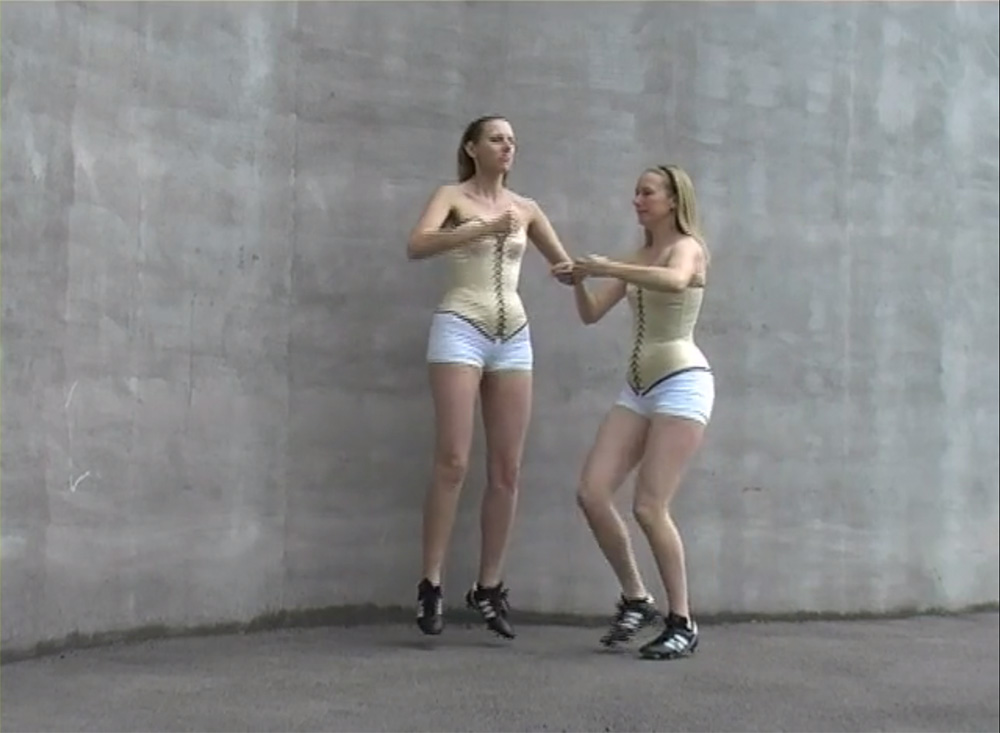
In front of a gray curved concrete wall two women, dressed in football shoos, corsets and panties are jumping. The different rhythms that they jump, produces a soundscape as the metal spikes are hitting the tarmac ground. The women move along the wall, they turn and move back, they turn again and so on.
TBL (TallBlondLadies) is a Swedish/German performance duo between Anna Berndtson and Irina Runge. Since its start in 2003 TBL is a significant part of both their artistic work. TBL works with the image of woman. They use different female types found in our society and through combination of materials they create collages of female metaphors. TBL are not working out of the emotional but their performances derive out of the formal and the structure. All performances by TBL are placed in basic forms. In the doubling they find synchronised movement patterns. Sound is vital as part of each performance. Both sound and form are used by TBL to discover rhythm and timelessness.