Catalogue > Faire une recherche
Résultats pour : Tout le catalogue

Mariangela Ciccarello
Battleground
Installation vidéo | hdv | couleur | 5:25 | Italie, USA | 2017
The existence of a battleground implies a larger war going on and an inherent lack of a resolution. Even within a single battle, the balance can shift, things can change or evolve, and be regarded from a different perspective. Rules and roles can be surpassed. Gesture is crucial in this regard as "the process of making a means visible as such" (Agamben).
Mariangela Ciccarello is a moving image artist and filmmaker whose work has been exhibited at the Festival del film Locarno, Torino Film Festival, Edinburgh International Film Festival, The Film Society of Lincoln Center's "Art of the Real" and Harvard Art Museum. In 2017 she participated in the Mediterranea 18 Biennale. Her work has been supported by the Roberto Cimetta Fund, New York State Council on the Arts, and the Valletta 2018 Foundation.

Luciano Cieza
one two three blue
Doc. expérimental | hdv | couleur | 26:0 | Argentine | 2015
There is something going on. People are moving, maybe going somewhere. Their cars lighting the way, out of the darkness, out of the night. Then, the day comes. People are moving, maybe going somewhere. Then there is the wind the sand and the animals. One, two three blue is a portrait of a place and the people who inhabit it, in a specific moment in time. It is about the relationship that exists between this space, what we can call the natural, and the people, and how they relate to it.
I was born in Buenos Aires Argentina. I have lived in San Francisco, USA and now live in Paris, France. Studied fine arts and experimental film.

Linda Ciharova
Jízda Emokrajem
Vidéo | dv | couleur | 8:15 | Tchèque (Rép.) | 2010
The whole project is interested in the border of an urbanistic landscape, where the city meets the nature. It is using an artficial light (hand torch, car lights or a helicopter´s search light ) to enlight and discover a landscape. An artificial light paraphrases here not only quite invasive human activity, but also a searching human mind. Through giving an focused attention revaluates an relationship to this "normal" suburbian landscape and lifts up the landscape and its part into unique objects. The fundamental element here is a feeling - an emotion, which we get from some places minded to communicate with us.
Linda Čihařová has born on 2.7.1982 in Prague, where she is also living and working. She graduated at the University of Art, Archuitecture and design in Prague and also experienced studies on FAMU in Prague, University of New Mexico in Albuquerque and Academy Beeldene Kunste in Maastrichtu, Netherlands. Although Linda Čihařová is using different new media, her projects have base in land art and concept art. She is in a way an muliinstrumentalist of new media techniques, because she is formally not limited in means of expression. While working on her ideas, she is mostly using video, photography, drawing, painting, instalations, an interactivity with a viewer and their combinations. Unifying element and main inspiration source she almost always finds in landscape, nature and a point of reflection of a human energy on it. Recently she is focused on communication of humans and their surrounding. She is also inspired by scientifical methods, micro worlds and landscape deatils. By making the photography an abstract one, she gets into a inner world of landscape and creating a psychological portrait of the place. she finds creatures, stories and situations, which want to be made visible. The drawing is here an expression of a personal reading in particular place and the landscape an interactive personality.

Florinda Ciucio
And yet I rise
Film expérimental | mp4 | couleur | 7:20 | Belgique, Espagne | 2020
Il y a cinq ans, Amr a quitté la Syrie pour s'installer à Madrid. Au cours d'une promenade dans le Jardin botanique royal de son nouveau chez-lui, entouré de plantes et d'arbres du monde entier, il réfléchit à ce que cela signifie pour lui d'être l'Autre. "And yet I rise" vise à transformer l'échange de pensées et de conversations entre Amr et le réalisateur en une synergie organique entre Amr, le spectateur et son esprit réflexif. Il en résulte une mosaïque d'images de plantes qui souligne leur caractère classifié. Le jardin devient ainsi une métaphore de l'immigration, un sujet très dense, tout en demeurant un environnement paisible, propice à la réflexion.
Florinda Ciucio est née en 1993, en Belgique. Fille d'un père argentin et d'une mère belgo-néerlandaise, elle s’est toujours intéressée aux thèmes de la culture et de l'identité. Ainsi, elle a rapidement pris conscience de l'importance et de la beauté de la compréhension interculturelle. Cela se reflète également dans son travail, où elle recherche un langage commun à travers les images et les métaphores. Elle a obtenu en 2018 un Master en arts audiovisuels à la LUCA school of Arts, Bruxelles (Belgique), avec une spécialisation en images documentaires. Depuis, son travail voyage grâce à des plateformes multidisciplinaires, comme des centres d'art, des festivals de cinéma et des expositions. En 2019, elle a été sélectionnée pour participer à un programme de stage lancé par les Nations Unies, le UN Flanders trainee program, dans lequel elle participé à la construction d’un langage audiovisuel pour une agence espagnole de l'ONU. Elle s'est ensuite concentrée sur le développement de sa propre pratique artistique, ce qui lui a permis de réaliser "And yet I rise" et de recevoir une subvention de production de la part de l'organisation Breedbeeld, pour un futur projet d'installation vidéo. Cette œuvre portera sur les vieilles images tournées en Super 8 par son grand-père, qui était marin en Europe pendant les années 50.
Claudia Claremi
El Tiempo
Doc. expérimental | mov | couleur et n&b | 18:36 | Cuba, Espagne | 2020
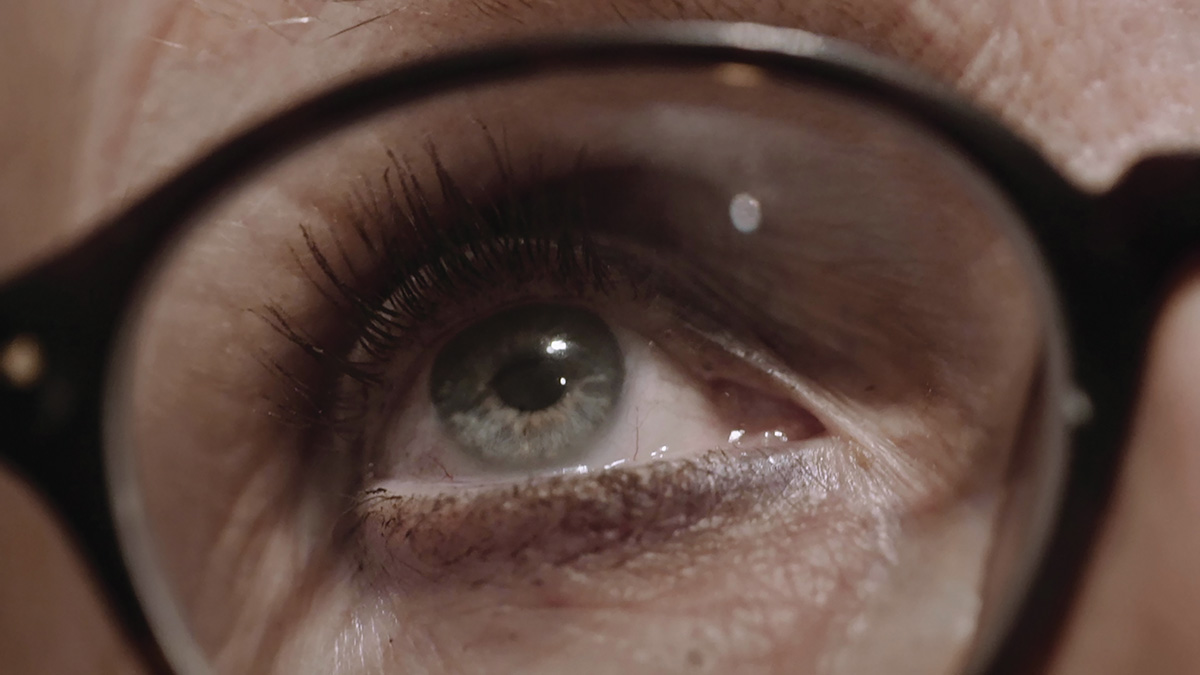
El Tiempo is a collaboration with the volunteers of the Reina Sofía Museum, a group of pensioners that play an active role in the museum’s educational programmes. Through the creation of a collaborative experimental film, El Tiempo examines the intangible, explores personal and collective memories, and delves into the relationship between this group and the Museum, representing a symbiosis of bodies and artworks. The project started in 2019, with the idea of making a film set in a dystopian present, where the Museum is closed to the public as a result of the collapse of modern society. Western culture has therefore lost its hegemonic role, causing the abandonment of the institutions that sustained it. In this context, the volunteers appear to be the only people who inhabit the Museum. The framework of this fictional thread, facilitated the development of group and individual performative actions, and allowed a series of encounters of bodies, space and artworks. This work was shot just before the pandemic and the editing and post-production process took place during the confinement. This experience deeply redefined the project and those images that were created as a vision of an imagined present, began to represent a plausible reality.
Claudia Claremi (Madrid, 1986). Visual artist and filmmaker. Graduated in Documentary Film from the Escuela Internacional de Cine y Televisión de San Antonio de los Baños (Cuba) and in Fine Arts from University of the Arts London (UK) and the Instituto Superior de Arte de La Habana (Cuba), and she has participated in alternative programmes of study and critical practice such as VISIO (Lo Schermo dell’Arte, Florence), P.O.P.S. (Colectivo Ayllu, Matadero, Madrid), Campus (Latitudes, Barcelona) and La Práctica (Beta Local, Puerto Rico). Her films Firefly, Bat and The woodland, among others, have been shown and awarded at international film festivals such as Raindance, Ann Arbor, Ji.hlava, FIC Guadalajara, Documentamadrid or Márgenes. Her work has been part of many exhibitions and she has also obtained the XXI Generación 2021 award, XXXI Circuitos award, the Matadero CREA grant. In 2020-21 she has completed El Tiempo, a film in collaboration with the Reina Sofía Museum in Madrid.

Louis Braddock Clarke
Under Boom
Installation vidéo | 4k | couleur | 18:0 | Royaume-Uni, Pays-Bas | 2024
UNDER BOOM (2024) is a hallucinatory cinematic experience shaped through a combination of human-shaped sonic ecologies and deep time. Framed as a listening station and a geological hotspot to imagine society’s shifting sonic world, the work takes the audience through an anthropogenic cinema experience with infrasound, an inaudible bandwidth of 0–20 Hz filled with shockwaves caused by human activities. These include mining blasts, burning space debris, air strikes, atomic bangs, sonic booms, seismic guns, and the calving of ice sheets. The work stems from the discovery of a listening island in the mid-Atlantic, which due to its geo-positioning and low noise ratio is hyper-sensitive to long-wave sounds. From this island, the sonic ruptures of the Earth’s ever-changing global acoustics can be heard. UNDER BOOM is captured using stroboscopic techniques, where anthropogenic beats orchestrate the presence of visuals. Infrasonic events become markers of visibility, entangling frequency with video frame-rates in an act to dissolve ocularcentrism. The frictions of vibrating matter, shaking sonics, and flickering images highlight the physical renderings of human sounds on the Earth. Linking the intimacy and intensity of flicker cinema with an embodiment of climate allows for alternative modes of listening and climatic imaginary experiences. What if the Earth was dancing faster and faster every year?
Louis Braddock Clarke is an artist and researcher interpreting notions from domains of art, geography, physics, and esoteric philosophy. Listening and amplification as creative methods have become key approaches to their work relating to disrupted ecologies. Through fieldwork, filmmaking, sonic tuning, and amateur geology their projects seek to speculate on the future surfaces of the Earth. Braddock Clarke’s relationship with the geographical arts is embedded in their formative years in Cornwall, surrounded by radon moorlands, granite quoits, shifting isolines, pixies, tin mines, and trans-Atlantic cable systems. These entangled Earth energies have become paramount to their ongoing research methods relating to technologies and terrains.
Eva Claus
Any Way
Film expérimental | 16mm | noir et blanc | 17:5 | Belgique | 2022
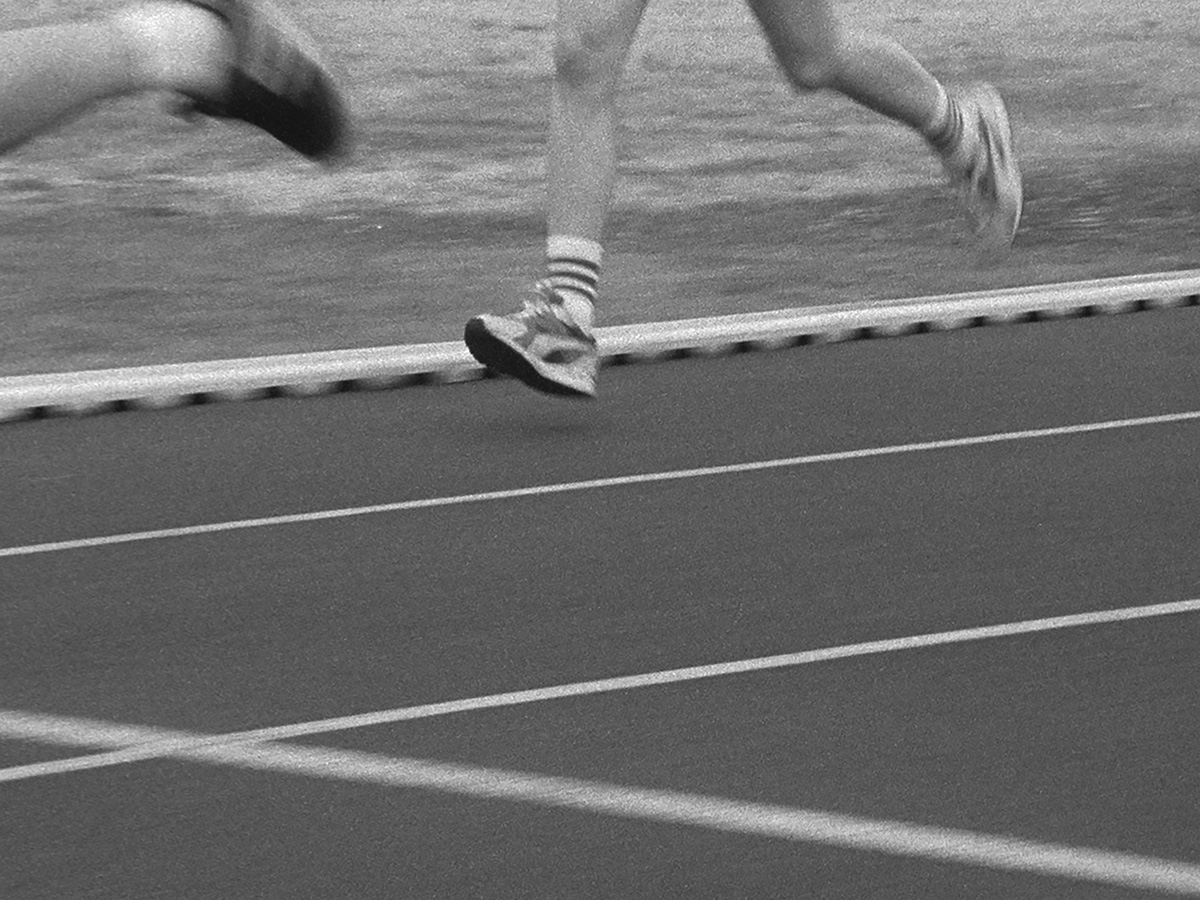
Any Way shows three people running together on an athletics track. The repetitive motion introduces the rhythm to a serene trance. The act of running itself is the focal point of the film: a continuous movement suspended in time. Varying frame rates allow the viewer to examine details of the motion that would otherwise be obscured by their own speed. The repetitive soundscape and music generates suspense. Breath, heartbeat and the runners' strides give way to each other. Towards the end of the film the physical exertion turns into a state of bliss.
Born in Brussels in 1992, Eva Claus is an audio-visual artist working primarily with 16mm film. Her practice is driven by observations of un/expected encounters with landscapes and people, natural habitats, space, psyche, circularity and means of film itself. Claus´s films exhibit a contemplative form of watching. In her recent films she uses an intuitive method of filmmaking in which she shares her interest in minimal narration. Claus was educated at the Friedl Kubelka School for independent film in Vienna, Austria and she obtained her MFA in photography at the Royal Academy of Arts in Ghent. Her films have been shown at festivals such as Light Field San Francisco, International Film Festival Rotterdam, Moscow International Film Festival, Process Film Festival Riga, Harkat Festival Mumbai, Rencontre International Paris / Berlin, and Istanbul International Film Festival, amongst others. She won the Public film prize at the 22nd Dresdner Schmalfilmtage, Dresden, Germany in 2021. Parallel to her artistic practice she works as a film restoration assistant at The Temenos. Eva currently lives and works in Brussels.

Eva Claus
Lomme's Garden
Documentaire | 16mm | couleur | 10:0 | Belgique | 2024
Lomme´s garden is a film shot 16mm.
Born in Brussels in 1992, Eva Claus is an audio-visual artist working primarily with 16mm film. Her practice is driven by observations of un/expected encounters with landscapes and people, natural habitats, space, psyche, circularity and means of film itself. Claus uses an intuitive method of filmmaking and her films exhibit a contemplative form of watching. Claus was educated at the Friedl Kubelka School for independent film in Vienna, Austria and she obtained her MFA in photography at the Royal Academy of Arts in Ghent. Her films have been shown at festivals such as Light Field San Francisco, International Film Festival Rotterdam, Vienna Shorts, Indie Lisboa, Short Waves, Go Short, Rencontre International Paris / Berlin, Istanbul International Film Festival, amongst others. She won the Public film prize at the 22nd Dresdner Schmalfilmtage, Germany. Was nominated for the Lichter Art Award and the Prix Médiatine. Parallel to her artistic practice she works as a film restoration assistant at The Temenos. Eva currently lives and works in Brussels.

Eva Claus
Russell
Film expérimental | 16mm | | 3:15 | Belgique, Autriche | 2018
I am living close to the sea. There is a time to film and a time to do nothing. While I am sleeping my days away I can hear the waves breaking, I see the moon coming up like the sun and the rainbows are coming out of the water, so close.
Eva Claus (Belgium) is working primarily with 16mm film. Educated in photography at the Royal Academy of Fine Arts, Ghent, Belgium and at the Friedl Kubelka School for independent film in Vienna, Austria. Her films have been screened in various places over the world. Eva currently lives and works in Brussels.

Christophe Clavert
LITTLE PRESIDENT
Documentaire | mov | couleur | 58:0 | France | 2020
De la résidence universitaire lilloise où il a été hébergé après le démantèlement de jungle de Calais, Khalid témoigne du parcours qui l’a mené en France, depuis le Soudan en passant par l’est européen, et de ce qu’a été, pour lui et d’autres, la Jungle.
Christophe Clavert est né à Paris en 1975. Il est cinéaste et monteur. Il a réalisé notamment "Les ruines de Paris" (2004), "La fuite du jour" (2011), "Hannah Arendt" (2012), et "Friday for Example" (2015). Il a été monteur de plusieurs films de Jean-Marie Straub, notamment "Dialogue d'Ombre" (2013), "Kommunisten" (2014), "A propos de Venise" (2014), et "France against Robot" (2020).

Christophe Clavert
LA ROUTE DE CAYENNE
Fiction | hdv | couleur | 32:0 | France | 2020
Aujourd'hui, en France. Un homme évadé d’un centre de rétention parcourt les routes en cherchant à rejoindre Paris. Parallèlement, en 1894, une étrange scène se déroule dans un appartement.
Après des études de cinéma et de philosophie, Christophe Clavert réalise son premier film en 1999, Les Faux monnayeurs (la bonne affaire). Il travaille ensuite dans la distribution et la production parallèlement à la réalisation de ses propres films et en étant occasionnellement pour d’autres chef opérateur et monteur. Il a notamment fait la photographie et été le monteur de nombreux films de Jean-Marie Straub depuis 2009.
Dana Claxton
Anwolek - Regatta city
Vidéo expérimentale | dv | couleur | 4:22 | Canada | 2005
Commandé dans un premier temps par la ville de Kelowna et la Alternator Gallery, ce travail remet en question la mémoire, la perte, l?identité, la nostalgie et la manière dont les paysages sont détériorés à travers l?apparat. Ce travail, plein de sujets sous-jacents et de métaphores, fait allusion au 11 septembre, à l?assassinat de Kennedy et à Olympia de Leni Riefenstahl.
Lenka Clayton
Zweifel (doubt)
Documentaire | betaSP | couleur | 32:0 | Royaume-Uni | 2006
Un regard surréaliste sur les Socialistes restants de l'Allemagne de l'Est. Racontée par la doublure de l'ex-président Erich Honecker, l'histoire de deux anciens douaniers (l'un de l'est, l'autre de l'ouest) qui se sont photographié l'un et l'autre par-dessus la barrière pendant 18 ans et celle d'un homme dont le rêve est la refondation de sa propre version de la République Démocratique Allemande dans une triste ville d' Allemagne de l'Est grevée par 70% de chômage. Ce film offre un aperçu des répercussions confuses d'un pays disparu.
Lenka s'est formée en tant qu'artiste au Central St.Martins. Après son diplôme elle quitta l'Angleterre pour Berlin où elle travailla comme projectionniste et s'occupa d'une galerie d'art contemporain. Son premier film; Qaeda, quality, question, quickly, quickly, quiet, un réarrangement alphabétique du speech "Axis of Evil" du Président Bush, a été montré internationalement et la bande son a été diffusée en édition limitée de 12" par Accidental Records. Elle a exposée et organisée des expositions à travers le monde et a récemment collaboré avec le musicien Matthew Herbert et le chorégraphe Rafael Bonachela sur deux vidéos-performances. Son film- cérémonie Zweifel (doute), un regard surréaliste sur les Socialistes restants de l'Allemagne de l'Est, a été montré en République Tchèque, Allemagne, Ukraine et au Liban. Elle travaille actuellement sur un documentaire photo de Corée du Nord et enseigne l' Image Mobile à l'École d'Art de St.Martins à Londres.
Wayne Clements
www.in-vacua.com/src1.html
net art | 0 | couleur | 0:0 | Royaume-Uni | 2005
?Src? (prononcez ?source?) répond à la question complexe de la relation entre l?image, le code et le texte. Lorsqu´un utilisateur entre un ou plusieurs mots-clé pour une recherche, Src cherche dans une banque de données d?images (en ce moment www.picsearch.com) et tente de trouver une correspondance. Si elle y arrive, Src affiche l?image et le code de sa source. Elle défile alors vers le bas et continue jusqu?à ce que l?on lui donne une un nouvel ordre de recherche.
Wayne Clements est un artiste visuel et poète. En 2005, il a soumis une thèse de doctorat explorant l?utilisation des lois et des instructions en art visuel (au Chelsea College of Art Design de Londres). Il a programmé ces dernières années des ?uvres artistiques sur Internet. ?Alt_Img_Tate? fait partie du FILE 2005 Electronic Language Festival de Sao Paulo au Brésil. ?History of a Russian Revolution? (un poème plus long) est publié par Writers, Londres, 2005.
Wayne Clements
The Most Wanted
Net art | | couleur | 0:0 | Royaume-Uni | 0
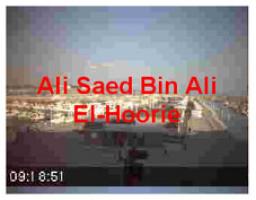
"The Most Wanted" est une oeuvre diffusée sur Internet. On la trouve sur le site http://www.in-vacua.com/themostwanted.shtml ou via la page d'information: http://www.in-vacua.com/TheMostWantedInfo.html. il s'agit d'une sélection d'image JPG issues de caméras de surveillance trouvées sur Internet. une mise à jour séquentielle d'images immobiles toutes les deux secondes donne une impression de mouvement. L'image source est changée toutes les quinze secondes, selon un mode aléatoire. Des textes viennent se superposer aux images. Ceux-ci comprennent les noms des terroristes les plus recherchés par le FBI. La logiciel qui commande ce processus est un programme informatique écrit en Perl. L'oeuvre est censée tester le climat d'anxiété qui entoure la question de la menace en combinant des caméras de surveillance avec des données issues des services de renseignement. Le titre de l'oeuvre est un clin d'oeil au Thirteen Most Wanted Men d'Andy Warhol (1964).
Wayne Clements vit à Londres. Il est artiste visuel et écrivain. En 2005, il termine son Ph.D. au Chelsea College of Art and Design. Ses recherches concernent sur l'utilisation des règles et des instructions appliquées au texte. Son travail récent implique la sélection, la génération et la manipulation de textes et d'images sur le net. Son oeuvre poétique, son travail visuel et ses textes en prose sont publiés dans un certain nombre de magazines et de livres.

Charlotte Clermont
Gephyrophobia
Documentaire | 16mm | noir et blanc | 2:21 | Canada | 2012
Gephyrophobia ? latin word for ?the fear of crossing bridges? - was shot in Ottawa/Gatineau, Canada. Inspired by pet architecture, a term coined by Japan?s Atelier Bow-Wow, and seeking to integrate the experience of the cinema into that of the city, the Situated Cinema references small buildings that have been squeezed into leftover urban spaces. The small cinema space, which can be demounted and which will travel to unorthodox locations across Canada, is intended to provide an alternative cinema-going experience: rather than constructing an immovable structure situated more or less permanently in the city, the Situated Cinema Project will construct a mobile micro-cinema that can be situated into various spaces, tapping into the flow and energies of the city. The cinema will screen a loop of five specially commissioned silent 16mm films from artists across the country.
Caroline Monnet is an award winning filmmaker and visual artist working in film/video, installation and printmaking. Her work has been exhibited extensively in film festivals and galleries, including the Toronto International Film Festival, Clermont-Ferrand vidéoformes (France), Urban Shaman Contemporary Aboriginal Art Gallery (Winnipeg), Künstlerhaus Bethanien (Berlin), Plug In Institute of Contemporary Art (Winnipeg) and the Manguere Arts Centre (Auckland, NZ). Monnet is also part of ITWÉ, a trans-disciplinary art collective dedicated to the creation of Aboriginal digital culture. She works and lives in Montréal, Canada.
Charlotte Clermont
Semi-auto Colours
Fiction expérimentale | 16mm | couleur | 6:10 | Canada | 2011
Kids in the West End of Winnipeg learn to count to One.
Isiah Medina was born in 1991, and grew up in the West End of Winnipeg. Main influences include Badiou, Godard, and Jay-Z. Semi-auto Colours is his first film.
Julia Clever
A la poursuite du vent
Documentaire | hdv | couleur | 60:0 | Belgique | 2018
Je filme mon grand-pe?re, Wilhelm depuis mon adolescence. Apre?s sa mort, je tombe sur des objets re?ve?lant son passe? Nazi. L’ai-je questionne? sur ce passe?? Je ne m’en souviens pas... Et aujourd’hui, dans nos histoires ici, dans le centre de l’Europe - que reste-t-il de ce temps la? ?
Avant de venir à Bruxelles, Julia Clever étudie la psychologie sociale et l’anthropologie en Allemagne. Après ses études en arts audiovisuels au RITCS, elle travaille comme vidéaste de théâtre, créant des projections de de?cors et des performances vidéo en live sur scène. A côté de son travail théâtral, elle documente au fil des ans plusieurs processus de groupe en vidéo dans le secteur socio-artistique. Entre 2012 et 2014, elle fait des recherches ethnographiques sur le rôle de l’Allemand dans les reconstitutions de guerre Belges et crée l’installation multi-écran “Devoir de mémoire”. Depuis 2014, Julia Clever est chercheuse au RITCS et enseigne depuis 2017. Ceci est son premier film d’auteur.
Claude Closky
Flux
Installation vidéo | 0 | couleur | 20:0 | France | 2004
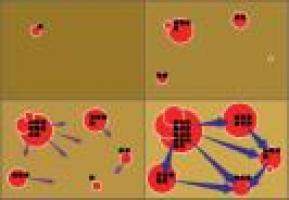
"L`oeuvre récente de Claude Closky s`attache à l`hyperconsommation des signes; et particulièrement des signes publicitaires, parmi lesquels on inclura aisément le vocabulaire graphique de l`économie, pour autant qu`on veuille bien accepter que sa signification, sa capacité de représentation efficace d`une réalité, s`efface derrière une abstraction divertissante, qui produit un effet tapisserie. Closky valorise ces signes en ne prenant en compte que l`énonciation des signifiants, et leur fonction dévorante sur la réalité, faisant disparaître tout message au profit d`un motif décoratif, dont l`infinité des variations ne produit qu`une reproduction infatigable du même. Flux utilise de manière simplifiée, réduite à l`édulcoration logotypique de formes héritées d`une abstraction géométrique moderniste (cercle et ligne), un des motifs caractéristiques de l`économie contemporaine, consistant à représenter les déplacements, matériels et immatériels, entre des masses. En extrayant ces flux de toute intention et de tout contexte, Closky rend leurs mouvements intransitifs jusqu`à l`absurde, mais montre aussi comment ils érigent en valeur, sans qu`elle soit questionnée ni remise en cause, les notions de mobilité, d`adaptabilité, de flexibilité? Par-delà la surface lisse des sphères et des vecteurs, la fluidité de leur animation tranquille, transparaît la violence d`une réalité savamment gommée de ces représentations invariablement positivistes : la violence de l`effacement des causes et conséquences possibles de ces échanges." François Piron, mars 2004 Courtesy www.art-netart.com
Claude Closky vit à Paris. Il travaille avec différent média, video, photographie, internet, dessin... Il a exposé à l`Arnolfini Gallery, Bristol (2002), au Bass Museum, Miami (2005), à la Bunkamura Gallery, Tokyo (1999), au Busan MoMA, Busan (2005), au Castello di Rivoli (1996), au CCA, Glasgow (1996), au CCAC, San Francisco (2001), au CGC, Genève (1994), au Centre Pompidou, Paris (1993, 2000, 2001, 2002), aux fondations Cartier, Paris (2001), la Caixa, Lleida (2004), Tarragona, Girona (2005), Mirò, Barcelone (2004), Olivetti, Rome (2002), au Fotomuseum, Winterthur (2001), au GEM, La Haye, à Location One, New York (2003), au Ludwig Museum, Cologne (2002, 2005), au Migros Museum, Zürich (2002), à la Moderna Galerija, Ljubljana (2000), au Musée d`art moderne de la Ville de Paris (ARC) (1992, 2000), au Musée d`art moderne Grand-Duc Jean, Luxembourg (2002), au Museum of Contemporary Art, Herzliya (1997), à l`Oca, Sao Paulo (2001), à la Schirn Kunsthalle, Francfort (2002), à la Tate Liverpool (2001, 2003), etc. Il a participé aux Biennales de Lyon (1995), Rotterdam (photo, 2003), Sharjah (2005), Sydney (1996), Taïwan (2000), Valence (2001), Venise (2001), etc? Il est représenté par les galeries Mehdi Chouakri, Berlin - Laurent Godin, Paris - Edward Mitterrand, Genève - Nicola-Fornello, Prato, Turin.
Claude Closky
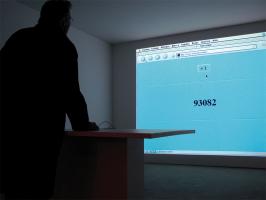
+1
Installation vidéo | 0 | couleur | 99:99 | France | 2000
Closky ne décode pas pour rire. Il ne détourne pas les signes de consommation pour le plaisir de critiquer. De façon nihiliste et désespérée, il met en doute la possibilité même de communiquer quelque chose à qui que ce soit. Dans ses ?uvres, le rapport des éléments entre eux compte plus que le contenu. Ainsi, ne s?intéresse-t-il pas à l?introspection ni aux récits singuliers mais aux relations souvent pauvres, stéréotypées et répétitives que nous entretenons avec notre environnement mental et physique. Loin d`exprimer quelque chose de personnel, l`opération +1 appartient aux lieux communs de la pensée arithmétique. Nous apprenons à additionner dès lors que nous savons par c?ur la succession des chiffres. L?ajout d?une unité est une opération de calcul élémentaire dont le résultat est connu d?avance. Aucun hasard, aucun affect ne sauraient perturber les règles de ce jeu fort ancien. Pour pointer cette évidence et mettre à nu les automatismes de la pensée et du comportement, Claude Closky a recours à des outils technologiques usuels : un ordinateur, un écran, une souris. De façon élémentaire, l?écran présente un fond uniformément bleu clair. Au centre, l?inscription +1 est insérée dans un rectangle. Le décalage entre les moyens sophistiqués qui sont mis en ?uvre et l?effet à la fois simple et tautologique que l?on obtient en cliquant +1, plonge l?utilisateur dans un état de trouble. Pourquoi, pour quel effet vient-il de cliquer une ou plusieurs fois de suite ? En tout point conforme à la formule inscrite, le résultat est sans surprise. Le nombre augmente d?une unité à chaque nouveau clic. Tout a commencé à partir du numéro un, un beau jour du mois de janvier 2000. Depuis, le nombre à plusieurs chiffres qui s?affiche n`est rien d`autre que la somme des différents clics. De façon apparemment naïve, Claude Closky détourne les lieux communs de la pensée artistique. Le rêve d?interactivité, si cher aux publicitaires et aux médiateurs culturels, est singulièrement mis à l?épreuve. Tel un boomerang, l?absurdité de certains de nos gestes et de nos croyances nous est renvoyée en pleine figure. Closky ne cherche pas à dénoncer, il ne cherche même pas à être personnel. Avec +1, il réalise une ?uvre conceptuelle minimaliste, accessible à qui le souhaite, à partir de n?importe quel poste branché sur internet. Carole Boulbès
Pierre Yves Clouin
I'm a New York Based Artidt
Art vidéo | dv | couleur | 2:12 | France | 2007
que sera sera what will be will be
Pierre Yves Clouin est né à Paris, où il vit et travaille. Ses vidéos ont été internationalement montrées aussi bien au Yerba Buena Center for the Arts San Francisco, Paula Cooper Gallery et Apexart New York City, qu?à Guggenheim Bilbao, ainsi que dans les festivals tels Sundance ou la Biennale de Genève.