Catalogue > Faire une recherche
Résultats pour : Tout le catalogue
Allison Chhorn
Blind Body
Doc. expérimental | hdv | couleur | 14:59 | Australie | 2021
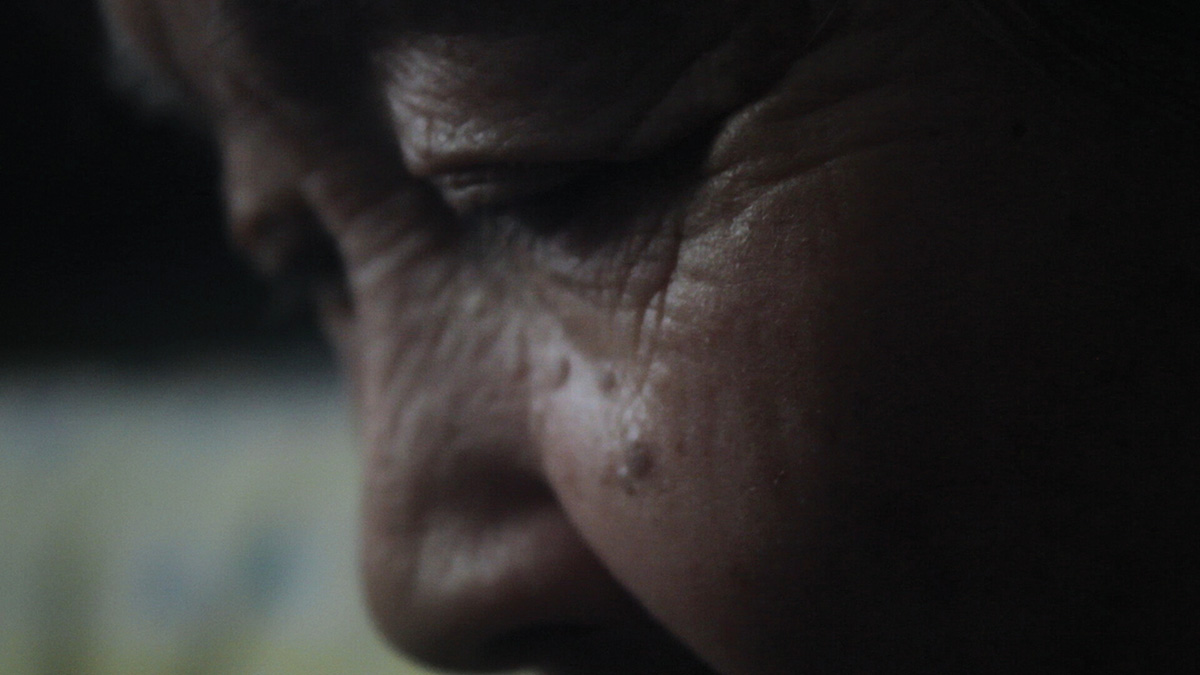
As abstract shapes come into focus, dim memories surface. With Blind Body, Allison Chhorn offers an impressionistic portrait of her grandmother Kim Nay, a survivor of the Khmer Rouge. Partially blind, Kim spends her days in a mostly sonic and textural world, in which the sound of rain, the voices of Khmer radio, and distant birdsong summon the sensations of a lost homeland.
Allison Chhorn is a Cambodian-Australian filmmaker and interdisciplinary artist living on Kaurna Land (South Australia). Her work explores the effects of migrant displacement and post-memory through impressionistic forms, often with other family members as subjects. Since graduating with Honours in painting at UniSA in 2014, she has made numerous films including “Blind Body”, “Missing” and “The Plastic House”. The latter was filmed on her family’s farm and has screened at MIFF, New York Film Festival and the Asia Pacific Triennial of Contemporary Art. Her films were also screened as part of a retrospective at the 11th Cambodian International Film Festival. Crossing into the gallery, she received the 2022 Porter St Commission from ACE Gallery to make her first solo exhibition and multi-channel installation “Skin Shade Night Day” which was exhibited as part of The National: Australian Art Now at MCA in 2023.
Robyn Chien
Eva et le Merkabas
Fiction expérimentale | mp4 | couleur | 34:41 | France | 2023
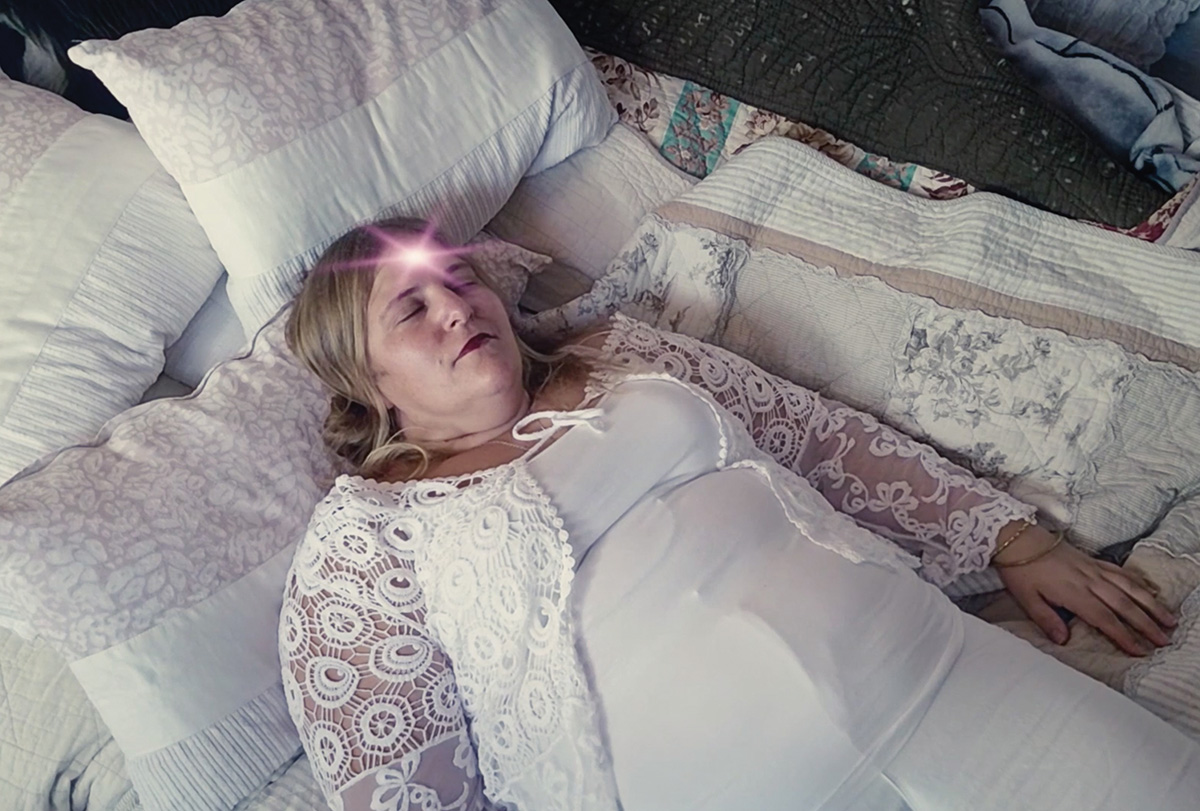
Sur un plateau de tournage en pleine nature, les membres d’une équipe s’agitent. Eva, l’actrice, lorsqu’elle n’exécute pas les indications bancales de la réalisatrice, profite des dons de Merkabas. C’est la médium du plateau. Eva rêve de créer sa propre société de production de film pornographique et souhaite mettre toutes les chances de son côté, y compris dans les mondes invisible. Ça tombe bien, Merkabas adore aider. En marge du film, une étrange relation de coaching se tisse entre les deux femmes. Elles échangent sur leurs réalisations, leurs conditions de travail ou leurs visions du monde. Elles se partagent leur secret ou: “comment avoir plus d’influences?”. Petit à petit, ensemble, elles délaissent doucement la réalité du tournage et la réalité tout court.
Artiste, réalisatrice, fondatrice et chargée de coordination chez Puppy Please Née à Toulouse en 1994, Robyn Chien vit et travaille à Marseille. Diplômée de la Haute École des Arts du Rhin, elle cocrée avec Lullabyebye et Gordon B.rec la société de production Puppy Please, au sein de laquelle elle réalise des films pour adulte. Leur but : faire des films porno et pouvoir faire des films porno. La réalisation des films, leur distribution et ce qui les empêche d’exister devient son terrain. En parallèle, elle réalise des films. Elle utilise la fiction comme un outil qui vient briser les impossibilités qui se mettent sur son chemin. Grâce à un processus similaire à l’action de la magie, elle répare le destin lorsqu’il est injuste. La performance et la caméra rendent compte et fixent ce changement. Elle a réalisé “Eva et Merkabah”, un film pour lequel elle a reçu le soutien Traversées du CIPAC, de la FRAAP, du réseau Diagonal et de la DRAC. Son travail a été présenté dans diverses expositions, notamment : So Far (Casino du Luxembourg, 2016), La Relatividad de llévar el mundo a cuesta (Quinonera, mexico, 2017), Là où les vents se croisent (Syndicat Potentiel, Strasbourg, 2018), Les martinets dorment en volant (CRAC Altkirch, 2018) et au festival Latitudes Contemporaines (Lille, 2021).
Patric Chiha
Les messieurs
Doc. expérimental | dv | couleur | 25:0 | Allemagne | 2006
Gugging est l?un des deux hôpitaux psychiatriques de la région de Vienne. L?hôpital est constitué de plusieurs pavillons, dont un s?appelle « La Maison des Artistes ». Là vivent et travaillent quinze peintres, entourés de quelques infirmières et d?un médecin. Trois Messieurs serait le portrait croisé de trois hommes qui tous trois peignent et vivent dans la même chambre. Dans ce portrait, j?aimerais aborder la façon dont leur environnement et Vienne marquent leurs récits et leurs tableaux. Je voudrais tenter, en les écoutant et en les interrogeant, de comprendre et de m?approcher de leur point de vue compliqué, à la fois fragile et brutal, sur l?extérieur. Plus que leur activité de peintres et ce qu?on appelle l?« Art Brut », ce qui m?importe est de questionner une citoyenneté singulière et émouvante, marquée par le souvenir et construite dans l?isolement.
Né en 1975 à Vienne, Patric Chiha vit et travaille à Paris. De 1998 à 2001, il étudie le montage à l?INSAS (Bruxelles). Pendant ses études, au lendemain de la coalition qui porte l?extrême-droite autrichienne au pouvoir, il réalise DE VIENNE, un documentaire sur sa ville où il a grandi (2001, 6?, vidéo, couleurs). Depuis, il également réalisé ALBERTINE! (2002, 1?, vidéo/Super 8mm, couleurs), CASA UGALDE (2004, 20?, 35mm, couleurs, produit par Kinoko Films) et HOME (2006, 50`, 35mm couleurs). Par ailleurs, Patric Chiha travaille régulièrement comme monteur, notamment pour Vincent Dieutre, dont il également été assistant réalisateur.
Aïcha Chikh
Circumambulation
Vidéo | mp4 | couleur | 12:4 | France, Algérie | 2024
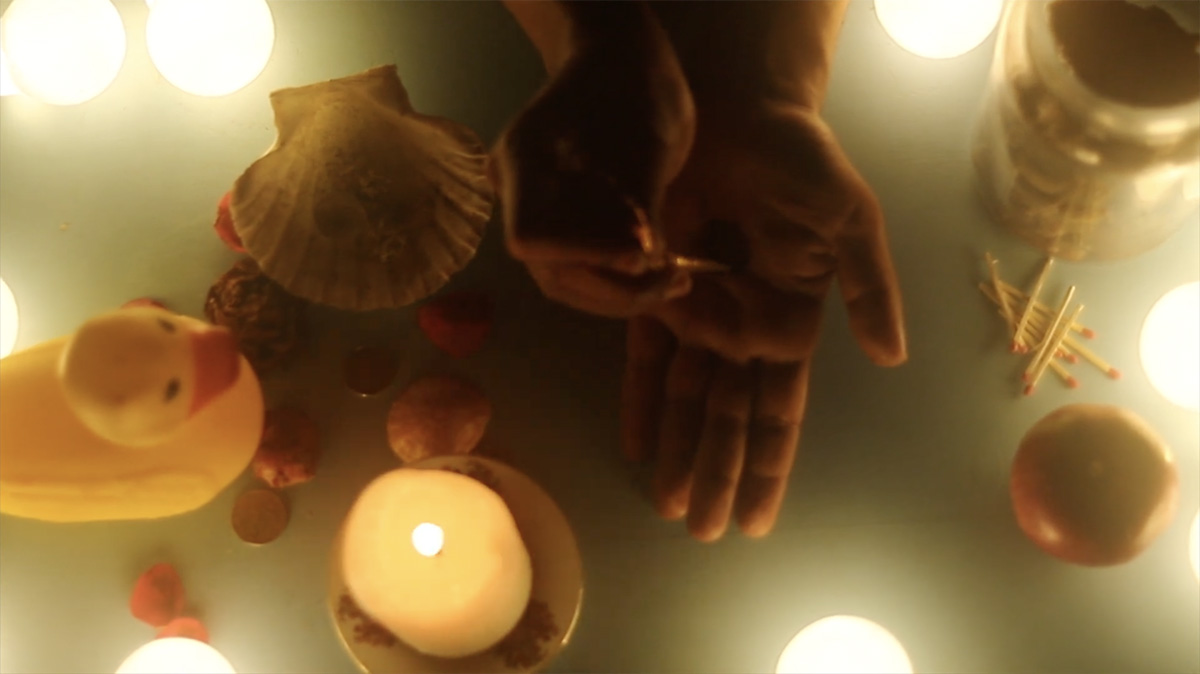
“Tawaf (at-tawâf), la circumambulation, désigne les sept tours que les musulman.e.s effectuent autour de la Kaaba, lors du pèlerinage (hajj) à La Mecque“ wikipedia 2024 Dans cet œuvre vidéo j'explore les parallèles entre certaines pratiques spirituelles musulmanes (Hajj) et celto-bretonnes (les menhirs) en imageant des formes de dialogues non verbaux qui peut y avoir entre certaines communautés dans leurs "terre d'origines" dans les pays du Sud avec leurs diasporas en Occident et une forme de rattachement à certains éléments sensoriels en contexte migratoire qui peuvent invoquer une sensation de familiarité et de "déjà vu". Asetta (Le métier à tisser en Tamazight) y est comme une allégorie à l'accumulation des couches d'expériences dans les corps diasporiques et migrants. Cette vidéo a été tournée en collaboration avec ma mère, en partie au M'Zab (Sahara, Algérie) et sur l'île d'Ouessant (Bretagne, France).
Aïcha Chikh est une artiste née et grandie à Ghardaïa (Algérie) et actuellement basée à Marseille. En ce moment entrain de préparer son DNSEP (Diplôme national supérieur d'expression plastique) en Écriture expérimentale à l'Ecole Supérieure des Beaux-Arts de Nîmes, et auparavant diplômée en master en Biodiversité et Evolution de la faculté des sciences à Montpellier et, avant, de l'université d'Oran (Algérie). Son parcours académique et personnel imprègne sa pratique artistique en explorant les questions liées aux déplacements et la place des corps dans les différents espaces géopolitiques et géographiques, elle s'attarde particulièrement sur les espaces physiques "périphériques" de l'occident. Ses créations empreintes différents médiums qui vont de la vidéo et l'écriture en passant par la performance.
Angélica Chio
Bei Kerzenschimmer und Sonnenschein
Art vidéo | dv | couleur | 7:0 | Mexique, Allemagne | 2005
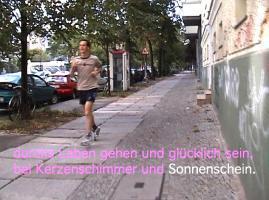
Un quidam se promène dans les rues d'un quartier berlinois connu. En même temps , un homme et une femme chantent en duo une chanson d'amour. Le texte de la chanson est basée sur des petites annonces internet de recherche de partenaires, en allemand. La vidéo cherche à questionner les attentes des hommes et des femmes modernes, et à révéler l'utilisation quotidienne de la langue allemande dans sa relation historique entre amour et chanson.
Né en 1966 à Mexico au Mexique. Il a étudié à l'Escuela Nacional de Pintura, Escultura y Grabado (Ecole supérieure de la peinture, de la sculpture et de la sérigraphie) La Esmeralda à Mexico et à la HdK ( aujourd'hui la UdK, Université des Arts) à Berlin. Vit et travaille à Berlin depuis 1993. Reçoit une bourse par le FONCA Fondo Nacional para la Cultura y las Artes (Fond National pour la Culture et les Arts)à Mexico pour les programmes suivants: Intercambio de Residencias Artísticas México-Canada [bourse de résidence Banff Centre for the Arts, Canada] 1999, Jóvenes Creadores [Jeunes Artistes] 2001-2002, et Intercambio de Residencias Artísticas México-Colombia [bourse de résidence Bogota, Colombie] 2003.

Chen Hung Chiu
大理石廠工人
Doc. expérimental | hdv | couleur | 7:30 | Taiwan | 2013
The video shows two Tai labors in Hualien marble factory pushed a trolley used in the past particularly for mine district, today , this old style trolley has been replaced by the new style crane, Artist invites two labors walking back and forth through the old trolley that he gilded by covering gold leaves as a divinized presentation. This work therefore has blended and mixed the reality and memory in life like the layers of wrinkles and folds in the stratum, the viewer could create an archaeological journey from the imaginations in many aspects.
Chen-Hung Chiu creative works revolve around collecting those inadvertently hidden objects / people and legends surrounding him, as well as rewriting the ambiguous ties between these "anonymous identities" and the locality, in a sense analogous to the connections between body and building, city and cells, monuments and intimacy. Comparable to the process of remodeling monuments, he strips away the logic designed and rationalized by social structures in attempt to rename those that offer significance and meaning to each material. Yet, unlike the citations made through reminiscing in the past, his works are instead sincere observations which explore personal experience and logic. Important exhibitions Chiu participated in include the Liverpool Biennial: City States(2012), ThaiTai:A Measure of Understanding, Bangkok Art and Culture Centre(2012), Une terrible poetique, La Biennale de Lyon, Galerie Olivier Hong(2011), Arte da Taiwan, Museo di Arte Contemporanea di Villa Croce, Genova(2011), Taiwan Calling-The Phantom of Liberty, Mucsarnot Museum, Budapest(2010), etc. in 2012, he was also chosen as an artist in residence at Cite internationale des arts Paris for the 12th Visual Arts Talent Exchange Program conducted by the Taiwan Ministry of Culture.

Seoungho Cho
buoy
Vidéo | dv | couleur | 6:21 | Coree du Sud, USA | 2008
BUOY/ SEOUNGHO CHO 6:21 MINUTES, COLOR, SOUND, 2008 The golden, barren landscape of Death Valley, California, recorded by Cho from a moving car, provides the luminous and mysterious texture of Buoy. As the title suggests, this work reflects on the polar extremes of this desert, which was once the floor of a vast sea, now traversed by sight-seeing tourists. In contrast to the horizontal landscape, which floats ceaselessly past Cho`s camera, vertical "strata" pattern the imagery, creating an axis between natural landscape and Cho`s composition. Cho accumulated his Death Valley footage over several years; the vertical patterning further represents the collapse of this footage into what appears to be a continuous drive through the desert.
Seoungho Cho was born in 1959 in Pusan, South Korea, and currently lives and works in New York. He received a BA and an MA in graphic arts from Hong-Ik University, Korea, and an MA in video art from New York University. He has had solo exhibitions in many prestigious venues such as the Museum of Modern Art in New York and his videos have been shown in biennales and group screenings throughout Europe and North America. Cho has received various awards and grants, including ones from the Jerome and Rockefeller foundations. Cho uses digital image processing techniques to manipulate simple, everyday objects, scenes or landscapes into highly lyrical sound and image collages. Cho`s videos are often very painterly in their use of rich, saturated colour and exquisite composition of the space on the screen. The works sometimes involve subtly developed, open-ended narratives that emphasize the embodied nature of perception and experience. The formal aspects of Cho`s videos are closely tied to explorations of how nature is represented through technology, specifically how representation is constituted by traces of contact between bodies, technology and the environment.
Seoungho Cho
I left my silent house
Art vidéo | dv | couleur et n&b | 8:51 | Coree du Sud, USA | 2007
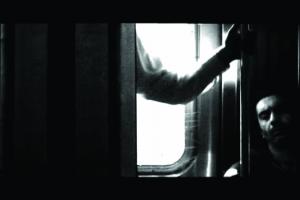
La dernière ?uvre de Seoungho Cho, « I Left my Silent House », commence dans une atmosphère méditative, avec des images en noir et blanc de personnes dans le métro, se transforme ensuite en un voyage coloré à travers des espaces théâtraux ouverts, pour retourner enfin de nouveau à la ville. La vidéo est une recherche sur les tensions et les plaisirs du voyage et, en fin de compte, sur la métamorphose.
Seoungho Cho est né en 1959 à Pusan (Corée du Sud) et vit actuellement à New York. Il a obtenu sa licence et sa maîtrise en arts graphiques à l?Université de Hong-Ik (Corée), et une maîtrise en art vidéo à l'Université de New York. En 1998, il a reçu une bourse en arts médiatiques de la Fondation Rockefeller et, en 2003, une subvention de la Jerome Foundation. Il lui a été décerné le Grand Prix du 27e Annual Black Maria Film and Video Festival, ainsi que le Prix International pour l'Art Vidéo du ZKM. Les vidéos de Cho ont été diffusées à une échelle nationale et internationale.

Seoungho Cho
Latency / Contemplation 1
Vidéo | hdv | couleur | 6:32 | Coree du Sud, USA | 2016
In this video, Cho transforms the sea shore into a visual poem. His inner landscapes and his perception of the outer world come together in an abstract meditation about space and place, light, time and traveling. The video consists of heavily electronic distorted images which result in mainly horizontal lines and colour bars which are reminiscent of the horizontal lines of VHS video. At the same time, Cho pushes the image to the edge of abstraction through which its relation to painting comes to the fore; through the emphasis on the flatness of the image this work reminds us of colour field painting (Mark Rothko). The soundtrack consists of manipulated audio of sea sound, like waves and wind, also pushing to abstraction. To this `noise` a minimal, poetic piano sound is added which brings a melancholic sphere to the work. The montage is hardly felt since cuts seem to be absent: everything seems to be metamorphosed into one another. Through the contemplative quality of the sound as well as the image, this video becomes a wondrous experience.
Seoungho Cho was born in 1959 in S.Korea. He received his M.A. from New York Univ. He received a Rockefeller Foundation Fellowship. Cho`s solo exhibitions have included The Museum of Modern Art, NY, Montevideo, Amsterdam and LeeUm Museum of Modern Art, Seoul. His installations have been selected for the permanent collection at such as the Museum of Modern Art, NY; LeeUm Museum of Modern Art, Korea and at the Los Angeles International Airport. In 2012, Cho`s Buoy (2008) was presented as a massive multi-channel installation in Times Square NY, a collaboration between EAI and the Times Square Alliance. Cho`s tapes have been broadcast nationally and internationally. He lives in New York.
Seoungho Cho
snap
Art vidéo | | couleur et n&b | 4:32 | Coree du Sud, USA | 2006
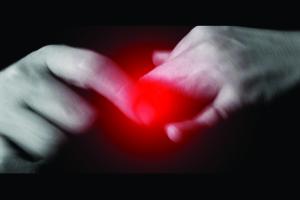
"Snap" est une oeuvre brève et minimaliste qui explore l'esthétique de la production vidéo numérique. Des doigts et des mains en gros plan effectuent des mouvements rapides, puis lents, suivant une bande son de cliquetis et de claquements stylisés, tandis que des flammes de couleur traversent par intermittence les images originales en noir et blanc. "Snap" pousse l'image et le son vers l'abstraction dans une exploration inventive, bien pensée et agréable de la technologie de l'image en mouvement.
Seoungho Cho est né en 1959 à Pusan, en Corée du Sud. Il est diplômé de l'université d'arts graphiques de Honk-lk en Corée. Il a également un diplôme en art vidéo de l'université de New York. En 1998, il a reçu une bourse du Rockfeller Foundation Media Arts et en 2003 l'aide de la Jerome Foundation. Il a reçu la "Juror's Citation" au 18ème Black Maria Film and Video Festival ainsi qu'un prix pour l'art vidéo de ZKM.
Eun Woo Cho
GATE
Installation multimédia | dv | couleur | 1:20 | Coree du Sud, USA | 2008
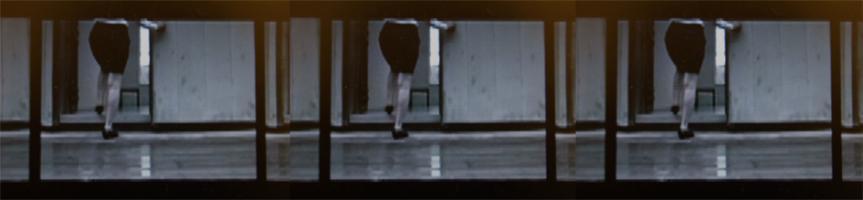
« Gate » constitue un point d?entrée ou un tournant dans l?espace psychologique circonscrit dans, et créée par, une forme architecturale spécifique à l?intérieur du corps humain. Il représente une ouverture, avec différents types de rencontres humaines et de séparations. « Gate » voudrait réussir à s?opposer au contrôle extrême des entrées et à la libre sortie de soi-même et des autres. Le geste de rencontre et de séparation est une forme de psychothérapie, qui a émergé avec la communication interpersonnelle et l?intensification de l?expérience psychologique du spectateur et du public. Lorsque le processus de séparation se produit, il transforme un mélange de substances, en rapport avec plusieurs espaces physiques, en différents composants architecturaux et psychanalytiques. Souvent, la pression du pouvoir et la force politique provoquent d?inévitables migrations humaines, ainsi qu?immigration, rencontres et séparations. Ces séparations et rencontres sont intimement liées au cycle de vie naturel. La structure de la pression ou du pouvoir impose des situations frontalières existantes, telles précisément, la séparation actuelle entre Corée du Nord et Corée du Sud.
Cho Eun Woo est née à Séoul (Corée). Elle a obtenu son BFA (Bachelor of Fine Arts) à l?Ontario College of Arts & Design (Canada). Elle a été impliquée dans diverses performances et expositions au Canada, en Italie et aux USA. Elle a récemment obtenu son MFA (Master of Fine Arts ) de la School of Visual Art de New York (USA) et fréquente actuellement les cours de l?Institute for Doctoral Studies in the Visual Arts Main de Portland (USA). Elle a obtenu des résidence artistiques auprès de la 7e Gawnju Biennale Global Institution et du Skowhegan Residency Program in Main de Portland en 2008-2009, et du Cat?Art en France, en 2007-2008.
Seoungho Cho
Snap
Vidéo expérimentale | dv | couleur et n&b | 4:32 | Coree du Sud, USA | 2006
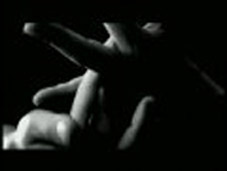
"Snap" is a taut, minimalist work that explores the aesthetics of digital video production. Fingers and hands in close-up move fast, then slowly, to a soundtrack of stylized clicks and snaps, while intermittent flares of color burn through the original black and white footage. "Snap" pushes figure and sound toward abstraction in an inventive, considered, and pleasurable exploration of moving image technology.
Seoungho Cho was born in 1959 in Pusan, South Korea. He received his B.A. and M.A. in Graphic Arts from Hong-Ik University, Korea, and an M.A. in video art from New York University. In 1998 he received a Rockefeller Foundation Media Arts Fellowship and in 2003 he received a Jerome Foundation grant. He received the "Juror's Citation" at the 18th Annual Black Maria Film and Video Festival as well as the International Award for Video Art from ZKM.
Seoungho Cho
Show your tongue
Vidéo expérimentale | dv | couleur | 6:8 | Coree du Sud, USA | 2006
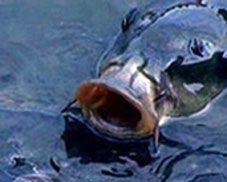
"Show Your Tongue" de Seoungho Cho est un millefeuille, une ?uvre composée de différentes couches. La première est de l?eau. On observe sa surface. On la voit de dessus et de près. Elle est parcourue de petites ondulations. Elle est d?un bleu profond. La deuxième couche est aussi fine et vivante, aussi gracieuse que la première. Son reflet sonore presque parfait, impossible de les différencier. Puis, petit à petit, la sensation de paix se dissipe. On commence à percevoir l?existence des monstres qui vivent sous la surface. Leurs écailles, leurs ailerons se frôlent. Leurs bouches claquent à la surface de l?eau. Cho manipule les images de ces bêtes en un motif vivant de formes et de motivation qui débordent les une sur les autres, recouvert d?un glaçage aqueux brillant. Il tisse une structure transparente en deux dimensions. Une structure qui se développe toute seule, couche après couche, et qui grandira jusqu?à consumer les filtres et les optiques de la camera, jusqu?à brûler la pellicule et les rétines du spectateur.
Stanley Cho
Nevertheless
Fiction | 16mm | noir et blanc | 20:40 | USA | 2004
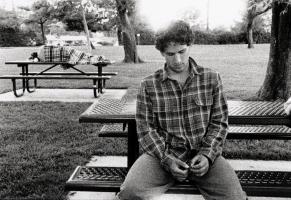
Joseph est engagé dans un voyage sinueux. Son oncle, Henry, est veuf et vit seul. Joseph arrive chez Henry. Gisela, qui lit Neruda, est la gouvernante d'Henry. Sam, qui joue du piano, habite à côté et est le seul ami de Henry. Joseph a sa propre tristesse, mais cela conduit Henry à repenser à ses propres souvenirs sombres.
Stanley Cho vit et travaille à Los Angeles, Californie. Il obtient son diplôme à la UCLA School of Art and Architecture en 2001. "Nevertheless" est son deuxième court-métrage.
Seoungho Cho
WS.2
Art vidéo | dv | couleur | 8:6 | Coree du Sud, USA | 2004
Il y a plusieurs aspects de l?acte d?observation qui rendent la réaction que l?on devant une image subjective. Seoungho Cho en souligne quelques importants et en omet clairement différents autres qui sont pourtant importants aussi. On ne nous propose aucun récit, aucun contexte ni aucune palette de couleur variée, pas de tout, pas de partie. Ces restrictions lui permettent en grande partie de définir la manière d?observer du spectateur comme une action en elle-même. Le cadre de ?WS.2? est en mouvement, ce qui permet au spectateur de prendre conscience du mécanisme de l??il, de la lumière, de la distance, de l?espace et de la réflexion, et de l?analogie de ceux-ci avec la caméra, l?enregistrement et la projection. L?image qui change à des moments bien choisis, provoque des changements dans notre perception de l?espace. Cela apporte un sentiment de transposition, le sentiment qu?on cherche quelque chose ? comme si on voyageait derrière la fenêtre d?un véhicule conduit par quelqu?un d?autre ? en avant puis en arrière de nouveau, comme s?il devait y avoir une raison pour regarder quelque chose en arrière. Le mouvement est tellement précis et contrôlé qu?il n?en est plus ni naturel ni physique, un peu comme un robot ; comme si quelqu?un contrôlait votre tête et vos yeux avec un joystick. Et pourtant ce que nous voyons rappelle le monde, un caractère capricieux et la beauté. Des lignes qui ondulent nous rappelant des dunes, des gros plans de courbes qui nous rappellent celle du corps, des plans micro de textiles ou des plans macro de vaste paysages pour définir cela, parce que l?image reste toujours ?matérielle?. Ce que vous voyez est une raison d?installer une chaise de réalisateur pour Cho dans votre tête.
Seoungho Cho est né en 1959 à Pusan en Corée du Sud. Il a obtenu un B.A. (Bachelor of Arts) et un M.A. (Master of Arts) en arts graphiques à l?université de Hong-Ik, en Corée et un M.A. en vidéo à l?université de New York. En 1998, il a reçu le Rockefeller Foundation Media Arts Fellowship et en 2003, une récompense de la Jerome Foundation. Il a également obtenu la ?Juror?s Citation au 18ème Annual Black Maria Film and Video Festival ainsi que le prix international pour la vidéo d?art de ZKM. Parmi les expositions personnelles de Cho on compte par exemple le Museum of Modern Art de New York ; la Philip Feldman Gallery en Oregon ; le Contemporary Art Museum d?Honolulu à Hawaii ; le Pusan Metropolitan Museum of Art en Corée ; le Montevideo à Amsterdam et la Cinémathèque Ontario à Toronto. Son travail a été présenté dans de nombreux festivals internationaux et expositions collectives, comme par exemple the Philadelphia Museum of Art à Philadelphie, the Museum of Contemporary Art à Chicago, le 58ème Fetsival International du Film d?Edimbourg, le Pandaemonium ?98 au Lux Centre de Londres, le Centro d?Art Santa Monica de Barcelone en Espagne, the National Gallery of Art de Washington DC, le Stedelijk Museum à Amsterdam, le Samsung Museujm of Modern Art en Corée, le Festival Nouveau Cinéma, Nouveaux Médias de Montréal au Canada, la Valencia Biennial en Espagne, the Kwangju Biennial en Corée, the Palm Beach Institute of Contemporary Art en Floride, the Robert Flaherty Film Seminars; Artist?s Space à New York, the International Film Festival Rotterdam, et the New York Video Festival au Lincoln Center à New York. Les cassettes de Cho ont été diffusées au niveau national et international, il vit à New York.
Pip Chodorov
Rooftop Flicker
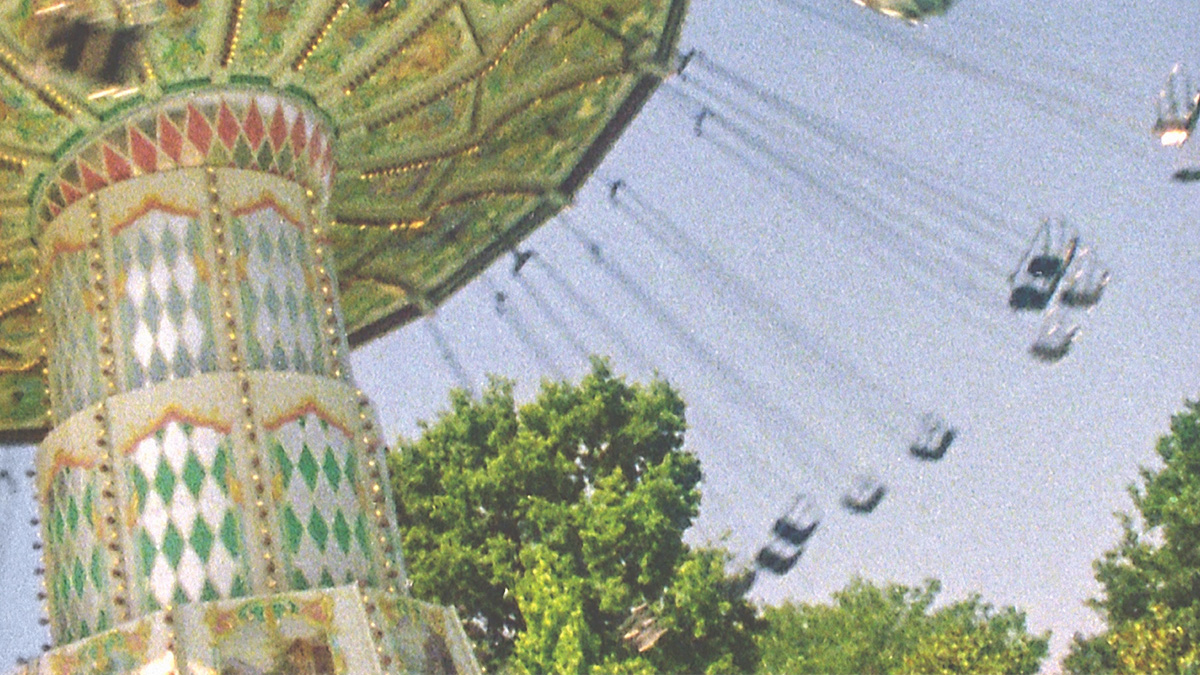
Film expérimental | super8 | couleur | 3:20 | USA, Coree du Sud | 2022
Super-8 flicker film shot and hand-developed in Seoul in spring 2022 with jazz soundtrack from a Jonas Mekas centennial tribute in Busan.
Pip Chodorov. Born April 13, 1965 in New York. Filmmaking and music composition since 1972. Studied cognitive science at the University of Rochester, NY and film semiotics at the University of Paris, France. Work in film distribution - previously Orion Classics, NYC; UGC, Paris; Light Cone, Paris; and, currently, Re:Voir Video, Paris, which he founded in 1994 and The Film Gallery, the first art gallery devoted excusively to experimental film. He is also co-founder of L'Abominable, a cooperative do-it-yourself film lab in Paris, and the moderator of the internet-based forum on experimental film, FrameWorks.

Pip Chodorov
The Stranger
Fiction expérimentale | 16mm | couleur | 9:19 | USA, Roumanie | 2018
Romanian fairy tales usually start with the sentence: “Once upon a time something happened, if it hadn’t happened it couldn’t be told”. In this fairy tale, a stranger visits the remote mountain village of Slon. This film was made at an annual ten-day filmmaking residency in Slon. As a stranger myself, first time to Romania, with only four days to shoot and four days to edit, I wrote this modern-day fairy tale to coincide with my fantasy idea of what my unpredictable visit to the village would be like.
Pip Chodorov. Born April 13, 1965 in New York. Filmmaking and music composition since 1972. Studied cognitive science at the University of Rochester, NY and film semiotics at the University of Paris, France. Work in film distribution - previously Orion Classics, NYC; UGC, Paris; Light Cone, Paris; and, currently, Re:Voir Video, Paris, which he founded in 1994 and The Film Gallery, the first art gallery devoted excusively to experimental film. He is also co-founder of L`Abominable, a cooperative do-it-yourself film lab in Paris, and the moderator of the internet-based forum on experimental film, FrameWorks.
Adam Chodzko
Knots
Fiction expérimentale | hdv | couleur | 8:5 | Royaume-Uni | 2013
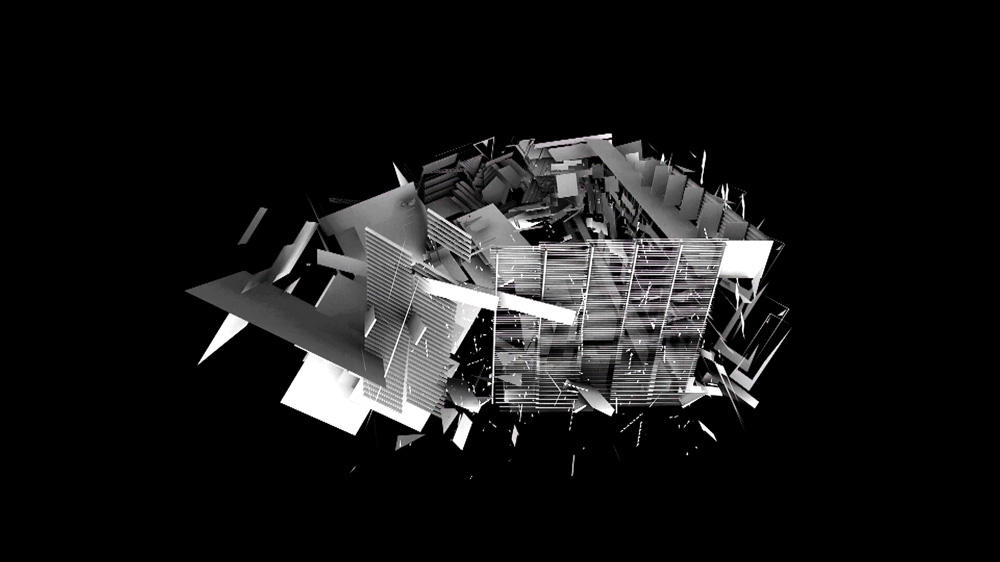
In Knots, Adam Chodzko focuses on the remote but important relationship between the artist Kurt Schwitters, in the final years of his life in the late 1940’s, living in poverty and exile in England’s Lake District, and J. Edgar Kaufmann, the wealthy owner of the Kaufman Department Store in Pittsburgh, USA. Kaufmann had arranged for money to be wired to Schwitters so that he could develop a new Merz structure. Chodzko plays with the desire to conclude and tie up the loose and disparate ends of this narrative. He imagines the now empty Merzbarn (Schwitters final work having been removed to a Newcastle museum in 1965) as a vacuum, sucking in thoughts, desires and matter; all caught up in the vortex of a dream-like surreality. Kaufmann had commissioned Frank Lloyd Wright to design his Pittsburgh office, a structure that itself was also later displaced from its source when donated to the Victoria & Albert Museum, London. Chodzko sees the interior spaces that Schwitters and Kaufmann worked within as unstable, flowing, collaged together, as though becoming a Merz themselves, whilst the form of the video also echoes this process of construction and deconstruction. Knots is a mesmerizing combination of fact and fiction, text and moving image building a story about longing, creation and fragmentation, endings and beginnings, networks of people and isolated individuals, separations and notions of home. It was commissioned by Tate Britain in 2012.
Adam Chodzko’s art explores the interactions and possibilities of human behaviour by investigating the space between how we are and how we could be. Working across media, from video installation to subtle interventions, with a practice that is situated both within the gallery and the wider public realm, his work investigates and invents the possibilities of collective imagination through using a poetics of everyday life. By wondering how, through the visual, we might best engage with the existence of others he reveals the realities that emerge from the search for this knowledge. Chodzko's art proposes new relationships between our value and belief systems, exploring their effect on our communal and private spaces and the documents and fictions that control, describe and guide them. Working directly with the networks of people and places that surround him, often using forms of anthropology, Chodzko focuses on the relational politics of culture's edges, endings, displacements, transitions and disappearances through a provocative looking in the 'wrong' place; a search for knowledge through instability. His art is catalysed by imagining a collapse of the category of Art, requiring not only a new audience but also a new status for the art object. Chodzko’s practice operates in the tight, poetic spaces he evolves between documentary and fantasy, conceptualism and surrealism, and public and private space, often engaging reflexively and directly with the role of the viewer. Intimate collections and ephemeral communities are frequently generated through his works; assemblies of owners of a particular jacket and a reunion of the children 'murdered' in a Pasolini film; a god look-alike contest; lighting technicians asked to advise on the light in heaven; a London gallery's archive given to a group of Kurdish asylum seekers to edit and hide outside the capital; the multi-faceted Design for a Carnival, the evolution of a ritual event for the future including Settlement, the legal purchase of a square foot of land as a gift to a stranger, Nightshift, a late night parade of nocturnal animals to the Frieze Art Fair, London and M-path, the collection and distribution of perception-changing footwear for gallery visitors. More recently a trilogy science fiction video and mixed media works, Hole, Around and Pyramid, have all explored, the idea of art becoming a vehicle for a community’s collective mythology, whilst Echo, The Pickers and Ghost elaborate these themes through excavating processes of memory, empathy and the imaginary. Because, 2013 (at Tate Britain) and We are Ready for your Arrival, 2013 (at Raven Row) further develop these ideas through manifestations of the unconscious relationships between individuals and groups; their excesses and disappearances. Born in 1965. Lives and works in Whitstable, Kent, UK. Since 1991 Chodzko has exhibited extensively in international solo and group exhibitions including: Raven Row, London; Tate Britain; Tate, St Ives; Museo d'Arte Moderna, Bologna (MAMBo); The Benaki Museum, Athens; Athens Biennale, Istanbul Biennale, Venice Biennale; Royal Academy, London; Deste Foundation, Athens; PS1, NY; Ikon Gallery, Birmingham, Kunstmuseum Luzern etc. Recent projects include commissions by Creative Time, New York, The Contemporary Art Society, Frieze Art Fair, and Hayward Gallery. In 2002 he received awards from the Hamlyn Foundation and the Foundation for Contemporary Art, New York, and in 2007 was awarded an AHRC Research Fellowship in the Film Department at the University of Kent, Canterbury. His work is in the collections of the Tate, The British Council, The British Film Institute, The Arts Council, APT, Auckland City Art Gallery, Contemporary Art Society Collection, The Creative Foundation, Frac Languedoc-Rousillon, GAM - Galleria d’Arte Moderna, Turin, Grizedale Arts, MAMBo - Museo d’Arte Moderna di Bologna, Plains Arts Museum, North Dakota, USA, Saatchi Collection, South London Gallery, Towner Gallery Eastbourne, and international private collections.
Ahram Choi
Ice
Vidéo | 0 | couleur | 6:2 | Coree du Sud, Allemagne | 2024
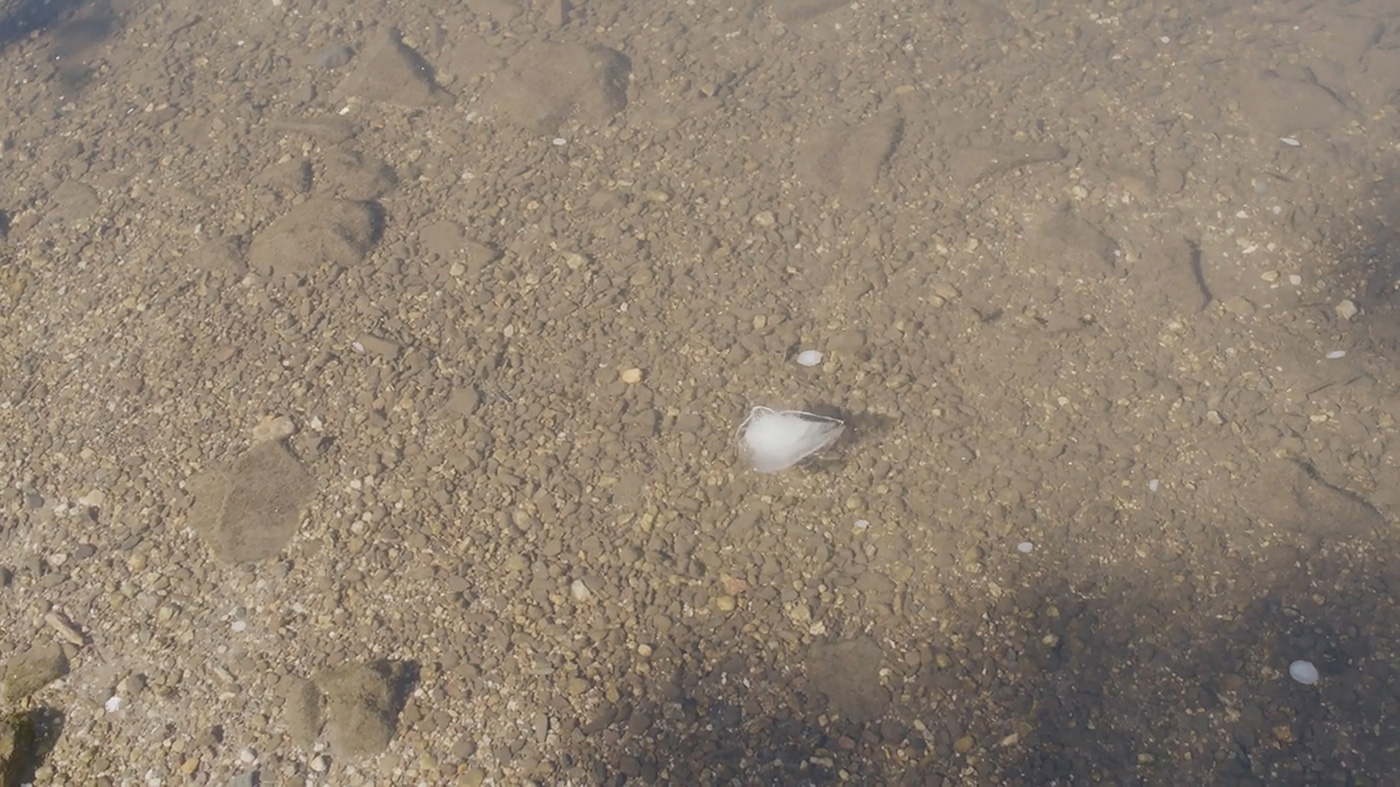
“Ice” follows a woman walking along a riverside before she quietly kneels and releases a block of ice into the flowing water. The work moves slowly, allowing the small gestures surrounding this action to surface with clarity. As the ice drifts and dissolves, the scene becomes a meditation on everything and nothing. It reflects on what is carried, what is left behind, and what quietly disappears without resistance. This work moves between documentation and metaphor. The physical melting of the ice mirrors the gradual fading of thoughts, emotions, and states of being that once felt solid but eventually lose their form. What seems like a minor act begins to echo larger questions about attachment, cultivation, and the invisible residue left by moments of departure. “Ice” does not aim to narrate a story, but rather to offer a space of deceleration, where time stretches and the viewer can lean into subtle shifts. These include the weight of the ice, the coldness of the air, and the sound of water carrying something away. Within this quiet event, the work invites contemplation on how a small, dissolving object can hold the fullness of something once considered everything, even though it is now becoming almost nothing.
Ahram Choi is a visual artist working with video, installation, photography, and text. Her practice focuses on subtle emotional states, temporal fragility, and the quiet traces that remain around moments of departure or transition. Through minimal gestures and slow, observational structures, she explores how small actions can reveal internal landscapes that are rarely spoken but deeply sensed. Born in South Korea and trained in time-based media art in Germany, she creates works that move between documentation and metaphor. Her videos often unfold gradually, offering a space where viewers can sense shifting atmospheres and disappearing elements. She approaches each work as a quiet inquiry into perception, memory, and the transient qualities of experience.

Chris Chan Fui Chong
Heaven Hell (1ch)
Film expérimental | mov | couleur et n&b | 11:18 | Malaisie, Japon | 2024
A collaboration with and a commission by NPO Koganecho Area Management Center as part of Chong’s residency at the Koganecho Bazaar, which is located in the former red-light district of Koganecho, Yokohama, Japan. Koganecho was the conceptual reference for ‘hell’ in Akira Kurosawa’s 1963 film High and Low. However, because of the district’s notoriety, shooting on location became far too dangerous for the cast and crew. HEAVEN HELL looks to restage the past and present representations of the red-light district by shooting the slum scene on the same street that Kurosawa had initially intended but was unable to do so. Chong referred to the film scenes that Kurosawa shot in the studio in order to re-create the eerie and hyper-theatrical mood of the infamous street in both the traditional and contemporary periods; recruiting local youth in the now gentrified neighbourhood of Koganecho. HEAVEN HELL takes the point of view of the kidnapper/villain, using his entire dialogue in the film compressed into a single moment through the slums, past and present, expressing the toll it has taken on him and the class he was relegated to.
CHRIS CHONG CHAN FUI is a filmmaker and artist who works between Southeast Asia and Canada. From digital and analog moving images to fabricated and organic objects, Chong works to reveal unfamiliar narratives. His work layers the social and natural sciences with transnational circuits of globalization and manufactured cultures and landscapes. With a rigorous research methodology and a formalist aesthetic, he uses structure and constraints as a creative path toward expressive innovation. Chong has exhibited at such venues as the Hirshhorn Museum & Sculpture Garden, Palais de Tokyo, EYE Film Institute Netherlands, and the Gwangju Biennale, while premiering films at the Cannes Film Festival's Directors’ Fortnight, BFI London, and TIFF’s Wavelengths, where he won back-to-back awards for Best Canadian Short Film. He is a Smithsonian Institute fellow (National Museum of Natural History), a Ford Foundation fellow, and a Rockefeller Foundation's Bellagio Arts Fellow. Chong holds an MFA (film) from York University and is an Assistant Professor (film) at Simon Fraser University’s School for the Contemporary Arts on the unceded territories of the S?wx?wú7mesh Úxwumixw (Squamish), s?l?ilw??ta?? (Tsleil-Waututh) and x?m??k??y??m (Musqueam) Nations.
Isaac Chong Wai
Rehearsal of the Futures: Police Training Exercises
Vidéo | mp4 | | 18:14 | Hong Kong | 2018
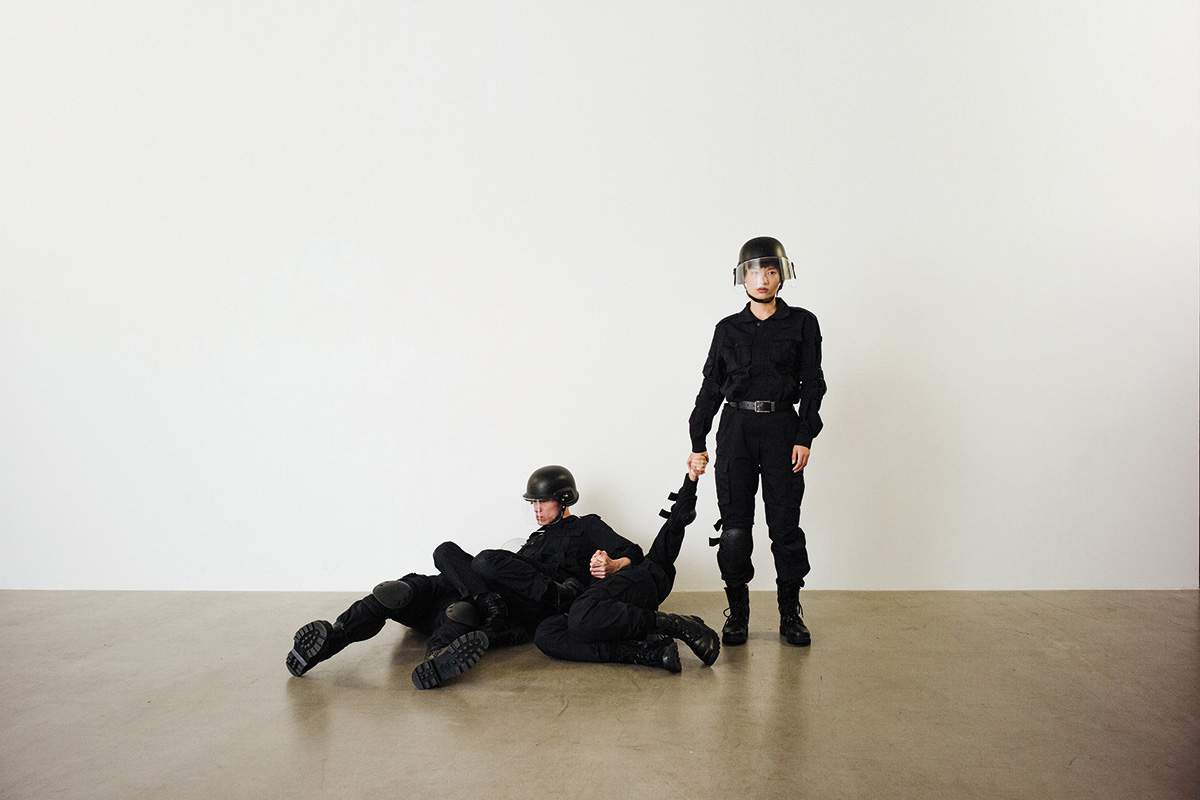
Dans "Rehearsal of the Futures: Police Training Exercises" (2018), Isaac Chong Wai chorégraphie le mouvement de policiers anti-émeute en uniforme dans un ralenti tortueux, insufflant une douceur paradoxale à leurs intentions initialement violentes. Par le ralentissement de l'attaque agressive et de la collision des corps, les postures et les mouvements oscillent entre caresses et coups. Ces actions décélérées rendent visible la violence infligée aux individus par les structures collectives du pouvoir.
Isaac Chong Wai est artiste. Il habite à Berlin et est originaire de Hong Kong (Chine). Son travail s’inscrit dans des domaines variés, dont la performance, l'installation, la peinture, la vidéo, la photographie et le multimédia. Influencé par ses expériences personnelles et des phénomènes globaux, il aborde les thèmes du collectivisme et de l'individualisme, de la géopolitique, de la migration, des traumatismes historiques, des politiques identitaires et de la sphère publique. Traitant des changements sociétaux, des tensions mondiales et des blessures collectives, il s'efforce de transformer l'impuissance - les demandes sans réponse, l’exclusion de l'autorité et le déni de la liberté individuelle - en résistance, rébellion et critique des systèmes sociaux. Il a présenté des expositions personnelles notamment à Bilsart, Istanbul (Turquie), commissionné par la Kulturakademie Tarabya (Turquie) et la Zilberman Gallery [2021]; à la Blindspot Gallery, Hong Kong (Chine) [2019]; à la Zilberman Gallery, Berlin (Allemagne) [2019]; au Kunstraum München, Munich (Allemagne) [2018]; au Goethe Institut Hongkong (Chine) [2018] et au Bauhaus Museum, Weimar (Allemagne)[2016]. Son travail a été présenté au National Museum of Modern and Contemporary Art, Séoul (Corée du Sud), à la Biennale d'Innsbruck (Autriche) et à l'IFFR – Festival international du film de Rotterdam (Pays-Bas) [2020]; au Museum of Contemporary Art Taipei (Taïwan) et au Guangdong Times Museum, Guangzhou (Chine) [2019]; au M+ Museum et au Para Site, Hong Kong (Chine) [2018]; à la Stiftung Brandenburger Tor et à la Haus der Kulturen der Welt, Berlin (Allemagne) [2017]; au Deutsche Kuenstlerbund, Berlin (Allemagne) et au Gwangju Media Art Festival (Corée du Sud) [2016]; au Kunstfest Weimar (Allemagne) et au Muzej Macura, Belgrade (Serbie) [2015]; à la Moscow International Biennale for Young Art, au Musée de Moscou (Russie) [2014]. Il a obtenu une licence en arts visuels à la Academy of Visual Arts de la Hong Kong Baptist University (Chine), et un Master en arts visuels "art public et nouvelles stratégies artistiques" à la Bauhaus-Universität de Weimar (Allemagne).