Catalogue > Search
Results for : Tout le catalogue
Allison Chhorn
Blind Body
Experimental doc. | hdv | color | 14:59 | Australia | 2021
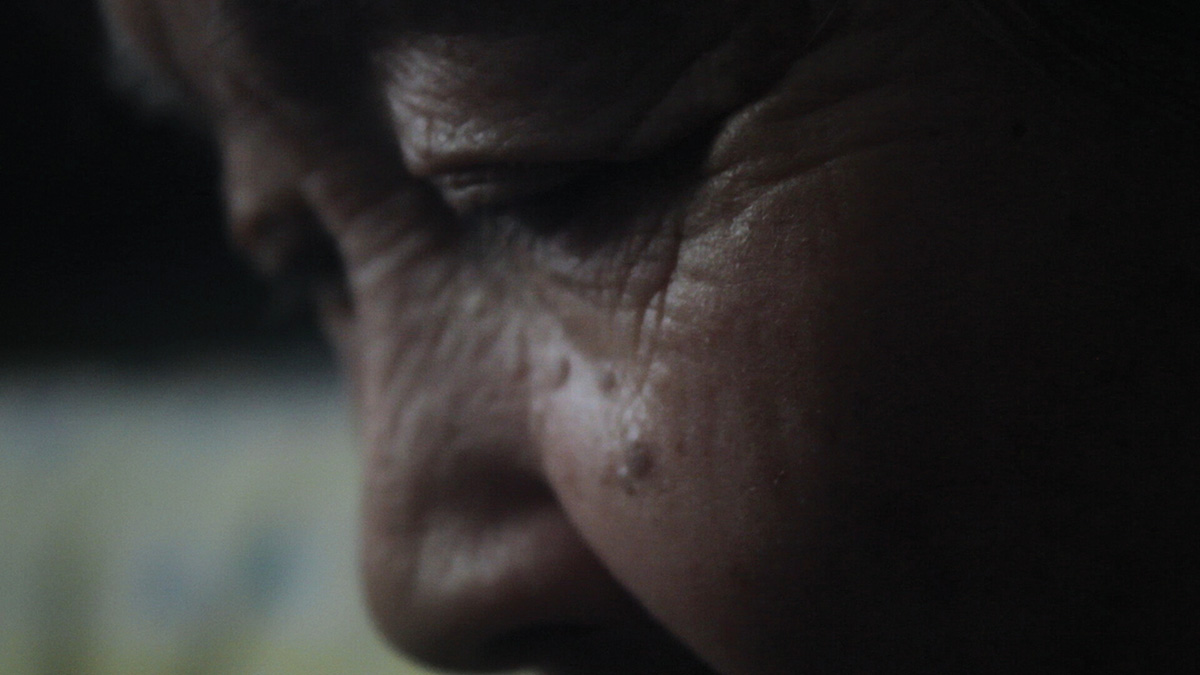
As abstract shapes come into focus, dim memories surface. With Blind Body, Allison Chhorn offers an impressionistic portrait of her grandmother Kim Nay, a survivor of the Khmer Rouge. Partially blind, Kim spends her days in a mostly sonic and textural world, in which the sound of rain, the voices of Khmer radio, and distant birdsong summon the sensations of a lost homeland.
Allison Chhorn is a Cambodian-Australian filmmaker and interdisciplinary artist living on Kaurna Land (South Australia). Her work explores the effects of migrant displacement and post-memory through impressionistic forms, often with other family members as subjects. Since graduating with Honours in painting at UniSA in 2014, she has made numerous films including “Blind Body”, “Missing” and “The Plastic House”. The latter was filmed on her family’s farm and has screened at MIFF, New York Film Festival and the Asia Pacific Triennial of Contemporary Art. Her films were also screened as part of a retrospective at the 11th Cambodian International Film Festival. Crossing into the gallery, she received the 2022 Porter St Commission from ACE Gallery to make her first solo exhibition and multi-channel installation “Skin Shade Night Day” which was exhibited as part of The National: Australian Art Now at MCA in 2023.
Robyn Chien
Eva et le Merkabas
Experimental fiction | mp4 | color | 34:41 | France | 2023
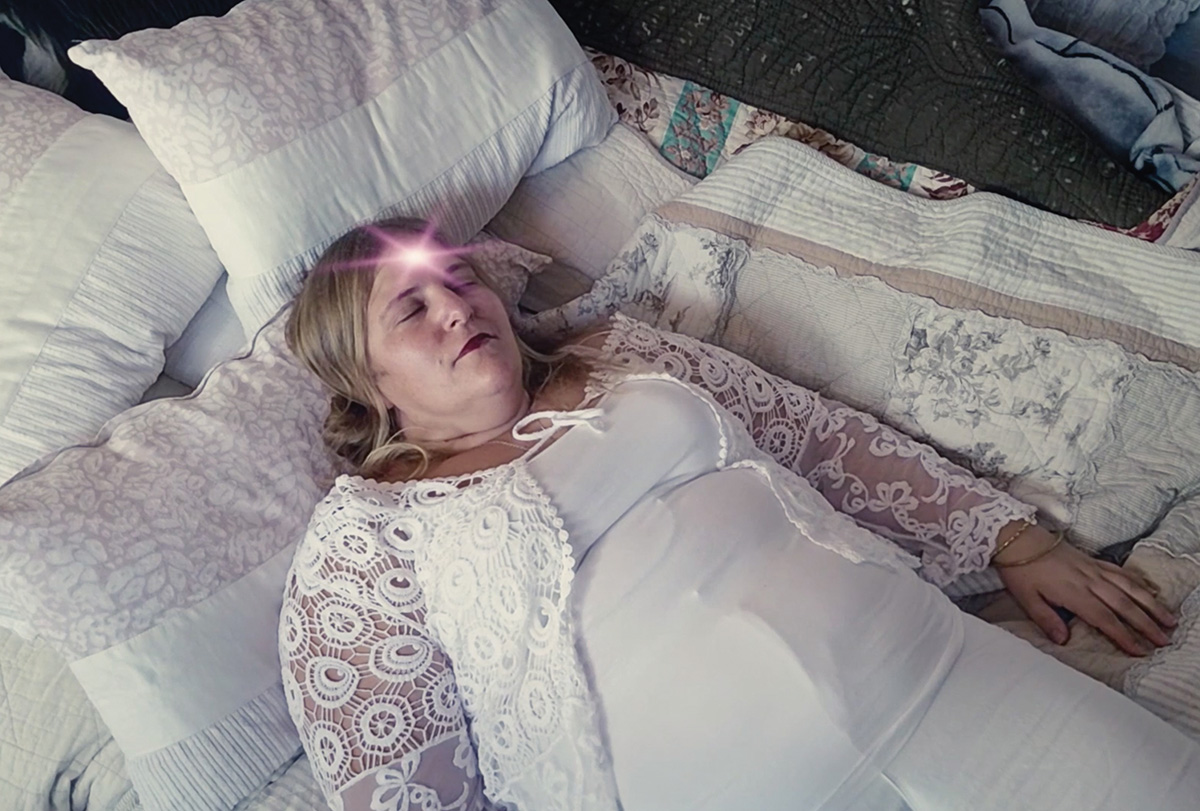
Sur un plateau de tournage en pleine nature, les membres d’une équipe s’agitent. Eva, l’actrice, lorsqu’elle n’exécute pas les indications bancales de la réalisatrice, profite des dons de Merkabas. C’est la médium du plateau. Eva rêve de créer sa propre société de production de film pornographique et souhaite mettre toutes les chances de son côté, y compris dans les mondes invisible. Ça tombe bien, Merkabas adore aider. En marge du film, une étrange relation de coaching se tisse entre les deux femmes. Elles échangent sur leurs réalisations, leurs conditions de travail ou leurs visions du monde. Elles se partagent leur secret ou: “comment avoir plus d’influences?”. Petit à petit, ensemble, elles délaissent doucement la réalité du tournage et la réalité tout court.
Artiste, réalisatrice, fondatrice et chargée de coordination chez Puppy Please Née à Toulouse en 1994, Robyn Chien vit et travaille à Marseille. Diplômée de la Haute École des Arts du Rhin, elle cocrée avec Lullabyebye et Gordon B.rec la société de production Puppy Please, au sein de laquelle elle réalise des films pour adulte. Leur but : faire des films porno et pouvoir faire des films porno. La réalisation des films, leur distribution et ce qui les empêche d’exister devient son terrain. En parallèle, elle réalise des films. Elle utilise la fiction comme un outil qui vient briser les impossibilités qui se mettent sur son chemin. Grâce à un processus similaire à l’action de la magie, elle répare le destin lorsqu’il est injuste. La performance et la caméra rendent compte et fixent ce changement. Elle a réalisé “Eva et Merkabah”, un film pour lequel elle a reçu le soutien Traversées du CIPAC, de la FRAAP, du réseau Diagonal et de la DRAC. Son travail a été présenté dans diverses expositions, notamment : So Far (Casino du Luxembourg, 2016), La Relatividad de llévar el mundo a cuesta (Quinonera, mexico, 2017), Là où les vents se croisent (Syndicat Potentiel, Strasbourg, 2018), Les martinets dorment en volant (CRAC Altkirch, 2018) et au festival Latitudes Contemporaines (Lille, 2021).
Patric Chiha
Les messieurs
Experimental doc. | dv | color | 25:0 | Germany | 2006
Gugging is one of the two psychiatric hospitals situated in the area of Vienna. Several buildings make up this hospital, one of which is called "The House of Artists". There, fifteen painters live and work, surrounded by a few nurses and a doctor. "Trois Messieurs" is meant to be a cross-portrait of three men, all of whom paint and live in the same room. In this portrait, Chiha wants to introduce the way their environment and Vienna shape their stories and paintings. By listening and questioning them, he wants to try and understand and get closer to their complicated point of view, both fragile and brutal, of the external world. What matters to him, more than their activity as painters and what is called "Raw Art", is to question a peculiar and touching type of a peculiar citizenry which is haunted by memories and was constructed in isolation.
Patric Chiha was born in 1975 in Vienna. He lives and works in Paris. From 1998 to 2001 he studied film editing at the INSAS (Brussels). During his studies, right after the coalition which brought Austria's radical-right wing to power, he shot "De Vienne" (2001), a documentary movie about his hometown. Since then he has also directed "Albertine!" (2002), "Casa Ugalde" (2004), and "Home". Patric Chiha has also been regularly working as a film editor for, among others, Vincent Dieutre, for whom been an assistant-director.
Aïcha Chikh
Circumambulation
Video | mp4 | color | 12:4 | France, Algeria | 2024
“Tawaf (at-tawâf), circumambulation, refers to the seven laps that Muslims perform around the Kaaba, during the pilgrimage (hajj) to Mecca” wikipedia 2024 In this video work, I explore the parallels between some spiritual practices in islam (Hajj) and in the Celto-Breton (Menhirs), imaging forms of non-verbal dialogue that can exist between certain communities in their "homelands" in the Global South and their diasporas in the Global North, and a form of attachment to certain sensory elements in a migratory context that can invoke a sense of familiarity and "déjà vu". Asetta (loom weaving in Tamazight) is an allegory for the accumulation of layers of experiences in diasporic and migrant bodies. This video was shot in collaboration with my mother, partly in M'Zab (Sahara, Algeria) and partly on the island of Ouessant (Bretagne, France).
Salah Chikh is an artist born and raised in Ghardaïa (Algeria) and now based in Marseille. they are currently preparing their DNSEP (Diplôme national supérieur d'expression plastique) in Experimental Writing at Ecole Supérieure des Beaux-Arts de Nîmes, and previously graduated with a Master's degree in Biodiversity and Evolution from the Faculty of Science in Montpellier and, before that, from the University of Oran (Algeria). Thier academic and personal background informs their artistic practice, exploring issues of the movements and the places of bodies in different geopolitical and geographical spaces, with a particular focus on the “peripheral” physical spaces of the West. Their work incorporates a variety of media, from video and writing to performance.
Angélica Chio
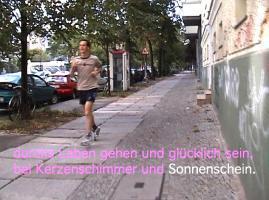
Bei Kerzenschimmer und Sonnenschein
Art vidéo | dv | color | 7:0 | Mexico, Germany | 2005
An anonymous passer-by walks through street corners of a known berliner neighborhood, while the voices of a man and a woman sing a love song. Lyrics are based on online adds written in German by persons looking for partner. The target is to question the personal expectations of men and woman in present society, as well as to highlight the common uses of the German language through the historical relation between love and song.
Born 1966 in Mexico city, Mexico. Studied at the Escuela Nacional de Pintura, Escultura y Grabado [National Academy for Painting, Sculpture and Graphic] La Esmeralda in Mexico city and at the HdK (today UdK: University of Arts) Berlin. Since 1993 living and working in Berlin. Scholarship holder at the FONCA Fondo Nacional para la Cultura y las Artes [National Fund for Culture and Arts] Mexico under the programs: Intercambio de Residencias Artísticas México-Canada [artistic residency Banff Centre for the Arts, Canada] 1999, Jóvenes Creadores [Young Creators] 2001-2002, and Intercambio de Residencias Artísticas México-Colombia [artistic residency Bogota, Colombia] 2003.

Chen Hung Chiu
大理石廠工人
Experimental doc. | hdv | color | 7:30 | Taiwan | 2013
The video shows two Tai labors in Hualien marble factory pushed a trolley used in the past particularly for mine district, today , this old style trolley has been replaced by the new style crane, Artist invites two labors walking back and forth through the old trolley that he gilded by covering gold leaves as a divinized presentation. This work therefore has blended and mixed the reality and memory in life like the layers of wrinkles and folds in the stratum, the viewer could create an archaeological journey from the imaginations in many aspects.
Chen-Hung Chiu creative works revolve around collecting those inadvertently hidden objects / people and legends surrounding him, as well as rewriting the ambiguous ties between these "anonymous identities" and the locality, in a sense analogous to the connections between body and building, city and cells, monuments and intimacy. Comparable to the process of remodeling monuments, he strips away the logic designed and rationalized by social structures in attempt to rename those that offer significance and meaning to each material. Yet, unlike the citations made through reminiscing in the past, his works are instead sincere observations which explore personal experience and logic. Important exhibitions Chiu participated in include the Liverpool Biennial: City States(2012), ThaiTai:A Measure of Understanding, Bangkok Art and Culture Centre(2012), Une terrible poetique, La Biennale de Lyon, Galerie Olivier Hong(2011), Arte da Taiwan, Museo di Arte Contemporanea di Villa Croce, Genova(2011), Taiwan Calling-The Phantom of Liberty, Mucsarnot Museum, Budapest(2010), etc. in 2012, he was also chosen as an artist in residence at Cite internationale des arts Paris for the 12th Visual Arts Talent Exchange Program conducted by the Taiwan Ministry of Culture.

Seoungho Cho
buoy
Video | dv | color | 6:21 | Korea, South, USA | 2008
BUOY/ SEOUNGHO CHO 6:21 MINUTES, COLOR, SOUND, 2008 The golden, barren landscape of Death Valley, California, recorded by Cho from a moving car, provides the luminous and mysterious texture of Buoy. As the title suggests, this work reflects on the polar extremes of this desert, which was once the floor of a vast sea, now traversed by sight-seeing tourists. In contrast to the horizontal landscape, which floats ceaselessly past Cho`s camera, vertical "strata" pattern the imagery, creating an axis between natural landscape and Cho`s composition. Cho accumulated his Death Valley footage over several years; the vertical patterning further represents the collapse of this footage into what appears to be a continuous drive through the desert.
Seoungho Cho was born in 1959 in Pusan, South Korea, and currently lives and works in New York. He received a BA and an MA in graphic arts from Hong-Ik University, Korea, and an MA in video art from New York University. He has had solo exhibitions in many prestigious venues such as the Museum of Modern Art in New York and his videos have been shown in biennales and group screenings throughout Europe and North America. Cho has received various awards and grants, including ones from the Jerome and Rockefeller foundations. Cho uses digital image processing techniques to manipulate simple, everyday objects, scenes or landscapes into highly lyrical sound and image collages. Cho`s videos are often very painterly in their use of rich, saturated colour and exquisite composition of the space on the screen. The works sometimes involve subtly developed, open-ended narratives that emphasize the embodied nature of perception and experience. The formal aspects of Cho`s videos are closely tied to explorations of how nature is represented through technology, specifically how representation is constituted by traces of contact between bodies, technology and the environment.
Seoungho Cho
I left my silent house
Art vidéo | dv | color and b&w | 8:51 | Korea, South, USA | 2007
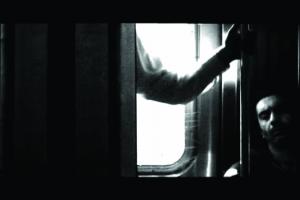
I LEFT MY SILENT HOUSE/ SEOUNGHO CHO 8:51 MINUTES, COLOR, B&W, SOUND, 2007 Selected as ?Grand Prize? at the 27th (2008) Black Maria Film and Video Festival. Jersey City, NJ Seoungho Cho`s latest work, I Left My Silent House, begins in a meditative mood with black and white images of people in the subway and then transforms itself into a colorful journey across dramatic open spaces, until it returns once again to the city. The video`s driving electronic soundtrack and dramatic image processing give it an intense yet somber quality. It is a visceral investigation of the tensions and pleasures of travel and, ultimately, metamorphosis.
Lyrical and visually striking, the video works of Korean artist Seoungho Cho are distinguished by a unique confluence of complex image processing and sound collage. Resonating with a highly metaphorical sensibility, Cho`s single-channel tapes and installations are formalist, almost painterly explorations of subjectivity and the subconscious. The urban landscapes that Cho often depicts move with a continuous fluidity, shifting from dreamlike abstractions of light to fleeting reflections of the city. Figures, cars, and trains are mirrored and diffused through one another, silhouetted with a haunting anonymity that is echoed in the poetic texts and soundscapes that accompany each piece. These often tense meditations focus on the nature and cost of isolation and loneliness while integrating into a culture, landscape and language other than one`s own. Seoungho Cho was born in 1959 in Pusan, South Korea. He received his B.A. and M.A. in Graphic Arts from Hong-Ik University, Korea, and an M.A. in video art from New York University. In 1998 he received a Rockefeller Foundation Media Arts Fellowship and in 2003 he received a Jerome Foundation grant. He has received the "Grand Prize" at the 27th Annual Black Maria Film and Video Festival as well as the International Award for Video Art from ZKM. Cho`s one-person exhibitions have included The Museum of Modern Art, New York; The Philip Feldman Gallery, Oregon; the Contemporary Art Museum, Honolulu, Hawaii; Samsung LeeUm Museum of Modern Art, Korea; the Pusan Metropolitan Museum of Art, Korea; Montevideo, Amsterdam; and the Cinematheque Ontario, Toronto. His work has been shown in numerous international festivals and exhibitions, including the Philadelphia Museum of Art, Philadelphia; Museum of Contemporary Art, Chicago; the 58th Edinburgh International Film Festival; Pandaemonium `98, Lux Centre, London; Centro d`Art Santa Monica, Barcelona, Spain; the National Gallery of Art, Washington, DC; Stedelijk Museum, Amsterdam; Mori art Museum, Tokyo; the Festival Nouveau Cinema, Nouveaux Medias, Montreal, Canada; the Valencia Biennial, Spain; the Kwangju Biennial, Korea; the Palm Beach Institute of Contemporary Art, Florida; the Robert Flaherty Film Seminars; Artists Space, New York; the International Film Festival Rotterdam; and the New York Video Festival, Lincoln Center, New York. Cho`s tapes have been broadcast nationally and internationally. He lives in New York.

Seoungho Cho
Latency / Contemplation 1
Video | hdv | color | 6:32 | Korea, South, USA | 2016
In this video, Cho transforms the sea shore into a visual poem. His inner landscapes and his perception of the outer world come together in an abstract meditation about space and place, light, time and traveling. The video consists of heavily electronic distorted images which result in mainly horizontal lines and colour bars which are reminiscent of the horizontal lines of VHS video. At the same time, Cho pushes the image to the edge of abstraction through which its relation to painting comes to the fore; through the emphasis on the flatness of the image this work reminds us of colour field painting (Mark Rothko). The soundtrack consists of manipulated audio of sea sound, like waves and wind, also pushing to abstraction. To this `noise` a minimal, poetic piano sound is added which brings a melancholic sphere to the work. The montage is hardly felt since cuts seem to be absent: everything seems to be metamorphosed into one another. Through the contemplative quality of the sound as well as the image, this video becomes a wondrous experience.
Seoungho Cho was born in 1959 in S.Korea. He received his M.A. from New York Univ. He received a Rockefeller Foundation Fellowship. Cho`s solo exhibitions have included The Museum of Modern Art, NY, Montevideo, Amsterdam and LeeUm Museum of Modern Art, Seoul. His installations have been selected for the permanent collection at such as the Museum of Modern Art, NY; LeeUm Museum of Modern Art, Korea and at the Los Angeles International Airport. In 2012, Cho`s Buoy (2008) was presented as a massive multi-channel installation in Times Square NY, a collaboration between EAI and the Times Square Alliance. Cho`s tapes have been broadcast nationally and internationally. He lives in New York.
Seoungho Cho
snap
Art vidéo | | color and b&w | 4:32 | Korea, South, USA | 2006
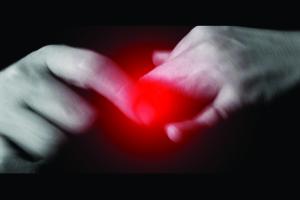
2006, 4:32 min, color and b&w, sound Snap is a taut, minimalist work that explores the aesthetics of digital video production. Fingers and hands in close-up move fast, then slowly, to a soundtrack of stylized clicks and snaps, while intermittent flares of color burn through the original black and white footage. Snap pushes figure and sound toward abstraction in an inventive, considered, and pleasurable exploration of moving image technology.
- Seoungho Cho was born in 1959 in Pusan, South Korea. He received his B.A. and M.A. in Graphic Arts from Hong-Ik University, Korea, and an M.A. in video art from New York University. In 1998 he received a Rockefeller Foundation Media Arts Fellowship and in 2003 he received a Jerome Foundation grant. He has received the "Juror`s Citation" at the 18th Annual Black Maria Film and Video Festival as well as the International Award for Video Art from ZKM.
Eun Woo Cho
GATE
Multimedia installation | dv | color | 1:20 | Korea, South, USA | 2008
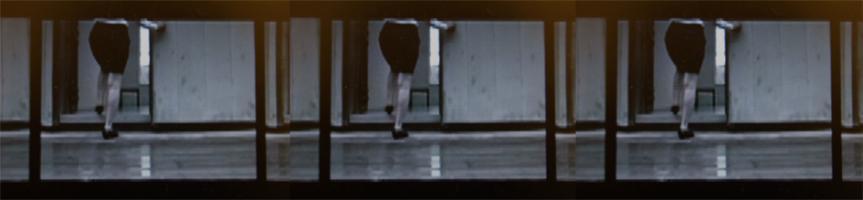
Gate is a point of entry or turning point for the psychological space enclosed in and created by a specific architectural form within the human body. It represents an opening, with different types of human encounters and separations. Gate may prevent extreme control entry or free exit to one`s self and others. The gesture of encounter and separation is a form of psychotherapy that emerged with interpersonal communication and the intensification of psychological experience of the viewer and audience. When the separation process occurs, it transforms a mixture of substances, relative to several physical spaces, into different architectural and psychoanalytic components. Often, power pressure and political force cause unavoidable human travels, immigration, encounters, and separation. These separations and encounters are extremely relative to the natural life cycle. The pressure or power structure forces existent boundary situations, such as political power structure; specifically, the present separation situation in North and South Korea.
Resume & Short Bio
Eun Woo Cho was born in Seoul Korea and earned her BFA at Ontario College of Arts & Design.
She has been involved in several different site specific performances and shows in Canada, Italy
and the United States. She recently obtained her M.F.A from the School of Visual Art in New York and attends in Institute for Doctoral Studies in the Visual Arts Main, Portland.
Education
2008-2013 Institute for Doctoral Studies in the Visual Arts Main, Portland
2007-2005 School of Visual Arts, MFA, Fine Arts in New York
2005-2004 Rasara Fashion Academy in Seoul, Korea
Seoungho Cho
Snap
Experimental video | dv | color and b&w | 4:32 | Korea, South, USA | 2006
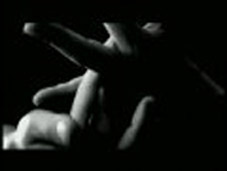
"Snap" is a taut, minimalist work that explores the aesthetics of digital video production. Fingers and hands in close-up move fast, then slowly, to a soundtrack of stylized clicks and snaps, while intermittent flares of color burn through the original black and white footage. "Snap" pushes figure and sound toward abstraction in an inventive, considered, and pleasurable exploration of moving image technology.
Seoungho Cho was born in 1959 in Pusan, South Korea. He received his B.A. and M.A. in Graphic Arts from Hong-Ik University, Korea, and an M.A. in video art from New York University. In 1998 he received a Rockefeller Foundation Media Arts Fellowship and in 2003 he received a Jerome Foundation grant. He received the "Juror's Citation" at the 18th Annual Black Maria Film and Video Festival as well as the International Award for Video Art from ZKM.
Seoungho Cho
Show your tongue
Experimental video | dv | color | 6:8 | Korea, South, USA | 2006
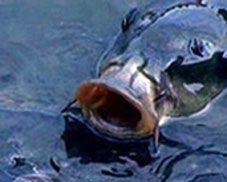
The water's surface, as it were, forms the first layer of this work by Seoungho Cho. We see it from above and close by. It moves in tiny ripples and is deep blue in colour. Just as thin and lively as this graceful membrane is the sound, which is present as a second layer. Now and then, with a sonorous tone and a soft tick, it is hardly distinguishable from the water. Then we slowly begin to perceive the monsters that are living beneath the skin. Their scales and fins slither closely past each other, their gaping mouths snap upwards through the surface of the water. Cho subtly but effectively manipulates the images of these beasts into a living pattern of forms and motives that overflow into each other and are covered by a watery layer of shiny icing. In this way, he weaves a transparent structure between the two dimensions of the image surface; a fabric which builds itself up, layer by layer, and which could keep on growing in your imagination until it even consumes the camera lenses and filters, the film that records the image, and the viewer's retina.
Stanley Cho
Nevertheless
Fiction | 16mm | black and white | 20:40 | USA | 2004
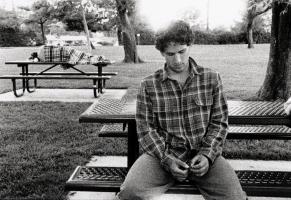
Joseph is on a meandering journey. His uncle, Henry, is a widower, who lives alone. Joseph arrives at Henry`s door. Gisela, who reads Neruda, is Henry`s housekeeper. Sam, who plays the piano, lives next door and is Henry`s only friend. Joseph has his sadness, but it leads Henry to revisit his own dark memories.
Stanley Cho lives and works in Los Angeles, California. He graduated from the UCLA School of Art and Architecture in 2001. Nevertheless is his second short film.
Seoungho Cho
WS.2
Art vidéo | dv | color | 8:6 | Korea, South, USA | 2004
There are many aspects of the act of looking that make the experience of an image subjective. Seoungho Cho highlights a few of the important ones and emphatically omits various others that are also important. We are not offered any narrative, context, or extensive colour palette, no 'whole', no 'things'. These restrictions largely enable him to determine the viewer's way of looking as an action in itself. "WS.2" has a moving framework, which allows the viewer to become conscious of the workings of the eye, light, distance, space, and reflection, and the analogies of these with the camera, registration, and projection. The image, shifting at well-chosen moments, causes changes in our spatial experience. This leads to a feeling of transposition, of looking for something ? like travelling behind the window of a vehicle being driven by someone else ? forwards, then backwards again, as if there has to be a reason to look back at something. The motion is so precise and controlled that it becomes unnatural and unphysical in a robot-like way; as if someone is controlling your head and eyes with a joystick. And yet, what we see refers to the world, to capriciousness, and to beauty. Undulating lines reminiscent of dunes, close-ups of bodily curves, micro-shots of textiles or macro-shots of vast landscapes: Cho creates associations that are aroused and intensified by the music, or are sometimes even undermined by it. And ultimately you are helped precious little by language to define this, because the image always remains 'material'. What you see is a reason to give Cho a director's chair in your head.
Seoungho Cho was born in 1959 in Pusan, South Korea. He received his B.A. and M.A. in Graphic Arts from Hong-Ik University, Korea, and an M.A. in video art from New York University. In 1998 he received a Rockefeller Foundation Media Arts Fellowship and in 2003 he received a Jerome Foundation grant. He received the "Juror's Citation" at the 18th Annual Black Maria Film and Video Festival as well as the International Award for Video Art from ZKM. Cho's one-person exhibitions have included The Museum of Modern Art, New York; The Philip Feldman Gallery, Oregon; the Contemporary Art Museum, Honolulu, Hawaii; the Pusan Metropolitan Museum of Art, Korea; Montevideo, Amsterdam; and the Cinematheque Ontario, Toronto. His work has been shown in numerous international festivals and exhibitions, including the Philadelphia Museum of Art, Philadelphia; Museum of Contemporary Art, Chicago; the 58th Edinburgh International Film Festival; Pandaemonium '98, Lux Centre, London; Centro d'Art Santa Monica, Barcelona, Spain; the National Gallery of Art, Washington, DC; Stedelijk Museum, Amsterdam; Samsung Museujm of Modern Art, Korea; the Festival Nouveau Cinema, Nouveaux Medias, Montreal, Canada; the Valencia Biennial, Spain; the Kwangju Biennial, Korea; the Palm Beach Institute of Contemporary Art, Florida; the Robert Flaherty Film Seminars; Artists Space, New York; the International Film Festival Rotterdam; and the New York Video Festival, Lincoln Center, New York. Cho's tapes have been broadcast nationally and internationally. He lives in New York.
Pip Chodorov
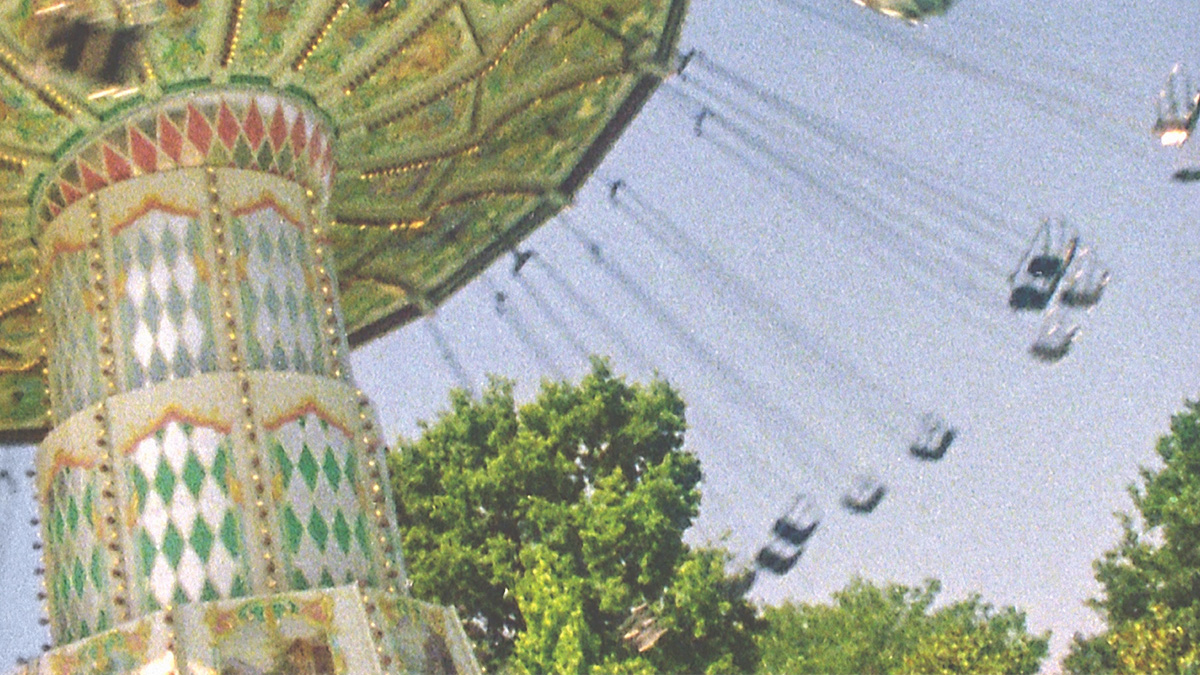
Rooftop Flicker
Experimental film | super8 | color | 3:20 | USA, Korea, South | 2022
Super-8 flicker film shot and hand-developed in Seoul in spring 2022 with jazz soundtrack from a Jonas Mekas centennial tribute in Busan.
Pip Chodorov. Born April 13, 1965 in New York. Filmmaking and music composition since 1972. Studied cognitive science at the University of Rochester, NY and film semiotics at the University of Paris, France. Work in film distribution - previously Orion Classics, NYC; UGC, Paris; Light Cone, Paris; and, currently, Re:Voir Video, Paris, which he founded in 1994 and The Film Gallery, the first art gallery devoted excusively to experimental film. He is also co-founder of L'Abominable, a cooperative do-it-yourself film lab in Paris, and the moderator of the internet-based forum on experimental film, FrameWorks.

Pip Chodorov
The Stranger
Experimental fiction | 16mm | color | 9:19 | USA, Romania | 2018
Romanian fairy tales usually start with the sentence: “Once upon a time something happened, if it hadn’t happened it couldn’t be told”. In this fairy tale, a stranger visits the remote mountain village of Slon. This film was made at an annual ten-day filmmaking residency in Slon. As a stranger myself, first time to Romania, with only four days to shoot and four days to edit, I wrote this modern-day fairy tale to coincide with my fantasy idea of what my unpredictable visit to the village would be like.
Pip Chodorov. Born April 13, 1965 in New York. Filmmaking and music composition since 1972. Studied cognitive science at the University of Rochester, NY and film semiotics at the University of Paris, France. Work in film distribution - previously Orion Classics, NYC; UGC, Paris; Light Cone, Paris; and, currently, Re:Voir Video, Paris, which he founded in 1994 and The Film Gallery, the first art gallery devoted excusively to experimental film. He is also co-founder of L`Abominable, a cooperative do-it-yourself film lab in Paris, and the moderator of the internet-based forum on experimental film, FrameWorks.
Adam Chodzko
Knots
Experimental fiction | hdv | color | 8:5 | United Kingdom | 2013
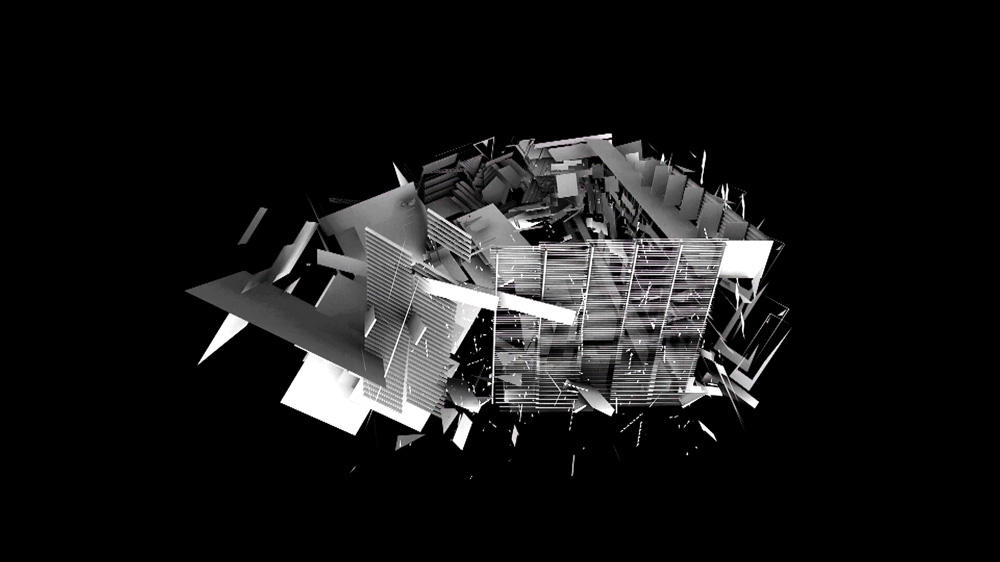
In Knots, Adam Chodzko focuses on the remote but important relationship between the artist Kurt Schwitters, in the final years of his life in the late 1940’s, living in poverty and exile in England’s Lake District, and J. Edgar Kaufmann, the wealthy owner of the Kaufman Department Store in Pittsburgh, USA. Kaufmann had arranged for money to be wired to Schwitters so that he could develop a new Merz structure. Chodzko plays with the desire to conclude and tie up the loose and disparate ends of this narrative. He imagines the now empty Merzbarn (Schwitters final work having been removed to a Newcastle museum in 1965) as a vacuum, sucking in thoughts, desires and matter; all caught up in the vortex of a dream-like surreality. Kaufmann had commissioned Frank Lloyd Wright to design his Pittsburgh office, a structure that itself was also later displaced from its source when donated to the Victoria & Albert Museum, London. Chodzko sees the interior spaces that Schwitters and Kaufmann worked within as unstable, flowing, collaged together, as though becoming a Merz themselves, whilst the form of the video also echoes this process of construction and deconstruction. Knots is a mesmerizing combination of fact and fiction, text and moving image building a story about longing, creation and fragmentation, endings and beginnings, networks of people and isolated individuals, separations and notions of home. It was commissioned by Tate Britain in 2012.
Adam Chodzko’s art explores the interactions and possibilities of human behaviour by investigating the space between how we are and how we could be. Working across media, from video installation to subtle interventions, with a practice that is situated both within the gallery and the wider public realm, his work investigates and invents the possibilities of collective imagination through using a poetics of everyday life. By wondering how, through the visual, we might best engage with the existence of others he reveals the realities that emerge from the search for this knowledge. Chodzko's art proposes new relationships between our value and belief systems, exploring their effect on our communal and private spaces and the documents and fictions that control, describe and guide them. Working directly with the networks of people and places that surround him, often using forms of anthropology, Chodzko focuses on the relational politics of culture's edges, endings, displacements, transitions and disappearances through a provocative looking in the 'wrong' place; a search for knowledge through instability. His art is catalysed by imagining a collapse of the category of Art, requiring not only a new audience but also a new status for the art object. Chodzko’s practice operates in the tight, poetic spaces he evolves between documentary and fantasy, conceptualism and surrealism, and public and private space, often engaging reflexively and directly with the role of the viewer. Intimate collections and ephemeral communities are frequently generated through his works; assemblies of owners of a particular jacket and a reunion of the children 'murdered' in a Pasolini film; a god look-alike contest; lighting technicians asked to advise on the light in heaven; a London gallery's archive given to a group of Kurdish asylum seekers to edit and hide outside the capital; the multi-faceted Design for a Carnival, the evolution of a ritual event for the future including Settlement, the legal purchase of a square foot of land as a gift to a stranger, Nightshift, a late night parade of nocturnal animals to the Frieze Art Fair, London and M-path, the collection and distribution of perception-changing footwear for gallery visitors. More recently a trilogy science fiction video and mixed media works, Hole, Around and Pyramid, have all explored, the idea of art becoming a vehicle for a community’s collective mythology, whilst Echo, The Pickers and Ghost elaborate these themes through excavating processes of memory, empathy and the imaginary. Because, 2013 (at Tate Britain) and We are Ready for your Arrival, 2013 (at Raven Row) further develop these ideas through manifestations of the unconscious relationships between individuals and groups; their excesses and disappearances. Born in 1965. Lives and works in Whitstable, Kent, UK. Since 1991 Chodzko has exhibited extensively in international solo and group exhibitions including: Raven Row, London; Tate Britain; Tate, St Ives; Museo d'Arte Moderna, Bologna (MAMBo); The Benaki Museum, Athens; Athens Biennale, Istanbul Biennale, Venice Biennale; Royal Academy, London; Deste Foundation, Athens; PS1, NY; Ikon Gallery, Birmingham, Kunstmuseum Luzern etc. Recent projects include commissions by Creative Time, New York, The Contemporary Art Society, Frieze Art Fair, and Hayward Gallery. In 2002 he received awards from the Hamlyn Foundation and the Foundation for Contemporary Art, New York, and in 2007 was awarded an AHRC Research Fellowship in the Film Department at the University of Kent, Canterbury. His work is in the collections of the Tate, The British Council, The British Film Institute, The Arts Council, APT, Auckland City Art Gallery, Contemporary Art Society Collection, The Creative Foundation, Frac Languedoc-Rousillon, GAM - Galleria d’Arte Moderna, Turin, Grizedale Arts, MAMBo - Museo d’Arte Moderna di Bologna, Plains Arts Museum, North Dakota, USA, Saatchi Collection, South London Gallery, Towner Gallery Eastbourne, and international private collections.
Ahram Choi
Ice
Video | 0 | color | 6:2 | Korea, South, Germany | 2024
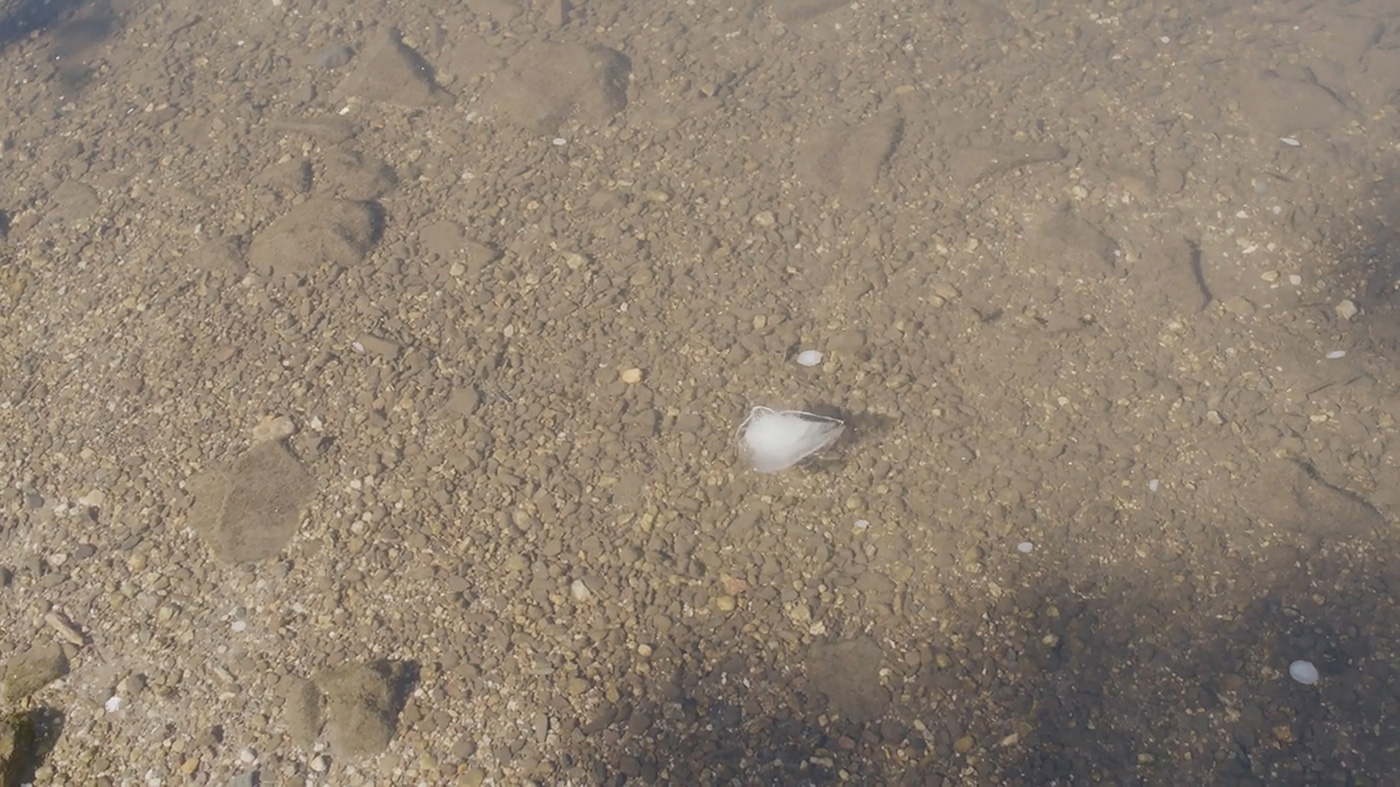
“Ice” follows a woman walking along a riverside before she quietly kneels and releases a block of ice into the flowing water. The work moves slowly, allowing the small gestures surrounding this action to surface with clarity. As the ice drifts and dissolves, the scene becomes a meditation on everything and nothing. It reflects on what is carried, what is left behind, and what quietly disappears without resistance. This work moves between documentation and metaphor. The physical melting of the ice mirrors the gradual fading of thoughts, emotions, and states of being that once felt solid but eventually lose their form. What seems like a minor act begins to echo larger questions about attachment, cultivation, and the invisible residue left by moments of departure. “Ice” does not aim to narrate a story, but rather to offer a space of deceleration, where time stretches and the viewer can lean into subtle shifts. These include the weight of the ice, the coldness of the air, and the sound of water carrying something away. Within this quiet event, the work invites contemplation on how a small, dissolving object can hold the fullness of something once considered everything, even though it is now becoming almost nothing.
Ahram Choi is a visual artist working with video, installation, photography, and text. Her practice focuses on subtle emotional states, temporal fragility, and the quiet traces that remain around moments of departure or transition. Through minimal gestures and slow, observational structures, she explores how small actions can reveal internal landscapes that are rarely spoken but deeply sensed. Born in South Korea and trained in time-based media art in Germany, she creates works that move between documentation and metaphor. Her videos often unfold gradually, offering a space where viewers can sense shifting atmospheres and disappearing elements. She approaches each work as a quiet inquiry into perception, memory, and the transient qualities of experience.

Chris Chan Fui Chong
Heaven Hell (1ch)
Experimental film | mov | color and b&w | 11:18 | Malaysia, Japan | 2024
A collaboration with and a commission by NPO Koganecho Area Management Center as part of Chong’s residency at the Koganecho Bazaar, which is located in the former red-light district of Koganecho, Yokohama, Japan. Koganecho was the conceptual reference for ‘hell’ in Akira Kurosawa’s 1963 film High and Low. However, because of the district’s notoriety, shooting on location became far too dangerous for the cast and crew. HEAVEN HELL looks to restage the past and present representations of the red-light district by shooting the slum scene on the same street that Kurosawa had initially intended but was unable to do so. Chong referred to the film scenes that Kurosawa shot in the studio in order to re-create the eerie and hyper-theatrical mood of the infamous street in both the traditional and contemporary periods; recruiting local youth in the now gentrified neighbourhood of Koganecho. HEAVEN HELL takes the point of view of the kidnapper/villain, using his entire dialogue in the film compressed into a single moment through the slums, past and present, expressing the toll it has taken on him and the class he was relegated to.
CHRIS CHONG CHAN FUI is a filmmaker and artist who works between Southeast Asia and Canada. From digital and analog moving images to fabricated and organic objects, Chong works to reveal unfamiliar narratives. His work layers the social and natural sciences with transnational circuits of globalization and manufactured cultures and landscapes. With a rigorous research methodology and a formalist aesthetic, he uses structure and constraints as a creative path toward expressive innovation. Chong has exhibited at such venues as the Hirshhorn Museum & Sculpture Garden, Palais de Tokyo, EYE Film Institute Netherlands, and the Gwangju Biennale, while premiering films at the Cannes Film Festival's Directors’ Fortnight, BFI London, and TIFF’s Wavelengths, where he won back-to-back awards for Best Canadian Short Film. He is a Smithsonian Institute fellow (National Museum of Natural History), a Ford Foundation fellow, and a Rockefeller Foundation's Bellagio Arts Fellow. Chong holds an MFA (film) from York University and is an Assistant Professor (film) at Simon Fraser University’s School for the Contemporary Arts on the unceded territories of the S?wx?wú7mesh Úxwumixw (Squamish), s?l?ilw??ta?? (Tsleil-Waututh) and x?m??k??y??m (Musqueam) Nations.
Isaac Chong Wai
Rehearsal of the Futures: Police Training Exercises
Video | mp4 | | 18:14 | Hongkong | 2018
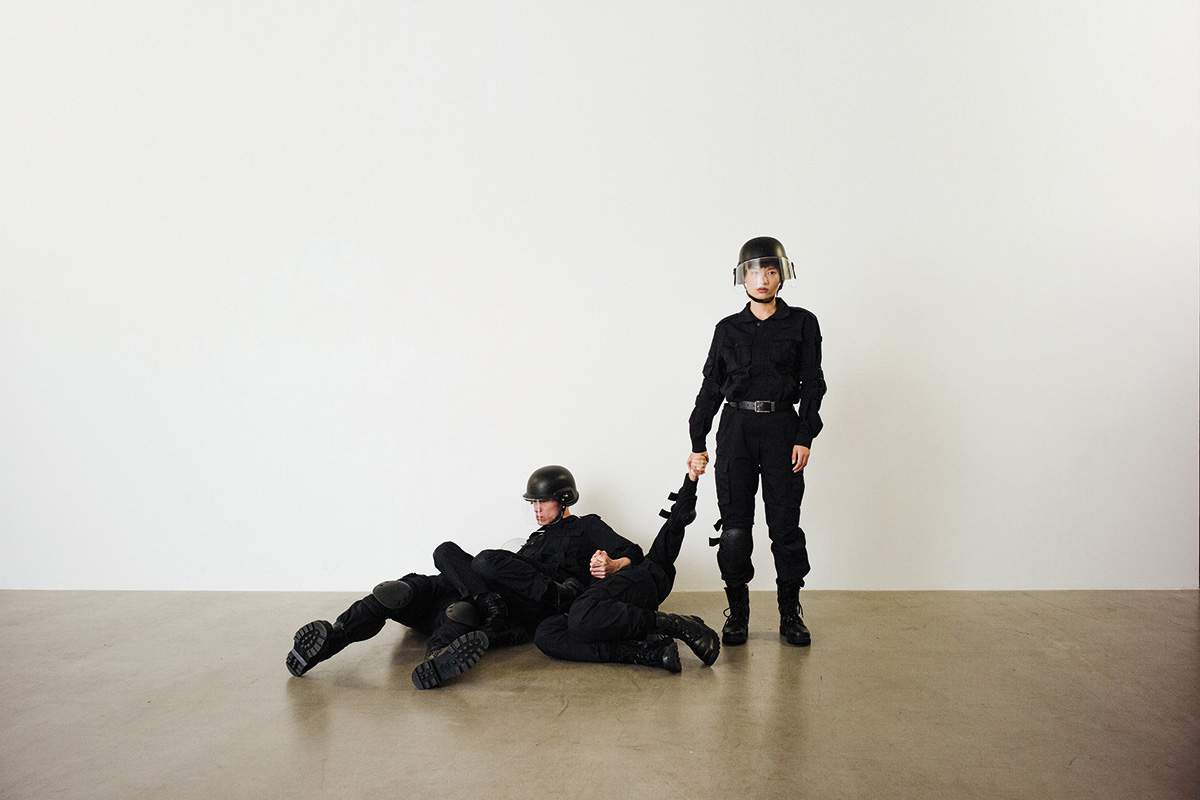
In Rehearsal of the Futures: Police Training Exercises (2018), Isaac Chong Wai choreographs the movement of uniformed riot police in a tortuously slow motion, imbuing their originally violent intentions with a paradoxical gentleness. Slowing down the aggressive attack and the collision of bodies, the posturing and movements struggle in between touching and hitting. These decelerated actions visualise the violence inflicted upon individuals by the collective power structures.
ISAAC CHONG WAI is a Berlin-based artist from Hong Kong. He works across a range of media, including performance, installation, painting, video, photography and multimedia. Influenced by personal events and global phenomena, he engages themes of collectivism and individualism, geopolitics, migration, historical trauma, identity politics and public spheres. Dealing with societal shifts, global tensions and collective wounds, he endeavors to transform the powerlessness—the unanswered demands, the suppression from authority and the denial of individual freedom—into resistance, rebellion and criticism of social systems. He had solo exhibitions at Bilsart, commissioned by Kulturakademie Tarabya and Zilberman (2021); Blindspot Gallery, Hong Kong (2019); Zilberman, Berlin (2019); Kunstraum München, Munich (2018); Goethe Institut Hongkong, Hong Kong (2018); Bauhaus Museum, Weimar (2016). His work has been shown at National Museum of Modern and Contemporary Art, Seoul, Innsbruck Biennial and IFFR, Rotterdam (2020); Museum of Contemporary Art in Taipei and Guangdong Times Museum in Guangzhou (2019); M+ Museum and Para Site in Hong Kong (2018); Stiftung Brandenburger Tor and Haus der Kulturen der Welt in Berlin (2017); Deutsche Kuenstlerbund, Berlin and Gwangju Media Art Festival (2016); Kunstfest Weimar and Macura Museum, Serbia (2015); Moscow Biennale for Young Art in Museum of Moscow (2014). He graduated from Academy of Visual Arts at Hong Kong Baptist University with a BA in Visual Arts and Bauhaus-Universität in Weimar, Germany, with a MFA in Public Art and New Artistic Strategies.