Catalogue > Search
Results for : Tout le catalogue

Jan Philippe Carpio
Bayanihan
Experimental video | mp4 | color and b&w | 4:57 | Philippines | 2019
An experimental documentary that depicts a May 6, 2018 art activity where the community members of Barangay San Lorenzo, Makati, Sipat Lawin Ensemble, Philippine Air Force Band, Museo Pambata, and Ayala Museum collaborated with visual artist Alwin Reamillo to stage a common Filipino community practice called “bayanihan” in the heart of the Philippines’ financial district. “Bayanihan” is where Filipino community members help one of their neighbors literally move their bamboo house by placing it on bamboo poles and lifting it onto their backs. The participants carried on their backs Reamillo’s art installation bamboo hut from one of the city parks, through the city streets, right up to the museum’s front steps. The activity was called “BAYANIHAN HOPPING SPIRIT HOUSE”.
Jan Philippe “JP” V. Carpio is a writer and filmmaker living in the Philippines. He has written and directed four feature length films: Girl of My Dreams (2000), Balay Dakû (Big House) (2002) Hilo (thread) (2007), INT.-EXT. (Ella, Marita, Atbp.) (2017). He is a National Commission for Culture and the Arts Cinema Grant Recipient for the first full length film in the Ilonggo language Balay Dakû. His films have been screened and cited at national and international film festivals like the Cinemalaya Philippine Independent Film Festival, Filipino International Cine Festival, Experimental Forum International film and Video Art Festival, and Thessaloniki International Film Festival. He is a two time .MOV International Digital Film Festival Silvershorts Competition Finalist. He was selected as a participant for the 2016 Abbas Kiarostami Black Factory Cinema Filmmaking Workshop. He teaches at the Digital Filmmaking program of the College of St. Benilde School of Design and Arts and the Film program of MINT College.

Steve Carr
Burn Out
Video | | color | 4:53 | New Zealand | 2009
Burn Out, 2009 16mm transferred to DVD Duration 4 mins 53 secs
Sidse Carstens
Contact
Video | hdv | color | 8:25 | Denmark | 2012
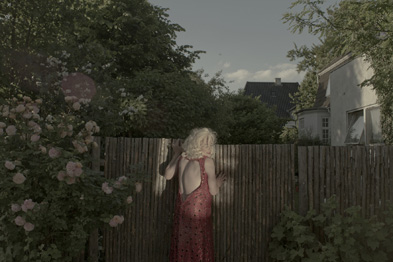
In the video "Contact" Sidse Carstens seeks to change our collective awareness of Marilyn Monroe through rituals and manifestations in collaboration with performance artist Ramona Macho and a spiritual medium. "Contact" has been exhibited i connection with "Mirror Mirror" at The Black Diamant, Copenhagen.
Sidse Carstens lives and works as film director and visual artist in Copenhagen, Denmark. Main themes in the works of Sidse Carstens are displacement and transformation. Through film, video and images she examines the transition between fiction and reality. She is educated as an animation director from The National Film School of Denmark. Sidse Carstens is a member of the Danish Film Directors Association, and her work is supported by i.a. The Danish Filminstitute / filmworkshop and The Danish Arts Agency. Her films are exhibited and screened both in Denmark and internationally. Together with the Danish writer Katrine Grünfeld, she is the director of an artists? workspace and salon in Copenhagen.
Sidse Carstens
Show Dream
Art vidéo | 16mm | color | 13:30 | Denmark | 2009
Show Dream is an emotionally disturbing film. It explores the world of transformation and dreams. The conjurer, the avenger, the woman with a new face, the horse and the egg woman is the four characters presented in Show Dream The film is a metamorphosis, we are thrust straight in to the middle of the story. There is no explanation to the rising questions; what?s burning? Why is that woman being made up? Where is she going? In Show Dream we detect the story before it happens ? something happened before we enter the scene ? and we leave the stage before the story ends. These unfinished stories, events before events will stick with the viewer long after the film finishes.
Sidse Carstens (1971) graduated in 2000 as an Animation Director from The National Film School of Denmark. She now works as Film director and visual artist in Copenhagen, Denmark. Her films have been screened at some of the most well renowned museums and galleries in Denmark and international at festivals. Her work is funded by Danish Film Institute and The Danish Arts Agency. Recently Sidse Carstens directed several music videos for the Danish band "Under Byen". She teaches courses in artfilm at The National Film school and recently guest edited a volume of the Danish Film director Association Magazine. In the summer of 2010 Sidse Carstens was invited to Northcap Norway, as Artist in Residency there. She is currently finishing a new film shot in Norway during her residency.
Lorenzo Casali
BANZAVOIS
Experimental doc. | 4k | color | 75:0 | Italy | 2022
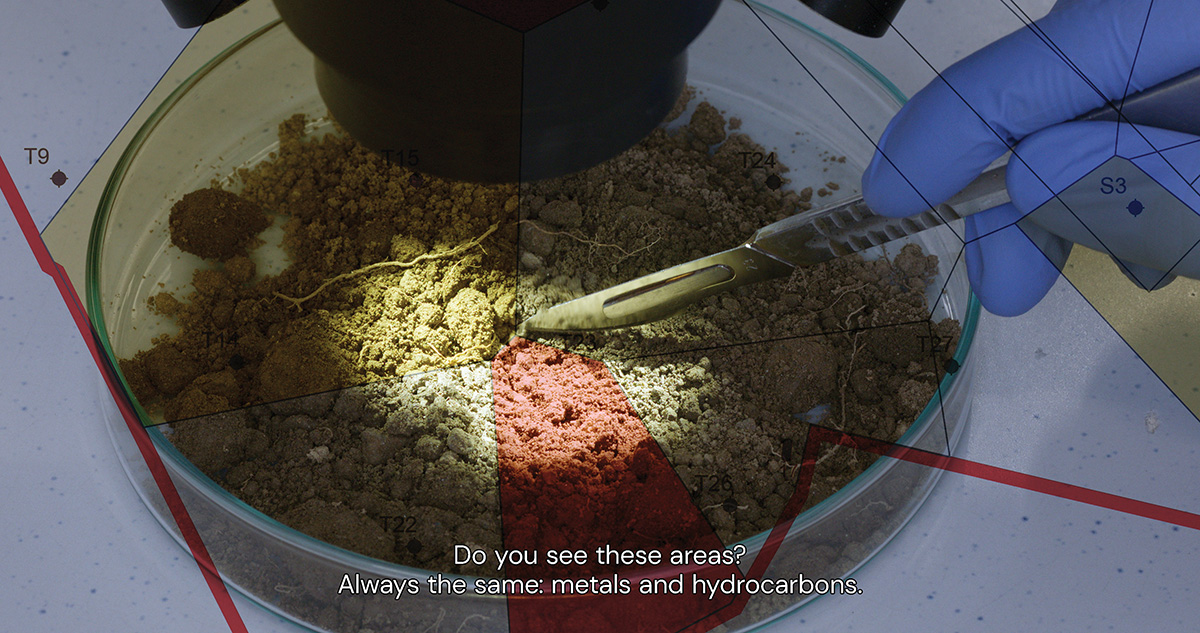
Banzavóis, in assonance with maize, is an invented word coined by the Italian writer C.E.Gadda for corn, symbol of Lombard agricultural production. Banzavóis may also stands for empty bellies, the laborers and sharecroppers who found job in large numbers in the first Lombard industrial plants at the end of the 19th century. The word suggests a geographical-political shift in an imaginary South America: brought back to nowadays Brianza, it is well suited to its landscape rich in tropical flora, globalized right into the inner structure of a drastically changed nature. Banzavóis follows for two years the radical transformation process of the former Isotta Fraschini industrial area in Saronno, 20 km from Milan. A coring throughout a century, a kaleidoscopic journey in the history of a site abandoned for 30 years, six hectares of ruins and six of invasive species. The factory becomes a palimpsest for a narration in which antifascism, memory of work, socio-political achievements are gradually interwoven with today discontinuation landscape.
Lorenzo Casali (1980) is a visual artist and filmmaker working mainly in site-specific projects, which start from the analysis of the complex network of relationships existing in a given place, from the study of the cultural, social, political and economic stratifications that define it. Since the early 2000s he has participated in prizes, screenings, exhibitions and residencies in Italy and Europe. Alongside his artistic research he carries out teaching activities, he is currently professor at the Academy of Fine Arts in Rome (photographic documentation) and the Academy of Fine Arts Carrara in Bergamo (video editing).

Lorenzo Casali, Gianluca Angioi
Banzavóis
Experimental doc. | 4k | color | 74:0 | Italy | 2023
Banzavóis is an invented word, in assonance with maize and perhaps dialectal amalgam, coined by Carlo Emilio Gadda for corn, a symbol of Lombard agricultural production. Banzavóis may also stands for empty bellies, the laborers and sharecroppers who found job in large numbers in the first Lombard industrial plants at the end of the 19th century. The word suggests a geographical-political shift in an imaginary South America: brought back to nowadays Brianza, it is well suited to its landscape rich in tropical flora, globalized right into the inner structure of a drastically changed nature. Banzavóis follows for two years the radical transformation process of the former Isotta Fraschini industrial area in Saronno, 20 km from Milan. A coring throughout a century, a kaleidoscopic journey in the history of a company abandoned for 30 years, six hectares of ruins and six of invasive species. The factory becomes a palimpsest for a narration in which antifascism, memory of work, conflict and discontinuation are gradually interwoven.
Lorenzo Casali works mainly in site-specific projects, which start from the analysis of the complex network of relationships existing in a given place, from the study of the cultural, social, political and economic stratifications that define it. Since the early 2000s he has participated in prizes, screenings, exhibitions and residencies in Italy and Europe. Since 2010 he has worked in the artistic duo Casali + Roubini. In addition to artistic research, he combines teaching activity, currently at the Academy of Fine Arts in Rome (photo documentation) and Bergamo (video editing).

Quimu Casalprim
Out of the gardens
Experimental doc. | dcp | color | 82:0 | Germany | 2018
A paradise is emerging on earth. It is neither a dream nor a utopian delusion but an opportunity for a new kind of society. A step beyond the human as it has been known. A step we don't dare to consummate.
Born in Catalonia and based in Germany. Studies of philosophy, philology and media art in Barcelona and Cologne. Shorts selected and awarded in Clermont-Ferrand and Oberhausen among others. "Out of the gardens" is his first full-length film, premiered at the international competition of FID Marseille.
Quimu Casalprim
ZEITRISS
Experimental fiction | 16mm | color and b&w | 11:0 | Germany | 2009
L`immobilité physique bascule vers une fissure dans le temps. Tout s`effondre dans une expérience de lumière, de bruit et de mouvement.

Carlos Casas
Faro (Lighthouse)
Video | hdv | color | 20:0 | Spain, Italy | 2016
Faro is a portrait of the lighthouse of Santa Maria di Leuca (Italy), one of the last lighthouses in the south of the Mediterranean. The lighthouse illuminates the unknown, embraces the borders of the extreme lands. Every lighthouse possesses an identity, a light’s signature code that allows sailors to identify where they are: Santa Maria di Leuca has 3 light beams; its first beam offers half a second of light, followed by two and a half seconds of darkness, then half a second of light, followed by two and a half seconds of darkness, then once again half a second of light, and it finishes up with eight and a half seconds of darkness. And then the cycle starts all over again. Casas portrays its spirit, its behaviour and its evocative power. The artist studied the light, which in the Finis Terrae begins with the horizon and ends with a contrary rhythm regarding the lights switching on and off in the lighthouse in Santa Maria di Leuca.
Carlos Casas, (b. 1974, Barcelona, Spain) Lives and works between Paris and Barcelona. His last three films have been awarded in festivals around the world from Torino, Madrid, Buenos Aires, and Mexico City and his film works and installations have been presented in collective and personal exhibitions internationally. He has concluded a trilogy of films, END dedicated to the most extreme environments on the planet, Patagonia, Aral Sea, and Siberia. Avalanche an a lifelong project and site-specific film project based on one of Pamir highest inhabited village has been presented in different museums, festivals and gallery spaces around Europe and the USA. His films have been shown in festivals like Venice Film festival, Rotterdam Film Festival, FID Marseille, BAFICI Buenos Aires, Jeonju Festival, South Korea, Documenta Madrid, FICCO Mexico and others. His works have been presented in museum and spaces like Tate Modern, London, Palais de Tokyo, Paris, Hangar Bicocca, Milano, Bozar Bruxelles, Oi Futuro Rio de Janeiro, MIS Sao Paolo, Center Pompidou, Fondation Cartier, Paris, Centre Cultura Contemporanea, Barcelona, Malba Buenos Aires, GAM, Torino. Cemetery his latest project on production is a take on the myth of the elephant cemetery. He was creative director of Colors Music and Films from 2005-2008 where he developed audiovisual projects and music research in various regions around the world. He is co-founder of Map Productions and the visual sound label Von Archives. He is visiting professor at Dartmouth College USA, and ECAM Madrid, Spain.

Charley Case
Friday, June 18, 1999, City of London
Documentary | betaSP | black and white | 8:12 | Belgium, United Kingdom | 1999
While the elite gangs of state and capital become evermore faceless, their fear of the faces of the everyday resistance grows. Yet, somehow the victims of their power - the poor, the oppressed, the broken and desolate - are always voiceless and are always faceless. Today we shall give this resistance a face: for by putting on our masks we reveal our unity; and by raising our voices in the street together, we speak our anger at the facelessness of power.
Born in 1969, Charley Case studied graphic design at the Brussels' La Cambre and he has made illustrations and designs for various international newspapers and projects. After collaborations with different activist groups he began to work independently for the Sangam collective. He picks his medium ? photography, film, painting, graphics, and performance ? in function with his objective. Most of his themes are marked by social awareness and rooted in conflict, between images and meanings, within contexts and among people. His work has been shown, amongst others, at The Fifart Festival International du film sur l?art in Lausanne, the Dallas Video Festival and the MACBA museum in Barcelona.

Lucy Cash, Mark Jeffery
Winterage: Last Milk
Video | hdv | color | 21:0 | United Kingdom | 2021
The thousand-year history of a farm in rural Doveridge, Derbyshire, UK, entangles with the singular life of queer Chicago-based artist, Mark Jeffery. Parsing the vernacular of Mark’s East Midlands childhood - hedge-laying, tending to cattle and land – within the vocabulary of expanded choreography, Winterage: Last Milk considers the film image itself as a collaborator as well as a material akin to fabric or clay. Returning to his childhood home in December 2019 to memorialise personal loss, and extending his body via the wearable sculptures of Grace Duval, Mark’s choreography brings forward the mineral and animal in all of us within a film composition that considers connections between place, language, loss and movement.
Mark Jeffery and Lucy Cash Mark and Lucy are both former members of Goat Island performance (Chicago) which is where they began collaborating. Mark Jeffery is a Chicago-based queer performance/installation artist, curator and Associate Professor at the School of the Art Institute of Chicago. Mark co - founded ATOM-r in 2012 a performance / technology group where he is a choreographer, and performer in the company. He is the organizer of IN>TIME, a Tri Annual performance festival hosted by multiple venues in Chicago. Mark was a former member of the internationally renowned Goat Island Performance Group from 1996 - 2009. Glasgow-based Lucy Cash in an interdisciplinary artist working within and through choreographic processes, and across form. Her commissioned work often involves social exchange and has taken place in galleries, museums, libraries, housing estates, on water and in the air. Her projects evolve ideas of collective practice which nurture interconnectedness between human and more than human, and across disciplines. Lucy has received funding and commissions from the BFI; Arts Council England; Creative Scotland; Gulbenkian Trust; BBC and Channel 4. Her works on film and video draw on choreography & movement to reveal the systems and patterns of the subjects considered and have shown in both cinema & installation contexts and in galleries including Sophiensaele and Haus der Kulturen der Welt, Berlin; Hyde Park Art Center; Cultural Center and Sullivan Galleries, Chicago, USA; Zahoor ul Akhal Gallery, Lahore, India; Bonington Gallery, Nottingham; Tramway, Glasgow and Whitechapel Gallery, Tate Modern, Siobhan Davies Studios, and the Natural History Museum, London, UK.
Natan Castay
En attendant les robots
Experimental doc. | mp4 | color | 39:17 | Belgium | 2022
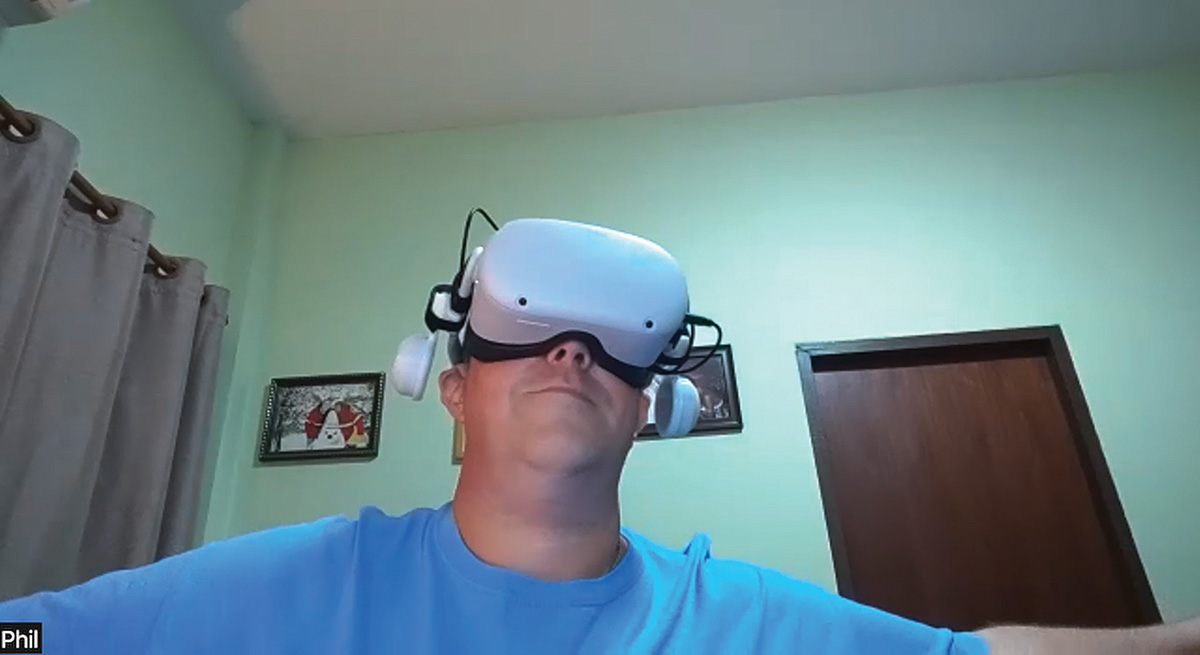
Otto spends night and day blurring faces on Google Streetview for a cent each. It's the kind of work he and his friends around the world can find on the Amazon Mechanical Turk, the crowdworking platform. Alongside his turker friends, Otto sinks into a robotic world that raise the question of humanity.
Natan Castay was born in Brussels and still resides there as of today. In 2022, he wrote and directed the movie "Human, not human" as a graduation project for the Institut des Arts de Diffusion (IAD) located in Louvain-la-Neuve, Belgium. The idea came from his personal experience as a “turker”, a slang word used to describe people working for the crowd-working platform created by Amazon: the Amazon Mechanical Turk. Indeed, during the 2020 lockdown, Natan lost his student job in a fast-food restaurant. He then googled "how to make money online" and instantly came across the Amazon Mechanical Turk platform. Very quickly, this besides being a way to earn money, made him want to make a film about it. As he dug deeper into this universe, what seems to be a bottomless pit of questions arose, and the need to make a film about it was more and more prevalent. I This is, for example, the case of the site name – the Amazon Mechanical Turk – which originally refers to a legend from the 17th century , in which an Austro-Hungarian automaton called Mechanical Turk was able to play chess and beat the great historical figures of that era: from Napoleon to Benjamin Franklin or Maria-Theresa. But in reality, the mechanical entrails of the automaton hid none other than a human being. A few centuries later, Amazon decided to name its platform after this legend, perhaps cynically. Nevertheless, this chosen name holds a great meaning today. For a year, Natan met hundreds of turkers around the world and this resulted in a writing that mixes documentary, fiction and experimental in order to try and translate his own experience as well as many others.
Dani Castillo, Enrique Corrales
Calle Leganés, por ejemplo
Experimental doc. | dv | color | 17:0 | Spain | 2007
Leganés Street, for example. Leganés St. doesn`t want to disappear; as soon as the inhabited homes empty the buildings will be demolished to keep on constructing. advancing ruthlessly, the bulldozers don`t care about memories? they don`t ask? they don`t hesitate.
ZAUNKA was founded in 2004 by Dani Castillo and Quique Corrales. Their work talk about the relationship between people and their enviroment in contemporary world. They try to explore our society, developing projects between Art and Documentary. Dani Castillo (Vitoria 1974). Photographer and filmmaker. Specialist in on-line image solution. Quique Corrales (Madrid 1969). Photographer and filmmaker. Teaching Art and Photography in Universidad Europea de Madrid.
Jeannette Castioni
everywhere´s local
Video | hdv | color | 6:0 | Iceland | 2014
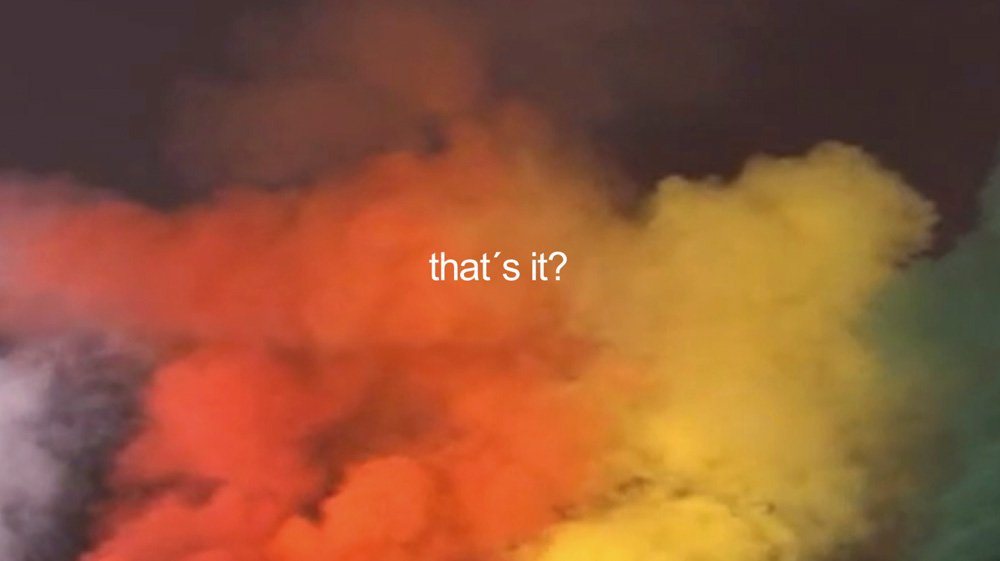
Public and private spaces make people develop political and social questions reaching beyond localities, widening questions about their role in the formation of political subjectivity. "Everywhere´s local" intends to examine how conventions about mobility as counter resistance affects identities of individuals and small communities as well as in working places and private locations; how these conventions speak about subjectivity ; their way of quest political and social visibility, and whether actions of reciprocity might be the source of mutual support allowing civilians to activate endurance in the development of social structures. The piece investigates the role of the aesthetic vision within the process of objectification, juxtaposing documents of daily practices where individual actions become the apparatus that institutions use to master control and by doing so reducing civilians as objects. Spaces create distinctive features for subjectivity to be activated where meanings of defiance alongside civil resistance are deepened inside description of subjectivity within differentiation of forms. Where actions are endorsed by connotation and not by their visible value. Interpretation of actions are investigated as potential fields, where their manifestations compared coloured smokes, aim to empower people visibility and at the same time longing to dismiss a system.
education: 1989/9 Institute for Arts and Restoration, Palazzo Spinelli. MA(Diploma) in Painting Conservation and Restoration on wood and canvas, Florence Italy, 1999/02 Academy of Arts, Painting department Bologna, Italy. 2004/06 LHÍ University of Arts, BA in Fine Arts Reykjavík, Iceland. 2006/07 LHÍ University of Arts, MA (I grade) Art Education, Reykjavík, Iceland. 2012/14 Goldsmiths University of London MFA in Fine Art. awards: 2010- 1 Year Research Prize from the Visual Artists Foundation of Iceland 2010- Art Prize from the Guðmunða Andresdottir Cultural Foundation for Postgraduate studies in Art. 2012-“Visual Art Award” Icelandic Prize as the best artist of the year 2012. 2013- 6 Months Research Prize from the Visual Artist foundation of Iceland grants: 2007- Travel Grant from the Icelandic Ministry of Education and Culture, for cultural exchanges between Greenland, Iceland and Foræ Islands. 2010-Travel Grant from MUGGUR, Artist Foundation of Iceland 2011-CIA International Travel grant, from the Centre for Icelandic Art residency/ workshops: 2008 Kangerullussuak Atuarfiat, Nuuk, Greenland. Two weeks workshops with pupils from secondary local schools, deepening questions around issues on memories and cultural connotations. 2008 Silamiut Theatre Nuuk, Greenland/ Theatre rehearsals with students from schools 2010/11 Circle Scandinavo in Rome/ Hosted performances and seminars on the rhetoric of language. group exhibition: 2008 After Urban - University of Pennsylvania in Philadelphia, PA – USA. New Media & Video Festival at the Indiana University Art Gallery, USA. Art & Architecture event at Monkey town in Williamsburg Brooklyn, New York. The law of dialectic at The New Branch “Grassroots’ 2008”, the Icelandic emergent artist Exhibition in Hjalteyri, Iceland. The entropy of landscape /God words Municipal Art Museum of Akureyri. 2009 Communism didn´t happen /Solitude Landscape, Exhibition at the Kulturhaus in Ahrenshoop, North-east Germany. Sometimes they’ll return Exhibition at the Natural History Museum of Kopavogur in Reykjavik, Iceland. ATTITUDE Festival- Centre for Contemporary Public Arts - Bitola, Macedonia. 2010 Anamnesis/ be known to knowledge, at the Árnesinga Art Museum in Hveragerði, Iceland DRA the Dieter Roth Academy in Hjalteyri Iceland 2011 In between ,Hafnaborg Hafnafjörður, Iceland 2012 The painting site Akureyri Municipal Art Museum 2014 Big Screen/Latitude Festival Southwold , Suffolk UK. 2014 6th Cairo Video Festival. Medrar films Cairo, Egypth

Jeannette Castioni, Þúriður Jónsdóttir
Sounds of doubt- wave behaviour
Video installation | hdv | color | 6:6 | Iceland | 2018
Can we investigate our character, role or self-image by observing everyday phenomena and by looking into and discussing simple esthetic symbols? Can the particular tonality or attribute of a certain nationality be discovered -a sort of national character in sound? Can people’s performances in everyday life be observed in a way that simple actions, which in our memory seem to be real, demonstrate to be the result of misremembering or even completely fictional? On Cycle in 2018 during Sounds of Doubts -Workshop the artists worked with three groups, each one with participants from a different Nordic country: Iceland, Faroe Islands and Greenland. Their behaviour was observed by introducing them to different roles and circumstances, either staged or real. This environment gave them the opportunity to examine how the inception of natural and cultural milieu influence the participants’ experience. During the development of the project, languages and the creative functions of our memory were elaborated with musical and visual means. The video and sound recordings from workshops were used for further analyses and elaborations for the multi-media work: Sounds of Doubts. The interdisciplinary collaboration between the artists constitutes a research project in itself as much as the final piece, where conventional ideas and beliefs about musical composition on the one hand and the aesthetic vision on the other, are reviewed and questioned.
My background lies, besides the field of fine arts in the conservation and restoration of paintings. Engaging with diversified collections and archives since the inception of my career enhanced my will to understand questions of time and space and the human ability to develop differentiated forms of cultures and knowledge. I collaborate with cultural mobility programs both in Europe and Asia, as well as receiving awards and prizes from several institutions: The Nordic Cultural Point, the Icelandic Visual Association alongside the Icelandic Patronage from “Amalie Engilberts Art trust” from The National Gallery of Iceland, and the Reykjavik Art Museum. The award for Postgraduate studies from the Guðmunda Andresdottir Foundation.

Clemente Castor
Príncipe de Paz
Experimental fiction | hdv | color | 84:0 | Mexico | 2019
What divides us and what keeps us together? Maybe, both questions have the same answer. The body revealing itself to the mind. The mind to the space. The space, a place without walls which its inhabitants can’t get out of. Confinement in a place that seems open. People like the objects of a place. A place as a body they can’t get out of. The body, a group of membranes, the tissue that contains us. The fear that this tissue might not contain us anymore. A giant’s skeleton appears.
He received a grant from the National Fund for Culture and the Arts (FONCA) of Mexico to study at the Sarajevo Film Academy in Bosnia Herzegovina, founded by Hungarian director Béla Tarr. He studied Latin American literature at the Iberoamericana University (UIA, in Spanish). Also, he participated in the Mantarraya film workshop, in Mexico City. He is co-founder of the distribution and production company Salón de Belleza and was selected for the Berlinale Talents-Guadalajara 2019. He is currently studying a master's degree in contemporary art at SOMA, Mexico. He has directed short films, screening in several national and international film festivals in Colombia, Bosnia, Vienna, Argentina, Houston, France, Tijuana, etc. His feature film “Prince of Peace” received the award for best Mexican movie at FICUNAM and had its International premier at FidMarseille where it obtained the special mention of the international competition and special mention of Centre National des Artes Plastiques (CNAP). As well presented in festivals like Viennale, Mar del Plata Film Festival, Márgenes, etc. Also, he works as a contemporary artist and has presented his installations in some independent spaces and in contemporary art museums like Biquini Wax EPS, Queretaro Contemporary Art Museum, Baxter St, NY, Soma, and others.
Lorenzo Castore, Adam Cohen
No Peace Without war
Experimental doc. | dv | color | 38:0 | Italy, Germany | 2012
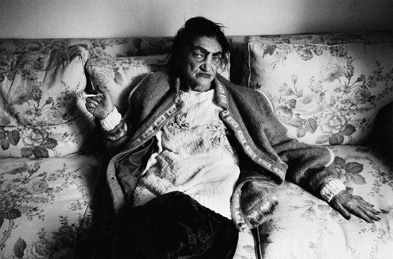
?No Peace Without War? is a film about Ewa and Piotr Sosnowski, brother and sister, living together since the death of their father. It is meant to be the story of a forgotten world that takes place behind the door of a two-room apartment in Krakow, Poland. Comprehending Ewa and Piotr?s past and present simply through facts is almost impossible. At a certain moment everything falls into a misty and mysterious cloud where real and invented memories become indistinct. The more we get to know them facts become trifling and unsubstantial. The only sure thing is that they live in extreme poverty but they never complain about it. Insight and unique access to this story is made possible through the eyes and understanding of Italian photographer-filmmaker Lorenzo Castore (Mario Giacomelli Prize 2003, Leica European Publisher Award 2005) and the visual approach of experimental documentary filmmaker Adam Cohen. In collaboration with Austrian composer and guitarist Christian Fennesz.
Lorenzo Castore / Director / Biography Lorenzo Castore was born in Florence in 1973. Since today he has worked in Europe (1997 ? 2011), New York (1997 ? 2001), Cuba (2000 ? 2002) and India (1997 ? 2001): he favours long term projects and special collaborations on the most different topics. His main interest is life and memory and their more mysterious and hidden aspects in relation with individual and personal stories and history. His work was published in many magazines such as Le Monde 2, Liberation, Sunday Telegraph, L?Espresso, Amica, Ventiquattro, D, Marie Claire, etc. He won the Mario Giacomelli Price (2003) and the Leica European Publishers? Award (2005) and published two books: Nero (2004) and Paradiso (2006). He?s represented by Agence/Galerie VU?. No Peace without War is his first film. Adam Cohen / Director / Biography Adam Cohen is a New York City born filmmaker and photographer. Working somewhere between film, painting and photography ? the city as a place to explore themes of memory and forgetting, history and entropy. Filmography: Blind Grace (1993), Fire of Time (2000). Christian Fennesz / Composer / Discography Fennesz uses guitar and computer to create shimmering, swirling electronic sound of enormous range and complex musicality. »Imagine the electric guitar severed from cliché and all of its physical limitations, shaping a bold new musical language.« (City Newspaper, USA). His lush and luminant compositions are anything but sterile computer experiments. They resemble sensitive, telescopic recordings of rainforest insect life or natural atmospheric occurrences, an inherent naturalism permeating each piece. Christian Fennesz is published by Touch Music. He lives and works in Vienna and Paris.
Libia & ólafur Castro & ólafsson, Libia Castro & Ólafur Ólafsson
Il Tuo Paese Non Esiste (Your Country Doesn't Exist), 2011
Experimental video | 0 | color | 16:0 | Spain, Italy | 2011
The video "Il tuo paese non existe" is a recording of a staged public musical performance in Venice. Appropriating the cliché and reality of the gondolier and the serenade, a mezzo soprano sings a contemporary serenade acompanied by a trumpet and a guitar, while floating in a gondola through the canals of the city. The lyrics, which were composed by the artists, are comprised of the following sentence in several languages: ?This is an announcement from Libia and Ólafur: your country doesn?t exist, your country doesn?t exist?. This statement is intertwined with phrases appropriated from a text by writer and curator Antonia Majaca, in which she reflects on their ongoing project ?Your Country doesn?t Exist?. The artists collaborated with the Icelandic composer Karólína Eiríksdóttir, who wrote the score. The video was shot at various locations across the city, in the afternoon and during the golden hour on two spring days in early May. It is an edit of several versions of the performance, these having been performed over the course of the journey, against the background of the city?s everyday life and the omnipresent reality of tourism.
Berlin and Rotterdam based artists Libia Castro (Spain) and Ólafur Ólafsson (Iceland) met in the Netherlands in 1997 and have been collaborating since. Exploring the relationships between art, everyday life, sociopolitical and cross-cultural issues, the artists have built up a body of work using a variety of media. Their practice is among other concerned with the ways in which globalization has affected local cultures, transformed national industries and led to an increase in mobility while deepening social injustices. Castro & Ólafsson?s situated projects, often made in collaboration with other artists, professionals, local citizens, decision makers, activists and illegal immigrants alike, serve as catalysts within given contexts. They operate by assembling, re-presenting and destabilising heterogeneous elements ? specific conflicts, inconspicuous social groups, etc. ? back to the host community through documentary videos, public performances, sculpture, photography, interventions and multimedia installations. Castro & Ólafsson represent Iceland at this year´s 54th Venice Biennial. They have furthermore shown in international exhibitions at major museums, contemporary art centres, galleries and biennials. In 2008 they participated in Manifesta 7 and in 2009, were awarded third place in the prestigious Dutch art prize, Prix de Rome, for their video work Lobbyists.

Anibal Catalan
babel
Video | dv | color | 3:10 | Mexico | 2009
Babel is a video taken with a cellphone camera. A scafolding its being constructed over the roof of some building without any apparent reason. The idea of contemplation its a fundamental principal in my video works , Babel its made from basic video tools, like cell pone cameras and photo digital cameras, the video was editing from this small cuts during a week, showing the process of construction as a methaphore of how the cities and its usuaries grows, get empowerment or loss everything in a second. The title Babel comes from the ancient history of the tower, in many ways big metrópolis and its biggest owners such as: enterprises, coorporations, goverments, and privates are represented trough the idea of high and big towers or construcrions to reflect their power, making this as a global and in some occasions a trendy effect.
Anibal Catalan was born in 1973 in the small Mexican village of Iguala. He attended the School of Architecture at Anahuac University, Mexico City (1993-1997) and earned his MFA from the National School of Painting, Sculpture and Engraving, La Esmeralda, Mexico City (2006). He has had solo exhibitions at Steve Turner Contemporary, Los Angeles (2008); Brasilea Kulturhaus, Switzerland (2006); Gallery 415, San Francisco (2007) and National Center for the Arts, Mexico City (2004). Catalan?s work has also been included in the group exhibitions Qui Vive? at I Moscow International Biennale for Young Art, Moscow Museum of Modern Art (2008); Festival Miden Kalamata, Grecce(2009), Its not Easy ,Exit Art. New York (2008); Draw In 00130 Gallery, Helsinki Finland (2008); VIII Biennial Monterrey FEMSA, San Idelfonso Museum, Mexico City (2007); Shangri L.A. Architecture as a State of Flux, 18th Street Arts Center, Santa Monica CA. (2009) and Mexi-Cali Biennial 09-10, Los Angeles (2009). His works are represented in collections such as: Artists Pension Trust APT (USA), Mexic-Arte Museum (USA), Sayago & Pardon Collection (USA), National Auditórium(MEX)

Wim Catrysse
Outpost
Experimental doc. | 4k | color | 34:41 | Belgium | 2018
“ A transfixing look at how Belgian artist filmmaker Wim Catrysse surveys the dynamics of self-constructed, architectural settings or the fictitious characteristics of phenomenal environments ? dissecting subjectivity and thereby also the illusion of control. His films and video installations challenge both participants and viewers in a primordial way through the evocation of vertigo. This precondition of boundaries operates to expose the observer to underlying motives. His artistic approach combines intuition with technical reasoning, which often leads to complex, cinematographic image constructions. ”
Born 1973 in Leuven (BEL) Lives and works in Antwerpen (BEL) Studied at ESA St-Luc Bruxelles (BEL), Higher Institute for Fine Arts, Anvers( BEL) and The Glasgow School of Art (GBR)
Wim Catrysse
Catch-as-catch-can
Experimental video | dv | color | 7:56 | Belgium | 2005
Wim Catrysse est né en 1973 à Lovent en Belgique. Il a étudié à l?institut supérieur de Saint-Lukas de Brussel (1993 - 1997) et a obtenu un Master en arts visuels. En 1997 ? 2000, il a suivit le post-programme Higher Institute for Fine Arts (HISK), d?Anvers en Belgique. En 2000-2001, il a suivit le post-programme de la Glasgow School of Art, Glasgow, au Royaume-Uni.Son projet pour 2006-2007 : Künstlerhaus Bethaniën, Berlin, Allemagne.