Catalogue > Search
Results for : Tout le catalogue

Miguel Rato
Meeting Point
Experimental doc. | hdv | color | 10:4 | Portugal | 2014
The imagined city as a simulation takes over the real one. Desire and reality meet creating a new space with its own rules. Ever sprawling suburban areas, anonymous landscapes generated by computers, places with no memory, landmarks, residential projects. Staged scenery for action to take place. Mostly filmed in London, Meeting Point is a study of urban space and of its representations, the virtuality of contemporary public space and landscape.
Miguel Rato (1986, Lisbon) studied Sound and Image at ESAD Arts and Design School (Portugal) and Documentary Film at London College of Communication, University of the Arts London. His film and photography work has been exhibited in the United Kingdom, Peru, United States, Spain, Canada, Holland and Portugal.

David Jeremy Rauschning
Es sind noch Bilder übrig I
Experimental doc. | dv | color | 7:45 | Germany | 2010
David J. Rauschning, geboren 1980 in Bergen auf Rügen. Ausbildung zum Film- & Videoeditor und Studium der Montage an der HFF ?Konrad Wolf? in Potsdam-Babelsberg. Schnitt von Dokumentationen, Werbung, Musikvideos für TV & Kino und preisgekrönten Kurzfilmen. Ab 2008 erste eigene Videoarbeiten und Gastvorlesungen an der HTW Dresden. Lebt und arbeitet in Berlin.

Nassif Rawane
Sokun Al Sulhufat (Turtles Are Always Home)
Experimental doc. | hdv | color | 11:39 | Lebanon | 2016
I left Lebanon in 2006. For the past 10 years I lived in 7 countries, 10 cities, and 21 homes. I slept in 21 beds, cooked in 21 kitchens, cleaned 21 bathrooms, wrote on 21 desks and locked 21 doors behind me. I packed all of my life into two suitcases and a backpack. The rest stayed behind. Somebody somewhere uses my bed, somebody somewhere has my shoes, somebody somewhere maybe remembers me in those fragmented traces of mine. I was there. But now I am here. In Qatar. In a fake Venice with colorful houses. Houses have memories too. They hide them under their windowsills, tuck them in layers of paint and sometimes whisper them to birds passing by. I wonder whose memories will these houses keep. I live here but I am unable to leave a trace. I try to attach myself to the walls, dirty them, mark them… but I fail. They are constantly cleaned, watched and protected. I caress them instead. And I film them, lest I forget. Home is where the heart is, they say. I disagree. My heart is everywhere. It left with the music. Like a turtle, I am always home.
Rawane Nassif is a Lebanese/Canadian filmmaker and anthropologist. She works in research and films often addressing subjects such as space, traditions, identities, displacement and memory. Rawane has directed social documentaries and wrote a book on the politics of memory in Lebanon, worked with immigrants and indigenous people in Canada, conducted visual research on nomadic traditions in Kyrgyzstan, taught anthropological courses in Tajikistan, wrote children’s books based on oral histories in Honduras and worked as a film researcher with the Doha Film Institute and the National Museum of Qatar. Her short film, “ Turtles are Always Home ” screened at numerous film festivals including the Berlinale, AFI Docs, Toronto, Camden, and RIDM. She is currently completing a mentorship with the “ Masters in Experimental Cinema, Creative Documentaries, and Video Creation ” Program at the Transforming Arts Institute in Madrid.

Zazie Ray-trapido
The Instability of Clouds
Experimental doc. | 16mm | color | 15:16 | USA | 2023
Two neighbors bond after a shared traumatic event, a continuous home development creeps into nature's threshold, and a community celebrates freedom. The Instability of Clouds navigates an ecosystem in decay and growth while traversing across its spaces of comfort, spectacle, and disaster. Through the observation and construction of facets within a suburban neighborhood in Southern California, connections between landscape, neighbors, and environment ruminate on the American Dream and its resonances.
Zazie Ray-Trapido is a filmmaker and producer from Philadelphia, based in Los Angeles and New York. Her experimental and documentary films create narrative vignettes of the quotidian and personal. Her films have screened at the New York Film Festival, REDCAT, Curtas Vila do Conde, Athens International Film and Video, Antimatter, Engauge, Bideodromo, San Diego Underground, The Clemente Center, Mimesis, and others. She holds a Theatre and Performing Arts degree from Bard College and a master’s in Film/Video from the California Institute of the Arts.

Mohd Naguib Razak
Glass enclosure: Tokyo invisible
Experimental doc. | dv | color | 80:0 | Malaysia | 2005
like a recurring dream, the writer wakes up again and again in a glass enclosure. he looks down below. watches the stream of tiny people streaming here and there. watching nature call on him, come and go. is this his glass enclosure? is that theirs? and when dusk sets. so do his emotions. descending. and rising. hoping. wishing. hearing. listening. this city. this great big city. tokyo. toh-kyoh. he doesn`t know what he's doing here. cannot remember if it was a good idea or a bad idea that brought him here. it isn't funny to be lost and lonely in tokyo. he thinks. then voices come to him. they tell of loneliness, despair, quiet desperation. nothing lost in translation, their loneliness echos loud and clear. the same loneliness that strangulates his soul. still the voices come. and then some linger. some speak of hope. of change. of unexpected kindness. relenting. the writer relents. surrenders. until what remains is just...
Mohd Naguib Razak is a writer, director, and producer. He began his working career as an advertising copywriter-cum-occasional magazine writer, whilst moonlighting in all manner of underground creative work, from poetry writing to graphic novel composition, from improvised street performance to experimental jazz theatre, before finally settling for a career in film and television. Even then, he couldn?t decide whether to become a writer, director or a producer. After 4 years of service as a Television Producer, Director and Scriptwriter/Editor in ASTRO, Malaysia?s leading satellite broadcast network company, and a spell as Feature Film Writer in Astro Shaw, he decided to move on to seek out new challenges. A small experimental documentary film called "Anak Duyung" (Child of Mermaid) took him to the Yamagata International Documentary Film Festival in 1999, and this experience opened him up to the wonderful world of the documentary film form. In 2001, he made a significant commercial breakthrough when he was chosen and commissioned to write, produce and direct a documentary film for Discovery Channel. The resulting film, entitled "The Boat-Maker and The Sea", was eventually broadcasted to some 80 million households across Asia, and subsequently awarded Best Documentary Film at the Malaysian Film Festival 2003. All this culminated with a six-month stay in Japan in 2002 as an artist-in-residence under the auspices of The Japan Foundation Fellowship (Invitation) Program. It was during this stay that he conceived and shot "Glass Enclosure: Tokyo Invisible", a feature-length documentary film that has competed in three International Competitions ? at the 4th Taiwan International Documentary Festival 2004, the 10th It?s All True ? International Documentary Film Festival 2005 in Sao Paulo and Rio de Janeiro, and the 2nd Documenta Madrid International Documentary Film Festival 2005. In 2005, he briefly served as a Senior Executive for Television in the Programme Department of the Asia-Pacific Broadcasting Union (ABU) in Kuala Lumpur. Whilst there, he was responsible for organizing and co-ordinating various international co-productions, programme exchanges as well as the ABU Prizes television & radio awards. He is now bound for Japan under the auspices of Nippon Foundation?s Fellowship for Asian Public Intellectuals (API) and will be based in Tokyo for one year to research and produce a documentary film relating to the theme, "Spirituality in Japan?s Material Utopia".

Alsalah Razan
A Stone’s Throw
Experimental film | 16mm | color and b&w | 40:0 | Palestine | 2024
Amine, a Palestinian elder, is exiled twice from land and labour. He is displaced from his birthplace Haifa seeking refuge in Beirut, and again to Zirku Island, for work on an offshore oil platform and work camp in the Arab Gulf. "A Stone’s Throw" trespasses borders to reveal an emotional and material proximity between the extraction of oil and labour in the region and the Zionist colonization of Palestine. The film rehearses a history of the Palestinian resistance when, in 1936, the oil labourers of Haifa blow up a BP pipeline.
Razan is a Palestinian artist and teacher based in Tiotiake/Montreal.

Maria-leena Räihälä
untitled
Animation | | black and white | 4:0 | Finland, Germany | 2006
The artist presents ten minimalist flash-animated drawings, trying to respect the original handmade ones. Together they build a series, but every small loop definitely has its own story: 001 is a female figure trying to fly out of his monitor 002 is a another female with a ghost in her head 003 in this third one she is trying to find a balance for her hat (or maybe better: her head) while her hands are only sticks 004 is a morning bird living in a spruce 005 is a female figure from the series "flirting with flowers". Her head is communicating with... 006 ...basil, which the artist saw last spring growing in his garden. He had the feeling that while coming trough the earth they were like small babies opening their mouths, hungry for life 007 is a girl who merges with her chair so that she looks like a strange animal (the artist thinks it might just be him sitting too much at home) 008 is the only male figure, he is called Boxer. He has a very sad end by a brave young woman 009 is a very angry young woman 010 is called "blähungen" (flatulence). These animations have a very simple self-made sound in the background (even some stolen pieces from Finnish folk-songs were used as a loop).
Maria-Leena Räihälä was born on July 16, 1964. After her art studies at the "Nordic Art School" (Kokkola, Finland 1984-87) she moved to Berlin and hit the underground art scene (e.g. her exhibition "Electric Angel" at the Fischbüro in 1988). The beginning techno movement both fascinated and inspired her. In the early 90s, for example, she made a lot of exhibitions at the legendary club "Ständige Vertretung". That brought her to experiments with electric pictures and multimedia installations with projections and huge photocopies of her drawings fitted perfectly with the music of the best DJs in the city. The base of her work was and continues to be drawings. For their digital versions Flash is still her favourite program no.2. Beside these she works with computer prints and large photocopies in order to produce room-filling installations. An example for this is last summer's "Morgenvogelstation", a sort of an audio-visual Gesamtkunstwerk. Huge prints of her drawings went together with pictures of historical bird song transcriptions by Heinz Thiessen (1887-1971). At the same time you could hear bird recordings by Veikko Neuvonen (Finland 1997). Eventually there were several concerts by the Berlin experimental group The RotTT under the name of "The Birds, Too". They played with all sorts of bird sounds and wore bird masks, which the artist had tailored for them. A select list where her exhibitions have been held includes: 2006 - Multimedia Happening, Berlin; Joint Exhibition, Neues Problem, Berlin 2005 - L.O.F.T, Berlin; Neues Problem, Berlin; Joint Exhibition, Gutleut 15 Ausstellungsraum, Frankfurt/Main, and Glue, Berlin; Joint Exhibition, 'Nothing except drawings Vol.2', QUARTAIR, Den Haag 2. Berliner Kunstsalon, Berlin 2004 - Joint Exhibition,Haus am Lützowplatz, Studiogalerie, Berlin; Joint Exhibition, Gallery Christa Burger, München; Hinterconti Gallery, Hamburg 2003 - Joint Exhibition, Neues Problem Gallery, Berlin 2002 - Emil Bock Institut, Berlin 2000 - Joint Exhibition, Pussy Galore, Berlin; Joint Exhibition, Neues Problem Gallery, Berlin 1999 - Joint Exhibition, Berlin Brandenburg Exhibition, Radio-Berlin 1998 - Haus am Lützowplatz, Studiogalerie, Berlin; Fruchtig Gallery, Frankfurt am Main; Walden Gallery, Berlin 1997 - Congress for Performance and Visual Art, Berlin 1995 - HTC Gallery, Berlin; Installation at Friseur, Berlin 1989 - Vanhan Galleria, Culture-Center, Helsinki, Finland; Kunsthaus Tacheles, Berlin 1988 - SoToDo Gallery, Berlin; Vincenz Scala Gallery, Berlin

Nanna Rebekka, Pernille Lystlund Matzen
Furiernes Hus
Experimental doc. | 16mm | color | 28:51 | Denmark | 2019
HOUSE OF FURIES is an institutional ghost story that takes its starting point in an unemployment centre in Copenhagen that recently went bankrupt. The empty basement premises have now been taken over by local departments of American test centres, where people can document their work skills to possible future employers. One hundred years ago, the same building was a workhouse, where the poor worked in exchange for board and lodging. In this mausoleum of idleness, a clairvoyant man wanders around and establishes an occult contact to the dreams and sufferings of the past, while a restless 16mm camera scans the empty corridors as if it was trying to map the tragic inner architecture of emptiness. Plastic plants, old ring binders and outdated Xerox machines are accompanied by the voices of the former job consultants who are now themselves unemployed. The film traces the historical connections between three different institutions for unemployment across the past hundred years, which still haunt the same historical building in the middle of Copenhagen. By drawing these connections, the film seeks to investigate - and lay bare - how our culture has dealt with unemployment and precarious working conditions across the past century.
Pernille Lystlund Matzen (b. 1986) and Nanna Rebekka (b. 1989) is a directing duo based in Copenhagen, Denmark. Their work concentrates on new documentary forms, video art and essayistic modes of filmmaking. In their collaborative, research-based practice, they seek to examine and unfold the untold stories that lie hidden in the monuments, buildings and material objects that surround us in our everyday life.

Pedro Rebelo
Laut[omata].3
création numérique | 0 | color and b&w | 9:0 | Portugal, United Kingdom | 2005
laut[omata].3 is a semi-generative work which has developed from activity in improvisatory performance with electronics and visuals. It is fabricated as fundamental digital data manipulations upon media constructed from sampling and 3D modelling. laut[omata] is a digital entity which prolongs the life of human-based interaction; it is an entity which attempts self-organisation with digital residues derived from human activity. These residues consist of behavioural structures initially defined as human-computer interaction strategies.
Pedro Rebelo Composer/Digital Artist Born in 1972 ? Portugal Pedro is a composer/digital artist working in electroacoustic music, digital media and installation. His approach to music making is informed by the use of improvisation and interdisciplinary structures. He has been involved in several collaborative projects with visual artists and has created a large body of work exploring the relationships between architecture and music in creating interactive performance and installation environments. This includes a series of commissioned pieces for soloists and live-electronics which take as a basis the interpretation of specific acoustic spaces. In the duo laut with saxophonist Franziska Schroeder he investigates the extension of interfaces and control in interactive performance practices. His electroacoustic music is featured in various CD sets (Sonic Circuits IV, Discontact III, Exploratory Music from Portugal, ARiADA). Pedro conducts research in the field of digital media, interactive sound and composition. His writings reflect his approach to design and composition by articulating creative practice in a wider understanding of cultural theory. Pedro has been awarded a PhD in composition from the University of Edinburgh and is currently Director of Research at the Sonic Arts Research Centre, Queen?s University Belfast.

Monika Rechsteiner
Tawisupleba
Experimental doc. | dv | color and b&w | 38:30 | Switzerland, Germany | 2007
Tawisupleba - ein dokumentarischer Bild-Essay durch Georgien mit Gesprächen über die Kunst Was wissen wir über Georgien? Welche komplexen Entwicklungen Georgien seit dem Ende der Sowjetunion genommen hat, und von welchem Erbe diese Entwicklungen überhaupt ausgehen können, ist in der öffentlichen Wahrnehmung in Westeuropa weitgehend unbekannt. Welche Chancen und Umstände bietet Georgien, ein Land im Transformationsprozess, für Kunstschaffende? Was wissen wir über die zeitgenössische Kunst in Georgien? Fotografien, aufgenommen im Zeitraum von zwei Jahren, 2004 ?2006, und aktuelle Kunstvideos georgischer KünstlerInnen sind im Film zu einer Reise montiert. Zitate über Kunst, Politik und Gesellschaft, von georgischen Kunstschaffenden und Kuratoren gesprochen, ergänzen die Stimmung vor dem Hintergrund des gegenwärtigen Georgien.
Monika Rechsteiner geboren in der Schweiz, arbeitet im Bereich Film, Filminstallation, Fotografie, Film/Musik-Projekte. Seit 1998 Ausstellungstätigkeit in der Schweiz, Deutschland, Holland, Finnland, Kanada. Nach dem Studium an der Hochschule für Gestaltung und Kunst in Luzern, Schweiz arbeitete Monika Rechsteiner als Dozentin bildnerisches Gestalten und Fotografie und als freiberufliche Künstlerin. 2007 schloss sie ihr Masterstudium an der Universität der Künste in Berlin ab. Seit einigen Jahren fokussiert sie ihren Blick auf Fotografie und Dokumentarfilm. Sie lebt in Berlin und Basel.

Marc Rees, Neil DAVIES
Comfort Zone
Performance | 0 | | 60:0 | United Kingdom | 2006
Two men enclosed in a small, cheap plastic, transparent green house, sealed off from their surroundings, in their own private, soft, and temporary, architecture. They stand on a bed of their own jumbled clothes, in turn repeatedly dressing and undressing, methodically until their breath steams up the see-through walls and their clothes become soaked with their married sweat. "They are standing less than a body length apart. What lies between them, apart from enough outfits to clothe a whole dance floor of men? Imagine a pulsing disco dance beat. Imagine dancing exactly this far apart all night. Imagine holding onto that personal/erotic space measurement of all that lies between us. Imagine if we never broke that magic volume of air to clasp arms, lock shoulders and wrestle briefly, naked from the waist down, sleeves rolled and hoods up, heads bent slightly but furiously into each other."
Marc Rees is one of Wales' leading exponents of contemporary performance and installation. His innovative interdisciplinary artworks are known for their flamboyant, humorous, and often extreme interpretations of history, culture, and personal experience. He has lived and worked in Amsterdam, Montreal, and Berlin, and under his company R.I.P.E has initiated several highly successful artistic alliances with furniture designers, film makers, authors, composers, and choreographers across Europe and North America. In addition to working with some of Britain's foremost physical theatre companies (Brith Gof, Earthfall, and DV8) and Germany's premiere choreographers (Angela Guerreiro, Thomas Lehmen, and Tanz Compagnie Rubato), his own extensive body of work includes the solo stage works "Iddo Ef"/"Caligula Disco", the award winning installation/performances "The House Project", "RevolUn", "Shed*light", and the BBC film "A Very Gladys Night". His most recent international commissions were the site specific events, Shed*light: "Norman Behaviour" for ARCO 05, Madrid ,"Adagietto Ara Deg" for the 51st Venice Biennale 2005, "Vaseline Machine" for VERBO, Galeria Vermehlo, Sao Paulo 2006, and "S x 3", SINOPALE, Turkey 2006.

Total Refusal
How to Disappear
Documentary | dcp | color | 21:0 | Austria | 2020
“How to Disappear” is an anti-war movie in the true sense of the word, searching for possibilities for peace in the most unlikely place of an online war game. It’s a tribute to disobedience and desertion - in both digital and physical-real warfare. Shot in the picturesque war landscapes of “Battlefield V”, the hyperreal graphics become the backdrop for an essay-like narrative. The film revolves around the history of deserters - a part of human history, which has hardly been illuminated. Performances and creative interventions explore the scopes and limits of the audiovisual entertainment machine. SYNOPSIS DE Ist es möglich, in einem Ego-Shooter-Spiel zu desertieren? Entlang dieser Frage reflektiert “How to Disappear” über Krieg und Spiel, Disziplin und Ungehorsam. Denn die Geschichte der Kriegsverweigerung ist genauso alt wie die Geschichte des Krieges -- und dennoch sprengt die Fahnenflucht den digitalen Handlungsraum des Spiels. Gedreht in den pittoresken Schlachtfeldern des Online-Shooters “Battlefield V”, wird dieses zur Kulisse für eine essayhafte Erzählung. Sie erzeugt einen Riss, durch den physisch-reale Wirklichkeiten in die depolitisierte Spaßbühne des Spiels eindringen. Anhand von Performances und Interventionen in das digitale Schlachtfeld lotet “How to Disappear” die Spielräume und Grenzen der audiovisuellen Unterhaltungsmaschine aus.
Total Refusal is an open artists’ collective which criticizes and artistically appropriates contemporary video games. However, as most mainstream game narratives employ the same infinite loops of reactionary tropes, the genre largely fails to challenge the values of their players and instead affirms hegemonial moral concepts. Acknowledging that this media is currently not realizing its cultural potential, we aim to appropriate digital game spaces and put them to new use. Moving within games but casting aside the intended gameplay, we rededicate these resources to new activities and narratives, looking to create “public” spaces with a critical potential.
Jeremie Reichenbach
La mort de la gazelle
Documentary | dv | color | 45:0 | France | 2009
North of Niger, somewhere on the borders of Sahara, hundreds of rebels of the MNJ movement, mainly Tuareg young men barely grown-up are ready to go to war. Cut-off from the world, they live according to their own rules, their own codes, in harmony with the desert. The humor, the boredom, the beauty, the nonsense of the situations, the danger of weapons and the threat of an invisible enemy, this film explores the improbable everyday life of these young fighters. Morning gatherings, discussions around the tea to pass the time, days go by and time seems to stand still, to suddenly accelerate when danger arises.
JEREMIE REICHENBACH Born in Paris the 29/08/1975 Master of Cinema at the university Paris 8 supervised by J.L. Comolli. FILMOGRAPHY ABOU AND STARS OF the MANDE (52 min) HIBOU production 2007 - Distribution(Broadcasting) France O Mosaïque of the malian cultures, this film lands through the journey of Abou Kouyaté, the roles which occupy the traditional and modern musics in the malian society. NIAMEY, HOW?S WORK ? (26 min) HIBOU prod. On 2006 - Distribution(Broadcasting) FranceO Tuareg, Fulani, Zermas native of all the regions of Niger are now settling in the capital Niamey. TESHUMARA, THE GUITARS OF THE TUAREG REBELLION (50 min) HIBOUproduction 2005 The history of the Tuareg rebellion through the music and the testimonies of the members band Tinariwen. Distribution(broadcasting) Mezzo, Image +, FranceO, TV Catalunya ( Spain), SVT(LIFE SCIENCE) (Sweden). Grand Prix Sacem of the documentary
Jeremie Reichenbach
QUAND PASSE LE TRAIN
Documentary | dv | color | 30:0 | France | 0
Mark Reid
Park sky split
Video | dv | color and b&w | 5:14 | Australia | 2010
Park Sky Split is a study of temporal abstraction and rhythmic structures in video. The film presents an ambiguous black and white image, fragmented into small sections and repeated in seemingly random sequences. Brief moments of repeated rhythms and patterns are quickly broken as the film traverses back and forth across the timescale of the original footage. The film is comprised of a single piece of footage, copied and superimposed upon itself at half speed. Using digital compositing, the differences between the two videos are manifested in the frame as light, while the areas that remain the same across both images are represented by darkness. As the film progresses and this difference becomes greater, the dark areas of the frame appear to tear, filling with light. The rhythmic repetition creates a tension with the audience`s expectations of temporality in film as linear, while investigating the possibilities of visual interpretations of time.
Mark Reid is a new media artist who lives and works in Melbourne, Australia. He completed a Bachelor of Fine Arts (Honours) majoring in Media Arts at RMIT University in 2010. In 2011, Mark is moving to the United Kingdom to further explore his current body of work, which focuses on studies of place in artists` video.
Andrew Reid
Seeking foreign policy advice from...
Création sonore | 0 | | 4:15 | United Kingdom | 2006
"Seeking foreign policy advice" is part of an ongoing sound project exploring the concepts behind 'Culture Jamming', copyright issues in artistic expression, and the 'Fair Use' of appropriation. For this work specifically, the artist has used extracts from key foreign policy speeches of the five most recent US presidents, re-contextualised them, and combined them with a roll of continuous applause (extracted from a conference of the religious right - also US). The work is not necessarily political or auto-biographical, but it is up to the listeners to draw their own personal conclusions from the work.
Andrew Reid was born in Northern Ireland in 1972, and educated at Duncan of Jordanstone College from 2000-2005 where he obtained a BA Honours degree and a MFA, respectively. He is currently preparing a PhD at the University of Dundee.

Patricia Reinhart
Ein Nachtstück
Video installation | | black and white | 5:10 | Austria | 2012
An end. Impasse. The ciné collages, 3 screenings parallel, only in black and white, without tone. The dialogue takes place between the individual scenes. By using different imaging sequences and lengths a new conflict, a new language, a new image is created. Ein Nachtstück is created in great detail from still photographs. Reinhart uses a technique to make her film loops which she has named ciné-collage. Multiple still photographs of characters and location details are collaged together in painterly layers and given just enough movement to provide a depth of colour and space. Architectural elements and public spaces of Paris are montaged together to present a destroyed, post-apocalyptic world. By using the bilateral symmetry of a building and its surroundings, or seen in the tradition of the Rorschach test, perspectives change. The world reflects itself, and seems to break and collapse. Patricia Reinhart created a world full of darkness, fear and the feeling of oppression. The disaster of the present has become an irrevocable reality. Lautréamont`s " Les Chants de Maldoror " and Max Ernst`s collages "Une semaine de Bonté" influenced Reinhart during the process of developing this work.
Patricia Reinhart studied painting at the Academy of Fine Arts in Vienna/AT and currently lives in Paris/FR. She has exhibited widely throughout Europe, including solo exhibitions at Gallery Lisa Ruyter/AT, Gallery Dana Charkasi/AT, marks blond project/CH, as well as public screenings at the beach in Venezuela and Spain. Her work has been shown in group exhibitions at Kunst im Tunnel/DE, Eglise Saint-Merry Paris/FR, Kerstin Engholm Gallery/AT, Essl Museum/AT and she also showed video work at Paris Nuit Blanche 2013. Works of her`s are included in many collections such as CCA Andratx/ES, Essl Museum/AT and Ursula Blickle Archiv - Kunsthalle Wien/AT.
Wolfgang Reinke
Nicht böse sein!
Documentary | dv | color | 95:4 | Germany | 2006
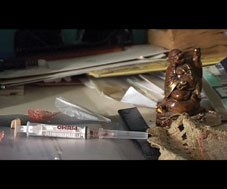
Johann Wolfgang is a poet and an alcoholic. For years Dieter and Andi, both heroin addicts, have been sheltered in his flat. For Andi, the 24 hours of the day are just enough to score his daily ration of heroin. Andi lives in Wolfgang?s bathroom. Dieter is continually postponing a one hundred day stretch in prison because of his fear of withdrawal symptoms. Dieter lives in Wolfgang?s kitchen. Despite the hopelessness of their addiction and the conflicts that regularly break out between them, they still manage to get close to each other and think about a better life.
Wolfgang Reinke was born in 1974 in Güstrow, GDR. 1984 - First encounter with a documentary film team from East German television, who gave up interviewing him after two hours. 1986 - The East German "People's Police" tried to recruit him after he turned in a family of "troublesome citizens" for stealing his bicycle. His first unexpressed scepticism about the victory of socialism was when he saw the inside of the Police car that brought them to the gang of thieves. 50 East German Marks blood money. 1987 - His first and last scientific thesis titled "Is there life on Saturn`s moon, Titan?" (Life hasn't been detected on Titan yet.) 1988 - A film team shoots parts of "Emergency Room Dr. Federau", an East German TV series, in his front yard. His impression: a film team consists of electricians. 1989 - Presentation of his first multimedia show about the "Nuclear threat resulting from the weapons race". After finishing High School in 1992 worked as an assistant for a photographer (studio, industry, landscape), an archaeological excavation assistant, a barman, a construction worker, an employment agent, a press spokesman for the Rostock University student parliament, a freelance news photographer, especially for German human rights associations, as a "medico international" in Kurdistan, Turkey, a freelance author for the satirical magazin ?eulenspiegel?, Berlin, a VTR engineer at the Bavaria TV studios in Munich, a gaffer, and a script/continuity assistant to an art director.

Steve Reinke
Rib Gets In the Way
Documentary | hdv | color | 52:15 | Canada | 2014
Rib Gets in the Way is narrated in the first person by Reinke and addresses mortality, the body, the archive, and the embodiment of a life’s work. The final and longest section of the video presents an animated children’s adaptation of Friedrich Nietzsche’s philosophical novel Thus Spoke Zarathustra (1883–85). The hand-drawn animations in this and earlier sections of the video are by Jessie Mott, a visual artist and writer whose work consistently engages a menagerie of human, animal, and celestial forms and with whom Reinke has collaborated on several previous videos.
Steve Reinke has long been lauded for his irreverent, philosophical, and often acerbic works, which typically adopt the form of personal essays to wryly bend and reread wide-ranging topics from pop culture to sex to theories of visual perception and beyond.

Steve Reinke
Welcome to David Wojnarowicz Week
Video | hdv | color | 14:1 | Canada, USA | 2016
Reinke proposes a new holiday with the motto MORE RAGE LESS DISGUST: David Wojnarowicz Week and takes us through his seven days of celebration of the life of artist, writer and AIDS activist, David Wojnarowicz. Plankton, Kafka, Bette Davis, Wednesday afternoon visits with friends, more plankton, burning villages, Hollis Frampton, Sammy Davis Jr. as a libidinal machine producing sadness, opera, disembowelment, poetry.
Steve Reinke is an artist and writer best known for his monologue-based video essays, which are widely screened and collected. Originally from Canada, he know lives in Chicago and teaches in the department of Art, Theory, Practice at Northwestern.
Remi
Auto_facing
Performance | 0 | | 25:0 | Austria | 2005
_________
______________