Catalogue > Search
Results for : Tout le catalogue

Benjamin Ramírez Pérez
A Fire in My Brain That Separates Us
Experimental film | hdv | color | 17:10 | Germany | 2015
In an initially deserted room objects slowly begin to move; they are manipulated from the off-screen space, being pulled and dragged by strings, cables or the carpet. Thus a ‘ghostly’ choreography emerges, with the objects taking on a life of their own, vanishing and reappearing. The control of these processes from the off-screen is made visible, by showing the strings attached to the objects as well as parts of the acting persons on the edge of the frame. This is accompanied by superimposed subtitles, which consist of a collage of existing film dialogue: Lines from the sub-genre of ‘gaslighting’ films are combined, taking the eponymous Gaslight (1944) as a starting point. A text assemblage on seduction and betrayal unfolds. At the same time the ambient lighting of the room gradually becomes increasingly colored, reaching an almost excessive saturation point as off- and on-screen space become reversed and a muffled pop music penetrates the room. A kind of karaoke video comes into being with the music – like many elements of the film – taking on the notion of a copy of something vaguely familiar.
Benjamin Ramírez Pérez, born in Hutthurm, Germany. Lives and works in Cologne. Studied at the Academy of Media Arts Cologne from 2009–2015. His works have been screened at Locarno, Edinburgh and Toronto International Film Festival, among others. In 2013, he was awarded the Prize of the German Federal Association of Film Journalists for Best Experimental Short. In 2015, he received the Chargesheimer Scholarship for Media Arts by the City of Cologne.

Benjamin Ramírez Pérez
Body Snatcher
Experimental film | 16mm | color | 17:18 | Germany | 2016
Body Snatcher conflates new 16mm material and found footage from Barbara Loden‘s film Wanda (1970) into an abstract narrative. Loden‘s film shows a character that seemingly passively navigates the world, but at the same time fights for her own identity and challenges social norms through her refusal to function as expected: „Life is a mistery to her. She doesn’t know what she wants but she knows what she doesn’t want.“ Taking fragments of the film as a starting point, objects, props and surfaces from the film were recreated, visually isolated and filmed anew. In a kind of vacuum, an abstract and associative narration touching on emptiness, failure, and identity construction slowly unfolds. A sort of parasitic science fiction remake of Wanda emerges - a layer of meaning that lies behind the film‘s plot and surface is imagined and constructed, positioning disparate elements in relation to each other and forging connections between them.
Benjamin Ramírez Pérez lives and works in Amsterdam. He studied at the Academy of Media Arts Cologne from 2009 - 2015. He was awarded the German Film Critics’ Prize for Best Experimental Short in 2013. In 2015, he received the Chargesheimer Scholarship for Media Arts of the City of Cologne. Currently, he is a participant at De Ateliers in Amsterdam (2016 – 2018).

Benjamin Ramírez Pérez
Embellishments
Experimental film | 16mm | color | 7:50 | Germany, Netherlands | 2016
Reenactments of cinematic strategies, images and fantasies tied to sex work and stage performance are layered on top of each other, focusing on embellished surfaces of bodies, objects and architectures. They intertwine and form a new entity in a female drag performance referencing 1970s cinema, sex work activism and pop choreography, which was developed in collaboration with the performance artist Liad Hussein Kantorowicz.
Benjamin Ramírez Pérez is currently a participant of de Ateliers Amsterdam (2016-2018). He studied at the Academy of Media Arts Cologne from 2009-2015. His works have been screened at Locarno, Edinburgh, Rotterdam and Toronto International Film Festival, among others. He had recent Group and Solo shows at Artothek Cologne, Kunsthalle Recklinghausen, Kunstmuseum Bonn and Museum of Contemporary Art Belgrade.

Benjamin Ramírez Pérez
Summer Heat an Early Frost
Experimental doc. | 16mm | color | 13:45 | Canada, Germany | 2021
Created based on research conducted during a 2018 residency at LIFT (Liaison of Independent Filmmakers of Toronto), SUMMER HEAT AN EARLY FROST combines the narrative structures of film, documentation, photography, cinematographic staging, and interview into a collage on the organizational principles of our perception. Similar to a stream of consciousness formed of constantly expanding recordings that proceed as the common denominator between a partially sensory, partially mechanically narrative voice and a screen text that fluctuates in intervals between narration, commentary, and subtitle, the image flow comprises a number of visual resources: arranged rhythmically behind an archival setup of vintage pornographic magazines from the University of Toronto’s Sexual Representation Collection, the marked text passages on film theory are taken from a collection of essays by Russian formalists. A multi-layered and narrative complement is present in the form of excerpts from “An Early Frost” (1985)—the first mainstream TV feature film to address the emerging public, social, and political crisis surrounding the spread of HIV/AIDS as part of the everyday life of a US family. Quietly and with an almost static austerity, set pieces from early silent films of the 1920s such as those from Jean Epstein and Dziga Vertov are superimposed across from sexually fetishized sequences of self-produced montages from tooth and mouth recordings, only to be expanded upon in the form of a new cut expounding on the pornographic industry’s digital infrastructure. Massed like a cluster of findings from a multimedia, multi-thematic search for the internal logics of filmic and documentary mechanisms of production and affect—whose focus potentially also stretches to include the representation and repression of queer desire, longing, and craving—the montage opens up a different access to images and their language; a language whose essence is concealed in the multiplicity of the information gathered and which, transferred via data-mining technology into the artistic process of the film, facilitates the recognition of patterns of regularity and of hidden interrelations.
Benjamin Ramirez Perez, is visual artist working primarily with film, video and installation based in Cologne, Germany. He was a participant at De Ateliers Amsterdam from 2016-2018 and studied at the Academy of Media Arts Cologne from 2009–2015 with Julia Scher, Phil Collins and Matthias Mueller. His works have been screened at IFFR Rotterdam, Locarno, Edinburgh and Toronto International Film Festival, as well as Julia Stoschek Collection Du?sseldorf, Kurzfilmtage Oberhausen and Visions du Réel Nyon among others. He had group and solo exhibitions at Artothek Cologne, Kunstmuseum Bonn, Museum of Contemporary Art Belgrade, de Ateliers Amsterdam, Gallery Markus Luettgen Duesseldorf, and more. In 2015 he was awarded the Chargesheimer Scholarship for Media Art by the City of Cologne and in 2013 he received the Prize of the German Association for Film Journalists.

Benjamin Ramírez Pérez
Despair
Experimental film | 16mm | color | 21:50 | Germany | 2019
DESPAIR works with cinematic reenactments, which are connected in an associative collage-like layering into an experimental film, taking Rainer Werner Fassbinder’s film of the same title from 1977 as its starting point. Drawing on and digressing from various complementary sources such as Fassbinder’s contribution to "Germany in Autumn", David Cronenberg’s "Dead Ringers", the 1970s "Mission Impossible" TV-series as well as cel-animation, the theme of the cinematic double is explored and questions of identity, identification and alienation are raised alongside an inquiry into the political and cultural legacies of the German Autumn.
Benjamin Ramírez Pérez (*1988, Germany) lives and works in Cologne. He studied at the Academy of Media Arts Cologne from 2009–2015. He undertook the residency programme at de Ateliers from 2016 - 2018. His works have been screened at Locarno, Edinburgh, Toronto and Rotterdam International Film Festival, among others. He had recent Group and Solo shows at Artothek Cologne, Kunsthalle Recklinghausen, Kunstmuseum Bonn, Museum of Contemporary Art Belgrade and Alternative Space LOOP, Seoul.

Ivan Ramljak
Dom boraca
Documentary | mov | color | 50:0 | Croatia | 2018
In 1974 communist authorities built the so-called ‘Memorial Home for WWII Resistance Fighters and Youth of Yugoslavia’ in Kumrovec, a tiny rural hometown of the legendary president Marshal Tito. In 1991, when Yugoslavia collapsed 11 years after Tito’s death and the Croatian War of Independence started, the Memorial Home was closed, and it remained closed until today. Several attempts to repurpose the building have failed. Still, some fighters remain...
Ivan Ramljak (born 1974) is a film critic, director and independent curator. He currently curates a short film program called Kratki utorak (‘Short Tuesday’) at cinema Tuškanac in Zagreb. So far, he has directed nine short films, four fiction ones in collaboration with Marko Škobalj, four documentaries and an experimental film. His most successful film so far was ‘Kino otok’ (Islands of Forgotten Cinemas) which was screened on more than 25 international festivals, and won 6 awards, including the FIPRESCI prize for Best Eastern European documentary at goEast FF in Wiesbaden. In 2016 he enrolled the master study of documentary directing at the Academy of Dramatic Art in Zagreb. ‘Home of the Resistance’ is his first medium length film.

Steffen Ramlow
Une vie foraine ? ein offenes Leben
Experimental doc. | dv | color | 78:0 | Germany | 2005
This film introduces Christian Lagny, former owner of a dodge car and the filmmaker´s uncle. Until a few years ago Christian Lagny used to travel from village to village and work on the funfairs in southern France. Now he lives in ?Canet?, a small village not far from Montpellier in an old Camper just with his mother. The second protagonist of the film is his brother in law Luc Archer, who is still working as a fairground worker. The starting point is interviews in which the two men tell about the funfair business, the changes and the peculiarities of a life on the road. The interviews tell more and more about personal details and the story of Christian Lagny?s life. With great frankness he reveals his opinions, wishes and mistakes. Why did he stop working? Why is he living alone? How does he judge the family changes? How can he get his life cleared out? A life between tradition and work, full of inconsistencies, anecdotes and great cordiality unfolds step by step. Going further, the filmmaker dwells on personal memories: The summers spent on the funfairs and his relation to his uncle. Starting from his first impressions about funfairs today and goes through a visual time-travel that takes him closer to his uncle.
Steffen Ramlow was born in 1974 in Berlin. After his highschool diploma, he worked as a lighting technician and props man for several theaters in Berlin, Hamburg and Wolgograd (Russia). He started artistic training at the Arts University of Berlin, where he studied video and photography with Maria Vedder, cinema with, amongst others, Harun Farocki, Klaus Wyborny et Heinz Emigholz. In 2004 he passed his diploma in experimental media creation. He co-published "Der Taktstock" (Zsolnay editions) in 2001, and took part in numerous exhibitions and cinematographic programs. He worked as a lighting technician and filmmaker in Berlin.

Lynn Rammal, -
Documentary | hdv | color | 19:19 | Lebanon | 2019
Je pars à la découverte de mon père, distant depuis des années, cherchant à rétablir notre relation boiteuse et longuement négligée.
Ayant étudiée le cinema à l'Université Saint Joseph de Beyrouth, Liban, je me présente comme étant une réalisatrice en herbe, qui cherche à communiquer sa propre perspective de la vie, à travers le documentaire.

Diego Ramos
Rua Guaipá
Video | hdv | color | 5:2 | Brazil | 2019
Today, those who pass the old Estrada do Corredor (Corridor Road), on the way to the station or coming back from work, see bars, automobile repair shops and commercial shops. On the sidewalk there are people working, waiting for the bus, looking at the street or the screen of the smartphone. To see everyday life, that one full of gestures, we should suspend time, almost to stillness. This is how the minimal expressiveness is revealed and the street is no longer a place of passage and becomes something similar to a tissue, which incorporates everything and everyone, day and night.
Diego Ramos is a historian (Unifesp-2018) and a visual artist. His research on the audiovisual area focuses on experimental cinema and video art. Among his various works, the highlights were the short films at ASIFF - African Smartphone International Film Festival (2018); DOBRA - International Experimental Film Festival (2018); V Fotoativa Projection Exhibition (2019).
Gf Ramsay
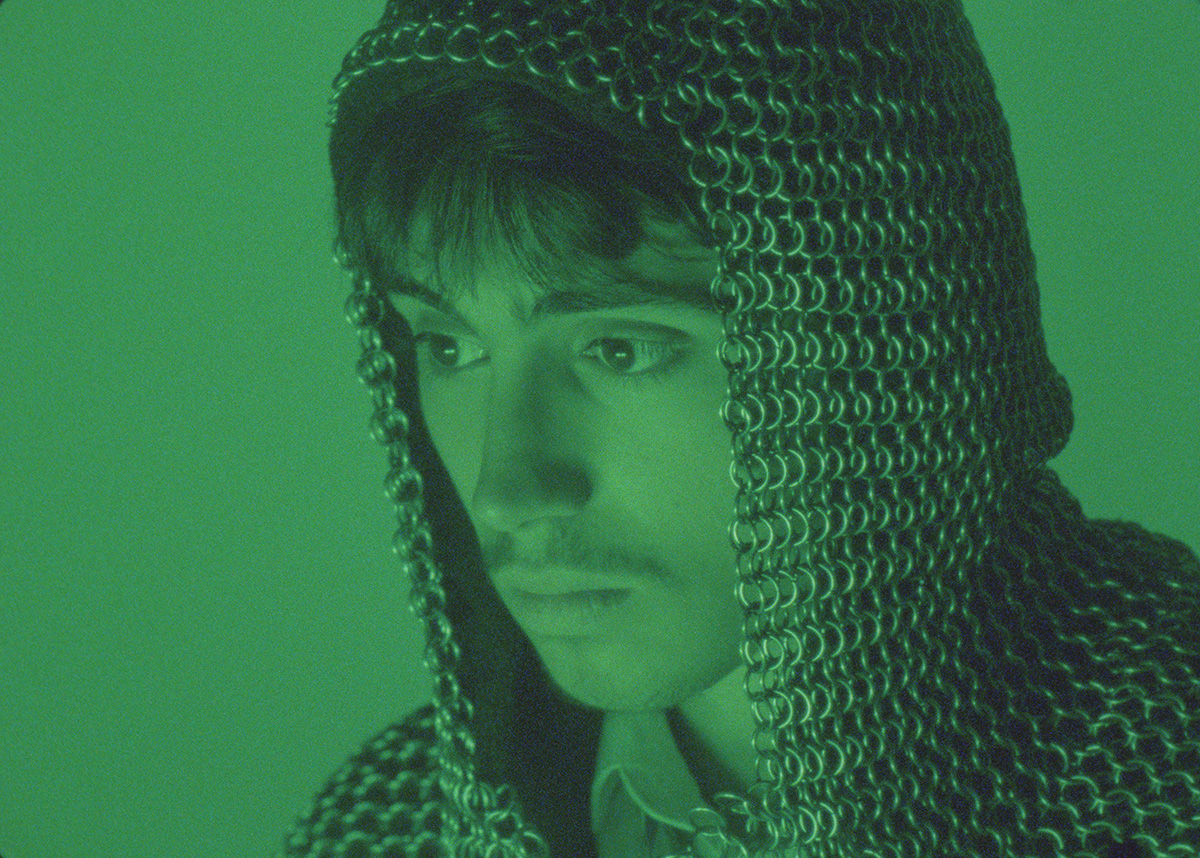
Family Fugue
Experimental doc. | 16mm | color and b&w | 35:12 | United Kingdom | 2022
A film about how we are haunted by, and in turn haunt our ancestors, and a family who cannot agree on how to tell their own story. Family Fugue is a chase in three movements in pursuit of a white snake, a red duchess and a golden boy, spanning eight centuries and starting in a cave. Beginning with the family's origin story of Neish de Ramsay, a 13th century wizard who was said to have cured king Alexander II of Scotland using a potion from a white snake; it continues with Katherine Stewart Murray, Duchess of Atholl, a trailblazing female MP in the early 20th century who fell out of politics because she vocally opposed fascism; and concludes with David Ramsay, a polymath prankster whose life was terminated abruptly during action in World War II, suggesting his death was not final. Playing with these histories as a score to be interpreted, using documentary, reenactment and lush theatrical tableau, the film allows disagreement, criticism and self doubt to flow in and out. ‘Life is not the wick, nor the candle, it is the burning’ Katherine Stewart Murray
GF Ramsay (b. 1988, Dundee, Scotland) is an artist working with poetry, ritual and analogue filmmaking. In 2017 & 2018 he burned hundreds of people’s regrets inside volcanoes across Eurasia. His fake epic poem Raven’s Reprise (2020) tells of a trickster raven travelling through the pandemic and remaking the world to her better designs. His short film CASTOROCENE (2021) sees beavers re-build the world after humans have destroyed it. Mid length film Family Fugue (2022) is about how we are haunted by, and in turn haunt our ancestors. Forthcoming films Nursted from the sleep side (2023) and Flesh, Wax & Glass (2023) deal with the idea of a place falling asleep, and the impossibility of filming sacred rituals respectively. He is currently making plans to have his body thrown into a volcano after he dies. In 2023 Ramsay was shortlisted for the Margaret Tait Award. He has collaborated with artists and scientists such as CAConrad, Clive Oppenheimer, Alexander Hetherington, Coby Sey and Mica Levi.

Marco Raparelli
Abandoned Dog
Animation | dv | color | 4:31 | Italy | 2008
Title Abandoned Dog - 2008 Animation 4 minutes 20 seconds Narration is the principal characteristic of Marco Raparelli`s animations. Nevertheless, it is not a point of departure, but rather the consequence of a deviation of themes that are evoked by sensations transmitted from other images or drawings. The animations are free and extemporaneous deviations of images, which connect to each other to create infinite microcosms. Raparelli?s most recent animation tells the story of an abandoned dog who, while walking towards the sea, encounters different adventures, friends and nemeses and faces manifold abstract situations. The video functions as a sort of metaphor for life in which the dog plays the protagonist. He is an outcast who must cope with how to survive each impending new day. The video?s soundtrack consists of a piano score by Cosme McMoon. In the 1940s McMoon often accompanied the American soprano singer Florence Foster Jenkins, a rich heiress who, while having mediocre melodious qualities, was able to perform thanks to being very wealthy. Both McMoon and Foster Jenkins were anthropological phenomena and their absurdist songs serve as an appropriate soundtrack to the video?s images.
Biography Marco Raparelli was born in Rome on 12 July 1975. He graduated at the Accademia di Belle Arti di Roma and studied animation at the College of Art of Loughborough, London. He collaborated to the satiric weekly magazine ?Cuore?, and afterwards worked for a period of time as author of comics. In his artist practice he employs drawing painting and stop-motion animation. He has exibited widely. Group show include ?Emporio? Via Farini(2001) Milan, ?Lavori in corso? curated by Roberto Pinto (2002) Milan, ?3500 cm? Rialto S.Ambrogio, Rome curated by Lorenzo Benedetti, Grand1th:Cult media ?Bastart contemporary, Bratislava (2006) , "Clearly Invisible", Consulta - Centre d`Art Santa Monica, Barcelona, (2007) curated by Filipa Ramos, ?Animotion? Gallery F15, Moss Norway curated by Bjorn Hegardt(2007), New Entry Careof Milan curated by Chiara Agnello, Opla video animation from Italy Galerie Vanessa Quang Paris, curated by Raffaele Gavarro , Screening Haunch of Venison London, A,B,C,D,M,N,Z. Fondazione Bevilacqua La Masa Venice curated by Chiara Agnello, One of these things is not like the other thing, Gallery unosunove Rome curated by Raimundas Malasauskas, Sarah?s Journey Section of the 7th Bulgarian Biennal of Contemporary Art in Varna, Bulgaria , curated by Lorenzo Bruni. Solo show include "Pina ti amo Catania", Gallery Ugo Ferranti, Roma (2005), ?As a drop of water on a K-way?, Careof, Milan (2007) ?As. A drop of water on a K-way? Uqbar Berlin Curated by Marina Sorbello.. His book As a drop of water on a k-way is editing by fine arts unternehmen books. His next solo show will take a place in january 2009, in Umberto di Marino Gallery, Naples.

Marco Raparelli
Ristorante Italia
Animation | dv | color | 4:36 | Italy | 2007
Narration is the principle characteristic in the video animations of Raparelli. However, rather than a point of departure, it is the consequence of a deviation of themes that are represented by very precise images and drawings which transmit or evoke sensations. The narrative is a free and extemporaneous deviation on an image that connects to others to create infinite micro-worlds. Ristorante Italia ? 2007 animation 4 minutes 36 seconds A sometimes unexpected, sometimes forboding, chain of events take place inside a dive restaurant. The viewer is eyewitness to the occurance of the restaurant?s normal working and other activities that occur without beginning or end. Only the eventual arrival of evening suggests possibile relief or a truce.
Marco Raparelli was born in Rome on 12 July 1975. He graduated at the Accademia di Belle Arti di Roma and studied animation at the College of Art of Loughborough, London. He collaborated to the satiric weekly magazine ?Cuore?, and afterwards worked for a period of time as author of comics. In his artist practice he employs drawing painting and stop-motion animation. He has exibited widely. Group show include ?Emporio? Via Farini(2001) Milan, ?Lavori in corso? curated by Roberto Pinto (2002) Milan, ?3500 cm? Rialto S.Ambrogio, Rome curated by Lorenzo Benedetti, Grand1th:Cult media ?Bastart contemporary, Bratislava (2006) , "Clearly Invisible", Consulta - Centre d`Art Santa Monica, Barcelona, (2007)curated by Filipa Ramos, ?Animotion? Gallery F15, Moss Norway curated by Bjorn Hegardt(2007), New Entry CareOf Milan curated by Chiara Agnello. Solo show include : ?Pina ti amo Catania? gallery Ugo Ferranti Rome, ?Restroom and other stories? gallery Sergio Tossi Firenze Curated by Raffaele Gavarro, ?As a drop of water on a K-way? Careof Milan, project with Norberto Dalmata and Scintilla Robina.
Simone Rapisarda Casanova, Simone Rapisarda Casanova
EL ÁRBOL DE LAS FRESAS
Experimental doc. | hdv | color | 71:0 | Canada | 2011
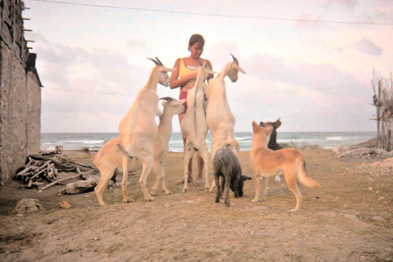
Filmed in the remote hamlet of Juan Antonio, Cuba, just before it was wiped out by a hurricane, El árbol de las fresas (The Strawberry Tree) tests the boundaries between anthropology, documentary and reverie while capturing the final sigh of one of Cuba`s last fishing villages. The villagers? ingeniousness and resilience, as well as their playful and irreverent relationship with the filmmaker, render a sensitive portrait of a unique culture into a reflection on documentary filmmaking and on humanity on the edge of time.
Simone Rapisarda Casanova is a former computer scientist. He grew up in rural Sicily and currently lives in Montreal, Canada. He holds a Master of Fine Arts in film production from York University in Toronto. El árbol de las fresas is his first feature film.

Paulo Raposo
Verbatim
Experimental video | dv | color | 2:0 | Portugal | 2005
`verbatim` A adjective 1 direct, verbatim in precisely the same words used by a writer or speaker; "a direct quotation"; "repeated their dialog verbatim" B adverb 1 verbatim, word_for_word using exactly the same words; "he repeated her remarks verbatim" `verbatim` is based in a Maurice Blanchot short text, "la folie du Jour".
Paulo Raposo is a sound and media artist based in Lisbon, Portugal. Born in 1967, after studies of philosophy and cinema in Lisbon, he has been working in the medium of live electronic and computer sound, performing, recording and exhibiting works in France, Germany, UK, Spain, Italy, Netherlands, Portugal, Baltic States and United States. His work explores the inter-relationships and displacements between digital process and architectural spaces, using computer and custom-built software to create abstract and delicate soundscapes. Since the late nineties, he started also exploring intersections between sound and image taking advantage of the digital medium real-time possibilities, both in solo performances and collaborative work. He has "composed" moving images to several media: instalations, dance, performance, theatre and intermedia projects. Raposo performed and colaborated with numerous artists, including Janek Schaefer, Jason Kahn, Kaffe Mathews, Marc Behrens, Jgrzinich, Zbigniew Karkowski, Matt Rogalski, Carlos Santos, Carlos Zíngaro, Christopher Murphy, Koji Asano, Sara Kolster, among others.
Peter Bo Rappmund
TECTONICS
Experimental doc. | hdv | color | 60:0 | USA, Mexico | 2012
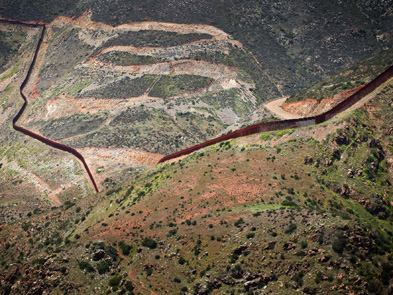
A refreshing antidote to the burgeoning genre of films that focus on illegal immigration and cross-border violence, Peter Bo Rappmund?s experimental portrait of the U.S.-Mexico boundary surveys this wide swath of land?s physical qualities and metaphysical quandaries with an artist?s gaze. The structure of Tectonics is dictated by the border itself, as Rappmund incrementally moves from the Gulf of Mexico bordering Texas, to the Pacific Ocean and California, capturing wide vistas of the American West, the Rio Grande, the monuments and memorials to (personal) histories, and, naturally, the fences and walls that have been escalating since the Bush Presidency. (The actual border appears in 95% of the shots.) Rappmund?s unique process involves shooting photos with a DSLR camera, usually one frame per second, then animating the images in post-production. This method yields jaw-dropping, high-resolution time-lapse photography, described by Thom Andersen as ?electronic Rothko.? (Rappmund shot Andersen?s Reconversão, showing later in the festival). At times, Tectonics resembles surveillance photography, and what?s present is just as important as what?s absent: the world?s most traversed border is also surely the most observed, with visible and hidden cameras, armed patrols, aerial surveillance, motion sensors, etc. Over his voiceover-less images, Rappmund lays a soundtrack that fills in the missing human presence, and deconstructs the sociopsychological image of the border in American society: though everyone has a view of the border, its reality remains unseen. [Mark Peranson, 04 | 08 | 2012]
Peter Bo Rappmund was born in Casper, Wyoming, and grew up in Golden, Colorado. He attended the University of Colorado at Boulder, Mills College, and holds graduate degrees in both music composition and film/video from CalArts. His work has screened at a variety of museums, galleries and festivals including: the Museum of Modern Art, New York; Anthology Film Archives; Ann Arbor Film Festival; New York Film Festival; Viennale; Locarno; REDCAT, White Box Gallery; Whitney Museum of American Art and the Vancouver, Bangkok, and Hong Kong International Film Festivals. This past summer, PBR held his first retrospective at the Laguna Art Museum, and completed work as principal photographer on Thom Andersen`s latest film about Pritzker Prize winning architect, Souto de Moura.

Peter Bo Rappmund
TOPOPHILIA
Experimental doc. | hdv | color | 60:0 | USA | 2015
“In this exquisite study of the Trans-Alaska Pipeline—one of the world’s longest conduits for crude oil—Rappmund continues his experimentation with landscape and time-lapse photography. As the film follows the 800-mile pipeline from end to end, astonishing images and rhythms arise, capturing the complex intersections at which industrial and natural sublimes meet, and suggesting a new politics of the petro-image.” - MoMA Documentary Fortnight
Peter Bo Rappmund is a Texas-based artist whose practice relies on understanding both empirical and metaphysical properties of built and natural environments. He has exhibited his work at a variety of venues, including MoMA, New York; Anthology Film Archives; National Maritime Museum, London; REDCAT; the California Academy of Sciences; George Eastman Museum; the Whitney Museum of American Art; and the Locarno, New York, Vienna, CPH:DOX, Ann Arbor, and Hong Kong International Film Festivals. Rappmund held a solo exhibition at the Laguna Art Museum in 2012, and he is currently collaborating on Communion Los Angeles, a project about the 110 freeway in Southern California, with Adam R. Levine. PBR received his MFA from the school of music and school of film/video at CalArts.

Oday Rasheed
Underexposure
Fiction | 35mm | color | 67:0 | Iraq | 2004
"Underexposure, a title that refers not only to the outdated film stock that was used to make the film, but also to the generation of Iraqis that have been isolated from the world for decades, takes an unprecedented, uncensored look into the lives, hearts, and minds of those living in Iraq during the tumultuous days after the fall of Saddam. Director Oday Rasheed has created a vivid world set against a real backdrop of war and upheaval. Friends, lovers, strangers and family members are woven together by the complexities of their new reality. The past is only a moment behind them, with the presence of death a constant companion into the future. Maysoun, the object of her brother and lover`s affections, finds solace in her sexuality. Hassan finds comfort in the belief that his films will outlive the cancer taking over his body. Homeless and alone with only his sacks of brightly colored rags, Nassir experiences his first taste of companionship and responsibility with the discovery of a dying Iraqi soldier. The first feature length film shot on location in Baghdad after the war, Underexposure blends reality and fiction to create a lyrical and textured work that captures the dizzying atmosphere of life during war and fiercely illuminates a part of the world long left in the dark."

Elise Rasmussen
The Year Without a Summer
Experimental film | 16mm | color | 20:5 | Canada, Indonesia | 2020
The Year Without a Summer takes its title from a phenomenon that occurred in the summer of 1816 wherein many parts of the world experienced extreme weather conditions. Dramatic storms and colorful skies gave inspiration to Romantic art, as witnessed in works by J.M.W. Turner and Casper Friedrich; while poor harvests, economic decline and civil unrest influenced Mary Shelley’s writing of “Frankenstein” during her summer sojourn to Lake Geneva. A century and a half later it was discovered that the eruption of Mount Tambora on the island of Sumbawa in Indonesia was the cause of this erratic shift in the world’s weather patterns, causing a famine in Switzerland and speculation that the world was ending. Using this historical framework as a provocation, The Year Without a Summer re-examines the effects of this environmental anomaly, finding parallels with our current climate crises, while intertwining diaristic accounts of Mary Shelley and her circle, Sumbawan folklore, and my own reflections traveling to the same volcano and lake during the hottest summer on record.
Elise Rasmussen is a research-based artist working with lens-based media. She has exhibited, performed and screened her work internationally including venues such as the Brooklyn Museum, the Bronx Museum, Pioneer Works (New York), Night Gallery, JOAN (Los Angeles), Belvedere 21 (Vienna), Sharjah Art Foundation (UAE), Institute of Modern Art (Brisbane), Dazibao (Montreal), Art Gallery of Alberta (Edmonton), and the Doris McCarthy Gallery at the University of Toronto. Elise received her MFA from the School of the Art Institute of Chicago on a Merit Scholarship and has been an artist in residence at a number of institutions including the Irish Museum of Modern Art (Dublin), the Nirox Foundation (South Africa), La Becque (Switzerland), LMCC (New York), Shandaken Projects (Storm King), SOMA (Mexico City), the Banff Centre (Alberta) and was a 2016 Fellow in the Art & Law Program (New York). Elise has been written about in publications such as Art in America, BOMB Magazine, Hyperallergic, Canadian Art and the New Inquiry, and has received grants and awards from the Jerome Foundation, the Canada Council for the Arts, NYFA/NYSCA, Contact Photography Festival, and the American Austrian Foundation. Born in Edmonton, Canada, Elise is currently based in Los Angeles, USA.

Elise Rasmussen
A Poetic Truth in a Pathetic Fallacy
Experimental doc. | hdv | color | 16:0 | Canada, South Africa | 2017
A Poetic Truth in a Pathetic Fallacy considers ways in which human-kind has been fascinated by and has misinterpreted the rhinoceros, exploring the urgency to keep this genus from extinction while considering the lingering effects of colonialism and collection. Over the past decade the trafficking of rhino horns has gained popularity and both poaching and theft of vintage horns has risen dramatically. Horns were traditionally used in Eastern medicine and although scientists have concluded they have no health benefit, this has not dissuaded the market and its value has risen due to its newfound status as a luxury good. This is not the first time that the rhino has been misconstrued. In 1515 Albrecht Dürer created his famous woodcut based off of a written description of the rhinoceros. Although grossly inaccurate, his artwork served as the prototype for future depictions of rhinos up until the mid-19th century. In South Africa today, the lingering effects of colonialism and apartheid are at the root of poaching. In the male-dominated industry of wildlife protection, the Black Mambas [all female] Anti-Poaching Unit has been gaining international recognition for their efforts. Although beloved by the media, the Mambas risk their lives and struggle to support their families while protecting the wildlife that serves the interests of white landowners. This project is a multi-layered investigation into the link between globalization and extinction, using the poaching of the rhinoceros and its horn to speak about the relationship between bodies, labor, desire and the contested territory of representation.
Elise Rasmussen (born 1977, Edmonton, Canada; resides in Brooklyn, NY) is a research-based artist working in photography, video and performance. Her work has been exhibited, performed and screened at international venues including the Brooklyn Museum (NY), the Irish Museum of Modern Art (Dublin), CCS Bard Hessel Museum (Annandale-on-Hudson), Night Gallery (LA), Pioneer Works (NY), and Erin Stump Projects (Toronto). Elise received her MFA from the School of the Art Institute of Chicago on a Merit Scholarship (2007) and is a 2017-2018 artist in residence at LMCC’s Workspace program in Manhattan.
Rodd Rathjen
Tau Seru
Fiction | hdv | color | 8:1 | Australia | 2013
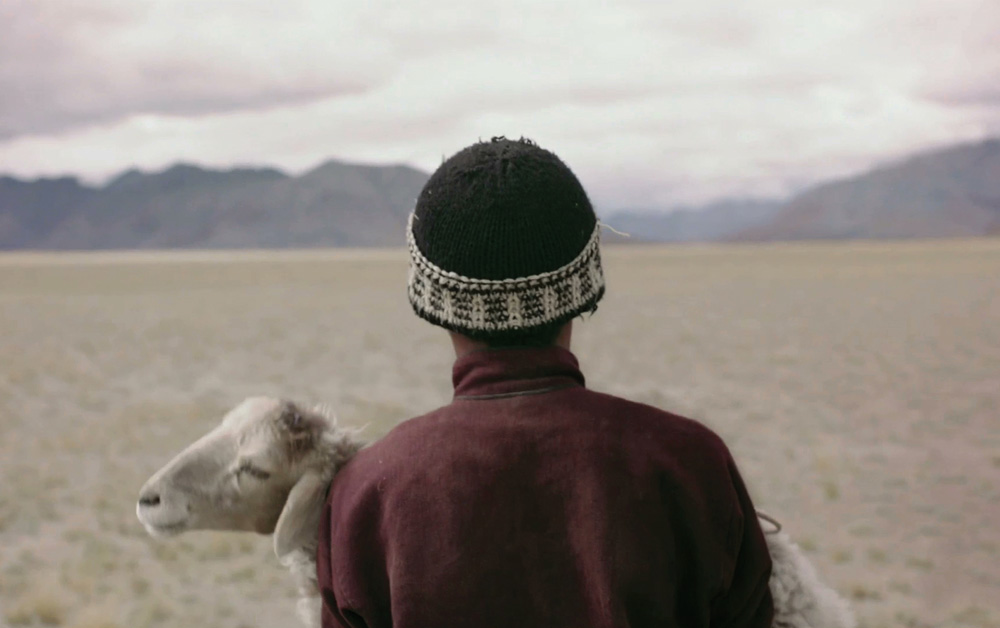
In the vastness of the Himalayas, a young nomad`s curiosity lies beyond the horizon.
Rodd Rathjen is an Australian born director raised in Colbinabbin, a small country town in central Victoria. Rodd completed a bachelor of Film and Television with Honours from the Victorian College of the Arts in 2010. His latest short film ‘Tau Seru’, had its World Premiere at Cannes as part of Critics Week 2013 and has screened at a number of festivals around the world. Rodd recently completed another short film with Screen Australia called ‘Sweat’ due for release in 2015. He is currently developing his first feature ‘Terra Australis’.

Birgit Rathsmann
White Out
Art vidéo | dv | color | 3:15 | Germany, USA | 2006
WHITE OUT: Single channel animation with digital stills, 02:32 min., 2005 A minimalist experiment in which digital stills of a nighttime encounter emulate a film noir in a Brooklyn park, slowly adding up to a digital blizzard until the frame is filled with white.
Birgit Rathsmann has received grants from NYSCA, the Illinois State Arts Council, Columbia College, the MacDowell Colony, the Skowhegan School of Painting and Sculpture and the Atlantic Art Center. Her video works have won awards at South by Southwest Film Fest, Palm Springs Film Fest, Telluride IndieFest, Raindance and have screened at numerous international film festivals and venues. Her video installations could be seen at the Bemis Center, Omaha and in Kamiyama, Japan. She teaches digital animation at New York University, NY and lives in Brooklyn, NY.