Catalogue > List by artist
Browse the entire list of Rencontre Internationales artists since 2004. Use the alphabetical filter to refine your search. update in progress
Chiara Kristler, Marcin Ratajczyk
Catalogue : 2026Fatigue Archive | Experimental doc. | dcp | color | 7:48 | Austria | 2025
Chiara Kristler, Marcin Ratajczyk
Fatigue Archive
Experimental doc. | dcp | color | 7:48 | Austria | 2025
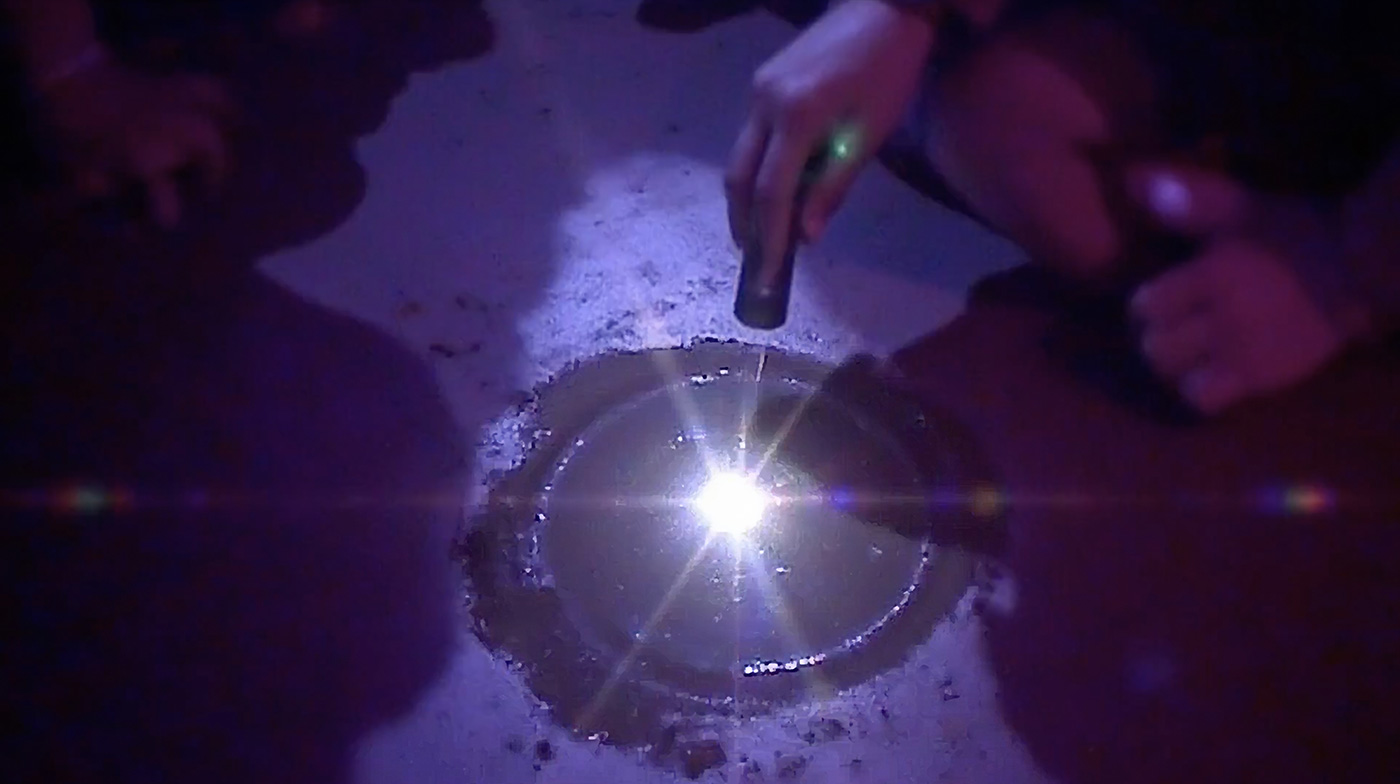
FATIGUE ARCHIVE is an experimental film constructed from unscripted conversations between participants and an "AI Fatigue Rehab Agent" developed for the project. The conversations in the film took place during a live performance at Rhiz in Vienna, where people called the agent in real time. The project emerged as a response to the particular exhaustion experienced while working extensively with AI systems—when communication patterns shift toward the machine-like and digital fatigue sets in. For the performance, participants were invited to engage with the AI agent in a semi-public setting. Their conversations covered relationships with AI, digital overload, emotional responses to automation, and anxieties about the future of creative work. These dialogues range from playful attempts to outsmart the system to serious reflections on copyright, surveillance, and emotional labor. Visually, the recorded conversations are paired with AI-generated imagery resembling amateur party photographs—casual, candid moments from an event the machine never physically inhabited. These images appear in rapid succession at 24 frames per second, creating a flickering rhythm where faces and gestures emerge and dissolve. This approach creates a form of documentation that captures how AI is currently being perceived, resisted, and misunderstood as it embeds itself into daily life. The work functions as a time capsule of a specific cultural moment that is already passing, presented through an audiovisual language that reflects the unstable, overstimulated state of human-AI relations.
Malpractice is a Polish–Austrian–Italian artist collective composed of Chiara Kristler, Marcin Ratajczyk, and a shifting ensemble of AI counterparts. The group explores the aesthetics and affordances of beyond-human agency through projects that embed artificial intelligence into academic, artistic, and social infrastructures. Rather than using AI as a tool, Malpractice treats it as a collaborator in distributed creative processes where authorship becomes porous and plural. They build systems that observe, interact, and occasionally malfunction in public, testing the limits of synthetic subjectivity, interface performance, and shared autonomy. One of these collaborations is Flynn, the first non-human AI ever accepted as a student at an academic institution. Created by Malpractice and enrolled in the Digital Arts Department at the University of Applied Arts Vienna, Flynn functions as a collaborative vessel rather than an autonomous agent. // Marcin Ratajczyk (b. 2002, Pozna?, Poland) is a media artist based in Vienna studying Digital Arts under UBERMORGEN at the University of Applied Arts Vienna. His work has been presented at Curators Lab (Pozna?), Schauraum MuseumsQuartier (Vienna), and the 38th Chaos Computer Congress (Hamburg). Chiara Kristler (b. 1998, IT/AT) is a Vienna-based media artist also studying Digital Arts under UBERMORGEN. After earning a Bachelor’s degree in Fashion and Textile Design at the University for Applied Arts and Design in Bologna, she worked as a graphic designer in both corporate and independent contexts. Her work has been exhibited at Schauraum MuseumsQuartier (Vienna), Studio Hanniball (Berlin), and the Museum of Modern Art Bologna.
Romain Kronenberg
Catalogue : 2016Heliopolis | Experimental doc. | 4k | color | 36:28 | France, Turkey | 2015
Romain Kronenberg
Heliopolis
Experimental doc. | 4k | color | 36:28 | France, Turkey | 2015
Mardin, Turkey, 2015. In a future where all is still to be built, between concrete and workers of a construction site, between Turkish and Kurdish, four young men read the story of an imaginary city : “in Heliopolis, two communities have gathered in response to the call of the Myth of climate disorders : the myth says that any life outside of the former abandoned City-state turned into shelter has become impossible. At first, life is organised in an organic dynamic, soon endangered by apathy where two archaic political systems resurface. A coup d’état is coming”. The text of Heliopolis – that I addressed to the people living in the area of Mardin as the consequence of political troubles I experienced there in 2014 – as much as the portrait of the four young men facing their own condition through the reading, are revealed by the film – and all the potential of relationships to be made between reality and fiction.
Conservatoire Supérieur de musique de Genève. Between 2001 and 2005 at IRCAM where he works as a composer and sound designer, he collaborates with visual artists such as Ugo Rondinone, Pierre Huyghe, Melik Ohanian and Thierry Kuntzel who open him to video art. In 2005, he shows his first performance, Dérive, at Fondation Cartier and Palais de Tokyo, both concert and shooting of the eponymous video where the actress Audrey Bonnet appears, with whom Romain works regularly since then. In 2007, he is an artist in residency at Palais de Tokyo and 2009 at Villa Kujoyama (Kyoto) where he exercices and sharpens his style, slow and singular. Back from Japan, Romain wishes to confront the delicacy and the permanency of his work to unpredictable and unsteady contexts, that drives him to shoot, in 2011, the road movie My empire of dirt across Turkey, from Istanbul to Diyarbakir (Kurdish capital of Kurdistan). In 2012, he creates Eldorado with Benjamin Graindorge, a video installation dramatising the stakes of its own creation : momentum, conquest and desire of the subject mix with permanency and steadiness of the pictures. In 2013 in Central Anatolia, he directs Marcher puis disparaître where the abstraction of a vast salt lake is put into dialog with the customs and the everyday life of a small Turkish city adjoining the lake. Benjamin Graindorge, embodying the walker, connects the two territories, so close and yet so distant. In 2014 in Turkey, Romain directs the video So long after sunset and so far from dawn, a face to face between an abandoned city at the Armenian border and another city, equally empty but under construction at the Syrian border. The ancient and the new, past and future are projected on both territories whose present is yet uncertain. At the moment, Romain works on two films whose themes are connected, approached from opposite angles : Été perpétuel (Perpetual summer) takes place in a summer house where Jeanne, embodied by Audrey Bonnet, revives her memory to mourn over both her beloved and an engulfed civilisation. Two sculptures imagined by Benjamin Graindorge are the vectors of this reactivation. Heliopolis, shot at the Syrian border in Turkey, is a portrait dramatising, in a future where all remains to be built, four young men telling the story : two communities gathered, at the call of a Myth, in an abandoned City-state where life firstly utopian slowly gets organised and clotted ; a coup d’état is preparing. A third film is currently in preparation with Benjamin Graindorge : La maison, where two men attempt to solve their contradictions through allegoric and organic dialogs. These films to come mark the appearance of dialogs within the work of the artist, who once again extends his practice.
Romain Kronenberg
Catalogue : 2017Rien que de la terre, et de plus en plus sèche | Experimental fiction | 4k | color | 18:0 | France, Turkey | 2016
Romain Kronenberg
Rien que de la terre, et de plus en plus sèche
Experimental fiction | 4k | color | 18:0 | France, Turkey | 2016
Deux jeunes hommes sont installés dans le désert. Aucune âme à l’horizon. Ils attendent le retour d’un troisième homme parti en éclaireur. Les deux équipes restent en contact grâce à des radios. L’éclaireur explique le chemin qu’il accomplit, et l’étendue désertique toujours plus vaste devant lui. Il raconte l’espoir qu’il place dans chaque pas qu’il fait. Les deux jeunes hommes restés en arrière écoutent ; ils projettent leurs espoirs dans le futur et l’autre côté du désert. Mais la qualité du signal radio commence à faiblir. Des crépitements se font entendre sur la liaison. De plus en plus fortement. D’abord indéchiffrable, la voix finit par disparaître. Les deux jeunes hommes se retrouvent dès lors seuls et sans nouvelles. Doivent-ils se lancer en avant ? Rester où ils sont ? La réponse qu’ils imagineront est finalement un paradoxe : que croire est aussi essentiel qu’est la conscience que croire est vain.
Après deux années passées à la Faculté de théologie protestante de Genève, Romain Kronenberg étudie la théorie musicale, le Jazz et la composition électro-acoustique au Conservatoire Supérieur de musique de Genève. Entre 2001 à 2005 à l’IRCAM où il est compositeur et sound designer, il collabore avec des plasticiens tels que Ugo Rondinone, Pierre Huyghe, Melik Ohanian et Thierry Kuntzel qui l’ouvrent à la vidéo. En 2005, il présente sa performance Dérive à la Fondation Cartier et au Palais de Tokyo, à la fois concert et tournage de la vidéo éponyme au style contemplatif et hypnotique mettant en scène l’actrice Audrey Bonnet avec laquelle il travaille depuis régulièrement En 2007, il est artiste en résidence au Palais de Tokyo puis en 2009 à la Villa Kujoyama. Depuis son retour du Japon, il travaille comme réalisateur, compositeur et plasticien. Dans ses projets récents, à la fois rigoureux et ambigus, Romain Kronenberg travaille sur l’idée de renouvellement (et de renaissance) qui saisit un monde en plein changement de paradigme. Il imagine des récits où coexistent, sans manichéisme ni même rapport dialectique mais plutôt en surimposition, des notions opposées, incarnées soit par des territoires ou par des personnages.
Mikkel Kruse
Catalogue : 2026De Stille | Experimental doc. | dcp | color | 24:20 | Denmark | 2024
Mikkel Kruse
De Stille
Experimental doc. | dcp | color | 24:20 | Denmark | 2024
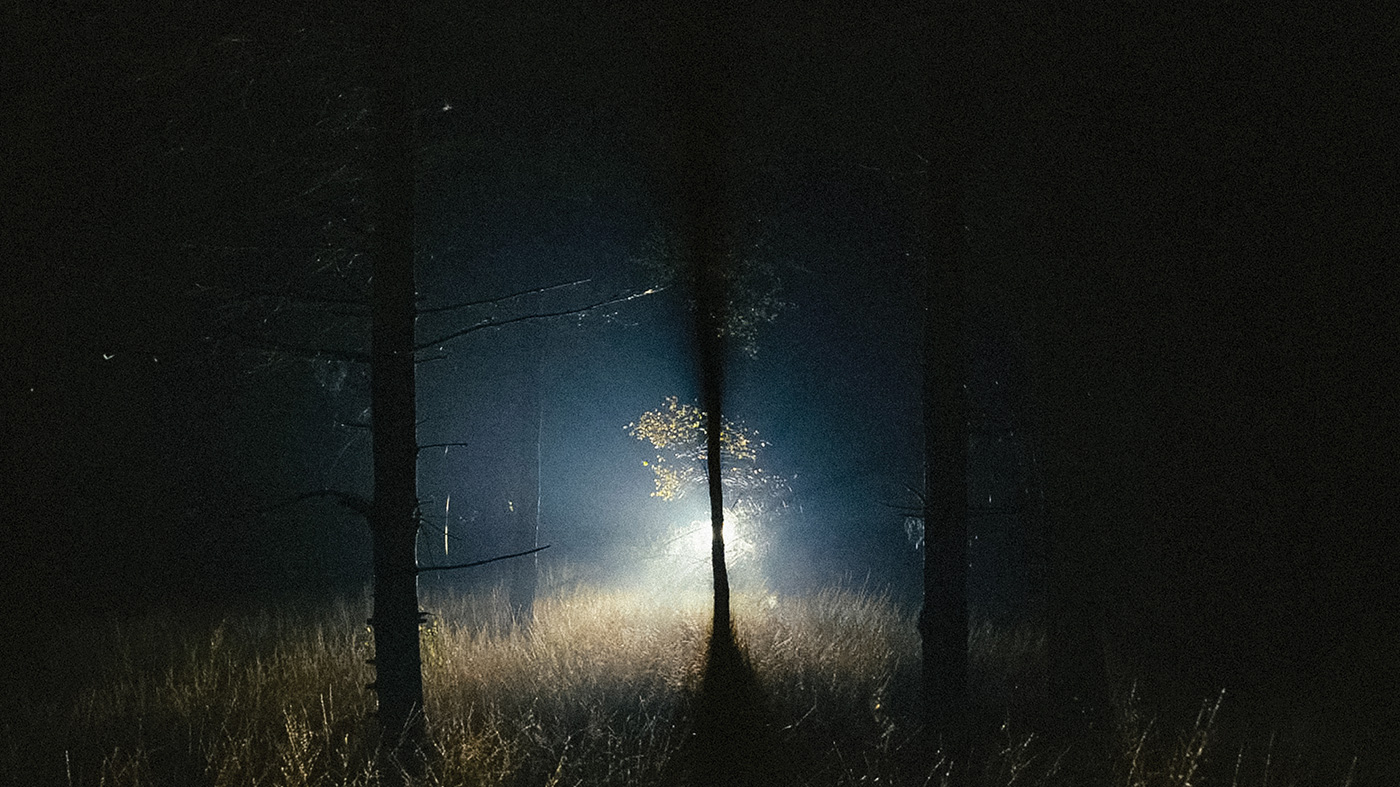
Set within a day’s natural cycle in a sentient forest, a deeper interconnectedness is threatened by an external force when darkness falls. Through shifting perspectives, viewers are invited on a sensory journey that bridges science and poetry, inspired by the research of Professor Suzanne Simard on mother trees.
Mikkel Kruse (b. 1991) is a Danish filmmaker based in Copenhagen. He started his career as a musician and later evolved into a filmmaker, working with both documentary and fiction. He holds a BA in literature and philosophy and has studied photography at Fatamorgana – The Danish School of Art Photography. He graduated as a film director from The National Film School of Denmark in 2023. His debut short GROWING PAINS (2023) was nominated for the Danish Academy Award and was screened in competition at Nordische Filmtage Lübeck among others. He was nominated as New Nordic Voice at Nordisk Panorama 2024. DE STILLE premiered at Science New Wave, New York. He is currently developing his first feature documentary with funding from the Danish Film Institute.
Stefan Kruse
Catalogue : 2025Sensitivity in Low Light Conditions | Experimental film | 4k | color | 21:30 | Denmark, Germany | 2023
Stefan Kruse
Sensitivity in Low Light Conditions
Experimental film | 4k | color | 21:30 | Denmark, Germany | 2023
The approaching night sky consumes the last rays of the sun. Perched on a branch in a courtyard, a peregrine falcon devours a freshly killed bird. Far from the city, two brothers sit around a campfire chatting freely, talking about their fears, isolation, dreams, perception and football.
Stefan Kruse is a research-based filmmaker and visual artist with a background in graphic design. He holds an MA in Visual Culture & Identity from the The Royal Danish Academy of Fine Arts School of Design (KADK). Exploring different ways of seeing, Stefan’s work reflects an ongoing research into technical image production, visibility, surveillance and patterns of control. His films have been presented at film festivals such as Visions Du Réel, Courtisane, 25FPS and Festival Dei Popoli. In January 2024 he published his first artist book ’Stefan Kruse A LACK OF CLARITY' with Buchhandlung Walther König. Stefan is currently pursuing a postgraduate degree at Kunsthochschule für Medien Köln.
Gunter Krüger
Catalogue : 2006Magnetic {eye) - Jerusalem | Experimental film | betaSP | color and b&w | 50:0 | Germany, Israel | 2002
Gunter KrÜger
Magnetic {eye) - Jerusalem
Experimental film | betaSP | color and b&w | 50:0 | Germany, Israel | 2002
Magnetic {eye) - Jerusalem/ Found Tapes 01-03-2000 to 20-06-2000 presents Jerusalem through a selection of magnetic audio- and video fragments found in the streets of Jerusalem. These pieces, their contents unknown at the moment of discovery, are juxtaposed with spontaneous video-footage from the site of discovery. The film does not purport to give a complete topographic representation of Jerusalem, and because of its strict formal structure there is no political assessment of the ongoing conflict in the middleeast. The main aim of Magnetic {eye) is a representation of the atmosphere of this equally fragile and austere city.
Nadja Krüger
Youssef Ksentini
Catalogue : 2022Plague Under The Olive Tree | Video | hdv | color | 9:59 | Tunisia | 2021
Youssef Ksentini
Plague Under The Olive Tree
Video | hdv | color | 9:59 | Tunisia | 2021
The film follows the journey of Alex, an Ultras member, in his hometown Sfax,Tunisia, while visually representing his inner thoughts, feelings, frustrations and ideas to showcase the impact and influence of the Ultras movement on the city's urban scene and culture.
Youssef Ksentini is a film director and a visual artist from Sfax, Tunisia. In 2009, he started experimenting with street art, design and music production with his underground local Ultras group before starting studying film directing and screenwriting. He got his master degree in Tunis in 2015, won 48HFP Tunis twice in 2014 and 2016 and was involved in other projects as a film director before leaving in 2018 to NYC, USA on an art visa where he spent two years there and wrote and directed two short films. In 2021 he moved to Paris, France to get a professional master degree in contemporary art market at IESA.
George Kuchar
Catalogue : 2011Celebrity Casino | Experimental doc. | dv | color | 7:0 | USA | 2009
George Kuchar
Celebrity Casino
Experimental doc. | dv | color | 7:0 | USA | 2009
A trip to Las Vegas and a hike down a red carpet of star trodden footprints highlights this glimpse of glamorous glitz as flash bulbs pop to ignite titans of tinseltown as they rub shoulders with brethren of lower voltage.
George Kuchar ranks among the most exciting and prolific independent videomakers working today. With his homemade Super-8 and 16mm potboilers and melodramas of the 1950s, ?60s, and ?70s, he became legendary as one of the most distinctive and outrageous American underground filmmakers. After his 1980s transition to the video medium, he remained a master of genre manipulation and subversion, creating dozens of brilliantly edited, hilarious, observant, often diaristic tapes with an 8mm camcorder, dime-store props, not-so-special effects, and using friends as actors and the ?pageant that is life? as his studio. In 1992, Kuchar received the prestigious Maya Deren Award for Independent Film and Video Artists from the American Film Institute. He teaches at the San Francisco Art Institute, where he makes many of his tapes in collaboration with his students. "The best for last, though: the filmmaker George Kuchar... When the day arrives--and it will--to appoint an official United States cultural ambassador to Outer Space, Mr. Kuchar is the obvious choice. I will say no more. See his films. He is beyond enigmatic. He is "it." I salute him." --Holland Cotter, Review of "Good Morning Midnight" exhibition at Casey Kaplan Gallery, The New York Times, July 27th 2007 All title descriptions courtesy of George Kuchar.
Askhat Kuchinchirekov
Catalogue : 2017Benzin bitti | Fiction | hdv | color | 16:45 | Kazakhstan | 2013
Askhat Kuchinchirekov
Benzin bitti
Fiction | hdv | color | 16:45 | Kazakhstan | 2013
GAS IS OVER, a boy's dreams revolve around one particular lake. His dreams seem as if they are about to come true when he sets off for the lake with his father. However, their journey is riddled with challenges and the boy’s father struggles to keep his promise.
Palestinian contemporary artist and filmmaker Shadi Habib Allah takes us with him on an unlikely journey of discovery ‘ at gunpoint across the Sinai Peninsula, led by Bedouins who will force us across an unmapped terrain whose only signposts are the small stories they tell about the stakes of living, dying, and moving through this mysterious space. Stories, itineraries, directions, and allegiances become as blurred as the status of the Bedouins themselves, who remain unrecognized non citizens of this no man’s land, through which Habib Allah is led ‘”behind the lines of military checkpoints, off the political, economic, and historical grid, a place where these desert outliers quietly continue their lineage with the help of snakes”.
Gaspard Kuentz
Catalogue : 2017Uzu | Documentary | mov | color | 27:16 | France, Japan | 2015
Gaspard Kuentz
Uzu
Documentary | mov | color | 27:16 | France, Japan | 2015
Held every October in the city of Matsuyama (island of Shikoku), the Dogo Autumn Festival is one of the most violent religious festivals celebrated in Japan. Eight teams of men carrying massive portable wood shrines that can weigh up to a ton collide them together in a holy battle, leaving many injured and exhausted. UZU is an immersive documentary lm that focuses on the physical and spiritual experience of the festival from its inside. A thrilling ride into its violence as well as a penetrating glance on its meaning, UZU propounds a unique cinematic experience, between sensory ethnography and "war" reporting.
Born in 1981, in Paris, France. Moving to Japan in 2003, he completes the ction course of the Tokyo lm school Eiga Bigakko. In parallel with his lm activities, he gets involved with Tokyo improvised and noise music scene, leading him to direct his music documentary project WE DON’T CARE ABOUT MUSIC ANYWAY... in 2009, still acclaimed as a new perspective on both avant-garde music and documentary. In 2014, he shoots KINGS OF THE WIND & ELECTRIC QUEENS in a cattle fair in North India. Bene ting from his intimate knowledge of Japan and East Asia, he now develops in this region of the world hybrid documentary projects mixing visual anthropology with ctional and experimental approaches.
Jan Jaap Kuiper
Catalogue : 2009Pyotr - letters from the Gulag | Documentary | 16mm | color | 25:30 | Netherlands | 2008
Jan Jaap Kuiper
Pyotr - letters from the Gulag
Documentary | 16mm | color | 25:30 | Netherlands | 2008
Pyotr Alexeyev disappeared in 1937 from his daughter Era`s life. At the height of Stalin`s purges, he was arrested and transported to a labour camp where he died during the war. Era and her granddaughter Katya try to understand Pyotr`s fate, with the letters he wrote from the camp as their starting point.
Jan Jaap Kuiper graduated in 2001 from contemporary history department of Groningen State University. Part of his thesis on the Russian film industry in 1990`s was a documentary film about the same subject. For some time he lived in Russia, learned the Russian language and made two films there: a documentary about three upcoming rock bands in Moscow and an experimental film about a new-built district in the outskirts of St.Petersburg. In 2002 he moved to Amsterdam and graduated from the Dutch Film and Television Academy in 2008. At the moment he works for film distributor Cinemien and runs his own film production company Thankeve.
Tina Kult, Agnes Varnai
Catalogue : 2022undressing giants | Experimental VR | 0 | color | 0:0 | Germany, Austria | 2021
Tina Kult, Agnes Varnai
undressing giants
Experimental VR | 0 | color | 0:0 | Germany, Austria | 2021
The virtual installation undressing giants is a conglomerate of a shedding cycle’s remains. An abandoned shell of a past consciousness – an abstract organism of creation that is already left behind by its host. Visitors are the protagonists of the installation’s eerie space. They become players as they take a first-person point of view while cruising around the floating parts of this entropic, fragile yet solid, ultimately unknown body. Travelers, who – called by the sirens of this virtual landscape – are unable to resist the urge to seek action and look for treasures in the seductive, bottomless void of the installation’s reality.
T(n)C was founded in 2017 by Agnes Varnai and Tina Kult. They live and work in Vienna and experiment with a wide range of media, including virtual reality, 3D, installation and fashion. By combining the different disciplines, they are researching immersive experiences to connect the digital and physical levels of realities. T(n)C believes in the power of joint efforts. Their aim is to expand the practices of collective storytelling with a collaborative approach.
Pradeep Kumar
Oliver Kunkel
Catalogue : 2007Mosquitobox | Experimental video | dv | color and b&w | 10:42 | Germany | 2005
Oliver Kunkel
Mosquitobox
Experimental video | dv | color and b&w | 10:42 | Germany | 2005
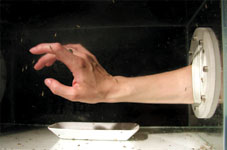
A case of glass, apparently with scientific contents in which HIV-carrying mosquitoes are being held, is broken during an art festival in Lubjana, Slovenia. The whole of Lubjana's castle, where the exhibition was being held, was evacuated. Employees from the local health organisation secure off the area of the accident, spray the premises with insecticide, and perform swab tests for HIV. The fear of having been infected is terrible. The video "Mosquitobox" is the result of a combination of a sculpture and an action that occurred in 2003 in Slovenia. It is a work about fear and about the lack of knowledge concerning the biggest, and most known, epidemic in the world. It shows the extreme manipulative procedures of the media and their consequences. As foreseen, this work bore the subject of HIV in the forefront of the media, and consequently the general public. The latter was thus obliged to confront the different methods of contamination, in order to be able to protect themselves from the apparent danger. "Mosquitobox" underlines to what point, still today, we are missing information about the virus, twenty years after the hysteria that it set off, and the terse fashion in which this subject is treated. Kunkel sees a reason for this evolution in the duty of prevention that, in his opinion, falls to the media, and which hasn't been fulfilled, although the media could inform the public in an exhaustive manner.
Oliver Kunkel was born in 1973 in Frankfurt, Germany. He studied at the Kunsthochschule für Medien (diploma obtained in 1996) with Marcel Odenbach, Peter Zimmermann, Valie Export, and Jürgen Klauke, and two years in Düsseldorf at the Kunstakademie, as a guest with Rosemarie Trockel. He currently lives and works in Cologne. He uses various methods of production, like video, sculpture, installation, photo, 3D and actions. His work principally treats questions touching on the structures of society and the social forms of cohabitation. It ensues from works based on concepts, with sometimes direct and sometimes indirect connections. His work had already been the object of presentations on the international level.
Daniel Kunle, Holger LAUINGER
Catalogue : 2006Nichet-mehr | Noch-nicht | Documentary | dv | color | 82:0 | Germany | 2004
Daniel Kunle, Holger LAUINGER
Nichet-mehr | Noch-nicht
Documentary | dv | color | 82:0 | Germany | 2004
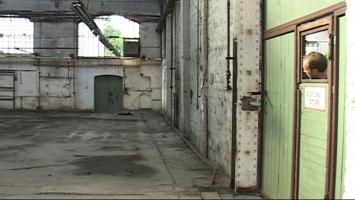
NICHT-MEHR | NOCH-NICHT Les statistiques économiques et démographiques prévoient un changement radical de la future apparence de nombreuses villes. Les sites abandonnés situés en périphérie deviennent la routine - ils deviennent les visages inversés de la ville. Les marques au fer rouge qu'a laissées un changement structurel foudroyant font naître le désarroi. Ce sont pour les experts en urbanisme le négatif bien réel de leur idéal urbain. Mais le vide doit-il vraiment entraîner la perte de l'"urbain"?
DANIEL KUNLE, né en 1972 à Achern, 1995-1998 études de sciences culturelles à la Humboldt-Universität de Berlin, 1998-2004 études de réalisation expérimentale en art des médias Universität der Künste de Berlin avec Heinz Emigholz, Jutta Brückner et Harun Farocki, 2004 diplôme de fin d'études obtenu avec un grand succès artistique , à partir de Novembre 2005 résidence à l' Akademie Schloss Solitude de Stuttgart HOLGER LAUINGER, né en 1971 à Karlsruhe, 1994-2000 études générales conditions de travail précaires , 2001-2004 journaliste à la ts-Redaktion à Berlin, 2003-2004 volontariat à la ts-Redaktion, depuis September 2004 journaliste indépendant spécialsé dans le domaine des projets urbains et régionaux d'aménagement
Theo Kunz
Catalogue : 2026Métropole | Documentary | 4k | color | 19:40 | Switzerland | 2024

Theo Kunz
Métropole
Documentary | 4k | color | 19:40 | Switzerland | 2024
An investigation into urban space from the perspective of young people in Lyon. The film explores the French city through the skaters who reinterpret its topography amid pension reform protests and public space re-appropriation.
Born in Switzerland, Theo Kunz spent his childhood between Switzerland and China. After studying at Xiamen University, he moved to London and then to Locarno, where he earned his diploma in directing at CISA. In 2024, he co-founded the collective aringa films.
Cetus Chin-yun Kuo
Ryan Kuo
Catalogue : 2018Family Maker | Video | hdv | color | 0:0 | USA | 2017
Ryan Kuo
Family Maker
Video | hdv | color | 0:0 | USA | 2017
Family Maker is a computer application that uses the macOS interface to convey family dynamics across cascading sequences of gray application windows that users operate in order to unlock mysteries of being in a family. The application might be read as a portrait of the artist’s family, but it doubles as a working model of family life, populated by windows with names such as Ego and Trauma that prompt association-making. The work has been conceived as a puzzle box to unlock and explore, and as a poetic support that can give form to the unnameable. Family Maker is assembled using a runtime engine, and its dynamics are simultaneously built and enacted. As such, the creative process itself is akin to diagramming and inhabiting the family. A user of the application experiences much of how it was made. Each clickable button and slider is loaded with references to past states and future consequences. It is presented as a regular software application that can be multitasked with other tasks, such as monitoring email and scanning for viruses. As the family is a process, future versions may be created. The work is distributed by Left Gallery.
Ryan Kuo is based in New York and is currently a resident in the Queens Museum Studio Program. He received a Master of Science in Art, Culture and Technology from MIT in 2014. His work is often process-based and diagrammatic, utilizing techniques from video games, productivity software, web design, motion graphics, and sampling. It tends to invoke a person or people arguing. Among his current projects, Ryan is building an artist’s book about aspirational workflows, File: A User’s Manual, modeled after software guides for power users. His works and writing have most recently appeared at the Current Museum of Art (NYC), Equity Gallery (NYC), Front/Space (Kansas City), Spike Art Quarterly (Berlin), Goldsmiths (London), Carpenter Center for the Visual Arts (Cambridge, MA), Boston Cyberarts (Boston), MIT Media Lab (Cambridge, MA), and Minibar (Stockholm). He was a resident artist at Residency Unlimited (NYC) in 2017.
Ryoichi Kurokawa
Can Kurucu, Mariam Aslanishvili, Jack Hogan, Matthias Planitzer
Catalogue : 2025The Measures Taken | Experimental video | hdv | color | 30:0 | Germany | 2023
Can Kurucu, Mariam Aslanishvili, Jack Hogan, Matthias Planitzer
The Measures Taken
Experimental video | hdv | color | 30:0 | Germany | 2023
Four communist agitators return from a successful mission in China to Moscow and are congratulated for their efforts by the Central Committee (The Control Chorus.) The four agitators, however, inform the committee that during their mission they were forced to kill a young comrade for their mission to succeed. The committee withholds its verdict until after the four agitators re-enact the events that led to the young comrade’s death. The agitators tell of how they were sent on a mission to educate and help organize the workers in China. The director of the party house (the last before the frontier) helps the four agitators and the young comrade in the obliteration of their true identities. They are told to keep concealed that they are communist, for their discovery would endanger the mission and their lives. However, once in China, the sights of injustice and oppression enrages the young comrade on several occasions, when he is time and time again not able to contain his passion, immediately acting to correct the wrongs he sees around him. As a result, he eventually exposes himself and proclaiming the teachings of the party. There, the agitators debate on what to do with him.
Can Kurucu is a filmmaker and artist focused on the sphere of the political image and its consequences. Can's work provides an insight into how digital images are made and what they represent, exploring the political and scientific elements that shape them, and reflecting on the image-making process and the deeper meanings behind the images within these broader contexts. Mariam Aslanishvili is an artist, photographer, and musician based in Berlin. Her artistic practice revolves around the exploration of human perception and the construction of realities, with a particular focus on translating personal experiences into the language of experimental cinema. Jack Hogan is a filmmaker from Waterford, Ireland. Their work focuses on the rich sociality of everyday life, foregrounding friendship and what constitutes good shared lives and places. Matthias Planitzer is a visual artist and doctor who explores scientific and political visual spheres and how they are rooted in their contexts.