Catalogue > List by artist
Browse the entire list of Rencontre Internationales artists since 2004. Use the alphabetical filter to refine your search. update in progress
Steffen Köhn, Paola Calvo
Catalogue : 2012Tell me when... | Documentary | dv | color | 54:30 | Germany | 2011
Steffen KÖhn, Paola Calvo
Tell me when...
Documentary | dv | color | 54:30 | Germany | 2011
Melilla is a small spanish exclave on the North-African coast. A piece of Europe in Africa, a remnant of colonialism. A huge 12 km long fence here seperates rich Europe from the global South in order to keep away migrants seeking their fortune in Europe. Our films tells the story of three migrants who have made it across the fence. One foot on European soil, they wait for their papers or their final deportation. Opara is from Nigeria. For two years, he lives in the CETI detention camp at the outskirts of the city. He doesn´t want to indemnify with his situation and fights for the respect of the spanish population. He is an active member of the city´s small pentecostal church. Shahbaz from Pakistan lives in the camp for three years. Through his mobile phone, he organises a complex network of relationships to his family at home and to friends who already have reached Europe. The pictures and Hindi-Pop-Songs he has saved on his phone provide him an emotional connection to home. Ilham is from Morocco. Like many other Moroccans, she lives illegally in the city. For years, she fights for a legal status, lives on the street or stays occasionally with friends and does small jobs to survive.
Steffen Köhn Born on the 1st of December1980 in Kirchheimbolanden. Studies of social anthropology and film studies in Mainz and Berlin. Fieldwork and thesis on the West-african Videofilm-Industry. Since 2006 study of film directing at German Film- and Television Academy in Berlin. Paola Calvo Born on the 22nd of May 1980 in Caracas/ Venezuela. Media studies at Universidad Complutense Madrid. Since 2006 study of camera at German Film- and Television Academy in Berlin.
Thomas Köner
Catalogue : 2010Le manifeste du futurisme | Multimedia concert | dv | color | 50:0 | Germany | 2009
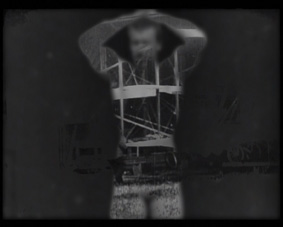
Thomas KÖner
Le manifeste du futurisme
Multimedia concert | dv | color | 50:0 | Germany | 2009
Catalogue : 2010La Barca | Video | dv | color | 6:40 | Germany | 2009

Thomas KÖner
La Barca
Video | dv | color | 6:40 | Germany | 2009
In a barque she sails across the high lands of the past. The barque heads shimmer and glow at stern and bow, and that lights her unseeable passage. She calls to the spirits of this hour, and that is how we come to even hear her voice. La Barca locates a radiance of memories by transforming the residues of recorded visual and sonic reality into imaginary music of urban spaces.
Catalogue : 2009Pasajeros Peregrinos Pilotos | Art vidéo | dv | color | 3:0 | Germany | 2008
Thomas KÖner
Pasajeros Peregrinos Pilotos
Art vidéo | dv | color | 3:0 | Germany | 2008
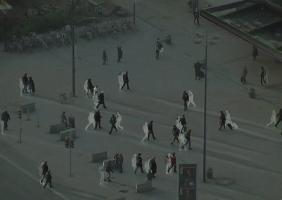
Pasajeros Pelegrinos Pilotos shows commuters and pedestrians on their daily track. An imaginative Doppelgänger that accompanies each person is becoming visible. The Doppelgänger to me represents an ideal thyself, knowing everything, never making wrong decisions, and of course, always being too late. Bound to the wear and tear of mass movements, this idealistic vision can decompose at any time.
Thomas Köner (b. 1965) is a media artist working with audiovisual installations, sound, video, photography, net art and live performance. His works are in the collections of numerous significant art museums. Awards: (a.o.) Golden Nica, Prix Ars Electronica 2004; Transmediale Award 2005; Golden Tiger Cub, Filmfestival Rotterdam 2005.
Catalogue : 2008Pneuma Monoxyd | Experimental video | dv | color | 10:30 | Germany | 2007
Thomas KÖner
Pneuma Monoxyd
Experimental video | dv | color | 10:30 | Germany | 2007
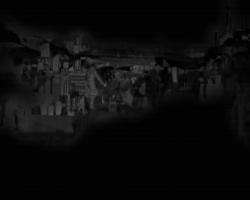
With PNEUMA MONOXYD, media artist Thomas Köner works on a series of audiovisual works that attempt to trace fluctuations and invisible border crossings that constitute any moment. Ina part one, a static gaze of a Balkan market seems like a window looking to the other side, unveiling that Hic et Nunc has become a porous frontier. Dissolved by an unsound breeze, the banality of everyday life is set free to embrace gloom and beauty in a blurry dance.
Thomas Köner, born 1965, attended the music college in Dortmund and studied electronic music at the CEM-Studio in Arnhem. Until 1994 he worked for the film industry as editor and sound engineer. He extended his concept of time and sound colour to images, resulting in video installations, photography and film works. 2000 the Montreal International Festival New Cinema New Media awarded him the "New Media Prize". 2004 the Prix Ars Electronica awarded him the "Golden Nica", and he was awarded the "Produktionspreis WDR / Deutscher Klangkunst-Preis" (german sound art award). His media installation "Suburbs Of The Void" received the Transmediale 2005 award in Berlin and was presented at La Biennale di Venezia, Teatro La Fenice as a live performance in the same year. Köners video "Nuuk" received the Tiger Cub Award (best short film) during the International Filmfestival Rotterdam 2005. His point of departure was composition of sound in which aspects of a performance and visual language were gradually integrated. At first in the collaboration with film artist Jürgen Reble and the live performance Alchemie (1992). Following this, he started to compose film soundtracks and music to accompany historic silent films for the Louvre Museum and the Musée d`Orsay, Paris. The Rimbaud Museum commissioned Thomas Köner five permanent sound installations for five rooms of the "Maison Rimbaud" in Charleville-Mezières, France. The Musée d`art contemporain Montreal and other museums acquired his audiovisual works for their collection.
Catalogue : 2007Périphériques | Video installation | dv | color | 13:34 | Germany | 2006
Thomas KÖner
Périphériques
Video installation | dv | color | 13:34 | Germany | 2006
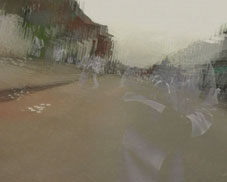
Three scenes in remote, hazy locations: second, third world; people on the streets of Harar, Belgrade and in a favela in Buenos Aires. The camera traces fluctuating and vanishing movements; we see faces becoming transparent, the images leafing through beclouding layers of personal memory. What first seemed to be an observation of three daily-life fragments merges into the vast space of a given moment, unsealing a microcosm of time that can only be entered from the off, the insignificant edge of the world. The third section homes in on people passing by, zooming into walking clothes afloat, ghostly outlines without being or body, as if person and identity disappear when questioned, revealing an agitated emptiness that drifts around its center of periphery.
Thomas Köner, born 1965, attended music college in Dortmund and studied electronic music at the CEM-Studio in Arnhem. Until 1994 he worked with film sound as sound engineer. He extended his concept of sound colour to moving images, resulting in video installations and film works. In 2000 the Montreal International Festival "New Cinema New Media" awarded him the "New Media Prize". In 2004 the Prix Ars Electronica awarded him the "Golden Nica", and he was awarded the "Produktionspreis WDR" during the "Deutsche Klangkunst-Preis" (German sound art award). His media installation "Suburbs of the Void" received the Transmediale 2005 award in Berlin and was presented at La Biennale di Venezia, Teatro La Fenice as a live performance in the same year. Köners video "Nuuk" received the Tiger Cub Award (best short film) during the Rotterdam International Film Festival 2005. While studying, he dedicated himself to intensive sound research in the recording studio. His first impulse consisted in avoiding rhythm and melody and focusing instead on the phenomenon of sound colour. To intensify the experience of sound, he decided to work with other media, resulting at first in the collaboration with film artist Jürgen Reble and the live performance "Alchemie" (1992). Following this, he started to compose film soundtracks and electronic live music to accompany old silent films for the Louvre in Paris. As "Porter Ricks", a collaboration with Andy Mellwig, he became an acclaimed producer of progressive techno, resulting in remix commissions for "Nine Inch Nails" and a Claude Debussy remix for Universal Music, a.o. Köner's interest in combining visual and auditory experiences and in extending the effectiveness of his works was conducive to an involvement with the work of other artists like Max Eastley, in which the combination between sound sculpture and performance became central. "List Of Japanese Winds", a collaboration of Max Eastley and Thomas Köner, is an installation piece that was commissioned by the Hayward Gallery in London. The Rimbaud Museum commissioned five permanent sound installations to be installed in five rooms of the "Maison Rimbaud" in Charleville-Mezières (until 2010). The Centre Georges Pompidou and other museums acquired his audiovisual works for their collection.
Catalogue : 2006Nuuk | Video installation | dv | color | 6:0 | Germany | 2004
Thomas KÖner
Nuuk
Video installation | dv | color | 6:0 | Germany | 2004
Nuuk is a simple but profound film, which makes do with one single washed-out shot taken by a webcam. In the snowy landscape of Greenland Köner shows the hamlet of Nuuk in changing light, which by all means complies with classic demands of rendering landscapes yet undermines them by way of denying visual expectations. The soundtrack is an integral part of the video. Without fully transcending the images the music passes just as imperceptibly as light and time do. Jurystatement Videoex Festival, Zurich 2005
1965 born in Bochum, Germany Education: 1985-1990 studying electronic music at CEM Studio, Arnhem 1987-1992 Conservatory of Music, Dortmund 1992-1994 Avid Operator, cutter- and soundassistant, Ruhr Sound Studios, Dortmund 1995 ? working as independant artist with sound, installation, film, music, video, theater and radio art Scholarships: 2001 Cité Internationale des Arts, Paris. 2006 Villa Aurora, Los Angeles Awards (selection): ARCO Award Best Young Artist at Arco, Feria International de Arte Contemporaneo Madrid 2005 Transmediale.05 Award, International Media Art Festival, Berlin 2005 TV5 Tiger Cub Award, International Filmfestival Rotterdam 2005 Golden Nica, Prix Ars Electronica, Linz 2004 German Sound Art Award Deutscher Klangkunst-Preis / Produktionspreis WDR, Marl 2004 Laureate, BBI Creation Contest, Fribourg 2004 Norman Award, Filmwinter Stuttgart 2004 New Media Prize, Montreal 2000 Nominations: 2004 MuVi Award, Short Film Festival Oberhausen 2004 Golden Cube, Monitoring Exhibition 21. Kasseler Dokumentarfilm- und Videofest 2004 & 2005 Viper Award, International Festival for Video and New Media, Basel Permanent installations: Musée Rimbaud / Maison Rimbaud, Charleville-Mézières Work in public collections: Centre Pompidou Musée national d`art moderne Paris, France Musée d`art contemporain Montreal, Canada Communidad Madrid Collection, Spain Ayuntamiento de Pamplona, Spain Exhibitions (selection): 2000 Sonic Boom Hayward Gallery London. 2004 Regarder, observer, surveiller Séquence Galerie Chicoutimi (Canada). Cyberarts Center for Contemporary Art, Linz. SoundART ArtCologne, Cologne. German Sound Art Award Skulpturenmuseum Marl. 2005 Gallery 44 Centre for Contemporary Photography, Toronto. Climax National Taiwan Museum of Fine Arts, Taichung. disappear Kunstpavillion Innsbruck. The Pantagruel Syndrome, Museo d`Arte Contemporanea Castello di Rivoli. Commissioned works: 1998 Musée National d`art moderne, Paris 2001 Centre d?art contemporain, Rennes 2004 Musée Rimbaud, Charleville-Mézières Remix (selection): 1999 Nine Inch Nails Remix for Nothing Records / Interscope 2002 Claude Debussy Remix for Universal Music 2003 ISIS Remix for Hydrahead Records Discography: since 1990 releases on more than 70 CD Live-Performance (selection): 1994 Louvre, Auditorium Paris. 1998 Spiral Hall Tokyo. 2001 New Zealand Film Festival. 2002 Kunsthalle Schirn Frankfurt. La Biennale Filmfestival Venice. Walker Art Center Minneapolis. 2003 Musée d?art contemporain Montreal. NYYD Festival for New Music Tallinn. 2004 Musée d?Orsay Paris. Festival de Carthage Tunis. 2005 La Biennale di Venezia, Teatro La Fenice. Palais des Beaux-Arts, Bruxelles. Serralves Museum, Porto. Radio art: 2001 Radio France 2004& 2005 Deutschlandradio Kultur 2006 Westdeutscher Rundfunk WDR Theatermusic: 1997 Krieg, Rainald Goetz, Schauspielhaus Dortmund Guest lectures & workshops (selection): 1998 Keio University Arts Center, Fujisawa. 2000 University of Traditional Music Theatre, Beijing. 2003 Musashino Art University, Tokyo. 2004 Dutch Art Institute, Enschede. 2004 Musrara School of Photography, Jerusalem. 2005 Hyperwerk, Basel.
Thomas Köner
Catalogue : 2017Expanding Illuminance | Multimedia concert | 0 | | 35:0 | Germany, France | 2017
Thomas KÖner
Expanding Illuminance
Multimedia concert | 0 | | 35:0 | Germany, France | 2017
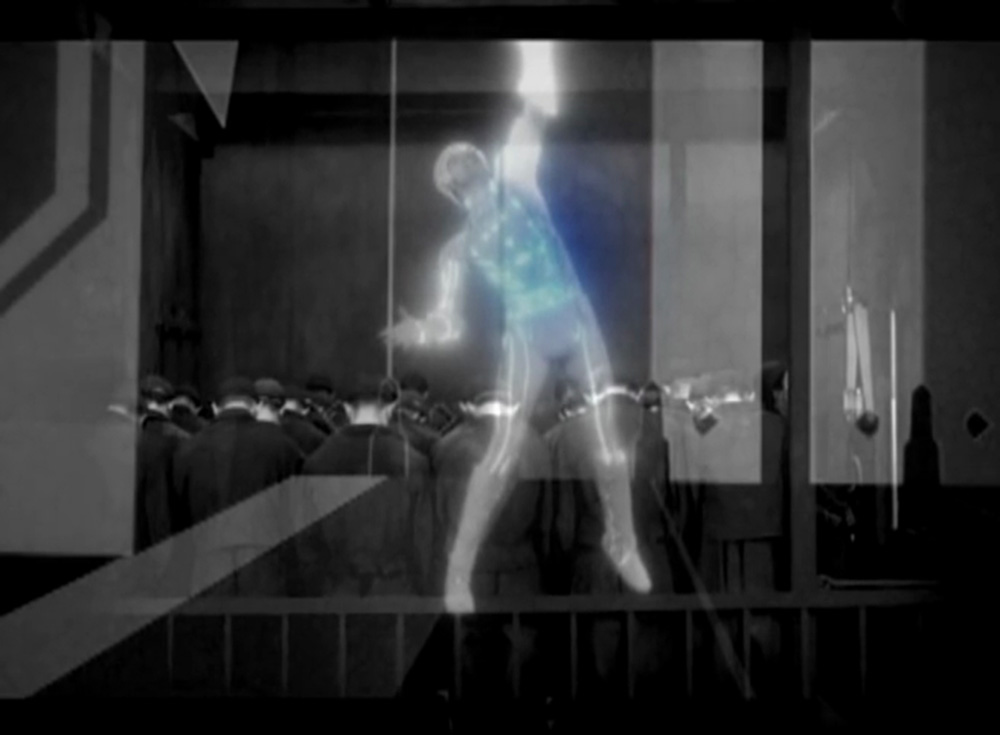
An hypnotic journey between two visions of the future and two utopias, from footages of the monumental “Metropolis” (Fritz Lang, 1927) and of the film 80`s cult “Tron” (Steven Lisberger, 1982).
Thomas Köner studied at the Music Academy in Dortmund, and at CEM-Studio in Arnhem. His work revolves mainly on the combination of visual and audio experiences, and develops into installations, concerts, videos, photos and multimedia works. In 2000, he received the “New Media Prize” at the Montreal International Festival New Cinema New Media. In 2004, he received the “Golden Nica” of Prix Ars Electronica, the “Produktionspreis WDR/Deutscher Klangkust – Preis” (German prize for sound art). His media installation “Suburb of the Void” received the Transmediale prize 2005 in Berli and was presented at the Venice Biennale, at the Fenice theatre, as a live performance. Various important museums has acquired his audio-visual works for their collection: mainly the Pompidou Centre, the Museum of contemporary art of Montreal, the Comunidad of Madrid, the FRAC of Limousin. In 2008, he participated at the Media Art Biennale in Seoul. In 2009, he received the MuVi prize at the International short film festival of Oberhausen. Thomas Köner is nominated for the Nam June Paik prize in 2012.
Julia König
Daniel Kötter, Constanze Fischbeck
Catalogue : 2025Landshaft | Documentary | 4k | color | 96:42 | Germany | 2023

Daniel KÖtter
Landshaft
Documentary | 4k | color | 96:42 | Germany | 2023
Landshaft sketches the psychogeography of a geopolitically charged landscape and its inhabitants between extractivism, war and displacement. In the form of a journey in eastern Armenia, the film follows human and non-human actors as they make their way through the landscape, from Lake Sevan to the Sotk gold mine, occupied by Azerbaijan since the Karabakh War in 2020.
Daniel Kötter (1975, Bergisch Gladbach, Germany) has been working for 20 years as a theatre and documentary film director. His documentary and performance practice regularly takes him to the African continent, but also to the Middle East, North America and Southeast Asia. His work, which has been presented at numerous international festivals, focuses on the study of spatial politics. In addition to numerous music theatre pieces with composer Hannes Seidl (2008-2020), he developed the documentary film series “State-theatre Lagos/Tehran/Berlin/Detroit/Beirut/Mönchengladbach” (2009-2014, with Constanze Fischbeck), the award-winning trilogy on urban peripheries Hashti Tehran, Desert View, Rift Finfinnee (2017-2020), the exhibition and film project “CHINAFRIKA” (2014-18, with Jochen Becker) and the series of virtual reality performances and films “landscapes and bodies” on the impact of mining on landscapes and communities in West Papua, Saxony, Ruhrgebiet, the Democratic Republic of the Congo and Estonia (2018-2021).
Catalogue : 2022Rift Finfinnee | Documentary | 4k | color | 79:0 | Germany | 2020
Daniel KÖtter
Rift Finfinnee
Documentary | 4k | color | 79:0 | Germany | 2020
The film Rift Finfinnee takes the viewer on a journey through the periphery of Ethiopian capital Addis Ababa. In strictly composed landscapes and architecture shots, and with a soundtrack that interweaves the original conversations in a complex way, the film travels along the Akaki river gorge, dissecting the more than symbolic rift between city and rural. It takes the concrete geography, architecture and the every day life of individual agricultural and construction workers in the east of Addis Ababa (in Oromo: Finfinnee) as the starting point for an allegorical narrative about the becoming urban of an African society on the edge of civil war.
Daniel Kötter is an international filmmaker and theater director. Visual research leads him again and again to the African continent and the Middle East. 2014-18 he worked with the curator Jochen Becker (metroZones) on the research, exhibition and film project CHINAFRIKA. Under Construction. In 2017-20 he worked on the documentary film trilogy Hashti Tehran (2017, 60 ’), Desert View (2018, 84’) and Rift Finfinnee (2020, 80 ’) about urban peripheries in Tehran, Cairo and Addis Ababa. Hashti Tehran won the special award of the German Short Film Award, Rift Finfinnee the DEFA Award at DOK Leipzig. Daniel Kötter is currently working on a series of spatial performances and 360° films on the landscape and social consequences of extractivism in Germany, West Papua, DR Congo and Estonia under the title landscapes and bodies.
Catalogue : 2019Chinafrika.mobile | Documentary | hdv | color | 38:20 | Germany, Congo (RDC) | 2017
Daniel KÖtter
Chinafrika.mobile
Documentary | hdv | color | 38:20 | Germany, Congo (RDC) | 2017
The documentary Chinafrika.mobile is tracking the life cycle of a mobile phone. From its birth in the mines in the Kolwezi, DR Congo, to its manufacturing in Chinese factories in the Pearl River Delta to its use and death in the markets and recycling dumps in Lagos, Nigeria, the mobile phone camera sends images of its global journey to the viewer`s mobile phone display. It was filmed by miners, factory employees, dealers and electronic scrap collectors at the original locations in Congo, China and Nigeria. Four short documentary films show the work on the device that shapes our everyday life. China and Africa act as driving forces for the economic, political and cultural future of globalization and the mobile phone is their important link. Since 2013 Jochen Becker and Daniel Kötter have done research on cultural effects of the economic and political connections between China and the African continent.
Daniel Kötter ist ein international tätiger Filmemacher und Musiktheater-Regisseur. Seine Arbeiten changieren zwischen verschiedenen medialen und institutionellen Kontexten und verbinden Techniken des strukturalistischen Experimentalfilms mit performativen und dokumentarischen Elementen. Sie wurden weltweit auf zahlreichen Film- und Videokunstfestivals, in Galerien, Theatern und Konzerthäusern gezeigt. Zu seinen Hauptwerken zählen die experimentellen Videokonzertperformances Falsche Freizeit (2010), Freizeitspektakel (2010), 'konomien des Handelns 1-3: KREDIT, RECHT, LIEBE (2013-16, alle mit Hannes Seidl), die Mehrkanal-Trilogie Arbeit und Freizeit (2009-2011) sowie die Film-, Performance- und Diskursreihe state-theatre über die Bedingungen des Performativen in den Städten Lagos, Teheran, Berlin, Detroit, Beirut, Mönchengladbach (2009-2014 mit Constanze Fischbeck). Seine umfangreiche Film- und Textarbeit KATALOG (2013) entstand in 13 Ländern rund um das Mittelmeer mit einem besonderen Interesse an Praktiken des Raums. Visuelle Recherchen führen ihn immer wieder auf den afrikanischen Kontinent sowie in den Mittleren Osten. 2014-18 arbeitete er u.a. mit dem Kurator Jochen Becker (metroZones) an dem Recherche-, Ausstellungs- und Filmprojekt CHINAFRIKA. Under Construction. Sein Film "Hashti Tehran" (2017, HD, 60") gewann u.a. den Sonderpreis des Deutschen Kurzfilmpreises.
Catalogue : 2017HASHTI Tehran | Experimental doc. | mov | color | 59:45 | Germany, Iran | 2016
Daniel KÖtter
HASHTI Tehran
Experimental doc. | mov | color | 59:45 | Germany, Iran | 2016
Hashti, in most traditional houses in Iran, is a octagonal space of distribution and circulation to direct the person towards the various parts of the house, the private (andarouni) and semi-public (birouni) reserved for the reception from abroad and the access to spaces of service. Based on the idea that Tehran itself represents a house, so to speak the inner circle of The Islamic Republic of Iran, the outskirts of the city become the space of transition between inside and outside, between urban and non-urban. Thus the film and discursive project HASHTI Tehran looks at four very different areas in the outskirts of Tehran: the mountain of Tochal in the north, the area around the artificial lake Chitgar in the West, the construction of social housing called Pardis Town in the far east and the neighbourhood Nafar Abad at the southern edges of the city. By combining Road movie and architectural documentary and by inverting the techniques of inside and outside shots the film HASHTI Tehran portrays Tehran through its peripheral spaces. Background „Segregation“ and „privatization“, „security“ and „control“ are core terms of urban transformation in the developping cities of the 21st century around the globe. Its contested counterparts are „public“ or „open space“, „access“ and „citizenship“. All these concepts seem stuck in the negotiation between aspiration of new liberal economies trying to connect to a global construction and business boom on the one and a tendency of preserving a shared public sphere for all groups of society within the urban area on the other hand. HASHTI tries to shift this focus to areas where the controlling force of urban development seems to lose its influence, where definitions get blurry and fluid: the edges and peripheries, those contact zones, where city and landscape, nature and construction meet. Can a citizen who leaves the city for recreational or other purposes, still be called a citizen? Which societal function does he take on, which political role does he play in the moment where he enters or lives in the periphery of a city? Administrative aswell as geographical city borders divide space into inside and outside, into what belongs and what is beyond. The relation of those spaces on both sides of the border is therefore not symmetrical. The definitional authority is on the side of the city. The city would always determine the use and formation of space beyond its limits in a stronger way than the countryside would determine the urban space. One of the reasons for this is the fact that the city produces things, that it has to exclude from its centre, in order to guarantee the functionality of the living together: waste, dead corpses, criminals and socially marginalized. The space beyond the city limits therefore is predetermined for storage, settlement and disposal of what is socially peripheral. On the other hand the space beyond the boundaries of the city calls for this need for the city’s opposite: recreation, life in the green space, better air, less density and pollution. Living in the periphery therefore can be understood equally as Stigma and privilege. The Tehran case study Tehran’s peripheral geography shows a significant structural analogy with its social, environmental and psychological divisions: the northern periphery, reserved for the upper class in penthouse appartments and for recreation in the „clean air“ of the mountains, heavily contradicts the situation at the southern periphery, where smog and desert define the social life of the middle and low classes. While the geographical layout of the city with the mountains in the north and the desert in the south define a north-south axis, growth and development of the city are only possible on a west-east axis. HASHTI as a discursive project in collaboration with Shadnaz Azizi, Kaveh Rashidzadeh, Amir Tehrani and Pouya Sepehr and explored in four printed booklets, examines the different strategies of urban planners, architects and sociologists in these areas. How is traffic, how are meeting places, contact zones, gardening controlled and defined? And how do these spaces relate to the definition of interior spaces, the living room as a main forum in a society that regulates public space.
Daniel Kötter is a director and video artist whose work oscillates deliberately between different media and institutional contexts, combining techniques of structuralist film with documentary elements and experimental music theater. It was shown in numerous galleries, video festivals, concert halls and theatres all over the world. Between 2008 and 2011, he developed the video-performance trilogy Arbeit und Freizeit. His music theatre performances in collaboration with composer Hannes Seidl are shown at numerous international festivals. Between 2013 and 2016 they developped the trilogy Ökonomien des Handelns: KREDIT, RECHT, LIEBE. Kötter’s series of films, performative and discursive work on urban and socio-political conditions of theatre architecture and performativity has been under development between 2009 and 2015) under the title state-theatre: Lagos/Teheran/Berlin/Detroit/Beirut/Mönchengladbach (with Constanze Fischbeck). His film and text work KATALOG was shot in twelve countries around the mediterranean sea portraying sites and practices related to the definition of the public sphere. It was presented at the Venice Biennal for Architecture (2013/14). He is currently working with curator Jochen Becker (metroZones) on the research, exhibition and film project CHINAFRIKA. Under Construction. (2014-2018) www.danielkoetter.de www.state-theatre.de http://katalog.danielkoetter.de
Catalogue : 2017Repetitionen | Video | hdv | color | 21:28 | Germany | 2016
Daniel KÖtter
Repetitionen
Video | hdv | color | 21:28 | Germany | 2016
He who walks down the street, over there, is immersed in the multiplicity of noises, murmurs, rhythms. By contrast, from the window, the noises distinguish themselves, the flows separate out, rhythms respond to another. No camera, no image or series of images can show these rhythms. The observer in the window knows that he takes his time as first reference, but that the first impression displaces itself and includes the most diverse rhythms on the condition that they remain to scale. Rhythms always need a reference, the initial moment persists through other perceived givens. Henri Lefebvre, Rhythmanalysis
Daniel Kötter is a director and video artist whose work oscillates deliberately between different media and institutional contexts, combining techniques of structuralist film with documentary elements and experimental music theater. It was shown in numerous galleries, video festivals, concert halls and theatres all over the world. Between 2008 and 2011, he developed the video-performance trilogy Arbeit und Freizeit. His music theatre performances in collaboration with composer Hannes Seidl are shown at numerous international festivals. Between 2013 and 2016 they developped the trilogy Ökonomien des Handelns: KREDIT, RECHT, LIEBE. Kötter’s series of films, performative and discursive work on urban and socio-political conditions of theatre architecture and performativity has been under development between 2009 and 2015) under the title state-theatre: Lagos/Teheran/Berlin/Detroit/Beirut/Mönchengladbach (with Constanze Fischbeck). His film and text work KATALOG was shot in twelve countries around the mediterranean sea portraying sites and practices related to the definition of the public sphere. It was presented at the Venice Biennal for Architecture (2013/14). He is currently working with curator Jochen Becker (metroZones) on the research, exhibition and film project CHINAFRIKA. Under Construction. (2014-2018)
Catalogue : 2015A Composer | Experimental doc. | hdv | color | 18:55 | Germany | 2014
Daniel KÖtter
A Composer
Experimental doc. | hdv | color | 18:55 | Germany | 2014
Daniel Kötter’s single take film “A Composer” documents a car ride by Lebanese composer Zad Moultaka, re-imagining a story that happened 10 years ago, when Moultaka was threatened for using the word “Israel” in one of his compositions. The political situation of his home country, its psycho-geography and the conditions of artistic practice in the Middle East, all this superimposed in the protagonist’s imagination. A film documenting the assimilation of past and present reflected in the recording situation.
Daniel Kötter is a director and video artist whose work oscillates deliberately between different media and institutional contexts, combining techniques of structuralist film with documentary elements and experimental music theater. It was shown in numerous galleries, video festivals, concert halls and theatres all over the world. Between 2008 and 2011, he developed the video-performance trilogy Arbeit und Freizeit. His music theatre performances in collaboration with composer Hannes Seidl are shown at numerous international festivals. Kötter`s series of installations, films, and discursive work on urban and socio-political conditions of performativity has been under development since mid-2009 under the title state-theatre: Lagos/Teheran/Berlin/Detroit/Beirut/Mönchengladbach (with Constanze Fischbeck). His film and text work KATALOG was shot in twelve countries around the mediterranean sea portraying sites and practices related to the definition of the public sphere. It was presented at the Venice Biennal for Architecture.
Catalogue : 2014communal retreat | Experimental fiction | hdv | color | 15:0 | Germany, Canada | 2012
Daniel KÖtter
communal retreat
Experimental fiction | hdv | color | 15:0 | Germany, Canada | 2012
Following the traces of Glenn Gould and his so-called ?Solitude-Trilogy? up north at Lake Superior seemed a welcome alibi for a middle-european to explore a little bit of what is called THE NORTH for Canadians, what it means to drive hours and hours without one single settlement, having the car radio and the camera as sole companions. And what community might mean under the circumstances of the periphery. What I brought back from there? The certainty that there is definitely no marxist in the White House! And that even in the most remote retreat: Beware of the dogs!
Catalogue : 2014state-theatre #6 MÖNCHENGLADBACH | Experimental doc. | hdv | color | 46:0 | Germany | 2013
Daniel KÖtter, Constanze Fischbeck
state-theatre #6 MÖNCHENGLADBACH
Experimental doc. | hdv | color | 46:0 | Germany | 2013
The small german City of Mönchengladbach, a former textile industry hub, redefines its commercial and cultural centre by removing the modernist theatre building, abandoned during the past decade, and replacing it with a shopping mall. This constant process of producing space comes to a temporary halt when a group of citizens enters the winterly void to claim and re-stage the public discourse on appropriation of urban space: ?There ought not to be a vacuum which might attempt to lead us to the idea of the void as potentiality.? state-theatre is a series of six experimental documentaries that explore urban conditions for performance based on six case studies in Lagos, Tehran, Berlin, Detroit, Beirut and Mönchengladbach. state-theatre departs from places that have shed their apparent societal functions: deserted areas, construction sites, unused or reinterpreted buildings ? empty spaces in the urban fabric, places that were originally meant as allegoric gathering places: theaters.
Daniel Kötter ist ein international tätiger Filmemacher und Musiktheater-Regisseur. Seine Arbeiten changieren zwischen verschiedenen medialen und institutionellen Kontexten. Sie wurden weltweit auf zahlreichen Film- und Videokunstfestivals, in Galerien, Theatern und Konzerthäusern gezeigt. Zu seinen Hauptwerken zählen neben experimentellen Videokonzertperformances (mit Hannes Seidl) die Mehrkanal-Trilogie Arbeit und Freizeit (2009-2011) sowie die Film-, Performance- und Diskursreihe state-theatre über die Bedingungen des Performativen in den Städten Lagos, Teheran, Berlin, Detroit, Beirut, Mönchengladbach (mit Constanze Fischbeck). Constanze Fischbeck was born in 1968 in Berlin. She works as stage designer and video artist. Her artwork is based on the space and present of specific locations. In her films she investigates the interference of documentary and staged moments in the urban context. Her work was presented at various festivals, art institutes and theatres.
Catalogue : 2013Neues Theater (Rahmenanalyse Warschau, 13. November 2011 | Video | hdv | color | 40:12 | Germany, Poland | 2011
Daniel KÖtter
Neues Theater (Rahmenanalyse Warschau, 13. November 2011
Video | hdv | color | 40:12 | Germany, Poland | 2011
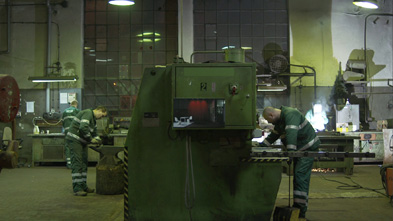
?You know what - this whole ?common ground? category scares me. It must be conceived from the position of someone? - I don?t know - an allegorical film director, an engineer ? someone outside the frame, designing the potential encounter.? Daniel Kötter?s single take film Neues Theater, based on a performance staged in November 2011, examines a moment of fundamental change in the understanding of public space in post-communist Poland. The workshop hall of the Warsaw city cleaning company MPO will turn into the new cultural centre for Poland?s most internationally renowned theatre company Nowy Teatr, the work of the workers will be replaced by the work of actors and viewers. While the camera slowly travels along the hall, the roles of viewers and actors, of labour and performance, practice and theory keep oscillating. The film stages the ?theatre? itself, not as yet another art form (with its specific institutional conditions, market rules and local aesthetic and historic limitations), but as a name for the allegoric space of encounter.
Daniel Kötter, born 1975, is a director and video artist whose work oscillates deliberately between different media and institutional contexts, combining techniques of structuralist film with documentary elements and experimental music theater. It was shown in numerous galleries, video festivals, concert halls and theatres all over Europe, in New York, Mexico, Tehran and Lagos. Between 2008 and 2011, he developed the video- and opera-performance trilogy Arbeit und Freizeit. His music theatre performances in collaboration with composer Hannes Seidl are shown at international festivals such as the Venice Biennale, Musica d?hoy Madrid and others. Kötter`s new series of installations, films, and discursive work on urban and socio-political conditions of performativity has been under development since mid-2010 under the title state-theatre: Lagos/Teheran/Berlin/Detroit/Beirut/Mönchengladbach (with Constanze Fischbeck). For galleries and dance performances, he developed multi-channel live video delay installations. His award-winning short-Film Film für übers Sofa (with Hannes Seidl) was shown at festivals worldwide. Between 2002 and 2008 Daniel Kötter, as artistic director of the labor für musik:theater, developed and produced numerous feature-length performative projects and multi-channel movies on the borderline between concert and musical theater. Daniel Kötter has been living and working in Berlin since 1996.
Catalogue : 2013state-theatre #4 DETROIT | Experimental doc. | hdv | color | 53:0 | Germany, USA | 2011
Daniel KÖtter, Constanze Fischbeck
state-theatre #4 DETROIT
Experimental doc. | hdv | color | 53:0 | Germany, USA | 2011
Detroit, once America?s center for auto-industry and theater, was shrinking to a third of its population. What used to be the space for theatrical presentation, nowadays presents the urban crisis. What once was private space became public open space for societal negotiation. The city became a theater itself. In front of the backdrop of former Michigan theater, today a parking garage for the adjacent office building, the film stages the performative discourse of six locations, six neighborhoods, and six Detroiters: ?...we?re sort of talking about Detroit in a way that it itself is a theater, that it itself is the object to behold.? state-theatre is a series of six experimental documentaries that explore urban conditions for performance based on six case studies in Lagos, Tehran, Berlin, Detroit, Beirut and Mönchengladbach. state-theatre departs from places that have shed their apparent societal functions: deserted areas, construction sites, unused or reinterpreted buildings ? empty spaces in the urban fabric, places that were originally meant as allegoric gathering places: theaters.
Daniel Kötter, born 1975, is a director and video artist whose work oscillates deliberately between different media and institutional contexts, combining techniques of structuralist film with documentary elements and experimental music theater. It was shown in numerous galleries, video festivals, concert halls and theatres all over Europe, in New York, Mexico, Tehran and Lagos. Between 2008 and 2011, he developed the video- and opera-performance trilogy Arbeit und Freizeit. His music theatre performances in collaboration with composer Hannes Seidl are shown at international festivals such as the Venice Biennale, Musica d?hoy Madrid and others. Kötter`s new series of installations, films, and discursive work on urban and socio-political conditions of performativity has been under development since mid-2010 under the title state-theatre: Lagos/Teheran/Berlin/Detroit/Beirut/Mönchengladbach (with Constanze Fischbeck). For galleries and dance performances, he developed multi-channel live video delay installations. His award-winning short-Film Film für übers Sofa (with Hannes Seidl) was shown at festivals worldwide. Between 2002 and 2008 Daniel Kötter, as artistic director of the labor für musik:theater, developed and produced numerous feature-length performative projects and multi-channel movies on the borderline between concert and musical theater. Daniel Kötter has been living and working in Berlin since 1996.
Catalogue : 2012state-theatre #1 LAGOS | Experimental doc. | hdv | color | 24:7 | Germany | 2010
Daniel KÖtter, Constanze Fischbeck
state-theatre #1 LAGOS
Experimental doc. | hdv | color | 24:7 | Germany | 2010
The word `theatre` (theatron in greek) refers first and foremost to the place and architecture of a performance, rather than to what is being performed. Even after centuries, a theatre?s architecture represents the visual order from which it emerged: the possibilities for artistic production are historically conditioned. The geometrical space of architecture is pitted against the anthropological space of its use. 1st case study: LAGOS The National Theatre of Nigeria in Lagos was built for the Second Festival of Black and African Arts and Culture (FESTAC) in 1976. It is the only state-subsidized theatre in Nigeria. While its smaller halls are occasionally used for theatre performances, banquets and weddings, the 5000-seat main hall has been deserted since the early 1990s. A reopening was scheduled for 2010 but postponed indefinitely after a series of changes in direction. counter shot: The Bariga Arts Center was founded in 2009 in a Lagosian slum by choreographer and Nollywood actor Segun Adefila, after the rent free agreement between his company Crown Troupe of Africa and the National Theatre of Nigeria had been revoked.
Daniel Kötter has been implementing experimental approaches to the formats of theatrical and musical performance, collaborative models for artists and non-artists, video art in the context of different formats of presentation ? exhibitions, live performances, film, with a particular interest in multi-channel video installations and alternative concert formats. Daniel Kötter (b. 1975) lives and works in Berlin. Between 2008 and 2011 he developed the video- and opera-performance trilogy on artistic labour - Arbeit und Freizeit. His music theatre performances in collaboration with composer Hannes Seidl are shown on international festivals like Venice Biennale, Musica d?hoy Madrid and others. A new series of installations, films, and discursive work on urban and socio-political conditions of performativity has been developed in collaboration with Constanze Fischbeck since 2010 under the title state-theater: Lagos/Teheran/Berlin. Constanze Fischbeck was born in 1968. She studied set design, and now works as a set designer for theater, music theater and dance. She has also been working as a video artist since 1996. Space and the current time of specific locations are always the initial points from which her work unfolds. In her video works, she is interested in the intersection of documentary and staged moments in the context of an urban environment. Since 2001, she has developed a series of works that explore the function of society in cities like Magdeburg, Berlin, Sao Paulo, Sarajevo, Lagos, Tehran and Detroit. Her work has been shown in festivals, art institutions and theaters. "state-theater" is her second collaboration with Daniel Kötter.
Catalogue : 2008checkpoint | Experimental film | super8 | color | 7:13 | Germany | 2006
Daniel KÖtter
checkpoint
Experimental film | super8 | color | 7:13 | Germany | 2006
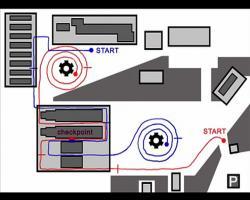
Checkpoint Grenzanlage a.D.: zwei Fahrzeuge, simultan, Start auf zwei Seiten einer Grenze. Aufeinandertreffen am Checkpoint. Spirale um zwei Wachtürme. Beschleunigung durch zunehmende Anzahl von Bildern pro Sekunde. Location: ehemalige deutsch-deutsche Grenzanlage Marienborn. Arbeitsweise: Rück-Übertragung von bevorzugten Methoden der DV-Technik wie Simultaneität, Splitscreen, Beschleunigung, Planseuquenz auf das nostalgische Medium Super8. Vermischung von Roadmovie, Dokumentarfilm, Experimentalfilm.
Daniel Kötter 1975 geboren; seine mehrkanaligen Videoinstallationen und Konzertinszenierungen wurden gezeigt u.a. am Hebbel-Theater Berlin, in den sophiensaelen, den KW- institute for contemporaray art Berlin, Künstlerhaus Bethanien, im tesla Berlin, im Festspielhaus Hellerau Dresden, Casa da musica Porto, Konzerthaus Wien, musica viva und im Rahmen des Ultraschall-Festivals Berlin, der Ostseebiennale für Klangkunst, Warschauer Herbst, Tanz im August sowie dem Kunstfrühling Bremen und Rohkunstbau; Zusammenarbeit u.a. mit den Komponisten John Lely, Helmut Oehring, Thierry Blondeau, Christoph Ogiermann, Iris ter Schiphorst, dem Ensemble Apartment House London, den Musikern Boris Baltschun, Daniel Teige und den Choreographen Sasha Waltz, Paul Gazzola und Petra Sabisch, Videoinszenierungen u.a. zu Musik von Luigi Nono, Iannis Xenakis, Helmut Oehring und Franco Evangelisti, seit 2000 Künstlerischer Leiter des labor für musik: Theater Berlin.
Catalogue : 2007Aufschläge - Kanon | Experimental video | dv | color | 2:27 | Germany | 2004
Daniel KÖtter
Aufschläge - Kanon
Experimental video | dv | color | 2:27 | Germany | 2004
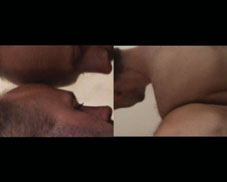
The exchange between two adversaries starts with thuds (here: tennis or badminton serves), they are the thuds (here: hits) that happen at the fall, and the thuds (here: the raising of the eyelids that open the game of seduction. But here the body doesn't encounter or achieve anything but its self: vertically (thuds). It continues hopeless of recapturing a day: horizontally (canon). The arms, the legs, the head, the face, and the skin come face to face and enter into contact in a corner of the room. This installation video has two canons, "Aufschläge ? Kanon" was first presented in the framework of the audiovisual project "In der Gnade der Strafe sein" by Christoph Ogiermann (composition) and Daniel Kötter (video).
Daniel Kötter was born in 1975. His directorial works and installation videos have been presented at Hebbel-Theater Berlin, Sophiensaelen; the KW-Institute for Contemporary Art Berlin; Künstlerhaus Bethanien, Tesla, Berlin; Festspielhaus, Hellerau Dresden; Casa da musica, Porto; Rahmen des Ultraschall, Festivals Berlin; the Ostseebiennale für Klangkunst, Dance in August; as well as Kunstfrühling Bremen and Rohkunstbau, among others. Hehas collaborated with the composers John Lely, Helmut Oehring, Thierry Blondeau, Christoph Ogiermann, and Iris ter Schiphorst on the Ensemble Apartment House London with the Musicians Boris Baltschun and Daniel Teige, and the Choreographers Sasha Waltz, Paul Gazzola, and Petra Sabisch, among others. He has done video directing for the music of Luigi Nono, Iannis Xenakis, Helmut Oehring und Franco Evangelisti. Has been the artistic director of "labour for music: theater Berlin" since 2000.
Daniel Kötter
Catalogue : 2022Water & Coltan | VR 360 video | 4k | color | 52:22 | Germany | 2021
Daniel Kötter
Water & Coltan
VR 360 video | 4k | color | 52:22 | Germany | 2021
“Water & Coltan” transports its viewer directly to the places of the struggle of women in artisanal coltan mining camps in South Kivu in Democratic Republic of Congo. Superimposed with a posthuman near-future scenario of the former coal mining Ruhr area in Germany the 360° documentary immersive experience combines two local sides of one and the same violent global phenomenon: the extractivist relation to natural and human resources with its long-term consequences for the environment and society.
Daniel Kötter (Germany, 1975) is a documentary filmmaker and theater director. His research based works alternate between media and institutional contexts. They have been shown worldwide at film festivals, in galleries and theaters. Since 2007 visual research on urbanization and political landscapes leads him to the African continent and the Middle East. His major works include the film and performance series “state-theatre” about urban conditions of performativity in the cities of Lagos, Tehran, Berlin, Detroit, Beirut, Mönchengladbach (2009-2014), the research, exhibition and film project “CHINAFRIKA” (2013-2019) and the film trilogy “Hashti Tehran” (2017, Special Award of the German Short Film Award), “Desert View” (2018) and “Rift Finfinnee” (2020, DEFA Award DOK Leipzig) about urban peripheries in Tehran, Cairo and Addis Ababa. Since 2019 Daniel Kötter was working on the series of spatial performances and 360° films “landscapes and bodies” on the consequences of extractivism in Germany, West Papua and Democratic Republic of Congo. His 360° film “Water & Coltan” (2021) is premiered at IDFA DocLab Competition.
Daniel Kötter
Catalogue : 2025Landshaft | Documentary | 4k | color | 96:42 | Germany | 2023
Daniel KÖtter
Landshaft
Documentary | 4k | color | 96:42 | Germany | 2023
Landshaft sketches the psychogeography of a geopolitically charged landscape and its inhabitants between extractivism, war and displacement. In the form of a journey in eastern Armenia, the film follows human and non-human actors as they make their way through the landscape, from Lake Sevan to the Sotk gold mine, occupied by Azerbaijan since the Karabakh War in 2020.
Daniel Kötter (1975, Bergisch Gladbach, Germany) has been working for 20 years as a theatre and documentary film director. His documentary and performance practice regularly takes him to the African continent, but also to the Middle East, North America and Southeast Asia. His work, which has been presented at numerous international festivals, focuses on the study of spatial politics. In addition to numerous music theatre pieces with composer Hannes Seidl (2008-2020), he developed the documentary film series “State-theatre Lagos/Tehran/Berlin/Detroit/Beirut/Mönchengladbach” (2009-2014, with Constanze Fischbeck), the award-winning trilogy on urban peripheries Hashti Tehran, Desert View, Rift Finfinnee (2017-2020), the exhibition and film project “CHINAFRIKA” (2014-18, with Jochen Becker) and the series of virtual reality performances and films “landscapes and bodies” on the impact of mining on landscapes and communities in West Papua, Saxony, Ruhrgebiet, the Democratic Republic of the Congo and Estonia (2018-2021).
Catalogue : 2022Rift Finfinnee | Documentary | 4k | color | 79:0 | Germany | 2020
Daniel KÖtter
Rift Finfinnee
Documentary | 4k | color | 79:0 | Germany | 2020
The film Rift Finfinnee takes the viewer on a journey through the periphery of Ethiopian capital Addis Ababa. In strictly composed landscapes and architecture shots, and with a soundtrack that interweaves the original conversations in a complex way, the film travels along the Akaki river gorge, dissecting the more than symbolic rift between city and rural. It takes the concrete geography, architecture and the every day life of individual agricultural and construction workers in the east of Addis Ababa (in Oromo: Finfinnee) as the starting point for an allegorical narrative about the becoming urban of an African society on the edge of civil war.
Daniel Kötter is an international filmmaker and theater director. Visual research leads him again and again to the African continent and the Middle East. 2014-18 he worked with the curator Jochen Becker (metroZones) on the research, exhibition and film project CHINAFRIKA. Under Construction. In 2017-20 he worked on the documentary film trilogy Hashti Tehran (2017, 60 ’), Desert View (2018, 84’) and Rift Finfinnee (2020, 80 ’) about urban peripheries in Tehran, Cairo and Addis Ababa. Hashti Tehran won the special award of the German Short Film Award, Rift Finfinnee the DEFA Award at DOK Leipzig. Daniel Kötter is currently working on a series of spatial performances and 360° films on the landscape and social consequences of extractivism in Germany, West Papua, DR Congo and Estonia under the title landscapes and bodies.
Catalogue : 2019Chinafrika.mobile | Documentary | hdv | color | 38:20 | Germany, Congo (RDC) | 2017
Daniel KÖtter
Chinafrika.mobile
Documentary | hdv | color | 38:20 | Germany, Congo (RDC) | 2017
The documentary Chinafrika.mobile is tracking the life cycle of a mobile phone. From its birth in the mines in the Kolwezi, DR Congo, to its manufacturing in Chinese factories in the Pearl River Delta to its use and death in the markets and recycling dumps in Lagos, Nigeria, the mobile phone camera sends images of its global journey to the viewer`s mobile phone display. It was filmed by miners, factory employees, dealers and electronic scrap collectors at the original locations in Congo, China and Nigeria. Four short documentary films show the work on the device that shapes our everyday life. China and Africa act as driving forces for the economic, political and cultural future of globalization and the mobile phone is their important link. Since 2013 Jochen Becker and Daniel Kötter have done research on cultural effects of the economic and political connections between China and the African continent.
Daniel Kötter ist ein international tätiger Filmemacher und Musiktheater-Regisseur. Seine Arbeiten changieren zwischen verschiedenen medialen und institutionellen Kontexten und verbinden Techniken des strukturalistischen Experimentalfilms mit performativen und dokumentarischen Elementen. Sie wurden weltweit auf zahlreichen Film- und Videokunstfestivals, in Galerien, Theatern und Konzerthäusern gezeigt. Zu seinen Hauptwerken zählen die experimentellen Videokonzertperformances Falsche Freizeit (2010), Freizeitspektakel (2010), 'konomien des Handelns 1-3: KREDIT, RECHT, LIEBE (2013-16, alle mit Hannes Seidl), die Mehrkanal-Trilogie Arbeit und Freizeit (2009-2011) sowie die Film-, Performance- und Diskursreihe state-theatre über die Bedingungen des Performativen in den Städten Lagos, Teheran, Berlin, Detroit, Beirut, Mönchengladbach (2009-2014 mit Constanze Fischbeck). Seine umfangreiche Film- und Textarbeit KATALOG (2013) entstand in 13 Ländern rund um das Mittelmeer mit einem besonderen Interesse an Praktiken des Raums. Visuelle Recherchen führen ihn immer wieder auf den afrikanischen Kontinent sowie in den Mittleren Osten. 2014-18 arbeitete er u.a. mit dem Kurator Jochen Becker (metroZones) an dem Recherche-, Ausstellungs- und Filmprojekt CHINAFRIKA. Under Construction. Sein Film "Hashti Tehran" (2017, HD, 60") gewann u.a. den Sonderpreis des Deutschen Kurzfilmpreises.
Catalogue : 2017HASHTI Tehran | Experimental doc. | mov | color | 59:45 | Germany, Iran | 2016
Daniel KÖtter
HASHTI Tehran
Experimental doc. | mov | color | 59:45 | Germany, Iran | 2016
Hashti, in most traditional houses in Iran, is a octagonal space of distribution and circulation to direct the person towards the various parts of the house, the private (andarouni) and semi-public (birouni) reserved for the reception from abroad and the access to spaces of service. Based on the idea that Tehran itself represents a house, so to speak the inner circle of The Islamic Republic of Iran, the outskirts of the city become the space of transition between inside and outside, between urban and non-urban. Thus the film and discursive project HASHTI Tehran looks at four very different areas in the outskirts of Tehran: the mountain of Tochal in the north, the area around the artificial lake Chitgar in the West, the construction of social housing called Pardis Town in the far east and the neighbourhood Nafar Abad at the southern edges of the city. By combining Road movie and architectural documentary and by inverting the techniques of inside and outside shots the film HASHTI Tehran portrays Tehran through its peripheral spaces. Background „Segregation“ and „privatization“, „security“ and „control“ are core terms of urban transformation in the developping cities of the 21st century around the globe. Its contested counterparts are „public“ or „open space“, „access“ and „citizenship“. All these concepts seem stuck in the negotiation between aspiration of new liberal economies trying to connect to a global construction and business boom on the one and a tendency of preserving a shared public sphere for all groups of society within the urban area on the other hand. HASHTI tries to shift this focus to areas where the controlling force of urban development seems to lose its influence, where definitions get blurry and fluid: the edges and peripheries, those contact zones, where city and landscape, nature and construction meet. Can a citizen who leaves the city for recreational or other purposes, still be called a citizen? Which societal function does he take on, which political role does he play in the moment where he enters or lives in the periphery of a city? Administrative aswell as geographical city borders divide space into inside and outside, into what belongs and what is beyond. The relation of those spaces on both sides of the border is therefore not symmetrical. The definitional authority is on the side of the city. The city would always determine the use and formation of space beyond its limits in a stronger way than the countryside would determine the urban space. One of the reasons for this is the fact that the city produces things, that it has to exclude from its centre, in order to guarantee the functionality of the living together: waste, dead corpses, criminals and socially marginalized. The space beyond the city limits therefore is predetermined for storage, settlement and disposal of what is socially peripheral. On the other hand the space beyond the boundaries of the city calls for this need for the city’s opposite: recreation, life in the green space, better air, less density and pollution. Living in the periphery therefore can be understood equally as Stigma and privilege. The Tehran case study Tehran’s peripheral geography shows a significant structural analogy with its social, environmental and psychological divisions: the northern periphery, reserved for the upper class in penthouse appartments and for recreation in the „clean air“ of the mountains, heavily contradicts the situation at the southern periphery, where smog and desert define the social life of the middle and low classes. While the geographical layout of the city with the mountains in the north and the desert in the south define a north-south axis, growth and development of the city are only possible on a west-east axis. HASHTI as a discursive project in collaboration with Shadnaz Azizi, Kaveh Rashidzadeh, Amir Tehrani and Pouya Sepehr and explored in four printed booklets, examines the different strategies of urban planners, architects and sociologists in these areas. How is traffic, how are meeting places, contact zones, gardening controlled and defined? And how do these spaces relate to the definition of interior spaces, the living room as a main forum in a society that regulates public space.
Daniel Kötter is a director and video artist whose work oscillates deliberately between different media and institutional contexts, combining techniques of structuralist film with documentary elements and experimental music theater. It was shown in numerous galleries, video festivals, concert halls and theatres all over the world. Between 2008 and 2011, he developed the video-performance trilogy Arbeit und Freizeit. His music theatre performances in collaboration with composer Hannes Seidl are shown at numerous international festivals. Between 2013 and 2016 they developped the trilogy Ökonomien des Handelns: KREDIT, RECHT, LIEBE. Kötter’s series of films, performative and discursive work on urban and socio-political conditions of theatre architecture and performativity has been under development between 2009 and 2015) under the title state-theatre: Lagos/Teheran/Berlin/Detroit/Beirut/Mönchengladbach (with Constanze Fischbeck). His film and text work KATALOG was shot in twelve countries around the mediterranean sea portraying sites and practices related to the definition of the public sphere. It was presented at the Venice Biennal for Architecture (2013/14). He is currently working with curator Jochen Becker (metroZones) on the research, exhibition and film project CHINAFRIKA. Under Construction. (2014-2018) www.danielkoetter.de www.state-theatre.de http://katalog.danielkoetter.de
Catalogue : 2017Repetitionen | Video | hdv | color | 21:28 | Germany | 2016
Daniel KÖtter
Repetitionen
Video | hdv | color | 21:28 | Germany | 2016
He who walks down the street, over there, is immersed in the multiplicity of noises, murmurs, rhythms. By contrast, from the window, the noises distinguish themselves, the flows separate out, rhythms respond to another. No camera, no image or series of images can show these rhythms. The observer in the window knows that he takes his time as first reference, but that the first impression displaces itself and includes the most diverse rhythms on the condition that they remain to scale. Rhythms always need a reference, the initial moment persists through other perceived givens. Henri Lefebvre, Rhythmanalysis
Daniel Kötter is a director and video artist whose work oscillates deliberately between different media and institutional contexts, combining techniques of structuralist film with documentary elements and experimental music theater. It was shown in numerous galleries, video festivals, concert halls and theatres all over the world. Between 2008 and 2011, he developed the video-performance trilogy Arbeit und Freizeit. His music theatre performances in collaboration with composer Hannes Seidl are shown at numerous international festivals. Between 2013 and 2016 they developped the trilogy Ökonomien des Handelns: KREDIT, RECHT, LIEBE. Kötter’s series of films, performative and discursive work on urban and socio-political conditions of theatre architecture and performativity has been under development between 2009 and 2015) under the title state-theatre: Lagos/Teheran/Berlin/Detroit/Beirut/Mönchengladbach (with Constanze Fischbeck). His film and text work KATALOG was shot in twelve countries around the mediterranean sea portraying sites and practices related to the definition of the public sphere. It was presented at the Venice Biennal for Architecture (2013/14). He is currently working with curator Jochen Becker (metroZones) on the research, exhibition and film project CHINAFRIKA. Under Construction. (2014-2018)
Catalogue : 2015A Composer | Experimental doc. | hdv | color | 18:55 | Germany | 2014
Daniel KÖtter
A Composer
Experimental doc. | hdv | color | 18:55 | Germany | 2014
Daniel Kötter’s single take film “A Composer” documents a car ride by Lebanese composer Zad Moultaka, re-imagining a story that happened 10 years ago, when Moultaka was threatened for using the word “Israel” in one of his compositions. The political situation of his home country, its psycho-geography and the conditions of artistic practice in the Middle East, all this superimposed in the protagonist’s imagination. A film documenting the assimilation of past and present reflected in the recording situation.
Daniel Kötter is a director and video artist whose work oscillates deliberately between different media and institutional contexts, combining techniques of structuralist film with documentary elements and experimental music theater. It was shown in numerous galleries, video festivals, concert halls and theatres all over the world. Between 2008 and 2011, he developed the video-performance trilogy Arbeit und Freizeit. His music theatre performances in collaboration with composer Hannes Seidl are shown at numerous international festivals. Kötter`s series of installations, films, and discursive work on urban and socio-political conditions of performativity has been under development since mid-2009 under the title state-theatre: Lagos/Teheran/Berlin/Detroit/Beirut/Mönchengladbach (with Constanze Fischbeck). His film and text work KATALOG was shot in twelve countries around the mediterranean sea portraying sites and practices related to the definition of the public sphere. It was presented at the Venice Biennal for Architecture.
Catalogue : 2014communal retreat | Experimental fiction | hdv | color | 15:0 | Germany, Canada | 2012
Daniel KÖtter
communal retreat
Experimental fiction | hdv | color | 15:0 | Germany, Canada | 2012
Following the traces of Glenn Gould and his so-called ?Solitude-Trilogy? up north at Lake Superior seemed a welcome alibi for a middle-european to explore a little bit of what is called THE NORTH for Canadians, what it means to drive hours and hours without one single settlement, having the car radio and the camera as sole companions. And what community might mean under the circumstances of the periphery. What I brought back from there? The certainty that there is definitely no marxist in the White House! And that even in the most remote retreat: Beware of the dogs!
Catalogue : 2014state-theatre #6 MÖNCHENGLADBACH | Experimental doc. | hdv | color | 46:0 | Germany | 2013
Daniel KÖtter, Constanze Fischbeck
state-theatre #6 MÖNCHENGLADBACH
Experimental doc. | hdv | color | 46:0 | Germany | 2013
The small german City of Mönchengladbach, a former textile industry hub, redefines its commercial and cultural centre by removing the modernist theatre building, abandoned during the past decade, and replacing it with a shopping mall. This constant process of producing space comes to a temporary halt when a group of citizens enters the winterly void to claim and re-stage the public discourse on appropriation of urban space: ?There ought not to be a vacuum which might attempt to lead us to the idea of the void as potentiality.? state-theatre is a series of six experimental documentaries that explore urban conditions for performance based on six case studies in Lagos, Tehran, Berlin, Detroit, Beirut and Mönchengladbach. state-theatre departs from places that have shed their apparent societal functions: deserted areas, construction sites, unused or reinterpreted buildings ? empty spaces in the urban fabric, places that were originally meant as allegoric gathering places: theaters.
Daniel Kötter ist ein international tätiger Filmemacher und Musiktheater-Regisseur. Seine Arbeiten changieren zwischen verschiedenen medialen und institutionellen Kontexten. Sie wurden weltweit auf zahlreichen Film- und Videokunstfestivals, in Galerien, Theatern und Konzerthäusern gezeigt. Zu seinen Hauptwerken zählen neben experimentellen Videokonzertperformances (mit Hannes Seidl) die Mehrkanal-Trilogie Arbeit und Freizeit (2009-2011) sowie die Film-, Performance- und Diskursreihe state-theatre über die Bedingungen des Performativen in den Städten Lagos, Teheran, Berlin, Detroit, Beirut, Mönchengladbach (mit Constanze Fischbeck). Constanze Fischbeck was born in 1968 in Berlin. She works as stage designer and video artist. Her artwork is based on the space and present of specific locations. In her films she investigates the interference of documentary and staged moments in the urban context. Her work was presented at various festivals, art institutes and theatres.
Catalogue : 2013Neues Theater (Rahmenanalyse Warschau, 13. November 2011 | Video | hdv | color | 40:12 | Germany, Poland | 2011
Daniel KÖtter
Neues Theater (Rahmenanalyse Warschau, 13. November 2011
Video | hdv | color | 40:12 | Germany, Poland | 2011
?You know what - this whole ?common ground? category scares me. It must be conceived from the position of someone? - I don?t know - an allegorical film director, an engineer ? someone outside the frame, designing the potential encounter.? Daniel Kötter?s single take film Neues Theater, based on a performance staged in November 2011, examines a moment of fundamental change in the understanding of public space in post-communist Poland. The workshop hall of the Warsaw city cleaning company MPO will turn into the new cultural centre for Poland?s most internationally renowned theatre company Nowy Teatr, the work of the workers will be replaced by the work of actors and viewers. While the camera slowly travels along the hall, the roles of viewers and actors, of labour and performance, practice and theory keep oscillating. The film stages the ?theatre? itself, not as yet another art form (with its specific institutional conditions, market rules and local aesthetic and historic limitations), but as a name for the allegoric space of encounter.
Daniel Kötter, born 1975, is a director and video artist whose work oscillates deliberately between different media and institutional contexts, combining techniques of structuralist film with documentary elements and experimental music theater. It was shown in numerous galleries, video festivals, concert halls and theatres all over Europe, in New York, Mexico, Tehran and Lagos. Between 2008 and 2011, he developed the video- and opera-performance trilogy Arbeit und Freizeit. His music theatre performances in collaboration with composer Hannes Seidl are shown at international festivals such as the Venice Biennale, Musica d?hoy Madrid and others. Kötter`s new series of installations, films, and discursive work on urban and socio-political conditions of performativity has been under development since mid-2010 under the title state-theatre: Lagos/Teheran/Berlin/Detroit/Beirut/Mönchengladbach (with Constanze Fischbeck). For galleries and dance performances, he developed multi-channel live video delay installations. His award-winning short-Film Film für übers Sofa (with Hannes Seidl) was shown at festivals worldwide. Between 2002 and 2008 Daniel Kötter, as artistic director of the labor für musik:theater, developed and produced numerous feature-length performative projects and multi-channel movies on the borderline between concert and musical theater. Daniel Kötter has been living and working in Berlin since 1996.
Catalogue : 2013state-theatre #4 DETROIT | Experimental doc. | hdv | color | 53:0 | Germany, USA | 2011
Daniel KÖtter, Constanze Fischbeck
state-theatre #4 DETROIT
Experimental doc. | hdv | color | 53:0 | Germany, USA | 2011
Detroit, once America?s center for auto-industry and theater, was shrinking to a third of its population. What used to be the space for theatrical presentation, nowadays presents the urban crisis. What once was private space became public open space for societal negotiation. The city became a theater itself. In front of the backdrop of former Michigan theater, today a parking garage for the adjacent office building, the film stages the performative discourse of six locations, six neighborhoods, and six Detroiters: ?...we?re sort of talking about Detroit in a way that it itself is a theater, that it itself is the object to behold.? state-theatre is a series of six experimental documentaries that explore urban conditions for performance based on six case studies in Lagos, Tehran, Berlin, Detroit, Beirut and Mönchengladbach. state-theatre departs from places that have shed their apparent societal functions: deserted areas, construction sites, unused or reinterpreted buildings ? empty spaces in the urban fabric, places that were originally meant as allegoric gathering places: theaters.
Daniel Kötter, born 1975, is a director and video artist whose work oscillates deliberately between different media and institutional contexts, combining techniques of structuralist film with documentary elements and experimental music theater. It was shown in numerous galleries, video festivals, concert halls and theatres all over Europe, in New York, Mexico, Tehran and Lagos. Between 2008 and 2011, he developed the video- and opera-performance trilogy Arbeit und Freizeit. His music theatre performances in collaboration with composer Hannes Seidl are shown at international festivals such as the Venice Biennale, Musica d?hoy Madrid and others. Kötter`s new series of installations, films, and discursive work on urban and socio-political conditions of performativity has been under development since mid-2010 under the title state-theatre: Lagos/Teheran/Berlin/Detroit/Beirut/Mönchengladbach (with Constanze Fischbeck). For galleries and dance performances, he developed multi-channel live video delay installations. His award-winning short-Film Film für übers Sofa (with Hannes Seidl) was shown at festivals worldwide. Between 2002 and 2008 Daniel Kötter, as artistic director of the labor für musik:theater, developed and produced numerous feature-length performative projects and multi-channel movies on the borderline between concert and musical theater. Daniel Kötter has been living and working in Berlin since 1996.
Catalogue : 2012state-theatre #1 LAGOS | Experimental doc. | hdv | color | 24:7 | Germany | 2010
Daniel KÖtter, Constanze Fischbeck
state-theatre #1 LAGOS
Experimental doc. | hdv | color | 24:7 | Germany | 2010
The word `theatre` (theatron in greek) refers first and foremost to the place and architecture of a performance, rather than to what is being performed. Even after centuries, a theatre?s architecture represents the visual order from which it emerged: the possibilities for artistic production are historically conditioned. The geometrical space of architecture is pitted against the anthropological space of its use. 1st case study: LAGOS The National Theatre of Nigeria in Lagos was built for the Second Festival of Black and African Arts and Culture (FESTAC) in 1976. It is the only state-subsidized theatre in Nigeria. While its smaller halls are occasionally used for theatre performances, banquets and weddings, the 5000-seat main hall has been deserted since the early 1990s. A reopening was scheduled for 2010 but postponed indefinitely after a series of changes in direction. counter shot: The Bariga Arts Center was founded in 2009 in a Lagosian slum by choreographer and Nollywood actor Segun Adefila, after the rent free agreement between his company Crown Troupe of Africa and the National Theatre of Nigeria had been revoked.
Daniel Kötter has been implementing experimental approaches to the formats of theatrical and musical performance, collaborative models for artists and non-artists, video art in the context of different formats of presentation ? exhibitions, live performances, film, with a particular interest in multi-channel video installations and alternative concert formats. Daniel Kötter (b. 1975) lives and works in Berlin. Between 2008 and 2011 he developed the video- and opera-performance trilogy on artistic labour - Arbeit und Freizeit. His music theatre performances in collaboration with composer Hannes Seidl are shown on international festivals like Venice Biennale, Musica d?hoy Madrid and others. A new series of installations, films, and discursive work on urban and socio-political conditions of performativity has been developed in collaboration with Constanze Fischbeck since 2010 under the title state-theater: Lagos/Teheran/Berlin. Constanze Fischbeck was born in 1968. She studied set design, and now works as a set designer for theater, music theater and dance. She has also been working as a video artist since 1996. Space and the current time of specific locations are always the initial points from which her work unfolds. In her video works, she is interested in the intersection of documentary and staged moments in the context of an urban environment. Since 2001, she has developed a series of works that explore the function of society in cities like Magdeburg, Berlin, Sao Paulo, Sarajevo, Lagos, Tehran and Detroit. Her work has been shown in festivals, art institutions and theaters. "state-theater" is her second collaboration with Daniel Kötter.
Catalogue : 2008checkpoint | Experimental film | super8 | color | 7:13 | Germany | 2006
Daniel KÖtter
checkpoint
Experimental film | super8 | color | 7:13 | Germany | 2006
Checkpoint Grenzanlage a.D.: zwei Fahrzeuge, simultan, Start auf zwei Seiten einer Grenze. Aufeinandertreffen am Checkpoint. Spirale um zwei Wachtürme. Beschleunigung durch zunehmende Anzahl von Bildern pro Sekunde. Location: ehemalige deutsch-deutsche Grenzanlage Marienborn. Arbeitsweise: Rück-Übertragung von bevorzugten Methoden der DV-Technik wie Simultaneität, Splitscreen, Beschleunigung, Planseuquenz auf das nostalgische Medium Super8. Vermischung von Roadmovie, Dokumentarfilm, Experimentalfilm.
Daniel Kötter 1975 geboren; seine mehrkanaligen Videoinstallationen und Konzertinszenierungen wurden gezeigt u.a. am Hebbel-Theater Berlin, in den sophiensaelen, den KW- institute for contemporaray art Berlin, Künstlerhaus Bethanien, im tesla Berlin, im Festspielhaus Hellerau Dresden, Casa da musica Porto, Konzerthaus Wien, musica viva und im Rahmen des Ultraschall-Festivals Berlin, der Ostseebiennale für Klangkunst, Warschauer Herbst, Tanz im August sowie dem Kunstfrühling Bremen und Rohkunstbau; Zusammenarbeit u.a. mit den Komponisten John Lely, Helmut Oehring, Thierry Blondeau, Christoph Ogiermann, Iris ter Schiphorst, dem Ensemble Apartment House London, den Musikern Boris Baltschun, Daniel Teige und den Choreographen Sasha Waltz, Paul Gazzola und Petra Sabisch, Videoinszenierungen u.a. zu Musik von Luigi Nono, Iannis Xenakis, Helmut Oehring und Franco Evangelisti, seit 2000 Künstlerischer Leiter des labor für musik: Theater Berlin.
Catalogue : 2007Aufschläge - Kanon | Experimental video | dv | color | 2:27 | Germany | 2004
Daniel KÖtter
Aufschläge - Kanon
Experimental video | dv | color | 2:27 | Germany | 2004
The exchange between two adversaries starts with thuds (here: tennis or badminton serves), they are the thuds (here: hits) that happen at the fall, and the thuds (here: the raising of the eyelids that open the game of seduction. But here the body doesn't encounter or achieve anything but its self: vertically (thuds). It continues hopeless of recapturing a day: horizontally (canon). The arms, the legs, the head, the face, and the skin come face to face and enter into contact in a corner of the room. This installation video has two canons, "Aufschläge ? Kanon" was first presented in the framework of the audiovisual project "In der Gnade der Strafe sein" by Christoph Ogiermann (composition) and Daniel Kötter (video).
Daniel Kötter was born in 1975. His directorial works and installation videos have been presented at Hebbel-Theater Berlin, Sophiensaelen; the KW-Institute for Contemporary Art Berlin; Künstlerhaus Bethanien, Tesla, Berlin; Festspielhaus, Hellerau Dresden; Casa da musica, Porto; Rahmen des Ultraschall, Festivals Berlin; the Ostseebiennale für Klangkunst, Dance in August; as well as Kunstfrühling Bremen and Rohkunstbau, among others. Hehas collaborated with the composers John Lely, Helmut Oehring, Thierry Blondeau, Christoph Ogiermann, and Iris ter Schiphorst on the Ensemble Apartment House London with the Musicians Boris Baltschun and Daniel Teige, and the Choreographers Sasha Waltz, Paul Gazzola, and Petra Sabisch, among others. He has done video directing for the music of Luigi Nono, Iannis Xenakis, Helmut Oehring und Franco Evangelisti. Has been the artistic director of "labour for music: theater Berlin" since 2000.
Andrew Kötting
Catalogue : 2026Hope Holds Up Her Head And Hopes - The Installation | Multimedia installation | 0 | color and b&w | 16:16 | United Kingdom | 2025
Andrew KÖtting
Hope Holds Up Her Head And Hopes - The Installation
Multimedia installation | 0 | color and b&w | 16:16 | United Kingdom | 2025
Hope Holds Up Her Head And Hopes is an installation that hovers above the make-believe world of hope. The film-maker’s daughter Eden, dressed as Dorothy from The Wizard of OZ takes us on a journey from The Factory to The Silent Valley. Accompanied by a ragtag gaggle of folkloricists and workers in white coats the journey ends in The Toilet of Hope. Projected onto a large screen with sound is the short film Hope Holds Up Her Head And Hopes with accompanying texts which hover above the characters. Playing within the same space but on a monitor is the short digital-pinhole animation: HOPE.
Andrew Kötting trained at the Slade School of Art in London, specialising in performance and film. He is a Professor of Time Based Media at UCA, Canterbury. To date he has made eight independent feature films Gallivant, This Filthy Earth, Ivul, This Our Still Life, Swandown, By Our Selves, Edith Walks and Lek And The Dogs and The Whalebone Box. He presently resides by the sea in St Leonards and continues to collaborate with his daughter Eden on short films, performances and exhibitions and in 2023-2026 their touring VR Project The Tell Tale Rooms.
Laura Kraning, Blue Kraning
Catalogue : 2020Las Breas | Experimental doc. | 4k | color | 12:20 | USA | 2019
Laura Kraning, Blue Kraning
Las Breas
Experimental doc. | 4k | color | 12:20 | USA | 2019
LAS BREAS is an observational portrait of three tar pits, of which there are only six in the entire world. Situated in three distinct landscapes in Southern California – urban Los Angeles, the oil fields of the San Joaquin Valley, and Carpinteria Beach, LAS BREAS investigates the spaces between archiving the pre-historic and the contemporary industrial landscape. While skeletons of extinct megafauna and vintage animatronic beasts are on display in the heart of Hollywood, the sticky remains of ancient microscopic organisms seep to the surface of both land and sea. Of the earth, yet primordial and impenetrable, the bubbling tar that rises from the depths speaks of past extinction and human exploitation of the earth’s limited resources.
Laura Kraning’s moving image work has screened widely at international film festivals, museums, and galleries, such as the New York Film Festival’s Views from the Avant-Garde and Projections, International Film Festival Rotterdam, Edinburgh Film Festival, London Film Festival, Visions du Réel, MoMA’s Doc Fortnight, Art Toronto, Centre Pompidou, National Gallery of Art, and REDCAT Theater, among others. Her work has received awards at the 2010, 2015, and 2016 Ann Arbor Film Festival, 2016 Athens International Film Festival, and the 2018 Rencontres Internationales Sciences & Cinémas Film Festival. Blue Kraning’s documentary and narrative films have screened internationally at festivals and venues such as International Film Festival Rotterdam, Helsinki International Film Festival, Shanghai International Film Festival, Image Forum Festival, Ann Arbor Film Festival, Denver Film Festival, Nashville Film Festival, Festival du Nouveau Cinema, Los Angeles Filmforum, and the Walker Art Center. He has won numerous awards such as the IFP/Blockbuster Film Development Fund, The Morrow-Hues Screenwriting Award (finalist) and his television writing has garnered two Emmy Awards.
Catalogue : 2016Port Noir | Experimental doc. | hdv | color | 10:45 | USA | 2014
Laura Kraning
Port Noir
Experimental doc. | hdv | color | 10:45 | USA | 2014
Within the machine landscape of Terminal Island, the textural strata of a 100 year old boat shop provides a glimpse into Los Angeles Harbor’s disappearing past. Often recast as a backdrop for fictional crime dramas, the scenic details of the last boatyard evoke imaginary departures and a hidden world at sea.
Laura Kraning’s work explores secret worlds hidden beneath the surface of the everyday that traverse the border between the objective and the subjective, the real and the imaginary. Navigating landscape as a repository for memory, cultural mythology, and the technological sublime, her work has been described as a form of “esoteric archeology,” delving into an experience of the subconscious of a landscape. Laura’s work has screened widely at international film festivals, such as the New York Film Festival’s Views from the Avant-Garde, International Film Festival Rotterdam, Ann Arbor Film Festival, Edinburgh International Film Festival, Visions du Réel, Festival du Nouveau Cinema, and Rencontres Internationales, among others. She is the recipient of the 2010 Princess Grace Foundation John H. Johnson Film Award and Jury Awards at both the 2010 and 2015 Ann Arbor Film Festival.
Catalogue : 2012Devil's Gate | Experimental doc. | hdcam | black and white | 19:48 | USA | 2011
Laura Kraning
Devil's Gate
Experimental doc. | hdcam | black and white | 19:48 | USA | 2011
DEVIL?S GATE explores the metaphysical undercurrents of a Southern California landscape scarred by fire. The film lyrically depicts the physical and mythological terrain of Devil?s Gate Dam, located at the nexus of Pasadena?s historical relationship with technology and the occult, and intertwining with its central figure, Jack Parsons, who some believe to have opened a dark portal in this place. The film merges an observational portrait of a landscape transformed by fire, ash and water with a fragmentary textual narrative, providing a view into man?s obsession with controlling and transcending the forces of nature and spirit. It can be seen as unearthing a subconscious of the landscape, as the echoes of the past reverberate in the present and infect our perception and experience of place.
Laura Kraning?s experimental documentaries are portraits of secret worlds hidden beneath the surface of the everyday that traverse the border between the objective and the subjective, the real and the imaginary. Her early work as an abstract painter infused her filmmaking process in which she makes visible the textural and symbolic layers inherent in landscapes filmed over time. Her work has screened widely at international festivals and venues including the New York Film Festival, International Film Festival Rotterdam, Visions du Réel, Edinburgh International Film Festival, Ann Arbor Film Festival, Athens International Film and Video Festival, Rencontres Internationales, and the National Gallery of Art. Her film VINELAND was awarded the City is Cinema Jury Award at the 2010 Ann Arbor Film Festival and she is a recipient of a 2010 Princess Grace Foundation John H. Johnson Film Award for her latest film, DEVIL?S GATE. Laura currently resides in Los Angeles.
Catalogue : 2011Vineland | Experimental doc. | dv | color | 10:15 | USA | 2009
Laura Kraning
Vineland
Experimental doc. | dv | color | 10:15 | USA | 2009
VINELAND is a short experimental documentary filmed at the last drive-in movie theater in Los Angeles, located in a desolate area called the City of Industry. Floating within a backdrop of smokestacks, beacon towers, and passing trains, dislocated Hollywood images filled with apocalyptic angst are re-framed and reflected through car windows and mirrors as the displacement of the radio broadcast soundtrack collides with the projections upon and surrounding the multiple screens. In VINELAND, the nocturnal landscape is seen as a border zone aglow with dreamlike illusions revealing overlapping realities at the intersection of nostalgia and alienation.
Laura Kraning is a filmmaker whose work blurs the boundaries of documentary and experimental film and often explores the surreal within the real. Her early work as an abstract painter has infused her process of seeing and translating the hidden meanings beneath the surface of the everyday, making visible the textures unfolding within the temporal landscape. Her films have screened at numerous festivals and venues including the International Film Festival Rotterdam, Edinburgh International Film Festival, Antimatter Film Festival, Athens International Film and Video Festival, National Gallery of Art, Los Angeles Filmforum, Portland Documentary and Experimental Film Festival, and the REDCAT Theater in L.A. Her most recent film, VINELAND, premiered at the New York Film Festival`s Views From the Avant-Garde and received a Jury Award at the 2010 Ann Arbor Film Festival. Laura currently resides in Los Angeles.
Laura Kraning
Catalogue : 2020Las Breas | Experimental doc. | 4k | color | 12:20 | USA | 2019
Laura Kraning, Blue Kraning
Las Breas
Experimental doc. | 4k | color | 12:20 | USA | 2019
LAS BREAS is an observational portrait of three tar pits, of which there are only six in the entire world. Situated in three distinct landscapes in Southern California – urban Los Angeles, the oil fields of the San Joaquin Valley, and Carpinteria Beach, LAS BREAS investigates the spaces between archiving the pre-historic and the contemporary industrial landscape. While skeletons of extinct megafauna and vintage animatronic beasts are on display in the heart of Hollywood, the sticky remains of ancient microscopic organisms seep to the surface of both land and sea. Of the earth, yet primordial and impenetrable, the bubbling tar that rises from the depths speaks of past extinction and human exploitation of the earth’s limited resources.
Laura Kraning’s moving image work has screened widely at international film festivals, museums, and galleries, such as the New York Film Festival’s Views from the Avant-Garde and Projections, International Film Festival Rotterdam, Edinburgh Film Festival, London Film Festival, Visions du Réel, MoMA’s Doc Fortnight, Art Toronto, Centre Pompidou, National Gallery of Art, and REDCAT Theater, among others. Her work has received awards at the 2010, 2015, and 2016 Ann Arbor Film Festival, 2016 Athens International Film Festival, and the 2018 Rencontres Internationales Sciences & Cinémas Film Festival. Blue Kraning’s documentary and narrative films have screened internationally at festivals and venues such as International Film Festival Rotterdam, Helsinki International Film Festival, Shanghai International Film Festival, Image Forum Festival, Ann Arbor Film Festival, Denver Film Festival, Nashville Film Festival, Festival du Nouveau Cinema, Los Angeles Filmforum, and the Walker Art Center. He has won numerous awards such as the IFP/Blockbuster Film Development Fund, The Morrow-Hues Screenwriting Award (finalist) and his television writing has garnered two Emmy Awards.
Catalogue : 2016Port Noir | Experimental doc. | hdv | color | 10:45 | USA | 2014
Laura Kraning
Port Noir
Experimental doc. | hdv | color | 10:45 | USA | 2014
Within the machine landscape of Terminal Island, the textural strata of a 100 year old boat shop provides a glimpse into Los Angeles Harbor’s disappearing past. Often recast as a backdrop for fictional crime dramas, the scenic details of the last boatyard evoke imaginary departures and a hidden world at sea.
Laura Kraning’s work explores secret worlds hidden beneath the surface of the everyday that traverse the border between the objective and the subjective, the real and the imaginary. Navigating landscape as a repository for memory, cultural mythology, and the technological sublime, her work has been described as a form of “esoteric archeology,” delving into an experience of the subconscious of a landscape. Laura’s work has screened widely at international film festivals, such as the New York Film Festival’s Views from the Avant-Garde, International Film Festival Rotterdam, Ann Arbor Film Festival, Edinburgh International Film Festival, Visions du Réel, Festival du Nouveau Cinema, and Rencontres Internationales, among others. She is the recipient of the 2010 Princess Grace Foundation John H. Johnson Film Award and Jury Awards at both the 2010 and 2015 Ann Arbor Film Festival.
Catalogue : 2012Devil's Gate | Experimental doc. | hdcam | black and white | 19:48 | USA | 2011
Laura Kraning
Devil's Gate
Experimental doc. | hdcam | black and white | 19:48 | USA | 2011
DEVIL?S GATE explores the metaphysical undercurrents of a Southern California landscape scarred by fire. The film lyrically depicts the physical and mythological terrain of Devil?s Gate Dam, located at the nexus of Pasadena?s historical relationship with technology and the occult, and intertwining with its central figure, Jack Parsons, who some believe to have opened a dark portal in this place. The film merges an observational portrait of a landscape transformed by fire, ash and water with a fragmentary textual narrative, providing a view into man?s obsession with controlling and transcending the forces of nature and spirit. It can be seen as unearthing a subconscious of the landscape, as the echoes of the past reverberate in the present and infect our perception and experience of place.
Laura Kraning?s experimental documentaries are portraits of secret worlds hidden beneath the surface of the everyday that traverse the border between the objective and the subjective, the real and the imaginary. Her early work as an abstract painter infused her filmmaking process in which she makes visible the textural and symbolic layers inherent in landscapes filmed over time. Her work has screened widely at international festivals and venues including the New York Film Festival, International Film Festival Rotterdam, Visions du Réel, Edinburgh International Film Festival, Ann Arbor Film Festival, Athens International Film and Video Festival, Rencontres Internationales, and the National Gallery of Art. Her film VINELAND was awarded the City is Cinema Jury Award at the 2010 Ann Arbor Film Festival and she is a recipient of a 2010 Princess Grace Foundation John H. Johnson Film Award for her latest film, DEVIL?S GATE. Laura currently resides in Los Angeles.
Catalogue : 2011Vineland | Experimental doc. | dv | color | 10:15 | USA | 2009
Laura Kraning
Vineland
Experimental doc. | dv | color | 10:15 | USA | 2009
VINELAND is a short experimental documentary filmed at the last drive-in movie theater in Los Angeles, located in a desolate area called the City of Industry. Floating within a backdrop of smokestacks, beacon towers, and passing trains, dislocated Hollywood images filled with apocalyptic angst are re-framed and reflected through car windows and mirrors as the displacement of the radio broadcast soundtrack collides with the projections upon and surrounding the multiple screens. In VINELAND, the nocturnal landscape is seen as a border zone aglow with dreamlike illusions revealing overlapping realities at the intersection of nostalgia and alienation.
Laura Kraning is a filmmaker whose work blurs the boundaries of documentary and experimental film and often explores the surreal within the real. Her early work as an abstract painter has infused her process of seeing and translating the hidden meanings beneath the surface of the everyday, making visible the textures unfolding within the temporal landscape. Her films have screened at numerous festivals and venues including the International Film Festival Rotterdam, Edinburgh International Film Festival, Antimatter Film Festival, Athens International Film and Video Festival, National Gallery of Art, Los Angeles Filmforum, Portland Documentary and Experimental Film Festival, and the REDCAT Theater in L.A. Her most recent film, VINELAND, premiered at the New York Film Festival`s Views From the Avant-Garde and received a Jury Award at the 2010 Ann Arbor Film Festival. Laura currently resides in Los Angeles.
Gintas Kraptavicius
Catalogue : 2006Lengvai | Création sonore | 0 | | 40:0 | Lithuania | 2004
Gintas Kraptavicius
Lengvai
Création sonore | 0 | | 40:0 | Lithuania | 2004
My works might be described as microsound or noise, but my aim is not to create within these frames. Primary interest is to study the physical effects sound has on human psyche. In result, I utilize sine waves, digital sounds, expressive synthesized tones, noises and complex rhythmical structures . And then you can hear an eclectic mix of minimal techno, industrial sounds, experiments with frequencies - including pure sine waves and expressive, overladen sound structures - operating on human psycho-acoustic experiences.
Gintas K has been participating in the Lithuanian experimental music scene since 1994. Gintas K was a core member of the first Lithuanian industrial electronic music band "Modus". From 1997 to 2000 he worked as an editor on the radio station `Kapsai` for an alternative radio show titled `The Ways and Mistaken Pathways`. He became known for his sound actions, theatrical performances and conceptual art in the manner of Fluxus. Since 1999 Gintas K has been working as a sound artist exploring minimal digital sounds, sine waves, noise, glitches, microwaves and acoustic vibration, making music for films, sound installations. Gintas K sound works were presented in various festivals, exhibitions and released by various record labels.
Aron Krause
Catalogue : 2006[ 0-1 ] | Experimental fiction | dv | color and b&w | 15:10 | Germany | 2003
Aron Krause
[ 0-1 ]
Experimental fiction | dv | color and b&w | 15:10 | Germany | 2003
The topic of the movie [0-1] deals with a boy who lives in a monotonous world where the atmosphere smells of the end of the world. He is the only one to develop his own thought system, the only one who feels the necessity to go beyond the limits of the world he lives in and of his existence.
Aron Krause was born on the 3d of October 1985 in Kassel, Germany. He played music at Christmas markets to put up the money for his first camera recorder at age 10, and has, since then, learned by himself how to film. When he was in 8th grade, he wrote a 40-page-memoir entitled "Film and cinematography", and shot his first short movie "...An diesem einen Tag..." (on this precise day). He then directed one new short film per year, as well as several short movies, created during seminars. He also took part in numerous projects in the field of theater and music. In 2002, he had an internship in an advertising agency (Wuppertal, Germany). He won the youth video prize (Jugendvideopreis) in Germany with his last short film [0-1], and participated in many festivals including that of New York. in 2003 and 2004 he led short movies workshops in his high school. He passed his secondary-school diploma in 2005.
Carine Krecke, ELISABETH KRECKE
Catalogue : 2011MEMORIAL DRIVE | Video installation | dv | color | 6:40 | Luxembourg | 2009
Carine Krecke, ELISABETH KRECKE
MEMORIAL DRIVE
Video installation | dv | color | 6:40 | Luxembourg | 2009
Memorial drive figure un roadtrip fictif à travers le Texas contemporain. L?installation comporte deux projections synchrones sur deux écrans : sur l?un défilent des photos de sites urbains ou fragments de désert (montés en diaporama), sur l?autre, les coordonnées de ces lieux tels que répertoriés par Google. Les photogrammes ont l?air d?être pris de la route, de façon aléatoire. Certains l?ont réellement été, lors d?une traversée du Texas que nous avions effectuée en 1997. En 2009, nous avons cherché à relocaliser sur Google Map les lieux photographiés à l?époque, ce qui impliquait des heures de trajet virtuel grâce au dispositif Street View de Google. D?autres images, en revanche, furent fabriquées de toutes pièces. Il s?agissait de reproduire, à partir de fragments de nos anciens clichés, des remakes aussi fidèles que possibles d?images de Dallas sélectionnées arbitrairement sur Street View. Il n?y a pas de démarcation entre les deux types d?images, réelles et fictives. Toutes sont d?une banalité affligeante ? bretelles d?autoroutes, terrains vagues, parking désertés, panneaux de signalisation... Dans Memorial drive, l?application Google Street View est utilisée non seulement comme source d?inspiration pour la fabrication d?images, mais elle est récupéré (ou revendiquée) comme genre photographique à part entière.
Carine et Elisabeth Krecké sont deux s?urs jumelles d?origine luxembourgeoise, établies à Marseille et à Luxembourg. Leur production artistique se situe au croisement des médiums dessin, photographie et littérature (elles sont auteurs de récits, romans, pièces de théâtre, mais aussi d?articles et d?ouvrages collectifs dans le domaine de la philosophie des sciences sociales). Le thème de l?artiste et de ses doubles fictionnels est récurrent dans leur travail : identités cachées ou doubles, simulacres et pastiches caractérisent aussi bien leurs productions visuelles que littéraires (par exemple, la photographe en crise de création qui se lance sur les traces de Robert Frank, la chronique d?une enquête photographique au Dakota du Sud sur les traces d?un homme vu sur Google Street View avec une Kalachnikov, l?artiste-performer dont l??uvre est construite au cours d?un roman, l?artiste infiltré dans des communautés scientifiques pour révéler le caractère fictionnel de propositions scientifiques?.). Les s?urs Krecké ont participé à diverses expositions internationales, notamment avec leurs séries Photographies fictives/ Extraits de films inexistants : Casino-Luxembourg 2003, Mois Européen de la Photographie 2006-2007, Nuits de l?Europe des Rencontres d?Arles 2007, Paris Photo 2007, Galerie Xippas Paris 2007, Nuits Blanches Paris 2008, Pingyao Photography Festival 2008, Caochangdi Photo Spring Peking 2010...
Johannes Krell
Catalogue : 2026Les Rites de Passage | Experimental film | super8 | color | 14:41 | Germany | 2025
Johannes Krell
Les Rites de Passage
Experimental film | super8 | color | 14:41 | Germany | 2025
Small holes appear inside a spruce tree, left by bark beetles to lay their brood. The tiny openings reveal a forest plantation that was cultivated for economical purposes. As a result of climatic developments, the spruce population is in decline and creates now a breeding ground for future life forms. (1) Fossils form a planetary time window that exceeds the limits of human experience. 300 million year old petrified roots and trees, preserved by the ash fall of a volcano, appear as silent witnesses to the transformation of things. (2) A burial and ritual site was built around 7000 years ago for observing the sky and aligned with the light axis of the winter and summer solstice. Performative sequences of a light figure enter into an exchange with the possible stories of the place. (3) The film forms an alliance of human and non-human, planetary and spiritual history, which is in a permanent state of becoming and passing.
As an artist duo, Florian Fischer and Johannes Krell have been working at the interface of film and visual art since 2013. Their non-verbal, cinematic works function as resonating bodies for the ambivalent relationships between human and non-human actors. The artists aim to undermine dualistic thought patterns that seek to differentiate between nature and culture, the animate and the inanimate, the normative and the monstrous, and fact and fiction, in order to occupy the shimmering spaces in between. Their works have been shown at several international film festivals (including IFF Rotterdam, IDFA Amsterdam, Berlinale, IFF Chicago, HotDocs Toronto) and have been awarded the German Short Film Award and the Golden Bear (Berlinale Shorts). Fischer and Krell are supported artists of the media art association Werkleitz and members of the film collective FILZ in Leipzig. Their works are in the distribution program of Light Cone Paris and the video art foundation imai in Düsseldorf.
Catalogue : 2017Kaltes Tal | Video | 4k | color | 11:56 | Germany | 2016
Johannes Krell, Florian Fischer
Kaltes Tal
Video | 4k | color | 11:56 | Germany | 2016
Oscillating between aesthetic and documentary forms, the short film “Kaltes Tal” describes the daily business of a strip mine harvesting lime. The material removed is processed and returned to nature through forest liming. This measure attempts to counteract acid rain that troubles the forest floor. A cycle like a Mobius strip – an irreversible consequence due to the mining materials in order to restore the fragile natural balance. Lime dust delicately dusts the forest floor. A white, spherical alternative world opens, questioning our ambivalent relationship to nature.
Johannes KRELL was born in Halle an der Saale, Germany. After studying Philosophy and Art History at the MLU Halle, he was educated in Audiovisual Media in Berlin. He made various short films. His films have been screened at ASFF York and FIVA Buenos Aires, and he won the Jury Prize at the Emergeandsee Media-Arts Festival Berlin for A Cloud of Unknowing (2011). After studying, Krell became a freelance photographer, editor and sound designer.
Johannes Krell, Florian Fischer
Catalogue : 2026Les Rites de Passage | Experimental film | super8 | color | 14:41 | Germany | 2025
Johannes Krell
Les Rites de Passage
Experimental film | super8 | color | 14:41 | Germany | 2025
Small holes appear inside a spruce tree, left by bark beetles to lay their brood. The tiny openings reveal a forest plantation that was cultivated for economical purposes. As a result of climatic developments, the spruce population is in decline and creates now a breeding ground for future life forms. (1) Fossils form a planetary time window that exceeds the limits of human experience. 300 million year old petrified roots and trees, preserved by the ash fall of a volcano, appear as silent witnesses to the transformation of things. (2) A burial and ritual site was built around 7000 years ago for observing the sky and aligned with the light axis of the winter and summer solstice. Performative sequences of a light figure enter into an exchange with the possible stories of the place. (3) The film forms an alliance of human and non-human, planetary and spiritual history, which is in a permanent state of becoming and passing.
As an artist duo, Florian Fischer and Johannes Krell have been working at the interface of film and visual art since 2013. Their non-verbal, cinematic works function as resonating bodies for the ambivalent relationships between human and non-human actors. The artists aim to undermine dualistic thought patterns that seek to differentiate between nature and culture, the animate and the inanimate, the normative and the monstrous, and fact and fiction, in order to occupy the shimmering spaces in between. Their works have been shown at several international film festivals (including IFF Rotterdam, IDFA Amsterdam, Berlinale, IFF Chicago, HotDocs Toronto) and have been awarded the German Short Film Award and the Golden Bear (Berlinale Shorts). Fischer and Krell are supported artists of the media art association Werkleitz and members of the film collective FILZ in Leipzig. Their works are in the distribution program of Light Cone Paris and the video art foundation imai in Düsseldorf.
Catalogue : 2017Kaltes Tal | Video | 4k | color | 11:56 | Germany | 2016
Johannes Krell, Florian Fischer
Kaltes Tal
Video | 4k | color | 11:56 | Germany | 2016
Oscillating between aesthetic and documentary forms, the short film “Kaltes Tal” describes the daily business of a strip mine harvesting lime. The material removed is processed and returned to nature through forest liming. This measure attempts to counteract acid rain that troubles the forest floor. A cycle like a Mobius strip – an irreversible consequence due to the mining materials in order to restore the fragile natural balance. Lime dust delicately dusts the forest floor. A white, spherical alternative world opens, questioning our ambivalent relationship to nature.
Johannes KRELL was born in Halle an der Saale, Germany. After studying Philosophy and Art History at the MLU Halle, he was educated in Audiovisual Media in Berlin. He made various short films. His films have been screened at ASFF York and FIVA Buenos Aires, and he won the Jury Prize at the Emergeandsee Media-Arts Festival Berlin for A Cloud of Unknowing (2011). After studying, Krell became a freelance photographer, editor and sound designer.
Elsa Kremser, Peter Levin
Catalogue : 2020Space Dogs | Documentary | 4k | color and b&w | 91:0 | Austria | 2019
Elsa Kremser, Peter Levin
Space Dogs
Documentary | 4k | color and b&w | 91:0 | Austria | 2019
Laika, a stray dog, was the first living being to be sent into space and thus to a certain death. A legend says that she returned to Earth as a ghost and still roams the streets of Moscow alongside her free-drifting descendants.
Elsa Kremser (*1985 Wolfsberg/Austria) is an author and producer of documentaries that have been shown at the Berlinale, Locarno and other festivals. In 2016 she founded RAUMZEITFILM Produktion in Vienna with Levin Peter. As a directing duo they are currently working on their feature film debut. Levin Peter (*1985 Jena/Germany) is a director, author and producer. With his diploma film he won the First Steps Award. In 2016 he founded RAUMZEITFILM Produktion in Vienna with Elsa Kremser. As a directing duo they are currently working on their feature film debut THE GREEN PARROT.
Nicole Krenn, Truttmann Lisa
Catalogue : 2023Folds of Stone | Experimental film | dcp | color | 4:7 | Austria | 2022
Nicole Krenn, Truttmann Lisa
Folds of Stone
Experimental film | dcp | color | 4:7 | Austria | 2022
FOLDS OF STONE Experimental film, 2022 DCP, AT, 4:07 min. Nicole Krenn & Lisa Truttmann Rock is subject to constant change. Forces of nature, geodynamics, and anthropogenic interventions shape the ostensibly rigid matter as an extended organism, which can only be perceived in a geo- logical concept of time. In the short film Folds of Stone, we see breathing stones, pulsing grooves and trembling rocks: material that vibrates. Microscopic landscapes come to life and dissolve into the images. Surface, materiality and structure oscillate between jagged rock edges and soft, silky fabric folds. Nicole Krenn and Lisa Truttmann have translated their multimedia installation from a former sawmill in Gesäuse National Park into the cinema space, tracing the act of touching and unfolding as artistic gestures.
Short biographies: Lisa Truttmann (*1983) is an artist and filmmaker based in Vienna, Austria. In her practice she ties documentary elements into staged settings and rhythmic compositions, tracing the structures of social, architectural and ecological landscapes. Playfully she exposes work and thought processes in essayistic montages, reflecting upon the poetics of a certain cinematic language. She studied Transmedia Arts at the University of Applied Arts in Vienna and received an M.F.A. in Film/Video at California Institute of the Arts, where she developed her feature film debut Tarpaulins (2017). Lisa’s moving images and installations have been shown in exhibitions and film festivals such as CPH:DOX Copenhagen, New York FF Projections, Images Festival Toronto, Jihlava IDFF, Viennale, Kunsthalle Vienna, MAK Vienna, among others. https://lisatruttmann.at Nicole Krenn (*1982) lives and works in Vienna. Her artistic work includes performance, installa- tion, video and graphic art. Krenn’s engagement with the motif of rock manifests itself in various techniques. In her graphic works, she traces material-immanent structures and thus transforms the karstified surfaces of limestone into filigree cartographies. Through her work, she tries to understand the geological thinking of time and visualize it on different levels of artistic expression. Nicole Krenn studied art history and archaeology at the University of Vienna, graphic arts at IADE Lisboa and KKP at the University of Applied Arts Vienna, where she graduated in 2010. In 2015 she was awarded the Koschatzky Art Prize. http://www.krennn.at
Igor Krenz
Catalogue : 2008TV S Reconstruction | Experimental video | dv | color | 3:30 | Poland | 2006
Igor Krenz
TV S Reconstruction
Experimental video | dv | color | 3:30 | Poland | 2006
In 1985 a group of astronomers from the University of Torun constructed their own TV transmission equipment and superimposed Solidarity slogans over official TV broadcasts. Tests to check the range and effectiveness of the transmitter were carried out by broadcasting small geometric shapes in the corner of the TV screen. In September 1985, during an official news broadcast and during an edition of the popular detective series `07 Over and Out`, the two following slogans appeared on the TV screen: ?Solidarity Torun, Enough of price rises, lies and repression?, `Solidarity Torun, It is our duty to boycott the election`.
In mid 90s, to promote, present, document and technologically support video art, Igor Krenz established an unofficial organization called "ZF Kino". He is also a co-founder of "Photo Service" and "Azorro" groups. His works were presented in Centre for Contemporary Art and Raster Gallery in Warsaw, GB Agency in Paris and Tate Modern in London. He made over 60 films. He lives and works in Warsaw.
Delphine Kreuter
Catalogue : 2011Dubai Birds | Experimental video | dv | color | 4:14 | France, United Arab Emirates | 2010
Delphine Kreuter
Dubai Birds
Experimental video | dv | color | 4:14 | France, United Arab Emirates | 2010
Delphine Kreuter (née en 1973 à Lyon), vit et travaille à paris. Après avoir obtenue une licence de lettres modernes, elle fait sa première exposition de photographies à la galerie Alain Gutharc en 1997. Elle réalise simultanément sa première vidéo, "Marthe", 4 minutes qui seront transférées en 35 mm grâce à l`aide de Jack Gajos, alors directeur de la FEMIS, puis sélectionnées en 1999 au festival du court métrage de Clermont Ferrand. Après de nombreuses expositions de photographies et de vidéos, plusieurs FIAC, quatre monographies, achetée par de nombreux collectionneurs, elle réalise son premier long métrage "57000 KM entre nous" avec Mathieu Amalric et Florence Thomassin. Son second long métrage avec Vanessa Paradi "Dubaï Flamingos" sortira en salle en septembre 2011.
Catalogue : 2009hotel riverview | Experimental fiction | dv | color | 1:56 | France, USA | 2008
Delphine Kreuter
hotel riverview
Experimental fiction | dv | color | 1:56 | France, USA | 2008
An American and a French woman, two votes, two languages, nobody speaking. Two minutes, caught in an instant in front of the Hudson in Manhattan, built around something that doesn?t exist.
Born in 1973, in Lyon, Delphine Kreuter studied Modern Litterature. In 1997, she showed her photographs for the first time in Berlin, and in Paris at the renowned Alain Gutharc Gallery. The same year, she won the Paris Photo Prize and her first short film, "Marthe" was at the Clermont Ferrand short film Festival. She`s the youngest artist at the FIAC 2000 and be congratulate in press. Shown at the "J`embrasse Pas" exhibition at Yvon Lambert. She holds a Villa Médicis Hors Les Murs grant for Dubai. Delphine Kreuter, a mixed media artist, also works as a draughtswoman, as an illustrator, a video artist and a film-maker, she has worked closely with Christian Lacroix and published four monographs. Her first feature "57,000 Km between us? had been released in France in 2008 and won the special Jury Prize in Taipei, the Femina prize in Rio de Janeiro for the young Marie Burgen.
Catalogue : 2007XXXy | Experimental film | dv | color | 17:0 | France | 2006
Delphine Kreuter
XXXy
Experimental film | dv | color | 17:0 | France | 2006
Four characters, masked or transvestites, and a young lady meet up on an 11th November in the flat of a woman who has just died.
Delphine Kreuter was born in 1973. She began to make photographs and videos after her art studies in 1995. She is currently finishing up her first full-length film.
David Krippendorff
Catalogue : 2016Nothing Escapes My Eyes | Experimental film | 4k | color | 13:43 | Germany, Egypt | 2014
David Krippendorff
Nothing Escapes My Eyes
Experimental film | 4k | color | 13:43 | Germany, Egypt | 2014
Nothing Escapes My Eyes (2014) is about a silent transformation of a place and a human being, both subjected to the melancholy of conforming. Inspired by the texts of Edward W. Said, the poems of Mahmoud Darwish and the Verdi opera Aida, the film depicts in a metaphoric form current issues of cultural identity, loss and the pressures to conform. The film refers to the following historical event related to this opera: Aida premiered in Cairo in 1871 at the “Khedivial Opera House”. One hundred years later the building was completely destroyed by fire and replaced by a multi storied parking garage. Nevertheless, to this day, the place is still named Opera Square: Meidan El Opera. The film combines this urban alteration with the painful transformation of a woman (actress Hiam Abbass) in the process of shedding one identity for another. With no dialogues, the film is backed by a musical excerpt from Verdi’s Aida whose lyrics express the difficulties of being loyal to one’s country and cultural identity. The personal and urban transformation tackles on issues of identity, loss and disorientation as a result of historical colonialism and contemporary globalization.
David Krippendorff was born in Berlin, grew up in Italy, and returned to Berlin to study fine arts, eventually relocating to New York, where he lived for five years. His works and videos have been shown internationally, a.o. at the New Museum (New York), ICA (London), Hamburger Kunsthalle (Hamburg), Museum on the Seam (Jerusalem). He has participated in three Biennials (Prague, Poznan and Tel Aviv). He currently lives and works in Berlin.
Martin Kristanto
Catalogue : 2007Dangdut Koplo | Experimental video | dv | color | 3:0 | Indonesia | 2005
Martin Kristanto
Dangdut Koplo
Experimental video | dv | color | 3:0 | Indonesia | 2005
"Dangdut Koplo" is a specific music genre developed in East Java province, which is usually performed as amusement on stage and traditional ceremonies of low-class people. The music is now becoming very popular after one of the East Java singers emerged as a national icon. This video smartly represents the aesthetic language of Dangdut music and all at once reflects a very specific characteristic of popular spectacle culture in Indonesia, which is necessarily banal and vulgar, but in some sense also eclectic and creative. This video is actually a composition of found-footages of a spectacle product, which is very popular in Indonesia, namely pirated VCD. The VCDs are commonly created only using a very simple production and distribution process, which is sometimes also illegal.
Martin Kristanto's work has become known thanks to "Dangdut Koplo", when the association of artists 'Ruangrupa', organizing the 2003 Jakarta Video Art Festival, called upon young Indonesian artists to work on the theme of the role of art in the urban community. "Dangdut Koplo" very quickly attracted the attention of the organizers and Kristanto's work has since then been exhibited at all the festivals in which the association participates.