Catalogue > Faire une recherche
Résultats pour : Tout le catalogue

Ivar Veermäe
Crystal Computing (Google Inc., St. Ghislain)
Documentaire | hdv | couleur | 9:19 | Estonie, Espagne | 2014
Data in the Cloud seems to be disembodied. But in reality, it does have a physical manifestation, albeit a small one, on the hard drives on internet servers. To cool the servers requires massive amounts of energy, so the data is stored in huge centres that look like factories, complete with chimneys releasing large clouds of vapour into the atmosphere. One of the largest data centres in the world with close to 300 000 servers is in St. Ghislain, Belgium, where Google Inc. uses a code name, Crystal Computing. Ivar Veermäe was not granted permission to visit the centre, so he filmed it from a distance. The distance makes the physical location of the data take on a magical quality, like an unattainable paradise, but with unfavourable auspices.
Ivar Veermäe is visual artist concentrating on issues of public space, mediation processes, new technology and networks. His projects are based on long term artistic research, which goal is to analyze the notions connected to information, networks, materiality, locality and also representation. He has had several solo exhibitions in Berlin and Estonia. His work has been exhibited in group exhibitions at transmediale Festival in HKW, the Zentrum für Kunst und Urbanistic, Forum Factory and Kleine Humboldt Gallery in Berlin, the Art Museum of Estonia, Art Hall of Tallinn, the Estonian Contemporary Art Museum, the Sociale Verzekeringsbank in Holland, the Kulturhuset Bronden in Denmark, the Mamara University in Istanbul. He has participated with perfomances in Hebbel am Ufer, Berlin and in Month of Performance Art Berlin in ACUD Theater. His videos are being screened in various screenings at the AND Festival in Manchester, EMAF in Osnabrück, Crosstalk festival in Budapest, Carneval of eCreativity in India, and in Virtual Memorial, Cambodia. Ivar Veermäe currently lives and works in both Tallinn and Berlin, Germany. He received a BA in photography from the Estonian Academy of Arts in 2009 and a MA in 2014 at Spatial Strategies department in Weissensee Kunsthochschule Berlin. www.ivarveermae.com
Ivar Veermäe
Effelsberg
Doc. expérimental | mov | couleur | 15:3 | Estonie, Allemagne | 2024
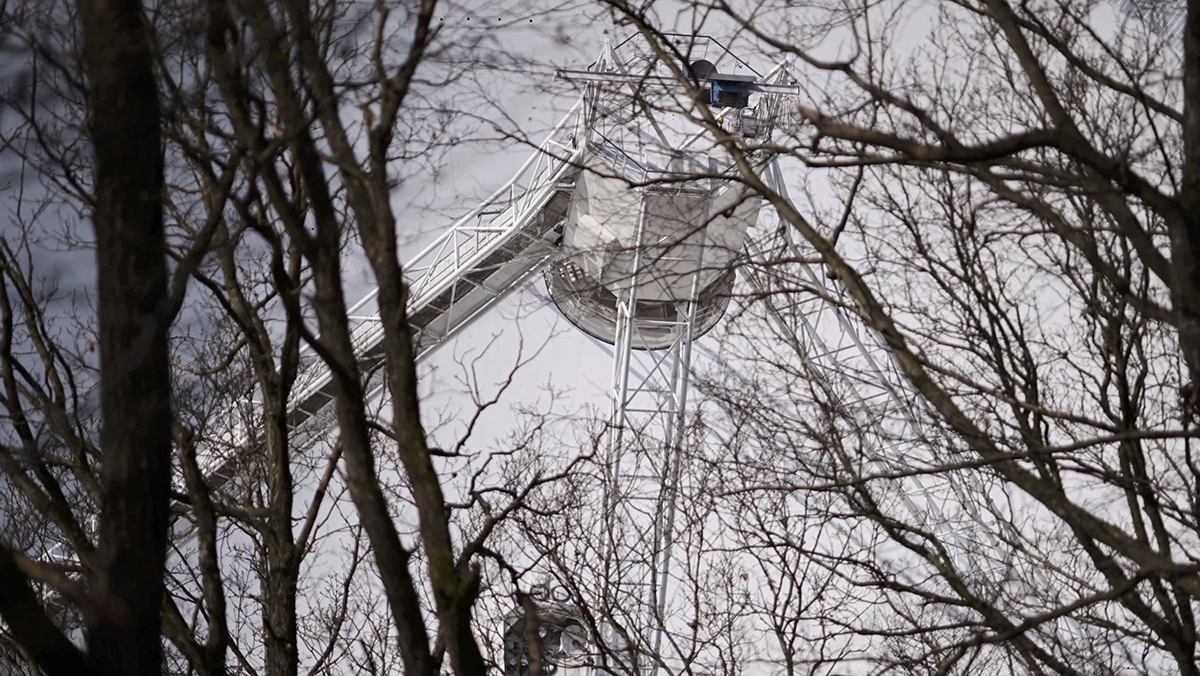
The work combines material from the Effelsberg radio telescope in Germany with my conversations with several geoengineering experts. Calm images are overlaid with discussions that follow a wide range of topics – questions about visual models and their real life impact, uncertain- ties connected to geoengineering, questions about power and CO2 mitigation, guesses about climate warming and the probability of stratospheric aerosol injection deploy- ment. The design of one of the world’s largest fully steerable radio telescope in Effelsberg is massive yet mechanically relatively simple. It is used to research distant territories far away from Earth, the formation of stars and the disap- pearance of matter into black holes. Also to detect radio waves from neighboring galaxies. I have chosen this as a research object in order to think about what can be perceived and understood through visibility? How visual simplicity fails to convey the complexity of such sets of relationships? Or how to think of inconceivable scales? Effelsberg stems from my research about solar geoengi- neering, that theoretizises the idea, that it will be pos- sible imitate the activity of volcanoes and thus reduce climate warming. One of the most scientifically studied processes describes the spraying of large amounts of aerosols into the stratosphere, where they would scatter the sun’s radiation and thereby reduce the amount of energy reaching the earth’s surface. It would be a delib- erate intervention in the global climate system, it would have to be done for about a few hundred years, and its fully realised form could not be interrupted without cata- strophic consequences.
Ivar Veermäe (born 1982 in Tallinn, lives and works in Berlin) received a BA in photography from the Estonian Academy of Arts in 2009 and a MA in 2014 at Spatial Strategies department in Weissensee Kunsthochschule Berlin. He has received various scholarships and grants – Kunstfonds Arbeitsstipendium, Edith-Russ-Haus Media Art Grant, Elsa-Neumann-Stipendium Berlin and scholarships from Estonian Cultural Endowment. The artist has had solo exhibitions in Edith-Russ-Haus, Oldenburg, Germany, Gallery im Turm, Berlin, Tallinn Art Hall Gallery, City Gallery of Tallinn, Estonia, AV17 Gallery in Vilnius, Lithuania, Cultural Center Belgrade in Serbia, among others. His work has been exhibited in group exhibitions at Riga Biennale, BIENALSUR in Buenos Aires, Venice Architecture Biennale, transmediale Festival in HKW, Moscow Biennale for Young Art, the Bozar in Brussels, the ZKM in Karlsruhe, Rijksmuseum Twenthe, Netherlands, the Art Museum of Estonia, Art Hall of Tallinn, the Estonian Contemporary Art Museum, the Kulturhuset Bronden in Denmark, the Kunstverein Kassel, the Latvian Centre for Contemporary Art, the Kunstverein Wolfsburg, the Pinnacles Gallery in Australia. His videos are being screened at the Rencontres Internationales in Paris and Berlin, in HeK Basel, transmediale Festival, e-flux.com, MoMa web platform, AND Festival in Manchester, EMAF in Osnabrück, Kasseler Dokfest, Crosstalk festival in Budapest, in Virtual Memorial, Cambodia.

Ivar Veermäe
Our Word Our Bond
Doc. expérimental | hdv | couleur | 14:14 | Estonie, Allemagne | 2017
The film is a journey of tracing the former Baltic Exchange´s building. 1903 it was built in neoclassical Edwardian style in the centre of London and 1992 destroyed by Provisional IRA´s biggest car bomb to the date. After the bombing there were plans to attach parts of Baltic Exchange´s house to a new building in the same location. Before dismantling it was fully documented and catalogued. These plans never materialized and in 2006 two estonian businessmen bought the facade and parts of the trade hall wanting it to be rebuilt in Tallinn. The stones were sent to Estonia, where they have stayed in shipping containers over 10 years (with the exeption of the facade sculptures, which were used in a project by estonian architects and artist in 2016). After the real estates developers won dispute with conservationists Foster and Partners iconic “ Gherkin ” - Swiss Re-s building has been constructed in the former Baltic Exchange´s site. Tracing the stones and the story of former building, in Estonia and London, leads to unpredictable outcomes. For example, terrorist attack being economic consideration; real estate boom in London; redesign of city space by incorporating anti attack measures.
The work of visual artist Ivar Veermäe (born 1982 in Tallinn, Estonia; lives in Berlin) circles around questions of public and private space, mediation processes, architecture and infrastructure, information technology and networks. As a result of long-term artistic research by means of photography, film and sound, his works are presented in versatile ways (such as video, on-site installations, interactive works and performances, also in public space). Ivar Veermäe aims to document and analyze the infrastructure underlying our contemporary culture of data and information. Concentrating on physical and local presence, confronting it with its representations creates a possibility for questions and doubts. His interest lays in hidden or stealty qualities of various spaces and objects. He has had solo exhibitions in Edith-Russ-Haus, Oldenburg, Gallery im Turm, Berlin, Freies Museum Berlin, City Gallery of Tallinn and Hobusepea Gallery in Estonia, among others. His work has been exhibited in group exhibitions at transmediale Festival in HKW, Venice Architecture Biennale, Athens Digital Arts Festival, Moscow Biennale for Young Art, the Bozar in Brussels, the CNB Contemporánea in Buenos Aires, the Zentrum für Kunst und Urbanistic, Forum Factory and Kleine Humboldt Gallery in Berlin, the Art Museum of Estonia, Art Hall of Tallinn, the Estonian Contemporary Art Museum, the Latvian Centre for Contemporary Art, the Kulturhuset Bronden in Denmark, the Old Sugar Factory in Groningen, the Kunstverein Wolfsburg, the Kunstverein Kassel, the Pinnacles Gallery in Australia.

Ana Vega
3 shades (She blue, red, yellow)
Vidéo | hdv | couleur | 12:18 | Italie | 2014
Une Mercedes-Benz blanche dérobe la vedette à un pare-soleil. Elle (she) existe en trois modèles. Tourné en 2014 entre San Francisco, Los Angeles et Pismo Beach pour l’exposition I want to Live in Los Angeles / Not the one in Los Angeles au Torrance Art Museum (LA), le film est écrit en trois volets : trois figures, trois créatures dans leur environnement artificiel. D’une durée approximative de deux cents trente secondes, chaque volet se déploie telle une bannière pop-up, agissant comme un interlude publicitaire à l`intention trouble. Les films opèrent d`un amalgame de langages - cinématique, publicitaire, stratégie marketing, clip - auxquels ils n’adhèrent jamais tout à fait, et qui s`annulent par l`illisibilité de la résultante.
Ana Vega (1987) est diplômée de l’École nationale supérieure des Beaux-Arts de Paris (2012) et de l’ENSAAMA – Olivier de Serres à Paris (2008). Elle a également étudié la vidéo au CIEVYC à Buenos Aires. Depuis 2013, elle séjourne régulièrement en Californie dans le cadre de résidences de recherche et de production : Dickerman Prints à San Francisco ; 18th Street Arts Center et Commonwealth & Council à Los Angeles. Elle a participé à l’été 2014 à deux expositions à Los Angeles : Outside crease of elbow à Commonwealth & Council, en duo avec l’artiste Gina Osterloh, et I want to live in Los Angeles/not the one in Los Angeles au Torrance Art Museum, lors de laquelle elle a bénéficié de la publication d’un catalogue aux éditions du Torrance Art Museum. Son travail a été montré à Paris lors de l’exposition collective SUPERNATUREL (commissariat : Neïl Beloufa) à la Fondation Ricard en 2014, puis à la galerie Florence Loewy pour la Collection Joseph Kouli, ainsi qu’au Centquatre dans l’exposition Dépaysements (commissariat : Gunnar Kvaran) en 2013. En 2015, elle présente double décor (commissariat : Alexandre Quoi) en duo avec l’artiste Eléonore False, une exposition en deux temps, au centre d’art de l’Hotel de Gallifet, Aix-en-Provence, puis à la galerie Escougnou-Cetraro à Paris. En l’été 2015, Ana Vega projette son dernier film à cette même galerie, et participe, dans le cadre d’une exposition personnelle, à la programmation satellite du centre d’art Image/Imatge, ainsi qu’à l’exposition collective Acts of Transmission (commissariat : Sarina Basta) au Palais des Beaux-Arts de Paris. L’artiste prépare actuellement un nouveau projet filmique.

Ana Vega
Where Are We Going? (Hey Siri)
Vidéo | hdv | couleur | 13:59 | Argentine, France | 2018
Voix flottantes dans un espace que l'on devine par oscillations. Sorti.es faire une course, les deux protagonistes s'égarent dans les contextes historiques de l'objet qu'elles.ils cherchent, s'émeuvent et se désillusionnent des rapports humains, passent du temps ensemble et se trouvent des compagnons de voyage. Une séquence en clair-obscur, abstraite et figurative, qui suit les trajets d'une conversation entre personnages invisibles et incorporels, le temps d'un itinéraire indécis. Where do you want to go? I'm sorry, I can' t answer that. Where are we going? Here's what I've found : _ Un jeune homme et sa mère, Robin, Siri, Siri, Chris C. et d'autres.
Ana Vega (née à Bahia Blanca, Argentine, 1987) est une artiste qui vit et travaille à Paris et Saint-Ouen. Elle a étudié à l'Ecole Nationale Supérieure des Beaux-Arts de Paris et à l'école Nationale Supérieure des Arts Appliqués et des Métiers d'Art de Paris ; à Carnegie Mellon University, Pittsburgh (USA) ; à Pittsburgh Filmmakers Center for the Arts, Pittsburgh (USA) ; au Centro Cultural Rojas (Buenos Aires). Elle participe à l'exposition collective « Mademoiselle » curatée par Tara Londi au Centre Régional d'Art Contemporain à Sète (2018-19). Son travail a été montré en 2017 à Arondit, Paris ; au Centre d'Art Contemporain Chanot (Clamart) ; à Arnaud Deschin Galerie (Paris) ; à Vidéobox#4, Carreau du Temple, Paris ; la La Salle de Bains, Lyon, FR ; Festival d'art vidéo de Carcassonne, Cinéma le Colisée, Carcassonne, FR ; et précédemment, notamment au 22 rue Muller, Paris, 2016 ; au Festival vidéo les Rencontres Internationales à la Gaîté Lyrique, Paris, 2016 ; au centre d`art Image/Imatge, Orthez, FR, 2015 ; au Palais des Beaux Arts, Paris 2015 ; à la galerie Escougnou-Cetraro, Paris, 2015 ; à Commonwealth & Council, Los Angeles, USA, 2014 ; Torrance Art Museum, Los Angeles, 2014 ; à la Fondation Ricard, Paris, 2014 ; à la Galerie Florence Loewy, Paris, 2013 ; au Centquatre, Paris, 2013 ; à la Dickerman Gallery, San Francisco, USA, 2013 ; au 58e Salon de Montrouge, Le Beffroi, Montrouge, FR, 2013 ; à la Fondation Rosenblum, Paris, 2012.

Mateo Vega
Center, Ring, Mall
Film expérimental | 16mm | couleur | 17:29 | Pérou, Pays-Bas | 2022
A multi-vocal triptych through peripheral sites of urban infrastructure: a data center, a ring road, and a run-down mall. All three sites were built with certain worldviews: visions of the future and promises of progress that didn't turn out to be the utopias they presented themselves as. Through multi-lingual texts, a site-specific soundtrack, 16mm and 3D images, the spaces and their implications are subjectively mapped, poeticized and questioned. A poetic materialism of decay, renewal, remembering and projecting, "Center, Ring, Mall" is perhaps a mourning, but one that desires and demands a rebirth.
Mateo Vega (1994) is a filmmaker and artist from Peru raised in Amsterdam, and a graduate of Sandberg Instituut, Amsterdam University College and The New School. The starting point of their work is the subjective experience of (urban) space, and the politics, histories and futurities embedded in landscapes, architecture and infrastructure. Their films and installations have been supported by Mondriaan Fund, Netherlands Film Fund, Amsterdam Fonds voor de Kunst, and shown at places like MoMA, Film at Lincoln Center, International Film Festival Rotterdam, Framer Framed, Amsterdam Museum, and Theater Rotterdam.
Carlos Velandia
La mujer como imagen, el hombre como portador de la mirada
Film expérimental | dcp | couleur et n&b | 7:20 | Colombie | 2022
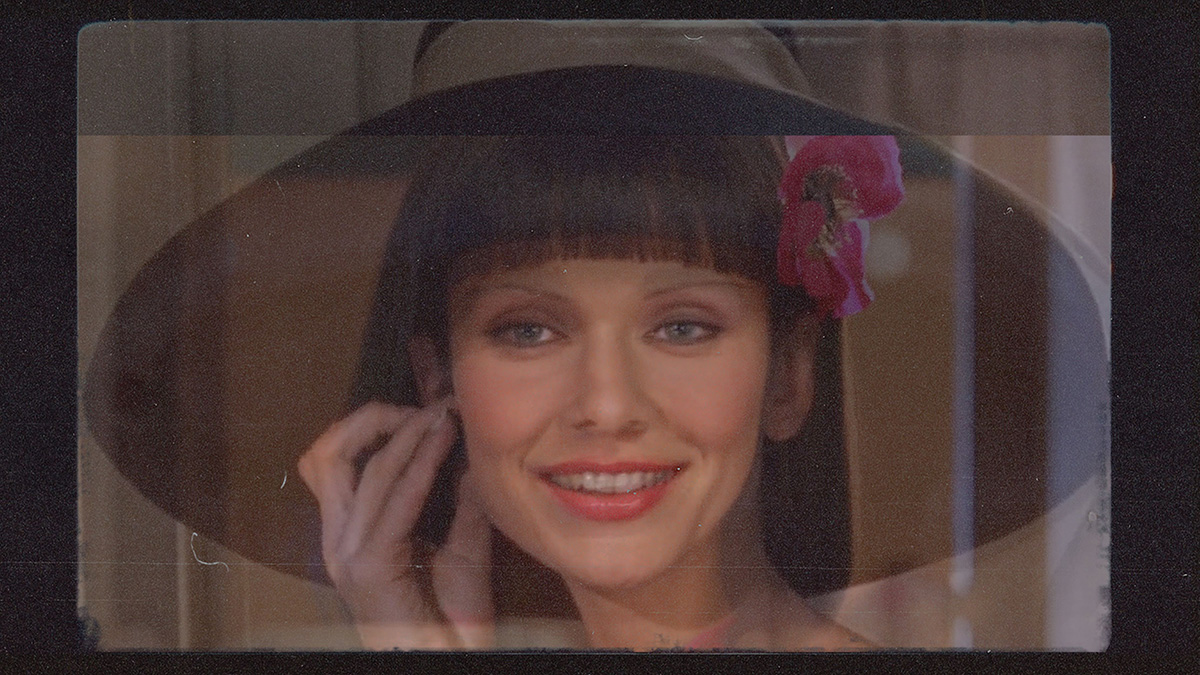
Faces, bodies and actions are juxtaposed endlessly. Fragmented pieces of the woman come together and form the volume of what has been her image in the history of cinema; one marked by the routinary domination and exploitation of her body.
Colombian moving image artist and film curator whose work focuses on feminism, anticolonialism, experimental-expanded animation and new technologies. His work has won the ZINEBI Grand Award (Oscar Qualifying) at Bilbao International Festival of Documentary and Short Film, the Silver Lynx Experimental Award at FEST - New Directors | New Films and has premiered several times at Annecy International Animation Festival.

Javier Velazquez Cabrero, Xolisile Bongwana
The Loop
Vidéo | hdv | couleur | 4:20 | Espagne, Afrique du sud | 2018
We get in touch with the creative processes of both artists. At the beginning of the video, we see a small interview with Xolisile, which shows how the previous interaction was. He does not want to verbally negotiate his interests, proposing an exclusively corporal dialogue. When asked about his opinion on the system of rules with which is proposed to work, Xolisile continues with an enigmatic and powerful career that works as an escape and as a response at the same time.
Martijn Veldhoen
Public spaces
Fiction expérimentale | dv | couleur | 10:0 | Pays-Bas | 2006
Il fut une époque où ?l?espace public? était un concept bien défini. C?était une sorte de moyen d?expression démocratique auquel tout le monde avait accès, disponible en toute sécurité et en toute liberté et qui permettait les échanges entre les personnes. Aujourd?hui les choses ont changé ; grâce aux systèmes de télécommunication, on emporte notre espace personnel avec nous, comme une bulle d?air, et la sphère publique est devenue un ensemble de sous-ensembles. Tout le monde est connecté en permanence à quelque chose ou quelqu?un d?autre, de sorte que l?espace de séparation prend une forme virtuelle propre à elle-même, qui change constamment avec le temps. Il reste entre les sous-ensembles quelque chose qui a les caractéristiques d?un vide qui génère des forces. Il aspire un grand nombre d?individus qui ne peuvent pas ou ne veulent pas ?participer?, ou qui n?ont pas accès ou ne veulent pas avoir accès aux moyens qui permettent de connecter les bulles individuelles entre elles. Veldhoen nous montre comment notre perception de l?espace publique a changé, nous ne le percevons plus du tout comme un endroit sûr. Bien que la voix off ait adopté un ton contemplatif, il reste un sentiment de menace et de paranoïa ; on peut lire le mot ?Bombe? sur un mur, comme un graffiti. Les personnages principaux se déplacent dans un espace que Veldhoen a représenté grâce à une sorte de technique de ?photographie en mouvement? grâce à laquelle une image en deux dimensions devient une image en trois dimensions et commence à bouger. On voit des images révélatrices d?un train, d?une station de métro et d?un marché. C?est une série ?d?endroits coupables?. On ne peut pas voir les ?suspects habituels?, mais le temps continue de s?écouler impitoyablement et l?événement annoncé aura lieu.
Martijn Veldhoen est né en 1962 aux Pays Bas. Son travail a été exposé dans des endroits tels que le CaixaForum Palma à Palma de Majorque, Le Fresnoy, Studio national des arts contemporains à Tourcoing, la Sala Rekalde à Bilbao, la Fundación La Caixa - CaixaForum à Barcelone, le National Museum of Contemporary Art (MNAC) à Bucarest, le Kunstmuseum de Bonn, la Dorottya Gallery à Budapest et la Städtische Galerie im Buntentor à Brême.
Martijin Veldhoen
Why do I keep going - FORWARD
Vidéo expérimentale | dv | couleur | 6:0 | Pays-Bas, Pays-bas | 2004
Qu´il est bon d´avancer. Avec le vent dans les cheveux sur le pont d´un bateau ou sur la plateforme d´un wagon de marchandises - lorsque le paysage commence à défiler de plus en plus vite devant vos yeux, botre corps sait que vous vous dirigez vers le futur. Mais pourquoi est il tellement agréable d´avancer? "(pourquoi est-ce que je continue à) avancer" commence par cette question, mettant immédiatement en relation la sensation s´aller de l´avant et le `progrès`. Alors que des images enregistrées à bord de trains, bateaux, avions défilent devant nos yeux, on peut ontendre quelqu´un qui pense tout haut; quelqu´un qui se pose des queestions. Des questions sur notre amour de la nature et de la culture en tant que sources d´harmonie et de civilisation: la nature et la culture ne sont elles pas régies par les mêmes lois qui s´appliquent à l´économie? les évolutions qui ont conduit à faire nager les poissons, et à faire prospérer Venise sont elles différentes de celles qui alimentent la frénésie du monde des affaires à Manhattan? `Le progrès" présuppose une direction et un but, mais ni l´un ni l´autre n´a vraiment d´importance comparés à ce qu´on ressent à bord d´un train ou d´un bateau en mouvement. En avant ou en arrière dépend de la direction dans laquelle vous regardez; et en ce qui concerne le ´progrès´, la direction n´a en fin de compte pas plus d´importance tant qu´il y a du mouvememnt.
Veldhoen a reçu plusieurs bourses de la fondation BKVB et de la fondation Mondrian. Il a vendu plusieurs de ses oeuvres à des collections privées ou des sociétés, parmi lesquelles la collection de la banque ABN-ARMO et le Bouwfonds Nederlandse Gemeente. En 1999 et 2000 il travaille en tant que professeur invité à l´académie d´art Minerva (Groningen) et au HKA (Arnhem). En 2003 il fait partie du jury décernant les prix LSVB et René Coehlo. Les services d´"expert Extérieur" de Martijn Veldhoen ont été demandés à plusieurs reprises pour des examens de fin d´année de plusieurs académies d´art (AKI; Enschede, Institut Frank Mohr, Groningen, entre autres)
Nikos Veliotis
ObJet
Art vidéo | dv | couleur | 11:28 | Grèce | 2004
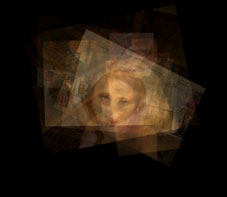
Le contenu de "obJet's" consiste entièrement en images pornographiques de basse résolution. Cet "objet trouvé" pornographique a été téléchargé sur internet à la suite de douzaines de spams offrant des images gratuites. Peu de temps après avoir rassemblé ces images, le compte a été détruit car, en raison du nombre important de spams, il n'était plus gérable. La vidéo s'emploie à ralentir radicalement le rythme frénétique des rapports sexuels tirés de films pornographiques se déroulant à l'écran, en utilisant un simple procédé d'animation : des couches multiples de photos suivent lentement les mouvements d'un balancier. L'animation entraîne l'apparition continue de parties du corps disloquées et de visages qui émergent au sein d'une confusion mouvante qui les lie, juste avant d'être avalés par la vague d'images suivante. La superposition d'images dissimule autant qu'elle expose. Il n'y a que les parties de visages et de corps qui suggèrent une réalité à plusieurs couches invisible à l'oeil nu.
Nikos Veliotis est né à Athènes, Grèce, en 1970. Artiste vidéo prisonnier dans le corps d'un musicien, il travaille sur des revêtements statiques de déchets numériques et autres matériaux numériques trouvés (par internet ou par des diffusions) combinés avec un son live ou le silence. Il travaille également dans le domaine de la musique comme violoncelliste et artiste vidéo.

Javiera Veliz, -
Vivir allì no es el infierno, es el fuego del desierto. La plenitud de la vida que quedó ahí como un árbol
Documentaire | hdv | couleur | 58:34 | Chili | 2018
This documentary is about the wind, birds, sweat, hands, a wheelbarrow, drought and burial. Could it be possible to disappear in the desert? Totoral is a town that disappears between its hills. a town that was born and raised by the land, by their animals and by survival. The desert is constantly mutating, the trees get drier and the men get older. These men, together with their animals, erase their footprints and their passage through time.
Javiera Véliz Fajardo est née en 1986, à Copiapó, région d?Atacama, nord du Chili. A suivi d’études en Beaux Arts et cinéma à Santiago. En 2011, avec Bárbara Pestan crée la société de production Pocilga. En 2013 continue ses études à la EICTV à Cuba. En 2015, réalise un master en direction photographique à la ESCAC, en Espagne. Elle a travaillé en plusieurs projets en tant que réalisatrice, productrice et chef opérateur. Son documentaire “Habiter la-bàs n'est pas l'enfer, c'est le feu du désert, la plénitude de la vie qui est resté là comme un arbre”, a eu sa présentation en cinema du Reel 2019, prix tenk distribution. Actuellement elle réalise son deuxième long métrage “Agua Marina”.
Vangjush Vellahu
Land X
Vidéo expérimentale | 4k | couleur | 23:41 | Albanie, Somalie | 2022
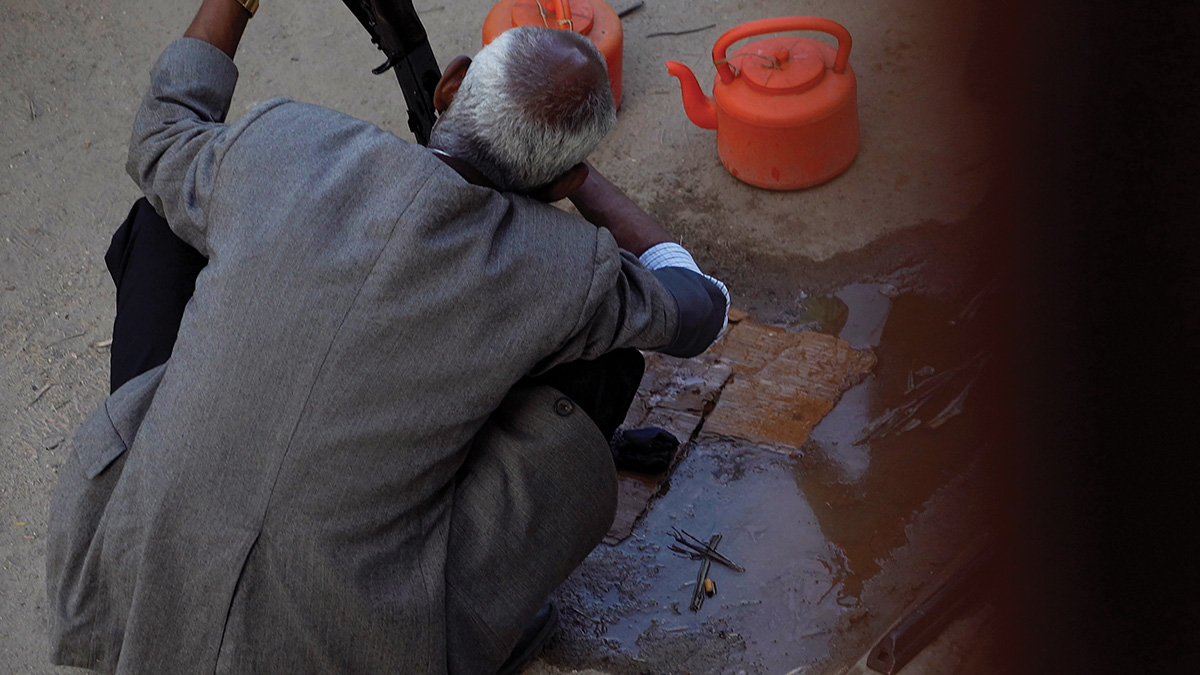
This video was filmed in February 2022 from one of the rooms at Oriental Hotel in the city center of Hargeisa, interfering in a way in between the two opposing positions to a place that it is being referred to as fictional and real at the same time. -Position One: I was never here and therefore I never filmed this video, these images don't exist because this place doesn't, the hotel, the buildings around, the people and that military entity. The filming took place entirely somewhere else. -Position Two: I certainly was here and therefore I certainly filmed this video, these images do exist because this place does, the hotel, the buildings around, the people and that military entity. The filming took place entirely in Somaliland. Both of this positions emphasize two points of political actions, one being exterior and the other interior.
Vangjush Vellahu born in 1987 in Pogradec, Albania, lives and works between Berlin and Tirana.

Vangjush Vellahu
A Tool of Resistance
Vidéo | hdv | couleur | 29:55 | Albanie, Allemagne | 2020
Cette installation vidéo à deux canaux est une introduction à ce qui se passe en Cisjordanie, entre les Palestiniens et l'armée israélienne. Cette installation vidéo est conçue pour raconter la réalité quotidienne des Palestiniens en général, à travers l’exemple précis de la ville d'Hébron et de sa résistance à l'armée israélienne. Pour développer ce récit, l'artiste s'est rendu dans la région, où il est entré en contact avec Human Rights Defenders, un groupe local qui utilise la caméra et les enregistrements vidéo comme outils de résistance pacifique. Cette installation vidéo contient principalement des séquences filmées par l'artiste, mais aussi d'autres documents d'archives, donnant un aperçu de l'histoire et de la réalité palestiniennes. Cette réalisation explore le rôle et la nature de la caméra et de la vidéo, en particulier en situations de conflit et d'oppression. Elle fait partie d’une série en cours intitulée "Fragments", que Vangjush Vellahu a réalisée depuis 2015 dans différents territoires affectés par de longues années de conflits gelés.
Vangjush Vellahu est né en 1987 à Pogradec (Albanie), et vit et travaille actuellement entre Tirana (Albanie) et Berlin (Allemagne). Dans son travail, il s'intéresse au voyage comme moyen de récolter et de raconter des histoires. Ses œuvres entremêlent les histoires urbaines d'entités qui, d'un point de vue idéologique et politique, restent en marge, inconnues. En 2018, il a publié son premier carnet de voyage, "Fragments I - Where stories cut across the land", qui a accompagné l’exposition vidéo solo portant le même titre. Ses œuvres ont été exposées, entre autres, au Times Art Center, Berlin (Allemagne); au Museu d'Història de Catalunya, Barcelone (Espagne); au Museum of Modern and Contemporary Art, Rijeka (Croatie); à la Škuc Gallery, Ljubljana (Slovénie); au Hamburger Bahnhof, Berlin (Allemagne); au State Museum of Contemporary Art, Thessalonique (Grèce); au MACA – Museum of Contemporary Art of Acri (Italie); à la National Gallery of Arts, Tirana (Albanie); au National History Museum, Tirana (Albanie) et à la Galerie nationale de Prague (République tchèque).

Dimitri Venkov
Krisis
Doc. expérimental | 4k | couleur | 32:26 | Russie | 2016
The video Krisis is a reenactment of a facebook discussion among Russian and Ukrainian artists, which took place in December 2013 upon the tear-down of the statue of Lenin in Kiev during the early stages of the Maidan protests. The discussion unfolds at a pivoting point in modern history. In fact, it occurs at the very moment when History bursts into the scene as a force surpassing individual actors and dragging them into its course in an indefinite capacity somewhere between that of a witness and participant. Krisis should also be understood here as trial or judgment, where twelve jurors debate the meaning of the historical event but fail to pass a verdict. Just as with Pilate’s judgment of Jesus, the decision is not reached and the trial takes on “a continuous and implacable course, an incessant passing and progress through time.” The historical crisis is bound to last like trauma in psychoanalysis: separated from its original context, it reappears in pathological forms in every sphere and at every moment. Structurally and thematically it is a remake of the Sidney Lumet film “Twelve Angry Men.” This classic is an idealized image of the American democracy based on inclusiveness. In the film Krisis the situation is reversed: although the characters belong to the same circle or community, their positions are irreconcilable and mutually exclusive thus making a compromise impossible. There is no way out of this argument but to split apart. The film Krisis plays out a metaphor of a society divided by history, politics, and aesthetics. New challenges further polarize it and augment its internal contradictions revealing a crisis as a state of imminent threat that the society presents for itself.
Dimitri Venkov (born 1980) is a video artist and filmmaker working across art, film, and academic institutional contexts. His works have been presented at Vth Moscow Biennale, First Bergen Assembly, Hayward Gallery, Kino der Kunst, Documenta 14,Oberhausen and Moscow Film Festivals, and others. In 2012 he received the Young Artist Kandinsky Prize for his film Mad Mimes. He was nominated for the Moscow Innovation Prize and St. Petersburg Kuryokhin Prize. Dimitri is a professor of videoart at Moscow Rodchenko School of Photography and Multimedia and has lectured at Yale University, Moscow State University, Moscow Art and Multimedia Museum.

Devis Venturelli
Unframed
Vidéo | hdv | couleur | 4:22 | Italie | 2018
In "Unframed", the city is object of observation from inside a nebula black, floating, cavernous, mysterious. As in the depths of a primordial cave, the urban overview is fragmented in a collage-city in form of video. The drone unveils the Milan urban fabric with its patterns, grains and densities: from historical city emerges a new contemporary skyline. "Unframed" investigates the possibility to create images with mobile and fluid outline, an aerial view, sinuous and oscillating, in an incessant fluctuation. "Unframed" documents the odeporic approach of the contemporary culture in which the perception is an idiomatic overview.
Born 1974 in Faenza, Italy. He lives and works in Milan, Italy. Multi-disciplinary artist and architect, in his practice he uses the languages of video, performance, sculpture and installation to document ephemeral architectures and temporary utopias. He has taken part in solo and group shows in institutions such as Lincoln Center for the Performing Arts, New York; Antology Film Archive, New York; PAC, Milan; Medialab-Prado, Madrid; Museo de Arte, Lima; Xinjiang Biennale; MACRO, Rome; Kulturhuset Museum, Stockholm; MMOMA - Moscow Museum of Modern Art, Moscow; Ace Gallery, Los Angeles; Angel Orensanz Foundation, New York; Istituto Italiano di Cultura, Amsterdam; Spazio Oberdan, Milan; Fondazione Sandretto Re Rebaudengo, Turin; Kunsthalle, Wien; Stadtgalerie, Kiel; Centre d'Art Santa Monica, Barcelona; Fondazione Merz, Turin; Kunstverein, Augsburg; National Museum, Wroclaw; Mart - Galleria Civica, Trento; Galleria Nazionale d'Arte Moderna, Rome. In 2013 he presented the film project Luciano Berio/Devis Venturelli/Tempo Reale. In My End is My Music produced by Fondazione Romaeuropa. His videos and experimental films have been screened in International Film Festivals including Dance on Camera Festival, Videoformes, 25FPS Experimental Film Festival, FIVA - Festival Internacional de Video Arte, Romaeuropa Festival, Tehran International Short Film Festival, Regensburg International Short Film Week, New Filmakers NY.

Borjana Ventzislavova
Gesellschaftsspiele
Vidéo | hdv | couleur | 15:55 | Autriche | 2021
Games are generally defined through agreements—rules, within the framework of which, a certain degree of freedom reigns, but also compelling constraints. Many of these conventions are not explicitly identified as such, for example, how earnest one should be, or how much inner distance to keep. And a game does not at all define the more precise (individual, social, etc.) characteristics that participants should display in order to be among the players. For that reason, it is incredibly perplexing to see the adults in Borjana Ventzislavova’s Gesellschaftsspiele / Real Games in relations of play that we generally dismiss as puerile. In clever montages with players who appear deliberately misplaced or “miscast,” the film expands five of these contexts; or rather, interlocks them in such a way that we are rendered witnesses to an uncanny alienation. The nursery rhymes recited with a wink of the eye at the start are merely gentle harbingers of the dead serious shooting game with blowpipe arrows played by a group of sophisticated ladies and gentlemen in the concrete column foundation of a massive building shell. No less ambiguous is the cops and robber game that adult, suit-wearing players engage in around a monumental memorial in Sofia. And another game that’s not so bad is the acrobatic Chinese jump rope enjoyed by three smartly dressed women in a closed school yard. Entirely enigmatic, on the contrary, is a group wearing only underwear who pursue an odd ritual around a quartz lamp sculpture in the film’s sole interior space—until it turns out that what they’re doing is nothing other (or perhaps entirely different) than a simple Ring-Around-The-Rosey. The film’s transfiguration and simultaneous unmasking, has a double effect: on the one hand, as recognition that even the most casual activities are controlled by some type of role playing; and on the other—which is perhaps even more sobering—that their symbolic contexts withstand even the cleverest infiltrations. Whereby freedom and compulsion can even boil down to one and the same thing at times. And that is, no least, what the “real” aims at; uncatchable, as it were, these revealing and at the same time enigmatic games. (Christian Höller)
Born 1976, Sofia, BG, currently based in Vienna and Sofia; graduated visual media art / digital art at the University for applied arts Vienna. She works in the fields of film/ video, photography, installation and new media. Her works have been exhibited internationally in solo and group shows as well at film and media art festivals.
Mario Verandi
Klang-Film
Doc. expérimental | dv | noir et blanc | 12:12 | Argentine, Allemagne | 2005
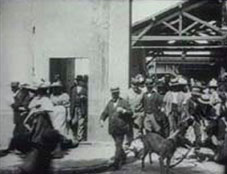
?La Sortie des Usines Lumière à Lyon? (1895) est le titre du premier film à avoir jamais été projeté en public. D´une durée de 45 secondes, il montre les ouvriers sortant d' une usine photographique appartenant aux frères Lumière, à Lyon. Dans son film "Arbeiter verlassen die Fabrik", Harun Farocki explore cette scène en utilisant l´histoire du film. Pour "Klang-Film", le film de Farocki à été re-monté en une version plus courte. La plus grande partie des dialogues ont été coupés au remontage, faisant du film quasiment un film muet. La musique, rajoutée par la suite, est donc devenue un élément nouveau et d'influence sur la forme, et elle ouvre une nouvelle dimension dans la perception des images. "Klang-Film" explore le conterpoint sensoriel des sons et des images, ainsi que leur interaction, ambiguité et heurts. Comment une musique particulière façonne-t-elle la perception des images? Comment les images façonnent-t-elles la perception d´une musique particulière? Dans son livre "Audio-Vision: Sound on Screen", Michel Chion avance l´idée que son et image sont toujours indépendants, et que seuls notre conditionnement et l´utilisation de nos conventions de synchronisation nous font croire que ce n´est pas le cas. Citons la métaphore éclairante du réalisateur français Robert Bresson : "Images et sons, comme des gens qui font connaissance en route et ne peuvent plus se séparer"
Mario Verandi (Buenos Aires 1960) à étudié la musique en Argentine, à Barcelone et à l´Université de Birmingham (GB).Les oeuvres de Verandis comprennent de la musique éléctroacoustique, des morceaux audiovisuels, des installations sonores et des travaux radiophoniques. Il était compositeur résident à La Muse en Circuit (Paris), au Studio Césaré (Reims), TU-studios Berlin, au ZKM (Karlsruhe) et invité du programme des artistes-en-résidence (artists-in-residence) à Berlin. Verandi a été récompensé entre autres lors de la Bourges Electroacoustic Music Competition (France), Musica Nova Competition (Prague), CIEJ Electronic Music Awards (Barcelona), Prix Ars Electronica (Linz), Stockholm Electronic Art Awards (Sweden), et ZKM European Bell Days Commission Prize (Germany). Ses oeuvres ont été jouées et diffusées dans le monde entier. www.marioverandi.de Harun Farocki est né en 1944 à Nová Jicin, dans la partie de la Tchécoslovaquie annexée par les allemands. Il a étudié à la Deutsche Film- und Fernsehakademie Berlin (DFFB) de 1966 à 1968. Aprés avoir occupé quelques postes d´enseignant à Berlin, Düsseldorf, Hambourg, Manille, Munich et Stuttgart, Farocki a été nommé au poste de professeur invité à l´Université de Californie, Berkeley, entre 1993 et 1999. Farocki a réalisé près de 90 films, dont trois longs-métrages, des essais cinématographiques et des documentaires. www.farocki-film.de

Bas Verbruggen
Environs
Film expérimental | 4k | couleur | 17:45 | Belgique | 2020
Dans un paysage désert où les animaux sont affectés par un grondement lointain, un personnage émerge. S'enfonçant plus profondément dans le monde sonore, les sons se mettent à vibrer, le temps perd lentement sa fonction, et une tempête se lève. Le personnage écoute attentivement, tandis qu'une tour sombre semble absorber ses souvenirs sonores.
Bas Verbruggen est né en 1997, à Anvers (Belgique). Il a commencé des études de cinéma à la KASK School of Art, Gand (Belgique), où il a obtenu son master en septembre 2020, avec le film "Environs". Il est fasciné par les formes absurdes dans le paysage quotidien (belge), se concentre sur l'expérience du son au cinéma, et réalise en général ses films seul et toujours dans la perspective d’une recherche audiovisuelle.

Matthieu Verdeil, Dominique POUPARDIN, Jérémie VAN QUYNH
Dans l’armure d’Abraham
Film expérimental | mov | couleur | 60:0 | France | 2020
Vêtu d’une lourde armure médiévale, Abraham traverse la Bretagne à pied, tel un Don Quichotte du XXIe siècle. Cheminant à travers champs et forêts, villes et villages, cet anachronique et farfelu chevalier suscite l’ébahissement de ceux qui croisent sa route. Il est accompagné dans son périple par le réalisateur, son Sancho Panza, devant et derrière la caméra. Ensemble, ils vagabondent, acceptent le gîte et le couvert qui leur sont offerts, ou bivouaquent sous les étoiles. Peu à peu, Abraham perd pied. Son armure devient sa Dulcinée. Absorbé par son œuvre, l’artiste s’efface finalement derrière le personnage qu’il a créé. Seul reste un chevalier errant menant une quête insensée.
Depuis 1997, Matthieu Verdeil travaille avec de nombreuses sociétés de production pour la télévision, la communication, les institutions et le web. Principalement en tant que chef-opérateur de prise de vue, mais également en réalisation et en montage. Son expérience est très diverse, allant de gros événements en direct, à des reportages réalisés seul en territoire inconnu, en passant par des magazines télé, des documentaires... Il a notamment réalisé des films commissionnés par le MuCEM – Musée des Civilisations de l’Europe et de la Mediterranée, Marseille (France); la Friche Belle de Mai, Marseille (France); le Centre National des Arts Plastiques, Paris (France); la KLAP - Maison pour la danse, Marseille (France); le Palais de Tokyo, Paris (France); le CIRVA - Centre international de recherche sur le verre et les arts plastiques, Marseille (France).
Matthew Verdon
Hugelkultur
Vidéo | hdv | couleur et n&b | 9:30 | Australie, Royaume-Uni | 2013
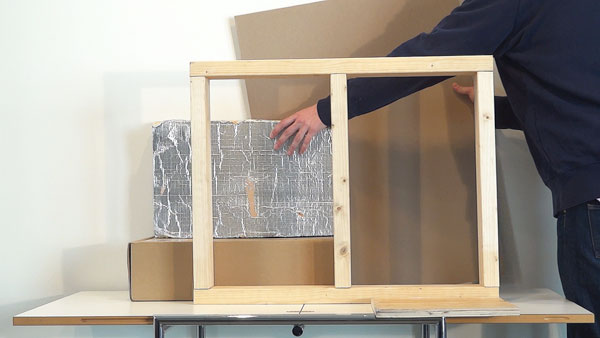
In 1963 a spiral staircase was built in Salvador, Brazil, by the architect Lina Bo Bardi as part of the transformation of an old mill into a museum of modern art. The design of this staircase was based on a vernacular technique for making ox cart wheels. The agricultural practice of hugelkultur involves burying large pieces of old wood that rot over time and subsequently become rich fertiliser, providing enhanced growing conditions for the roots of new plantings. A spoken narrative describes the proposed renovation of an old room in need of repair into a new room of unspecified end uses. Such varying but related notions of material transformation and adaptive re-use are featured in the present work as ways of thinking about how the ?new? is produced and the relationship of such production to the already existent. Featuring filmed, found and hand drawn footage, the video is based upon the idea of a spiral staircase, this being utilised for not only its content but also its form through the structural use of evolving repetitions and loops. The work draws on plant science, architecture and speculation to arrive at a questioning of function, progress and growth.
Born: Brisbane, Australia Lives & Works: London, United Kingdom