Catalogue > Liste par artiste
Parcourez la liste complète des artistes présentés dans le cadre des Rencontres Internationales depuis 2004. Utilisez le filtre alphabétique pour affiner vos recherches.
Christopher Messina
Catalogue : 2006Nightlight | Vidéo expérimentale | dv | couleur | 9:30 | USA | 2005
Christopher Messina
Nightlight
Vidéo expérimentale | dv | couleur | 9:30 | USA | 2005
Expérience utilisant la photographie numérique, "Nightlight" est une étude des nuits et des lumières le long de la Charles River à Boston, Massachusetts. L'?uvre est entièrement composée de photographies, dont l'assemblage donne l'impression qu'elles sont en mouvement. En réalisant des ajustements subtils entre chaque photographie prise, les lumières de la ville semblent prendre vie.
Né dans l'état de New York, Chris vit et réalise des films à Boston, Massachusetts.
Mathilde Mestrallet
Catalogue : 2007La règle du jeu | Vidéo expérimentale | dv | couleur | 3:50 | France | 2006
Mathilde Mestrallet
La règle du jeu
Vidéo expérimentale | dv | couleur | 3:50 | France | 2006
La règle du jeu fait partie d?une série de 8 vidéos nommée Errances. Ces vidéos interrogent le rapport de l?homme au paysage. Chaque projet a pour point de départ le déplacement physique, la découverte d?un lieu auparavant inconnu. L?artiste utilise son corps comme sujet, silhouette évoluant dans l?espace qu?elle investit, décidant de cadrages précis, plans fixes, paysages à traverser. On pourrait dire que ces vidéos tournent autour de rien, à vide, et que chaque vidéo est le résultat, récit, de la rencontre, expérience de ces espaces étrangers. La règle du jeu, Synopsis: Une jeune femme court le long des buissons, se cache, comme poursuivie, elle tente une échappée, un tir de fusil retentit et l?arrête dans son élan. Tuerie ludique, jeu d?enfant, la caméra tire sur sa victime.
Mathilde Mestrallet, diplômée des Arts Décoratifs de Strasbourg, réalise des projets vidéos où elle interroge la place de l?homme dans le paysage, la relation de l?homme à ce dernier. Elle s?intéresse aux différents parcours que propose un site. Les vidéos s?établissent sur des scénarios et mises en scènes simples: répétition d?une même action dans un lieu, marches, déambulations,jeux. L?expérience vécue, véritable rencontre avec le paysage, et la relation à l?espace, comme terrain inconnu, lieu étranger, territoire des possibles sont les points de départ de chaque projet vidéo. Entre «No man?s land» et architecture labyrinthique, les différents héros évoluent dans ces espaces surdimensionnés.
Toni Mestrovic
Catalogue : 2025Tisina | Film expérimental | 4k | couleur | 22:42 | Croatie | 2024
Toni Mestrovic
Tisina
Film expérimental | 4k | couleur | 22:42 | Croatie | 2024
Silence is the period between two compositions in the space of shipbuilding heritage with an uncertain future. Due to the long-standing process of restructuring and privatization, political interventions and the governing structures' corrupting malfeasances, the workers of the 3. maj (3rd of May) shipyard stayed at home without pay for a full year, and the production facility went silent. That moment of silence in a facility that is usually filled with sound is the starting point for the portrayal of a specific space and time. Revealing the beauty of the spatial and auditory narratives of an industrial space, in the absence of workers and work processes, contextualizes the frightening socio-economic consequences of the “silence” and “emptiness” phenomena. After months-long negotiations in the fall of 2019, production continues with an uncertain future.
Toni Meštrovi?, graduated with a Graphic Arts degree from the Academy of Fine Arts in Zagreb, where he produced graphic arts, sculpture and installation. Due to his interest in electronic audiovisual media, he studied Video/Digital Imaging at the International Summer Academy for Contemporary Art in Salzburg, and completed postgraduate diploma in Media Art at the Academy of Media Arts, Cologne. Since 1992, he has taken part in group and solo shows, as well as video/film festivals. He lives in Rijeka and Kaštela, and teaches at the Arts Academy in Split.
Barbara Meter
Catalogue : 2006Ariadne | Film expérimental | 35mm | couleur | 12:0 | Pays-bas | 2004
Barbara Meter
Ariadne
Film expérimental | 35mm | couleur | 12:0 | Pays-bas | 2004
Film constant de roues, frusques et pignons en hommage au loyen du film.
Barbara Meter, née en 1939 est allée à l'Académie néerlandaise du film en 1963. Elle fait des films depuis les années 70 : des documentaires, des films collectifs - principalement expérimentaux. Meter était la co-fondatrice d l'Electric Cinema au début des années 70, un bastion du cinéma expérimental néerlandais et la Stichting Lighthouse dans les années 80. A présent, elle travaille aussi dans la programmation de films, professeur et chargée de cours freelance sur les films.
Barbara Meter
Catalogue : 2009A Touch | Film expérimental | 16mm | couleur | 13:30 | Pays-Bas | 2008
Barbara Meter
A Touch
Film expérimental | 16mm | couleur | 13:30 | Pays-Bas | 2008
Ainsi donc, tout passe, comme le vent, comme les ombres et la fumée.
Barbara Meter, qui vit et travaille aux Pays-Bas, fait des films depuis les années 70, le plus généralement des films expérimentaux mais également des documentaires et des fictions. Elle enseigne le cinéma à Groningen (Pays-Bas) et au San Francisco Art Institute (USA). Elle a organisé de nombreuses projections de films expérimentaux, sans précédents aux Pays-Bas.
Henrike Meyer, Thérèse Nylén
Catalogue : 2009Still Leben | Installation vidéo | | couleur | 4:56 | Allemagne | 2008
Henrike Meyer, Thérèse Nylén
Still Leben
Installation vidéo | | couleur | 4:56 | Allemagne | 2008
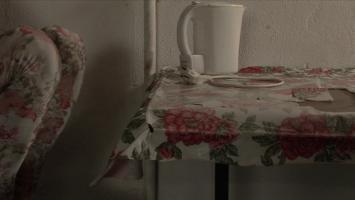
Les deux artistes se sont penchées sur la cave d?un restaurant d?asperges dans le Brandenburg. Pendant les trois mois que dure la saison, le restaurant offre l?hébergement à 150 ouvriers polonais. Le reste de l?année, les 30 chambres restent vides, à l?abandon. Elles produisent l?effet de capsules temporelles. Des fleurs en plastiques dans de grandes boîtes, des pages de calendrier griffonnés, des graffitis au mur, des torchons sur les tables sont autant de traces du passage des ouvriers. Des arrangements pleins d?histoires. Les prises de vues de ces arrangements et de la danseuse sont confrontées dans Le 2-Canal-Projection, et se motivent mutuellement dans leurs mouvements dans un échange mimétique.
Henrike Meyer est née en 1984 à Hoya dans le Weser. De 2003 à 2006, elle étudie le théâtre, l?histoire de l?art et la littérature à la Freie Universität de Berlin, puis jusqu?en 2008, la communication visuelle à l?Université des Arts de Berlin, et est actuellement en création expérimentale et médias dans cette même université. Elle vit et travaille à Berlin. Thérèse Nylén est née en 1976 à Malmö, en Suède. Elle obtient une licence en danse théâtrale moderne à l?Ecole Supérieure des Arts d?Amsterdam en 2001. En 2005, elle est sélectionnée pour partir en résidence à Scuol, en Suisse, avec le NAIRS Kuturzentrum, et à nouveau en 2007, cette fois avec le Werkbeitrag Tanz du canton de Luzerne. De 2001 à 2007, elle collabore à des projets avec, entre autres, Martin Butler (Pays-Bas), Suzanne Marx (Pays-Bas), Kyle Bukhari (Suisse), et Nina F.Schneider (Suisse). Elle vit et travaille à Berlin.
Agnes Meyer-brandis
Catalogue : 2023Have A Tea With A Tree - a video conference with trees | 0 | 0 | couleur | 0:0 | Allemagne | 2021
Agnes Meyer-brandis
Have A Tea With A Tree - a video conference with trees
0 | 0 | couleur | 0:0 | Allemagne | 2021
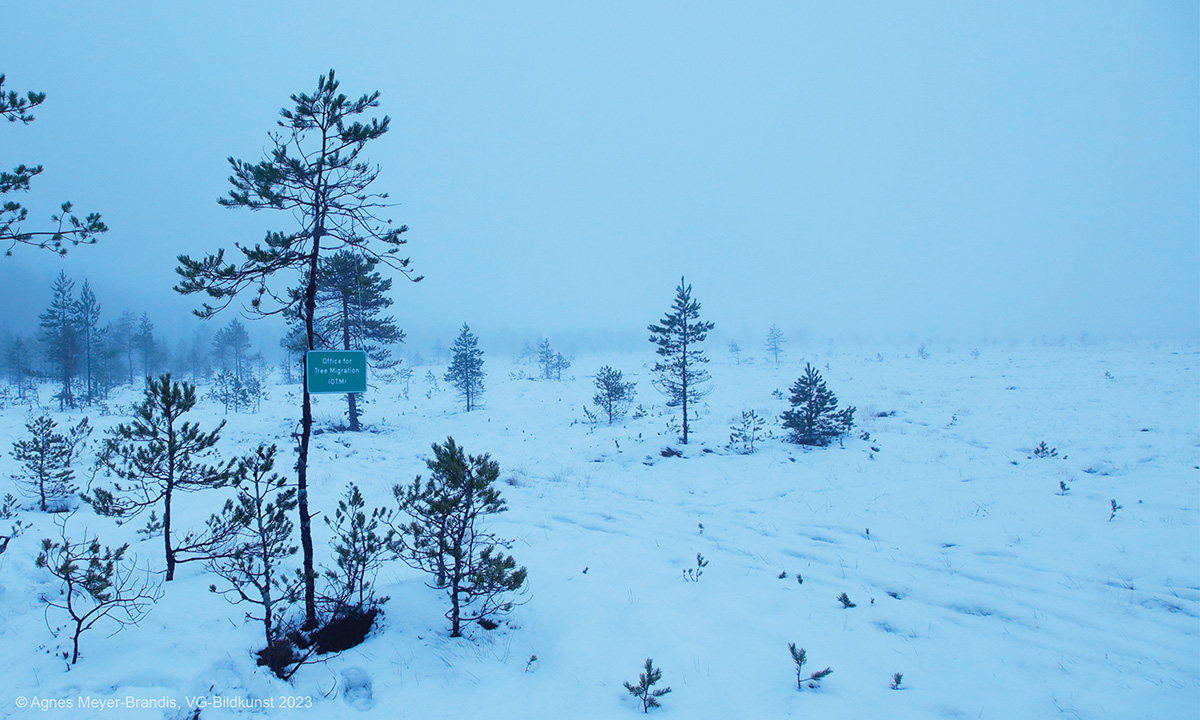
"Have a Tea with a Tree" is an online platform of the "Office for Tree Migration" where anyone can book an appointment for a video conference with 1-10 trees of different countries & climates for free. The trees will also participate live in the stream. The conferences are scheduled with one hour each. Besides the meeting with trees, these meetings can be extended and e.g. guests can be invited or scenes staged can be added. The OTM online platform thus becomes a hybrid field of experimentation between digital and analog worlds, humans, nature and technology. It can become stage, exhibition space, film, performance, reading, conference, and exchange between different forms of communication as well as life, play, explore.
Agnes Meyer-Brandis is a Berlin based artist with a background in sculpture and new media, She creates works on the fringes of science, fiction and fabulation. Educated first in mineralogy, followed by studies at the art academies in Maastricht, Düsseldorf and KHM Cologne, she has been the founder and director of the Research Raft, an „Institute for Art and Subjective Science“ that purposefully ‘is asking questions but gives no answers’ in fields such as climate research, environmental studies, meteorology, as well as synthetic and artistic biology. Meyer-Brandis’ work has been exhibited worldwide and awarded many prizes, including a Prix Ars Electronica Award of Distinction, and the European Kairos prize. Please find further info under the following link: www.ffur.de
Sebastian Mez
Catalogue : 2022DIE GROßE LEERE | Doc. expérimental | mov | couleur | 86:0 | Allemagne | 2021
Sebastian Mez
DIE GROßE LEERE
Doc. expérimental | mov | couleur | 86:0 | Allemagne | 2021
On a mysterious crackling magnetic tape, a “viewer” discovers shaky, low-definition images, which seem to have been shot during a moon landing. It is as if we had just landed on another planet, the desert—or rather deserted—landscapes of which, filmed in static shots, seem nonetheless familiar to us and encircled by a worry-ing strangeness. Traces of the past remain: rusty machines, pylons, human artefacts that multiply as the cameraman approaches what were towns, now plunged into absolute and silent desolation. Although Sebastian Mez (Metamorphosen, VdR 2013) shot the images of his new film before the pandemic that immobilised a large part of the world last spring, The Great Void is inevitably enshrined within the dystopic imagination disseminated across consciences by this global event. Composing a series of magnificently framed scenes, emptied of all living presence, the German filmmaker observes without blinking the agony of our civilisation. No more, no less.
Sebastian Mez is a filmmaker, video- and soundartist. His work has been shown at countless festivals worldwide and have won numerous awards. He studied film directing at Filmakademie Baden-Württemberg in Ludwigsburg, Germany. His short film CLEAN UP was shown at more than 40 international film festival and won several prices. Among others EIN BRIEF AUS DEUTSCHLAND won best middle length competition at Visions du Réel in Nyon in 2011. METAMORPHOSEN was his first feature length film, which premiered at the Berlinale 2013, followed by numerous festivals and awards worldwide. His experimental work SUBSTANZ was nominated for the Filmpreis für Filmkunst of the Neue National Gallerie in Berlin 2015. Sebastian lives and works in Berlin.
Catalogue : 2017Remains from the Desert | Doc. expérimental | 4k | noir et blanc | 21:10 | Allemagne | 2016
Sebastian Mez
Remains from the Desert
Doc. expérimental | 4k | noir et blanc | 21:10 | Allemagne | 2016
A cinematic examination trying to approach the experiences of Osman, a young Eritrean refugee, who survived seven months in one of the „torture camps“ in the Sinai desert.
Sebastian Mez is a filmmaker, video- and soundartist. He studied at FILMAKADEMIE BADEN-WÜRTTEMBERG in Ludwigsburg, Germany specializing in directing. His experimental film ‘Clean Up‘ was shown at more than 40 international film festival and won several prices. ’Ein Brief aus Deutschland’, which takes a special approach onto the subject of modern slavery and prostitution in Europe, won the international middle length competition at VISION DU RÉEL in Nyon in 2011. ‘Metamorphosen‘ was his first feature lenght film, which premiered at the Berlinale 2013, followed by numerous festivals and awards worldwide. His experimental work `Substanz` was nominated for the Filmkunstförderpreis of the National Gallery in Berlin 2015. Sebastian lives and works in Berlin.
Gitlin Michael
Catalogue : 2025The Night Visitors | Doc. expérimental | mov | couleur | 72:22 | USA | 2023
Gitlin Michael
The Night Visitors
Doc. expérimental | mov | couleur | 72:22 | USA | 2023
The Night Visitors is a movie about moths. In large and small fragments, looking both inward and out, through a critical lens that is by turns social and personal, the film closely examines these underknown creatures. While The Night Visitors is interested in moths as organisms, with fascinating life histories, staggering biodiversity, and a functional importance as indicators of climate change and habitat degradation, its engagement with them is not primarily entomological. Instead, the film looks at moths as aesthetic beings and as carriers of meaning, aiming for a deep encounter with the beauty and incommensurability of the profoundly other. The small hours of the night are threaded through with a sense of mortality and loss. Moths, with their trembling and exquisite impermanence, provide both a kind of solace and, in their diversity and difference, a focal point around which the desire to know can be organized.
Michael Gitlin makes work about some of the intricate conceptual and ideological systems out of which ways of knowing the world can be constructed. His films have screened at numerous venues, including the Museum of Modern Art in New York, the Toronto International Film Festival, the Full Frame Documentary Festival, the London Film Festival and the Whitney Biennial Exhibition. Gitlin’s experimental documentary, The Night Visitors, premiered at the 2023 New York Film Festival. His 2015 feature documentary, That Which Is Possible, screened at The Museum of the Moving Image in New York, the Museum of Fine Arts in Boston, and at the Pacific Film Archive in Berkeley, among other venues. His short film project, A Disaster Forever, was in the 2015 New York Film Festival. His 16mm film, The Birdpeople, is in the collection of the Museum of Modern Art. Gitlin was the recipient of a Guggenheim Fellowship in 2006. His work has also been supported by the Jerome Foundation, the New York State Council on the Arts, and the New York Foundation for the Arts. Gitlin received an M.F.A. from Bard College. He teaches at Hunter College in New York City.
Alice Michaud
Catalogue : 2023Au Pays des Morts Debout | Fiction | digital | couleur | 67:5 | France | 2022
Alice Michaud
Au Pays des Morts Debout
Fiction | digital | couleur | 67:5 | France | 2022
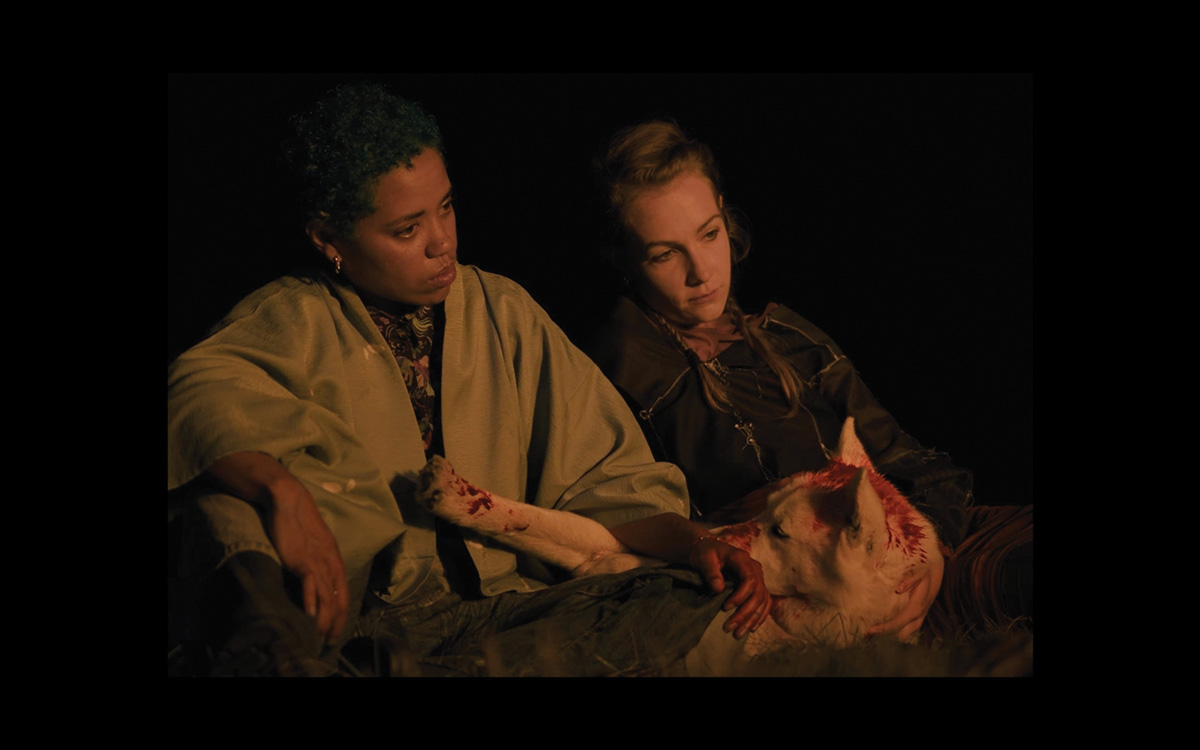
Quelque part, retirée du monde, une communauté vit langoureusement selon ses règles et ses croyances. Entre chansons et dîners festifs, l'apparente harmonie est bousculée lorsqu'une nouvelle venue fait son apparition. La mort frappe et plonge un à un les personnages dans des ténèbres glamour et glaçantes. Se saisissant des utopies queers pour les défaire, le film s’empare des esthétiques post-giallos et nous plonge joyeusement dans l’horreur.
Née en 1998 Alice Michaud est réalisatrice et étudiante à l’Ecole Nationale Supérieure des Beaux Arts de Paris Cergy, en 2023 elle y obtient son DNA avec les félicitations du jury. Sa démarche s’articule autour d’un jeu sur les codes des films de genre et visite parallèlement le camp et le poétique. Au pays des morts debout, son premier film lui vaut plusieurs sélections en festivals tels que le Fringe! Queer film and arts fest, à Londres, la FDS à Lausanne, le Leeds Queer Film Festival en Grande Bretagne ainsi qu’à l’Internacional Queer Film Festival Playa del Carmen au Mexique.
Philippe-alain Michaud
Catalogue : 2007Anthony Mccall | 0 | 0 | | 60:0 | France | 2007

Philippe-alain Michaud
Anthony Mccall
0 | 0 | | 60:0 | France | 2007
Désormais le film n'est plus cette image projetée qui creuse dans la surface du mur une profondeur fictive mais un champ réellement constitué qui se confond avec l'événement de la projection même. C'est ainsi que les faisceaux lumineux découpés dans la fumée d'Anthony McCall, développant les propriétés proprement plastiques du film, passent les frontières de l'histoire du cinéma pour rejoindre les propositions minimalistes de la sculpture des années 70. En 1975, Gordon Matta-Clark, dans Conical Intersect (une pièce conçue comme un hommage au film de McCall) pratique, au 27-29 rue Beaubourg, sur le site du futur Centre Pompidou, une gigantesque ouverture dans un immeuble voué à la démolition. En 1996, Pierre Huyghe, dans Light Conical Intersect rabat le film de Matta-Clark sur celui de McCall en projetant sur le mur de l`immeuble du quartier de l`Horloge, où s`élevait l`édifice investi par Matta-Clark, une image de Conical Intersect prélevée au moment où la lumière envahit la cavité conique pratiquée dans la façade : dans une coïncidence virtuelle parfaite, le dispositif architectural se résout en lumière et revient ainsi à son origine.
Depuis 2003, Philippe-Alain Michaud, historien et critique d?art français né en 1961, est conservateur, chef du service cinéma au Musée National d?Art Moderne (MNAM) de Paris où il a travaillé à l?exposition "Le mouvement des images - Art et Cinéma". Une présentation originale de la collection permanente du MNAM, dans laquelle il proposait une relecture de l?histoire du XXème siècle à partir de celle du cinéma. Son attention se porte sur les territoires situés entre les arts plastiques et le cinéma, il s'interroge sur les formes artistiques contemporaines et leur passé. En 2004, il fut l'instigateur de "Hollywood Déconstruit : remontages, remises en scène, resucées" au cinéma du MNAM. Un cycle témoignant de la manière dont les cinéastes expérimentaux et les artistes ont revisité l'univers du cinéma hollywoodien. Auteur, il a rédigés de nombreux articles et ouvrages, dont "Le peuple des images" et "Sketches. Histoire de l?art, cinéma". Il est membre du comité de rédaction des Cahiers du MNAM et responsable de la collection "La littérature artistique", aux éditions Macula.
Ariane Michel
Catalogue : 2014Le dernier voyage | | | | 14:58 | France | 0
Ariane Michel
Le dernier voyage
| | | 14:58 | France | 0
Ariane Michel
Catalogue : 2010LA CAVE | Vidéo | | couleur | 13:0 | France | 2009
Ariane Michel
LA CAVE
Vidéo | | couleur | 13:0 | France | 2009
Dans une cave gelée, un homme travaille à la lueur d`une lampe. Il dégèle patiemment un grand bloc de terre qui renferme le corps intact d`un Mammouth.
Ariane Michel vit et travaille à Paris, ou elle est née en 1973. Depuis ses études à L`ENSAD, un passage au Fresnoy et une résidence au Pavillon - cellule de recherche au Palais de Tokyo, Ariane Michel réalise des travaux en vidéo qui s`inscrivent le plus souvent dans des dispositifs d`installation ou de performance. On a pu les voir à l`Atelier du Jeu de Paume à Paris, à la foire de Bâle, en centres d`art ou dans des festivals de cinéma (FRAC de Reims, CRAC de Sète, MoMA NY, Festival de Rotterdam). Si son long-métrage Les Hommes, (Grand Prix de la Compétition Française, FID Marseille 06), est sorti en salles de cinéma en France en 2008, il s`inscrit dans une même recherche : offrir au visiteur-spectateur une expérience perceptive. En 2010, on pourra voir le travail d`Ariane Michel dans des expositions personnelles à la Fondation d`Entreprise Ricard (Paris) et à l`Espace Croisé de Roubaix. Ariane Michel est représentée par la galerie Jousse Entreprise à Paris. Plus d`infos sur: www.ariane-michel.com
Audrius Mickevicius
Catalogue : 2018Pavyzdingas elgesys_2 (Exemplary Behaviour_2) | Installation vidéo | 4k | couleur | 10:0 | Lituanie | 2017
Audrius Mickevicius
Pavyzdingas elgesys_2 (Exemplary Behaviour_2)
Installation vidéo | 4k | couleur | 10:0 | Lituanie | 2017
A few years ago my elder brother was killed by two men. One of the murderers escaped punishment while the second, who alone took the blame for the crime, was later released from prison for an exemplary behaviour. This made me decide to start a socio-artistic research regarding what “exemplary behaviour” means in the case of a murderer, when and how killers behave exemplarily. In summer 2014 I started to develop feature-length creative documentary “Exemplary Behaviuor”. Logline of the documentary says: The documentary explores the paradox of exemplary behaviour in murderers currently serving life sentences in Vilnius’ Lukišk?s prison and hoping to return to society. “Exemplary Behaviour” is a journey of transformation for the author, the murderers, and society who are searching for tolerance among humans. Now the documentary developed into a big scale socio-artistic transmedia project. “Exemplary Behaviour” is a project that seeks to create an emotionally and visually strong, thoughts provoking spaces that are meant to encourage tolerance to murderers. Tolerantia in Latin means ability to bear hardship, to be patient. Today many Europeans still tend to lack tolerance towards other ethnicities, immigrants, prisoners, unorthodox thinking, etc. In this project, the prisoner becomes a metaphor for “the other”. The main goal is to encourage tolerance of “others”. Video installation “Exemplary Behaviour” is an extended format of the documentary of the same title. It concentrates on a film element called healing sequence. Film’s healing sequences are hypnotic episodes, that are meant to awaken viewers’ imagination and are related to scientific phenomenon called “Prisoner’s Cinema”. Prisoner’s cinema is mainly reported by prisoners kept in dark cells for long periods of time. It’s an experience of seeing light without light actually entering the eye. It is a visual hallucination of light created by human brain that tries to compensate for lack of stimuli and the resulting monotony
Audrius Mickevi?ius is a Lithuanian film director, interdisciplinary artist (video art, photography, architecture, installations, graphics, sound, writing), and a professor in the Department of Media Art at the Vilnius Academy of Fine Arts, a guest lecturer in European universities. He completed his architectural sudies in Vilnius (1988) and visual communication studies in Copenhagen (1996). Audrius became obsessed with cinema at a young age. In 1983 he made his first 8 mm film “Requiem for Quartet”. Since then Audrius has made 17 more films. In recent years he created several experimental, documentary, and fiction films, which were screened in various international film festivals and MoMA, New York. Since 2010 the film director has been a member of the Lithuanian Filmmakers Union. He works and lives in Vilnius, Lithuania.
Coppens Mieriën, Elie Maissin
Catalogue : 2020La maison | Documentaire | hdv | noir et blanc | 25:0 | Belgique | 2019
Coppens MieriËn, Elie Maissin
La maison
Documentaire | hdv | noir et blanc | 25:0 | Belgique | 2019
Si la maison est simplement un dortoir, juste un endroit pour manger et dormir alors ce n'est plus un lieux de notre lutte
Ildefonso Miguel
Catalogue : 2012Engine | Vidéo expérimentale | dv | couleur | 5:54 | Portugal | 2010
Ildefonso Miguel
Engine
Vidéo expérimentale | dv | couleur | 5:54 | Portugal | 2010
L`homme et la nature. L`homme et la machine. Quand on mélange les realités, il y a quelque chose de nouveau. Une étrane voix du futur annonce un nouveau monde.
Né 1985. Il a etudié scénario et montage. Engine c`est son premier film.
Mitlag Miguel
Catalogue : 2021Carrots Movie Tape | Doc. expérimental | super8 | couleur | 3:22 | Allemagne | 2020
Mitlag Miguel
Carrots Movie Tape
Doc. expérimental | super8 | couleur | 3:22 | Allemagne | 2020
"Carrots Movie Tape" est un film expérimental à propos de Carrots Tapes: un label berlinois de cassettes audio, dirigé par un poète et un artiste visuel. Les tâches au bureau principal comprennent le tamponnage, l'impression des jaquettes, l’enregistrement sur les cassettes vierges, la planification de nouveaux projets, l'organisation des archives et les discussions d'idées. Filmé au printemps 2020 en Super 8.
Miguel Mitlag est né en 1969, à Buenos Aires (Argentine). Il vit et travaille à Berlin (Allemagne). Il a fait des études de cinéma à la Universidad del Cine, Buenos Aires (Argentine), ainsi que des études de photographie à l'ICP – International Center of Photography, New York (USA). Il est également artiste visuel, et présente fréquemment son travail dans des expositions individuelles et collectives.
Aurelia Mihai
Catalogue : 2011City of Bucur | Doc. expérimental | 0 | couleur | 21:42 | Roumanie, Allemagne | 2010
Aurelia Mihai
City of Bucur
Doc. expérimental | 0 | couleur | 21:42 | Roumanie, Allemagne | 2010
City of Bucur is a film about the foundation myth of Bucharest set in the present. Next to the hill which the legendary Bucur the Shepherd chose to settle down on, the People?s Palace now stands, the architectural embodiment of Ceausescu?s megalomaniac dictatorship and today the seat of the Romanian Parliament. In the ?making-of? format, the film tells the story of ?? a short movie production about the foundation myth in this historic location. The shepherd, the film director, and the flock of sheep all begin their parallel journeys towards the location, the place where the legend originated. The movie, which has not yet been shot, has actually been recounted indirectly before the film crew has even reached the set. We know about this projected film which will tell the tale of the city?s development in a single shot ? from its foundation myth to the present. One shot that transports a ?fiction? into contemporary reality.
Aurelia Mihai?s video work has been the recipient of numerous prizes and scholarships that include the Video Art Awards Bremen (1997), the E STAR Scholarship from the Institut for Electronic Arts, Alfred, New York and the Villa Aurora Scholarship, Los Angeles (2001) the EMARE Scholarship Hull Time Based Arts UK (2004) the Villa Massimo Rome Scholarship (2007) the Schloss Balmoral Scholarship (2009) and IASPIS, Stockholm, Sweden (2010). Her works have been exhibited internationally at the K21 Düsseldorf, Gropius Bau, Berlin, Hamburger Kunsthalle, Germany, at the Chelsea Art Museum, New York, USA , Centre International d`Art Contemporain de Pont Aven/ France, Museo Nacional Centro de Arte Reina Sofia, Madrid, Spanien, Periferic 8 - Biennial for Contemporary Art, Iaºi, Romania and at the Centre of Contemporary Art and the Nature World, in Plymouth, UK
Catalogue : 2010CINEMATOGRAFUL ROSU / Rotes Kino | Vidéo | | couleur | 6:52 | Roumanie, Allemagne | 2009
Aurelia Mihai
CINEMATOGRAFUL ROSU / Rotes Kino
Vidéo | | couleur | 6:52 | Roumanie, Allemagne | 2009
Rotes Kino ein Projekt von Aurelia Mihai Die Arbeit ist als filmische Episode in zwei Szenen angelegt, sie baut auf einem Zeitsprung auf von 1610 zum 1969 und zurück. Konzipiert ist sie als filmische Schleife - (ein Loop in der Narration), je nachdem wo man in die Geschichte einsteigt, bekommt man sie chronologisch oder als Rückblende erzählt. In diesem Projekt benutze ich die Figur der Gräfin Elisabeth Báthory als bekannte Serienmörderin der Geschichte, und weibliches Pendant des transsilvanischen Mythos Dracula. Der Legende nach hat Elisabeth Báthory in Jungfrauenblut gebadet, in dem Glauben dadurch jung und schön zu bleiben. Da es sich um eine Hybridfigur handelt (zwischen Mythologie und Historie) bleibt sie auch in meiner Arbeit eine rätselhafte Gestalt, was durch die Verschiebung in ein andere Zeit in der zweiten Szene verstärkt wird. Hier sehen wir sie als Patientin in einer Psychiatrischen Anstalt 1969, in der Sozialistischen Republik Rumänien. Das Verhältnis von Täter und Opfer wird in Frage gestellt. Thematisiert wird hier die Problematik, die die Frauen unter dem Ceausescu Regime erlebt haben. Im Gegensatz zur sexuellen Befreiung im Westen, wurde 1966 in Rumänien per Gesetz die Einfuhr von Verhütungsmitteln verboten, um die Geburtenrate zu steigern, sowie die Abtreibung unter Strafe gestellt.
Aurelia Mihai is an artist born in Bucharest, Romania who lives and works in Hamburg, Germany and Bucharest. Aurelia Mihai`s video work has been the recipient of numerous prizes and scholarships that include the Video Art Awards Bremen (1997); the ESTAR Scholarship from the Institute for Electronic Arts, Alfred University, New York and the Villa Aurora Scholarship, Los Angeles (2001); the EMARE Scholarship Hull Time Based Arts UK (2004), and the Villa Massimo Rome Scholarship (2007). Project Scholarship Künstlerhaus Schloß Balmoral, Bad Ems, Germany (2009) Her works have been exhibited internationally at the K21 Düsseldorf, MNAC Bucharest, Gropius Bau Berlin, Hamburger Kunsthalle, the Chelsea Art Museum ? New York, Galerie Anita Beckers Frankfurt, Museum Goch ? Germany, Marburger Kunstverein ? Germany, Kunsthalle Bremen ? Germany, Centre International d`Art Contemporain de Pont Aven ? France, Centrum Beeldende Kunst Gelderland Arnhem ? Netherlands, Museo Nacional Centro de Arte Reina Sofia - Madrid, Robert Else Gallery ? Sacramento, California ? USA, Selby Gallery Sarasota, Florida ? USA, FUTURA ? Centre For Contemporary Art, Prague, Latvian Centre for Contemporary Art ? Riga, Periferic 8 - Biennial for Contemporary Art ? Iasi, Romania, Centre of Contemporary Art and the Nature World, in Plymouth, UK.
Aurelia Mihai
Catalogue : 2013CENTO PIEDI | Fiction expérimentale | hdv | couleur et n&b | 11:7 | Roumanie, Allemagne | 2012
Aurelia Mihai
CENTO PIEDI
Fiction expérimentale | hdv | couleur et n&b | 11:7 | Roumanie, Allemagne | 2012
CENTO PIEDI (A Hundred Steps) deals with recent themes of the Romanian society: identity, image and immigration for work purposes. Immigration has become a widespread phenomenon in the last couple of years. The location of the movie centers around one of the kernels of the Romanian exodus ?Rome, the capital of Italy. The Eternal City, has played a crucial role in the history of the formation and establishment of the Romanian tongue and nation (through the conquest of Dacia in 105-106 the emperor Trajan has Latinized the Dacian people around the Danube river leading to the formation of the Romanian language). In Rome, on the site of Trajan?s Forum, we can nowadays find ?Trajan?s Column? who described through exceptional relieves the two Dacian wars. This monument is not only a masterpiece of ancient Rome but also the symbol of the birth of the Romanian people. The structure of the narrative in this movie unfolds on two parallel grounds of action through which two spaces will be defined: the Internal one (inside the column of Trajan) and the Exterior one (outside the column and on the forum).
Aurelia Mihai is an artist and filmmaker born in Bucharest, Romania who lives and works in Bucharest and in Hamburg, Germany. She is professor at the Braunschweig University of Art, Germany since 2009. Aurelia Mihai?s video work has been the recipient of numerous prizes and scholarships that include the E STAR Scholarship from the Institut for Electronic Arts, Alfred, New York and the Villa Aurora Scholarship, Los Angeles, USA (2001), the EMARE Scholarship Hull Time Based Arts, UK (2004), Prize for young artists of Düsseldor (2001), Prix Spiridon-Never-DuMont (2002), Euregio Kunstpreis / Germany / NL (2005), Hamburger Arbeitsstipendium für Bildende Kunst, Scholarship Schloss Ringenberg (2005), Project scholarship for short films, BBRKM, Künstlerhaus Schloß Balmoral, Germany (2009) , German Academy in Rome, - Villa Massimo (2007), Italy, and IASPIS, International Artist Studio Programme Stockholm, Sweden (2010). Her works have been exhibited internationally at the Städtische Galerie Wolfsburg, K21 Düsseldorf, Kunsthalle Mainz, Martin Gropius Bau, Berlin, Hamburger Kunsthalle, Germany, at the Chelsea Art Museum, New York, The Cheekwood Art Museum, Nashville Tennessee, USA , Centre Pompidou, Paris, Centre International d`Art Contemporain de Pont Aven/ FR, Cobra Museum in Amstelveen, NL.
Dan Mihaltianu
Catalogue : 2015In the Skin of a Srtay Dog | Film expérimental | super8 | couleur | 5:19 | Roumanie | 2014
Dan Mihaltianu
In the Skin of a Srtay Dog
Film expérimental | super8 | couleur | 5:19 | Roumanie | 2014
In the Skin of a Stray Dog Of dogs and men, black and white film material shot between 1992-1994 and edited twenty years later, depicting the decay of the urban environment after the collapse of Communism in Bucharest and the alternative living in Berlin after the fall of the Wall.
Dan Mihaltianu is a cross-media artist, born 1954 in Bucharest, Romania, based in Bucharest, Berlin and Bergen. His artistic approach is concern with social, political and trans cultural aspects related to the permanent changes occuring in our society, by developing long term process-oriented-projects, among others: Field Archive (1979-1989), Nature of Light (1980-1989), Official History / Personal History (1984-1994), Liquid Matter (1993-2014), Divided Files (2001-2014), Plaques tournantes (2004-20014), Celluloids (1992-2014). Since the 1980s his work has been exhibited internationally in various art events, biennials,, museums, art centres and galleries from Europe, Asia, North and South America.
Catalogue : 2014Divided Cities | Film expérimental | super8 | noir et blanc | 3:44 | Roumanie, Allemagne | 2013
Dan Mihaltianu
Divided Cities
Film expérimental | super8 | noir et blanc | 3:44 | Roumanie, Allemagne | 2013
Divided Cities, 2013, 03:44 min, 8mm film transfer on Full HDV, camera / editing: Dan Mihaltianu A film based on fragmented views of Berlin and Bucharest, divided between east and west, past and present, left and right, centre and periphery, rich and poor, hip and precarious, in and off. The footage is covering the laps-time between 1992-2013 in the attempt to catch the rapid transformations of the two metropoles.
Dan Mihaltianu (born 1954 in Bucharest, Romania, based in Bucharest, Berlin and Bergen) has studied at the Institute of Fine Arts Bucharest (1975-1983). He was cofounder of subREAL, Bucharest (1990); Professor at Bergen Academy of Art and Design (2001-2007), Guest Professor at Université du Québec á Montréal (2008-2009); Editor / Associate Editor of Arta Magazine, Bucharest (1990-1993 / 2011- to present). Since the 1980s his work has been exhibited in major international art events, museums, art centres and galleries in Europe, Asia, North and South America.
Bielka Mijoin-némirovsky
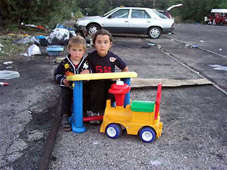
Catalogue : 2007Romani bakht | Documentaire | betaSP | couleur | 32:0 | France | 2005
Bielka Mijoin-nÉmirovsky
Romani bakht
Documentaire | betaSP | couleur | 32:0 | France | 2005
Montreuil. Eté 2005. Des familles Roms de Roumanie sont expulsées d`un squat. Parmi celles ci la famille de Sorina, qui tente de vivre dignement dans la rue, avec son mari et ses deux enfants.
Bielka Mijoin Némirovsky a développé une activité artistique et pédagogique autour de l'expression artistique, en tant que comédienne, chanteuse, ethnomusicologue. Elle a créé un espace de développement de l`expression artistique et de réflexion autour des questions posées par l'époque et la sociétés dans lesquelles nous vivons. Projets autour des chants du monde comme éveil à la culture de l'"autre",au sein des écoles primaires. Elle a réalisé "Romani Bakht" dans le cadre de la formation aux ateliers Varan. C'est son premier film documentaire. Projets en cours.