Catalogue > Search
Results for : Tout le catalogue

Guillermina Pico
Todo nuevo
Fiction | 4k | color | 35:0 | Argentina | 2023
Julia is a teenager about to finish school struggling to stay afloat in a sea of expectations and confusion.
Guillermina Pico is a film director and writer. Her work as a director has been exhibited and awarded in national and international film festivals such as BAFICI (Best Short Film and Audience Award), DOCUMENTA Madrid, L'Alternativa, Festifreak, Kinoforum Sao Pablo (Special Mention), Cinemateca Uruguaya, Lima Film Festival, Chile, Quito, Cali, Galicia, TFF Torino, DiBa Festival (Best Short Film) and art venues such as Palais de Glace Buenos Aires, Centro Cultural Recoleta and Bienal Buenos Aires (Talent Campus Award) among others. Her first feature film "Borrá todo lo que dije del amor porque no sabía bien quién era" was premiered at Torino International Film Festival and was awarded in the audiovisual contest of the Fondo Nacional de las Artes. Among the institutions that supported her work are the Fondo Nacional de las Artes, Talent Campus Buenos Aires, Fundación Proa Cine, Fondo Metropolitano de las Ciencias y las Artes, NOVOS CINEMAS#LAB, Galicia. She is currently developing the documentary Las Galaxias (INCAA) and the fiction Todo Nuevo. She combines her artistic work with teaching and online consulting. Born and raised in Santa Rosa, La Pampa, she lives and works in Buenos Aires.

Leighton Pierce
Everything s gonna be OK
Video | 4k | color | 6:37 | USA | 2021
This is a part of a developing series titles UAP (Unidentified Arial Phenomena). Looking to the sky can reveal both threats and salvation. This was shot and edited on a phone and is intended eventually to be presented on the intimate format of a phone. Shot and edited in summer 2021.
Pierce has been making films, video, and installations for over 3 decades with screenings at Cinematheque francais, Pompidou Center, Sundance, NYFF, Rotterdam, EMAF ad many other venues. Among others, he is recipient of Guggenheim, Rockefeller, and Creative Capital Fellowships. For the past 8 years he has been living in LA where he was dean and is now faculty at CalArts.

Leighton Pierce
Lodestar
Experimental video | mobile phone | color | 13:42 | USA | 2022
LODESTAR Leighton Pierce Pierce has recently created hundreds of short reflective loops to stimulate subtle alterations in states of mind. He shoots and processes them entirely on his phone in order to bring the active video "meaning-making" process into his daily lived experience. His camera (and NLE) is always in his pocket. Lodestar takes advantage of synergies and leaps among some of these loops and then extends them toward proto-narrative --the moment when an objective narrative is first detected. Sound is integral to the potential for an in-depth experience during this 13 minute video. Slow transformations and repetitions with subtle variations are explicitly invoked through both image and sound to soften the rational sense-making that we are usually immersed in. Lodestar could be an inducement to trance--but not only trance. I suggest watching it with attention and patience and with a minimum of narrative expectation.
Leighton Pierce Bio Leighton Pierce is an artist and a committed educator grounding his work in an examination of how one can use art, or video and sound in his case, to explore the fringes of narrative, the seeds of cognition, and the thresholds of perception. He takes an holistic approach to video making and video installations embracing all aesthetic/technical aspects as an entangled web of symbiotic relationships. His work has been widely screened at over 500 film festivals with numerous awards and accolades. His major multi-channel video installations, designed to de-objectify the video viewing experience, have been presented at the Sundance Film Festival, the Kochi (India) Biennial, the Ann Arbor Film Festival, the University of Iowa Museum of Art, and the Sheldon Museum of Art; his film and video work has also been screened at museums including the Whitney Biennial, Pompidou Museum, and MOMA in addition to hundreds of festival screenings. He is a recipient of grants/fellowships from Creative Capital, the NEA, the Guggenheim Foundation, and the Rockefeller Foundation.

Romain Pierre
Taverne Française
Fiction | hdv | color | 7:23 | France | 2013
Taverne Française est d`abord un espace, physique et social, comprenant des murs et des possibles. Son vocabulaire pourrait être d`aujourd`hui, sa musique d`hier, son énergie celle de la jeunesse. Ce n`est pourtant pas l`analyse d`une époque ni le portrait d`une génération. Peu importe la taverne, c`est une taverne : on y sent l`urine, l`alcool et la sueur, on y parle de désir et de mort. Il ne pourrait pas s`agir d`autre chose, car c`est précisément toutes les autres choses qui sont en jeu. Les corps ne connaissent pas d`histoires ; la seule histoire s`inscrit entre les corps. Dès lors qu`il n`y a plus de jugements de valeur, le besoin ne se distingue pas de l`ennui, ni la cruauté de la tendresse, et dans ce délire, sans humour ni gravité, se trame le délire du monde. On ne délire pas sur une affaire personnelle mais, comme le dit Deleuze de l`inconscient, "sur les races, les tribus, les continents, l`histoire et la géographie, toujours un champ social". Et la parole de corps désaffectés, si elle n`est pas la parole des morts, ressemble bien à celle de l`inconscient.
Romain Pierre est né en 1989 à Paris. Il suit une formation de comédien à l`école supérieure d`art dramatique du Théâtre National de Strasbourg. En 2013, il écrit et réalise son premier court-métrage, Taverne Française, inspiré de l`oeuvre de Georges Bataille et des Velvet Underground.

Bartolomeo Pietromarchi
Fluid Cities
Documentary | dv | color | 32:47 | Italy | 2004
Fluid Cities covers the third phase of "Trans": it?s project research as conducted in the Mediterranean area. Produced in 2004, it investigates the projects for public space developed by artists active in Athens, Istanbul, and Cyprus, showing a particular interest in traditions and local culture, manifest in the light of globalisation pressures arriving from the world at large. The context, an open field in which artistic expressions and social experiments are closely connected, is fundamental to an understanding of the work of artists involved in a territory marked by rapid urban, social and economic transformations. The cities have been transformed into multicultural laboratories. Migratory flows, collective memories and spaces undergoing rapid change have given form to the concept of fluidity, a characteristic common to various territories and demonstrative of the continual, rapid, and growing process of transformation to which the urban context is subject. Here, the concept of community is not understood only as a process of collective history but is seen from the micro-social point of view according to which the extended family and its traditions are the field of intervention for contemporary culture. Contemporary art acts within a sort of "public intimacy" through which the subjects represent themselves. The concept of the private is therefore not understood as absolutely contrary to the concept of the public but rather is mediated through the legacy with which the community -the family within, that is, expresses itself to the outside world. Multicultural society in these countries is not the result of globalisation but rather belongs historically to the very genetic code of each country. It is the result of living together and of conflict between ineliminable cultural and religious differences. The documentary film was realized within the European cultural project: "Trans:it. Moving Culture through Europe" promoted by Fondazione Adriano Olivetti in collaboration with European Cultural Foundation, Fondation Evens, Fondation de France and The J.F. Costopoulos Foundation.
Bartolomeo Pietromarchi was born in 1968 in Rome, and is currently a critic and a curator. Since 1997 he has been directing the program of contemporary art for the Fondazione Adriano Olivetti in Rome. He was nominated General Secretary of the Foundation in 2002. Filmography: Director of the cycle of documentary films realized within the project "Trans:it. Moving Culture through Europe": "The Invisible Community", documentary film, 2003, Italy. "Ruins for the Future", documentary film, 2004. "Fluid Cities", documentary film, 2004, Italy.

Stéphanie Pihery
L'hopital du Dr. Galmo
Documentary | betaSP | color | 3:30 | Canada | 2004
In Niamey, Doctor Galmo is the director of an extraordinary hospital. The patients who are convalescing are not who you think they are.
Vaughan Pilikian
Household Gods
Experimental fiction | 16mm | color | 6:30 | United Kingdom | 2008
Alone at home, but haunted by other voices: six people is six rooms somewhere in London.
Vaughan Pilikian is a writer, director and artist who lives in London. His short films have screened in festivals around the world, and he is currently at work on his first feature.
Michael Pilz
Across the river
Documentary | betaSP | color | 151:0 | Germany, Zimbabwe | 2004
Across the River is a documentary focusing on the cultural exchange that took place when the Tonga music ensemble \"Simonga\" and people living in the village of Siachilaba near Zimbabwe\`s Lake Kariba met a group of Austrian musicians and composers. It highlights the cultural strength and resistance of the Tonga people.

Joana Pimenta
AS FIGURAS GRAVADAS NA FACA COM A SEIVA DAS BANANEIRAS
Experimental doc. | 16mm | color | 16:30 | Portugal | 2014
The rapid turning of a light draws a circle. In the space bound by its line unravels an archive of postcards sent between the island of Madeira and the former Portuguese colony of Mozambique. The figures carved into the Knife by the Sap of the Banana Trees circulates between a fictional colonial memory, and science-fiction.
Joana Pimenta (b. 1986, Lisbon) works in film and video installation. Her work has been recently presented at the Carpenter Center for the Visual Arts, Fundacion Botin, Galeria da Boavista, R4, and The Pipe Factory. Her short film "The Figures Carved into the Knife by the Sap of the Banana Trees" received the Pixelbunker Award for Best Short Film in the National Competition at Indielisboa `14, where it premiered, and has been selected for the Toronto International Film Festival (Wavelenghts)and the New York Film Festival (Projections, former Views of the Avant-Garde). She is a Teaching Fellow and PhD candidate in the Department of Visual and Environmental Studies at Harvard University, a fellow at the Film Study Center, and is pursuing her MFA in Film/Video at the Milton Avery School of the Arts at Bard College. She lives and works in Lisbon and Brooklyn, NY.

Antoni Pinent
FILM QUARTET / POLYFRAME
Experimental film | 35mm | color and b&w | 9:0 | Spain | 2008
FILM QUARTET / POLYFRAME is conceived as a small cinematographic bomb attempting to question the established definition of frame as the minimum unit of (cinematographic) time by dynamiting it in four fragments. A step further in the so-called sub-genre practice of found footage film -recycled material- is also put forward for consideration in this project. The appropriationism applied in this work makes use of material found in Hollywood cinema (Singin?in the rain, Stanley Donen, 1952); Pink Panther; Buster Keaton; etc., the first avant-garde period (Un chien andalou, Luis Buñuel & Salvador Dalí, 1929) and American experimental film (Wavelength, Michael Snow, 1966-1967). Such method makes possible, therefore, to maintain image ecology while it provides an analysis of the history of cinema. An explosive artifact has been inscribed as cinematographic notation on musical staffs in order to facilitate the interpretation and development of the piece beyond its mere projection. Such being the case, unchanging cinematographic would pushed for their reinvention-destruction-explotion. This piece celebrates the 50th anniversary of A Movie (1958), by Bruce Conner (1933-2008).
Pink Twins
Box
Experimental video | dv | color | 8:0 | Finland, Fiji | 2004
Box is based on photographs from Tunguska, Siberia, where a large area of land was destroyed when a huge meteorite exploded above the ground in 1908. The video is a slow composition, where landscape images go through several stages of transformation. The video material which was further developed into "Box" was originally made for a stage version of Stalker, produced by Circus Maximus at Helsinki City Theater in 2003.
The Finnish duo Pink Twins, the brothers Vesa and Juha Vehviläinen, started to work together in 1997. Since then they have been exploring visual and sonic noise combined in a most physical experience. Sampling the everyday images and tearing them apart to pixels then putting them together again to a chaotic and blasting unity. In Pink Twins` music and video works "the logical and analytic thematic developments surrender to the frenetic and non-repetitive information overflow.

Pink Twins
Firewalk
Animation | dcp | color | 9:35 | Finland | 2025
A pre-apocalyptic midnight walk takes you through a burning forest to witness a looming destruction. A fire in the forest either marks an impending doom or serves as a metaphysical gateway between realities.
Helsinki based duo Pink Twins, Juha and Vesa Vehviläinen, have worked in the fields of media art, moving image and electronic music since 1997. The boundaries of human perception, immersion and physicality are central to their works. Pink Twins implement their complex animations through parametric design and programming. Their works are performed not only in exhibitions and festival screenings but also as live performances combining music and video projections. Pink Twins have been seen on all continents, and in all kinds of venues from concert halls, festivals, theaters to churches. In recent years, Pink Twins have also made audio and video works directly online, e.g. the sound piece Infinity for Kiasma’s online art collection.
Pink Twins
Defenestrator
Experimental video | dv | color | 8:30 | Finland | 2008
A spectacle of grandiose spaces, monumental halls and majestic architecture. Overpowering architectural constructions disintegrate, deform and transform into a flowing stream of lava, creating new distorted spaces as building blocks of a new order.
Pink Twins, brothers Juha (b.1978) and Vesa Vehviläinen (b.1974) are Helsinki-based visual artists and musicians working with digital music and video. The video works by Pink Twins are usually processed on Framestein, a video software developed by Juha, and combined to a soundtrack of Pink Twins music. Live Pink Twins deliver improvised digital soundscapes, often with video screenings.
Pink Twins
Live Paris Villette
Performance | 0 | color | 40:0 | Finland | 2006
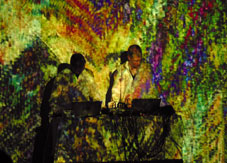
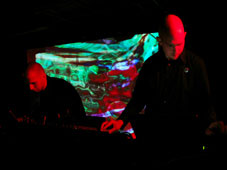
Pink Twins is a duo of musicians and video artists, brothers Juha and Vesa Vehviläinen from Helsinki, Finland. Active since 1997, Pink Twins have played their music to audiences in Europe and Asia, in festivals, clubs, art museums, churches and outdoor events. Based on improvisation and the brothers` symbiotic collaboration, music of Pink Twins is a chaotic whole of intense soundbursts, melodies and infinitely detailed sounds. In their concerts Pink Twins create a constantly changing multilayered wall of sound and aim for a physical, mental and spatial experience. Pink Twins often incorporate video projections to their concerts. Mostly created with their self-made software, the video works are abstract and painterly, from formal compositions to extremely fast shapeless pixelstorms.
Pink Twins is a duo of musicians and video artists, brothers Juha and Vesa Vehviläinen from Helsinki, Finland. Active since 1997, Pink Twins have displayed their video works and played their music to audiences in Europe and Asia, in festivals, art spaces, clubs, churches, and outdoor events. Mostly created with their self-made software, Pink Twins' video works are abstract and painterly, from formal compositions to extremely fast shapeless pixel storms. Music of Pink Twins, based on improvisation and the brothers' symbiotic collaboration, is a chaotic whole of intense soundbursts, melodies, and infinitely detailed sounds. In their concerts, Pink Twins create a constantly changing multi-layered wall of sound, and aim for a physical, mental, and spatial experience. The live music is normally accompanied by video projections. During 2005 and 2006 Pink Twins performed actively in Europe and Asia. Their most notable performances have been the Venice Biennial Music Festival and a tour in China. Pink Twins has also had several solo and group exhibitions, for example, in Sweden, Luxembourg, China, and Mongolia. Pink Twins have released five CDs on their own label Pink Twins Media. A double DVD compilation will have been released in late 2006.
Pink Twins
Pink Twins Live
performance | | | 35:0 | Finland | 2005
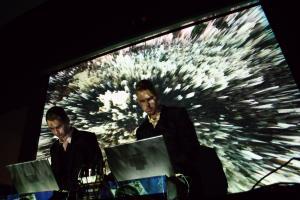
Pink Twins are brothers Juha and Vesa Vehviläinen from Helsinki. Their music and video work is a constant mass flow of abstract, electronic and concrete sound and visuals, where the logical and analytic thematic developments surrender to the frenetic and non-repetitive information overflow. The concert is a dynamic, improvised epic that follows an organic logic to build a dramatic unity out of seemingly opposing movements. The performance is backed by a live mix of Pink Twins` video works.
Pink Twins (brothers Juha and Vesa Vehvilainen from Helsinki) have been working together since 1997. Working as computer musicians and video artists, Pink Twins perform live as well as show video and sound installations in exhibitions.
Pink Twins
Pink Twins Live
0 | 0 | | 30:0 | Finland | 2008
Pink Twins work on the crossing of visual art and music. Their computer-treated imagery and sound, often processed on selfmade software, focus on human perception, its functionality and limits. For their live performances Pink Twins incorporate live electronic music and a live mix of video works. The music of Pink Twins is based on improvised live sound processing of concrete and electronic sounds, noises and musical elements. The mix of live sound and video projections creates a hyperactive, constantly changing and extremely detailed experience of time and space.
Pink Twins (musicians and video artists, brothers Juha and Vesa Vehviläinen from Helsinki, Finland) build a tissue of connections between their sound work and their visual work, attempting to intimately join together mundane fragments usually disjoint. They work from fragments of images, sounds and sensations which our daily life is subjected to in order to break them down into small particles and reunite them once again in audacious constructions formed from chaos, pulverising and rendering them abstract, according to a unified artistic sensitivity. Their concerts are surprising chromatic combinations with strong sonic collusions which correspond to a deep need, with nothing superfluous. Active since 1997, Pink Twins have played their music to audiences in Europe, Asia and Americas, in festivals, art museums, clubs, churches and outdoor events, and displayed their video works on all continents.
Pink Twins
Splitter
Experimental video | dv | color | 6:0 | Finland | 2006
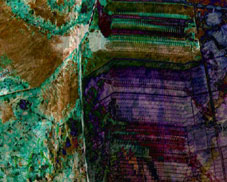
"Splitter" is a macrocosmos of interleaving streams of colour, a digital mass of endlessly transforming surface. Created from simple satellite photos and transformed into a richly detailed, multi-layered landscape, the static motion of "Splitter" creates a sacramental space that carries the layers of our perception and consciousness.
Pink Twins is a duo of musicians and video artists, brothers Juha and Vesa Vehviläinen from Helsinki, Finland. Active since 1997, Pink Twins have displayed their video works and played their music to audiences in Europe and Asia, in festivals, art spaces, clubs, churches, and outdoor events. Mostly created with their self-made software, Pink Twins' video works are abstract and painterly, from formal compositions to extremely fast shapeless pixel storms. Music of Pink Twins, based on improvisation and the brothers' symbiotic collaboration, is a chaotic whole of intense soundbursts, melodies, and infinitely detailed sounds. In their concerts, Pink Twins create a constantly changing multi-layered wall of sound, and aim for a physical, mental, and spatial experience. The live music is normally accompanied by video projections. During 2005 and 2006 Pink Twins performed actively in Europe and Asia. Their most notable performances have been the Venice Biennial Music Festival and a tour in China. Pink Twins has also had several solo and group exhibitions, for example, in Sweden, Luxemburg, China, and Mongolia. Pink Twins have released five CDs on their own label Pink Twins Media. A double DVD compilation will have been released in late 2006.
Pink Twins
Splitter 2
Experimental video | dv | color | 10:0 | Finland | 2006
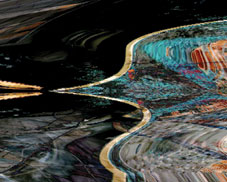
"Splitter 2" is an abstract sci-fi epic, where satellite photos from the surface of planet earth are reformed into a cosmic stream. "Splitter 2" shows a static, frozen, transforming, and moving space in which matter, light, and colour are interleaved with the darkness of the void to create a new universe.
Pink Twins is a duo of musicians and video artists, brothers Juha and Vesa Vehviläinen from Helsinki, Finland. Active since 1997, Pink Twins have displayed their video works and played their music to audiences in Europe and Asia, in festivals, art spaces, clubs, churches, and outdoor events. Mostly created with their self-made software, Pink Twins' video works are abstract and painterly, from formal compositions to extremely fast shapeless pixel storms. Music of Pink Twins, based on improvisation and the brothers' symbiotic collaboration, is a chaotic whole of intense soundbursts, melodies, and infinitely detailed sounds. In their concerts, Pink Twins create a constantly changing multi-layered wall of sound, and aim for a physical, mental, and spatial experience. The live music is normally accompanied by video projections. During 2005 and 2006 Pink Twins performed actively in Europe and Asia. Their most notable performances have been the Venice Biennial Music Festival and a tour in China. Pink Twins has also had several solo and group exhibitions, for example, in Sweden, Luxemburg, China, and Mongolia. Pink Twins have released five CDs on their own label Pink Twins Media. A double DVD compilation will have been released in late 2006.
Jörg Piringer
SIG/B
Experimental video | dv | color | 2:0 | Austria | 2005
Jörg Pringler est né en 1974, et vit actuellement à Vienne en Autriche. Pringler est membre de l´institut pour la recherche trans-acoustique et du vegetable orchestra (l´orchestre de légumes/das erste Wiener gemüseorchester). Il a étudié à la Schule für Dichtung à Vienne, et a obtenu un Mastère en informatique. On peut le considérer comme un poète du son.

Sasha Pirker, Lotte Schreiber
Exhibition Talks
Experimental doc. | 16mm | black and white | 9:0 | Austria | 2014
Wenn, wie Walter Benjamin behauptet hat, Gebäude auf doppelte Art, durch Gebrauch und Wahrnehmung rezipiert werden, d.h. taktil und optisch, dann könnte man Sasha Pirkers und Lotte Schreibers Exhibition Talks als Versuch verstehen, diese doppelte Rezeptionsweise ein Stück weit zu entkoppeln. Während auf der Tonspur vom Gebrauch der Ausstellungsräume des Tiroler Architekturforums aut die Rede ist, von den Gegebenheiten der einzelnen Räume und den Möglichkeiten, sie für eigene Bedürfnisse zu adaptieren, liefert die Bildspur fragmentarische, statische und in Schwarzweiß gehaltene Ansichten derselben Räume, die allein schon deshalb im optischen Register verharren, weil sie über die Montage zu keinem kohärenten Raumganzen verbunden werden. Anstatt die Größe der Räume und ihre gebaute Anordnung etwa über einen Rundgang durch das Gebäude zu "erzählen", fängt die Kamera Details der Fassade und der Innenräume ein, die zum einen mit ihren klar gezogenen Linien und den vielfältigen Gelegenheiten zu Ein-, Aus- und Durchblicken von der Formensprache der klassischen Moderne zeugen, zum anderen diese Formensprache einem optischen Spiel von Licht und Schatten, von Grauwerten und Schwarzweiß aussetzen, das die drei Dimensionen des Bauwerks grafisch auflöst. Bestand die Pointe der doppelten Rezeptionsweise von Gebäuden bei Benjamin in der Übertragung auf die Wahrnehmungsbedingungen am Ort des Kinos (Zerstreuung statt Kontemplation), scheint die experimentelle Entkopplung von optischer Wahrnehmung und taktilem Gebrauch in Exhibition Talks einer anderen Logik zu folgen. Obwohl vom Bild strikt getrennt, suchen die Möglichkeiten des Gebrauchs nach Wegen ins Sichtbare. "Normalerweise ist der Eingang hier": Zu sehen ist eine Öffnung, durch die Licht auf eine Wand fällt, während der übrige Raum im Schatten versinkt. Die Öffnung ist ein Fenster, sie könnte aber auch eine Tür sein bzw. ist sie gerade im Begriff, zu einer solchen zu werden. Von solchen Übergängen handelt Exhibition Talks: vom Offenen, vom Beweglichen und Veränderlichen des gebauten Raums. (Vrääth Öhner)
Sasha Pirker
Once at Miracle Mile
Experimental doc. | dv | color | 9:10 | Austria | 2009
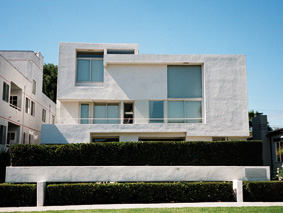
?Once at Miracle Mile? The Pearl M. Mackey Apartment House in Los Angeles, built in 1939 by Rudolph M. Schindler, is completely compelling to Sasha Pirker. In her work, she doesn?t strive to merely capture architecture on film, nor to simply record and document what she sees, but rather to work with the building itself (albeit in a restrained and respectful way), indeed to map it. Intriguingly, Sasha Pirker takes what would seem awkward in a conventional feature film and makes it her own: the idiosyncratic use of cross dissolves in this short film becomes in fact its main stylistic principle, and ? stunningly ? it works. In ?Once at Miracle Mile,? several calm, steady and yet at times even hesitant circular camera pans are intertwined, playing with the gaze and the expectations of the audience. Into the background of one pan enters a second, although this one refuses to displace the first ? at least not initially ? but rather, the two camera pans exist simultaneously, allowing the viewer?s attention to move between the coming and going of the images, jumping ? no, gliding ? back and forth. A slow-motion dance through the building, a dance with the building, a fusion of inside and out, a simultaneity of views ? as if we were passing the house and just happened to catch a glimpse of ourselves in one of the windows. Why not? Everything is possible at Miracle Mile on this mild Californian afternoon. This film is a declaration of love, made with solemn and tender affection for the house it?s also a remembrance of: Once ? (Bernhard Seiter) Translation: Janet Grau
Sasha Pirker, artist, born 1969 in Vienna/Austria. Studied linguistics and architecture in Vienna. She lives in Vienna. Since 2006 she is a teaching member of the department ?Video and Videoinstallation? at the University of Fine Arts in Vienna.