Catalogue > List by artist
Browse the entire list of Rencontre Internationales artists since 2004. Use the alphabetical filter to refine your search. update in progress
Samira Elagoz, Z. Walsh
Catalogue : 2025You Can't Get What You Want but You Can Get Me | Experimental doc. | 4k | color and b&w | 13:0 | Finland, Netherlands | 2024
Samira Elagoz, Z. Walsh
You Can't Get What You Want but You Can Get Me
Experimental doc. | 4k | color and b&w | 13:0 | Finland, Netherlands | 2024
A unique slideshow documenting two long-haired trans men falling madly in love. Over the course of one year, the artist couple Samira Elagoz & Z Walsh gathered photographs from real-life events such as their first kiss, meeting each other's parents, long-distance thirst traps, a beach wedding, and top surgery and its subsequent recovery. A sweet and steamy celebration of T4T love with life and art all tangled up.
Samira Elagoz is a Finnish/Egyptian transmasculine artist. He has toured in various international film, visual art, and performance contexts, and won several awards, including Silver Lion at the Venice Biennale Teatro in 2022. Elagoz combines performance art and film, creating his unique brand of “docu-fiction”. Z Walsh is a Brooklyn-based transmasculine artist focusing on photography. Z is known for his raw, intimate depictions of his subjects and himself. Throughout his work, Z is dedicated to elevating trans voices and combating transmasculine erasure.
Ahmed Elghoneimy
Catalogue : 2022Al-Maw oud | Documentary | hdv | color | 18:14 | Egypt | 2020
Ahmed Elghoneimy
Al-Maw oud
Documentary | hdv | color | 18:14 | Egypt | 2020
In and around the historical ruins of Fustat in Old Cairo, tensions simmer between the site’s government-appointed guards and residents of a nearby informal settlement, al-Izba. The guards chase away looters and confiscate their equipment, while locals infuriate them by taking shortcuts through the site, occasionally stopping for a smoke. For the guards it would be easiest to keep the site closed until further notice.
Ahmed El Ghoneimy, born in 1986 in Alexandria, Egypt, is a filmmaker and artist currently living between Alexandria and Cairo. His work revolves around interpersonal tensions between the different protagonists presented in his films, such as sons and fathers (Tripoli Tide, 2018), victims and perpetrators (Bahari, 2011), bullies and friends (The Cave, 2013). Alternating between fiction and documentary, his films follow associations and use moments of collision as an opportunity to investigate notions like victimhood, power, and masculinity.
Sara Eliassen
Catalogue : 2015A Blank Slate | Experimental fiction | hdv | color | 27:0 | Norway | 2014
Sara Eliassen
A Blank Slate
Experimental fiction | hdv | color | 27:0 | Norway | 2014
A character is passing time in a desolate beach town. Slowly, the loneliness and alienation she experiencesin theforeign town makes her enter into an uncanny delusional realm, that blurs the memory of her own experiences with that of female protagonists from film history.
Sara Eliassen (b 1977) is a filmmaker based between Oslo and San Francisco. Her film Still Birds premiered at the Venice Film Festival in 2009 and has later screened at several other international film festivals, amongst them Sundance 2010. Eliassen holds an MFA in filmmaking from San Francisco Art Institute and was a studio fellow at The Whitney Museum’s Independent Study Program in 2011.
Daria Elkonina
Catalogue : 2023While I was sleeping | Experimental fiction | digital | color | 27:40 | Russia | 2021
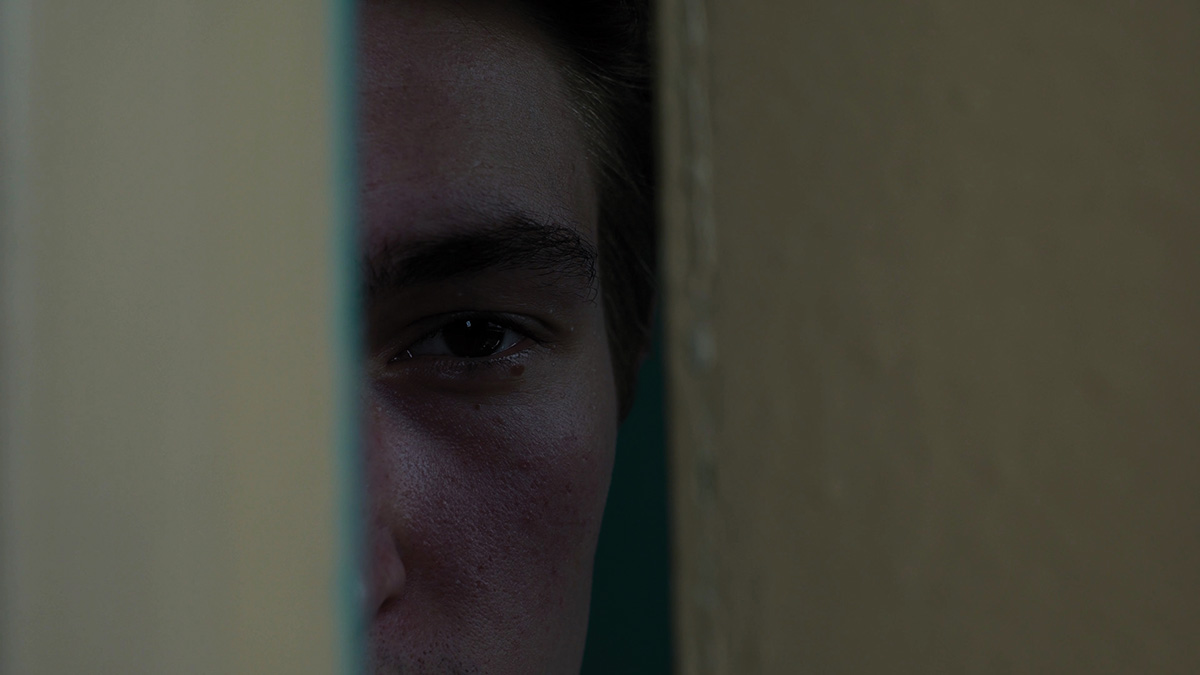
Daria Elkonina
While I was sleeping
Experimental fiction | digital | color | 27:40 | Russia | 2021
An unexpected encounter on the staircase threw the young man out of his regular routine.
Was born in Tomsk, Siberia. Moved in Moscow in childhood. Studied phylology in "Russian State University for the Humanities", then stuied in "Moscow School of New Cinema" (editing department). Is living in Tel-Aviv since August 2022.
Jürgen Ellinghaus
Catalogue : 2017Togoland November | Documentary | hdv | color | 10:52 | Germany, France | 2016

Jürgen Ellinghaus
Togoland November
Documentary | hdv | color | 10:52 | Germany, France | 2016
From 1884 to 1914, a small belt of land between the British Gold Coast Colony and French-governed Dahomey was part of the German overseas empire in Africa. "Togoland", the later Togo and the eastern part of today`s Ghana, experienced the first German capitulation in the early days of WWI. European rule left its marks on people`s minds, even more than a century after the forced pull-out of one of the major European players in the competitive "great colonial game" and more than half a century after the African Independences. Lomé - Adibo and Yendi (Ghana) - Kamina - Wahala: present-day glimpses of a journey into the past. Original languages: Dagbani, English, Ifè
1985-1997, freelance work and author/producer for German and French public radio companies. 1995-2004, documentary program manager for public and private TV companies in France and Germany.
Carl Elsaesser
Catalogue : 2025How to Run a Trotline | Experimental film | hdv | color | 18:0 | USA | 2024

Carl Elsaesser
How to Run a Trotline
Experimental film | hdv | color | 18:0 | USA | 2024
Despite the didactic promise of its title, Carl Elsaesser’s new film will not teach you how to complete this obscure action. The phrase itself, at once ridiculous and noble, is pleasure enough, and its tone fits perfectly on a work that walks a thin, dandyish path down the border of farce and elegy. Another pleasure: it isn’t about anything, though it’s of quite a lot. Of fathers (who might teach one how to run a trotline, or sit on a porch, or disappear); of other films (particularly a pair by adopted fathers Michael Snow and William E. Jones); of at least two kinds of cruising; of the winter in Maine and the streets in New York and the many kinds of light to be found in and around both (ranging from snowy diffusion to snare-hit clarity). But one needn’t know these films or Maine or New York, not any more than one need know what a trotline is, to be hooked by the ongoing oddness of Elsaesser’s rhythms, which move gently, languidly toward new raptures of illumination. (Text: Phil Coldiron)
Carl Elsaesser is an experimental filmmaker who mixes genres and materials to critically investigate the overarching presence of the historical without losing sight of individual experiences of human connection. His works have screened regularly at festivals including The Berlinale, The New York Film Festival, Cinema Du Reel, European Media Arts festival where he won the German Film Critics award for best film, and the Ann Arbor film festival where his debut film won the award for most promising emerging experimental video artist. He's had the honor of receiving grants and residencies throughout his career including a Minnesota Arts Council grant, a fellowship with Macdowell and residencies with the Ellis Beauregard Foundation, Hewnoaks and The Squeaky Wheel Media Center. His work has been written about in publications like the LA Review of Books, Millennium Film Journal and FilmExplorer by Kevin B. Lee.
Carl Elsaesser
Catalogue : 2022Home When You Return | Experimental doc. | 16mm | color | 30:0 | USA | 2021
Carl Elsaesser
Home When You Return
Experimental doc. | 16mm | color | 30:0 | USA | 2021
“Stretching and blurring the boundaries of video essay, experimental film and home movie, traces of a 1950s homemade melodrama by amateur filmmaker Joan Thurber Baldwin intermingle with a mournful homage to the author’s grandmother and her vacated home. A powerful mélange of cinematic and domestic spaces, past and present.”
Carl Elsaesser (1988, USA) graduated from Hampshire college and University of Iowa. He lives and works between midcoast and interior Maine and Brooklyn, NY. He has made several short films which have screened at festivals in New York, Berlin, Michigan, Amsterdam, Korea among others. In his work, Elsaesser mixes genres and materials to produce work that “critically investigates the overarching presence of the historical without losing sight of individual experiences of human connection.”
Walid Elsawi
Catalogue : 2014Do-Mystic Uni-Verse | Video | | color | 3:10 | Egypt | 2012
Walid Elsawi
Do-Mystic Uni-Verse
Video | | color | 3:10 | Egypt | 2012
Do-Mystic Uni-Verse: is a visual interpretation of the aftermath of the bomb that went off recently inside of me, It`s about hope and also showing the stagnant life we live. It`s a nine clips subtitled with nine vague, subtle, and desperate sentences "verses", about the dull life of mine, but in the same time there`s a sort of sarcasm in them? The motion mechanism is inspired by the motion of the solar system, performed with home worn out nick nacks. I emulate the solar system to represent infinity and continuation.
Walid elsawi, Egyptian visual artist, based and works in Alexandria. BFA in painting, Alexandria University, 2010. He works with different kinds of media, such as installation, video art and painting. He became interested in the concept of the alienation by the time he graduated, expressing his thoughts through oil paintings; he made a series of 14 oil paintings depicting his self-portrait. In 2011 he discovered the impact of the words and how strong they are, so he used texts and words as another form of showing his personality, he came up with three pieces concentrating on the subliminal messages and how tricky words can be In 2012 he made a piece entitled (a contemporary artist vs. a con artist) a dozen statements, taken from the artist?s ongoing interview project are written on glowing neon boxes, peppered around the space. The interview consists of responses he gives to the question ?are you an artist?? a means of exploring the current climate of contemporary art, and the cult of personality, with a tongue-in-cheek emphasis on certain stereotypes, perceived pre-requisites or trends. Alongside with that, In terms of the alienation concept, I decided to deal with it with a whole different form. I worked on manipulating personal domestic photos, because puzzling the viewer makes them think a little deeper, at the first glance they wouldn`t recognize, but when they take a closer look they would see the trick? Believing that the convincing image is the poor resolution one, the non-designed picture; this makes it more realistic by avoiding the aesthetics of photography, I don`t want to focus on a main item in the picture, I prefer to take raw pictures, to enhance the idea.
Nanna Elvin Hansen
åsa Elzén, Wetzel, Markus
Catalogue : 2008I'll be you if you'll be me 4 - Love Hurts More | Experimental fiction | dv | color | 10:0 | Sweden | 2007
Åsa ElzÉn, Markus Wetzel, Wetzel, Markus
I'll be you if you'll be me 4 - Love Hurts More
Experimental fiction | dv | color | 10:0 | Sweden | 2007
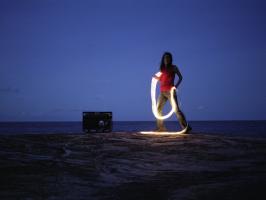
I?ll be you if you?ll be me 4 - Love Hurts More a collaboration by Åsa Elzén and Markus Wetzel During three months in 2006 we isolated ourselves on a small, uninhabited island in the Baltic Sea and collaborated on a series of short films. In the same film we continuously changed roles, back and forth, between being the director and the actor and through this method, developed narratives about a fictitious androgynous character. The one of us that was currently acting wore a mask and became this somewhat odd, mostly silent figure, alone on her/his island, trying to come to terms with the surrounding alienating nature, loneliness, death and longing for love. As well as being a ?trans character? with an ever-changing gender, this figure inhabits an indefinable space between the two of us. The actual stay on the island is here a metaphor for the self-inflicted isolation that a couple can put itself in, mentally or physically. This ambivalent state between security and isolation influenced the situation where the collaboration took place. We are interested in problematizing notions of heteronormativity, gender and sexuality in this project, as well as negotiating the point where the subject ends and the other begins. At the beginning of Love Hurts More (10:00 min) our character sings the song Love hurts on the rocky shore in the night. S/he is using a generator to get some light from a domestic light tube and sings along with the noise of the generator. Afterwards this person starts making her/his way into the middle of the island, getting directions by laying out the light tube and dragging the heavy generator along. Finally s/he has completed his/her task and finds a crystal hidden in the branches of an ancient tree. Back in the little cottage with her/his trophy, our hero/ine half-heartedly tries to cure her/his longing for love by an odd incantation.
Åsa Elzen received her MFA at the Royal University College of Fine Art, Stockholm in 2002. She is currently attending the Whitney Independent Study Program in New York. She works with project based installation and video art often dealing with feminism and post colonial issues. Markus Wetzel received his MFA at the Hochschule fur Gestaltung und Kunst in Zurich. Currently he is working in New York and Zurich. In his projects he uses the idea of an island equally as forms of reality and fiction: his computer images, installations and outdoor projects as well as his collaborations stretch fictional, model-type space and storytelling to the ultimate, the moment in which fiction seems to tip over into reality. Since 2005 Elzén and Wetzel have collaborated on three projects.
Heinz Emigholz
Catalogue : 2023Mamani in El Alto | Documentary | 4k | color | 95:0 | Germany | 2022
Heinz Emigholz
Mamani in El Alto
Documentary | 4k | color | 95:0 | Germany | 2022
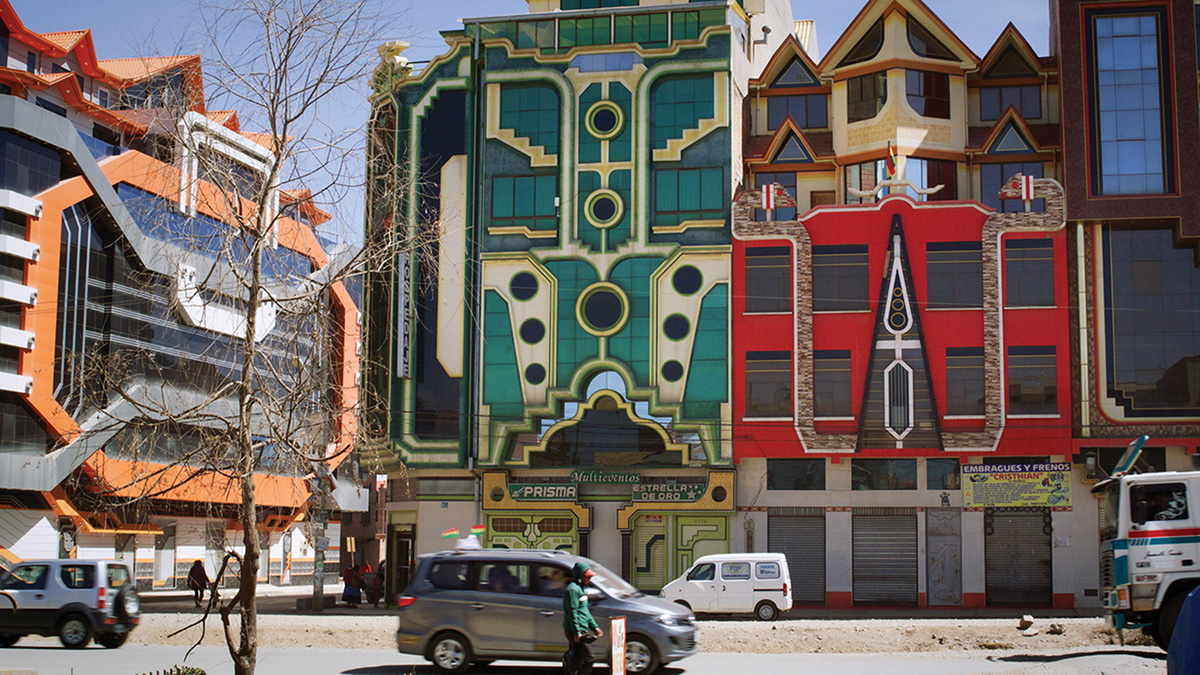
The civil engineer and architect Freddy Mamani Silvestre (*1971), has designed more than 60 building projects in the Bolivian city of El Alto since 2008, which mock the norms of a formulaic modern architecture shaped and enforced with global aspirations by the Bauhaus. Mamani comes from a humble background and belongs to the Aymara people. His self-taught architecture is a counter-utopia that grew out of local usages and opens up a view of preferences other than sparseness and global stylistic adherence. The film shows many of the “cholets” he built with their magnificent ballrooms in their urban setting. Mamani became the founder of neo-Andean architecture.
Born in 1948 near Bremen in Germany, Heinz Emigholz trained first as a draftsman before studying philosophy and literature in Hamburg. He began filmmaking in 1968 and has worked since 1973 as a filmmaker, artist, writer and producer in Germany and the USA. In 1974 he started his encyclopaedic drawing series “The Basis of Make-Up”. He looks back on numerous exhibitions, retrospectives, lectures and publications. In 1984 he started his film series “Photography and beyond”. He had held a professorship in Experimental Filmmaking at the Universität der Künste Berlin 1993-2013, and co-founded the Institute for Time-based Media and the Art and Media program, there. In 2003 Filmgalerie 451 started an edition of all his films on DVD. Publications a.o.: Krieg der Augen, Kreuz der Sinne (War of Eyes, Cross of Senses), Seit Freud gesagt hat, der Künstler heile seine Neurose selbst, heilen die Künstler ihre Neurosen selbst (Since Freud Said That the Artist Heals His Neuroses Himself, Artists Have Been Healing Their Neuroses Themselves), Normalsatz – Siebzehn Filme (Ordinary Sentence – Seventeen Films) and Das schwarze Schamquadrat (The Black Sqare of Shame) (all four books were published at Verlag Martin Schmitz); “Die Basis des Make-Up (I) and (II)”, “Der Begnadete Meier”, “Kleine Enzyklopädie der Photographie” (Small Encyclopaedia of Photography) and “Die Basis des Make-Up (III)” (in Die Republik No. 68-71, 76-78, 89-91, 94-97 and 123-125); Sense of Architecture with more than 600 photographs. Heinz Emigholz is a member of the Academy of the Arts in Berlin.
Heinz Emigholz
Catalogue : 2021The Last City | Fiction | hdv | color | 100:0 | Germany | 2020
Heinz Emigholz
The Last City
Fiction | hdv | color | 100:0 | Germany | 2020
An archeologist and a weapons designer – who, in a prior life, knew each other as a filmmaker and a psychoanalyst – meet at an archeological excavation site in the Negev Desert and begin discussing love and war; a conversation they continue in the Israeli city of Be’er Sheva. The film then proceeds with changing actors in changing roles; a round dance that takes us to the cities of Athens, Berlin, Hong Kong and São Paulo. The characters include: an old artist, who meets his younger self; a mother, who lives with her two grown sons – a priest and a policeman; a Chinese woman and a Japanese woman; a curator and a cosmologist. Their dialogues deal with now obsolete social taboos, generational conflict, war guilt and cosmological musings. The architecture of each of the five cities serves as the third participant in the protagonists' dialogues, and completes their philosophical and metaphysical journeys.
Born in 1948 near Bremen in Germany, Heinz Emigholz trained first as a draftsman before studying philosophy and literature in Hamburg. He began filmmaking in 1968 and has worked since 1973 as a filmmaker, artist, writer and producer in Germany and the USA. In 1974 he started his encyclopaedic drawing series “The Basis of Make-Up”. He looks back on numerous exhibitions, retrospectives, lectures and publications. In 1984 he started his film series “Photography and beyond”. He had held a professorship in Experimental Filmmaking at the Universität der Künste Berlin 1993-2013, and co-founded the Institute for Time-based Media and the Art and Media program, there. In 2003 Filmgalerie 451 started an edition of all his films on DVD. Publications a.o.: "Krieg der Augen, Kreuz der Sinne" (War of Eyes, Cross of Senses), "Seit Freud gesagt hat, der Künstler heile seine Neurose selbst, heilen die Künstler ihre Neurosen selbst" (Since Freud Said That the Artist Heals His Neuroses Himself, Artists Have Been Healing Their Neuroses Themselves), "Normalsatz – Siebzehn Filme" (Ordinary Sentence – Seventeen Films) and "Das schwarze Schamquadrat" (The Black Sqare of Shame) (all four books were published at Verlag Martin Schmitz); “Die Basis des Make-Up (I) and (II)”, “Der Begnadete Meier”, “Kleine Enzyklopädie der Photographie” (Small Encyclopaedia of Photography) and “Die Basis des Make-Up (III)” (in "Die Republik" No. 68-71, 76-78, 89-91, 94-97 and 123-125); "Sense of Architecture" with more than 600 photographs. Heinz Emigholz is a member of the Academy of the Arts in Berlin.
Heinz Emigholz
Catalogue : 2018Streetscapes [Dialogue] | Experimental doc. | 4k | color | 120:10 | Germany | 2017
Heinz Emigholz
Streetscapes [Dialogue]
Experimental doc. | 4k | color | 120:10 | Germany | 2017
There are streets, paths, motorways, alleys, boulevards and promenades. And there are life paths, intersections and dead ends. Two men sit on the shady raised platform of a brick building somewhere in Montevideo. They are submerged in a conversational marathon that never ceases throughout the entire film. The younger of the two is an analyst; the older man his analysand. Their nationalities are unclear; they speak a simple, internationally understandable English. They talk about a childhood among the ruins and the traumatised people of Germany shortly after the Second World War, about fleeing, about an obsessive interest in architecture and about manic writing. And they speak about work with the film camera, which is a technical instrument for the young analyst, but a lifeline for the old film director. The starting point of the six-day marathon is the psychological and physical block that prevents the director from starting a last great film, the Streetscapes saga. The conversation, which in a slow process dissolves the director’s block, takes place in changing places in extreme architectures. The camera, which portrays them both and sets them in relation to the architecture, becomes a third partner. The camera repeatedly disengages from where they are and explores the surrounding streets and neighbourhoods before returning to the two protagonists. The shell constructions of the Uruguayan builder Eliado Dieste where they sojourn resemble gigantic braincases and thus provide a framework for the site and the theme of the project that emerges in the course of their talk: trauma and architecture.
Born in 1948 in Achim, Germany, Heinz Emigholz studied philosophy and literature at the University in Hamburg. In 1978, he founded his own film company Pym Films. From 1993 to 2013, he held a professorship in experimental filmmaking at the Berlin University of the Arts, where he co-founded the Institute for Time-Based Media as well as the university’s art and media course. The artist has been working since 1973 as a freelance filmmaker, artist, writer, cinematographer, producer, and journalist. Since 2012 he has been a member of the Academy of Arts in Berlin. For the past fifteen years, the German experimental filmmaker has dedicated himself to an ambitious series of documentaries that focus on the work of visionary 20th century architects. Emigholz is known as a man of few words, making photography and architecture his own language. To use his words, “Architecture projects space into this world. Cinematography translates that space into pictures projected in time. Cinema then is used in a completely new way: as a space to meditate on buildings.” Thus, the artist enhances our understanding of a critical junctures in architectural history and explores how film and architecture deal with issues of time, space and narrative. Heinz Emigholz is an internationally renowned artist who has won multiple awards. He was the winner of the Berlin International Film Festival for Best Documentary (1988); Special award for four of his films at the German Film Critics Association Awards (2001/2008/2009); Best Film at the German Film Critics Award for Best Film(1983). The artist has also been nominated in several festivals, namely the Oberhausen International Short Film Festival (2013), and the German Film Critics Award for Best Cinematography / Best Editing (2017). His work has been presented in a great deal of berliner galeries (the Galerie Eisenbahnstraße, Berlin (1986); the Galerie, Berlin (1988); the Hamburger Bahnhof – Museum für Gegenwart, Berlin (2007) ; the Zwinger Gallery, Berlin (2014) ; the Berlinische Galerie, Berlin (2015). He has been also presented in Architekturbiennale, Venice (2008) and Kassel, Toronto, Tel Aviv or Vienna.
Leon Emonds-pool, Emilia Auhagen-Kuoppamäki
Catalogue : 2026Seen From Here, I Feel Like Belonging | Experimental doc. | super8 | color | 30:0 | Germany | 2025
Leon Emonds-pool, Emilia Auhagen-Kuoppamäki
Seen From Here, I Feel Like Belonging
Experimental doc. | super8 | color | 30:0 | Germany | 2025
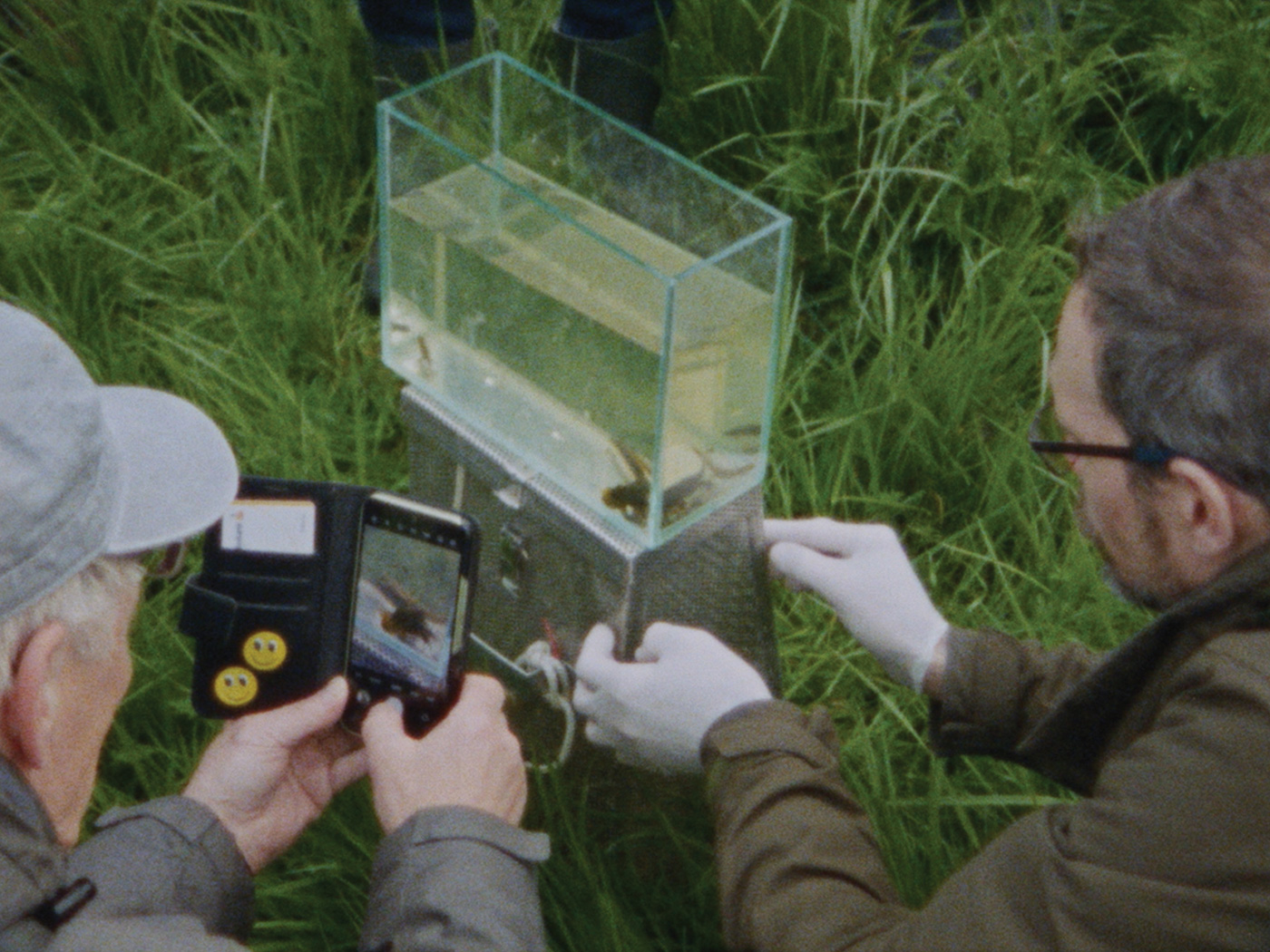
June 1971 - in a fluid landscape completely below sea level, a young biology student dies during the last year of his studies, leaving behind an unfinished scientific collection. More than fifty years later, a group of ecologists and volunteers are trying to understand and document the same environment as it is today.
Leon Emonds-Pool holds a degree as a Director of Photography from the International Filmschool Cologne and is currently studying at the Friedl Kubelka School for Independent Film in Vienna. After working for short films solely as a cinematographer, he is now also directing his own projects, mainly in the various fields between documentary and experimental filmmaking. In his films, which are often shot on analog Super 8 or 16mm material, he tries to explore the complex relationship of humans with the natural environment. He also works as an analog projectionist and is one of the founding members of the Cologne-based artist-run-filmlab and event series collective "Film auf Film". Emilia Auhagen-Kuoppamäki completed her master’s degree in North American Studies in 2024. In the course of her studies, she developed a growing interest in cultural ecology, particularly in film and literature. Her current research interest lies in exploring how artists generate change in human interaction with the non-human world through their artistic practice. Complementing her research, Emilia is engaged in creative projects in the visual arts. She is one of the five founding members of the Cologne-based artist-run-filmlab and event series collective "Film auf Film".
Laura Engelhardt
Catalogue : 2021Auftritt und Abgang von Mascha B. | Experimental doc. | 4k | color | 14:0 | Germany | 2020
Laura Engelhardt
Auftritt und Abgang von Mascha B.
Experimental doc. | 4k | color | 14:0 | Germany | 2020
"Entrance and Exit of Mascha B." follows a young woman through a digital transformation process. In the premises of a big architectural visualization company, delicate operations give rise to a photorealistic rendering that is to promote a yet-to-be-built office space. The virtual office room is furnished and inhabited by Mascha B. and digital colleagues. The final rendering process is accompanied by the aria from the 1881 fantastic opera The Tales of Hoffmann, in which the hero hopelessly falls in love with the mechanical puppet Olympia.
Laura Engelhardt (born 1988 in Bremen) earned a degree in Architecture and Fine Arts (London, Stuttgart, Berlin) and is currently completing the postgraduate program in Film at the Academy of Media Arts Cologne. Her work examines built and imagined architectures and the fragile relations between the human body and its environment. Her films are shown internationally at festivals and exhibitions. Currently, she is writing and developing her first feature film.
Jérôme Enrico
Catalogue : 2007L'Art et la Manière - Coop Himmelb(l)au | Documentary | betaSP | color | 26:0 | France | 2006
Jérôme Enrico
L'Art et la Manière - Coop Himmelb(l)au
Documentary | betaSP | color | 26:0 | France | 2006
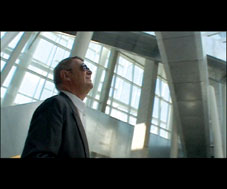
Coop Himmelblau is a collective of architects founded in 1968 by Wolf d. Prix and Helmut Swicinsky, who has worked on numerous town-planning, architecture, and design projects throughout the world. Among the principal productions can be listed the master plan of the city of Melun-Sénart, the Fine Arts Academy of Munich, the transformation of the old gasometers into housing complexes in Vienna, the Museum of Confluences in Vienna, the Akron Art Museum in Ohio, the central area of the Los Angeles faculty, the Guangzhou Opera in China, the BMW showroom in Munich, and the Central European Bank in Frankfurt. In 1998, Marc Wigley analyzed deconstructionism for the first time for an exhibition at the MOMA. Under this name he gathers works by Franck Gehry, Daniel Libeskind, Rémi Coolhaas, Peter Eisenman, Zaha Hadid, Bernard Tschumi, and from the Coop Himmelb(l)au collective.
The son of Robert Enrico, maker of "Des Grandes Gueules", 1965, and "le Vieux Fusil", 1975, Jérôme Enrico started out in cinema as an actor, with a small role in "Un peu, beaucoup, passionnément..." that his father directed in 1971. It was in the beginning of the following decade that he truly started his double career as both an assistant-director - "Clara et les chics types", 1980; Jacques Monnet - and filmmaker, when he was part of two short films - "Le rat noir d'Amérique", 1981, and "La dernière image", 1983 - which both earned prizes in various festivals. As an assistant he has worked with Gérard Oury and Robert Enrico, in "Au nom de tous les miens", 1983, "Zone rouge", 1985, and "Vent d'est", 1991 - for which he was first assistant-director for the first time. He played that same role for "Prêt-à-porter", 1994; Robert Altman, and "La reine Margot", 1993; Patrice Chereau, a film for which he was also in charge of directing the second filming team. In 2000, Jérôme Enrico made his first full length film, "L'origine du monde", with Roschdy Zem and Angela Molina.
Janick Entremont
Redmond Entwistle
Catalogue : 2010Belfast Trio | Experimental doc. | 16mm | color | 10:20 | United Kingdom | 2009
Redmond Entwistle
Belfast Trio
Experimental doc. | 16mm | color | 10:20 | United Kingdom | 2009
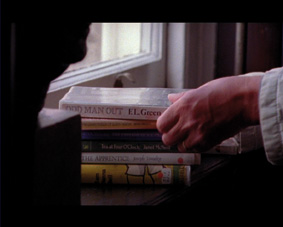
Revised synopsis Belfast Trio (Tea at Four O'Clock/The Hollow Ball/The Apprentice)is a sequence of three 3-minute films, which can be shown in different orders. Each film is a piece of a puzzle of which the three films form a whole. Taking their titles from classic mid-20th century novels of Belfast life, each film is at once a description of a film to be made, a conversation between characters in a love triangle, and a portrait of a city attempting to refashion itself for entry into a global economy. The films restage original interviews with professionals from the film and IT industry in Belfast, two industries through which the city hopes to attract investment and establish itsâ?? position within an international pecking order of knowledge economies and creative industries. Interwoven with these interviews are moments of melodrama and documentary explorations of redevelopment projects. The films were made with a crew drawn from Northern Irelandâ??s film industry, and allude to this image-making economy in which on the one hand local history has a market function, and on the other the city can stand-in for any number of other cities or time periods. Originally shown in three separate cinemas around Belfast before feature films, most of which were North American, the films hint at the promises and thwarted desires of mobility and economic participation at an international level that characterize the new economy.
Redmond Entwistle (b. London, 1977) is an artist-filmmaker currently living in New York. Entwistle employs documentary and abstract modes of film-making, often investigating histories of social displacement and creating portraits of cities anchored on the invisible or the implied. Recent works include Monuments (2009), a narrative exploration of the origins of Post-Minimalist art in the economic and spatial relationship between New York and New Jersey, Skein (2007), a video portrait of migration to the towns that spread out from New York, and Paterson ? Lódz (2006), a 16mm expanded film about two towns (Paterson, New Jersey, and Lódz, Poland) and their interrelated history of politics and migration in the early years of the 20th century. Redmond Entwistle studied at California Institute of the Arts and the Whitney Independent Study Program. He has presented projects at recent group shows at Miguel Abreu Gallery (NY), Nought to Sixty (ICA, London), a film performance at Gallery TPW (Toronto), and a recent solo exhibition at Belfast Exposed (UK).
Redmond Entwistle
Catalogue : 2013Walk-Through by | Experimental doc. | hdv | color | 18:0 | United Kingdom | 2012
Redmond Entwistle
Walk-Through by
Experimental doc. | hdv | color | 18:0 | United Kingdom | 2012
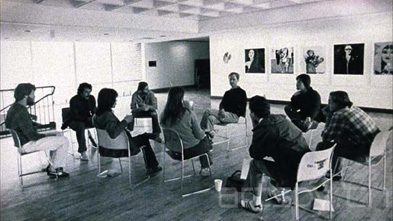
A film exploring the role and value of art education today through the history of the seminal California Institute of the Arts. WALK-THROUGH revisits the history of pioneering Los Angeles art school, the California Institute of the Arts, to explore wider questions about the purpose and value of education today. This newly commissioned film by artist filmmaker Redmond Entwistle will premier at Tramway for the Glasgow International Festival on 20th April. It will then tour to Cubitt Gallery, London, and International Project Space, Birmingham, reaching a wide audience through out the UK, with plans to tour further in the US and Europe.
Redmond Entwistle (b. London, 1977) is an artist and filmmaker based in New York and London. Working across a range of film forms from expanded cinema to narrative, his work has shown in both galleries and film festivals internationally. In 2008 his film Paterson ? Lódz won Best International Film On-Screen at Images Festival. His films have been included in recent group shows Nought to Sixty (ICA, London) and Greater New York: Artists Cinema (PS1 MOMA). His last film Monuments had its gallery premiere at Art in General in 2010 and had its festival premiere in competition at the Rotterdam International Film Festival 2010 and has been shown in a number of festivals and curated programs internationally including the National Gallery of Art Washington, Viennale, FID Marseilles, Hors Pistes at the Centre Pompidou, Argos Center for Art and Media, Anthology Film Archives and the Walker Art Center. His work is distributed by Lux Artists Film and Video.
Mélissa Epaminondi
Catalogue : 2015LAVEZZI | Video | hdv | color | 12:35 | France | 2013
Mélissa Epaminondi
LAVEZZI
Video | hdv | color | 12:35 | France | 2013
/Volumes/MELISSA-2/LAVEZZI/DIVERS/Paris Berlin Madrid/LAVEZZI SYNOPSIS .pdf
/Volumes/MELISSA-2/LAVEZZI/DIVERS/Paris Berlin Madrid/LAVEZZI BIOGRAPHIE .pdf
Mélissa Epaminondi, Esteban Ulrich
Catalogue : 2021Deconstructing Niemeyer | Experimental doc. | mp4 | color | 1:9 | France | 2020
Mélissa Epaminondi, Esteban Ulrich
Deconstructing Niemeyer
Experimental doc. | mp4 | color | 1:9 | France | 2020
Sur une succession d'images documentant le chantier de remise en état de la coupole du siège du Parti Communiste Français, la voix de l'architecte brésilien Oscar Niemeyer traverse le temps pour nous dévoiler le cœur de son œuvre et de sa pensée.
Mélissa Epaminondi est née en 1977. Elle vit et travaille entre Paris (France) et Oletta (Corse, France). Elle est DPLG diplômée de l’École d’Architecture de Luminy Marseille (France). Architecte et artiste, son travail reflète une vision sensible en même temps qu’une réflexion étayée sur les questions environnementales. Elle poursuit sa pratique initiale et réalise des films, vidéos et installations. Esteban Ulrich est né à Buenos Aires, Argentine, en 1975 il étudie dans des écoles françaises avant de commencer sa carrière professionnelle chez Los Inrockuptibles, la version argentine du magazine français. Depuis, il se partage entre le journalisme, le cinéma, la photographie et l'expérimentation avec les nouvelles technologies appliquées à l'art et aux médias. Il vit à Paris (France) depuis 2015.
Catalogue : 2020Princess | Video | hdv | color | 6:31 | France, USA | 2019
Mélissa Epaminondi
Princess
Video | hdv | color | 6:31 | France, USA | 2019
Défilent les façades de Brooklyn NY sur le trajet de l'aéroport. Au volant du taxi, Princess raconte son quotidien. Vis-à-vis / visage-à-visage / de corps de bâtiment à corps de bâtiment Fenêtres, bow-window, blocs, entrée, store, ventilateur de plafond, ONE WAY, bow-window, porche, CHINESE KITCHEN, fenêtre à guillotine, arbre, nuit, pluie, intérieure lumière jaune, guirlande, lumière rouge appartement, blanche, STOP, brique, bardage, bâche, bardage bois, fenêtre à guillotine, appuis de fenêtre, intérieur lumière jaune, linteau blanc, vitrine, escalier, GROCERY, DELI GROCERY, rideau, ampoules blanches…
Mélissa Epaminondi, née en 1977, travaille entre Paris et Oletta (Corse). Diplômée de l’Ecole d’Architecture de Marseille Luminy, architecte et artiste, elle poursuit sa pratique initiale et réalise des films, vidéos et installations. En 2009 elle co-fonde le collectif L140. Dans le prolongement des bâtiments qu’elle construit, ses films, vidéos et installations sont des architectures projectives révélant l’inconscient individuel ou collectif.
Catalogue : 2017La Villa | Video | hdv | color | 5:34 | France | 2016
Mélissa Epaminondi
La Villa
Video | hdv | color | 5:34 | France | 2016
LA VILLA Etre dans sa maison L’été 2016, je filme le caveau familial à peine achevé. Cet ouvrage minimaliste, projet de mon père, est bâti dans le cimetière d`Oletta en Corse. Le marbre de Carrare, reflète dans sa permanence l`architecture du village dont certaines villégiatures.
Mélissa Epaminondi est née en 1977. Elle vit et travaille entre Paris et Oletta (Corse). Elle est diplômée de l’Ecole d’Architecture de Marseille Luminy. Architecte et artiste, elle poursuit sa pratique initiale et réalise des films, vidéos et installations. Depuis 2008 elle mène son activité d’architecte au sein du collectif L140. Elle enseigne l’art-vidéo à l’Université de Corse Pascal Paoli. Dans le prolongement des bâtiments qu’elle construit, ses films, vidéos et installations sont des architectures projectives révélant l’inconscient individuel ou collectif. Les références à la culture populaire sont présentes dans ses oeuvres dont l’univers part d’un regard alternativement amusé et grinçant sur le monde. Tout dans son travail est à la faveur des projections mentales. Chaque non-dit, chaque manque, chaque vide permet l’ambiguité. Les objets y sont transitionnels, faisant appel à la mémoire, à l’interprétation, au désir à la faveur d`un renversement du regard. Les mouvements de caméra sont synthétiques. S’ils ne suivent pas la trajectoire du corps qui porte la caméra ils s’opèrent grâce à un mécanisme présent sur place au moment du tournage.
Catalogue : 2016Il Grattacielo Nuovo | Experimental film | hdv | color | 8:10 | France, Italy | 2015
Mélissa Epaminondi
Il Grattacielo Nuovo
Experimental film | hdv | color | 8:10 | France, Italy | 2015
La place Castello est surmontée de l’une des transformations urbaines les plus discutées de la ville de Sassari, construite par Fernando Clemente en 1965. Ce bâtiment, baptisé “Il Grattacielo Nuovo”, a été le premier édifice d’architecture moderne en Sardaigne. Le gratte-ciel est visible de tous les points de la ville, et jusqu’en 1970 une étoile filante lumineuse était installée à son sommet pendant les fêtes de Noël. Dans le même période, entre 1965 et 1970 l’homme a rejoint la Lune. Le film est une évocation de la chute des utopies. Deux plans séquences se succèdent : l’un suit le mouvement vertical de la nacelle électrique suspendue à la façade est du gratte-ciel en cours de rénovation ; l’autre, vue du ciel, traverse horizontalement la ville de Sassari depuis la campagne périurbaine jusqu’au centre historique de la place Castello. Sous la forme d’un karaoké la lecture de ces images est accompagnée par la chanson I want to know dans laquelle Adriano Celentano critique la société, son mode de vie et son urbanisme. Ce titre sort en 1976 dans les premières années d`existence de cette tour symbole de modernité. Sur la place Castello j’ai installé une sculpture représentant une étoile filante en métal. Elle est posée à l’horizontale au centre de la place à même le sol. Elle a été réalisée selon le dessin de l’artiste sarde Leonardo Boscani, faisant appel à son souvenir d’enfant.
Née en 1977 à Bastia, Mélissa Epaminondi est architecte et artiste, elle vit et travaille entre la Corse et Paris. Elle s’est engagée dans un processus de travail établissant des liens entre l’art et l’architecture au travers de la notion de projection. Son approche architecturale lui permet d’appréhender l’installation et l’art vidéo d’une manière singulière, questionnant le rapport entre le corps, l’architecture et le cinéma. Elle s’attache particulièrement aux espaces en lien avec l’intime. Depuis 2008 elle mène également son activité au sein du collectif l 140 (bureau de conception de projets d’art et d’architecture). Depuis 2013 Mélissa Epaminondi est représentée par la société de production Stanley White au sein de laquelle le producteur et historien d’art Fabien Danesi accompagne ses projets cinématographiques.