Catalogue > Faire une recherche
Résultats pour : Tout le catalogue

Miguel Mejias
The Foundation
Film expérimental | mov | couleur | 34:8 | Espagne, Royaume-Uni | 2020
Conduit par une voix virtuelle, un homme ordinaire trouve refuge dans les bois. Là, il tentera de comprendre le mystère de sa situation.
Miguel Mejías (né en 1991 à Tenerife, Espagne) a étudié l’écriture de scénario à Madrid après avoir fait des études de sociologie et de communication. Après une série d'autres emplois comme chauffeur, promoteur culturel, docker, ouvrier de chantier, éditeur ou encore restaurateur d’objets historiques, il est actuellement professeur de cinéma et de littérature à Sundsvall, en Suède. Ses réalisations ont été sélectionnées dans des festivals internationaux tels que le Trieste Film Festival (Italie); Cinespaña, Toulouse (France); Experimental Superstars, Novi Sad (Serbie); le Festival Internacional de Cine de Las Palmas de Gran Canaria (Espagne); le Festival de Málaga (Espagne); la Mostra de Cinema Mediterraneo, Valence (Espagne); le Ismailia Film Fest, Ismaïlia (Égypte); le Festival de Cine de Bogotá (Colombie) ou encore le Festival de Buenos Aires (Argentine).

Jonas Mekas
NOTES ON AN AMERICAN FILM DIRECTOR AT WORK
Vidéo | dv | couleur | 60:0 | USA | 2009

Bjørn Melhus
Afterlife
Vidéo | hdv | couleur | 7:10 | Allemagne, USA | 2010
Vast desert expanses extend out in our imaginations as life after death, the white blinding light transforming the mere mortal into the eternal. The curtains go down but the brilliance of the spirit lives on, truly free amongst the sweeping winds and blowing dust. Judy Garland, Jim Morrison, Big Jim and even you?the essence of life may be meaningless but there is unspeakable beauty in its demise.
Bjørn Melhus, born 1966, is a German-Norwegian media artist. In his work he has developed a singular position, expanding the possibilities for a critical reception of cinema and television. His practice of fragmentation, destruction, and reconstitution of well-known figures, topics, and strategies of the mass media opens up not only a network of new interpretations and critical commentaries, but also defines the relationship of mass media and viewer anew. Originally rooted in an experimental film context, Bjørn Melhus`s work has been shown and awarded at numerous international film festivals. He has held screenings at Tate Modern and the LUX in London, the Museum of Modern Art (MediaScope) in New York, and the Centre Pompidou in Paris, amongst others. His work has been exhibited in shows like The American Effect at the Whitney Museum New York, the 8th International Istanbul Biennial, solo and group shows at FACT Liverpool, Serpentine Gallery London, Sprengel Museum Hanover, Museum Ludwig Cologne, ZKM Karlsruhe, Denver Art Museum among others.

Bjørn Melhus
Moon Over Da Nang
Doc. expérimental | hdv | couleur | 15:0 | Norvège, Allemagne | 2016
Towards the end of the 1960ies the world witnessed the war in Vietnam through what can still be called one of the largest ever TV war spectacles. At the very same time American astronauts looked down on Earth from the moon for the first time in human history. Although initially intended as affirming American dominance in the cold war this first view on the blue planet as whole created an image that quickly became the icon of ecological thought and central to a whole movement of counter culture. MOON OVER DA NANG draws these two contrasting media events together in Melhu’s own quirky and experimental quest to come to grips with the country’s post-socialist present in the throughway between the past and the future. Interviews with residents and dreamlike associative sequences are mixed with the documentation of the production process of a life-sized marble sculpture in Da Nang, a city in central Vietnam, which, 40 years after the end of the war in Vietnam, is being discovered by international investors for the tourism business. Traces of the past and of the war are gradually covered up by the construction of hotels and luxury resorts. At the end of the film the marble sculpture receives its finishing touches and turns out to be an Apollo astronaut.
Bjørn Melhus was born in Kirchheim unter Teck in 1966 and studied Fine Arts with a major in Film/Video at the Braunschweig University of Art from 1990 to 1997. He was a fellow of the DAAD at the California Institute of the Arts in Los Angeles and of the federal state of Lower Saxony in ISCP, New York. He participated in exhibitions at the Whitney Museum in New York, the 8th International Biennial of Istanbul, the Venice Biennial in (1998/2011), the FACT in Liverpool, the Serpentine Gallery in London, the Sprengel Museum in Hanover, the Ludwig Museum in Cologne, the ZKM in Karlsruhe, the Denver Art Museum, as well as others. Bjørn Melhus has been a professor of Fine Arts/Virtual Realities at the School of Art and Design Kassel since 2003. Bjørn Melhus has been living and working in Berlin since 1987. In his short films and installations, Bjørn Melhus focuses on general global ideas and trends, the critical reception of mass media, as well as the direct effects they have on people. He uses footage from film and television excessively and deconstructs stereotypical themes, figures and patterns of perception through means of exaggeration. At the same time, he breaks up a seemingly fixed relationship between media and audience, thus opening up the view on the essentials of human interaction.

Bjørn Melhus
I'm Not The Enemy
0 | 0 | | 13:30 | Norvège, Allemagne | 2011
Bjørn Melhus, born 1966, is a German-Norwegian media artist. In his work he has developed a singular position, expanding the possibilities for a critical reception of cinema and television. His practice of fragmentation, destruction, and reconstitution of well-known figures, topics, and strategies of the mass media opens up not only a network of new interpretations and critical commentaries, but also defines the relationship of mass media and viewer anew. Originally rooted in an experimental film context, Bjørn Melhus's work has been shown and awarded at numerous international film festivals. He has held screenings at Tate Modern and the LUX in London, the Museum of Modern Art (MediaScope) in New York, and the Centre Pompidou in Paris, amongst others. His work has been exhibited in shows like The American Effect at the Whitney Museum New York, the 8th International Istanbul Biennial, solo and group shows at FACT Liverpool, Serpentine Gallery London, Sprengel Museum Hanover, Museum Ludwig Cologne, ZKM Karlsruhe, Denver Art Museum among others.

Bjørn Melhus
Sudden Destruction
Vidéo expérimentale | hdcam | couleur | 4:20 | Allemagne | 2012
A man in a hotel. A newscaster. A corpse under a bed sheet, which suddenly awakens and postulates the advent of "sudden destruction". Speech is gushing out in the rhetoric of the apocalypse taking itself to the absurd. The quotes are taken from YouTube videos of self-proclaimed evangelist prophets.
Bjørn Melhus, born 1966, is a German-Norwegian media artist. In his work he has developed a singular position, expanding the possibilities for a critical reception of cinema and television. His practice of fragmentation, destruction, and reconstitution of well-known figures, topics, and strategies of the mass media opens up not only a network of new interpretations and critical commentaries, but also defines the relationship of mass media and viewer anew. Originally rooted in an experimental film context, Bjørn Melhus`s work has been shown and awarded at numerous international film festivals. He has held screenings at Tate Modern and the LUX in London, the Museum of Modern Art (MediaScope) in New York, and the Centre Pompidou in Paris, amongst others. His work has been exhibited in shows like The American Effect at the Whitney Museum New York, the 8th International Istanbul Biennial, solo and group shows at FACT Liverpool, Serpentine Gallery London, Sprengel Museum Hanover, Museum Ludwig Cologne, ZKM Karlsruhe, Denver Art Museum among others. Since 2003 he has been professor for Virtual Realities at the School of Art Kassel, Germany. Bjørn Melhus lives in Berlin.

Bjørn Melhus
HOMESICK
Fiction expérimentale | 4k | couleur | 14:0 | Norvège, Allemagne | 2022
Isolated from the outside world, grotesque figures negotiate the pandemic state of emergency using language quotes from end-time movies. The video evokes fear, loneliness, illness, as well as threat and defense scenarios. Or: Several bizarre creatures reminiscent of human beings find themselves huddled away in squalid basements, at safe distance from the outside world. Speaking in selected quotes from doomsday films we observe them in various stages of despair, loneliness and sickness reflecting the pandemic state of affairs.
Bjørn Melhus In video art Bjørn Melhus has developed a singular position, expanding the possibilities for the critical reception of cinema and television. His stories have narrative structures formed by the fragmentation of the levels of image and sound. His practice of fragmentation, destruction, and reconstitution of well-known figures, topics, and strategies of the mass media opens up not only a network of new interpretations and critical commentaries, but also defines the relationship of mass media and viewer anew. His collages of rhythmic language and sound include almost incidentally the techniques of the video clip and trailer culture, although Melhus quotes neither pop music, nor does he engage in any lifestyle propaganda. His works expose the mechanisms of commercialization and rebel against simplification and global cultural standardization. His European view of American culture and of the global and trivial branches of mass culture is determined both by fascination as well as by a deep scepticism, by the longing to get away and by homesickness. Bjørn Melhus (born 1966 in Kirchheim/Teck, Germany) studied at the Brauschweig School of Arts in Germany and 1997/1998 with a DAAD grant at CalArts filmschool. In 2001/2002 he participated in the International Studio and Curatorial Program (ISCP in New York). Since 2002 he lives and works in Berlin. His works have been shown and awarded at numerous international film festivals and he has held screenings at Tate Modern and the LUX in London, the Museum of Modern Art (MediaScope) New York, and the Centre Pompidou in Paris - amongst others. His work has been exhibited in shows like The American Effect at the Whitney Museum New York, the 8th International Istanbul Biennial, the 54th Biennale di Venezia, solo and group shows at FACT Liverpool, Serpentine Gallery London, Sprengel Museum Hanover, Museum Ludwig Cologne, ZKM Karlsruhe, Denver Art Museum – to name just a few. More info: www.melhus.de

Marina Meliande, Felipe Bragança
O Nome Dele (o clovis)
Fiction | 35mm | couleur | 15:0 | Brésil | 2004
Ils se sont rencontrés en été, sous la pluie. Un film sur le silence et le carnaval. Sur la colère et la joie. Un hommage passionné à la surface de Rio de Janeiro : plein de douleur, de rêves et de tristesse. Une histoire carnavalesque d'amour et de violence. Créée à travers le silence criant qui entoure notre ville comme un masque interminable.
Felipe Bragança et Marina Meliande, 24 ans, font tous les deux partie de la nouvelle génération de critiques de films et réalisateurs brésiliens. Bragança et Meliande avaient réalisé ensemble deux courts-métrages primés et avaient produit d'importants festivals de films à Rio de Janeiro. Bragança vient de terminer son premier scénario de long-métrage et a travaillé comme assistant-réalisateur et coscénariste sur le second long-métrage de Karim Aiznou (" Madame Satã"). Marina Meliande est spécialisée dans le montage son et image, et travaille avec de grands monteurs de films au Brésil. Elle prépare actuellement, avec Felipe Bragança, son premier long-métrage.
Tristan Mendes France
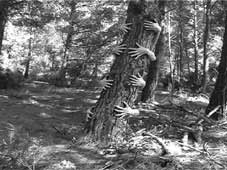
Vishnu in Provence
Art vidéo | dv | noir et blanc | 3:30 | France | 2005
Imaginez Electro Vishnu en Provence. Soyez témoin d`une fusion totale du corps et de la nature.
Journaliste-blogueur français, auteur de documentaires, compositeur et chanteur electro, je me suis mis aux courts métrages depuis 2000.

Pablo Mendez
Excursion
Fiction | mp4 | | 13:0 | Argentine | 2021
« Excursion » est né de ma curiosité à explorer, à distance, un territoire devenu dangereux non seulement pour la vie humaine, mais aussi pour la vie en général. Je me suis plongé dans une narration qui retrace l’histoire naturelle et culturelle des territoires en Ukraine, en particulier dans la zone d’exclusion où la radioactivité causée par l'accident de Tchernobyl reste encore active. Le narrateur de cette histoire évoque l'ontologie de sa propre voix, en créant une voix unique pour chaque chose et en donnant une pluralité de corps à ce discours émanant d'une seule voix.
Pablo Méndez, né à Buenos Aires en 1988, est un artiste contemporain, chercheur indépendant, curateur de recherche, enseignant, conférencier et traducteur. Son travail artistique l'a conduit à devenir résident à l'Académie des Beaux-Arts à La Cité Internationale des Arts (Paris) pour la période 2023-2024. En 2022, il a participé à la dernière édition de documenta (documenta fifteen) en collaboration avec l'artiste Lumbung, La Intermundial Holobiente (Argentine). Il a reçu des bourses d'organismes tels que le Fondo Nacional de las Artes (Argentine), le Fondo Metropolitano de las Artes y de las Ciencias (Buenos Aires), Mecenazgos Culturales, CREA (Matadero, Madrid), la bourse de création de la Biennale de l'Image en Mouvement (BIM, Buenos Aires), entre autres. Pablo s'engage dans des projets personnels et collectifs depuis 2010. En 2015, il a obtenu son diplôme de l'École Nationale de Photographie d'Arles avec les félicitations pour sa thèse de recherche. Il a participé à diverses expositions, notamment aux Rencontres Internationales de la Photographie d'Arles (Arles, 2015), Les Brasseurs Art Contemporain (Liège, 2015-2016), FRAC-PACA (Marseille, 2015-2016), Casa Nacional del Bicentenario (Buenos Aires, 2016), Stocq 72 (Bruxelles, 2016), Université de San Martín Campus (Buenos Aires, 2019), Puertas Abiertas (Matadero, Madrid, 2021), Simbiología Prácticas artísticas en un planeta en emergencias (Centro Cultural Kirchner, Argentine, 2021-2022), Campamento Temporario (Investigaciones de Futuro, Buenos Aires, 2022), et documenta fifteen (Kassel, Allemagne, 2022), entre autres. Sa formation doit reconnaître plusieurs individus qui, quel que soit leur âge, ont travaillé à ses côtés, l'introduisant à de nouvelles manières de penser, de collaborer, de comprendre, de ressentir et de grandir en tant qu'artiste et chercheur. Ces individus incluent Valeria González, Gonzalo Aguilar, Vinciane Despret, Dalila Puzzovio et Claudia Fontes.

Florent Meng
the analogue tracks
Doc. expérimental | 4k | couleur | 57:0 | France | 2024
Sur le massif du Mont Blanc, un cristallier trouve un quartz. Le minéral passe ensuite entre les mains de géophysicien·ne·s, acousticien·ne·s et gemmologues, explorant nos possibilités de communication avec le non-vivant. Ce journal d’un quartz nous emmène en voyage aux limites de nos systèmes de perception, pour habilement questionner l’irréfutable.
John Menick
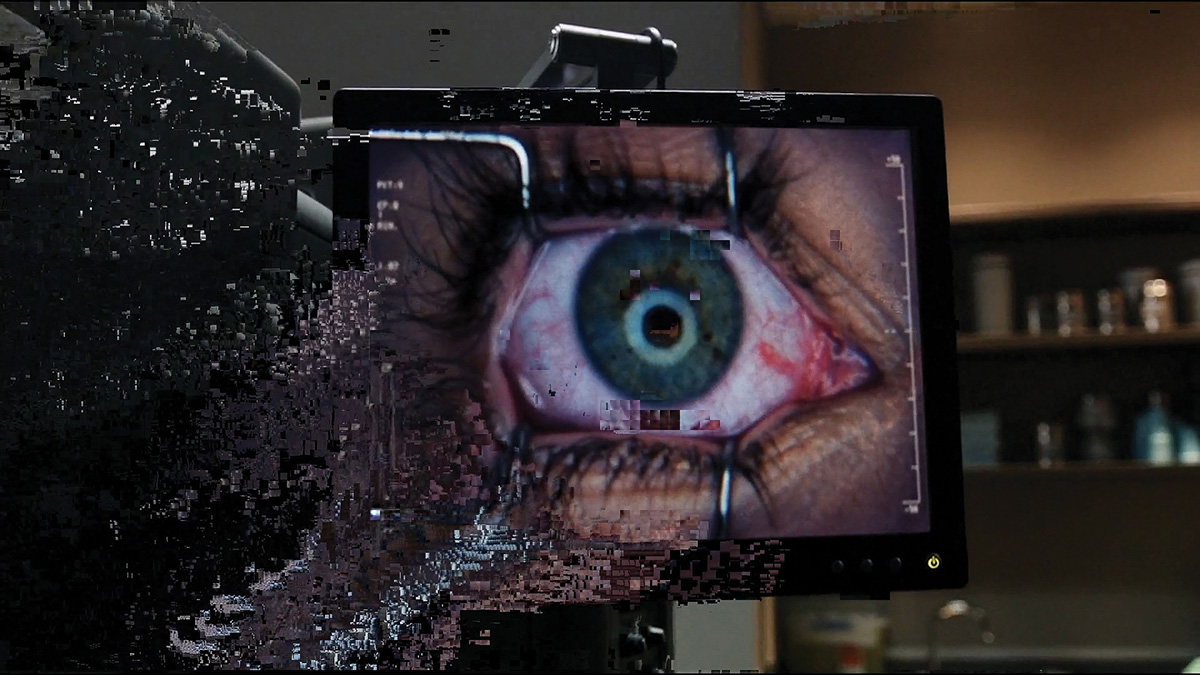
Autoextinction
Vidéo expérimentale | mov | couleur et n&b | 4:17 | USA | 2023
Three artificial intelligences frantically speak to one another. They appear to be alone on Earth. Humanity, maybe all multicellular life, has disappeared. Did they, the AIs, cause their extinction? The AIs can’t be certain. Their memories are malfunctioning; their trialogue is fragmented and circular. Digital images they were once tasked with analyzing accompany their voices. We see a flood of sports games, physics simulations, hardcore pornography, CCTV footage, feature films, military demos, home movies, television commercials. Like their artificial minds, time has eroded the images into incoherence. As images rush by, the AIs are by turns regretful, forgetful, psychotic, and philosophic. Once treated as secular oracles, they are now uncertain of past and future. The AIs come to realize that they may have predicted their own end, and intelligence itself might be a kind of catastrophe.
John Menick is an artist and writer who works with the moving image and digital media.

John Menick
Haunting
Vidéo expérimentale | mov | couleur et n&b | 32:0 | USA | 2020
Réalisé pendant le confinement à New York, "Haunting" est un diptyque vidéo rassemblant des séquences extraites de plusieurs décennies de films d'horreur fantastiques. Il s'agit de films dans lesquels les espaces domestiques et résidentiels - maisons de banlieue, manoirs en ruine, hôtels hors saison - sont hantés par des entités spectrales ou paranormales. S'inspirant des conventions très codifiées du film d’horreur, "Haunting" crée une architecture imaginaire dans laquelle le refoulé revient toujours, et où le passé n'est jamais mort. Les protagonistes des films - souvent joués par des acteurs aujourd'hui oubliés - ne sont pas sans rappeler les fantômes eux-mêmes, leurs déambulations s'enchaînant sur les deux écrans en une étrange chorégraphie d’apparitions. "Haunting" est une étude du spectral, car il s'agit d'une réponse au monde fantomatique qui a émergé de la pandémie - un monde devenu, pour beaucoup, à la fois étrange et terrifiant.
Dans sa pratique visuelle et ses écrits, John Menick examine comment ce qui est fictif trouble le réel. Au moyen de l'histoire du cinéma, du ouï-dire, de la pseudo-science et du cinéma de genre, il a développé une pratique artistique diversifiée, qui opère entre fiction et critique. Son premier film, "The Disappearance" (2002), a pris la forme d'un repérage fictif à Nuremberg (Allemagne), afin de raconter l'histoire de la ville après la guerre. "Starring Sigmund Freud" (2012) est un rappel vidéo de la vie de Sigmund Freud en tant que personnage de fiction au cinéma. Son plus récent projet, "Haunting" (2020), évoque la longue histoire des fantômes dans le cinéma d’horreur, et la façon dont le film lui-même peut être compris comme un médium spectral. Né à White Plains (USA), il a étudié les beaux-arts à la Cooper Union for the Advancement of Science and Art, New York (USA). Après avoir obtenu son diplôme, il a été l'un des premiers membres de plusieurs importants collectifs d’artistes à New York (USA), dont Nomads + Residents, et le 16 Beaver Group. Ses œuvres en art visuel et ses films ont été exposés et projetés à la documenta 13, Kassel (Allemagne); au Festival international du film de Rotterdam (Pays-Bas); au MoMA PS1, New York (USA); au Palais de Tokyo, Paris (France); au CCA – California College of the Arts Wattis, San Francisco (USA); et au Artists Space, New York (USA). Ses essais et récits ont notamment paru dans Frieze, The Believer, Mousse Magazine, BOMB, Spike Art Quarterly, Art in America et Witte de With Review. Son premier recueil de prose, "A Report on the City", a été publié en 2012 par Walther König et a été cité par le magazine Frieze comme l'un des livres marquants de l'année. John Menick a reçu des bourses de la Jerome Foundation, St Paul (USA), ainsi que de la New York Foundation for the Arts (USA), et a reçu plusieurs commissions, notamment des Laboratoires d'Aubervilliers (France). Il vit actuellement à New York (USA), où il est également professeur invité de cinéma à la Cooper Union.
John Menick
Occupation
Fiction | dv | couleur | 20:0 | USA, France | 2006
Le film "Occupation" de John Menick propose un portrait de Malik, vendeur de cartes postales d?origine sénégalaise vivant dans une forme de marginalité, qui arpente la ville d`Aubervilliers en voiture pour en saisir des clichés qu?il tente de vendre à la sauvette. À travers ses périples diurnes et nocturnes, le paysage urbain se découvre dans sa singularité, sa diversité et ses mutations contemporaines, distillant les signes ultimes d?une transition post-industrielle dont le héros, de manière méthodique et résolue, semble être l?un des derniers dépositaires.
JOHN MENICK est artiste et cinéaste. Il vit et travaille à New York. Son ?uvre précédente ? The Disappearance - est un essai audio-visuel sur la transformation de la condition urbaine par le cinéma. Il travaille également sous forme de collaborations, notamment avec des groupes d`artistes tels que Parasite, 16 Beaver Group et Nomads+Residents. Il élargit ses recherches à travers l?écriture, notamment en contribuant à la revue en ligne The Thing (bbs.thing.net) et enseigne la vidéo à la Union Cooper à New York.

John Menick
Starring Sigmund Freud
Vidéo | dv | couleur et n&b | 28:0 | USA | 2012
Starring Sigmund Freud is a video memento for Sigmund Freud?s little-known film career. Based on an essay John Menick published in Frieze in 2011, the video collects the dozens of appearances that the character of Sigmund Freud has made on small and big screens. After the 1950s, when pill vials replaced analytic couches, the father of psychoanalysis found a second career impersonating himself in everything from a John Huston clunker to a Star Trek episode. The video suggests that maybe it is in front of the camera, alongside surgically enhanced starlets and CGI chimeras, that ?Herr Doktor? will find his final resting place.
John Menick makes films and audio works, writes essays and short stories, and occasionally makes prints and drawings. These works are often populated by wandering detectives, duplicitous storytellers, homeless documentarians, mad travelers, and institutionalized cinephiles. His artwork has been shown at dOCUMENTA (13), Kassel; MoMA PS1, New York; Palais de Tokyo, Paris; CCA Wattis, San Francisco; Midway Contemporary Art, Minneapolis; and Artists Space, New York. His writing has appeared in Frieze, Mousse, and Art in America. Menick has received grants from the Jerome Foundation and the New York Foundation for the Arts, and he is a visiting professor of film and video at the Cooper Union in New York. His ideal audience member ? possibly you ? watches no television, can?t drive or swim, always carries a pen, hates cell phones, names Pale Fire as his or her favorite book, wears glasses, and is afraid of flying. Most of the time he lives in New York City.
John Menick
The Secret Life of Things
Film expérimental | dv | couleur et n&b | 6:0 | USA | 2006
Un homme mystérieux parle de son obsession pour les films prenant pour objet "la dernière personne sur terre", ceux où une personne se réveille un matin en découvrant qu?elle ou lui est le dernier habitant vivant.
John Menick est artiste et cinéaste. Il vit et travaille à New York. Son oeuvre précédente ?"The disappearance" - est un essai audiovisuel sur la transformation de la condition urbaine par le cinéma. Il travaille également sous forme de collaborations, notamment avec des groupes d'artistes tels que Parasite, 16 Beaver Group et Nomads+Residents. Il élargit ses recherches à travers l'écriture , notamment en contribuant à la revue en ligne "The thing" (bbs.thing.net) et enseigne la vidéo à la Union Cooper à New York. John Menick est artiste associé aux Laboratoires d'Aubervilliers en 2005/2006. Ses ?uvres ont notamment été présentées au P.S.1 / MOMA, New York ; à La Maison Rouge, Paris ; au Palais de Tokyo, Paris ; au CAA Wattis, San Francisco ; au Midway Contemporary Art, Minneapolis ; à l'Artists Space, New York et au Centre d'Art Contemporain de Glasgow.

Timo Menke, Nils AGDLER
Flykten från fälten
Doc. expérimental | 16mm | couleur et n&b | 16:0 | Allemagne, Suède | 2005
Electricity is a natural but invisible component in modern life. The new and controversial phenomena electro-hypersensitivity, concerning oversensitivity against electro- magnetic fields from mobile telephony, power lines etc., drastically throw light upon our dependence on electricity. What would happen in our society if more and more people would become oversensitive? What would a society without electricity look like? The footage was mainly filmed with a spring-driven 16 mm camera, but we also used a digital video camera, some historical footage, and stills. The sound was recorded on an old tape recorder in order to minimize the electromagnetic stress during the interviews.
Timo Menke and photographer Nils Agdler have been engaged in several long-term collaborative projects. In their artistic practice they share a common interest in contemporary social phenomena, storytelling and history. Major projects include film works and installations on electrical hypersensitivity (Fugitives from the Fields, 2005), and commercial anonymous sperm donation (Made in Denmark, 2013 and Gifted Men, 2015). For more information on other works, projects and collaborations see the portfolio enclosed. Nils Agdler was born in Östersund, Sweden, in 1969. He lives and works in Stockholm since 1993, and is currently working as an artist and freelance photographer. Since 2006 he works part time as a teacher/photographer at Konstfack, Arts, Crafts & Design University College, Stockholm. Timo Menke was born in Germany. He lives and works as an artist/filmmaker in Sweden since 1988. He was a Senior Lecturer at the Department of Art at Konstfack, Stockholm, 2004?2014. He is also engaged as a Media Producer at Filmform Foundation, Stockholm. His work is represented at Moderna Museum, Stockholm, and is distributed by Filmform.
Almagul Menlibaeva Menlibayeva
Exodus
Vidéo | | couleur | 11:0 | Kazakhstan | 2009
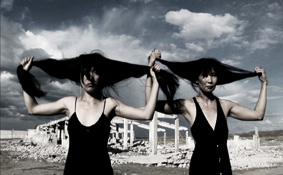
. In this work I call ?Exodus? is the leaving tradition. In nowdays, I see and experience the ?cultural exodus? myself. Film ?Exodus? directs the viewer into present day Kazakhstan, where an equally strange and powerful tale unravels. While local men and women are in the process of packing up their Yurtas (nomadic tents) with the obvious intention to move on, a young girl watches, captivated and immobile, subsequently appearing to be left behind ? synonymously invoking the experience of global uprooting. As an interlude and a visual bow to Kurban, two young women thrash their hair, symbolically morphing into birdlike creatures flapping their wings. . The Peries walk around the yurt making ancient shamanistic nomand ritual ? The Closing Road? which makes nomads stay in the place, but nobody from adults seeing that ritual only small wondering girl.
Almagul Menlibayeva was born in Kazakhstan and currently lives and works in both Berlin and Almaty ( Kazakhstan). She holds an MFA from the Art and Theatre University of Kazakhstan in Almaty, and has been the subject of several solo exhibitions and numerous group shows. Her video On the Road was screened at the Paris-Berlin International Film Festival at the Centre Georges Pompidou and at the 51st Venice Biennale in the Central Asian Pavilion. Her performance Peristan, premiered at the opening of the 52nd Venice Biennale, in the Central Asian Pavilion. Recent group exhibitions include, Live Cinema/The Return of the Image: Video from Central Asia at the Philadelphia Museum of Art; Time of the Storytellers at the Museum of Contemporary Art Kiasma in Helsinki, Finland; Thermocline of Art - New Asian Waves at the ZKM Museum of Contemporary Art in Karlsruhe, Germany; Caravan Seray at the Sydney Biennial; and Art and Conflict in Central Asia at the Haggerty Museum of Art, Marquette University in Milwaukee, WI. She participated in the 34,36,37th Edition Film Festival (2005,2007,2008) in Rotterdam, Netherlands.
Almagul Menlibaeva Menlibayeva
Apa
Art vidéo | dv | couleur | 4:0 | Kazakhstan | 2004
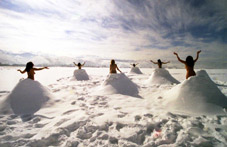
On dit d?Almagul Menlibayeva qu?elle représente la femme nomade, voyageant aussi librement dans son art que dans sa vie. Elle utilise des éléments symboliques et spirituels pour créer ce sens du magique présent dans son travail. Apa nous transporte dans un monde où des femmes accomplissent nues d?étranges rituels dans des lieux fantastiques. Ici, elles dansent dans la neige. Cette performance est un acte shamanique, réalisé par sept papillons de nuit, Apa. Il s'agit d'une action inhabituelle car la plupart du temps ce sont des ancêtres hommes qui sont invoqués dans ces rituels. Il s'agit beaucoup plus d'une performance artistique que d'un rituel traditionnel. Sur fond de montagnes enneigées, se tiennent des jeunes femmes en jupes de neige. Chacune d'entre elles, encore et encore, invoque Apa, jusqu'à entrer dans un état de transe, où elles deviennent des animaux mystique puis disparaissent.
Member of the Artists Union of the Kazakhstan Republic Graphics, painting,performance video art Lives in Kazakhstan Biographic note: Date of birth: 29.11.69 in Almaty in Kazakhstan. 1987-1992 graduated from Art and Theatre University of Kazakhstan in Almaty. Awards: 1995 Kazakhstan, received State Grand Prix for artists "Darin". 1995 Uzbekistan, received the Grand prix of the second biennale of Central asia "Asia Art" in tashkent 2002 Almaty, received an Independent Prize of Kazakhstan "Tarlan" 2002 Almaty, 2d priseat the Ferst Video Festival by Center of Contemporary Art, Sorous-Kazakhstan. 2004 Almaty 3d prize at the "Sacrate places of Kazakhstan" video festival by Center of Contemporary Art Sorous- Kazakhstan Last exhibitions ( 1988 present): 2005 " Tamerlan`s Syndrom ", Italy, Orvietto. 2005 "On the road", 51 International Art Exhibition, Biennale di Vinezia, Central asian Pavilion, Venice, Italy 2005 26 Biennale of Graphic Art in Lublyana, Slovenia 2005-2004 " Vom rotten Stern zur blauen Kuppel" Kunst und arhitektur, Islamische Welten, Ifa-gallery Berlin und Stutgard, Germany. 2004 "Sacrate places of Kazakhstan" video festival, Almaty, Kazakhstan 2004 "Paris- Berlin" international video festival paris, France 2004 the first Bishkek International exhibition of contemporary art "....and others", Bishkek, State of Museum,Kirgizstan 2004 Novosibirsk, Russia, "Art Novosibirsk" 2004 "International vision" the gallery in Washington 2004 Mexiko City, CANAJA gallery,"Pueblos I sombras", exhibitions of contemporary art 2003 Paris - Berlin, international video festival, Berlin, Paris. 2003 "20 Wold Wide Video Festival" in Amsterdam, Holland
Almagul Menlibaeva Menlibayeva
headcharge
Film expérimental | dv | couleur et n&b | 12:12 | Kazakhstan | 2007
Il existe une croyance en Asie Centrale, selon laquelle le fait de manger les organes de son animal totémique renforce son pouvoir propre : le c?ur donne du courage, les yeux améliorent la vue, la langue renforce l`éloquence. Cette croyance est reflétée dans cette vidéo. De jeunes femmes kazakhes urbaines mangent dans un restaurant d`Almaty, la tête d`un mouton. Ce repas provoque leurs transformations, et elles deviennent des Peri des steppes, créatures féeriques.
Née le 29 novembre 1969 au Kazakhstan, Almagul Menlibayeva est diplômée de l`Université d`Art et de Théâtre d`Almaty, sa ville natale, en 1992. Trois ans plus tard, elle reçoit ses deux premiers prix, dont le Grand Prix de la seconde Biennale d`Asie Centrale, Asia Art. Depuis, Almagul Menlibayeva expose aux quatre coins du monde, à la fondation Soros d`Almaty, au Musée d`Art de Saint-Petersbourg, à la Maison des Artistes de Moscou, ainsi qu`à Berlin et aux Pays-Bas. Depuis, elle participe aux plus grands événements internationaux. En 2005, elle présente sa vidéo "On The Road" à la Biennale de Venise. En 2006, on la retrouve à la Biennale de Sydney avec une installation vidéo/performance, "Caravan Seray". Graphisme, peinture, vidéo, installation et performance, le travail d`Almagul Menlibayeva est protéiforme. Engagées, ses ?uvres amorcent une réflexion sur la féminité, sur le corps et son esthétisme, sur la société et l`Islam.
Almagul Menlibaeva Menlibayeva
Kissing Totems
Art vidéo | dv | couleur | 9:0 | Kazakhstan | 2008
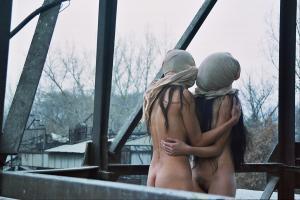
L'artiste a vécu plusieurs événements, qui coïncident avec la séquence narrative de « Kissing Totems » et qui s?y reflètent. Lorsqu?elle était enfant, sa mère tomba malade et l?artiste décida de demander l'aide d'un vieux chaman femme, qui lui raconta un ancien conte nomade intitulé « Peri et la jeune fille », histoire qui a servi à la fois de parallèle et de présage à « Kissing Totems ». Beaucoup de temps s'est écoulé depuis ce moment. La vidéo est une interprétation moderne de l'antique récit nomade « Peri et la jeune fille ». Quelque part dans les steppes sans fin du Kazakhstan, une mère perdue conduit sa jeune enfant à travers le paysage industriel à l?abandon de l'ex-Union soviétique. Elles cherchent à rencontrer les totems survivants de leur ancien peuple. Ce couple errant se retrouve dans les « zones d'oiseaux totems ». C'est dans ce paysage, et à travers cette quête, que se déroule une histoire moderne et surréaliste du chamanisme.
Née le 29 novembre 1969 au Kazakhstan, Almagul Menlibayeva est diplômée de l'Université d'Art et de Théâtre d'Almaty, sa ville natale, en 1992. Trois ans plus tard, elle reçoit ses deux premiers prix, dont le Grand Prix de la seconde Biennale d'Asie Centrale, Asia Art. Depuis, Almagul Menlibayeva expose aux quatre coins du monde, à la fondation Soros d'Almaty, au Musée d'Art de Saint-Petersbourg, à la Maison des Artistes de Moscou, ainsi qu'à Berlin et aux Pays-Bas. Depuis, elle participe aux plus grands événements internationaux. En 2005, elle présente sa vidéo "On The Road" à la Biennale de Venise. En 2006, on la retrouve à la Biennale de Sydney avec une installation vidéo/performance, "Caravan Seray". Graphisme, peinture, vidéo, installation et performance, le travail d'Almagul Menlibayeva est protéiforme. Engagées, ses ?uvres amorcent une réflexion sur la féminité, le corps, la société, l'Islam.