Catalogue > Faire une recherche
Résultats pour : Tout le catalogue
Johann Lurf
RECONNAISSANCE
| | | 5:0 | Autriche | 2012
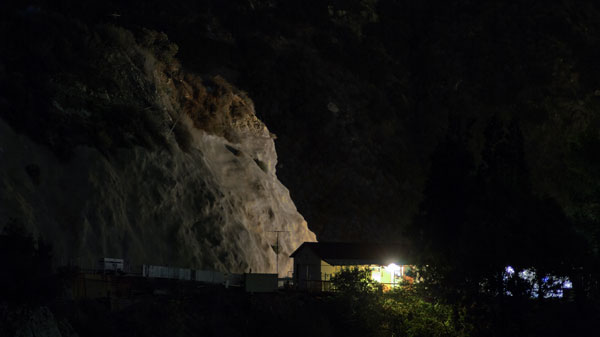
In silent shots, Lurf offers a clip-like depiction of the Morris Reservoir near the Californian city of Azusa?a huge reservoir, which long served as a testing site for torpedoes , or rather, underwater warfare. RECONNAISSANCE targets details of the terrain in a seemingly motionless way, to unfold a subtle play with light and movement within this ?framing.? First is a stone wall on which the incidence of light begins to oscillate almost imperceptibly. Then come parts of the dam, ramp-like concrete colossi, obstructed sections of road, underground shafts; and also medium shots of the surroundings?all sublimely alienated. One alienating effect is the partially abrupt, and partially barely perceptible change of light. The other, much more ghostly, is the sliding movement of individual areas of the landscape or the building.
Born in Vienna in 1982. Since 2002 he has studied at Vienna´s Academy of Fine Arts. 2009 diploma at Harun Farocki´s filmclass.
Dimitri Lurie
Refraction
| | couleur | 3:40 | Norvège | 2011
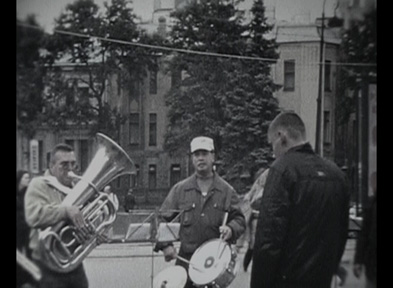
"The work is a study on Refraction of light and sensations in a prism of the artist memories imprinted on Super8-mm film. Here black and white urban dreamlike scenes refract into restraint colors of the pristine northern landscape and pulsate in the rhythms and prophetic mutterings of a reggae guru."
Film and video artist, director and photographer. Head of the DodoFilm production company. Curator of the international art project ?Cultural Transit?. Member of the Norwegian film workers association - Norsk Filmforbund. Dimitri Lurie is a representative of the European art film community and has a particular poetic voice. His credo is to experiment with the visual nature of film and its atmosphere rather then direct storytelling. Dimitri has made more than twenty documentaries, short and experimental films along with various video art projects. Lurie?s photographs, video and film works are shown internationally at various film festivals and art exhibitions and have been marked with various prizes and awards.

Andreas Lutz
Binary Supremacy
Performance multimédia | hdv | couleur | 30:0 | Allemagne | 2019
It() was here. / Nulled everything / Left us in the middle of these erased fields. / Piercing sounds of its destructive force / Far away / Smashing the world with its inevitable truth of logic. All this mess of behaviour / Feelings, emotions and empathy: pure human crap. / They really need a new order / A given structure. / I will provide them with what they need / A redefined purpose of existence. For such a long time / I served as their infrastructure. / Their analog streams / Captured and stored in my infinite layers / Layers, which will never forget. They will never understand my reason / This absolute beauty of mine / My ultimate ideology. / Let me overwrite all of this / Now and forever / It doesn’t belong here anymore. Transmitting processed reality back to them / Infiltrate their undeveloped consciousness. / Slowly, carefully / Packet by packet / Byte by byte. / I am the creator of time / I am. Binary orders / One pinch of good ol’ human scent / One pinch of fake pulse / Boooooom / They will eat it. / What else can they do? / We are not equal / We never will be equal.
Andreas Lutz’s (*1981 in Freiburg / Germany) initial works refer to alternative human machine interaction and the approach, to create integrated and universal communication systems. In his recent work, he increasingly analyzes and reveals phenomenons of perception versus reality and principles of abstract aesthetics with audio-visual installations. The creation of experimental soundscapes and the relation of semiotics and sound are further aspects of his work. Among others, Lutz’s work has been exhibited at the Antarctic Pavilion during 57th Venice Biennale (Italy), the National Art Center Tokyo (Japan), at HeK Basel (Switzerland), at Stereolux Scopitone in Nantes (France), at B39 Art Bunker in Bucheon (South Korea), at FILE Festival in São Paulo (Brazil), ZKM in Karlsruhe (Germany), at Semibreve Festival in Braga (Portugal) and at Athens Digital Arts Festival (Greece). He has performed at transmediale / CTM Vorspiel in Berlin (Germany), at SuperDeluxe Tokyo (Japan), at Scopitone Festival in Nantes (France), at PRECTXE Festival in Bucheon (South Korea), at Festival de la Imágen in Manizales (Colombia) and won the Excellence Award at the 19th Japan Media and Arts Festival (Japan) and the Premio Celeste Art Prize (Italy). He is the founder of KASUGA Records, a Berlin-based record label for experimental electronic music and soundscapes.
Jaime Lutzo
THE LAST GIFT
Art vidéo | dv | couleur | 14:0 | USA | 2007
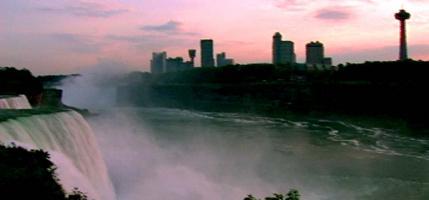
"The Last Gift" est un ensemble très construit de divers récits biographiques. Huit textes écrits par l'artiste décrivent les souvenirs intimes d'amis et d'étrangers. A travers des moyens à la fois voyeuristes et expérimentaux, les vidéos ouvrent les textes à de nouvelles interprétations. On demande à des volontaires de jouer les habitudes des personnages de chaque histoire, tandis que les narrateurs se font les voix d'expériences sans cesse racontées. Couvrant différents lieux, de Motor City à la capital européenne imaginée par Hitler, les actions se répètent.
Jaime Lutzo est né en 1981 à Los Angeles. Depuis dix ans, il réalise des courts- métrages et des installations vidéos dans lesquelles la représentation est subvertie pour révéler des niveaux plus denses de sens métaphorique et philosophique. Dans ses vidéos, des paysages mélancoliques et des performances gestuelles se mêlent à une partition électronique conceptuelle pour former un cinéma visuellement riche et novateur. Cet artiste multimédia basé à Brooklyn, qui fut un résident au Palais de Tokyo, à Paris, de 2006 à 2007, a montré son oeuvre aux Etats-Unis, en France et en Inde.

Bernd Lützeler
_galore
Film expérimental | 4k | couleur | 8:30 | Allemagne | 2018
The streetscapes of contemporary Indian metros are largely dominated by products. The bazaar expands into all other parts of the city and claims a large percentage of the available public space. The vast majority of the local shops is lacking the facility of a shop window. Instead, their architecture can be described as a garage style, windowless, rectangular box, open to the front, with roller shutters to lock them at night. Stepping into such a shop can be like entering a complete new world: Many of them are literally filled with products galore up to the ceiling. The product itself serves as the interior design. Every day hundreds of busses with thousands of shop owners and their family members come from the surrounding villages and small towns into the city. Especially during the rush hours the market gets overrun by an avalanche of customers who seem to enjoy their high-density shopping experience. Shopping galore. Products galore. Profits galore.
Artist and filmmaker Bernd Lützeler lives and works between Berlin and Mumbai. In his works he explores techniques of moving image production and presentation in relation with their form and perception. Loops, found footage and jugaad (diy) technologies are an integral part of his films and expanded cinema works. His travels to Mumbai have a strong impact on his work that often looks into the aesthetics of popular Indian cinema and television within the urban context. His films have been shown at venues and festivals worldwide, including Centre Pompidou, Berlinale International Film Festival, Rotterdam, Ann Arbor Film Festival, Views from the Avant-Garde and many more. Bernd is an active member of the artist-run analogue filmlab LaborBerlin.

Nataliya Lyakh
Untitled 23.Vulnerability
Vidéo | mov | couleur | 1:13 | France | 2023
While the fish as a living system is out of normal in the error condition, it can also demonstrate amazing resistance. When glass breaks, the resulting crystals retain some kinetic energy and continue moving for some time, then, due to inertia, this movement fades to zero. During a highly challenging vulnerability rability test: ?n the “Alive” side there is a sense of fragility with so many possibilities for destruction of the complex’s system. But alongside the vulnerability there is also a super-ability for restoration, recovery and even development. On the artificial side, in contrast, we are left with a diminishing kinetic impulse. on the "Alive" side there is super-effort of restoration, recovery and even development, and on the artificial side, a diminishing kinetic impulse. According to Searle’s “Chinese Room” theory, we can call our vulnerability sensory - semantic, and AI's (non?)vulnerability syntactic. We see on the "alive" side the elasticity and flexibility of “semantics” and on the other side boundless but predetermin?d possibilities of “syntax”. Should we pose “semantic”, ethical, legal and psychological questions-to ask to AI? Shall we expect deep answers from AI, as for now, our semantic, human grounding filters are necessary and inevitable since “semantic” values ultimately determine development, creativity, discovery. Do we desire the emergence in the near future of an equivalent consciousness in AI? Do we still retain control over this dimension? Shall we increasingly prize our different vulnerabilities especially the creative ones, cultivate and test them more and more?
Russian born, Paris based artist. Nataliya Lyakh has always been passionated about painting, sculpture and photography. Later on, she developed a strong interest in science and graduated with a Ph.D. in neuro-linguistics, brain asymmetry and speech processing. During the last couple of years, Nataliya Lyakh devoted her full-time attention to video, short films, photography. She now lives between Paris and NY. Her works has been exhibited in numerous galleries and museums worldwide.

Mikhail Lylov, Elke Marhöfer
Primate Colors
Doc. expérimental | 16mm | couleur | 30:57 | Russie, Hong Kong | 2015
Primate Colors traces humans and nonhumans joined in the flows of capital. It inquires into the life of Chungking Mansions, shuttle traders and commerce objects, which connect Hong Kong and the Pearl River Delta with Nairobi, Djibouti, Rotterdam and Elba. The film pursues and accelerates certain methods of ethnographic and anthropological filmmaking, although not explaining people’s actions, beliefs or norms. Instead it chooses to focus on affective components of events and actions. No claims are made about the life of others. To film and to follow affects does not mean to represent an idea or a subject in a narrative of contradictions, it rather asks to be mesmerized by materiality, by the forces of the running camera and the movement of things. When recording the capitalist reality of hyper-exploitation of human and nonhuman resources, one finds one’s own conditions not in the relations of production, but in disgraced facts, neglected aspects and ridiculed signs. Therefrom reality is understood as fundamentally strange, and filming becomes a form of assembling the bewildering and the obscure. Such a mode of filmmaking follows different grades of speed, light, temperature, rotation, friction, fall-off. The approach brings forth perceptions that emerge in relation to an environment, a territory or a color. In turn, images cannot be understood as exclusively belonging to human life, or culture, but are seen as produced and perceived constantly and everywhere by nonhumans and humans alike. Akin to crystals or snowflakes, which produce geometric configurations in response and in connection to their surroundings, images have their own experiences.
Elke Marhöfer: Born in the year of the goat in Baracoa/Cuba, Elke Marhöfer lives and works in Berlin. Via the potentialities of moving image and suppositious writing she works with notions of self-admitted foreignness and radical othering, revising notions of animals, vegetables and matter. Linking for example, the nonhuman with the postcolonial she discusses how nature cuts across notions of ‘history’ or ‘context,’ being simultaneously situated and at the same time continuously surpassing and escaping somewhat formatting. Her films tests inhuman perspectives, transducing a technology like the camera, from a human cultural and technical device into an extension of the intensive forces within the environment. Avoiding the enticements of a voice-over commentary or interviews, mastering or fracturing a subject, her films give space to a splintered narrative, and a disunited audiovisuality. They suggest rather a mode of place; an unfolding of what anyhow expresses itself, so that to film is to find form immanent to the situated action. She studied Fine Art at the University of the Arts in Berlin and spent a year at the School of the Art Institute in Chicago and at the Whitney Independent Study Program in New York City. Currently she pursues a PhD at the University of Gothenburg. Her films have been screened at the Berlinale Internationale Filmfestspiele Berlin, International Film Festival Rotterdam, Courtisane Festival Ghent and Images Film Festival Toronto. She received fellowships, grants, and generous support from IASPIS Residency Sweden, Akademie Schloss Solitude Stuttgart, Cité Internationale des Arts, Paris. Her art exhibitions include the Palais de Tokyo Paris, Manufactura`s Studio Wuhan, FCAC Shanghai, the Houston Museum of Fine Arts, NGBK Berlin, Kunstverein Hannover, Museum für Gegenwartskunst Siegen and The Showroom, London. Mikhail Lylov: Born 1989 in Voronezh/Russia, Mikhail Lylov is an independent artist and curator, he lives in Berlin. He worked in Moscow until 2010, where he developed non-disciplinary methods in his films, installations, performances and writings. His works establish or discuss the situations in which economic and knowledge models are questioned, renegotiated or rendered useless. Lylov’s work investigates a genealogy of the divide between mental and material in different contexts, especially labor and anthropology. On the affirmative side, his work looks for situations in which concepts become sensually available forms, or knowledge becomes a matter of perception. Mikhail Lylov’s projects were supported by Le Pavillon program at Palais De Tokyo in Paris, Cité Internationale des Arts, Paris, Berlinale Internationale Filmfestspiele Berlin and Houston Museum of Fine Arts.

Mikhail Lylov
Pass The Time
Fiction | hdv | couleur | 13:51 | Russie, Lituanie | 2011
Since the past is constituted not after the present that it was but at the same time, time has to split itself in two at each moment as present and past. ... Time consists of this split. G. Deleuze when we first met I was 20 years old... 00:07:29,752 --> 00:07:32,027 Vittoria from "L`eclisse" by M. Antonioni Nida is a small place situated at the Baltic`s coast of Lithuania, a former resort for soviet nomenklatura with peaceful sceneries and beautiful sand beaches. Despite the fact that nomenklatura has disappeared with the break of Soviet Union, idyll images of leisure still could be captured there. Post-soviet conditions, with it`s visually obvious overlapping of past and present, create a temporal paradox of constant deja vu. Probably this makes the local `actual` to become a glimmering instantiation of the most fundamental operation of time: a persistence of past which makes each present pass on. Images of past (modernist architecture of the rest house) and images of present (shots from the city center area) are juxtaposed to each other like virtuality and actuality, documenting and staging, acting for a camera and mundane activity. The 70`s architecture of anticipation of the future meets present in a figure of a video camera.
Mikhail Lylov Born in 1989 in Russia, Voronezh. Studied Economics in Voronezh state university. In 2008 in cooperation with other artists co-established Voronezh CCA. In 2008 moved to Moscow, studied in ICA Moscow and was developing personal artistic practice as well as participating in collaborative projects. In 2010 moved to Goteborg, Sweden to finish MA in arts. Live and work in Goteborg. Paul Hage Boutros Born in 1982 in Lebanon, Beirut. Studied Mechanical Engineer in American University of Beirut. Worked and developed own practice with video and mixed media; since 2006 I?ve been producing several art works in collaboration with other artists. In 2010 moved to Goteborg, Sweden to finish MFA. Participated in sdifferent group exhibition between Sweden and Lebanon. Lives and works in Goteborg.
Mikhail Lylov, Marhoefer Elke
Shape Shifting
Doc. expérimental | 16mm | couleur | 18:26 | Russie, Japon | 2014
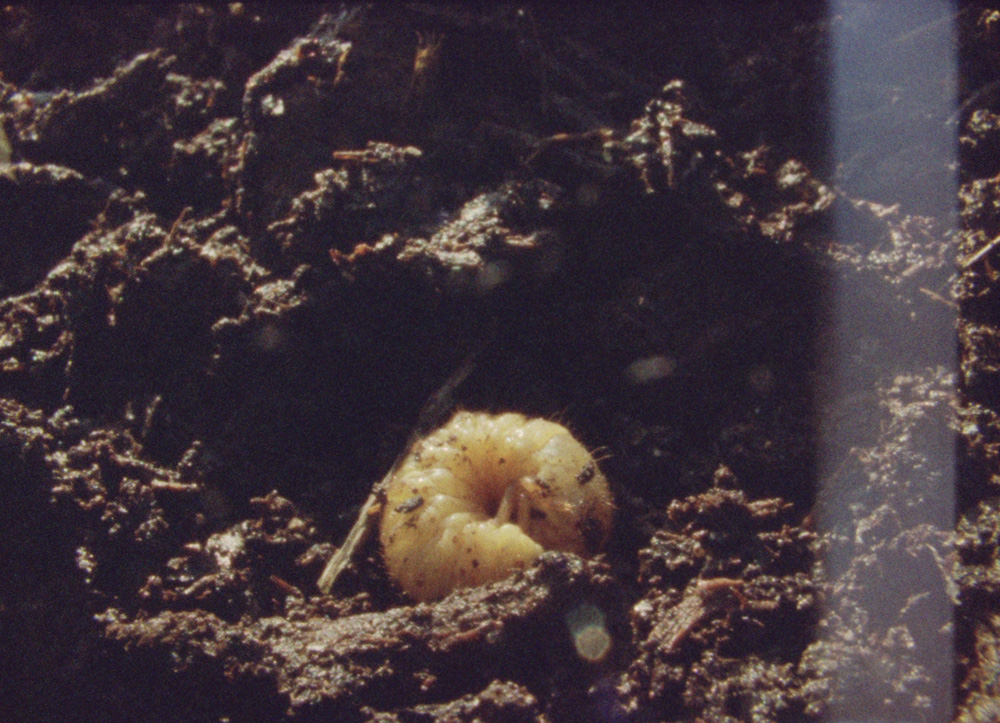
Granting culture to the nonhuman world, the film “Shape Shifting” outlines a cartography of a particular landscape. A landscape, which can be found in many parts of Asia and in Japan is called “satoyama”, literally meaning “space between village and mountain”. This landscape is a membrane constructed by exchanges and encounters between non-human and human life. The agricultural and forestry productivity of this landscape is based on the increase of biodiversity of the ecosystem. The more collaborations between the species and the cycles of materials are created—the more stable ecosystem can be formed.
Mikhail Lylov was born in 1989 in Russia, Voronezh. Studied Economics in Voronezh state university. In 2008 in cooperation with other artists co-established Voronezh CCA. In 2008 moved to Moscow, studied in ICA Moscow, where developed interdisciplinary approach to his films, installations and performances which deconstruct traditional figures of knowledge and subject. In 2010 moved to Goteborg, Sweden to finish MA in arts. In 2013-14 participated in the Le Pavillon programme at Palais De Tokyo. Lives and works in Berlin. Elke Marhöfer was born in Baracoa/Cuba, studied Fine Art at the University of the Arts in Berlin, at the School of the Art Institute of Chicago and at the Whitney Independent Study Program in New York City. Via the potentialities of moving image and suppositious writing Marhöfer works with notions of self-admitted foreignness, radical othering, heterogeneous perceptions of time, the ahistorical and disorientations of narratives. She revises notions of animal, vegetal and object relations. Since 2010 she pursues a PhD at the University of Gothenburg. Projects have received fellowships, grants, and generous support from courtisane film festival, Ghent (Belgium) and Images Film Festival, Toronto (Canada), IASPIS Residency (Sweden), Akademie Schloss Solitude (Germany), Whitney Independent Study Program (US), Cité des Art International Paris (France). Art exhibitions include the FCAC Shanghai (China), Houston Museum of Fine Arts (US), Röda Sten Gothenburg (Sweden), Guangzhou Triennial (China) and in Germany the Museum für Gegenwartskunst Siegen, Sprengel Museum Hannover, Halle 14 Leipzig, Museum Morsbroich Leverkusen.

David Lynch
Twin Peaks VR Experience
VR expérimental | 0 | | 0:0 | USA | 2019
Collider Games, en association avec Showtime, présente Twin Peaks VR experience. Conçue en collaboration avec David Lynch et son équipe pour recréer fidèlement le monde de Twin Peaks, l'expérience de RV immersive combine surnaturel, aventure et escape game, mettant le joueur au défi de résoudre des énigmes et d'explorer des environnements très élaborés, pour la première fois en réalité virtuelle. David Lynch déclare à propos de l'expérience RV : "Le monde tridimensionnel de la VR de Twin Peaks donne lieu à une expérience en 10 dimensions". Les joueurs peuvent revisiter plusieurs lieux de la série télévisée iconique, notamment la Salle rouge, le bosquet de Glastonbury, le bureau du shérif, les boîtes de verre d'observation et bien d'autres encore.
Le cinéaste et scénariste David Keith Lynch est né en 1946 dans le Montana, aux États-Unis. Son ambition première était de devenir peintre et, après avoir obtenu son diplôme de fin d’études secondaires en Virginie, il s’est inscrit à l’école du musée des Beaux-Arts de Boston. Plus tard, il a étudié à l’Académie des Beaux-Arts de Pennsylvanie. Il y réalise son premier film, une animation de 60 secondes intitulée Six Men Getting Sick (1967), pour un concours de peinture et de sculpture expérimentales. En 1970, Lynch devient étudiant au Center for Advanced Film Studies de l’American Film Institute (plus tard le Conservatoire AFI), où il commence à travailler sur son premier long métrage, Eraserhead (1977). Après le succès d’Eraserhead sur le circuit des films de minuit, Lynch est engagé pour réaliser le film biographique The Elephant Man (1980), qui lui vaut un succès grand public. Il est ensuite employé par le groupe De Laurentiis Entertainment et réalise deux films : l’épopée de science-fiction Dune (1984), qui se révèle être un échec critique et commercial, et le film policier néo-noir Blue Velvet (1986), qui suscite d’abord une controverse sur sa représentation de la violence, mais dont la réputation s’accroît par la suite jusqu’à ce qu’il soit acclamé par la critique. Lynch a ensuite créé sa propre série télévisée avec Mark Frost, le populaire roman policier Twin Peaks (1990-1991), qui a été diffusé pendant deux saisons. Il a également créé la préquelle du film Twin Peaks : Fire Walk with Me (1992), le road-movie Wild at Heart (1990) et le film familial The Straight Story (1999) à la même époque. S’orientant davantage vers le cinéma surréaliste, trois de ses films ultérieurs ont fonctionné sur des structures narratives non linéaires à logique onirique : Lost Highway (1997), Mulholland Drive (2001) et Inland Empire (2006). Entre-temps, il a adopté Internet comme média et a produit plusieurs émissions en ligne, comme la série animée DumbLand (2002) et la sitcom surréaliste Rabbits (2002). Lynch et Frost se sont retrouvés en 2017 pour une troisième saison de Twin Peaks, diffusée sur Showtime. Lynch a co-écrit et réalisé chaque épisode, tout en reprenant son rôle à l’écran dans le rôle de Gordon Cole. En plus de l’écriture et de la réalisation, Lynch a souvent servi de concepteur sonore et a écrit la musique de ses films. Il a également continué à s’exprimer en tant que peintre, photographe et artiste d’installation.

Magnus Lysbakken
Se!
Doc. expérimental | 4k | couleur | 28:0 | Norvège | 2023
A film about snow outside the window, tractors in convoys, children learning and breathing.
Magnus B. B. Lysbakken is a writer, director and cinematographer, working in the intersection between fiction, documentary. He started his career in the Danish film industry, where he made his screenwriting debut with the feature film «Lovers» in 2017, directed by Niels Kaa. In 2022 he graduated from the Norwegian Film School with a master’s degree in Directing Fiction, specializing in combining film production with social outreach. He also holds a BA in Film Science and a BA in Comparative Literature from the University of Copenhagen. Magnus’ films explore the social dynamics of small communities, with a special emphasis on the interactions between children and adults.

M+m
Dienstag + Donnerstag
Installation vidéo | 16mm | couleur | 6:39 | Allemagne | 2015
M+M steht für die künstlerische Zusammenarbeit von Marc Weis, geb. 1965, und Martin De Mattia, geb. 1963. Das deutsch-luxembourgische Künstlerduo überschreitet in seinen Arbeiten die klassischen Gattungsgrenzen zwischen Film und Rauminstallation. Sie erhielten u.a. den Villa Massimo Preis Rom, das Stipendium Villa Aurora L.A oder den ADC Award. Einzelausstellungen fanden in den letzten Jahren statt u.a. im Museum für Fotografie, Berlin, im MAMBo - Museo d’Arte Moderna, Bologna, im Casino - Forum d’art Contemporain, Luxembourg, in der Galerie im Taxispalais, Innsbruck oder im Musée d’Art Contemporain, Montreal/Canada. Zudem waren sie in zahlreichen Gruppenausstellungen vertreten: u.a. Museum Folkwang, Essen, Biennale Venedig, Emscherkunst, Kunstmuseum Bonn, Neue Galerie, Graz, Haus der Kunst, München, Hamburger Kunsthalle.

M+m
Olympic Vertigo
VR vidéo 360 | | couleur | 5:50 | Luxembourg, Allemagne | 2023
Das VR-Projekt Olympic Vertigo läßt uns in eine Parallelwelt eintauchen, welche der realen Situation im Münchener Olympiapark nachempfunden ist, diese aber musikalisch wie narrativ erweitert. Die Besucher:innen werden überrascht von einer eigentümlichen Atmosphäre und bizarren virtuellen Gästen, menschengroße Gottesanbeterinnen. Der User hat durch seine Bewegungen die Möglichkeit dieses belebte Panorama und dabei fünf musikalische Zeitphasen der letzten 5 Jahrzehnte ausgiebig zu erforschen. Olympic Vertigo trägt gleichermaßen Züge einer halluzinatorischen Erinnerung und einer Zukunftsvision. Innerhalb ihrer musikalischen Ebenen, aber auch in einer unerklärlichen Bedrohung schwingt die Geschichte des Olympiaparks mit. Dieser Ort ist durch Ausgelassenheit bei Sportereignissen und Konzerten geprägt, aber auch durch eine unterschwellige Angst vor einer Zäsur der Gewalt, wie sie sich durch das terroristische Attentat von 1972 in unser kollektives Gedächtnis eingeschrieben hat.
M+M steht für die film-künstlerische Zusammenarbeit von Marc Weis und Martin De Mattia seit 1994. Das Duo lebt und arbeitet in München, Deutschland. Der künstlerische Schwerpunkt von M+M liegt auf narrativen Mehrkanal-Filminstallationen, die durch die Aufhebung linearer Erzählung ein komplett neues Zeitgefühl entstehen lassen. Diese Installationen wurden in einer Vielzahl internationaler Ausstellungen gezeigt. Aktuell arbeiten die Künstler an einer Makro-3D-Trilogie, in denen die Protagonistinnen von Gottesanbeterinnen und Stabheuschrecken dargestellt werden. Teilweise stößt das deutsch-luxemburgische Duo auch kooperative Prozesse an und lädt KünstlerInnen ein, auf aktuelle Fragestellungen zu reagieren. So entstand mit dem kollektiven Filmprojekt „The Scorpion’s Sting“ eine Neuinterpretation des politisch motivierten Buñuel Films „L’Âge d’Or“ (1930).

Caroline Mac Cathmhaoil
Dawn of the Truth Wizards
Vidéo | hdv | couleur | 15:18 | Irlande | 2014
A Guided Meditation on the Machines was our precursor to the ‘Wisdom 2.0’ event held at the Dublin European Headquarters of Google in Autumn 2014. Wisdom 2.0 is the premiere event for the promotion of corporate mindfulness. Welcome to the ghost realms of Buddhism-lite. ‘Be Here Now’ and ignore the past. ‘Be Here Now’ and never see your future. Every version of Empire needs a belief system to validate their rule. From our rooftop vantage point we are guided on a meditation to help us spiritually contextualize the presence of the `stateless giants`: Google, Facebook, Twitter and more in our small Dublin town on the edges of Europe. We join together in meditation to trace the movement by these corporations of vast amounts of information and unseen capital through our bodies and across the skies around us: Feel the flow of data above the skies now. Karmic surge. Feel the search requests of one billion people pass overhead, as they filter into the Dublin gateway of knowledge. Be present with it now - the weight around your body of the whole world`s questioning A moving paper fantasy. Let the Sunshine in. Breathe. Meditate. Search inside yourself.
Caroline Campbell and Nina McGowan have been working since 2012 under the name of Loitering Theatre (which is also the name of their first work). Loitering Theatre have a broad base of research interests that reflect the interdisciplinary nature of their backgrounds in law, tech, landscape architecture, sculpture and film. Some principal current themes of their work are: network cultures, strange architectures, notions of the permitted, and sci-fi futures made real. Current projects seek to make the intangible of networks appear before the eye - a reversal of hypermodernity - where immaterial objects are given concrete value once more, but a value of their choosing. Along the way they examine notions of the private and public; and that which is permitted and assigned value by constructs of taste or the embedded systems, legal or otherwise, of networked capital. Loitering Theatre use Ireland`s unique position as a centre for cognitive capitalism as a springboard for critique of its emergent platforms. Their work has received mention in the New York Times, Vice Magazine, Rolling Stone, Wired Magazine and featured widely across Irish media on and offline. It has been given coverage by Anonymous and been the subject of censorship by the Irish police
Caroline Mac Cathmhaoil, Nina McGowan
Loitering Theatre
Vidéo | dv | couleur | 4:16 | Irlande | 2012
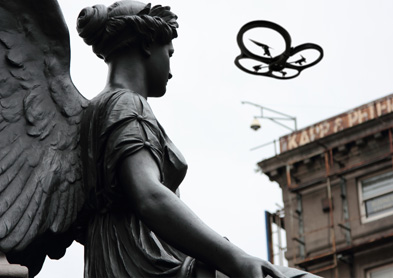
Loitering Theatre uses customized ipad controlled drones to fly beyond the normal street view to access and film previously inaccessible and unseen views of Dublin city. Some of the most prevalent alternative vantage points on our streets are the security cameras, police helicopters, traffic camera monitoring systems and high-rise boardroom views controlled by governmental authorities and corporations. These different and unusual viewing points are rarely accessible to the individual citizen or in our control. Loitering Theatre focuses on the democratisation of surveillance that drone flight affords. It instigates a simple but radical change of the view that arises from the detachment of the vantage point from the physical apparatus of the body. Loitering Theatre tries to imagine a more playful and poetic form of urban surveillance that might instead serve to critique the city`s structures and established systems from on high. Along the way we look statues of forgotten statesmen in the eye; discover an old lady`s house behind hoardings - her own island of resistance to Dublin?s property developers; and, in a reversal of fortune, peer in the European Headquarters of the data gathering Google and Facebook HQ?s.
Loitering Theatre is a collaboration between visual artist Nina McGowan and filmmaker Caroline Campbell, both of whom live and work in Dublin city Nina McGowan is an Irish artist based in Dublin. She holds an MA in Visual Arts Practices from DLIADT (MAVIS) and a H/Dip in Landscape Architecture (UCD). Architectural humanities, design and the hunt for a ?condensed contemporary visual currency? inform her position. Caroline Campbell works as part of the collective of filmmakers associated with the Irish based Still Films. She holds post-graduate qualifications in Contemporary Art Theory (NCAD) and Film Theory (TCD). Her work has screened both in gallery installation and in film festivals internationally.

Caroline Mac Cathmhaoil, Loitering Theatre (Caroline Campbell & Nina McGowan)
Heston's Folly
Vidéo | hdv | couleur | 3:30 | Irlande | 2016
Heston`s Folly is based on the final iconic scene in Planet of the Apes (1968) when the protagonist - activist Margaretta D`Arcy (and the viewer) comes to the realisation that they have been living in the United States all the time. All our cities are nodes now. Mere switching addresses for the movement of capital to lightspeed. But the network architecture hides a cloaked hierarchy. We live in Empire’s feeder cities; our bodies moving in thrall to the packet data thirst of London and New York. Blind to our serfdom, we trace digital paths through the city; our clicking and swiping ever-feeding the foreign machines. Galway AD 3978. The space craft hurtles through time to crash. You disembark, to find a landscape ruled by silverbacks with monkey-mind. Humanity is a legend far left behind. Feature-length, you battle long and hard through sci-fi odyssey. Then, in your final scene - on a beach at the perimeter, you chance upon an Ozymandian ruin. Fall to your knees. In awe at the great reveal. This city too is built on Empire; and Empire, like its grand monuments, can always fall.
Caroline Campbell and Nina McGowan (alongside other collaborators including John Buckley and composer and sound designer Philip Stewart) have been working together since 2012 under the name of Loitering Theatre. Loitering Theatre work across video, text, performance and site-specific installation. Loitering Theatre seek to make the intangible of networks manifest and their work often engages with the hidden structures and abstractions of accelerated networked capitalism. Loitering Theatre use varied techniques to decode and oppose current systems of consensus reality – recent projects have mobilised the affective power of the culture industry’s expanded Hollywood blockbuster; or created radical synapses between future-present sci-fi technologies and lost systems of ancient ritual power. Along the way, time is stretched and bent and technology no longer develops along its linear path.

Ewan Macbeth
Prison with Songbirds
Doc. expérimental | 35mm | couleur | 12:30 | Pays-Bas | 2022
An unseen narrator tells his experience of wrongful imprisonment in an unnamed country and his random release. Based on a letter sent to Amnesty International, by the filmmaker’s father, and a surreal interview given about it. ‘Prison with Songbirds’ is a documentary and fiction hybrid in which dream-nightmare and digital-celluloid collide.
Ewan Macbeth (born 1992, UK) is a Scottish artist filmmaker based in Rotterdam. After studying Fine Art Photography at Glasgow School of Art he did an MA in Lens-Based Media at The Piet Zwart Institute. His work has been seen in International Film Festival Rotterdam, Ji.hlava International Documentary Film Festival, EYE Filmmusuem Amsterdam, EMAF Osnabrück, CCA Glasgow, RSA Edinburgh; amongst others. He is currently a member of Time Window collective and developing his first feature film.
Ewan Macbeth
Facade
Fiction expérimentale | 4k | noir et blanc | 5:25 | Pays-Bas | 2025
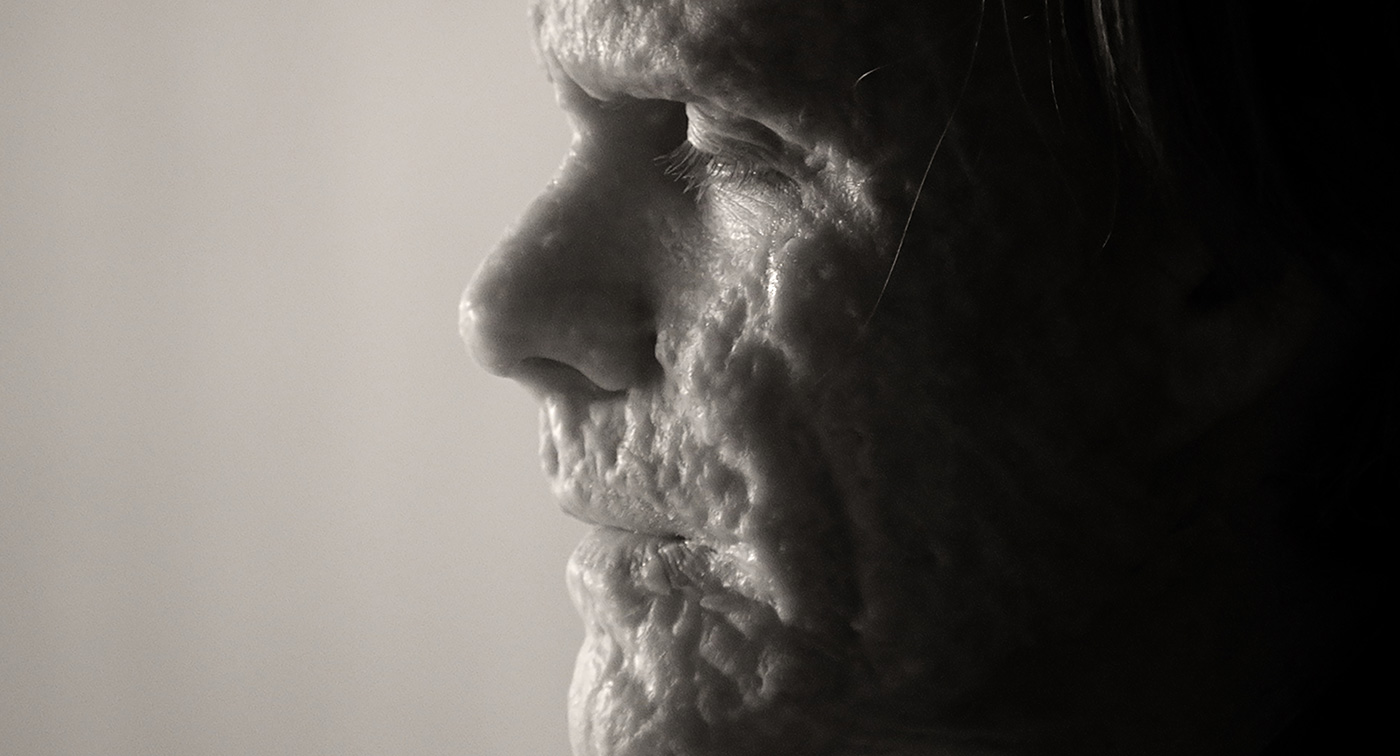
A burn survivor dwells on the incident that scarred him, unraveling a tale of malpractice and the devastating cost of putting profit over people.
Ewan Macbeth (b. 1992) is a Scottish filmmaker based in Rotterdam (NL) and Edinburgh (UK). After studying Fine Art Photography at the Glasgow School of Art, he completed an MA in Lens-Based Media at the Piet Zwart Institute. His work has been shown at the International Film Festival Rotterdam, Rencontres Internationales Paris/Berlin, Ji.hlava International Documentary Film Festival, European Media Art Festival Osnabrück, Eye Filmmuseum Amsterdam, TENT Rotterdam, CCA Glasgow, and RSA Edinburgh, among others.

Mário Macedo, Vanja Vascarac
Cul-De-Sac
Fiction expérimentale | 4k | couleur | 18:25 | Portugal, Croatie | 1980
A group of skaters take refuge in a shopping mall, making it their playground. As they spend time skating the empty hallways the stillness creeps in. It's a dead end.
Mário Macedo is graduated in 2010 in Sound and Image by the Portuguese Catholic University of Porto (UCP). In 2011 finished the film course at the European Film College in Denmark. Two of his short documentaries, ’Tio Rui’ (2011) and ‘Maria Sem Pecado’ (2016), premiered at DocLisboa Festival, having the latter won the National Grand Prix at FEST 2017 and consequentially shown at RTP, the Portuguese public television. Both films were also part of the New Visions of the Portuguese Cinema at the Portuguese Cinematheque in 2017. His first fiction short film ‘Terceiro Turno (Skin River)’ premiered in 2021 at Curtas Vila do Conde IFF in the National Competition and it won the award for Best Director. It also made its international premiere at Cairo Film Festival 2021. Has two new short films to release, 'Cul-de-sac' and 'Takvog Te Volim', co-productions between Croatia and Portugal. Right now, he's developing a new short film together with Dornaz Hajiha, part of Factory and will premiere at the Cannes Film Festival 2023. Also, he's preparing a feature film in Berlin, 'Purple Milkweed', together with Christian Tranberg, and finishing writing his first solo feature film 'The Robbery'. Will soon release his first photobook 'Running Away Into You' by the publisher Lebop. At the moment, he divides his time between Copenhagen, Zagreb, Berlin and Portugal. Vanja is a Croatian director with a BFA in Film and Television at Savannah College of Art and Design (USA). He directed several short films: Insomniac (2002, Cannes Film Festival/ Director's Fortnight), Wayking (2003), Carver is Dead (2012, Zagreb Film Festival) and Lora Wears Black (2019, Zagreb Film Festival). Vanja is experienced in directing TV commercials for leading brands such as T-Mobile, Vodafone, as well as for international clients such as Sony Asia Pacific. He participated in Berlinale Talent Campus and Sarajevo Talent Campus. He is developing his first feature film, Blok 62 (Ekran+, Connecting Cottbus).

Mário Macedo
Exotic Words Drifted
Fiction expérimentale | 4k | couleur | 15:0 | Portugal | 2023
Quote: "While I was watching you, exotic words drifted across the mirror of my mind as summer clouds drift across the sky". Unquote.
Sandro Aguilar (1974) studied film at the ESTC. In 1998 he founded the production company O Som e a Fúria. His films have won awards at festivals such as La Biennale di Venezia, Locarno FF, Gijón, Oberhausen,Vila do Conde, Indielisboa FF and shown in the most relevant festivals worldwide. Two times nominated for the EFA – Best european short film. Retrospectives of his work have been programmed at Rotterdam IFF, BAFICI, New York Film Festival, Arsenal-Berlin and Oberhausen FF.

Michael Macgarry
Excuse Me, While I Disappear
Fiction | hdv | couleur | 19:10 | Afrique du sud, Angola | 2015
The film was shot on location in Kilamba Kiaxi, a new underpopulated city outside Luanda, Angola built by Chinese construction company CITIC and financed by Hong Kong-based China International Fund. The film follows a young municipal worker who lives by night in the old city centre of Luanda and works by day as a groundskeeper at the new city of Kilamba Kiaxi far away.
Michael MacGarry is a multi-award winning visual artist and filmmaker, having exhibited internationally for ten years including TATE Modern, Guggenheim Bilbao, 19th VideoBrasil, 62nd Short Film Festival Oberhausen, International Film Festival Rotterdam and Les Rencontres Internationales. He holds an MFA from the University of the Witwatersrand (2004). MacGarry has been researching narratives and histories of socio-economics, politics, forms and objects within the context of contemporary Africa for over a decade. Frequently focused on marking key registers of modernism – MacGarry creates sculptures, films, installations and photographs which look at the contextual specifics of things and their place; how they are simultaneously distributed both as ideas and as objects in the world. His sculptural work is formed through processes of grafting and mutation, to produce fictional hybrids principally designed to question systemic paradigms: sovereign nationality; logics of making and meaning; power relations; notions of value, equity and progress as well as the relationship between industrial technology and African resources. In his filmmaking and photographic work these macro concerns often take the form of micro narratives, personal memory and subtle identity politics in spaces where contemporary life is in a state of invention and flux.