Catalogue > Liste par artiste
Parcourez la liste complète des artistes présentés dans le cadre des Rencontres Internationales depuis 2004. Utilisez le filtre alphabétique pour affiner vos recherches.
Vanja Sandell Billström, Lucia Pagano
Catalogue : 2025Diskret Matematik | Fiction expérimentale | 4k | couleur | 15:20 | Suède | 2024
Vanja Sandell BillstrÖm, Lucia Pagano
Diskret Matematik
Fiction expérimentale | 4k | couleur | 15:20 | Suède | 2024
A passage between two buildings, a nail salon, a stairwell, a badminton hall, an atrium, a hospital culvert. Life takes place. With the small details of existence in focus, rather than the larger narratives and conflicts, fragments are connected to a possible outcome. In mathematics, the word discrete is used to describe objects that are not continuous and separated from each other. Discrete mathematics is applied in a number of different areas such as encryption, databases, game theory, graph theory and algorithms.
Lucia Pagano and Vanja Sandell Billström were educated at the Lodz Film School and at the Royal Institute of Art in Stockholm. Discrete Mathematics is their second film as a duo which further explores methods developed in their previous film Park. Park was nominated to the Best Swedish Short at Göteborg Film Festival 2020, Tempo Short Award, 1KM Film Award, and winner of the Tempo Sound Award the same year. Previously they have shown their work at festivals and art venues around the world.
Catalogue : 2021Park | Documentaire | mov | couleur | 14:58 | Suède | 2020
Vanja Sandell BillstrÖm, Pagano, Lucia
Park
Documentaire | mov | couleur | 14:58 | Suède | 2020
Scènes de personnes en mouvement. Certains travaillent, d'autres profitent de leur temps libre. Le bruit des avions et des métros nous rappelle la ville située derrière ce bout de nature artificielle. Un court documentaire fait de scènes filmées dans les parcs de Stockholm, pendant une année.
Lucia Pagano est née en 1984. Elle est réalisatrice et artiste, et a été formée à la Lodz Film School, Lodz (Pologne) et au Royal Institute of Art, Stockholm (Suède). Ses films s'intéressent aux détails de la vie quotidienne, souvent en observant, parfois jusqu'à l'absurde, des fragments de réalité en apparence insignifiants. Ils ont été projetés dans des festivals à l’international, notamment à São Paolo (Brésil); à San Francisco (USA), à Kiev (Ukraine) et à Varsovie (Pologne). Ils ont été récompensés ou ont reçu une mention honorifique aux festivals du film de Los Angeles (USA), Oberhausen(Allemagne), Stockholm (Suède), et au Nordisk Panorama, Malmö (Suède). Vanja Sandell Billström est née en 1983. Elle est réalisatrice et artiste. Elle a été formée au Royal Institute of Art, Stockholm (Suède). Elle travaille à la fois la forme documentaire, des situations mises en scène, et des installations vidéo. Ses films portent souvent sur des situations quotidiennes, et présentent des personnages qui semblent réfléchir spontanément aux conditions de leur vie quotidienne ou aux situations du film lui-même. Vanja Sandell Billström a déjà été nommée pour le Prix Guldbagge du meilleur film court suédois, et a exposé au Göteborg Konsthall (Suède); à la Supermarket Art Fair, Stockholm (Suède); à la Box Gallery, Göteborg (Suède); et Färgfabriken, Stockholm (Suède). "Park" est le premier film qu’elles ont réalisé ensemble. Il a été nommé pour le prix du meilleur film court suédois au festival du film de Göteborg (Suède); pour le Tempo Short Award, Stockholm (Suède); pour le 1KM Film; et a remporté le Tempo Sound Award, Stockholm (Suède) [2020].
Aurora Sander
Catalogue : 2020À la carte | Animation | mp4 | couleur | 12:44 | Norvège, Allemagne | 2019
Aurora Sander
À la carte
Animation | mp4 | couleur | 12:44 | Norvège, Allemagne | 2019
A narrator takes you on a deep dive into the art world. What mechanisms are driving this ecosystem, or rather: which participants? The animation film "À la carte" takes a humorous look at the food chain in the art field and the challenges we face.
The artist duo consisting of Ellinor Aurora Aasgaard and Bror Sander Berg Størseth constantly serve up fresh perspectives on the world, tongue in cheek, jaws scraping off the ground. In their particular case form does not follow function, but function at least contains the word fun. The objects produced by the duo are caught in between form and function, art and design, discourse and disgust. For instance: portable paintings whose support structure doubles as shipping crates, and a mobile sculpture serving you social lubrication. Or high heeled shoes with built in brushes for an easy clean, and seats reserved for magazine covers. Aurora Sander reacts to the intrinsic structures of the art world, of socialization, distribution, value creation, judgement, and accruement, to turn some tables, but making sure the tables look damned good on the way round. The references in the work of Aurora Sander are plentiful, and the usual appropriation of low culture you traditionally would find in the art is repurposed with a refined knowledge of not just the art world, but also an interest in merchandizing and hanging out, dipping low. Their artistic strategies are closely linked to design, theater, and fashion; fields that art is struggling to keep at bay. Art historian Benjamin Buchloh describes this relationship as one where high art constantly appropriates images, strategies, and mechanisms from low culture, not in order to assimilate the two, but rather to reaffirm art's position in the hierarchy. Aurora Sander seems to confuse the hierarchy, and the identity of the duo, who might be mistaken for a singular artist, a case of mistaken identity, might range from a Disney princess to an emerging artist trying to make it in the cruel marketplace of the art world. Aurora Sander's strategy of confusion, fusion, fiction and friction, seems to be the duo's strength, making objects and creating characters that belong in the art world, but have no idea how they got there.
Talena Sanders
Catalogue : 2019Between my flesh and the world's fingers | Doc. expérimental | 16mm | couleur et n&b | 31:0 | USA | 2018
Talena Sanders
Between my flesh and the world's fingers
Doc. expérimental | 16mm | couleur et n&b | 31:0 | USA | 2018
Mary MacLane, the Wild Woman of Butte, Montana, published her diaries in 1902 and 1917. As an out queer and proto-feminist at the turn of the century, MacLane became notorious upon the publication of her 1902 diary, I Await the Devil’s Coming. She was whisked away from the industrial hellscape of her copper mining Montana hometown to a life in the public eye as an author, journalist, female film pioneer and always a provocateur - sending up social norms throughout her career, with a special focus on staid notions about women and sexuality. Between my flesh and the world’s fingers is an experimental essay and diary film primarily based on her published diaries and her film work. Though the film is not directly a personal film, the production is founded in part in the act of a woman telling her own story through that of another woman, a trailblazing figure from the past.
Talena Sanders makes moving image works that explore the development of individual and collective senses of identity in affinity groups. Her films and videos are informed by an interest in presenting the many ways that social institutions can shape individuals lives on both the broader geopolitical level and the most intimate, personal scales. A common starting point for developing new projects begins with an interest in interrogating narratives from histories and how historical records can influence senses of identity, especially as it relates to ideas of national and regional character. She believes there are endless means to present and interrogate materials from the real on the spectrum from nonfiction to narrative production approaches. Her work often places historical found/archival footage and audio in dialogue with contemporary media captured on location to question constructs of privilege and power in who gets authorized to tell the story of a shared experience. She holds an MFA from Duke University’s Experimental and Documentary Arts program and a BFA from the University of Kentucky. Her work has been screened, exhibited, and collected internationally, including at the New York Film Festival`s Views from the Avant-Garde, FID Marseille, Montreal International Documentary Festival, Fronteira Festival, Viennale, DokuFest Kosovo, BFI London Film Festival, and Southeastern Center for Contemporary Art. Her first feature documentary, Liahona, is distributed by Documentary Educational Resources and Doc Alliance. She has previously taught film and video production and film studies at Duke University and the University of Montana. She is currently an Assistant Professor of Communication and Media Studies at Sonoma State University.
Vladlena Sandu
Catalogue : 2025No Nation Without Culture | Doc. expérimental | hdv | couleur | 16:0 | Russie, Pays-Bas | 2022
Vladlena Sandu
No Nation Without Culture
Doc. expérimental | hdv | couleur | 16:0 | Russie, Pays-Bas | 2022
Tchétchénie, Grozny, printemps 2021. Les paysages de la ville sont remplis de portraits de Poutine, de Kadyrov père et de Kadyrov fils. Ils me surveillent de tous les coins, s’infiltrent dans mes pensées. C’est presque impossible à croire et à accepter. Je ressens le totalitarisme que ces portraits dégagent, les observant délibérément à travers un objectif déformé. Je filme les rues de ma ville natale, Grozny, depuis les vitres teintées d’une voiture, consciente que de tels actes m’exposent au risque de persécution. Je documente un moment où le fascisme commence à s’enraciner en Russie—un temps où, après trente ans de lutte du peuple tchétchène pour l’indépendance, l’accent est mis sur l’endoctrinement des enfants. En 2022, plus de 12 000 soldats de l’armée de Kadyrov sont envoyés en guerre en Ukraine.
Vladlena Sandu est née en Crimée, en Ukraine (URSS), en 1982 et a grandi à Grozny, en Tchétchénie, où elle est restée pendant quatre années de guerre. Elle est diplômée du VGIK en 2016 avec un diplôme en réalisation cinématographique. En 2019, elle a obtenu un diplôme de troisième cycle en art au VGIK, spécialisé en esthétique, et a publié plusieurs articles académiques. La même année, elle a également terminé sa formation en mise en scène théâtrale au Studio de Boris Yukhananov. Ses œuvres ont été présentées dans des festivals internationaux tels que le Festival du film de Rotterdam, la Berlinale, DocLisboa, GoEast, Movies That Matter, ZagrebDox, le Festival international du film de Genève, DOK Leipzig, et bien d’autres, remportant des prix internationaux. Au début de la guerre de la Russie contre l’Ukraine, en mars 2022, Sandu a fui la Russie et s’est installée à Amsterdam. Là, elle a réalisé No Nation Without Culture, un film sur le régime en Tchétchénie, qui a remporté le prix du Meilleur court-métrage au GoEast IFF 2023. En 2023, elle a également mis en scène la performance autobiographique The Rainbow Cinema et a reçu le prix du Meilleur spectacle d’Amsterdam Fringe 2023.
Fette Sans
Catalogue : 2023La Reprise (Dérive) [extrait] | Vidéo expérimentale | mp4 | noir et blanc | 15:0 | France, Allemagne | 2022
Fette Sans
La Reprise (Dérive) [extrait]
Vidéo expérimentale | mp4 | noir et blanc | 15:0 | France, Allemagne | 2022
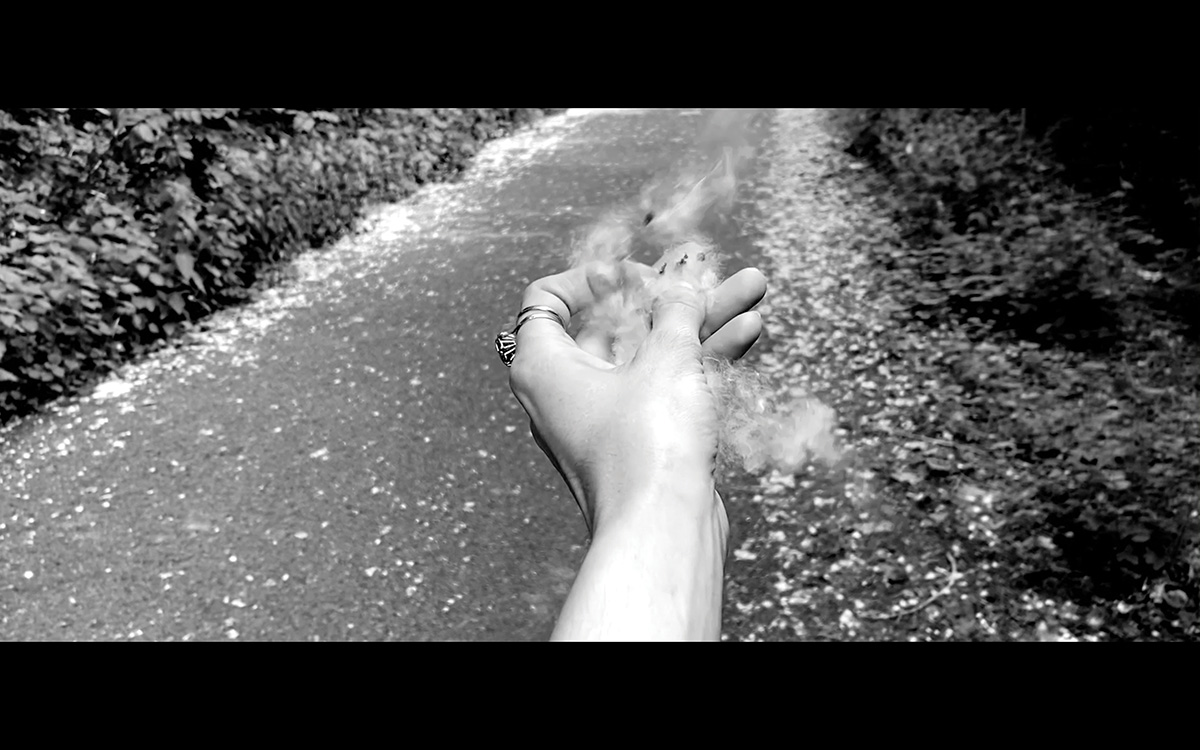
La Reprise (Dérive) is an exercise in continuity and distortion. This experimental film began on June 20, 2020. As of September 3, 2023, it is 168 min / weeks long. Every week, a subsequent minute is produced by combining scenes shot that week with archival material from the past years. Footage and sound are consistently recorded with the same single device (an iPhone). The film may distort, but there is always a presumption that something exists, or did exist, which is what was recorded. The sequences are neither true nor false, they integrate various degrees of theatricality and authenticity. They become portraits of an agitated immersion in the perpetual process of being, of this unpredictable yet systematic gathering and indexing. They are the record of close observations. I am a passenger, a witness to recurrences and patterns. This continuous collage of archives is the tension. The narrative is disconnected from the sum of its parts and elaborates on successes and failures. In this regard, the film is in a constant state of being finished, rather than interminably in progress. While its length progressively evolves, it also always is its final duration. This work is meant to continue until my death.
Fette Sans is based in Zagreb and in Berlin. She has a conceptual and interdisciplinary practice that includes the production of images, writing, performances, online gestures, film-making, discussions, and installations. Games of dissociative identities and the stories we tell ourselves to collect evidence of what has happened are recurring components in her work. She is interested in the ambiguity of what constitutes an image’s residue. Concerned with social systems, representation, and technology, she develops obsessive rituals, collaborations, and speculative narratives to question these issues. Rituals are interesting because there are ways of expressing repetition and the longing for security while accepting the risks associated with the very act of ceremonial reiterations: boredom itself.
Catalogue : 2015La Reprise | Vidéo | hdv | noir et blanc | 40:3 | France, Allemagne | 2014
Fette Sans
La Reprise
Vidéo | hdv | noir et blanc | 40:3 | France, Allemagne | 2014
La Reprise is an ongoing exercise begun on April 21, 2013. Every week, a subsequent minute is produced consisting of scenes shot that week along with archival material from the past years. Footage and sound are consistently recorded with the same single device. The film may distort, but there is always a presumption that something exists, or did exist, which is what was recorded. The sequences are neither true nor false, they integrate various degrees of theatricality and authenticity. They become portraits of an agitated immersion in the perpetual process of systematic indexing and gathering, and of close observations. [I am a passenger, a witness to recurrences and patterns.] This continuous collage of archives is the tension. The narrative is disconnected from the sum of its parts, and elaborates on successes and failures. Each screening becomes a unique occasion to view the film as the succession of each 1min weekly film is added every time.
At the beginning of the work, there is writing - perhaps a story, then there are photographs, films, and installations. Fette Sans was born in France. She lived in Los Angeles for about ten years where she ran an artist space, then moved to Berlin in 2010. Her work aims at questioning authenticity and the precious. What is representation without narrative? What is the role of light in memory? Panic. Repeat. Overwhelm. Serendipity plays an important role in her interaction with the characters and materials she gathers. She collects and re-interprets, referencing previous gestures and leaving these traces available for more examinations.
Gabriel Sanson
Catalogue : 2020Empathie | Fiction expérimentale | 4k | couleur et n&b | 8:42 | France | 2019
Gabriel Sanson
Empathie
Fiction expérimentale | 4k | couleur et n&b | 8:42 | France | 2019
Un chimpanzé se métamorphose en Ange de la Mélancolie et abandonne son île pour Saturne, la triste planète.
Gabriel Sanson, né à Paris en 1993, a réalisé plusieurs court-métrages présentés dans les prestigieux festivals de la Biennale de Venise et de Rotterdam.
Larissa Sansour
Catalogue : 2021al Mukhtabar | Vidéo expérimentale | 4k | noir et blanc | 28:0 | Palestine, Royaume-Uni | 2019
Larissa Sansour, Søren Lind
al Mukhtabar
Vidéo expérimentale | 4k | noir et blanc | 28:0 | Palestine, Royaume-Uni | 2019
"In Vitro" (Al Mukhtabar) se déroule après une catastrophe écologique. Sous la ville biblique de Bethléem, un réacteur nucléaire abandonné a été transformé en un énorme verger. À l'aide de graines de variétés anciennes, récoltées pendant les derniers jours précédant l'apocalypse, un groupe de scientifiques se prépare à replanter le sol à la surface. Dans l'infirmerie du complexe souterrain, la fondatrice du verger, Dunia, 70 ans, est étendue sur son lit de mort, tandis qu'Alia, 30 ans, lui rend visite. Alia est née sous terre, dans le cadre d'un programme de clonage complet, et n'a jamais vu la ville qu'elle est destinée à reconstruire.
Larissa Sansour est palestinienne. Elle est artiste et réalisatrice, et le tiraillement entre la fiction et la réalité est un élément central de son travail. Dans ses œuvres récentes, elle utilise la science-fiction pour aborder des questions sociales et politiques. Travaillant principalement le film, Larissa Sansour crée également installations, photographies et sculptures. Son travail est présenté dans des festivals de cinéma et des musées du monde entier. En 2019, elle représente le Danemark à la 58e Biennale de Venise (Italie). Elle a montré son travail à la Tate Modern, Londres (Royaume-Uni); au MoMA – Museum of Modern Art, New York (USA); au Centre Pompidou, Paris (France); à la Biennale d'Istanbul (Turquie); à la Berlinale, Berlin (Allemagne); au Festival international du film de Rotterdam (Pays-Bas); et au BFI London Film Festival, Londres (Royaume-Uni). Parmi ses récentes expositions personnelles, citons la galerie Bluecoat, Liverpool (Royaume-Uni); le musée Dar El-Nimer, Beyrouth (Iran); et le Nikolaj Kunsthal à Copenhague (Danemark). Larissa Sansour vit et travaille à Londres (Royaume-Uni). Søren Lind est né en 1970 et est d’origine danoise. Il est auteur, réalisateur et scénariste. Formé en philosophie, il a écrit des livres à propos de l'esprit, du langage et de la compréhension, avant de se tourner vers le cinéma et la fiction. Il a publié des romans, des recueils de nouvelles et plusieurs livres pour enfants. Søren Lind projette et expose ses films dans des musées, des galeries et des festivals de cinéma du monde entier, notamment à la 58e Biennale de Venise (Italie); au MoMA – Museum of Modern Art, New York (USA); au Barbican Centre, Londres (Royaume-Uni); au Nikolaj Kunsthal, Copenhague (Danemark); à la Berlinale, Berlin (Allemagne), au Festival international du film de Rotterdam (Pays-Bas); et au BFI London Film Festival, Londres (Royaume-Uni). Il vit et travaille à Londres (Royaume-Uni).
Catalogue : 2008happy days | Art vidéo | dv | couleur | 2:59 | Palestine | 2006
Larissa Sansour
happy days
Art vidéo | dv | couleur | 2:59 | Palestine | 2006
Happy Days est une vidéo qui expose la vie de tous les jours des palestiniens sous l'occupation israélienne. Pendant la vidéo, un collage de métrages filmés dans les territoires occupés est accompagné par la bande son de la série des années soixante-dix, "Happy Days". Le passage montre des images différentes de celles des journaux télévisés. La musique crée un contraste avec l'apathie du public confronté aux conflits mondiaux. L'idée est de soumettre les politiques internationales à un format normalement associé au divertissement, et ainsi amener l'attention sur cette frontière floue entre les deux.
Née à Jérusalem en 1973, Sansour étudia les beaux arts à Copenhague, London et New York et reçu son MFA à l'université de New York. Ses travaux sont interdisciplinaires, immergés dans le dialogue politique actuel et se servent de l'art vidéo, photographie digitale, documentaires expérimentaux et internet. Le travail de Sansour a été montré de par le monde dans des galeries, des musées mais aussi dans des festivals de films. Ses expositions les plus notables comprennent, le Tate Modern de Londres, le Musée National de la Reine Sofia, Madrid et un show prochain au Arken Museum of Modern Art au Danemark. Sansur est membre international du comite de la nouvelle école de concept Chaos Pilots avec lequel elle contribue par ses écrits sur l'art, la politique et l'éducation. Elle vie et travaille a Copenhague, au Danemark.
Larissa Sansour
Larissa Sansour, Søren LIND
Catalogue : 2017In The Future, They Ate From the Finest Porcelain | Fiction expérimentale | hdv | couleur | 28:30 | Palestine, Danemark | 2015
Larissa Sansour, Søren LIND
In The Future, They Ate From the Finest Porcelain
Fiction expérimentale | hdv | couleur | 28:30 | Palestine, Danemark | 2015
In the Future They Ate From the Finest Porcelain resides in the cross-section between sci-fi, archaeology and politics. Combining live motion and CGI, the film explores the role of myth for history, fact and national identity. A narrative resistance group makes underground deposits of elaborate porcelain – suggested to belong to an entirely fictional civilization. Their aim is to influence history and support future claims to their vanishing lands.
Larissa Sansour Larissa Sansour was born in 1973 in East Jerusalem, Palestine, and studied fine arts in London, New York and Copenhagen. Her work is interdisciplinary, immersed in the current political dialogue and utilises video, photography, installation, the book form and the internet. Central to her work is the tug and pull between fiction and reality. Recent solo exhibitions include Turku Art Museum in Finland, Photographic Center in Copenhagen, Galerie Anne de Villepoix in Paris, Kulturhuset in Stockholm, Lawrie Shabibi in Dubai, Sabrina Amrani in Madrid and DEPO in Istanbul. Sansour’s work has featured in the biennials of Istanbul, Busan and Liverpool. She has exhibited at venues such as Tate Modern, London; Centre Pompidou, Paris; LOOP, Seoul; Al Hoash, Jerusalem; Queen Sofia Museum, Madrid; Centre for Photography, Sydney; Cornerhouse, Manchester; Townhouse, Cairo; Maraya Arts Centre, Sharjah, UAE; Empty Quarter, Dubai; Galerie Nationale de Jeu de Paume, Paris; Iniva, London; Institut du Monde Arabe, Paris; Third Guangzhou Triennial, Guangzhou , China; Louisiana Museum of Contemporary Art, Denmark; House of World Cultures, Berlin, and MOCA, Hiroshima. Sansour currently lives and works in London, UK. Soren Lind Soren Lind (b. 1970) is a Danish author. He writes children’s books and literary fiction. With a background in philosophy, Lind wrote books on mind, language and understanding before turning to fiction. He has published a novel and two collections of short stories as well as four children’s books. In addition to his literary production, Lind is also a visual artist and writes short film scripts. Lind lives and works in London, UK. Sansour/Lind Larissa Sansour and Soren Lind have worked together on numerous occasions. Lind usually provides the scripts for Sansour’s films, just as he contributed a sci-fi story for Sansour’s 20
Larissa Sansour, Ashery Oreet
Catalogue : 2012Falafel Road | Doc. expérimental | hdcam | couleur | 61:0 | Palestine, Royaume-Uni | 2011
Larissa Sansour, Ashery Oreet
Falafel Road
Doc. expérimental | hdcam | couleur | 61:0 | Palestine, Royaume-Uni | 2011
During February 2010, Jerusalem born artists Oreet Ashery and Larissa Sansour had twenty meals in twenty falafel eateries in London, one on each day. The meals were open for the public to join in eating and debate, and functioned as art events, laboratories, performances, therapy sessions and oral history hubs. All the meals were filmed with a small Flip camera on a rotating cheeseboard and were edited together into one-hour of raw and immediate film. Ashery and Sansour opened each meal with the question: Did Israel steal the falafel from the Palestinians? This seemingly silly and controversial question, was a precursor to an investigation into the intentional and systematic hijacking and eradication of Palestinian cultural history by the state of Israel.
Oreet Ashery is a Jerusalem born, London based visual artist, cultural activist and educationist, engaged in solo and collaborative practices. Ashery works across performance, still and moving image, objects and facilitation to create situations that explore the relationships between politics, culture and representation. Ashery?s work is presented extensively in an international context, and discussed in numerous publications and books, in various languages. Recently Ashery had published three books: The Novel of Nonel and Vovel, with the artist Larissa Sansour, Charta; the monograph Dancing with Men, Live Art Development Agency; and the Artangel commission Staying, dream, bin, soft stud and other stories. Sansour?s work is interdisciplinary and borrows heavily from the language of film and pop culture. References and details ranging from sci-fi and spaghetti westerns to horror films converge with Middle East politics and social issues to create intricate parallel universes in which a new value system can be decoded. Sansour?s work has been exhibited worldwide in international biennials, galleries, museums, film festivals and on the internet and is featured in many art publications. Larissa Sansour was born in Jerusalem and lives and works in London, UK.
Larissa Sansour, Søren Lind
Catalogue : 2021al Mukhtabar | Vidéo expérimentale | 4k | noir et blanc | 28:0 | Palestine, Royaume-Uni | 2019
Larissa Sansour, Søren Lind
al Mukhtabar
Vidéo expérimentale | 4k | noir et blanc | 28:0 | Palestine, Royaume-Uni | 2019
"In Vitro" (Al Mukhtabar) se déroule après une catastrophe écologique. Sous la ville biblique de Bethléem, un réacteur nucléaire abandonné a été transformé en un énorme verger. À l'aide de graines de variétés anciennes, récoltées pendant les derniers jours précédant l'apocalypse, un groupe de scientifiques se prépare à replanter le sol à la surface. Dans l'infirmerie du complexe souterrain, la fondatrice du verger, Dunia, 70 ans, est étendue sur son lit de mort, tandis qu'Alia, 30 ans, lui rend visite. Alia est née sous terre, dans le cadre d'un programme de clonage complet, et n'a jamais vu la ville qu'elle est destinée à reconstruire.
Larissa Sansour est palestinienne. Elle est artiste et réalisatrice, et le tiraillement entre la fiction et la réalité est un élément central de son travail. Dans ses œuvres récentes, elle utilise la science-fiction pour aborder des questions sociales et politiques. Travaillant principalement le film, Larissa Sansour crée également installations, photographies et sculptures. Son travail est présenté dans des festivals de cinéma et des musées du monde entier. En 2019, elle représente le Danemark à la 58e Biennale de Venise (Italie). Elle a montré son travail à la Tate Modern, Londres (Royaume-Uni); au MoMA – Museum of Modern Art, New York (USA); au Centre Pompidou, Paris (France); à la Biennale d'Istanbul (Turquie); à la Berlinale, Berlin (Allemagne); au Festival international du film de Rotterdam (Pays-Bas); et au BFI London Film Festival, Londres (Royaume-Uni). Parmi ses récentes expositions personnelles, citons la galerie Bluecoat, Liverpool (Royaume-Uni); le musée Dar El-Nimer, Beyrouth (Iran); et le Nikolaj Kunsthal à Copenhague (Danemark). Larissa Sansour vit et travaille à Londres (Royaume-Uni). Søren Lind est né en 1970 et est d’origine danoise. Il est auteur, réalisateur et scénariste. Formé en philosophie, il a écrit des livres à propos de l'esprit, du langage et de la compréhension, avant de se tourner vers le cinéma et la fiction. Il a publié des romans, des recueils de nouvelles et plusieurs livres pour enfants. Søren Lind projette et expose ses films dans des musées, des galeries et des festivals de cinéma du monde entier, notamment à la 58e Biennale de Venise (Italie); au MoMA – Museum of Modern Art, New York (USA); au Barbican Centre, Londres (Royaume-Uni); au Nikolaj Kunsthal, Copenhague (Danemark); à la Berlinale, Berlin (Allemagne), au Festival international du film de Rotterdam (Pays-Bas); et au BFI London Film Festival, Londres (Royaume-Uni). Il vit et travaille à Londres (Royaume-Uni).
Catalogue : 2008happy days | Art vidéo | dv | couleur | 2:59 | Palestine | 2006
Larissa Sansour
happy days
Art vidéo | dv | couleur | 2:59 | Palestine | 2006
Happy Days est une vidéo qui expose la vie de tous les jours des palestiniens sous l'occupation israélienne. Pendant la vidéo, un collage de métrages filmés dans les territoires occupés est accompagné par la bande son de la série des années soixante-dix, "Happy Days". Le passage montre des images différentes de celles des journaux télévisés. La musique crée un contraste avec l'apathie du public confronté aux conflits mondiaux. L'idée est de soumettre les politiques internationales à un format normalement associé au divertissement, et ainsi amener l'attention sur cette frontière floue entre les deux.
Née à Jérusalem en 1973, Sansour étudia les beaux arts à Copenhague, London et New York et reçu son MFA à l'université de New York. Ses travaux sont interdisciplinaires, immergés dans le dialogue politique actuel et se servent de l'art vidéo, photographie digitale, documentaires expérimentaux et internet. Le travail de Sansour a été montré de par le monde dans des galeries, des musées mais aussi dans des festivals de films. Ses expositions les plus notables comprennent, le Tate Modern de Londres, le Musée National de la Reine Sofia, Madrid et un show prochain au Arken Museum of Modern Art au Danemark. Sansur est membre international du comite de la nouvelle école de concept Chaos Pilots avec lequel elle contribue par ses écrits sur l'art, la politique et l'éducation. Elle vie et travaille a Copenhague, au Danemark.
Roberto Santaguida
Catalogue : 2023Avenuers (ep. 3) | Documentaire | 16mm | noir et blanc | 28:0 | Canada | 2021
Roberto Santaguida
Avenuers (ep. 3)
Documentaire | 16mm | noir et blanc | 28:0 | Canada | 2021
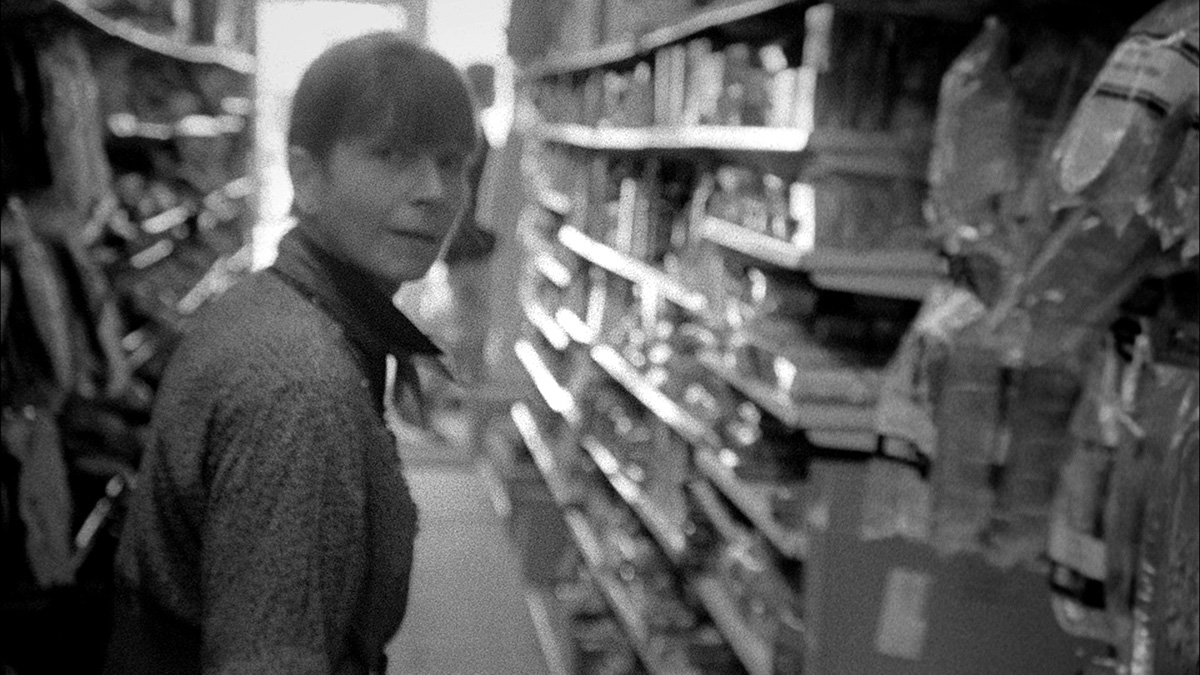
Six avenues, in south-central Montreal, revisited.
Since completing his studies in film production at Concordia University, Roberto Santaguida’s films and videos have been shown at more than 400 international festivals, including Tampere Film Festival (Finland), CPH: DOX, Copenhagen International Documentary Film Festival (Denmark), Contemporary Art Festival Sesc_Videobrasil (Brazil), Flickers' Rhode Island International Film Festival (United States), transmediale (Germany), and Message to Man (Russia). Roberto is the recipient of the K.M. Hunter Artist Award, the Chalmers Arts Fellowship and a fellowship from Akademie Schloss Solitude in Germany.
Ruben Santiago
Catalogue : 2008Daily | Vidéo expérimentale | dv | couleur | 2:41 | Portugal, Espagne | 2006
Ruben Santiago
Daily
Vidéo expérimentale | dv | couleur | 2:41 | Portugal, Espagne | 2006
Ruben Santiago 1974 born in Sarria (galicia), Spain Lives and works in Barcelona, Spain
Catalogue : 2008Future | Vidéo expérimentale | dv | couleur | 3:3 | Portugal, Espagne | 2005
Ruben Santiago
Future
Vidéo expérimentale | dv | couleur | 3:3 | Portugal, Espagne | 2005
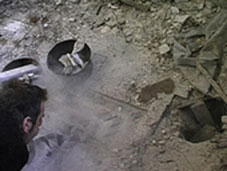
Sous des couches de poussière et de souvenirs oubliés, je cache une époque qui arrive. Je la cache ? Je ne le sais toujours pas. Je retrouve peut-être seulement ces choses qui n'arriveront jamais.
Ruben Santiago est né en 1974 en Espagne. Son travail est varié puisqu'il comprend des installations à grande échelle, des projets Internet, des interventions artistiques dans des endroits publics, des travaux basés sur le développement, des enregistrements et des publications. durant ces dernières années, l'utilisation d'images et de sons mobiles a été le fil conducteur de sa recherche artistique, soit en les combinant à d'autres disciplines, soit en les concevant de manière autonome. Son travail a été exposé dans plusieurs galeries et institutions internationales. Il est actuellement artiste en résidence au Hangar Centre de Producció de Barcelone. 'Exception', 'mémoire' et 'crime' sont les mots-clé de son travail.
Catalogue : 2006Monogamy home edit | Art vidéo | dv | couleur | 3:7 | Portugal, Espagne | 2004
Ruben Santiago
Monogamy home edit
Art vidéo | dv | couleur | 3:7 | Portugal, Espagne | 2004
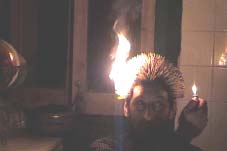
De mon ancienne cuisine, je me mets face à toi 1800 allumettes dans la tête.
Ruben Santiago est né en Galice (Espagne) en 1974. Il travaille et vit entre Barcelone et Porto (Portugal). Formé à la base comme sculpteur grâce à des études à la Universidad Complutense, à Madrid et la Escola Massana de Barcelone, la carrière de Rubben Santiago a évolué avec des projets qui ont dérivés vers les images en mouvements, avec la vidéo et la projection de films.
Catalogue : 2006Monogamy outdoors | Art vidéo | dv | couleur | 2:24 | Portugal, Espagne | 2004
Ruben Santiago
Monogamy outdoors
Art vidéo | dv | couleur | 2:24 | Portugal, Espagne | 2004
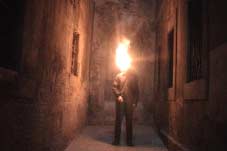
Une petite rue étroite de Barcelone. C'était mon quartier pendant un moment. 1800 allumettes dans ma tête. Ainsi fut ma première monogamie.
Ruben Santiago est né en Galice (Expagne) en 1974. Il travaille et vit en Barcelone et Porto (Portugal). Formé à la base comme sculpteur grâce à des études à la Universidad Complutense, à Madrid et la Escola Massana de Barcelone, la carrière de Rubben Santiago a évolué avec des projets qui ont dérivés vers les images en mouvements, avec la vidéo et la projection de films.
Mauro Santini
Catalogue : 2020Megrez (Vaghe stelle) | Vidéo | 4k | couleur | 7:20 | Italie | 2019
Mauro Santini
Megrez (Vaghe stelle)
Vidéo | 4k | couleur | 7:20 | Italie | 2019
“Vaghe stelle” is a seven-chaptered film, conceived as a musical album and composed of seven movements, which can be watched singly (like songs), or in the established order (like a record) or also mixing the films creating new combinations or possible narrations. The ‘songs’ are seven as the principal stars of the Ursa Major. It will be a nocturnal wandering with the starry sky as a reference: an earthly pilgrimage looking for epiphanies or the drift of a hypothetical interstellar trip.
Since 2000, Mauro Santini (Fano, Italy, 1965) has composed a series of video diaries, stories told in the first person about time, memory and the search for oneself. One of these, ‘Da lontano’, won the Italian competition at the 2002 Torino Film Festival. He has participated at the international film festivals of Locarno, Venezia, Oberhausen, Jeonju, Annecy, Rencontres Internationales Paris/Berlin, DocLisboa, Cinémas Différents Paris, Alchemy, Montpellier, Pesaro etc In 2006, he made the feature film Flòr da Baixa and participated in 2008 with different works at “La cité des yeux, une saison italienne”, about Italian avant-garde cinema from 1968 to 2008, which was organized by the Cinémathèque Française in Paris and curated by Nicole Brenez and Federico Rossin.
Catalogue : 2019Vaghe Stelle - Mizar | Vidéo expérimentale | 4k | couleur | 11:0 | Italie | 2017
Mauro Santini
Vaghe Stelle - Mizar
Vidéo expérimentale | 4k | couleur | 11:0 | Italie | 2017
“Vaghe stele” is a seven-chaptered film, conceived as a musical album and composed of seven movements, which can be watched singly (like songs), or in the established order (like a record) or also mixing the films creating new combinations or possible narrations. The “songs” are seven as the principal stars of the Ursa Major. It will be a nocturnal wandering with the starry sky as a reference: an earthly pilgrimage looking for epiphanies or the drift of a hypothetical interstellar trip.
Since 2000, Mauro Santini (Fano, Italy, 1965) has composed a series of video diaries, stories told in the first person about time, memory and the search for oneself. One of these, “Da lontano”, won the Italian competition at the 2002 Torino Film Festival. He has participated at the international film festivals of Locarno, Venezia, Oberhausen, Jeonju, Annecy, Rencontres Paris/Berlin, DocLisboa, Cinémas Différents Paris, Montpellier, Pesaro etc In 2006, he made the feature film Flòr da Baixa and participated in 2008 with different works at “La cité des yeux, une saison italienne”, about Italian avant-garde cinema from 1968 to 2008, which was organized by the Cinémathèque Française in Paris and curated by Nicole Brenez and Federico Rossin.
Catalogue : 2018Alkaid (Vaghe stelle) | Vidéo expérimentale | 4k | couleur | 6:12 | Italie | 2017
Mauro Santini
Alkaid (Vaghe stelle)
Vidéo expérimentale | 4k | couleur | 6:12 | Italie | 2017
“ Vaghe stelle ” is a seven-chaptered film, conceived as a musical album and composed of seven movements, which can be watched singly (like songs), or in the established order (like a record) or also mixing the films creating new combinations or possible narrations. The “ songs ” are seven as the principal stars of the Ursa Major. It will be a nocturnal wandering with the starry sky as a reference: an earthly pilgrimage looking for epiphanies or the drift of a hypothetical interstellar trip.
Since 2000, Mauro Santini (Fano, Italy, 1965) has composed a series of video diaries, stories told in the first person about time, memory and the search for oneself. One of these, “ Da lontano ”, won the Italian competition at the 2002 Torino Film Festival. He has participated at the international film festivals of Locarno, Venezia, Oberhausen, Jeonju, Annecy, Rencontres Paris/Berlin, DocLisboa, Cinémas Différents Paris, Montpellier, Pesaro etc In 2006, he made the feature film Flòr da Baixa and participated in 2008 with different works at “ La cité des yeux, une saison italienne ”, about Italian avant-garde cinema from 1968 to 2008, which was organized by the Cinémathèque Française in Paris and curated by Nicole Brenez and Federico Rossin.
Catalogue : 2011Notturno | Film expérimental | dv | couleur | 7:0 | Italie | 2009
Mauro Santini
Notturno
Film expérimental | dv | couleur | 7:0 | Italie | 2009
An indefinite image appears: a journey begins, a drift in the dark, in an unknown sea, waiting for a landing at the end of the night. ?I have always tried to use shaky shots, unusable leaders or time dilation of fragments to find testimony of a past that has been lived. In Notturno, this search continues within the image, penetrating it, running the pleasurable risk of getting lost inside it.? Mauro Santini
Mauro Santini (Fano, Italy, 1965) since 2000 has composed a series of video diaries, stories told in the first person about time, memory and the search for oneself. One of these, ?Da lontano?, won the Italian competition at the 2002 Torino Film Festival. He has participated at the international film festivals of Locarno, Oberhausen, Jeonju, Annecy, DocLisboa, Cinémas différents in Paris, Rencontres Paris/Berlin/Madrid, Montpellier, Pesaro and Bellaria. In 2006, he made the feature film Flòr da Baixa and in 2008 he participated with different works at the festival La cité des yeux, une saison italienne, about Italian avant-garde cinema from 1968 to 2008, which was organized by the Cinémathèque française of Paris and curated by Nicole Brenez.
Catalogue : 2009cosa che fugge | Vidéo expérimentale | dv | noir et blanc | 5:0 | Italie | 2008
Mauro Santini
cosa che fugge
Vidéo expérimentale | dv | noir et blanc | 5:0 | Italie | 2008
Le corp d`une femme devient un voyage, paysage qui coule; le temps marque et transforme un visage: une vie se passe et s`enfuit.
Mauro Santini est né à Fano (Italie) en 1965. Après avoir achevé des études artistiques , il se consacre à la photographie et la vidéo. Depuis 2000, il a composé une série de vidéos-journal intime, sans scénario, qui parlent à la première personne du temps, de la mémoire et de la recherche de lui-même. Ces vidéos ont participé à de nombreux festivals à Locarno, Jeonju (Corée du Sud), Oberhausen, Montpellie, Pesaro, Bellaria (Italie), aux Rencontres Paris/Berlin/Madrid, à Cinémas Différents de Paris, à Doclisboa de Lisbonne.
Catalogue : 2008Desalento | Vidéo expérimentale | dv | couleur | 50:0 | Italie | 2006
Mauro Santini
Desalento
Vidéo expérimentale | dv | couleur | 50:0 | Italie | 2006
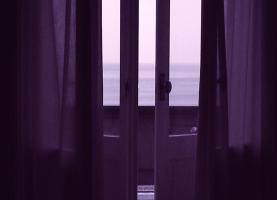
`Desalento` is the story of a love lost in a Lisbon hotel and of a journey to Rio de Janeiro. It`s a diary about absence and solitude; about something that is missing, always and everywhere.
Mauro Santini was born in Fano in 1965. Since 2000 he has composed a series of video-diaries ? without any screenplays, narrated in the first person, that deal with time, memory and the search for self ? that have participated at numerous festivals (Locarno, Jeonju, Oberhausen, Torino, Rencontres Paris/Berlin/Madrid, Montpellier, Annecy, DocLisboa, Pesaro).
Catalogue : 2007Rio de Janeiro | Vidéo expérimentale | dv | couleur | 32:0 | Italie | 2005
Mauro Santini
Rio de Janeiro
Vidéo expérimentale | dv | couleur | 32:0 | Italie | 2005
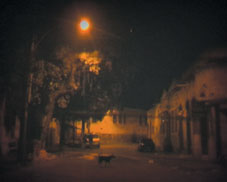
Avec "Rio de Janeiro" nous nous trouvons dans les limites du video-art et du video quotidien. Petits scenes hors focus, tremblantes, presque avec texture, nous montrent perspectives d'une ville qui pourrait être n'importe lequelle.
Mauro Santini est né en 1965 dans la ville de Fano. Après des études d?Art en graphisme et photographie, il a fait de la vidéo pendant dix ans et en 2000, il a commencé ??Dove sono stato??, une série de carnets de voyages, une archive personnelle d?images et de sons où l?aspect carnet et voyage s?entrelacent et la narration par les images se mélange avec la vidéo artistique. ??Da lotano?? a remporté le premier prix du festival du film de Turin en 2002, dans la section Compétition italienne. ??Fermo net Tempo?? et ??Petite mémoire?? (présenté lors du festival de Locarno en 2003) continue à suivre la recherche de la mémoire. Dans ??Da qui, sopra il mare??, le temps devient un élément et la recherche ne font plus qu?un, sans distinction entre la mémoire et le présent.
Vasco Braga Santos
Catalogue : 2006Bars & Tone | Art vidéo | dv | couleur | 1:10 | Portugal | 2004

Vasco Braga Santos
Bars & Tone
Art vidéo | dv | couleur | 1:10 | Portugal | 2004
Le temps, la couleur et les repères de volumes venant d?une émission télévision sont le point initial. Ces notions de manipulation sont utilisées pour créer une lecture visuelle, sonore et des fautes temporelles. Les repères des cibles perdent de leur sens, la boucle de développement suggère une action de fin qui n?arrive jamais, ce qui amène du suspens.
Vasco Braga Santos est né à Lisbonne, le 8 janvier 1980. En 2005, il a commencé un Master en Education Artistique à la Belas Artes da Universidade de Lisboa (Fbaul). En 2004, il a fini le College in Fine Arts à Escola Superior de Arte e Design (ESAD) avec une note de 16/20. En 2005, il participe à la Galeria Cubic, à l?exposition ?Near Step ?, au Video Centro Cultural de Paredes de Coura, puis au XVII Bienal de Cerveira, au Vídeo Lisboa, mais aussi le Vídeo Show 2005, le ETICVídeo Sevilha, le Festival Zemos 98, à la Participation in Zemos 98 Fest, et enfin à l?Informative Selection. En 2004, il fait partie de Group Exibithion Caldas Da Rainha, d'ESAD04, ainsi que de Exposição Colectiva Porto, Labor.04 et enfin Colectiv Exibithion in Fernando Santos Galeria, Oficina e Padaria Independente
Davor Sanvincenti
Catalogue : 2019Skoro nista: i dalje noc | Film expérimental | 16mm | couleur et n&b | 12:0 | Croatie | 2017
Davor Sanvincenti
Skoro nista: i dalje noc
Film expérimental | 16mm | couleur et n&b | 12:0 | Croatie | 2017
Le film tourne autour de l'ampoule comme la Terre tourne autour du Soleil. La lumière rend le film visible. En orbite autour de la tragédie du film et de notre réalité, l'image résiste à la cruauté de l'expérimentation.
Davor Sanvincenti (1979) is a multimedia artist specifically interested in audiovisual phenomenology and anthropology of visual culture, particularly focused on the conditions and forms of human senses and perceptions. His artistic practice takes shape in the variety of media - film and video, photography, physical light and sound installations and live media performances. His work plays with the concept of illusion, exploring the possible boundaries of perception and the construction of experience. In 2010, he was recipient of the Radoslav Putar Award for the best Croatian artist under 35. Davor Sanvicenti`s work has been exhibited and presented internationally, including festivals like Rotterdam, Music Biennale - Zagreb, Rencontres Internationales - Paris/Berlin/Madrid, Device_Art Triennale - Montreal, LOOP - Barcelona, World Film Festival - Bangkok, 25FPS - Zagreb, VideoEX - Zurich and venues including Centre Georges Pompidou, Paris; ZKM, Karlsruhe; Lincoln Center, New York; Universal Museum Joanneum, Graz; Museo de Arte Contemporanea, Oaxaca; Camera Austria, Graz; FRAC Pays de la Loire, Carquefou; MoCA, Zagreb; NIU, Barcelona; La Triennale, Milano; Filmoteca Española, Madrid; Glassbox, Paris; Haus der Kulturen der Welt, Berlin.
Catalogue : 2011The River | Vidéo expérimentale | betaSP | noir et blanc | 7:30 | Croatie | 2009
Davor Sanvincenti
The River
Vidéo expérimentale | betaSP | noir et blanc | 7:30 | Croatie | 2009
Through multiple crackling structures The River spreads audiovisual resources to create atmospheres that combine narrative and aesthetic concepts beyond one photography, Versus, captured with 82 years old camera-box which portrays the social landscape that is devoid of any romanticism. The work investigates and examines the human like the unforeseeable active presence between the nature and technology, analogue and digital, static and dynamic. It explores and reveals a research for the essence of seeing and hearing, for ontology of the audiovisual landscape.
Davor Sanvincenti a.k.a. Messmatik (b.1979) is a Croatian multimedia artist. Over the last years he has been specifically interested in a field of audiovisual research and anthropology of visual culture, particularly oriented on the conditions and forms of human senses and perceptions, developing experimental videos and immersive installations which are at the intersection of video and performing arts. He explores aesthetical and qualitative capabilities of different media as direct communication with the spectator which becomes an inevitable part of the work, a reflecting contemplative-physical structure. He is recipient of several art awards, including the Radoslav Putar Award 2010 for the best Croatian artist under 35. His physical video installation "1001" is part of the AV collection of the Museum of Contemporary Art in Zagreb.
Joaquim Sapinho
Abtin Sarabi
Catalogue : 2021PARCELLES S7 | Doc. expérimental | hdv | couleur | 27:47 | Iran, Sénégal | 2020
Abtin Sarabi
PARCELLES S7
Doc. expérimental | hdv | couleur | 27:47 | Iran, Sénégal | 2020
Des entrailles brulées des champs, soudain, apparut l’aurore. Ici, l’homme est seul. Dans cette solitude, l’ombre des cannes à sucre s’étend à l’infini.
Abtin Sarabi est né en 1984 à Téhéran (Iran). Il est cinéaste, photographe, plasticien. Dès l’adolescence, Abtin Sarabi développe un travail photographique tendant vers le documentaire et la sociologie, autant que vers une photographie plus mise en scène. Après avoir étudié la philosophie orientale, la peinture et la photographie à l’Université d'Art et d'Architecture de Téhéran (Iran), où il obtient son diplôme en 2009, il s'oriente vers l'art vidéo et le cinéma. Après quatre années d'études à l'École des Beaux-Arts de Toulouse (France), où il réalise des courts métrages, des vidéos d'art et plusieurs séries de photographies argentiques, il obtient un Diplôme national supérieur d'expression plastiques en 2014. Il poursuit ses recherches durant deux ans au Fresnoy, le Studio national des arts contemporain de Tourcoing (France), où il obtient son post-diplôme. Ses créations, fortement imprégnées par l’art pictural, sont souvent apparentées à un "cinéma poétique", sans doute à cause de la présence constante d’une dimension symbolique et de références à la mythologie.
Denis Saraginovski, Stevceska SLOBODANKA, Talevski SASHO
Catalogue : 2006Let's talk about? | Vidéo expérimentale | dv | couleur | 7:0 | Macédoine | 2003
Denis Saraginovski, Stevceska SLOBODANKA, Talevski SASHO
Let's talk about?
Vidéo expérimentale | dv | couleur | 7:0 | Macédoine | 2003
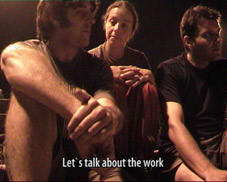
Installés devant leur caméra, les trois artistes du groupe OPA§HA, , évoquent la situation de l'art contemporain et plus particulièrement le rôle qu'ils jouent sur la scène de l’art macédonien. La vidéo montre leur combat.
OPA§HA est une collaboration entre trois auteurs: Denis Saraginovski (né en 1971 en Macédoine, diplômé de la Faculté des Beaux Arts de Skopje, artiste visuel et vidéographe freelance); Slobodanka Stevceska (née en 1971, également diplômée de la Faculté des Beaux Arts de Skopje, artiste visuelle et pédagogue en art) et Sasho Talevski (né en 1967 en Macédoine, diplômé de la Faculté de Philosophie de Skopje, artiste conceptuel, écrivain et journaliste). La collaboration OPA§HA (qui en français signifie Agression Obsessive et Possessive, et Arrogance Chronique)débute en 2002 avec des projets impliquant action, performance, vidéo, "mockumentaries", travail particulier. Parmi les projets de trois artistes figurent: "Professional Site Specific Installers", "Don’t miss the MISS", "Reality Macedonia", etc. Leur travail est centré sur la position/relation de l'artiste dans/avec différents systèmes culturels ou sociaux. Ils traitent des problèmes politiques, culturels et sociaux avec humour et abordent les préoccupations et situations locales d'un point de vue critique. En 2004, ils ont reçu le prix DENES des meilleurs jeunes artistes macédoniens. Ils ont exposé dans plusieurs pays d'Europe et aux Etats-Unis.
Paula Saraste
Catalogue : 2025Let us Stay for a While | Fiction expérimentale | 4k | couleur | 30:38 | Finlande | 2022
Paula Saraste
Let us Stay for a While
Fiction expérimentale | 4k | couleur | 30:38 | Finlande | 2022
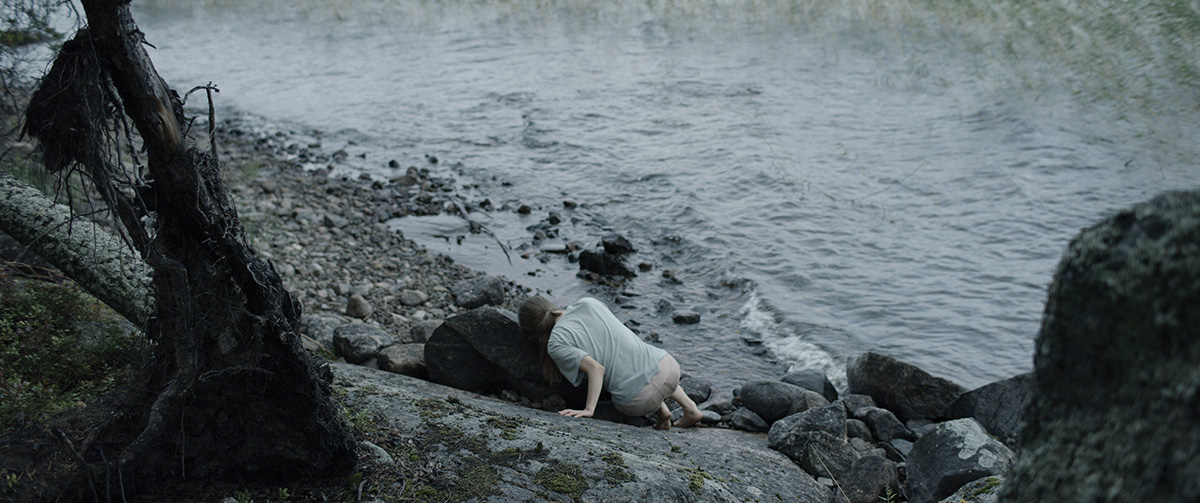
Let us Stay for a While takes its inspiration from Jean-Luc Nancy’s proposal that we could remain exposed to and think about what is happening to us. It is we who are arriving and leaving and we who encounter catastrophic events. In the film the aeroplane as a symbol of human technical development – the human-machine – is destroyed, and a new kind of time begins. Let us Stay for a While is a story about a weekend on a remote island. The protagonists witness a mystical aeroplane accident and rescue one of the survivors. Inexplicable things start to happen, the protagonists are thrown back to an altered mood and the island doesn’t seem to want them to leave. The idea of nature as something veiled is thematized in the film – a mystical stone has been found on the island – and the protagonists’ understanding of each other is only partial. The work stands at the confluence of psychological thriller and less traditional dramaturgy. The island as a location has a special relation to time. In the film it exists as a time-space, a temporalization between expectations of the end of the present age and narrative flashbacks on the level of dialogue.
Paula Saraste (b.1981) is a Helsinki based visual artist who works with film, photography and performance. The themes of her works are often related to the relationship between the past and the present as well as fear and identity, and they talk about broader questions beyond their psychological level. Saraste has an MfA degree from the Finnish Academy of Fine Arts (2016). Her works have been exhibited in solo, joint and group exhibitions, such as Photography Gallery Hippolyte, gallery Myyma?la?2 and Forum Box in Helsinki, Galerie Heike Arndt and HilbertRaum in Berlin and Aomori Contemporary Art Centre, Japan. In addition, she has participated in numerous group exhibitions and screenings in Finland and abroad.
Nina Sarnelle
Catalogue : 2026Breath Work | Doc. expérimental | mov | couleur | 63:0 | USA | 2025
Nina Sarnelle
Breath Work
Doc. expérimental | mov | couleur | 63:0 | USA | 2025
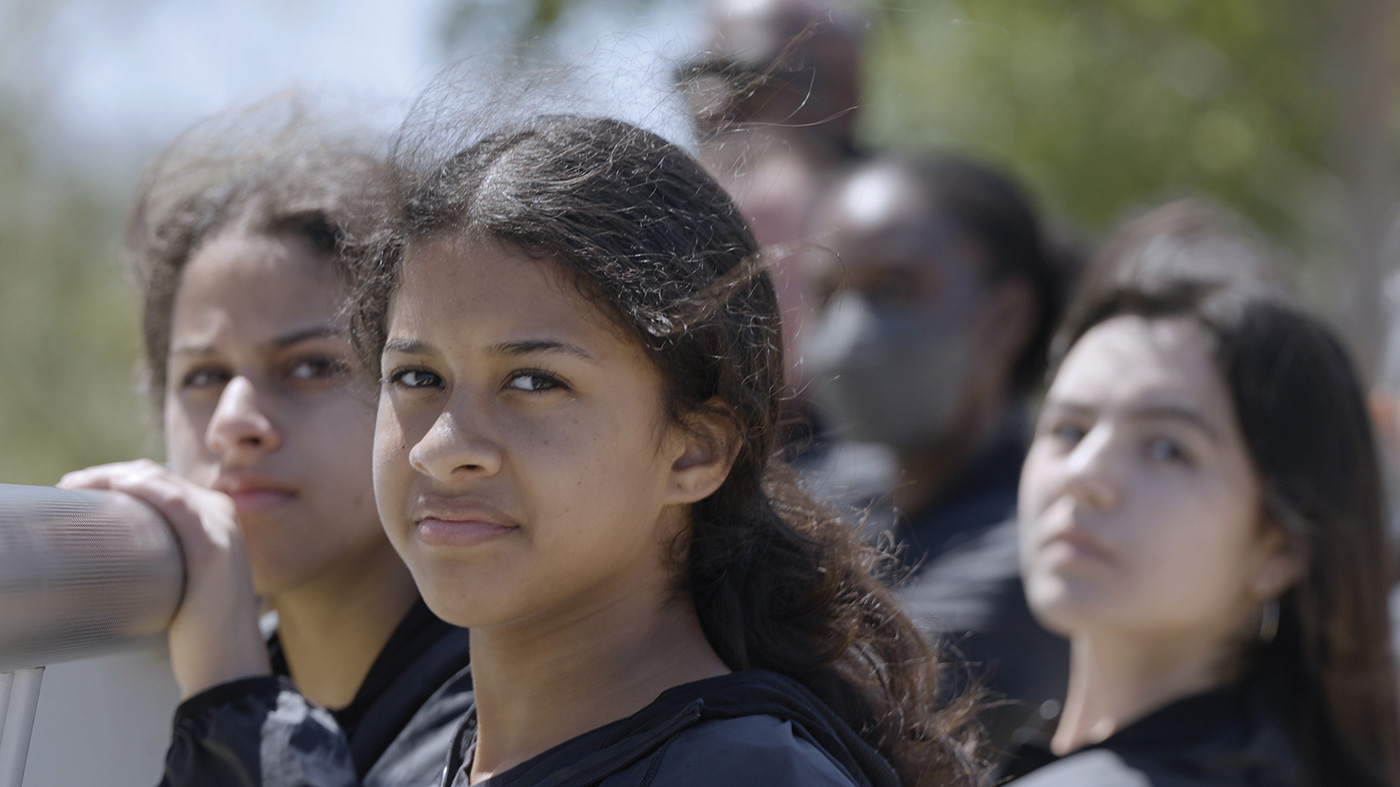
When we vocalize, we share and transform air, placing our bodies into critical relation to one another and the non-human world. Breath Work is an experimental community opera that explores air as a medium for resistance. Part documentary, part performative ritual, it takes place in Long Beach, California—an area filled with oil production and one of the largest ports in the world, where 25% of all imported goods enter the USA.Shipping infrastructure, railyards, freeways and oil refineries provide a striking backdrop for scenes of solidarity and grief staged by a cast and crew of 13 untrained local community members aged 11-65. Breath Work weaves together their creativity and their voices with personal stories of respiratory disease and environmental racism.
Nina Sarnelle (they/she) makes research projects, participatory performances, music composition, video and sculpture; their work interfaces with sites of neocolonialism(s), ecological destruction and labor exploitation in strange and intimate ways. They earned a BA from Oberlin College and an MFA from Carnegie Mellon University, and recently had a solo video exhibition at the New Museum: https://www.newmuseum.org/exhibitions/view/screens-series-nina-sarnelle Their work has also shown at Hammer Museum (LA), Getty Center (LA), Forum des Images (Paris), Haus der Kulturen der Welt (Berlin), Whitechapel Gallery (London), La Gaîté Lyrique (Paris), Ballroom Marfa (TX), MoMA (NY), Istanbul Modern (Turkey), Neuer Berliner Kunstverein (Berlin), Museum of Art, Architecture & Technology (Lisbon), Fundacion PROA (Buenos Aires), Black Cube (Denver), Southern Exposure (San Francisco), Recess (NY), UNSW Galleries (Sydney), Project 88 (Mumbai), Kevin Space (Vienna), Garage MCA, Moscow, Villa Croce Contemporary Art Museum (Genova), Mwoods (Beijing), Human Resources (LA) and others; and been featured in Art Forum, Frieze, Art in America, Vogue Italy, Huffington Post, SFMoMA, Creators Project, FlashArt, and Hyperallergic. www.ninasarnelle.com