Catalogue > Search
Results for : Tout le catalogue
Clemens Von Wedemeyer, Maya SCHWEIZER
Rien du tout
Fiction | 35mm | color | 30:0 | France | 2006
A young director wants to direct a medieval film in the Paris suburbs. During the casting she concentrates on one single person. The parking lot in front of the theatre, on which the young actors are waiting their turn, quickly becomes the decor of the new scene. While inside the alienation between the director and her assistant reaches its climax, the dance of the "superfluous" begins outside.
Maya Schweizer was born January 10, 1976, in Maisons-Alfort. She currently lives and works in Berlin. Her education includes a degree in plastic arts from the University of Aix-en-Provence in 1998. She studied from 2000-2002 at the Hochschule for Graphics and Book Art (HGB) Leipzig, and then entered the Art University of Berlin (UdK) where she obtained her degree in January 2005. Clemens von Wedemeyer was born in 1974 in Göttingen, Germany. He now lives and works in Berlin and Leipzig. His education includes: a MFA in 2002 from the Academy of Visual Arts in Leipzig, Germany, and studies in Fine Arts at the Academy of Visual Arts, Leipzig from 1998-2002. Select filmsography: Occupation (2002), Silberhöhe (2003), Die Siedlung (2004), Otjesd (2005). Exhibitions include: 2006, Kölnischer Kunstverein (catalogue); CAC Brétigny sur Orge, France; 2007, Skulptur Projekte Münster, Germany; Umea University, Umea, Sweden; 2006, Just off focus, Andrew Kreps Gallery, New York; In Moment, Skelleftea Konsthall, Sweden; t.i.n.a b., Prague; 4th Biennial of Contemporary Art, Berlin; 2005-2006 Fama Fluxus Mythos Beuys... jetzt neu! NEW!, Kunst+Projekte Sindelfingen, Galerie der Stadt, Sindelfingen, Germany; 2005, Leipzig Lens, Podium Gallery, Glasgow School of Art, Glasgow, UK; The Pantagruel Syndrom, T- Triennale, Torino.

Clemens Von Wedemeyer
Transformation Scenario
Video | 4k | color | 20:0 | Germany | 2018
In the background of blockbuster films, algorithms have been employed to replace extras in post-production. Since years we are used to scenes in which masses of automated characters fill the screen, animated by algorithms that let them interact, similar to computer games and agents in computational sociology. Such artificial masses are stepping in the foreground. Simulating life began in the movies and computer games, but is influencing many fields today. In architecture, city planning and traffic navigation as well as in predictions of markets and trade, virtual scenarios influence society and change the way we live. Transformation Scenario (2018) by Clemens von Wedemeyer creates a speculative narration on the impact of emulated group behaviour in society. It follows an idea that could be inspired by Jean Luc Godards film Le Gai Savoir: “To find the solution to a problem, be it a chemical or political problem, one has to dissolve it: dissolve hydrogen, dissolve the parliament. Therefore we will now dissolve images and sounds.“ The film is part of a long term project by the artist making reference to the work Mass and Power (1960) by Elias Canetti, shifting the view on imageries of society, crowd control and potentials of masses today. This is especially relevant in times of populism, when numbers are used to construct power, and demonstrations and mass events form moments of resistance.
Clemens von Wedemeyer, born in 1974 in Göttingen, Germany, currently lives and works in Berlin and holds a professorship for media art at the Academy of Fine Arts Leipzig. The artist and filmmaker participated in group shows such as the 1st Moscow Biennale (2005), the 4th Berlin Biennale (2006), Skulptur Projekte Münster in 2007, the 16th Biennale of Sydney (2008), and dOCUMENTA (13) (2012). He had solo shows among others at MoMA PS1, New York, ARGOS Centre for Art and Media, Brussels, the Barbican Art Centre, London, Frankfurter Kunstverein, Museum of Contemporary Art, Chicago, Neuer Berliner Kunstverein and Hamburger Kunsthalle. His works can be found in major collections such as The Museum of Modern Art, New York; Museum Ludwig, Cologne; Tate Modern, London.

Nicole Vögele
nebel
Experimental doc. | 16mm | color | 60:0 | Switzerland, Germany | 2014
A station in thick fog, tracks that disappear into the white mists and a figure, waiting. In between patches of mist a fox appears, looking for a scent in the wind. And then: bluster, shimmer, silence. And more fog. Views of nature merge with brief encounters. People living in their own worlds: an astronomer who, looking to the sky, would welcome the idea that we might not be alone in the universe. A musician hoping to meet the right woman one day. And a stableman for whom the world has always turned a little too fast. All are driven by their quiet longing to make contact, to not feel alone, to gaze into openness. Far from providing explanations, the film tries instead to help us perceive our inner hum, reaching out for an emptiness that cannot be grasped. In the end a clear view. The fox runs off, and we remain alone.
Born in 1983 in Gretzenbach (Switzerland). 2002 she got her first job at the Swiss Television. Over the last ten years she has been working as a journalist and reporter for several programs as «CASH-TV», «10vor10» and «Reporter». At the Swiss TV she started making documentaries. In 2010 Nicole Vögele enrolled at the Baden-Württemberg Film Academy, studying documentary filmmaking. Her first short documentary „Frau Loosli“ won the Postproduction Prize for the best swiss film at Visions du Réel 2013. Her latest film „nebel“ premiered at Berlinale 2014 and received an honorable mention by the dialogue en perspective jury. Nicole Vögele is currently working on her diploma project.

Viet Vu
Nguoi Kien
Fiction | hdv | color | 26:19 | Vietnam | 2018
The daily life of a homosexual man whose body is inhabited by ants.
Viet Vu (Ph?m Quang Trung) is a newcomer in moving image. He was introduced to images in a workshop at Hanoi Doclab by artist Jamie Maxtone-Graham in 2016. So far he has made one image collection of "Mom-me" (2017 - group exihibition at Hanoi Manzi Art Space) and a short film of "Ant-Man" (2018). Viet likes to approach the sublimity in vision of humanity through his camera.

Viet Vu
An Act Of Affection
Documentary | mp4 | color | 16:0 | Vietnam, Portugal | 2020
While making a portrait of a single gay man in Lisbon, a filmmaker offers his character a little gift from the bottom of his heart. Not only capturing beautiful interactions between two individuals through a first-person perspective camera, this is also a film on the act of filming.
Viet Vu (Quang Trung Pham) used to be a film critic before breaking into filmmaking with his debut short of “Ant-Man”, 2018. The film won him “Purin Award for The Most Promising Filmmaker from South East Asia”. He has since then completed a series of shorts on memory, time and internal decolonization. His works have been shown at Locarno, Rotterdam, Tampere, Singapore among other film festivals. At present, Viet is finishing DOC NOMADS, his master program of documentary film directing across three different cities of Europe – Lisbon (Portugal), Budapest (Hungary) and Brussels (Belgium).
Matthijs Vuijk
La Soledad de Montaña
Experimental doc. | mp4 | color | 12:53 | Netherlands, Colombia | 2021
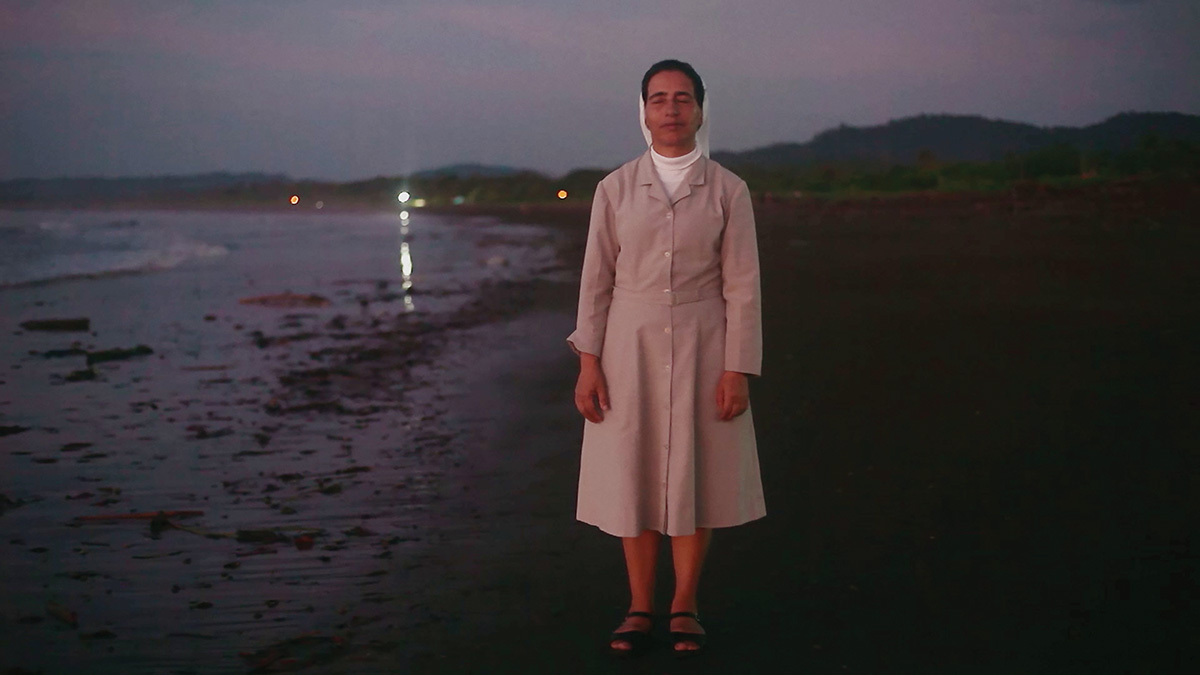
In a small village on the Pacific coast of Colombia, there is a single mountain surrounded by the ocean. On this mountain, a very special bird species settled a long time ago named Soledad de Montaña, directly translated as ‘the solitary mountain’. These birds carry a magical story and it's said that it can be heard during the stormy winds once in a while..
Matthijs Vuijk (1995, NL) is a director, artist and cinematographer with a diverse background in photography, film, and virtual reality. After studying photography at the Royal Academy of the Arts in Ghent, Belgium, he pursued a Bachelor Honours in Film & Television at the University of the Witwatersrand (WITS) in Johannesburg, South Africa. Matthijs' collaborative graduation film, "Sikelela Tapes" (2020), was selected for the prestigious International Documentary Festival Amsterdam (IDFA). His work revolves around creating captivating worlds through a powerful audiovisual atmosphere, exploring fragmented memory, space, and the emotional impact of societal shifts. Matthijs' practice has been recognized with a 'Starting Artist' stipend from the Dutch Mondriaan Fonds and gained Netherlands Film Fund support for his recent virtual reality project, "With the Whole World Crumbling, We Pick this Time to Fall in Love". Currently, he is actively engaged in various cultural initiatives in Johannesburg and Amsterdam.

Matthijs Vuijk, Straub Sammie
What do I see when I see me
Experimental doc. | mp4 | color | 3:23 | Netherlands, South Africa | 2020
A young woman interacts with her own cyborg self. Freed from flesh and thoughts in cyberspace, the digital body extends the movements and expressions of her organic body. In this way, the young woman escapes earthly conventions around the female body.
Sammie Straub (1994, NL) is a multidisciplinary artist born and raised in Amsterdam. Sammie’s interests lie in visual culture, philosophy and music. In her visual works, performances and installations she looks for (fashion)aesthetics amidst societal political chaos and distractions. Her works contain elements of social criticism, styling, art-direction, music and graphic design. In her musical works Sammie has a preference for electronic music; breaks, wave, EBM and techno, transgressing boundaries of musical genres just like her origin transcends colonially defined borders and nations. Sammie is currently studying photography at the Willem de Kooning Academy in Rotterdam and philosophy at the University of Amsterdam. Matthijs Vuijk (1995, NL) has been studying photography at the Royal Academy of the Arts in Ghent, Belgium. After doing an internship with Dutch Filmmaker Lara Verheijden, Matthijs moved to Johannesburg, South Africa. There Matthijs finished an Honours in Film&Television at the University of the Witwatersrand (WITS), and participated in a collaborative VR project between the Filmuniversität Babelsberg and WITS. Matthijs has edited on Lara's new film Coco (2020), received regional funding from the province of Zeeland for his new documentary and is currently involved in different cultural initiatives in Johannesburg and Amsterdam.

Matthijs Vuijk
With the Whole World Crumbling, We Pick This Time to Fall In Love
Experimental VR | 0 | color | 7:0 | Netherlands, South Africa | 2021
This immersive experience includes three-dimensional scans combined with voice-memos, images, videos and WhatsApp messages which together form an assemblage of distant yet intimate encounters with friends and subjects. The viewer is able to walk through a personal and emotional digital landscape, creating their own non-linear narrative between dream and reality, a liminal space of longing.
Matthijs Vuijk (1995, NL) is an independent new media artist and filmmaker who has been studying photography at the Royal Academy of the Arts in Ghent, Belgium, from which he graduated with distinction. After doing an internship with Dutch filmmaker Lara Verheijden, Matthijs moved to Johannesburg, South Africa. There Matthijs finished a Bachelor Honours in Film & Television at the University of the Witwatersrand (WITS) with distinction and participated in a collaborative VR project between the Filmuniversität Babelsberg and WITS. Matthijs’ background in visual art, film and VR encompass his passion, which lies in the creation of captivating worlds through a strong visual atmosphere. He is formally and technically interested in different mediums while the important narrative factors within his work have a strong emphasis on emotions, intimacy and connection. His recent collaborative film What do I see when I see me with Sammie Straub has been selected at the Rencontres Internationales Paris/Berlin 2021, while Matthijs’ newest immersive experience With the Whole World Crumbling, We Pick this Time to Fall in Love participates in the 2021 edition of the Fak’ugesi Digital Innovation Festival in Johannesburg, South Africa. His collaborative graduation film Sikelela Tapes was selected for the ‘Frontlight’ competition of the renowned International Documentary Festival Amsterdam (IDFA) and had its world premier at the Zanzibar International Film Festival (ZIFF) in Tanzania. Matthijs is currently involved in different cultural initiatives in both Johannesburg and Amsterdam.
Nicolas Wackerbarth
Halbe Stunden
Fiction | 35mm | color | 20:0 | Germany | 2007
Melanie lives aimlessly into the day, or more accurately: into a Friday. She's alone at home. "Half Hours" describes the time you have for yourself. Before someone arrives, after someone has left. If you gazing into space too long, you could lose yourself. Time lenghthens itself, till it becomes a threat. A Thriller about an uneventful day.
Nicolas Wackerbarth Director, Writer and Actor. Co-editor of the film magazine "Revolver". 1992-93 studies of law. 1993-96 studies at the Bavarian Theatre Academy: Graduate Actor. 1996-97 State Theatre Of Frankfurt, 1997-99 State Theatre Of Cologne. Since 2000 studies at the dffb, German Film and Television Academy of Berlin. Films / Director (selection): brat (short film 2000), Lovesick - Max Ophüls Wettbewerb/ Hauptpreis Pathos Award München (short film 2003), ?Beginners!? - Price of the Jury Med Film Rom/ Best Video GLTurin Film Fest. (TV, 2004) Westerntown (documentary 2005), Half Hours - Cannes Cinéfondation/ Kurzfilmtage Oberhausen (short film 2007)
Emmanuelle Waeckerle, Jimmy ROBERT
Newsflash
Art vidéo | dv | color | 8:4 | France, United Kingdom | 2004
In a series of slapstick tableaux we respond with humour and pathos to media manipulation in relation to War and Terrorism - while attempting to make a personal sign of protest. Behind our seemingly desperate satire and selfmocking attitude lurks a critique of violence and demagogy. Originally devised as a performance for Berlin International Meetings 2003 @ La gaite Lyrique in Paris -Feb 2003, as a personal response to the war ?against Irak? that had just started. The work feels as timely now as it did then.
Emmanuelle Waeckerle's interdisciplinary practice evolves between sound language and the body, exploring their performative intersections. The idea of fluidity and flux in identity and space has been central to modernity and has always found its way into her multidisciplinary art practice - Perhaps due to her own experience of a mixed cultural background (from Morocco to France to England). But also as in Henri Michaux words ? one of the best remedy against one?s own vulnerability, dissatisfaction and fundamental sense of inadequacy in the world ?. She is currently exploring new technologies of interactivity in relation to using, hearing and seeing the voice and the possibilities of a vocal yet non-verbal communication. Research funded by London Arts and Surrey Institute of Art and Design where she is a senior lecturer in Visual Communication. Jimmy Robert is currently at the rijks akademie in Amsterdam, completing the 2 years postgraduate residency programme.. His work gravitates in the space between materiality and representation, evolving from photography towards film and performance as well as writing. He attempts to activate the porosity of different identificatory supports such as literature and cinema, to reach beyond the page or the screen by merging with the image or embodying the text.

Beny Wagner
Coal Mine in the Canary
Experimental doc. | mp4 | color | 18:34 | Germany, United Kingdom | 2020
An essay film told through the body, 'Coal Mine in the Canary' explores the work of John Scott Haldane, the late 19th century physiologist whose experiments with respiration in atmospheric extremes led him to put canaries in coal mines as early indicators of air toxicity. The film explores this historical technique as a form of environmental control, one that would ultimately shape the possibilities of exchange between organisms and their surroundings, determined as a series of regulated variables. In the canary, Haldane developed a new paradigm: to modify an organism is a form of environmental control because there is no border at which the organism begins and the environment ends.
Beny Wagner is an artist, filmmaker, researcher and writer. Working in moving image, text, installation and lectures, he constructs non-linear narratives situated within the ever shifting threshold of the human body. ? He has presented his work in festivals, exhibitions and conferences internationally including: Berlinale, International Film Festival Rotterdam, Eye Film Museum, Haus der Kulturen der Welt, Media Art Biennale WRO, 5th and 6th Moscow Biennale for Young Art, Moscow International Experimental Film Festival, Plato Ostrava, Künstlerhaus Bremen, Kunsthalle Amsterdam, Sonic Acts, Impakt Festival, Berlin Atonal, Venice Biennale, White Columns among many others. His work has been featured in Artforum, Spike Magazine Quarterly, Frieze Magazine, Kaleidoscope Press, Flash Art and Die Zeit. His writing has been published in Valiz and Sonic Acts Press among others.
Janaina Wagner
Quebrante
Experimental doc. | 4k | color and b&w | 23:0 | Brazil | 2024
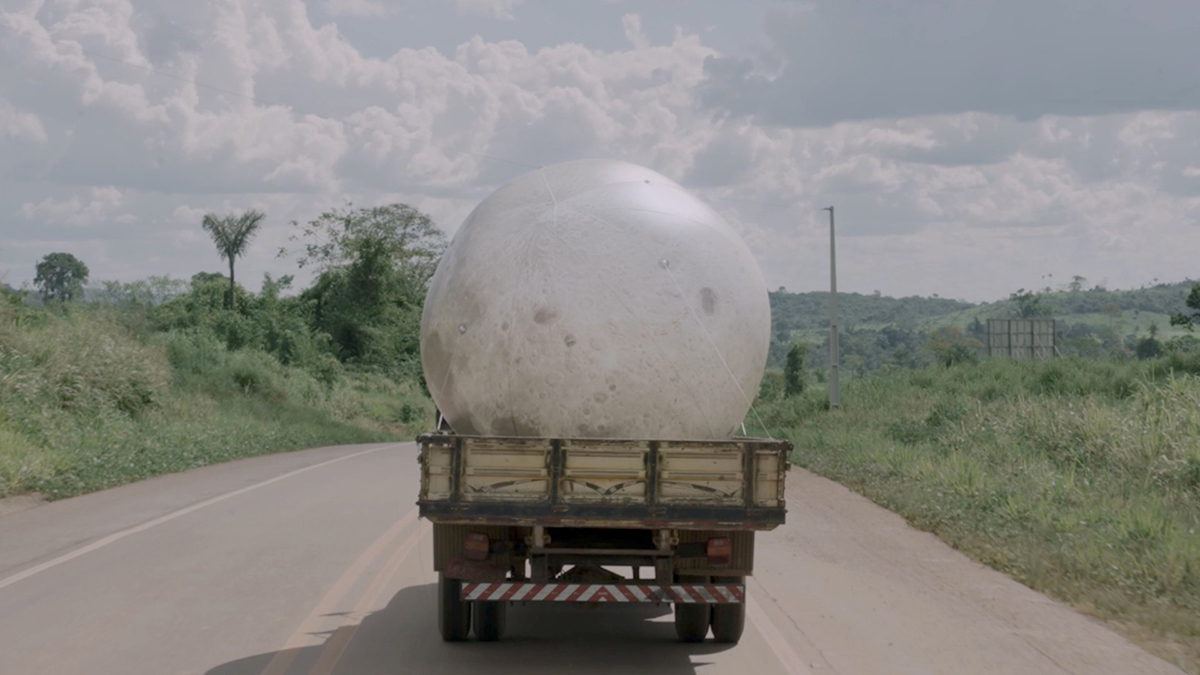
A spell breaking, QUEBRANTE traverses the caves, ruins and phantasmagorias of Transamazon BR230 Highway, portraying its stones and its ghosts. A conversation between the moon and the stones, QUEBRANTE is freely inspired in Robert's Smithson project THE TRULY UNDERGROUND CINEMA (1971) and in the film THE VERY EYE OF THE NIGHT (1958) by Maya Deren. Set in the tiny town of Rurópolis (Pará) - the very first one to be build in the Highway to serve as a base for the workers that were building it - QUEBRANTE follows Ms. Erismar, known in the region as "The Cave Woman". A retired elementary school teacher, Ms. Erismar was the one responsible for the discovery of the region's caves: she would enter the dark unknown holes till their ends, with only a candle in her hands and a lighter tied to her pants - in case the flame would fade out. A huge nationalistic propaganda part of the progress and development project of Brazil, Transamazônica Highway was implemented during the civic-military dictatorship that took place at the moment – and it is till nowadays a warm scar of the wreckage dream of the history of the country.
Janaina Wagner (1989) develops her research in film, drawing and installations. Her work aims to present a critical understanding of the ways in which humans impose systems of order and control upon their surroundings. Currently a Phd student at Le Fresnoy-Studio National des Arts Contemporains (FR), Janaina has participated in several residencies, such as Gasworks (UK); VISIO - European Program on Artists’ Moving Images (IT); FID Campus (FR), Bolsa Pampulha (BR). Her work is part of important collections, such as Instituto Inhotim (BR), Galeria Municipal do Porto (PT) and Coleção Moraes Barbosa (BR). Among the main exhibitions, stand out the individuals CINEMA CAVERNA (BR) and With burning love - Villa Belleville (FR); and the group 22a Bienal Videobrasil (BR), Ensaio de Tração - Pinacoteca do Estado de São Paulo (BR); Garganta - CIAJG - José de Guimarães International Arts Center (PT); Aliens are temporary - Kunstraum Kreuzberg/Bethanien (DE). Janaina has been participating in several film festivals, such as Berlinale (DE) and Tiradentes Film Festival (BR). Janaina Wagner is currently developing her first feature film, the experimental documentary A Mala da Noite. Janaina lives and works between Paris and São Paulo.
Janaina Wagner
Quebrante
Experimental doc. | 16mm | color | 23:0 | Brazil | 2024
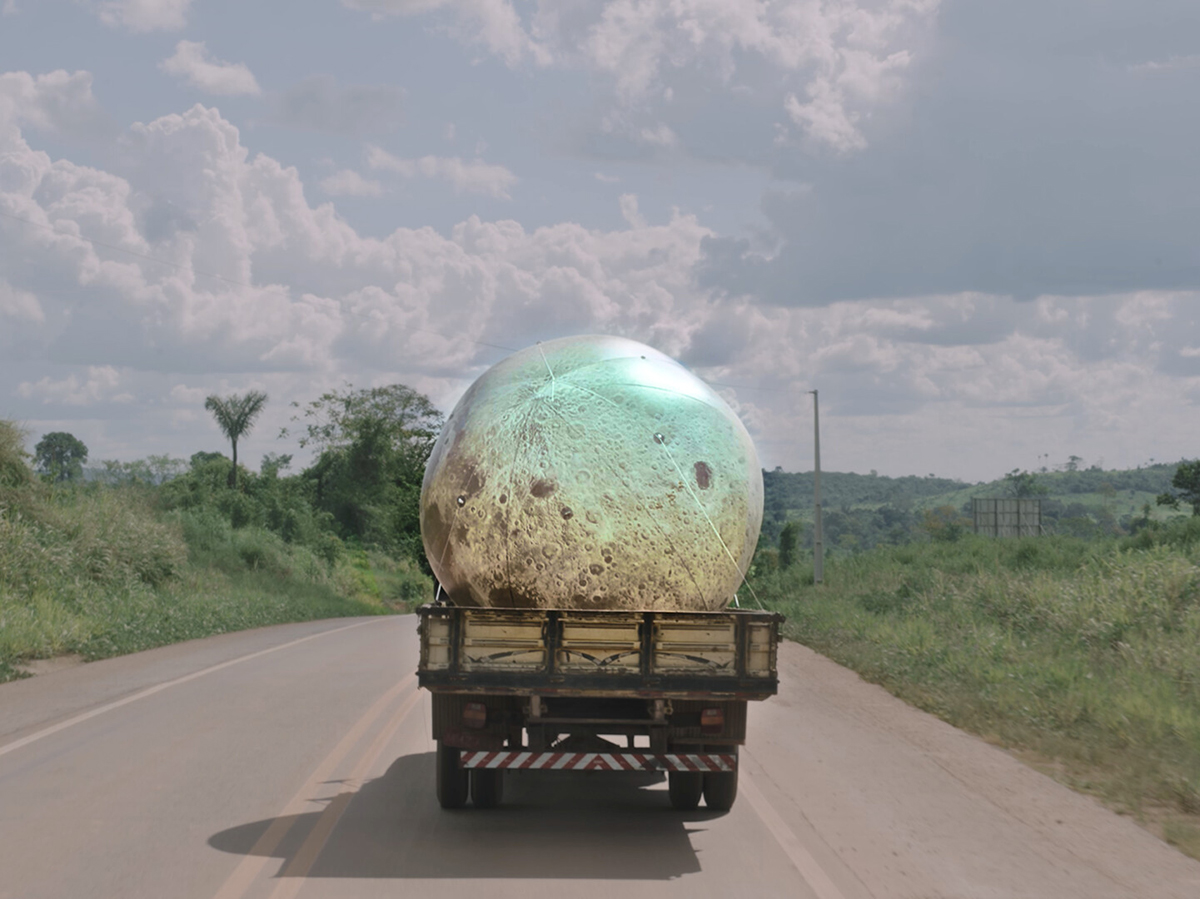
A spell breaking, QUEBRANTE traverses the caves, ruins and phantasmagorias of Transamazon BR230 Highway, portraying its stones and its ghosts. QUEBRANTE follows Ms. Erismar, known in the region as "The Cave Woman". A huge nationalistic propaganda part of the progress and development project of Brazil, Transamazônica Highway was implemented during the civic-military dictatorship that took place at the moment – and it is till nowadays a warm scar of the wreckage dream of the history of the country. A conversation between the moon and the stones, QUEBRANTE is freely inspired in Robert's Smithson project THE TRULY UNDERGROUND CINEMA (1971) and in the film THE VERY EYE OF THE NIGHT (1958) by Maya Deren.
Janaina Wagner (1989) develops her research in film, drawing and installations. Her work aims to present a critical understanding of the ways in which humans impose systems of order and control upon their surroundings. Currently a Phd student at Le Fresnoy-Studio National des Arts Contemporains (FR), Janaina has participated in several residencies, such as Gasworks (UK); VISIO - European Program on Artists’ Moving Images (IT); FID Campus (FR), Bolsa Pampulha (BR). Her work is part of important collections, such as Instituto Inhotim (BR), Galeria Municipal do Porto (PT) and Coleção Moraes Barbosa (BR). Among the main exhibitions, stand out the individuals CINEMA CAVERNA (BR) and With burning love - Villa Belleville (FR); and the group 22a Bienal Videobrasil (BR), Ensaio de Tração - Pinacoteca do Estado de São Paulo (BR); Garganta - CIAJG - José de Guimarães International Arts Center (PT); Aliens are temporary - Kunstraum Kreuzberg/Bethanien (DE). Janaina has been participating in several film festivals, such as Berlinale (DE) and Tiradentes Film Festival (BR). Janaina Wagner is currently developing her first feature film, the experimental documentary A Mala da Noite. ?Janaina lives and works between Paris and São Paulo.

Janaina Wagner
Cães Marinheiros
Video | mov | color | 7:0 | Brazil | 2020
Cães Marinheiros (Sailors Dogs) was filmed in the ruins of the small town of Velho Aira?o, in the Brazilian Amazon, at the confluence of Rio Negro and Rio Jaú. Founded by Portuguese missionaries in 1694, Airão concentrated the entire rubber production in the region. After a rapid and unsustainable economic growth, followed by the decline of the Rubber Cycle, the city went bankrupt. A politician at the time said that the population was being eaten by ants. Ruined, Airão was abandoned. Sailors Dogs juxtaposes the homonymous tale by Portuguese poet Herberto Helder with the dismantled landscapes of the village. In a perspectivist inversion, textual and visual images assemble and disassemble within a forest eaten away by men. By reflecting on the precarity and fragilities of human nature, and the limits of our relationship with the environment, the film questions our place of dominance in the universe that we inhabit.
Franco-Brazilian artist JANAINA WAGNER (1989) works with cinema, photography, scenography, drawing, video and installations, researching the relations of limit, control and contention that human-kind establishes with the world. Currently on a PhD at Le Fresnoy-Studio National des Arts Contemporains (FR), Wagner participated in several artistic residencies, such as Gasworks, VISIO, FID Campus - Festival International de Cinéma de Marseille, Bolsa Pampulha, Festival Mondes Possibles - Théâtre Nanterre-Amandiers, Casa Tomada, Anarcademia W139 Amsterdam and NES Skagaströnd. Among the main exhibitions and film festivals, stands out Eco-spectrality: Residual Fabulations - Glasgow Film Festival, Thinking Beyond: Images for a post pandemic world (IT), Aliens are Temporary - Kunstraum Bethanien (DE), A natural history of Ruins – Pivô (BR), Mostra de Cinema de Tiradentes (BR), Casa Carioca – MAR Museu de Arte do Rio de Janeiro (BR), Ensaio de Tração - Pinacoteca do Estado de São Paulo (BR), Simultan Festival XV – Unseen (RO), 10 ª Semana de Cinema do Rio de Janeiro (BR), Bestiário - Centro Cultural São Paulo - CCSP (BR). Graduated both in Fine Arts and in Journalism (BR), her references derives from the procedures through which human-kind registers and articulates its progress and legacy – a constellation of tales, facts and images. Janaina lives and works between Paris and São Paulo.

Beny Wagner
Outside
Experimental film | mp4 | color | 14:0 | Germany | 2017
`Outside` traverses two cyclical metabolic paths in the attempt to forge a reciprocal relationship between the two. Moving from the metabolism of the human body to the metabolism of waste infrastructures, the film creates an inverted exchange wherein the concealment of waste inside the human body turns to the concealment of the human body inside waste. The boundary that divides waste from production would seem to contain an underlying set of moral implications. The film considers these as situated somewhere between law enforcement and class structure as defined through labor positions.
Wagner has exhibited his work and screened films world wide: International Film Festival Rotterdam, Media Art Biennale WRO, Movimenta Biennale (Nice), Rongwrong (Amsterdam), Haus der Kulturen der Welt (Berlin), Art Athina (Athens), Impakt Festival (Utrecht), 5th Moscow Biennale for Young Art, Eye Film Museum (Amsterdam), Venice Biennale, Plato (Ostrava), Import Projects (Berlin), Future Gallery (Berlin), Center (Berlin) among others. His work has been featured in Artforum, Spike Magazine Quarterly, Frieze Magazine, Kaleidoscope Press, and Die Zeit. He has published texts with Valiz, BLOCK Magazin and 60 pages. Wagner graduated with honors from Bard College, New York in 2008. He was a researcher at Jan van Eyck Academy, The Netherlands in 2015-6. He is currently a lecturer at Gerrit Rietveld Academy, Amsterdam, and has been a guest teacher at several other academies.
Nicolas Wagnieres, benoit peverelli
hotel jugoslavija 1.0
Documentary | 16mm | color | 12:50 | Switzerland, Serbia | 2006
This film traces the history of the JUGOSLAVIJA hotel in Belgrade, witness of past times and of the many historical changes the country has known. Through a voice over testimony of a previous director and former employees, the history of the building is unravelled and is partly recreated as the camera sweeps the rigorous architecture with long travelling and panoramic shots of the place and brings us to a building site-like present.

Gwenola Wagon
Chroniques du soleil noir
Experimental fiction | hdv | color and b&w | 17:0 | France | 2023
In a dystopian future, humans have had to block out the sun in order to survive on Earth. Drought is extreme and the planet is gradually turning into a scorching desert where the survivors, installed in the basements of the great observatories, live in perpetual darkness. To compensate for the image of a sun they can no longer see, they instruct an artificial intelligence program to reconstruct it. The AI is supervised by a young woman whose mental images are particularly vivid. Drawing on the photo-novel structure of Chris Marker's film La Jetée (1962), Chronicles of the Dark Sun work on a science fiction narrative in which, as in Marker's film, an algorithm is tasked with reconstructing the past using an image from the protagonist's childhood. By recycling photographs from personal albums, advertising images and scientific snapshots, all of which are reprocessed by an AI, the film examines our relationship with technology in a disturbing and ironic way. This work is an uncanny fable that makes us think about the deformation of reality in AI as well as the unsustainability of our way of inhabiting the planet. Production with the support of Hangar Y, in partnership with l’Observatoire de Paris-PSL
Gwenola Wagon is an artist and researcher. She teaches at the Sorbonne School of Arts and the University of Paris 1. Through installations, films and books, she imagines alternative and paradoxical narratives for thinking about the contemporary digital world. With her first films, Globodrome, she surveyed the virtual globe, investigating the space of hyperinformation and Internet infrastructures in collaboration with artist Stéphane Degoutin, with whom she co-produced World Brain and the book Psychoanalysis of the International Airport. After Bienvenue à Erewhon, Virusland and Chroniques du soleil noir, post-cybernetic fables with Pierre Cassou-Noguès, she published Planète B, an essay that blends investigation and fiction in order to apprehend a rapidly expanding monster.

Hamid Waheed
Etterkrigstid
Fiction | 4k | color | 30:0 | Norway | 2018
A city dweller moves through various routines and encounters throughout a single day. The gradually revealed circumstances point toward a crisis starting to unfold.
Hamid Waheed is a filmmaker and artist currently based in Oslo, Norway. He works with the film and video, as well as utilizing writing and performance. The work often emphasizes characterization and queerness as methods of investigating social/physical structures, with a particular interest in history and archived data. Film projects are initiated through ’Verbal Film’, often in collaboration with other parties. Aside from this, a practice in curating video works is ongoing through the collective ?HÆRK’. He has a BFA in Moving Images from Nordland College of Art and Film.

Hamid Waheed
Areoles
Video | 4k | color | 13:46 | Norway | 2021
Queer characters talk about their lives and making sense of their worlds.
Hamid Waheed is a filmmaker and visual artist utilizing moving images, as well as writing and performing. His work often emphasizes characterization, dramaturgy and queer desires as methods of investigating psycho-social structures, ruminating on time, intimacies and violence. He is also interested in histories and the materialities of archived data. Works have been presented a number of places, including the Museum of Cultural History, Fotogalleriet and Kunstnernes Hus Kino (Oslo), METEOR International Theatre Festival (Bergen), Open Out Festival (Tromsø), Nikolaj Kunsthal (Copenhagen) and Rencontres Internationales Paris. He’s also part of the curatorial collective ’HÆRK’ and has a BFA in Moving Images from Nordland College of Art and Film. Currently, he’s pursuing an MFA at the Oslo National Academy of the Arts.

Kay Walkowiak
Minimal Vandalism
Video | hdv | color | 3:49 | Austria | 2013
Touching art objects in an exhibition space is usually not allowed. Not so in Kay Walkowiak´s Minimal Vandalism, where this prohibition is practically stomped on. The setting, the Generali Foundation in Vienna is the epitome of a modernist exhibition building, which—as neutral White Cube-like shell—is meant to intervene as little as possible in the act of viewing art.. Well, other than the tube-like enfilade with the massive concrete wall running down the middle along which a parcours of minimalist sculptures is set up in Minimal Vandalism. And it truly is a parcours, as after a brief exposition, in which the jerky camera movements already lead us to suspect that something’s up, an entirely unexpected performance unfolds. In one of the few calm takes, a surveillance camera soon becomes visible and the show begins: a skateboarder (Kilian Martin) coming from the depths of the room makes his approach on three boards piled on top of one another, to subject the sculptures to a test of endurance, or skill. The “performer” relentlessly includes the objects in his acrobatics, regardless of the fact that they are art, gliding up onto them, sliding across their surfaces, and daringly jumping over them.
*1980 in Salzburg, lives and works in Vienna. Several Grants and awards; e.g. Artist in Residence Grant Banff(2014), Beijing(2013), Varansi (2013), Theodor Körner Preis (2010), Otto Prutscher award (2008), Fred Adlmüller scholarship (2006). He studied philosophy and psychology at the University of Vienna, photography and video art at the Academy of fine Arts, Vienna and art & communication and sculture & multimedia art at the University of Applied Arts, Vienna.
Susanna Wallin
Lizzy
Experimental doc. | 4k | color | 15:0 | Sweden, USA | 2024
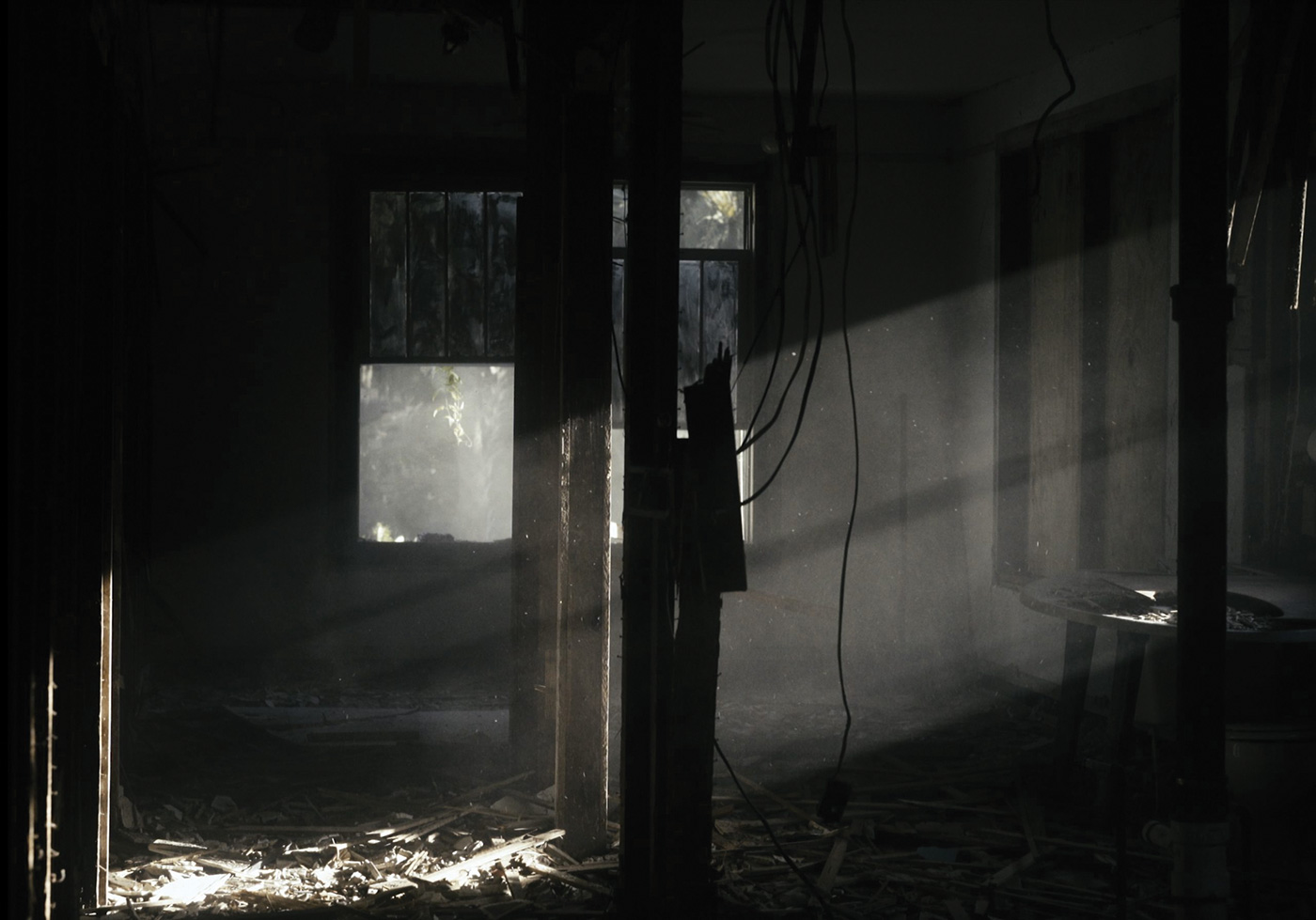
Lizzy is the result of the days spent in the aftermath of the death of a neighbour, who passed in the house where she had lived out her whole life on the Hillsborough River in Tampa, Florida and who left behind an electric organ addressed to the filmmaker, without a note. To receive it was like a wild riddle.How might one story continue in the hands of another? What powers organize the telling? Through weaving indoors with outdoors, dust with swamp, celebration with critique, the film traverses binary notions such as self-world, truth-fiction, witnessing-imagining and nature-experience among others.
Susanna Wallin is an artist and filmmaker engaged in questions regarding what to do with our time, our bodies and the tools we are given to live a life. She probes subject matter across diverse contexts, modalities and timescales, often immersing herself in a particular place over extended periods. She is attentive to what emerges in hesitation, together, through experimentation and open ended, lending an ear to the unspoken with fiction as practice. Born and raised in Sweden, she studied filmmaking and art practice/theory at Goldsmiths College and University of the Arts London in the UK. She has been the recipient of numerous awards including The Flamin London Artist Film and Video Award, New Approaches, Film London UK, Pure Fiction, Sweden and commissions from the UK Film Council, Channel 4, BBC, Arts Council England, Arte France/Germany, SVT, Sweden and the BFI in the UK. Her award-winning films are shown in cinema and gallery contexts and have appeared in venues such as MOCA LA, The American Cinematheque, The Barbican, Whitechapel Gallery, The London Underground, ICA and the British Film Institute. In recent years, Wallin has been developing several feature length film projects, one of which is set in Florida and now in post production. She is part of the Research School at University of the Arts London in the UK completing a PhD through practice and is Assistant Professor of Film and Video at University of South Florida in the US. She lives and works between Tampa and London.