Catalogue > Search
Results for : Tout le catalogue

Ivar Veermäe
Crystal Computing (Google Inc., St. Ghislain)
Documentary | hdv | color | 9:19 | Estonia, Spain | 2014
Data in the Cloud seems to be disembodied. But in reality, it does have a physical manifestation, albeit a small one, on the hard drives on internet servers. To cool the servers requires massive amounts of energy, so the data is stored in huge centres that look like factories, complete with chimneys releasing large clouds of vapour into the atmosphere. One of the largest data centres in the world with close to 300 000 servers is in St. Ghislain, Belgium, where Google Inc. uses a code name, Crystal Computing. Ivar Veermäe was not granted permission to visit the centre, so he filmed it from a distance. The distance makes the physical location of the data take on a magical quality, like an unattainable paradise, but with unfavourable auspices.
Ivar Veermäe is visual artist concentrating on issues of public space, mediation processes, new technology and networks. His projects are based on long term artistic research, which goal is to analyze the notions connected to information, networks, materiality, locality and also representation. He has had several solo exhibitions in Berlin and Estonia. His work has been exhibited in group exhibitions at transmediale Festival in HKW, the Zentrum für Kunst und Urbanistic, Forum Factory and Kleine Humboldt Gallery in Berlin, the Art Museum of Estonia, Art Hall of Tallinn, the Estonian Contemporary Art Museum, the Sociale Verzekeringsbank in Holland, the Kulturhuset Bronden in Denmark, the Mamara University in Istanbul. He has participated with perfomances in Hebbel am Ufer, Berlin and in Month of Performance Art Berlin in ACUD Theater. His videos are being screened in various screenings at the AND Festival in Manchester, EMAF in Osnabrück, Crosstalk festival in Budapest, Carneval of eCreativity in India, and in Virtual Memorial, Cambodia. Ivar Veermäe currently lives and works in both Tallinn and Berlin, Germany. He received a BA in photography from the Estonian Academy of Arts in 2009 and a MA in 2014 at Spatial Strategies department in Weissensee Kunsthochschule Berlin. www.ivarveermae.com
Ivar Veermäe
Effelsberg
Experimental doc. | mov | color | 15:3 | Estonia, Germany | 2024
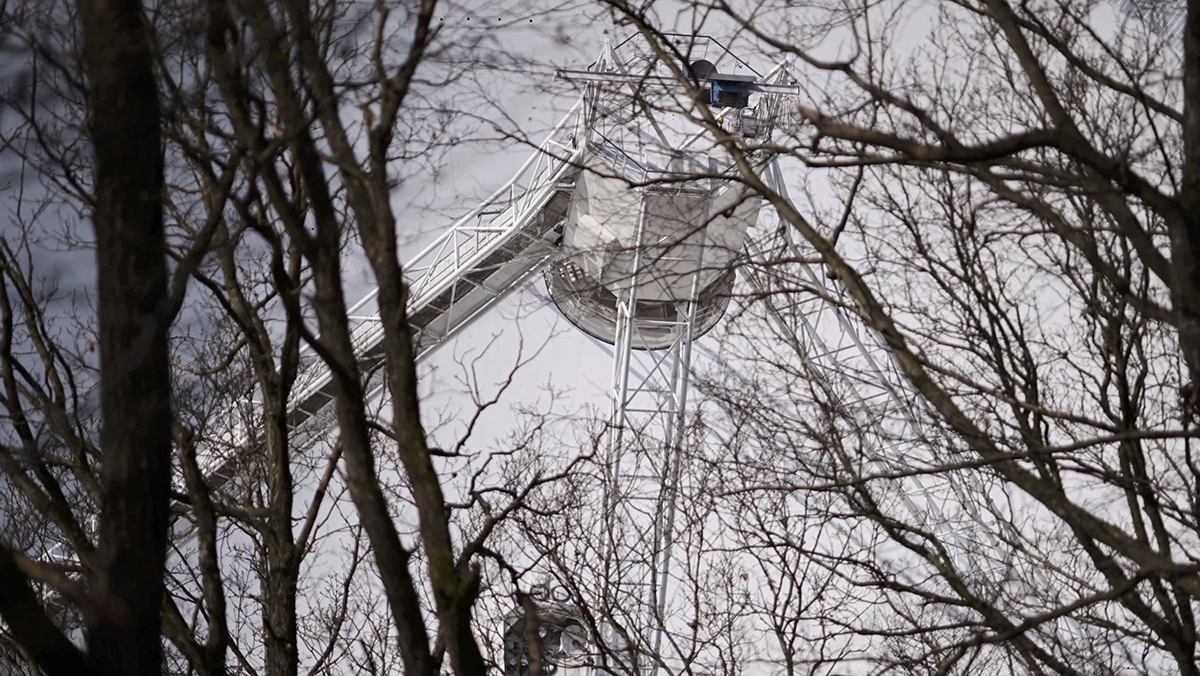
The work combines material from the Effelsberg radio telescope in Germany with my conversations with several geoengineering experts. Calm images are overlaid with discussions that follow a wide range of topics – questions about visual models and their real life impact, uncertain- ties connected to geoengineering, questions about power and CO2 mitigation, guesses about climate warming and the probability of stratospheric aerosol injection deploy- ment. The design of one of the world’s largest fully steerable radio telescope in Effelsberg is massive yet mechanically relatively simple. It is used to research distant territories far away from Earth, the formation of stars and the disap- pearance of matter into black holes. Also to detect radio waves from neighboring galaxies. I have chosen this as a research object in order to think about what can be perceived and understood through visibility? How visual simplicity fails to convey the complexity of such sets of relationships? Or how to think of inconceivable scales? Effelsberg stems from my research about solar geoengi- neering, that theoretizises the idea, that it will be pos- sible imitate the activity of volcanoes and thus reduce climate warming. One of the most scientifically studied processes describes the spraying of large amounts of aerosols into the stratosphere, where they would scatter the sun’s radiation and thereby reduce the amount of energy reaching the earth’s surface. It would be a delib- erate intervention in the global climate system, it would have to be done for about a few hundred years, and its fully realised form could not be interrupted without cata- strophic consequences.
Ivar Veermäe (born 1982 in Tallinn, lives and works in Berlin) received a BA in photography from the Estonian Academy of Arts in 2009 and a MA in 2014 at Spatial Strategies department in Weissensee Kunsthochschule Berlin. He has received various scholarships and grants – Kunstfonds Arbeitsstipendium, Edith-Russ-Haus Media Art Grant, Elsa-Neumann-Stipendium Berlin and scholarships from Estonian Cultural Endowment. The artist has had solo exhibitions in Edith-Russ-Haus, Oldenburg, Germany, Gallery im Turm, Berlin, Tallinn Art Hall Gallery, City Gallery of Tallinn, Estonia, AV17 Gallery in Vilnius, Lithuania, Cultural Center Belgrade in Serbia, among others. His work has been exhibited in group exhibitions at Riga Biennale, BIENALSUR in Buenos Aires, Venice Architecture Biennale, transmediale Festival in HKW, Moscow Biennale for Young Art, the Bozar in Brussels, the ZKM in Karlsruhe, Rijksmuseum Twenthe, Netherlands, the Art Museum of Estonia, Art Hall of Tallinn, the Estonian Contemporary Art Museum, the Kulturhuset Bronden in Denmark, the Kunstverein Kassel, the Latvian Centre for Contemporary Art, the Kunstverein Wolfsburg, the Pinnacles Gallery in Australia. His videos are being screened at the Rencontres Internationales in Paris and Berlin, in HeK Basel, transmediale Festival, e-flux.com, MoMa web platform, AND Festival in Manchester, EMAF in Osnabrück, Kasseler Dokfest, Crosstalk festival in Budapest, in Virtual Memorial, Cambodia.

Ivar Veermäe
Our Word Our Bond
Experimental doc. | hdv | color | 14:14 | Estonia, Germany | 2017
The film is a journey of tracing the former Baltic Exchange´s building. 1903 it was built in neoclassical Edwardian style in the centre of London and 1992 destroyed by Provisional IRA´s biggest car bomb to the date. After the bombing there were plans to attach parts of Baltic Exchange´s house to a new building in the same location. Before dismantling it was fully documented and catalogued. These plans never materialized and in 2006 two estonian businessmen bought the facade and parts of the trade hall wanting it to be rebuilt in Tallinn. The stones were sent to Estonia, where they have stayed in shipping containers over 10 years (with the exeption of the facade sculptures, which were used in a project by estonian architects and artist in 2016). After the real estates developers won dispute with conservationists Foster and Partners iconic “ Gherkin ” - Swiss Re-s building has been constructed in the former Baltic Exchange´s site. Tracing the stones and the story of former building, in Estonia and London, leads to unpredictable outcomes. For example, terrorist attack being economic consideration; real estate boom in London; redesign of city space by incorporating anti attack measures.
The work of visual artist Ivar Veermäe (born 1982 in Tallinn, Estonia; lives in Berlin) circles around questions of public and private space, mediation processes, architecture and infrastructure, information technology and networks. As a result of long-term artistic research by means of photography, film and sound, his works are presented in versatile ways (such as video, on-site installations, interactive works and performances, also in public space). Ivar Veermäe aims to document and analyze the infrastructure underlying our contemporary culture of data and information. Concentrating on physical and local presence, confronting it with its representations creates a possibility for questions and doubts. His interest lays in hidden or stealty qualities of various spaces and objects. He has had solo exhibitions in Edith-Russ-Haus, Oldenburg, Gallery im Turm, Berlin, Freies Museum Berlin, City Gallery of Tallinn and Hobusepea Gallery in Estonia, among others. His work has been exhibited in group exhibitions at transmediale Festival in HKW, Venice Architecture Biennale, Athens Digital Arts Festival, Moscow Biennale for Young Art, the Bozar in Brussels, the CNB Contemporánea in Buenos Aires, the Zentrum für Kunst und Urbanistic, Forum Factory and Kleine Humboldt Gallery in Berlin, the Art Museum of Estonia, Art Hall of Tallinn, the Estonian Contemporary Art Museum, the Latvian Centre for Contemporary Art, the Kulturhuset Bronden in Denmark, the Old Sugar Factory in Groningen, the Kunstverein Wolfsburg, the Kunstverein Kassel, the Pinnacles Gallery in Australia.

Ana Vega
3 shades (She blue, red, yellow)
Video | hdv | color | 12:18 | Italy | 2014
She is yours. You might find yourself scanning, your eye guided by a languid sliding pan, detail after detail of waxed body, parts of a car. Other elements, half omitted, slope by, appearing from the edges of the frame. Are they part of a larger story, is there a narrative to follow? She is a vessel, drawing you in. Everything is plausible, yet more enjoyable for moderately enhanced. You will be given treats, something recognizable out of a sequence of slightly abstractions, merely suggestions. Or you might get distracted by these props offered unto your gaze, were they not a source of nearfamiliarity. A Mercedes-Benz, Wave blonde cigarettes. As out of place as usual. It’s a set up. Sunshade. text : Robin Jiro Margerin

Ana Vega
Where Are We Going? (Hey Siri)
Video | hdv | color | 13:59 | Argentina, France | 2018
Floating voices in a swaying space. Gone out looking for an object, the two protagonists digress and get lost in the quest for its historical context, get stirred and disenchanted by human relations, spend time together and find travelling companions. A figurative and abstract sequence in chiaroscuro of an indecisive ride, that follows the trajectories of a conversation between invisible and incorporeal characters. Where do you want to go? I'm sorry, I can't answer that. Where are we going? Here's what I've found : _ A young man and his mom, Robin, Siri, Siri, Chris C. and others.
Ana Vega (born in Bahia Blanca, Argentina, 1987) is a visual artist who lives and works in Paris. She studied at the Ecole Nationale Supérieure des Beaux-Arts in Paris and at the Ecole Nationale Supérieure des Arts Appliqués et des Métiers d'Art in Paris ; as well as at Carnegie Mellon University, Pittsburgh (USA) ; at the Pittsburgh Filmmakers Center for the Arts, Pittsburgh (USA) ; at the Centro Cultural Rojas (Buenos Aires). She participated in the 2018-19 collective exhibition « Mademoiselle » curated by Tara Londi at the Regional Contemporary Art Center (CRAC, Sète). Her work was exhibited in 2017 at Arondit, Paris ; the Albert Chanot Contemporary Art Center (Clamart) ; the Arnaud Deschin gallery (Paris) ; Vidéobox#4, Carreau du Temple, Paris ; La Salle de Bains, Lyon, FR ; the Video Art Festival of Carcassonne, Cinéma le Colisée, Carcassonne, FR ; and, precedently, particularly at 22 rue Muller, Paris, 2016 ; in the video library of the Festival les Rencontres Internationales at the Gaîté Lyrique, Paris, 2016 ; at the Image/Imatge Art Center, Orthez, FR, 2015 ; the Palace of Fine Arts, Paris 2015 ; the Escougnou-Cetraro gallery, Paris, 2015 ; Commonwealth & Council, Los Angeles, USA, 2014 ; the Torrance Art Museum, Los Angeles, 2014 ; the Ricard Foundation, Paris, 2014 ; Florence Loewy gallery, Paris, 2013 ; the Centquatre, Paris, 2013 ; Dickerman Gallery, San Francisco, USA, 2013 ; the 58th Salon de Montrouge, Le Beffroi, Montrouge, FR, 2013 ; the Rosenblum Foundation, Paris, 2012.

Mateo Vega
Center, Ring, Mall
Experimental film | 16mm | color | 17:29 | Peru, Netherlands | 2022
A multi-vocal triptych through peripheral sites of urban infrastructure: a data center, a ring road, and a run-down mall. All three sites were built with certain worldviews: visions of the future and promises of progress that didn't turn out to be the utopias they presented themselves as. Through multi-lingual texts, a site-specific soundtrack, 16mm and 3D images, the spaces and their implications are subjectively mapped, poeticized and questioned. A poetic materialism of decay, renewal, remembering and projecting, "Center, Ring, Mall" is perhaps a mourning, but one that desires and demands a rebirth.
Mateo Vega (1994) is a filmmaker and artist from Peru raised in Amsterdam, and a graduate of Sandberg Instituut, Amsterdam University College and The New School. The starting point of their work is the subjective experience of (urban) space, and the politics, histories and futurities embedded in landscapes, architecture and infrastructure. Their films and installations have been supported by Mondriaan Fund, Netherlands Film Fund, Amsterdam Fonds voor de Kunst, and shown at places like MoMA, Film at Lincoln Center, International Film Festival Rotterdam, Framer Framed, Amsterdam Museum, and Theater Rotterdam.
Carlos Velandia
La mujer como imagen, el hombre como portador de la mirada
Experimental film | dcp | color and b&w | 7:20 | Colombia | 2022
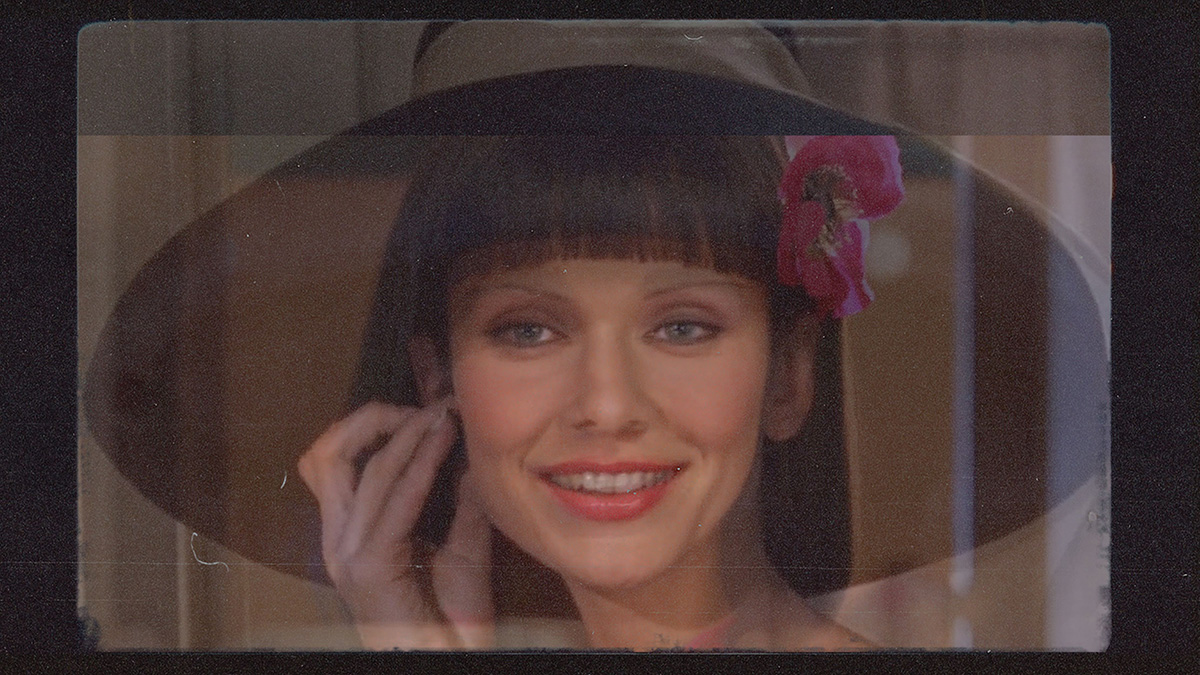
Faces, bodies and actions are juxtaposed endlessly. Fragmented pieces of the woman come together and form the volume of what has been her image in the history of cinema; one marked by the routinary domination and exploitation of her body.
Colombian moving image artist and film curator whose work focuses on feminism, anticolonialism, experimental-expanded animation and new technologies. His work has won the ZINEBI Grand Award (Oscar Qualifying) at Bilbao International Festival of Documentary and Short Film, the Silver Lynx Experimental Award at FEST - New Directors | New Films and has premiered several times at Annecy International Animation Festival.

Javier Velazquez Cabrero, Xolisile Bongwana
The Loop
Video | hdv | color | 4:20 | Spain, South Africa | 2018
We get in touch with the creative processes of both artists. At the beginning of the video, we see a small interview with Xolisile, which shows how the previous interaction was. He does not want to verbally negotiate his interests, proposing an exclusively corporal dialogue. When asked about his opinion on the system of rules with which is proposed to work, Xolisile continues with an enigmatic and powerful career that works as an escape and as a response at the same time.
Martijn Veldhoen
Public spaces
Experimental fiction | dv | color | 10:0 | Netherlands | 2006
Once "public space" was a clear concept. It was a kind of democratic medium that could be accessed by everyone, safely and freely available for traffic between people. Now things have changed; thanks to mobile communication systems, we carry our personal space with us like an air bubble, and the public sphere has become a set of subsets. Everyone is always connected to something or someone else, so that the space between has taken on a virtual form of its own, which constantly changes with time. What is left over between the subsets has the characteristics of a vacuum; it generates forces. It sucks in a great many individuals who cannot or will not 'participate', or who do not have or do not want to have access to the means that link the individual bubbles. Veldhoen shows us how differently we now perceive public space, certainly not as a safe place any more. Even though the voiceover has adopted a contemplative tone, there is still a sense of repressed threat and a feeling of paranoia; the word Bomb can be read on a wall, like graffiti. The main characters are moving through a space that Veldhoen has portrayed with a kind of 'moving photography' technique, whereby a two-dimensional image becomes three-dimensional and starts to move. We see telling images of a train, a metro station, and a market. It is a series of modern 'guilty spots'. We cannot see the 'usual suspects', but time is ticking on mercilessly; and the heralded occurrence will take place.
Martijn Veldhoen was born in Holland in 1962. Her work has been exhibited in places like The CaixaForum Palma, in Palma de Majorque, Le Fresnoy, Studio national des arts contemporains in Tourcoing, la Sala Rekalde in Bilbao, la Fundación La Caixa - CaixaForum in Barcelone, the National Museum of Contemporary Art (MNAC) in Bucharest, the Bonn Art Museum Kunstmuseum, the Dorottya Gallery in Budapest, and the Städtische Galerie im Buntentor in Brême.
Martijin Veldhoen
Why do I keep going - FORWARD
Experimental video | dv | color | 6:0 | Netherlands | 2004
Going forward feels good. With the wind in your hair on the deck of a ship or the platform of a railway carriage - when the landscape begins to pass more and more quickly before your eyes, your body knows that you are heading for the future. But why does it feel so good to be moving forward? (Why do I keep going) Forward begins with this question, immediately linking the feeling of going forward with `progress`. While images recorded from trains, boats and planes pass us by, we can hear someone thinking aloud; someone who is asking himself questions. Questions about our love of nature and of culture - as sources of harmony and civilization. Because, do nature and culture not obey the same laws as we apply to the economy? Are the evolutions that resulted in fish swimming, and Venice flourishing, not equal to the process that propels the rat race in Manhattan? `Progress` presupposes a direction and a goal, but neither is of great importance to the feeling that you have on a moving boat or train. Forward or backward depends on which way you are looking - and when it comes to `progress`, the direction is ultimately not important either, as long as there is movement.
Veldhoen received several grants from the Fund BKVB and the Mondrian Foundation. He managed to sell several works to private and corporate collections, among whom the ABN-AMRO bank collection and the Bouwfonds Nederlandse Gemeente. During 1999 until 2000 he worked as guest Teacher at art academies Minerva (Groningen) and the HKA (Arnhem). In 2003 he was jury member for the LSVB price and the René Coelho Price. Martijn Veldhoen was asked several times as `external expert` for final exams for several art academies; amongst others: AKI; Enschede, Frank Mohr Institute; Groningen.
Nikos Veliotis
ObJet
Art vidéo | dv | color | 11:28 | Greece | 2004
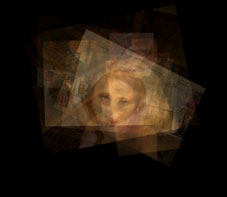
obJet?s material consists entirely of low-resolution free porn pictures. This porn ?objet trouve? was downloaded via the Internet by following dozens of spam emails that offered free pictures. Shortly after the collection of the material the account was terminated since due to the large amount of spam it was no longer manageable! The video proceeds formally by dramatically slowing down the frenetic rhythm of on screen intercourse encountered in porn movies through the use of a simple kind of animation: multiple layers of still images in soft pendulum motion. The animation generates a perpetual emergence of dislocated body parts and figures which surface in the midst of a binding, ondulating confusion only to be swallowed by the next wave of images. The superposition of images conceals as much as it reveals. Only the emerging slices of faces and bodies suggest a, multilayered reality invisible to the naked eye.
Video artist trapped inside the body of a musician. Working on static overlays of digital trash and other digital found material (through internet or broadcasts) combined with live sound or silence. Also active in the experimental music field as a cellist and video artist.

Javiera Veliz, -
Vivir allì no es el infierno, es el fuego del desierto. La plenitud de la vida que quedó ahí como un árbol
Documentary | hdv | color | 58:34 | Chile | 2018
Le vent, les oiseaux, la sueur, les mains, un chariot, la sécheresse et le sable. Sera t-il possible de disparaître dans le désert? Totoral est un village qui disparaît dans ses propres collines. Un lieu enraciné à la terre, à ses animaux et à la survie. Le désert change en permanence. Les arbres sèchent et les hommes, en compagnie de ses animaux, effacent leur traces ainsi que le passage du temps.
Javiera was born in 1986 in Copiapo, Chile, Where she stu- died visual arts and cinema. In 2009 she founded Pocilga Productions with Bárbara Pestan. In 2013 she studied in EICTV, Cuba. In 2015 she studied a Master’s in Direction of Photography at Escac, Spain. She`d realized several works as producer and DOP. “Living there...” her`s first film as director has it ?s interna- tional premiere in Cinema du réel where she won Tenk`s Prize. Actually she`s producing “To see is an act“ and realizing her second film “Marine water”.
Vangjush Vellahu
Land X
Experimental video | 4k | color | 23:41 | Albania, Somalia | 2022
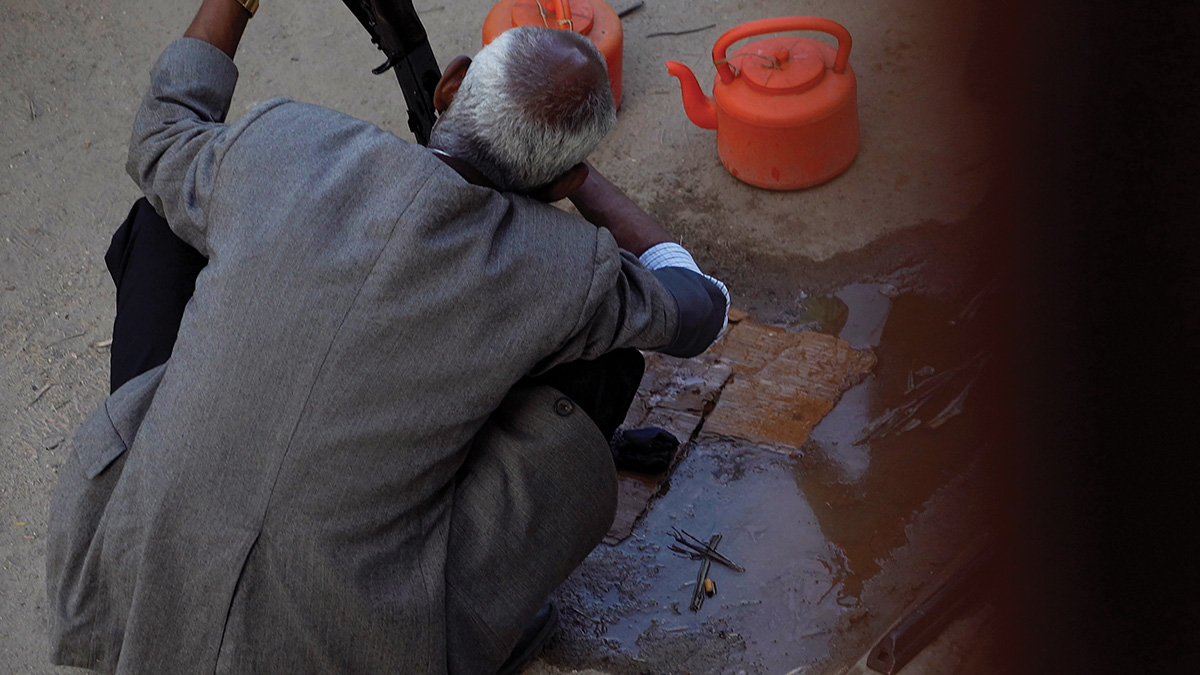
This video was filmed in February 2022 from one of the rooms at Oriental Hotel in the city center of Hargeisa, interfering in a way in between the two opposing positions to a place that it is being referred to as fictional and real at the same time. -Position One: I was never here and therefore I never filmed this video, these images don't exist because this place doesn't, the hotel, the buildings around, the people and that military entity. The filming took place entirely somewhere else. -Position Two: I certainly was here and therefore I certainly filmed this video, these images do exist because this place does, the hotel, the buildings around, the people and that military entity. The filming took place entirely in Somaliland. Both of this positions emphasize two points of political actions, one being exterior and the other interior.
Vangjush Vellahu born in 1987 in Pogradec, Albania, lives and works between Berlin and Tirana.

Vangjush Vellahu
A Tool of Resistance
Video | hdv | color | 29:55 | Albania, Germany | 2020
This two channel video installation is an introduction to what is happening in the West Bank, between Palestinians and the Israeli army. This video installation is designed to narrate the everyday reality of the Palestinians at large through the micro example of the city of Hebron and its resistance to the Israeli army. In order to be able to develop this narrative, the artist traveled to the region, where he came into contact with Human Rights Defenders, a local group who makes use of the camera and video footage as a tool of peaceful resistance. This video installation contains mostly footage filmed by the artist but includes also other archival materials, allowing this way an insight into the Palestinian history and reality. The work explores the role and nature of the camera and video especially in situations of conflicts and oppressions. This work is part of the ongoing series called "Fragments" that he has made, since 2015, in different territories affected by long years of frozen conflicts.
Vangjush Vellahu was born in 1987 in Pogradec, Albania and currently lives and works between Tirana and Berlin. In his work he is interested in travel as a medium to collect and tell stories. His works intertwine urban histories of entities that from an ideological and political stand point remain on the margins of recognition. In 2018 he published his first travelogue “Fragments I - Where stories cut across the land” that came along with his video solo show with the same title. His works have been exhibited, among others at: Times Art Center, Berlin, DE; Museu d´Història de Catalunya, Barcelona, ES; Museum of Modern and Contemporary Art, Rijeka, HR; Škuc Gallery, Ljubljana, SI; Hamburger Bahnhof, Berlin, DE; State Museum of Contemporary Art, Thessaloniki, GR; Museum of Contemporary Art, Acri, IT; National Gallery of Arts, Tirana, AL; National Historical Museum, Tirana, AL; National Gallery, Prague, CZ; etc.

Dimitri Venkov
Krisis
Experimental doc. | 4k | color | 32:26 | Russia | 2016
The video Krisis is a reenactment of a facebook discussion among Russian and Ukrainian artists, which took place in December 2013 upon the tear-down of the statue of Lenin in Kiev during the early stages of the Maidan protests. The discussion unfolds at a pivoting point in modern history. In fact, it occurs at the very moment when History bursts into the scene as a force surpassing individual actors and dragging them into its course in an indefinite capacity somewhere between that of a witness and participant. Krisis should also be understood here as trial or judgment, where twelve jurors debate the meaning of the historical event but fail to pass a verdict. Just as with Pilate’s judgment of Jesus, the decision is not reached and the trial takes on “a continuous and implacable course, an incessant passing and progress through time.” The historical crisis is bound to last like trauma in psychoanalysis: separated from its original context, it reappears in pathological forms in every sphere and at every moment. Structurally and thematically it is a remake of the Sidney Lumet film “Twelve Angry Men.” This classic is an idealized image of the American democracy based on inclusiveness. In the film Krisis the situation is reversed: although the characters belong to the same circle or community, their positions are irreconcilable and mutually exclusive thus making a compromise impossible. There is no way out of this argument but to split apart. The film Krisis plays out a metaphor of a society divided by history, politics, and aesthetics. New challenges further polarize it and augment its internal contradictions revealing a crisis as a state of imminent threat that the society presents for itself.
Dimitri Venkov (born 1980) is a video artist and filmmaker working across art, film, and academic institutional contexts. His works have been presented at Vth Moscow Biennale, First Bergen Assembly, Hayward Gallery, Kino der Kunst, Documenta 14,Oberhausen and Moscow Film Festivals, and others. In 2012 he received the Young Artist Kandinsky Prize for his film Mad Mimes. He was nominated for the Moscow Innovation Prize and St. Petersburg Kuryokhin Prize. Dimitri is a professor of videoart at Moscow Rodchenko School of Photography and Multimedia and has lectured at Yale University, Moscow State University, Moscow Art and Multimedia Museum.

Devis Venturelli
Unframed
Video | hdv | color | 4:22 | Italy | 2018
In "Unframed", the city is object of observation from inside a nebula black, floating, cavernous, mysterious. As in the depths of a primordial cave, the urban overview is fragmented in a collage-city in form of video. The drone unveils the Milan urban fabric with its patterns, grains and densities: from historical city emerges a new contemporary skyline. "Unframed" investigates the possibility to create images with mobile and fluid outline, an aerial view, sinuous and oscillating, in an incessant fluctuation. "Unframed" documents the odeporic approach of the contemporary culture in which the perception is an idiomatic overview.
Born 1974 in Faenza, Italy. He lives and works in Milan, Italy. Multi-disciplinary artist and architect, in his practice he uses the languages of video, performance, sculpture and installation to document ephemeral architectures and temporary utopias. He has taken part in solo and group shows in institutions such as Lincoln Center for the Performing Arts, New York; Antology Film Archive, New York; PAC, Milan; Medialab-Prado, Madrid; Museo de Arte, Lima; Xinjiang Biennale; MACRO, Rome; Kulturhuset Museum, Stockholm; MMOMA - Moscow Museum of Modern Art, Moscow; Ace Gallery, Los Angeles; Angel Orensanz Foundation, New York; Istituto Italiano di Cultura, Amsterdam; Spazio Oberdan, Milan; Fondazione Sandretto Re Rebaudengo, Turin; Kunsthalle, Wien; Stadtgalerie, Kiel; Centre d'Art Santa Monica, Barcelona; Fondazione Merz, Turin; Kunstverein, Augsburg; National Museum, Wroclaw; Mart - Galleria Civica, Trento; Galleria Nazionale d'Arte Moderna, Rome. In 2013 he presented the film project Luciano Berio/Devis Venturelli/Tempo Reale. In My End is My Music produced by Fondazione Romaeuropa. His videos and experimental films have been screened in International Film Festivals including Dance on Camera Festival, Videoformes, 25FPS Experimental Film Festival, FIVA - Festival Internacional de Video Arte, Romaeuropa Festival, Tehran International Short Film Festival, Regensburg International Short Film Week, New Filmakers NY.

Borjana Ventzislavova
Gesellschaftsspiele
Video | hdv | color | 15:55 | Austria | 2021
Games are generally defined through agreements—rules, within the framework of which, a certain degree of freedom reigns, but also compelling constraints. Many of these conventions are not explicitly identified as such, for example, how earnest one should be, or how much inner distance to keep. And a game does not at all define the more precise (individual, social, etc.) characteristics that participants should display in order to be among the players. For that reason, it is incredibly perplexing to see the adults in Borjana Ventzislavova’s Gesellschaftsspiele / Real Games in relations of play that we generally dismiss as puerile. In clever montages with players who appear deliberately misplaced or “miscast,” the film expands five of these contexts; or rather, interlocks them in such a way that we are rendered witnesses to an uncanny alienation. The nursery rhymes recited with a wink of the eye at the start are merely gentle harbingers of the dead serious shooting game with blowpipe arrows played by a group of sophisticated ladies and gentlemen in the concrete column foundation of a massive building shell. No less ambiguous is the cops and robber game that adult, suit-wearing players engage in around a monumental memorial in Sofia. And another game that’s not so bad is the acrobatic Chinese jump rope enjoyed by three smartly dressed women in a closed school yard. Entirely enigmatic, on the contrary, is a group wearing only underwear who pursue an odd ritual around a quartz lamp sculpture in the film’s sole interior space—until it turns out that what they’re doing is nothing other (or perhaps entirely different) than a simple Ring-Around-The-Rosey. The film’s transfiguration and simultaneous unmasking, has a double effect: on the one hand, as recognition that even the most casual activities are controlled by some type of role playing; and on the other—which is perhaps even more sobering—that their symbolic contexts withstand even the cleverest infiltrations. Whereby freedom and compulsion can even boil down to one and the same thing at times. And that is, no least, what the “real” aims at; uncatchable, as it were, these revealing and at the same time enigmatic games. (Christian Höller)
Born 1976, Sofia, BG, currently based in Vienna and Sofia; graduated visual media art / digital art at the University for applied arts Vienna. She works in the fields of film/ video, photography, installation and new media. Her works have been exhibited internationally in solo and group shows as well at film and media art festivals.
Mario Verandi
Klang-Film
Experimental doc. | dv | black and white | 12:12 | Argentina, Germany | 2005
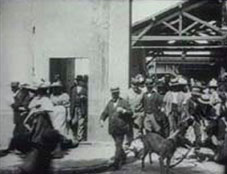
"La Sortie des Usines Lumière à Lyon" (1895), was the title of the first cinema film ever shown in public. For 45 seconds, this film depicts workers leaving a photographic factory owned by the brothers Lumière in Lyon. In his film "Arbeiter verlassen die Fabrik", Harun Farocki explores this scene right through the history of film. For the creation of "Klang-Film", Farocki's film was re-edited into a shorter version. Most of the spoken texts were edited out, so that only a few were left. Therefore the film essentially became a silent movie. This allowed the incorporation of music as a new and influential shaping element which opens up a new dimension for the perception of the images. "Klang-Film" explores the sensory counterpoint of sounds and images and their interaction, ambiguity, and friction. How does certain music shape the perception of images? How do images shape the perception of certain music? In his book "Audio-Vision: Sound on Screen", Michel Chion suggests that sound and image are always independent, it is simply our conditioning and use of conventions of synchronization that make us believe that they are not. The French filmmaker Robert Bresson provides us with an illuminating metaphor: "Images and sounds, like strangers who make acquaintance on a journey and afterwards cannot separate".
Mario Verandi was born in Buenos Aires in 1960. He studied music in Argentina, Barcelona, and at the University of Birmingham, England. Verandi's works include electro-acoustic music and audiovisual pieces as well as sound installations and radiophonic works. He was composer-in-residence at La Muse en Circuit (Paris), the Césaré Studio (Reims), TU-studios Berlin, ZKM (Karlsruhe) and a guest of the 2000 Berlin artists-in-residence program. Verandi's awards include the Bourges Electroacoustic Music Competition (France), Musica Nova Competition (Prague), CIEJ Electronic Music Awards (Barcelona), Prix Ars Electronica (Linz), Stockholm Electronic Art Awards (Sweden), and ZKM European Bell Days Commission Prize (Germany). His works have been performed and broadcast worldwide. Harun Farocki was born in 1944 in in Nová Jicin (Neutitschein), in German-annexed Czechoslovakia. He attended the Deutsche Film- und Fernsehakademie Berlin (DFFB) from 1966-68. After having held teaching posts in Berlin, Düsseldorf, Hamburg, Manila, Munich, and Stuttgart, Farocki took up a visiting professorship at the University of California, Berkeley, from 1993-1999. Farocki has made close to 90 films, including three feature films, essay films and documentaries.

Bas Verbruggen
Environs
Experimental film | 4k | color | 17:45 | Belgium | 2020
In a deserted landscape where animals are affected by a distant rumble, a character emerges. Sinking deeper into the auditive world, sounds start to vibrate, time slowly loses its function and a storm rises. The character listens carefully as a dark tower seems to absorb his sonorous memories.
Bas Verbruggen (1997, Antwerp) started studying film at the KASK school of arts in Ghent, where he completed his master's degree in september 2020 with the film Environs. He is fascinated by absurd shapes in the everyday (Belgian) landscape, focuses on the experience of sound in cinema and usually makes his films individually and always from an audiovisual investigative point of view.

Matthieu Verdeil, Dominique POUPARDIN, Jérémie VAN QUYNH
Dans l’armure d’Abraham
Experimental film | mov | color | 60:0 | France | 2020
Dressed in heavy medieval armour, Abraham crosses Brittany on foot, like a 21st century Don Quixote. Travelling through fields and forests, towns and villages, this anachronistic and wacky knight is astonishing to those who cross his path. He is accompanied on his journey by the director, his Sancho Panza, in front and behind the camera. Together, they wander around, accepting the food and lodging offered to them, or bivouacking under the stars. Little by little, Abraham loses his footing. His armour becomes his Dulcinea. Absorbed by his work, the artist finally disappears behind the character he has created. Only a knight errant on a foolish quest remains.
Since 1997, Matthieu Verdeil has been working with numerous production companies for television, communication, institutions and the web. Mainly as a cinematographer, but also in directing and editing. His experience is very varied with all types of services, from very big live events to the report alone in unknown lands, through TV magazines, documentaries... He has made commissioned films for the MuCEM, the Friche Belle de Mai, the National Center for Plastic Arts, KLAP-maison pour la danse, the Palais de Tokyo, the CIRVA international research center on glass and plastic arts...
Matthew Verdon
Hugelkultur
Video | hdv | color and b&w | 9:30 | Australia, United Kingdom | 2013
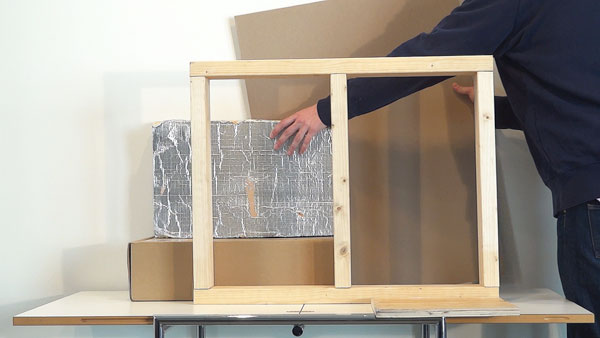
In 1963 a spiral staircase was built in Salvador, Brazil, by the architect Lina Bo Bardi as part of the transformation of an old mill into a museum of modern art. The design of this staircase was based on a vernacular technique for making ox cart wheels. The agricultural practice of hugelkultur involves burying large pieces of old wood that rot over time and subsequently become rich fertiliser, providing enhanced growing conditions for the roots of new plantings. A spoken narrative describes the proposed renovation of an old room in need of repair into a new room of unspecified end uses. Such varying but related notions of material transformation and adaptive re-use are featured in the present work as ways of thinking about how the ?new? is produced and the relationship of such production to the already existent. Featuring filmed, found and hand drawn footage, the video is based upon the idea of a spiral staircase, this being utilised for not only its content but also its form through the structural use of evolving repetitions and loops. The work draws on plant science, architecture and speculation to arrive at a questioning of function, progress and growth.
Born: Brisbane, Australia Lives & Works: London, United Kingdom