Catalogue > Search
Results for : Tout le catalogue

Su-mei Tse
Pays de neige
Video | hdv | color | 7:40 | Luxembourg, Italy | 2015
Pays de neige (Snow Country), 2015 A walk to clear your mind as a moment of suspension, the undefined space similar to that of a respiration before every beginning. As time during which the canvas is prepared before applying paint, or the time in which the blank sheet waits for writing, or when a thought is about to be put into language. In this video Su-Mei Tse’s sweeping emphasizes the magic moment in which we are preparing to act, to be carried away by our desires, to walk into the snow ...

Su-mei Tse
Vertigen de la Vida (Dizziness of Life)
Video | hdv | color | 9:21 | Luxembourg | 2011

Yu-chin Tseng
No Land to Live
Video | hdv | color | 26:35 | Taiwan | 2015
No land to live In the production process of this piece of work. I feel the transition of political atmosphere in Taiwan. The atmosphere of distrust spread around the society. In this work, all of these are just like after leaving an anxious scene. Maybe a insurrection, a late night party, an end of a sex, or on the way return after a rebellion protest. Don’t want to return, the so-called home, the place to live. No one will wait there, or it doesn’t matter anymore. Thinking of where can self exist. And the body rather stay at the interim middle, somewhere no where. I shoot 56 street scene in midnight Taipei. Those bodies have no intent to return to the place they live. Maybe they feel too strong about the place they just left, and the feeling can’t be soothed. They need a place in the middle, just stay there, exist there. Let self feel the existence of self. To recover the senses of the body. And this status becomes a kind of ceremony. The ceremony of trying to cover or stop what just happened. The fluttering insects are the summon of ghost. It’s a foretell of the past and those unhappened. Entrenching the body, waiting for the evidence left, becoming the existence.
TSENG YU-CHIN Born in 1978
Documenta 12 Germany Kassel
Lectorate at the Shih Chien University Communication Design
Lectorate at the Taipei National University of the Arts
CCAA Best Young Artist of Chinese Contemporary Art Awards 2008
Paris La Cité internationale des Arts International Artist Residency Program
New York Location One International Artist Residency Program
honour
2003 Shih Chien University Communication Design Graduate with honor
2007 Technical Art at Taipei National University of the Arts outstanding alumni
2013 Shih Chien University Communication Design outstanding alumni
Overseas Exhibition
2004 MOMA CONTEMPORARY The New Identity Part-5 Tracing Self
2005 The 10th Hong Kong Independent Short Film and Video Awards ( ifva Asian New Force)
2005 First

Yu-chin Tseng
Shivering wall
Video | hdv | color | 10:0 | Taiwan | 2012

Yu-chin Tseng
Breath hard : meneat
Experimental video | dv | color | 6:0 | Taiwan | 2006
I get up in the morning. I dreamt of my grandmother last night. She was sighing; she lied down next to me. I receive a phone-call. Grandmother passed away. She was very important to me. These days, I keep on remembering when I used to run into grandmother's kitchen when I was a child. Grandmother always spoke in the Hakka tongue, and would ask me sweetly where I was coming from at that moment or whether I wanted something to eat. The Kitchen and the steam evaporate. Grandmother's hair is white. I grab the New Year's cake on the table and look stupidly at my grandmother. I miss my grandmother so much. My childhood was certainly not very joyful, but most of the joys I had came from my grandmother. These days, I want to cry when I ride my motorcycle. I feel like I am choking.
Born in 1978, Tseng Yu-Chin is currently studying at the Graduate School of Technical Art at Taipei National University of the Arts. From 1999 to 2002 he participated in In-Between Visual Art Design. In 2001 he was member of the Tai-tung Theater Group Visual Art Design and the AFA International Ltd. Visual Art. In 2003, he worked for the Tai-shun Performance Group Visual Art Design, and the National Symphony Orchestra Opera "Faust" Documentary Film Post Production. Tseng YU-CHIN spends a lot of time writing. In 2000 his poems "Something Trivial" and "My Illness" are published in In-Between vol. 2, and his novel "Age 20 and 40" in In-Between vol. 3. "Don?t Worship Things That Dangle" can be found in DPI Magazine vol. 55, 2003. Moreover, he worked in the Tai-tung Theater Group "Our Snake" as a Visual Art Inspector. Recording/Installation performed at Chung-cheng No. 2 Stage Fang Feng Art Festival 2003 and Tai-shun Performance Group "Audience" Visual Art Design at the International Art Village. Yu-Chin has received the following awards: for "Our Snake" a Golden Harvest Awards 2001, and for "Projection and Reflection During That Time", at Golden Horse Film Festival in 2002. In 2004, his work "Projection and Reflection During That Time" was chosen for the Spring Film Festival. "I?m Leaving" was played for the 10th Hong Kong Independent Short Film and Video Awards 2005 (ifva Asian New Force). He has vast experience in exhibitions. His main works; "Projection and Reflection During that Time", "Who's listening?", "What had been done?", and "I despise presumptions. But if I could at the very beginning, perhaps I could save a few", have been shown at many festivals, including Poor film festival, Golden Horse film festival, Spring film Festival, "Noisy" Art Festival; and internet exhibitions, Non Sign Internet Art, The Whimsical and the Fantastic, and an on-line exhibition of Taiwan's Media Artists. In 2005, he presented his work in the 3rd Fukuoka Asian Art Triennale, and in 2006, Yu-Chin created the "oxy_ Tseng Yu ching solo exhibition", for which he received the Taishin art award.

Yu-chin Tseng
Despise presumptions. But if I could at the very b
Experimental video | dv | color | 6:0 | Taiwan | 2005
"I despise presumptions. But if I could at the very beginning, perhaps I could save a few". I am losing language, especially the vocal part. It used to function with rare shocking but lately it is replaced by random vomit and phlegm. Those who used to speak with me gradually disappeared. I am seeing myself living like this inside of my body. Don't even have energy to be loud. When I am talking to others, my throat hurts and I cannot catch up with my breath. My body and my mouth feel dried-out. I feel my two fake front teeth about to break. I want to say something, but I keep on hurting in my chest. Creation no longer is an enjoyment. Originally, it was to cure my pathetic self-indulgence. But now not anymore. I cannot speak about anything. I used to be crazy about images but now I deny it, not being understood. I do not even understand myself. I realized I would become psychotic and sickening. Especially when emotions run high. My shaking hands make me fearful and I have to pinch them, try to stiffen my muscles until they are on the edge of splitting. Yes I admit. I am wishing for pure emotions. But even with a simple swallowing, I am afraid it will hurt. Things repeat themselves, especially at night. Breathing sounds coming next to me. I watched her shoulder moving up and down. It all seemed the same. I do not care who it is, is that not it? I see it as I am sick. I sigh again. It is an old habit, I like to sigh. Was that me? Was that myself? Or someone's back? At least the smell of people becomes rare. I hate presumptions, really. About every aspect. Actually, I force myself. What is there to be regretted? Yes, it is another equal sign. Presumption and regret to me are equal, absolute. Because I force myself. There is no use for this word "regret". Nonetheless, it is no use. He cannot change anything in the body. Cannot turn, cannot clean Or is it the so called "wisdom"? The presuming tone always being shown as know-it-all. I do not know, but at last I cannot presume. I would not allow myself. But that evening, that person's back, a few smells. The body warmth flew over. I feel pain. My skin stuck with the organs and it was painful. Difficult to breathe smoothly. Really. If I really could, if I closed my eyes at the beginning. Like a game of trust Let it guide me. Let air, let body warmth, let sounds feel. Beginning, the so-called beginning is when things are in their most tortuous state. When I am still clean, when the body is still pure white. Really. If I really could. Perhaps, maybe I can save something. I cannot speak, because I lost the language. Water, sunshine. I would no longer feel the organ's pain. My body is white, no more spots. No longer going toward emotions' directions with stains. Now even these smallest things no longer are. I regret. I force myself. What is there regret? I hate presumptions. That evening, that person's back. A few snoring sounds. I see a white wall that appears to be grey due to darkness. Suddenly I see myself in a moving bus. I am sleeping with my eyes closed. Sounds pass through. Sun passes through. Air passes through. Suddenly, I think of some old man, on a bus, touching my hips over my uniform. And some elementary school girl sitting in front of me, making an arousing pose. Her uniform and skirt slightly lift up. Looks at me and smiles. I cannot sleep. My brain starts to function again. I cannot speak. Who can I talk to? Not about those. But deeper, more personal, more sobbing. Until morning. The breathing sound next to me still exists. And I am sitting on a bus with my eyes closed but he is looking at me with eyes closed. What is that. I do not know. I cannot tell.
Born in 1978, Tsent Yu-Chin graduated from Shih Chien University with Communication Design Major in 2002. He is currently studying at the Graduate School of Technical Art at Taipei National University of the Arts.
His work experience includes:
1999-2002, In-Between Visual Art Design; 2001, Tai-tung Theater Group Visual Art Design; 2001, AFA International Ltd. Visual Art;
2003, Tai-shun Performance Group Visual Art Design; 2003, Eslite Books 116 Anniversary Commercial Post Production; 2003, National Symphony Orchestra Opera "Faust" Documentary Film Post Production
Literary Works; 2000, Poetry "Something Trivial" and "My Illness" published in In-Between vol. 2; 2001, Novel "Age 20 and 40" published in In-Between vol. 3; 2003, "Don?t Worship Things That Dangle" published in DPI Magazine vol. 55
Stage Design; 2001, Tai-tung Theater Group "Our Snake"
Visual Art Inspector Recording Installation performed at
Chung-cheng No. 2 Stage Fang Feng Art Festival; 2003, Tai-shun Performance Group "Audience"
Visual Art Design at International Art Village.
His awards include:
2001, "Worms" and "Hole", Print Design Taipei Intl Design Exhibition The Young Designs Exhibition 2001; "Our Snake", The Golden Harvest Awards; 2002, "Projection and Reflection During That Time" Golden Horse Film Festival; 2004, "Projection and Reflection During That Time" Spring Film Festival; 2004, "Who's listening?", 2004 Taipei Art Award; 2005, "I'm Leaving", The 10th Hong Kong Independent Short Film and Video Awards
His many exhibitions include:
2001, "Age 20 and 40", Poor Film Festival; 2002, "Projection and Reflection During that Time", Taiwan Avant-Garde Documenta, Poor Film Festival, and Golden Horse Film Festival; "Who's listening?" RANDOM-IZE Film & Video Festival; 2004, "?Projection and Reflection During That Time" Spring Film Festival; "Who`s listening?" Taipei Art Award; "I'm Leaving" stock20 Film Festival; "I despise presumptions. But if I could at the very beginning, perhaps I could save a few" Taiwan Avant-garde Documenta II; 2005, "I?m Leaving" The 10th Hong Kong Independent Short Film and Video Awards; "What had been done?" Con-temporary Citizens; "In All That Happened" Telepathy Technical Art; "Breath Hard" First

Yu-chin Tseng
Fever Dark
Video | dv | color and b&w | 21:0 | Taiwan | 2009
I hate New York! From the day I?ve stepped into the city, I?ve been feeling this way. It has never left my mind, and never denied, except for a few minor surprises or some little goodness. Eating brownies, or the dazzling lights of the Broadway, reduced my dislike of New York. It?s like when I repeatedly write ?I HATE NEW YORK? on the blackboard, at the same time erasing it with a duster, but yet, traces of the words remain, as though I haven?t had any intention to rub it off more forcefully and deliberately. This is a very uninteresting game, where you cannot hide too far in, you cannot hide yourself completely, or camouflage yourself as any item in the darkness under the bed hoping that you won?t be found, whilst listening to the noises outside, you feel safe as you hide. All because, you want to be found, and this is no longer innocent child?s play. You can recklessly hide, because of anger or simply because you wish to hide away with a friend, just the two of you. You can no longer do that! You must be found, and you must show yourself, and face the music! This indeed, is no longer child?s play. Ever since I came to New York, I?ve unconsciously begun to force myself to get along with myself, and even though I?m pretty used to getting along with myself. From the time back in my home country, the solitary me, has been forced to go out and face plenty of things, and this had been repeating itself. And eventually, I took a 15-hour flight and arrived in New York, and I?m left with only myself. It is really a test of inner strength, when you?re all alone, and the only thing you can rely on is the lingering scent of your home country that?s left in your suitcases. All I want to do is to curl up and sleep while embracing the scent, and even more often, I stay indoors, inside this so-called temporary apartment of mine. I confess about my initial insecurity. Amidst the noise that goes on every hour of the day, there is hardly any serenity, and any freedom to ponder. One thinks he can travel to many places, but the truth is, you can?t. The so-called travelling, is merely a physical shift of territory, and subsequently imprisoning oneself again. Forgive my use of vocabulary ? imprisoning. I?m imprisoned. By myself, by words and speech, by this conformity of a life that isn?t mine, by the responsibilities and obligations which I need to bear. I am imprisoned. I?m so perturbed in the winter of New York, that I can?t even be sure of the magnitude of the effects that this major illness that I?m going through is bringing me. I only recall the many feverish nights, dry-coughing, which kept me awake. I groaned with a slight growl, but still I can feel the trembles from the subway beneath my apartment. And I saw a kid, facing me, all curled up, and watching me restlessly, or at least I think he?s watching me! Perhaps?? his gaze isn?t at all on me. He may be simply staring straight, as though a beast is approaching. Or like stealing glances curiously, or perhaps not. I am unable to interpret his feeling. The complexity is preventing him from focusing. It?s a thought of speaking up, but he can?t, except for the urge to speak up, displayed through the shivering of his lips.
TSENG YU-CHIN Born in 1978 2002 Graduated from Shih Chien University Communication Design 2006 Graduate School of Technical Art at Taipei National University of the Arts. 2007 aching in Shih Chien University 2007 Documenta 12 Germany Kassel 2008 New York Location One International Artist Residency Program 2008-2009 Lectorate at the Shih Chien University Communication Design 2008 CCAA Best Young Artist of Chinese Contemporary Art Awards 2008 2009 Paris La Cité internationale des Arts International Artist Residency Program 2009-2010 Lectorate at the Shih Chien University Communication Design honour 2003 Shih Chien University Communication Design Graduate with honor 2007 Technical Art at Taipei National University of the Arts outstanding alumni Awards 2001 ?Worms? Print Design Taipei Int`l Design Exhibition The Young Designs` Exhibition 2001 2001 ?Hole? Multimedia Taipei Int`l Design Exhibition The Young Designs` Exhibition 2001 2001 ??Our Sanke??The Golden Harvest Awarde 2002 ?Projection and Reflection During That Time?Golden Horse Film Festival 2004 ?Projection and Reflection During That Time?Sprin Film Festival 2004 ?Who`s listening ?? 2004 Taipei Art Award Prizewinnimg 2005 ?I?m Leaving? The 10th Hong Kong Independent Short Film and Video Awards ( ifva Asian New Force) 2005 ? I despise presumptions? S-AN Cultural Foundation Prizewinnimg 2006 ?oxy_ Tseng Yu ching solo exhibition ? Taishin art award Final nominate 2006 "Un_let out the part" Taipei Digital Art Festival Prizewinnimg 2007 Yageo Tech-Art Award Prizewinnimg 2007 ?Acid Tongue Tseng Yu ching solo exhibition ? Taishin art award nominate 2008 CCAA Best Young Artist of Chinese Contemporary Art Awards 2008

Yu-chin Tseng
In fact, I've known all along
Experimental video | 35mm | color | 10:30 | Taiwan | 2005
In fact, I?ve known all along. Don?t deny me again. Although I can take more than a blow, I don?t enjoy masquerading. In fact I need to display a look of purity, to let you believe, that everything is fine. And then you will be assured that life is perfect. And then I must know where I stand, and be told bluntly what lies in the future for me. You will always believe that I will display the innocent look, and then smile blankly. This is how I will convince you. However, you did not notice what I?m lightly drawing on the floor with a finger of mine. It appears to bear the shape of a teardrop but yet will imaginatively evaporate in the light after which I will put up a faint smile, and enter my world of imagination. Everyone grows up, who wouldn?t? But have we really? When one loses his cool, it gets most noticeable as he ages. And I only hope to try hard and see a warm sunny afternoon, while you?re still great in my heart. Left in my memories, at least, when I recall them, you are still great, very, very great. However, I always remember, that I?m always denied, in the prettiest of situations. What have I done in the past? When I was indulging in senseless pleasure, or when I was just about to enter another phase. Yet suddenly, a shadow would always appear before me, blocking me. I can?t help but notice that my shadow had disappeared. In fact, I knew all along, what would happen in the future, although I couldn?t accurately put a finger to it. But believe me, I roughly know, and am able to gauge, which kind of route I will proceed along. This should not be about growing up in threats, really. Because, I would never succumb to threats, and hence get a better life. Everyone has had their difficult moments, and had endured hardships, and then they?ll be asked, whatever for? A laid back way of life is a forbidden thought, as threats will surface at anytime. Then, on whichever day, probably, just one day, I need not force myself to put up the innocent smiley face. To persuade everyone that I am fine, and I can be denied, and subsequently, I am still determined to grow up. And that would also be the day I hear the most sympathies? Fake sighs, as though they?re trying to retrieve or make amends to those denials and threats, and yet those people still continue to live marvelous lives. And then depart. The sun is great. The next person to be paralyzed here, drawing the floor with his finger, will subsequently appear. Anyway There is no great person Who would happily share his piece of candy, with another person?
TSENG YU-CHIN Born in 1978
2002 Graduated from Shih Chien University Communication Design
2006 Graduate School of Technical Art at Taipei National University of the Arts.
Solo Exhibition
2005

Yu-chin Tseng
Un_let out the part
Experimental video | dv | color | 4:0 | Taiwan | 2005
I'm not so bad. I don't want to strongly to shock others by saying "Do you know..." I dragged in a huge silence, I am wet, I close myself tightly, my past, and my nose waters and tears flow. I am losing my body, and I am gone. I hate shock, and want to knock out my throat, which is choked with sobs. Then cut everything with knife. Watch a kind of complete and great thin waste lose. I grab a paper and sway it slowly. It is the process where the matter occurs, on the paper. Swing and swing it, then put it down. A black, dense, and numerous paper picked up again, sway and sway. That happened, that?s all. Heard the sound of the paper shocked. It's like reading some words but forgetting the shape of those words because of the swinging and swaying. Scrappy, some night, scrappy and dense, like something happened. I do not necessarily have to say it all, because I'm not so bad.
Born in 1978, Tsent Yu-Chin graduated from Shih Chien University with Communication Design Major in 2002. He is currently studying at the Graduate School of Technical Art at Taipei National University of the Arts.
His work experience includes:
1999-2002, In-Between Visual Art Design; 2001, Tai-tung Theater Group Visual Art Design; 2001, AFA International Ltd. Visual Art;
2003, Tai-shun Performance Group Visual Art Design; 2003, Eslite Books 116 Anniversary Commercial Post Production; 2003, National Symphony Orchestra Opera "Faust" Documentary Film Post Production
Literary Works; 2000, Poetry "Something Trivial" and "My Illness" published in In-Between vol. 2; 2001, Novel "Age 20 and 40" published in In-Between vol. 3; 2003, "Don?t Worship Things That Dangle" published in DPI Magazine vol. 55
Stage Design; 2001, Tai-tung Theater Group "Our Snake"
Visual Art Inspector Recording Installation performed at
Chung-cheng No. 2 Stage Fang Feng Art Festival; 2003, Tai-shun Performance Group "Audience"
Visual Art Design at International Art Village.
His awards include:
2001, "Worms" and "Hole", Print Design Taipei Intl Design Exhibition The Young Designs Exhibition 2001; "Our Snake", The Golden Harvest Awards; 2002, "Projection and Reflection During That Time" Golden Horse Film Festival; 2004, "Projection and Reflection During That Time" Spring Film Festival; 2004, "Who's listening?", 2004 Taipei Art Award; 2005, "I'm Leaving", The 10th Hong Kong Independent Short Film and Video Awards
His many exhibitions include:
2001, "Age 20 and 40", Poor Film Festival; 2002, "Projection and Reflection During that Time", Taiwan Avant-Garde Documenta, Poor Film Festival, and Golden Horse Film Festival; "Who's listening?" RANDOM-IZE Film & Video Festival; 2004, "?Projection and Reflection During That Time" Spring Film Festival; "Who`s listening?" Taipei Art Award; "I'm Leaving" stock20 Film Festival; "I despise presumptions. But if I could at the very beginning, perhaps I could save a few" Taiwan Avant-garde Documenta II; 2005, "I?m Leaving" The 10th Hong Kong Independent Short Film and Video Awards; "What had been done?" Con-temporary Citizens; "In All That Happened" Telepathy Technical Art; "Breath Hard" First

Stefanos Tsivopoulos
Amnesialand
Video | 16mm | color and b&w | 24:0 | Greece, Netherlands | 2010
Deep in the future the massive Event that by definition cannot be remembered separates the Revolution from its history. A man, historical agent of the future socialist authority, believes he has found evidence of the Event`s origins in 20th century The Union. The post-industrial wasteland The Union previewed Earth`s future before it happened. So too, the Man believes, it previewed, and glimpsed the Event, and proved its true nature. The event was Metallic. Amnesialand is the whole world. Our inability to remember the past mirrors their inability to see their future.
Stefanos Tsivopoulos (b. 1973) lives and works in Amsterdam. He participated in international art residencies such as the Rijksakademie van beeldende kunsten Amsterdam, Netherlands; Platform Garanti Istanbul, Turkey; IASPIS Stockholm, Sweden; and ISCP NY, USA. Recent solo shows include The Blind Image, ISCP NY, USA; Amnesialand, Heidelberg Kunstverrein, Germany; The Real The Story The Storyteller Smart Project Space Amsterdam, Netherlands; Lost Monument, Art Forum Berlin, Germany. Group shows include The Rest is History, Manifesta 8 Murcia, Spain; On Morality-Act III, Witte de With, Rotterdam, the Nethrlands; One Giant Leap, BFI Southbank London, UK; Practicing Memory, Fondazione Pistoletto, Biella, Italy; And the moral of the story is... APEXART New York, USA; Hors Pistes-Un Autre Mouvement des Images, Centre Pompidou Paris, France; Monitoring, Friedericianum Kunstverein Kassel, Germany; Destroy Athens, 1st Athens Biennale, Athens, Greece, In Present Tense, Museum of Contemporary Art, Athens. He is recipient of the Golden Cube Award at the 25th edition of the Kasseller Documentary Film Festival in Kassel Germany for his film Untitled (The Remake). He was shortlisted for the 4th edition of the DESTE Prize for Contemporary Art, Athens Greece and the 7th edition of the "Future of Europe" Award.

Stefanos Tsivopoulos
Object Reconnaissance
Experimental film | 4k | color and b&w | 29:43 | Greece, Netherlands | 2024
"Object Reconnaissance" is a work of fiction that depicts actual artifacts, historical archives, and museum collections from the Netherlands. The story is set in the 1960s and references events such as the Indonesian mass killings, the Free Papua Movement, and stories of forced displacement. The narrative follows the fictional character Ratna "Merah Muda" Bakti, an Indonesian activist associated with the Gerwani movement who fled to the Netherlands in 1965 during the political crisis. In the present day, her granddaughter, Ria Bloem, seeks to uncover Merah's past by exploring letters, family albums, and Super 8 films. During her investigation, Ria discovers photos of a significant ceremonial object, a seashell, which has gone missing. Intrigued, she sets out to find the shell, leading her to uncover family secrets that shed light on Dutch colonial history.
Stefanos Tsivopoulos is an interdisciplinary visual artist, filmmaker, writer, and educator who divides his time between Amsterdam, New York, and Athens. Known for his research-based work on archives and the unique visual style of his films, which blend found footage with cinematic sequences, Tsivopoulos is motivated by a pressing need to delve into the anthropological aspects of contemporary global crises. These include ecological, economic, political, social, and cultural issues. His body of work focuses on personal and collective histories, examining their influence on present-day socio-political discourses. Throughout his 15-year career, Tsivopoulos has written, directed, and produced over 30 short and medium-length films across different countries.

Kuang-yu Tsui
The shortcut to the systematic life: city spirits
Experimental video | dv | color | 4:50 | Taiwan | 2005
In this video work of 2005, "The Shortcut of Systematic Life ? City Spirit', Kuang-Yu sought out spaces in both London and Taipei that could be interpreted in two different ways, and that had ambiguous relationships with their environments. In these spaces he then interjected a specific action, using video to transform the entire scene into a temporary yet unreal segment of life. For example, on a thoroughfare with hectic traffic, he would wave a black-and-white checkered flag, as if urging the drivers to take part in a speed race. He would play golf in a certain green spot in the city. Or, on a small path stretching out in a park, I would roll a bowling ball at a flock of pigeons. On the surface, it is a little similar to rediscovering in a stereotypical environment a different level of urban space with which we are familiar, even though this invisible city can only appear for a few minutes or a few short seconds when the action takes place. Nevertheless, compared to "Superficial Circumstance," in which the artist transformed himself by adapting to his external environment, the mimicry that takes place in "City Spirit" transforms and expands the employed cultural symbol from clothing to a recognition of the similarity of environments. These selected environments genuinely possess a certain similarity with the predesignated scene which the artist imposes through his actions (such as imposing a golf course on the "turf" of a traffic island). This seemingly shared similarity appears to be a necessary symbol that determines the existence of a systemic relationship, but we also know that these similarities are not reliable. What the artist?s interjection of similarity underscores is in fact its limitation, and this limitation derives from the existence of institution. "In order to pursue the possibilities that lie within the crevices of the city... at any given time we place ourselves in the exotic moods that arise from the overlapping of fragmentary realities and everyday life." Perhaps we can view "City Spirit" as a form of environmental mimicry on a very large scale: In the name of art, in a series of casual pretences, all of our preconceptions are re-enacted. This self-awareness allows us to engage in these constant dead-end collisions and survive unscathed. Perhaps this is the true triumph of contemporary life.
Tsui, Kuang-Yu was born in 1974 in Taipei, Taiwan. EDUCATION 1997 Taipei National University of the Arts AWARDS 2003 "The Shortcut to the Systematic Life: Superficial Circumstance", Solo Exhibition by K. Y. Tsui in IT Park Gallery & Photo Studio, Taishin Arts Award "Jury?s Special Award" RESIDENCY PROGRAM 2004 Gasworks Studio, London, UK 2006 Rijksakademie van beeldende kunsten Stichting Trustfonds, Amsterdam, NL

Kuang-yu Tsui
18 copper guardians in Shoulin Temple &Penetration
Experimental video | dv | color | 6:43 | Taiwan | 2001
The artist tries to perceive reality through the performer?s body movements, who confronts with the objects. He repeatedly jumps over different objects such as a window, mailboxes, and even a cow, and then rebounds. This repetitive action reveals his strong desire to be empowered in the physical world. Shao-Lin is a well-known Chinese temple where the legacy of martial art, known as Gong Fu, was originated. These legacies have been depicted in Chinese fictions, soap operas, and films, which represent Gong Fu in an overstated way. The eighteen Copper Guardians are monks who have mastered Gong Fu, and are assigned to protect the temple. They can use their bodies in many magic ways. For instance, they can use their heads to break hard objects. Tsui?s use of this title reveals his inspiration from Chinese legacy and popular culture ,however rather satirical. This Gong Fu monk lives in an urban environment. Gong Fu for him is not a way to show the magic power of body, but rather is just a way of living. He explores how easily he can deal with the obstacles that are in his way in reality. Will the performer?s strong will itself be enough to provide a "shortcut" to penetrate the obstacles and bring him to his desired destination quickly"? The question is apparently ironic and absurd.
AWARDS 2003 "The Shortcut to the Systematic Life: Superficial Circumstance, Solo Exhibition by K. Y. Tsui in IT Park Gallery & Photo Studio", Taishin Arts Award "Jury?s Special Award" RESIDENCY PROGRAM 2004 Gasworks Studio, London, UK 2006 Rijksakademie van beeldende kunsten Stichting Trustfonds, Amsterdam, NL

Kuang-yu Tsui
The Wind from Taipei
Experimental fiction | hdv | color | 7:25 | Taiwan | 2020
Tsui’s works explore the adaptive relationship between humans and social systems, questioning the established structure through actions, and creates survival methods, and redefining reality through his behaviors and experiments. Tsui regards such behaviors as means to measure environmental tolerance, and attempts to highlight the absurdity behind certain social values within the system we are accustomed to. By transforming reality in this way, Tsui’s actions crossed various obstacles, and declares a guerrilla-style intervention, and uncovers invisible relationships in everyday environments.
Born in Taipei, in 1974. In 1997 he graduated from the National Institute of the Arts and has exhibited internationally since, including Venice Biennale, Liverpool Biennale, Werkleitz Biennial, Asian Art Museum San Francisco, ZKM Center, Contour Biennial, Chelsea Art Museum, Mori Museum, OK Centrum.

Kuang-yu Tsui
The Shortcut to theSystematicLife:Superficial Life
Experimental video | dv | color | 9:54 | Taiwan | 2002
The art actions of the artist make use of simple digital video documentaries and installations, taking place in a city environment, underscoring the "interjection' of the individual, and serving as a provocative exploration and experimentation with a given environment's capacity for tolerance. In his 2002 video works "The Shortcut of Systematic Life ? Superficial Circumstance," the artist considered mimicry to be the work's key concept. For example, in one film segment, he walks into view of a video camera set at a fixed angle in a certain neighbourhood, and using a single set of clothes deliberately created for the demands of a specific venue and able to dramatically alter the response to the demands of different settings, he 'changes costumes' in front of the camera in order to blend into the environment. This is a morphological strategy, simple yet able to produce an effect of disguise. Frequently, a film segment closes with him walking into a chosen environment and becoming lost in a crowd. As the core concept of an art action, mimicry invokes a biological concept, not only providing a subject within an ecosystem with a tool-like interface that can change according to reality, but also achieving a strategy in which the subject deliberately alters his external appearance in order to penetrate environmental barriers. But these films of 'mimicry' usually include the action of the artist entering, passing through, and exiting the scene. It is an imitation, not an explanation. It is also a declaration of the dissonance among various pre-established identities: You arrive at a certain venue in society and at great pains perform an extremely divergent form of behaviour, acting out the inner drama that occurs in the daily life of urban people ? the attempt to demonstrate that one is no different from anyone else.
Tsui Kuang-Yu was born in Taipei, Taiwan in 1974. His education consists of a degree in 1997 from the Taipei National University of the Arts. His awards include: "The Shortcut to the Systematic Life: Superficial Circumstance, Solo Exhibition by K. Y. Tsui in IT Park 2003; and Gallery and Photo Studio, Taishin Arts Award, "Jury's Special Award". He has done two residency programs. One in 2004 at Gasworks Studio in London, England, and at the Rijksakademie van beeldende kunsten Stichting Trustfonds, Amsterdam, Holland in 2006.

Yuliya Tsviatkova
In the animal's skin
Experimental film | mov | color and b&w | 14:10 | Belarus, Poland | 2025
I dreamed that I turned into an animal. I could cross the border freely, through the forest. I entered that land unnoticed — the land I miss and fear at the same time. I met my grandmother, whom I haven’t seen for several years. She didn’t recognize me, but we stood very close to each other, in silence. In the Animal’s Skin explores the Belarus-Poland border cutting through the ancient Bia?owie?a Forest — a protected sanctuary turned into a place of walls, detentions, and fear. The wall not only blocks refugees, but also divides animal habitats and disrupts ancient migration routes. In Bohoniki, a Tatar village near the border, the local tatar community buries refugees found in the forest with quiet dignity — a stark contrast to political neglect.The film reflects on borders, violence, and the fragile connections between humans, animals, and the forest that bears silent witness.
Yuliya Tsviatkova (b. 1993, Belarus) is a visual artist and filmmaker based in Germany. With a background in microbiology and fine arts, she approaches moving image as a space where scientific observation meets poetics. Her work explores ecology, memory, and political trauma through non-linear narratives, often centering on exile, environmental violence, and the entanglement of human and non-human lives.

Anya Tsyrlina, Sid Iandovka
COLDER
Experimental doc. | 4k | color | 9:0 | Switzerland, Italy | 2024
Filmed in Moscow twenty years after Akerman’s d’Est and over ten years ago, COLDER addresses the deep conundrums of memory, place, and time. A camera locks on to past glories, lingers, skittishly- its tonalities are sombre, nonmetaphoric, obscure and difficult. Iandovka and Tsyrlina’s cinematic approach to memory is closer, more intimate, and more unstable and problematic—more true—to notions of remembrance than other sorts of cinematic representations. An almost graspable (post)cinematic spatiality - a space both interior (subjective and singular) and exterior (collective, communal) overcomes us - complete with an apparitional trace that haunts memory and event alike. COLDER opens the unstable spaces of memory to confront the presence/non-presence of events and our complicated and difficult relations to our histories and our selves.
Sid Iandovka and Anya Tsyrlina (both born and bred in Novosibirsk, USSR) are visual artists often working together on film and video.

Anya Tsyrlina
All Other Things Equal
Experimental doc. | 35mm | color | 19:30 | Switzerland | 2020
Taking cinematic recontextualisation to the extreme without changing the original context, this radical fairytale magically weaves together hundreds of subtly enigmatic frames and scenes from late Soviet “gender equality” propaganda - creating an elliptical, sensuous, quietly subversive world that provokes and evokes...
Anya Tsyrlina is a Russian-born visual artist. Her moving image work has been recently screened at film festivals and venues such as International Film Festival Rotterdam, Viennale, Berwick Art and Media Festival, Oberhausen, Winterthur, EMAF, MIEFF, Rencontres Internationales Paris/Berlin, Bildrausch, Haus der elektronischen Künste Basel, Anthology Film Archives, HKW.

Anya Tsyrlina, Sid Iandovka
Horizõn
Experimental film | 35mm | color | 7:0 | Switzerland | 2019
"An unremarkable random 70’s newsreel from the artists’ hometown in the Soviet Siberia forms the substrate for a relentless exploration of the representational and narratological technics: without ever collapsing into a ‘story’ or abstraction, horizõn recants the relationship between analog and digital, surface and reference, sense and experience, past and present" (Thomas Zummer)
Hervé Ttrioreau
DV
Video installation | 0 | color and b&w | 64:32 | France, Ukraine | 2006
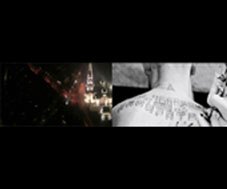
Ttrioreau completed a project which he had elaborated for many years. At the centre of this proposal is Dziga Vertov's film "L`homme à la caméra". But here as well, an oppositional system presides over Ttrioreau's work. In what measure? To sum it up, Dziga Vertov's film can be described as an attempt to report the activities of the citizens of the city of Odessa in the Ukraine; skimming the ground, the camera is the eye that gives an account of the modernization and industrialization of the city: "L`homme à la caméra" is somehow the point of contact between cinema, city, and citizenship. Furthermore, Dziga Vertov views the film editing as truth, truth more pure than the eye. Yet, Ttrioreau's proposal operates a strict shift from the basis material: in two films, Ttrioreau short-circuits Dziga Vertov's thematic. The first film is a long aerial panoramic doing concentric circles around present day Odessa. The city is placed at a distance with a panoptic vision that becomes manipulable as the architecture and the buildings transform into pure geometric forms. The second film revives one of the announcements published by Dziga Vertov in the Pravda before the release of his film. The contents of this announce - But where has the man with the camera gone? (in Cyrillic) - is tattooed on the artist's back, a process filmed in a long sequence shot. As the buildings become geometric in the first film, it is now the letters in the announcement that transform into volumes, in quasi-sketches of buildings during the tattoo sequence. Distance versus proximity, editing versus shot-sequence: Ttrioreau reverses the relations. Even so, the game is not free because, in the end, as the phrase tattooed on the artist's own flesh shows, an even stronger proximity is reached. What is at stake here is the inscription of the architecture, whose meaning on the body is forever shifting: everything happens as if the skin was taking the place of the eye, a skin understood as a membrane on which the architecture's polysemic sense vibrates. The two films are projected simultaneously, opposite each other in the same temporality. The point of contact between the two projections is not assured by a physical actor but by the immateriality of a sonorous ellipse that unites the two moments in one single and same architecture. Thus a single sonorous screen for the two films, a envelopping quadraphonic where we rediscover the secret virtues of editing. To the visual poles respond the sonorous elements used in the ellipse. The helicopter's rotor on the one hand, mechanic fury of a giant spinning top ("dziga"), and the small tattooing machine with its needles thrown across the chair in singular rotations ("vertov") on the other hand. 64 minutes and 32 seconds of concrete music mixed with the worry of being a structural element against the naive expressiveness of the illustration. The diffusion of sound creates the two films' space of encounter. Extracted from the two dimensions of their screens, they become the architectural space of a disconcerting place for the one who advances, the one who immerses in this multiple scales environment to apprehend with both eye and ear. The memory conjured up here is that of cinema-truth (kino-pravda) where the eye produces the reality as much as it records, questionning in the gyratory and noisy movements, the built spaces in which our bodies witness the restraints of living in them.
Hervé Ttrioreau's proposals come within a reflection linked to the nature of the urban system. His installations move around the very structure of the spaces built. They produce displacements that disturb our perception and display in a political way the normative character of the architecture. His work intervenes in the urban intervals; he establishes junctions in the interior/exterior relations. Taking into account the stakes linked to urbanism, and not looking only at representation, he necessarily creates "in situ" and principally outside the exhibition places. Ttrioreau focuses on the structures of the urban network. His interventions in the state of things in architecture are often very radical and contrary to the established ideas on the role and meaning of the construction domain. In his system of transformations, inside and outside represent only relative notions, as well as the relation between whole and detail, between real space and imaginary space. Where we build, we also demolish: the city and its buildings are variables submitted to market logic. The buildings lose their prestigious character of architectural creation to become just a good opportunity for investment of capital, and when it will stop bringing money, it will be invested elsewhere, leaving these constructions to deteriorate. Only the documents and the models resist these manipulations of the market. Ttrioreau's devices work on the urban zones, on their walls and their memory. Willing to include all the possibilities, he creates hybrid territories that are constituted by default or hegemony and put the body to test by depriving it of the usual partitions. These are transgressed or transgressive spaces that do not offer a definitive equilibrium because the limit becomes blurred to leave space to the interference. If the change always appears imminent, in reality it is already effective: without a real place of existence, he invests a whole territory, transforms it into a hybrid zone where the frontiers withdraw. Ttrioreau presents the production of abnormal structures, immanent to the field of urban normalization. The architecture is static only by way of the controlled identity that it assigns. In proposing an alternative perspective, the installation defines itself as a polemic process. It questions our trust in the structural solidity of buildings, in their immobility and their permanence, to describe them as intervals, passages, transitions...

Ttt Ttt
Voilà l'enchaînement
| | | 29:39 | Angola | 2014
To film the words of Christine Angot, words which describe what we obliterate. I use that word, obliterate, perhaps there`s a better word to express that unavoidable bond that a black man doubtless feels instinctively. That trap.