Catalogue > List by artist
Browse the entire list of Rencontre Internationales artists since 2004. Use the alphabetical filter to refine your search. update in progress
Megan Fraser
Catalogue : 2008The Clearance | Documentaire | 16mm | couleur | 15:0 | Royaume-Uni | 2007
Megan Fraser
The Clearance
Documentaire | 16mm | couleur | 15:0 | Royaume-Uni | 2007
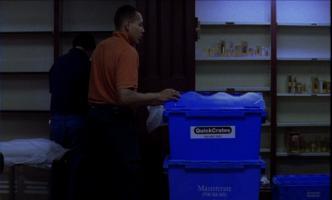
"The Clearance" est un film 35mm tourné dans un musée médical à Londres. C'est un document sur la destruction, la dispersion et la numérisation de la collection de spécimens humains du musée. Le film se compose d'une série de plans liés par une esthétique minimaliste, sans ordre véritable, juste montrés "l'un après l'autre". Ce qui se passe à l'écran, la signification des choses et des actions représentées, imprègne la surface de l'image et flotte à travers le film. "The Clearance" est une sorte de document mais non un documentaire. Réalisé en réponse aux débats autour des lois régissant la collection de tissu humain, le film mélange les méthodes du documentaire d'observation avec une mise en scène théâtrale du sujet pour produire une méditation obsédante sur la notion de "chose", et sur les cadres légaux, sociaux et culturels qui influencent son statut.
Megan Fraser vit et travaille à Londres, Paris et New York. Elle est diplômée du Bard College de New York depuis 2007. Son travail a été montré dans divers lieux à travers le monde: Koelnischer Kunstverein, Koln, Oberhausen Film Festival, Allemagne, Rotterdam International Film Festival, Pays -Bas, The Walker Art Centre, Minneapolis et The Tramway, Glasgow.
Peter Freund
Catalogue : 2008Time-Based Correction | Art vidéo | 16mm | noir et blanc | 5:45 | USA | 2007
Peter Freund
Time-Based Correction
Art vidéo | 16mm | noir et blanc | 5:45 | USA | 2007
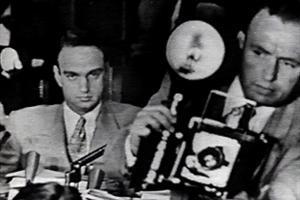
Marquant la fin de la "Peur Rouge" dans la mythologie américaine, les audiences McCarthy/Armée de 1954 occupent une place emblématique dans l'histoire, définissant la brillante et autosatisfaite coïncidence de deux pouvoirs: le libéralisme et la télévision. "Time-Based Correction" est une étude des gestes effectués dans la chorégraphie inconsciente de l'espace social pendant ces célèbres audiences télévisées.
Peter Freund est un artiste média, un universitaire et un éducateur basé dans les environs de la baie de San Francisco. Il travaille essentiellement sur la rhétorique et l'entrecroisement des médias. Il enseigne l'art des médias au Saint Mary's College de Moraga, en Californie.
Mauricio Freyre
Catalogue : 2021Interspecies Architecture | Fiction expérimentale | mov | | 11:0 | Pérou, Espagne | 2020
Mauricio Freyre
Interspecies Architecture
Fiction expérimentale | mov | | 11:0 | Pérou, Espagne | 2020
Comment rétablir l’avenir de nos relations avec les autres espèces? Un voyage dans la forêt près de Taipei, une destination incertaine. Une spéculation nomade sur les relations et les processus qui se produisent entre les espèces, et sur des dimensions qui dépassent l'être humain.
Mauricio Freyre est né à Lima (Pérou) en 1976. Chercheur, artiste audiovisuel et réalisateur, il a une formation en architecture. Ses projets tournent autour des structures et des systèmes de pensée en marge du construit et du projeté, concentrant l'attention sur les angles morts, les zones d'ombre, les accidents, les distorsions et les formes de conscience exclues. Il travaille actuellement sur le projet audiovisuel "Estados Generales", axé sur le rôle de la botanique et de son pouvoir au sein des sciences coloniales, explorant la dimension politique et subversive du monde végétal par rapport à une épistémologie occidentale. Il a obtenu le prix national du film expérimental, décerné par le ministère de la culture du Pérou, ainsi que la Matadero Production Grant, Madrid (Espagne). Ses films et installations ont été présentés dans divers programmes et expositions, notamment au Festival Internacional de Cine Valdivia (Chili); au Strangloscope, Florianópolis (Brésil); aux Rencontres Internationales Paris/Berlin (France/Allemagne); à L’Alternativa, Barcelone (Espagne); à la Haus der Kulturen der Welt, Berlin (Allemagne); au TENT, Rotterdam (Pays-Bas); au Nederlands Film Festival, Utrecht (Pays-Bas); et à la Fundación Telefonica Lima (Argentine).
Catalogue : 2019Movimiento continuo | Doc. expérimental | hdv | couleur | 14:36 | Pérou, Espagne | 2018
Mauricio Freyre
Movimiento continuo
Doc. expérimental | hdv | couleur | 14:36 | Pérou, Espagne | 2018
The history of an experimental housing project in Lima, conceived as an international competition, is the starting point of an exploration on the nature of transformation and hybridization in the context of the project of modernity in Perú. The unfinished housing complex designed in the late sixties gathered the architectural avant-garde of that time, incorporating notions of self-construction, metabolism and progressive growth to its architecture. Juxtaposing the briefing of the project, together with archival material of three sources, the film explores different sequences of formal procedures. Transfers, cuts and superpositions, in a sequence of permanent transformation, operate as transcriptions that explore various relations and configurations of the material, to displace a fixed point of view.
Mauricio Freyre (1976, Lima) is an artist and filmmaker, his projects revolve around structures and systems of ideas between the constructed and the projected, focusing on blind spots, dark areas, accidents and distortions, in the search of invisible narratives, metaphors, dimensions and forms of consciousness that were excluded and silenced. He is currently working on a project that studies the role of botanics, its agency within the colonial sciences, along with its role within the modern project in Peru; exploring the political and subversive dimension of the plant world in relation to a western epistemology. His films and installations have been part of different programs and exhibitions including FIC Valdivia, Haus der Kulturen der Welt, TENT Rotterdam, Unforseen Festival, Nederlands Film Festival, Film Museum Amsterdam, Fundación Telefonica.
Catalogue : 2017SET OUT 1 | Fiction | 16mm | couleur | 2:14 | Pérou, Espagne | 2015
Mauricio Freyre
SET OUT 1
Fiction | 16mm | couleur | 2:14 | Pérou, Espagne | 2015
When does the fiction of a film start? Where do characters go when the movie is over? A story made of fragments and discarded footage from a film shooting. The camera examines the landscape of the mise-en-scène, looking for meaning in the elements that make up the picture.
Mauricio Freyre is an artist and filmmaker, graduated from Architecture and Fine Arts, based in Madrid. He uses the film medium to explore structures and systems of thought behind the constructed and projected. His projects and films have been exhibited at Haus der Kulturen der Welt (Berlin), Fundación Telefonica (Lima), TENT Museum (Rotterdam), W139 (Amsterdam), Nederlands Film Festival (Utrecht), FIC (Valdivia), Sunset Cinema (Luxemburg), Filmmuseum (Amsterdam), etc. He is currently a visiting teacher at The Berlage (Delft), KABK Royal Academie of Art (The Hague) and ETSAM Universidad Politècnica (Madrid).
Louis Fried
Catalogue : 2020Flexible Bodies | Fiction expérimentale | hdv | couleur | 18:53 | Allemagne | 0
Louis Fried
Flexible Bodies
Fiction expérimentale | hdv | couleur | 18:53 | Allemagne | 0
In FLEXIBLE BODIES a high-rise building protrudes out of its surroundings as a strange object. It's the (already dated) materialized utopia of an ideal workspace, dreams of career opportunities and self-optimization echoing through the hallways. In and around the building bodies converge: working, exercising, growing. While we follow a woman through the building, the question arises which bodies here are real or if what we are seeing is part of an elaborate plan or just part of someone's phantasy.
Louis Fried was born in Munich, Germany. 2004-2010 studied Visual Communication/Film at the University of fine arts (HfbK) Hamburg. He is a co-founder of VETO Film a platform for experimental film and video art. He lives and works in Hamburg.
Sarah Friedland
Catalogue : 2023Trust Exercises | Vidéo expérimentale | 4k | couleur | 25:18 | USA | 2022
Sarah Friedland
Trust Exercises
Vidéo expérimentale | 4k | couleur | 25:18 | USA | 2022
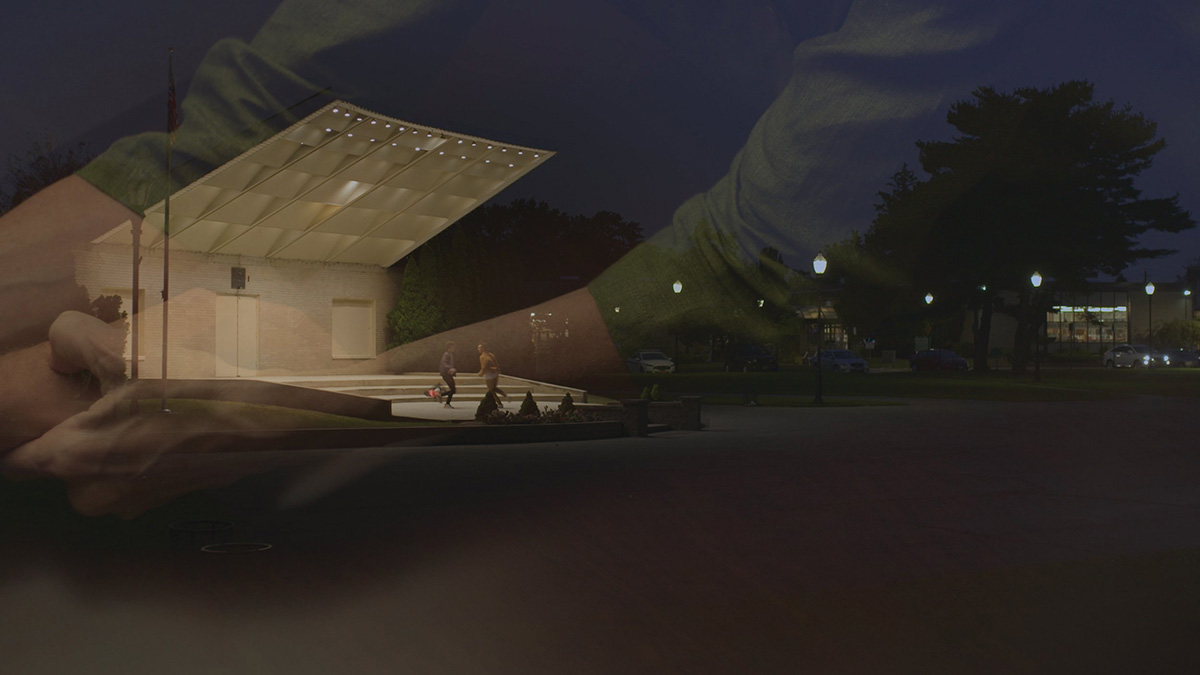
The final film in Friedland’s “Movement Exercises” trilogy, Trust Exercises is a hybrid experimental dance film which explores the tension between the poetics of group movement and its instrumentalization for capitalist management. Amending the choreography of team-building and the visual grammars of corporate video, Trust Exercises braids together movement from three work spaces: a fictional start-up retreat, a body work session as interview, and a dance rehearsal. Movements transmit between performers across scenes, complicating the discrete goals of their choreographies and examining their portability across spheres. Dislocating the movement of the retreat to the space of rehearsal, professional dancers transform stock exercises into intimate social dances. A body work session reconfigures the office environment. Lingering after hours, movement facilitators transmute team-building games into a playful duet. Trust Exercises examines the premise and promise of the exercise: that by moving together, repeatedly, we both create and recreate the social body.
Sarah Friedland is a filmmaker and choreographer working at the intersection of moving images and moving bodies. Through hybrid, narrative, and experimental filmmaking, multi-channel video installation, and site-specific live dance performance, she stages and scripts bodies and cameras in concert with one another to elucidate and distill the undetected, embodied patterns of social life and the body politic. Facilitating a research process integrating found movements, gestures, and postures from cinema and archival footage, embodied memories, and contemporary dance languages, she choreographs through practices of interviewing, pre- and re-enactment, adaptation, and improvisational play, shaping dances with diverse communities of performers and movers—from professional dancers to cohorts of seniors and teenagers. Her work has screened and been presented in numerous festivals and film spaces including New York Film Festival, New Directors/New Films, Ann Arbor Film Festival, New Orleans Film Festival, Oberhausen Film Festival, BAMcinématek, Mubi, and Anthology Film Archives, in art spaces such as Performa19 Biennial, La MaMa Galleria, MoMA, Sharjah Art Foundation, MAM Rio, Nasher Museum, Wassaic Project, and Manifattura delle Arti (Bologna), and in dance spaces including the American Dance Festival and Dixon Place, among others. Her work has been supported by the Foundation for Contemporary Arts, Film at Lincoln Center, Dance Films Association, Art Factory International, NYSCA/Wave Farm, Rhode Island State Council of the Arts/NEA, Berlinale Talents, where she was one of 10 selected screenwriter/directors for the 2017 Script Station/Project Lab, and most recently by the Bronx Museum, where she was an AIM Emerging Artist Fellow in 2020. Sarah graduated from Brown University's department of Modern Culture and Media and started her career assisting filmmakers including Steve McQueen, Mike S. Ryan, and Kelly Reichardt. Sarah has worked on collaborative research and writing projects with media theorists Wendy Chun on slut-shaming and new media leaks, with Erin Brannigan on the dancing body on film, and has an ongoing collaboration with writer, scholar, and programmer Tess Takahashi on masses and embodiment. She has taught workshops on dance film and been a guest artist at Brown, Yale, Skidmore, Reed, and University of Utah, among others, in addition to teaching filmmaking to older adults in senior centers through Brooklyn Arts Council’s Su Casa program. In 2021, Sarah was a Pina Bausch Fellow for Dance and Choreography, collaborating with artists Wen Hui and Eiko Otake, a NYSCA/NYFA Fellow in Video/Film, and was awarded the Jerome Foundation’s 2021 New York City Film, Video, and Digital Production grant for her feature film in development, Familiar Touch.
Catalogue : 2021Drills | Vidéo expérimentale | mov | couleur | 16:45 | USA | 2020
Sarah Friedland
Drills
Vidéo expérimentale | mov | couleur | 16:45 | USA | 2020
"Drills" est un film sur la chorégraphie de la préparation pour l'avenir. Hybride entre documentaire et film de danse expérimentale, réimaginant la forme des films d’éducation sociale produits par le gouvernement américain à l'époque de la guerre froide, "Drills" interroge les avenirs auxquels nous nous préparons par le biais d'exercices incarnant les anxiétés actuelles. Entrelaçant de multiples formes de chorégraphie et de documents, "Drills" remet en scène des exercices de confinement et de tireur actif, présente la méditation dans les bureaux de grandes entreprises et de start-up technologiques, et réinterprète des exercices scouts tirés du manuel 1917 des Boy Scout.
Sarah Friedland est cinéaste et chorégraphe. Elle travaille à l'intersection des images et des corps en mouvement. Son travail a été projeté et présenté dans de nombreux festivals et lieux de cinéma, notamment le New York Film Festival (USA); le festival New Directors/New Films, New York (USA); le Ann Arbor Film Festival (USA); le New Orleans Film Festival, La Nouvelle-Orléans (USA); la BAMcinématek, New York (USA) et les Anthology Film Archives, New York (USA); dans des lieux d’expositions telles que la biennale Performa19, New York (USA); La MaMa Galleria, New York (USA); le MoMA – Museum of Modern Art, New York (USA); la Sharjah Art Foundation, Sharjah (Émirats arabes unis); le MAM Rio – Museu de Arte Moderna do Rio de Janeiro (Brésil); Nasher Museum of Art, Durham (USA); le Wassaic Project, Wassaic (USA) et la Manifattura delle Arti, Bologne (Italie); ainsi que dans des lieux de danse, tels que le American Dance Festival, Durham (USA) et la Dixon Place, New York (USA). Son travail a été soutenu par la Foundation for Contemporary Arts, New York (USA); la Film Society of Lincoln Center, New York (USA); la Dance Films Association, New York (USA); la Art Factory International, Bologne (Italie); le New York State Council of the Arts/Wave Farm (USA); le Rhode Island State Council of the Arts/National Endowment for the Arts (USA); Berlinale Talents, Berlin (Allemagne), où elle a été l'une des 10 scénaristes et réalisateurs sélectionnés pour le Script Station/Project Lab de 2017; et, plus récemment, par le Bronx Museum, New-York (USA), où elle a été AIM Emerging Artist Fellow en 2020. Elle est diplômée du département de la culture moderne et des médias de l'université Brown, Providence (USA), et a commencé sa carrière en assistant des cinéastes, notamment Steve McQueen, Mike S. Ryan et Kelly Reichardt. Elle a travaillé sur des projets de recherche et d'écriture en collaboration avec les théoriciens des médias Wendy Chun (sur le slut-shaming et les fuites dans les nouveaux médias) et Erin Brannigan (sur le corps dansant au cinéma), et collabore actuellement avec l'écrivaine, chercheuse et programmatrice Tess Takahashi sur les masses et l'incarnation. Elle a donné des workshops sur le film de danse et a été artiste invitée, notamment aux universités Brown, Providence (USA); Yale, New Haven (USA); Skidmore College, Saratoga Springs (USA); NYU Florence, Florence (Italie); Reed, Portland (USA); University of Utah, Salt Lake City (USA) et au centre UnionDocs, New York (USA).
Yariv Friedman
Catalogue : 2006Cuba Libre | Documentaire | dv | couleur et n&b | 24:37 | Israel, Suisse | 2005
Yariv Friedman
Cuba Libre
Documentaire | dv | couleur et n&b | 24:37 | Israel, Suisse | 2005
Ce court-métrage clandestin nous transporte au travers des tensions qui règnent entre la mémoire de l?icône locale Ernesto « Che Guevara et la réalité quotidienne à Santa Clara (Cuba), faite de dictature, de pauvreté et de prostitution. Ce documentaire regroupe des monologues de citoyens de Santa Clara. Au travers de leurs témoignages reflétant leur acceptation passive de la dictature, on voit pourtant transparaître par des gestes, des attitudes ce qui ne peut être dit. Puis la fluidité du film est entrecoupée par des images fixes du « Che », de façon à proposer au spectateur un voyage dans la mémoire, le présent et l?idéal.
Yariv Friedman est né en Israël en 1971. Il vit en suisse depuis 1999. Licencié en droit et en économie de l?Université de Tel-Aviv, il travaille actuellement à Genève dans le cadre d?un programme de compensation des victimes de l?holocauste. Il a étudié la direction d?acteurs à Paris. En septembre 2004, il a réalisé Dona Juanita (fiction, 15?) qui depuis sa courte existence a été chaleureusement accueilli dans plusieurs festivals (Cardiff, Haïfa, Pskov). Cuba Libre est son deuxième film. Actuellement, il travaille sur « la rivière » (long-métrage documentaire, mars 2005) et Ecclésiaste (long-métrage fiction, novembre 2005)
Verena Friedrich
Catalogue : 2013Cellular Performance | Vidéo | dv | couleur | 9:0 | Allemagne, Australie | 2012
Verena Friedrich
Cellular Performance
Vidéo | dv | couleur | 9:0 | Allemagne, Australie | 2012
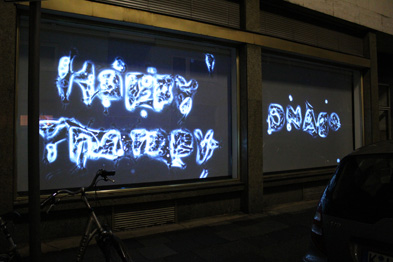
?Cellular Performance? has been developing during residencies at ?SymbioticA ? Centre of Excellence in Biological Arts? in Perth, Australia and the ?Laboratory of Stem Cell Bioengineering? at the EPFL in Lausanne, Switzerland. Human skin cells have been maniulated to grow into predefined patterns and recorded via time-lapse imaging techniques. The cells are forming up to legible text fragments and disperse again over time?visualizing terms culled from the advertising language of care products industry. Verena will talk about the background of the project as well as her research and practical work in the field of ?cell patterning? and micro-engineering.
Verena Friedrich is an artist who develops concept-driven artworks in the form of installations, objects and robotics. Her work includes the use of electronics, digital and sculptural media as well as the use of biological material. Shown internationally, her work has for example been granted the International Media Art Award for Science and Art from ZKM Karlsruhe (Germany). Since 2009 she is developing her project ?Cellular Performance? in collaboration with several scientific partner institutions and funding bodies. Verena is currently based in Germany where she is working as a scientific research assistant at the Academy of Media Arts Cologne.
Darko Fritz
Catalogue : 2023Zamisljene Buducnosti: Turizam | Film expérimental | mp4 | couleur | 19:24 | Croatie | 2022
Darko Fritz
Zamisljene Buducnosti: Turizam
Film expérimental | mp4 | couleur | 19:24 | Croatie | 2022
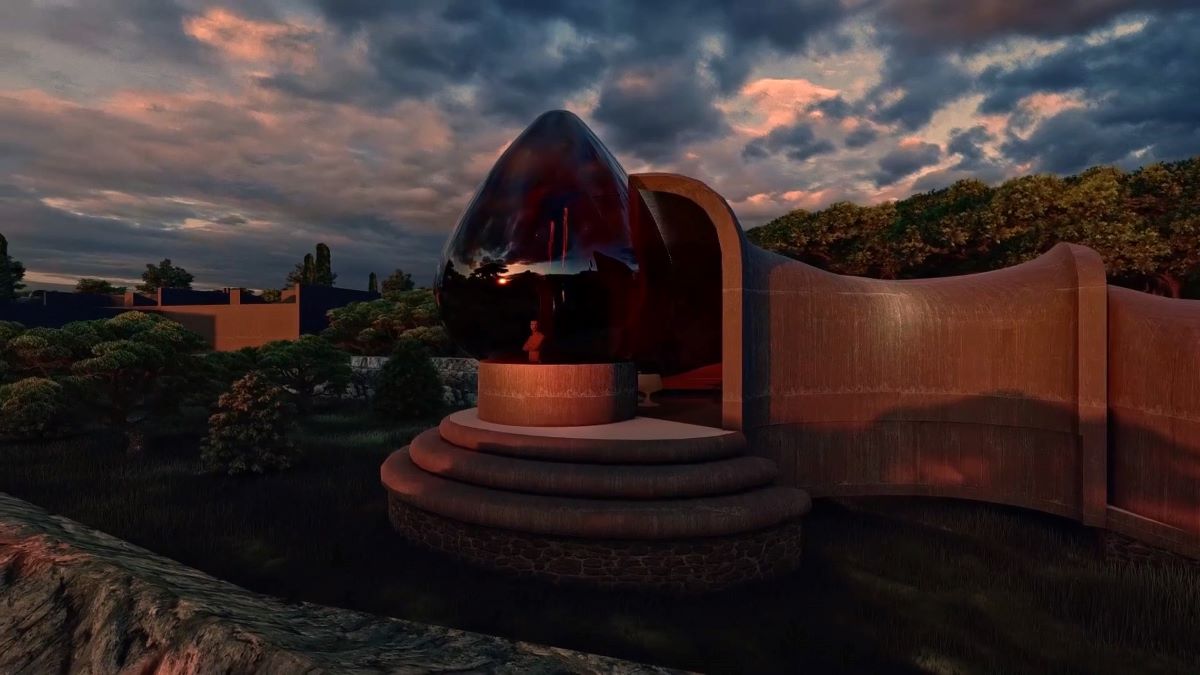
The film considers the question of the vision of the future and Utopia. In 1970, Cuban architect Ricardo Porro made a master plan of the tourist settlement in the shape of a human body. The design was elaborated by a group of international artists and architects but finally was not built. The main visual in the film is the model of this tourist settlement which was to synthesize architecture, sculpture, painting, and tourism. Image treatments with an oscilloscope, lying somewhere between analogue and digital worlds, introduce a new set of artifacts and looks. Apart from the film author made a VR installation and series of artworks in different media.
Since the late 1980s, the work of artist, curator and researcher Darko Fritz has revolved around a significant investigation into the use of technology in culture. He studied architecture in Zagreb and visual arts at Rijkakademie van beldende kunsten in Amsterdam. His work bridges the gap between contemporary art, media art and network culture, taking up topics such as glitch, error, and surveillance. He uses different media (graphic art, photography, film, video, internet, etc.). He is a critical observer of technology that changes society. His long-run project Imaginary Futures started with the film Zagreb Confidential was premiered in Oberhausen 2016 and the project continued with a series of artworks and other films. Fritz is the founder and programmer of the grey) (area – space for contemporary and media art since 2006.
Fred Froehlich
Catalogue : 2007Volume I | Vidéo expérimentale | 0 | couleur | 8:0 | Allemagne | 2005
Fred Froehlich
Volume I
Vidéo expérimentale | 0 | couleur | 8:0 | Allemagne | 2005
A la base de l'animation informatique "VOLUME I" se trouve l' image d'archive d'un stock de 100000 photos commerciales. Le matériel brut de départ a été trié selon des critères formels comme la couleur, le contraste, la composition, et rassemblé en une animation d'images individuelles. Les changements d'image interviennent si rapidement que l'oeil ne peut pas suivre. La fréquence des changements d'image rappelle la vue de l'intérieur d'un train à grande vitesse, lorsque devant l'ordonnance du paysage formant décor des personnes, des arbres, des objets passent en une fraction de seconde pour diparaître aussitôt. Les images sont en fait la matière première de l'industrie publicitaire, qui les utilise pour des annonces et des brochures. Elles montrent le monde sous un angle idéalisé. Le contenu des images ont avant tout une charge positive et se distinguent par leur interchangeabilité sémantique. Les images relevant de tous les thèmes d'actualité importants ont été rassemblés afin de correspondre au caractère encyclopédique de ce travail. En amont du choix du matériel à inclure dans la réserve il y a eu une sélection en fonction de la pureté du contenu symbolique. VOLUME I crée une association avec des images de rêve. Une course folle à travers les images supposées être les dernières fait établir au récepteur une comparaison entre ce qu'il a vu ailleurs -consciemment ou inconsciemment- et le flot d'images. Le mouvement rapide de l'oeil est imité; les images bougent toutes seules. Les clichés cherchent leur contexte dans le monde des représentations du spectateur et s'émancipent ainsi du lien avec leur finalité originelle.
Fred Fröhlich, né en 1968 à Suhl (Thuringe), a étudié la photographie, a été élève de masterclasse et assistant à la Hochschule für Grafik und Buchkunst 'école supérieure de graphisme et des arts du livre) de Leipzig, il a effectué de nombreux séjours d'étude aux Etats-Unis, en Espagne, en Thaïlande, au Cambodge, en Russie et au Japon. Il a participé à des expositions collectives à l'étranger comme dans son propre pays et a réalisé des expositions individuelles et des projets liés aux médias dans l'espace public. Fred Fröhlich vit à Berlin.
Graciela Fuentes
Catalogue : 2006Saida | Art vidéo | dv | couleur | 5:43 | Mexique, USA | 2005
Graciela Fuentes
Saida
Art vidéo | dv | couleur | 5:43 | Mexique, USA | 2005
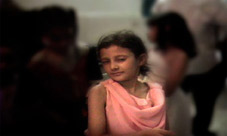
Saida est une petite fille de sept ans qui danse avec beaucoup de séduction pour la caméra placée devant elle. Elle n?a reçu aucune instruction quand la caméra fut placée. Le spectateur est confronté au regard très intense de Saida, mais en fait, elle est en train de regarder une image d?elle-même qu?elle a inventée sur l?écran de l?appareil. Elle est captivée par son image et n?interrompt son engagement avec elle-même que pour regarder momentanément les adultes autour d?elle ou pour se battre avec les autres filles essayant d?apparaître sur l?écran de la caméra. La pièce met l?accent sur elle et la relation entre ce regard et ce que le spectateur perçoit. Le reste de l?image est hors champ et reproduit sa propre isolation du contexte le temps qu?elle danse devant la caméra.
Graciela Fuentes est un artiste visuelle travaillant la vidéo, les installations et la photographie. Elle est née en 1975 à Monterrey, au Mexique. Elle vit et travaille à New York où elle participe en ce moment au Whitney Museum Independent Study Program. Elle est détentrice d?un MFA de l?université de New York et un BA en Studio Arts de UIW. Son travail a été présenté dans des expositions solos à New York, Mexico, au Portugal et à Puerto Rico. Elle a aussi pris part dans des expositions de groupe majeures à Mexico, New York, en Bolivie, à Paris, en Californie et à Taïwan. Son travail a été imprimé dans Art On Paper, The Village Voice, the New Yorker et Arte al Dia, parmi d?autres. Elle a reçu trois récompenses de la part du National Council for Culture and the Arts de Mexico et en 2005, le Visual Arts Grant de la Fondation Espagnole Marcelino Botin.
Fabienne Fulcheri
Soren Thilo Funder
Catalogue : 2022GAME Engine (Orange Bulletproof Kids) | Vidéo | hdv | couleur | 30:0 | Danemark | 2021
Soren Thilo Funder
GAME Engine (Orange Bulletproof Kids)
Vidéo | hdv | couleur | 30:0 | Danemark | 2021
In GAME Engine (Orange Bulletproof Kids) we are invited to an exclusive press meeting at an undisclosed location. Here, the spokesperson of a notorious game developer, presents a brand new game engine. A game engine that promises revolutionary in-game experiences, the layout of which are never fully disclosed in protection of its intellectual property value. This oral evasive manoeuvre leads the spokesperson into complex landscapes in which game and reality, body and avatar, the sensorial and the informational, blend together. Parallel to this fiction scenario, a group of CS:GO athletes are recreating their game experiences, using their bodies as vehicles for motoric and visual memory.
Soren Thilo Funder is a visual artist working primarily with video and installation. His works are mash-ups of popular fictions, cultural tropes and socio-political situations, projections and histories. They are narrative constructions insisting on new meaning forming in the thin membrane negotiating fictions from realities. Invested in written and unwritten histories, the paradoxes of societal engagement, temporal displacements and a need for new nonlinear narratives, Thilo Funder proposes spaces for awry temporal, political and recollective encounters. Soren Thilo Funder’s previous exhibitions include solo presentations at Turku Museum of Art, Museum of Contemporary Art Zagreb, Tranen Contemporary Art Center, Overgaden – Institute for Contemporary Art and Den Frie - Centre for Contemporary Art, Copenhagen. He was furthermore represented at the 19th Biennale of Sydney, eva International Biennial of Visual Art - “After The Future”, 12th Istanbul Biennial, Manifesta 8 – Parallel Events and 6th International Liverpool Biennial. He is currently doing a PhD in Artistic Research at The Art Academy - Department of Contemporary Art, University of Bergen.
Catalogue : 2012Disastrous Dialogue | Vidéo | hdv | couleur | 10:0 | Danemark | 2011
Soren Thilo Funder
Disastrous Dialogue
Vidéo | hdv | couleur | 10:0 | Danemark | 2011
Disastrous Dialogue focuses on the modern subject?s fixation on catastrophe images, here particularly the Hollywood-produced Catastrophe Cinema. Appropriating movie script dialogue from three major catastrophe movies, all written and directed by the German Director Roland Emmerich, Disastrous Dialogue sets out to challenge the mainstream viewpoint of disaster strategies. The script is translated into Arabic and performed by Egyptian actors, transforming the script through the voice of Hollywood cinema?s unrepresented. The film was shot immediately before the Egyptian Revolution and is dedicated to the actress Sally Zahran who perished during the brutal attacks on Egyptian demonstrators.
Soren Thilo Funder is a visual artist based in Copenhagen, Denmark. His works are audio-visual productions dealing with diverse cultural fields and integrating aspects of critical theory, literature, theater, cinema, Sci-Fi, Horror, political activism and other counter-cultural disciplines. The works are formal investigations of the power relations of modern day society. Through the use of cinematic narratives, choreography and mise en scène, the works strive to expose the precariousness of contemporary society and the broken link between politics and the political. The works use the fictional and extra-real to pose new questions and generate a new potential space, a third place, for political contemplations and counter-memory. Soren Thilo Funder has a MA from the Royal Danish Academy of Fine Arts. He has exhibited his works in international galleries, film festivals, museum exhibitions and public space exhibitions, in countries like Japan, USA, Iceland, Iran, Turkey, Russia, Vietnam, Bulgaria, Spain, Germany and Egypt. He has been an artist-in-residency at SOMA in Mexico City, Townhouse Gallery in Cairo, Frankfurter Kunstverein in Frankfurt am Main and Platform Garanti Contemporary Art Center in Istanbul. He was furthermore represented at the 12th Istanbul Biennial, VII Shiryaevo Biennale of Contemporary Art, 2nd International Moscow Biennial for Young Art, the 6th International Liverpool Biennial and Manifesta 8. In 2011 Soren Thilo Funder is currently artist-in-residence at Art Space SOMA in Mexico City.
Catalogue : 2011Red Tape (Don't go into Tarlabasi) | Art vidéo | | couleur | 7:9 | Danemark, Turquie | 2010
Soren Thilo Funder
Red Tape (Don't go into Tarlabasi)
Art vidéo | | couleur | 7:9 | Danemark, Turquie | 2010
Red Tape (Don`t go down into Tarlabasi) Video - HD AppleProRes Duration: 7:09 min. 2010 Coming to Istanbul I was told immediately that I should not go down into Tarlabasi. The ghettoized area Tarlabasi is, apart from not being all that dangerous, also the next poor area to be gentrified. Red Tape takes it outset in the Japanese horror film Kairo and in the mix between documentary and horror fiction it aims to distort the image of ghettoization.
Soren Thilo Funder is a visual artist based in Copenhagen, Denmark. His works are audio-visual productions dealing with diverse cultural fields and integrating aspects of critical theory, literature, theater, cinema, Sci-Fi, Horror, political activism and other counter-cultural disciplines. The works are formal investigations of the power relations of modern day society. Through the use of cinematic narratives, choreography and mise en scène, the works strive to expose the precariousness of contemporary society and the broken link between politics and the political. The works use the fictional and extra-real to pose new questions and generate a new potential space , a third place, for political contemplations and counter-memory. Soren Thilo Funder has exhibited his works in international galleries, film festivals, museum exhibitions and public space exhibitions. He has been an artist-in-residency at Frankfurter Kunstverein in Frankfurt Am Main, Platform Garanti Contemporary Art Center in Istanbul and Townhouse Gallery in Cairo. He was furthermore represented at the 2nd International Moscow Biennial for Young Art, the 6th International Liverpool Biennial and Manifesta 8.
Catalogue : 2010Friedlos (aka The Bandit Wolf-Man) | Fiction expérimentale | | couleur | 8:12 | Danemark | 2009
Soren Thilo Funder
Friedlos (aka The Bandit Wolf-Man)
Fiction expérimentale | | couleur | 8:12 | Danemark | 2009
Friedlos (aka The Bandit Wolf-Man) HD DVCPRO Duration: 08:12 Synopsis: On the outskirts of the city, the townsfolk are gathered to expel the citizen and bandit Friedlos (aka The Bandit Wolf-Man). In a heathen display they perform the traditional heathen ritual of banishment. Finally Friedlos is tight to a horse, masked with a wolf?s head and send out of town. The banishment questions contemporary societies exclusion/inclusion relationship. The heathen aspect and the epic western soundtrack underlines this society?s regression towards rhetoric?s and ethics in comparison with those of the Wild West, witch hunts and tribal community fear. Friedlos (aka The Bandit Wolf-Man) is set in a world of no specific time generating a timescape that foresees the future as it dwells in the past.
Soren Thilo Funder is a visual artist, working mainly with audio-visual productions, based in Copenhagen, Denmark. He graduated at the Royal Danish Academy of Fine Arts in 2008. He has also studied at the The University of Illinois at Chicago ? Art and Architecture and The European Film College. He has exhibited in numerous International constellations in countries as Iran, Serbia, United States of America, Japan, Germany, Denmark, Iceland and Spain. His works has been presented in commercial galleries, at film festivals, museum exhibitions and in public space. He has been an artist-in-residency at Frankfurter Kunstverein in Frankfurt Am Main and Platform Garanti Contemporary Art Center in Istanbul.
Soren Thilo Funder
Catalogue : 2020The Watchers of Malheur (TWEET TWEET) | Fiction expérimentale | 4k | couleur | 22:5 | Danemark, USA | 2019
Soren Thilo Funder
The Watchers of Malheur (TWEET TWEET)
Fiction expérimentale | 4k | couleur | 22:5 | Danemark, USA | 2019
A series of intense political events at a wildlife reserve in Oregon USA are the focus of The Watchers of Malheur (TWEET TWEET). The work combines reportage with speculative fiction, political events with extended periods of waiting, wild nature with a digital sensory apparatus, and filmic construction with virtual transience. Photo-realistic camouflage, a motion capture studio with a horse and a Berlingo car, vast expanses of the American landscape, fetishized optic tech, and a pitiable animated Twitter bird are just a few of the many layers that comprise the transrealistic story of armed combat between ornithologists and militia members on the borders of the Malheur National Wildlife Refuge.
Soren Thilo Funder is a visual artist working primarily with video and installation. His works are mash-ups of popular fictions, cultural tropes and socio-political situations, projections and histories. They are narrative constructions insisting on new meaning forming in the thin membrane negotiating fictions from realities. Invested in written and unwritten histories, the paradoxes of societal engagement and a need for new nonlinear narratives, Thilo Funder proposes spaces for awry temporal, political and recollective encounters. Soren Thilo Funder has an MA from the Royal Danish Academy of Fine Arts and The School of Art and Architecture at the University of Illinois at Chicago. He is currently a Research Fellow at The Art Academy - Department of Contemporary Art, University of Bergen. He has been artist-in-residence at ISCP in New York, Künstlerhaus Bethanien in Berlin, SOMA in Mexico City, Townhouse Gallery in Cairo, Frankfurter Kunstverein in Frankfurt and Platform Garanti in Istanbul. Previous exhibitions include solo presentations at Turku Museum of Art, Museum of Contemporary Art Zagreb, Tranen Contemporary Art Center, Overgaden – Institute for Contemporary Art and Den Frie - Centre for Contemporary Art, Copenhagen, as well as the duo show “Little Lies” with David Claerbout at Yarat Contemporary Art Centre. He was furthermore represented at the 19th Biennale of Sydney, eva International Biennial of Visual Art - “After The Future”, 12th Istanbul Biennial, Manifesta 8 – Parallel Events and 6th International Liverpool Biennial.
Catalogue : 2016Anti-Optimistic Earthquake Scenario | Fiction expérimentale | hdv | couleur | 18:45 | Danemark | 2015
Soren Thilo Funder
Anti-Optimistic Earthquake Scenario
Fiction expérimentale | hdv | couleur | 18:45 | Danemark | 2015
ANTI-OPTIMISTIC EARTHQUAKE SCENARIO 2015, HD Video, 18’45 During the 1755 Lisbon earthquake Voltaire and Ted Kaczynski meets in a cold war bunker outside Copenhagen to engage in reflections on the future of mankind in the face of disaster. Voltaire recites parts of his poem about the devastating earthquake that nearly completely destroyed Lisbon. With its tens of thousands of victims it became one of the deadliest in history and had a strong influence on the development of the philosophy of Enlightenment. Also known as the “Unabomber”, Ted Kaczynski conducted a series of terrorist attacks motivated by a fight against the disastrous effects of industrial society in the name of freedom and nature. He lived alone in a cabin in the Montana mountains without electricity for nearly 20 years. He now returns to his past in Mathematics working intensively on the theories of the Zeeman Disaster Machine, a small device build to visualize the unpredictable jumps of the Cusp Catastrophe, the sudden disturbance of a stable situation.
Soren Thilo Funder’s works are formal investigations of the power relations of modern day society. Through the use of conceptual visual strategies, cinematic narratives and mise en scène, the works aim to expose the precariousness of contemporary society using fiction to generate new potential spaces for political contemplations and counter-memory. Soren Thilo Funder has an MA from the Royal Danish Academy of Fine Arts and The School of Art and Architecture at the University of Illinois at Chicago. He has been an artist-in-residence at Künstlerhaus Bethanien in Berlin, SOMA in Mexico City, Townhouse Gallery in Cairo, Frankfurter Kunstverein in Frankfurt and Platform Garanti in Istanbul. He was represented at the 19th Biennale of Sydney, 1st Copenhagen Art Festival, eva International Biennial of Visual Art - “After The Future”, 12th Istanbul Biennial, 2nd International Moscow Biennial for Young Art, Manifesta 8 – Parallel Events and 6th International Liverpool Biennial. Upcoming shows include solo presentations at Museum of Contemporary Art Zagreb, Croatia and Overgaden – Institute for Contemporary Art, Copenhagen, Denmark, as well as an artist-in-residence project at ISCP in New York City.
Catalogue : 2015First Citizen (House of the Deaf Man) | Fiction expérimentale | hdv | couleur | 12:30 | Danemark | 2013
Soren Thilo Funder
First Citizen (House of the Deaf Man)
Fiction expérimentale | hdv | couleur | 12:30 | Danemark | 2013
First Citizen (House of the Deaf Man) opens in a small room, where a therapist is in consultation with a young man. Through the use of hypnosis, the young man is experiencing a ma¬nipulation of his unconscious motivation. A feeling of debt is implanted in him through psycho-suggestion. First Citizen (House of the Deaf Man) proposes the idea that the indebt¬edness of the citizen is not only a causality of a flawed eco¬nomic system, but also the last relation that connects the citizen to a community. The only sure way to be part of any power relation is to enter the creditor/debtor relationship. Debt might hence be something that the citizen uncontiously desires - as the only means of experiencing community. First Citizen (House of the Deaf Man) paints an awry portrait of the indebted man with a little help from Goya’s painting ‘Duel with Cudgels’.
Soren Thilo Funder’s works are formal investigations of the power relations of modern day society. Through the use of conceptual visual strategies, cinematic narratives and mise en scène, the works aim to expose the precariousness of contemporary society using fiction to generate new potential spaces for political contemplations and counter-memory. Soren Thilo Funder has an MA from the Royal Danish Academy of Fine Arts and The School of Art and Architecture at the University of Illinois at Chicago. He has been an artist-in-residence at Künstlerhaus Bethanien in Berlin, SOMA in Mexico City, Townhouse Gallery in Cairo, Frankfurter Kunstverein in Frankfurt and Platform Garanti in Istanbul. He was represented at the 19th Biennale of Sydney, 1st Copenhagen Art Festival, eva International Biennial of Visual Art - “After The Future”, 12th Istanbul Biennial, 2nd International Moscow Biennial for Young Art, Manifesta 8 – Parallel Events and 6th International Liverpool Biennial.
Valentina Furian
Catalogue : 2022Ciacco | Vidéo | hdv | couleur | 6:50 | Italie | 2021
Valentina Furian
Ciacco
Vidéo | hdv | couleur | 6:50 | Italie | 2021
When the day has declined, the night overwhelms us. An unusual bestiality envelops us, it does not belong to us but attracts us to itself. Ciacco develops from a reinterpretation of the sixth canto of the Inferno of the Divine Comedy, where Dante and Virgilio enter the third circle. In the Tartarean circle gluttonous sinners are scourged by a violent rain and tormented by the gigantic and frightening dog Cerberus, feral triad. Ciacco is the gaze through which we are spectators and actors, as well as dogs: the eyes of a damned incessantly hit by a cyclical storm of images, instincts, rain. A damned who lies beneath the beastly torment inflicted by Cerberus, a gigantic, frightening three-headed dog. Three, the number is repeated: triple is the beast, triple the setting in which it navigates. As if we were in the amphitheatre of Dante’s hell, sitting on Ciacco’s lap, we observe the spectacle from the third tier of benches. On stage, the torture of the damned is revealed by the staging itself and by the epic character of the natural environment. The sequences in the film become the viewer’s exploration in “this long night of the world” that we are experiencing.
Valentina Furian (b. 1989, IT) is an Italian visual artist based in Milan, Italy. She is working mainly with moving images. She studied Visual Arts at University Iuav of Venice. Her research investigates the relationship between human and nature. She is particularly interested in exploring animal domestication as a form of human domination as well as human domestication in relation to social rules. Her films have been exhibited in institutional and indipendent spaces such as: Pearl Art Museum, Shanghai, CN; VISIO - European Programme on Artists’ Moving Images; Collezione FARNESINA, Mattatoio, MAXXI - Museo nazionale delle arti del XXI secolo, Rome; MUSE - Science Museum of Trento; UNA galleria, Piacenza; Fondazione Francesco Fabbri, Treviso; MAMbo - Museo d’Arte Moderna di Bologna; The Blank Contemporary Art, Bergamo; Museo Civico di Bassano del Grappa; Case chiuse, Careof and ViaFarini, Milan; Fondazione Bevilacqua la Masa and Microclima, Venice, IT; Sunaparanta Center for Contemporary Art, Goa; Italian Cultural Institute in Mumbai, IND; Goyki3 Art Incubator, Sopot, PL.
Coco Fusco
Catalogue : 2006A/K/A Mrs. George Gilbert | Doc. expérimental | dv | noir et blanc | 31:0 | USA | 2004
Coco Fusco
A/K/A Mrs. George Gilbert
Doc. expérimental | dv | noir et blanc | 31:0 | USA | 2004
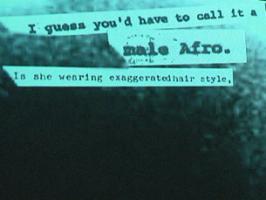
This hybrid video blends fictional and documentary source material in an imaginative re-creation of a crucial political moment in U.S. history. Co-scripted by Rick Moody (The Ice Storm), it tells the story of an FBI agent who confesses to his involvement in the nationwide search for Angela Davis, the famous radical philosopher and black activist who was on the FBI`s "Ten Most Wanted" list in 1970 and an underground fugitive for two months.
"Coco Fusco is a New York-based interdisciplinary artist and writer. She has performed, lectured, exhibited and curated around the world since 1988. She is the author of "English is Broken Here" (The New Press,1995), "The Bodies That Were Not Ours and Other Writings" (Routledge/inIVA, 2001) and the editor of "Corpus Delecti: Performance Art of the Americas" (Routledge, 1999) and "Only Skin Deep: Changing Visions of the American Self" (Abrams, 2003). Fusco is a recipient of a 2003 Herb Alpert Award in the Arts. Fusco`s performances and videos have been included in such events as The Whitney Biennial, Sydney Biennale, The Johannesburg Biennial, The Kwangju Biennale, The London International Theatre Festival, and the National Review of Live Art. Her 1993 documentary about her caged Amerindian performance with Guillermo Gómez-Peña, The Couple in the Cage, has been screened at over two hundred venues around the world. She recently curated a comprehensive exhibition on racial taxonomy in American photography for the International Center for Photography, Only Skin Deep: Changing Visions of the American Self, that is currently on tour. Her latest video, a/k/a Mrs. George Gilbert, was selected for the 2004 Shanghai Biennale and will screen at the Museum of Modern Art in 2005. Her video, Els Segadors, commissioned by the Museum Boijmans in Rotterdam in 2001 was featured in the ICP`s first Triennial in 2003. Her video installation, Dolores from 10 to 10, received an honorable mention from the 2003 Transmediale Festival in Berlin. Fusco`s writings have appeared in a wide variety of publications, including The Village Voice, The Los Angeles Times, Art in America, The Nation, Ms., Frieze, Third Text, and Nka: Journal of African Art, as well as a number of anthologies. She is the co-founder and co-moderator of Undercurrents, an on-line discussion about feminism, new technologies and globalization. Fusco is an associate professor in the Visual Arts Division of Columbia University`s School of the Arts." Courtesy Video data bank