Catalogue > Faire une recherche
Résultats pour : Tout le catalogue

Pere Portabella
Uno de aquellos
Doc. expérimental | 35mm | couleur | 5:0 | Espagne | 2009
Ever since the 1960s, Pere Portabella involved himself in the movements against the Franco dictatorship and in support of liberties. In 1977, he was elected senator in the first democratic elections, and took part in the drafting of the Spanish constitution (1978). Since 2001, he has chaired the Fundación Alternativas. Before working as a director, with Films 59, he produced some of the most emblematic spanish films: Los golfos (1959) by Carlos Saura, El cochecito (1960) by Marco Ferreri and Viridiana (1961) by Luis Buñuel wich provoked a scandal that obliged him to move to Italy. In 1964, he wrote the screenplay for Il momento della verità with Francesco Rosi. He began directing in 1967 with No compteu amb els dits followed by his first feature-length film, Nocturno 29 (1968). Vampir-Cuadeduc (1970) is a key work in his filmography, togheter with Umbracle (1972), represents a phase of radical rupture with the production of those years and marked him as one of the most original forces in underground and avantgarde cinema of the time. After Informe General of 1976 he only returned to directing in 1989, with Pont de Varsòvia. In 2001, his films became part of the collection of the Barcelona Museum of Contemporary Art (MACBA). In 2002, he was the only Spanish artist to be invited to Documenta 11 in Kassel. In 2008, the Museum of Modern Art of New York (MoMA) acquires a copy of Vampir-Cuadecuc and Die Stille vor Bach (2007).

Marianela Portillo, Ignacio Iasparra, Marianela Portillo, Stecconi Bruno, Nicolas Dominguez Bedini and Guillermo Ueno
Sinuosos y dorados médanos
Doc. expérimental | hdv | couleur | 61:14 | Argentine | 2015
11 years happens in Medanos, a town of 5,000 inhabitants of the Province of Buenos Aires, an unprecedented event. A group of boys and girls with artistic interests, decided to get together and organize actions to not migrate. From cooking pig in a field, until the sale of raffles to pay future expenses Médanos Cultural Center, they began with their own initiatives. This group takes one of the greatest works of political activism in the Argentine art scene, show that you can work in a class without having to constantly look outside is one of the objectives of the documentary. When we learned that for various reasons the last "Spring Season" would take place was born the idea of making a documentary film project the history of Medanos and traveled Group. Record the lives and experiences of a generation that cultural alternatives proposed for years and also show how they live some historical villagers who were able to access and frequent. Who create Winding & golden Médanos: Ignacio Iasparra, Marianela Portillo, Stecconi Bruno, Nicolas Dominguez Bedini and Guillermo Ueno, we think of a documentary sketch experience local cultural management. That assumed a commitment to its people. Through self-management and the pursuit of aesthetic deliver.
Guillermo Ueno, Buenos Aires 1968 Photographer, Video maker. Between 1999 and 2015 he showed his work in Gallery Benzacar .Belleza y felicidad. Malba .Mamba .Macro. Museum of Contemporary Art Niteroi, Brazil. Cultural Center Medanos .Vasistas Gallerie, Montpellier , France. FNA . Printed Matter , NY. Argentine Consulate NY. Museum of Contemporary Art Santiago de Chile. Catena Gallery. Gallery TL OAS , Washington. He published regularly in Purple , Purple Journal, Les Chronicles Purple, iD magazine , Lápiz Japonés, Masterbox , Hawaii, Otso. Director of photography and camera Hachazos Andrés Di Tella , 2011 , 327 cuadernos Andrés Di Tella 2015 . Davidovski (one day in Medanos ), 2015 . Co-direction (Sergio Subero ) Alter Sapukai ! Bafici 2012. Sinuosos y dorados Médanos 2015 , with Ignacio Iasparra , Marianela Portillo, Bruno Stecconi and Nicolas Dominguez Bedini .

Clément Postec, Delwaulle Pauline
Linescape
Documentaire | dv | couleur | 30:0 | France | 2010
Une ligne-frontière divise la Bosnie-Herzégovine en deux entités autonomes et dépendantes. Nous partons à la recherche de cette ligne mais peu à peu les traces de sa présence viennent troubler l?enquête...
Clément Postec, réalisateur, 24 ans, né le 8 février 1986 Après un baccalauréat scientifique option cinéma audiovisuel, Clément Postec poursuit sa formation en classe préparatoire littéraire option études cinématographiques au Lycée de Sèvres (92). En 2007, il obtient une licence de lettres modernes et une licence de cinéma à l?Université de Paris 3, Sorbonne Nouvelle. Il passe une année au sein du département des Film Studies à l?Université de Kent à Canterbury au Royaume-Uni, puis poursuit son parcours en master recherche études cinématographiques à l?Université de Paris 3. En parallèle, il a réalisé un court métrage, à propos d?e., mise en fiction de moments de danse contemporaine. Il travaille régulièrement la vidéo, moins comme objet définitif que comme laboratoire de ses projets de films (www.etcaeteraprod.org). Diplômé de l?IEP Sciences-Po Strasbourg (Politique et Gestion Culturelles), il est actuellement assistant de direction artistique pour pointligneplan. Pauline Dewaulle(co-réalisatrice), 22 ans, née le 2 décembre 1988. Elle s?intéresse au cinéma depuis une durée indéterminée, et a fait quelques films en super 8, dont Portrait de Jean Rolin (commande du musée portuaire de Dunkerque et de la Drac nord ? Pas-de-Calais) et La bête à rêves. Avant de quitter la mer du Nord et ses dunes pour rejoindre Paris, elle prend part à divers ateliers de création, et notamment participe à la réalisation d?un court-métrage avec Jean-Charles Fitoussi. Ainsi, après un baccalauréat littéraire en classe européenne, elle entre en 2006 à l?Ensa Paris-Cergy. Elle y fait des dessins et des films d?animation dont Personne ne peut exiger de la mer qu?elle porte tous les bateaux (grattage sur pellicule 16 mm) ; Les oiseaux (dialogue avec cage), installation de projecteurs 16 mm projetant un même film divisé en deux pellicules ; Le grand sommeil, film réalisé à partir de dessins fixes d?un dormeur. En parallèle, elle prend part à de nombreux projets, dont Je m?appelle Hélène d?Hélène Motteau et Le dernier voyage de Maryse Lucas d?Artus de Lavilléon et David Ledoux en tant que cadreuse.

Stuart Pound
Birdsong Marimba
Vidéo expérimentale | dv | couleur et n&b | 7:5 | Royaume-Uni | 2005
Après une décision irréversible, un débat politique est plongé dans une ambiance de marimba, chants d´oiseaux, et de photographies.
Stuart Pound a un passé de réalisateur et travaillait sur le calcul par ordinateur. La vidéo numérique lui a permis de conjuguer ces deux domaines. Il débuta la réalisation en 1970 en tant que membre de la London Film-makers Co-op et enseigna la réalisation à l´Université Nottingham Trent par la suite, jusqu´en 1979. Ses oeuvres ont été exposé lors de festivals à Londres entre autres.

Stuart Pound
Tehran Trace
Art vidéo | dv | couleur | 7:25 | Royaume-Uni | 2005
Tehran Trace emprunte le même chemin en mouvement, le pas lent et silencieux, à travers quatre photographies figées: le vestibule de l'Hotel Laleh, le Mirror Hall of the Golestan Palace, un arche en pierre tourné vers le nord de la ville et un bazar avec vue sur des montagnes. Chaque "piste" commence en gros plan, s'éloigne en courbe de son sujet d'ouverture et finit avec l'image initiale cadrée intégralement.
Stuard Pound a reçu une formation en réalisation et en informatique,la vidéo numérique réunissant les deux activités. Il fait ses débuts dans la réalisation en 1970 comme membre de la London Film-makers Co-op et enseigne par la suite la réalisation à la Nottingham Trent University jusqu'en 1979. Son oeuvre a été présentée dans des festivals à Londres et ailleurs ainsi que via internet. Des projections ont eu lieu notamment à MoMA (Paris),Tate Modern, Impakt Festival Utrecht, London Film Festival, Split International Festival of New Film, VIPER (Basel), International Media Art Biennale Wroclaw, Vidéoformes Clermont-Ferrand , Media Forum, Moscow International Film Festival , prog:ME, Centro Cultural Telemar, Rio de Janeiro, KunstFilmBiennale Köln, Microwave International Media Art Festival, Hong Kong

Schahram Poursoudmand, Yoann Trellu
Schmutziges Licht (Lichtphon Art-Avant X)
Performance multimédia | hdv | couleur et n&b | 7:35 | Allemagne | 2018
Schmutziges Licht (Lichtphon Art-Avant X) An abstract, poetic visual-sound-drama The visual, tonal union and view of transcendent embodiment. A symbiosis of micro-coded, floating light-dust particles, interconnected in cracked soundscapes, layered sound cells, residual impulses and dissecting short-time cuts in noise structures. A self-born symbiotic being - alive through dissolution and constant change in time - Metamorphoses - Schmutziges Licht (Lichtphon Art-Avant X) is transformation in the beauty of decay and nonexistence. In the change of sight and hearing, reality and the levels of being resonate. Form and formlessness become inseparable. The unknown emerges, moves, penetrates into the observer, into us - becomes conscious and existent - Inner perception is infinite - Schmutziges Licht (Lichtphon Art-Avant X) is a multi-layered light-image-sound-vision. An artistic position and poetic exploration of the perception of artificial light and the unknown in the incarnate - of selfhood in an eternally lasting word in silence. On the technical side, the music consists of several hundred audio tracks with thousands of individual sounds. The visual level is based on a self-developed software particle system. There are hundreds of thousands coded pixel points, cross- linked lines and inner networked connections. Micro-audio clips, multi-level, time-independent organic soundscapes and digital visual light codes. Schmutziges Licht (Lichtphon Art-Avant X) is a complex visual sound correlation. Abstract, mysterious, filigree, powerful and subtle at the same time. A German-French co-production by the experimental artists Schahram Poursoudmand (DE) and Yoann Trellu (FR). Note: Schmutziges Licht (Lichtphon Art-Avant X) is created and produced to be played loud and projected in high quality. Please listen to it loud or via headphones. ...the night becomes the day - Light Overload - Schmutziges Licht (Dirty light) is artificial light. Excessive use of artificial light and its misuse (light pollution) on humans and the environment. Fatal consequences through the artificially constructed and manipulated lightening of the night by humans...
Schahram Poursoudmand Music & Sound Art, Composer, Visual Imagist, Poet Schahram Poursoudmand is a German composer, music & sound artist, visual imagist and poet. He creates extraordinary music, sound and visual art of a unique kind. In the avant-garde projects LICHTPHON, ONEVERYMOON, LICHTSCHREI, SHINE and ART-AVANT, he explores and realizes his artistic visions of music, sound, visual image and video art in existential poetry. The creative discovery of beauty through disintegration, dissolution, transformation, recreation and the representation of being and beyond in the transition from existence to non-existence is the essential approach and destination in his artistic passion. Music, sound, image and moving picture is stretched and condensed in form, time and space. Tonal and visual entities, sections and details, become disintegrated through dissolution in themselves and creates new structures, unknown realities and avant-garde elements by further deformation, in the beauty of decomposition. Existence, time, duality, deconstruction, humanism, transcendence, the infinite moment, the unknown, and recreation are some of the themes in his works. Schahram Poursoudmand creates unreal worlds of music, sound, visual art and poetry of strange beauty with unique aesthetics and expression. A surreal and bizarre mystery in music and visual art. „The fascination of renewal after the dissolution. The discovery and changing of time and time states. The artistic deconstruction, the diving into deep micro- and nanostructured soundworlds, as well as the representation of beauty in the creation of existence in nonexistence and new realities are the themes that stirs and fascinates me. Not the clearly audible and visible - but the secret behind the veil.“ * ...another world...an unknown place...an unknown time... * ::::::::::::::::::::::::: ::::::::::::::::::::::::: Yoann Trellu French video artist and software developer based in Berlin. Starts working with live video projections in 1999, Nantes, France. Moves to Berlin in 2003 and starts working with choreographers, creating media environment for stage productions. Yoann Trellu works internationally on numerous stage productions as well as developing his own projects through collaborations with musicians and dancers. His work is mostly abstract and stems from his early photographic work, using the camera and digital tools to alter reality, to extend details and moments into their own world. He considers the computer as a collaborator, able to suggest and create artistic elements. Using controlled randomness and probability is an important aspect of his practice, giving rules, limitations and (unlimited) variations on which to build further.

Yvan Pousset
9°N
Vidéo expérimentale | dv | couleur | 4:30 | France | 2006
La fenêtre de la video s`ouvre sur un personnage vêtu de rouge, errant dans une forêt, en quête d`un quelque chose dont le commencement serait antérieur à celui de la video. Aveugle de l`oeil qui le scrute, le personnage poursuit son activité sans relâche tel un Sisyphe d`une époque récente. L`épaisseur de la forêt s`insère entre une perception éloignée du personnage et une proximité enveloppante produit par la netteté des bruits de son déplacement (craquement de branches, respiration). La fenêtre balaye l`espace de la forêt autour du personnage qui se révèle être un point fixe dans la surface de projection. Cet espace, cette distance créée entre sa perception éloignée et sa présence sonore (et celle de l`outil de projection) laisse apparaître le flottement d`une image et de son auteur (celui qui filme) semblant plus être perdu dans son intention de filmer que le protagoniste assumant tel Sisyphe sa destinée. Déstructurer, disloquer chacun des éléments composant une illusion, serait une façon de replacer le spectateur dans sa position réelle.
Né en 1977 à Rennes, après des études dans le milieu artistique, Yvan pousset a poursuivi aux Beaux-Arts d'Angers en tant que sculpteur et s'exprime depuis 4 ans avec la vidéo. Tout son travail est larecherche d'une matérialité dans la vibration des pixels de ce médium.

Yvan Pousset
ANNA ET ROBBIE
Vidéo | dv | couleur | 1:30 | France | 2012
Un personnage en gros-plan fait face à un paysage sauvage, se dessinant au fur et à mesure derrière lui. Des spasmes le submergeront de plus en plus, jusqu`à le projeter dans la matière des lieux. La condition d`Anna et Robbie n`en est pas moins banale qu`ils sont denses et périssables.
Formé aux Beaux-Arts de 1999 à 2005, mes réalisations questionnent le corps et ses pratiques dans des installations-vidéo et vidéos expérimentales. Vidéaste indépendant, je confronte mon travail de recherche à d`autres disciplines artistiques (théâtre, musique, danse), ainsi qu`au contact de populations diverses (écoles, démarche participative, instituts d`études) et dans la volonté de lier création plastique et citoyenneté.

Yvan Pousset
Solanus ad solana
Vidéo expérimentale | dv | couleur | 1:11 | France | 2011
Une caméra embarquée voit se débattre à contre-jour et en contre-plongée, un homme muni de son arme/outil.
Formé aux Beaux-Arts de 1999 à 2005, mes réalisations questionnent le corps et ses pratiques dans des installations-vidéos et vidéos expérimentales. Vidéaste indépendant, je confronte mon travail de recherche à d`autres disciplines artistiques (théâtre, musique, danse), ainsi qu`au contact de populations diverses (écoles, démarches participatives, instituts d`études) et dans la volonté de lier création plastique et citoyenneté.

Txuspo Poyo
DELAY GLASS
Animation | dv | couleur | 8:30 | Espagne | 2007
Delay Glass 2007 animation vidéo 3D 8''30'. Couleur. Stéréo. Bilbao Delay Glass fait référence à l'?uvre inachevé de Marcel Duchamp, "The Large Glass" dans une simulation ou les contributions scientifiques, technologiques, mécaniques et érotiques acquièrent un mouvement rotatif et onaniste des différents artefacts, entre les faits et la fiction.
Txuspo Poyo was born in Alsasua-Navarra, Spain. He studied in Basque Country University(Bilbao), Where he received his B:F:A. He then spent two years in Toronto-Canada with a grand to continue education. After that he moved 1991 to New York City with a grand fron Basque Country where is living and sharing place with Bilbao. 2001 he was awarded a grant from Marcelino Botin Fundation for a ISCP residential program NY and CADA at the New York University. 2005 he got a grand from Bilboarte Fundation. 2006 he got a grand from Arte y Derecho, Madrid and he was a Gure Artea awarded, Basque Country. 2007 He got a residential at FAAP, Sao Paulo, Brasil. Where he show at File Festival, Sao Paulo.

Txuspo Poyo
Expediente: Tunel de la Engaña (File: La Enagaña Tunnel)
Installation vidéo | hdv | couleur et n&b | 46:2 | Espagne | 2016
This project is an attempt at a residual image of the construction of the La Engaña tunnel. It is a fabric made from the threads of various intertwined stories expressed in fragments of memory, identity and history, inviting re-readings of an unfinished tale somewhere between fact and fiction. The La Engaña tunnel, with its 6,976 m length, was at the time the longest tunnel ever built in the Iberian Peninsula. This giant railway infrastructure lies between Burgos and Cantabria, and was the last stretch of an ambitious project to create a train link between the city of Santander and the Mediterranean coast. In 1941, the office in charge of public works deployed squads of political prisoners to the area. There they began building worker’s settlements, together with other laborers from all over Spain. The tunnel was completed in 1961, but the project was put on hold until 1985 when the government decided to abandon it. Inside the room, one screen shows the historic trepanning of a mountain and its interior bracing, rivalling in proficiency with a team of operatives who hollow out a pachyderm before mounting its inner frame. On the other screen, an elephant advances through the ruined remains of platforms, a station and the former worker’s homes before ending up inside the tunnel. The animal’s state connects with the accounts of survivors in terms of physicality, emotional charge and feelings of grief. On both screens, the actions of digging and emptying draw on the poems Digging by Seamus Heaney and The Hollow Men by T. S. Eliot, as if each were stationed Metaphorically at one of the tunnel’s extremes. A third screen in the hall depicts a recent action performed at the southern mouth of the La Engaña tunnel, now sealed off by a wall. A worker is engaged in restoring the missing letter « E ». Lodged inside the new « E » is a time capsule with the spoken testimonies of survivors who worked at both ends of the tunnel. This tunnel is a deep hole in the body of history, the inside of a belly emptied ofits organs, a cave, a dark abyss, a wound, but also the door that leads us to theunknown and an entrance to advance from, in spite of the warning.
Txuspo Poyo (1963, Alsasua, Navarra) holds a BA in Fine Arts from the University of the Basque Country (UPV). In 2001 he completed an ISCP residency sponsored by Fundación Marcelino Botín and also studied at the CADA center of New York University. In 2006 he received funding from Fundación Arte y Derecho and Fundación de las Artes de Valencia for his Delay Glass project, and the same year won the Premio Gure Artea of the Basque Government. In 2008, he was awarded first prize at the 10th Unión Fenosa International Exhibition. He has taken part in the Madrid Region’s 15th Image Symposium, and has been an invited speaker on master’s programs at the University of Cuenca and the UPV. He has held solo exhibitions in venues such as Museo Artium in Vitoria, Centre d’Art la Panera in Lleida, the Costa Rica Museum of Contemporary Art and Design and the Montcada Gallery of Fundació la Caixa in Barcelona. His group exhibitions include Geopolíticas de la animación showing at the CAAC in Seville and MARCO in Vigo; Les Rencontres Internationales Paris/Madrid/Berlin; the 2nd Angola Triennial; the FILE in São Paulo; Incógnitas at the Guggenheim Museum Bilbao; Cine y casi cine at the Reina Sofía in Madrid; Multitude at the Artist Space gallery in New York, and Fundación Sandretto Re Rebaudengo, in Guarene Turin, Italy.

Txuspo Poyo
Love Needs Time to Kill
Fiction expérimentale | 4k | couleur et n&b | 21:28 | Espagne | 2020
L’idée de penser ce projet en commençant par la fin est un symptôme de la crise de l'expérience historique. Alors que les séminaires du Pays basque ont commencé à fermer, leurs méthodes pédagogiques se sont vues réduites aux souvenirs de plusieurs générations. "Love Needs Time to Kill" traite du vide causé par la perte de ce qui est naturel et culturel. Dans les dernières décennies, les séminaires franciscains, et ceux d'autres ordres, ont fermé leurs portes dans tout le Pays basque. Avec la fermeture, vient la perte d'une pédagogie qui a été un pilier fondamental dans l'éducation et l'identité du Pays Basque. Une partie de cette approche pédagogique consistait en de grandes collections de spécimens de plantes et d'animaux, ramenés de missions dans les colonies en Amérique, en Afrique et en Asie. Ce projet de recherche fait le lien entre l'identité ainsi que l’approche pédagogique oubliée de la diaspora dans les missions, et la construction d'un imaginaire exotique et colonial. Sur la scène d'un petit théâtre dans l'un des séminaires fermés, nous avons recréé une nature morte baroque du XVIIe siècle. Cette nature morte devient une forme de barricade, un geste de lutte et de résistance, dans lequel les corps inertes mais expressifs des animaux affirment un sens du destin et de l'incertitude qui nous a accompagnés depuis l'époque romantique, jusqu'à aujourd'hui.
Txuspo Poyo est né à Alsasua (Espagne). Il a obtenu une Licence en beaux-arts à la UPV-EHU - Université du Pays basque, Leioa (Espagne). En 2001, il a participé à une résidence ISCP – International Studio and Curatorial Program, New York (USA), parrainée par la Fondation Marcelino Botín, et a également étudié au CADA Center de la New York University (USA). En 2006, il a reçu un financement de la Fondation Vegap – Visual Entidad de Gestión de Artistas Plásticos (Espagne) et de la Fundacio?n de las Artes de Valencia (Espagne) pour son projet "Delay Glass", et a remporté la même année le prix Gure Artea du gouvernement basque. En 2008, il a obtenu le premier prix de la 10e Unión Fenosa International Exhibition, A Coruña (Espagne). En 2015, il a reçu la grande bourse Multiverso de la Fondation BBVA (Espagne), pour son projet à propos du tunnel La Engaña. En 2018, il a reçu une des bourses du Centre d'art contemporain Huarte (Espagne) et du gouvernement de Navarre (Espagne) pour le projet "Izaro". En 2019, il a reçu une bourse de la Fondation Vegap - Visual Entidad de Gestión de Artistas Plásticos (Espagne). Il a participé au 15e Image Symposium de la région de Madrid (Espagne), et a été invité à intervenir dans des programmes de Master à la Universidad de Cuenca (Équateur) et à la UPV-EHU - Université du Pays basque, Leioa (Espagne). Il a présenté des expositions individuelles dans divers lieux, notamment à la Fondation BBVA, Madrid (Espagne); au musée Artium, Vitoria-Gasteiz (Espagne); au Centre d'Art La Panera, Lleida (Espagne); au Museo de Arte y Disen?o de Costa Rica, San José (Costa Rica); et à la galerie Montcada de la fondation La Caixa, Barcelone (Espagne). Parmi ses expositions collectives, citons "Geopolíticas de la animación", présentée au CAAC – Centre andalou des arts contemporains, Séville (Espagne), au MARCO – Museo de Arte Contemporánea, Vigo (Espagne); Les Rencontres Internationales Paris/Madrid/Berlin (France/Espagne/Allemagne); la 2e Triennale d'Angola, Luanda (Angola); le FILE - Festival Internacional de Linguagem Eletrônica, São Paulo (Brésil); "Incógnitas" au Musée Guggenheim de Bilbao (Espagne); "Cine y casi cine" au Musée Reina Sofía, Madrid (Espagne); ainsi que "Multitude" à la Artist Space Gallery, New York (USA), et à la Fondation Sandretto Re Rebaudengo, Guarene-Torino (Italie).
Txuspo Poyo
U.N(INVERSE)
Animation | dv | couleur | 19:0 | Espagne | 2010
U.N(Inverse) is a project that delves into mechanisms of historical complexity from tracks of fragmentation as questions of interpretation, narration and fiction that has surrounded the construction of the United Nations, specifically the architectural complex of the New York headquarters. Constant changes of reference models have taken me to the crossroads between the idealism of the moment and the symbolism, the architecture and the cinema, sharing the limelight at a time of collapse. In terms of architecture, the decongestion and suspension proposed by Le Corbusier compared to the ideological vacuum of Wallace (the architect in vogue at that time), the backdrop of the cinema in the middle of the Cold War and as now the UNO is surrounded by Hollywood stars to promote themselves abroad; in this way Peter Pan?s Tinkerbell is the new ambassadress of the United Nations.
Txuspo Poyo was born in Alsasua-Navarra, Spain. He studied in Basque Country University(Bilbao), Where he received his B.F.A. He then spent two years in Toronto-Canada with a grand to continue education. After that he moved 1991 to New York City with a grand fron Basque Country where is living and sharing place with Bilbao. 2001 he was awarded a grant from Marcelino Botin Fundation for a ISCP residential program NY and CADA at the New York University. 2005 he got a grand from Bilboarte Fundation. 2006 he got a grand from Arte y Derecho, Madrid and he was a Gure Artea awarded, Basque Country. 2007 He got a residentian at FAAP, Sao Paulo, Brasil. Where he show at File Festival, Sao Paulo. 2008 he was awarded the first price at the international Union Fenosa competition, Spain. Txuspo has participated in the XV simposion of the study of the image, Madrid. 2010 invited artist in a master talk at the Cuenca University. Spain.

Marlies Pöschl
Vivo Vision
VR vidéo 360 | mp4 | couleur | 34:30 | Autriche | 2024
The young Swiss economist Hans travels to Thailand with his mum to visit his grandmother in “Vita Bona”, a care home for European seniors. The facility has changed its name and is hard to find at first. When they finally arrive, it is completely different from what they expected: a perfectly styled wellness retreat for young people. While Hans indulges in the beauty of the place, Daniela wanders through the labyrinthine complex in search of her mother and observes strange occurrences. Where are the senior citizens? What is the manager Mrs. Vasall hiding behind her charming smile? This conceptual VR film is a dystopian parable about the outsourcing of care work, as produced by our neo-colonialist globalized economic system. “Vivo Vision” refers to a way of seeing that Ms. Vasall, the manager of the resort, has invented. Wellness retreat and retirement home are present in the same place, but without interfering with each other. While the young people practice yoga poses by the pool, the seniors and workers have been relocated to another, invisible level. “Vivo Vision” is a view of the world in which everything that is considered unproductive in a capitalist logic has become invisible.
MARLIES POESCHL is an artist, filmmaker, curator and educator. She is currently based in Vienna (AT), where she teaches at the Academy of Fine Arts Vienna, but has previously worked in France, Iran, Thailand and China. Shifting between artistic, curatorial and educational approaches, Pöschl is interested in art as a form of knowledge production. She understands filmmaking as social practice and often collaborates with actors from outside the art world in search for polyphonic narrations and open-ended dramaturgies. Since 2018 Pöschl has focused on ways in which societies of the global north respond to the ‘care crisis’. Pöschl has received various prizes for her work: in 2022 she was granted the state scholarship for media art, in 2021 the Young Artist’s Award (City of Vienna). Her films and installations have been shown in several solo presentations, a.o. Kunstverein Ludwigshafen, DE (2022), Salzburger Kunstverein, AT (2021), CAC Brétigny, (2018) and MUSA, Vienna, AT (2016). She has participated in biennales and film festivals such as the Vienna Biennale for Change (AT), Antimatter media art festival (CA), Edinburgh International Film Festival (GB), Cinema Verité (IR), Diagonale (AT) and others. Her work is distributed by VTape and The Golden Pixel Cooperative.

Lucia Prancha
CASA DO SOL
Vidéo expérimentale | hdv | couleur | 12:0 | Portugal, Brésil | 2020
"Casa do Sol" explore l'œuvre et l'héritage de l'écrivaine brésilienne Hilda Hilst (1930-2004). Souvent décrite comme le marquis de Sade du Brésil, elle aborde dans son œuvre étonnante le mysticisme, la folie, l'incarnation, l'érotisme et la libération sexuelle des femmes. Hilst fait partie des auteurs de langue portugaise les plus importants du vingtième siècle. Pourtant, son œuvre est pratiquement inconnue dans notre communauté. "Casa do Sol", traduit du portugais "Maison du soleil", est le nom de la maison de Hilst. De son vivant, sa demeure était un lieu de rassemblement important pour les écrivains, les artistes et les intellectuels. Aujourd'hui, Casa do Sol conserve ses archives et accueille un programme de résidence en petit comité, qui permet aux écrivains et aux artistes de s’imprégner de la magie rustique du lieu. La vidéo de Lucia Prancha, "Casa do Sol", a été tournée sur place, dans la maison et les jardins de Hilst, pendant l'été 2019, et utilise le texte d'une des nouvelles de Hilst. Cette vidéo expérimentale explore la sexualité et le colonialisme à travers le militantisme politique et poétique de son écriture.
Lúcia Prancha (née en 1985, au Portugal) a obtenu un MFA au CalArts – California Institute of the Arts, Los Angeles (USA), en 2015, après avoir fait des études de licence à Lisbonne (Portugal) [2009] et de Master à São Paulo (Brésil) [2012]. Elle explore les tensions entre esthétique, perception et politique, souvent en repensant des sites historiques et sociaux précis à travers la sculpture, la vidéo et l'impression. Son travail a été exposé à la LACA - Los Angeles Contemporary Archive, Los Angeles (USA); au Hordaland Kunstsenter, Bergen (Norvège); à la Serralves Foundation, Porto (Portugal); à la Galeria Leme, Sao Paulo (Brésil) et au Museu Berardo, Lisbonne (Portugal). En 2016, son film "Sebastian, The Ghost" a été projeté aux Rencontres internationales Paris/Berlin nouveau cinéma et art contemporain (France/Allemagne) et au 24e Curtas Vila do Conde – International Film Festival, Vila do Conde (Portugal). En 2017, Elle a été artiste en résidence à la Jan van Eyck Akademie, Maastricht (Pays-Bas). Au printemps 2020, elle a fait partie de la Visiting Artist Faculty de CalArts - California Institute of the Arts, Los Angeles (USA).

Lucia Prancha
Sebastião, O Fantasma
Fiction | hdv | couleur | 14:57 | Portugal, USA | 2014
Sebastian of Portugal disappeared in the battle of Alcácer Quibir and is often referred to as The Desired by the Portuguese. The people of Lençóis believe that the ghost of Sebastian of Portugal haunts their Brazilian island. Some see themselves as direct descendants of the king. They also believe that every first Friday of every month king Sebastian visits the beach in full armour and on his horse, and that a subterranean ouroboros will swallow the island some day. A group of people who inhabit the island of Lençóis on the Northeast of Brazil and their interest in the myth of D. Sebastião I (Sebastian of Portugal 1554-1578).
Lúcia Prancha (1985, Lisbon / Portugal) received a MFA from CalArts - California Institute for the Arts (2015). Lúcia explores the tensions between aesthetics, perception and politics rethinking historical and social episodes through installation, video and sculpture. Her work has been exhibited at the Serralves Foundation, Oporto, Portugal; Galeria Leme, Sao Paulo, Brazil and Galeria Baginski, Lisbon, Portugal. In 2013, she was the recipient of a two-year Calouste Gulbenkian Foundation and the Luso-American Foundation for Development (FLAD) Scholarship. Presently practicing in Los Angeles.
Lucia Prancha
CHARLES
Doc. expérimental | hdv | noir et blanc | 2:38 | Portugal, USA | 2025
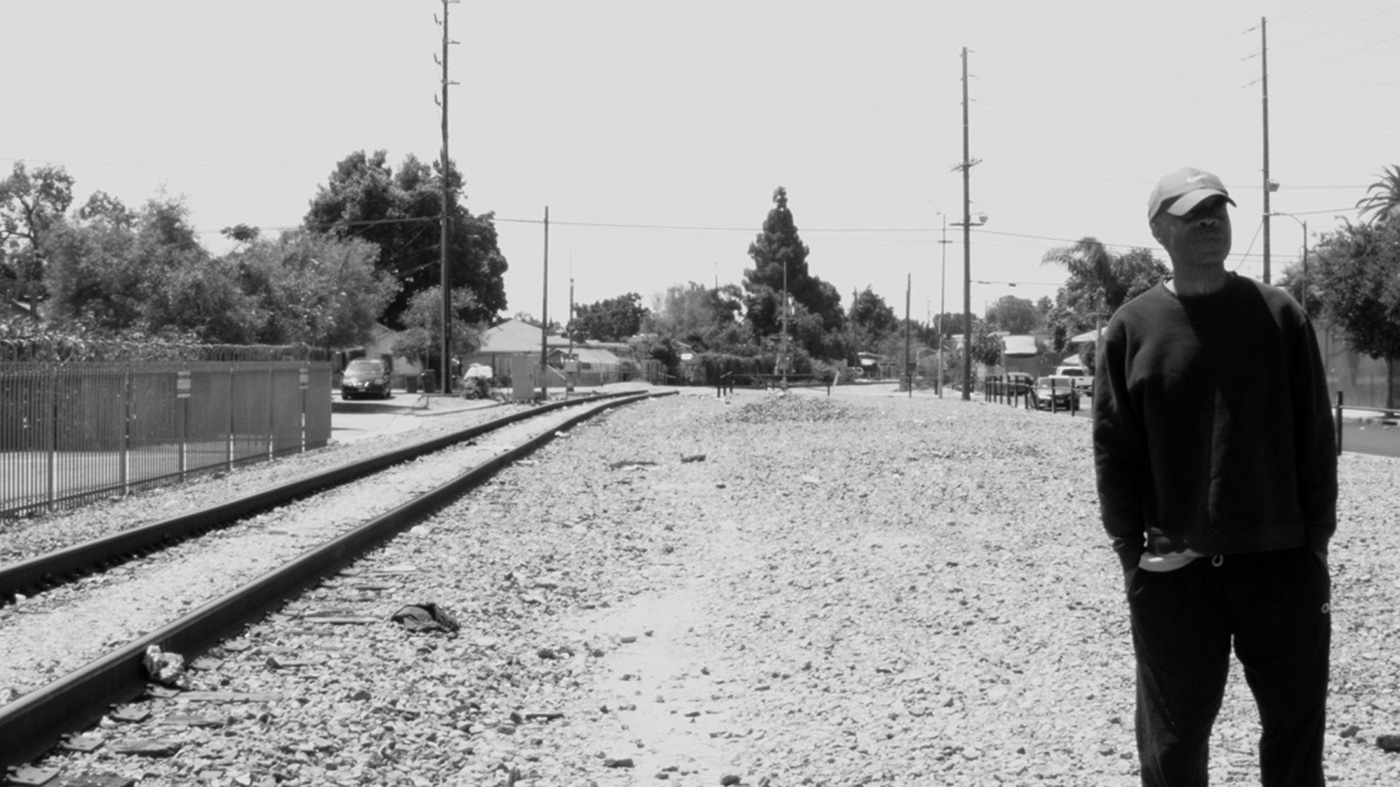
Do you remember the scene in Killer of Sheep (1978) où les enfants jouent sur des voies ferrées abandonnées ? La scène se déroule dans le quartier de Watts, en Californie. Le réalisateur Charles Burnett a emmené l’artiste Lúcia Prancha sur plusieurs lieux de tournage de ses films à Los Angeles
Lúcia Prancha (1985, Lisbonne) est une artiste qui vit et travaille à Barcelone. Lúcia est diplômée en peinture de la FBAUL (2009, PT) et a obtenu un Master en arts à CalArts – California Institute of the Arts (2015, USA). Son travail a été exposé au Pavilhão Branco, Museu da Cidade, Lisbonne ; au 19 Crac de Montbéliard ; au Centro de Arte Oliva ; au Sesc-Pompeia, São Paulo ; à LACA – Los Angeles Contemporary Archives ; au Hordaland Kunstsenter, Bergen ; à la Fondation Serralves, Porto ; à la Galeria Dynamo, Porto ; à la Galeria Leme, São Paulo ; au Musée Berardo, ainsi qu’à la Biennale de São Paulo. Ses vidéos ont été projetées à la Cinemateca Portuguesa ; à INTERSECCIÓN, La Corogne ; à Curtas Vila do Conde ; aux Rencontres Internationales Nouveau Cinéma et Art Contemporain de Paris ; et à la Haus der Kulturen der Welt, Berlin. Elle participe actuellement à « El vértigo de las imágenes », XVIIIe Biennale Internationale de Photographie – Fotonoviembre, au TEA – Tenerife Espacio de las Artes et au Centro de Fotografía Isla de Tenerife, ES. De septembre à novembre, elle sera en résidence artistique à la Cité Internationale des Arts à Paris.

Sorayos Prapapan
Boonrerm
Fiction | hdcam | couleur | 16:35 | Thaïlande | 2013
Boonrerm is a housemaid.Every day she received a weird order.
Sorayos Prapapan is a part of thai independent filmmaker. He graduated from Department of Film and Photography Thammasat University Thailand in 2009 He began his career working as Production Assistant for Uncle Boonmee Who Can Recall His Past Lives (2010 Palme D`Or Winner Festival De Cannes) Now he working as sound recordist,foley artist and sometimes sound designer for thai independent film such as 36 (2012 New Current Award Busan Winner) and just graduated from Asian Film Academy 2013. Beside that he directed his own short such as Noumena Scene,Boonrerm and Long Live the Kim.

Sorayos Prapapan
Digital Funeral: Beta Version
Film expérimental | dcp | couleur | 5:24 | Thaïlande | 2020
Un de mes rêves est d'organiser mes propres funérailles.
Sorayos Prapapan est né en 1986, en Thaïlande. Il est réalisateur indépendant. Il a réalisé plusieurs films courts primés dans son pays et présentés dans de nombreux festivals internationaux, notamment à la Mostra de Venise (Italie), au Festival international du film de Locarno (Suisse), au Festival international du film Rotterdam (Pays-Bas), et au Festival International du Court Métrage à Clermont-Ferrand (France).

Katja Pratschke, Gusztáv Hámos
Cities (Territories & Occupation)
Doc. expérimental | 4k | couleur et n&b | 29:50 | Allemagne | 2019
Cities (Territories & Occupation) is about "the city" divided into districts, neighborhoods, zones and domains, marked by inner-city borderlines. The film investigates how cities emerge and change through inclusion and exclusion, migration, decay, destruction, demolition, relocation, displacement. Urban territories, districts are characterized by different social processes, business relationships, power relations, private affairs. We wonder how urban territories are formed and why they change? Who controls the city or how do the inhabitants create free spaces? Who owns the city?
Gusztáv Hámos, born in Budapest, lives in Berlin, is a media artist, curator and author. His oeuvre includes video, film, photography and installation and has been exhibited at Documenta, Biennale Venice, ZKM Karlsruhe, Ludwig Muzeum Budapest. His videos and films have been shown at Tate Modern London, SFMOMA, Videobrasil Sao Paulo, Palais de Tokyo Paris, Ernst Muzeum Budapest and Art Basel Miami. His work is in the Collections of The Museum of Modern Art NY, Centre Georges Pompidou Paris, Múzeum Ludwig Budapest, NBK Berlin and ZKM Karlsruhe. Katja Pratschke, is a media artist, curator and since 2006 has organised photofilm seasons with Gusztáv Hámos with whom she has collaborated since 1998. Her films and installations have been shown at Ludwig Muzeum Budapest, Akademie der Künste Berlin, IndieLisboa and the 63th Mostra Internazionale d’Arte Cinematografica di Venezia. She has received various awards and grants: german short film award, travel grant of the Hessische Kulturstiftung, Artist-in-Residence Istanbul, Dhaka, Venice and Kolkata.

Katja Pratschke, Gusztáv Hámos
Cities
Fiction expérimentale | 35mm | couleur et n&b | 27:0 | Allemagne | 2012
The theme of the film HIDDEN CITIES is personal urban perceptions, which we call »the city«. The city, as a living organism, reflecting social processes and interactions, economic relations, political conditions and private matters. In the city, human memories, desires and tragedies find expression in the form of designations and marks engraved in house walls and paving slabs. But what the city really is under this thick layer of signs, what it contains or conceals, is what we are researching in the HIDDEN CITIES project. The source material for the film are 9 sequential photo works created by Gusztáv Hámos between 1975 and 2010. Each of these »city perceptions« depicts essential situations of urban experiences containing human and inhuman acts in a compact form. The cities in which the photo sequences have been made are Berlin, Budapest and New York ? places with a traumatised past: Wars, dictatorships, terrorist catastrophes.
Gusztáv Hámos, born in Budapest, lives in Berlin. He is an artist, curator and author. His artistic work includes video, film, photography and installation and has been exhibited at Documenta, Biennale Venedig, ZKM Karlsruhe, Ludwig Muzeum Budapest. His videos and films were shown a.o. at Tate Modern London, Rencontres Internationales, 63th Mostra Interernazionale d?arte cinematografica di Venezia, Section Corto Cortissimo, SFMOMA, YBCA San Francisco. His work is included in the Collections of MOMA NY, Centre Georges Pompidou Paris, NBK Berlin, ZKM Karlsruhe, Kunstsammlung NRW, Ludwig Museum Budapest, C3 Budapest, Saint Gervai SIV, Geneve. Katja Pratschke is an artist, curator and since 2006 she has organised photofilm seasons with Thomas Tode and Gusztáv Hámos with whom she has collaborated since 1998. Her artistic projects include: Natural Born Digital (1998); Fremdkörper/Transposed Bodies (film, installation, book, 2001/2003); Rien ne vas plus (film, installation, 2005); Fiasko (split screen film 2010, book 2012), Cities (Verborgene Städte) (film, installation, book 2012). Her films were shown a.o. at Tate Modern London, Rencontres Internationales Paris/Berlin/Madrid, Triennale der Photographie Hamburg, 63th Mostra Interernazionale d?arte cinematografica di Venezia, Sektion Corto Cortissimo. She is co-editor of the publication Viva Fotofilm bewegt/unbewegt, Schüren 2010, and co-founder of the Concrete Narrative Society e.V.