Catalogue > Liste par artiste
Parcourez la liste complète des artistes présentés dans le cadre des Rencontres Internationales depuis 2004. Utilisez le filtre alphabétique pour affiner vos recherches.
Jenni Toikka
Catalogue : 2023Prelude Op. 28 No. 2 | Film expérimental | 16mm | couleur | 8:25 | Finlande | 2022
Jenni Toikka
Prelude Op. 28 No. 2
Film expérimental | 16mm | couleur | 8:25 | Finlande | 2022
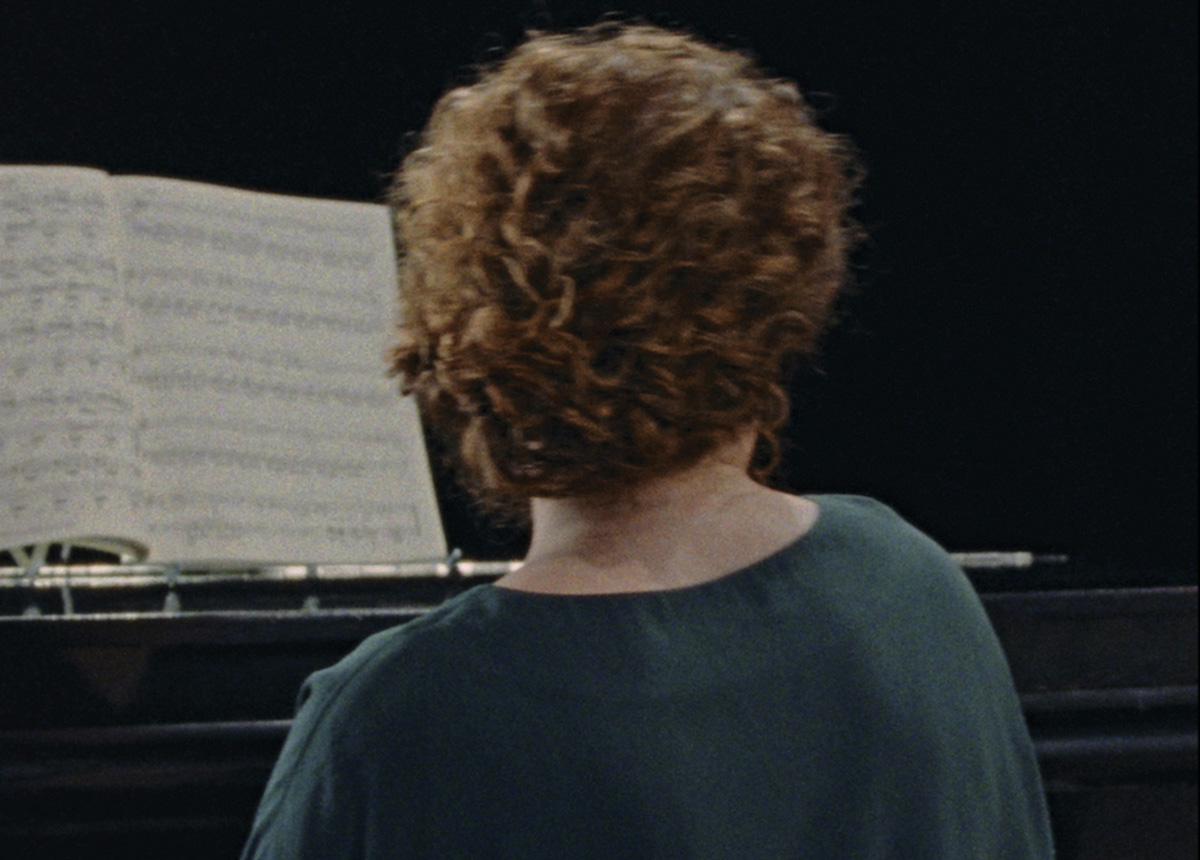
During a single long shot, we see two people taking turns playing the piano and listening alternately. The piece is the same on both times - Preludi Op. 28 No. 2 by Chopin - but when the performer changes, the interpretation of the song changes along with the perspective from which the song and its performance are viewed. The uninterrupted playing and single shot capture the event in one temporal moment, but as the camera moves and two people change places, time is equally layered. The performer becomes the listener and the listener becomes the performer. In one of the key scenes of Ingmar Bergman's Autumn Sonata (1978), the mother and daughter take turns playing the very same Chopin's Prelude. It is a piece that both are familiar with, so they are able to settle into the position of the other as they listen and watch the other play. A situation like this raises questions about the sense of reciprocity, simultaneity and synaesthesia. Could the roles become mixed from viewer and listener to the object of the gaze and listening? When watching the other playing, can you feel your own hands and fingers on the keys?
Jenni Toikka (b. 1983) is a Helsinki-based visual artist working predominantly with moving images. Toikka graduated from the Academy of Fine Arts, Helsinki in 2012. She has had several solo exhibitions in Helsinki including at Sinne, Forum Box and Kluuvi Gallery. In autumn 2019, her work was shown in the solo exhibition Reel at HAM – Helsinki Art Museum. Jenni Toikka’s video pieces have been seen internationally in group exhibitions and at festivals. Her work is represented in the collections of the Saastamoinen Foundation, Espoo Modern Art museum EMMA and the Museum of Contemporary Art Kiasma.
Jenni Toikka, Eeva-riitta Eerola
Catalogue : 2025W is for Waves | Film expérimental | 16 mm | couleur | 9:53 | Finlande | 2024
Jenni Toikka, Eeva-riitta Eerola
W is for Waves
Film expérimental | 16 mm | couleur | 9:53 | Finlande | 2024
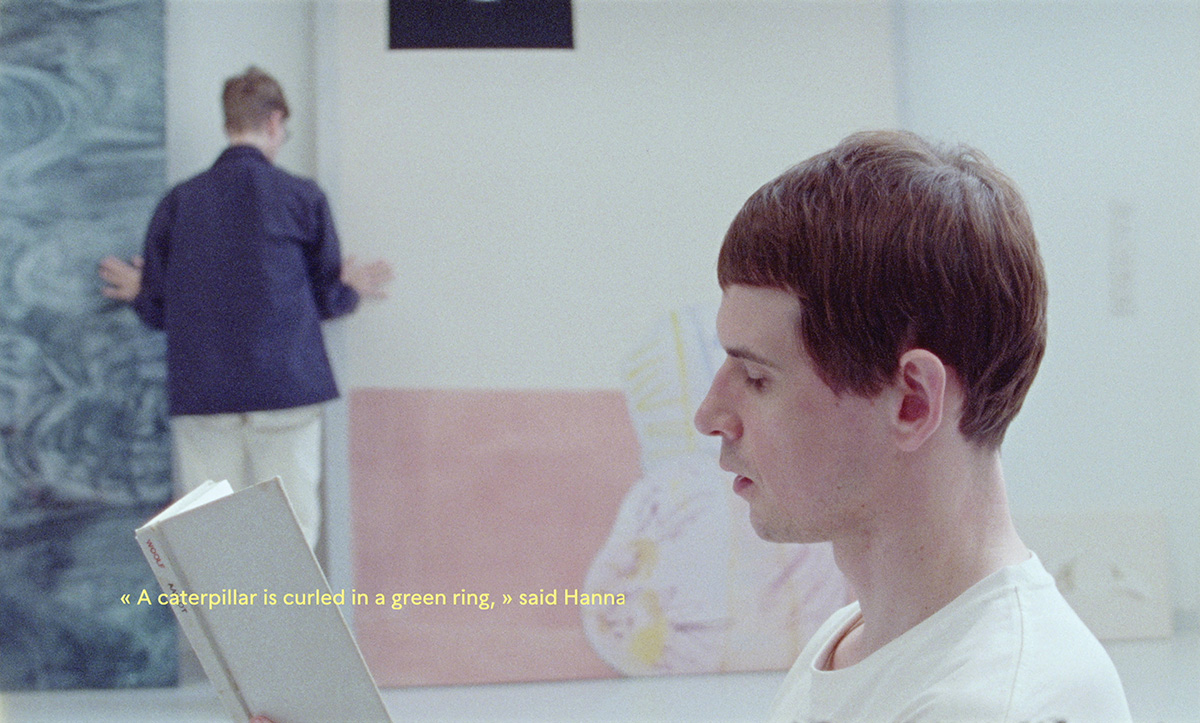
The film W is for Waves takes sisters, author Virginia Woolf and visual artist Vanessa Bell, as a starting point to explore the artistic process and examine the relationship between the visual and the literary. We see a choreography of two figures taking turns reading a book and moving with two large-scale paintings. The camera witnesses the actions and plays a subtle yet active role in altering the experience of space and visibility The film was shot on 16 mm film at Bell’s country house, Charleston, in East Sussex, and at Kalervo Kallio’s Artist Home in Helsinki. The text is adapted from Virginia Woolf's novel The Waves (1931), with some modifications.?
Jenni Toikka (b. 1983) is a Helsinki-based visual artist who graduated from the Academy of Fine Arts (FI) in 2012. Toikka has had several solo and group exhibitions in Finland and abroad, and her works have been shown at international film festivals. Her work is represented by different public collections such as the Museum of Contemporary Art Kiasma and the Saastamoinen Foundation. Alongside her own artistic work, Toikka has also worked in many artistic ensembles and she is one of the founding members and curators of Monitoimitila O. Eeva-Riitta Eerola (b. 1980) graduated from the Finnish Academy of Fine Arts in 2010 and has also studied at the École nationale supérieure des Beaux-arts de Paris. She has exhibited in several group and solo exhibitions in Finland and abroad, e.g. at Galleri Bo Bjerggaard, Copenhagen, in 2015 and Gallery Jaus, Los Angeles, 2014. Eerola's latest solo show, Locus, was seen at Helsinki Contemporary in January 2022. Eerola’s work is represented in a number of Finnish art and museum collections, such as those of the Museum of Contemporary Art Kiasma, Saastamoinen Foundation, Sara Hildén Art Museum, and the Wihuri Foundation. Eerola and Toikka have been working as an artist duo since 2016. Previous collaborative exhibitions have been exhibited at Turku Art Museum's Studio (2017), Hippolyte Studio in Helsinki (2018) and Maison Louis Carré in France (2019). The process-oriented and intuitive way of working and the montage-like combining of images and the use of juxtapositions define their work.
Eleni Tomadaki-balomenou
Catalogue : 2020The Chair | Animation | hdv | couleur | 0:39 | Grèce, Royaume-Uni | 2019

Eleni Tomadaki-balomenou
The Chair
Animation | hdv | couleur | 0:39 | Grèce, Royaume-Uni | 2019
A chair with breaking legs, a seat that cannot be stabilised, a place that is not guaranteed. The chair is a short animation made for the RCA degree show showreel by Eleni Tomadaki, 2019.
Eleni Tomadaki is a Greek artist based in London. Using moving image, performance and text, her work researches Scurgriness through intersecting fiction and reality. Eleni is a Masters graduate of Royal College of Art 2019, she has shown work at Tate St Ives, South London Gallery, Uppsala Art Museum and Assembly Point amongst others.
Yan Tomaszewski
Catalogue : 2022Gangnam Beauty | Doc. expérimental | 4k | couleur | 23:11 | France | 2020
Yan Tomaszewski
Gangnam Beauty
Doc. expérimental | 4k | couleur | 23:11 | France | 2020
L'influenceur·euse anglais·e Oli London est fasciné·e par la Corée du Sud et surtout par Jimin, membre du célèbre groupe de K-pop BTS. Depuis des années, iel dépense une fortune en chirurgie esthétique pour lui ressembler et devenir à son tour une star de la K-pop. Son cheminement personnel est mis en scène via un conte coréen parlant de masques, de tabou et de chamanisme.
Yan Tomaszewski is a Franco-Polish filmmaker and visual artist trained at Beaux-Arts de Paris and at Le Fresnoy Studio national des arts contemporains. His often narrative projects combine research-based methodologies with visually seductive outcomes. His films were screened in such festivals as IDFA International Documentary Film Festival in Amsterdam (NL), FIFA Montreal (CA), FID Marseille (FR), Kasseler Dokfest (DE), Doclisboa (PT), and recently in a solo presentation for Prospectif Cinéma at Centre Pompidou in Paris (FR). He has had solo exhibitions at the Archaeological Museum in Krakow (PL), at the Musée de l’Air et de l’Espace in Le Bourget (FR) or the Middelheim Museum in Antwerp (BE). He has taken part in numerous group shows, notably at the MAK Center for Art and Architecture in Los Angeles (USA), at Artience Daejeon (KR), at the Fondation Hippocrène in Paris (FR), at the Centre Pompidou (FR), and at Manifesta 9 in Genk (BE). He has received grants from Ateliers Médicis, French Institute, DRAC, CNC-DICRéAM or the Vysehrad Fund. In 2019 he was nominated for Sciences Po Prize for Contemporary Art and in 2020 he was finalist of Studio Collector Prize and laureate of Allegro Prize.
Yan Tomaszewski
Catalogue : 2020The Good Breast and the Bad Breast | Documentaire | 4k | couleur | 22:22 | France | 2019
Yan Tomaszewski
The Good Breast and the Bad Breast
Documentaire | 4k | couleur | 22:22 | France | 2019
2002, Palm Springs, Californie : une incroyable maison d’architecte est rasée au bulldozer par un individu qui venait de l’acheter 2,5 millions de dollars. Construit en 1962, ce "bijou moderniste" situé sur un majestueux terrain de golf en plein désert, fut conçu par Richard Neutra pour héberger une grande collection d’art moderne et contemporain. En puisant dans l’intérêt de Neutra pour la psychanalyse et dans les rumeurs d’une vendetta personnelle de l’acheteur, le film mène l’enquête sur notre désir de protéger et de détruire la beauté. En écho à la théorie psychanalytique de Melanie Klein, la maison devient l’incarnation du bon sein encourageant et protégeant la créativité, tandis que l’acheteur incarne l’envie du mauvais sein destructeur.
Yan Tomaszewski est un artiste franco-polonais travaillant à la croisée de la sculpture, de l’installation et du cinéma. Son travail a été présenté lors d’expositions personnelles, notamment au Musée Archéologique de Cracovie (PL), au Musée de l’Air et de l’Espace au Bourget (FR), au Centre d’art contemporain Kronika à Bytom (PL), au Middelheim Museum à Anvers (BE), à la galerie Asymetria à Varsovie (PL) ou à Primo Piano à Paris (FR). Il a participé à de nombreuses expositions collectives, notamment à Artience (Daejeon, KR), au Fresnoy Studio national des arts contemporains (Tourcoing, FR), au Prix Sciences Po pour l’art contemporain (Paris, FR), à la Galerie municipale Arsenal (Poznan, PL), à Chapter II (Séoul, KR), à la Fondation Hippocrène (Paris, FR), à Chalet Society (Paris, FR) au Centre Pompidou (FR), à Manifesta 9 (Genk, BE), à la Saline Royale d’Arc et Senans (FR). Ses films ont été présentés au FID Marseille (FR) et à DocLisboa (PT).
Pierre Tonachella
Catalogue : 2025Longtemps, ce regard | Doc. expérimental | hdv | couleur | 0:0 | France | 2024
Pierre Tonachella
Longtemps, ce regard
Doc. expérimental | hdv | couleur | 0:0 | France | 2024
Pierre Tonachella films not only to return to his childhood home in Essonne, but also to find in the work of cinema a raison d'être equal to that of the friends who stayed behind. A fragment from Schiller's letters, one of four literary excerpts that punctuate the film and provide a middle ground between the poetic and the political, suggests that return is a compass for aesthetic education. Far from sterile nostalgia, this compass points both to fidelity to origins and to a path for the future. For a long time, this vision has revived the collective, collaborative form of Jusqu'à ce que le jour se lève (presented at Cinéma du réel in 2018) after a film dedicated to his poet friend Théophile Cherbuin. Familiar faces are reunited, and each enters the film without introduction, through varied stagings that project shared memories onto the stage of the game, while the space left vacant by the biographical narrative is invested by words from other times and places. In praise of friendship, an intimate attachment to the land and a documentary on a proletarian, contemporary rurality, all come together in the exercise of an attentive, open, precise and free gaze. Closer in this respect to early Guiraudie or Creton than to Bruno Dumont, this vision echoes the words of Mahmoud Darwich: “This is the strength of poetry: there is no last poem. The horizon is open. The path to poetry is poetry. There is no last station, not even God. [...] If we knew what this poem was, we'd write it and be done with it.” (Text: Antoine Thirion)
Pierre Tonachella was born in 1988. He grew up in a village in Essonne, then studied philosophy and film theory in Paris before devoting himself to documentary filmmaking. His work blends the intimate and the political, and is often made with people close to his village. He also writes poetry.
Chelsea Tonelli Knight
Catalogue : 2009The Official | Installation vidéo | dv | couleur | 6:30 | USA | 2007
Chelsea Tonelli Knight
The Official
Installation vidéo | dv | couleur | 6:30 | USA | 2007
Dans l?installation vidéo à trois canaux « The Officiel », Chelsea Tonelli Knight explore les fantasmes du pouvoir au sein de la bureaucratie. Tourné dans les bureaux privés et les couloirs de l'ONU à New York, « The Officiel » entreprend d?examiner le rôle d?un diplomate de sexe masculin au sein d?une institution idéalisée. Ce qui semble à première vue être un documentaire ou une interview se transforme en un récit fragmenté dans lequel le théâtre de l'autorité et de la séduction se joue entre le diplomate et son interlocuteur, non identifié. Les deux personnages adoptent une série d'attitudes, en déplaçant les tensions entre institutionnel et intime et en questionnant la manière dont ils se définissent l?un l'autre.
Chelsea Tonelli Knight est une vidéaste et artiste performance basée à Chicago (USA). Elle a obtenu son MFA (Master of Fine Arts) à la School of the Art Institute de Chicago en 2007 et a été boursière Fulbright en Italie en 2007. Knight a exposé aux USA et en Europe, notamment lors d?expositions à la Werkschauhalle Gallery des Spinnereigalerien de Leipzig (Allemagne), au St. Louis Art Museum (USA), au Centro Arte Moderna e Contemporanea della Spezia (Italie) et a participé en 2007 à la Biennale d?Istanbul (Turquie).
Oliwia & Jerem Tonteri
Catalogue : 2010Unknown | Fiction | 35mm | couleur | 4:45 | France, Finlande | 2008
Oliwia & Jerem Tonteri
Unknown
Fiction | 35mm | couleur | 4:45 | France, Finlande | 2008
?Then I saw the face belonging to the voice that had spoken all night long.?
Oliwia Tonteri studies documentary film and Jerem Tonteri film editing at University of Art and Desing (UIAH), Helsinki.
Duro Toomato
Jaan Toomik
Catalogue : 2008HARE CHRISTMAS | Art vidéo | dv | couleur | 2:0 | Estonie | 2007

Jaan Toomik
HARE CHRISTMAS
Art vidéo | dv | couleur | 2:0 | Estonie | 2007
In the medieval Town Hall Square, in the heart of the Old Town of Tallinn stands a huge fir tree. Christmas is in the air. On the streets is the hustle and bustle of present buying and preparation. Around the tree itself is a Christmas market, a range of kitsch, purpose built, festive stalls almost filling the square with their decorative, superfluous bric-a-brac. Approaching faintly is the familiar sound of the Hare Krishna, those naives with their innocent philosophy who always bring a condescending smile to our faces, blissfully chanting their way through the city ? ?Hare Krishna - Hare Rama?. But as the sound approaches it becomes clear that the chant is not Hare Krishna but actually ?Hare Christmas - Hare Christmas?, and it is not our friends from the Krishna community but in fact a line of Santa Clauses in the familiar red attire and with flowing white beards, skipping along to the rhythm of the chant. A young girl is explaining to us her desire to do something good and worthwhile in the world. She wants to help others. She is kind. The sound of her voice is honest but we do not see the speaker ? what we see is an interior, a living place, if it can be called that. The slum, of an alcoholic, anti-social character, who it is hard to believe has any hope left or even cares anymore. The rooms are infested with cockroaches and flies. Heaps of decomposing rubbish strewn around. We can easily imagine the smell of the place. Two different worlds that at some point in time will collide.
Jaan Toomik
Catalogue : 2011OLEG | Fiction | | couleur | 20:0 | Estonie | 2010
Jaan Toomik
OLEG
Fiction | | couleur | 20:0 | Estonie | 2010
Jaan Toomik (born 1961; lives and works in Tallinn) is a video artist and a painter, often described as the most widely acknowledged Estonian contemporary artist on the international scene. In the Estonian art world Toomik received recognition as a painter from the late 1980s and from the early 1990s as an installation and video artist. The critics often refer to him internationally as the most well-known contemporary artist from Estonia [2] mainly due to his short video works that have received wide international acclaim (e.g. Father and Son, 1998). He has participated at the São Paulo Biennale (1994), ARS ?95 (1995), Manifesta 1 (1996), Venice Biennale (1997; 2003), 4th Berlin biennial of contemporary art (2006).
Patrick Topitschnig
Catalogue : 2017Carusel | Doc. expérimental | 4k | couleur | 5:41 | Autriche, Roumanie | 2015
Patrick Topitschnig
Carusel
Doc. expérimental | 4k | couleur | 5:41 | Autriche, Roumanie | 2015
With precisely composed filmic-tableaux and through minimal movements the work Carusel evokes the image of a post-apocalyptic playground, while somewhere outside or above various doomsday scenarios take their course. It is a setting of the Zeitgeist-phenomenon celebrated by our pop culture in graphic novels, computer games and television series in all of its enjoyment and pessimism. Carusel triggers trails of thought in-between mythical traditions and actual fear of the dark. In an elevator ride in one of the sequences, we eavesdrop a conversation of a family: Arguably, the rest of the world still standing. Carusel was shot in the damp caverns of a former Romanian salt mine which was reused as a bomb shelter in the second world war and is now refurbished as an erie underground amusement park. Though equipped with a carousel, ping-pong tables, a childrens’ playground and rowboats, the combination with large threatening steel structures and surreal light-objects still produce a gloomy atmosphere and ambience of fear. It seems that the mythical echos of the historically charged site are still abound, yet absurdly translated into an uncanny and bizarre „amusement park“. Marlies Wirth
Patrick Topitschnig is a Vienna based filmmaker and audio artist and also collaborates on theatre projects. After he finished his studies in Commercial Information Technology he studied Intermedia Art and Narrative Film in Vienna and Berlin under the likes of Bernhard Leitner, Erwin Wurm, Constanze Ruhm and Thomas Arslan. For his diploma in 2012 he produced the experimental video “Right to Hospitality”. He received several awards, such as the Fred Adelmueller Grant and the Ursula Blickle Preis for his video "Concision of the Whole" (2007) ("Zerschneidung des Ganzen"). In 2013 he was granted the STARTstipendium for video and media art (Austrian Federal Ministry for Culture and Arts). He works primarily with video and sound, often within installative contexts. His works center on direct physical experience and immediate reception of time, as well as on enduring and measuring the passing of time on a visual or on an acoustic basis. Permanent repetitions or continuous oscillations constitute a recurrent theme.
Tanin Torabi
Catalogue : 2025Until... | Vidéo | 4k | couleur | 13:49 | Iran | 2022
Tanin Torabi
Until...
Vidéo | 4k | couleur | 13:49 | Iran | 2022
"Until..." is a single-take video, captured using only the switch between the front and back cameras of an iPhone by the performers, and filmed during the 2022 "Woman Life Freedom" protests in Tehran, Iran. The video not only presents a highly intricate choreography for the camera, infused with the originality and urgency of what is deemed 'possible' in that specific situation, but also encapsulates the essence of unity, resilience, and purposefulness demonstrated by young artists responding creatively and courageously to an actual brutal situation in Iran.
Tanin Torabi is a multi-award-winning filmmaker and choreographer acclaimed for her innovative single-take short dance films in Tehran, described by critics as 'pushing the boundaries of screendance.' In 2021, Dance Magazine recognized her as one of the '9 Screendance Artists You Should Know.' Throughout the past decade, Tanin has showcased her films at over 200 film festivals and academic institutions globally, while also conducting workshops at universities and institutions like The Place London, Irish World Academy of Music and Dance, Villa Arson, ArtEZ Arnhem, Mov’in Cannes, and Tetralab Screendance. She has served on jury panels for prestigious festivals such as the Cannes Dance Film Festival and Dance Camera West, to name a few. Her recent accolades include the esteemed Cinedans Grand Jury Prize, ZED Festival’s Best Original Storytelling Prize, and the AVIFF Festival Jury Award for her 2023 film Until. Her 2017 film The Derive is one of the most frequently showcased dance films at festivals, winning many awards, including the Best Film Prize at the San Francisco Dance Film Festival, Dance Camera Film Festival, and Southampton Film Week. Tanin has previously received numerous awards in categories like Creative Vision, Best Artist Film, Best Inspirational Film, Best Inspiring Woman in a Film, Best Experimental Film, and Best Documentary. Juries have described her works as rebellious, without words but full of expression, inspiring, evoking the feeling of real life, emblematic and poignant, and empowering to women over the years. In 2024, she received a 7-month bursary from the Institut Français to conduct choreographic research at the Cité Internationale des Arts residency in Paris. She was also invited as an Associate Artist for Dance Limerick in Ireland to offer workshops to the University of Limerick and Dance Limerick's joint programs and conduct choreographic research. As a choreographer and performer, she has collaborated with numerous dance artists internationally, most notably with NYC-based choreographer Yoshiko Chuma since 2021 in her international shows. Currently, she is the artist-in-residence at Villa Arson, in collaboration with the Collège de France, engaging in the university's pedagogic programs, offering mentorship, and working on her screendance projects and writings. Tanin holds an MA in Contemporary Dance from the University of Limerick in Ireland and a BA in Sociology from BIHE.
Noam Toran, Onkar Kular
Catalogue : 2008Postponing the Inevitable | Fiction | 16mm | couleur | 16:0 | USA, Royaume-Uni | 2007
Noam Toran, Onkar Kular
Postponing the Inevitable
Fiction | 16mm | couleur | 16:0 | USA, Royaume-Uni | 2007
"Postponing the Inevitable" est un film présentant trois interprétations différentes du thème de la mort proche. Basés sur des histoires vraies, les chapitres "Falling", "Faking" et "Freezing" se situent entre le récit cinématographique traditionnel et un espace ambigu de représentation visuelle, demandant au spectateur d'interpréter les indices qui lui sont proposés: un éboueur est photographié par une femme pour une raison inconnue, un homme va et vient sur une plage, un hôpital ne contient qu'un seul patient.
Noam Toran est né en 1975 à las Cruces à New Mexico. Il a étudié les beaux arts. Il a réalisé des décors de théâtre et de cinéma avant de recevoir son MA en design au Royal College of Art de Londres. Son oeuvre utilise plusieurs disciplines et médias, du film à l'installation en passant par le design conceptuel, et explore les implications sociales, psychologiques et éthiques des technologies naissantes, de la culture de masse, du cinéma et de la photographie. L'oeuvre de Toan est exposée, projetée et publiée sur le plan international, notamment au MOMA de New York, au MUDAM du Luxembourg, au Centre Pompidou de Paris, et au Kulturhuset de Stockholm. Actuellement, il enseigne au Royal College of Art et donne des conférences à travers le monde.
Jose Luis Torres Leiva
Catalogue : 2006Ningun Lugar en Ninguna Parte | Documentaire | dv | couleur | 70:0 | Chili | 2004
Jose Luis Torres Leiva
Ningun Lugar en Ninguna Parte
Documentaire | dv | couleur | 70:0 | Chili | 2004
?No Place Nowhere? peut parler de plein de sujets. C?est un voyage personnel à travers l?image et le temps. C?est le portrait d?un quartier marginal. C?est la rencontre entre la réalité et la fiction. C?est la recherche constante d´une réalité dans le documentaire. C?est une répétition musicale et la construction permanente d?un film. C?est un documentaire qui traite plus des questions que des réponses. Un visage silencieux, une autoroute vide, un paysage d?hiver, le vent qui souffle dans les feuilles d´un arbre, la mer, n?importe quel quartier donne pour ?créer par les moyens du registre?, une vérité unique pour chaque spectateur.
José Luis Torresest un jeune réalisateur chilien né en 1975. Avec le court métrage ??The Dead?? il a gagné le Fondart Award en 1998. Depuis, il a réalisé beaucoup de vidéos courtes et indépendantes. En 2003, il a reçu une bourse de la Fundación Andes pour la création du documentaire ??No Place Nowhere??. Il travaille en ce moment sur ce qui sera son Opera Prima en réalisation de film : ??The Sky, the Earth and the Rain??, pour lequel il a eu la bourse de la Fundación Carolina pour le projet de développement de la réalisation ibéro-américaine à Madrid en 2003, en Espagne, et la subvention Hubert Bals 2004 du Rotterdam?s Film Festival pour les projets de développement et une mention pour la qualité du projet dans le II Bal du 6e Independent Filmmaking Festival, Buenos Aires, 2004. Dernièrement, il a fini un film en 35 mm ??Women Workers coming out of Factory?? avec le support de la Fondo de Fomento Audiovisual Nacional (FONDART) et qui fut sélectionné dans de nombreux festivals de cinéma comme Toulouse, Huesca, Belo Horizonte, Sao Paulo, Drama (Grand Prix Best Short Film) Viña del Mar and Leeds. Le documentaire ??No Place Nowhere?? a été sélectionné dans plusieurs festivals de film dont le Barcelona DOCUPOLIS 2004 Documentaries International Festival, dans la catégorie Opera Prima, Rotterdam Film Festival, Rencontres de Toulouse, It?s all true documentary festival in Brazil, Vancouver, Canada, Viennale in Austria, etc. Il a été nommé meilleur réalisateur au VIII Santiago Documentaries Festival, FIDOCS 2004.
Fabiola Torres-alzaga
Catalogue : 2023The Uninvited | Film expérimental | 4k | noir et blanc | 12:2 | Mexique | 2023
Fabiola Torres-alzaga
The Uninvited
Film expérimental | 4k | noir et blanc | 12:2 | Mexique | 2023
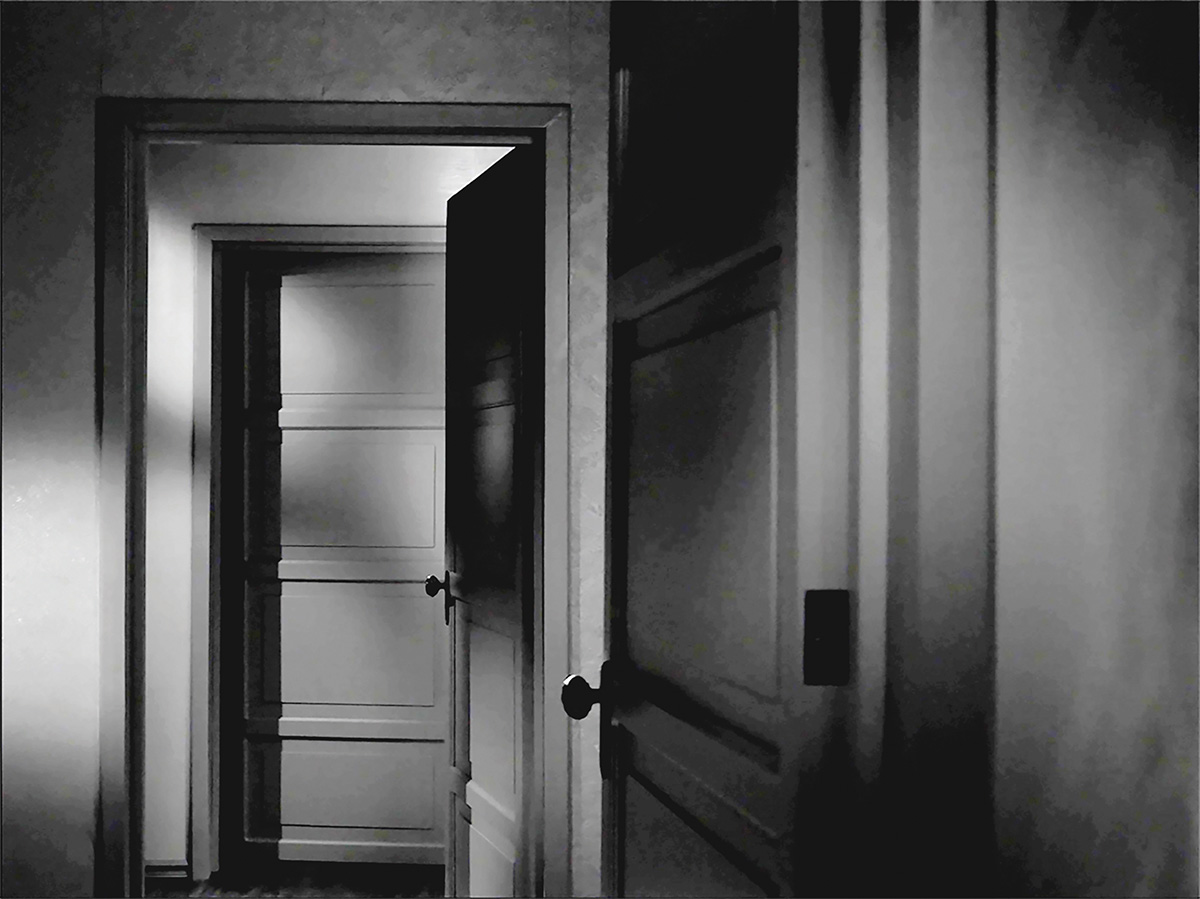
With no visible human presence, we move through the interior of a house. Like all houses, it contains spaces of darkness and corners hidden from view. That house, that interior, hides its flat background of ephemeral construction. We are inside a set built to the limits of the frame that films it. That house was only a fragment of what it appears to be. “The Uninvited” is a short film not about what there is, but about what there could be. Cinema is an apparatus of power over the representations shown therein and the bonds of continuity of a society. “The Uninvited” shows a house haunted by those absences, its blind spots and the violence of its limits and exclusion that its representations have meant.
Fabiola Torres-Alzaga is a Mexican artist working in contemporary art. She studied photography at “The active school of photography” and visual arts at “La Esmeralda” in Mexico City. She has been investigating focus and nearsightedness present in the act of gazing, and its repercussions in our socio-spatial relationships. I have a keen interest in cinema and its articulations of space and time, as well as stage magic and its defiance of logic. Both disciplines comprise the basis of my research. Through them, I seek to expand the scope of the visible, creating illusionary worlds that intrude into real space, counter-spaces that claim inclusive folds within the rigid limits of patriarchy to generate Other possible relations. Her work has been shows at MUAC (Mexico City, 2021), Lille3000 (France, 2019), the Biennal FEMSA (Zacatecas, 2018), the Anthology Film Archives (New York, 2018), the Biennal of Moving Images (Buenos Aires, 2018), the Paul Kasmin Gallery (New York, 2018), Videoex , Maison des Arts de Malakoff (France, 2016), the Polytechnic Museum of Moscow (Russia, 2015), MARCO (Monterrey, 2015), Museum of El Chopo (Mexico City, 2014), Museum of Modern Art (Mexico City, 2014), Laboratorio Arte Alameda (Mexico City, 2011), the Center for Contemporary Art (Tel Aviv, 2006) and Sala de Arte Público Siqueiros (Mexico City, 2004), among others. She has published “Historias de la noche” (Stories of the night, ESPAC, 2019) a book/project in dialogue with cinema curator Mara Fortes, and a solo catalogue “Fabiola Torres-Alzaga: In between acts” (Museo Universitario del Chopo, 2015), she´s currently a member of the Fonca’s Sistema Nacional de Creadores.
Total Refusal
Catalogue : 2023Hardly Working | Doc. expérimental | 0 | couleur | 20:30 | Allemagne, Autriche | 0
Total Refusal
Hardly Working
Doc. expérimental | 0 | couleur | 20:30 | Allemagne, Autriche | 0
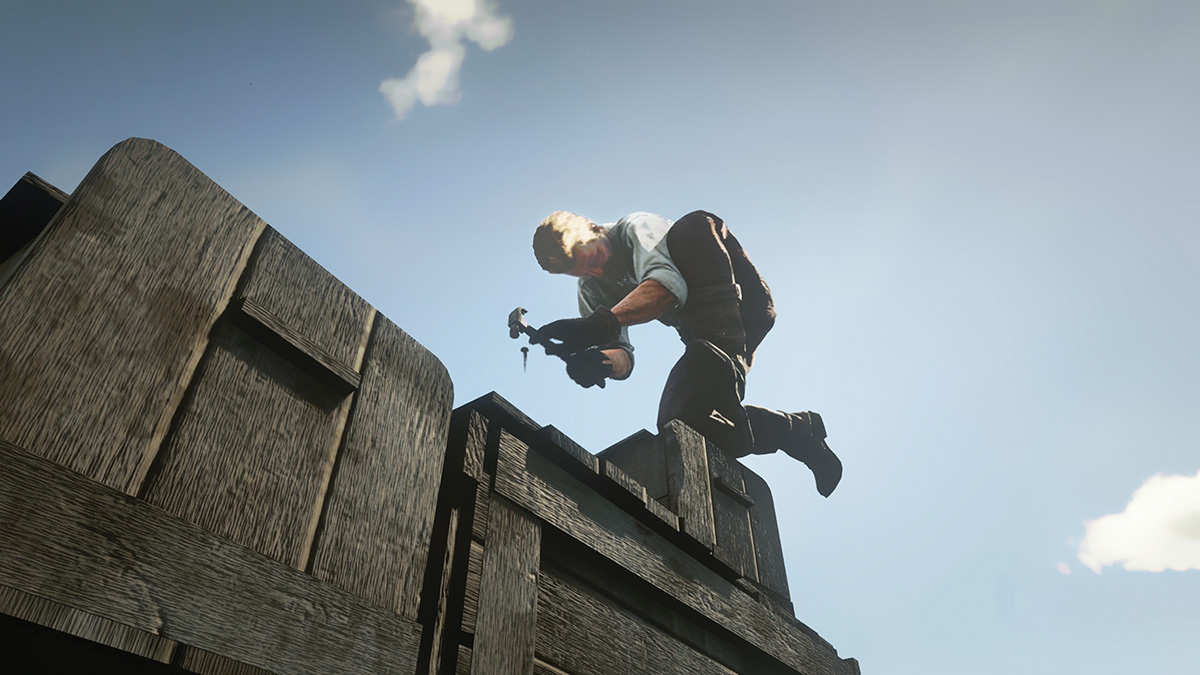
Hardly Working sheds a limelight on the very characters that normally remain in the background of video games: NPCs. They are non-player characters that populate the digital world as extras to create the appearance of normality. A laundress, a stable boy, a street sweeper and a carpenter are observed with ethnographic precision. They are Sisyphus machines, whose labour routines, activity patterns as well as bugs and malfunctions paint a vivid analogy for work under capitalism.
The pseudo-marxist media guerilla Total Refusal explores and practices strategies for artistic intervention in contemporary video games. It works with tools of appropriation and rededication of game resources. Their films and performances were presented among others at Berlinale ‘20, Locarno 22 and at the MoMA in NYC and they have received more than 46 international and national awards and honorary mentions. The current members of Total Refusal are: Susanna Flock, Adrian Jonas Haim, Jona Kleinlein, Robin Klengel, Leonhard Müllner & Michael Stumpf
Esther Toth
Catalogue : 2017Mémoires d'une infirmière | Fiction expérimentale | hdv | couleur | 20:25 | Hongrie, France | 0
Esther Toth
Mémoires d'une infirmière
Fiction expérimentale | hdv | couleur | 20:25 | Hongrie, France | 0
Existerait-il une fin à l’analyse, ou bien serions-nous condamnés, comme dans Mémoires d’une infirmière, à revivre et réexaminer les événements passés éternellement, néanmoins sous un nouvel angle ? Ce troisième volet d’une trilogie d’hybride de film et de théâtre, avec des marionnettes, se passe après la mort, dans un au-delà où la psychanalyse est obligatoire et s’avère être un processus infini. Sur la frontière flottant entre rêve et cauchemar, utopie et dystopie, la protagoniste : E recherche du sens de l’amour via le transfert envers son analyste, qu’elle perçoit comme un objet sauveteur et réparateur. Le psychanalyste est la marionnette de David Lynch et la marionnette de Larry David est à l’accueil du hall post-mortem.
Esther Toth, née à Budapest, est diplômée de l’École Nationale Supérieure des Beaux Arts. En 2010 elle a commencé une série de films avec des marionnettes : une exploration du processus psychanalytique, qui se suivra par un film sur Walter Benjamin. Les deux premiers volets de la trilogie (M’as-tu rêvé ou t’ai-je rêvé ? , Sisters, un cas classique) ont été présentés au Palais de Tokyo, Mémoires d’une infirmière au Freud Museum, à Londres, et il sera projeté au Centre Pompidou à Paris, à l’automne 2017.
Jalal Toufic, Graziella Rizkallah
Catalogue : 2023Hong Kong, China, Solaris | Film expérimental | 0 | couleur | 10:0 | Iraq, Hong Kong | 2023
Jalal Toufic, Graziella Rizkallah
Hong Kong, China, Solaris
Film expérimental | 0 | couleur | 10:0 | Iraq, Hong Kong | 2023
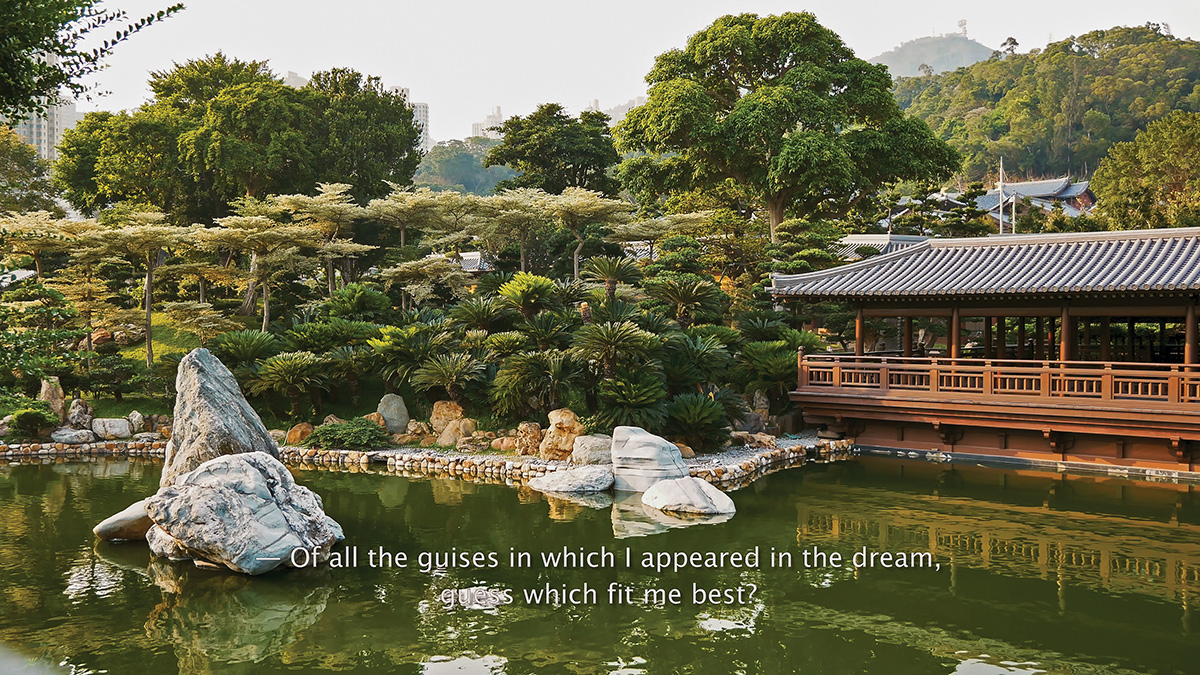
« Jalal, la nuit dernière, j’ai rêvé de notre film. » « Quel film ? » « Celui sur lequel nous travaillons ces jours-ci. » « Hong Kong, Chine, Solaris ? » « Oui. » Peut-on faire un rêve dans lequel les souhaits, les plus profonds et inconscients sont exaucés par Solaris ou un équivalent de Solaris, l’océan extraterrestre hyperintelligent et sensible du film Solaris de Tarkovski qui exauce de tels souhaits ? Oui, si notre méta-souhait est de voir nos souhaits inconscients réalisés de la manière dont Solaris le fait plutôt que de la manière dont les rêves le font (par le biais de mécanismes tels que la condensation et le déplacement). Il faut cependant garder à l’esprit que, puisque les rêves sont des exaucements de souhaits, Solaris ou un équivalent de Solaris finirait par nous rendre incapables de rêver, insomniaques, car il rendrait les rêves superflus. En rêvant de Solaris ou d’un équivalent de Solaris, on rêverait d’un endroit où l’on ne peut pas rêver, où il n'y a pas de rêves.
Graziella Rizkallah est une réalisatrice libanaise. Ses vidéos ont été présentées à la 11ème Biennale de Sharjah, au Musée d’art moderne de San Francisco, au MAXXI, à la première Biennale d'Asie et à la 5ème Triennale de Guangzhou, à la 7ème Biennale d’urbanisme et d’architecture de Shenzhen, au Times Art Center de Berlin, à Darat al Funun (Amman) et au Beirut Art Center. Jalal Toufic est un penseur et un mortel à en mourir. Il est né en 1962 à Beyrouth ou à Bagdad et est mort avant de mourir en 1989 à Evanston, dans l’Illinois. Outre l’écriture de plus de dix livres, il a réalisé plus de dix films et vidéos, dont des films-essais et des films conceptuels, des courts métrages (7 minutes, 8 minutes, etc.), des longs métrages (110 minutes, 138 minutes, etc.) et des films « inhumainement » longs (72 heures, 50 heures), des vidéos qui sont des œuvres autonomes et d’autres qui font partie d’œuvres mixtes, des films qu’il a tournés et des films dont toutes les images sont tirées d’œuvres d’autres cinéastes (Hitchcock, Sokourov, Bergman, etc.). Son travail a été présenté aux 6ème, 10ème et 11ème Biennales de Sharjah, à la 9ème Biennale de Shanghai, à la 5ème Triennale de Guangzhou, au MoMA PS1, au Musée d’art moderne de San Francisco, au Centre Pompidou, au ZKM, à la Kunsthalle Fridericianum, au MAXXI, au Witte de With et aux Deichtorhallen de Hambourg.
Muriel Toulemonde
Catalogue : 2013la théorie des vagues | Vidéo | hdv | couleur | 20:0 | France | 2011
Muriel Toulemonde
la théorie des vagues
Vidéo | hdv | couleur | 20:0 | France | 2011
La théorie des vagues est un film en trois mouvements, au fil desquels, à partir du motif de la vague, la question du passage de la perception à la représentation tente de se résoudre. Le film s?ouvre sur la description d?une maison tout au bord de l?eau, sur laquelle les vagues viennent éclater les jours de tempête. Ce lieu évoqué par la narratrice est celui où j?ai passé les deux premières années de ma vie. Hormis le récit que l?on m?en a fait, je n?en garde aucun souvenir, aucune image, même si je peux supposer qu?il a affecté mon mode de perception. C?est un autre lieu, le laboratoire de mécaniques des fluides de l?école centrale de Nantes, qui a réactivé la mémoire de cette maison au bord de l?eau, quarante ans après. Là, les vagues viennent s?écraser régulièrement sur les murs de béton d?un bassin à houle.
Muriel Toulemonde est née à Lille en 1970. Durant ses études à l?Ecole Nationale Supérieure des Beaux-arts de Paris et après, (DNSAP en 1997), elle bénéficie de plusieurs résidences à l?étranger : Milan (1991), Los Angeles (1994), Cologne (1999), Budapest (2001), Delphes (2004).
Giorgos Tourlas
Catalogue : 2006Sarcocoptes | Animation | dv | couleur | 4:0 | Grèce | 2005
Giorgos Tourlas
Sarcocoptes
Animation | dv | couleur | 4:0 | Grèce | 2005
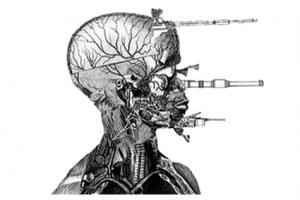
"Sarcocoptes" signifie en grec "coupeurs de viande". Cette courte vidéo d'art est une animation expérimentale. L'être humain se transforme en fonction de ses émotions. Caractère durable de l'esprit humain et de son anatomie. Les codes anatomiques se transforment. Les émotions et les souvenirs s'incarnent et entrent en conflit avec la propre chair de l'Homme. Une simple pensée ressemble à une opération chirurgicale. L'organisme s'approche t-il à chaque instant de la mort ou est-il déjà prêt à renaître ? Une créature solitaire qui creuse dans son esprit à la découverte de soi-même.
Giorgos TOURLAS est né à Athènes en 1979. Il est diplômé de l'école des Beaux-Arts d'Athènes où il a étudié dans le laboratoire d'étude de Rena Papaspyrou entre 1999-2000 et 2003-2004. Il a également étudié la mosaïque et l'informatique dans ce même département. Actuellement, il continue ses études de 3ème cycle en art numérique. En Espagne, à l'Université des beaux-arts de Valence en 2002, il a étudié la chalcographie (technique de gravure sur cuivre) et l'animation.