Catalogue > Liste par artiste
Parcourez la liste complète des artistes présentés dans le cadre des Rencontres Internationales depuis 2004. Utilisez le filtre alphabétique pour affiner vos recherches.
Luciana Decker Orozco
Luciana Decker Orozco
Catalogue : 2025Lo que los humanos ven como sangre, los jaguares ven como chicha | Doc. expérimental | 16mm | couleur | 29:54 | Bolivie | 2023

Luciana Decker Orozco
Lo que los humanos ven como sangre, los jaguares ven como chicha
Doc. expérimental | 16mm | couleur | 29:54 | Bolivie | 2023
Water like crystals, spirited ruminants and haunted lakes. A meal is prepared, animals graze, wind moves through potato flowers. Land, lore and history conflate, confuse and constellate. Meanwhile: musicians are in the street, ancient objects are unearthed and small plans are made.
Bolivian filmmaker living in La Paz. MFA graduated in Cinematic Arts program at the University of Wisconsin in Milwaukee. Working in 16mm format, I’m exploring the spectral presence of places, objects, and matter, intertwining them with microhistories revealed through intimate interactions and relationships with the people who participate in my films.
Alain Declercq
Catalogue : 2025Leaks | Fiction expérimentale | hdv | couleur | 82:0 | France | 2023
Alain Declercq
Leaks
Fiction expérimentale | hdv | couleur | 82:0 | France | 2023
In an Paper, a journalist revealed some classified elements which prove that French weapons are involved in war crimes. She is being questioned by the intelligence services to reveal her source.
Various structures of power, the forces of order, contemporary forms of oppression and security, and media manipulation are the core concerns of French artist Alain Declercq. Born in 1969 in Moulins, France, he lives and works in Paris. His work has been shown in Europe since the early 1990s, including at the Palais de Tokyo, Paris (2006 and 2003), Museum 52 in London (2005) and the Musée d’art moderne de la ville de Paris (2001). He has also created a number of specific pieces, among them Welcome Home Boss, featured in the Mois de la Photo in Montreal (2001) and Crash Cars, shown at the Cairo Biennale (2001). Alain Declercq is represented by Lœvenbruck gallery, Paris. Jacky Strenz gallery, Frankfurt and Museum 52, London.
Catalogue : 2013Pill-boxes | Vidéo | dv | couleur | 10:0 | France, Suisse | 2012
Alain Declercq, Jeanne Susplugas
Pill-boxes
Vidéo | dv | couleur | 10:0 | France, Suisse | 2012
En Suisse, plus de trois-mille bunkers ont été construits entre 1882 et 1995. En 1914, l?aviation entre pour la première fois dans l?histoire d?un conflit armé et engendre des changements de stratégies : il devient nécessaire de se cacher, c?est la naissance du camouflage. Les ouvrages militaires suisses ont été camouflés par d?étonnantes décorations, si bien intégrés au paysage que personne ne les remarque: du sapin métallique de Fort Pré-Giroud (Vallorbe) au porte rocher de Gütsch (Uri). Cette singulière architecture témoigne de la neutralité Suisse et questionne la relation entre architecture et paysage. Aujourd?hui, la plupart de ces fortins sont désaffectés et posent la question du devenir de cet important patrimoine.
De la vidéo à la photographie, de l?installation au dessin, Jeanne Susplugas évolue dans un univers aussi séduisant qu?inquiétant avec comme préoccupations principales nos addictions. Elle crée des espaces pénétrables, des « maisons » qui questionnent le spectateur sur des comportement sociaux et intimes. Susplugas est représentée par la galerie Valérie Bach (Bruxelles), Mizuma Art Gallery (Tokyo) et Rewind (New York). Alain Declercq explore les différentes structures du pouvoir et les oppressions qu`elles engendrent - schizophrénie sécuritaire, surveillance, manipulations médiatiques. Sa technique de l`inversion transforme Declercq en chasseur d`indices, provocateur de dysfonctionnements, renverseur de situations ou empêcheur de tourner en rond. Declercq est représenté par les galeries Elaine Lévy (Bruxelles) et Loevenbruck (Paris).
Catalogue : 2012Protection civile | Vidéo expérimentale | 0 | couleur | 15:44 | France, Suisse | 2011
Alain Declercq, Jeanne SUSPLUGAS
Protection civile
Vidéo expérimentale | 0 | couleur | 15:44 | France, Suisse | 2011
A l?occasion de ce travail, "Protection Civile", les deux artistes sont allés explorer les abris antiatomiques suisses. Le pays regorge d?abris souterrains et chaque individu y a une place. Qu?ils soient individuels ou collectifs, allant de la cave particulière aux immenses abris médicalisés, ils répondent tous à une organisation stricte et efficace. Le film interroge alors une éventuelle présence sous terre, les limites de la cohabitation, la promiscuité et les inévitables problèmes d?organisation que soulève un tel plan de protection. Sous forme panoptique et systématique, apparaissent tour à tour des dortoirs, cuisines, blocs opératoires, sanitaires et matériel d?urgence. Cependant, dans certains de ces espaces, s?opèrent des mutations, des changements d?affectation ou d?utilisation. Ainsi, certains abris peuvent servir de lieux de stockage hétéroclites qui peuvent parfois prendre un aspect incongru... Les artistes témoignent à travers ce film du patrimoine architectural singulier et unique de la Suisse. Protection civile apparaît comme la suite logique du premier film coréalisé par les deux artistes, Plan iode. En explorant les arrières boutiques de pharmacies, les artistes examinaient le système prévu pour la distribution de l?iodure de potassium, médicament vital en cas d?attaque nucléaire.
Alain Declercq est un artiste français, né à Moulin en 1969, Moulin. Il vit et travaille à Paris, son travail est exposé depuis 1996. Il est représenté en France par la Galerie Hervé Loevenbruck à Paris, et en Belgique par Élaine Levy Project Gallery (Bruxelles). Jeanne Susplugas est une artiste française, née à Montpellier en 1974. Elle vit et travaille à Paris. Elle est représentée à Paris par la JamoisArtPartners Gallery, à Bruxelles par la Charles de Jonghe Gallery, à Copenhague par la Poulsen Gallery et à Tokyo par la Mizuma Art Gallery.
Alain Declercq, Jeanne SUSPLUGAS
Catalogue : 2025Leaks | Fiction expérimentale | hdv | couleur | 82:0 | France | 2023
Alain Declercq
Leaks
Fiction expérimentale | hdv | couleur | 82:0 | France | 2023
In an Paper, a journalist revealed some classified elements which prove that French weapons are involved in war crimes. She is being questioned by the intelligence services to reveal her source.
Various structures of power, the forces of order, contemporary forms of oppression and security, and media manipulation are the core concerns of French artist Alain Declercq. Born in 1969 in Moulins, France, he lives and works in Paris. His work has been shown in Europe since the early 1990s, including at the Palais de Tokyo, Paris (2006 and 2003), Museum 52 in London (2005) and the Musée d’art moderne de la ville de Paris (2001). He has also created a number of specific pieces, among them Welcome Home Boss, featured in the Mois de la Photo in Montreal (2001) and Crash Cars, shown at the Cairo Biennale (2001). Alain Declercq is represented by Lœvenbruck gallery, Paris. Jacky Strenz gallery, Frankfurt and Museum 52, London.
Catalogue : 2013Pill-boxes | Vidéo | dv | couleur | 10:0 | France, Suisse | 2012
Alain Declercq, Jeanne Susplugas
Pill-boxes
Vidéo | dv | couleur | 10:0 | France, Suisse | 2012
En Suisse, plus de trois-mille bunkers ont été construits entre 1882 et 1995. En 1914, l?aviation entre pour la première fois dans l?histoire d?un conflit armé et engendre des changements de stratégies : il devient nécessaire de se cacher, c?est la naissance du camouflage. Les ouvrages militaires suisses ont été camouflés par d?étonnantes décorations, si bien intégrés au paysage que personne ne les remarque: du sapin métallique de Fort Pré-Giroud (Vallorbe) au porte rocher de Gütsch (Uri). Cette singulière architecture témoigne de la neutralité Suisse et questionne la relation entre architecture et paysage. Aujourd?hui, la plupart de ces fortins sont désaffectés et posent la question du devenir de cet important patrimoine.
De la vidéo à la photographie, de l?installation au dessin, Jeanne Susplugas évolue dans un univers aussi séduisant qu?inquiétant avec comme préoccupations principales nos addictions. Elle crée des espaces pénétrables, des « maisons » qui questionnent le spectateur sur des comportement sociaux et intimes. Susplugas est représentée par la galerie Valérie Bach (Bruxelles), Mizuma Art Gallery (Tokyo) et Rewind (New York). Alain Declercq explore les différentes structures du pouvoir et les oppressions qu`elles engendrent - schizophrénie sécuritaire, surveillance, manipulations médiatiques. Sa technique de l`inversion transforme Declercq en chasseur d`indices, provocateur de dysfonctionnements, renverseur de situations ou empêcheur de tourner en rond. Declercq est représenté par les galeries Elaine Lévy (Bruxelles) et Loevenbruck (Paris).
Catalogue : 2012Protection civile | Vidéo expérimentale | 0 | couleur | 15:44 | France, Suisse | 2011
Alain Declercq, Jeanne SUSPLUGAS
Protection civile
Vidéo expérimentale | 0 | couleur | 15:44 | France, Suisse | 2011
A l?occasion de ce travail, "Protection Civile", les deux artistes sont allés explorer les abris antiatomiques suisses. Le pays regorge d?abris souterrains et chaque individu y a une place. Qu?ils soient individuels ou collectifs, allant de la cave particulière aux immenses abris médicalisés, ils répondent tous à une organisation stricte et efficace. Le film interroge alors une éventuelle présence sous terre, les limites de la cohabitation, la promiscuité et les inévitables problèmes d?organisation que soulève un tel plan de protection. Sous forme panoptique et systématique, apparaissent tour à tour des dortoirs, cuisines, blocs opératoires, sanitaires et matériel d?urgence. Cependant, dans certains de ces espaces, s?opèrent des mutations, des changements d?affectation ou d?utilisation. Ainsi, certains abris peuvent servir de lieux de stockage hétéroclites qui peuvent parfois prendre un aspect incongru... Les artistes témoignent à travers ce film du patrimoine architectural singulier et unique de la Suisse. Protection civile apparaît comme la suite logique du premier film coréalisé par les deux artistes, Plan iode. En explorant les arrières boutiques de pharmacies, les artistes examinaient le système prévu pour la distribution de l?iodure de potassium, médicament vital en cas d?attaque nucléaire.
Alain Declercq est un artiste français, né à Moulin en 1969, Moulin. Il vit et travaille à Paris, son travail est exposé depuis 1996. Il est représenté en France par la Galerie Hervé Loevenbruck à Paris, et en Belgique par Élaine Levy Project Gallery (Bruxelles). Jeanne Susplugas est une artiste française, née à Montpellier en 1974. Elle vit et travaille à Paris. Elle est représentée à Paris par la JamoisArtPartners Gallery, à Bruxelles par la Charles de Jonghe Gallery, à Copenhague par la Poulsen Gallery et à Tokyo par la Mizuma Art Gallery.
Leon Decock
Catalogue : 2023Een Vogel met Jouw Naam | Doc. expérimental | dcp | couleur et n&b | 18:42 | Belgique | 2022
Leon Decock
Een Vogel met Jouw Naam
Doc. expérimental | dcp | couleur et n&b | 18:42 | Belgique | 2022
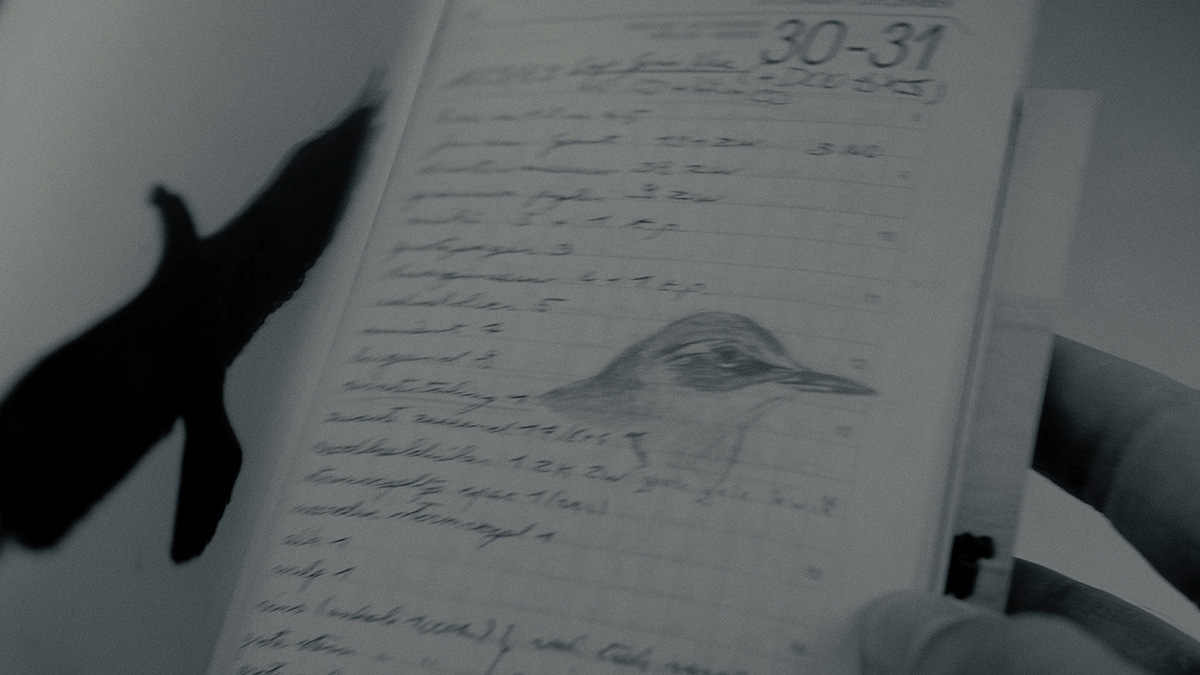
Silhouettes and songs are hand-scrawled besides lists of birds and other animals. Feathers are carefully placed besides photographs of remote destinations. This was a life of observation documented in little notebooks, but the man who made them is no longer here. Now these fragments serve as a guide in search of a waning fascination for the environment. I revisit these traces and explore what is left behind.
Leon Decock was born in 1999 in Ghent, Belgium. He has a background in documentary filmmaking and holds a MA in audiovisual arts from RITCS, Brussels and as of 2022 studies media art at KASK, Ghent.
Jason Dee
Catalogue : 2009We're going for a trip across the water | Vidéo expérimentale | dv | noir et blanc | 2:0 | Royaume-Uni | 2006
Jason Dee
We're going for a trip across the water
Vidéo expérimentale | dv | noir et blanc | 2:0 | Royaume-Uni | 2006
Un couple sur une barque est pris dans une boucle sans fin. Ils semblent prisonniers par le mécanisme du film lui-même. Dans cette répétition transforme l'homme en automate, et donne à la femme une allure fantômatique. Les acteurs, ou plutôt leurs images sont prises dans un été d'entre-deux, entre passé et présent, mouvement et suspen, vie et mort.
Jason Dee studied photography at Northumbria University and completed a Masters in Fine Art at Glasgow School of Art. His current art practice investigates connections between modern media from the mid 19th century to the present day. He uses digital software to alter film scenes originally shot on celluloid, assessing how new media has reconfigured and re-contextualised the way we perceive 20th century cinema. His work has been exhibited in Europe and the United States. Dee is currently undertaking a year long new-media residency at the University of Abertay funded by the Scottish Arts Council. He lives in Dundee, Scotland.
Catalogue : 2008Moonscape | Vidéo expérimentale | dv | couleur | 2:30 | Royaume-Uni | 2007
Jason Dee
Moonscape
Vidéo expérimentale | dv | couleur | 2:30 | Royaume-Uni | 2007
Moonscape est un panorama continuel en boucle, fait en recousant digitalement les fonds peints de nombreux films de science-fiction des années 50. Ces films se projetaient vers le futur - cependant créaient leurs effets futuristes en revenant aux racines cinématographiques. Ils étaient filmés en cinémascope, à l'époque technologie de pointe, pourtant leurs formats et l'usage de paysages peints à la main remontent aux panoramas du 19eme siècle. "Moonscape", en mélangeant la peinture, le celluloïd et les pixels, continue cet esprit de simultanément regarder vers le passé et le futur. Dans les années cinquante, ces paysages devaient être imaginés, et pourtant ils contenaient des détails scientifiques d'une société à la limite du voyage spatial. Les fonds peints à la main mélangés avec de l'imagerie faite à l'objectif, de la fantaisie mélangée avec des faits scientifiques, quand les peintures imaginées deviennent infusées d'un effet de réalité. De voir ces paysages maintenant, après que l'aire de l'exploration lunaire semble être venue et révolue, l'optimisme de pionnier (démontré par l'usage de Technicolor et de Panavision) ouvre le chemin à un point de vue plus désolé et sans directions. Ce panorama montre un monde suspendu et distant, comme enfermé hors de notre monde et du temps. Des cosmonautes distants et fantasmagoriques semblent isolés et sans but, tombés dans l'oubli d'un paysage futur imaginé de celluloïd et de peinture qui est devenu réalité et qui seulement maintenant nous revient en mémoire.
Jason Dee is a graduate from Glasgow School of Art`s MFA programme. He continues to live in the city, working on his art practice while occasionally teaching New Media skills and lecturing at the Art School. His work has been exhibited and screened at venues throughout Europe and the USA.
Olivier Degorce, Christophe GRISEAU
Catalogue : 2006Wall Street (épisode 1) | Vidéo expérimentale | dv | couleur | 4:3 | France | 2004
Olivier Degorce, Christophe GRISEAU
Wall Street (épisode 1)
Vidéo expérimentale | dv | couleur | 4:3 | France | 2004
Après l?échec d?un avenir radieux annoncé par le communisme, nos amis les clones, chantres du capitalisme, décident la mise en faillite délibérée d?entreprises. EXTRAIT D?UN ENSEMBLE DE FILMS REGROUPÉS SOUS LE TITRE : « In The World Of Opulence » Les films se jouent des sujets épineux et calamiteux de nos sociétés contemporaines. Les thèmes récurrents qui ont influencé OBSESSION 27 (l?isolement social, l?exclusion, la jet set, la perversité, certains fléaux planétaires?) sont illustrés avec légèreté ou tragique, humour ou ironie, parfois sous forme purement documentaire et généralement engagée. Tout à la fois ludiques et humoristiques, les vidéos participent autant de la critique sociale que du divertissement. Toute lourdeur de production écartée,a favorisé une grande souplesse de réalisation et les moyens réduits furent propices à la spontanéité : Matériel minimum (caméra DV), logiciel de montage de base, séances improvisées et intervenants évidemment non professionnels
Olivier Degorce & Christophe Griseau sont nés à Niort, France. Ils vivent et travaillent à Paris et près de l`Atlantique. Au gré de ses collaborations, on retrouve Olivier DEGORCE sous différents pseudos : M&M?S, OBSESSION 27, NOWHERE, ou encore WHAT?S FOR DINNER. Sa production polymorphe associe la vidéo, la musique électronique, la photographie, et l?écriture. Il revendique une approche ludique, touche-à-tout, iconoclaste et un certain militantisme. Les thématiques récurrentes qui traversent sa pratique et constituent des sources d?inspiration sont aussi variées que les médias qu`il utilise : l?environnement, la question de la célébrité, les sociétés d?opulence, les fléaux planétaires, etc? Ses installations photographiques ont été exposées à Paris [ American Center, Passage de Retz, Centre Georges Pompidou...], à l`étranger [Nikolai Comtemporary Art Center de Copenhague, Traders Pop Gallery à Maastricht, Speak For Gallery à Tokyo] et dans plusieurs galeries de province [Confort Moderne de Poitiers, C.A.P.C de Bordeaux , Le rectangle à Lyon...]. Dès 1988, M&M`S a été partie prenante de la scène électronique française. En 1998, il a publié l?ouvrage de référence sur la culture DJ, « NORMAL PEOPLE » compilant 180 portraits photographiques de Dj`s français et internationaux (Crash Editions). Ses productions musicales ont été signées sur des labels tels que TEKNOTIKA ? Detroit / USA, MENTAL GROOVE Records?Genève /Suisse SKAM Records-Manschester/UK MAZZO Music (Pays-Bas), B-Cool (Japon), Sony France, BMG?.. En 2004 et 2005, il se consacre notamment, avec Christophe Griseau, à la réalisation d`une série de vidéos illustrant leur pièce sonore : OBSESSION 27 "In the World of Opulence" Ce projet est réalisé avec le soutien de la DRAC Ile-de-France. *Articles et textes engagés avec Amandine Geers sur l`alimentation et l?écologie pour le magazine CRASH / Paris, pour lequel il a été également photographe.
Stéphane Degoutin, Gwenola Wagon
Catalogue : 2026Apple | Film expérimental | mov | couleur | 4:0 | France | 2025
Stéphane Degoutin, Gwenola Wagon
Apple
Film expérimental | mov | couleur | 4:0 | France | 2025
Everything is Real montre les pommes les plus rouges, les call centers les plus verts, les salles de serveurs avec le plus de câbles, les employés les plus souriants, les livreurs avec leurs plus beaux colis, les bénévoles les plus efficaces, les montagnes de déchets les plus grandes – mais les pousse au paroxysme du stéréotype : insensiblement, les stéréotypes versent dans l’extrême.
Stéphane Degoutin est artiste et chercheur. Son travail explore les « systèmes obscurs », les structures qui passent souvent inaperçues mais organisent nos vies : de l’air conditionné aux aéroports internationaux, de la musique pour plantes vertes aux infrastructures urbaines. Il tente une forme de reverse engineering de ces logiques cachées, pour imaginer d’autres façons de penser et d’agir. Gwenola Wagon est artiste et chercheuse. Elle est Professeure des Universités et elle enseigne à l’École des Arts de la Sorbonne à l’Université Paris 1. À travers des installations, des films, des performances et des livres, elle imagine des récits alternatifs et paradoxaux pour penser le monde numérique contemporain.
Catalogue : 2023La maison qui vous veut du bien | Doc. expérimental | mov | couleur | 20:4 | France | 2022
Stéphane Degoutin, Gwenola Wagon
La maison qui vous veut du bien
Doc. expérimental | mov | couleur | 20:4 | France | 2022
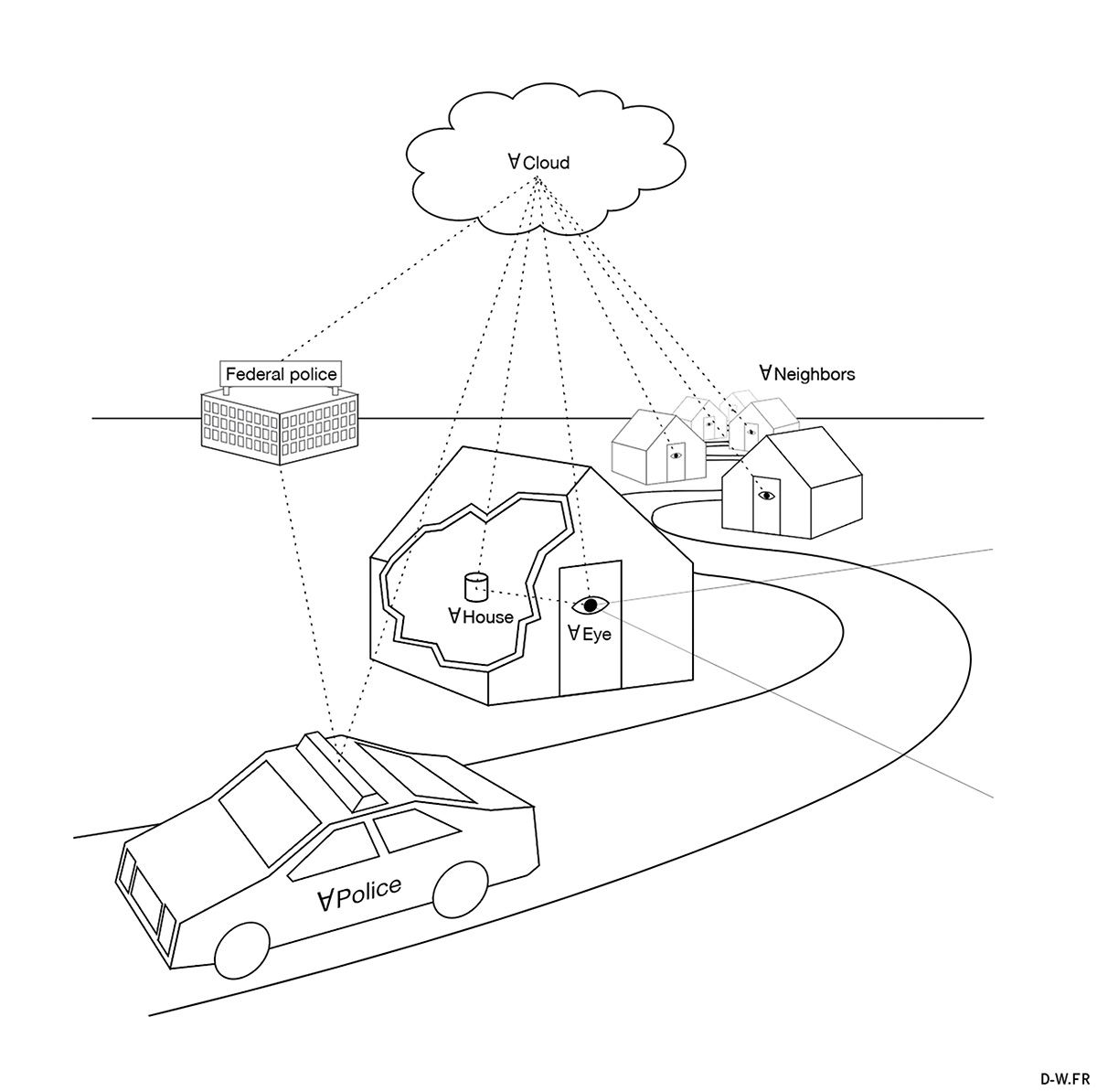
La maison qui vous veut du bien La maison qui vous veut du bien est un film-essai sur l'histoire de la sonnette caméra de la société Ring rachetée par Amazon devenant en quelques années l'épicentre des objets connectées dits smart. Elle se voit envahie d'innombrables produits, éclairages, capteurs, caméras, aspirateurs, ours en peluche « intelligents » qui deviennent autant de témoins aux points de vue improbables. Des logiciels associés au réseau de surveillance des quartiers sont programmés pour analyser des comportements, ou encore des réseaux de neurones sont entraînés à reconnaître des visages captent, annotent, data minent, transforment la masse de données, filtrent par la détection biométrique assistée par du deep learning, en fonction de listes de gestes suspects, balancent leurs résultats aux officiers des polices publiques ou autres agences de sécurité... La capture sans autorisation du voisinage, l'espionnage organisé entre voisins et la disponibilité des vidéos privées pour les polices municipales font basculer le grand rêve de la maison automatisée en un cauchemar paranoïaque. Le moindre signe capté – vol d'un papillon, chien perdu, ombre d'un promeneur... – devient suspect, vient hanter les occupants de la petite maison blanche. Il se constitue progressivement un réseau d'espionnage privé en peer to peer. La bunkerisation des maisons entre dans sa phase «deep».
Stéphane Degoutin est artiste et chercheur. Ses thèmes de recherche portent sur l'humanité après l'homme, la ville après l'espace public, l'architecture après le plaisir. Ses projets enquêtent sur des situations d'ambivalence, entre la guerre et la danse, entre le plaisir sexuel et le non-lieu, entre la ville et son potentiel, entre le posthumain et l'obsolescence de l'homme. Il enseigne à l'École des Arts Décoratifs à Paris. Site internet : https://d-w.fr/ Gwenola Wagon est artiste et enseigne à l'université Paris 8 à Saint-Denis. Son travail imagine des alternatives et des récits paradoxaux pour déconstruire le monde numérique contemporain. Elle a réalisé des films et des installations pour des festivals et des expositions en France et à l'étranger. Elle a publié Psychanalyse de l'aéroport international avec Stéphane Degoutin, et le livre Planète B aux éditions 369. Site internet : https://d-w.fr/
Anne Deguelle
Catalogue : 2026ghost dance | Vidéo | mp4 | couleur | 1:15 | France | 2025
Anne Deguelle
ghost dance
Vidéo | mp4 | couleur | 1:15 | France | 2025
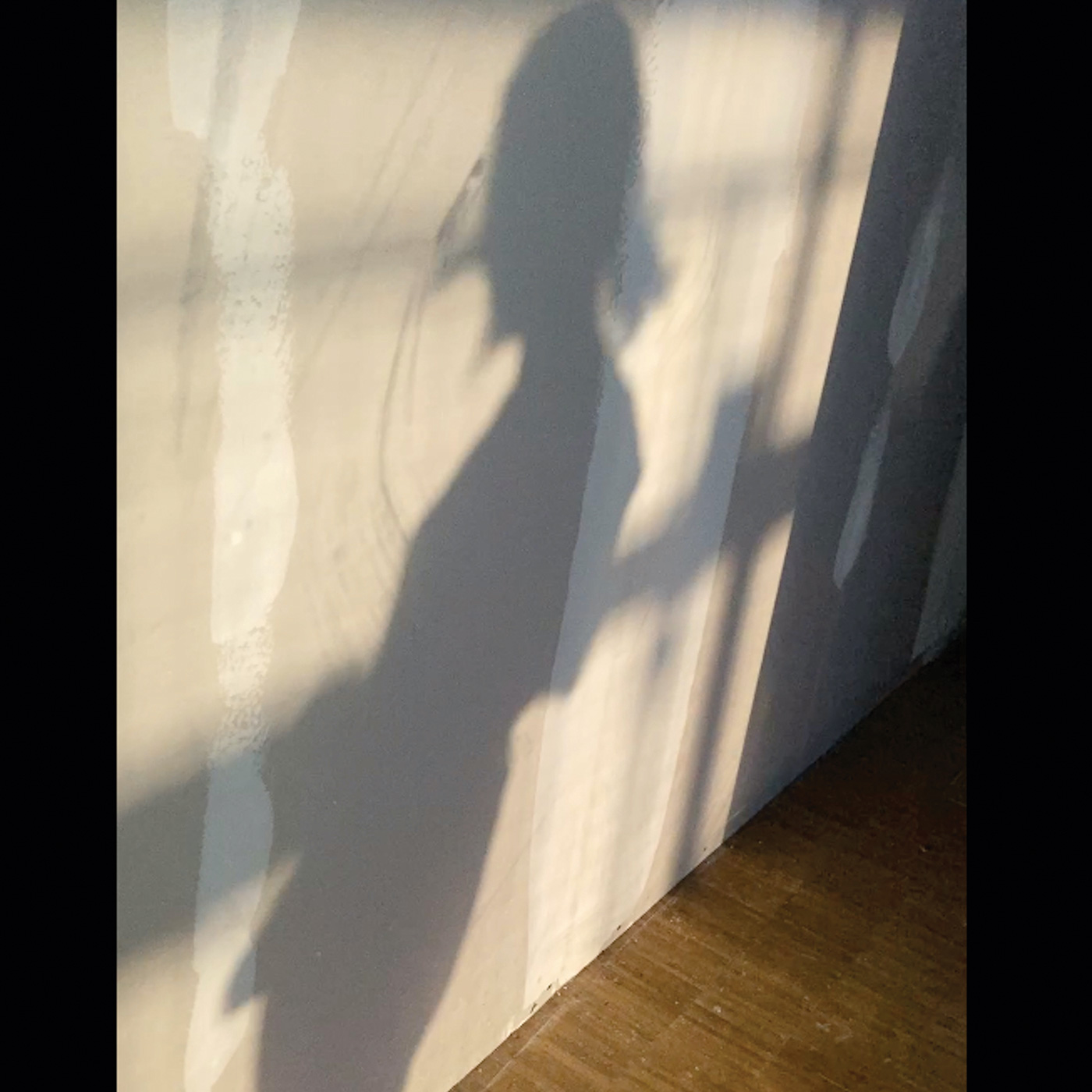
anne deguelle ghost dance Dans les coulisses du Centre Pompidou à Paris, se jouent des improvisations de rap et break dance à l'insu du musée. Les adolescents réunis à l'extérieur profitent de l'effet miroir des immenses vitrages pour performer leurs imaginaires sur la scansion bpm du rap diffusé sur leurs portables. A l’intérieur du musée, au dos des cimaises, se glissent ces images fantômes, traces éphémères des ombres portées clandestines révélées avec la complicité du soleil. Les figures mouvantes de ces jeunes danseurs ignorent le ballet de leurs ombres habitées par le rythme qui les transcendent. Captée à son tour par un portable, la Ghost dance renoue avec le mythe de la caverne des débuts de notre humanité.
Note biographique anne deguelle ghost dance Anne Deguelle est une artiste inclassable qui recourt à des médiums différents : la photographie, la vidéo, l'installation, les projections lumineuses ou encore les créations sonores avec une prédilection pour la lumière; elle mobilise tous les moyens possibles pour explorer les signes du réel qu'elle tente de décrypter en réinvestissant l'histoire, en jetant le trouble dans la perception de l'information et de notre mémoire. Son oeuvre est présente dans les collections du Centre Pompidou, MNAM et Bibliothèque Kandinsky, dans celles du Musée d'art moderne Weserburg Fonds Anne Deguelle à Bremen (D), dans celles du musée et du Frac Les Abattoirs à Toulouse, du FNAC Fonds national d'art contemporain, de la collection de la Ville de Paris, des FRAC Basse- Normandie, FRAC Auvergne, et FRAC Occitanie, du MACVAL, des Fonds de livres d'artistes des Musées Serralves Porto et Reina Sofia Madrid, du Fonds Beinecke à la YaleUniversity Des expositions personnelles ont présenté son œuvre au Printemps de Septembre-Toulouse, au Freud Museum à Londres, au Musée d’art moderne Weserburg à Brême, au FRAC Auvergne, au Centre d’art abbaye Maubuisson, aux centres d’art de Gennevilliers, de Vitry, l’artothèque de Caen, galeries Dix9 Paris et Anne Barrault.
Michelle Deignan
Catalogue : 2021Idiots | Animation | mov | noir et blanc | 2:7 | Irlande, Royaume-Uni | 2020
Michelle Deignan
Idiots
Animation | mov | noir et blanc | 2:7 | Irlande, Royaume-Uni | 2020
"Idiots" combine mots et rythmes en une symphonie apoplectique. La langue est crue et hachée, bégayant diatribes, cris, et hurlements sur l'écran. Ce film est en colère à votre place.
Michelle Deignan crée des images en mouvement, des photographies et des œuvres imprimées pour des expositions en galerie, pour le cinéma et pour d'autres contextes de projection. Par les images en mouvement, elle crée des récits factuels et fictifs, qui présentent des expériences et interprétations alternatives de l'identité et de la place de chacun. Ces films mettent souvent en scène les triomphes et les échecs de protagonistes qui luttent pour être vus, pour qu’on se souvienne d’eux, ou pour être entendus, alors qu'ils se battent pour leur autonomie. Son travail d'images en mouvement est distribué par LUX, Londres (Royaume-Uni). Elle fait partie d'un groupe international de femmes artistes qui produisent collectivement "The Crown Letter", un projet artistique participatif en ligne, qui a débuté en avril 2020.
Catalogue : 2017A Glimpse of Common Territory | Fiction expérimentale | hdv | couleur | 8:47 | Irlande, Royaume-Uni | 2015
Michelle Deignan
A Glimpse of Common Territory
Fiction expérimentale | hdv | couleur | 8:47 | Irlande, Royaume-Uni | 2015
By exploring representation of time, movement, fact and fiction, `A Glimpse of Common Territory` tells of the unsettling distance between what we see, what we assume and what we know. Two aristocratic characters from an 1827 sci-fi novel, "The Mummy: a Tale of the Twenty Second Century", are invoked through the words of their author. We see them overlooking the landscape from an open platform within an uncanny architectural anomaly, a 127 metre cast concrete building in the centre of a housing estate. Together they confront a crisis, their new found awareness that what they perceive, see and control are completely fictitious. Though their negotiations are precarious they reach an understanding about how they can retain a semblance of control.
Deignan has exhibited her work in over 100 exhibitions, screenings and film festivals including: ‘New Work UK - Trust Yourself’, Whitechapel Gallery, London; ‘Europart - New Contemporary Art from Europe’, Vienna; ‘Terror and the Sublime: Art and Politics in an Age of Anxiety’, Crawford Art Gallery, Cork; ‘transmediale.08’, House of Cultures, Berlin; ‘Les Rencontres Internationale’, Gaîté Lyrique, Paris; Cork International Film Festival; ‘This Fanciful Digression’, CAN, Neuchatel, Switzerland; ‘Black Box Programme’ at the Edinburgh Film Festival. Michelle Deignan’s moving image work is distributed by LUX.
Catalogue : 2016Ways to Speculate | Vidéo | hdv | couleur | 3:44 | Irlande, Royaume-Uni | 2014
Michelle Deignan
Ways to Speculate
Vidéo | hdv | couleur | 3:44 | Irlande, Royaume-Uni | 2014
Actual and virtual simulacra of historical European buildings, monuments and recreational spaces are presented in a tumultuous and fluctuating sonic landscape. This uncanny vision of past and present, depicting the instrumentalisation of places, is framed by two distinct voices. One languidly quotes lyrics from Kraftwerk’s Europe Endless (1977) the other earnestly performs excerpts from the introduction to the sci-fi novel, “The Mummy: A Tale of the Twenty Second Century” by Jane Webb Loudon (1827). Between them they proposes a progressive but unstable future where past dramas can easily be re-enacted.
Michelle Deignan (b. Dublin 1970) is an artist and filmmaker based in London. She has exhibited her work in over 60 national and international exhibitions, screenings and festivals including: `Public Space Ltd.`, Athens Media Art Festival;`transmediale`, House of Cultures, Berlin; `India Art Summit`, Delhi; The LUX and Cranford Collection Present: The World Turned Upside Down, Camden Arts Centre, London; `Terror and the Sublime: Art and Politics in an Age of Anxiety`, Crawford Art Gallery, Cork; `This Fanciful Digression`, CAN, Neuchatel, Switzerland. Michelle Deignan`s moving image work is distributed by LUX.
Catalogue : 2014Her Fanciful Digression | Fiction expérimentale | hdcam | couleur | 10:54 | Irlande, Royaume-Uni | 2012
Michelle Deignan
Her Fanciful Digression
Fiction expérimentale | hdcam | couleur | 10:54 | Irlande, Royaume-Uni | 2012
`Her Fanciful Digression` imagines a meeting between 19th Century Irish feminist Anna Doyle Wheeler and English landscape painter John Constable. It is set in Hatfield Forest, formerly The Houblon Estate, in South East England. Two apprentice romantics dressed in period costume repeatedly walk through the vistas of the landscape as the film`s voice over talks about the events that contribute to Constable and Wheeler`s meeting. The film considers the aesthetics of romanticism within the context of cultural, political and economic changes of the time and the application of those aesthetics in film now.
Michelle Deignan`s is an artist and filmmaker. Her work is represented by Maria Stenfors, London. She has exhibited in over 50 national and international exhibitions and festivals including: `New Work UK - Trust Yourself`, Whitechapel Gallery, London; `Europart - New Contemporary Art from Europe`, Vienna; `transmediale.08`, House of Cultures, Berlin; `Her Fanciful Digression`, Crawford Art Gallery, Cork; `Film Programme 1`, Badischer Kunstverein, Karlsruhe; `Black Box Programme` at the Edinburgh Film Festival.
Johannes Deimling
Catalogue : 2006Taxi libre | Doc. expérimental | betaSP | couleur et n&b | 11:0 | Allemagne | 2005
Johannes Deimling
Taxi libre
Doc. expérimental | betaSP | couleur et n&b | 11:0 | Allemagne | 2005
Fernando Del Cubo
Catalogue : 2010Madera 22 | Doc. expérimental | dv | couleur | 3:8 | Espagne | 2009
Fernando Del Cubo
Madera 22
Doc. expérimental | dv | couleur | 3:8 | Espagne | 2009
My experience as a DJ in the eighties has provided me whith first-hand material to be abe to ofer an alternative version of the "Movida Madrileña" through events that were the general trend of group bahavoir. Violence and Drugs are one of the aspects concealed in the official history,Which insists on remembering the most playful and banal aspects. Employing a process of re-writing musical films and the appropiation of soundtracks,the video plays with the reconstruction of memory,showing up the present-day manipulation of the "nostalgia for the not experienced". Assembling real and fictitious images,Madera 22 recreates teh presentations of the first record of a "cult band ",during which the public took an LSD cocktail without teir knowledge,whith the resulting general high.
2009:Para/site-Hong Kong "Misery flae market" 2009:?Chupa-Chapa? BELLAMATIC :RIGA (Lituania)2009:?Feria? película 3m (Video ) 2009 :?Te calientan la cabeza ?? esculpture 2009: ?Trilogía de los tres minutos? 2008:?EL MOTIN DEL MOSCA? centre du art POMPIDÚ (PARIS) Rencontres internacionales Paris/Berlin/Madrid/ 2008: EL MOTÏN DEL MOSCA dentro de LHFA (Explorando Usera) MADRID ABIERTO 2007: Instalatión : MADRID HA-BIERTO 2007:?AMOR DE MOTERO?Proyect art. 2007:?MOLLERUSSA art fair ?MERCADILLO DE LA MISERIA 2007:sound sculpture?NO TE METAS DONDE NO TE LLAMAN? Proyect-film 2007: Instalatión video esculpture :MERCADILLO DE LA MISERIA (working process ) 2007:LAMASBELLA ARCO07 2006: Instalation for Art Palace 2006:PROHIBICION:Street art 2006:Aparca-coches:Sculpture street art 2005:Ape-DREAM-e: ARCO 05 2005: Performance "SUJETO VIOLENTADO" 2005:PerformanceHOAX:Video-performance 2004:?La mujer inventada? esculturas relacionadas 2004:? MeCaGo`NL amorrr? Sculpture.
Catalogue : 2009EL MOTIN DEL MOSCA | Doc. expérimental | dv | couleur | 3:42 | Espagne | 2008
Fernando Del Cubo
EL MOTIN DEL MOSCA
Doc. expérimental | dv | couleur | 3:42 | Espagne | 2008
Madrid 1980, Lou Reed fait un concert dans le quartier usera. Trop de yankees, trop de violence!
Cubo 1967 video-performance video art Sculpture http://es.geocities.com/cuboart/index.htm
Diego Del Pozo Barriuso
Catalogue : 2013APRENDER FÍSICA | Vidéo | hdv | couleur | 13:23 | Espagne | 2012
Diego Del Pozo Barriuso
APRENDER FÍSICA
Vidéo | hdv | couleur | 13:23 | Espagne | 2012
Learning Physics Video HD. 13´ 23´´ Single Channel Color, Stereo 2012 Learning Physics raises the importance of reinterpreting history, and to read in the present its possible transformations as an exercise of questioning what is experienced, and of the vision and of how we see? What do we see? Who has the privilege of handling various points of view and why? Why some people blind others or why some people deliberately covers their eyes? It addresses the problem of vision when agreeing the boundaries of the territories and their organization, the boundaries between variable and invariable in the imagination and construction of futures. In the video essay there is a connection between the current financial crisis, the contemporary scientific revolutions and experiences of Huesca and Jaen collectivists at the time of the Spanish Civil War.
Lives and works in Madrid. Artist and cultural producer, member of the collective CASITA and professor at the Faculty of Fine Arts at the University of Salamanca. Among of his solo exhibitions include those in the CAB of Burgos in 2011, ECAT in Toledo in 2009, at the Cultural Center Montehermoso of Vitoria in 2007 and at the Contemporary Art Center of Salamanca, DA2 in 2006. He has participated in group exhibitions including: Educating Knowledge, MUSAC, Leon (2010); Apres la fin / valeur travail, Haus der Culturen der Welt, Berlin, Germany (2009); Heterotopías, Oktogon HFBK, Dresden, Germany (2007 ) Destination future, Royal Botanic Gardens, Madrid (2007), Terraplane blues, The Burning House, Madrid (2006); Radicáis free, Auditorio de Galicia in Santiago (2005). His videos have been programmed into the International Video Rencontres Paris / Madrid / Berlin, Theatre du Chatelet, Paris, MNCA Reina Sofia, Madrid and Jeu de Paume, Paris in 2008 and 2011. His work is also in collections such as the Leon MUSAC or Domus Artium 2002 Salamanca (DA2). Villaplana.!
Catalogue : 2011ACCIONES SINUOSAS | Art vidéo | dv | noir et blanc | 5:6 | Espagne | 2010
Diego Del Pozo Barriuso
ACCIONES SINUOSAS
Art vidéo | dv | noir et blanc | 5:6 | Espagne | 2010
Sinuous actions reflects a memory of the most important disagreements that have been pronounced by various social and political movements in different contexts. It shows different strategies of these movements using disguises and changes of indentity in order to get their goals or to put in evidence the contraditions of the system. Sinuous actions proposes a set of multiple clashes. Not only for the use of two screens but for showing different types of masks which operate on different levels of power (patriarchal heteronormativity, globalization, intolerance for ideas policies,...). At the same time this work visualizes unconscious gestures of any person which present different ways of hiding. We can hide ourself, by imposed cause or by incidental situation. These gestures could suggest different ways of understanding and changing subjectivities from individual position to collectives positions.
Diego del Pozo Barriuso lives and works in Madrid. He studied at the Faculty of Fine Art in Salamanca and Madrid, and at the Gerrit Rietveld Academie in Amsterdam. Artist and cultural producer, he develops projects about the social production of the body and identity. His work is based on his concern about affection and desire and the way in which these emotions, associated with subjective, private experience are conditioned by our social environment, by power and by production methods. His work is based on the idea that social control mechanisms are interiorised by individuals, and he shows how the cracks in these tools of power come into conflict and create contradictions within us. He also works with the group C.A.S.I.T.A. (www.ganarselavida.net) His work forms part, among other collections, of the collection of the MUSAC of León, Spain, and of the collection of DA2, the Centre of Contemporary Art of Salamanca, Spain.
Catalogue : 2010PIEZA PARA ORGÍA Y FÁBRICA | Animation | dv | noir et blanc | 6:42 | Espagne | 2006
Diego Del Pozo Barriuso
PIEZA PARA ORGÍA Y FÁBRICA
Animation | dv | noir et blanc | 6:42 | Espagne | 2006
This is a piece about loneliness, about the need for affection and about how the contemporary subject is submerged in the strive for a resolution of these lacks in the context of the work and production system. The images represent a number of different individuals in two completely different situations, and some of them participate in both: some people have just taken part in an orgy, while others are at work, in different working environments (an office, a production line, a workshop, a school, a hospital). We witness the interior monologues of all these people. They are never alone in these situations, but they feel lonely. Their intimate thoughts come in succession, never simultaneously.
Diego del Pozo Barriuso lives and works in Madrid. He studied at the Faculty of Fine Art in Salamanca and Madrid, and at the Gerrit Rietveld Academie in Amsterdam. Artist and cultural producer, he develops projects about the social production of the body and identity. His work is based on his concern about affection and desire and the way in which these emotions, associated with subjective, private experience are conditioned by our social environment, by power and by production methods. His work is based on the idea that social control mechanisms are interiorised by individuals, and he shows how the cracks in these tools of power come into conflict and create contradictions within us. He also works with the group C.A.S.I.T.A. (www.ganarselavida.net) His work forms part, among other collections, of the collection of the MUSAC of León, Spain, and of the collection of DA2, the Centre of Contemporary Art of Salamanca, Spain.
Catalogue : 2009EL TOPO Y LA ANGUILA | Art vidéo | dv | couleur | 5:2 | Espagne | 2007
Diego Del Pozo Barriuso
EL TOPO Y LA ANGUILA
Art vidéo | dv | couleur | 5:2 | Espagne | 2007
« El topo y la anguila » est un film sur l?Echange, le travail affectif, et les relations entre Économie et Affection. Il raconte l?histoire de deux groupes de clandestins qui ont inventé un autre type d?économie durant une période de guerre. Les individus qui appartiennent à ces deux groupes choisissent de vivre une existence assez précaire, dans le contexte d?une économie supposée abondante. C?est également l?histoire de deux groupes de personnes anonymes, qui appartiennent à deux classes et deux niveaux de production différents. Ils recherchent des actions subjectives par le biais de l?émancipation de la chaîne des échanges affectifs. Dans le film, la ville, le fleuve, l?île et les réseaux de gens opèrent de façon symbolique et forcent à réfléchir aux problèmes et aux contradictions de notre temps. Pour les Rencontres Internationales Festival, « El topo y la anguila » se limite à une version monocanal, mais le film travaille aussi avec le format installation-vidéo, ainsi qu?avec une autre vidéo et plusieurs séries de dessins.
Diego Del Pozo Barriuso est né à Valladolid (Espagne), en 1974. Il vit et travaille à Madrid (Espagne). Il a étudié à la Faculté des Beaux-Arts de Salamanque et de Madrid ainsi qu?à la Gerrit Rietveld Academie d?Amsterdam (Pays-Bas). Artiste et producteur culturel, il développe des projets sur la production sociale du corps et de l?identité. Son ?uvre se base sur son intérêt pour l?affection, l?amour et le désir et pour la façon dont ces émotions, associées à l?expérience subjective et privée, sont conditionnées par notre environnement social, par le pouvoir et par les méthodes de production. Son travail se base également sur l?idée que les mécanismes de contrôle social sont intériorisés par les individus, et montre comment les fissures de ces outils de pouvoir peuvent entrer en conflit et créer des contradictions parmi nous. En utilisant différentes techniques et médias ? le dessin, les installations, la vidéo ... ? il nous met face à face avec une réalité dans laquelle nos désirs, que nous pensions personnels et privés, se révèlent être des constructions qui incitent à la consommation ou au contrôle social. Iego Del Pozo Barriuso travaille également avec le groupe C.A.S.I.T.A. Son travail fait partie, entre autres, des collections de MUSAC de León (Espagne) et de DA2, Centre d? Art Contemporain de Salamanque (Espagne).
Liryc Dela Cruz
Catalogue : 2022Santelmo | Fiction expérimentale | hdcam | noir et blanc | 52:28 | Philippines | 2021
Liryc Dela Cruz
Santelmo
Fiction expérimentale | hdcam | noir et blanc | 52:28 | Philippines | 2021
Encyclopaedias describe St. Elmo's fire as a harmless meteorological phenomenon caused by a strong static discharge. In Philippine mythology, a "santelmo" is a wandering soul of a deceased person who has not found peace yet. Three young men wandering through countryside seeking in vain reconciliation with the world. Their aimless journey is accompanied by rustling of leaves and grass, chirping of insects, and singing of birds, conversations about people for whom they have suffered and whom they plan to take revenge on. Yet, they are prevented from freeing themselves by memories that cannot be killed.
Liryc Dela Cruz (1992) is an artist and filmmaker from Tupi, South Cotabato in Mindanao, Philippines and now based in Rome, Italy. His works were selected and screened in different international film festivals and art events. His debut short film “The Ebb of Forgetting” premiered at the prestigious 68th Locarno Film Festival. His films are thematically related to his origins, history, and personal psychology. His works outside cinema focuses on care, indegenous practices, decolonial practices, post-colonial Philippines, transpacific slave trade, hospitality and reconnecting the colonized and slave body to the soil. Dela Cruz was one of the key collaborators of Philippine independent master filmmaker Lav Diaz. He is also considered as one of the representatives of the slow cinema movement (Ji.hlava IDFF ‘18). In 2019, he represented Italy at the UK Young Artist in Nottingham, he was selected as one of the artists of AtWork Venice mentored by Simon Njami and was the Editor in Chief of the Where is South exhibition at the Palazzo Querini, Fondazione Ugo e Olga Levi as part of the “Rothko in Lampedusa'' initiative during the 58th Venice Biennale. In 2020, he was selected as one of the young emerging filmmakers to represent Italy in Berlinale Talents during the 70th Berlin International Film Festival. Dela Cruz was also mentored by French Political Scientist and Activist, Françoise Vergès during the Mediterranean Ecofeminist Decolonial Union for Self-Education in Lecce, Italy. Recently, he debuted a performance in Teatro di Roma - Teatro Nazionale in Rome as part of his ongoing research project “Il Mio Filippino/a,” a project about “gestures of care and cleaning methods” of Filipino cleaning workers. The same project was also a recipient of Artissima - Torino Social Impact Art Award for the year 2020 and has been selected by Cité internationale des arts Paris for their residency program in 2022 and by Mattatoio di Roma for its Prender-si Cura residency programme. Currently, Dela Cruz is developing “Ocean as a Space of Perpetual Care '' a project based on indigenous care and hospitality of pre-colonial Filipinos and from the diary of Antonio Pigafetta.
Marion Delaballe
Catalogue : 2007Tour(s) | Installation vidéo | dv | couleur | 10:0 | France | 2005
Marion Delaballe
Tour(s)
Installation vidéo | dv | couleur | 10:0 | France | 2005
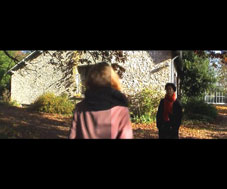
Atelier d?Alexandre Calder : Un paysage ? promontoire d?essai pour ses stabiles. Un 360° à deux caméras qui prennent le relais d?images l?une de l?autre, formant un cadrage 16/9ème. Capter le spectateur dans une première vision d?une image lisse et attractive. Puis, celle-ci se dilate en son milieu : une jonction de pixels. Des chocs se créent, troublant l?harmonie du plan-séquence. Les corps se dédoublent ou disparaissent, pointant les failles d?un dispositif qui s'est établi sur une forme écran, plane, une circonférence d?images : le trompe l??il du décor d?une pré narration filmique.
Marion Delaballe ? 26 ans Née à Paris. Vit et travaille à Paris. A fait ses études aux Beaux Arts de Valence et est diplômée du D.N.S.E.P. Art, en juin 2005. Spécialisée dans les installations vidéographiques qui se basent sur des processus filmiques spécifiques (morphing, double camera, chronophotographie, ?).
Anita Delaney, -
Catalogue : 2021Well | Vidéo expérimentale | mp4 | couleur | 1:28 | Irlande, Royaume-Uni | 2020
Anita Delaney, -
Well
Vidéo expérimentale | mp4 | couleur | 1:28 | Irlande, Royaume-Uni | 2020
"Well" (2020) un plaidoyer pour les relations familières. À la fois solitaire et intime, il se compose de courts plans de moments ordinaires de la vie à la maison. C’est une inspiration rapide, une expiration rapide. Ce sont des doigts croisés en espérant que tout ira bien.
Anita Delaney est d’origine irlandaise, mais vit et travaille à Londres. Elle est artiste. Parmi ses récentes projections et expositions figurent "Very Thirsty" à la Borzoi Tower, Chicago (USA) [février 2020]; "6 x 6 Project" au Set, Londres (Royaume-Uni) [septembre 2019] et "Sick Monday" au Horse Hospital, Londres (Royaume-Uni) [juillet 2019].
Catalogue : 2016The Cusp of Your Credenza | Vidéo | 4k | couleur | 10:27 | Irlande, Royaume-Uni | 2015
Anita Delaney
The Cusp of Your Credenza
Vidéo | 4k | couleur | 10:27 | Irlande, Royaume-Uni | 2015
The cusp of your credenza is a wandering speculation through various material encounters. A woman presents a number of scenarios that involve the ingestion or ejection of substances. From toenails to statuary, muffins to monuments, The Cusp of Your Credenza is looking for how we place ourselves bodily in a material world.
Working mainly in moving image, Anita Delaney graduated with BA Fine Art from IADT, Ireland in 2006 and MA Fine Art from Chelsea College, London in 2011. She has recently shown work at CCA, Glasgow, Whitechapel Gallery, London and the Royal Hibernian Academy, Dublin. In 2015 she was a recipient of an Arts Council Visual Arts Bursary Award which helps enable the production of new work.
Anita Delaney
Catalogue : 2021Well | Vidéo expérimentale | mp4 | couleur | 1:28 | Irlande, Royaume-Uni | 2020
Anita Delaney, -
Well
Vidéo expérimentale | mp4 | couleur | 1:28 | Irlande, Royaume-Uni | 2020
"Well" (2020) un plaidoyer pour les relations familières. À la fois solitaire et intime, il se compose de courts plans de moments ordinaires de la vie à la maison. C’est une inspiration rapide, une expiration rapide. Ce sont des doigts croisés en espérant que tout ira bien.
Anita Delaney est d’origine irlandaise, mais vit et travaille à Londres. Elle est artiste. Parmi ses récentes projections et expositions figurent "Very Thirsty" à la Borzoi Tower, Chicago (USA) [février 2020]; "6 x 6 Project" au Set, Londres (Royaume-Uni) [septembre 2019] et "Sick Monday" au Horse Hospital, Londres (Royaume-Uni) [juillet 2019].
Catalogue : 2016The Cusp of Your Credenza | Vidéo | 4k | couleur | 10:27 | Irlande, Royaume-Uni | 2015
Anita Delaney
The Cusp of Your Credenza
Vidéo | 4k | couleur | 10:27 | Irlande, Royaume-Uni | 2015
The cusp of your credenza is a wandering speculation through various material encounters. A woman presents a number of scenarios that involve the ingestion or ejection of substances. From toenails to statuary, muffins to monuments, The Cusp of Your Credenza is looking for how we place ourselves bodily in a material world.
Working mainly in moving image, Anita Delaney graduated with BA Fine Art from IADT, Ireland in 2006 and MA Fine Art from Chelsea College, London in 2011. She has recently shown work at CCA, Glasgow, Whitechapel Gallery, London and the Royal Hibernian Academy, Dublin. In 2015 she was a recipient of an Arts Council Visual Arts Bursary Award which helps enable the production of new work.
Daniela Delerci
Catalogue : 2025Before Night Falls | Documentaire | mov | couleur | 20:42 | Italie, Egypte | 2023
Daniela Delerci
Before Night Falls
Documentaire | mov | couleur | 20:42 | Italie, Egypte | 2023
This project ventures into the intricate landscape of masculinity, embarking on an in-depth investigation that challenges and deconstructs conventional definitions framed by societal and cultural norms. By examining masculinity through the lens of vulnerabilities, repression, and gender role construction, the initiative encourages a profound reevaluation of the male identity, advocating for a reconnection to the more primal, emotional, and sensitive sides of men's nature.
Daniela is an internationally renowned choreographer and movement director known for her boundary-pushing approach to dance. Driven by a profound curiosity about movement’s power, her work interweaves memory and the body’s capacity for storytelling. She debuted at the 2017 Biennale Danza with We Are Raw Material, setting the stage for a journey of artistic exploration across continents. Her collaborations include projects with the Pinuccio Sciola Museum, Accademia Nazionale di Roma, ?finMalta, and Tanz Company Gervasi. In 2021, Daniela earned an MFA in Choreography from Trinity Laban, where her innovative vision continued to flourish. Her celebrated piece Before Night Falls recently premiered at Contemporary Cairo Night and is currently touring Italy. Her latest work, Truncare Su Cadenas, explores the profound links between Armenian and Sardinian dance traditions.
Mathias Delfau
Catalogue : 20118 | Animation | | couleur | 17:13 | France | 2010
Mathias Delfau
8
Animation | | couleur | 17:13 | France | 2010
8 Un film d?animation de Mathias Delfau (2010 ? 17mn) Après avoir travaillé avec Noëlle Renaude à la mise en page d?Une belle journée et de Topographie, où la recherche portait sur une mise en espace du déroulement du texte sur la page, j?ai cherché à mettre en scène une partie de sa pièce 8 dans l?espace 3D et le temps d?un film d?animation. Ce travail est la rencontre entre une recherche picturale abstraite et une situation incarnée par les 5 personnages de la pièce. 8 est avant tout un procédé, celui de ne pas donner à voir, ni à entendre la pièce telle qu?elle pourrait être jouée sur scène, mais à montrer les traces qu?elle pourrait produire. Ne pas chercher le sens mais le laisser apparaître dans les traces laissées par ces phrases qui sont dites sans trop réfléchir à leurs portées, au gré de l?action, mais qui restent et influent sur le déroulement, dans les méandres des traces laissées par les déplacements de ces cinq personnages qui s?attirent et se repoussent au sein de ce qu?on pourrait appeler un groupe. Juste garder la subjectivité de l?axe de la caméra, comme celle des didascalies dans la pièce, le mouvement de la caméra crée un second plan détaché de l?action. 8 est une sorte d?observatoire où l?action se déroule en même temps qu?elle est observée, dans ce qu?elle est et dans ce qu?elle produit.
Je travaille avec des créateurs dans des domaines différents et c`est de ce va-et-vient entre l`art plastique, l`art numérique, le spectacle vivant et la littérature, qu`est né le film 8.
Catalogue : 2008MUR | Animation | 0 | couleur | 6:26 | France | 2006
Mathias Delfau
MUR
Animation | 0 | couleur | 6:26 | France | 2006
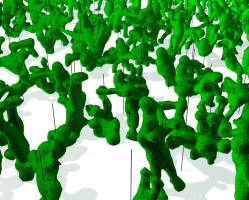
Mur, c?est la rencontre violente de deux points de vue. De l?extérieur, c?est un motif, sorte de treille végétale plus ou moins régulière. Dans la violence des percussions, la caméra semble hésiter face au mur, puis elle est projetée contre le motif. De l?intérieur, silence, le motif se découvre en volume, construit à partir de formes anthropomorphes, postures figées et épinglées de façon régulière sur le tracé du motif. La caméra découvre la particularité de chacun de ces corps, le motif est oublié, il est vu dans l?accumulation d?individualité dont il est formé. C?est de la répétition de ce passage entre le bruit et le silence, la forme et son sens que va naître MUR.
Mathias Delfau (1968) : je travaille comme designer graphique, plasticien et artiste numérique. Mon travail sur l?image s?est développé au moyen de différents médias. D?abord la peinture (1988/1999). Puis avec la scénographie et le spectacle, l?image est pensée dans l?espace (de 1995 à 1999 j?ai monté trois spectacles confrontant l?acteur à l?image). Enfin la vidéo en 1997 avec l?arrivée du numérique, parce qu?elle est le support parfait pour une recherche sur le montage, sur le passage progressif d?une image fixe à 25 images seconde. Pendant 7 ans, j?ai travaillé la vidéo sur ordinateur comme la peinture, couche après couche par superposition. Au service de la composition plus que de l?histoire. J?ai mâché cette matière numérique en produisant beaucoup de petites choses qui n?avaient d?autres buts que le temps passé à les faire. Depuis 2000, je travaille aussi avec le groupe d?artiste Accès local dont le but est de replacer la recherche artistique dans un contexte social et professionnel. Aujourd?hui, je n?utilise plus la vidéo mais l?animation 3D qui me permet de continuer ma recherche sur le dessin dans l?espace.
Catalogue : 2007HA | Animation | 0 | couleur | 5:0 | France | 2006
Mathias Delfau
HA
Animation | 0 | couleur | 5:0 | France | 2006
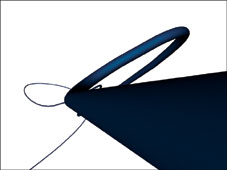
L?animation HA semble un aboutissement au regard des films réalisés depuis 1991. Travail de rencontre entre l?image vidéo et sa manipulation numérique, jeu de caché/montré, qui a débouché sur la disparition, le recouvrement de la figuration par l?image 3d (v. C?est Clair 2003), seul est resté le dessin, le trait. Ha c?est aussi le point d?équilibre entre la narration et le motif, l?animation n?ayant pas réellement de début et de fin, elle donne la possibilité d?être croisée du regard ou regardée sur la durée. Car c?est aussi de ça qu?il s?agit , amener par une accroche ludique (chevaucher le trait comme des montagnes russes) le spectateur à passer du temps devant ce trait qui dessine en fonction du regard qu?on lui porte, passant continuellement d?une impression physique d?espace au dessin qui s?anime sur le plan de l?écran.
Mathias Delfau (1968) Mène en parallèle un travail de graphiste, de plasticien et d?artiste vidéo. 1985-1994 Par la peinture, apprend l?image comme surface finie pouvant englober les espaces les plus infinis. L?image comme vocabulaire d?une parole non démonstrative. 1987-1992 Etudes de plasticien de l?environnement architectural aux Arts Appliqués de Paris (BTS), et de peintre aux Beaux-Arts de Paris, pour réfléchir sur la notion paradoxale de l?art appliqué. 1992-1995 Travail à temps partiel comme assistant d?exposition à la Galerie Nationale du jeu de paume. 19993-1994 Conception et réalisation d?expositions pour la cinémathèque française. 1992-1995 Mise en scène trois spectacles de manipulation d?images. 1994-2006 Poursuite de la peintre par la vidéo numérique et réalisation de plusieurs films d?animation. 1997-2003 Travail à temps partiel comme créatif dans une agence de graphisme spécialisée dans la communication culturelle. 2000-2006 Collaboration et expositions avec le groupe d?artistes Accès Local dont le but est de replacer la recherche artistique dans un contexte social. 2003-2006 Travail en indépendant pour des travaux imprimés (affiches, plaquettes, éditions, illustrations), animés (sites internet, habillages, vidéos), et mis en espace (signalétique, site d?accueil, événementiel). 2003-2006 De nouveau des images fixes au moyen de grands tirages couleurs, formes sculpturales apparemment simples reconstruites à partir de centaines de macrophotographies. 2004-2005 avec l?installation Madame T. la vidéo est placée dans l?espace et confronte au sein d?une même installation différents médias, chacun prenant en charge une facette de l?histoire. 2006 Fondation de l?association OA, structure légale permettant à des artistes aux savoirs faire complémentaires de travailler ensemble pour concevoir, réaliser et diffuser des formes émettrices originales, légères et mobiles pouvant s?intégrer simplement dans différents espaces publics.
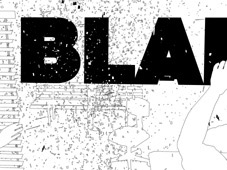
Catalogue : 2006Blahblah | Vidéo expérimentale | dv | noir et blanc | 4:16 | France | 2005
Mathias Delfau
Blahblah
Vidéo expérimentale | dv | noir et blanc | 4:16 | France | 2005
BLAH BLAH, c?est un huis clos dont chaque protagoniste est réduit à une action. C?est aussi un manège répétitif de pantins qui montent et descendent. Comme des automates de boîtes à musique, sauf que dans BLAH BLAH il n?y a pas de son. La seule chose qui se développe et qui raconte, ce sont les mots, pas dans leurs significations mais par leurs déplacements. BLAH BLAH, c?est une caricature de société où la vie naît de l?interaction., un flipper de mots dont le flux a plus d?importance que le sens.
Mathias Delfau (1968) Mène en parallèle un travail de graphiste, de plasticien et d?artiste vidéo. 1987-1992 études de plasticien de l?environnement architectural aux Arts Appliqués de Paris, et de peintre aux Beaux-Arts de Paris, 1992-1995 Met en scène trois spectacles de manipulation d?images. 1994-2005 Poursuit son travail de peintre grâce à la vidéo numérique et réalise de nombreux films d?animation. 1997-2003 Travail à temps partiel dans une agence de graphisme. 2000-2005 Collaboration avec le groupe d?artistes Accès Local dont le but est de replacer la recherche artistique dans un contexte social. 2003-2005 Travail en indépendant pour des travaux imprimés (affiches, plaquettes, éditions, illustrations), animés (sites internets, habillages, vidéos), et mis en espace (signalétique, sites d?accueil, événementiel). 2004-2005 avec l?installation Madame T. il place la vidéo dans l?espace et confronte au sein d?une même installation l?image fixe et l?image en mouvement.
Teresa Delgado, Jakob Kirchheim
Catalogue : 2015Veracruz | Doc. expérimental | hdv | couleur | 5:53 | Espagne, Mexique | 2014
Teresa Delgado, Jakob Kirchheim
Veracruz
Doc. expérimental | hdv | couleur | 5:53 | Espagne, Mexique | 2014
Veracruz without ship by Teresa Delgado & Jakob Kirchheim A documentary melodrama with privatizations and without lovers. A poetic walk through Veracruz, port of European exiles and Mexican oil, of melodrama and of the rhythm danzón. Since 1938 Lázaro Cárdenas government offered political asylum to thousands of Spanish republicans who were fleeing war and persecution. They arrived to the port of Veracruz, unreachable paradise for the defeated who couldn´t leave Spain. We revisit this myth of the grandparents and confront it with the present in 2014. In this year the PRI government is opening the doors to private investment of multinationals in a natural resource which Mexicans consider their own: oil. Oil plays an important role in the Gulf of Mexico and Mexican oil was nationalized by Cárdenas government in 1938.
Born in Madrid 1965 and living in Berlin since 1987. Graduated from the Free University of Berlin with a M. A. in German and Spanish Literature. She is teaching Latin American cinema, history and culture at the Humboldt University and use to collaborate with the artist Jakob Kirchheim since their first film “Die Prinzessin der zweiten Hand”/”La princesa de la segunda mano” which was shown at the Berlin Film Festival and in Imagfic Madrid (1992). She has been working in poetry and short documentary films. The best known is “Terrorsounds” in collaboration also with Jakob Kirchheim (2010) shown at the Zebra Poetryfilm Festival in Berlin, VideoBardo Buenos Aires, Bristol, Vancouver and in 2013 at the “Zentrum für Kunst und Medien “ in Karlsruhe in the exhibition “Typemotion. Type as image in motion”.
Daniela Delgado Viteri
Catalogue : 2014Monstruo | Film expérimental | 16mm | noir et blanc | 15:6 | Equateur, Argentine | 2013
Daniela Delgado Viteri
Monstruo
Film expérimental | 16mm | noir et blanc | 15:6 | Equateur, Argentine | 2013
There are mass suicides and there are mass naps. They seem pretty close but they actually have different ontological dimensions. This film is about a mass nap and some mysterious acts of violence that are not taken very seriously. There is not much more to say. However, I would like to add the fact that I believe this film is very serious due to the fact that doesn?t take itself seriously.
Daniela Delgado was born in Ecuador in 1987. She studied film at Universidad del Cine in Buenos Aires. She wrote and directed short films screened at Rotterdam Film Festival, Split Film Festival, Bienal of Moving Image in Buenos Aires, Museum of Modern Art in Buenos Aires and Semana del Cine Experimental in Madrid. She participated at the Berlinale Talent Campus #10 (2012). She is currently a scholarhip holder at the Centre of Investigation of the Arts in Buenos Aires.