Catalogue > Search
Results for : Tout le catalogue

Milutin Gubash
Vesna at Monument
Video | hdv | color | 3:46 | Canada, Serbia | 2016
In Vesna At the Monument (2016), a humble middle aged woman appears on the site of a dilapidated, in-the-middle-of-nowhere monument, erected likely in the time when she was youthful and at her most optimistic. The monument was commissioned in order to commemorate the heroic actions of common citizens in their struggle against fascism, and desire to promote and participate in a progressive, utopic state. She shuffles past the monument, and sits to smoke a cigarette. Off screen, a voice is heard, asking her questions such as what is the meaning of this place, this monument, this moment. She does not answer, as though she does not hear the question, even while acknowledging the camera, and the voice itself. It could, one supposes, be the voice of the cameraman or director, a voice in the subject’s own head, perhaps the voice of the monument itself, trying to ascertain the meaning of itself in this day and age. It gets no reply, and eventually (perhaps fed up with the question), she simply leaves, with the interlocutor left in his own uncertainty. The video seems to reject or deny a past, while expressing grave uncertainty to the future.
Born in Novi Sad (Serbia) and lives in Montréal (Canada) since 2005, Milutin Gubash has presented exhibitions in Québec, Canada, the United States, and Europe, including a solo show at Musée d’art contemporain de Montréal (2007) and a ten year survey exhibition co-produced by six institutions across Canada (Rodman Hall Art Centre 2011, Carleton University Art Gallery 2012, Kitchener-Waterloo Art Gallery 2012, Southern Alberta Art Gallery 2012, Musée d’art de Joliette 2012 and Fonderie Darling 2013). He was the recipient of the Conseil des arts et des lettres du Québec studio residency in Paris for 2016. His practice encompasses photography, video, and performance, and regularly features the participation of his family and friends, who portray versions of themselves in Do-It-Yourself soap operas, historical rewrites and improv theatre pieces. Using simple means and often absurdist gestures, Gubash reconsiders assumptions about the narratives of our identities, histories and environments.

Mark Gubb
The Death of Peter Fechter
Création numérique | dv | color and b&w | 55:0 | United Kingdom | 2007
The video work The Death of Peter Fechter is documentation of a one-off live-performance; a re-enactment of the murder of Peter Fechter; an 18 yr old citizen of the GDR, shot and fatally wounded in an attempt to escape over the Berlin Wall on August 17th, 1962. An important moment in the history of the wall, Peter was not the first or last to die in his attempt to escape, but his story made the international news as he was fired upon and hit, falling back in to mans land where he lay for an hour, calling for help and slowly bleeding to death, whilst a crowd of West Berliners gathered against the wall pleading for the guards to help him and the guards on either side made no moves to help him. Commissioned by the ICA, London, as a live-performance, I recognised the possibility for the documentation to be something more than mere documentation; that it could be shot in such a way as to work as a film in its own right. Working closely with an independent director, a multi-angle, yet unobtrusive, shoot was devised to capture the power of the performance and allow the work to exist beyond that day.
S Mark Gubb (b.1974) currently lives and works in Nottingham, England. Mark works across a range of media including sculpture, video, sound, installation and performance. Recent projects/exhibitions include Out of Bounds: The 5 Codes Tours (a new commission for Cornerhouse, Manchester, as part of the launch of the Cultural Olympiad), Here Today, Gone Tomorrow, The City Gallery, Leicester and The Death of Peter Fechter, ICA, London. Previous residencies include Cove Park Production Residency, Cove Park, Scotland (2008), Arts Council England International Fellow, Bunkier Sztuki, Krakow, Poland (2005), The Wheatley Fellowship, BIAD, Birmingham (2004) and Romantic Detachment, PS1(MoMA), NYC (2004). Mark is represented by Ceri Hand Gallery, Liverpool, and has his first solo show there, My Empire of Dirt, in January 2009, alongside which will be the launch of a book documenting previous projects and exhibitions, including an interview by Ross Sinclair and an essay by Andrew hunt.

Chris Gude
Mariana
Experimental fiction | hdv | color | 64:0 | USA, Colombia | 2017
The Guajira is a borderland peninsula between Colombia and Venezuela of resolute natives as well as disinherited adventurers. Some there take advantage of the peripheral territory to smuggle through isolated ports and over rugged landscape. They write their rebellious proclamation in the sands of crisscrossing desert paths and their rusted motors accompany their solitary voices with an unorthodox music, animating their indiscipline and adhesion to pure movement.
Chris Gude (1985, New York) studied geography and anthropology at Middlebury College. His first film, MAMBO COOL (2013), exhibited at FIDMarseille, Viennale, Punto de Vista, Mar del Plata, Cartagena, among others. His second film, MARIANA (2017), also premiered at FIDMarseille and won Best Director at the Ourense International Film Festival.
Tito Guedes, Manuel OGANDO
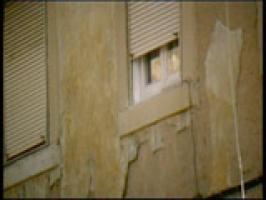
From park to park
Experimental doc. | dv | color | 3:40 | Portugal | 2003
Experimental portrait of the city as a self-experience: the images are too intense and sometimes the sound is unbearable. Independent Cinema festival of Lisbon, 2004.
Gueli
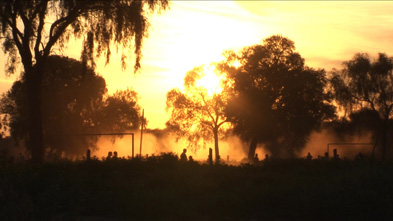
LA FABRIL - work in progress
Experimental doc. | hdv | color | 17:40 | Argentina, Italy | 2012
The images of a virgin Argentina, out from a private photographic archive, become present landscape: the river, the forest, the road: everything seems unchanged... except a ruined cotton factory, ghost of the collapse of a model of development imported from Europe, which is now a few teenager`s playground.
Caterina Gueli an italo-argentinean director/editor based in Paris. ?La Fabril? is a work in progress, through which she deepens the research engaged in her precedent two short films : Resistencia (Premio Avanti! Torino Film Festival 2007, Best Soundtrack Genova Film Festival 2008, etc.) and Somewhere (2009). She has participated to the realization of Il Canto dei Nuovi Emigranti (Best Documentary Torino Film Festival 2005) and In Attesa dell`Avvento (Best Short Film - Mostra del Cinema di Venezia 2011 ? Orizzonti) of Felice D`Agostino and Arturo Lavorato.

Rafael Guendelman Hales
Hombre: a veces por la noche pierdo mi mente
Video | hdv | color | 11:26 | Chile | 2012
Man: Sometimes in the night I lose my mind (2011) This work was part of the project ?Between Iloca and Dichato.? It tried to capture, by means of a trip, the marginal and unmediated consequences of the Chilean Tsunami, one year later. It´s a choral story of the experience from interviews with people who witnessed the wave. The video shows ideas, abstractions and derivations of what happened that night, putting the emphasis on the paradoxical perception of the people; between humor and tragedy. A fragmented narrative emerges naturally from the memory pieces of the people.
Rafael Guendelman, was born in Santiago of Chile, in 1987. Bachelor in Visual Arts and degree on Theory of Cinema from Catholic University, Chile. In the same University has been Teacher Assistant in the Video Art and Workshop classes for several years. Rafael works as a visual artist and video maker. He has participated in group exhibits and video screenings in Chile, the USA, France, Israel, Palestinian territories and others. This year he has been living in/between Middle East and Europe, filming in the Palestinian territories and Israel, and participating in the international residency program of ZK/U, The ?Center for arts and Urbanistics? in Berlin.
Rafael Guendelman Hales
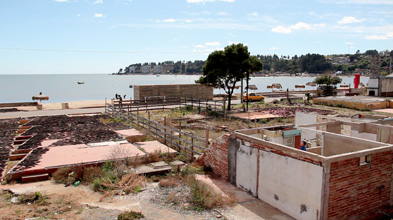
Paisaje: Mis pies en la noche, el mar en mis pies.
Video | hdv | color | 6:59 | Chile | 2012
Landscape: My feet at night, the sea on my feet (2012) This work was born as a late work from the project ?Between Iloca and Dichato? which tried to capture, by means of a trip, the marginal and unmediated consequences of the Chilean Tsunami, one year later. The space reveals the weight of time, where in the year since the Tsunami things haven´t changed radically. Compared with ?Man?, this video focuses on the landscape using steady and long shots as a strategy to capture those ?after? spaces. The silence of the field, contrasted with the government speech; the Sea goes up and down, the man is just a viewer, or another piece from the picture.
Rafael Guendelman, was born in Santiago of Chile, in 1987. Bachelor in Visual Arts and degree on Theory of Cinema from Catholic University, Chile. In the same University has been Teacher Assistant in the Video Art and Workshop classes for several years. Rafael works as a visual artist and video maker. He has participated in group exhibits and video screenings in Chile, the USA, France, Israel, Palestinian territories and others. This year he has been living in/between Middle East and Europe, filming in the Palestinian territories and Israel, and participating in the international residency program of ZK/U, the ?Center for arts and Urbanistics? in Berlin.
Guerreiro Do Divino Amor
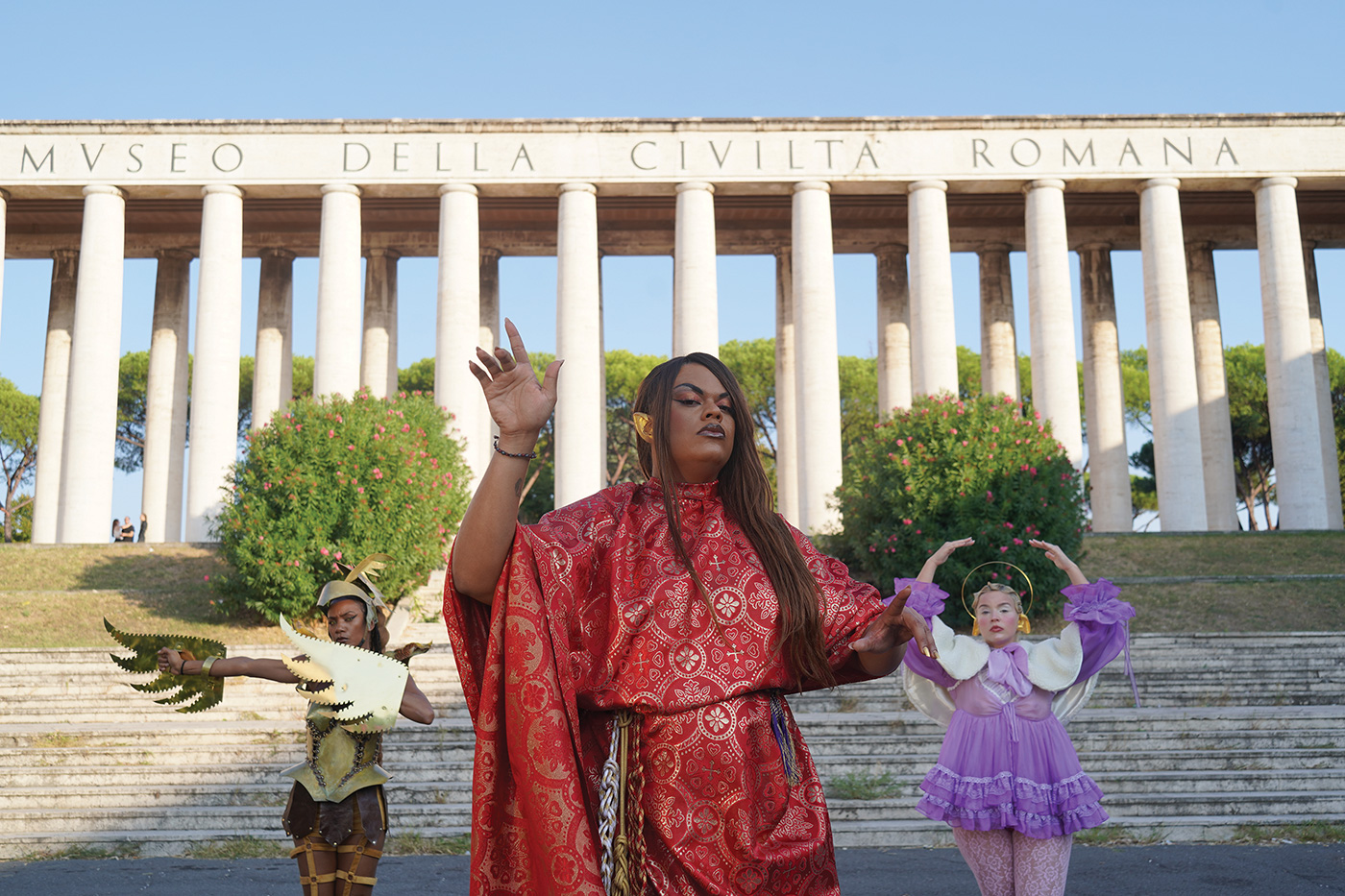
Roma Talismano
Experimental doc. | 4k | color | 9:38 | Brazil | 2024
Roma Talismano, seventh instalment of the ‘Superfictional World Atlas’, explores Rome as the moral and aesthetic talisman of the West. To the sound of opera hymns and arias, the allegorical animals the she-wolf, the eagle and the lamb narrate the endless recycling of Roman aesthetics to create an artificial and pale classical universality, from the Renaissance to fascism to the present day: Roma Talismano, eternal volcano of visual and spiritual bleach.
Guerreiro do Divino Amor holds a master’s degree in architecture from the School of Architecture of Grenoble (France). His since 20 years ongoing research “Superfictional world Atlas” explore the historical, media-related, religious and corporative mythologies that make up the collective imaginary of nations. He creates an universe of science fiction from fragments of reality in the shape of films, publications, and large-scale installations. Divino Amor represented Switzerland in the 2024 Venice biennial, was a fellow of the DAAD Artist-in-Berlin Program in 2021-2022, was awarded the PIPA Prize 2019. In 2022 he presented the retrospective solo show “Superficitional Sanctuaries” at the Centre d’Art Contemporain in Geneva. His work has been presented at the Frestas Trienal in Sorocaba (Brazil) Bangkok Biennale 2024, CAC Vilnius (Lithuania), Pinacoteca de São Paulo, among other institutions. His award-winning films have been screened at various national and international venues and festivals. Guerreiro do Divino Amor lives and works in Rio de Janeiro, Brazil.
Felipe Guerrero
Corta
Experimental doc. | 16mm | color | 69:0 | Colombia, Argentina | 2012
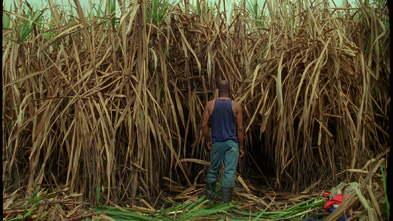
Through the means of a still fixed camera and the rhythmic strengtht granted by on-camera editing; Corta is a film centered upon the hypnotic extenuation generated by the body movements of sugar cane cutters. A contemplation of the frenziness and softness of the performatic gestures of hand labour while the surrounding plantations act as an omnipresent backdrop as the canes disappear. Corta is a pure cinematic experience about the natural and everyday ritual of a timeless world.
Felipe Guerrero holds a degree in Film Editing from the Centro Sperimentale di Cinematografia, in Rome, Italy. As an editor he has worked in internationally exhibited and award-winning films. In 2006 he made his directing debut with the documentary Paraíso, which was awarded at FID Marseille. Corta is his second film. He lives in Buenos Aires.
Felipe Guerrero
Nelsa
Experimental fiction | hdv | color | 13:0 | Colombia | 2014
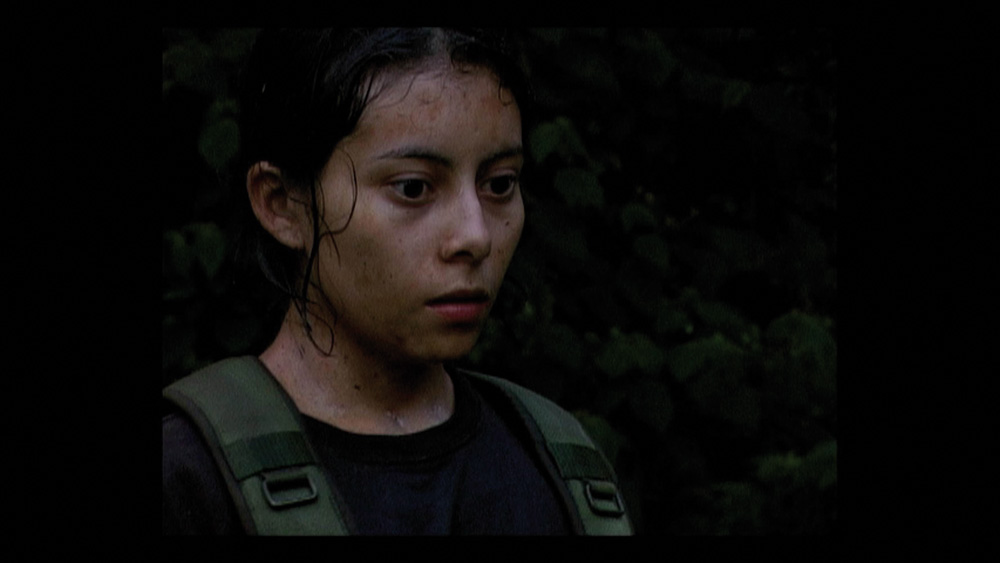
A mission in the middle of the Colombian jungle. Time seems to have stopped. There is something sinister in the air. The ambiance is tense. Hot and humid. A man surrounded by an environment that burns himfrom the inside. Power, poetry, violence. Everything happens in an instant, leaving everyone breathless.
Director and editor Felipe Guerrero was born in Colombia in 1975. His first film Paraíso(2006) received the Mention Spécial for First Films at FIDMarseille. Corta(2012), his second film, premiered in the BrightFuture Section at the Rotterdam FF 2012, and was exhibited in Festivals around the world (FICCICartagena de Indias, BAFICI Buenos Aires, JIFF Jeonju,FIDOCS Santiago de Chile, DISTRITAL México DF, SPLITCroacia, DOKLeipzig, La Habana). As an editor, he worked in films exhibited and awardedinternationally, among them: Los Hongos(2014), La playaDC(2012), El páramo(2011), El vuelco del Cangrejo (2009). In 2011 he founded his own production company Mutokino.
Felipe Guerrero
Paraíso
Experimental doc. | super8 | color and b&w | 55:0 | Colombia | 2006
PARAÍSO is a poetic evocation of a country and its historical memory, an intimate portrait of modern Colombian life. Within the soft grain of Super 8 throbs the reality of a country wrapped up in its own, unending war.
Felipe Guerrero (Colombia, 1975) studied film editing at Centro Sperimentale di Cinematografia of Rome. He works as an editor in Europe and Latin America. He lives in Buenos Aires.

Adler Guerrier
untitled - rhetoric that preaches revolution
Experimental doc. | hdv | color and b&w | 23:19 | Haiti, USA | 2008
Dans Untitled (Rhetoric that Preaches Revolution), je voulais faire une pièce qui se concentrerait sur la voix d’un groupe d’artistes et qui serait éclairée par les fondements structurels de leurs œuvres. L’accent est mis en partie sur ce qu’ils voudraient dire à la lumière des évènements mondiaux et régionaux. La pièce se base sur des enregistrements de journaux télévisés et des images assemblées des unes de la presse écrite relatant l’actualité, principalement de 1965 à 1968, comme Martin Luther King marchant vers Selma, Malcolm X en train de parler, des membres du Black Panther Party en confrontation avec les médias et la police, le soulèvement du Watts, des manifestants étudiants avec des revendications et des ouvriers en contestation. Lire ces images, d’un point de vue sympathisant, et les transformer en œuvres constituaient mon objectif général.

Dor Guez
Qalâat Al-Husan
Video installation | 4k | color | 8:0 | Palestine, United Kingdom | 2022

Vincent Guilbert
Brutalement, le silence (Savagely, Silence)
Experimental doc. | hdv | color and b&w | 20:30 | France, Japan | 2016
December 21, 2015. The image of a fox was captured by a camera inside the unit 2 building at Fukushima No.1 nuclear power plant...
Vincent Guilbert was born on June 2, 1976 in Saint-Denis, Seine-Saint-Denis, France. He is a director and cinematographer known for the experimental diptych "Shinjuku Blues & Whispering Shadows" (a collaboration with musician Michel Henritzi), or the documentary films April's Shadows (2013), Jolie Chanson (2015) and Le murmure de la pivoine (2016). He is mainly working between France and Japan since 2005.

Vincent Guilbert
Gestures
Documentary | hdv | color and b&w | 31:0 | France | 2017
Sightings of Brooklyn-based musician Loren Connors. To graze against the pulsations of time, to feel matter, to linger on the imperceptible frailty of gesture...
Né en 1976 à Saint-Denis, France. Parallèlement à ses recherches sur la texture de l'image, les thèmes développés à travers ses films/photos sont essentiellement liés au Temps, à la mémoire et au fragment.
Mauricio Guillén
Avenida Progreso
Fiction | 16mm | black and white | 20:0 | Mexico | 0
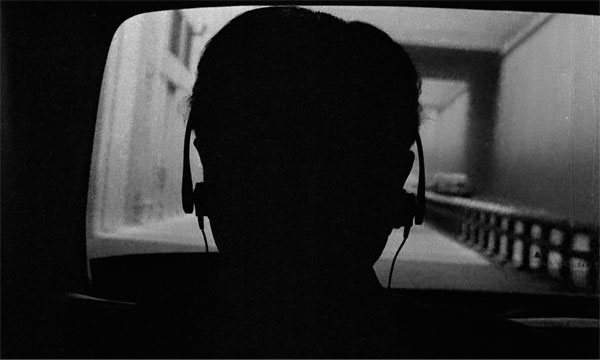
Mr. Jocotot, a philosophy and ethics professor, has just collected final exams from his students and, unlike most other days, decides to take a taxi home. As he turns onto Avenida Progreso, a prominent street in Mexico City, he will come up against corruption and his ignorance will teach him a lesson.
Mauricio Guillén was born in México city in 1971. He studied at Parsons School in Paris, The Cooper Union in New York City and The Royal College of Art in London England. He currently lives in Frankfurt Germany where last summer, as part of an exhibition of his work, he presented the film AVENIDA PROGRESO at MMK (Museum für Moderne Kunst Frankfurt am Main).

Alexis Guillier
Purgatoire (Cinema that kills)
Experimental doc. | digital | color and b&w | 61:44 | France, Lebanon | 2023
Alexis Guillier’s film looks at the deadly fire that broke out at the Beirut nightclub "Purgatoire" on the set of the 1969 Lebanese movie "Kolouna Feda'iyoun" ("We are all fedayeen") by Gary Garabedian, a take on Palestinian resistance at the time. Guillier’s project delves into the complexity of the film’s context, the precariousness of Lebanese cinema, and the investigation of the accident. The narrative of the film is built through the stories of the main protagonists: Purgatoire’s owner Sami Ghosn, TV star and Gary Garabedian's good friend Salah Tizani (aka Abu Salim), actor Samir Abu Saeed, the last living actor to have appeared in the film and who was at Purgatoire the night of the accident, actor Samir Chamas, who played in the film and who arrived on the scene just after the accident, Mirvat Kousa, sister of the actress Mona Slim, who was seriously injured in the accident, Hussein Al Sayyed, special effects expert and Christiane Mallouk, sister of the extra Gaby Mallouk who died in the accident. "Purgatoire" is part of the larger project "La réalité éclatée / A many splattered thing, conceived as an investigative history of cinema through set accidents that have caused deaths and severe injuries. The whole project is interested in the tensions between production and representation, material reality and image carried on the screen. In this respect, the exploration of the accident in "Purgatoire" is marked by these questions and inhabited by the revealing power of the accident. The film also testifies to the evolution of Alexis Guillier's image work, which is illustrated here through the increased exploration of visual associations, layered editing and opacity, which are also reflexive tools on the context, the story, and the narrative of the accident, and which nourish a play with certain formal codes of documentary.
Alexis Guillier (France, 1982) dedicates himself to films, performances, texts or installations, which all are narratives, stem from investigations (documentary and on the ground) in collective and individual stories. Leading him from forgeries to defacement and disappearance of artworks, from a movie set accident to ghost ships, or to the exploration of the giant statue Notre-Dame de France, his forms gather many different documents, which coexist in cultural history but rarely meet. His areas of investigation push him to observe the circulation of images and cultural productions, echoes and recurrences, the formation of imaginaries, interactions between personal actions and national stories, on an aesthetic as well as anthropological level. The telling of these stories questions itself, always on an uncertain line, between detached subjectivity and documentary lyricism, thus contributing to the indeterminacy of treated objects. His research is made of analogies, association of ideas, also deals with paranoia as method. More recently, he focuses on putting his projects in perspective with "cases", considering that the accident or the disaster, and the violence that comes with it, insistently recur. Investigation and editing processes also reflect a similar connection with the notion of body, as a way of putting pieces cut in different stories or sources together.

Tamar Guimaraes, in collaboration with Luisa Cavanagh and Rusi Milán Pastori
Soap
Fiction | 4k | color | 53:50 | Brazil, Germany | 2020
SOAP is a film in four episodes in which a group of isolated, left-winger urbanites imagine how to create a telenovela, or soap, to infiltrate the conspiratorial far right in Bolsonaro’s Brazil. Can a coalition of activists, artists and writers avoid tripping over their own assumptions and privileges to form something persuasive? Can they join forces to beat a populist system at their own game? SOAP is a collaboration between Tamar Guimarães, Luisa Cavanagh and Rusi Millán Pastori and was filmed in Berlin and São Paulo during the first covid19 lockdown in 2020.
TAMAR GUIMARÃES (b. Belo Horizonte 1967, BR, lives and works in Berlin) is a visual artist working with film and other forms of time based media. She often works with actors alongside non-actors in semi-fictional films exploring socio-political dynamics both residual and contemporary, and situations within art, architecture and the institutions that present them. Her work has been included at the 33rd, 31st and the 29th São Paulo Biennial; the Belgian Pavilion at the 56th Venice Biennial; the 55th Venice Biennial; the LACMA (USA); the Guggenheim Museum, NY (USA); the SculptureCenter (NY/USA); The Renaissance Society (Chicago); the 7th Gwangju Biennial (SK); Frac/Le Plateau, Paris (FR); CAC Synagogue de Delme (FR). Solo exhibitions include Museo Nacional Centro de Arte Reina Sofia, Madrid and the Jeu de Paume Satellite, Paris. LUISA CAVANAGH (1979, Buenos Aires, Argentina) is a visual artist, colourist, and cinematographer. She studied Cinematography at National Film School. Focused on collaborative work, she joined 'Grupo Mexa' to develop the film/performance 'Cancionero Terminal 10Mg'. She is a co-founder of 'Eterno work in progress', an artist-run cine-club that explores the limits of cinema exhibition, live music and moving images. RUSI MILLÁN PASTORI (1976, Argentina) is a writer, film director and director of photography. Actual political scenarios are a common thread throughout his work, as chronicles that combine different situations and characters. He studied cinematography at the National School of Experimentation and Cinematographic Realization in Buenos Aires. He has directed short and medium-length films which were shown in festivals such as the BAFICI in Buenos Aires and at the 41st Mostra in São Paulo.

Tamar Guimaraes
Soap: Epidode 5 - Moses And Monotheism
Video | hdv | color | 27:0 | United Kingdom, Brazil | 2021
SOAP, 2020-ongoing, imagines what it would take to create a soap opera with which to infiltrate, and influence, the conspiratorial far right in Bolsonaro’s Brazil. A group of idealistic left-wing intellectuals join forces to play a populist system at its own game. Through the initial five episodes, the heroes struggle to chart a course through their own ideas and ideologies by way of quotidian dramas and veiled intrigues. But how can this small group of artists, writers and activists overcome the struggle of principles, their internal bickering and the absurdities of their own privilege to create something that resonates and has real impact with their target audience? IN Episode 5, ‘MOSES AND MONOTHEISM’, concepts clash ferociously, hand puppets scream and pray, renowned Genocide Scholars are accosted and conspiracies bleed across borders. Meanwhile, as the left-wing infiltrators struggle to make sense of their own intentions, entertaining the idea of creating a YouTube series aimed at the evangelic Brazilians, the Querdenkers (a movement that fuses protesters against Covid measures with the far-right scene thriving on a sense of crisis and apocalypse) move through plague-time Berlin like a danse macabre.
Tamar Guimarães (b. Belo Horizonte, BR, lives and works in Copenhagen and Berlin) is a visual artist working with film and other forms of time based media. She often works with actors alongside non- actors in semi-fictional films. Recent solo exhibitions include Museo Nacional Centro de Arte Reina Sofia, Madrid; Jeu de Paume Satellite, Paris; Gasworks, London and the IMA Institute of Modern Art, Brisbane. Guimarães’ works have been included at the 33rd, 31st and the 29th São Paulo Biennial; the Belgian Pavilion at the 56th Venice Biennial; the International Exhibition at the 55th Venice Biennial; at the LACMA - Los Angeles County Museum of Art (USA); Baltimore Museum of Art (USA); the 11th Sharjah Biennial (UAE); the Banff Centre, Alberta (CA); Malmö Museum (SE); the Guggenheim Museum, NY (USA); the SculptureCenter (NY/USA); the 7th Gwangju Biennial (SK); the 3rd Guanghzhou Triennial (CN); the Jumex museum, Mexico (MX); Frac/Le Plateau, Paris (FR); CAC Synagogue de Delme (FR) and at the Haus der Kulturen der Welt, Berlin (DE). Her work has been screened at the Berlinale Forum Expanded (2019); Blackout, International Film Festival Rotterdam (2019); VIDEONALE, Bonn (2018); Anthology Film Archive, New York (2016); CPH:DOX (2013 and 2007); Images Film Festival and Experimental Media Congress, Toronto, Canada (2010); Architektur-Visionen # 1-6, Metropolis Kino, Hamburg (2015); Les Rencontres Internationales, Paris and Berlin (2014); TRAMWAY art film biennial, Glasgow (2012); Viennale Film Festival, Vienna (2011); and Oberhausen Film Festival (2009) among others. Guimarães’ work is represented in the collections of the Tate Modern (UK); the Solomon Guggenheim Foundation, N.Y. (USA); Museo Nacional Centro de Arte Reina Sofía (ES); Kadist Foundation (SF); Inhotim (BR); Frac Lorraine (FR); Guandong Museum (CN) and Cisneros Fontan- als Art Foundation (USA). She was awarded the 2018 Faena Prize for the Arts, Faena Art, Buenos Aires, Argentina; the 2014 Edstrandska Foundation Prize, Malmö, Sweden; the 2012 Cisneros Fontanals Art Foundation Grants and Commissions Prize, Miami, USA; was the receiver of a three-year work grant from the Danish Arts Council and was nominated for the 2018 Prize The Future of Europe, Leipzig, Germany.

Tamar Guimaraes
Soap: Episode Six and a Half: Talking Soap
Fiction | 0 | color | 23:55 | Brazil | 2023
SOAP is a film in seven episodes following the infiltration attempts of a cluster of left-wing people in right-wing social networks. The tactic chosen by the group is the creation of a YouTube channel aimed at teenagers employing the apparently conservative language of religious devotion and self help through prayer. SOAP asks questions such as can a coalition of artists, writers and activists avoid tripping over their own assumptions and privileges to form something persuasive? Is the white left dead? Or rather, have the forms of appeal and address relied upon by the intellectual Lefts ceased to be effective? Is there a way out of the internal bickering and accusations - that continue to hamper political movements? In episode 'six and a half', Camila narrates the previous episodes, reflecting on the project's aims and fractures from the perspective of a post election moment in which the Left was re-elected to the presidency in Brazil.
Tamar Guimarães (b. Belo Horizonte, BR, lives and works in Copenhagen and Berlin) is an artist working with film and installation. Her work has been included at the 33rd, 31st and the 29th São Paulo Biennial; the Belgian Pavilion at the 56th Venice Biennial; the International Exhibition at the 55th Venice Biennial; the LACMA - Los Angeles County Museum of Art (USA); Baltimore Museum of Art (USA); 11th Sharjah Biennial (UAE); the Banff Centre, Alberta (CA); the Guggenheim Museum, NY (USA); the SculptureCenter (NY/USA); the 7th Gwangju Biennial (SK); the 3rd Guanghzhou Triennial (CN); Frac/Le Plateau, Paris (FR); CAC Synagogue de Delme (FR). Her moving image work has been screened at the Les Rencontres Internationales (2014, 2021, 2022); Berlinale Forum Expanded (2019); Blackout, International Film Festival Rotterdam (2019); VIDEONALE, Bonn (2018); Anthology Film Archive, New York (2016); CPH:DOX (2013 and 2007); Images Film Festival and Experimental Media Congress, Toronto, Canada (2010); Architektur-Visionen # 1-6, Metropolis Kino, Hamburg (2015); TRAMWAY art film biennial, Glasgow (2012); Viennale Film Festival, Vienna (2011); and Oberhausen Film Festival (2009). Guimarães’ work is represented in the collections of the Tate Modern (UK); the Solomon Guggenheim Foundation, N.Y. (USA); Museo Nacional Centro de Arte Reina Sofía (ES); Kadist Foundation (SF); Frac Lorraine (FR) among others.

Tamar Guimaraes
SOAP: Episode Six: THEY DON T HAVE JESUS IN THEIR HEARTS
Fiction | digital | color | 14:38 | Brazil | 2023
SOAP follows the infiltration attempts of a cluster of left-wing people in right-wing social networks. The tactic chosen by the group is the creation of a YouTube channel aimed at teenagers employing the apparently conservative language of religious devotion and self-help through prayer. In episode six our infiltrators continue to discuss the implications of the soap they are plotting. In the meantime the group has fractured and one of its former member has left the project to pursue traditional politics, preparing to launch her candidacy as a trans councilwoman.
Tamar Guimarães (b. Belo Horizonte, BR, lives and works in Copenhagen and Berlin) is an artist working with film and installation. Her work has been included at the 33rd, 31st and the 29th São Paulo Biennial; the Belgian Pavilion at the 56th Venice Biennial; the International Exhibition at the 55th Venice Biennial; the LACMA - Los Angeles County Museum of Art (USA); Baltimore Museum of Art (USA); 11th Sharjah Biennial (UAE); the Banff Centre, Alberta (CA); the Guggenheim Museum, NY (USA); the SculptureCenter (NY/USA); the 7th Gwangju Biennial (SK); the 3rd Guanghzhou Triennial (CN); Frac/Le Plateau, Paris (FR); CAC Synagogue de Delme (FR). Her moving image work has been screened at the Les Rencontres Internationales (2014, 2021, 2022); Berlinale Forum Expanded (2019); Blackout, International Film Festival Rotterdam (2019); VIDEONALE, Bonn (2018); Anthology Film Archive, New York (2016); CPH:DOX (2013 and 2007); Images Film Festival and Experimental Media Congress, Toronto, Canada (2010); Architektur-Visionen # 1-6, Metropolis Kino, Hamburg (2015); TRAMWAY art film biennial, Glasgow (2012); Viennale Film Festival, Vienna (2011); and Oberhausen Film Festival (2009). Guimarães’ work is represented in the collections of the Tate Modern (UK); the Solomon Guggenheim Foundation, N.Y. (USA); Museo Nacional Centro de Arte Reina Sofía (ES); Kadist Foundation (SF); Frac Lorraine (FR) among others.