Catalogue > Search
Results for : Tout le catalogue

Yann Beauvais
meeting paul in buffalo
Experimental film | dv | color | 3:10 | France | 2010
Une brève visite à Buffalo à l`occasion d`une projection de mes films invité par Paul Sharits. Quelques fragments initialement tournés en super 8 dans les années 80
Yann Beauvais est né en 1953, il vit et travaille à Paris et São Paulo. Il est cinéaste, critique et curateur. Il est l'auteur d'une trentaine de films courts et d'installations. Il est cofondateur de Light Cone, structure dédiée à la diffusion et la sauvegarde du cinéma expérimental qui est aujourd'hui, avec plus de 3500 films à son catalogue, la plus importante coopérative européenne de diffusion du cinéma expérimental. Il a enseigné l'esthétique et l'histoire du cinéma expérimental au Studio Le Fresnoy, à l'Université Paris 3 - Sorbonne Nouvelle et à l'Université de Floride. Il a été conservateur et programmateur à l'American Center et est intervenu au Centre Pompidou, au Musée d'art moderne de la Ville de Paris ainsi qu'au Musée du Jeu de Paume. Ses articles, publiés dans diverses revues, ont été rassemblées dans le recueil "Poussière d?image, paru en 1998, aux Éditions Paris expérimental.
Ayelet Bechar, Jonathan Ben Efrat, Hanna Musleh, Sobhi al-Zobaidi
Stories from the Middle East
Documentary | betaSP | color | 55:0 | Israel, Palestine | 2006
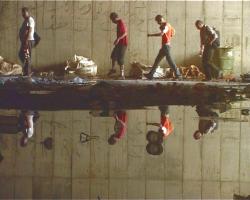
A project commissioned by the World Health Organization. Four short films portraying lives of Palestinians and Israelis, inspired by the WHO definition of health: ?Health is a state of complete physical, mental and social well-being and not merely the absence of disease or infirmity? (WHO Constitution 1948). The first film, `The Mall` reveals the surreal routine of an abandoned Israeli shopping mall, which is home to hundreds of Palestinian illegal workers. In `Missing Gaza`, a group of Gazans living in Ramallah in the west bank meet for lunch in a friends? house to talk about the people and the places in Gaza, whom they miss so much. `Power` is the story of a young Bedouin man from a village which receives no basic services from the state of Israel. He decides to volunteer to serve in the Israeli army, believing that by doing so he will help bring electricity to his home and save his sick little sister. And finally, `Journey with Naba? takes us through the complexity of life in the Dheisheh refugee camp through the story of Naba, a 12-year-old boy on his way to meet his imprisoned brother.
Ayelet Bechar is a documentary film maker and journalist. She is a graduate of the Tel Aviv University department of Film and Television, and of the Columbia University Graduate School of Journalism in New York. Ayelet lives in Tel Aviv, Israel with her family. This year she is a Nieman Fellow at Harvard University.
Sarah Beddington
Brief Encounter
Video installation | dv | color | 2:46 | United Kingdom, USA | 2007
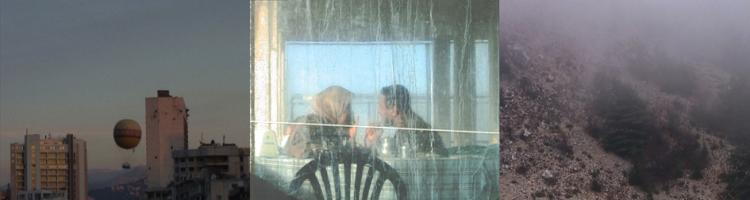
`Brief Encounter` (2006), TRT 2:50 min, three-channel PAL digital video, no audio `Brief Encounter` uses three simultaneous images to reflect on the fragility of current life in Lebanon. The central image was filmed in West Beirut. A couple is seen at a café table beyond a divide created by a dirty piece of plastic sheeting. The man is dressed in army uniform, the woman?s head is covered with a hijab. They face one another, talk and laugh, move ever closer and finally briefly hold hands. The left hand image shows a tethered hot air balloon slowly rising slowly until it can go no further, into a post-sunset sky beyond the Holiday Inn in Beirut. This high-rise building, close to the Mediterranean, still shows the scars of mortar fire from the civil war that ended in 1990. The right hand image shows a cedar tree, the motif of Lebanon that is present on the flag. In this shot the tree is a symbolically immature specimen, intermittently shrouded in a mist that undermines its materiality.
Sarah Beddington is a British artist based in London and New York whose multi-disciplinary work examines the intersection between the personal, the political and the social to be found at the periphery. None of her film and video works are staged, they are non-narrative observations, verging on the documentary, recorded from an unmoving camera. The works are characterised by meticulous framing, sensuous imagery and suspense reminiscent of film noir - a sensibility informed by her practise as a painter. Under her detached gaze, cultural and visual fragments coalesce into poetic tableaux. With seemingly disconnected sequences, Beddington builds an eloquent insight into a world that appears to run parallel to our everyday understanding of it. Solo exhibitions include ?Crossing?, DAC, New York (2008); `Places of Laughter and of Crying`, Bloomberg SPACE, London (2008); `Panoptiscope`, Petrie Museum, UCL, London (2006); `Parallel Lines and Other Stories`, Artlab, Berlin (2005). Group exhibitions include `Eastern Standards: Western Artists in China`, MASS MoCA (until March 2009); `Vanishing Point`, Wexner Center for the Arts, Columbus, Ohio; `About Time`, Nordjyllands Kunstmuseum, Denmark; `Panoramica`, The Rufino Tamayo Museum, Mexico City. Her work is represented in a number of public and private collections including Arts Council England.
Sarah Beddington
Lost in Space
Art vidéo | 0 | color | 5:55 | United Kingdom | 2009
`Lost in Space`, 2009, 16mm film in colour, 5:55 min, with sound `Lost in Space` was filmed at an abandoned U.S. nuclear missile base and is part of Beddington?s investigation into capsular architecture of the Cold War period. The strange flying saucer-like object, lying abandoned on an old baseball court, was part of a now defunct radar system used to pinpoint co-ordinates for a nuclear-charged missile launch during the 1960s. In the film the object is approached cautiously thus giving it a certain presence that is heightened by shots of moving clouds and swaying vegetation. Sarah Beddington makes films that often investigate environments from the past as a starting point from which to look at the present. With `Lost in Space`, as in all of her other work, there is a sense of anticipation of waiting for something to happen. The meticulously observed compositions of her shots from an unmoving camera encourage the viewer to slow down and observe details of stillness and watching, light and shadow that turn this object of surveillance, once part of a system of power and fear, into an abject one that is now being surveyed. This relic from a utopian future that never happened becomes a surreal sundial for another era.
Sarah Beddington is a British artist and filmmaker, currently based in Paris, whose work is documentary in nature and investigates the intersection between the social, the personal and the political. Working in a variety of media, she records unique social and aesthetic circumstances that can manifest themselves in unanticipated ways. Her work revolves around the juxtaposition of the historical and the contemporary, often in relation to specific places, journeys and migration. Whether using installation, film or video, Beddington constructs parallel moments which, existing within a non-linear, non-narrative time, often have a dream-like quality. Solo exhibitions include Places of Laughter and of Crying, Bloomberg SPACE, London (2008); Crossing, DAC, New York (2008); Panoptiscope, Petrie Museum of Egyptian Archaeology, UCL, London (2006); Parallel Lines and Other Stories, Artlab, Berlin (2005). Group exhibitions include Liverpool Biennale: Future Movements (2010); Les Rencontres Internationales, Reina Sofia Museum, Madrid (2009); Eastern Standards: Western Artists in China, MASS MoCA (2009); Vanishing Point, Wexner Center for the Arts, Columbus, Ohio; About Time, Nordjyllands Kunstmuseum, Denmark. Her work is represented in a number of public and private collections including Arts Council England.
Roger Beebe
Amazonia
Experimental doc. | super8 | color | 24:37 | USA | 2019
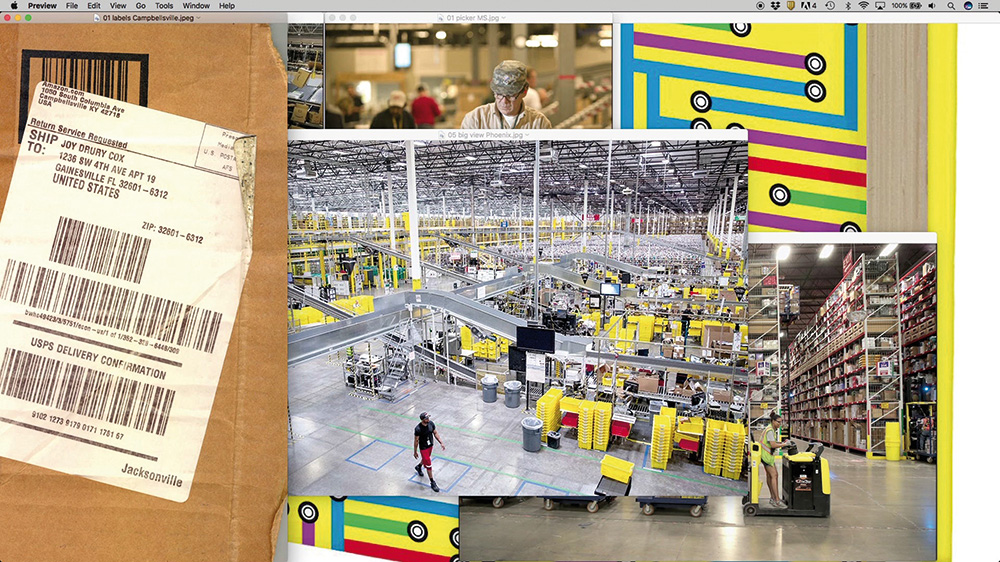
“Amazonia” is a "desktop cinema" essay on one of the key sites where the virtual world of e-commerce transforms physical space—and physical labor: the Amazon.com fulfillment centers where the millions of items available for purchase with the click of a mouse await our orders. The film visits the four cities where Amazon’s four original fulfillment centers were located to meditate on the impacts of our online purchases on the people and places “at the other end of the internet.”
Roger Beebe is a filmmaker whose work since 2006 consists primarily of multiple projector performances and essayistic videos that explore the world of found images and the "found" landscapes of late capitalism. He has screened his films around the globe at such unlikely venues as the CBS Jumbotron in Times Square and McMurdo Station in Antarctica as well as more likely ones including Sundance and the Museum of Modern Art. Beebe is also a film programmer: he ran Flicker, a festival of small-gauge film in Chapel Hill, NC, from 1997-2000 and was the founder and Artistic Director of FLEX, the Florida Experimental Film Festival from 2004-2014. He is currently a Professor in the Department of Art at the Ohio State University.
Roger Beebe
S A V E
Experimental film | 16mm | color and b&w | 5:0 | USA | 2006
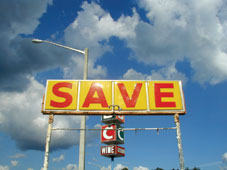
A disused gas station offers a curious imperative: "Save". A riddle posed in the form of architecture: what is there to save? One more instalment in the history of Americans pointing their cameras at gas stations; an attempt to figure out something about where we've been, where we're headed, and what's been left behind. The first part of "S A V E" was edited entirely on camera.
Roger Beebe is a professor of film and media studies at the University of Florida. His work has been shown around the globe at such unlikely venues as McMurdo Station in Antarctica and the CBS Jumbotron in Times Square, and at more likely ones including Ann Arbor, NY Underground, and Rotterdam. From 1997-2000 he ran 'Flicker', a bi-monthly festival of small gauge film in Chapel Hill, NC, and he is currently artistic director of FLEX, the Florida Experimental Film/Video Festival.
Roger Beebe
TB TX DANCE
Experimental film | 16mm | black and white | 2:30 | USA | 2006
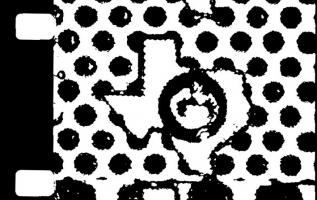
The background of the image is made of patterns of dots directly laser printed on clear leader. That background also doubles as an optical soundtrack with different pitches created by the different density of dots. The dots were inspired by the stockings Toni Basil (?Antonia Christina Basilotta?) wore in Bruce Conner?s ?Breakaway? in 1966, which also serves as the source footage for the dancer in the film. Toni Basil herself is a source of inspiration for all 30-somethings who haven?t yet made enough of their lives. (She was 39 when ?Mickey? was a hit in 1982.) This film was commissioned at Cinematexas in 2005 over a meal of pulled pork and peach cobbler. This film is also known as ?32.37? (the price of that meal). From the Lunchfilm series: curator Mike Plante has lunch with a filmmaker and then gets a film for the cost of the lunch in trade. Some rules are written on a napkin. Here are the rules for this commission: Reference dance. Reference Texas. Have an autograph in it. Mention Toni Basil.
Roger Beebe is a professor of film and media studies at the University of Florida. His work has been shown around the globe at such unlikely venues as McMurdo Station in Antarctica and the CBS Jumbotron in Times Square and at more likely ones including the Museum of Modern Art, Ann Arbor, NY Underground, and Rotterdam. From 1997-2000 he ran Flicker, a bi-monthly festival of small gauge film in Chapel Hill, NC, and he is currently artistic director of FLEX, the Florida Experimental Film/Video Festival.

Amanda Beech
Covenant Transport, Move or Die
Experimental fiction | hdv | color | 22:47 | United Kingdom, USA | 2015
1. Covenant Transport, Move or Die in its original form is a multi-channel video installation, presented here as one screen from this format. The work speaks directly to the mutual fantasies of mobility and non-place that have occupied the capitalist liberal imaginary as well as the world of leftist politics and contemporary art. The work features five characters that occupy the site of a wasteland making up a workerist crew of manager, worker, programmer, consumer, and dealer. In this parallel reality, derived from and cluttered with the detritus of our life as we know it, they program and mobilize the unrelenting movements of economies, states, culture and people. Using game show style methods of consensus building they wade through the terrain of global capitalist power to transcend the political stagnation of technology, industry and the mire of our present.
Amanda Beech is an artist and writer. Her work entangles narratives of power, reason and cause from philosophical theory, literature and real political events, exploring how the myths that seem necessary for an account of human agency are lived with, but can also be supplanted by a realist politics. Through entangling narratives of power and agency from philosophical theory, noir-ish narratives of TV shows like 24, CSI, the hard-boiled writing of James Ellroy and real political events, her artwork, in video, print and sculpture manifest an argument for a propositional art that executes another form of force to surpass the notion that art simply reflects and reproduces the status quo. The work traverses the aesthetic and philosophical paradigms of institutional, individualistic, metaphysical, rational and mythological authorities to propose a new realist politics of the artwork itself that can surpass the tragic consciousness and the ideal skepticism that has mutually championed and debilitated the value of art in Modern and contemporary culture. In this hard critique of liberal and neo-liberal cultural politics her work examines and produces the condition of language as force and the force of language with the weight of a commitment to a future
Sergio Belinchón
AVALANCHA
Art vidéo | 16mm | color | 7:0 | Spain, Germany | 2008
Avalancha is the story of a group of people hidden in the woods, they start running out of it and try to trespass a fence with handmade ladders, they jump and run into the woods, and the loop starts, they are hidden in the woods? Based on the events that happened in the border of Morocco and Spain, when several big groups of people tried to trespass the border fence. The press called this event as "avalanche". The film was shot in Germany, in a former fence separating East and West Germany, with german actors, trying to mix equal situations but not being obvious, there is no information about all this in the video. This is just a choreography based on a situation. I filmed the action from 3 different points of view that we can see simultaneously in 3 screens, one for the fence, one for the woods and one for the whole action. The video is presented as a continuous loop as the real fences problem is also a loop.
Foued Bellali
rue du Nord
Documentary | dv | color | 50:30 | Belgium | 2003
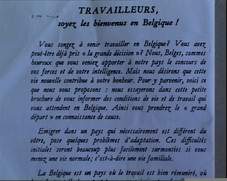
Testimony of immigrants of the first generation: North African men and women in cross sight with a Polish sight and a catholic priest fro Belgium. Life of immigration under personal tale form.
First film by Foued Bellali, Katty de Boeck, Nadia Remy. Filmmaking and editing by Foued Bellali, Katty De Boeck, Nadia Remy. Camera and sound by Yael André, Foued Bellali, Katty De Boeck, Nadia Remy. Production: Vow. 2004 Length: 54 min. Form: miniDV Also available in beta SP and DVD (soon). Subtitle: original version with French subtitle. Text transcription in French available. Subtitle in English available soon (DVD).
Bernard Bellefroid
Rwanda, les collines parlent
Documentary | dv | color | 50:0 | Belgium | 2005
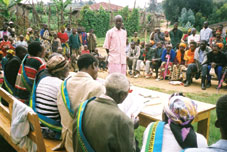
Eleven years after the genocide, the film follows the survivors and torturers before and after the first Gacaca trials during which they find each other face to face. There's Obede, accused of having killed children, and whose request for pardon is simply a cynical release strategy. There's also Gahutu, who has "no remorse" and who, facing his judges, speaks of "snakes" in reference to those being exterminated. And finally, there's François, forced to kill his own brother in order to survive and who is now trying to make it up with his sister-in-law. Through these three stories, the film weaves a portrait of a society at war against the still present ideology of genocide.
Born in Belgium in 1978, Bernard Bellefroid followed two years of undergraduate studies in journalism. In 2003, he graduated from the National Film School of Belgium (INSAS). "Rwanda, the hills are talking" is his first documentary film. At the moment, he is preparing his first feature film "The Regatta", produced by Jean-Pierre and Luc Dardenne and selected by the "Atelier du festival du film de Cannes" 2006.
Luca Bellino
Mate y moneda
Documentary | dv | color | 52:0 | Italy | 2004
"Between 1870 and 1955 millions of Italians migrated to Argentina. On the 21st of December 2001, Argentina suddenly fell into chaos. Within the context of the 2003 elections, the movie retells the story of migration between these two countries, the story of a shattered dream. Memories and present time yearnings mix, connecting the trip of those who decided to travel back to the path their ancestors took ..."
Piero Messina was born in Sicilia (Caltagirone) in 1981, and is about to complete his thesis in Film and Video studies at the DAMS Roma Tre university (in Arts, music and theater). At age 16, he directed his first short movie which was awarded with the special prize from the Jury at Libere Visione. He successively directed "Ben Adam" and ten comic video clips "Melies e caramelle". In 1999 he produced and directed with Fabio Cillia the amateur full-length movie "Una Vista non basta", which was shown at the Politeama in Caltagirone. After that he made a documentary "Due esempi di sviluppo" and the advertisement spot of AVIS (Italian association of Blood donation). At age 22, he directs "Stidda ca curri", which is rewarded with the best short movie award at the 5Oth Taormina film fest, the "Giglio D'Argento at the 55th Valdarno Festival, the special distinction at Fano's International Festival and Arcipelago Festival (Roma), best image at the 28th International Meeting Henri Langlois and is selected for the 12th biennial of European and Mediterranean young artists (bjcem). Besides, he has under his belt musical creations, soundtracks of his own movies as well as these of Luca Bellino's movie "Mate y moneda" and "Due Sigarette", a short movie produced by the Fandango"Due Sigarette". He is currently preparing a short movie inspired by a poem written by Cesare Pavese.
Remi Belliveau
L'Empremier live at Beaubassin
Experimental doc. | 16mm | color | 62:26 | Canada | 2023
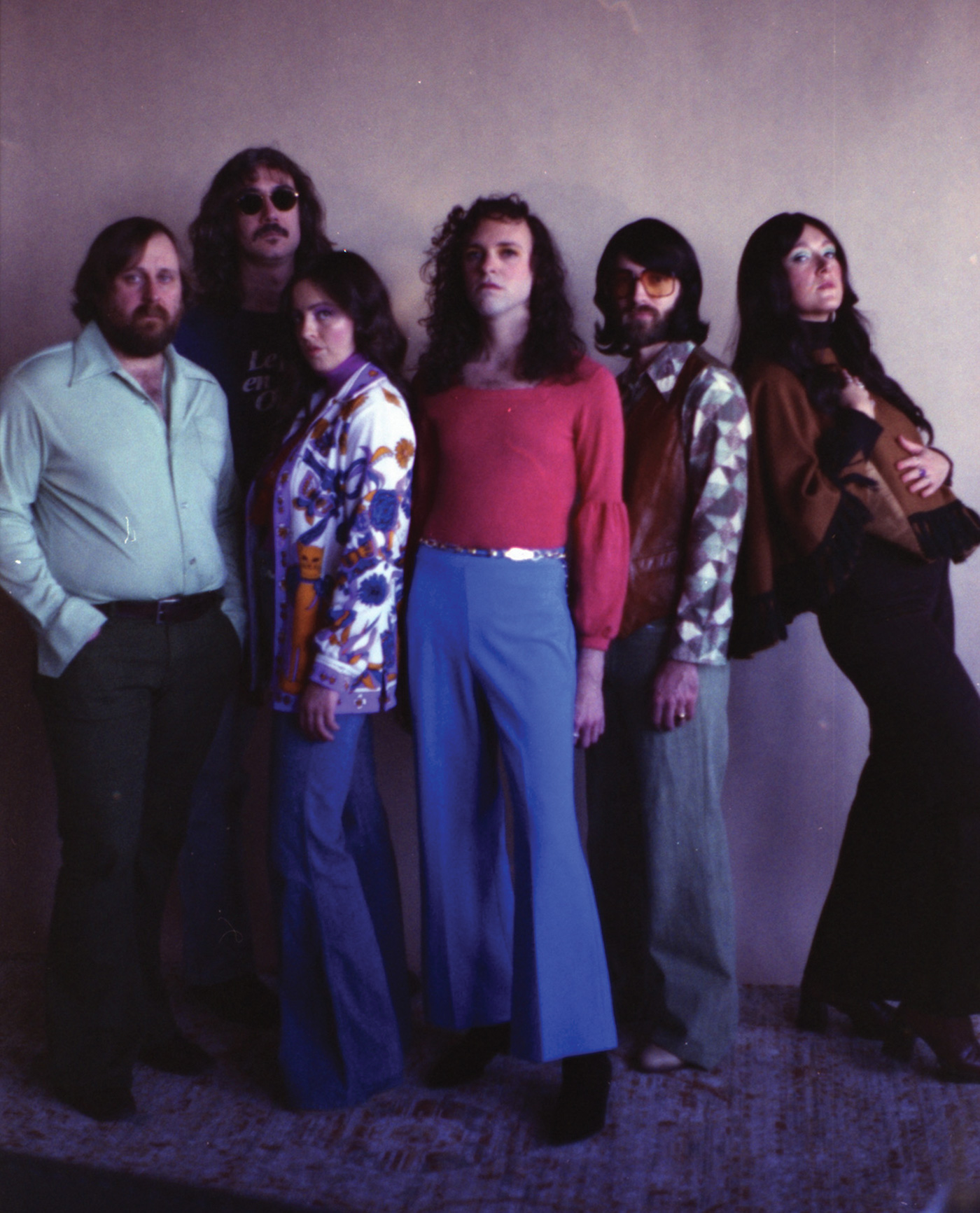
L’Empremier live at Beaubassin (1970) est une œuvre vidéo qui prend la forme d’un long métrage pastiche du film Live at Pompeii (1972, 1974) d’Adrian Maben ou? l’on voit le groupe mythique Pink Floyd jouer dans l’amphithéâtre vide de cette fameuse île détruite par l’éruption volcanique du Mont Vésuve. À Beaubassin, les ruines du Fort Beauséjour – situées a? la frontière entre le Nouveau-Brunswick et la Nouvelle-Écosse – servent d’amphithéâtre dans lequel les esprits du passe? (ceux des ancêtres acadien·ne·s, condamne?·e·s ici, en 1755, a? la déportation et a? des années d’errance) sont convoqués comme spectateur·ice·s fantomatiques. Adoptant le décor de l’e?te? 1970, Live at Beaubassin met en scène un·e chansonnie?r·e acadien·ne fictive – Joan Dularge – alors qu’iel approche la décennie tumultueuse des années 1970, pre?occupe?·e par l’actualité? LGBT[Q2IA+] au lendemain des Stonewall riots (28 juin 1969) et motive?·e par sa condition de personne nouvellement trans-out. Lors de séquences documentaires encore tournées a? l’image de Live at Pompeii (version de 1974), on a l’occasion de voir le processus de création de de Joan et son groupe L’Empremier, alors que ses membres – surtout la chanteuse principale – ont le regard tourne? résolument vers le futur, aux prises avec des enjeux d’actualité : « Jouez-vous de la musique acadienne ? » « Est-ce que la langue est un enjeu avec votre producteur anglophone ? » « Est-ce que l'acadiennete? est une forme de queerness ? »
Rémi Belliveau est un·e artiste, musicien·ne et auteurice interdisciplinaire acadien·ne originaire de Belliveau-Village (vallée de Memramcook, Nouveau-Brunswick), un hameau acadien situé sur Mi’kma’ki, le territoire ancestral non cédé du peuple Mi’kmaq. Son travail artistique s’attache à déconstruire et reprogrammer les fondements, les structures et les imaginaires de la culture acadienne à laquelle iel appartient dans le but de cultiver des capacités d’(auto)analyse et de sens critique, notamment en ce qui concerne la relation entre acadienneté et transitude. Récemment, iel a été deux fois en lice au Prix Sobey pour les arts (finaliste Atlantique en 2021, liste préliminaire Atlantique en 2024), lauréat·e du Prix Claudine et Stephen Bronfman (2022), lauréat·e du programme MOMENTA X RBC (2023), lauréat·e des Ateliers Montréalais de la Fonderie Darling (2023-2026), lauréat·e de la bourse Periculum pour le discours sur l’art (2024) et finaliste au Prix en art actuel du Musée national des beaux-arts du Québec (2025) où iel a gagné prix du public.
Neil Beloufa
Kempinski
Experimental video | dv | color | 15:0 | France, Mali | 2007
Welcome to Kempinski, The people of this mystical and animist place introduce it to us. "Today we have a space station. We will soon launch space ships and a few satellites that will allow us to have much more informations about the other stations and other stars. " The video has no script and the screenplay is caused by a specific game rule.
Neil Beloufa was born on 1985 in Paris. He is student in the Beaux-Arts and in the Art Decoratifs of Paris. He is in scholar exchange in Cooper Union in New York. In 2008 he ll be in CalArts in Los Angeles.
Neil Beloufa
Sans titre
Fiction | dv | color | 15:0 | France | 2010
A cardboard decor and photographs reconstitute a luxury Californian-type villa in Algeria. Its inhabitants, neighbours and other protagonists imagine themselves there to explain why and how the latter was occupied by terrorists in order to hide whilst, paradoxically, it is entirely in glass. They even polished it clean so as to leave no traces. This improbable and irresolvable anecdote encourages the characters to invent images of anevent given media coverage without the images nor the story and thus missing the main point.
Neil Beloufa
TONIGHT AND THE PEOPLE
Experimental fiction | hdv | color | 81:0 | France, USA | 2013
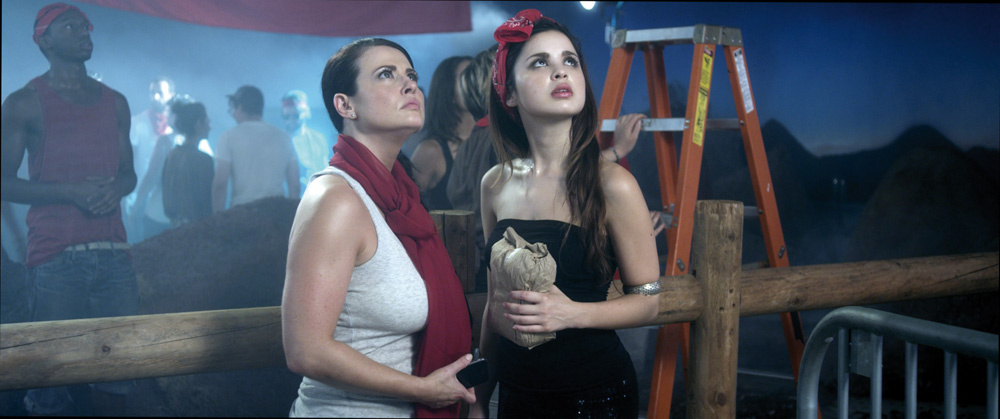
In a wannabe Hollywood-like scenery, cowboys, gang-members, activists, hippies and rebel-teenagers craft a philosophical tale that recycles the strongest stereotypes of our time. In this world where documentary and Sci-Fi collide, class warfare meets extra- terrestrial invasion.
Neil Beloufa (1985, Paris) studied at the Ecole Nationale Supérieure des Beaux- Arts (ENSBA) and the Ecole Nationale Supérieure des Arts Décoratifs (ENSAD) in Paris, and in Le Fresnoy - National Studio for Contemporary Arts. He received several awards, notably the Prix Videoforme of Clermont Ferrand 2009, the Grand Prix IndieLisboa 2009, the Arte Award for a European Short the Jury Price at the Oberhausen Film Festival in 2011. His work was shown in many solo exhibitions in Frankfurt, Los Angeles, Paris and New York, and selected for numerous group exhibitions and projects since 2007. His films were screened in international festivals for video and documentary. In 2012, he was awarded the Audi Talent Awards for his feature-film project TONIGHT AND THE PEOPLE, which premiered at FID Marseille in 2013. That same year, he was awarded the prix Meurice for his next film project. He lives in Paris.
Louidgi Beltrame
Brasilia/Chandigarh
Experimental doc. | dv | color | 27:0 | France | 2008
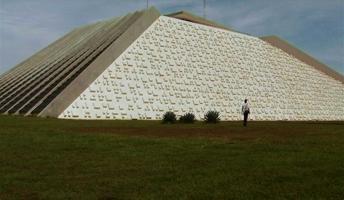
Two architects hoped to build the ideal city: Oscar Niemeyer created Brasilia in the middle of the Brazilian mato (savanna); Corbusier went to India to build Chandigarh. Both cities raise above the landscape, like two futuristic memoranda of concrete, monuments to their builders, those rare inhabitants who are given to us. The film is bases on the respective geometrics of Brasilia and Chandigarh, while the dialogue takes place between the two cities.
Louidgi Beltrame, screen writer and artist, was born in Marseille in 1971. He presented his work at the Workshop of the Play of Palm, the Palais de Tokyo and the Museum Andre Malraux in Le Havre as well as the Festival of Film of Locarno and the International Documentary Festival of Marseille.
Louidgi Beltrame
gunkanjima
Experimental doc. | dv | color | 33:0 | France | 2010
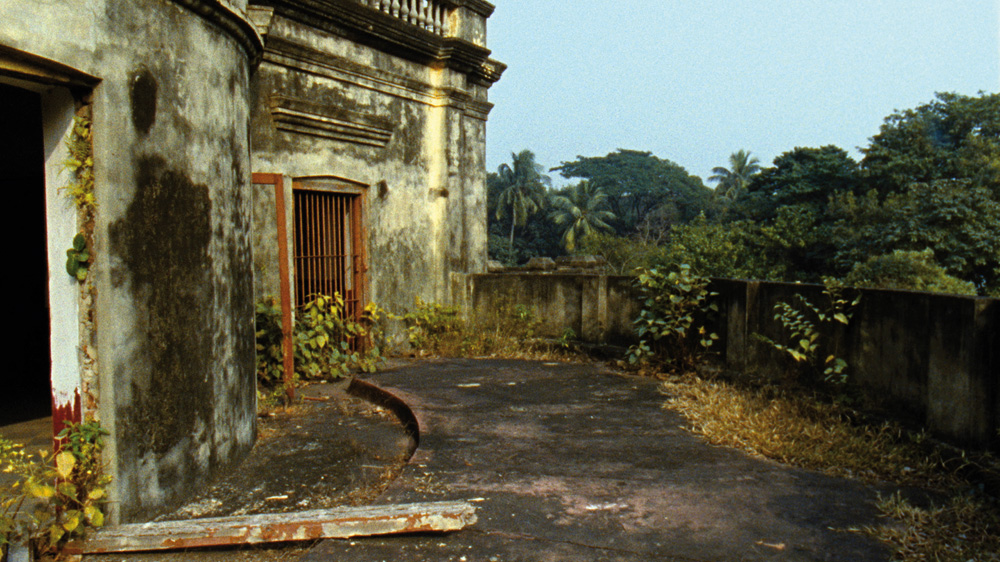
Située au large de Nagasaki au Japon, l?île de Gunkanjima est une colonie minière abandonnée depuis 1974. Objet d?une expérimentation urbaine verticale, extrême, et non planifiée, l?île rassemble aujourd?hui les vestiges archéologiques de l?architecture moderne japonaise. Ces formes vides, filmées comme des sculptures monumentales, sont néanmoins habitées par des histoires stratifiées - celles des conditions de production, des idéologies qui ont motivé ces chantiers et des hommes qui les ont bâti et exploités.
Louidgi Beltrame est un artiste français. Né à Marseille, il vit et travaille actuellement à Paris. Son travail se développe autour de la déconstruction des structures narratives et formelles du cinéma, considéré comme un médium avec sa syntaxe spécifique, mais également comme une force politique qui a influencé les développements du siècle passé, et qui constitue également une documentation de l?architecture moderniste et de ses vestiges. Le travail de Louidgi Beltrame est exposé dans des galeries, des musées et présenté dans des festivals de cinéma en France et à l?étranger, notamment au Musée d?Art Moderne et Contemporain de Strasbourg ; à Paris au Musée du Jeu de Paume, à la Fondation Ricard, au Palais de Tokyo, au centre d?art Le Plateau, au Centre Georges Pompidou. Ses films ont été diffusés au FID Marseille (festival international du documentaire), au festival international du film de Rotterdam, au festival du film de Locarno, à la Fondation Funarte de Rio de Janeiro, à LOOP, Barcelone ; au Japon à la Echigo Tsumari Art Triennal, à Niagata et à l?Hiroshima Art Document.
Louidgi Beltrame
the walking tree
Experimental doc. | 16mm | color | 35:0 | France | 2014
Louidgi Beltrame films in 16 mm a large banyan tree in the botanical gardens in Calcutta. This tree, whose distinctive feature is the way it spreads rhizome-like over several hundred yards, is approached like a forest of clones, a metaphysical space where histories re-surface: the history of the invention and parallel development of photography and telegraphy in the context of colonized India, Linnaeus’ dream according to Foucault, reminiscences of the films of Ritwik Ghatak and Satyajit Ray, where reality and fiction met.

Louidgi Beltrame
El Brujo
Experimental film | 4k | color | 17:29 | France, Peru | 2016
El Brujo, which means "The Sorcerer" in Spanish, is also the name of a Mochica archeological site. It is on this Peruvian beach that Louidgi Beltrame shot a part of his movie. The curandero (shaman) José Levis Picón Saguma is performing a re-enactment of François Truffaut’s 400 blows (1959) last sequence. In that sequence, the young hero, Antoine Doinel, interpreted at the time by iconic ?nouvelle-vague? actor Jean-Pierre Léaud, is running away in direction of the ocean. Right performing a Mesa - a psycho-active San-Pedro cactus related traditional healing ceremony - José Levis Picón Saguma is taking care of the vacant space left into the cinematographic apparatus by the actor whom was sick at the time of the shooting and thus was forced to remain in France. Feeling better soon after this magical operation, Jean-Pierre Léaud has been shot drifting through the streets of Paris, following a trajectory which is superimposing his memories from the 400 blows original shooting with his own "Nouvelle-Vague" subjective history. Through these transpositions, Beltrame orchestrates a series of shifts, with a migration of characters, patterns and eras. The geometric lines of the pyramids and excavations of the Peruvian landscape are echoed in the structure of the film?s editing, with tracking and panoramic shots, and are highlighted by the synthetic modular music of the track Triangle (1979) by Jacno.
Louidgi Beltrame was born in 1971 in Marseille and now lives in Paris. He studied at the Ecole supérieur d’art et de design Marseille-Mediterranée, the Fresnoy - Studio national des arts contemporains, and la Villa Arson in Nice. Beltrame is a growing artist in the contemporary art scene and has won the SAM prize for contemporary art in 2014. His work is based on documenting modes of human organization throughout the history of the 20th century. He travels to sites defined by a paradigmatic relation to modernity: Hiroshima, Rio de Janeiro, Brasilia, Chandigarh, Tchernobyl or the mining colony of Gunkanjima, over the sea off Nagasaki. His films - based on the recording of reality and the constitution of an archive - appeal to fiction as a possible way to consider History. The artist has exhibited in many places, namely at the Palais de tokyo (2006/2016), the Centre d’Art Contemporain de Chelles (2010), The Musée d’Art moderne et contemporain, Strasbourg (2008), the Pinchuk Art Center, Kiev (2007), l’Atelier de Jeu de Paume, Paris (2006), the Musée d’art conemporain de Val-de-Marne, France (2005), the Centre Georges Pompidou, Paris (2005).
Marcel Beltrán, Marcel Beltrán
La opción cero
Experimental doc. | 4k | color | 80:0 | Cuba | 2020
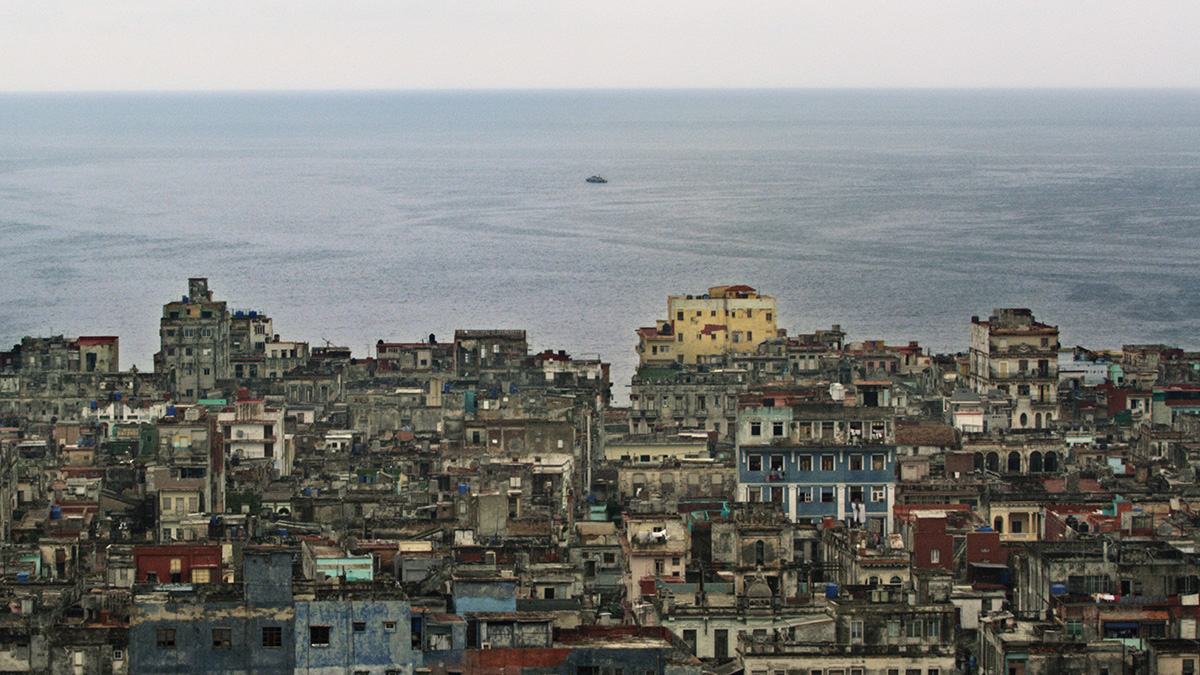
A group of Cuban migrants use their mobile phones to record and transmit through social networks intimate moments of their passage through the jungle, gathering more than 100 hours of experiences. Immobilized in a makeshift camp by Cáritas in Panama City, the difficult passage through the Darien Jungle comes to life on their devices. In this migratory limbo, Cuban director Marcel Beltrán films the passing of the hours in the camp and gains access to this shocking archive.
Marcel Beltrán (b. 1985, Moa, Cuba) is a film director and producer currently living and working in São Paulo, Brazil. He is the founder of Mediocielo Films, a consultant for international development projects and a facilitator of sustainability practices within the arts, exploring environmentally and ecologically-focused issues. Beltrán’s work combines image degradation, memory and life experience creating a dialogue between the poetic and political / the intimate and public. Marcel has wrote, directed and produced “La música de las esferas” (2018) premiere at 35 MIFF and "La opción cero" (2020), a feature documentary with world premiere at IDFA, Hot Docs and DOC NYC, receiving, among other awards, Best International Feature Film at Miradasdoc (Spain), FIDBA (Argentina). His previous films were selected in film festivals around the world, such as MoMA Documentary Fortnight (New York), Busan International Short Film Festival, Documenta Madrid, DOK Leipzig, AmDocs (Palm Springs), Malaga, Biarritz, SANFIC (Santiago de Chile), Festival Latino (São Paulo), BIFF (Bogota), Havana Festival, among others.