Catalogue > Search
Results for : Tout le catalogue
Zhenchen Liu
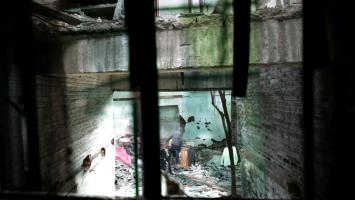
Under construction
Experimental doc. | dv | color | 9:55 | China, France | 2007
City planners decide to pull down parts of Shanghai?s old town in order to regenerate the city. Every year more then one hundred thousand families are forced to leave their homes and move into buildings on the edge of city. ?Under construction? is a two- and three- dimentional flight across the now destroyed living areas of Shanghai which shows how random and brutal decisions can affect peoples?s lives.
Zhenchen Liu was born in 1976 in Shanghai. He graduated at Ecole Nationale Superieur de la Villa Arson; and at the Fresnoy National Studio of Contemporary Art in France. He works a lot on the subjects of "urban", "modernization", and "the problem with the development of China". Recently, he participated in the Locarno International Film Festival, Festival de Clermont-Ferrand, Oberhausen International Film Festival? Currently he works as a freelance artist in France and China.
Wei Liu
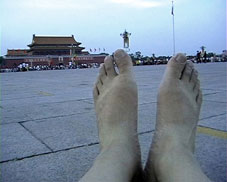
Wang Que De Yi Tian
Documentary | dv | color | 13:30 | China | 2005
A Day to Remember 13min On June 4th, I went to Peking University, the place where the incidence was originated from, and Tian?anmen Square, the place where the incidence occurred. I took with me a camera and a few simple questions, repeated them to those who I met and recorded down the whole day?s encounter. People reacted to my question with blank face or dodging words, or just shied away. The blood and life sixteen years ago have been forgotten and faded way, leaving behind helpless silence and blank memory. As it remains a taboo in today?s China, people don?t talk about it openly for their own sake; or they are reluctant to recall it to live in reality. Many young people even don?t know about it for this topic has been covered and forbidden for years. Sixteen years have passed. Mother?s hair has turned gray; beloved ones have dried up the tears. Glorious as forever on this first street of China, silence prevails. Silence, forgetting and deliberate covering, people?s memory turns into a vacuum. The bygones twisted into a blurred picture, true memory gone, illusion remains.
Liu Wei Born in 1965, P. R. China. Live and work in Beijing. Educational Background In 1992, graduated with bachelor`s degree in literature, as a design major, from the Department of Fine Arts, of China Central Academy of Drama. In 1995, completed his studies at the Symposium on the Relationship between Religion and Culture, hosted by the Philosophy Department of the Beijing University.

Zhouanqi Liu
A Walk in Spring
Fiction | 4k | color | 10:39 | China | 2019
A laid-off worker pretends to go to work as usual but goes on an excursion to the mountain by his own.
Zhouanqi Liu 8/30/1994 Director/Screenwriter/Production Designer/Photographer 346 West 84th St #2F, New York, 10024 NY zl2734@columbia.edu (929) 319-6622 Education ? Beijing Film Academy Screenwriting 2012-2016 ? Columbia University Directing 2018-2021 (thesis film shooting year stage) Experience ? 2013.8-11 Chinese post-rock band ’48V’ 8-city China Road Show as photographer ? 2014.10/2015.10 13&14st ‘ISFVF’ International Student Film and Video Festival of Beijing Film Academy as subtitle translator ? 2015.6-2015.11 Chinese rock band ’Omnipotent Youth Society’ 13-city China Road Show as photographer ? 2016.2 Peking University ‘Preparation for Entrance’ Campus Activity Feature Film (No.5 the Summer Palace Road) as screenwriter ? 2016.4-2016.8 Musician prof. Guo 9-city China Road Show as photographer ? 2017.2-5 Info&Updates Studio China First Exhibition ‘Grand Coupes’ as curation&music production in Beijing&Shanghai ? 2017.6 Beijing 1st ‘Vintage Fair’ advertising video as art director ? 2017.8-10 The Door music company experimental advertising video as screenwriter ? 2017.11-2018.4 School of Visual Arts graduate student thesis documentary ‘The Wanderer’ as the self ? 2018.4-2018.8 Jing Wang photo exhibition on Beijing Three Shadows Art Center ’Goodbye, Paris’ as technician( darkroom film processing&hand coloring)
Frédéric Liver
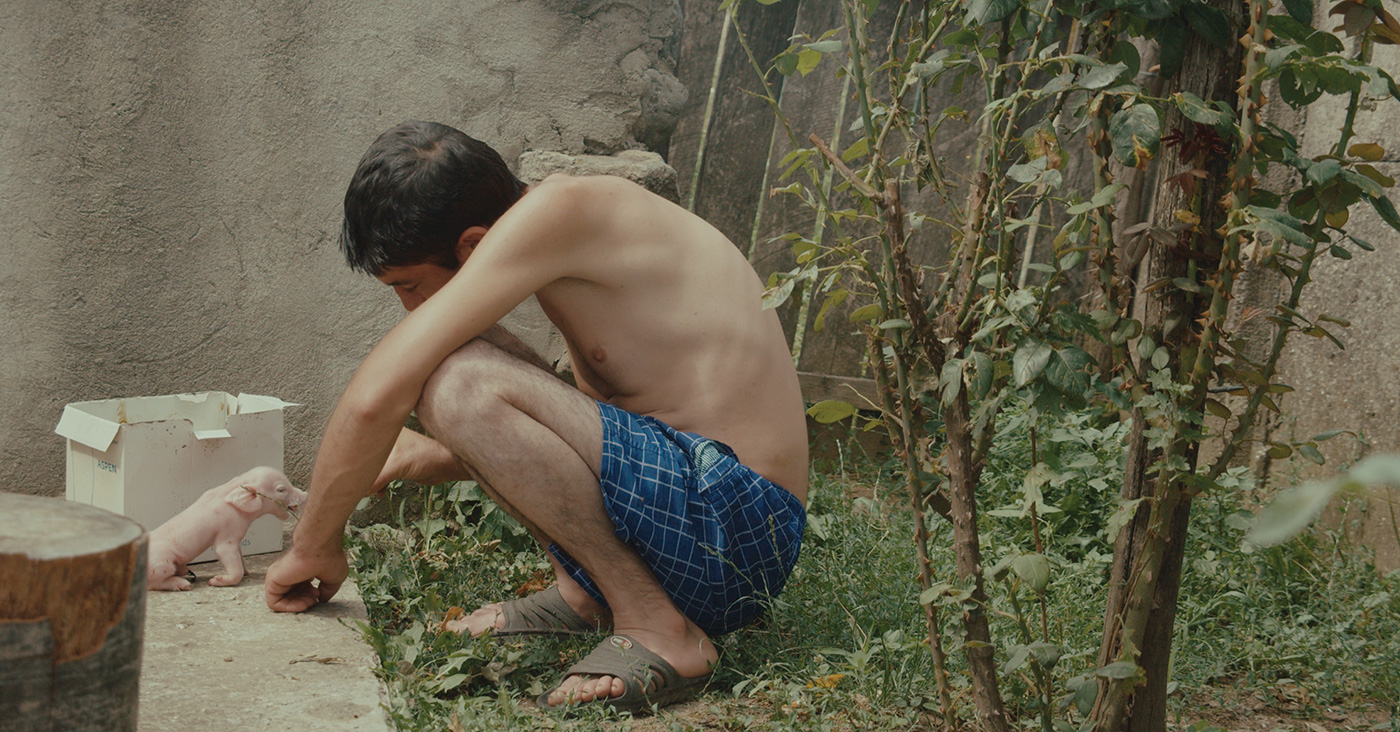
Dansul Satului
Experimental fiction | 4k | color | 30:0 | France, Romania | 2024
Through a series of encounters with workers, their environment, and their activity, "It could have been... gold" is a series of portrait films exploring apprenticeship. Dansul Satului, the first film in the series, plunges us into the Romanian village of Schela. Like a diary, it shows the life of the village, its inhabitants, and the work they do day after day. We meet Cristi, a stone wall builder, and Emil, a woodworking enthusiast. We made a wall, and a wooden railing and celebrated Madalin's birthday. In the old days, the village held a dance party every Sunday. The elders used to observe the younger ones, and if someone saw that a guy was a good dancer, they thought he was a good worker. The name was "hora satului".
Frédéric Xavier Liver is a French-Italian artist whose multidisciplinary practice spans film, performance, and installation. His work explores the processes of learning, endurance, and vulnerability as means of reflecting on transformation and shared experience. Often initiated by a physical or personal challenge, his projects develop through encounters, gestures, and repetition, revealing how memory and emotion inhabit the body. At the crossroads of visual art and performance, he creates works that combine observation and participation, blending poetic sensibility and artistic research. He lives and works between France and Belgium.

Jason Livingston
Ancient Sunshine
Experimental doc. | 16mm | color and b&w | 19:28 | USA | 2020
A fossil cast in plastic, an artificial plateau, classic cars running on the fumes of the nation. Ancient Sunshine traces a meandering path through coal extraction and climate defense in the American West. The film proposes solidarity against the violence by which "earth" becomes "resource." Utah Tar Sands Resistance has been fighting experimental mining in the Tavaputs Plateau for almost a decade, setting up camp every summer in sight of heavy equipment and construction crews. The film asks, how might the concept of horizontalism be applied to the physical horizon, its decimation, and to capital’s propensity for vertical extrication? Ancient Sunshine interweaves the endless remaking of the Western landscape with labor history, reflections on anarchist organization, and interspecies economies, such as animal husbandry. Toward a poetic solidarity, toward a formal politics.
Jason Livingston is a media artist, film programmer, and writer. His award-winning work has screened widely, including Rotterdam, Anthology, the Austrian Museum, and the Vancouver Art Gallery. Under Foot & Overstory is distributed by the CFMDC, and Lake Affect is available through EAI’s Experimental Television Center collection. Awarded residencies include the Millay Colony and the Virginia Center for the Creative Arts. Jason is pursuing a practice-based PhD as a Presidential Fellow with the Department of Media Study at the University at Buffalo. He holds a B.A in Philosophy from Cornell University, and a M.A. and M.F.A. in Cinema from the University of Iowa. He currently serves on the Board of Trustees with the Flaherty Seminar.

Antonio Llamas
La insurrección que viene
Experimental fiction | digital | color | 24:17 | Spain | 2023
On another day, a group of policemen guard the outskirts of a city. There is no one else on the streets. They wait for an order to go into action. However, that order never comes and a state of confusion and disorientation begins to take hold off them, until they forget what they were doing there.
So far his works have toured several international film festivals and contemporary art spaces such as FICVIÑA, Minsk, Curtocircuito, Riga IFF , Tabakalera Donosti or La Fábrica de Armas in Oviedo. "The Coming Insurrection" was selected as a project in the Focus Script 2022 of the Cannes Film Festival, and was also a beneficiary of one of the Visual Creation Grants of Matadero Madrid, having its international premiere in the Busan International Short Film Festival. Also, he is codirector of "A suburban mythology" (2024, an hybrid film premiered at Documenta Madrid. He is currently editing several projects and developing of his first feature film, "Laguna El Ministro".

Jan Locus
Masters of the Land
Experimental video | 4k | color | 14:0 | Belgium | 2020
Thanks to the rise of mining, post-communist Mongolia was the fastest growing economy in the world in 2012. However, the poor were not profiting from the booming industry, and climate change plus overgrazing were leading to vast desertification. According to Mongolian shamanistic belief, the earth and sky are connected. Violation of nature by men provokes the anger of the ruling spirits or the ‘masters of the land’ and leads to drought and pestilence. How does the population relate to its ancestors when desires threaten to upset the cosmic balance? The film opens with images shot in Baganuur and Nalaikh, once the largest coal mines in Mongolia. Fixed camera images of workers in the shadow of gigantic machines alternate with desolate landscapes and downtown Ulaanbaatar by day and by night. Intermediate texts cut the medium long shots. The first excerpt originates from the Hungarian poet Ferenc Juhasz. In 1957, under the influence of LSD, he experienced the painful initiation of a shaman. The second excerpt comes from a song by the shamaness Kyrgys Khurak. It deals with the evocation of lurking greed and inequality that might destroy nature – an aspect that implicitly refers to the climate crisis. (Ive Stevenheydens)
The long-term projects of photographer and filmmaker Jan Locus study the complexity of worldwide, socio-political issues. His books include Mongolia, De Bewegende Stad and Devoted. His films have been screened at IFFR Rotterdam (NL), DokFest Kassel (DE), Internationale Kurzfilmtage Oberhausen (DE), Rencontres Internationales Paris/Berlin (FR/DE), Asolo Art Film Festival (IT), Split International Festival of New Film (HR) and FIFA Montreal (CA) among others. He lives and works in Brussels.
Jan Locus
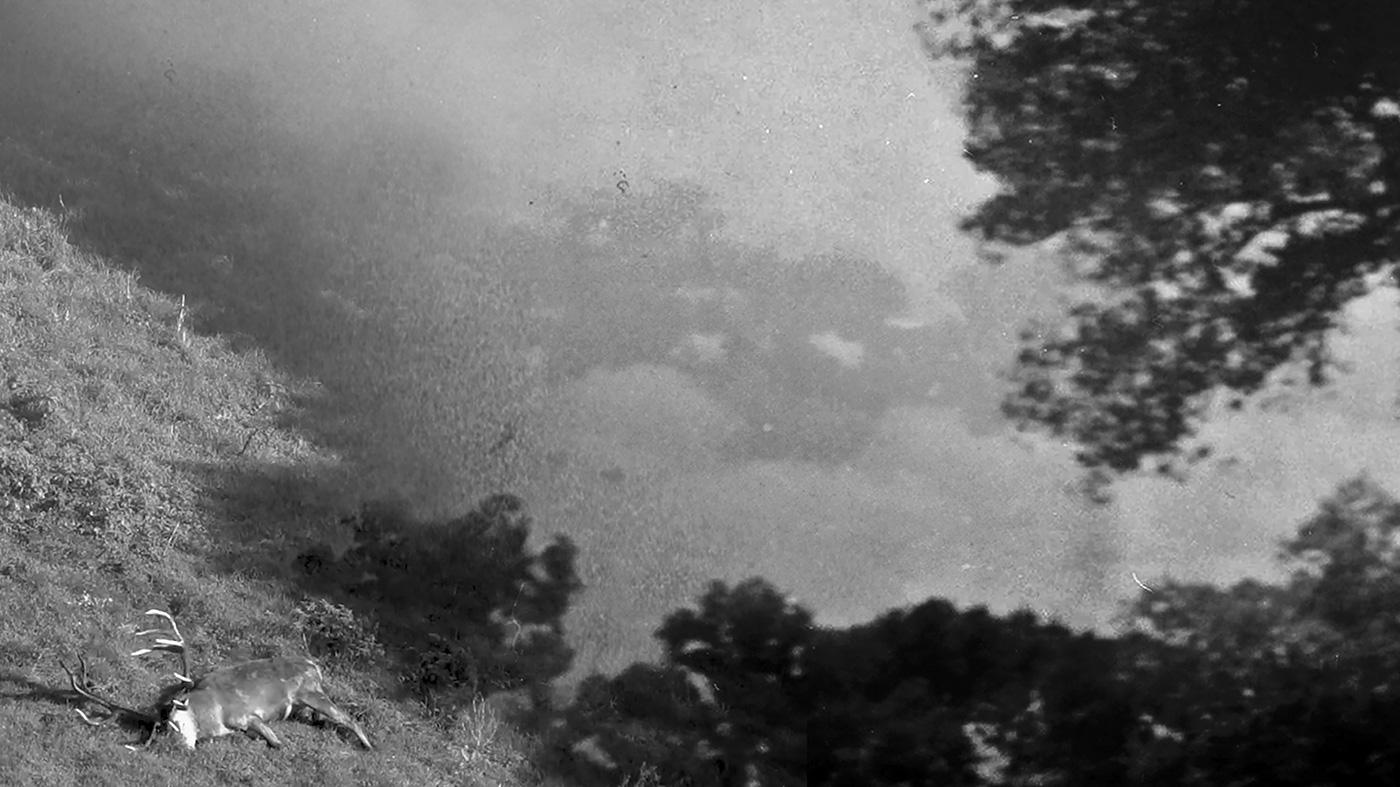
Intruders
Experimental film | 0 | black and white | 6:5 | Belgium | 2025
Intruders explores the boundary between science fiction and reality, investigating themes of reverse colonization, ecology and human environmental impact. The film offers an introspective reflection on the Western fascination and fear of extraterrestrial entities. In an elongated pan, mountain landscapes and misty images of animals are presented in an ethereal, ghostly way. Locus does not use conventional film footage, but found footage online hunting videos and black and white photographs of UFO observations from the 1950s and 60s. Although these images reveal their origins through their grainy texture, Locus removed the UFOs from these photos to seamlessly merge the remaining landscapes. The phenomenon of unforeseen animal death, often reported in UFO sightings, serves as a metaphor for human influence on nature. Locus intertwines photography with video to create a complex narrative that emphasises the ambiguity of reality and fiction. The film reflects on ‘intruders’ in nature, inspired by dystopian visions of the future and challenges the viewer to consider the complex and often disturbing relationships between humans, technology and nature.
Spanning the mediums of film, photography, and sound, his work often addresses landscape as a tool for the creation of national and social identities, focusing on environments altered by extraction and industrialization. In his latest work, he explores the tension between found footage, still photography, and the moving image, emphasizing the ambiguity of our perception of reality and fiction. His films have been presented at numerous international festivals, including the International Film Festival Rotterdam (IFFR), the International Short Film Festival Oberhausen, Rencontres Internationales Paris/Berlin, Le FIFA – International Festival of Films on Art (Montreal), Kasseler Dokfest, Asolo Art Film Festival, Stuttgarter Filmwinter, CROSSROADS Film Festival (San Francisco), ANTIMATTER Media Art (Victoria), Festival ECRÃ (Rio de Janeiro), PROYECTOR Plataforma de Videoarte (Madrid), SPLIT Film Festival, ONION CITY Experimental Film Festival (Chicago), BISFF Beijing International Short Film Festival, and Flight / Mostra Internazionale del Cinema di Genova among others. Locus lives and works in Brussels.

Arianna Lodeserto
Trentasette film per una casa
Experimental doc. | mov | color and b&w | 11:0 | Italy | 2017
At various times during the 60s and the 70s, the urgency of the struggle triggered “a cinema right now”, underground as well as militant, experimental as much as documentary. That immediate cinema, joyful and conspiratorial, intended to upset the cinematic shapes, its narrow boundaries and its productive logics, as well as to tell otherwise the alternative forms of human inhabitancy. Thirty-seven movies for a home is a visual essay made of film shreds and videotape flats, of fighting women and building speculators, of criticism and action.
I studied analogue photography in a public school of Rome, editing in Saint Denis and documentary writing at ENS Louis-Lumière. Philosophical PhD at La Sorbonne, I also did postdoctoral researches in Media Archeology at Paris IV, ENSA Malaquais and LIRA (Sorbonne Nouvelle). Often exploring different media, I am passionate about history of urbanism, third landscape, found footage, experimental documentaries and creative writing. My short movie "The houses we were" was awarded at the Building Bridges Emerging Filmmaker Awards (Minnesota-USA), IsReal, Festival di cinema del reale (Sardegna-ITALY), Linz International Short Film Festival (AUSTRIA) and Family Film Project (PORTUGAL), and selected in Serbia, Croatia, Spain, Hungary and Scotland.
Sophie Loesch, Erja Andrea
Grimms Albtraum
Documentary | dcp | color | 23:42 | Germany | 2025
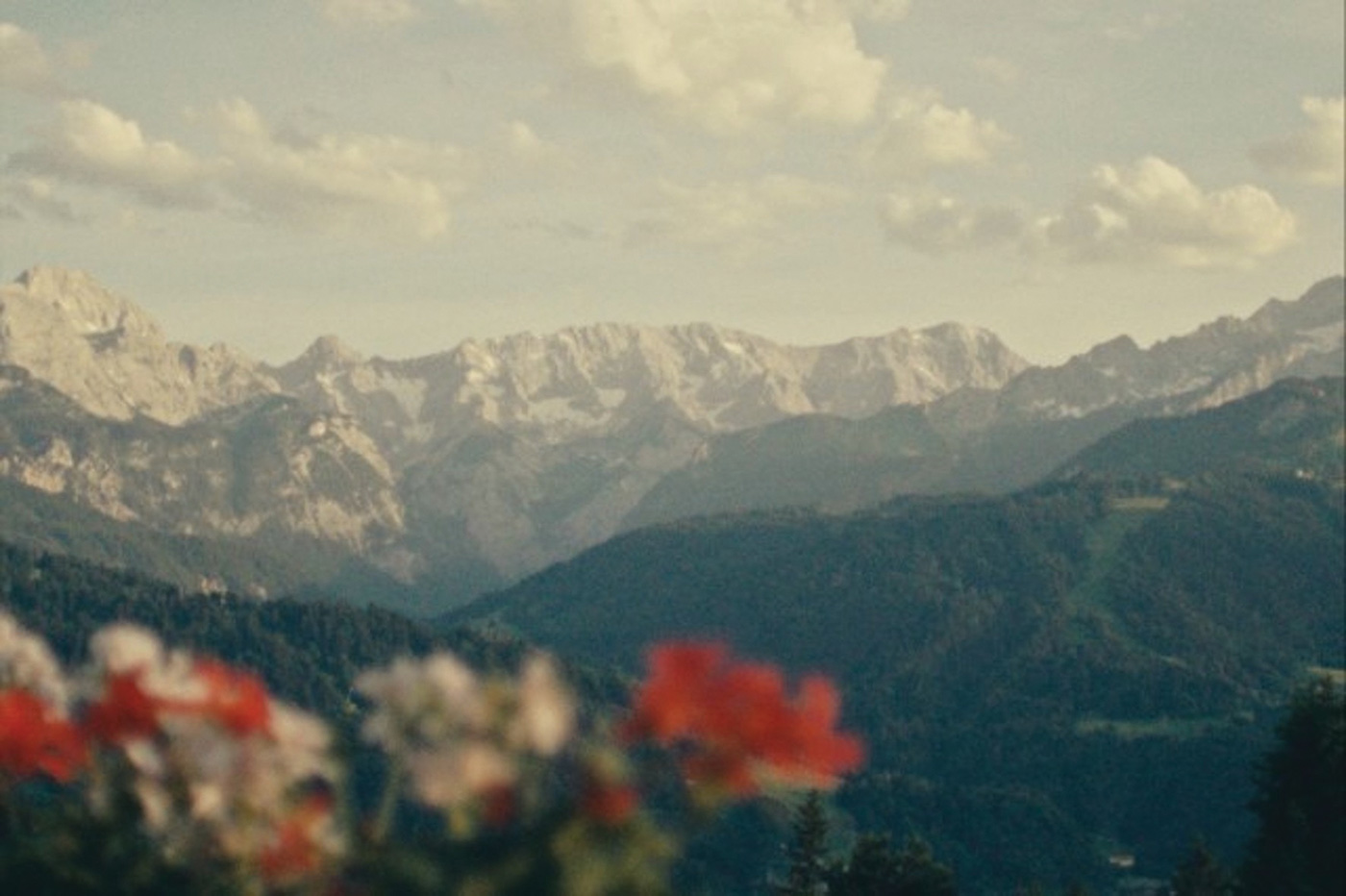
The wolf is back, warned the mother Little Red Riding Hood. Social imprints reflect in collective stories and narratives - as in the fairytale ‘Little Red Riding Hood’. But what happens if fiction and reality become blurred and the fairytale suddenly finds itself in right-wing rhetoric? Documentary Folk Horror about right-wing rhetoric and the figure of the ?problem wolf ? as a subject of projection regarding social and national borders - a reinterpretation of the fairytale ‘Little Red Riding Hood’.
Andrea Erja studied cultural and social anthropology at the University of Vienna, specialising in media and visual anthropology. In addition to her studies, she has supported various documentary film festivals, such as Ethnocineca in Vienna and DOK.fest Munich, in various areas of activity. Since October 2022 she is studying documentary film directing and television journalism at the University of Television and Film Munich. Sophie Loesch graduated with a Bachelor's degree in Social and Cultural Anthropology and Art History and interned at DOK.fest Munich. Since Fall 2022 she studies Documentary Filmmaking at University of Television and Film Munich.
Deirdre Logue
Beyond the Usual Limits: Part 1
Experimental video | dv | color | 3:0 | Canada | 2005
There are things - stupid things - which the artist has always wanted to do, just to see if she could, just to see what it would feel like. "Why Always Instead of Just Sometimes" is a selection of 12 short works.
Deirdre Logue was the Executive Director of the Images Festival of Independent Film and Video and currently holds the position of Executive Director at the Canadian Filmmakers' Distribution Centre in Toronto. Deirdre is perhaps best known for her series of short handmade performance films entitled "Enlightened Nonsense" completed in 2000.

Yulia Lokshina
REGELN AM BAND, BEI HOHER GESCHWINDIGKEIT
Documentary | 4k | color | 90:0 | Germany | 2020
A small town in western Germany is the last stop for 26,000 pigs per day and a temporary home for masses of Eastern European temporary workers. The workers of the largest slaughterhouse in the country are fighting for survival, while German activists who stand up for their rights, are fighting against the local authorities. At the same time, Munich high school students are working on the play "Saint Joan of the Stockyards" and trying to grasp the old text and German capitalism of our days. Interwoven with the thoughts of the young people and their examination of the text in the rehearsals, the film deals in various fragments with conditions and facets of temporary work and labour migration in Germany.
Yulia Lokshina was born 1986 in Moscow. Since 2011 she studies documentary directing at the Munich filmschool HFF München. Her documentary film and video works deal with the interference of social environments and their protagonists. Her film „Days of youth“ on a military patriotic youth camp in the east Russian periphery examines the connection of patriotism and education and was awarded the Starter film prize of the city of Munich 2017. In the framework of her involvement with the Forum of international Science at the University of Bonn she works on audio-visual projects between film and scientific research. For 2018 she was awarded the 12th media art yearly scholarship of the Kirch foundation (Munich). "Rules of the Assembly Line“, her graduation film, was awarded the prize for best documentary film at the Festival Max Ophüls Preis 2020, the „Megaherz Student Award“ at Dok.fest Munich 2020 and the “Healthy Workplaces Award” at Doclisboa 2020. Currently Yulia started an artistic PhD project on documentary adaptation at the Konrad Wolf Film University of Babelsberg.
Lesley Loksi Chan
Lloyd Wong, Unfinished
Experimental doc. | 0 | color | 28:49 | Canada | 2024
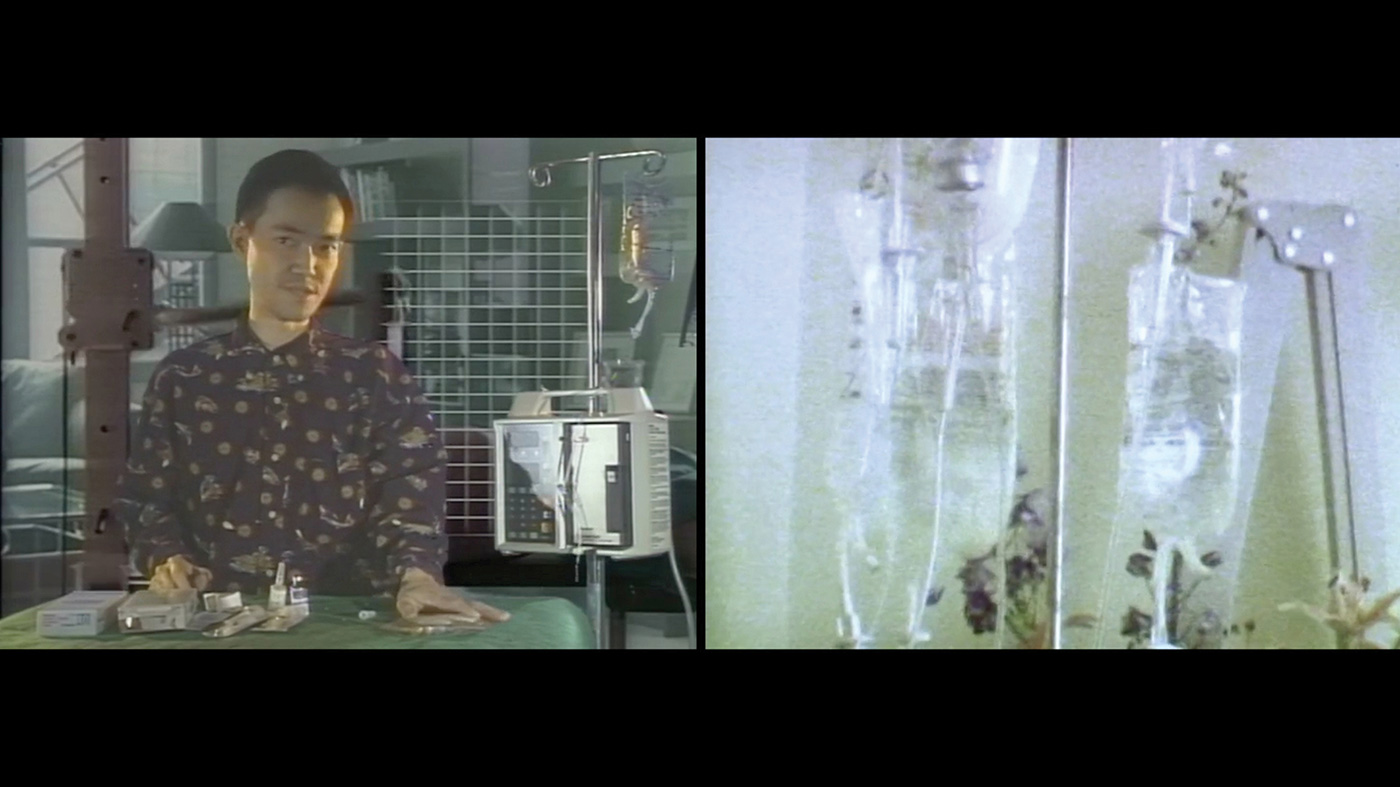
In the 1990s, Chinese-Canadian artist Lloyd Wong began a video work about his living with HIV. It remained unfinished. Thirty years after his death, Lesley Loksi Chan edited the material. Rough and unprocessed, this film explores the meaning of incompletion.
Lesley Loksi Chan is an artist and filmmaker. Her practice is concerned with questions of invisibility, believability and resistibility. Her work asks how material culture and image culture affect the particular ways we think, remember, and live together. Through experimental, handmade and process-based filmmaking, she creates moving-images as mementos.
Petr Lom
Bride Kidnapping in Kyrgyzstan
Documentary | dv | color | 52:0 | Czech Republic, Kyrgyzstan | 2004
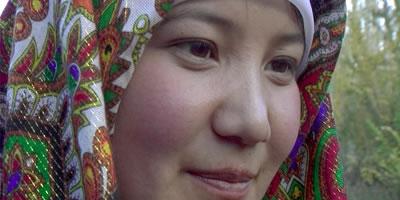
Bride Kidnapping is a common way of marrying in Kyrgyzstan, one of the former Soviet Republics in Central Asia. Though the custom is ancient, it has picked back up since Kyrgyzstan?s independence. With increasing poverty, many choose to kidnap, because they cannot afford the typically high price asked by a Kyrgyz bride's family. Typically, the groom takes several friends, hires a car, stakes out his bride-to-be`s movements, and snatches her off the street. The woman is taken to the groom`s family home. A delegation is then sent to her family to inform them of the kidnapping. The abducted woman is kept until someone from her family arrives to determine whether she will marry her abductor. The level of consent and the familiarity of the bride with the groom vary. Sometimes the kidnappings are consensual - the bride is engaged to the groom and agrees to her ?abduction,? a playful ritual, prior to marriage. But in many other cases, the bride has never met the groom before her abduction, and does not want to marry. Recent studies estimate that about half of all rural marriages in Kyrgyzstan today follow the kidnapping custom, and that in half of these marriages the bride is forced to marry against her will. This documentary - the first to ever document the custom - follows the dramatic stories of four non-consensual kidnappings.
Petr Lom was born in Prague in 1968. He grew up in Canada, and received his Ph.D. in Political Philosophy from Harvard University. He taught at several European universities from 1998-2004 (The EUI in Florence in 1998-1999 and the CEU in Budapest form 1999-2004). In 2003, he decided there must be more to life than the library, and so decided to make a documentary film, though he had no training or experience in the craft. The resulting film, "Bride Kidnapping in Kyrgyzstan" has been screened in over 25 film festivals around the world, and will be broadcast in more than 20 countries. Petr has since given up his academic career to devote himself to documentary filmmaking. He is much happier now that he is following his dreams.
Francesco Lomastro
E quattro giorni che ti amo
Experimental fiction | dv | color | 12:34 | Italy | 2004
A young boxer is fighting his first significant spar: obstructed by his mother, and attempt of corruption by his adversary's father, he finds in himself, and in the love for a girl met on the beach, the spirit to react.
Francesco Lomastro has been working on audiovisual and movie production since 1993, making his way up to first-assistant director and production director. As a director he has shot several video-clips, one documentary, and a television programme on a national network (LA7). "Four days that I love you" is his first fiction short film. He is currently working on a video linked to an installation and is writing a feature film.

Dora Longo Bahia
Antígônadá
Experimental fiction | hdv | color | 120:0 | Brazil | 2021
Taking Sophocles' Antigone as its starting point, “Antígônadá” deals with the contemporary political situation, exploring the revolutionary aspect of the main character, a woman who defies the established social order. After the death of their two brothers, Antigone and Ismene reflect on the laws of “God” and the laws of the State, the rights of the citizens and of the social excluded. “Antígônadá” is an experimental film, composed of 6 travelling shots of 20 minutes, with the camera in a circular continuing motion. Each shot represents one of the 4 elements: light, water, earth and air. The camera accompanies Antigone and Ismene - played by the same actress – whose journey follows the same path four times, reflecting on the status of women in patriarchal society.
Dora Longo Bahia is a visual artist, born in São Paulo, Brazil, in 1961. As of 1984, she has worked with various media: painting, photography, video, sound, set design, illustration and performance art. She has also played bass with several bands: Disk Putas, Verafischer, Maradonna, Sujos de Dora, Osmacaco, Blá Blá Blá and Cão. In 2010 she completed her PhD on visual poetics at ESchool of Communication and Arts of the University of São Paulo - ECA/USP where she currently teaches. In 2016 she completed her postdoctoral studies at the Faculty of Philosophy, Letters and Human Sciences of the University of São Paulo – FFLCH/USP that resulted in her first long feature film, The Dora Case. Since the 1980’s, she participated in several exhibitions and festivals, amongst them: We Never Sleep, at Schirn Kunsthalle Frankfurt (2020); Bienal Sur, in Argentina (2019); 9th Busan Biennale: Divided We Stand, Busan, South Korea (2018); 35o Panorama da Arte Brasileira – Brasil por multiplicidade, São Paulo, Brazil (2017); Eloge du Vertige, Maison Européenne de la Photographie, Paris, France (2012); The Spiral and the Square, Bonniers Konsthall, Stockholm, Sweden (2011); IX Biennial of Monterrey, Monterrey, Mexico (2009); 28th International Biennial of São Paulo, São Paulo, Brazil (2008). Among the artist’s audiovisual achievements are: petit a (2011), part of the Brazilian version of the Destricted project that brought together directors such as Gaspar Noe, Larry Clark and Matthew Barney and the feature film The Dora Case (2017).

Valeriano Lopez
Salvem la Diada de la Toma
Experimental video | dv | color | 13:0 | Spain | 2006
In this work, Valeriano Lopez makes an assessment of historical aspects that perpetuate themselves, starting with the celebrations that incorporate customs and folklore. The video displays the Toma de Granda, a celebration that is held every beginning from the balcony of the town hall where a municipal councillor addresses the city with the slogan, "Granada for the venerable Catholic Kings and Queens", while the banner is brandished and the national hymn plays. The filming results in a complete anachronism of this triumphal tone and in the imposition of a quintessence associating Spanish with a Catholic fanaticism. In this work, modelled on the different takes of the celebration, operates a sequence shot of the Archbishop's sermon based on the unity of Spain. The act appears like an exaltation of Spanish nationalism which has its ironic counterpart in this work with the subtitling in Catalan.
Valeriano Lopez is a Spanish artist who in his works principally resorts to video, the language of video games, or publicity, products of a society of consumption, to attract the attention of viewers to problems such as immigration or the differences that are intentionally established to push away the third world. His irony reflected on these phenomena produce a critical reflection on the cultural stereotypes and introduce doubt in the spectator. He dissolves the frontiers of artificial separation constructed for the Occident with the sole motive of protecting himself from this "other" that he fears, and with the objective of justifying the xenophobic and racist behaviours that translate themselves in established systems to control the population that has emigrated from countries that are either poorer or in the developmental process.

Rafaela Lopez
Showtime
Documentary | mov | color | 39:10 | France, USA | 2022
The film follows for two years a group of NYC subway dancers. In the trains, at home, at the rehearsal location, at the events organized by their commutity. The film portraits five individuals as well as the dance community they are part of, the city and the society they are living in. Despite obstacles, social backgrounds and racism, they are determined to succeed and fight against an illusional meritocratic system.
Rafaela Lopez (b. 1988, Paris) is a visual artist working in New York and Paris. Her work deploys between videos, performances, sculptures, drawings and collaborative projects. She is interested in marginalized creative practices, the pop cultures and our socio-cultural backgrounds. Each of her projects searches for a specific language, adapted to the implicated communities and questions the social role of art. Rafaela Lopez studied at Royal College of Art (London), Villa Arson (Nice) and Ecole Nationale Supérieure des Arts Décoratifs de Paris. In 2015, she is awarded at Art-O-Rama (Marseille), in 2017 by Mécènes du Sud (Montpellier / Sète), in 2020 she is nominated for Prix Sciences Po for contemporary art (Paris), in 2021 she is awarded by the Fondation des Artistes and in 2022 she is the laureate of the Social Practice Arts Prize, organized by the Centquatre, Calouste Gulbenkian Foundation and Rotschild Foundation. She has exhibited in various venues such as Wassaic Project (Wassaic, NY, 2022), NY Greek Consulate (NY, 2020), FLAX (Los Angeles, 2018), Fondation Louis Vuitton (Paris, 2018), Palais de Tokyo (Paris, 2017), Centre National d’Art Contemporain de la Villa Arson (Nice, 2012, 2014, 2017), Studio Voltaire (London, 2015), Camden Art Centre (London, 2015), Flat Time House (London, 2014, 2015). She has been a resident artist at FLAX (2018, Los Angeles), Villa Arson (2017, Nice), Laboratoires d'Aubervilliers (2017, invited by Grace Ndiritu), Villa Lena (2015, Palaia) and Casa de Velazquez (2014, Madrid). Rafaela Lopez is the former president of DOC!, an independent art space located in North Paris.

Luciana Lopez Schütz
The Argentinian Neighbor
Experimental doc. | mov | color | 5:0 | Argentina, Hungary | 2021
A voice describes the relationship between two young neighbours and their encounter with a mysterious woman that reveals an augury about future times.
Luciana is an Argentinian born film director and photographer . Her main area of interest has been always the visual language. She started from an early age taking several courses on analogue photography and Super 8 film. She obtained her BA in Image and Sound Design at the University of Buenos Aires and a MA in documentary film directing at ULHT, SZFE and LUCA School of Arts as a scholarship student. She has directed several short films that have been featured in international film festivals such as BAFICI and FIDBA in its competitive section and selected by Berlinale Talents BA as director. In 2019, she attended Biographical Documentary Theatre Course with Gudrun Herrbold at UDK awarded with a fellowship and in 2021, she was chosen to participate as a jury at ELIA Academy (European League of Institutes of the Arts). Nowadays, she is based in Brussels working on both personal and commissioned projects.
Colectivo Los Hijos
Enero, 2012 (o la apoteosis de Isabel, La Católica)
Video | hdv | | 18:0 | Spain | 2012
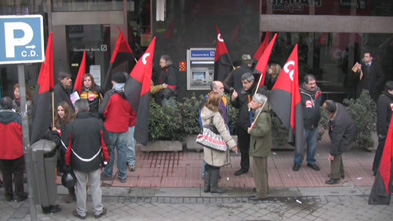
Ecoutons le guide pour un parcours touristique balisé, aux étapes attendues, entre statues des Grands hommes et sites qui furent le théâtre d?une geste mémorable. Regardons le paysage urbain de Madrid, un jour de janvier 2012. Deux fils se déroulent. Du frottement de oeil et de l?oreille, s?ouvrent des interstices.

Colectivo Los Hijos
LOS MATERIALES
Experimental doc. | dv | black and white | 75:0 | Spain | 2009
material. (lat.: materiālis). 1. adj. Having substance or capable of being treated as fact; not imaginary. 2. adj. Derived from or composed of matter. 3. adj. Having material or physical form or substance. 4. adj. Directly relevant to a matter especially a law case. 5. adj. Concerned with or affecting physical as distinct from intellectual or psychological well-being. 6. adj. Concerned with worldly rather than spiritual interests. 7. n. Artifact made by weaving or felting or knitting or crocheting natural or synthetic fibers. 8. n. Things needed for doing or making something. 9. n. Information (data or ideas or observations) that can be used or reworked into a finished form. 10. n. The tangible substance that goes into the makeup of a physical object.
In 2008, Javier Fernández (1980), Luis López Carrasco (1981) y Natalia Marín (1982) found the artistic collective Los Hijos, devoted to the research of cinematic form and the mechanisms of audiovisual representation. With their first work, El sol en el sol del membrillo, they competed in the official section of DocumentaMadrid. Afterwards, this short film has been selected in several other festivals as well as art galleries. Afterwards, they finished their second short-film, Ya viene, aguanta, riégueme, mátame, video essay that attempts to question certain sequences which have become iconic in the history of Spanish cinema. Los materiales, their first feature-length film won the Jean Vigo award to the best direction in Punto de Vista International Documentary Film Festival of Navarre and a Jury?s Special Mention in FidMarseille 2010. Their second, feature-length film, Circo, was selected in the competition section section of Documentamadrid 2010. Currently, all their works are being screened at several contemporary art museums and art centres throughout Spain. In november 2010, Los Hijos enjoyed their first retrospective of their work in Mar del Plata Film Festival.