Catalogue > Search
Results for : Tout le catalogue

Ikuru Kuwajima
City of Transformers
Experimental video | hdv | color | 3:39 | Japan, Russia | 2016
The project is about the transforming cityscape of Kazan, the millennium old capital of the Republic of Tatarstan in Russia. With the brand-new buildings and anime costume characters “ Transformers ”, I visualized my impression of this fast-growing modern multicultural city, located in the middle Volga, about 600 km east from Moscow. In Kazan, newcomers would soon notice the futuristic bizarre architecture scattered around the city’s center. Those buildings are somewhat reminiscent of the contemporary but ambiguous glittering architecture in Kazakhstan’s capital Astana and Turkmenistan’s capital Ashgabat in Central Asia. In Kazan’s city center, visitors would also notice awkward-looking costume characters like ones from American-Japanese robot anime “ Transformers ” giving out leaflets or getting pictures taken with kids for money. Kazan is home to Tatars, a predominantly-Islam Turkic people, but it is more complex and unique, as Tatar, Russian and Soviet cultures have been intertwined in the past centuries there. Now, western capitalism gets mixed with this cultural melting pot, bringing even “ Transformers ”to the city and turning parts of the cityscape a little Disneylandish. Kazan is still in the process of this intricate transformation. This project demonstrates my vision of this transforming multicultural city located near the edge of geographical Europe.
After growing up in Japan, studying in journalism in the University of Missouri, Columbia, and living in Romania for a year, Ikuru Kuwajima has been living and working on visual documentary and art projects mainly with photography in various post-Soviet countries (Ukraine, Kyrgyzstan, Kazakhstan and Russia) in the past 10 years. After three years in Kazan, he now lives in Moscow, Russia, continuing personal projects. His artist books “ Tundra Kids ” and “ Oblomov ” were published in Vienna in 2015 and in Moscow in 2017, respectably.
Hans Kuzmich
Radiant Center
Multimedia installation | 0 | | 60:0 | USA, Lithuania | 2025
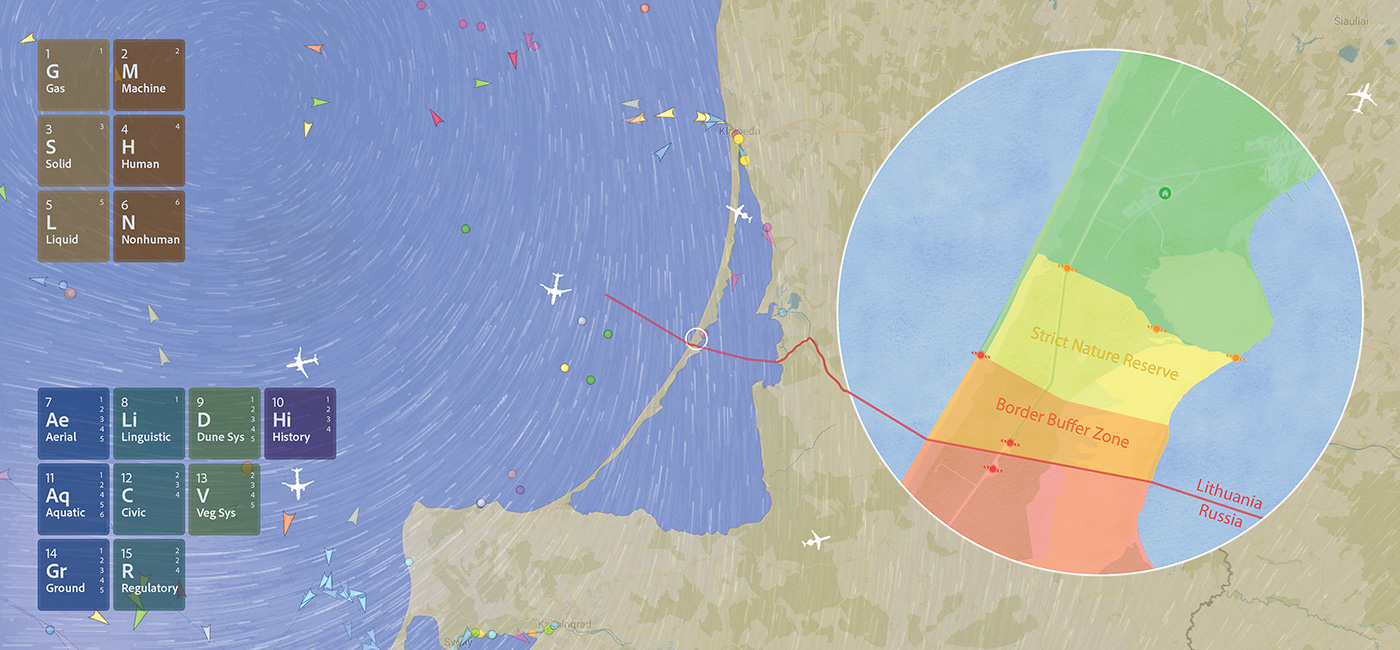
"Radiant Center" is a four-channel sound installation examining the convergence of security practices, media technologies, and geological environments at the Russian-Lithuanian border on the Curonian Spit, a peninsula along the southeastern Baltic Sea. Engaging with the site's cultural history as a UNESCO World Heritage Site known for its wind-blown sand dunes, the project investigates how borders and wind function as media infrastructures that are simultaneously local and global, geopolitical and ecological, mobile and emplaced. The methodology centers on embodied listening to the border's acoustic and transmission ecologies, informing the creation of documentary and performative recordings of radio communications, broadcasts, and electromagnetic emissions related to border security and atmospheric science, alongside field recordings that capture how aeolian forces resonate across the Spit's terrain. Bridging border studies, environmental humanities, and sound art practice during a period of heightened xenophobic border rhetoric across American and European contexts, "Radiant Center" advances an understanding of borders as porous, contested zones where political, technological, and environmental forces continually reshape both human and non-human mobilities.
Hans Kuzmich is a Belarus-born interdisciplinary artist based in Los Angeles whose work examines gender as an interface between subjects and the state. Working across transmission arts, media installation, and performance, his practice is grounded in site-specific listening and sonic fiction methodologies. Kuzmich is currently completing a hybrid doctoral dissertation in Film and Digital Media at the University of California, Santa Cruz. Recent exhibitions and residencies include Sonic Nomads, Seoul, South Korea; SPAM New Media Festival, Seattle, WA; Sound + Environment, Newcastle upon Tyne, England; Nida Art Colony of Vilnius Academy of Arts, Lithuania; Radiophrenia, Glasgow, Scotland; Wave Farm, Acra, NY; Vermont Studio Center, Johnson, VT; The Studios at MASS MoCA, North Adams, MA; The 8th Floor, New York, NY; and SOMA, Mexico City. Kuzmich holds an MFA from the University of California, Los Angeles, a BFA from the Cooper Union, and was a participant in the Whitney Independent Study Program.
Klaudia & Jacqueline/ Künstlerduo Stoll & Wachall, Jacqueline WACHALL
Control your body
Art vidéo | dv | color | 5:44 | Germany | 2004
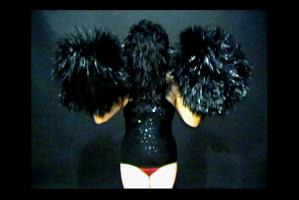
Une silhouette féminine vêtue d?une très courte robe noire moulante à paillettes, se tient debout, devant un fond noir. La perruque noire qu?elle porte est à l?envers. De ce fait, les longs cheveux brillants et ondulés tombent vers l?avant et recouvrent ses seins. Un son techno cadencé démarre et se développe peu à peu. La silhouette soulève deux pompons et commence à se balancer en suivant le rythme. Le refrain répétitif « Control your body. Let the beat control your body - com?on dance with me » l?entraîne dans une agitation de plus en plus hypnotique. Au début, la silhouette paraît presque insignifiante et ridicule. Elle est un persiflage des filles techno : apparence voyante, cheveux ondulés, formes généreuses. Lorsqu?elle commence à bouger sur le rythme, ça a l?air bizarre. Mais petit à petit, on se laisse envoûter. Les paroles répétitives de la chanson semblent sortir de sa bouche et donnent l?impression que c?est elle qui les maîtrise et qu?elle ne fait pas que leur obéir. Tout à coup, elle nous balance des signes et des mots: extra, highlights, make up, generation, ultra, image, fondation, maximum, overdose, yeah. Ce sont les signes de la modernité, de la séduction, du masque. Ce sont les mots-clés de notre quotidien qui nous sont insufflés. En bougeant et en agissant ainsi, elle nous apparaît peu à peu comme une idole ; dans le sens archéologique du terme, autrement dit, comme un objet vénéré. Elle devient une vraie idole de la musique pop, une Vénus de Willendorf du disco. Les pompons qui servent habituellement à encourager les équipes dans les stades américains, elle les utilise pour nous coacher, nous hypnotiser. Elle nous répète sans cesse : contrôle-toi, laisse-toi contrôler.
1993-99 Etudes à l?Ecole Supérieure des Arts Appliqués Saar avec les Pr. Ulrike Rosenbach et Pr. Bodo Baumgarten, Pr. Horst Gerhard Haberl 1997 Création du Duo d?Artistes Stoll & Wachall 1999 Diplôme et Conservatoire à l?ESAASaar 2001-03 Enseignement à l?ESAASaar

Tilman Küntzel
bodyguard
Art vidéo | dv | color | 6:40 | Germany | 2007
Television images of politicians being interviewed show us different worlds of perception. While the politician speaks to reporters, the bodyguard concentrates on potential dangers in the surrounding area. The viewer becomes witness to two parallel worlds, yet is inclined to pay more attention to the politician, who speaks outwardly to matters of public interest. The bodyguard brings to the situation a dramatically greater intensity, but one that is directed inward. He is deep in concentration, communicating through a small earpiece with a network that remains hidden from the viewer. The images are characterized by this contrast, which endows them with a particular tension. The video shifts the focus onto the bodyguard`s inner perception.
Kristina Kvalvik
City Heart
Experimental fiction | 0 | color | 5:23 | Norway | 2011
The spectator follows the protagonist through a city one dark winter night. Where is she going? Why do we follow her? The city in the dark and the woman in the night provokes an eerie atmosphere, - without the film giving any answers to why. This unsolved story is based upon how we are seen and interpreted in the public sphere. All images are from urban places and contain a subtle doomsday thematic as a sweeping tone through the film.
Kvalvik has exhibited her work internationally including Göteborg International Biennial for Contemporary Art, Overgaden Institute for Contemporary Art; Copenhagen, LOOP Film Festival; Barcelona, Center for Contemporary Art; Glasgow, GalleriBOX; Akureyri, Galeria Miroslav Kraljevic; Zagreb, Kunsthalle Exnergasse; Vienna, Parkingallery; Tehran, Västerås Konstmuseum, Høstutstillingen Kuntnernes Hus; Oslo and Abandoned Gallery; Malmö.

Kristina Kvalvik
Distant Landscape
Experimental film | super8 | color | 8:30 | Norway, Iceland | 2012
"Distant Landscape" consists of images of landscapes in which traces of movement of the film`s narrator are recognisable within the desolate surroundings. Short texts roll over the images, telling the story of someone in a close and sensual relationship with nature.
Kristina Kvalvik (b.1980) is a Norwegian visual artist currently based in Copenhagen, Denmark. She studied film and fine art in Norway, Sweden and Canada, and completed her MFA at Malmö Art Academy (SE) in 2008. Her work deals with matters relating to surveillance, the inexplicable and the threatening. She examines the limitations of sight and our ability to interpret what we see. Kvalvik has exhibited her work internationally including Göteborg International Biennial for Contemporary Art, Overgaden Institute for Contemporary Art; Copenhagen, LOOP Film Festival; Barcelona, Center for Contemporary Art; Glasgow, GalleriBOX; Akureyri, Galeria Miroslav Kraljevic; Zagreb, Kunsthalle Exnergasse; Vienna, Parkingallery; Tehran, Västerås Konstmuseum, Høstutstillingen Kuntnernes Hus; Oslo and Abandoned Gallery; Malmö.

Yunjoo Kwak
A Chronicle of Plan van Gool
Documentary | hdv | color | 20:0 | Netherlands | 2014
A Chronicle of Plan van Gool (20 mins, 2014) is a video essay by Yunjoo Kwak, developed during a conversation with an architect, Endry van Velzen, regarding his text ‘Over vanzelfsprekendheid, de 1138 van Gool in Amsterdam Noord’, (in: OASE nr. 49 1998, p. 44-65) The text presents a sophisticated analysis of Plan van Gool, designed by a State architect Frans van Gool (1929 – ) in 1968, and reflects upon van Gool’s fundamental critique of modernist concepts through the residential building. By appropriating his text, the essay attempts to re-examine the thoughts of the two architects, how they perceive of architectural performances – aesthetically, politically, and economically – and how each responds to environmental forces and crises.
Yunjoo Kwak (Seoul, South Korea, 1977) lives and works in Amsterdam. She studied and taught in MFA at the Korean National University of Art, Seoul, 2008 and Dutch Art Institute/ ArtEZ, Arnhem, 2011. Her works has exhibited in a number of different public venues such as French Cultural Centre, Reykjavik Museum of Photography and Seoul Museum of Art. Her works often deals within notion of ‘performativity’ as practicing political and aesthetical strategy in various mediums; film, lecture performance, text and publication.
Yunjoo Kwak
Simbang
Experimental doc. | mp4 | color and b&w | 58:0 | Netherlands | 2024
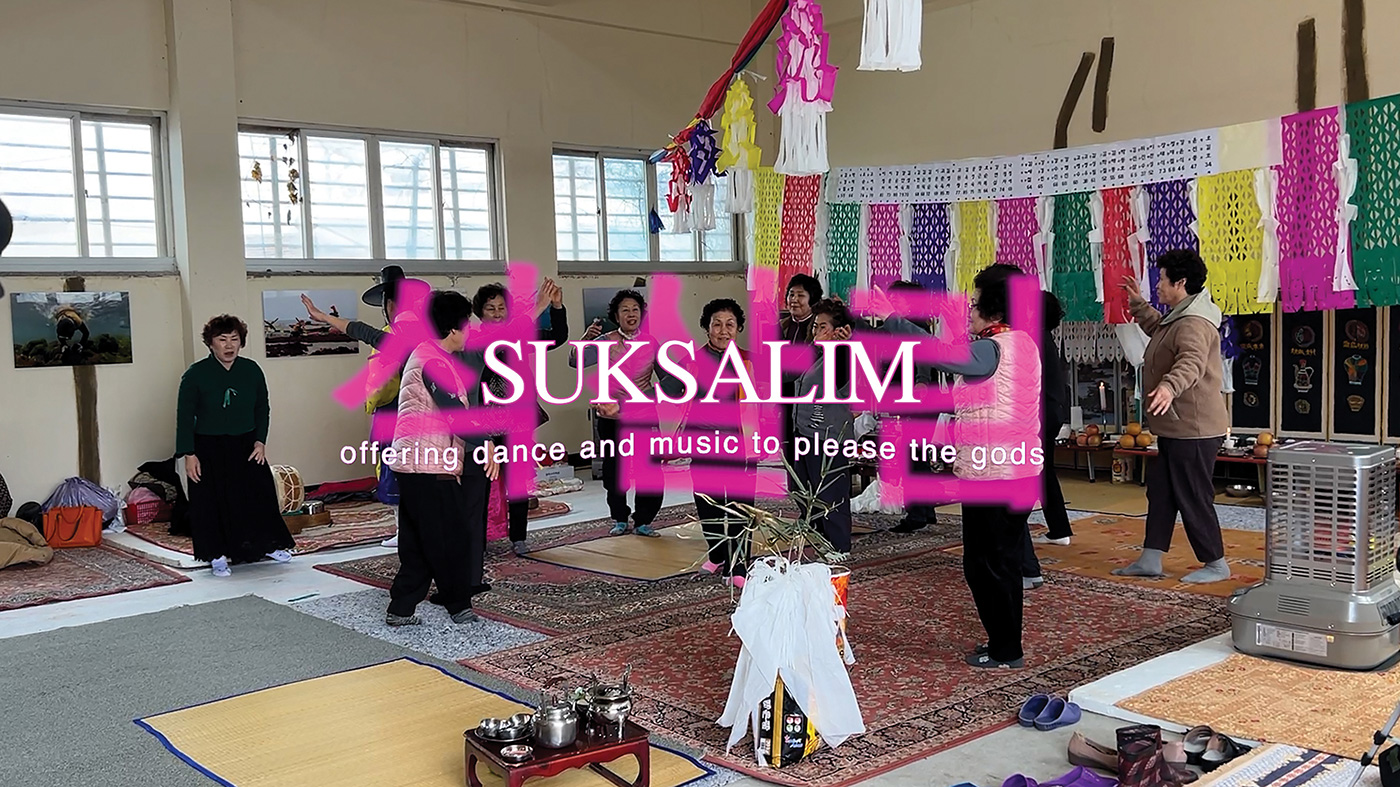
The feature film Simbang explores the process of spiritual recovery in the aftermath of the 4.3 Massacre by combining found footage taken by American military forces during the massacre with documentation of rituals held at various locations across the island. On Jeju island, “??” (Simbang; ??) refers to a shaman. “?” (sim) means spirit, and “?” (bang) means space or room, translating directly into a spirit room or spirit space, thereby evoking a spatial aspect of their beings in connection to the unseen world, yet powerfully sensible through the ritual. The camera follows all steps of the ritual; calling forth gods and spirits, welcoming them both on land and underwater, serving them with offerings, playing music and dancing, communicating with them, purging evil energies from the spirit and clients, and sending the spirits away back to their realm. During these rituals, the Jeju myth’s 18,000 gods and the life stories of the people who died in 1948 come together to weave a history of their sorrow and violence, enabling the processing of trauma. The physical, psychic, and emotional impacts of trauma go beyond the limits of the dominant historical archive and its knowledge.
Yunjoo Kwak is an artist and a lecturer at Willem de Kooning Academy in Rotterdam. She graduated from the Dutch Art Institute/ArtEZ (MFA, 2011) in Arnhem and the Korean National University of Arts (MFA, 2008). Yunjoo was an artist-in-residence at The Otolith Group (2015) in London and has participated in various exhibitions and collaborated with different institutes such as the Amsterdam Museum; Kuandu Biennale Taiwan; Makassar Biennale; the Korean Cultural Center, London; Studium Generale Rietveld Academy, Amsterdam; Seoul Museum of Art and The Museum of Photography Seoul. Her major video works include ‘Café Downey’s’ (2013), ‘Chronicle of Plan van Gool’ (2014), ‘The Defectors’ (2017) and ‘Only The Ports Are Loyal To Us’ (2020). Her practice is research-based and process-oriented, with a focus on architecture and history intersection with the filmmaking process. She works across the disciplines of ‘essay’ film, photography, digital montage, publication and archiving. She is interested in the blind spots of historical representation and seeks ways to haunt them through her artistic practice.

Hayoun Kwon
489 Years
Animation | hdv | color | 11:18 | Korea, South | 2016
“ 489 Years ” is transcribed according to the testimony of a former soldier in South Korea, Kim. It gives us access to the DMZ, and makes us immerse in the heart of the personal memory of a soldier. He tells us his experience in a research mission and the amazing discovery he made in the field full of mines (mines laid by South Korea with no record of where they were placed). He speaks of a place where people are forbidden, a place where nature has totally reclaimed its hold.
Hayoun KWON is a multimedia artist and documentary director. South Korea born in 1981. She graduated from the Fresnoy – Studio national des Arts contemporains in 2011 and she lives and works in France and in Korea. The reflection on identity and borders is central to her previous works. She has focused more specifically on the construction of historical and individual memory and their ambivalent relationship to reality and fiction.

Hayoun Kwon
VILLAGE MODELE
Video | hdv | color and b&w | 10:0 | Korea, South | 2014
A village loosely inspired by a north korean propaganda village ,Kijong-dong. Hayoun KWON reveals a setting and invites us into a fiction ,carrying out the journey by proxy. this film testifies to this ghost town in its true state as a mechanism of fiction. the reality of a border confronted with its staging. this village can only be reached within our imagination.
Hayoun Kwon was born in Seoul (South Korea) in 1981. She first studied at the Ecole des Beaux-Arts de Nantes, and then graduated from the Fresnoy – Studio national des Arts contemporains in 2011. Her work revolves mostly around the notions of memory (wether individual or collective), boundaries and limits, questionning the blurred lines between intention and interpretation, construction and fiction, recollection and invention. She examines the ambivalent relationships between reality and fiction.

Makis Kyriakopoulos
WHAT IS A MAN WITHOUT A SHADOW
Experimental fiction | 4k | color | 3:19 | Greece | 2020
In the video work "What is a Man Without a Shadow", a digital morphogenesis via AI is being used, as a method, taking its inspiration from biology, and it is used to describe the process of the evolutionary development of organisms and polymorphic systems. In digital morphogenesis, new forms replace the former ones, through the logic of optimization, via an open system of states of constant interaction. These organized structures are turning radically into disorganized ones, creating general disorder. Images get gradually degraded, revealing entities that change the consistency of space and time, with an average entropy value, enabling new realities to be tested in a virtual space. Consecutively, that allows the evolution of beings who strive to mark their existence in sequences that interact, passing from one situation to another, generating the genetic material of the project.
Makis Kyriakopoulos was born in Patra, Greece in 1975. He completed an MFA with distinction at the Athens School of Fine Arts in 2004 and completed the postgraduate course of (ASFA), in Digital Arts. He works predominantly in Digital Arts and specifically focuses on the nature of movement, materiality and immateriality challenging the relationship between human and space. He has participated in numerous international festivals globally, public lectures, group and solo art exhibitions.

Eva L'hoest
Under Automata
Experimental film | 4k | black and white | 10:49 | Belgium | 2017
Sleepers manually scanned in 3D during a flight over the Atlantic Ocean. This project used a last generation of video game sensor camera turned into a 3D scan. The shooting device was exclusively made during the flight, in the tension of being catch by autority.
Eva L'Hoest (1991, Belgium), focuses primarily on the exploration of memory and its strange and minute lingering reality. She tracks the often blurred and non-specific ways in which reminiscence appears. Working on the outer edge of perception where it becomes affect and emotion; starting out with accidents of light like “the operator of a memory who interprets, distorts selects or sometimes saturates and alters the images”*, Eva L’Hoest is an artist whose intuition plays a decisive role. Intuition as a working method, a decisional process in the literal sense given that intuito, i.e. “the regard”, is its etymological Latin root. Her work defines “a single plastic modality which is that of a clouded form, a migratory form, as if the subjects in question had all been taken in a transitory state between construction and deconstruction, reconstruction and erasure”*.

Eva L'hoest
The Inmost Cell
Video | 0 | color | 11:8 | Belgium | 2020
The Inmost Cell is a new video work by Eva L’Hoest which takes its narrative from the traditional tales of the Daugava river and the ruins of its underwater islands, flooded on the creation of the Riga dam. Through the combination of various digital processes, L'Hoest turns her photographic reportage of the outskirts of Riga into three-dimensional fluid architectures. These lost elements of Latvian culture mark a site of synthesis between humans, nature and man-made ruins. In a fusion of the rural and the maritime landscape referencing the calenture, a maritime mirage where the sea becomes an inviting grassy field, the artist imbues the images with a shifting, hallucinatory quality. Across slow, contemplative tracking movements, its different realities merge as forms fall one after the other, and passageways are created between places and memory.
Eva L’Hoest (1991, Belgium) explores how all types of mental images, in particular memory and reminiscence, are able to reappear in a technological form.Piece by piece, the artist appropriates contemporary technology to reveal both their nature as extensions for capturing the world and their potential as an artistic medium. Her work was recently exhibited at FRAC Grand Large (Dunkerque), “Shapeshifters” at the Malmö Museum, the Riga International Biennial “And suddenly it all blossoms” curated by Rebecca Lamarche-Vadel, the Lyon Biennale “Where Water Comes Together with Other Water” curated by Palais de Tokyo, Lyon (France); The triennale of Okayama Art Summit 2019 “IF THE SNAKE” curated by Pierre Huyghe, Okayama (Japon); “Suspended time, Extended space”, Casino Luxembourg.

Marcellvs L.
0434
Art vidéo | | color | 6:56 | Brazil | 2006
0434 focuses on two boats anchored at sea which slowly move in uncanny synchrony, composing a casual choreography that suggests a dialog or a strange courtship ritual. The video is a one piece of the on going series VideoRhizome.
The video and sound artist Marcellvs L. was born 1980 in Belo Horizonte (Brazil), he lives and works in Berlin. His particular and radical production that gets into dialogue with the electronic arts? universe attracts attention by the intensity with which it associates philosophical concepts to the electronic images and sounds. His work places itself in a zone of undiscernibility, which turns it inapprehensible by this or that audiovisual genre creating its own discursive universe.

Marcellvs L.
man.road.river.
Art vidéo | dv | color | 9:27 | Brazil | 2004
A man. A road. A river.
Marcellvs L. has an extensive background, including an academic education, music lessons since his childhood, and lots of reading. Even nowadays, the artist dedicates a few hours a day to studying the piano. His preferences range from Hungarian composers Béla Bartók (1881-1945) and Gyorgy Liget (1923) to Erik Satie (1866-1925) and Claude Debussy (1862-1918). His interest in music is not restricted to the universe of instrumental and classical music, as it includes more popular genres, such as rock and experimental music. His reading preferences are literature and philosophy, especially Nietzsche and Deleuze. Marcellvs? ongoing interest in music and intense reading pace comprise his initial background, after which it also includes cinema and video. This dual interest in music and image, in addition to an old friendship with the members of the pexbaA band, have led Marcellvs closer and closer to image production. Thus, over approximately four years, from 2000 until 2003, the artist presented himself along with the band. In some of the gigs, band members were hidden behind a front stage screen. Marcellvs presented himself together with pexbaA in the Projeto Rock Contemporâneo (Contemporary Rock Project) at SESC Ipiranga, São Paulo (2002), in the III Festival Eletrônika Telemig Celular at Palácio das Artes, Belo Horizonte (2002), in the SXSW Festival ? South by Southwest, Austin, Texas, USA (2002), and in the Projeto Rumos Itaú Cultural ? Cartografia Musical Brasileira (Itaú Cultural Pathways Project ? Brazilian Musical Cartography) at Itaú Cultural, São Paulo (2001), among others. During his college days at PUC-MG?s Faculdade de Comunicação e Artes (Communication and Arts College), the artist began researching videorhizomes as part for his graduation project, under the guidance of Professor André Brasil. With his videorhizomes, Marcellvs participated in a series of festivals and exhibitions such as ?Brésil, Brésils?, in the Videoformes Festival, at Clermont-Ferrand, France (2005); ?Abre Alas?, at Galeria A Gentil Carioca, Rio de Janeiro (2005); ?Do micro ao macro: novas políticas e imagens? (From micro to macro: new policies and images), exhibited during the 6th Belo Horizonte International Short Film Festival, in Belo Horizonte (2004); Laboratorio Arte Alameda, in Mexico City (2004); ?Uma mágica por minuto? (One magic per minute), Universidade de Passo Fundo, in Rio Grande do Sul (2004); Laisle.com Video Art Exhibition, Museu de Arte Moderna (Modern Art Museum), in Rio de Janeiro (2004); ?Investigações Contemporâneas? (Contemporary Investigations), exhibition at the 14th Videobrasil International Electronic Art Festival), in São Paulo (2003), ?Entre a casa e a metrópole? (Between the house and the metropolis), at the XXVI Intercom Congress, in Belo Horizonte (2003), among others. The Deleuzian thematic is also present in another enticing piece of work: the video ?Deleuze while a living model? (2003). In this piece, the image of Deleuze in a TV monitor is smeared with red lipstick. The video took part in the Southern Competitive Show at the 14th Videobrasil International Electronic Art Festival, in São Paulo (2003); in the Muestra de Cortometrajes de Minas Gerais (Minas Gerais Short Film Exhibition), at the Auditorio de la FUNCEB, Fundación Centro de Estudos Brasileiros (Brazilian Study Center Foundation), in Buenos Aires (2004); in the Cine Esquema Novo (New Scheme Cinema), at Usina do Gasômetro, in Porto Alegre, (2004); in the 7th Tiradentes Cinema Exhibition, at Centro Cultural Yves Alves, in Minas Gerais (2004), among others. The video also won the main prize at Festival do Livre Olhar (FLO ? Free Look Festival), at Santander Cultural, in Porto Alegre (2003), as well as the best video award at the 5th Competitive Exhibition of Images in Motion, at Casa do Conde de Santa Marinha, in Belo Horizonte (2003). Of all videorhizomes, ?Man.Road.River?, also know as ?Rizoma 0778?, is the most widely known, winning awards in several exhibitions and festivals. The video won the Grand Prize at the 51st Oberhausen International Short Film Festival (2005), the Best Experimental Film award at the Mostra do Filme Livre 2005 (Free Film Exhibition), at Centro Cultural Banco do Brasil, Rio de Janeiro, and the award in the Ousadia e Risco category (Daring and Risk) in the Festival do Livre Olhar (FLO), at Santander Cultural, Porto Alegre (2003). Recently, the artist has also received a scholarship fund from the Museu de Arte da Pampulha (Pampulha Art Museum), Belo Horizonte, and will be featured in an exhibition in the second semester of 2005 at Paço das Artes, in São Paulo. (by eduardo de jesus, dossier videobrasil marcellvs l.)

James L. Sansing
A Light Unseen
Video | 4k | color | 9:55 | USA | 2024
Light glinting off spider webs, seem unremarkable, but there is a world of color and composition invisible to the human eye revealed by this experimental film. These are not artifacts caused by camera optics, this is the natural world.
James Sansings films have shown all over the world. Including New York (NYFF , anthology film archive) , San Francisco (SFIFF, Pacific Film Archive). Ann Arbor (aaff) Rotterdam (Iffr), As well as in Berlin, Buenos Aires, LA, Chicago, Toronto, and others. He has won a Princess Grace Foundation Award, Pollock Krasner Grant, Eastman Kodak film grant, Pirkle Jones Fund, Sustainable Arts Grant, Audience awards at AAFF and SFAI and others. He graduated from the San Francisco Art Institute, where he studied with filmmakers George Kuchar, Craig Baldwin, Ernie Gehr, Janis Lipzin, Lawrence Jordan and Al Wong

Eva La Cour
Composite / De-Composited
Experimental film | 16mm | color | 3:0 | Denmark, Belgium | 2015
COMPOSITE / DE-COMPOSITED juxtaposes picturesque visions of authenticity in urban space with narratives of the High Arctic and the 20th century phantasmagoric medium of film. The short 16mm film is shot at a construction site in Brussels characterized by facadisme. In architecture, this is when a building is demolished and rebuilt from within while the exterior of the building is preserved. The film recording is merged with an account of mine extraction in mountain formations on Svalbard, and together the two elements form the story of creating an image: The film subtly addresses the relationship between planetary raw material and the landscape-as-image. Or, the relationship between the façade as raw material and the city as scenery.
Eva la Cour is a Danish visual artist and researcher with a background in fine arts as well as visual anthropology. She works with audio-visual and spatial forms of montage and display, performance and text, always negotiating with the surroundings in which her work actualizes. This reflects her general interest in notions such as fieldwork, skilled vision and mediation, which she particularly has investigated in relation to landscapes of narratives and raw materials in the Arctic terrain on Svalbard. Currently Eva la Cour lives and works in both Copenhagen and Gothenburg, where she is an artistic practice-based PhD candidate at Valand Academy of Art.

La Decanatura, Elkin Calderón Guevara & Diego Piñeros García
Pluralia tantum bon bril
Experimental video | hdv | color | 4:49 | Colombia | 2017
SYNOPSIS A Colombian video-contribution between the collective La Decanatura and the queer-artist Federica Burns presents the creation of the universe - the big bang - in a new way: Their work aims to subvert the lopsided vision of the white male sovereignty in the representation of the Creator in order to devise a god of ambiguity. As a hybrid being this god is neither male nor female but genderless, mestizo, playful, and plural has put on make-up and is dancing with a fire produced with a "Bon Bril" (kitchen steel wool sponges ) that is used as a fireworks in popular neighborhoods in Colombia and Brazil. Title: PLURALIA TANTUM BON BRIL Director: LA DECANATURA (Diego Piñeros GarcÃa & Elkin Calderón) Production: LA DECANATURA (Diego Piñeros GarcÃa & Elkin Calderón) Camera: Johannes Förster Edition: LA DECANATURA (Diego Piñeros GarcÃa & Elkin Calderón) Actor: Abner Wagner a.k.a Federica Burns Makeup artist: MartÃn Ortegón Duration: 5 min Technical details: Recorded in 4K, final Version in Full HD, 1920 x 1080 stereo
LA DECANATURA. Collective formed by artists Elkin Calderón Guevara and Diego Piñeros GarcÃa that seeks to generate new approaches to art from historical approaches and "foreign" disciplines that inquire hegemonic forms of knowledge and power. LA DECANATURA has been the winner of different awards for the development of artistic projects such as the Residence in Switzerland, Villa Ruffieaux of the Coincidence Program, Pro Helvetia, 2018. Plataforma Bogota Scholarship in art, Science and Technology 2017/18. They have exhibited individually at the Museum of Modern Art in Medellin, Caja Negra (Black Box) 2017. Also they have participated in the Regional Salon for Artists in the Central Zone 2015 and in the National Artists Salon, 2016. Their work "Centro Espacial Satelital de Colombia" has been shown in important festivals, winner of one of the prizes of the Videobrasil Festival 2017 and is part of the Art Collection of the Banco de la República in Colombia.

La Ribot
Film noir 001
Video | hdv | color | 12:48 | Spain | 2014
Commencé en 2014, FILM NOIR est un projet en évolution, en plusieurs parties, qui explore une fascination à long terme de La Ribot: la figure de l'extra, "surnuméraire" ou l'acteur de fond. Les pièces de La Ribot 40 Espontáneos, 2004, et PARAdistinguidas, 2011, par exemple, invitaient des extras (des bénévoles locaux, normalement avec peu ou aucune expérience théâtrale) au centre de la scène dans de nouvelles œuvres d’art vivant pour le théâtre. En revanche, FILM NOIR regarde en arrière dans l'histoire du cinéma et utilise la vidéo pour explorer la dynamique cinématographique du monde des extras. Premier de la série, FILM NOIR 001, 2014, se penche sur les extras dans Spartacus (1960) et El Cid (1961) - "papier de tournesol" humain dont les actions et les attitudes révèlent les idéologies contrastées des deux productions. Actuellement en cours, FILM NOIR 002 et 003 élargissent l'enquête sur d'autres films et d'autres questions.
L’artiste et chorégraphe La Ribot est née à Madrid. En 1986, elle co-fonde le groupe Bocanada Danza et le co-dirige jusqu’à sa dissolution en 1989. Deux ans après, elle commence à travailler sous le nom de La Ribot et elle inaugure le « striptease » humoristique Socorro! Gloria!, une pièce qui attire un nouveau public et qui lui inspire sa série solo intitulée 13 Pièces distinguées. Más distinguidas, la seconde série des Pièces distinguées, est inaugurée à Madrid à la fin de l’année 1997. Suivi d’autres série des pièces : Still Distinguished, 2000 et PARAdistinguidas, 2011. Panoramix, la version anthologique de trois heures rassemblant les trente-quatre premières Pièces distinguées, est inaugurée en 2003 à la Tate Modern et a voyagé ensuite dans d’autres galeries européennes, telles la Reina Sofía de Madrid ou le Centre Georges Pompidou à Paris. En 2000, La Ribot amorce son travail vidéo, et expérimente plus particulièrement l’utilisation du plan-séquence, tourné du point de vue du corps impliqué dans une performance. Cette approche a irrigué de nombreuses œuvres depuis les années 2000, dont l’installation Despliegue, 2001, et le travail complexe mené avec la pièce Mariachi 17, 2009. La même année, elle prend comme base Mariachi 17 afin de mettre en place Llámame Mariachi, un nouveau travail mêlant vidéo et performance live des trois interprètes. En 2004, La Ribot arrive à Genève, en Suisse. Elle y fonde et co-dirige entre 2004 et 2008 Art/Action, un département destiné à l’enseignement et à la recherche du live art basé à la Haute École d’Art et de Design (HEAD) de Genève. Les années 2000 voient aussi le développement de la pièce participative de grande envergure 40 Espontáneos, 2004 ; lancée en 2006 à l’Art Unlimited de Bâle, la pièce Laughing Hole ; et Gustavia, 2008, un duo conçu et joué avec la danseuse, chorégraphe et directrice du Centre National de la Danse de France, Mathilde Monnier. En 2011, elle lance PARAdistinguidas, une nouvelle série des Pièces distinguées conçue pour cinq danseuses et vingt « figurants » volontaires ; en 2012 elle achève EEEXEEECUUUUTIOOOOONS!!!, une commande chorégraphique majeure du Ballet de Lorraine à Nancy, en France. Également en 2012, le MUAC (Mexico City’s Contemporary Art University Museum), a inauguré son espace d’exposition de live art en proposant une exposition monographique sur son œuvre. Le travail vidéo de La Ribot est présenté au sein de collections privées et publiques dans toute l’Europe et elle continue à développer et présenter son travail à l’internationale. Elle a participé à des exhibitions au Japon, Seoul, Korée du Sud et Mexico: en 2012, le MUAC (Mexico City’s Contemporary Art University Museum), a inauguré son espace d’exposition de live art en proposant une exposition monographique sur son œuvre. En 2014, aux côtés du compositeur et pianiste Carles Santons, elle a produit Beware of Imitations!, un vidéo hommage à la danseuse américaine Loie Fuller. Elle poursuit son travail à l’international depuis sa base située à Genève, en Suisse, où elle vit avec le chorégraphe suisse Gilles Jobin.

La Ribot
Film noir 001 // 002 // 003
Video | hdv | color and b&w | 28:0 | Spain, Switzerland | 2015
Dans FILM NOIR 001 (2014), La Ribot fait apparaître les extras de deux péplums, «Spartacus» de Stanley Kubrick et «Le Cid» d’Anthony Mann, tournés dans l’Espagne des années 60. Témoignage des mouvements politiques et sociaux de cette époque, le film construit le fond de l’histoire à travers des corps anonymes. Dans FILM NOIR 002 (2015), la série continue avec les corps de figurants ou travailleurs de plusieurs films, nous laissant ainsi contempler la splendeur de leur jeu. Dans FILM NOIR 003 (2015), l’aspect spatial et chorégraphique nous saute aux yeux. Musicalement organisés, les figurants remplissent l’espace du fond, créant un ballet sensuel et drôle, parfois catastrophique, toujours impeccable.
L’artiste et chorégraphe La Ribot est née à Madrid. En 1986, elle co-fonde le groupe Bocanada Danza et le co-dirige jusqu’à sa dissolution en 1989. Deux ans après, elle commence à travailler sous le nom de La Ribot et elle inaugure le striptease humoristique Socorro! Gloria!, une pièce qui attire un nouveau public et qui lui inspire sa série solo intitulée «13 Pièces distinguées». «Más distinguidas», la seconde série des Pièces distinguées, est inaugurée à Madrid à la fin de l’année 1997. Suivi d’autres série des pièces : «Still Distinguished», 2000 et «PARAdistinguidas», 2011. «Panoramix», la version anthologique de trois heures rassemblant les trente-quatre premières Pièces distinguées, est inaugurée en 2003 à la Tate Modern et a voyagé ensuite dans d’autres institutions européennes, telles la Reina Sofía de Madrid ou le Centre Pompidou à Paris. En 2000, La Ribot amorce son travail vidéo, et expérimente plus particulièrement l’utilisation du plan-séquence, tourné du point de vue du corps impliqué dans une performance. Cette approche a irrigué de nombreuses oeuvres depuis les années 2000, dont l’installation «Despliegue», 2001, et le travail complexe mené avec la pièce «Mariachi 17», 2009. La même année, elle prend comme base «Mariachi 17» afin de mettre en place «Llámame Mariachi», un nouveau travail mêlant vidéo et performance live des trois interprètes. En 2004, La Ribot arrive à Genève, en Suisse. Elle y fonde et co-dirige entre 2004 et 2008 Art/Action, un département destiné à l’enseignement et à la recherche du live art basé à la Haute École d’Art et de Design (HEAD) de Genève. Les années 2000 voient aussi le développement de la pièce participative de grande envergure «40 Espontáneos», 2004 ; lancée en 2006 à l’Art Unlimited de Bâle, la pièce «Laughing Hole» ; et «Gustavia», 2008, un duo conçu et joué avec la danseuse, chorégraphe et directrice du Centre National de la Danse de France, Mathilde Monnier. En 2011, elle lance «PARAdistinguidas», une nouvelle série des Pièces distinguées conçue pour cinq danseuses et vingt figurants volontaires ; en 2012 elle achève «EEEXEEECUUUUTIOOOOONS!!!», une commande chorégraphique majeure du Ballet de Lorraine à Nancy, en France. Le travail vidéo de La Ribot est présenté au sein de collections privées et publiques dans toute l’Europe et elle continue à développer et présenter son travail à l’international. Elle a participé à des expositions au Japon, en Corée du Sud et à Mexico: en 2012, le MUAC (Mexico City’s Contemporary Art University Museum) a inauguré son espace d’exposition de live art en proposant une exposition monographique sur son oeuvre. En 2014, aux côtés du compositeur et pianiste Carles Santons, elle a produit «Beware of Imitations!», une vidéo hommage à la danseuse américaine Loie Fuller. Elle poursuit son travail à l’international depuis sa base située à Genève, en Suisse, où elle vit avec le chorégraphe suisse Gilles Jobin.

La Ribot, Raquel Freire
Differentness
Experimental fiction | 4k | color | 31:8 | Spain, Portugal | 2022
From the depths of our imagination, a forest appears, inhabited by plants, human beings and their fantasies. In this millenary forest, the space is shared with the wind. This place full of tales and fables evokes a reality close to a vivid dream. What is shown is a testimony of the desire to live and to dance. Differentness is based on the show Happy Island, choreography by La Ribot with company Dançando com a Diferença. Creation September 2018 at Grütli – Centre de production et de diffusion des Arts vivants, in the framework of La Bâtie-festival de Genève.
Born in Madrid, La Ribot is based in Geneva and works internationally. « La Ribot is a choreographer, dancer, and visual artist. She began working in the 1980s, towards the end of Spain’s transition to democracy, and has gone on to profoundly change the field of contemporary dance. She defies the frameworks and formats of the stage and the museum, borrowing freely from the vocabularies of theatre, visual art, performance, film and video to instigate a conceptual shift in choreography. Her solo works, collective explorations, experiments with amateurs, installations and moving images are the many facets of a protean practice that constantly focuses on the rights of the body. » — Marcella Lista, writer and chief curator of the New Media Collection, Centre Pompidou, Paris (2020) La Ribot’s choreographic and visual work has won numerous awards, including the Golden Lion for her entire career at the Venice Dance Biennale in 2020, the Grand Prix Suisse de danse awarded by the Federal Office of Culture in 2019, the Premio en Artes Plásticas de la Comunidad de Madrid (Spain) in 2018, the Medalla de Oro al Merito en las Bellas Arte in Spain in 2015, and the Premio Nacional de Danza awarded by the Spanish Ministry of Culture in 2000. Her choreographic work has been shown at the Tate Modern (London), Théâtre de la Ville and Centre Pompidou (Paris), Reina Sofia Museum (Madrid), Festival d’Automne in Paris, the Aïchi Triennale (Nagoya, Japan), Museu Serralves (Porto), Art Unlimited - Art Basel, S.M.A.K. (Ghent) and MUAC (Museo Universitario de Arte Contemporáneo, Mexico DF), among others. Her visual work is part of the private and public collections of the Reina Sofia Museum (Madrid), Centre Pompidou (Paris), CNAP - Centre national des arts plastiques (Paris), MUSAC (Museo de Arte Contemporáneo de Castilla y León), Artium (Centro - Museo vasco de arte contemporáneo), the FRAC Lorraine and Franche-Comté, FMAC - Collection d’art contemporain de la Ville de Genève...