Catalogue > List by artist
Browse the entire list of Rencontre Internationales artists since 2004. Use the alphabetical filter to refine your search. update in progress
Moira Zoitl
Catalogue : 2012fliehkraft | Experimental doc. | hdv | color | 14:0 | Austria, Germany | 0
Moira Zoitl
fliehkraft
Experimental doc. | hdv | color | 14:0 | Austria, Germany | 0
Two tailors who emigrated to Germany from Kabul sewed a suit for Moira Zoitl. All the circumstances surrounding the manufacture of the suit mirror the process of emigration, which Mr. Anwari talks about. The tailoring of the suit appears as an analogy to traveling.
Moira Zoitl, born in Salzburg, Austria, lives and works in Berlin. Her work reflects on issues like migration, city development, gender and questions of (auto)biography and identity. Selected exhibitions include: The Third Guangzhou Triennial, 2008, ?Other Possible Worlds - Proposals on this Side of Utopia?, NGBK Berlin, 2011 www.moirazoitl.com
Amina Zoubir
Catalogue : 2018Last pop dance before darkness | Video installation | 16mm | color | 28:28 | France, Algeria | 2016
Amina Zoubir
Last pop dance before darkness
Video installation | 16mm | color | 28:28 | France, Algeria | 2016
Marcel Duchamp talks about an absurd 'readymade'. An art dealer creates a discourse using the idea of the 'readymade'. An art historian talks about her long time relationship observing Robert Smithson's Spiral Jetty. These personal micro-histories around paradigm shifting artists offers hidden knowledge around the common art historical narrative. While the artist turns over the rocks of the Spiral Jetty, bringing back the experiential quality to an artwork that is mostly known through images.
Amina Zoubir is a visual artist, videast and curator who lives and works between Paris and Algiers. She has a Master’s in Theory and practice of contemporary art and new media from the Université Paris 8 and a DESA in graphic design from the Ecole Supérieure des Beaux-Arts in Algiers. In 2010 she published her university research on the video art of Algerian artists as a book, Relation de l’image et du son dans la vidéo contemporaine algérienne : une expèrience en temps reel (Relation of image and sound in contemporary Algerian video: an experience in real time). She is currently pursuing her Ph.d research at the AIAC laboratory (art of images, contemporary art) at Université Paris 8. She was the curator of the contemporary art exhibition La scène algérienne at the Hospice Saint Charles, at Rosny-sur-Seine in 2013, the programmer of Illegal Cinema #113 at the Laboratoires d’Aubervilliers, screened the movie Tahya Ya Didou by Mohammed Zinet, Aubervilliers, 2013, was co-curator of the exhibition of video art, Video killed the radio star at the e.Bannwarth Gallery, Paris, 2012. Her videos and photographs question the notions of the language of the female body and its projection in urban spaces in the Arab world. Her video installations have been exhibited at the 13th Biennale of young European and Mediterranean creators in Bari, Italy and during the 30th Biennale of contemporary art in Pontevedra, Spain. She directed six performance actions in Algerian urban spaces in 2012, Prends ta place (Take your place), for the webdocumentary Un étéà Algers (A Summer in Algiers), produced by Narrative and Une chambre à soi.
Amin Zouiten
Catalogue : 2023Nadir | Experimental doc. | 0 | color | 12:50 | Morocco, Sweden | 2022
Amin Zouiten
Nadir
Experimental doc. | 0 | color | 12:50 | Morocco, Sweden | 2022
Nadir takes place at Norra Grängesbergsgatan, a kilometer-long street just outside central Malmö. A place of sometimes conflicting cultural and political interests, which was once considered a “no-go zone” by the municipality, as well as cultural gentrification zone, can perhaps be described as an expressive and symphonic micro-city. Surrounded by several small-scale industries, established in the 1930s, there is a lingering scent from the nearby Pågen bread-factory. Here, a Baptist church gathers upstairs of an old production facility side by side with flowing neon from Arab furniture stores and carpet stores. In Nadir, the narratives surrounding the street are reformulated as “anti-narrative” through a series of sensorial sequences through and on the street.
Amin Zouiten, is a Swedish-Moroccan artist and filmmaker educated at the Academy of Fine Arts in Malmö and Akademie der bildenden Künste Wien. His works and films have been shown at, among others, Malmö Konsthall, Internationale Kurzfilmtage Oberhausen, Konsthall Charlottenborg, CPH:DOX, Tempo Documentary Festival.
Amin Zouiten
Catalogue : 2025Qirat | Fiction | 4k | color | 13:13 | Sweden | 2024
Amin Zouiten
Qirat
Fiction | 4k | color | 13:13 | Sweden | 2024
Qirat is loosely based around an oral family anecdote of a robbery that took place in the lush valley of Fez in northern Morocco during the 1980s. In the film, the events have been transposed to Ouarzazate, located on the edge of the Sahara Desert in central Morocco. Here the anecdote is reconstructed freely, over the course of a single Friday, shot solely during dawn, dusk and finally night.
Amin Zouiten (born 1994) is a Swedish-Moroccan filmmaker and artist educated at Malmö Art Academy and the Academy of Fine Arts in Vienna. His works and films have been shown at Malmö Art Gallery, Recontres Paris/Berlin, International Short Film Festival Oberhausen, Kunsthal Charlottenborg, CPH:DOX, and Tempo Documentary Festival, Uppsala Short Film Festival. In 2024, he was the recipient of the Cultural Award of the City of Stockholm and the Bernadotte Scholarship, awarded with an upcoming solo presentation at the Royal Academy of Arts in Stockholm. Beyond his own artistic practice, he has served as an assistant editor for filmmaker C.W. Winter and as a visiting tutor at Malmö Art Academy and the Royal Danish Academy of Fine Arts in Copenhagen.
Benjamin Zuber
Catalogue : 2007 | Création numérique | 0 | black and white | 0:0 | Germany | 2006
Benjamin Zuber
Création numérique | 0 | black and white | 0:0 | Germany | 2006
A flash animation produces alternative images - passing through several superimposed levels, some hundreds of semi-transparent sequences, animated and in black and white, pass by in random order every four seconds. Each sequence of images then is the mask of the next one. Nearly infinite possibilities of combinations and a duration of modifiable presentation at will follow. Animation permanently reinvents itself. The strict reduction to black and white produces the impression of a drawing. The impression created by the forming images permanently hovers between formal-abstract and associative-concrete. One of this work's strong points rests in the attempt to "automatically" generate dynamic compositions. A sort of "signs machine" is born, independent, inspired by the tide of media images.
Benjamin Zuber was born in 1982 in Bamberg. From 2002 to 2004 he studied Media-Sciences and History of Art at the University of Humboldt in Erlangen. Since 2004, he has been studying Free Painting and Artistic Education with Professor Michael Munding at the Akademie der bildenden Künste (Academy of Fine Arts) in Nuremberg. He has initiated the application of different projects, for instance a temporary fashion label, and practices as an independent graphic-designer in the field of print run and web. Artistically he is, at the same time, working on experimental multimedia and painting/drawing works. He considers drawing a kind of a raw material of all other work; the works brought to fruition being mostly installations. Conceptually and structurally, Zuber insists on the visual analysis and solemn pursuit of the bombing of omnipresent images performed by the mass media (that he meanwhile uses himself in his graphic-designing).
Luciano Zubillaga
Catalogue : 2020Point City VR | Experimental VR | 4k | color | 14:0 | Argentina, United Kingdom | 2019
Luciano Zubillaga
Point City VR
Experimental VR | 4k | color | 14:0 | Argentina, United Kingdom | 2019
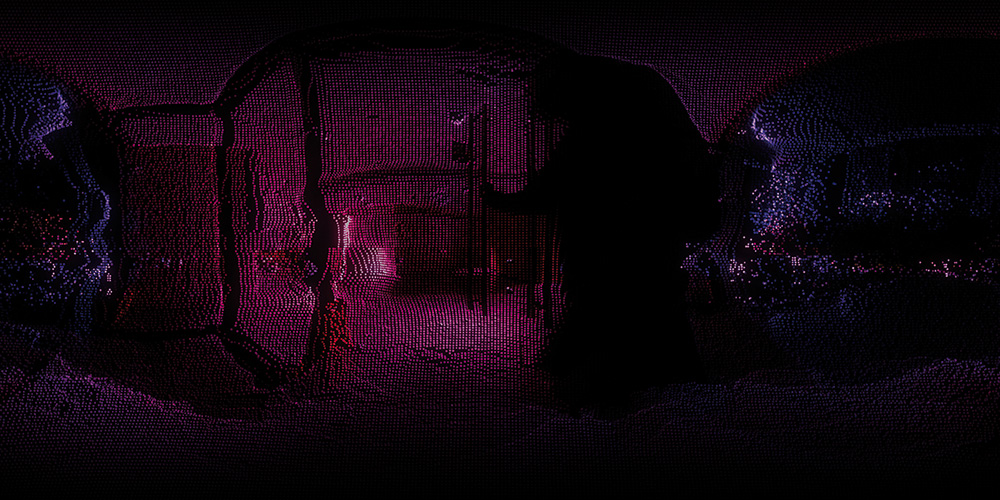
Set in the millenary Chinese city of Suzhou —now a super modern city— a fragile reconstruction of optical reality fails to fully materialise. Two mysterious characters help the “package” (POV) to follow a linear trajectory of space time, nevertheless there will be several instances to escape the linear construct. Sounds of machine guns, sonic monsters and war explosions do not interrupt the peaceful flow of an evening walk.
Luciano Zubillaga is an artist and scholar whose major works take the form of transdisciplinary research in the intersections of art, philosophy and technology with publicly engaged practice. He recently exhibited work at the Institute of Contemporary Art London ICA, Whitechapel Art Gallery and the Museum of Modern Art, Buenos Aires. His first feature film, Things to Come is based on a graphic music score and performed by German star Hanna Schygulla. In 2008, Luciano was the recipient of the London Artist Film and Video Awards (LAFVA) by Film London and Arts Council of England and his work is part of the British Artists? Film and Video Study Collection (BAFVS). He is co-founder of experimental moving image collectives Z.A.S.Z and TcoET. Luciano lives and works in Suzhou, China where he teaches experimental moving image.
Catalogue : 2016Cosas por Venir | Experimental film | 4k | color | 64:0 | Argentina, Germany | 2014
Luciano Zubillaga
Cosas por Venir
Experimental film | 4k | color | 64:0 | Argentina, Germany | 2014
Sluice Art Fair London 2015 http://sluice.info/2015 (from the catalogue) Luciano Zubillaga`s Things to Come 1968–2015 Sluice Art Fair 2015 have pleasure in presenting the UK premier of Luciano Zubillaga`s new feature film Things to Come staring the iconic German actress Hanna Schygulla. Things to Come is a powerful cinematic essay that poetically meditates on magic, youth, the politics of idealism and the poetry of Rainer Maria Rilke as narrated by Hanna Schygulla. Things to Come is set within Ex ESMA, the former Argentine military detention camp, notorious for the torture summary execution and disappearance of political dissidents during the 1970s, and serves within Things to Come as the place to memorialise not just those who have fallen in the fight against dictatorship, but also the possibility of revolutionaries yet to come and lovers yet to meet. Things to Come radically reinterprets the art of cinema by exploring the graphic score Ongilash, composed in 1968 by the directors father Luis Zubillaga, as a way of rethinking how the spatiality of our everyday notions of past, present and future, have been fundamentally de-centred as a result of 20 th century avant-garde art practice and the implications of quantum mechanics. Things to Come explores the potential for theatre beyond the linear, a fourth dimensional space were performers and places continually merge into one another. Things to Come is part of Alien Cartographies, a series of three films by Luciano Zubillaga that explore how ‘posthumanism` and ‘decolonial options` may come to effect how we see and experience narratives of spacetime within moving image and art practice. Things to Come 1968–2015 will also feature a live performance of the film’s music score -- Ongilash -- by the London College of Music Camerata and the English Chamber Orchestra Ensemble. Ongilash the music of Things to Come The Argentine composer Luis Zubillaga (1928–1995) composed the symphonic work, Ongilash in 1968. The title originates in the music of George Gurdjieff, the reading of a poem by Rainer Maria Rilke and the first word pronounced by the composers son. Ongilash avoids traditional music notation by embracing the experimental graphic style explored during the 1960`s that allow each performer the space to create, but within strict parameters. Ongilash takes temporal dynamics to the limit: a crescendo from the barely audible to the fortissimo maximo, non-traditional sound attacks, meticulous durations stipulated in seconds and the use of the voices of the performers. Ongilash received a posthumous premiere performance in 2012 by the Argentine National Symphony Orchestra in Buenos Aires and this performance will be the premiere of this work in the UK. Ongilash will be performed live by the London College of Music Camerata Orchestra in partnership with the English Chamber Orchestra Ensemble and will be performed as a loop with intervals.
Luciano Zubillaga works with sound, moving image, text and performance. His work combines transdisciplinary research in the margins of philosophy, science, and collaborative art practice. He recently exhibited work at The Museum of Modern Art, Buenos Aires, The Whitechapel Art Gallery, London, IMT Gallery, London, Image Movement, Berlin, Art-O-Rama, Marseille and at Ann Arbor Film Festival. In 2008, he received the London Artist Film and Video Awards (LAFVA) by the Arts Council and Film London.
Enea Zucchetti
Catalogue : 2020L'azzurro del cielo | Experimental film | 4k | color | 10:49 | Switzerland | 2019
Enea Zucchetti
L'azzurro del cielo
Experimental film | 4k | color | 10:49 | Switzerland | 2019
A silent city, mysteriously devoid of inhabitants, is crossed by a man who has come from a faraway country. The anonymised architecture that composes the urban landscape guides the person into an inaccessible space, the city cemetery, which will make him reflect on his own identity.
Enea Zucchetti was born in Lugano in 1996. Since childhood he has developed a strong interest in cinema and visual arts. In 2017 he moved to Milan where, influenced by the language of documentary and photography, he began to experiment with the image through audiovisual projects. Currently his artistic research touches on the themes of architecture, urban planning and contemporary landscape. His first short film, "L?azzurro del cielo", was selected at the 72nd Locarno Festival and other national and international film festivals.
Claudio Zulian
Catalogue : 2008A TRAVÉS DEL CARMEL | Experimental doc. | 0 | color | 40:0 | Italy, Spain | 2006
Claudio Zulian
A TRAVÉS DEL CARMEL
Experimental doc. | 0 | color | 40:0 | Italy, Spain | 2006
We stick out to almost two hours of the live of the neighborhood the 10th February 2006 afternoon to be precise, shot without interruption. The neighbors that have wished participate inviting us to their places, their houses, their garages, their daily occupations, explain us things of an any day in which we could guess the origin and the future of the city.
Claudio?s backround as a composer and his Doctorate in Aesthetics lead him directly towards the composition, creation and direction of a number of theatrical preformances (Varios efectos del Amor; Telediario; Macbeth, sempre; Fragor, Taxi, Fonia, Trenes de Marzo, Renacimiento.), all of these sharing one common characteristic: the application of new technologies in the service of the spoken word and expression. All of these performances were produced by Acteon and presentesd at national and international festivals. Work in the audiovisual area as well as the search for new forms of using the technical means available led Claudio to create audiovisual installations which were intended to be situated in art, cultural and conceptual centres (Centro Andaluz de Arte Contemporáneo (Sevilla), Centre de Cultura Contemporánea de Barcelona, Caixaforum (Barcelona) Centro Galego de Arte Contemporánea (santiago de Compostela), Espai d?Art Contemporàni de Castelló, Le cargo (Grenoble), La Casona (Panamá), Lille 2004). The materials produced for these projects have been developed hand-in-hand with documentary filmaking both for cinema and for television. In 2000 Claudio wrote his first complete film screeplay courtesy of a grant from the Ministry of Culture ICAA. In 2004 he directed and produced Beatriz/Barcelona and the documentary L?Avenir (The Future) and began to receive international awards (Leipzig, Mar de Plata (Chile), Tampere, Vannes...). In 2006 he directed the full film ?A través del Carmel? (The Shifting City) which was selected for the 2006 Sitges Film Festival where it was presented in the Catalan Focus section. In 2002 he published his first book ?Horas de la Ciudad? (City Hours, Ed. Calima) Claudio is also an Associate Professor attached to the Instituto Universitario del Audiovisual, at the Universitat Pompeu i Fabra de Barcelona. His theoretical activity includes lectures, courses, and publications in the course of which he has touched on such topics as the nature of art, the history of the performing arts and the means of communication in context.
Zulkhairi Zulkiflee
Theus Zwakhals
Catalogue : 2007Netherlands Media Art Institute / Montevideo | 0 | 0 | | 0:0 | Netherlands | 2007
Theus Zwakhals
Netherlands Media Art Institute / Montevideo
0 | 0 | | 0:0 | Netherlands | 2007
The Netherlands Media Art Institute (Het Nederlandse Instituut voor Mediakunst), Montevideo/Time Based Arts(Montevideo/TBA) is assigned with the mission of promoting the development and distribution of new arts, as well as the development and application of new technologies in the area of visual arts. In 1978, René Coelho, an elder of television, opened his Singel house, on an Amsterdam channel, to art. He transformed it into a gallery called Montevideo. Fed up with his television experience, he tried to "humanize technology with the help of artists". In 1983, the small Singel gallery, specialized in video art, became Montevideo/Time Based Arts, under the impetus of the Association of Video Artists. Today, Montevideo/TBA supports artistic creation in three different domains; presentation, preservation, and conservation, and provides services to artists and artistic institutions. In its own exhibition space on the Keizersgracht in Amsterdam, the Institute currently organizes long-term collective and personal exhibitions often in cooperation with other institutions. In parallel, Montevideo/TBA also organizes short-term exhibitions, symposiums, screenings, and performances and installations by artists and students. Since its foundation in 1978, the Institute has accumulated an extensive collection of video and multimedia works. It includes more than 1800 references and works by Dutch and international artists, continually increas. It is a collection almost entirely available for exhibitions and festivals that the Institute preserves from the infringements of time in a dedicated centre, created 1992. But the institute is also a training and research centre. A centre where artists can explore new medias and their applications to artistic practices. A centre where artists can meet and collaborate, and where they can benefit from various post-production tools and advice.
Along with Joke Ballintijn, Theurs Zwakhal distributes the Netherlands' Media Art Institute collection.