Catalogue > List by artist
Browse the entire list of Rencontre Internationales artists since 2004. Use the alphabetical filter to refine your search. update in progress
Yuliya Tsviatkova
Catalogue : 2026In the animal's skin | Experimental film | mov | color and b&w | 14:10 | Belarus, Poland | 2025
Yuliya Tsviatkova
In the animal's skin
Experimental film | mov | color and b&w | 14:10 | Belarus, Poland | 2025
I dreamed that I turned into an animal. I could cross the border freely, through the forest. I entered that land unnoticed — the land I miss and fear at the same time. I met my grandmother, whom I haven’t seen for several years. She didn’t recognize me, but we stood very close to each other, in silence. In the Animal’s Skin explores the Belarus-Poland border cutting through the ancient Bia?owie?a Forest — a protected sanctuary turned into a place of walls, detentions, and fear. The wall not only blocks refugees, but also divides animal habitats and disrupts ancient migration routes. In Bohoniki, a Tatar village near the border, the local tatar community buries refugees found in the forest with quiet dignity — a stark contrast to political neglect.The film reflects on borders, violence, and the fragile connections between humans, animals, and the forest that bears silent witness.
Yuliya Tsviatkova (b. 1993, Belarus) is a visual artist and filmmaker based in Germany. With a background in microbiology and fine arts, she approaches moving image as a space where scientific observation meets poetics. Her work explores ecology, memory, and political trauma through non-linear narratives, often centering on exile, environmental violence, and the entanglement of human and non-human lives.
Anya Tsyrlina, Sid Iandovka
Catalogue : 2025COLDER | Experimental doc. | 4k | color | 9:0 | Switzerland, Italy | 2024
Anya Tsyrlina, Sid Iandovka
COLDER
Experimental doc. | 4k | color | 9:0 | Switzerland, Italy | 2024
Filmed in Moscow twenty years after Akerman’s d’Est and over ten years ago, COLDER addresses the deep conundrums of memory, place, and time. A camera locks on to past glories, lingers, skittishly- its tonalities are sombre, nonmetaphoric, obscure and difficult. Iandovka and Tsyrlina’s cinematic approach to memory is closer, more intimate, and more unstable and problematic—more true—to notions of remembrance than other sorts of cinematic representations. An almost graspable (post)cinematic spatiality - a space both interior (subjective and singular) and exterior (collective, communal) overcomes us - complete with an apparitional trace that haunts memory and event alike. COLDER opens the unstable spaces of memory to confront the presence/non-presence of events and our complicated and difficult relations to our histories and our selves.
Sid Iandovka and Anya Tsyrlina (both born and bred in Novosibirsk, USSR) are visual artists often working together on film and video.
Catalogue : 2021All Other Things Equal | Experimental doc. | 35mm | color | 19:30 | Switzerland | 2020
Anya Tsyrlina
All Other Things Equal
Experimental doc. | 35mm | color | 19:30 | Switzerland | 2020
Taking cinematic recontextualisation to the extreme without changing the original context, this radical fairytale magically weaves together hundreds of subtly enigmatic frames and scenes from late Soviet “gender equality” propaganda - creating an elliptical, sensuous, quietly subversive world that provokes and evokes...
Anya Tsyrlina is a Russian-born visual artist. Her moving image work has been recently screened at film festivals and venues such as International Film Festival Rotterdam, Viennale, Berwick Art and Media Festival, Oberhausen, Winterthur, EMAF, MIEFF, Rencontres Internationales Paris/Berlin, Bildrausch, Haus der elektronischen Künste Basel, Anthology Film Archives, HKW.
Anya Tsyrlina
Catalogue : 2025COLDER | Experimental doc. | 4k | color | 9:0 | Switzerland, Italy | 2024
Anya Tsyrlina, Sid Iandovka
COLDER
Experimental doc. | 4k | color | 9:0 | Switzerland, Italy | 2024
Filmed in Moscow twenty years after Akerman’s d’Est and over ten years ago, COLDER addresses the deep conundrums of memory, place, and time. A camera locks on to past glories, lingers, skittishly- its tonalities are sombre, nonmetaphoric, obscure and difficult. Iandovka and Tsyrlina’s cinematic approach to memory is closer, more intimate, and more unstable and problematic—more true—to notions of remembrance than other sorts of cinematic representations. An almost graspable (post)cinematic spatiality - a space both interior (subjective and singular) and exterior (collective, communal) overcomes us - complete with an apparitional trace that haunts memory and event alike. COLDER opens the unstable spaces of memory to confront the presence/non-presence of events and our complicated and difficult relations to our histories and our selves.
Sid Iandovka and Anya Tsyrlina (both born and bred in Novosibirsk, USSR) are visual artists often working together on film and video.
Catalogue : 2021All Other Things Equal | Experimental doc. | 35mm | color | 19:30 | Switzerland | 2020
Anya Tsyrlina
All Other Things Equal
Experimental doc. | 35mm | color | 19:30 | Switzerland | 2020
Taking cinematic recontextualisation to the extreme without changing the original context, this radical fairytale magically weaves together hundreds of subtly enigmatic frames and scenes from late Soviet “gender equality” propaganda - creating an elliptical, sensuous, quietly subversive world that provokes and evokes...
Anya Tsyrlina is a Russian-born visual artist. Her moving image work has been recently screened at film festivals and venues such as International Film Festival Rotterdam, Viennale, Berwick Art and Media Festival, Oberhausen, Winterthur, EMAF, MIEFF, Rencontres Internationales Paris/Berlin, Bildrausch, Haus der elektronischen Künste Basel, Anthology Film Archives, HKW.
Anya Tsyrlina, Sid Iandovka
Catalogue : 2020Horizõn | Experimental film | 35mm | color | 7:0 | Switzerland | 2019
Anya Tsyrlina, Sid Iandovka
Horizõn
Experimental film | 35mm | color | 7:0 | Switzerland | 2019
"An unremarkable random 70’s newsreel from the artists’ hometown in the Soviet Siberia forms the substrate for a relentless exploration of the representational and narratological technics: without ever collapsing into a ‘story’ or abstraction, horizõn recants the relationship between analog and digital, surface and reference, sense and experience, past and present" (Thomas Zummer)
Hervé Ttrioreau
Catalogue : 2007DV | Video installation | 0 | color and b&w | 64:32 | France, Ukraine | 2006
Hervé Ttrioreau
DV
Video installation | 0 | color and b&w | 64:32 | France, Ukraine | 2006
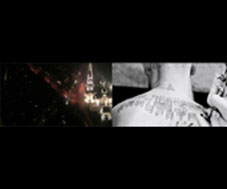
Ttrioreau completed a project which he had elaborated for many years. At the centre of this proposal is Dziga Vertov's film "L`homme à la caméra". But here as well, an oppositional system presides over Ttrioreau's work. In what measure? To sum it up, Dziga Vertov's film can be described as an attempt to report the activities of the citizens of the city of Odessa in the Ukraine; skimming the ground, the camera is the eye that gives an account of the modernization and industrialization of the city: "L`homme à la caméra" is somehow the point of contact between cinema, city, and citizenship. Furthermore, Dziga Vertov views the film editing as truth, truth more pure than the eye. Yet, Ttrioreau's proposal operates a strict shift from the basis material: in two films, Ttrioreau short-circuits Dziga Vertov's thematic. The first film is a long aerial panoramic doing concentric circles around present day Odessa. The city is placed at a distance with a panoptic vision that becomes manipulable as the architecture and the buildings transform into pure geometric forms. The second film revives one of the announcements published by Dziga Vertov in the Pravda before the release of his film. The contents of this announce - But where has the man with the camera gone? (in Cyrillic) - is tattooed on the artist's back, a process filmed in a long sequence shot. As the buildings become geometric in the first film, it is now the letters in the announcement that transform into volumes, in quasi-sketches of buildings during the tattoo sequence. Distance versus proximity, editing versus shot-sequence: Ttrioreau reverses the relations. Even so, the game is not free because, in the end, as the phrase tattooed on the artist's own flesh shows, an even stronger proximity is reached. What is at stake here is the inscription of the architecture, whose meaning on the body is forever shifting: everything happens as if the skin was taking the place of the eye, a skin understood as a membrane on which the architecture's polysemic sense vibrates. The two films are projected simultaneously, opposite each other in the same temporality. The point of contact between the two projections is not assured by a physical actor but by the immateriality of a sonorous ellipse that unites the two moments in one single and same architecture. Thus a single sonorous screen for the two films, a envelopping quadraphonic where we rediscover the secret virtues of editing. To the visual poles respond the sonorous elements used in the ellipse. The helicopter's rotor on the one hand, mechanic fury of a giant spinning top ("dziga"), and the small tattooing machine with its needles thrown across the chair in singular rotations ("vertov") on the other hand. 64 minutes and 32 seconds of concrete music mixed with the worry of being a structural element against the naive expressiveness of the illustration. The diffusion of sound creates the two films' space of encounter. Extracted from the two dimensions of their screens, they become the architectural space of a disconcerting place for the one who advances, the one who immerses in this multiple scales environment to apprehend with both eye and ear. The memory conjured up here is that of cinema-truth (kino-pravda) where the eye produces the reality as much as it records, questionning in the gyratory and noisy movements, the built spaces in which our bodies witness the restraints of living in them.
Hervé Ttrioreau's proposals come within a reflection linked to the nature of the urban system. His installations move around the very structure of the spaces built. They produce displacements that disturb our perception and display in a political way the normative character of the architecture. His work intervenes in the urban intervals; he establishes junctions in the interior/exterior relations. Taking into account the stakes linked to urbanism, and not looking only at representation, he necessarily creates "in situ" and principally outside the exhibition places. Ttrioreau focuses on the structures of the urban network. His interventions in the state of things in architecture are often very radical and contrary to the established ideas on the role and meaning of the construction domain. In his system of transformations, inside and outside represent only relative notions, as well as the relation between whole and detail, between real space and imaginary space. Where we build, we also demolish: the city and its buildings are variables submitted to market logic. The buildings lose their prestigious character of architectural creation to become just a good opportunity for investment of capital, and when it will stop bringing money, it will be invested elsewhere, leaving these constructions to deteriorate. Only the documents and the models resist these manipulations of the market. Ttrioreau's devices work on the urban zones, on their walls and their memory. Willing to include all the possibilities, he creates hybrid territories that are constituted by default or hegemony and put the body to test by depriving it of the usual partitions. These are transgressed or transgressive spaces that do not offer a definitive equilibrium because the limit becomes blurred to leave space to the interference. If the change always appears imminent, in reality it is already effective: without a real place of existence, he invests a whole territory, transforms it into a hybrid zone where the frontiers withdraw. Ttrioreau presents the production of abnormal structures, immanent to the field of urban normalization. The architecture is static only by way of the controlled identity that it assigns. In proposing an alternative perspective, the installation defines itself as a polemic process. It questions our trust in the structural solidity of buildings, in their immobility and their permanence, to describe them as intervals, passages, transitions...
Nicolas Tubery
Catalogue : 2025Mec 65 Smeraldo | Video | mov | color | 20:0 | France | 2024
Nicolas Tubery
Mec 65 Smeraldo
Video | mov | color | 20:0 | France | 2024
À l’automne 2023, j’ai été invité dans les Côtes-d’Armor, à Locquémeau, à porter mon regard sur le monde paysan le temps d’une résidence artistique. C’est ainsi que j’ai rencontré Audrey, qui a récemment repris la petite cidrerie de son père Gilbert. Le mois de novembre a été celui du ramassage et du pressage des pommes. Cette étape de quelques semaines est d’une importance capitale puisqu'il est question de récolter le jus des pommes pour l’année suivante. Durant cette période, il a été question pour moi d'investir ces différents espaces et temps de travail aux côtés d'Audrey et Aurélie qui est employée pour la saison. Cela m’a permis de comprendre, d’appréhender les éléments, ressentir les matières et leurs poids pour ensuite insérer le regard de ma caméra. Mec 65 Smeraldo est un film monté sur deux écrans différents, évoquant le travail à plusieurs mains, les différents points de vue et positionnements des corps ainsi que la question de la transmission et de l’apprentissage. Le geste et le vivant sont au centre du projet. Le scénario se construit naturellement au rythme des mains et des machines (Mec 65 Smeraldo est le nom de la pompe donnée par Gilbert), contournant les corps et les cuves pour assister à la transformation des fruits en jus.
ue: Nicolas Tubéry est né en 1982 à Carcassonne. Il a étudié à l’Ecole Supérieure d’Art et de Céramique de Tarbes puis à l’Ecole Nationale Supérieure des beaux arts de Paris où il obtient le DNSAP. Sculpteur et vidéaste, Nicolas Tubéry conjugue les deux pratiques dans ses œuvres. Ses recherches récentes se concentrent sur le monde paysan d'où il vient : ses phénomènes atemporels, comme une foire aux chevaux, mais aussi plus conjoncturels comme les exploitations abandonnées par manque de repreneur. Quel que soit le sujet, il concentre son attention sur les gestes du travail, et sa fascination pour les détails est contagieuse. Observant tout en sculpteur, il adapte le matériel agricole en machinerie cinématographique, puis utilise les mêmes matériaux pour créer les structures monumentales dans lesquelles il projette ses films. Il parvient, avec affection et justesse, à donner une place à la ruralité dans l'art contemporain. Marilou Thiébault
Catalogue : 2016Deman la tonda | Experimental doc. | hdv | color | 11:11 | France | 2015
Nicolas Tubery
Deman la tonda
Experimental doc. | hdv | color | 11:11 | France | 2015
Le dispositif de tournage se développe autour de la lourde planche de bois sur laquelle le paysan y déposera ses brebis une après l`autre pour les aléger de leur laine. L`oeil des caméras disposées sur la structure d`acier accompagne de l’intérieur le déroulement de l’événement, s’appuyant sur les mouvements et les points de vue des barrières. Révélant une chorégraphie de l’effort et du travail des bêtes, Deman La Tonda propose en même-temps d’envisager les mécanismes de la vidéo et du sujet filmé comme un tout, un seul et même acte
Filmer, se faire le témoin d’une action particulière, prélever des morceaux du réel et les assembler, donner une autre vision du spectacle en partant du quotidien. Les films de Nicolas Tubéry sont des témoignages subjectifs sans débuts ni fins, la mise en forme d’une manière de voir et d’être face aux choses. Dans sa volonté de rendre compte d’une situation, d’une atmosphère spécifique, il n’hésite pas à confronter les oppositions. Deux approches cinématographiques contradictoires sont utilisées selon les oeuvres, à savoir la mise en scène minutieuse et toutes les contraintes techniques qui y sont liées, et le cinéma direct caméra au poing qui autorise plus de spontanéité. Dans les deux cas, le hors-champ prend une place aussi importante que l’image elle-même, il en devient indissociable pour tenter de saisir les films dans leur globalité. Ce qui est donné à voir n’est qu’une partie de ce qui doit être vu, le spectateur ne peut pas se contenter de regarder passivement, il est conduit à plonger hors du cadre. Parfois le sujet est ailleurs, comme dans Rodeo où cheval et cavalier sont quasiment absents de l’image, occupée à saisir l’environnement, capter ce qui gravite autour de l’action principale. Ou bien à l’inverse c’est l’ailleurs qui est rendu invisible. Emballeuse nous fait suivre, par plans très rapprochés, chacun des mouvements d’une machine à compacter les bottes de paille. Chaque centimètre carré de l’emballeuse est disséqué par de lents mouvements de caméra. Toute perspective est bannie, pas un aperçu de l’espace alentours ne filtre. Cette décontextualisation quasi permanente isole les personnes ou les objets pour en faire des centres d’attention inhabituels. On retrouve souvent, comme dans Tsukiji, les techniques propres au cinéma comme le ralenti, l’utilisation d’une bande sonore, la mise en place d’une tension grandissante qui mène au climax. Mais à l’inverse du cinéma ces effets sont vains, ils ne servent pas la narration mais valent pour eux-mêmes, influant sur la manière d’observer l’action qui se joue à l’écran. Ils permettent seulement de déclencher une appréhension chez le spectateur, qui par habitude des images rentre dans l’intrigue et s’attend à un déroulement logique, à une suite qui finalement n’arrive jamais. Nicolas Tubéry cherche ainsi à retranscrire une vision personnelle, nous montrer une chose sous un angle bien précis pour nous contraindre à regarder de la même manière que lui, en nous invitant à voir au-delà. Aurélien Pelletier,2011 Formellement très différentes les trois oeuvres de Nicolas Tubéry s’articulent autour du même axe : l’attente d’un évènement spectaculaire à venir, qui n’arrive pas. Gros plans, tensions palpables Nicolas Tubéry nous propose une réflexion en trois actes sur la grammaire cinématographique et plus particulièrement sur le cadrage. L`artiste en appelle à nos capacités de narration, tout en jouant avec nos attentes. Il laisse le mystère entier… partiellement, puisque les titres font figure de prétérition. Supporter pose la question des frontières entre réalité et fiction en mettant en scène des gestes expressifs pouvant fonctionner comme emblème. Rodéo travaille l’omniprésence du hors-champ à partir de la bande son. Ces deux films pourraient être engloutis tout entier dans Screen qui les place hors-champ, pour ne s’intéresser qu’au phénomène de la projection. Leila Simon pour Jeune Création 2011 Dans son installation vidéo, Nicolas Tubéry met en regard trois moments suspendus, plongeant le spectateur dans une véritable frustration. Littéralement « en attentes », l’œuvre autant que celui qui la regardent abandonnent toute action, toute résolution. Car ce tryptique Rodeo, Screen et Supporter mêlant un cadre de projection vide, une foule en attente d’un évenement et ce qui ressemble à la fin d’un spectacle offre trois temporalités « déviantes » qui se répondent et viennent s’amplifier en jouant sur l’incidence d’un temps non pas seulement révolu mais bien condamné à ne plus jamais “passer”. Guillaume Benoit pour Slash Magazine,2011
Catalogue : 20141408-Jorn Festiu | Experimental doc. | hdv | | 5:39 | France | 2013
Nicolas Tubery
1408-Jorn Festiu
Experimental doc. | hdv | | 5:39 | France | 2013
L?événement n?est pas clairement défini. Le cadre plongeant défile lentement au dessus d?une longue table de jardin, laissant deviner la fin d?un barbecue un après-midi d?été. La caméra remonte et s?arrête sur un fanion plastique d?une guirlande annonçant la fête. De par la nature de l?image et notamment ses mouvements (panoramiques fluides, amplitude du cadre), le film semble être la reconstitution d?une petite fête de village. Il n?en est rien. 1408-Jorn Festiu documente le réel, usant d?un mode de captation directe faisant référence à celui utilisé dans l?événementiel. Une grue est introduite au centre d?une vrai fête privée dont les motifs sont habituellement saisis par les smartphones et autres outils portables. Ainsi nous reconnaissons la préparation d?un mechoui, la célébration d?un anniversaire, le coin bar, une piste de dance improvisée ou encore les fumigènes de fin de soirée. Le point de vue donne une certaine distance sur l?événement affectif et privé pour en proposer une analyse visuelle, un document, l?archive d?un jour de fête, un jour festif, jorn festiu.
Nicolas Tubery
Catalogue : 2019Maquignon | Experimental doc. | hdv | color | 17:54 | France | 2017
Nicolas Tubery
Maquignon
Experimental doc. | hdv | color | 17:54 | France | 2017
"Maquignon" se déroule à 80 kilomètres de Toulouse, aux Cammazes, une commune proche de la Montagne Noire. Là, il plonge dans l'atmosphère d'une foire aux chevaux en s'arrêtant sur les relations entre paysans et petits marchands de bestiaux "les maquignons", sur le langage des hommes et des animaux, parle? ou silencieux. Le film embrasse diffe?rents aspects de cet événement : aussi bien les négociations d'achat, la préparation et le soin des chevaux ou les moments de convivialité que les temps morts, quand la tension s'évapore.
Nicolas Tubéry est né en 1982 à Carcassonne. Il a étudié à l'Ecole Supérieure d'Art et de Céramique de Tarbes puis à l'Ecole Nationale Supérieure des beaux arts de Paris où il obtient le DNSAP. Sculpteur et vidéaste, Nicolas Tubéry conjugue les deux pratiques dans ses œuvres. Ses recherches récentes se concentrent sur le monde paysan d`où il vient : ses phénomènes atemporels, comme une foire aux chevaux, mais aussi plus conjoncturels comme les exploitations abandonnées par manque de repreneur. Quel que soit le sujet, il concentre son attention sur les gestes du travail, et sa fascination pour les détails est contagieuse. Observant tout en sculpteur, il adapte le matériel agricole en machinerie cinématographique, puis utilise les mêmes matériaux pour créer les structures monumentales dans lesquelles il projette ses films. Il parvient, avec affection et justesse, à donner une place à la ruralité dans l`art contemporain.
Nuno Tudela
Catalogue : 2006Atmosfera Reduzida | Experimental video | dv | color | 2:0 | Portugal | 2005

Nuno Tudela
Atmosfera Reduzida
Experimental video | dv | color | 2:0 | Portugal | 2005
Atmosfera Reduzida Video, specially made for the Cronica 021-2005 DVD: "Can I have 2 minutes of your time?". All Images by Nuno Tudela Audio by Pedro Tudela
Nuno Tudela is a video artist and filmmaker, based in Porto, Portugal
Catalogue : 2006guandong tuning tone | Experimental video | dv | color and b&w | 2:0 | Portugal | 2005
Nuno Tudela
guandong tuning tone
Experimental video | dv | color and b&w | 2:0 | Portugal | 2005
Guandong tuning tone Video, specially made for the Cronica 021-2005 DVD: "Can I have 2 minutes of your time?". All Images by Nuno Tudela Audio by Pedro Tudela
Nuno Tudela is a video artist and filmmaker based in Porto, Portugal.
Joëlle Tuerlinckx
Catalogue : 2022The Single Screen | Experimental doc. | hdv | color | 135:32 | Belgium, USA | 2021
Joëlle Tuerlinckx
The Single Screen
Experimental doc. | hdv | color | 135:32 | Belgium, USA | 2021
The key work, The Single Screen, provides an insight into the series of performances that Joëlle Tuerlinckx and her ‘That's it!’-team brought to the world-renowned museum Dia Beacon (US) between 2015 and 2018 invited by Jessica Morgan (Nathalie de Gunsberg Director, Dia Art Foundation). As such, the artist confronts, in a conceptual and humorous way, the experience of time and space at a museum with that of a cinema. On a projection screen, the space expands, overflows, unfolds its topics, double and multiple. A co-production by Escautville, Dia Art Foundation, the Flanders Audiovisual Fund (VAF) and S.M.A.K. (Ghent, BE).
Since the 1990s, and mainly after her participation in Documenta 11 in 2002, the artistic journey of the Belgian artist Joëlle Tuerlinckx (°1958) has gained momentum, with solo and group exhibitions in major institutions around the world (including the Museo Reina Sofia in Madrid in 2009, the Haus der Kunst in Munich in 2013, the Hermitage in Saint Petersburg in 2014 and her participation in Skulptur Projekte Münster in 2017). Today Tuerlinckx is among the most internationally renowned Belgian artists of her generation.
Rojda Tugrul
Catalogue : 2025In the World of Possibilities | Animation | hdv | color | 0:0 | Turkey | 2023
Rojda Tugrul
In the World of Possibilities
Animation | hdv | color | 0:0 | Turkey | 2023
The animated film depicts a female arctic fox’s epic journey from Norway to Canada in 2018. In her inter-continental journey, she covered 3507 km in seventy-six days, across vast and changing landscapes, transitioning from marine ecosystems to land-based prey. Her voyage highlights the understanding and adaptability of wildlife across diverse environments, providing exploration of survival and migration in the natural world.
Rojda Tu?rul is an interdisciplinary artist and researcher whose work focuses on identity in relation to space and time. Her early work examined the impact of war on ecological and cultural heritage within the socio-political framework of Kurdish territories, leading to her interest in analysing consciousness and cognition, both in human societies and the ecological world. Rojda examines sociopolitical landscapes as reflections of changes in cultural and ecological identity. Rojda holds an MSc in Veterinary Studies and a PhD in Practice from the Academy of Fine Arts Vienna.
Jan Pieter Tuinstra
Catalogue : 2006The Story of Boris | Experimental doc. | dv | color | 20:0 | Netherlands | 2005
Jan Pieter Tuinstra
The Story of Boris
Experimental doc. | dv | color | 20:0 | Netherlands | 2005
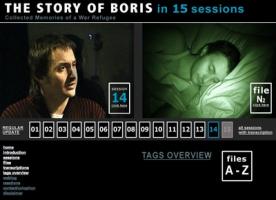
?The story of Boris? shows the sessions of a traumatised war refugee with his psychiatrist. Edited sequences of the latest session are uploaded weekly, along with other files on the history, treatment and life of the patient. This way a dossier is created to reconstruct Boris?s past. Boris is suffering from PTSD (post traumatic stress disorder) as a result of the war he fled from. Because of this disorder his story is fragmented. In order to recover, his memories and the reality of war have to be disclosed. What are the events that Boris went through? Which role did he play during the war? The audience is free to investigate Boris?s past and present by browsing the files at this website and take an independent view in search for the truth.
Jan Pieter Tuinstra - 1971 -, Graduated in 1995 at Art Academy St.Joost (Breda, The Netherlands) . His final examination film `Voyage until the end of a journey` was awarded with the Cinema Citroën Award as best Dutch Academy Film. Ever since he has worked as a freelance director and scriptwriter. Tuinstra`s documentary approach is characterised by profoundly composed images that together with an attractive use of voice over, result in strongly layered films. His keen eye for human relations and behaviour guarantees honest pictorial narratives.
Richard Tuohy
Catalogue : 2025The Land at Night | Experimental film | 16mm | color | 13:50 | Australia | 2024
Richard Tuohy
The Land at Night
Experimental film | 16mm | color | 13:50 | Australia | 2024
I used to find the dusk a very unsettling time, as though the approaching night was something to be feared. It was as if, once night fell you could not flee, and had to face unspecified consequences. Maybe the land remembers and the night will reveal what we might have done...
Biography Richard Tuohy (b. 1969, Melbourne, Aus.) began making works on super 8 in the late nineteen eighties. After a brief hiatus from cinema (including formal study in philosophy for seven years) he returned to film-making in 2004. Initially working exclusively in Super 8, the next five years saw an extremely productive period with dozens of experiments and works finished in the small gauge. In 2006 he, along with his partner Dianna Barrie, launched nanolab, a super 8 film processing laboratory based at their home in Daylesford Victoria. The establishment of this lab afforded the opportunity to set up darkrooms and install 16mm film processing and most importantly printing and sound recording equipment. Since 2009 he has been an active and vocal member of the international artist run film lab scene. In 2011 Richard and Dianna started the Artist Film Workshop which in 2012 became a membership based artist-run film lab, itself also part of the international labs network. AFW has become the center of experimental film practice on film in Australia, being the focus for regular experimental film screenings, touring artists programs, workshops and supporting numerous artists in their personal film practice.
Catalogue : 2019China not China | Experimental film | 16mm | color | 14:0 | Australia | 2018
Richard Tuohy
China not China
Experimental film | 16mm | color | 14:0 | Australia | 2018
Hong Kong marked 20 years since its hand over; half way through the planned 40 year `one country, two systems` transition. Taiwan, once imperial China, once Formosa, now ROC on the edge of the PRC. Multiple exposures of street scenes distort space and place creating a fluid sense of impermanence and transition, of two states somewhere between China and not China.
Richard Tuohy (b. 1969, Melbourne, Aus.) began making works on super 8 in the late nineteen eighties. Since 2009 he has been an active and vocal member of the international artist run film lab scene. In 2011 Richard and Dianna started the Artist Film Workshop which in 2012 became a membership based artist-run film lab, itself also part of the international labs network. An advocate for the possibilities of hand made cinema, Tuohy has devoted much time and effort in sharing his knowledge through workshops and classes both in his native Australia and internationally. His films and film based performances have screened at venues including the Melbourne IFF, EMAF (Osnabruck), Rotterdam IFF, New York FF, Ann Arbor and Media City and he has repeatedly toured Europe, North America and Asia presenting solo programs of his work and conducting experimental film-making workshops.
Catalogue : 2018Pancoran | Experimental film | 16mm | black and white | 9:0 | Australia | 2017
Richard Tuohy
Pancoran
Experimental film | 16mm | black and white | 9:0 | Australia | 2017
Jakarta traffic moves with the harmonious chaos of complex self organising entities everywhere. Through contact printer matteing techniques this mass transport becomes denser and denser until only the fluid futility of motion/motionlessness remains. Jakarta traffic stands as proof of the paradox of motion.
Richard Tuohy (b. 1969, Melbourne, Aus.) began making works on super 8 in the late nineteen eighties. In 2006 he, along with his partner Dianna Barrie, launched nanolab, a super 8 film processing laboratory in Australia. The establishment of this lab afforded the opportunity to set up darkrooms and install 16mm film processing and most importantly printing and sound recording equipment. Since 2009 he has been an active and vocal member of the international artist run film lab scene. Tuohy`s own works are firmly in the `hand-made` film tradition. An advocate for the possibilities of hand made cinema, Tuohy has devoted much time and effort in sharing his knowledge through workshops and classes both in his native Australia and internationally. His films and film based performances have screened at venues including the Melbourne IFF, EMAF (Osnabruck), Rotterdam IFF, New York FF, Ann Arbor and Media City and he has repeatedly toured Europe, North America and Asia presenting solo programs of his work and conducting experimental film-making workshops. He is the instigator of the AFW magazine Film Is and, along with Dianna Barrie and Sue K, was also a co-founder of the AIEFF experimental film festival in Melbourne.
Arthur Tuoto
Catalogue : 20154xELEPHANT | Video | hdv | color | 3:0 | Brazil | 2014
Arthur Tuoto
4xELEPHANT
Video | hdv | color | 3:0 | Brazil | 2014
By placing side by side four sequences from the movie Elephant (2003), by Gus Van Sant, the work explores the simultaneous actions in the film, revealing elliptical nuances in its filmic dispositif.
Arthur Tuoto works between visual art and cinema, producing a variety of works from video installations to experimental short and feature films. From appropriations to others audiovisual recontextualizations, the filmmaker`s body of work seeks to explore, by resignifying pre-existing materials, new possibilities in the audiovisual language, as well as to question the concept of intellectual property and authorship.
Mila Turajlic
Christin Turner
Catalogue : 2018What Happens to the Mountain | Experimental fiction | hdcam | color | 12:9 | USA | 2016
Christin Turner
What Happens to the Mountain
Experimental fiction | hdcam | color | 12:9 | USA | 2016
“ What Happens to the Mountain ” draws upon literary sources, late night radio, and ancient legends to conjure a psycho-geographic experience in a sacred landscape. A long-distance driver, a drifter, journeys from a tenuous reality into a vision of the afterlife, called forth by the spirit of the mountain.
Christin Turner (1985, USA) is a filmmaker and artist based in Boulder, Colorado by way of Southern California. Her films navigate the psychological terrains of landscape, material, and image; they investigate the possibilities of cinema as a site for transcendence.
Raewyn Turner, Colin BEARDON
Catalogue : 2007World Tree | Création numérique | 0 | color | 4:30 | New Zealand | 2005
Raewyn Turner, Colin BEARDON
World Tree
Création numérique | 0 | color | 4:30 | New Zealand | 2005
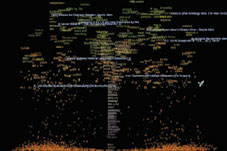
"World Tree" is about the contemporary notion of 'information'. We hang onto written texts in the belief that we can extract all their meaning. We keep masses of written and printed material that we will never read, giving us a false sense of security. "World Tree" plays with this phenomenon, presenting glimpses of texts which are puzzling but which also disintegrate before our eyes. The fragments drift like poorly-remembered facts or stories. Knowledge is promised, but always eludes us. The juxtaposition of the sole-authored text (forming the trunk and canopy of the tree) with text from the wider universe (forming the flowers and petals) is designed to highlight tensions between our subjective sensations and a universe accessed through digital communication (gathered from various websites, eg. amateur astronomy, tissue culture and cell technologies). "World Tree" ushers in the visual tongue of 'information', knitting it into a synthetic experience of the physical world. We understand the world systematically, that is, with our whole body, not just our eyes or ears or fingers or nose or tongue. The metaphor is the Tree which is a whole biological system through which the world is known. "World Tree" is a standalone application written in REALBasic.
Colin Beardon's work spans the creative arts and computer sciences, and concentrates on the interaction of technical expertise and the creative process. He developed the software 'Visual Assistant' for prototyping 3D environments, and has built innovative multimedia systems for museums. He is now interested in developing styles of programming that resemble sketching. He is a founding member of 'Computers in Art & Design Education' and is co-editor of the journal 'Digital Creativity'. After working in Australia, the UK, and Sweden, he returned to New Zealand in 2003 and currently holds a visiting professorship in the Department of Computer Science at Waikato University. Raewyn Turner's work is concerned with cross-sensory perception and technologies that are shaping an extrasensory perception of the world. Her works include video, colour, smell and sound for screen, installation, and live performance, including concerts for the hearing impaired with a symphony orchestra. Her works have been shown in numerous national and international exhibitions, including NZ Film Festival, Te Papa; Los Angeles MOCA; Canada; Germany; and Australia. She has an extensive background working with coloured light with contemporary performance on international tours in Britain, USA, Canada, Australia, and Europe. Her work is published in 'Art, Culture and Biotechnology', EAF, Australia, and 'Performance Research'(On Smell), UK.
Dick Turner
Catalogue : 2019Totem & Taboo | Multimedia performance | mp4 | color | 21:0 | USA, France | 2017
Dick Turner
Totem & Taboo
Multimedia performance | mp4 | color | 21:0 | USA, France | 2017
Totem and Taboo is an opera/recitative for Video projection, Grand Synthesized Orchestra in Playback, Dancer and Heldentenor. The work is based upon Sigmund Freud's classic text "Totem and Taboo". This book is presented by Freud as an inquiry into incest taboos found in primitive cultures. In fact Freud used the book to give a psychoanalytic hypothesis of the origins of religion. At the end of his book, Freud writes a short but highly colorful chapter describing what he calls "the primal scene" which led to the foundations of all religions: repressed sexual desire, murder and cannibalism. My opera takes Freud's hypothesis and plants it into a real world situation. I call this a "mise-en-chair" meaning literally "a putting into flesh" that is, the incarnation of the idea. I have created a synthesized orchestral version of the score which accompanies a projected video. There is a scene for a dancer which can either be performed live or in projection. The work is sung by a baritone-tenor, the so-called Heldentenor imagined by Richard Wagner. The composer performs this part. The practical needs for a performance are basic: A projector, a sound system and a screen (or simply a white wall) and a microphone. It can be performed on a stage or in a normal room. There are a few simple accessories, flowers, electric candles and a piece of astro-turf.
I was born in Baltimore, Maryland and now live in Paris, France. My work is centered upon the expression of ideas and human freedom. I have composed music since 1977. I have composed around 70 pieces for a large number of ensembles, from solo piano and cello to an opera for 45 individual players, also I have done electronic music performances, improvisation. I have given concerts continually since the early 1980's. I can give you endless examples of recordings. I have painted since 1978. I have hundreds of paintings and have given many expos and been in salons like Montrouge. I am represented by the Gallery Au Fil du Canal in Paris. I'd be happy to send examples of my work. I began making films in 1979. Two of my films have come out in France, in 2012 and 2016.
Bianca Turner
Catalogue : 2025Eva | Performance | mp4 | color | 10:47 | Brazil | 2022
Bianca Turner
Eva
Performance | mp4 | color | 10:47 | Brazil | 2022
"Eva" is a sequence shot from an audiovisual performative video art piece that simulates an acting test, where a naked female body is positioned within the iconic biblical imagery of Eve and Adam. The performance is directed by a male voice behind the camera, guiding the attempt to embody and conform to these archetypal representations.
Bianca Turner works across a diverse array of mediums, including video, video art, video performances, video installations, expanded cinema, audiovisual actions, urban interventions, and video mapping. Her practice critically engages with the concept of the archive as an imperialist imposition, while also exploring how time and space can be expanded through audiovisual technologies and video projection, particularly in relation to the human body. Turner holds a BA in Design and Performance Practice from Central Saint Martins (2011, London) and a Master's in Scenography from the Royal Central School of Speech and Drama (2013, London). Her career has seen her participate in prominent exhibitions, such as BIENALSUR and the 2023 exhibition Ese Frágil Equilibrio in Buenos Aires, Argentina, as well as Mulheres em Luta! Archives of Political Memory at the Memorial of Resistance in São Paulo, Brazil (2023). Turner also collaborated with Neo Muyanga and the Collective Legítima Defesa on the opening performance of the 34th São Paulo Biennial (2020). Other notable appearances include the Verbo Festival of Performance Art (2018, 2022, Vermelho Gallery), the 40th Arte Pará and the 1st Salon of Art of Goiás (2022, MAC), the 46th SARP (MARP) in 2021, and the SSA Mapping Festival (2018, 2023). She also participated in the Reencontre Audiovisualle #7 in Lille (2024), with Honorable Mention from the Jury. Her work, which she defines as expanded video, utilizes video mapping, video performances, and video art to challenge and expand the notions of time-space, while reclaiming narratives and interrogating the role of archives in shaping history.
Joe Turpin
Catalogue : 2020You/Gen/Ethics | Video | hdv | color | 4:0 | South Africa | 2018
Joe Turpin
You/Gen/Ethics
Video | hdv | color | 4:0 | South Africa | 2018
(2018) Video work disseminating the ethics of racial representation in the digital and gaming world. My employment/work as an editor for African region in a sports video game, and as an artist learning about agency and representation, led me to create this work. Colours and hair of a set list of ‘options’ assigned to African and Asian facial features in a player creation database are made arbitrary as a critique of having said select ‘options’ in the first place. The tampering with features occurs with an audio that captures the exhalations and reactions of a real life player to this game as it is played. This occurs in English and then French — both the two largest colonial powers in African history. The title is a play on the word ‘Eugenics’, which was a European developed pseudo-science that had racially demarcating visuals and biological beliefs.
Joe Turpin is a South African visual artist. Born in Johannesburg in 1995, Turpin obtained his BFA Fine Arts Honours degree from the University of Witwatersrand in 2018. Turpin's work is informed by history, narrative and symbolism, where the idea demands the medium. Turpin has shown work internationally in exhibitions and publications, and has participated in residency programs. He lives and works in Johannesburg.
Sybilla Marie Tuxen
Catalogue : 2023Silent Sun of Russia | Documentary | dcp | color | 71:0 | Denmark | 2023
Sybilla Marie Tuxen
Silent Sun of Russia
Documentary | dcp | color | 71:0 | Denmark | 2023
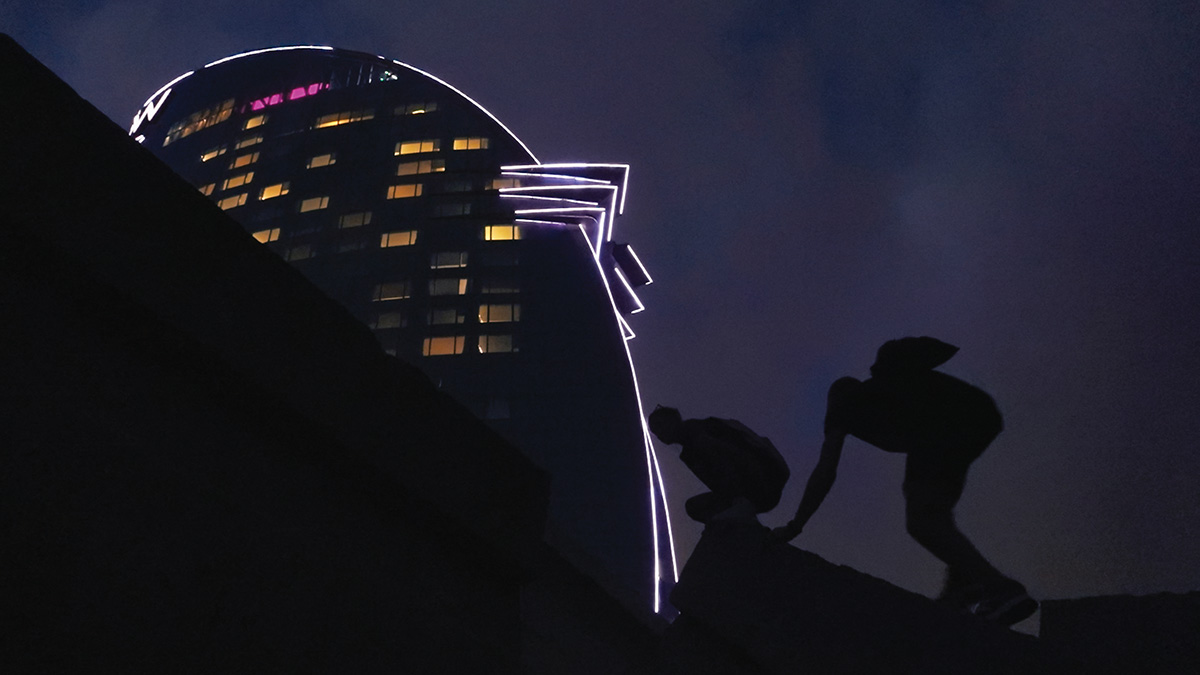
Silent Sun of Russia portrays a generation of young Russians between 2018 and 2022. The film follows three young women, Alika, Alyona, and Katya. They are rebels and anarchists and part of a global youth who dream of living a modern life in freedom. A pervasive sense of anxiety and restlessness about the future haunts the lives of the young women. After Russia's invasion in Ukraine, they find themselves in a new reality that requires difficult choices. In their quest for love, friendship, and the dream of escaping Putin's Russia, they live in uncertainty, where longing is replaced by difficult emotions and attempts to repress reality. The film provides an intimate and poetic view of the current living conditions and the urgent decisions faced today by young Russians who cannot see a future in their native country.
Sybilla Tuxen (1990) graduated as a photographer from Fatamorgana - Denmark's photographic school of visual arts, in 2011 and as a documentary filmmaker from The Danish Film School in 2017. Since 2011, when Sybilla lived and studied Russian in St Petersburg, she has worked on films in former Soviet countries. Sybilla works with polyphonic narratives. Her visual works explore the emotional currents of poetry with a unique eye for human destinies and the worlds of our mythological and literary subconscious.
Karel Tuytschaever
Catalogue : 2023Easy Tiger | Fiction | 0 | color | 60:0 | Belgium, Netherlands | 2022
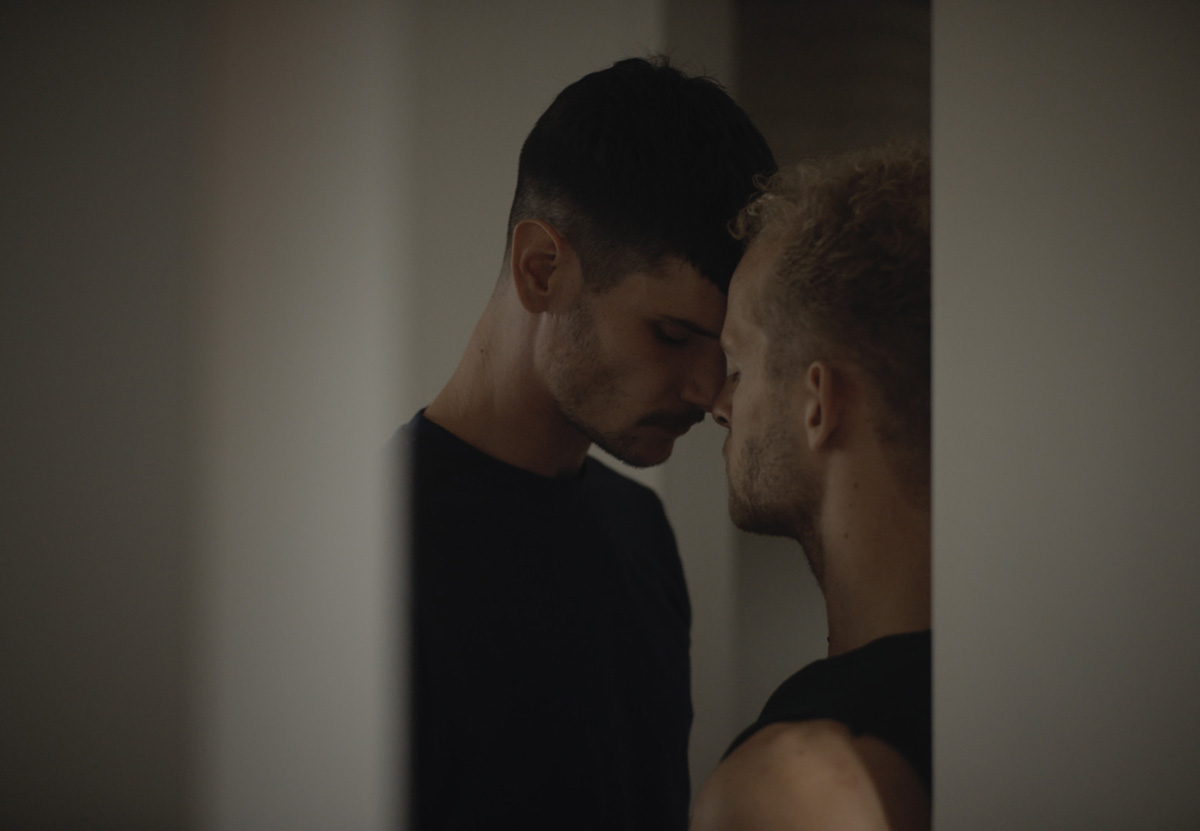
Karel Tuytschaever
Easy Tiger
Fiction | 0 | color | 60:0 | Belgium, Netherlands | 2022
Un moment inattendu lors d’une séance avec un patient confronte un psychologue à son propre monde intérieur. Aliéné par l’isolement de sa vie citadine apparemment parfaite, le psychologue se heurte à une incapacité à comprendre et embrasser sa propre nature humaine. Son désir irrépressible pour son client l’amènera à découvrir qui il est vraiment.