Catalogue > List by artist
Browse the entire list of Rencontre Internationales artists since 2004. Use the alphabetical filter to refine your search. update in progress
Gigi Scaria
Catalogue : 2007Picture Perfect | Experimental doc. | dv | color | 8:28 | India | 2006
Gigi Scaria
Picture Perfect
Experimental doc. | dv | color | 8:28 | India | 2006
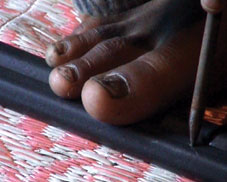
The city of Delhi, like any other metropolis in the world, has a parallel economic system other than the state driven or corporate initiated economies. This operates among the millions of rural migrants who flow into the city in order to survive every day of their lives. Their upbringing and way of life are different than that of the urban middle class. They are not trained in any managerial studies schools and not even educated enough to understand the sophisticated tools of global, as well as local, economy. But they do possess a "native intelligence" and a burning stomach. The ideas click for them when they walk around aimlessly, sleeping on the pavements or under the hot sun. Then the action follows, such as hiring a cycle rickshaw on a daily rental scheme, preparing snacks on a portable stand then selling them on the streets, always on the move, sell flowers, handkerchiefs, magazines, pens, toys balloons, sunshades, guide maps and many other suddenly invented local products at red traffic lights. Their inventions incorporate religious festivals, changes of seasons, and patriotic events in the country. Muhammad Kurshid Alam, a thirteen year old boy from a small village called Ajim Nagar in Bihar (state), migrated to Delhi to support his family back in the village. Gigi Scaria met him in front of the Jama Masjid Mosque in the old city of Delhi in the first week of April when the boy was trying to persuade him to buy some of his posters. Scaria was curious to see the posters as well as to observe the "local aesthetics" and technology put together in each of his frames. Apart from the religious faith, he was totally unaware of the geographical locations of the places in his poster collection. He also changes his collection and location according to the festival season. The "aesthetics" of his minute labour create a world parallel with the sophisticated multinational high tech world. Among thousands of differences, the striking difference between these two worlds is that the latter is intentional and the former accidental.
Born in Kerala, India, Gigi Scaria received his BFA from the College of Fine Arts Thiruvananthapuram, in 1995, and his MFA from Jamia Milia University, Delhi, in 1998. His scholarships/awards, among many, include: 2005, Sanskriti Award in Visual Art; 2002, Inlaks scholarship; 1995/97, Ministry of Human Resources and Development, Scholarship for Visual Arts. He had completed residencies at: 2005, CCA7 (Caribbean Contemporary Arts), Trinidad and Tobago, West Indies; 2004, Khoj at Khoj studios, Kirkee Village, New Delhi; and 2002, Unidee at Cittadellarte, Foundation Pistoletto, Biella, Italy. His many workshops include: 2006, "Dilli Dur Ast" a lens based workshop in Delhi; 2005, Sandarbh, an artist workshop and residency program; 2002, GASTHOF 2002, Frankfurt, Germany; and 2001, Khoj international artists' workshop at Modinagar, Near Merrut. He has also had many solo shows, of which: 2005, "Where are the Amerindians?" At Inter America Space at CCA7, Trinid; 2001, Exhibition of recent works at Art Inc., Shaprjhat, New Delhi; 1998 Exhibition of paintings and sculptures at The Great Art Gallery, New Delhi. Selected participations include: 2006, "Impossible India" at Frankfurt Kunstverein; "Ghost in the machine and other stories" (video, interactive media, and sound) at Apeejay Media Gallery, Delhi; "REAL 2006", Visual Art gallery, Habitat Center, New Delhi; "Dilli Dur Ast" a lens based workshop in the walled city of Delhi; Art in Cinema at Habitat center, New Delhi; 2005, Double?Enders at Jehangir Art Gallery, Mumbai; "Are we like this only?" in Rabindra Bhavan, New Delhi, New Delhi, Vadehra Art Gallery; 2003, "Crossing Generations Diverge" at National Gallery of Modern Art, Mumbai; "Indians + Cowboys" at Gallery 4A, Asian-Australia Arts Center, Sydney, Australia; "Arting Jerusalem", art project in Jerusalem, Israel; 2002, 'Photographica', Cittadellarte, Biella, Italy; Circo Fragile, a storytelling event at Pavia University, Italy; and Unidee in Progress at Pistoletto Foundation, Biella, Italy.
Eran Schaerf, Meyer Eva
Catalogue : 2021Dieses Spiel geht nur zu sechst | Experimental doc. | mov | color | 43:14 | Germany | 2020
Eran Schaerf, Meyer Eva
Dieses Spiel geht nur zu sechst
Experimental doc. | mov | color | 43:14 | Germany | 2020
It depends on who you are that an entrance is closed or open to you. If you enact your coincidence as incidence you can outsmart this mechanism. The cast of the dice in a card game is a good example -- the ritual of including or excluding cards in order to make the number of cards dealt into a complete group or not. Another is the game played by Kafka's “Fellowship” (“Gemeinschaft”), which counts five people and does not know how to exclude a rejected sixth person, who keeps coming back. Does he embody that first coincidence of every biography -- being born somewhere? Does he speak in an accent that since Biblical times can prevent access? Can assimilation in language, clothes, gestures help? These questions come up for a foreign guest staying in a New York apartment building when the doorman doesn't simply repeat his rehearsed „how are you?“ and exchange it as a password. The coincidence of this encounter transforms the lobby entrance into the staging area for stories that roam through persons, places, times, and mix their affiliations anew.
Grégoire Schaller
Deborah Schamoni, Deborah Schamoni, Judith Hopf
Gerald Schauder
Catalogue : 2018Skulptur21 | Multimedia installation | hdv | color | 3:30 | Germany | 2015
Gerald Schauder
Skulptur21
Multimedia installation | hdv | color | 3:30 | Germany | 2015
Skulptur21 is an 8 meter long sculpture made of wood, wire, carbon fiber and acrylic paint. It consists of individual hollow elements that are loosely assembled together, partly elevated on wires, on a specially constructed table. The different elements are painted white, light and dark grey, and black. The sculpture is a structural visualisation of Hans Richter‘s experimental film Rhythmus 21. The film, created around 1921, is considered a milestone in film history and is one of the first abstract films ever made. It consists of varying geometric elements that move within the pictorial frame of the screen and change in shape. The elements also change in size, giving the impression of movement towards and away from the viewer, thereby creating a feeling of depth. Skulptur21 shows this movement in space. In the sculpture, every element of the film is shown as a three- dimensional object. Size, position and colour of the elements correspond to those shown in the film. The viewer can physically retrace the elements of the lm by walking along the sculpture. One second of the 3-minute lm corresponds to about 5 cm of the 8 meter long sculpture. The lm can be seen in its entirety at one glance. The sculpture reveals relationships between the elements over the entire duration of the film. However, the translation of the film Rhythmus 21 into sculpture goes beyond a mere reinterpretation of the lm. Skulptur21 creates a connection between the time present in film and the space of architecture. In his paintings, Hans Richter was concerned with studying movement and rhythm. Taking as a basis musical theories, he started developing horizontal rolls depicting geometric elements that gradually change in shape and thus suggest movement. Skulptur21 can likewise be read as a musical score, a linear experimental notation that visualises dynamic proportions and progressions. In addition to o ering a new way of looking at the film Rhythmus 21, the aim of Skulptur21 is to enable the viewer to make their own personal discoveries and experiences, no matter what background or field they come from.
Gerald Schauder a.k.a. KABELTON, born and raised in Munich, socialized in Graz, now living in Cologne, produces media art, electronic music and electroacoustic compositions. He is working as a sound engineer for film and music
Sandra Schäfer
Catalogue : 2022Westerwald: Eine Heimsuchung | Experimental doc. | 4k | color | 43:40 | Germany | 2021
Sandra SchÄfer
Westerwald: Eine Heimsuchung
Experimental doc. | 4k | color | 43:40 | Germany | 2021
In her video installation “Westerwald: A Visitation”, the Berlin artist Sandra Schäfer - based on August Sander's series of Westerwald farmers - deals with the transformation of the rural region in which the artist herself grew up. Sandra Schäfer juxtaposes August Sander's perspective with her own and contemporary view. For it is also about how a region, its landscape and agricultural use have changed over the course of time. In her artistic work, Schäfer is interested in the various contemporary witnesses and their entanglements: How do the relatives/portrait subjects speak about the (artistic/documentary) pictures by August Sander? What does it mean to hear the dialect that always also marks a class difference? What knowledge is there about the photographer and his approach? How does this differ from that of photo curators in the museum context? And what does it mean for the artist, who was born and raised there, to return to create this artistic work?
The artist Sandra Schäfer works with film and video installations. Therein she deals with processes of unfolding and rereading of documents, images, spatial narratives and performative gestures. Often her works are based on longer researches, in which she is concerned with the margins, gaps and discontinuities of our perception of history, political struggles, urban and geopolitical spaces. Her works were exhibited at 66th and 67th Berlinale (Forum Expanded), Berlin; Camera Austria, Graz; Museum für Gegenwartskunst, Siegen; Schirn Kunsthalle Frankfurt; mumok, Vienna; Museum Ludwig, Cologne; Depo, Istanbul; La Virreina, Barcelona. Schäfer also is professor at the Academy of Fine Arts Munich and an associated member of the feminist film distributor Cinenova in London. She edited the books: Moments of Rupture: Space, Militancy & Film, Spector Books, Leipzig (2020), stagings. Kabul, Film & Production of Representation, b_books, Berlin (2009) and Kabul/ Teheran 1979ff. Filmlandschaften, Städte unter Stress und Migration, b_books, Berlin (2006, together with Jochen Becker and Madeleine Bernstorff).
Sandra Schäfer
Catalogue : 2011stagings | Video | dv | color | 22:0 | Germany | 2008
Sandra SchÄfer
stagings
Video | dv | color | 22:0 | Germany | 2008
The film Passing the Rainbow, shot in Kabul by Sandra Schäfer and Elfe Brandenburger in 2007, serves as the starting point for the installation stagings. The film presents female Afghan filmmakers and their strategies for subverting the gender norms of Afghan society. The practice of filmmaking in Afghanistan and the activities of everyday life are the film?s central concerns. At issue are changing roles and the enabling of freedom of action. Passing the Rainbow dramatizes scenes from its protagonists? daily lives, making visible the interactions and contradictions between constructed images and real living conditions. The installation stagings is devided in two parts: In the two-channel video installation to act in history, Sandra Schäfer uses images from the photo archives of Nancy Hatch Duprée and the Williams Afghan Media Project. Schäfer has combined this rarely seen material with footage of her own, shot during multiple research trips between 2002 and 2008. The installation reflects the creative process behind Passing the Rainbow as well as its reception in Kabul and Berlin, and it uses historical images to trace the representation of women in Afghanistan. A mobile cinema installation will show Passing the Rainbow as well as two films made in 2007 by Afghan women: 25 Darsad (25 Percent), by Diana Saqeb, and Nejat (The Rescue) by Saba Sahar. With the short film Saya (Shadow) by Nacir Alqas an historical arc is drawn to the short and changeful history of Afghan cinema.
The artist, writer and curator of film programs is located in Berlin. In her artistic work, Sandra Schäfer has previously dealt with themes of representation of gender, urbanity and (post-) colonialism. Schäfer has made repeated visits to Kabul and Tehran since 2002. She has been involved in different collaborative projects with filmmakers, activists and theoreticians. Together with the Berlin based filmmaker Elfe Brandenburger and in cooperation with actresses, filmmakers and activists from Kabul she made the film Passing the Rainbow. She is co-curator of the film festival Kabul/Teheran 1979ff: Filmlandschaften, Städte unter Stress und Migration that took place 2003 at the Volksbühne Berlin. She is co-editor of a book with the same title, published in 2006 by b_books, Berlin. 2007/08 she co-curated the film festival SPLICE IN and a lecture program on gender and society in Afghanistan, its neighboring countries and Europe. In 2009 her book stagings. Kabul, Film & Production of Representation got published in the series metroZones/media at b_books, Berlin. www.mazefilm.de
Catalogue : 2007The making of a demonstration | Documentary | dv | color | 10:0 | Germany, Afghanistan | 2004
Sandra SchÄfer
The making of a demonstration
Documentary | dv | color | 10:0 | Germany, Afghanistan | 2004
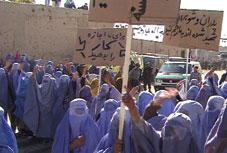
At the heart of this movie is the reconstitution of a women's demonstration after the Taliban bans them from working. These sequences were born during the shooting of the movie "Osama", in November 2002, in the streets of Kabul. One thousand women came to act out the scene. Most of them did so in order to earn money. By asking for work they hoped to improve their situation in life.
Sandra Schäfer studied arts, politics and sociology in Kessel, London, and Karlsruhe. She is a Berlin based director and movie curator. In November 2002 she visited Kabul and Tehran to perform research for her documentary film, "Passing the Rainbow", and the Film Festival "Kabul/Tehran: 1979ff". She curated a series of movies for Afghanistan and Tehran in Belfast, Lüneburg, Karlsruhe, and Berlin. She is currently working in collaboration with Elfe Brandenburger on the documentary movie "Passing the Rainbow". Schäfer is the co-editor of the book "Kabul/Tehran 1979ff: Filmlandschaften, Städte unter Stress und Migration", published and released in 2006 in Berlin by b_books-Verlag. Films/videos/video installations: "Traversée de la Mangroves" (2006), "The Making of a Demonstration" (2004), "A country?s new dawn" (2001), "Die unsichtbare Dienstleistung" (2000), "Kontaktfreudig, offen und gewandt im Umgang" (1999), "England-Deutschland" (1997), "Shift" (1996).
Sandra Schäfer
Catalogue : 2025Into the Magnetic Fields | Experimental doc. | 4K | color | 14:10 | Germany | 2024
Sandra Schäfer
Into the Magnetic Fields
Experimental doc. | 4K | color | 14:10 | Germany | 2024
What waves and signals run through the hybrid landscapes between agricultural use and fallow land? Who passes through them? Working, traversing, and intervening in the landscape and space meet the atmosphere, the wind, the earth. Posthuman modes of production encounter magnetism and visions of Afrofuturism. The settings of the film include a field in the Lower Rhine region, outer space, a forest in Bad Marienberg, and a research site for migratory birds. Generated voices quoting texts by feminist science fiction author Ursula K. Le Guin, theorist Mark Fisher, artist Lygia Clark, and interviews with foresters and bird researchers form the soundtrack together with music by Dominik Eulberg, Manuela Schininà, Maya Shenfeld, and Tim Tetzner.
Sandra Schäfer’s artistic practice deals with the production of urban, rural and geopolitical space, history, and visual politics. Often her works are based on researches, in which she is concerned with the margins, gaps and discontinuities of our perception of history, political struggles, urban, rural and geopolitical spaces. Her works were exhibited at 66th and 67th Berlinale (Forum Expanded), Berlin; at Camera Austria, Graz; Museum für Gegenwartskunst, Siegen; Schirn Kunsthalle Frankfurt; mumok, Vienna; Museum Ludwig, Cologne; Depo, Istanbul; La Virreina, Barcelona; Zentrum für Kunst und Medien, Karlsruhe. In 2018, she completed her doctorate focusing on militant visual and spatial politics at HFBK University of Fine Arts Hamburg. Schäfer also is professor at the Academy of Fine Arts Munich and an associated member of the feminist film distributor Cinenova in London. Schäfer’s practice involves curating film and lecture programmes. In 2003, for example, she curated the film festival Kabul/ Tehran 1979ff: Film Landscapes, Cities under Stress and Migration at the Volksbühne Berlin and the Filmkunsthaus Babylon together with Jochen Becker and Madeleine Bernstorff.
Cyril Schäublin, Valentin Merz
Catalogue : 2014MODERN TIMES | Experimental doc. | hdv | color | 7:22 | Switzerland, Germany | 2013
Cyril SchÄublin, Valentin Merz
MODERN TIMES
Experimental doc. | hdv | color | 7:22 | Switzerland, Germany | 2013
In the city of Essen, the Zollverein coal mine, once the dynamic center of the region, has been closed for many years. Adjacent to the empty factory, most of the residential buildings and shops are now abandoned. People have moved away from here. However, in 2001, the deserted coal mine received the UNESCO World Heritage status. A museum and the new `Zollverein Cube`, designed in 2006 by the Japanese architects Kazuyo Sejima and Ryue Nishizawa (SANAA), could be seen as an attempt to bring back life to the area. Yet the site appears only as a shadow of its former self; a vast, grey void is pervading the air. On a search to find some traces of life here, the film comes across an old veteran worker and meets visiting tourists from China, both with conflicting opinions on the old mine.
Cyril Schäublin was born in 1984 in Zurich, Switzerland. In 2005 he left to study filmmaking in Beijing, Berlin and Paris. In 2012 he graduated (M.F.A.) in film directing at the German Film and Television Academy Berlin (dffb). Cyril Schäublin lives and works in Zurich and Berlin. Valentin Merz was born in 1985 in Zurich. Trained as a graphic designer, he moved to Mexico City in 2007 to study Art History and Spanish Literature at the Universidad Nacional Autónoma de México. That aside, he worked as an actor, directing assistant and director on films in the US, Mexico and in Berlin. Valentin Merz lives and works in Zurich and Berlin.
Sylvia Schedelbauer
Catalogue : 2006Erinnerungen | Documentary | dv | color and b&w | 19:7 | Germany | 2004

Sylvia Schedelbauer
Erinnerungen
Documentary | dv | color and b&w | 19:7 | Germany | 2004
La petite histoire de la famille de l?auteur se tisse à l?aide de photos provenant de l?album de famille. Mais il ne s?agit pas seulement de l?histoire propre à la famille; le film essaie de relier la petite histoire à l?Histoire tout court. L?auteur se penche sur la question: comment se voit elle, elle-même, par rapport à la guerre ? Elle essaie de s?approcher de la réponse en regardant le passé de ses parents qui vécurent tous deux la 2ème Guerre Mondiale en Allemagne, respectivement au Japon.
Née et grandie au Japon Vit et travaille à Berlin
Raquel Schefer
Catalogue : 2012Nshajo (O Jogo) | Experimental doc. | dv | color | 7:52 | Portugal | 2010
Raquel Schefer
Nshajo (O Jogo)
Experimental doc. | dv | color | 7:52 | Portugal | 2010
Between 1957 and 1960, anthropologist Jorge Dias, one of the main figures of Portuguese colonial ethnography and Luso-Tropicalist Movement, conducted three field studies in the Macondes Plateau, in Northern Mozambique. The material he gathered would be compiled in the extensive monograph ?Os Macondes de Moçambique? (1964-70), one of Portuguese anthropology?s most fundamental works. In 1960, during the fourth expedition to Mozambique and the third to Macondes Plateau, Jorge Dias stayed for some days in my family?s house, in Mucojo, where my grandfather was the post administrator. ?Nshajo (The Game)? articulates the narration of a prosaic episode of Jorge Dias? stay in Mucojo with an attempt of visual reflection on anthropological representation and the processes of empirical observation, imitation, and acculturation. Continuity lines are delineated between systems of representation and paroxysmal imaginaries through the combination of a fake anthropological documentary with familiar archive footage from Mozambique during Portuguese colonialism.
Raquel Schefer (Oporto, 1981) is a film director and PhD student in Film Studies at the University Paris 3. She published the book ?El Autorretrato en el Documental? in 2008, in Argentina, where she received a MA degree in Documentary Film. She has directed short films which have been shown in various festivals and exhibits, including FIDMarseille, Berlinale Talent Campus, DocumentaMadrid Film Festival, Fundación Telefónica, Calouste Gulbenkian Foundation, Fundación Laboral, DocLisboa Festival, Quai Branly Museum, Dockanema Festival, between others.
Alexander Schellow
Catalogue : 2013Marseille #01 - #30 | Animation | dv | black and white | 6:3 | Germany, France | 2011
Alexander Schellow
Marseille #01 - #30
Animation | dv | black and white | 6:3 | Germany, France | 2011
Marseille #01-#30 s?inscrit dans une série de films de 3 secondes intitulés spots, série débutée en 2006. Les spots consistent en la reconstruction de mémoire de fragments de scènes du quotidien, à partir de dessins qui deviennent ensuite de brèves animations. Cet ensemble de 30 spots se concentre sur des moments spécifiques observés dans l?espace urbain marseillais. Une animation de trois secondes est constituée d?environ 36 dessins. Chacun est reconstruit indépendamment des autres et de mémoire. Montées en boucle et en alternance avec des écrans noirs d?une durée identique, les images apparaissent et disparaissent avant que l?on puisse vraiment les saisir, comme des souvenirs qui infiltrent inconsciemment la perception. Les spots Marseille #01-#30 ont été réalisés en 2011 dans le cadre d?une carte blanche proposée par les Rencontres Parallèles, à Marseille. À cette occasion les spots furent dispersés dans divers lieux de la ville, privés comme publics, sur des supports de tous types mais déjà existants : télévision d?un bar, magasin d?audiovisuel, librairie, cinéma, restaurant, etc. Les films agissent alors de manière diffuse sur la perception des spectateurs inconscients de leur statut. Ils ont ensuite fait l?objet d?un montage expérimental et d?une édition DVD offrant plusieurs approches de la matière.
Basé à Berlin, Alexander Schellow est né en 1974. Depuis 1999, il développe une pratique continue de reconstruction de la mémoire par le dessin et l?animation. Récemment, on a pu voir son travail au FIDMarseille 2012, à la Biennale de Lyon 2011, au Fresnoy, au Festival d?Upssala (Suède), à la Biennale de Tirana (Albanie), à la Biennale de Thessalonique (Grèce), au Museion de Bolzano (Italie), au Kunstmuseum de Stuttgart (Allemagne), ou encore au DeApple Artcenter (Amsterdam). En 2012, le Musée d?Art Contemporain de Lyon a fait l?acquisition de son installation Ohne Titel (Fragment). Il a créé en 2011 la société index.film, basé à Berlin. Il collabore régulièrement avec la plateforme internationale de production MELD (New York/Paris/Athènes), le label d`avant-garde Lowave (Paris), la société de production Films de Force Majeure (Marseille), et l?association Catalogue du Sensible. Depuis 2007, Alexander Schellow intervient comme enseignant dans diverses universités (Paris, Londres, Anvers, Constance). Il a obtenu plusieurs bourses et résidences - dernièrement à l`Akademie Schloss Solitude dirigée par Jean-Baptiste Joly ou au Zukunftskolleg de l`Université de Constance. Il termine actuellement le documentaire d?animation Tirana et prépare la création de la performance Ohne Titel (Live).
Alexander Schellow
Catalogue : 2011fragment/ Vienna | Animation | dv | black and white | 10:10 | Germany | 2009
Alexander Schellow
fragment/ Vienna
Animation | dv | black and white | 10:10 | Germany | 2009
fragment / Vienna 2009 DVD, S/W, Ton mono, 10:10 fragment ist die Rekonstruktion einer visuellen Situation im U-Bahnhof Karlsplatz in Wien anhand von drei Fragmenten dort (strikt in Mono) aufgenommenen Audio-Materiales. Dieses wurde in der Folge als eine Art Score genutzt, um die visuelle Situation in einer scheinbar lineraren timeline zu verorten und dabei das Erinnerte frame für frame zu rekontruieren. fragment kopiert dabei in einer Art künstlich erzeugter Kamerabewegung den Duktus der Objektivität einer ?echten? visuellen Aufnahme. Sichtbar ist einer jener Überwachungsräume in Wiener U-Bahnhöfen, in denen eine Reihe von CCTV-Monitoren dem Fahrgast in einer Art öffentlicher Installation präsentiert wird. Oft sieht der Betrachter von hinten wiederum einen Angestellten der Verkehrbetriebe, der seinerseits die Monitore beobachtet. Der Film gräbt in der gefundenen Oberfläche, legt in einer Art prospektiver Archäologie die zeitweise beinahe surreal anmutenden Schichtungen der Überwachungssituation frei. Jeder der drei Teile tut dies mit einem etwas anderen Fokus der Analyse, so dass sich in der Relation der Teile ein komplexes Gefüge zu bilden und dieses in der Wahrnehmung des Betrachters zu oszillieren beginnt. Jeweils nach die visuell rekonstruierten Sequenzen ist das zugrunde liegende auditive Material hart geschnitten. Es ist zu hören, während das Bild Schwarz bleibt. Die betrachtende Arbeit der Überlagerung und Verknüpfung des gehörten und (erinnert) gesehenen spiegelt sich an den Konstruktionsachsen zwischen Bild und Ton.
Catalogue : 2008still lives | Animation | dv | black and white | 3:36 | Germany, United Kingdom | 2007
Alexander Schellow
still lives
Animation | dv | black and white | 3:36 | Germany, United Kingdom | 2007
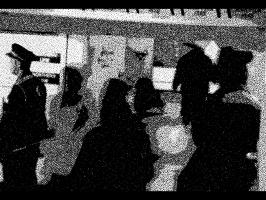
»still lives« is an attempt to rework and reuse memory. By that the practice particulary doesn`t focus on those daily experiences, that attract our strongest attention but in opposite to that. It focuses on the unfocussed perception ? what one hasn`t noticed clearly, but what still somehow is archived in one`s minds: a group of people in a train, a person behind a window, an empty staircase. Alexander Schellow deconstructs a series of thirty three-second long still images of London Underground-journeys from memory each into 36 individual images (drawn on paper) and reassembles them into a film. The sequence of three seconds corresponds with the perception of the present state in the human brain. It is, what we call a moment in the sense of a smallest possible memory-unit, out of which past and future are located. The filmic animated (re-)production becomes the reconstruction of this present moment condensed to a maximum. Based on the perception of ?still lives?, the film shows one possible realm of possibilities to reconstruct the scenario. With its slow and repeating scenic description, Alexander Schellow manages to constitute reality in a comprehensive sense.
Alexander Schellow Born 1974 in Germany Hannover, Alexander Schellow studied ?visual arts? at the Universität der Künste Berlin and the Glasgow School of Art. Since 1999 several solo- and groupshows in Europe, works for performance-theatre and lectures ? recently Steirischer Herbst, Graz (film-installation) / Kunstmuseum Stuttgart (solo-show) / Centre Pompidou, Paris (lecture with live-mapping) / 1. Biennale Thessaloniki / Galerie Ute Parduhn, Düsseldorf (solo-show) / Kunstsammlungen Zwickau (show of nominated artists) / Storefront for Art and Architecture, New York (screening of ?spots?). Publications 2007 beside catalogues of the Kunstmuseum Stuttgart and the Kunstsammlungen Zwickau include his book-project ?STORYBOARD? (published by Merz/Solitude, Stuttgart) and the DVD ?still lives? by Filmarmalade (London) such as contributions to magazines as DOMUS or LICHTUNGEN. Recent performancetheater-work 2007/2008 with David Weber-Krebs, Amsterdam, and Philipp Gehmacher, Vienna. 2006/07 Alexander Schellow was resident fellow of the Akademie Schloss Solitude (Stuttgart) and is Pechstein-fellow 2007. He lives in Berlin and teaches at the Metropolitan University in London.
Hester Scheurwater
Catalogue : 2006Glamour Girls | Experimental video | dv | color | 6:30 | Netherlands | 2004
Hester Scheurwater
Glamour Girls
Experimental video | dv | color | 6:30 | Netherlands | 2004
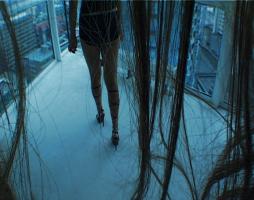
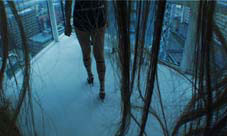
In Glamour Girls, as in many of her short films, Hester Scheurwater?s camera explores the relationship between human beings and space, and between humans themselves. That relationship does not flourish. The modern individual - in this case three women imprisoned by the glass and concrete of sleek high-rise structures - appears isolated from reality, unable to connect with itself or its surroundings. The women are modern geisha`s, with excessive, smudged make-up, and limbs covered in blood. After trying to fill the void with glamour, they lie down in silence, realizing that innocence has been lost. And brushing your teeth afterwards doesn`t scrub away the taste of sin. `As I lick your lips, they turn to stone,` sing Chicks on Speed. `Your hands are cold, I can see right through them, left with nothing but the aftertaste.? In Scheurwater?s universe there is hardly any room left for human warmth. The only living being that evokes a sense of pity is a dog. And the only hope that remains is the camera itself, feverishly searching for compassion in the remnants of decay.
Hester Scheurwater (born 1971, H.I. Ambacht, The Netherlands) studied monumental art at the Royal Academy of Fine Arts in The Hague, where she participated in workshops with Frans Zwartjes and Nan Hoover. She now teaches video art at the Academy. Since 1996, Scheurwater has made video installations and experimental films that have been shown all over the world at festivals, museums, galleries and art spaces. In many of her short films and videos, Hester Scheurwater`s camera explores the relationships between human beings, and between humans and space, relationships that rarely flourish. The modern individual appears isolated from reality, unable to connect with self or surroundings. In Scheurwater`s universe there is very little room for human warmth; the only hope that remains is the camera itself, feverishly searching for compassion in the remnants of decay.
Catalogue : 2006Mama | Art vidéo | dv | color | 2:30 | Netherlands | 2005
Hester Scheurwater
Mama
Art vidéo | dv | color | 2:30 | Netherlands | 2005
In Glamour Girls, as in many of her short films, Hester Scheurwater?s camera explores the relationship between human beings and space, and between humans themselves. That relationship does not flourish. The modern individual - in this case three women imprisoned by the glass and concrete of sleek high-rise structures - appears isolated from reality, unable to connect with itself or its surroundings. The women are modern geisha`s, with excessive, smudged make-up, and limbs covered in blood. After trying to fill the void with glamour, they lie down in silence, realizing that innocence has been lost. And brushing your teeth afterwards doesn`t scrub away the taste of sin. `As I lick your lips, they turn to stone,` sing Chicks on Speed. `Your hands are cold, I can see right through them, left with nothing but the aftertaste.? In Scheurwater?s universe there is hardly any room left for human warmth. The only living being that evokes a sense of pity is a dog. And the only hope that remains is the camera itself, feverishly searching for compassion in the remnants of decay.
Hester Scheurwater (born 1971, H.I. Ambacht, The Netherlands) studied monumental art at the Royal Academy of Fine Arts in The Hague, where she participated in workshops with Frans Zwartjes and Nan Hoover. She now teaches video art at the Academy. Since 1996, Scheurwater has made video installations and experimental films that have been shown all over the world at festivals, museums, galleries and art spaces. In many of her short films and videos, Hester Scheurwater`s camera explores the relationships between human beings, and between humans and space, relationships that rarely flourish. The modern individual appears isolated from reality, unable to connect with self or surroundings. In Scheurwater`s universe there is very little room for human warmth; the only hope that remains is the camera itself, feverishly searching for compassion in the remnants of decay.
Brieuc Schieb
Catalogue : 2023Koban Louzoù | Fiction | dcp | color | 58:58 | France | 2022
Brieuc Schieb
Koban Louzoù
Fiction | dcp | color | 58:58 | France | 2022
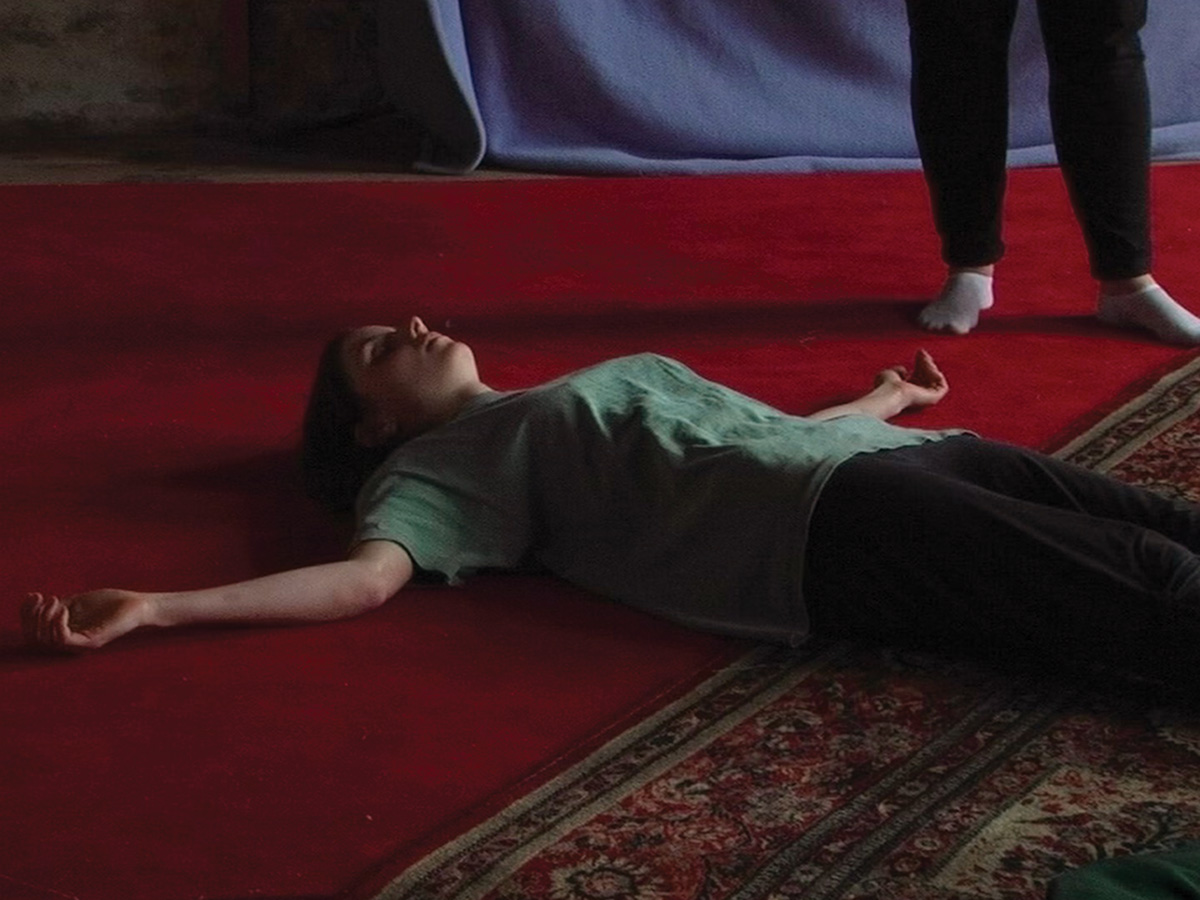
Audrey joins a participatory isolated workcamp where Kathleen, Laurence and Baptiste, volunteers from different backgrounds, live and work under the supervision of Aymeric. In a group marked by its disparity, each one tries to find one’s way around, to form bonds and to create a community.
Brieuc Schieb graduated from Paris Arts Déco. His work moves between films and installations. His projects are built around characters, environments or pre-existing materials. His first short fiction “La Tourbière” premiered at FID in 2019 and was screened in numerous festivals.
Schiefelbein
Catalogue : 2013I can. You can. | Video | hdv | color | 7:22 | Germany | 2012
Schiefelbein
I can. You can.
Video | hdv | color | 7:22 | Germany | 2012
A women is sitting on a couch while focussing her iron view into the camera and suddenly starts to talk. Out of her grows a canny and calm monologue which manifests her world of thoughts and ideas. The at first independently created monologue starts to get tangled up into contradictions, torn between different views and ideologies. It is a result of phrases taken out from different commercials which were combined into a continuously ongoing monologue. The women monologue turns out to be commanded and alienated by advertisement.
Marko Schiefelbein (*1984 in Stralsund, Germany) is a German artist living and working in Berlin. He studied Art History and graduated in Fine Arts in 2011 from University of Fine Arts Braunschweig (Germany). He is a master student of Prof. Candice Breitz. His works deals with the human estrangement in the century of modern life in a consumer society. His work was shown in
Timo Schierhorn
Catalogue : 2010Nacht um Olympia | Experimental doc. | super8 | color and b&w | 40:0 | Germany | 2009

Timo Schierhorn
Nacht um Olympia
Experimental doc. | super8 | color and b&w | 40:0 | Germany | 2009
In a small Sequence of a documentary film about the hostage taking at the Olympic Games 1972 in Munich Timo Schierhorn discovers a man on the screen that is similar to a picture of his father in a family photo. Furthermore the filmmaker learns that his father, who had died young, had worked as a BGS official at the Olympics. Additionally, in talking to a friend of his father?s he finds out that his father was given the name Uncle Luten, when he was mimicking his own father. For the film, ?Night in Olympia?, Schierhorn slips into the roll of this artificial figure whose staged biography investigates the mechanisms of memory and captures, that which has been forgotten, in images. Again and again over the last three years Schierhorn has encouraged his circle of acquaintances to re-enact every-day scenes of his parents, from their small town, between 1972 and 1980 ? similar to the of followers of living history re-enactments. This semi autobiographical film combines super 8 found-footage documentary sequences with staged scenes, which provide filmic links to the home movie memories. The ties between private films auctioned on eBay and the small film documentary performances, try to play two genres against one another: the home and art movie.
Timo Schierhorn Born in Winsen/Luhe, 1979, lives and works in Hamburg and Berlin 2009 Diploma (Fine Arts) Prof. Marie José Burki and Prof. Gerd Roscher, Hochschule für bildende Künste Hamburg
Jérôme Schlomoff
Catalogue : 2011Marbre | Experimental film | 35mm | black and white | 8:13 | France, Netherlands | 2010
Jérôme Schlomoff
Marbre
Experimental film | 35mm | black and white | 8:13 | France, Netherlands | 2010
« Marbre » est une ?uvre de l?artiste français Marc Couturier, de 1999, faisant partie de la série : « Redressement ». Elle se présente sous la forme de deux blocs de marbres de Carrare juxtaposés au sol (chacun au format 30X42 sur 12 cm de haut). Sur celui de gauche sont empilés 375 lavis à l?encre de chine sur papier bouffant (au même format 30X42). Accéder à l?appréhension intégrale de l??uvre consiste à feuilleter ce « livre » de dessins représentant 375 bouquets de fleur dans leur vase. On comprend la difficulté de faire vivre au public cette expérience dans un musée. Ce film met scène, en un plan fixe, l?artiste entrain de nous offrir cette expérience. Son accomplissement filmé devient une performance éphémère de l?artiste ayant valeur de portrait de l??uvre et de l?artiste. Le film crée la performance. Le film témoigne de la performance. Le film est performance.
Jérôme Schlomoff. Je suis né en 1961. Je suis photographe. Depuis 1984, je travaille sur le thème du portrait ; mon terrain de prédilection est le monde de l?art contemporain et je photographie sans cesse de nombreux créateurs. A partir de 1996, mon intérêt pour l?architecture s?affirme et je développe la série des « Sténopés d?Architecture », projet qui montre les liens étroits qui existent entre la photographie et l?architecture, en transformant l?architecture en appareil photo. Enfin, en l`an deux mille je construis ma caméra sténopé 35mm en carton et j?entreprends, image après image, la réalisation de films cinématographiques 35mm, où je prends le temps de poser un regard sur la ville, avec en tête toujours cette même question : « Comment habiter la ville aujourd?hui » ?. Portrait, architecture, cinéma sont ainsi les territoires essentiels à partir desquels s?organisent et se structurent mes recherches sur l?acte de photographier et sa signification actuelle. C?est au croisement de ces trois disciplines, dans leur dialogue permanent et leur enrichissement respectif que prend place mon attitude de photographe, de réalisateur & d?artiste.
Catalogue : 2010Blonde Redhead Meets Gainsbourg | Experimental film | dv | color | 5:5 | France, Netherlands | 2009
Jérôme Schlomoff
Blonde Redhead Meets Gainsbourg
Experimental film | dv | color | 5:5 | France, Netherlands | 2009
Live concert filmed in the "Cité de la Musique" in Paris on October 25th, 2008, at the request of the Blonde redhead group. For the American rock trio Blonde Redhead, filmmaker and photographer Jérôme Schlomoff used a pinhole camera to make a music video of their song "Spring & by Summer Fall." The video combines outdoor shots with concert footage recorded during the "Blond Redhead meets Gainsbourg" tour in Paris in October 2008. The song appears to be about someone searching for his own life who only manages to see fragments of it in the expressions of passersby. The feelings of desolation and longing are clearly visible in the images. Unrecognizable and at a distance, the musicians play in an enormous emptiness that is only occupied by the music. Outside, the camera travels over a railroad track, looking for someone or something. The effect of the pinhole camera is that all images from the past appear to be snatched away, and as a result are endowed with something tragic. Jérôme Schlomoff started using a pinhole camera he built himself as the medium for his 35mm films back in 2000. This camera with no lens works by allowing light into an otherwise lightproof box through a miniscule hole, which records the images on film. Schlomoff's film Amsterdam Reconstruction was selected for Paradocs in 2007.
My name is Jérôme Schlomoff. I?m born in Vincennes (France) in 1961. I live and work in Amsterdam since 2005. I am a photographer & filmmaker. Since 1984, shooting portraits has been my main occupation. My favorite field is the World of Contemporary Art, and I have been taking pictures of new creators continuously. My interest in architecture was confirmed in 1996 as I developed the « Sténopés d?Architecture » (Architectural Pinhole) series. This project shows the tight link between photography and architecture, as I turn architecture into a camera. Finally, in the year 2000, I built, by necessity, my first 35mm cardboard pinhole camera. Image after image, I gave life to a 35mm motion picture, taking my time, and wondering, with the city as my model, and with only one question in mind:? How can you live in a city today??. Portrait, Architecture, cinema are the essential fields from which I organize and build my research on the action of taking a picture and it?s actual meaning. It is at the crossroad of these three techniques, in their permanent dialogue, and respective enrichment that I set my attitude as a photographer, as a filmmaker and as an artist.
Catalogue : 2009la villa k | Experimental film | 35mm | black and white | 2:20 | France, Netherlands | 2008
Jérôme Schlomoff
la villa k
Experimental film | 35mm | black and white | 2:20 | France, Netherlands | 2008
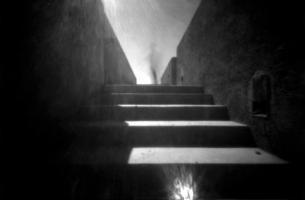
This film proposes a visit to the building site ?the villa K?, built on the outskirts of a small village 20 km from Marrakech by the architects Karl Fournier & Olivier Marty, founders of the agency Studio KB. The dialogue that the architects have between traditional and modernity created through their work, joined with his cinematographic approach, the artist also endeavors to capture the magic and the poetry which results from this dialogue.
Jerome Schlomoff was born in 1961. He lives and works in Amsterdam. Since 1984, he works as a portrait photographer; his predilection is the world of contemporary art and photography. From 1996, his interest in architecture continues and he develops the series of the ?Pinholes of Architecture?, project which shows the close links which exist between photography and architecture. Lastly, in 2000 the artist built his a pinhole 35mm camera out of paperboard and made 35mm films with it image of the city with the ever present question ?How to live in a city today??.Portraits, architecture, cinema are the essential territories from which the artist organizes and structures his research on photography and its significance today. It is at the intersection of these three disciplines in their dialogue and their respective enrichment takes place that shows his position as a photographer, director and artist.
Catalogue : 2008Amsterdam Reconstruction | Experimental film | 35mm | black and white | 20:0 | France, Netherlands | 2007
Jérôme Schlomoff
Amsterdam Reconstruction
Experimental film | 35mm | black and white | 20:0 | France, Netherlands | 2007
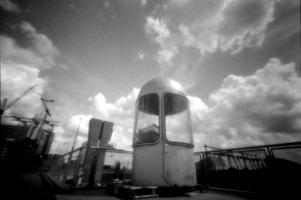
Ce film sténopé propose une visite de la ville d?Amsterdam à travers les chantiers de reconstruction de quatre institutions culturelles qui sont : la salle de cinéma de la Maison Descartes ; le Rijksmuseum ; le Stedelijk Museum Amsterdam ; le centre d?art W139. Ces lieu sont actuellement en travaux. Ce film est construit comme une mystérieuse balade du regard à travers ces 4 chantiers chargés d?histoire, où la magie de l?architecture mise à nu nous plonge dans un univers étrange et dont la caméra sténopé nous révéler la force poétique. Tout au long de cette balade, les éléments poétiques successivement rencontrés sont confrontés à la vision d?un monde industriel, en analogie ou en opposition, avec celle de la nature intacte. Cette vision d?Amsterdam permet de créer lien dynamique entre les quatre chantiers. Il s?agit d?une histoire de reconstruction, reconstruction de la ville à travers notre propre reconstruction du regard.
Jérôme Schlomoff. je suis né en 1961. J`habite & travaille à Amsterdam. Je suis photographe. Depuis 1984, je travaille sur le thème du portrait ; mon terrain de prédilection est le monde de l?art contemporain et je photographie sans cesse de nombreux créateurs. A partir de 1996, mon intérêt pour l?architecture s?affirme et je développe la série des « Sténopés d?Architecture », projet qui montre les liens étroits qui existent entre la photographie et l?architecture, en transformant l?architecture en appareil photo. Enfin, en l`an deux mille je construis ma caméra sténopé 35mm en carton et j?entreprends, image après image, la réalisation de films cinématographiques 35mm, où je prends le temps de poser un regard sur la ville, avec en tête toujours cette même question : « Comment habiter la ville aujourd?hui » ?. Portrait, architecture, cinéma sont ainsi les territoires essentiels à partir desquels s?organisent et se structurent mes recherches sur l?acte de photographier et sa signification actuelle. C?est au croisement de ces trois disciplines, dans leur dialogue permanent et leur enrichissement respectif que prend place mon attitude de photographe, de réalisateur & d?artiste. La littérature, le théâtre, toutes les formes de création, qui nourrissent mon imaginaire en poésie, attirent mon attention. Elles deviennent les territoires d?une expérimentation partagée autour d?un même langage.
Jérôme Schlomoff
Catalogue : 2007New York zéro zéro | Experimental film | 35mm | black and white | 20:50 | France, USA | 2006
Jérôme Schlomoff
New York zéro zéro
Experimental film | 35mm | black and white | 20:50 | France, USA | 2006
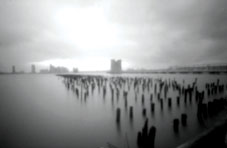
March 19, 2003, New York, 8.00pm. End of the ultimatum set by George W. Bush to Saddam Hussein. All the televisions broadcast live the president's short speech: America just entered war against Iraq. To these images of American television respond those of New York as a devastated world, plunged in an urban chaos that threatens a great cataclysm. Man deserts the city under a snowstorm. From strolling to strolling, from district to district, the city is broken up, abandoned. Then comes the meeting with Jerzy W.Sulek. An architect originally from Poland, he lives in the street and sleeps in his pick-up parked in front of undeveloped land. He collects furniture and objects which he sells for survival while waiting for some hypothetical building permit deposited years earlier at city hall. He talks about his dream of architecture and his outlook on the question "how to inhabit the city nowadays?"
Jérôme Schlomoff is forty year old photographer who lives and works in Paris. Since 1984, he has been working on the theme of the portrait; his field of predilection is the contemporary art world where he is constantly taking photographs of numerous creatives. In 1996 his interest for architecture asserted itself and he developed the series "Sténopés d?Architecture", a project that shows the close link that exists between photography and architecture while transforming architecture into a camera. In the year 2000 he I built a 35mm pinhole camera made out of cardboard and started, image after image, on the production of 35 mm cine films, where he allowed himself to stare at the city with the same question in mind: "How to inhabit the city nowadays?"
Eske Schlüters
Catalogue : 2016Title (Life goes on) | Video | hdv | color | 12:0 | Germany | 2015
Eske SchlÜters
Title (Life goes on)
Video | hdv | color | 12:0 | Germany | 2015
This is a film about the making of a film about a film that was never made. The film described here, as it is being made, is a true film, which however operates with film illusions to the extent that the film that treats this film is a film that was never made because it would have served to maintain illusions. This is a fictional documentary or a documenting fiction about a film that was planned and partly realized by the Ufa in the 1940s.
Thomas Schmahl
Catalogue : 2021Les montagnes amoureuses | Experimental film | mov | color | 21:48 | France | 2020
Thomas Schmahl
Les montagnes amoureuses
Experimental film | mov | color | 21:48 | France | 2020
Un jeune homme est traversé par les ondes. Elles sont stoppées par les montagnes. Il commence à observer plus précisément les grandes masses rocheuses qui l’entourent, et découvre des phénomènes romantiques. Par amour, il tourne autour.
Thomas Schmahl est né en 1994 à Annecy (France). Il vit et travaille entre Annecy (France) et Reims (France). Il est diplômé de l’ESAD – École Supérieure d’Art et de Design de Reims (France). Son travail s’intéresse à l’anecdotique, à la carence, à l’instable. L’artiste propose des situations, films ou installations dans lesquelles le récit et les protagonistes évoquent souvent un ailleurs. Il est lauréat du Prix de la Jeune Création de la Biennale d’art contemporain de Mulhouse (France) en 2019.