Catalogue > List by artist
Browse the entire list of Rencontre Internationales artists since 2004. Use the alphabetical filter to refine your search. update in progress
Collectifs Noyau / Mungongo Ya Sika / ôtre K'ôtre, collectifs
Catalogue : 2011LOBI (hier / demain) | Experimental fiction | super8 | color | 36:0 | Congo (RDC) | 2010
Collectifs Noyau / Mungongo Ya Sika / Ôtre K'Ôtre, collectifs
LOBI (hier / demain)
Experimental fiction | super8 | color | 36:0 | Congo (RDC) | 2010
Lobi (Yesterday/Tomorrow), 2010, 40 min., super 8 Lobi means yesterday as well as tomorrow in Lingala. Lobi assembles images that were conceived and shot in Kinshasa with SUPER 8 cameras by the belgolese collectives noix-yo, mungongo ya sika and ôtre k`ôtre in February-March 2010, a few months before the celebration of the 50th anniversary of Congo ?s independence. Which independence? 9 different visions merge in a quest for a common language that enables to broach the past, to conceive the present and to imagine the future. With the support of / Avec le soutien du : Vlaams Audiovisueel Fonds ? Filmlab
Jussie Nsana Banimba
Catalogue : 2018Tiamvu (The Bridge) | Video | hdv | color | 1:22 | Congo (Brazzaville) | 2015
Jussie Nsana Banimba
Tiamvu (The Bridge)
Video | hdv | color | 1:22 | Congo (Brazzaville) | 2015
Plasticienne - Bédéiste - Illustratrice - Vidéaste Fondatrice et directrice artistique de l’Espace Nsan’Arts , Jussie est professeure d?arts plastiques de peinture ou de Bande Dessinée pour les enfants et adolescents, tout en consacrant l'essentiel dedans les écoles de Pointe-Noire et se consacre entièrement à l'animation des ateliers d'illustration, son temps à sa passion, l’art
Catalogue : 2016Bimbambukila | Video | hdv | color | 6:1 | Congo (Brazzaville) | 2012
Jussie Nsana Banimba
Bimbambukila
Video | hdv | color | 6:1 | Congo (Brazzaville) | 2012
Réalisée lors des Ateliers Sahm (Rencontre Internationale d’Art Contemporain, qui se sont tenus du 15 novembre au 15 octobre 2012 à Brazzaville, « Bimbanbukila », première vidéo de Jussie Nsana pose le problème de mémoire. Cette première réalisation de l’artiste nous emmène au cœur de Brazzaville où l’artiste magnifie le mur sous toutes ses coutures. Des murs qui deviennent des espaces témoins, de ponts entre le passé et le présent.
Jussie Nsana Banimba est née à Brazzaville en 1984 et elle vit et travaille actuellement à Pointe-Noire. Elle est diplômée de l`École Nationale des Beaux Arts de Brazzaville, en arts plastiques. Elle se considère comme une artiste à part entière et crée des peintures, des bandes dessinées, et des vidéos. Jussie à participé octobre 2015 au Festival International de la Bande Dessiné d’Alger en Algérie. Elle a exposée ses œuvres en novembre 2015 à l`exposition «Soul Power» au Musée-Galerie du Bassin du Congo à Brazzaville, en 2014 à l`exposition "Butselé" au Centre Culturel Basango à Pointe-Noire; en 2013 à l`Institut Français du Congo (IFC) à Pointe-Noire; en 2012 et 2013et 2015 elle a participé à la 1ère, 2e et 4e édition de la "Rencontre d`Art contemporain de Brazzaville" aux Ateliers SAHM. Comme elle-même le dit, Jussie transporte dans son « sac à arts », ses passions les plus artistiques, la BD, la peinture et la vidéo. Engagée avec la jeunesse, Jussie, avec une générosité hors du commun, transmet son savoir-faire et son amour pour l’art aux enfants et aux jeunes dans son espace Nsana – Arts’ Butsilé.
Lydia Nsiah
Catalogue : 2025techno | Experimental film | 16mm | color | 22:0 | Austria | 2023
Lydia Nsiah
techno
Experimental film | 16mm | color | 22:0 | Austria | 2023
In the short film trilogy "techno" Lydia Nsiah assembles and spiralizes historic and contemporary Science Fiction Films with an emphasis on African, African American, Asian, Indian, Indigenous and South American film productions. Working with their imagery of the fears and chances of technology the found moving images are edited into the artistic and cinematographic sequences inner, outer and in between. In the beginning of each film piece the imagined future of the technological is countered with a short intro, showing 16mm-film recordings by the artist of present nature. Due to a multi-part film recording process the two media video and 16mm-film interfere. The digital, the analogue, artefacts, (film) layers and translations culminate. The sound compositions by the artists Pisitakun, Jejuno and Billy Roisz respond to the sequences, the Sci-Fi Found Footage and the spiraling camera movement. With these dialogues between film and sound three short films are created, conversing with each other in the form of a trilogy and spiraling the technological in filmic, bodily and immersive ways.
Lydia Nsiah is an artist, filmmaker and writer, working with the in-betweens, abysses and gaps in audiovisual knowledge production by transforming and incorporating found and recorded analogue and digital memory images, often in collaboration with sound artists. She publishes and exhibits internationally on science fiction and decolonial practice, body and virtuality, forgetting and remembering, failure and error, film art and use. Her works were shown, among others, at the Berlinale Forum Expanded, the Internationale Kurzfilmtage Oberhausen (DE), Prismatic Ground/ Maysles Documentary Center, NYC (US), Crossroads San Francisco Cinemateque/ SFMOMA (US), IDFA – International Documentary Film Festival Amsterdam (NL), Festival Ecrã (BR), Bangkok Art & Cultural Center (TH), Blickle Kino/ Belvedere 21, Kunsthalle Krems (AT), Slovenska kinoteka (SL), Curtocircuíto, Santiago de Compostela (ES), Antimatter [Media Art], Victoria, BC (CA), Kunstforeningen GL Strand (DK).
Josèfa Ntjam, Sean Hart, Nicolas Pirus
Catalogue : 2023Dislocations | Experimental film | digital | color | 18:15 | France | 2023
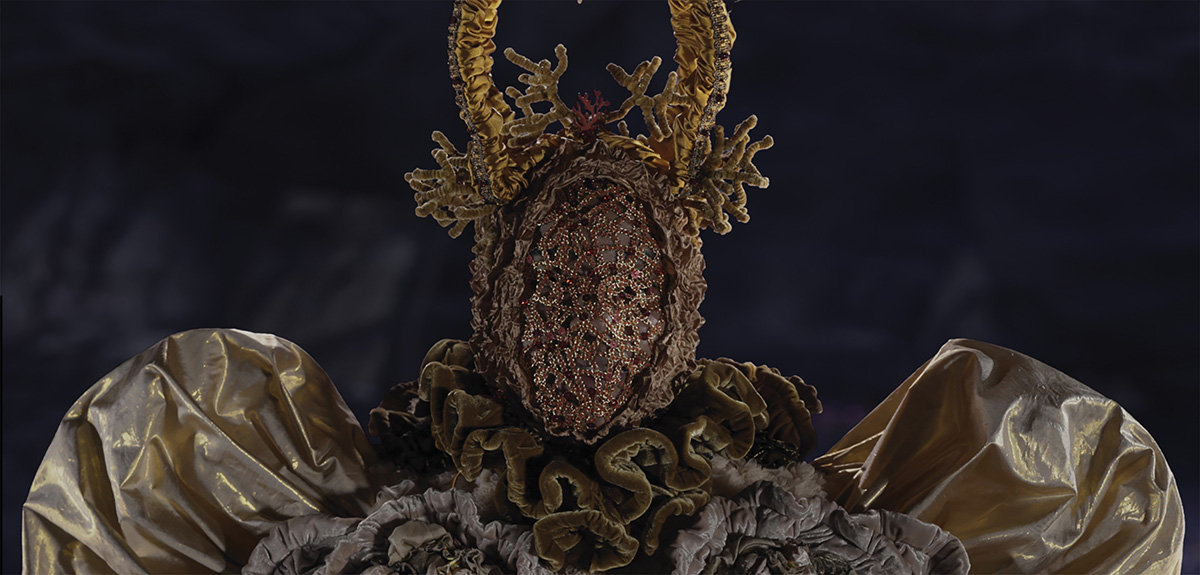
Josèfa Ntjam, Sean Hart, Nicolas Pirus
Dislocations
Experimental film | digital | color | 18:15 | France | 2023
Persona pursues her initiatory journey from the internet(s) spaces to a cave floating into outer space inhabited by memories and narratives from her ancestors’ fight for Cameroon’s independence. The cave’s walls and drops are a window to archives that end up melting with Persona, whose humanoid envelope has slowly vanished.
Monika Nuber
Catalogue : 2007Duette Chöre Formationen | Animation | 0 | color | 11:20 | Germany | 2005
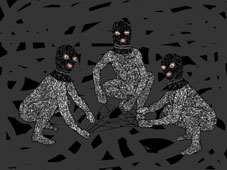
Monika Nuber
Duette Chöre Formationen
Animation | 0 | color | 11:20 | Germany | 2005
Masked forms sing a hymn, Quivering figures celebrate friendship, Young girls sing about love and sex, A three-headed dog and its master make rhymes, A group of kids in the forest sing a mysterious melody and two hanged people mutually help each other to present a song.
Monika Nuber is a Stuttgart based plastic artist and musician. She studied at Stuttgart's Arts Academy with Joseph Kosuth and Joan Jonas, and at the Academy of Fine Arts in Prague with Milan Knizak. Successive scholarships led her to Mongolia, China, and Pakistan.
Christof Nuessli
Catalogue : 2022Visibility | Video | mov | color | 9:3 | Switzerland | 2020
Christof Nuessli
Visibility
Video | mov | color | 9:3 | Switzerland | 2020
A stream of consciousness takes us from a society that is afraid of teenagers and birds to drone pilots wearing bomber jackets to the question of whether smoke can make change visible. Should we hold on tight or let ourselves be blown by the wind?
Christof Nüssli (*1986, Zurich) is a visual artist, whose interdisciplinary approach involves video, sculpture, installation, photography and writing. His work has been exhibited in various institutions and screened at international film festivals. In 2020, Nüssli received a Master of Fine Arts from the Glasgow School of Art. He works in Zurich and Glasgow.
Catalogue : 2020Under The Skin | Video | hdv | color | 16:40 | Switzerland, United Kingdom | 2019
Christof Nuessli
Under The Skin
Video | hdv | color | 16:40 | Switzerland, United Kingdom | 2019
Zooming into two books containing mug shots from around 1880–1935, Under the Skin, draws lines from historical events to contemporary developments of control and surveillance. While describing what she sees in the books, the narrator intertwines subject areas like; how time changes perspectives on historical events, the role of archives as foundations for power and control, the possible brutality of bureaucracy, the current state of facial recognition and personal experience with the law enforcement. Under the Skin questions given structures of power and asks how we can take back the sovereignty of information.
Christof Nüssli (*1986, Zurich) is a visual artist, whose interdisciplinary approach involves moving images, photography, sculpture, installation, text and artist books. His work has been exhibited in various institutions and off-spaces. In 2019 his work was shown at Photoforum Pasquart (CH), Swiss Institute New York (US), Glue Factory (UK) and VideoEx (CH). Nüssli authored three artist books (Miklos Klaus Rozsa, Withheld due to:, googly eyes) which won international prizes. Since 2014 Christoph Oeschger and Christof Nüssli run the publishing project cpress, focusing on artist books. In 2018, Nüssli was an artist in residence at the Swiss Institute New York, the Andreas Zuest Library and in 2016 at the Istituto Svizzero di Roma. In 2013, Nüssli received a Master of Design from Werkplaats Typografie. Since 2018 he attends the Master of Fine Arts program at the Glasgow School of Arts.
Eko Nugroho
Catalogue : 2007Ma Ling | Experimental video | dv | color | 4:0 | Indonesia | 2006
Eko Nugroho
Ma Ling
Experimental video | dv | color | 4:0 | Indonesia | 2006
"Ma Ling" (in Bahasa Indonesian can be mean: Thief) is an instant canned food from China. This work talks about stealing back terrors that have already been produced by television. Inspired by what happened in China for a pirated business product; taking something from a thing that already exists and reproducing it as something "new".
Eko Nugrono
Catalogue : 2007Bercerobong | Animation | dv | black and white | 4:0 | Indonesia | 2006
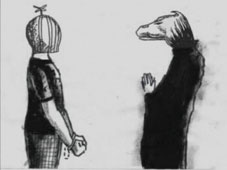
Eko Nugrono
Bercerobong
Animation | dv | black and white | 4:0 | Indonesia | 2006
As a great and productive comic maker, Eko Nugroho smartly uses simple drawing and animation for his video "Bercerobong" (Smoke-piping). He attempts to portray a condition happening in a community, in particular when a change of political agenda takes place in Indonesia after the downfall of the Soeharto regime. Everyone seems to be in turn: politicians, armies, governmental officers, religious teachers, and others. Like chameleons they have quickly changed their life's attitude, way of speaking, and action, adjusting to the environment and chatting partners. Sometimes in a tricky way, they use the situation for the sake of their own interest.
Bettina Nürnberg, Dirk Peuker
Catalogue : 2017Franzosensand | Documentary | hdv | color | 8:30 | Austria, Germany | 2016
Bettina NÜrnberg, Dirk Peuker
Franzosensand
Documentary | hdv | color | 8:30 | Austria, Germany | 2016
The film “Franzosensand” centers on agricultural settlements founded by theGerman National Socialitst on newly built dikes on the mudflat of the Wadden Sea (North Sea). Of the settlements, the so-called “Adolf-Hitler-Koog”, was meant to be a prototype for a national socialist community.Today, the bleak and tidy landscape does not offer much testimony to its history. Excerpts of archived materials that are interwoven with present-day images make the present appear as a surface built on complex, deeper layers of the past.
Bettina NUERNBERG (1976, Germany) was educated in art and film in Hamburg, Berlin and Toulouse. The work of the Berlin-based artist has been screened and exhibited worldwide. She founded the internet platform vestibuel-film. Dirk PEUKER (1970, Germany) studied film and art in Berlin and Vienna. The work of the experimental filmmaker and artist has been screened and exhibited worldwide.
Bettina Nürnberg, Dirk PEUKER
Catalogue : 2015Zement | Documentary | hdv | color | 12:38 | Germany, Austria | 2014
Bettina NÜrnberg, Dirk PEUKER
Zement
Documentary | hdv | color | 12:38 | Germany, Austria | 2014
The Nazis set up a concentration camp in Ebensee. Nürnberg and Peuker wonder what conclusions they can draw from the topography about dealing with the past. The takes remain static; a woman’s voice dryly contributing information from off screen is all that clarifies the context within contemporary history. A site that looks like a dirt road turns out to be the “Löwengang (Lion’s Walk),” which the camp’s prisoners were driven down like animals to reach a tunnel that had to be dug. As soon as the film moves to the residential area that was founded on the site of the concentration camp shortly after the end of the war, surprise at the lack of sensitivity in dealing with the past mixes into the off-screen commentary. What Zement aims to get at is the ambiguity of this proximity of commemorative site and settlement.
Dirk Peuker * 1970 in Friedrichroda 1998 – 2005 Studium experimentelle Filmgestaltung an der Universität der Künste Berlin und bildende Kunst an der Akademie der bildenden Künste Wien. 2006 Stipendium der Stiftung Kulturregion Hannover und der Nordmedia Filmförderung, Villa Minimo. 2007 DAAD Jahresstipendium 2008 Postgraduiertenstipendium des Freistaates Thüringen 2008 Meisterschüler der Universität der Künste Berlin 2009 NaFÖG Stipendium des Berliner Senats seit 2009 künstlerischer Mitarbeiter an der Kunsthochschule Berlin Weißensee
Sophie Nys
Catalogue : 2017Pungulume | Experimental doc. | 0 | color and b&w | 28:0 | Belgium | 2016
Sammy Baloji
Pungulume
Experimental doc. | 0 | color and b&w | 28:0 | Belgium | 2016
The town of Fungurume is situated in the province of Katanga (D.R. Congo) and the hills and mountains surrounding Fungurume form one of the world’s largest copper and cobalt deposits. In pre-colonial times the area was already a major centre in the copper trading network that ran across Central Africa. Today the mountains have become the property of the American Tenke Fungurume Mining consortium (TFM). From 2009 on, TFM’s mining activities have been in full swing, causing the resettlement of thousands of local Sanga inhabitants. Pungulume focuses on Sanga chief Mpala and his court elders while they are rendering the oral history of the Sanga people, against the backdrop of the industrial destruction of the landscape that anchors Sanga memory and identity. (Filip De Boeck)
Sammy Baloji was born in 1978 in Lubumbashi, in the Katanga province of Democratic Republic of Congo. He studied Computer and Information Sciences and Communication at the University of Lubumbashi. With a borrowed camera, he began photographing scenes as sources for his cartoons. He soon enrolled in photography courses in DRC, and continued with photography and video at Ecole Supérieure des Arts Décoratifs, in Strasbourg, France. Baloji juxtaposes photographic realities, combining past and present, the real and the ideal, to illicit glaring cultural and historical tensions. He explores architecture and the human body as traces of social history, sites of memory, and witnesses to operations of power. Baloji has had solo exhibitions at Musée du quad Branly (Paris), MuZee (Oostende), Royal Museum for Central Africa (Tervuren), WIELS (Brussels) and Museum for African Art (NY). Baloji has featured in numerous group exhibitions worldwide: Biennale de Lyon, Venice Biennale, Louisiana Museum of Modern Art, Foundation Cartier pour l’Art Contemporain,... He has been the recipient of numerous awards including, the 2014 Rolex Mentor and Protégé Arts Initiative award, partnering with Olafur Eliasson. He was nominated a Prix Pictet finalist in 2009, received the Prince Claus Award in 2008 and two awards at the 2007 African Photography Biennial in Bamako, Mali.
Catalogue : 2013Parque do Flamengo | Experimental doc. | hdv | color | 45:0 | Belgium, Brazil | 2012
Sophie Nys
Parque do Flamengo
Experimental doc. | hdv | color | 45:0 | Belgium, Brazil | 2012
Drawn by her interest in history and architecture and the ambiguity emerging from modernist utopias, the Belgian artist Sophie Nys left in January 2011 for Rio de Janeiro to shoot the film ?Parque do Flamengo?. From this a semi-documentary resulted whose main character is the Parque do Flamengo, a park designed by the landscape architect Roberto Burle Marx between 1954 and 1959. Simultaneously a painter, sculptor, poet and botanist, Roberto Burle Marx is known worldwide as one of the greatest landscape architects of the twentieth century. The film by Sophie Nys is a 45 minutes uncut travelling shot and represents the whole of the park as an isolated entity. The space is crossed from A to Z at a walking pace. As a stroll, the route follows the curved and sensual line of the park. The film is a physical and plastic portrait of the place, a recording of a living space between culture and nature. At Sophie Nys?s request, musician Arto Lindsay conceived an original soundtrack for the film, using the list of plants featured in the park as a starting point for this new composition.
Sophie Nys (º1974, Borgerhout) studied at Sint-Lukas Ghent and finished a post-graduate program at Jan van Eyck in Maastricht. She brings conceptual and minimalistic artistic strategies to their logical and formal limits by exploiting the broad artistic license possible within the contemporary art milieu. Far from being flippant, her works ? although seemingly ironic ? maintain their eloquence as poetic reflections on her subjects derived from the everyday. Her films have been shown at International Short Film Festival Detmold, FIDMarseille, BOZAR, e-flux, International Film Festival Rotterdam, Argos, Courtisane festival,...