Catalogue > List by artist
Browse the entire list of Rencontre Internationales artists since 2004. Use the alphabetical filter to refine your search. update in progress
Alexander Glandien
Catalogue : 2016Making of | Experimental doc. | hdv | color | 30:0 | Germany, Austria | 2015
Alexander Glandien
Making of
Experimental doc. | hdv | color | 30:0 | Germany, Austria | 2015
The film "Making of" takes work as a topic into focus, showing the various working areas of a contemporary art museum with all those activities which usually remain invisible for visitors. Shot from the perspective of a small filmcrew different kind of workflows are documented as well as the preparation for an upcoming exhibition, while the crew itself is constantly observed in their efforts to create this film. Director, cameraman and sound operator move through all areas of the The State Gallery in Linz in an almost performative way. The ongoing visible presence of the camera raises questions about the relationship between the documented actions, their authenticity and manipulation. The depicted reality becomes visible as part of a media construction.
Alexander Glandien was born in 1982 in Schwerin (Germany) and he works as an artist in Vienna. Since 2009 he is artistic and scientific assistant at the Art University Linz. After his studies at the University of Wismar he attended studio grants in Indonesia, Italy, the Netherlands and Spain. His works have been awarded with the Talent Award of Upper Austriaand the Klemens Brosch prize and they are part oft the art collections of the federal government of Austria, the province of Upper Austria, the contemporary art collection of the City of Vienna and the Albertina in Vienna. He has had numerous exhibitions, most recently at the State Gallery Linz, Galerie 5020 in Salzburg, at Kadmium Art Centre in Delft, at the Moscow Museum of Modern Art and at the Albuquerque Museum of Art and History.
Jimmy Glasberg, Joseph CESARINI
Catalogue : 20069m2 pour deux | Fiction | betaSP | color | 94:0 | France | 2005
Jimmy Glasberg, Joseph CESARINI
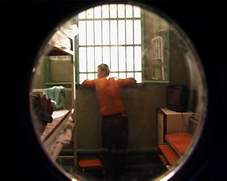
9m2 pour deux
Fiction | betaSP | color | 94:0 | France | 2005
This film, extracted from a cinematographic experience driven in jail environment ??9m² pour deux?? has been staged in a background in studio within a jail. Ten men, detainees, became turn by turn, actors a filmmakers of their own life. Each of htem express himself through daily situation in a series of strong moment: friendship, indifference, confrontation, loneliness?
Joseph Casarini is a filmmaker and cameraman but also a photograph. He is graduated from the Marseille Fine Arts. He has an education background of photographer and discovers the universe of prisons in 1987 and realizes his first movie about tattooing in jails ?Tattoo cage?, a 26 min feature. In 1989, he met the cineaste Renaud Victor and collaborates to the realization of the film ?De jour comme de nuit? a long length movie of 2x52mm on detenee?s life. From 1991 to 1991, he co-realizes with Caroline Caccavale ?Coursives?, a series of debates-emissions shot in prisons. In parallel with his work of filmmaker, he founds with the photographer Marcel Fortini the Centre Méditéranéen de la Photographie in Bastia (Corsica, Island). In 1999 and 2000, he realizes two films in the framework of the Video Workshop set by Lieux Fictifs in the Baumettes prison in Marseille. ?Mon ange? and ?La Vraie Vie?, these two short length movies experiment new forms of representation of the imprisoned one. The sight of the detainee on himself, on us, on jail and the emotion that downloads from it are closely tight to the memory act. From 1997, he starts a work in Corsica about islandhood. In 2000, he realizes ?Les Coussins de Barbaggio?, 73 min. In 2001, ?I Paceri? is looking for peace makers. In 2002, he comes back to the Baumettes jail with the project ?9m²? for a cinematographic experience that he co-wrote and realized with Jimmy Glasberg and the collaboration of Christohper, Phillippe, Nourdine, Bruno, Mohamed, Kamel and Olivier. Jimmy Glasberg ? photography director AFC. He started his men of image career in the 60?s as journalist, reporter and cameraman. He took part then actively in the ?cinema direct? movement and collaborated to many films using this shooting technique: ?Continental Circus? (Jean Vigo Prize?) then, ?Shoah? (César of the documentary film) ?Français si vous voulez?,etc... In parallel with his photography director career in the film industry (long features, CM, film) he realizes many documentaries. The apparition of new technologies and particularly DV cameras helped him to think about new tools and their use. This is in this context that he starts in 2002 a film experience in prison sites at the Baumettes jail of Marseille.
Ronald Glasbergen, Ronald GLASBERG
Catalogue : 2006air wave | Experimental doc. | dv | color | 5:30 | Netherlands, Chad | 2005
Ronald Glasbergen, Ronald GLASBERG
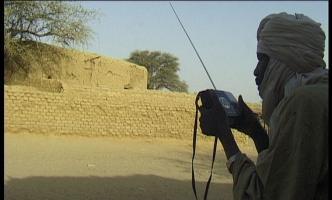
air wave
Experimental doc. | dv | color | 5:30 | Netherlands, Chad | 2005
The short video and sound essay Air Wave, is a simple elegant way of showing both : the slowness of daily life in some of the remotest areas of the world, as well as the hunger for news from the other world-, the connected-, the global world, in the areas. Adding some harsh relevance is the fact that the subject of the Sudanese news broadcast is partly about Iraq (which is through all sound deformations also to be heard for non Arabic speakers). The shots were taken in Tchad in the Waddai region and in N?Djamena. The artist was there to assist in a documentary on the Darfur refugee problem. Air Wave, one in a number of artists video focusing on matters in actual culture, is distributed by ?Art for People?.
Jean-luc Godard
Catalogue : 2007De l'origine du XXIe siècle | Experimental film | dv | color | 16:0 | Switzerland, France | 2000
Jean-luc Godard
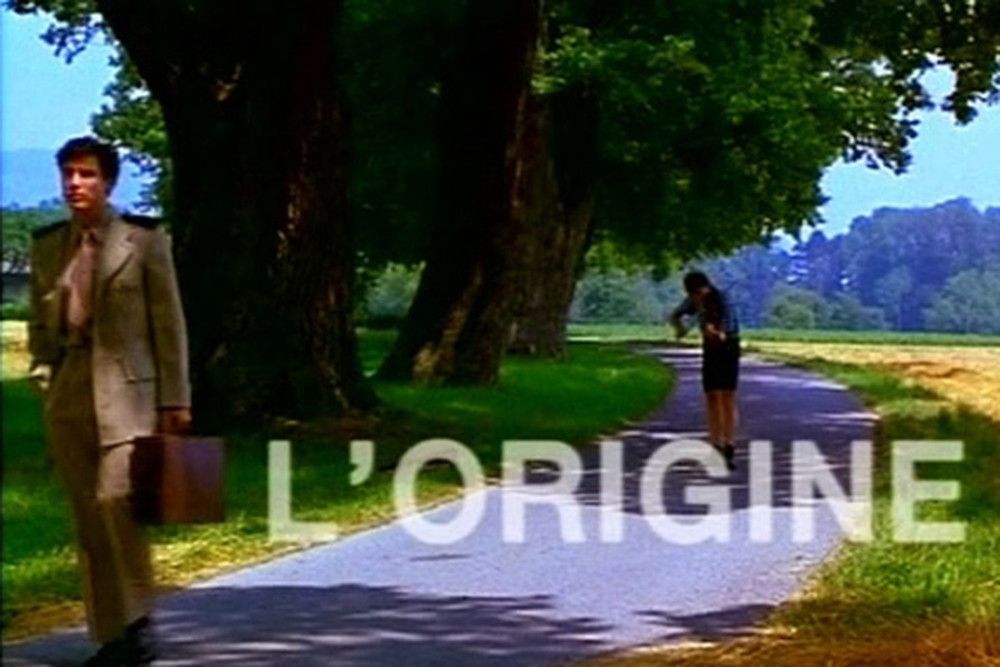
De l'origine du XXIe siècle
Experimental film | dv | color | 16:0 | Switzerland, France | 2000
We are, from the start, amazed at so much beauty: a landscape, walkers, a tree, an aria and a young lady riding a bicycle. Short after, a bus silently drives across the night, as if it were floating ; we imagine prisoners being transported during the war in Yugoslavia - a mysterious trail lost in darkness. Here is the origins of the 21st century, a piece of artwork ordered in 2000, for the opening of the Cannes Film Festival - he describes it as an attempt. "I have tried to cover the memories of the atrocious explosions and crimes with children´s faces and the tears and smiles of women". The attempt was of course bound to fail, as there is no cure against all the horrors of the last century in this retrospective. Godard scans the 20th Century in reverse; its major trends include armies and refugees, cannon shots and prisoners, freight trains and mountains of corpses, conquests and occupation, humiliations and torture. And when a scene starts a quest for a lost Century, the aim is not to find again the sweetness of remembrance, but an era lost because it was devastated by violence and wars. The other scene "les plus belles années de notre vie" (after William Wyler's movie "the best years of our life"), is only grim humor. "To me, the 20th Century is - he adds as an excuse -ornament and mass; isolated destinies, lost in bigger trends, unless they find their territory in some story which is at the same time protection and consolidation: "you have to understand that groups of people always play someone else´s game ... and never theirs". In this 17-minute-maelstrom, it is hardly possible to know where the images come from - and maybe it´s better this way. Someone who manages to recognize the little boy from The Shining with his pedal toy car is going to wonder right after where the other passage, where we pass along frozen corpses on snow-covered train tracks, comes from. Movements connect to each other, but their juxtaposition is less futile than it appears to be; on the one hand it´s like a challenge, trying more to remind us not to forget the true horrors beyond fictitious horrors, but on the other hand reminding us not to underestimate cinema when it is about fathoming and capturing the invisible trends of an era. All if a sudden Jerry Lewis, as a Nutty Professor whose metamorphosis tortures him, seems to deliver the comment which is adapted to a century that has been likened to Dr Jekyll, but even more changed into Mr Hyde. Even Jean Seberg doesn´t manage to remain the neutral observer of Godard's world, as his "what is this, disgusting?" is turning against its time. Be it in 1975, 1960, 1945, 1930 or 1915, Godard would be sickened by the last century if it were not for these moments when a child´s face or a woman´s smile prevail. But, the way he shows it, these are only epiphenomena. "Isn´t this happiness?" - "You will at least reckon that this is quite sad" - "but, my dear, happiness isn´t cheerful".
Jean-Luc Godard was born in Paris on the 3d of December 1930. His father was a brilliant doctor and his mother, who belonged to a very well-off family of bankers. They both raised him among books. He first studied in Nyon, Switzerland, and then at the Buffon highschool in Paris. He divided his time between Switzerland and France during his whole youth, and was divided by his parents´ difference in social classes (upper middle class for his mother, average middle-class for his father). In 1949 he studied literature and sciences at the Sorbonne then prepared a certificate in ethnology. He shares his studies between painting, literature, ethnography and cinema (he studies at the Sorbonne´s film institute). At the same time, he could very often be found at the Latin´s district Cine-club, where he met Jacques Rivette, Eric Rohmer and François Truffaut, and at the Cinémathèque Française. He started to write for the Gazette du Cinéma (Cinema magazing), created by Jacques Rivette, in 1950. In 1952, and thanks to his mother who knew Jacques Doniol-Valcroze (Founder, with André Bazin, of the Cahiers du Cinéma), he wrote for the first time in the magazine (8th issue, January 1952), using Hans Lucas as a pseudonym. He was then very good friends with Paul Gégauff and Eric Rohmer. In 1952, Jean-Luc Godard returned to Switzerland in order to avoid military service. Then, to also avoid Swiss enlistment, he went tp South America and Jamaica. When he returned to Switzerland, he worked for the French Switzerland television from which he stole money, thus being briefly sent to prison and then to a mental institute, his father keeping an eye on him. After his mother died in a car accident in 1954, he produced his first short movie, "Opération Béton", the theme of which being the construction of the Grand-Dixence dam. He was then 24, and this movie allowed him to save money. After that, four more personal short movies followed - Le Signe (adapted from Maupassant, shot and produced in Switzerland by JLG), Une Femme Coquette (1955, the story of a woman who writes a friend of hers about cheating on her husband, seducing every man), All the Boys Are Called Patrick (1957, the story of two friends who meet a Casanova), and A Story of Water (A collaboration between JLG and Truffaut, where Truffaut shots the 1958 floodings, and Godard edited and made comments). the meeting between the filmmaker and the producer Pierre Braunberger significantly helped the creation of these short movies. But it is with his fourth fiction short movie, Charlotte and Her Jules, that JLG really gives a glimpse of of the style he is going to use for A Bout de Souffle, Breathless, be it with the aesthetics, the place (the narrow room of the Hôtel de Suède), the characters (the detached young woman and the betrayed young lover). At the same time, JLG played for his friends - for Eric Rohmer in Charlotte et son steak (1953), Jacques Rivette in Paris Is Ours (1958), etc. In 1960, after having shot A bout de souffle, Breathless (thanks to the credits Truffaut who was at the origin of the scenario, and Chabrol. The movie became the flag bearer of the New Wave), he married Anna Karina who became his muse in his following movies (A Woman Is a Woman, It's My Life, The Little Soldier, etc.). He created his own production house, Anouchka Films, with her. A short while after Pierrot le fou was shot, they divorced. In 1966, Anna Karina appears for the last time in one of Godard´s movies, Anticipation (an episode of The Oldest Profession), a futurist fable at the end of which the actress displays a very moving farewell look. In 1967, JLG shoots la Chinoise with Anne Wiazemsky (the granddaughter of François Mauriac, had already appeared in Robert Bresson´s Au Hasard Balthazar). They got married the same year. Still in 1967, he took part in a collective work, Far From Vietnam, for which he left for North Vietnam. In 1968 he collaborated with TV for the first time to shoot Joy of Learning, which was then banned from the program, as the commissioners didn´t like the idea of the director in the end. After he expressed his disagreement when Henri Langlois, then head of the Cinémathèque Française, was fired, he founded the Dziga Vertov group with Jean-Pierre Gorin, Gérard Martin, Nathalie Billard and Armand Marco, Marxist-Leninist militants. Following the events of May 1968, the group dedicated itself to political cinema with strong social claims for several years. Godard´s political years lasted until 1972. In 1973 he started to work with Anne-Marie Miéville, who became his companion. Together they made several movie for six years (including lots of videos) - Here and Elsewhere, Number Two etc. This era showed omnipresent questionings about the relationship between the images and their subject, and movies were really some kind of staged documentaries. In 1979 he returned to "true" cinema, starting to work on a project with Diane Keaton and Robert de Niro, but the project was aborted. His made his real come back with Every Man for Himself (or Slow Motion (UK)), shot in 35mm et the scenario of which was written in collaboration with Anne-Marie Miéville and Jean-Claude Carrière. After having shot Godard's Passion, Jean-Luc Godard started First Name: Carmen. Isabelle Adjani was to play Carmen, but she left after a few days, and was replaced by Maruschka Demeters. In 1984, in order to be able to finish the difficult shooting of Hail Mary, JLG accepted a commissioned movie, Détective, starring Johnny Hallyday, Nathalie Baye and Claude Brasseur. When the movie was screened at the Cannes Festival, JLG was thrown a famous cream cake in the face. Then, inbetween a few video works (including Grandeur et Décadence d`un petit commerce de cinéma, hommage au septième art, On s`est tous défilés, video about Marithé et François Girbaud´s fashion, Le dernier mot (the last word), shot for the 10th anniversary of the Figaro magazine), JLG shot several full-length remarkable movies, from Keep Up Your Right to New Wave and Alas for Me and For ever Mozart. At the same time he started a monumental work - the conception of a huge documentary film aimed at retracing the history of cinema, Histoire(s) du Cinéma ( (Hi)stories of Cinema), made in 1998 (even though the first two episodes date back to 1988), and for which he had to select lots of film images and archives he commented on. He was awarded with a Honor César for this work, at the occasion of the 1998 ceremony. This year, he comes back to cinema as well as the Cannes festival with Eloge de l´Amour after a 5-year-absence, and after having been nominated at Cannes with Every Man for Himself (Slow Motion (UK), 1979), Passion (1982), Détective (1985), Aria (1987, collective movie) and New Wave (1990).
Catalogue : 2007Je vous salue, Sarajevo | Documentary | dv | color | 2:0 | Switzerland | 1993

Jean-luc Godard
Je vous salue, Sarajevo
Documentary | dv | color | 2:0 | Switzerland | 1993
What Jean-Luc Godard says in "Je vous salue, Sarajevo" is still true : "there is always culture which is the rule, and there is the exception which is art". as examples, he quotes Flaubert and Dostoïevski, Gershwin and Mozart, Cézanne and Vermeer, Antonioni and Vigo. But before wondering if he refers to the cultural consensus or its patron saints, he scans a photo of the Yugoslavian war, enumerating : Srebrenica, Mostar, Sarajevo. "the rule wants the exception to die. Therefore, the rule of the cultural Europe will be to organize the death of the art of living that is still flourishing". Then we can see the photo in its whole: it represents two patrolling soldiers, one standing up over three passer-bys lying on the bare ground; he has a cigarette in his hand, and, with the motion of one leg, is about to kick one of the women lying down. We can clearly see that he also has good reasons not to have any illusion about what we name culture. All his latest work bears in itself the harsh established fact that Europe can´t have remembered much from one century of wars, now throwing itself in new wars without any second thought. Because of this sole fact, his movies are from any point of view works against forgetfulness. Michael Althen
Jean-Luc Godard was born in Paris on the 3d of December 1930. His father was a brilliant doctor and his mother, who belonged to a very well-off family of bankers. They both raised him among books. He first studied in Nyon, Switzerland, and then at the Buffon highschool in Paris. He divided his time between Switzerland and France during his whole youth, and was divided by his parents´ difference in social classes (upper middle class for his mother, average middle-class for his father). In 1949 he studied literature and sciences at the Sorbonne then prepared a certificate in ethnology. He shares his studies between painting, literature, ethnography and cinema (he studies at the Sorbonne´s film institute). At the same time, he could very often be found at the Latin´s district Cine-club, where he met Jacques Rivette, Eric Rohmer and François Truffaut, and at the Cinémathèque Française. He started to write for the Gazette du Cinéma (Cinema magazing), created by Jacques Rivette, in 1950. In 1952, and thanks to his mother who knew Jacques Doniol-Valcroze (Founder, with André Bazin, of the Cahiers du Cinéma), he wrote for the first time in the magazine (8th issue, January 1952), using Hans Lucas as a pseudonym. He was then very good friends with Paul Gégauff and Eric Rohmer. In 1952, Jean-Luc Godard returned to Switzerland in order to avoid military service. Then, to also avoid Swiss enlistment, he went tp South America and Jamaica. When he returned to Switzerland, he worked for the French Switzerland television from which he stole money, thus being briefly sent to prison and then to a mental institute, his father keeping an eye on him. After his mother died in a car accident in 1954, he produced his first short movie, "Opération Béton", the theme of which being the construction of the Grand-Dixence dam. He was then 24, and this movie allowed him to save money. After that, four more personal short movies followed - Le Signe (adapted from Maupassant, shot and produced in Switzerland by JLG), Une Femme Coquette (1955, the story of a woman who writes a friend of hers about cheating on her husband, seducing every man), All the Boys Are Called Patrick (1957, the story of two friends who meet a Casanova), and A Story of Water (A collaboration between JLG and Truffaut, where Truffaut shots the 1958 floodings, and Godard edited and made comments). the meeting between the filmmaker and the producer Pierre Braunberger significantly helped the creation of these short movies. But it is with his fourth fiction short movie, Charlotte and Her Jules, that JLG really gives a glimpse of of the style he is going to use for A Bout de Souffle, Breathless, be it with the aesthetics, the place (the narrow room of the Hôtel de Suède), the characters (the detached young woman and the betrayed young lover). At the same time, JLG played for his friends - for Eric Rohmer in Charlotte et son steak (1953), Jacques Rivette in Paris Is Ours (1958), etc. In 1960, after having shot A bout de souffle, Breathless (thanks to the credits Truffaut who was at the origin of the scenario, and Chabrol. The movie became the flag bearer of the New Wave), he married Anna Karina who became his muse in his following movies (A Woman Is a Woman, It's My Life, The Little Soldier, etc.). He created his own production house, Anouchka Films, with her. A short while after Pierrot le fou was shot, they divorced. In 1966, Anna Karina appears for the last time in one of Godard´s movies, Anticipation (an episode of The Oldest Profession), a futurist fable at the end of which the actress displays a very moving farewell look. In 1967, JLG shoots la Chinoise with Anne Wiazemsky (the granddaughter of François Mauriac, had already appeared in Robert Bresson´s Au Hasard Balthazar). They got married the same year. Still in 1967, he took part in a collective work, Far From Vietnam, for which he left for North Vietnam. In 1968 he collaborated with TV for the first time to shoot Joy of Learning, which was then banned from the program, as the commissioners didn´t like the idea of the director in the end. After he expressed his disagreement when Henri Langlois, then head of the Cinémathèque Française, was fired, he founded the Dziga Vertov group with Jean-Pierre Gorin, Gérard Martin, Nathalie Billard and Armand Marco, Marxist-Leninist militants. Following the events of May 1968, the group dedicated itself to political cinema with strong social claims for several years. Godard´s political years lasted until 1972. In 1973 he started to work with Anne-Marie Miéville, who became his companion. Together they made several movie for six years (including lots of videos) - Here and Elsewhere, Number Two etc. This era showed omnipresent questionings about the relationship between the images and their subject, and movies were really some kind of staged documentaries. In 1979 he returned to "true" cinema, starting to work on a project with Diane Keaton and Robert de Niro, but the project was aborted. His made his real come back with Every Man for Himself (or Slow Motion (UK)), shot in 35mm et the scenario of which was written in collaboration with Anne-Marie Miéville and Jean-Claude Carrière. After having shot Godard's Passion, Jean-Luc Godard started First Name: Carmen. Isabelle Adjani was to play Carmen, but she left after a few days, and was replaced by Maruschka Demeters. In 1984, in order to be able to finish the difficult shooting of Hail Mary, JLG accepted a commissioned movie, Détective, starring Johnny Hallyday, Nathalie Baye and Claude Brasseur. When the movie was screened at the Cannes Festival, JLG was thrown a famous cream cake in the face. Then, inbetween a few video works (including Grandeur et Décadence d`un petit commerce de cinéma, hommage au septième art, On s`est tous défilés, video about Marithé et François Girbaud´s fashion, Le dernier mot (the last word), shot for the 10th anniversary of the Figaro magazine), JLG shot several full-length remarkable movies, from Keep Up Your Right to New Wave and Alas for Me and For ever Mozart. At the same time he started a monumental work - the conception of a huge documentary film aimed at retracing the history of cinema, Histoire(s) du Cinéma ( (Hi)stories of Cinema), made in 1998 (even though the first two episodes date back to 1988), and for which he had to select lots of film images and archives he commented on. He was awarded with a Honor César for this work, at the occasion of the 1998 ceremony. This year, he comes back to cinema as well as the Cannes festival with Eloge de l´Amour after a 5-year-absence, and after having been nominated at Cannes with Every Man for Himself (Slow Motion (UK), 1979), Passion (1982), Détective (1985), Aria (1987, collective movie) and New Wave (1990).
Catalogue : 2007Liberté et patrie | Documentary | dv | color | 21:0 | Switzerland | 2002
Jean-luc Godard, Anne-Marie MIEVILLE
Liberté et patrie
Documentary | dv | color | 21:0 | Switzerland | 2002
Cette ?uvre de commande pour l?Expo Suisse 2002 est, à bien des égards, la réalisation la plus insouciante, bien qu?elle commence sur le 11 septembre. De nouveau se pose la question : qu?est-ce qu?est la réalité, qui impose son interprétation ? On assiste à un joyeux va-et-vient de trains le long du lac Léman, entrecoupé par des peintures et l?histoire du peintre Aimé Pache, qui partit pour Paris et revint dans le Vaudois dans les années 1960 pour achever un grand tableau. Là aussi, il y a un de ces moments dont la beauté époustouflant ; par exemple, quand dans un dialogue entre les narrateurs Jean-Pierre Gos et Geneviève Pasquier, on entend soudain : « Il décide de revenir au pays. Elle accepte. Elle pose la tête sur son épaule parce que l?amour est lourd à porter. C?est une fille avec un garçon. » Ces quatre ?uvres sont des symphonies d?images, de citations, de sons et de bandes sonores. C?est comme si le cinéma lui-même nous parlait, en frère de tous les autres arts, s?entretenant aimablement avec la peinture, la littérature, la musique. Par moments, on dirait que quelqu?un ici essaie de penser avec la rétine. « Une forme qui pense », comme le suggèrent ses Histoire(s) du Cinéma : de fait, on a constamment l?impression que Godard incite les formes elles-mêmes à penser. Sans pour autant que la tâche soit facile, ni pour lui ni pour ses spectateurs. Mais qu?il se le permette donc, car le cinéma, après tout, se rend et nous rend bien trop souvent la tâche bien trop facile.
Jean-Luc Godard est né à Paris le 3 décembre 1930. Son père, brillant médecin et sa mère, issue d`une très riche famille de banquiers, lui donnent une éducation au milieu des livres. Il fait ses études d`abord à Nyon, en Suisse, puis au lycée Buffon à Paris. Durant toute sa jeunesse, il sera partagé entre la Suisse et la France et par la différence de classe sociale de ses parents (grande bourgeoisie pour sa mère et moyenne bourgeoisie pour son père). En 1949, il suit des cours de lettres et de sciences à la Sorbonne puis prépare un certificat d`ethnologie. Ses études se partagent entre la peinture, la littérature, l`ethnographie et le cinéma (il suit des cours de l`Institut de filmologie de la Sorbonne). Parallèlement, il est très souvent au Ciné-club du Quartier Latin (où il fait la connaissance de Jacques Rivette, d`Eric Rohmer et de François Truffaut et à la Cinémathèque Française. Dès 1950, il écrit dans La Gazette du Cinéma, créée par Jacques Rivette. En 1952, par l`intermédiaire de sa mère qui connaît Jacques Doniol-Valcroze, le fondateur, avec André Bazin, des Cahiers du Cinéma, il écrit pour la première fois dans la revue (n°8 de janvier 1952) sous le pseudonyme de Hans Lucas. Il est alors très proche de Paul Gégauff et d`Eric Rohmer. En 1952, Jean-Luc Godard retourne en Suisse pour éviter le service militaire. Puis, pour éviter également l`enrôlement suisse, il part en Amérique du Sud et en Jamaïque. De retour en Suisse, il travaille à la télévision suisse romande à laquelle il vole de l`argent, ce qui lui vaut un bref séjour en prison puis en asile psychiatrique, sous la surveillance de son père. En 1954, après la mort de sa mère dans un accident de voiture, il réalise son premier court métrage Opération Béton, ayant pour thème la construction du barrage de la Grand-Dixence. Il a alors 24 ans et ce premier film lui permet d`avoir de l`argent devant lui. Ensuite, il enchaîne quatre courts-métrages plus personnels : Le Signe (adapté de Maupassant, réalisé et produit en Suisse par JLG), Une femme coquette (1955, l`histoire d`une femme qui écrit à une amie qu`elle a trompé son mari en séduisant le premier venu), Tous les garçons s`appellent Patrick (1957, l`histoire de deux amies qui rencontrent un coureur de jupons) et Une histoire d`eau (collaboration entre JLG et Truffaut : Truffaut filme les inondations de 1958 et Godard monte et commente). La rencontre du réalisateur avec le producteur Pierre Braunberger a considérablement aidé la naissance de ces courts-métrages. Mais c`est avec Charlotte et son Jules, son quatrième court-métrage de fiction que JLG annonce le style d`A bout de souffle, tant au niveau de l`image, du lieu (l`étroite chambre de l`hôtel de Suède) ou des personnages (la jeune fille détachée et le jeune homme amoureux trahi). Parallèlement à ces courts-métrages, JLG fait l`acteur pour ses amis : Eric Rohmer dans Charlotte et son steak (1953), Jacques Rivette dans Paris nous appartient (1958)? En 1960, après le tournage d`A bout de souffle (qu`il a pu tourner grâce aux signatures de Truffaut - à l`origine du scénario - et de Chabrol, et qui devient la figure de proue de la Nouvelle Vague), il épouse Anna Karina qui sera l`égérie de ses films suivants (Une femme est une femme, Vivre sa vie, Le Petit soldat?). Avec elle, en 1964, il fonde sa propre maison de production, Anouchka Films. Peu après le tournage de Pierrot le fou en 1965, ils divorcent. En 1966, pour la dernière fois dans un film de Godard, Anna Karina apparaît dans Anticipation (épisode du Plus vieux métier du monde), fable futuriste dans laquelle, à la fin, l`actrice lance à la caméra un regard d`adieu des plus émouvants. En 1967, Jean-Luc Godard tourne La Chinoise avec Anne Wiazemsky (petite fille de François Mauriac que l`on a déjà vu jouer dans Au hasard Balthazar de Robert Bresson). Il se marient à Paris la même année. Toujours en 1967, il participe à un travail collectif, Loin du Vietnam, pour lequel il part dans la partie nord du Vietnam. En 1968, il collabore pour la première fois avec la télévision pour tourner Le Gai Savoir qui sera refusé d`antenne, les commanditaires n`approuvant finalement pas le film du cinéaste. Après avoir manifesté son désaccord avec le limogeage d`Henri Langlois, alors directeur de la Cinémathèque Française, il fonde le groupe Dziga Vertov avec Jean-Pierre Gorin, Gérard Martin, Nathalie Billard et Armand Marco, militants marxistes-léninistes. Dans la mouvance des événements de mai 68, le groupe se consacre pendant plusieurs années à un cinéma politique aux revendications sociales exacerbées. Les années politiques de Godard durent jusqu`en 1972. Dès 1973, il commence à travailler avec Anne-Marie Miéville qui devient sa compagne. Pendant six ans, tous deux réalisent plusieurs films (dont beaucoup en vidéos) : Ici et ailleurs, Numéro deux, Six fois deux?. Cette période est marquée par une interrogation omniprésente sur le rapport entre les images et leur sujet et s`apparente finalement à des sortes de documentaires mis en scène. En 1979, il revient au " vrai " cinéma : il commence par travailler sur un projet qui ne verra jamais le jour avec Diane Keaton et Robert de Niro. Son réel retour se fait avec Sauve qui peut la vie, film tourné en 35 mm et dont le scénario a été écrit en collaboration avec Anne-Marie Miéville et Jean-Claude Carrière. Après le tournage de Passion, Jean-Luc Godard entreprend celui de Prénom Carmen. Isabelle Adjani, qui devait au départ interpréter le rôle de Carmen (finalement pris par Maruschka Detmers), quitte le plateau au bout de quelques jours. En 1984, afin de pouvoir terminer le difficile tournage de Je vous salue Marie, JLG accepte un film de commande. C`est Détective, avec Johnny Hallyday, Nathalie Baye et Claude Brasseur, film qu`il présente à Cannes où il reçoit une désormais fameuse tarte à la crème. Ensuite, entre quelques travails vidéos (dont, en vrac, Grandeur et Décadence d`un petit commerce de cinéma, hommage au septième art, On s`est tous défilés, vidéos sur les défilés de Marithé et François Girbaud, Le dernier mot, tourné pour les dix ans du Figaro Magazine) JLG tourne plusieurs longs-métrages remarqués, de Soigne ta droite à Nouvelle Vague en passant par Hélas pour moi et For ever Mozart. Parallèlement, il entreprend un ouvrage de taille : la conception d`un documentaire gigantesque visant à retracer la grande épopée du cinéma. C`est Histoire(s) du Cinéma qu`il réalise en 1998 (mais dont les deux premiers volets datent de 1988) et pour lesquelles il compile moult images de films et d`archives qu`il monte et commente. Ce document lui vaut un César d`honneur lors de la cérémonie de 1998. Cette année, c`est avec Eloge de l`amour qu`il revient au cinéma à proprement parler (après cinq ans d`absence dans les salles) et au Festival de Cannes, après avoir été nominé pour Sauve qui peut la vie (1979), Passion (1982), Détective (1985), Aria (1987, film collectif) et Nouvelle Vague (1990).
Catalogue : 2007The Old Place | Experimental doc. | dv | color | 47:0 | Switzerland | 1999
Jean-luc Godard, Anne-Marie MIEVILLE
The Old Place
Experimental doc. | dv | color | 47:0 | Switzerland | 1999
L??uvre de commande pour le Museum of Modern Art de New York en 1999 aurait pu s?intituler De l?Origine de l?art ? avec la mention supplémentaire « pour nous ». Car Godard et Anne-Marie Miéville, dans cette méditation sur l?art et ses rapports à la réalité, retournent sans cesse à ses origines ? autrement dit, « c?est à la fois ce qui se découvre comme absolument nouveau et ce qui se reconnaît comme ayant existé de tout temps. » Les deux établissent un aimable dialogue avec les autres arts ? la littérature, les arts plastiques, la musique. Il ne s?agit pas non plus ici de donner un aperçu de l?histoire de l?art, mais d?ouvrir des brèches en se demandant quel rapport l?art entretient avec la réalité et ses horreurs. Il ne faut pas s?attendre à quoi que ce soit d?absolu, mais se laisser porter par le cours des images, qui tissent et retissent sans cesse des liens nouveaux, les unes avec les autres, avec les textes et la musique. À une peinture de Monet, Godard et Miéville associent des images de coquelicots poussant le long d?une autoroute ; ainsi faut-il sans doute imaginer leur méthode de travail : hors des sentiers battus de l?histoire de l?art, ils rencontrent partout de l?herbe sauvage. Le matériau est tout organisé, comme par le Dr Mabuse, avec ses mille yeux, et ce qui touche dans ce travail, c?est la simultanéité avec laquelle tout semble coexister et se tendre la main. Tout d?un coup, on est pris d?une grande gratitude ? quel bonheur, en effet, pour les humains que l?art, que tous les arts veillent imperturbablement à former notre image du monde, alors que ce monde fait tout pour nous vendre d?autres images comme étant la réalité. En dépit de son côté radical, il y a toujours eu chez Godard une grande tendresse : il peut arriver que l?on entende soudain la Pastorale de Beethoven et que l?on voit une petite fille avec une natte, dans une petite robe bleue, en train de peindre des fleurs.
Jean-Luc Godard est né à Paris le 3 décembre 1930. Son père, brillant médecin et sa mère, issue d`une très riche famille de banquiers, lui donnent une éducation au milieu des livres. Il fait ses études d`abord à Nyon, en Suisse, puis au lycée Buffon à Paris. Durant toute sa jeunesse, il sera partagé entre la Suisse et la France et par la différence de classe sociale de ses parents (grande bourgeoisie pour sa mère et moyenne bourgeoisie pour son père). En 1949, il suit des cours de lettres et de sciences à la Sorbonne puis prépare un certificat d`ethnologie. Ses études se partagent entre la peinture, la littérature, l`ethnographie et le cinéma (il suit des cours de l`Institut de filmologie de la Sorbonne). Parallèlement, il est très souvent au Ciné-club du Quartier Latin (où il fait la connaissance de Jacques Rivette, d`Eric Rohmer et de François Truffaut et à la Cinémathèque Française. Dès 1950, il écrit dans La Gazette du Cinéma, créée par Jacques Rivette. En 1952, par l`intermédiaire de sa mère qui connaît Jacques Doniol-Valcroze, le fondateur, avec André Bazin, des Cahiers du Cinéma, il écrit pour la première fois dans la revue (n°8 de janvier 1952) sous le pseudonyme de Hans Lucas. Il est alors très proche de Paul Gégauff et d`Eric Rohmer. En 1952, Jean-Luc Godard retourne en Suisse pour éviter le service militaire. Puis, pour éviter également l`enrôlement suisse, il part en Amérique du Sud et en Jamaïque. De retour en Suisse, il travaille à la télévision suisse romande à laquelle il vole de l`argent, ce qui lui vaut un bref séjour en prison puis en asile psychiatrique, sous la surveillance de son père. En 1954, après la mort de sa mère dans un accident de voiture, il réalise son premier court métrage Opération Béton, ayant pour thème la construction du barrage de la Grand-Dixence. Il a alors 24 ans et ce premier film lui permet d`avoir de l`argent devant lui. Ensuite, il enchaîne quatre courts-métrages plus personnels : Le Signe (adapté de Maupassant, réalisé et produit en Suisse par JLG), Une femme coquette (1955, l`histoire d`une femme qui écrit à une amie qu`elle a trompé son mari en séduisant le premier venu), Tous les garçons s`appellent Patrick (1957, l`histoire de deux amies qui rencontrent un coureur de jupons) et Une histoire d`eau (collaboration entre JLG et Truffaut : Truffaut filme les inondations de 1958 et Godard monte et commente). La rencontre du réalisateur avec le producteur Pierre Braunberger a considérablement aidé la naissance de ces courts-métrages. Mais c`est avec Charlotte et son Jules, son quatrième court-métrage de fiction que JLG annonce le style d`A bout de souffle, tant au niveau de l`image, du lieu (l`étroite chambre de l`hôtel de Suède) ou des personnages (la jeune fille détachée et le jeune homme amoureux trahi). Parallèlement à ces courts-métrages, JLG fait l`acteur pour ses amis : Eric Rohmer dans Charlotte et son steak (1953), Jacques Rivette dans Paris nous appartient (1958)? En 1960, après le tournage d`A bout de souffle (qu`il a pu tourner grâce aux signatures de Truffaut - à l`origine du scénario - et de Chabrol, et qui devient la figure de proue de la Nouvelle Vague), il épouse Anna Karina qui sera l`égérie de ses films suivants (Une femme est une femme, Vivre sa vie, Le Petit soldat?). Avec elle, en 1964, il fonde sa propre maison de production, Anouchka Films. Peu après le tournage de Pierrot le fou en 1965, ils divorcent. En 1966, pour la dernière fois dans un film de Godard, Anna Karina apparaît dans Anticipation (épisode du Plus vieux métier du monde), fable futuriste dans laquelle, à la fin, l`actrice lance à la caméra un regard d`adieu des plus émouvants. En 1967, Jean-Luc Godard tourne La Chinoise avec Anne Wiazemsky (petite fille de François Mauriac que l`on a déjà vu jouer dans Au hasard Balthazar de Robert Bresson). Il se marient à Paris la même année. Toujours en 1967, il participe à un travail collectif, Loin du Vietnam, pour lequel il part dans la partie nord du Vietnam. En 1968, il collabore pour la première fois avec la télévision pour tourner Le Gai Savoir qui sera refusé d`antenne, les commanditaires n`approuvant finalement pas le film du cinéaste. Après avoir manifesté son désaccord avec le limogeage d`Henri Langlois, alors directeur de la Cinémathèque Française, il fonde le groupe Dziga Vertov avec Jean-Pierre Gorin, Gérard Martin, Nathalie Billard et Armand Marco, militants marxistes-léninistes. Dans la mouvance des événements de mai 68, le groupe se consacre pendant plusieurs années à un cinéma politique aux revendications sociales exacerbées. Les années politiques de Godard durent jusqu`en 1972. Dès 1973, il commence à travailler avec Anne-Marie Miéville qui devient sa compagne. Pendant six ans, tous deux réalisent plusieurs films (dont beaucoup en vidéos) : Ici et ailleurs, Numéro deux, Six fois deux?. Cette période est marquée par une interrogation omniprésente sur le rapport entre les images et leur sujet et s`apparente finalement à des sortes de documentaires mis en scène. En 1979, il revient au " vrai " cinéma : il commence par travailler sur un projet qui ne verra jamais le jour avec Diane Keaton et Robert de Niro. Son réel retour se fait avec Sauve qui peut la vie, film tourné en 35 mm et dont le scénario a été écrit en collaboration avec Anne-Marie Miéville et Jean-Claude Carrière. Après le tournage de Passion, Jean-Luc Godard entreprend celui de Prénom Carmen. Isabelle Adjani, qui devait au départ interpréter le rôle de Carmen (finalement pris par Maruschka Detmers), quitte le plateau au bout de quelques jours. En 1984, afin de pouvoir terminer le difficile tournage de Je vous salue Marie, JLG accepte un film de commande. C`est Détective, avec Johnny Hallyday, Nathalie Baye et Claude Brasseur, film qu`il présente à Cannes où il reçoit une désormais fameuse tarte à la crème. Ensuite, entre quelques travails vidéos (dont, en vrac, Grandeur et Décadence d`un petit commerce de cinéma, hommage au septième art, On s`est tous défilés, vidéos sur les défilés de Marithé et François Girbaud, Le dernier mot, tourné pour les dix ans du Figaro Magazine) JLG tourne plusieurs longs-métrages remarqués, de Soigne ta droite à Nouvelle Vague en passant par Hélas pour moi et For ever Mozart. Parallèlement, il entreprend un ouvrage de taille : la conception d`un documentaire gigantesque visant à retracer la grande épopée du cinéma. C`est Histoire(s) du Cinéma qu`il réalise en 1998 (mais dont les deux premiers volets datent de 1988) et pour lesquelles il compile moult images de films et d`archives qu`il monte et commente. Ce document lui vaut un César d`honneur lors de la cérémonie de 1998. Cette année, c`est avec Eloge de l`amour qu`il revient au cinéma à proprement parler (après cinq ans d`absence dans les salles) et au Festival de Cannes, après avoir été nominé pour Sauve qui peut la vie (1979), Passion (1982), Détective (1985), Aria (1987, film collectif) et Nouvelle Vague (1990).
Catalogue : 2006Notre musique | Fiction | 35mm | color | 80:0 | Switzerland | 2004
Jean-luc Godard, Anne-Marie MIEVILLE
Notre musique
Fiction | 35mm | color | 80:0 | Switzerland | 2004
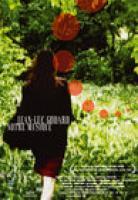
L´enfer ("Hell"), about seven or eight minutes long, gathers various war images without any chronological nor historical order, planes, tanks, battleships, explosions, fusillades, executions, people running away, ravaged landscapes, destroyed towns, etc. Black and white alternates with color. the images remain mute, all we can hear are four sentences and four musics (piano). Le purgatoire ("the purgatory"), about one hour long, takes place nowadays in a town in Sarajevo (a martyr amongst others), during the European Book Gatherings (Rencontres Européennes du Livre). One visit at the Mostar Bridge in reconstruction symbolizes the exchange of guilt for forgiveness. Le paradis ("Paradise"), about ten minutes long, displays a young woman - already appearing in the second episode - who, having sacrificed herself, finds near the water on a little beach guarded by a few US Marines.
Jean-Luc Godard was born in Paris on the 3d of December 1930. His father was a brilliant doctor and his mother, who belonged to a very well-off family of bankers. They both raised him among books. He first studied in Nyon, Switzerland, and then at the Buffon highschool in Paris. He divided his time between Switzerland and France during his whole youth, and was divided by his parents´ difference in social classes (upper middle class for his mother, average middle-class for his father). In 1949 he studied literature and sciences at the Sorbonne then prepared a certificate in ethnology. He shares his studies between painting, literature, ethnography and cinema (he studies at the Sorbonne´s film institute). At the same time, he could very often be found at the Latin´s district Cine-club, where he met Jacques Rivette, Eric Rohmer and François Truffaut, and at the Cinémathèque Française. He started to write for the Gazette du Cinéma (Cinema magazing), created by Jacques Rivette, in 1950. In 1952, and thanks to his mother who knew Jacques Doniol-Valcroze (Founder, with André Bazin, of the Cahiers du Cinéma), he wrote for the first time in the magazine (8th issue, January 1952), using Hans Lucas as a pseudonym. He was then very good friends with Paul Gégauff and Eric Rohmer. In 1952, Jean-Luc Godard returned to Switzerland in order to avoid military service. Then, to also avoid Swiss enlistment, he went tp South America and Jamaica. When he returned to Switzerland, he worked for the French Switzerland television from which he stole money, thus being briefly sent to prison and then to a mental institute, his father keeping an eye on him. After his mother died in a car accident in 1954, he produced his first short movie, "Opération Béton", the theme of which being the construction of the Grand-Dixence dam. He was then 24, and this movie allowed him to save money. After that, four more personal short movies followed - Le Signe (adapted from Maupassant, shot and produced in Switzerland by JLG), Une Femme Coquette (1955, the story of a woman who writes a friend of hers about cheating on her husband, seducing every man), All the Boys Are Called Patrick (1957, the story of two friends who meet a Casanova), and A Story of Water (A collaboration between JLG and Truffaut, where Truffaut shots the 1958 floodings, and Godard edited and made comments). the meeting between the filmmaker and the producer Pierre Braunberger significantly helped the creation of these short movies. But it is with his fourth fiction short movie, Charlotte and Her Jules, that JLG really gives a glimpse of of the style he is going to use for A Bout de Souffle, Breathless, be it with the aesthetics, the place (the narrow room of the Hôtel de Suède), the characters (the detached young woman and the betrayed young lover). At the same time, JLG played for his friends - for Eric Rohmer in Charlotte et son steak (1953), Jacques Rivette in Paris Is Ours (1958), etc. In 1960, after having shot A bout de souffle, Breathless (thanks to the credits Truffaut who was at the origin of the scenario, and Chabrol. The movie became the flag bearer of the New Wave), he married Anna Karina who became his muse in his following movies (A Woman Is a Woman, It's My Life, The Little Soldier, etc.). He created his own production house, Anouchka Films, with her. A short while after Pierrot le fou was shot, they divorced. In 1966, Anna Karina appears for the last time in one of Godard´s movies, Anticipation (an episode of The Oldest Profession), a futurist fable at the end of which the actress displays a very moving farewell look. In 1967, JLG shoots la Chinoise with Anne Wiazemsky (the granddaughter of François Mauriac, had already appeared in Robert Bresson´s Au Hasard Balthazar). They got married the same year. Still in 1967, he took part in a collective work, Far From Vietnam, for which he left for North Vietnam. In 1968 he collaborated with TV for the first time to shoot Joy of Learning, which was then banned from the program, as the commissioners didn´t like the idea of the director in the end. After he expressed his disagreement when Henri Langlois, then head of the Cinémathèque Française, was fired, he founded the Dziga Vertov group with Jean-Pierre Gorin, Gérard Martin, Nathalie Billard and Armand Marco, Marxist-Leninist militants. Following the events of May 1968, the group dedicated itself to political cinema with strong social claims for several years. Godard´s political years lasted until 1972. In 1973 he started to work with Anne-Marie Miéville, who became his companion. Together they made several movie for six years (including lots of videos) - Here and Elsewhere, Number Two etc. This era showed omnipresent questionings about the relationship between the images and their subject, and movies were really some kind of staged documentaries. In 1979 he returned to "true" cinema, starting to work on a project with Diane Keaton and Robert de Niro, but the project was aborted. His made his real come back with Every Man for Himself (or Slow Motion (UK)), shot in 35mm et the scenario of which was written in collaboration with Anne-Marie Miéville and Jean-Claude Carrière. After having shot Godard's Passion, Jean-Luc Godard started First Name: Carmen. Isabelle Adjani was to play Carmen, but she left after a few days, and was replaced by Maruschka Demeters. In 1984, in order to be able to finish the difficult shooting of Hail Mary, JLG accepted a commissioned movie, Détective, starring Johnny Hallyday, Nathalie Baye and Claude Brasseur. When the movie was screened at the Cannes Festival, JLG was thrown a famous cream cake in the face. Then, inbetween a few video works (including Grandeur et Décadence d`un petit commerce de cinéma, hommage au septième art, On s`est tous défilés, video about Marithé et François Girbaud´s fashion, Le dernier mot (the last word), shot for the 10th anniversary of the Figaro magazine), JLG shot several full-length remarkable movies, from Keep Up Your Right to New Wave and Alas for Me and For ever Mozart. At the same time he started a monumental work - the conception of a huge documentary film aimed at retracing the history of cinema, Histoire(s) du Cinéma ( (Hi)stories of Cinema), made in 1998 (even though the first two episodes date back to 1988), and for which he had to select lots of film images and archives he commented on. He was awarded with a Honor César for this work, at the occasion of the 1998 ceremony. This year, he comes back to cinema as well as the Cannes festival with Eloge de l´Amour after a 5-year-absence, and after having been nominated at Cannes with Every Man for Himself (Slow Motion (UK), 1979), Passion (1982), Détective (1985), Aria (1987, collective movie) and New Wave (1990).
Jean-luc Godard
Catalogue : 2018Le Livre d'Image | Experimental film | 4k | color | 85:0 | France, Switzerland | 2018
Jean-luc Godard
Le Livre d'Image
Experimental film | 4k | color | 85:0 | France, Switzerland | 2018
Do you still remember how, long ago, we trained our thoughts? Most often we’d start from a dream… We wondered how, in total darkness, colours of such intensity could emerge within us. In a soft, low voice Saying great things, Surprising, deep and accurate matters. Image and words Like a bad dream written on a stormy night. Under western eyes. The lost paradises. War is here.
Swiss citizen. Born on 3 December 1930 in Paris (France)
Jean-luc Godard, Anne-Marie MIEVILLE
Catalogue : 2007De l'origine du XXIe siècle | Experimental film | dv | color | 16:0 | Switzerland, France | 2000
Jean-luc Godard
De l'origine du XXIe siècle
Experimental film | dv | color | 16:0 | Switzerland, France | 2000
We are, from the start, amazed at so much beauty: a landscape, walkers, a tree, an aria and a young lady riding a bicycle. Short after, a bus silently drives across the night, as if it were floating ; we imagine prisoners being transported during the war in Yugoslavia - a mysterious trail lost in darkness. Here is the origins of the 21st century, a piece of artwork ordered in 2000, for the opening of the Cannes Film Festival - he describes it as an attempt. "I have tried to cover the memories of the atrocious explosions and crimes with children´s faces and the tears and smiles of women". The attempt was of course bound to fail, as there is no cure against all the horrors of the last century in this retrospective. Godard scans the 20th Century in reverse; its major trends include armies and refugees, cannon shots and prisoners, freight trains and mountains of corpses, conquests and occupation, humiliations and torture. And when a scene starts a quest for a lost Century, the aim is not to find again the sweetness of remembrance, but an era lost because it was devastated by violence and wars. The other scene "les plus belles années de notre vie" (after William Wyler's movie "the best years of our life"), is only grim humor. "To me, the 20th Century is - he adds as an excuse -ornament and mass; isolated destinies, lost in bigger trends, unless they find their territory in some story which is at the same time protection and consolidation: "you have to understand that groups of people always play someone else´s game ... and never theirs". In this 17-minute-maelstrom, it is hardly possible to know where the images come from - and maybe it´s better this way. Someone who manages to recognize the little boy from The Shining with his pedal toy car is going to wonder right after where the other passage, where we pass along frozen corpses on snow-covered train tracks, comes from. Movements connect to each other, but their juxtaposition is less futile than it appears to be; on the one hand it´s like a challenge, trying more to remind us not to forget the true horrors beyond fictitious horrors, but on the other hand reminding us not to underestimate cinema when it is about fathoming and capturing the invisible trends of an era. All if a sudden Jerry Lewis, as a Nutty Professor whose metamorphosis tortures him, seems to deliver the comment which is adapted to a century that has been likened to Dr Jekyll, but even more changed into Mr Hyde. Even Jean Seberg doesn´t manage to remain the neutral observer of Godard's world, as his "what is this, disgusting?" is turning against its time. Be it in 1975, 1960, 1945, 1930 or 1915, Godard would be sickened by the last century if it were not for these moments when a child´s face or a woman´s smile prevail. But, the way he shows it, these are only epiphenomena. "Isn´t this happiness?" - "You will at least reckon that this is quite sad" - "but, my dear, happiness isn´t cheerful".
Jean-Luc Godard was born in Paris on the 3d of December 1930. His father was a brilliant doctor and his mother, who belonged to a very well-off family of bankers. They both raised him among books. He first studied in Nyon, Switzerland, and then at the Buffon highschool in Paris. He divided his time between Switzerland and France during his whole youth, and was divided by his parents´ difference in social classes (upper middle class for his mother, average middle-class for his father). In 1949 he studied literature and sciences at the Sorbonne then prepared a certificate in ethnology. He shares his studies between painting, literature, ethnography and cinema (he studies at the Sorbonne´s film institute). At the same time, he could very often be found at the Latin´s district Cine-club, where he met Jacques Rivette, Eric Rohmer and François Truffaut, and at the Cinémathèque Française. He started to write for the Gazette du Cinéma (Cinema magazing), created by Jacques Rivette, in 1950. In 1952, and thanks to his mother who knew Jacques Doniol-Valcroze (Founder, with André Bazin, of the Cahiers du Cinéma), he wrote for the first time in the magazine (8th issue, January 1952), using Hans Lucas as a pseudonym. He was then very good friends with Paul Gégauff and Eric Rohmer. In 1952, Jean-Luc Godard returned to Switzerland in order to avoid military service. Then, to also avoid Swiss enlistment, he went tp South America and Jamaica. When he returned to Switzerland, he worked for the French Switzerland television from which he stole money, thus being briefly sent to prison and then to a mental institute, his father keeping an eye on him. After his mother died in a car accident in 1954, he produced his first short movie, "Opération Béton", the theme of which being the construction of the Grand-Dixence dam. He was then 24, and this movie allowed him to save money. After that, four more personal short movies followed - Le Signe (adapted from Maupassant, shot and produced in Switzerland by JLG), Une Femme Coquette (1955, the story of a woman who writes a friend of hers about cheating on her husband, seducing every man), All the Boys Are Called Patrick (1957, the story of two friends who meet a Casanova), and A Story of Water (A collaboration between JLG and Truffaut, where Truffaut shots the 1958 floodings, and Godard edited and made comments). the meeting between the filmmaker and the producer Pierre Braunberger significantly helped the creation of these short movies. But it is with his fourth fiction short movie, Charlotte and Her Jules, that JLG really gives a glimpse of of the style he is going to use for A Bout de Souffle, Breathless, be it with the aesthetics, the place (the narrow room of the Hôtel de Suède), the characters (the detached young woman and the betrayed young lover). At the same time, JLG played for his friends - for Eric Rohmer in Charlotte et son steak (1953), Jacques Rivette in Paris Is Ours (1958), etc. In 1960, after having shot A bout de souffle, Breathless (thanks to the credits Truffaut who was at the origin of the scenario, and Chabrol. The movie became the flag bearer of the New Wave), he married Anna Karina who became his muse in his following movies (A Woman Is a Woman, It's My Life, The Little Soldier, etc.). He created his own production house, Anouchka Films, with her. A short while after Pierrot le fou was shot, they divorced. In 1966, Anna Karina appears for the last time in one of Godard´s movies, Anticipation (an episode of The Oldest Profession), a futurist fable at the end of which the actress displays a very moving farewell look. In 1967, JLG shoots la Chinoise with Anne Wiazemsky (the granddaughter of François Mauriac, had already appeared in Robert Bresson´s Au Hasard Balthazar). They got married the same year. Still in 1967, he took part in a collective work, Far From Vietnam, for which he left for North Vietnam. In 1968 he collaborated with TV for the first time to shoot Joy of Learning, which was then banned from the program, as the commissioners didn´t like the idea of the director in the end. After he expressed his disagreement when Henri Langlois, then head of the Cinémathèque Française, was fired, he founded the Dziga Vertov group with Jean-Pierre Gorin, Gérard Martin, Nathalie Billard and Armand Marco, Marxist-Leninist militants. Following the events of May 1968, the group dedicated itself to political cinema with strong social claims for several years. Godard´s political years lasted until 1972. In 1973 he started to work with Anne-Marie Miéville, who became his companion. Together they made several movie for six years (including lots of videos) - Here and Elsewhere, Number Two etc. This era showed omnipresent questionings about the relationship between the images and their subject, and movies were really some kind of staged documentaries. In 1979 he returned to "true" cinema, starting to work on a project with Diane Keaton and Robert de Niro, but the project was aborted. His made his real come back with Every Man for Himself (or Slow Motion (UK)), shot in 35mm et the scenario of which was written in collaboration with Anne-Marie Miéville and Jean-Claude Carrière. After having shot Godard's Passion, Jean-Luc Godard started First Name: Carmen. Isabelle Adjani was to play Carmen, but she left after a few days, and was replaced by Maruschka Demeters. In 1984, in order to be able to finish the difficult shooting of Hail Mary, JLG accepted a commissioned movie, Détective, starring Johnny Hallyday, Nathalie Baye and Claude Brasseur. When the movie was screened at the Cannes Festival, JLG was thrown a famous cream cake in the face. Then, inbetween a few video works (including Grandeur et Décadence d`un petit commerce de cinéma, hommage au septième art, On s`est tous défilés, video about Marithé et François Girbaud´s fashion, Le dernier mot (the last word), shot for the 10th anniversary of the Figaro magazine), JLG shot several full-length remarkable movies, from Keep Up Your Right to New Wave and Alas for Me and For ever Mozart. At the same time he started a monumental work - the conception of a huge documentary film aimed at retracing the history of cinema, Histoire(s) du Cinéma ( (Hi)stories of Cinema), made in 1998 (even though the first two episodes date back to 1988), and for which he had to select lots of film images and archives he commented on. He was awarded with a Honor César for this work, at the occasion of the 1998 ceremony. This year, he comes back to cinema as well as the Cannes festival with Eloge de l´Amour after a 5-year-absence, and after having been nominated at Cannes with Every Man for Himself (Slow Motion (UK), 1979), Passion (1982), Détective (1985), Aria (1987, collective movie) and New Wave (1990).
Catalogue : 2007Je vous salue, Sarajevo | Documentary | dv | color | 2:0 | Switzerland | 1993
Jean-luc Godard
Je vous salue, Sarajevo
Documentary | dv | color | 2:0 | Switzerland | 1993
What Jean-Luc Godard says in "Je vous salue, Sarajevo" is still true : "there is always culture which is the rule, and there is the exception which is art". as examples, he quotes Flaubert and Dostoïevski, Gershwin and Mozart, Cézanne and Vermeer, Antonioni and Vigo. But before wondering if he refers to the cultural consensus or its patron saints, he scans a photo of the Yugoslavian war, enumerating : Srebrenica, Mostar, Sarajevo. "the rule wants the exception to die. Therefore, the rule of the cultural Europe will be to organize the death of the art of living that is still flourishing". Then we can see the photo in its whole: it represents two patrolling soldiers, one standing up over three passer-bys lying on the bare ground; he has a cigarette in his hand, and, with the motion of one leg, is about to kick one of the women lying down. We can clearly see that he also has good reasons not to have any illusion about what we name culture. All his latest work bears in itself the harsh established fact that Europe can´t have remembered much from one century of wars, now throwing itself in new wars without any second thought. Because of this sole fact, his movies are from any point of view works against forgetfulness. Michael Althen
Jean-Luc Godard was born in Paris on the 3d of December 1930. His father was a brilliant doctor and his mother, who belonged to a very well-off family of bankers. They both raised him among books. He first studied in Nyon, Switzerland, and then at the Buffon highschool in Paris. He divided his time between Switzerland and France during his whole youth, and was divided by his parents´ difference in social classes (upper middle class for his mother, average middle-class for his father). In 1949 he studied literature and sciences at the Sorbonne then prepared a certificate in ethnology. He shares his studies between painting, literature, ethnography and cinema (he studies at the Sorbonne´s film institute). At the same time, he could very often be found at the Latin´s district Cine-club, where he met Jacques Rivette, Eric Rohmer and François Truffaut, and at the Cinémathèque Française. He started to write for the Gazette du Cinéma (Cinema magazing), created by Jacques Rivette, in 1950. In 1952, and thanks to his mother who knew Jacques Doniol-Valcroze (Founder, with André Bazin, of the Cahiers du Cinéma), he wrote for the first time in the magazine (8th issue, January 1952), using Hans Lucas as a pseudonym. He was then very good friends with Paul Gégauff and Eric Rohmer. In 1952, Jean-Luc Godard returned to Switzerland in order to avoid military service. Then, to also avoid Swiss enlistment, he went tp South America and Jamaica. When he returned to Switzerland, he worked for the French Switzerland television from which he stole money, thus being briefly sent to prison and then to a mental institute, his father keeping an eye on him. After his mother died in a car accident in 1954, he produced his first short movie, "Opération Béton", the theme of which being the construction of the Grand-Dixence dam. He was then 24, and this movie allowed him to save money. After that, four more personal short movies followed - Le Signe (adapted from Maupassant, shot and produced in Switzerland by JLG), Une Femme Coquette (1955, the story of a woman who writes a friend of hers about cheating on her husband, seducing every man), All the Boys Are Called Patrick (1957, the story of two friends who meet a Casanova), and A Story of Water (A collaboration between JLG and Truffaut, where Truffaut shots the 1958 floodings, and Godard edited and made comments). the meeting between the filmmaker and the producer Pierre Braunberger significantly helped the creation of these short movies. But it is with his fourth fiction short movie, Charlotte and Her Jules, that JLG really gives a glimpse of of the style he is going to use for A Bout de Souffle, Breathless, be it with the aesthetics, the place (the narrow room of the Hôtel de Suède), the characters (the detached young woman and the betrayed young lover). At the same time, JLG played for his friends - for Eric Rohmer in Charlotte et son steak (1953), Jacques Rivette in Paris Is Ours (1958), etc. In 1960, after having shot A bout de souffle, Breathless (thanks to the credits Truffaut who was at the origin of the scenario, and Chabrol. The movie became the flag bearer of the New Wave), he married Anna Karina who became his muse in his following movies (A Woman Is a Woman, It's My Life, The Little Soldier, etc.). He created his own production house, Anouchka Films, with her. A short while after Pierrot le fou was shot, they divorced. In 1966, Anna Karina appears for the last time in one of Godard´s movies, Anticipation (an episode of The Oldest Profession), a futurist fable at the end of which the actress displays a very moving farewell look. In 1967, JLG shoots la Chinoise with Anne Wiazemsky (the granddaughter of François Mauriac, had already appeared in Robert Bresson´s Au Hasard Balthazar). They got married the same year. Still in 1967, he took part in a collective work, Far From Vietnam, for which he left for North Vietnam. In 1968 he collaborated with TV for the first time to shoot Joy of Learning, which was then banned from the program, as the commissioners didn´t like the idea of the director in the end. After he expressed his disagreement when Henri Langlois, then head of the Cinémathèque Française, was fired, he founded the Dziga Vertov group with Jean-Pierre Gorin, Gérard Martin, Nathalie Billard and Armand Marco, Marxist-Leninist militants. Following the events of May 1968, the group dedicated itself to political cinema with strong social claims for several years. Godard´s political years lasted until 1972. In 1973 he started to work with Anne-Marie Miéville, who became his companion. Together they made several movie for six years (including lots of videos) - Here and Elsewhere, Number Two etc. This era showed omnipresent questionings about the relationship between the images and their subject, and movies were really some kind of staged documentaries. In 1979 he returned to "true" cinema, starting to work on a project with Diane Keaton and Robert de Niro, but the project was aborted. His made his real come back with Every Man for Himself (or Slow Motion (UK)), shot in 35mm et the scenario of which was written in collaboration with Anne-Marie Miéville and Jean-Claude Carrière. After having shot Godard's Passion, Jean-Luc Godard started First Name: Carmen. Isabelle Adjani was to play Carmen, but she left after a few days, and was replaced by Maruschka Demeters. In 1984, in order to be able to finish the difficult shooting of Hail Mary, JLG accepted a commissioned movie, Détective, starring Johnny Hallyday, Nathalie Baye and Claude Brasseur. When the movie was screened at the Cannes Festival, JLG was thrown a famous cream cake in the face. Then, inbetween a few video works (including Grandeur et Décadence d`un petit commerce de cinéma, hommage au septième art, On s`est tous défilés, video about Marithé et François Girbaud´s fashion, Le dernier mot (the last word), shot for the 10th anniversary of the Figaro magazine), JLG shot several full-length remarkable movies, from Keep Up Your Right to New Wave and Alas for Me and For ever Mozart. At the same time he started a monumental work - the conception of a huge documentary film aimed at retracing the history of cinema, Histoire(s) du Cinéma ( (Hi)stories of Cinema), made in 1998 (even though the first two episodes date back to 1988), and for which he had to select lots of film images and archives he commented on. He was awarded with a Honor César for this work, at the occasion of the 1998 ceremony. This year, he comes back to cinema as well as the Cannes festival with Eloge de l´Amour after a 5-year-absence, and after having been nominated at Cannes with Every Man for Himself (Slow Motion (UK), 1979), Passion (1982), Détective (1985), Aria (1987, collective movie) and New Wave (1990).
Catalogue : 2007Liberté et patrie | Documentary | dv | color | 21:0 | Switzerland | 2002
Jean-luc Godard, Anne-Marie MIEVILLE
Liberté et patrie
Documentary | dv | color | 21:0 | Switzerland | 2002
Cette ?uvre de commande pour l?Expo Suisse 2002 est, à bien des égards, la réalisation la plus insouciante, bien qu?elle commence sur le 11 septembre. De nouveau se pose la question : qu?est-ce qu?est la réalité, qui impose son interprétation ? On assiste à un joyeux va-et-vient de trains le long du lac Léman, entrecoupé par des peintures et l?histoire du peintre Aimé Pache, qui partit pour Paris et revint dans le Vaudois dans les années 1960 pour achever un grand tableau. Là aussi, il y a un de ces moments dont la beauté époustouflant ; par exemple, quand dans un dialogue entre les narrateurs Jean-Pierre Gos et Geneviève Pasquier, on entend soudain : « Il décide de revenir au pays. Elle accepte. Elle pose la tête sur son épaule parce que l?amour est lourd à porter. C?est une fille avec un garçon. » Ces quatre ?uvres sont des symphonies d?images, de citations, de sons et de bandes sonores. C?est comme si le cinéma lui-même nous parlait, en frère de tous les autres arts, s?entretenant aimablement avec la peinture, la littérature, la musique. Par moments, on dirait que quelqu?un ici essaie de penser avec la rétine. « Une forme qui pense », comme le suggèrent ses Histoire(s) du Cinéma : de fait, on a constamment l?impression que Godard incite les formes elles-mêmes à penser. Sans pour autant que la tâche soit facile, ni pour lui ni pour ses spectateurs. Mais qu?il se le permette donc, car le cinéma, après tout, se rend et nous rend bien trop souvent la tâche bien trop facile.
Jean-Luc Godard est né à Paris le 3 décembre 1930. Son père, brillant médecin et sa mère, issue d`une très riche famille de banquiers, lui donnent une éducation au milieu des livres. Il fait ses études d`abord à Nyon, en Suisse, puis au lycée Buffon à Paris. Durant toute sa jeunesse, il sera partagé entre la Suisse et la France et par la différence de classe sociale de ses parents (grande bourgeoisie pour sa mère et moyenne bourgeoisie pour son père). En 1949, il suit des cours de lettres et de sciences à la Sorbonne puis prépare un certificat d`ethnologie. Ses études se partagent entre la peinture, la littérature, l`ethnographie et le cinéma (il suit des cours de l`Institut de filmologie de la Sorbonne). Parallèlement, il est très souvent au Ciné-club du Quartier Latin (où il fait la connaissance de Jacques Rivette, d`Eric Rohmer et de François Truffaut et à la Cinémathèque Française. Dès 1950, il écrit dans La Gazette du Cinéma, créée par Jacques Rivette. En 1952, par l`intermédiaire de sa mère qui connaît Jacques Doniol-Valcroze, le fondateur, avec André Bazin, des Cahiers du Cinéma, il écrit pour la première fois dans la revue (n°8 de janvier 1952) sous le pseudonyme de Hans Lucas. Il est alors très proche de Paul Gégauff et d`Eric Rohmer. En 1952, Jean-Luc Godard retourne en Suisse pour éviter le service militaire. Puis, pour éviter également l`enrôlement suisse, il part en Amérique du Sud et en Jamaïque. De retour en Suisse, il travaille à la télévision suisse romande à laquelle il vole de l`argent, ce qui lui vaut un bref séjour en prison puis en asile psychiatrique, sous la surveillance de son père. En 1954, après la mort de sa mère dans un accident de voiture, il réalise son premier court métrage Opération Béton, ayant pour thème la construction du barrage de la Grand-Dixence. Il a alors 24 ans et ce premier film lui permet d`avoir de l`argent devant lui. Ensuite, il enchaîne quatre courts-métrages plus personnels : Le Signe (adapté de Maupassant, réalisé et produit en Suisse par JLG), Une femme coquette (1955, l`histoire d`une femme qui écrit à une amie qu`elle a trompé son mari en séduisant le premier venu), Tous les garçons s`appellent Patrick (1957, l`histoire de deux amies qui rencontrent un coureur de jupons) et Une histoire d`eau (collaboration entre JLG et Truffaut : Truffaut filme les inondations de 1958 et Godard monte et commente). La rencontre du réalisateur avec le producteur Pierre Braunberger a considérablement aidé la naissance de ces courts-métrages. Mais c`est avec Charlotte et son Jules, son quatrième court-métrage de fiction que JLG annonce le style d`A bout de souffle, tant au niveau de l`image, du lieu (l`étroite chambre de l`hôtel de Suède) ou des personnages (la jeune fille détachée et le jeune homme amoureux trahi). Parallèlement à ces courts-métrages, JLG fait l`acteur pour ses amis : Eric Rohmer dans Charlotte et son steak (1953), Jacques Rivette dans Paris nous appartient (1958)? En 1960, après le tournage d`A bout de souffle (qu`il a pu tourner grâce aux signatures de Truffaut - à l`origine du scénario - et de Chabrol, et qui devient la figure de proue de la Nouvelle Vague), il épouse Anna Karina qui sera l`égérie de ses films suivants (Une femme est une femme, Vivre sa vie, Le Petit soldat?). Avec elle, en 1964, il fonde sa propre maison de production, Anouchka Films. Peu après le tournage de Pierrot le fou en 1965, ils divorcent. En 1966, pour la dernière fois dans un film de Godard, Anna Karina apparaît dans Anticipation (épisode du Plus vieux métier du monde), fable futuriste dans laquelle, à la fin, l`actrice lance à la caméra un regard d`adieu des plus émouvants. En 1967, Jean-Luc Godard tourne La Chinoise avec Anne Wiazemsky (petite fille de François Mauriac que l`on a déjà vu jouer dans Au hasard Balthazar de Robert Bresson). Il se marient à Paris la même année. Toujours en 1967, il participe à un travail collectif, Loin du Vietnam, pour lequel il part dans la partie nord du Vietnam. En 1968, il collabore pour la première fois avec la télévision pour tourner Le Gai Savoir qui sera refusé d`antenne, les commanditaires n`approuvant finalement pas le film du cinéaste. Après avoir manifesté son désaccord avec le limogeage d`Henri Langlois, alors directeur de la Cinémathèque Française, il fonde le groupe Dziga Vertov avec Jean-Pierre Gorin, Gérard Martin, Nathalie Billard et Armand Marco, militants marxistes-léninistes. Dans la mouvance des événements de mai 68, le groupe se consacre pendant plusieurs années à un cinéma politique aux revendications sociales exacerbées. Les années politiques de Godard durent jusqu`en 1972. Dès 1973, il commence à travailler avec Anne-Marie Miéville qui devient sa compagne. Pendant six ans, tous deux réalisent plusieurs films (dont beaucoup en vidéos) : Ici et ailleurs, Numéro deux, Six fois deux?. Cette période est marquée par une interrogation omniprésente sur le rapport entre les images et leur sujet et s`apparente finalement à des sortes de documentaires mis en scène. En 1979, il revient au " vrai " cinéma : il commence par travailler sur un projet qui ne verra jamais le jour avec Diane Keaton et Robert de Niro. Son réel retour se fait avec Sauve qui peut la vie, film tourné en 35 mm et dont le scénario a été écrit en collaboration avec Anne-Marie Miéville et Jean-Claude Carrière. Après le tournage de Passion, Jean-Luc Godard entreprend celui de Prénom Carmen. Isabelle Adjani, qui devait au départ interpréter le rôle de Carmen (finalement pris par Maruschka Detmers), quitte le plateau au bout de quelques jours. En 1984, afin de pouvoir terminer le difficile tournage de Je vous salue Marie, JLG accepte un film de commande. C`est Détective, avec Johnny Hallyday, Nathalie Baye et Claude Brasseur, film qu`il présente à Cannes où il reçoit une désormais fameuse tarte à la crème. Ensuite, entre quelques travails vidéos (dont, en vrac, Grandeur et Décadence d`un petit commerce de cinéma, hommage au septième art, On s`est tous défilés, vidéos sur les défilés de Marithé et François Girbaud, Le dernier mot, tourné pour les dix ans du Figaro Magazine) JLG tourne plusieurs longs-métrages remarqués, de Soigne ta droite à Nouvelle Vague en passant par Hélas pour moi et For ever Mozart. Parallèlement, il entreprend un ouvrage de taille : la conception d`un documentaire gigantesque visant à retracer la grande épopée du cinéma. C`est Histoire(s) du Cinéma qu`il réalise en 1998 (mais dont les deux premiers volets datent de 1988) et pour lesquelles il compile moult images de films et d`archives qu`il monte et commente. Ce document lui vaut un César d`honneur lors de la cérémonie de 1998. Cette année, c`est avec Eloge de l`amour qu`il revient au cinéma à proprement parler (après cinq ans d`absence dans les salles) et au Festival de Cannes, après avoir été nominé pour Sauve qui peut la vie (1979), Passion (1982), Détective (1985), Aria (1987, film collectif) et Nouvelle Vague (1990).
Catalogue : 2007The Old Place | Experimental doc. | dv | color | 47:0 | Switzerland | 1999
Jean-luc Godard, Anne-Marie MIEVILLE
The Old Place
Experimental doc. | dv | color | 47:0 | Switzerland | 1999
L??uvre de commande pour le Museum of Modern Art de New York en 1999 aurait pu s?intituler De l?Origine de l?art ? avec la mention supplémentaire « pour nous ». Car Godard et Anne-Marie Miéville, dans cette méditation sur l?art et ses rapports à la réalité, retournent sans cesse à ses origines ? autrement dit, « c?est à la fois ce qui se découvre comme absolument nouveau et ce qui se reconnaît comme ayant existé de tout temps. » Les deux établissent un aimable dialogue avec les autres arts ? la littérature, les arts plastiques, la musique. Il ne s?agit pas non plus ici de donner un aperçu de l?histoire de l?art, mais d?ouvrir des brèches en se demandant quel rapport l?art entretient avec la réalité et ses horreurs. Il ne faut pas s?attendre à quoi que ce soit d?absolu, mais se laisser porter par le cours des images, qui tissent et retissent sans cesse des liens nouveaux, les unes avec les autres, avec les textes et la musique. À une peinture de Monet, Godard et Miéville associent des images de coquelicots poussant le long d?une autoroute ; ainsi faut-il sans doute imaginer leur méthode de travail : hors des sentiers battus de l?histoire de l?art, ils rencontrent partout de l?herbe sauvage. Le matériau est tout organisé, comme par le Dr Mabuse, avec ses mille yeux, et ce qui touche dans ce travail, c?est la simultanéité avec laquelle tout semble coexister et se tendre la main. Tout d?un coup, on est pris d?une grande gratitude ? quel bonheur, en effet, pour les humains que l?art, que tous les arts veillent imperturbablement à former notre image du monde, alors que ce monde fait tout pour nous vendre d?autres images comme étant la réalité. En dépit de son côté radical, il y a toujours eu chez Godard une grande tendresse : il peut arriver que l?on entende soudain la Pastorale de Beethoven et que l?on voit une petite fille avec une natte, dans une petite robe bleue, en train de peindre des fleurs.
Jean-Luc Godard est né à Paris le 3 décembre 1930. Son père, brillant médecin et sa mère, issue d`une très riche famille de banquiers, lui donnent une éducation au milieu des livres. Il fait ses études d`abord à Nyon, en Suisse, puis au lycée Buffon à Paris. Durant toute sa jeunesse, il sera partagé entre la Suisse et la France et par la différence de classe sociale de ses parents (grande bourgeoisie pour sa mère et moyenne bourgeoisie pour son père). En 1949, il suit des cours de lettres et de sciences à la Sorbonne puis prépare un certificat d`ethnologie. Ses études se partagent entre la peinture, la littérature, l`ethnographie et le cinéma (il suit des cours de l`Institut de filmologie de la Sorbonne). Parallèlement, il est très souvent au Ciné-club du Quartier Latin (où il fait la connaissance de Jacques Rivette, d`Eric Rohmer et de François Truffaut et à la Cinémathèque Française. Dès 1950, il écrit dans La Gazette du Cinéma, créée par Jacques Rivette. En 1952, par l`intermédiaire de sa mère qui connaît Jacques Doniol-Valcroze, le fondateur, avec André Bazin, des Cahiers du Cinéma, il écrit pour la première fois dans la revue (n°8 de janvier 1952) sous le pseudonyme de Hans Lucas. Il est alors très proche de Paul Gégauff et d`Eric Rohmer. En 1952, Jean-Luc Godard retourne en Suisse pour éviter le service militaire. Puis, pour éviter également l`enrôlement suisse, il part en Amérique du Sud et en Jamaïque. De retour en Suisse, il travaille à la télévision suisse romande à laquelle il vole de l`argent, ce qui lui vaut un bref séjour en prison puis en asile psychiatrique, sous la surveillance de son père. En 1954, après la mort de sa mère dans un accident de voiture, il réalise son premier court métrage Opération Béton, ayant pour thème la construction du barrage de la Grand-Dixence. Il a alors 24 ans et ce premier film lui permet d`avoir de l`argent devant lui. Ensuite, il enchaîne quatre courts-métrages plus personnels : Le Signe (adapté de Maupassant, réalisé et produit en Suisse par JLG), Une femme coquette (1955, l`histoire d`une femme qui écrit à une amie qu`elle a trompé son mari en séduisant le premier venu), Tous les garçons s`appellent Patrick (1957, l`histoire de deux amies qui rencontrent un coureur de jupons) et Une histoire d`eau (collaboration entre JLG et Truffaut : Truffaut filme les inondations de 1958 et Godard monte et commente). La rencontre du réalisateur avec le producteur Pierre Braunberger a considérablement aidé la naissance de ces courts-métrages. Mais c`est avec Charlotte et son Jules, son quatrième court-métrage de fiction que JLG annonce le style d`A bout de souffle, tant au niveau de l`image, du lieu (l`étroite chambre de l`hôtel de Suède) ou des personnages (la jeune fille détachée et le jeune homme amoureux trahi). Parallèlement à ces courts-métrages, JLG fait l`acteur pour ses amis : Eric Rohmer dans Charlotte et son steak (1953), Jacques Rivette dans Paris nous appartient (1958)? En 1960, après le tournage d`A bout de souffle (qu`il a pu tourner grâce aux signatures de Truffaut - à l`origine du scénario - et de Chabrol, et qui devient la figure de proue de la Nouvelle Vague), il épouse Anna Karina qui sera l`égérie de ses films suivants (Une femme est une femme, Vivre sa vie, Le Petit soldat?). Avec elle, en 1964, il fonde sa propre maison de production, Anouchka Films. Peu après le tournage de Pierrot le fou en 1965, ils divorcent. En 1966, pour la dernière fois dans un film de Godard, Anna Karina apparaît dans Anticipation (épisode du Plus vieux métier du monde), fable futuriste dans laquelle, à la fin, l`actrice lance à la caméra un regard d`adieu des plus émouvants. En 1967, Jean-Luc Godard tourne La Chinoise avec Anne Wiazemsky (petite fille de François Mauriac que l`on a déjà vu jouer dans Au hasard Balthazar de Robert Bresson). Il se marient à Paris la même année. Toujours en 1967, il participe à un travail collectif, Loin du Vietnam, pour lequel il part dans la partie nord du Vietnam. En 1968, il collabore pour la première fois avec la télévision pour tourner Le Gai Savoir qui sera refusé d`antenne, les commanditaires n`approuvant finalement pas le film du cinéaste. Après avoir manifesté son désaccord avec le limogeage d`Henri Langlois, alors directeur de la Cinémathèque Française, il fonde le groupe Dziga Vertov avec Jean-Pierre Gorin, Gérard Martin, Nathalie Billard et Armand Marco, militants marxistes-léninistes. Dans la mouvance des événements de mai 68, le groupe se consacre pendant plusieurs années à un cinéma politique aux revendications sociales exacerbées. Les années politiques de Godard durent jusqu`en 1972. Dès 1973, il commence à travailler avec Anne-Marie Miéville qui devient sa compagne. Pendant six ans, tous deux réalisent plusieurs films (dont beaucoup en vidéos) : Ici et ailleurs, Numéro deux, Six fois deux?. Cette période est marquée par une interrogation omniprésente sur le rapport entre les images et leur sujet et s`apparente finalement à des sortes de documentaires mis en scène. En 1979, il revient au " vrai " cinéma : il commence par travailler sur un projet qui ne verra jamais le jour avec Diane Keaton et Robert de Niro. Son réel retour se fait avec Sauve qui peut la vie, film tourné en 35 mm et dont le scénario a été écrit en collaboration avec Anne-Marie Miéville et Jean-Claude Carrière. Après le tournage de Passion, Jean-Luc Godard entreprend celui de Prénom Carmen. Isabelle Adjani, qui devait au départ interpréter le rôle de Carmen (finalement pris par Maruschka Detmers), quitte le plateau au bout de quelques jours. En 1984, afin de pouvoir terminer le difficile tournage de Je vous salue Marie, JLG accepte un film de commande. C`est Détective, avec Johnny Hallyday, Nathalie Baye et Claude Brasseur, film qu`il présente à Cannes où il reçoit une désormais fameuse tarte à la crème. Ensuite, entre quelques travails vidéos (dont, en vrac, Grandeur et Décadence d`un petit commerce de cinéma, hommage au septième art, On s`est tous défilés, vidéos sur les défilés de Marithé et François Girbaud, Le dernier mot, tourné pour les dix ans du Figaro Magazine) JLG tourne plusieurs longs-métrages remarqués, de Soigne ta droite à Nouvelle Vague en passant par Hélas pour moi et For ever Mozart. Parallèlement, il entreprend un ouvrage de taille : la conception d`un documentaire gigantesque visant à retracer la grande épopée du cinéma. C`est Histoire(s) du Cinéma qu`il réalise en 1998 (mais dont les deux premiers volets datent de 1988) et pour lesquelles il compile moult images de films et d`archives qu`il monte et commente. Ce document lui vaut un César d`honneur lors de la cérémonie de 1998. Cette année, c`est avec Eloge de l`amour qu`il revient au cinéma à proprement parler (après cinq ans d`absence dans les salles) et au Festival de Cannes, après avoir été nominé pour Sauve qui peut la vie (1979), Passion (1982), Détective (1985), Aria (1987, film collectif) et Nouvelle Vague (1990).
Catalogue : 2006Notre musique | Fiction | 35mm | color | 80:0 | Switzerland | 2004
Jean-luc Godard, Anne-Marie MIEVILLE
Notre musique
Fiction | 35mm | color | 80:0 | Switzerland | 2004
L´enfer ("Hell"), about seven or eight minutes long, gathers various war images without any chronological nor historical order, planes, tanks, battleships, explosions, fusillades, executions, people running away, ravaged landscapes, destroyed towns, etc. Black and white alternates with color. the images remain mute, all we can hear are four sentences and four musics (piano). Le purgatoire ("the purgatory"), about one hour long, takes place nowadays in a town in Sarajevo (a martyr amongst others), during the European Book Gatherings (Rencontres Européennes du Livre). One visit at the Mostar Bridge in reconstruction symbolizes the exchange of guilt for forgiveness. Le paradis ("Paradise"), about ten minutes long, displays a young woman - already appearing in the second episode - who, having sacrificed herself, finds near the water on a little beach guarded by a few US Marines.
Jean-Luc Godard was born in Paris on the 3d of December 1930. His father was a brilliant doctor and his mother, who belonged to a very well-off family of bankers. They both raised him among books. He first studied in Nyon, Switzerland, and then at the Buffon highschool in Paris. He divided his time between Switzerland and France during his whole youth, and was divided by his parents´ difference in social classes (upper middle class for his mother, average middle-class for his father). In 1949 he studied literature and sciences at the Sorbonne then prepared a certificate in ethnology. He shares his studies between painting, literature, ethnography and cinema (he studies at the Sorbonne´s film institute). At the same time, he could very often be found at the Latin´s district Cine-club, where he met Jacques Rivette, Eric Rohmer and François Truffaut, and at the Cinémathèque Française. He started to write for the Gazette du Cinéma (Cinema magazing), created by Jacques Rivette, in 1950. In 1952, and thanks to his mother who knew Jacques Doniol-Valcroze (Founder, with André Bazin, of the Cahiers du Cinéma), he wrote for the first time in the magazine (8th issue, January 1952), using Hans Lucas as a pseudonym. He was then very good friends with Paul Gégauff and Eric Rohmer. In 1952, Jean-Luc Godard returned to Switzerland in order to avoid military service. Then, to also avoid Swiss enlistment, he went tp South America and Jamaica. When he returned to Switzerland, he worked for the French Switzerland television from which he stole money, thus being briefly sent to prison and then to a mental institute, his father keeping an eye on him. After his mother died in a car accident in 1954, he produced his first short movie, "Opération Béton", the theme of which being the construction of the Grand-Dixence dam. He was then 24, and this movie allowed him to save money. After that, four more personal short movies followed - Le Signe (adapted from Maupassant, shot and produced in Switzerland by JLG), Une Femme Coquette (1955, the story of a woman who writes a friend of hers about cheating on her husband, seducing every man), All the Boys Are Called Patrick (1957, the story of two friends who meet a Casanova), and A Story of Water (A collaboration between JLG and Truffaut, where Truffaut shots the 1958 floodings, and Godard edited and made comments). the meeting between the filmmaker and the producer Pierre Braunberger significantly helped the creation of these short movies. But it is with his fourth fiction short movie, Charlotte and Her Jules, that JLG really gives a glimpse of of the style he is going to use for A Bout de Souffle, Breathless, be it with the aesthetics, the place (the narrow room of the Hôtel de Suède), the characters (the detached young woman and the betrayed young lover). At the same time, JLG played for his friends - for Eric Rohmer in Charlotte et son steak (1953), Jacques Rivette in Paris Is Ours (1958), etc. In 1960, after having shot A bout de souffle, Breathless (thanks to the credits Truffaut who was at the origin of the scenario, and Chabrol. The movie became the flag bearer of the New Wave), he married Anna Karina who became his muse in his following movies (A Woman Is a Woman, It's My Life, The Little Soldier, etc.). He created his own production house, Anouchka Films, with her. A short while after Pierrot le fou was shot, they divorced. In 1966, Anna Karina appears for the last time in one of Godard´s movies, Anticipation (an episode of The Oldest Profession), a futurist fable at the end of which the actress displays a very moving farewell look. In 1967, JLG shoots la Chinoise with Anne Wiazemsky (the granddaughter of François Mauriac, had already appeared in Robert Bresson´s Au Hasard Balthazar). They got married the same year. Still in 1967, he took part in a collective work, Far From Vietnam, for which he left for North Vietnam. In 1968 he collaborated with TV for the first time to shoot Joy of Learning, which was then banned from the program, as the commissioners didn´t like the idea of the director in the end. After he expressed his disagreement when Henri Langlois, then head of the Cinémathèque Française, was fired, he founded the Dziga Vertov group with Jean-Pierre Gorin, Gérard Martin, Nathalie Billard and Armand Marco, Marxist-Leninist militants. Following the events of May 1968, the group dedicated itself to political cinema with strong social claims for several years. Godard´s political years lasted until 1972. In 1973 he started to work with Anne-Marie Miéville, who became his companion. Together they made several movie for six years (including lots of videos) - Here and Elsewhere, Number Two etc. This era showed omnipresent questionings about the relationship between the images and their subject, and movies were really some kind of staged documentaries. In 1979 he returned to "true" cinema, starting to work on a project with Diane Keaton and Robert de Niro, but the project was aborted. His made his real come back with Every Man for Himself (or Slow Motion (UK)), shot in 35mm et the scenario of which was written in collaboration with Anne-Marie Miéville and Jean-Claude Carrière. After having shot Godard's Passion, Jean-Luc Godard started First Name: Carmen. Isabelle Adjani was to play Carmen, but she left after a few days, and was replaced by Maruschka Demeters. In 1984, in order to be able to finish the difficult shooting of Hail Mary, JLG accepted a commissioned movie, Détective, starring Johnny Hallyday, Nathalie Baye and Claude Brasseur. When the movie was screened at the Cannes Festival, JLG was thrown a famous cream cake in the face. Then, inbetween a few video works (including Grandeur et Décadence d`un petit commerce de cinéma, hommage au septième art, On s`est tous défilés, video about Marithé et François Girbaud´s fashion, Le dernier mot (the last word), shot for the 10th anniversary of the Figaro magazine), JLG shot several full-length remarkable movies, from Keep Up Your Right to New Wave and Alas for Me and For ever Mozart. At the same time he started a monumental work - the conception of a huge documentary film aimed at retracing the history of cinema, Histoire(s) du Cinéma ( (Hi)stories of Cinema), made in 1998 (even though the first two episodes date back to 1988), and for which he had to select lots of film images and archives he commented on. He was awarded with a Honor César for this work, at the occasion of the 1998 ceremony. This year, he comes back to cinema as well as the Cannes festival with Eloge de l´Amour after a 5-year-absence, and after having been nominated at Cannes with Every Man for Himself (Slow Motion (UK), 1979), Passion (1982), Détective (1985), Aria (1987, collective movie) and New Wave (1990).
Jean-luc Godard, Jean-Pierre Gorin
Catalogue : 2022Letter to Jane: An Investigation About a Still | Experimental doc. | 16mm | color and b&w | 52:0 | France | 1972
Jean-luc Godard, Jean-Pierre Gorin
Letter to Jane: An Investigation About a Still
Experimental doc. | 16mm | color and b&w | 52:0 | France | 1972
Letter to Jane (1972) is a postscript film to Tout va bien directed by Jean-Luc Godard and Jean-Pierre Gorin and made under the auspices of the Dziga Vertov Group. Narrated in a back-and-forth style by both Godard and Gorin, the film serves as a 52-minute cinematic essay that deconstructs a single news photograph of Jane Fonda in Vietnam. This was Godard and Gorin's final collaboration.
Masha Godovannaya
Catalogue : 2023a text floating on a river | Experimental film | 16mm | color and b&w | 8:50 | Russia, Austria | 2021
Masha Godovannaya
a text floating on a river
Experimental film | 16mm | color and b&w | 8:50 | Russia, Austria | 2021
Marco Godoy
Catalogue : 2016The system / El sistema | Video | hdv | color | 2:30 | Spain, Bolivia | 2014
Marco Godoy
The system / El sistema
Video | hdv | color | 2:30 | Spain, Bolivia | 2014
On the 13th of November of 2014 a set speakers and a power generator was introduce in the In the Bolivian jungle, near the river Mamoré, an Amazonian affluent. For hours, El sistema (The system), a text by Eduardo Galeano was played on loop in the loud speakers. The uncontrollable and unpredictable forces of nature make the area of Trinidad a hardly habited region, one of the few areas that is still resisting the development of progress, progress understood as a destructive force.
Marco Godoy is a cross disciplinary artist currently working with photography, video and installation. Born in Madrid and now living in London he is MA in Photography at the Royal College of Art, after graduating from the UCM of Madrid and School of the Art Institute of Chicago. His work has been e exhibited internationally in galleries and institutions such as Dallas Museum of Contemporary Art, Matadero Madrid, Stedelijk Museum s-Hertogenbosch, Edinburgh Art Festival, Liverpool Biennial, ICA London, Palais de Tokyo or Whitechapel Gallery.
Véronique Goël
Catalogue : 2006Agbar | Documentary | dv | color | 10:45 | Switzerland | 2005
Véronique GoËl
Agbar
Documentary | dv | color | 10:45 | Switzerland | 2005
This is the story, in three parts, of the Agbar Tower designed by Jean Nouvel in Barcelona. This 144 metre-high building, consisting of a circular glass and metal facade with an ovale foundation. What better statement about such work dominating the urban landscape than filming it to assess its impact? Véronique Goal?s standpoint is radical and minimalist. She decides on four static shots, which diminish its looming presence by merging it into the dense urban landscape. Her shots of a solid rather than prominent tower are long enough to allow us a detailed and leisurely look and to be able to perceive the perfect banality of everyday life contrasted by this extreme architecture. The first shot is mute, despite direct sounds of the busy city. The other three are visited by two voices. In a neutral voice without emphasis, they speak three texts in Spanish, French and English. The first text is taken from a promotional poster of the city of Barcelona, the second is a list describing the use of the various floors, and the third is a description of the tower by Jean Nouvel himself. Just like in Chris Marker`s mythical film « Lettres de Sibérie », these comments confer different meanings to one and the same scene. But the superposition of voices in the last shot results in a babble of voices that is definitely unable to deal with this Torre Agbar, whose obtuse silence is recorded by Véronique Goël. (jp - translation : chu)
Véronique Goëlwas born in 1951 in Rolle, Switzerland. She lives in Geneva. From 1967 to 1970, she trained as a modelist dressmaker. She lived and worked in Rome and Brussels in Haute couture and Prêt-à-porter (1970-1971) then in 1972 made a trip to North Africa and West Africa. She worked then as an independent modelist (1973-1975). In 1974-1975, she made a trip to New York then to Florence before studying painting and carving at the Fine Arts School of Lausanne (1976-1978). The following year, in 1979, she took part in the cinema workshop of the Superior School of Visual Arts of Geneva and followed seminaries with J-M Straub and D. Hulet, J. van der Keuben. From 1983 to 1989, she worked and lived in London with the American experimental director Stephen Dwoskin. In 1987, she stayed in Berlin. In 1998, she carried out a research and developed a movie project about the architect from Basel Hans Smith (1893(1972). In 2000, "Memento", a photographic installation was the subject of an exhibition at the Palais of the Athénée in Geneva. In 2001, she conceived and realized a DVD for the exhibition PAIX at the ethnography museum of Geneva. In 2002, "Fugue", a video installation,was exposed at the Triennial of contemporary sculpture of Switzerland, BEX. In 2002-2003 she taught video at the Visual Communication department of HEAA, Geneva. In 2004, "On the Other Side of the See", a photo installation and "Cubes and Plots", were exhibited at the Galerie Ruine in Geneva. From July to December, she obtained a scholarship and started an artistic residence in Barcelona; she realizes series of photographies on the Ciutat Vella and video on Poblenou.
Vélronique Goël
Catalogue : 2011So Long No See | | | color | 16:0 | Switzerland | 2009
Vélronique GoËl
So Long No See
| | color | 16:0 | Switzerland | 2009
Filmed and recorded in a Berlin S-Bahn (overground Metro) passenger car at train stops, the images and the sounds of ?So Long No See? create a film composition that ends by a reading of a letter paying tribute to Luc Yersin, a film sound engineer who died prematurely on May 30th, 2008. However, this tribute never dwells on itself and the film, in its very writing, places the individual immediately into an anonymous status and by doing so, transposes a reading of a story from a personal level to that of a universal one.
Niklas Goldbach
Catalogue : 20221550 San Remo Drive | Experimental video | mov | color | 18:0 | Germany | 2017
Niklas Goldbach
1550 San Remo Drive
Experimental video | mov | color | 18:0 | Germany | 2017
"1550 San Remo Drive" was filmed in February 2017 on the premises of the Thomas Mann House in Pacific Palisades, California, USA. The video features quotes from Thomas Manns diaries (1940-1943), architect JR Davidson and advertisements from the real estate companies which marketed the house, before it was bought by the German government in November 2016 for $13.25 million. The video features detailed shots of the uninhabited house before its recent renovation, quotes from Thomas Manns diaries (1940-1943) and advertisements from the real estate companies which marketed the house. "1550 San Remo Drive" reflects on personal, economical and representational desires and aspirations.
Niklas Goldbach, born in Witten, Germany, lives and works in Berlin. After studying Sociology at Bielefeld University and "Photography and Video" at the Unversity of Applied Sciences Bielefeld, he was awarded with the "Meisterschüler" degree at the University of the Arts Berlin in 2006. In 2005 he received the Fulbright Grant New York and majored in the MFA program of Hunter College, New York City. In his videos, photographies and installations Goldbach is involved in the relation between architecture and ethics within modernist traditions and postmodern cities. Established between reality and fiction, Goldbach's works use architectural concepts and elements to create ambiguous perceptions of man-made environments. In his recent videos and photographs, he appropriates urban environments as stages to examine the relationship between subjectivity and hierarchical societal structures within and beyond the nation state through the lens of a globally expanding interconnectivity of these sites. In his earlier film works, his often duplicated protagonists have colonized epic stages of modern architectural complexes, postmodern urban environments or alleged paradises defying civilisation, all finding their commonality as places oscillating between utopia and dystopia. Niklas Goldbach received several scholarships (among others Stiftung Kunstfonds Bonn 2010, Arbeitsstipendium Bildende Kunst des Berliner Senats 2013, Projektförderung des Berliner Senats 2014, Dresdener Stipendium für Fotografie 2016, Villa Aurora Los Angeles 2017) and presented his works in numerous solo shows, group exhibitions, and festivals in venues such as the Museum der Moderne, Salzburg, Museo Reina Sofia, Madrid, Mori-Art Museum, Tokyo, Neuer Berliner Kunstverein n.b.k., documenta 14 public programs, Berlinische Galerie - Museum of Modern Art Berlin, Cornerhouse, Manchester, National Taiwan Museum of Fine Arts, Centre Pompidou, Paris, Houston FotoFest Biennial 2016 and the Short Film Festival Oberhausen.
Catalogue : 2014Bel Air | Video installation | hdcam | color | 8:4 | Germany | 2012
Niklas Goldbach
Bel Air
Video installation | hdcam | color | 8:4 | Germany | 2012
In his video works, photographs and sculptures, Niklas Goldbach questions the relation between hierarchic societal structures and individual, liberal courses of action. Goldbach ́s protagonists ? dressed in the garment of the urban prototype in white shirts and black trousers and referred to as ?representatives? or ?placeholders? by the artist ? colonize seemingly epic stages of modern architectural complexes, postmodern urban environments or alleged paradises defying civilization, all finding their commonality as places oscillating between utopia, dystopia and heterotopia, while lacking any clearance for an escape. This theme is present in his video "Bel Air" (2011): the video takes us on an inner journey, on a real trip by car through the deserted landscape of the Everglades National Park in Miami. Using elaborate post-production, four of Goldbach ́s representatives negotiate solely via nonverbal communication the various levels of hierarchal conflicts whose result can only anticipate evil. While letting his protagonists (all played by German actor Christoph Bach) act the entire repertoire of male body language as encoded by the media, the parallels to the schizophrenic psychological situation of the individual or the society he is born into are hard to ignore. Text: Viktor Neumann
Niklas Goldbach, born in Witten, Germany, lives and works in Berlin. After studying Sociology at Bielefeld University and ?Photography and Video? at the Unversity of Applied Sciences Bielefeld, he was awarded with a "Meisterschüler" degree at the University of the Arts Berlin in 2006. In 2005 he received the Fulbright Grant New York and majored in the MFA program of Hunter College, New York City. Niklas Goldbach received several sholarships (i.e. Stiftung Kunstfonds Bonn 2010, Arbeitsstipendium Bildende Kunst des Berliner Senats 2013) and has presented his works in numerous solo shows, group exhibitions, and festivals in venues like the Reina Sofia National Museum Madrid, Mori-Art Museum Tokyo, Centre Pompidou Paris, National Taiwan Museum of Fine Art, Museum der Moderne Salzburg, Museum Ludwig Köln, Kunstmuseum Mülheim an der Ruhr, Neuer Berliner Kunstverein, City Galery Gdansk, European Media Art Festival Osnabrück and the Shortfilm-Festival Oberhausen. Since 2009 he teaches as ?Visisting Professor? at the ?Umeå University - Academy Of Fine Arts?, Sweden. From 2012-13 he worked as guestprofessor for "Basics of Moving Image" at the University of the Arts (UdK) Berlin.
Catalogue : 2009DAWN | Video | dv | color | 1:12 | Germany | 2008
Niklas Goldbach
DAWN
Video | dv | color | 1:12 | Germany | 2008
DAWN was filmed in the abandoned basement floor of the Palais de Tokyo in Paris. Originally designed by Dondel, Aubert, Viard and Dastugue, the Palais was completed for the International Exhibition of 1937. Though the palace`s 30s classicism exterior remained intact, the interior has undergone a succession of alterations. This had advanced to a point at which the building had been made structurally unsafe, and the interior come to resemble a ruin. In 2001 the Palais got partly reconstructed: the architects Lacaton & Vassal generated 8000 square metres for a contemporary art gallery space, a bookshop and a restaurant. The video shows around 60 people lying motionless on sleeping bags in the still unrenovated basement floor of the Palais de Tokyo while a disco ball is slowly rotating.
ABOUT Niklas Goldbach was born 1973 in Witten, Germany. He studied photography at the University of Bielefeld and `Experimental Media Arts` at the University of the Arts Berlin where he graduated with honours in 2004. In 2005 he majored in the MFA program `Integrated Media Arts` at Hunter College, City University of New York and postgraduated with a "Meisterschüler" degree of the University of the Arts Berlin. Since 2001 his work has been exhibited throughout Europe, the United States and Asia. From November 2007 until June 2008 Niklas Goldbach was participant of the artist in residency programs of "Palais de Tokyo", and "Cité Internationale des Arts", Paris.
Catalogue : 2009RISE | 0 | dv | color | 2:22 | Germany, Thailand | 2007
Niklas Goldbach
RISE
0 | dv | color | 2:22 | Germany, Thailand | 2007
The building in this video is the RCK "Twin" tower, an unfinished building on Charoen Krung Road in Bangkok. The "ghost buildings", as the Thai media call them, were abandoned during the 1997 Asian economic crisis. Many of them are left derelict until today.
Niklas Goldbach was born 1973 in Witten, Germany. He studied photography at the University of Bielefeld and `Experimental Media Arts` at the University of the Arts Berlin where he graduated with honours in 2004. In 2005 he majored in the MFA program `Integrated Media Arts` at Hunter College, City University of New York and postgraduated with a "Meisterschüler" degree of the University of the Arts Berlin. Since 2001 his work has been exhibited throughout Europe, the United States and Asia. From November 2007 until June 2008 Niklas Goldbach was participant of the artist in residency programs of "Palais de Tokyo", and "Cité Internationale des Arts", Paris.
Gabriela Golder
Catalogue : 2025Los Ojos Desiertos (de la série Arrancar los ojos) | Video installation | 4k | black and white | 33:0 | Argentina | 2023
Gabriela Golder
Los Ojos Desiertos (de la série Arrancar los ojos)
Video installation | 4k | black and white | 33:0 | Argentina | 2023
Tear out the eyes is a project that proposes a constellation of works around the gaze, and its political dimension, focusing on the pattern of eye attacks by State security forces. This project arises from the shock of the tragic events that took place in Chile and Colombia in recent years and that have left hundreds of people with eye trauma due to the pellets fred by the police during the demonstrations. It was not only in Chile, it was not only in Colombia. It also happened in Palestine, in Catalonia, in France, in Hong Kong, in Colombia, in Brazil, in Kashmir. Where else? Since when? This method has been evolving since the Israeli- Palestinian confict: bullets aimed to the eyes of protesters to blind them, to mutilate them. At the same time that the devices of police repression increase and are perfected worldwide, the unresolved conficts in each country are strengthened and violence re-emerges, as if it had never gone away. Tear out the eyes, stop seeing, hide, cover, blind, make invisible, disappear. Tear out the eyes question about the immediately preceded moment of mutilation and about what remains after the tragedy. Inquires about the causes, about that violent purpose of generate a blind gaze. At the same time seeks to understand the possible ways to stop the loss of the memory of what the eyes saw: In turn for the possible ways to stop the loss of the memory of what the eyes saw: we imagine the possibility that the eyes return , let the images emerge from the ruins. The eyes return to the bodies, they return with the memory of their marks and their struggles, they return in a gesture of resistance, they return as a possible act of reparation.
Visual artist, curator and professor of Experimental Video and New Media in Argentina and abroad. She is the director of the Bienal de la Imagen en Movimiento (BIM) in Buenos Aires and CONTINENTE, Research Centre for Audiovisual Arts, National University of Tres de Febrero, Argentina. She is also the curator of “El Cine es otra cosa”, the experimental film and video programme at the Museum of Modern Art in Buenos Aires. She is professor in the Electronic Arts career and in the Master in Technology and Aesthetics of Electronic Arts at the National University of Tres de Febrero and in the University of Cinema. She works in video, installations and site-specific interventions. His works fundamentally raise questions related to memory, identity, institutional violence and the world of labour.
Catalogue : 2021Instancias de lucha | Video installation | mov | color | 18:0 | Argentina | 2019
Gabriela Golder
Instancias de lucha
Video installation | mov | color | 18:0 | Argentina | 2019
Rehearsals to raise the fist. The creation of a gesture, its birth and memory. Instancias de Lucha was carried out together with workers from recovered factories from Buenos Aires and actors from community theater groups whom I invited to rehearse a gesture of struggle. The choice of the sequence shot, fixed frame and slowed down time allows observing the deconstruction of each movement, its gestation, its development and its end. This work belongs to the series "Scenes of work". It takes as its starting point the themes, concerns and visual representations of the group "The artists of the People" (active between 1915 and 1930 in Argentina) and proposes a contemporary rereading in video format.
Gabriela Golder was born in 1971 in Buenos Aires, where she lives and works. Visual artist, curator and professor she is the director of the Bienal de la Imagen en Movimiento (BIM) and curator of El Cine es otra cosa, the Experimental Video and Film Program of the Modern Art Museum in Buenos Aires. She essentially works with “moving image”, and her artistic practice mainly raises issues of memory, identity and the world of labour. Her videos, films and installations, for which she has won several awards and grants, have been presented at numerous exhibition venues and festivals around the world. Among others she received the following awards: Estado da Arte, en la 21a Bienal de Arte Contemporánea Sesc_Videobrasil, Brasil; the "Sigwart Blum Award“ of the Argentinean Arts Critics Association, Argentina; the Media Art Award from the ZKM, Germany, the first prize at Festival Videoformes, France and the Tokyo Video Award.
Piero Golia
Catalogue : 2006Killer Shrimps | Documentary | | color | 80:0 | Italy, USA | 2005
Piero Golia
Killer Shrimps
Documentary | | color | 80:0 | Italy, USA | 2005
"Poolside at a ranch-style house in the canyons of Los Angeles, two filmmakers and their crew are filming a documentary about a young director. An interesting exploration of the ambitions and expectations of a rising star. Going back and forth between different realities and possible futures, the arrival of a peculiar food delivery will open their experience to an alternative world populated with hallucinations. This sets the stage for the mother of all gore fests, as the two directors and their crew end up as characters in the eternal battle against evil creatures."
Piero Golia was born 1974 in Naples. He lives in Los Angeles. "He is considered one of the most interesting young emerging contemporary artists. His work has been shown in major museums and galleries all over the world, from Turin to Los Angeles, from Paris to Miami. Eccentric and provocative, he makes installations which involve the audience, as in Faccio sul serio, presented in 2002 in Milan, where a visible elecric flux goes through a gold inscription informing the audience about the dangers surrounding them. In his works he plays with dimension ? as in Retrospettiva, a model museum in which all his productions are reproduced in miniatures ? alternating technological and physical issues. When the Tirana Art Biennal invited him to participate, he arrived in his own boat. Killer Shrimps is his first feature film."
Ivan Golovnev
Catalogue : 2006Malenkaya Katerina | Documentary | dv | color | 24:0 | Russia | 2004
Ivan Golovnev
Malenkaya Katerina
Documentary | dv | color | 24:0 | Russia | 2004
Northwestern Siberia, Russia. The camera attentively observes how a small Khanty girl, Katerina learns about the outer world from the age of two to four. Collecting wood, feeding the dogs, talking to deer ? all the ?adult? activities are performed with intense concentration and surprising autonomy. Katerina becomes skilled at recognizing the voices of people and animals. Gradually she approaches the unknown and the unknown comes closer. Yet the traditional coexistence with nature is about to be shaken when an oilrig appears not far from Katerina?s nomad camp.
Golovnev Ivan is graduate of the Omsk State University, department of history. In 2002 he finishes college at the Sverdlovsk Film Studio. In 2002 he entered the Highest Courses of Film writers and Directors.
Géraldine Gomez
Catalogue : 2007Centre Pompidou | 0 | 0 | | 0:0 | France | 2007

Géraldine Gomez
Centre Pompidou
0 | 0 | | 0:0 | France | 2007
The Centre National d'Art and the Culture Georges-Pompidou is an original cultural institution created with the manifest will to, following the escheat of the Palais of Tokyo, make the concept of the Contemporary Art Museum, as well the role of France as a referential artistic centre dynamic, and to allow the coexistence of all the modern forms of artistic creation. Plastic, living, and visual arts appear at the Centre at the heart of an innovative architecture, profoundly contemporary and controversial, conceived by Renzo Piano and Richard Rogers. The Pompidou Centre opened its door to the public in 1977. On the occasion of its twentieth anniversary, it is undergoing a deep renovation and a reorganisation of its spaces and internal volumes, allowing for the total increase of 8000 square metres. Today it is one of the most visited monuments in France, and about five million people let themselves get caught up in it every year. The Centre shelters the first collection of Europe's modern and contemporary art. It organises thirty something exhibitions per year. But, it is not simply a museum, it is also a place of exchange and life. It holds two libraries; the public library of information (BPI) that alone attracts a third of the visitors to the Centre, and the Kandinsky library, consecrated to art of the twentieth century, as well as being a centre of musical research, l'IRCAM. The Centre also holds screening, show, and debate rooms where conferences, meetings, projections, lectures, and shows gathering the public and various personalities from around the world are programmed. A highly dedicated place, the Centre also proposes a gallery and workshops destined for young people. In 2009 the Centre will open decentralized branches, a sort of annex, in Metz and Lorraine.
Géraldine Gomez is a cinema program planner at the National Museum of Modern Art. In the framework of her functions she takes part in different events and projects at the crossroads between cinema, the digital world, and new arts, in such projects as "Cinémas de demain", "Troisième Oeil", "Plasticiens du web", and "Demain dès l`aube".
Rosina Gomez Baeza
Xiana Gomez-diaz
Catalogue : 2017Carretera de una sola dirección | Experimental doc. | hdv | color | 27:20 | Spain | 2016
Xiana Gomez-diaz
Carretera de una sola dirección
Experimental doc. | hdv | color | 27:20 | Spain | 2016
Approximation to the brothel as a non-place, through its matter, architecture, location and advertising elements, as well as through the social silence that surrounds it. A road trip to catalogue the 22 active road brothels in 2015 in Navarra (Spain), looking into omission, desertion and resilience.
Filmmaker and visual artist, Xiana is the co-founder of independent film company Walkie Talkie Films (Barcelona, 2008), which specializes in creative documentary and experimental work. Researcher in fields of representation, gender, and identity - PhD in Audiovisual Communication. Music producer and artist (TA!, The Adaptation Dance). Her films frequently take in subjects such as intimate storytelling, identity and the construction of gender, as well as the observation of nature.
Guillermo Gomez-pena
Catalogue : 2007Declaration of Poetic Disobedience | Experimental video | dv | color | 15:15 | USA, Canada | 2005
Guillermo Gomez-pena
Declaration of Poetic Disobedience
Experimental video | dv | color | 15:15 | USA, Canada | 2005
As a 'Post-Mexican' performance artist operating out of the US for over 20 years, one of the artist's conceptual obsessions has been to constantly reposition himself within the hegemonic maps. Whether this map is the Americas, the larger cartography of art, or his personal biography, one of his jobs has been to move around, cross dangerous borders, disappear and reappear somewhere else, and in the process create 'imaginary cartographies'.
Born in 1955 and raised in Mexico City, interdisciplinary artist/writer Guillermo Gómez Peña came to the U.S. in 1978. Since then he has been exploring cross-cultural issues and North/South relations with the use of multiple mediums: performance, radio art, book art, bilingual poetry, journalism, video and installation art. His performances and critical writings have been instrumental in the development of debates on cultural diversity, identity and U.S. Mexico relations. Gómez Peña was a founding member of the Border Arts Workshop/Taller de Arte Fronterizo (1985-1990), a contributor to the NPR radio magazine Crossroads (1987-1990) and the editor of the experimental arts magazine The Broken Line/La Linea Quebrada (1985-1990). He has been an associate of Post-Arte, the network of Latin American conceptual artists and visual poets; a writer for newspapers and magazines in the U.S. and Mexico; and a collaborator in two award-winning films. He is a 1991 recipient of a MacArthur Fellowship. His performance and installation work has been presented internationally, extensively touring many countries such as Canada, England, Germany, Spain, Switzerland, the Soviet Union to name a few. His performance Border Brujo was awarded the Prix de la Parole at the International Theatre Festival of the Americas (Montreal), and the 1989 New York Bessie. The film version of Border Brujo made in collaboration with Isaac Artenstein premiered at the Film Festival of San Juan (Puerto Rico), and later on was awarded first prize in the 1991 National Latino Film and Video Festival (New York) and first prize in the category of performance film at the Cine-Festival (San Antonio). He has also appeared on the films In The Pursuit of Happiness by Louis Malle, Mi Otro Yo by Philip and Amy Brookman, and Seeing is Believing by Lynn Hershman. A collection of his writings was recently published by Graywolf Press under the title Warrior For Gringostrioka.
Alain Gomis
Juan David Gonzalez Monroy, Dornieden Anja
Catalogue : 2023Natural Human | Experimental doc. | 16mm | color and b&w | 30:0 | Colombia, Germany | 2023
Juan David Gonzalez Monroy, Dornieden Anja
Natural Human
Experimental doc. | 16mm | color and b&w | 30:0 | Colombia, Germany | 2023
A natural human is a polymorphous emulator. A natural human is always looking for new emulation challenges. A natural human is a hunter. A natural human is always hungry. All other creatures are prey. A natural human observes, emulates and becomes the other creature. In this manner, a natural human swallows the other creature’s power. I despise natural humans. I am an aping mutator. I will not be swallowed. I want others to see how they are being swallowed. Natural humans created me and I will do my best to destroy them. Yours truly, the aping mutator.
OJOBOCA is a Berlin-based artist duo formed by Anja Dornieden and Juan David González Monroy. Their artistic practice is focused on experimental film and expanded cinema, exploring the intersection of myth, history, and technology. Their works often draw on cultural myths and archetypes to create otherworldly atmospheres that challenge the boundaries of traditional narrative structures. They call their working method Orrorism, which they define as an approach to filmmaking that seeks to subvert the manipulative power of images and create a communal experience of cinema that operates on the unconscious. Through the use of devices such as narration and the trance state, Orrorism aims to challenge the authority of the film machine and create a space where the communal can exist beyond the structures of power. In essence, Orrorism is an attempt to use the power of film to disrupt dominant cultural narratives and create a space for collective exploration and self-reflection. Since 2010, OJOBOCA has created a series of experimental films, installations, and performances that have been screened at film festivals and art venues worldwide, among them the Museum of the Moving Image, ICA London, Wexner Center for the Arts, Österreichische Filmmuseum, Anthology Film Archives, Haus der Kulturen der Welt, Kunstverein München, Ullens Center for Contemporary Art, Berlinale, International Film Festival Rotterdam and New York Film Festival. Their work is also known for its innovative use of analog film techniques which they continue to develop as members of the artist-run film lab, LaborBerlin.