Catalogue > Faire une recherche
Résultats pour : Tout le catalogue

Pat Hillaire, Rolf Meesters
Dansent le désert
Art vidéo | s-vhs | couleur | 2:50 | France, Espagne | 2004
`Dansent le désert` Des paysages du corps se juxtaposent en images. Quelles danses sont possibles dans un tel environnement. C`est le défi que le désert pose aux danseurs. Créé par: Pat Hillaire Dansé par Rolf Meesters et Pat Hillaire Durée 2mn50
1998 initie un travail de vidéo-performance en présence de la danseuse Claudia Flammin puis de Rolf Meesters avec qui je commence en 2000 à expérimenter la danse. Dernière performance: octobre 2005 DA LI LI DA DA, Festival d?automne de Barcelone, 6 performers se réunissent pour expérimenter une performance oú l`important sera que chaque proposition aie la même intensité qu`une autre. Danse, poésie,vidéo, flute japonaise se fondent. En 2005 ont surtout lieu des performances de rue: bar opening exhibition, Festival de rue de Bcn, Museo Mares... 2003 à Berlin, ?KNOWHERE? 10 performances de rue, 3 performers,danseurs Rolf Meesters, Pat Hillaire, musicien sans instruments Johannes Bergmark. Celui-ci relève le défi de performer sans ses objets/instruments.

Jürgen Hille
koi beam boats retina
Vidéo expérimentale | mov | | 2:48 | Allemagne | 0
1961 in Düsseldorf geboren 1980-86 Studium Freie Kunst, Kunstakademie Düsseldorf 1983 Reisestipendium der Kunstakademie, Italien 1987 Arbeitsstipendium NRW, Schloss Ringenberg 1994 Arbeitsstipendium Schlesw.-Holstein, Künstlerhaus Selk 1995 Künstleraustausch Düsseldorf-Ein Hod, Israel 1999 Projektstipendium Kunstfonds e.V., Bonn (für Videoprojekt “HALDE”) 2018 Cites internationale des arts Paris (Gastatelier) Mitglied im Deutschen Künstlerbund

Jürgen Hille
AP 28-2
Vidéo expérimentale | mp4 | noir et blanc | 2:28 | Allemagne | 0
Meine Videoarbeit "AP 28-2" zeigt den Ort und die Institution "Alte Post" in Neuss. Das Gebäude wurde 1877 gebaut und diente bis ca. 1987 als städtisches Postgebäude. Ab 1989 ist darin das Kulturforum Alte Post mit einer kleinen Bühne untergebracht. Der Serviceraum hat sich zu einem kreativen Ort gewandelt. Ich zeige den "Tanz-Probe-Raum" im Obergeschoss mit einer Putzfrau in Aktion. Fotos aus dem Stadtarchiv Neuss. Ein bewegter kleiner Stein belebt die Szene akustisch.
1961 geboren in Düsseldorf 1980-86 Studium Freie Kunst, Kunstakademie Düsseldorf seit 1993 dokumentarische und experimentelle Videoarbeiten

Jürgen Hille
space capsule III
Vidéo expérimentale | mp4 | noir et blanc | 1:26 | Allemagne, 0 | 2020
Cette vidéo est une réaction artistique à la pandémie de Covid qui s’est déroulée au cours de la dernière année. Une bouée, dispositif passif et fixe de signalisation, que je remplis d’images souvenir et d’impulsions de mouvement. Un drone monte et descend. Je montre les êtres humains en tant que foule dans un stade de football et en petit groupe de vacanciers sous un parasol sur une plage déserte.
1961: naissance à Düsseldorf, en Allemagne. 1980-86: études de beaux-arts, Kunstakademie Düsseldorf (Allemagne). Depuis 1993, travaux libres de vidéo documentaire et expérimentale

Baba Hillman
Mary Bauermeister: Light and Stone
Film expérimental | super8 | couleur | 3:45 | Canada, France | 2022
Remembering my last visit with Mary in her garden of light, trees, glass and stone.
Baba Hillman grew up in Japan, Venezuela and Panama and works between France and the U.S.. She received a B.A. in French Literature from Duke University and an M.F.A. in Film and Performance from the University of California, San Diego. Her films and performance works explore memory, history, perception and the poetics and politics of place, language, and the body. She was co-director of Teatro Movimento in Florence, studied with Etienne Decroux and Jean-Pierre Gorin, and is Professor Emerita of Film at Hampshire College in Amherst, Massachusetts. Her films have screened widely at festivals and museums including the Museum of Contemporary Art, Los Angeles, FIDMarseille, Edinburgh Film Festival, Rencontres Internationales Paris/Berlin, Ann Arbor Film Festival, National Gallery of Art, Washington D.C., Anthology Film Archives, ICAIC Havana, Africa World Documentary Festival, Yaounde, MIX Brazil, and European Media Art Festival, Osnabruck, among others. She has received awards and grants from the French Ministry of Culture, the Whiting Foundation, the California Arts Council, and the Italian city governments of Florence, Lecce and Certaldo. In 2020, Hillman’s film Kitâb al-Isfâr: Book of the Journey, a feature-length film about near-death and mystical experiences in Andalucia, premiered at the FIDMarseille film festival and was selected for the Athens Avant Garde Film Festival. Earlier films by Hillman include Decroux’s Garden, and 5 Cité de la Roquette, part of a series of films connected to return, place and disappearance.

Baba Hillman
Kitâb al-isfâr: Book of the Journey
Doc. expérimental | 16mm | couleur et n&b | 58:0 | Canada, Espagne | 2020
Poème cinématographique immersif sur un voyage de retour long de sept ans, "Kitâb al-Isfâr: Livre du voyage", entremêle des histoires d’expérience de mort imminente et d'expériences mystiques en Andalousie. À 19 ans, je me suis mise en route, dans l’espoir de trouver le sens de la vie en "essayant tout". J'ai acheté une voiture pour 20 Mark dans un café d'Ulm. Je l'ai peinte à la bombe en jaune et vert et j’ai roulé de la Hollande à l'Espagne en passant par la Roumanie, dormant sur la banquette arrière dans une couverture rouge. Sur la route de Malaga, au sommet d’une montagne, les freins ont lâché. Alors que la voiture dévalait la pente et s'écrasait, j'ai perdu connaissance, avant d’avoir des visions pendant trois jours et trois nuits. Qu'ai-je vu, qu'ai-je compris ? Le Shaykh al-Akbar, Ibn 'Arabi, mystique et philosophe soufi, écrit que le voyage n'a de véritable sens que s'il apporte un nouveau départ. En voyageant, le cœur devient le but.
Baba Hillman est artiste et cinéaste. Elle a grandi au Japon, au Venezuela et au Panama, et travaille entre la France et les États-Unis. Ses films et ses performances interrogent la mémoire, l'histoire, la perception, ainsi que la poétique et la politique du lieu, du langage et du corps. Ses films ont été projetés dans des festivals et des musées, notamment au Museum of Contemporary Art de Los Angeles (USA); au FIDMarseille (France); au Edinburgh Film Festival (Royaume-Uni); à l'Anthology Film Archives, New-York (USA); au Ann Arbor Film Festival (USA); à la National Gallery of Art de Washington D.C. (USA); au Athens Avant Garde Film Festival, Athènes (Grèce); à l’ICAIC - Institut cubain des arts et de l’industrie cinématographique de La Havane (Cuba); à l'Africa World Documentary Festival de Yaoundé (Cameroun); à MIX Brazil (Brésil) et au European Media Art Festival d'Osnabrück (Allemagne).

Julien Hilmoine
A chaque instant mourir
Fiction | 16mm | noir et blanc | 20:20 | France | 2005
Une jeune femme à fleur de peau, Agnès. Son meilleur ami, Camille. Sa compagne, Marianne. La soeur de cette dernière, Astrid. Ils devaient se retrouver tous les quatre, pour la première fois depuis longtemps. Mais Marianne ne vient finalement pas. Agnès part sentimentalement à la dérive. Deux nuits et un jour où vont ressurgir de vieilles histoires, des désirs neufs ou enfouis, et une complète remise en cause de leurs rapports à tous.
-Julien Hilmoine est né à Fécamp, en 1979. -Il a passé son enfance et son adolescence à Rouen, dans "une famille de moyenne bourgeoisie, laïque et républicaine". Après des études de lettres et un B.T.S. Audiovisuel option Image, il entre à la Fémis en département réalisation. -Il mène une jeunesse française classique : histoires d?amour, amitiés ; passions, ruptures ; morts. -Parisien par la force des choses, il déclare essayer de réaliser des films. Il avoue aimer les acteurs, passionnément et mène une quête permanente d?images, de visages, de voix.

Steve Hines
Anyone
Vidéo expérimentale | dv | couleur | 2:11 | Royaume-Uni | 2006
Ce court métrage vidéo critique, parodie et renforce l'idée d'un Public Warning. Quelqu'un s'est emparé de la loi et a promis des poursuites judiciaires. On voit l'artiste, qui pourrait être n'importe qui, en train de défier et d'enfreindre la loi tout en la renforçant. Une planification minutieuse et une demande d'attention nous préparent à l'action en reproduisant la mise en garde, alors que la rapidité et l'humour sont utilisés pour la présentation et la mise en oeuvre de l'action.
Steve Hines a régulièrement exposé ces dix dernières années. Il a présenté son travail à un niveau national et international en participant à plusieurs festivals d'art interantionaux. Grâce à son expérience dans la photographie, la pratique de Steve Hines est solidement encrée dans cadre conceptuel à l'intérieur duquel il se sert de différents media pour travailler. Ceci lui offre une grande liberté et apporte constamment de nouveaux défis. Steve Hines aime réaliser des oeuvres conceptuelles minimales qui sont souvent combinées à la nature opposée, et pourtant complémentaire, des extrêmes. L'expérience personnelle et le quotidien l'inspirent et lui fournissent le matériau nécessaire à la création de son travail qui allie des récits à des éléments qui peuvent tous nous toucher.

Steve Hines
Speakers
Art vidéo | dv | couleur | 4:16 | Royaume-Uni | 2005
"Speakers" représente la notion d'un monde troublé et compétitif où les nombreux pays, factions, religions et cultures essayent tous de communiquer et de persuader le reste du monde que leur manière d'agir ou leurs croyances sont supérieures. Le film est une image impressionniste en kaléidoscope, accompagnée d'un message audio chaotique. "Speakers" est un court-métrage tourné en vidéo digitale, et composé de plans tournés au Speakers Corner à Hyde Park, Londres. L'oeuvre finale représente la notion d'un monde troublé et compétitif où les nombreux pays, factions, religions et cultures, dont la plupart appartiennent à une minorité, essayent tous de communiquer et de persuader le reste du monde que leur manière d'agir ou leurs croyances sont supérieures. Les Speakers (orateurs) : un homme noir musulman ; trois hommes blancs différents débattant des idéaux du socialisme ; un homme noir chrétien ; une femme et cinq différents hommes blancs chrétiens ; deux hommes noirs parlant de leurs expériences personnelles ; et un pasteur américain. Ce sont tous des personnes exprimant leurs idées, leurs espoirs, leurs peurs et leurs inquiétudes quant aux problèmes qui nous affectent tous. Les scènes filmées de tous les "participants" s'enchaînent directement les unes à la suite des autres. Il en ressort un montage et un chaos confus d'images mouvantes et de mots. Cet effet et cette méthode reflètent les problèmes dans le monde et dressent des comparaisons à travers des arguments et des désaccords touchant aux questions des frontières, des pays, des religions, des gouvernements et régimes,… Dans sa version finale, "Speakers" inverse le rôle original entre le public et l'orateur d'une façon particulière. Initialement, c'était les orateurs qui luttaient, criaient et rivalisaient pour faire passer leur message à travers un public varié, composé de personnes doutant de ce qu'ils disaient, s'y intéressant ou même s'en moquant. A présent, dans l'espace d'un musée, c'est le public qui se tient là, intrigué par ce qui leur est présenté, et qui commence alors à écouter plus attentivement, essayant de comprendre ou d'entendre un mot distinct par-ci par-là, ou de visualiser un visage dans la foule. L'image évoque une sorte de peinture mouvante impressionniste de nature kaléidoscopique, tandis que le son évoque davantage celui d'un monde civilisé en pleine confusion, comme celui de la Bourse à une heure de grande activité par exemple.
Steve Hines expose ses oeuvres régulièrement depuis près de 10 ans. D'abord nationale, leur diffusion est devenue plus récemment internationale, notamment grâce à sa participation à plusieurs festivals d'art dans le monde entier. D'abord centré sur la photographie, le travail de Steve Hines est à présent profondément ancré dans un cadre conceptuel et ainsi il travaille avec divers moyens d'expression. Il s'intéresse à la réalisation d'oeuvres minimalistes et conceptuelles, souvent combinées avec la nature opposée et pourtant complémentaire d'extrêmes. Des expériences personnelles et le quotidien lui fournissent l'inspiration et le matériel nécessaire à la création d'oeuvres alliant récits et éléments pouvant tous nous affecter.

Gavin Hipkins
The Valley
Vidéo | hdv | couleur et n&b | 14:18 | Nouvelle-Zélande, Royaume-Uni | 2019
Devon’s moors are the backdrop for this hybrid film that constructs an imaginary community and frames sentiments of belonging at a time when parochialism and nationalism are globally prevailing. Inspired by Arthur Conan Doyle’s The Hound of the Baskervilles, Hipkins grafts portraits of his forebears across Devon?s uncanny landscapes. A subtext of Doyle’s classic novel negotiates yearnings for a homecoming and a mythical ancestral land.
Gavin Hipkins (b. 1968) is a New Zealand-based artist. He holds a Master of Fine Arts from the University of British Columbia. He is currently Associate Professor at Elam School of Fine Arts at the University of Auckland. His work explores the nation state, particularly in colonised countries in an era of re-imagined communities and ideas of social and political utopia. His recent moving image works engage film as a cinematic art that blurs conventional genres of essay film, documentary and experimental narrative structures. His work has been exhibited widely over the last two decades. His solo exhibition The Homely will open at the Museum of Contemporary Art Australia, Sydney in July 2020. Recent exhibitions and screenings include: Videoex, Switzerland (2019); 9th Asia Pacific Triennial of Contemporary Art, Gallery of Modern Art, Brisbane, Australia (2018); International Film Festival Rotterdam (2018, 2015); International Short Film Festival Oberhausen (2017, 2016); The Jewish Museum, New York (2015); Museum of Arts and Design (MAD), New York (2014); City Art Centre, Edinburgh Art Festival (2014); Armory Film, New York (2012); Centre Pompidou, Paris (2011); Austrian Museum of Applied Art and Contemporary Art (MAK), Vienna, (2011).

Gavin Hipkins
The Deep II
Vidéo | 0 | couleur et n&b | 9:36 | Nouvelle-Zélande, 0 | 2025
Between sleeping and waking, a dreamscape charts fragile ecologies through the destructive forces of late capitalism. Found footage and wilderness travels overlap to evoke a hybrid condition of collective paralysis. This trance-like state navigates paradoxes of therapy and disturbances, isolation and connectivity.
Gavin Hipkins (b. 1968) is a New Zealand-based artist. He holds a Bachelor of Fine Arts from the University of Auckland and a Master of Fine Arts from the University of British Columbia. He is currently an Associate Professor at Elam School of Fine Arts at the University of Auckland. His photographs and moving images interrogate how images create meaning through fragmentation and circulation. His work explores the nation-state, particularly in colonised countries in an era of re-imagined communities and ideas of social and political utopia. His recent moving image works engage film as a cinematic art that blurs conventional genres of essay film, documentary and experimental narrative structures. His work has been exhibited widely over the last two decades including: Baltic Centre for Contemporary Arts, Newcastle, UK (2024); Recontres Internationales Paris/Berlin (2023, 2020); CROSSROADS 2022, San Francisco Cinematheque (2022); Internationale Kurzfilmtage Winterthur (2021); 25FPS Festival, Zagreb (2020); Stuttgarter Filmwinter (2020); Videoex, Switzerland (2019); 9th Asia Pacific Triennial of Contemporary Art, Gallery of Modern Art, Brisbane (2018); International Film Festival Rotterdam (2018, 2015); International Short Film Festival Oberhausen (2017, 2016); The Jewish Museum, New York (2015); Museum of Arts and Design, New York (2014); Edinburgh Art Festival (2014); Armory Film, New York (2012); Centre Pompidou, Paris (2011); Austrian Museum of Applied Art and Contemporary Art (MAK), Vienna, (2011); Gallery of Modern Art, Brisbane (2010); San Diego Museum of Photographic Arts, San Diego (2007); International Museum of Photography and Film at George Eastman House, Rochester, New York (2006); Australian Centre for Contemporary Art, Melbourne (2004); CCA Watts Institute for Contemporary Arts, California (2002); Museum of Contemporary Art, Los Angeles (2000).

Gavin Hipkins
Album
Film expérimental | 4k | couleur et n&b | 14:45 | Nouvelle-Zélande | 2020
La lettre d'un jeune homme à sa mère, envoyée en Nouvelle-Zélande depuis l’Angleterre pendant la première guerre mondiale. Les parcs royaux de Londres forment un cadre pittoresque pour repenser l'empire, le tourisme et la nostalgie, dans ce film hybride qui présente les photographies et les écrits du grand-père de l'artiste sur ses voyages dans l’armée.
Gavin Hipkins est artiste et est installé à Auckland, en Nouvelle-Zélande. Il est titulaire d'un Master en Arts Visuels de l'Université de la Colombie-Britannique, à Vancouver (Canada). Il est actuellement professeur d’arts visuels à la Elam School of Fine Arts de l'université d'Auckland. Son travail interroge l'État, en particulier dans les pays colonisés, à une époque de communautés réimaginées et d’idées d'utopie sociale et politique. Ses récents travaux sur l'image en mouvement abordent le film comme un art qui brouille les genres conventionnels de l'essai, du documentaire et des structures narratives expérimentales. Il a participé à de nombreuses reprises à des expositions et festivals de cinéma d’envergure internationale, notamment: 16e 25FPS International Experimental Film and Video Festival, Compétition internationale, Zagreb (Croatie) [2020]; Rencontres Internationales Paris/Berlin [2020] ; 33e Stuttgarter Filmwinter: Festival for Expanded Media, Stuttgart (Allemagne) [2020]; Festival international du film de Nouvelle-Zélande [2020]; Videoex, Zurich (Suisse) [2019]; The 9th Asia Pacific Triennial of Contemporary Art, Gallery of Modern Art, Brisbane (Australie) [2018]; Festival international du film de Rotterdam (Pays-Bas) [2018, 2015]; Festival international du court métrage d’Oberhausen, Compétition internationale (Allemagne) [2017, 2016]; Jewish Museum New York (USA) [2015]; MAD - Museum of Arts and Design , New York (USA) [2014]; Edinburgh Art Festival (Royaume-Uni) [2014].

Gavin Hipkins
Nature Writing
Vidéo expérimentale | mov | couleur et n&b | 9:48 | Nouvelle-Zélande | 2022
Recorded at night with a humble camcorder over multiple excursions through indigenous and exotic flora, rhythmic observational studies chart real and imaginary wildernesses. Revisiting Thoreau’s Walden ideal, the sentimental appeal of taking an axe to the woods in white-settler colonies encounters postcolonial unease.
Gavin Hipkins (born 1968, Auckland, Aotearoa New Zealand) holds a Bachelor of Fine Arts from the University of Auckland and a Master of Fine Arts from the University of British Columbia, Vancouver. He is an Associate Professor of Fine Arts at Elam School of Fine Arts, the University of Auckland. His photography and moving image works interrogate how images create meaning through fragmentation and circulation. His work explores the nation state, particularly in colonised countries in an era of re-imagined communities and ideas of social and political utopia. His practice engages film as a cinematic art that blurs conventional genres of essay film, documentary and experimental narrative structures. Hipkins has exhibited widely in international exhibitions and film festivals including: CROSSROADS 2022, San Francisco Cinematheque (2022); Internationale Kurzfilmtage Winterthur, Switzerland (2021); 25FPS Festival, Zagreb (2020); Rencontres Internationales Paris/Berlin (2020); Videoex, Zurich (2019); The 9th Asia Pacific Triennial of Contemporary Art, Gallery of Modern Art, Brisbane (2018); International Film Festival Rotterdam (2018, 2015); International Short Film Festival Oberhausen (2017, 2016); The Jewish Museum, New York (2015); Edinburgh Art Festival (2014); Armory Film, New York (2012); Centre Pompidou, Paris (2011); Austrian Museum of Applied Art and Contemporary Art (MAK), Vienna, (2011).

Nadia Hironaka, Matthew Suib
The Soft Epic, or: Savages of the Pacific West
Art vidéo | dv | couleur | 3:6 | USA | 2008
« The Soft Epic, or: Savages of the Pacific West » est une vidéo monumentale et une installation audio qui examine les représentations historiques et contemporaines de l'anxiété culturelle, et la relation fluide entre l'Histoire et le Cinéma, où réalité et fiction s?écroule l?une sur l'autre comme les plis d'un rideau de théâtre tiré. Composée de multiples projections et d?une bande son en surround ? nouvellement commandée à Bird Show (Ben Vida) ? l??uvre synthétise des images et des effets à partir de fresques historiques, d?épopées de science-fiction, de films de catastrophe et de peintures de Jérôme Bosch, en un paysage urbain fracturé et dystrophique, parsemé de flammes éternelles et de chimères. À travers la projection vidéo longue de cent pieds, la splendeur d?Hollywood usurpe le récit mythologique et historique au service de l'autorité politique et l'ordre social.
Nadia Hironaka réside actuellement à Philadelphie (USA) et est professeur au Maryland Institute College of Art. Elle a obtenu son MFA (Master of Fine Art) à l'Art Institute de Chicago (USA) et son BFA (Bachelor of Fine Art) à l'Université des Arts. En 2008, elle était membre du Pennsylvania Council on the Arts. Ses films et installations vidéo ont été montrés internationalement. Matthew Suib, artiste basé à Philadelphie, a exposé ses installations, vidéos, ?uvres audio, et photographies internationalement. En 2007, il a co-fondé Screening, avec Nadia Hironaka. Il est également membre du Pennsylvania Council on the Arts, et ancien membre de Vox Populi, un collectif d?artistes de Philadelphie.

Sin Tung Ho
Folie à deux
Doc. expérimental | dv | couleur | 73:0 | Hong Kong | 2011
Ho Sin Tung?s Folie à deux, shows a sequence of 17 people reading a passage with their back to the camera - from a book they have chosen themselves, at different indoor and outdoor locations in Hong Kong, the mainland China and Macau. This deceptively simple video, however, has a psychological tension reflected in its title, folie à deux, a term describing ?a condition in which symptoms of a mental disorder, such as the same delusional beliefs or ideas, occur simultaneously in two individuals who share a close relationship or association.? In the video, the intimate relationship is between the reader and the on-looking viewer of her video, the audience. Each reading situation becomes an almost confessional as the read passage reflects an intimate and potentially embarrassing part of the personality or ?soul? of the reader. The viewer is drawn into the readers? spoken passage, its significance, its meanings, and each reader?s viewpoint appreciated, possibly even absorbed by the viewer.
Ho Sin Tung was born in Hong Kong in 1986, and graduated from the Fine Arts Department of Chinese University in Hong Kong in 2008. Ho`s recent work predominantly uses pencil, graphite and watercolour in combination with found and ready-made images - such as stickers, maps, charts, rubber-stamps and timelines. These are reinterpreted to narrate stories of places, relationships and periods of time often within a considered, objective historical setting. Apart from painting, ho also do writing, installation and video work. Her work uses a lot of literature and cinema references. "Folie à deux" is an obvious combination of both themes.
Wei-ming Ho
Over my dead country
Vidéo | hdv | couleur et n&b | 11:11 | Taiwan | 2013
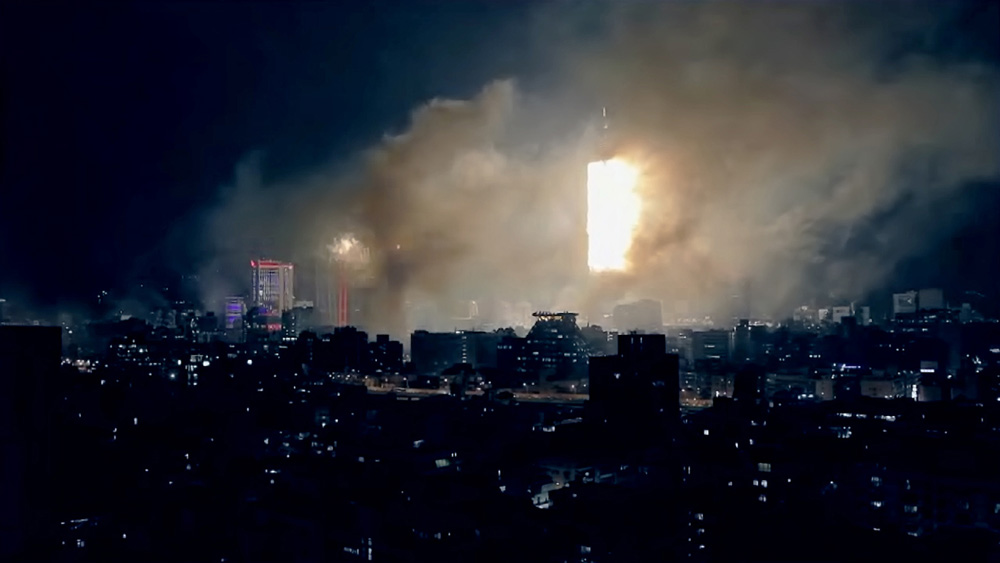
Is this the 100th anniversary celebration of a country or a prediction of doom, the last rays of a sun that is setting beneath the shadow of threats? Mixing the firework display and the self-immolation of freedom fighters, this work not only presents visual paradoxes but also re-visits the ghosts of history. Fusing tragedy and celebration, it reflects concerns about media monopolies and the current situation of the country. A historical process, repetition or an ending – what will be revealed through the flames?
Wei-Ming Ho was born in Taipei, Taiwan as a visual artist and filmmaker. He works across the fields of experimental film, video installation and media art. His works have been presented in cinemas and also in artistic contexts such as Museo Nacional Centro de Arte Reina Sofia, Egyptian Theater in Hollywood, National Taiwan Museum of Fine Arts and numerous art & film festivals in 40 countries.

Tzu Nyen Ho
The Bohemian Rhapsody Project
Film expérimental | dv | couleur | 6:52 | Singapour | 2006
Le "Bohemian Rhapsody Project" est entièrement basé sur les paroles de la chanson de Queen, "Bohemian Rhapsody", et tourné à la cour suprême de Singapour. Un garçon est accusé, et son coeur est brisé à la vue de sa "mama" en larmes. Au cours des mois de juin et juillet 2006, il a fallu quatre tours d'auditions pour le rôle du personnage principal. La chanson de Queen, écrite en 1975, remplace la structure de la chanson pop de base (couplet-refrain-couplet), par un jeu de rôle multiple et un mélange quasi schizophrénique de styles musicaux différents. Sur les nombreux professionnels et non professionnels auditionnés, 22 ont été invités à un dernier tour d'audition qui s'est tenu dans une ancienne salle d'audience de l'hôtel de ville. Etaient présents des spectateurs spécialement invités, 18 autres membres du casting, ainsi qu'une équipe de film. Sur ces 22 auditionnés, 21 ont été sélectionnés pour le film final, composé uniquement de ces images d'audition. Le film qui en résulte, découpé sur la durée exacte de la chanson (5mn 52), fonctionne en même temps comme enregistrement de cette audition. De plus, le film, qui oscille entre texte parlé et texte chanté, est un moyen de solliciter la mémoire musicale des spectateurs et d'encourager leur participation à un exercice de karaoké mental.
Born in Singapore, Ho Tzu Nyen is a visual artist and filmmaker. His first project was Utama - Every Name in History is I (2003), a film and installation that has been shown in art exhibitions and film festivals such as the 26th Sao Paulo Biennale (2004); the 3rd Fukuoka Asian Art Triennale (2005), before being presented as a performance lecture at KunstenFESTIVALdesArts (2006). In 2005, he scripted and directed 4 x 4 ? Episodes of Singapore Art, a unique hybrid of the art documentary, video essay and drama that was broadcasted over 4 weeks on a public television channel in Singapore. It was last shown at ZKM, Germany (2007). In 2006, he was commissioned by the inaugural Singapore Biennale to produce The Bohemian Rhapsody Project, a film that has since been shown in film festivals such as the 53rd International Short Film Festival Oberhausen, and the 30th Clermont-Ferrand Film Festival. In 2007, he completed a short film called Reflections, based on a 19th Century parable by Lafcadio Hearn, which was exhibited in Zendai Shanghai Museum of Modern Art and the National Gallery of Poznan. Reflections will be shown in 2008 at the 54th International Short Film Festival Oberhausen and the 8th Jeonju International Short Film Festival. He is now making his first feature film, Here. In 2006/2007, he conceptualized and wrote the first and second parts of King Lear ? The Avoidance of Love, a live audition / film shoot / lecture / theatre performance, which he co-directed with Fran Borgia.

Do Hoang
Tôi muốn rao lên
Fiction expérimentale | hdv | noir et blanc | 20:0 | Viet nam | 2014
The movie is about traces, disintegration, and the feeling of being adrift. Two people are in love with each other through the tangible objects. The film opens with a break-in and several stolen objects. A sense of losing traces, filled with shadows of violence and unexpectedness is provoked, foreseeing a disintegrated future. In theanxious space remained an old cloth - a hidden, humble and sensitive trace. The story tells the journey of the old cloth with the Man – the Woman and the Anonym, challenging their sensitive and hard-to-identify existences.
DO VAN HOANG 26/6/1987 Director, Screenplay, Actor Mobile: + 84(0)1668606403 Email: dovanhoang266@gmail.com EDUCATION Documentary and Experimental Film-making Course, Hanoi DOCLAB, Goethe Institute, 2010-2011 Faculty Cinema, The HaNoi Academy of Theatre & Cinema, 2007-2011

Jan Hoeft
Exit Strategies
Vidéo | hdv | couleur | 18:0 | Allemagne | 2014
In Exit Strategies an endless sequence of industrial fire escapes is shown. While somebody tells us how his life would change in case of a disaster, we see more and more examples of architecture that prepares us for the worst.
Jan Hoeft (b. 1981) is a visual artist based in Cologne. He was a researcher at the Jan Van Eyck Academy Maastricht in 2013/14. He is a graduate of the Academy of Media Arts Cologne and the Karlsruhe Institute of Technology.

Philippine Hoegen
Arena
Vidéo | dv | couleur | 65:0 | Pays-Bas | 2014
Arena is part of an on-going examination into the nature of display, and the ways in which objects and bodies are made to perform, through their display. The material for this work was shot at the Mission Museum of Steyl near Venlo in The Netherlands. The museum holds a collection of animals and artifacts that were collected by missionaries from the Steyl Monastery during their travels all over the world in the 19th and early 20th centuries. The museum was built specially to house the collection and its display has never been changed since it was first installed in the 1930’s and it uniquely reveals and exemplifies the perceptions and views of its time, many of which persist in the present. The animals’ bodies, stuffed and stiffly set in eternal grimaces, growls and howls, are made to perform these perceptions, ideas and ideologies that are projected upon them. The film is made of slow vertical pans that map the entire collection. The camera’s position is close up; skin fur and feathers take equal attention, as do painted backdrops, stones and attributes. As we stand before the projection, larger than life, of these animals, what becomes unclear and what is questioned is: Who is displaying what and for whom? Who is looking at whom?
Philippine Hoegen lives and works in Brussels and Amsterdam. Her work consists of installations and performance. She is currently a participant of apass artistic research program in Brussels and tutor of visual art at AKV St Joost Academy for Visual Art, Breda/Den Bosch, NL. With Carolien Stikker she runs BREW, a space in Brussels, which organises and hosts events in the field of contemporary art. She is founder and board member of Calcite Revolt, a transnational platform of exchange for artists, curators, critics and theoreticians, and with Banu Cennetoglu she conceived, produced and edited Bent, a series of artists’ books from Turkey. Recent projects, presentations and performances include: 2014 Kunstallmend (Transnational Art Commons: collective on-going project), Bern Biennial, Bern CH; Masist Gül by Banu Cennetoglu and Philippine Hoegen, KunstraumLakeside, Klagenfurt AT; 2013 Performative lecture Exterior Monologue followed by a workshop, University of Art and Design, Cluj-Napoca, RO; Exhibition; Exhibition and public discussions Adaptations, with Banu Cennetloglu, The Collective Gallery, Edinburgh SCO. Recent publications include: 2013 ‘Going Underground”, review by P. Hoegen and S. van Stein on the Sarajevo Biennale, Metropolis M online, April 2013, Kunstwordtterugkunst, Cahier for Contemporary Art, (artist’s contribution). 2012 Mutualisms Proximity Edition, magazine for contemporary art and culture, Public Media Institute, Chicago, artist’s contribution P. Hoegen and C. Stikker.

Philippine Hoegen
Crossed Wires
Doc. expérimental | hdv | couleur | 23:44 | Pays-Bas, Belgique | 2018
This document is an exploration of the Belgian art scene. It shows a series of conversations, with an informal, subjective mapping of the scene as a backdrop. In the conversations, questions are approached through the specificity of peoples' own trajectories: their practical, artistic or social paths, how such trajectories shaped certain practices and how these practices connect to the biotope of the art scene within its contemporary societal and political context. In preparation of the film numerous people were asked the question which persons, places or practices are important for them. We asked every interlocutor to suggest new interlocutors, so that every conversation generated new conversations. We let ourselves be guided by the suggestions we received, resulting finally in a varied assortment of interviewees. The notes for the informal preparatory conversations became the set for the film: they were drawn up on the walls, creating a haphazard, subjective mapping. The set functions as a performative space, as the interviewees are immersed in this unruly apparatus which they begin to correct, add on to, disagree with and debate
Philippine Hoegen is an artist living in Brussels. Her multi-stranded practice engages with issues of objectness and personhood, through the notion of versioning: How we create different versions of ourselves, the processes and technologies we use for that and what the existence of those multiple versions means for our understanding of self. Her work consists primarily of performance and performative interventions or events. She is researcher at CARADT, Avans University, NL; teacher at AKV St Joost, Breda and on an irregular basis mentor at apass, Brussels. Recent activities include: "Being as Becoming", a residency / exhibition and collaborative research project at Onomatopee, Eindhoven (2018); "Ventriloquists III", solo performance, at Plymouth University in the SAR conference Artistic Research Will Eat Itself and at the University of Twente in the conference Narrative Matters (2018); "Crossed Wires", a film commissioned by and launched at Art Brussels (2018); "The Many Machine", a performative collaborative event at AKV St Joost, Breda (2018). Recent publications include: "Ventriloquists III", a contribution to Proceedings 9th SAR Conference: Artistic Research Will Eat Itself (2018); "Body of Books: The BAS Collection", essay on the artists' run space BAS in Istanbul, published by Collectorspace, Inc, New York/Istanbul (2017).