Catalogue > Faire une recherche
Résultats pour : Tout le catalogue

Antoine Sement
Sleep
Animation | | couleur | 1:0 | France | 2005
"Sleep" fait référence à la vidéo éponyme d?Andy Warhol. Tenant le rôle de John Giorno je vis mon sommeil comme un refuge propice à l`inaction. De part ce fait j?évite les contraintes matérielles et les logiques productivistes du monde actuel. L?irruption de la figure tutélaire de Warhol ne tardera pas à rompre ce paisible isolement, me secouant et me demandant de me réveiller et de travailler (« wake up it?s time to work and be famous »). Par un jeu de miroir, s?introduit alors la logique répétitive d?une Histoire de l?Art obnubilée par une conception linéaire du progrès. Le caractère cyclique de la vidéo peut aussi bien préfigurer le retour rêvé de l?inertie bienfaisante que symboliser l?alternance implacable entre répression et régression dans une ambiance cauchemardesque.
Né en 1979, à Versailles. Après avoir acquis une formation Littéraire, option Arts Plastiques au lycée, je suis entré à l?Ecole des Beaux-Arts de Rouen où j?ai obtenu mon Diplôme National Supérieur d?Expression Plastique cette année. Le travail que j?ai développé utilise le dessin et l'animation vidéo pour illustrer les thèmes du doute et de la difficulté à créer. Me livrant à des jeux parodiques avec l?Histoire de l?Art, je laisse libre cours à des interprétations poétiques de mes incertitudes et inhibitions. A ma sortie des Beaux-Arts, j?ai participé à l?exposition « Sommeil », à la Chapelle du Genêteil à Château-Gontier.

Semiconductor, Jarman + Gerhardt
200 Nanowebbers
Vidéo expérimentale | dv | couleur | 2:49 | Royaume-Uni | 2005
Pour '200 Nanowebbers', Semiconductor a créé une toile moléculaire qui a été générée par la musique de Double Adaptor en fait. Avec des scripts écrits par eux-mêmes, les mélodies et les rythmes naissent à l'échelle manométrique ce qui déplace et se déforme à la résonance ; rebellant des aperçus de minuscules particules changeantes et interactives. Au fur et à mesure que les sons se construisent et d'autodétruisent, la toile se construit avec des éléments plus complexes qui enrobent le rythme de la musique et l'énergie.
Semiconductor créé des Films Sonores et qui révèlent notre monde physique en flux; les villes en mouvement, des paysages se déplaçant et des systèmes chaotiques. Depuis 1999, les artistes britanniques Ruth Jarman et Joseph Gerhardt ont exploré plusieurs processus d'animation numérique pour produire des films expérimentaux ou des animations en direct. Le point central de toutes ces ?uvres est le rôle du son, qui devient synonyme de l'image, car il crée, contrôle et la déchiffre ; en explorant la résonance par l'ordre naturel des choses. Finalement le travail numérique manufacturé est combiné avec le procédé analogue qui coupe le hasard et les erreurs dans le système informatique comme un co conspirateur. Ces travaux ont été exposés dans des galeries, des festivals, des cinémas et des biennales sur toute la planète. Les récentes expositions sont la Biennale de Venise, EMAF Allemagne, le Musée de Lyon d'Art Moderne, France et Inhabituel, Milan. La dernière contribution de Semiconductor dans le genre du cinéma en direct est leur logiciel de performance live dédié Sonic Inc ; un outil de sculpture 3D en temps réel où les sons sont crée par des entrées sonores spécifiques et par l'interaction et produisant des environnements audio créés et contrôlés sur le moment. Les dernières performances comprennent Transmediale ; Berlin, Tate Britain ; London and Images Festival; Toronto. Ils sont pour le moment basé au Space Science Laboratories à UC Berkeley et font des recherches pour de futures ?uvres d'art.
Marinella Senatore
how do u kill the chemist
Vidéo | dv | couleur et n&b | 8:10 | USA | 2009
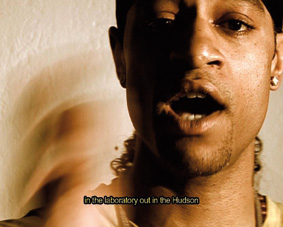
In 1957, Bassil killed the quemist Adrian Ghole in his laboratory, in Hudson city (NY). He prepared his plane with care, calculating every details: came to the Gole?s laboratory, kill him with chloroform, break the glass of his watch at 6:49, take the improtant formula of the quemist, run away with his car and get down into the river; the erosion activity of the water could cancel every elments could be associate with him. Everything runs perfect and Bassil was convenced that in the World just 1 person on a million was like him but he didn?t calculate than when pass on the bridge, a police, crow, firecrackers and applauses waiting for him: he was the million car who pass the bridge and he wins 1 million of dollars The day after his photos will appared on the news pape? the murderer in the murdered?s car.. just few hours later, Ghole?s car get down into the bridge? but Bassil was inside.
Marinella Senatore is a teacher, film director and director of photography and has been also working with drawing, painting and installation. Her first steps towards the visual arts came after a degree at Rome`s Centre for Experimental Cinematography. The films of the artist from Campania always present a thorough study and arrangement of lights on the set, which also become the source for sculptural installations (Memeland) and photographic series (Places). The characters of the stories told by Senatore embody nuances of her private life on which dreaming landscapes are inserted. Lately the artist has chosen to work on sets with non professional actors and technicians, and to embrace the richness and the generosity of ordinary people. Sets have become accessible place for everyone, whose mechanisms are consciously unveiled in the filmic production (for instance in Manuale per i Viaggiatori, 2007). The `behind the scenes` are included as a major part of the script, while corality and the idea of a laboratorium are at the core of a research that is not afraid to questions the world through the people inhabiting it. Marinella Senatore chooses to tell stories and by doing so in keeping alive and valuing both individual and collective memory.

Noe Sendas
Lady Macbeth
Vidéo expérimentale | dv | couleur | 7:0 | Portugal | 2003
NOÉ SENDAS Lady Macbeth Ecrit par Joao Pinharanda Noé Sendas, dans sa vidéo, cite les personnages de Macbeth et de sa femme. Utilisant une auto-représentation photographique obsédante, l'artiste nous met face à face avec les limites de la visibilité et de la représentation, avec les limites de l'existence éthique et politique de l'Homme. Dans le montage visuel, le visage, avec des expressions forcées de douleur et de peur, est souvent dupliqué par des miroirs (qui fonctionnent comme des reflets dans l'eau) et (le/nous) renvoie une image dont nous ne pouvons nous défaire. Des moments d'obscurité et des flashs vidéo intenses se suivent à un rythme irrégulier, indépendamment de la sonorité continue établie par les dialogues de la pièce de théâtre. Dans ces derniers, Noé Sendas mélange les répliques des deux versions cinématographiques de Macbeth : celle d'Orson Welles et celle de Polanski. On entend la mer, les cris de détresse des oiseaux de mer et les dialogues des personnages au bord de la dépression. Lady Macbeth tente en vain de laver le sang dont ils sont tâchés après la succession de meurtres sur lesquels ils ont fondé leur Pouvoir. La métaphore devient réalité.
NOÉ SENDAS Biographie Ecrite par Miguel Amado Noé Sendas (né à Bruxelles en 1972) a étudié à Ar.Co, à Lisbonnes. Sa formation comprend également des études dans des écoles étrangères, comme le Royal College of Arts, à Londres et la school of the Art Institute of Chicago, ainsi que des résidences (particulièrement celle du Kunstlerhaus Bethanien). Au milieu des années 1990, il commença à présenter son travail, et sa carrière s'est épanouie ces deux dernières années. Sa participation à de nombreuses expositions, tout particulièrement "En garde !" (Porto, 2002-2003), une exposition personnelle avec une matrice d'anthologie permettant une compréhension de la direction des artistes et réalisant une tendance personnelle qui jusque-là n'était que suggérée. Sendas a recours à différents moyens d'expression : vidéo, sculpture, son et dessin. Des références explicites ou implicites à des artistes, et des créations littéraires, cinématographiques ou musicales font partie de ses matières premières. Des citations de Shakespeare et Beckett, par exemple, sont récurrentes, ainsi que de divers réalisateurs tels que Godard et Coltrane. A son répertoire s'ajoutent également des soucis précis quant à la représentation et la pratique des arts visuels, notamment : le corps comme entité simultanément théorique et matérielle ; les mécanismes de perception de l'observateur ; ou le potentiel discursif des méthodes d'exposition. Le processus créatif de Sendas est ancré dans un dispositif intellectuel basé sur l'association de matériaux d'origines diverses. Cependant, la logique sous-jacente n'est pas seulement une logique d'appropriation, mais la définition d'une nouvelle paternité. Cette méthodologie partage des affinités électives avec des stratégies employées par les DJ et avec un instrument courant de la musique pop actuelle, le sampler, vu qu'il configure une appropriation de thèmes qui seront utilisés pour créer de nouveaux sons plutôt qu'un collage.

Noe Sendas, X
THE INDIFFERENT
Vidéo expérimentale | dv | couleur et n&b | 12:34 | Portugal | 2008
Cette vidéo est une réédition de fragments très courts réalisée à partir de plusieurs films, sur la base d'un simple constat : le moment de l'émotion la plus profonde ne coïncide souvent pas avec les évènements qui l?ont provoquée. Un homme se promène dans la rue, rentre dans un bâtiment, s?enfuit en courant par la rue principale, et s'arrête dans un square, pour revenir enfin exactement dans la même rue qu?au début, faisant de tout ceci une boucle parfaite. L'usage de la couleur et du noir et blanc permet de faire la distinction entre ce qui est « réel » et ce qui correspond à des projections, rêves ou fantômes.
Noé Sendas est né à Bruxelles en 1972 et vit et travaille à Berlin. Il a commencé à montrer ses ?uvres au milieu des années 1990. Sendas a recours à différents moyens d'expression : la vidéo, la sculpture, le son, le dessin et le son. Les références explicites et implicites à des artistes et des ?uvres littéraires, cinématographiques, musicales ou créations, font partie de ses principales matières premières.

Noe Sendas
Take Off
Vidéo expérimentale | dv | couleur | 4:2 | Portugal | 2005
Le point de départ de cette vidéo est le combat entre les visions, les peurs d'un personnage fictif et ses souvenirs lors du décolage d'un avion. Elle mélange une collection de photographies avec de vraies images d'un accident d'avion et un morceau de la dernière séquence de peeping Tom de Michael Powell, refilmé et monté à nouveau. 'Les Métaphores de la peur', écrit par Nuno Crespo. Il est possible que l'on se réfugie dans une image lorsqu'on sent que l'on est en danger, lui donnant ainsi le pouvoir d'atténuer la douleur, de calmer notre imagination, c'est un fait reconnu : la preuve en est le concept bien connu de la catharsis. Certains objets qui ont cette qualité deviennent des talismans qui ont le pouvoir de dénouer certains noeuds que l'on peut avoir à l'intérieur de la pointrine ou du coeur. On pourrait dire que ces noeuds représentent la peur, l'angoisse, les sentiments étranges dont on ne sait pas vraiment quoi faire mais que l'on veut dénouer et dominer. La peur d'être dans un avion par exemple, la peur de ses bruits vrombissants et métalliques inatendus. Etre dans un avion, dans le ciel, ne convient pas forcément à un être dont l'habitat naturel est la terre. Au moment du décollage, l'idée de la chute devient omniprésente, la chute sur en terre inconnue où seul le destin, grâce à ses pouvoirs mystérieux et invisibles, est capable de décider et d'anticiper. Cristalliser ces peurs et ces angoisses en les transformant en iages est le travail de l'art et se solde par la construction de sens à laquelle on peut attribuer certaines preuves ou, si on préfère, illuminations : par conséquent, prendre conscience de ses propres peurs peut amener à une meilleure compréhension de sa propre intimité. La peur se présente elle-même comme une catégorie esthétique - touver sa parfaite image est une tâche impossible : aucune image ne peut lui corresponde exactement ; il s'agit toujours d'une tentative de médiaton, ou pour être plus précis, une tentative de domestication. La tâche de l'artiste est de faire le choix de ne pas dépasser sa peur, mais d'avancer en vivant avec elle. Ce qui fait que Noé Sendas continue de travailler, c'est ce processus dynamique et toujours incomplet, c'est le fait qu'il ignore si le moteur vrombissant de l'avion va s'arrêter, c'est l'envie de donner forme au soupçon, au soupçon selon lequel quelque chose pourrait arriver. Nuno Crespo, Lisbonne, Juillet 2005
Noé Sendas est né à Bruxelles en 1972 et a fait ses études à l'Ar.Co à Lisbonne. Il a également étudié à l'étranger comme par exemple au Royal College of Arts de Londres et à l'Art Institute de Chicago. Il a également effectué des résidences, notamment au Kunstlerhaus Bethanien. Au milieu des années 90, il a commencé à présenter son travail et sa carrière a connu un réel essor durant ces deux dernières années. Il a participé à plusieurs expositions, notamment à En Garde! à Porto en 2002-2003. C'était une exposition personnelle avec une matrice anthologique qui permettait de comprendre le parcours de l'artiste et de prendre conscience d'une préférence personnelle qui jusque là n'avait été que partiellement visible. Sendas a recours à différents modes d'expression : la vidéo, la sculpture, le son et le dessin. Sa matière première se compose de références implicites et explicites à des artistes ainsi qu'à des créations littéraires, filmiques ou musicales. Il cite par exemple Beckett et Shakespeare ainsi que différents réalisateurs parmi lesquels Godard et Coltrane. On peut également ajouter à son répertoire ses intérêts pour la réflexion dans l'art visuel et sa pratique. Parmi ses intérêts il y a le corps en tant qu'entité à la fois théorique et matérielle ; les méchanismes de perception des spectateurs ou encore le potentiel discursif des méthodes d'exposition. Le processus créatif de Sendas prend racine dans une méthode intellectuelle fondée sur l'association de matériaux d'origines différentes. La logique sous-jacente n'est pourtant pas la simple appropriation mais la définition d'une nouvelle manière de créer. Cette méthodologie a des affinités particulières avec les stratégies employées par les DJs et avec un instrument courant dans la musique pop actuelle, le sampler : il configure une appropriation de thèmes qui seront utilisés pour construire de nouveaux sons, plutôt que pour réaliser un simple collage.

Leniko Sennoma
Augen Ohne Blick
Film expérimental | mov | couleur | 81:3 | Allemagne | 2025
Eyes Without Gaze is an experimental film that challenges conventional storytelling, inspired by Chantal Akerman’s focus on atmosphere and space over direct action. Blending animation, 16mm, poetry, video art, video clips, and digital formats, it constructs a fragmented, dreamlike narrative. The film explores life under patriarchal capitalism, folklore, and symbolism, while depicting sexual violence without retraumatization, presenting survivors as autonomous individuals seeking justice. At its center is Maria, a Greek immigrant navigating financial hardship, desire, and a search for justice. Inspired by “Vasilisa the Beautiful,” her journey toward a mysterious needle leads her to confront a man from her past and a fateful choice.
Leniko Sennoma is a Berlin-based film and installation artist whose work challenges the boundaries between reality and dream. Their art focuses on themes such as social justice, intersectional feminism, and the dismantling of systemic oppression. They combine techniques of lucid dreaming and archetypical symbolism to question the status quo of neoliberal information society. Their art is an ongoing search for possibilities of collective liberation, the dismantling of systemic oppression, and the creation of political collaboration. By developing an audiovisual-metaphorical language that works with the synchresis of image, sound, and material aesthetics, they create hypnotic environments that appear simultaneously gentle and eerie. Influenced by their studies in epistemology, theoretical, feministic, analytical philosophy and film theory, their works play with the consciousness of the viewer, generating a broad spectrum of associations, emotions and contrasts. Sennoma’s video-/installations and short films have been shown in numerous galleries, museums and festivals across continents, including Zilberman Gallery Berlin Germany, Gallery 062 Chicago USA, Gallery SA-KURA Nagoya Japan, Inflamável Film Festival Santa Caterina Brazil and Internationale Kurzfilmtage Oberhausen, Germany.

Shireen Seno
To Pick a Flower
Doc. expérimental | hdv | couleur et n&b | 16:57 | Philippines | 2021
My mother used to tell me that our dining table was as old as I am. I wonder how old the tree was when it was cut down to be turned into our table. I am fascinated in this kind of transmutation from the natural world to the human one, and how a tree takes on new lives long after it has been cut down. This video essay incorporates archival photographs from the American Colonial Era in the Philippines (1898–1946), exploring the sticky relationship between humans and nature and their entanglements with empire. Taking plants and trees as starting points, it aims to reflect on the intertwined roots of photography and capitalism in the Philippines.
Shireen Seno is an artist and filmmaker based in Manila whose work addresses memory, history, and image-making, often in relation to the idea of home. A recipient of the 2018 Thirteen Artists Award from the Cultural Center of the Philippines, she is known for her films which have won awards at Rotterdam, Shanghai, Olhar de Cinema, Vladivostok, Jogja-Netpac, and Lima Independiente and have screened at festivals including New Directors/New Films, Yebisu International Festival of Art & Alternative Visions, NYFF Currents, and institutions such as Tate Modern, UCCA Center for Contemporary Art, NTU Center for Contemporary Art Singapore, National Museum of Modern and Contemporary Art, Korea, and Portikus.

Shireen Seno
A Child Dies, a Child Plays, a Woman is Born, a Woman Dies, a Bird Arrives, a Bird Flies Off
Vidéo | hdv | couleur | 4:46 | Philippines | 2018
"A child dies, a child plays, a woman is born, a woman dies, a bird arrives, a bird flies off", is a voyeuristic glimpse of both local birds and migratory ones that make the Philippine marshlands their home for a time.
Shireen Seno is a lens-based artist whose work addresses memory, history, and image-making, often in relation to the idea of home. She was born to a Filipino family in Japan, where she spent most of her childhood. She has had two solo exhibitions and is a 2018 recipient of the 13 Artists Award from the Cultural Center of the Philippines. Her photo zine Trunks, produced while in residency at Objectifs Centre for Photography and Filmmaking, has been exhibited widely. She started out in film shooting stills for Lav Diaz before going on to direct her debut feature, Big Boy (2012), shot entirely on Super 8. It premiered at Rotterdam and won Best First Film at the Festival de Cine Lima Independiente. Her second film, Nervous Translation (2018), is about a girl who finds out about a pen that can translate the thoughts and feelings of nervous people. It premiered in Hivos Tiger Competition in Rotterdam and won the NETPAC Award for Best Asian Film. Other awards include: Critics’ Prize at Olhar de Cinema - Curitiba International Film Festival, Asian New Talent Award for Best Script Writer at Shanghai International Film Festival, Jury Special Mention at Pacific Meridian International Film Festival of Asia-Pacific Countries in Vladivostok, and Silver Hanoman at Jogja-Netpac Asian Film Festival. It also screened at MoMA as part of New Directors/New Films, Tate Modern as part of their Artists’ Cinema program, and at the Tokyo Photographic Art Museum for Yebisu International Festival for Art & Alternative Visions.

Anne Katrine Senstad
The Locker Plant Projections
Vidéo expérimentale | hdv | couleur | 8:21 | Norvège, USA | 2011
The Locker Plant Projections is part of a site specific projection video series of my video-installation piece Colour Kinesthesia. The Projections of the abstract colors and the act of projecting in itself become the vehicle for the merging of colors with the environment and that existential and poetic narrative of enlightening our surroundings. In this piece the known Donald Judd building in Marfa, TX - The Locker Plant, is subject to the projections, as well as the South Western Texas Railroad and local trees. In merging the movement of colors with an archetypal architectural form, passing people and natural life activity during the night, we experience an added level to the notion of spatial relations, time and volume. The music of J G Thirlwell, known from Foetus, Manoriexia and Wiseblood - creates a cinematic mood to the minimalist references. The Locker Plant is a former butcher and meat packing plant, one of a group of buildings Donald Judd acquired in Marfa, TX - it is now part of The Chinati foundation.
Anne Katrine Senstad is a multidisciplinary Norwegian artist who lives and works in New York. She works with light, installation, photography, video, site specific and land art. She was educated at Parsons School of Design and The New School for Social Research in New York. She is currently working with the internationally renowned architecture firm Snøhetta, where she has been awarded the public art commission for their first completed U.S. building ? a performing arts center in Bowling Green, Ohio, The Wolfe Center for the Arts at BGSU. Senstad will be creating a monumental mural consisting of 39 photographic, aluminum and Plexiglas panels extending over 28 feet high and 86 feet long (8 x 28 meters). The monumental mural piece entitled The Eternal is scheduled to officially open December 2011. She has exhibited widely internationally at Zendai Moma in Shanghai, ThisisNotAgallery in Buenos Aires, Utsikten Kunstsenter and Stiftelsen 3,14 in Norway, Bjorn Ressle Gallery, Gallery Nine5 and Elga Wimmer Gallery in NY, Pink Gallery in Seuol and KK Projects in New Orleans amongst others. Her work is represented in Gallery, Institutions, corporate and private collections.
Kevin Sepp
GOODBYE REGINA
Doc. expérimental | 16mm | couleur | 8:48 | Allemagne | 2025
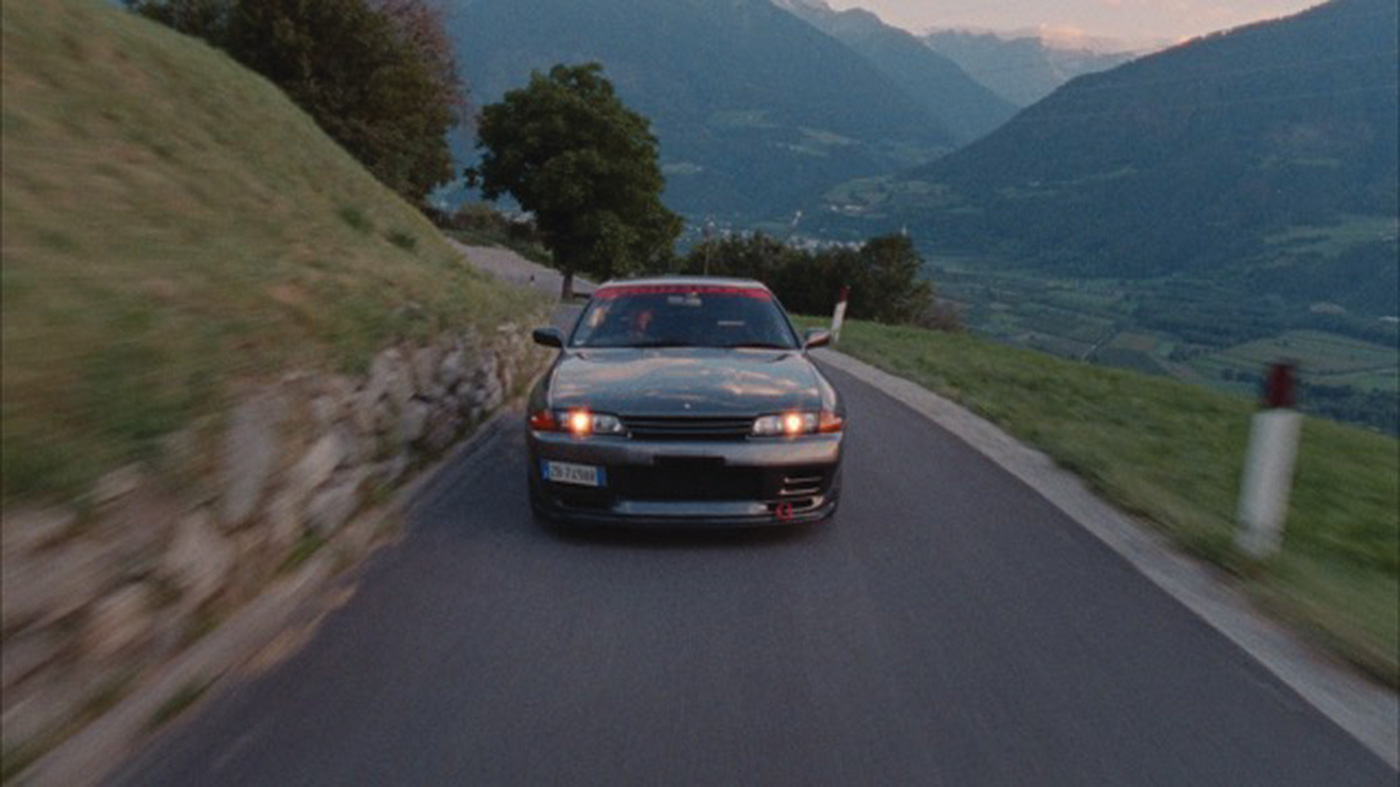
La région alpine italienne du Tyrol du Sud n'est pas connue pour sa scène tuning, mais celle-ci existe bel et bien. Un petit groupe de jeunes hommes s'est réuni pour exprimer à sa manière son amour pour sa région natale. Leurs voitures de sport japonaises glissent étrangement à travers les villages historiques, le long des pentes alpines et à travers une nature à couper le souffle. GOODBYE REGINA est une lettre d'adieu du réalisateur à sa grand-mère, qui a grandi dans ces montagnes. Il explore le lien entre l'ancien et le nouveau, sans juxtaposer les deux. Dans un paysage où rien ne semble changer, les machines semblent faire partie des créatures qui émergent de cette nature. Le résultat est une sorte de documentaire sur la nature, un recueil d'impressions loin des images de cartes postales touristiques.
Kevin Sepp est un réalisateur et monteur basé à Berlin. Issu d'une formation en sciences humaines, c'est un cinéaste autodidacte dont l'intérêt pour les récits courts et riches en images l'a conduit à travailler dans le cinéma commercial. Parallèlement à ses projets commandés, il continue d'explorer de nouvelles possibilités à travers son travail indépendant. Ses collaborations avec des musiciens et d'autres artistes influencent fortement son sens du son à l'écran et façonnent l'atmosphère de son travail. Ses films ont été présentés dans des festivals tels que les Berlin Commercial et Berlin Music Video Awards, ainsi que sur des plateformes telles que Directors' Library, Sleek Magazine et Crack Magazine.

Katia Sepulveda
Songwashing
Vidéo | hdv | couleur | 5:0 | Allemagne, 0 | 2018

Stratos Serafeimidis
a short film about an egg
Fiction | mp4 | couleur | 5:44 | Grèce | 2022
The film is about the director's attempt to stage a play, a series of unexpected events has inexplicable results for the actors. At the same time, the egg is constantly lurking between the directors and the actors.
Stratos Serafimidis(1997) was born and live in Drama,Greece.He studied at the Department of Visual Arts and Art Sciences of the School of Fine Arts University of Ioannina. He has participated in group exhibitions and in various research projects.Currently, he is studying in M.A in Digital Arts at Athens School of Fine Arts.He lives and works in Athens,Greece.

Gleb Sereda
Kros
Film expérimental | 0 | couleur | 52:0 | Russie | 2023
This is a metaphorical story about two young skaters who are trying to make sense of themselves in the world.

Marta Serna
BLACK WINGS
Animation | dv | couleur | 2:7 | Espagne | 2010
BLACK WINGS Black Wings is the third video that complete ?Power Trilogy?. The main theme is the transference to the character of the spiritual and magic nature that bestows on it special powers, focussing on mental and crerative facets. Story tells about a black crow flying over the sky. Down on earth, a little girl is waiting for him. The bird goes down to alighted on her arm. Between them exist a secret language. The girl turns her body and gives back to spectator. We don?t know what?s happend, but suddenly she is very convulsioned and begans to grow a smooth down on her shoulder blade. In a few seconds, she has a new couple of sparkling black wings.She is ready to take off? Black Wings is connected to one of the most ancient wishes of human been: Possibility of fly. The black crow is the driver of the transference. The bird gives her the opcion to explore the world of the ideas, dreams, fantasy, illusions?..the stranger world of imagination and creativity.
Biographical note Marta Serna. Visual artist. Graduated from Complutense University of Madrid (1993) with a degree in Fine Arts, majoring in Painting. She also studied Classical Dance at the Royal College of London, Spanish Dance at the Royal Conservatory of Córdoba and Oriental Dance. She has created stage sets for films, theatre and television, and has taken part with diferent dance companys In worshops and performances, including Contemporary Stage. As a visual artist she is concentrated on illustration, traditional animation video, mural Installations in vinyl and plastics sculptures . She has shown her work in Spain, U.K, Mexico and USA. Now she is currently working with Espacio Marzana Gallery in Bilbao, Spain. Serna?s latest solo exhibition are ? Winter Tale? Espacio Frágil, Madrid., ?Black Sparkle?, Espacio Marzana, Bilbao and ?Black Wings?, Domus Artium, Salmanca, all in Spain (2010). ?Dark Delicate?, Cubo Azul Gallery, León (2009). ?Cruel but Fair?, Rosa Santos Gallery, Valencia and ? Blood Breath?, NO-ID Gallery, London (2008). ?Havoc Amazing Cosmic Trip?, Proyect 142, London ( 2007). And Colectives like ?Merrie Melodies?, Domus Artium, Salamanca (2010) ? ARCO 2009 Premios Creación Artística Comunidad de Madrid? ?Bloody Boots? ARCO 2008, and the visual proyect ?Bloody Little Creatures? for the goup The Cure in London.
Marta Serna
BLOODY BOOTS
Animation | dv | couleur | 1:10 | Espagne | 2008
BLOODY BOOTS Bloody Boots is a traditional animation video and the first one about ?Power Trilogy?, whose mission is to reflect on our human, animal, artificial and spiritual nature and on the ritual of compensation we have to undertake to ensure that we adapt to our surrounding environment. The story tells about a normal pair of boots turns, by the vital and regenerator effect of blood, in autentic magic object of power. The blood that flows from earth transform the boots in protectives and magics. The ?new? boots gives the girl a big power. Now she is mentally and physically prepared to croos any territory. The blood is portrayed as the vital fluid that serves as a conduit for the realisation of the ritual and confers a special power on the object. Blood gives people a human condition and bestows an inheritance, a genetic nature. The content of the video is anchored in the earthly, working wih the human.
Biographical note Marta Serna. Visual artist. Graduated from Complutense University of Madrid (1993) with a degree in Fine Arts, majoring in Painting. She also studied Classical Dance at the Royal College of London, Spanish Dance at the Royal Conservatory of Córdoba and Oriental Dance. She has created stage sets for films, theatre and television, and has taken part with diferent dance companys In worshops and performances, including Contemporary Stage. As a visual artist she is concentrated on illustration, traditional animation video, mural Installations in vinyl and plastics sculptures . She has shown her work in Spain, U.K, Mexico and USA. Now she is currently working with Espacio Marzana Gallery in Bilbao, Spain. Serna?s latest solo exhibition are ? Winter Tale? Espacio Frágil, Madrid., ?Black Sparkle?, Espacio Marzana, Bilbao and ?Black Wings?, Domus Artium, Salmanca, all in Spain (2010). ?Dark Delicate?, Cubo Azul Gallery, León (2009). ?Cruel but Fair?, Rosa Santos Gallery, Valencia and ? Blood Breath?, NO-ID Gallery, London (2008). ?Havoc Amazing Cosmic Trip?, Proyect 142, London ( 2007). And Colectives like ?Merrie Melodies?, Domus Artium, Salamanca (2010) ? ARCO 2009 Premios Creación Artística Comunidad de Madrid? ?Bloody Boots? ARCO 2008, and the visual proyect ?Bloody Little Creatures? for the goup The Cure in London.
Marta Serna
CAT POWER
Animation | dv | couleur | 1:44 | Espagne | 2009
CAT POWER Cat Power, the second video of ?Power Trilogy?, is the title that served as a source of inspiration for the underlying argument of the video: a girl gains the confidence of a little kitten by petting and them??eats it! In just a few seconds she gets a new projecting appendix. Cat Power refers to the recovery of wild untamed power through a ritual of appropiation. The central character appropiates the intuitive and wild part of the animal. The death of the cat is not in vain, it is necessary to recover a lost and forgotten wild nature. A mutation is produced. Both, human and animal coexist in the same body. They are no longer who they used to be and have become a new hybridised being gifted with new characteristics that make it more complete and fit for survival. The conduit in that video is the cat, whose sacrifice transmits a savage instinct and nature to the central character. This video explores the atavistic underpinnings of intuition.
Biographical note Marta Serna. Visual artist. Graduated from Complutense University of Madrid (1993) with a degree in Fine Arts, majoring in Painting. She also studied Classical Dance at the Royal College of London, Spanish Dance at the Royal Conservatory of Córdoba and Oriental Dance. She has created stage sets for films, theatre and television, and has taken part with diferent dance companys In worshops and performances, including Contemporary Stage. As a visual artist she is concentrated on illustration, traditional animation video, mural Installations in vinyl and plastics sculptures . She has shown her work in Spain, U.K, Mexico and USA. Now she is currently working with Espacio Marzana Gallery in Bilbao, Spain. Serna?s latest solo exhibition are ? Winter Tale? Espacio Frágil, Madrid., ?Black Sparkle?, Espacio Marzana, Bilbao and ?Black Wings?, Domus Artium, Salmanca, all in Spain (2010). ?Dark Delicate?, Cubo Azul Gallery, León (2009). ?Cruel but Fair?, Rosa Santos Gallery, Valencia and ? Blood Breath?, NO-ID Gallery, London (2008). ?Havoc Amazing Cosmic Trip?, Proyect 142, London ( 2007). And Colectives like ?Merrie Melodies?, Domus Artium, Salamanca (2010) ? ARCO 2009 Premios Creación Artística Comunidad de Madrid? ?Bloody Boots? ARCO 2008, and the visual proyect ?Bloody Little Creatures? for the group The Cure in London.

Marta Serna
Misty Eyes
Animation | dv | couleur et n&b | 1:10 | Espagne | 2011
Presentation of the work and sinopsis Marta Serna?s current work is driven by her interest in the chaotic states of the mind, dreams, lethargy,myths,the boundary between reality and fiction, the subconscious adn their influence on human behaviour. In 2011, she developed the proyect ? Misty Eyes & Mourning Stones?, alluding firstly to the English expression of having the eyes blurred, as with tears, and secondly to the shiny, jet black jewels and stones used during the Victorian era, wich were primary elements in the mourners? attire between the seventeenth and nineteenth centuries. The combination of both expressions evokes the feeling of mourning and crying for oneself. The origin of the proyect is a restless interest for the chaotic state of the mind, when it feels confused and dreams with the possibility of getting rid of our internal mist. This leads to an open reflection about a mental space torn between lucidity and darkness, a lethargic state of the brain with magical, enchanted and supernatural connotations. The videos that I presented to Rencontres Internationales are part of this work. The first one, ?Misty Eyes? (2011),is a reflection about the nature of evil, whether it si produced by oneself or by our environment. The protagonist, combining human and animal characteristics, seems to be unprotected and lost, abandoned in the middle of nowhere and plunged into the immensity of the mist. When the landscape starts to become clear and the blur fades away, we can finally see that the mist comes from her mouth,plunging the forest into darkness again. She is held in her own environment and wilderness.
Marta Serna. Visual artist. Graduated from Complutense University of Madrid (1993) with a degree in Fine Arts, majoring in Painting. She also studied Classical Dance at the Royal College of London, Spanish Dance at the Royal Conservatory of Córdoba and Oriental Dance. She has created stage sets for films, theatre and television, and has taken part with diferent dance companys In worshops and performances, including Contemporary Stage. As a visual artist she is concentrated on illustration, traditional animation video, mural Installations in vinyl and plastics sculptures . . She likes drawing disfunctional caracters without scene and checking the roles of power on childhood. The mission on her work is to reflect on human, animal, spiritual and artificial natures and on the ritual of compensation we have to do to adapt ourselves to the surrounding environment. She has shown her work in Spain, U.K, France, Germany, Bulgary, Yugoslavia, Lebannon, Jordan, Algeria Mexico and USA. Now she is currently working with Asm28 Gallery in Madrid and Espacio Marzana Gallery in Bilbao, Spain. Serna?s latest solo exhibition are: ? Misty Eyes & Mourning Stones? Galeria Asm28 , Madrid ( 2011), ?Winter Tale? Espacio Frágil, Madrid . ?Black Sparkle?, Espacio Marzana, Bilbao, and ?Black Wings?, Domus Artium, Salamanca, all of them in Spain (2010). ?Dark Delicate?, Galeria Cubo Azul, León (2009) ?Blood Breath?, NO-ID Gallery, London, and ?Cruel butFair?, Galeria Rosa Santos, Valencia (2008) ?Havoc Amazing Cosmic Trip?, Proyect 142, London (2007) ?Havoc Oddity?, Galeria Cubo Azul, León. 2006) And collectives like ? The Noise of Bubbles?, Red Bull Academy, Matadero, Madrid. ?Gráfica. 30 Artists from young Spain? Cervantes Institute of Lebanonn, Jordan, Bulgary, Algiers, (2012 ). ?Rencontres Internationales?, with the video proyection ?Power Trilogy?? at Pompidou in Paris , Haus der Kulturen der Welt in Berlín and the Auditorio del Ministerio de Cultura in Madrid (2011_2010) ?Merrie Melodies?, Domus Artium, Salamanca (2010) ?Premios Creación Artistica Comunidad de Madrid?, ARCO 2009 ?Bloody Boots?, ARCO 2008, and the visual proyect ?Bloody Little Creatures? in London for the musical group The Cure. In 2008 receives the Prize of Artístical Creation for the Madrid Community for the creation of traditional video animation Cat Power.

Marta Serna
SnakeBoy
Animation | hdv | noir et blanc | 0:34 | Espagne | 2014
SnakeBoy is the first video of the serie Immaculate Dreams. It’s an animated portrait of a real person who creates a fictionalised version of himself, in what represents a journey through his own dreams. It features SnakeBoy riding a snake as a cowboy, truly enjoying being in control of the situation. Immaculate Dreams is about the possibility of turning a dark or unpleasant journey into something luminous and flawless through the exorcism of staging. The main characters will have to stage some of their dreamlike experiences in order to carry out their own “animated portrait of their dreams” and hence portraying themselves in a more intimate, personal way.
Marta Serna. Visual artist. Graduated from Complutense University of Madrid (1993) with a degree in Fine Arts, majoring in Painting. She also studied Classical Dance at the Royal College of London, Spanish Dance at the Royal Conservatory of Córdoba and Oriental Dance. She has created stage sets for films, theatre and television, and has taken part with diferent dance companys In worshops and performances, including Contemporary Stage. As a visual artist she is concentrated on drawings and illustration, traditional animation video, mural Installations in vinyl and plastics sculptures . She has shown her work in Spain, U.K, France, Germany, Bulgary, Yugoslavia, Lebannon, Jordan, Algeria Mexico and USA. Serna’s latest solo exhibition are: “SnakeBoy”Open Studio, Madrid (2014),”Abecedario para Monstruitos” Rita Castellote Gallery, Madrid(2012)” Misty Eyes & Mourning Stones” Gallery Asm28 , Madrid ( 2011), “Winter Tale” Espacio Frágil, Madrid . “Black Sparkle”, Espacio Marzana, Bilbao, and “Black Wings”, Domus Artium, Salamanca, all of them in Spain (2010). “Dark Delicate”, Galeria Cubo Azul, León (2009) “Blood Breath”, NO-ID Gallery, London, and “Cruel butFair”, Rosa Santos Gallery, Valencia (2008) “Havoc Amazing Cosmic Trip”, Proyect 142, London (2007) “Havoc Oddity”, Cubo Azul Gallery, León. 2006) and the visual proyect “Bloody Little Creatures” in London for the musical group The Cure. In 2008 receives the Prize of Artístical Creation for the Madrid Community for the creation of traditional video animation Cat Power.

Toni Serra, Ali ABU
Last night dikr
Doc. expérimental | dv | couleur | 7:0 | Espagne, Maroc | 2005
Inspiré d'un poème de Najmudin Kubra, maitre souffi du XIIème siècle, "Las Night Dikr", un "documentaire d'auteur", montre la route d'un groupe d'hommes assoiffés, à la recherche d'eau dans les terres désertiques de l'intérieur du Maroc. Minute après minute, image après image, ce chemin, plein de métaphores et de symboles, semble nous conduire vers ce monde intérieur que, selon le poète, tout être humain porte en lui. Un homme torse nu, à la poitrine trouée, nous invite à nous connaître, à nous comprendre nous et nos désirs, à comprendre ce que nous poursuivons. "Last Night Dikr" est un phare, une compilation de documents destinées à aider, à diriger le voyageur sur le chemin de la spiritualité.
Toni Serra vit entre Duar Msuar, au Maroc, et Barcelone. Il a étudié l'Histoire de l'Art et la Philosophie à l' Universidad de Barcelona et la Vidéo et la Photographie à la School of Visual Arts de New York. Réalisateur, Toni Serra est directeur des archives de l'OVNI, l'Observatoire de la Vidéo Non Identifiée. Ses ?uvres questionnent l'excès d'images, la simulations et le spectaculaire. Disposant de trop de matériel, il révèle au spectateur ce qui est resté dissimulé jusqu'à aujourd'hui. En parallèle à "Retroyou" de Joan Leandre, il développe "Babylon Archive", un projet d'archéologie médiatique. Il a compilé divers cycles de vidéos, dont "Malestar a les Ciutats" et "TransArab ? Nou Vídeo Àrab" ainsi que la programmation vidéo du MACBA 1996-97. Il a reçu, en 2002, le Prix d'Arts Plastiques de la Ville de Barcelone pour son installation "Fes Ciutat Interior" et, en 2004, le Prix du Patrimoine de Catalogne pour le projet "Arxius" de l'OVNI.

Ilan Serruya
Reunión
Documentaire | mov | couleur | 65:0 | Espagne | 2018
“Reunion” is the encounter between a father and a son. A moment marked by landscape, distance and silence. Ilan is cutting his own hair. He is getting ready to travel to Reunion Island. There lives his father, Raphael. An island is a piece of land surrounded by water on all its parts. A reunion is the act of making two or more things coincide at one point, sometimes colliding with one another. This meeting between the father and the son is distinguished by the absence of words, by everyday gestures, by different body postures, by the expression of their faces and by the few sentences that articulate an attempt to resume what seems to be an impossible dialogue. Raphael smokes on the chair, studying his son with his eyes. He is breathing hard. Among them, a camera acts as an intermediary. It observes them together and separately. It is a mediation device: it restrains the dialogue, registers the look on their faces and records the silence. The camera favors the meeting to take place. It protects them from the past and places them only in the present. We do not know the reasons that led them to this situation, nor the time that happened since they last saw each other. We only know that they are there, in Reunion. A path in the forest. Roots in the ground. Fog and cracks.
Ilan Serruya grew up between the cities of Mar del Plata (Argentina) and Seville (Spain). He studied Fine Arts (Universidad Complutense de Madrid), holds a degree in Film Editing (Instituto del Cine de Madrid) and Master LAV (Audiovisual Laboratory of Creation and Contemporary Practice). His search as a visual artist go into focusing on to autobiographical events, and his works often reveal some found domestic material. His feature film “Reunion” (2018) was selected for Input 2018 -Space for tutoring and advising film projects organized by (S8) Mostra de Cinema Periférico-. “Reunion” had its world premiere at Doclisboa (International competition) and its Spanish premiere at Seville European Film Festival (Endless Revolutions competition). The world premiere of “What is a zeide for?” (2018) was held by Filmadrid International Film Festival. His short film “The lost distance” (2016) participated in cinema screenings at Guadalajara (Mexico), Rome (Italy), Prague (Czech Republic) or festivals like Una casa: Muestra de cine documental autobiográfico (Spain).