Catalogue > Liste par artiste
Parcourez la liste complète des artistes présentés dans le cadre des Rencontres Internationales depuis 2004. Utilisez le filtre alphabétique pour affiner vos recherches.
Antonella Kurzen
Catalogue : 2006The challenge | Film expérimental | betaSP | couleur | 5:50 | Suisse | 2005
Antonella Kurzen
The challenge
Film expérimental | betaSP | couleur | 5:50 | Suisse | 2005
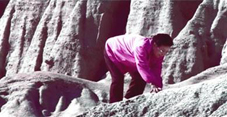
Dans le vide d'un paysage, un être humain grimpe sur les rochers pour tester son équilibre, trois pas en avant et trois dans le vide.
Antonella Kurzen, naît en Suisse en 1966. Elle entame ses études artistiques aux Etats Unis et les poursuit en Suisse, en Italie et en Allemagne. Elle entreprend ensuite des études dans le domaine de la cinématographie. Depuis 1998, elle travaille comme réalisatrice freelance et, depuis 2002, comme vidéaste également. Ses dernières vidéos sont des élaborations des conditions psychologiques observées en milieux naturels, transformées selon les intentions, en espaces réduits.
Thomas Kusitzky, Michael WILHELMI
Catalogue : 2006(((controller-band.'s Rodeo-Setup | Création sonore | 0 | | 20:0 | Allemagne | 2005

Thomas Kusitzky, Michael WILHELMI
(((controller-band.'s Rodeo-Setup
Création sonore | 0 | | 20:0 | Allemagne | 2005
"Musik-Performance (((controller-band., Berlin Die (((controller-band. ist eine Computerband und Teil von (((controllerentertainment.. (((controller-entertainment. wurde 2002 von Michael Wilhelmi und Thomas Kusitzky gegründet und dient als Rahmen für verschiedene Projekte und Experimente, bei welchen Computerspielcontroller, wie Joysticks, Lenkräder, etc. verwendet werden. In Verbindung mit einem hierfür entwickelten Softwareinterface, wird es möglich, die jeweiligen Computerenvironments ohne Zuhilfenahme von Tastatur, Bildschirm oder Maus intuitiv zu steuern. Die Konzerte der (((controller-band. sind Improvisationen, deren musikalisches Ausgangsmaterial aus bis zu 40 Sekunden langen Samples von Aufnahmen verschiedener Musikrichtungen besteht, die durch unterschiedliche Verfahren in ihrer Geschwindigkeit, Tonhöhe, zeitlichen Struktur und Klangfarbe verändert werden. Diese Verfahren sind in ihrer Art abhängig vom für das jeweilige Konzert erstellten Programm, also letztlich vom kompositorischen Rahmen."
Thomas Kusitzky geboren 1975 in Singen, lebt seit 1996 in Berlin. Musikstudium im Bereich Jazz, Hauptinstrument Bass an der Hochschule für Musik ?Hanns Eisler? Berlin. Weiterführende Seminare an der Universität der Künste Berlin und der Technischen Universität Berlin in den Bereichen Klangkunst, Elektroakustische Musik, Computermusik, Musikprogrammierung, Musikakustik und Raumklang. Teilnehmer am Modellstudiengang ?Sound Studies? an der Universität der Künste Berlin.Tätig als Live-Elektronik Musiker und Klangkünstler
Thomas Kutschker, -
Catalogue : 2009Backyard | Doc. expérimental | dv | | 26:0 | Allemagne | 2007
Thomas Kutschker, -
Backyard
Doc. expérimental | dv | | 26:0 | Allemagne | 2007
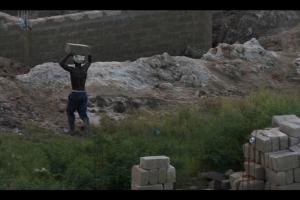
« Backyard » est une observation sur la vie quotidienne et le travail, filmée d?un trait au cours d?une fin d'après-midi à Dar Es Salam (Tanzanie). Ce film se trouve à mi-chemin entre l?étude ethnographique, le film expérimental et l?installation vidéo à canal unique.
Kutschker Thomas est né en 1963 à Mannheim (Allemagne). En 1996, il a obtenu une maîtrise en médias audiovisuels à l'Académie des Arts Médiatiques de Cologne. En 1998, il lui a été décerné le Premier Prix du Gouvernement pour les Jeunes Réalisateurs. De 2000 à 2005, il a enseigné la théorie et le film documentaire à l?Université Humboldt de Berlin.
Ikuru Kuwajima
Catalogue : 2018City of Transformers | Vidéo expérimentale | hdv | couleur | 3:39 | Japon, Russie | 2016
Ikuru Kuwajima
City of Transformers
Vidéo expérimentale | hdv | couleur | 3:39 | Japon, Russie | 2016
The project is about the transforming cityscape of Kazan, the millennium old capital of the Republic of Tatarstan in Russia. With the brand-new buildings and anime costume characters “ Transformers ”, I visualized my impression of this fast-growing modern multicultural city, located in the middle Volga, about 600 km east from Moscow. In Kazan, newcomers would soon notice the futuristic bizarre architecture scattered around the city’s center. Those buildings are somewhat reminiscent of the contemporary but ambiguous glittering architecture in Kazakhstan’s capital Astana and Turkmenistan’s capital Ashgabat in Central Asia. In Kazan’s city center, visitors would also notice awkward-looking costume characters like ones from American-Japanese robot anime “ Transformers ” giving out leaflets or getting pictures taken with kids for money. Kazan is home to Tatars, a predominantly-Islam Turkic people, but it is more complex and unique, as Tatar, Russian and Soviet cultures have been intertwined in the past centuries there. Now, western capitalism gets mixed with this cultural melting pot, bringing even “ Transformers ”to the city and turning parts of the cityscape a little Disneylandish. Kazan is still in the process of this intricate transformation. This project demonstrates my vision of this transforming multicultural city located near the edge of geographical Europe.
After growing up in Japan, studying in journalism in the University of Missouri, Columbia, and living in Romania for a year, Ikuru Kuwajima has been living and working on visual documentary and art projects mainly with photography in various post-Soviet countries (Ukraine, Kyrgyzstan, Kazakhstan and Russia) in the past 10 years. After three years in Kazan, he now lives in Moscow, Russia, continuing personal projects. His artist books “ Tundra Kids ” and “ Oblomov ” were published in Vienna in 2015 and in Moscow in 2017, respectably.
Hans Kuzmich
Catalogue : 2026Radiant Center | Installation multimédia | 0 | | 60:0 | USA, Lituanie | 2025
Hans Kuzmich
Radiant Center
Installation multimédia | 0 | | 60:0 | USA, Lituanie | 2025
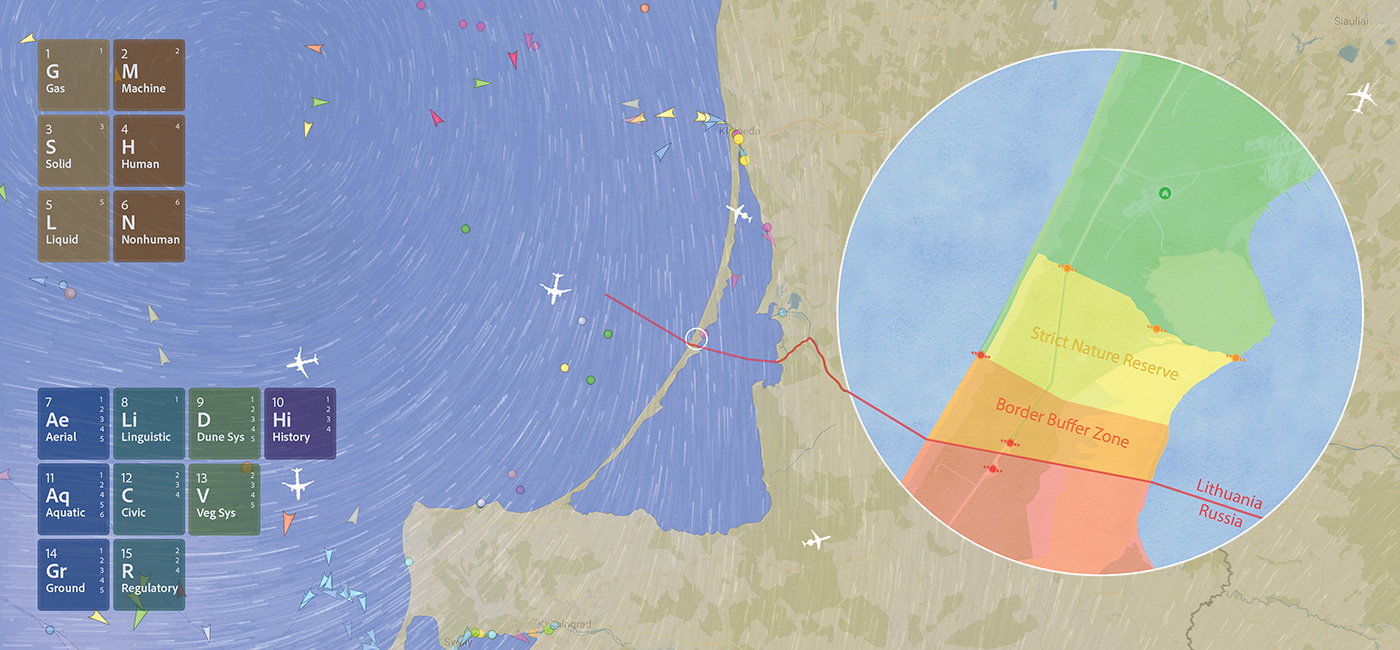
"Radiant Center" is a four-channel sound installation examining the convergence of security practices, media technologies, and geological environments at the Russian-Lithuanian border on the Curonian Spit, a peninsula along the southeastern Baltic Sea. Engaging with the site's cultural history as a UNESCO World Heritage Site known for its wind-blown sand dunes, the project investigates how borders and wind function as media infrastructures that are simultaneously local and global, geopolitical and ecological, mobile and emplaced. The methodology centers on embodied listening to the border's acoustic and transmission ecologies, informing the creation of documentary and performative recordings of radio communications, broadcasts, and electromagnetic emissions related to border security and atmospheric science, alongside field recordings that capture how aeolian forces resonate across the Spit's terrain. Bridging border studies, environmental humanities, and sound art practice during a period of heightened xenophobic border rhetoric across American and European contexts, "Radiant Center" advances an understanding of borders as porous, contested zones where political, technological, and environmental forces continually reshape both human and non-human mobilities.
Hans Kuzmich is a Belarus-born interdisciplinary artist based in Los Angeles whose work examines gender as an interface between subjects and the state. Working across transmission arts, media installation, and performance, his practice is grounded in site-specific listening and sonic fiction methodologies. Kuzmich is currently completing a hybrid doctoral dissertation in Film and Digital Media at the University of California, Santa Cruz. Recent exhibitions and residencies include Sonic Nomads, Seoul, South Korea; SPAM New Media Festival, Seattle, WA; Sound + Environment, Newcastle upon Tyne, England; Nida Art Colony of Vilnius Academy of Arts, Lithuania; Radiophrenia, Glasgow, Scotland; Wave Farm, Acra, NY; Vermont Studio Center, Johnson, VT; The Studios at MASS MoCA, North Adams, MA; The 8th Floor, New York, NY; and SOMA, Mexico City. Kuzmich holds an MFA from the University of California, Los Angeles, a BFA from the Cooper Union, and was a participant in the Whitney Independent Study Program.
Klaudia & Jacqueline/ Künstlerduo Stoll & Wachall, Jacqueline WACHALL
Catalogue : 2006Control your body | Art vidéo | dv | couleur | 5:44 | Allemagne | 2004
Klaudia & Jacqueline/ KÜnstlerduo Stoll & Wachall, Jacqueline WACHALL
Control your body
Art vidéo | dv | couleur | 5:44 | Allemagne | 2004
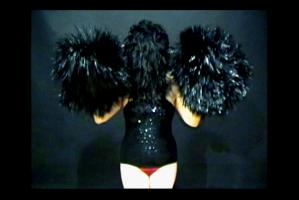
Une silhouette féminine vêtue d?une très courte robe noire moulante à paillettes, se tient debout, devant un fond noir. La perruque noire qu?elle porte est à l?envers. De ce fait, les longs cheveux brillants et ondulés tombent vers l?avant et recouvrent ses seins. Un son techno cadencé démarre et se développe peu à peu. La silhouette soulève deux pompons et commence à se balancer en suivant le rythme. Le refrain répétitif « Control your body. Let the beat control your body - com?on dance with me » l?entraîne dans une agitation de plus en plus hypnotique. Au début, la silhouette paraît presque insignifiante et ridicule. Elle est un persiflage des filles techno : apparence voyante, cheveux ondulés, formes généreuses. Lorsqu?elle commence à bouger sur le rythme, ça a l?air bizarre. Mais petit à petit, on se laisse envoûter. Les paroles répétitives de la chanson semblent sortir de sa bouche et donnent l?impression que c?est elle qui les maîtrise et qu?elle ne fait pas que leur obéir. Tout à coup, elle nous balance des signes et des mots: extra, highlights, make up, generation, ultra, image, fondation, maximum, overdose, yeah. Ce sont les signes de la modernité, de la séduction, du masque. Ce sont les mots-clés de notre quotidien qui nous sont insufflés. En bougeant et en agissant ainsi, elle nous apparaît peu à peu comme une idole ; dans le sens archéologique du terme, autrement dit, comme un objet vénéré. Elle devient une vraie idole de la musique pop, une Vénus de Willendorf du disco. Les pompons qui servent habituellement à encourager les équipes dans les stades américains, elle les utilise pour nous coacher, nous hypnotiser. Elle nous répète sans cesse : contrôle-toi, laisse-toi contrôler.
1993-99 Etudes à l?Ecole Supérieure des Arts Appliqués Saar avec les Pr. Ulrike Rosenbach et Pr. Bodo Baumgarten, Pr. Horst Gerhard Haberl 1997 Création du Duo d?Artistes Stoll & Wachall 1999 Diplôme et Conservatoire à l?ESAASaar 2001-03 Enseignement à l?ESAASaar
Tilman Küntzel
Catalogue : 2008bodyguard | Art vidéo | dv | couleur | 6:40 | Allemagne | 2007
Tilman KÜntzel
bodyguard
Art vidéo | dv | couleur | 6:40 | Allemagne | 2007
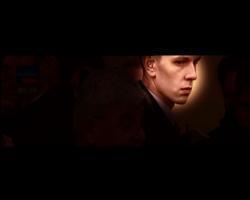
Television images of politicians being interviewed show us different worlds of perception. While the politician speaks to reporters, the bodyguard concentrates on potential dangers in the surrounding area. The viewer becomes witness to two parallel worlds, yet is inclined to pay more attention to the politician, who speaks outwardly to matters of public interest. The bodyguard brings to the situation a dramatically greater intensity, but one that is directed inward. He is deep in concentration, communicating through a small earpiece with a network that remains hidden from the viewer. The images are characterized by this contrast, which endows them with a particular tension. The video shifts the focus onto the bodyguard`s inner perception.
Tilman Küntzel *1959 Studium der Freien Kunst an der Hochschule für Bildende Künste Hamburg bei Claus Böhmler und Henning Christiansen. 1992 ? 1993 Studium der systematischen Musikwissenschaft an der Universität Hamburg. 1993 DAAD Stipendium bei Allan Kaprow an der University of California, San Diego, Kalifornien. 2002 Preisträger erster deutscher Klangkunstpreis Skulpturenmuseum Marl. 2004 Initiator der Symposiums mit Ausstellung und Konzerte ?Stare über Berlin? -Ästhetische Analogien des Vogelsangs. 2006 Initiator des Projekts ?World Cup 2006 Radio Commentaries in Native Tongues Synchronous Recordings?. 2007 Gastdozentur ?Klangkunst? an der Universität der Künste Berlin, Fakultät 01 Bildende Kunst. Tilman Küntzel lebt in Berlin.
Kristina Kvalvik
Catalogue : 2014Distant Landscape | Film expérimental | super8 | couleur | 8:30 | Norvège, Islande | 2012
Kristina Kvalvik
Distant Landscape
Film expérimental | super8 | couleur | 8:30 | Norvège, Islande | 2012
"Distant Landscape" consists of images of landscapes in which traces of movement of the film`s narrator are recognisable within the desolate surroundings. Short texts roll over the images, telling the story of someone in a close and sensual relationship with nature.
Kristina Kvalvik (b.1980) is a Norwegian visual artist currently based in Copenhagen, Denmark. She studied film and fine art in Norway, Sweden and Canada, and completed her MFA at Malmö Art Academy (SE) in 2008. Her work deals with matters relating to surveillance, the inexplicable and the threatening. She examines the limitations of sight and our ability to interpret what we see. Kvalvik has exhibited her work internationally including Göteborg International Biennial for Contemporary Art, Overgaden Institute for Contemporary Art; Copenhagen, LOOP Film Festival; Barcelona, Center for Contemporary Art; Glasgow, GalleriBOX; Akureyri, Galeria Miroslav Kraljevic; Zagreb, Kunsthalle Exnergasse; Vienna, Parkingallery; Tehran, Västerås Konstmuseum, Høstutstillingen Kuntnernes Hus; Oslo and Abandoned Gallery; Malmö.
Kristina Kvalvik
Catalogue : 2013City Heart | Fiction expérimentale | 0 | couleur | 5:23 | Norvège, 0 | 2011
Kristina Kvalvik
City Heart
Fiction expérimentale | 0 | couleur | 5:23 | Norvège, 0 | 2011
The spectator follows the protagonist through a city one dark winter night. Where is she going? Why do we follow her? The city in the dark and the woman in the night provokes an eerie atmosphere, - without the film giving any answers to why. This unsolved story is based upon how we are seen and interpreted in the public sphere. All images are from urban places and contain a subtle doomsday thematic as a sweeping tone through the film.
Kvalvik has exhibited her work internationally including Göteborg International Biennial for Contemporary Art, Overgaden Institute for Contemporary Art; Copenhagen, LOOP Film Festival; Barcelona, Center for Contemporary Art; Glasgow, GalleriBOX; Akureyri, Galeria Miroslav Kraljevic; Zagreb, Kunsthalle Exnergasse; Vienna, Parkingallery; Tehran, Västerås Konstmuseum, Høstutstillingen Kuntnernes Hus; Oslo and Abandoned Gallery; Malmö.
Yunjoo Kwak
Catalogue : 2026Simbang | Doc. expérimental | mp4 | couleur et n&b | 58:0 | Pays-Bas | 2024
Yunjoo Kwak
Simbang
Doc. expérimental | mp4 | couleur et n&b | 58:0 | Pays-Bas | 2024
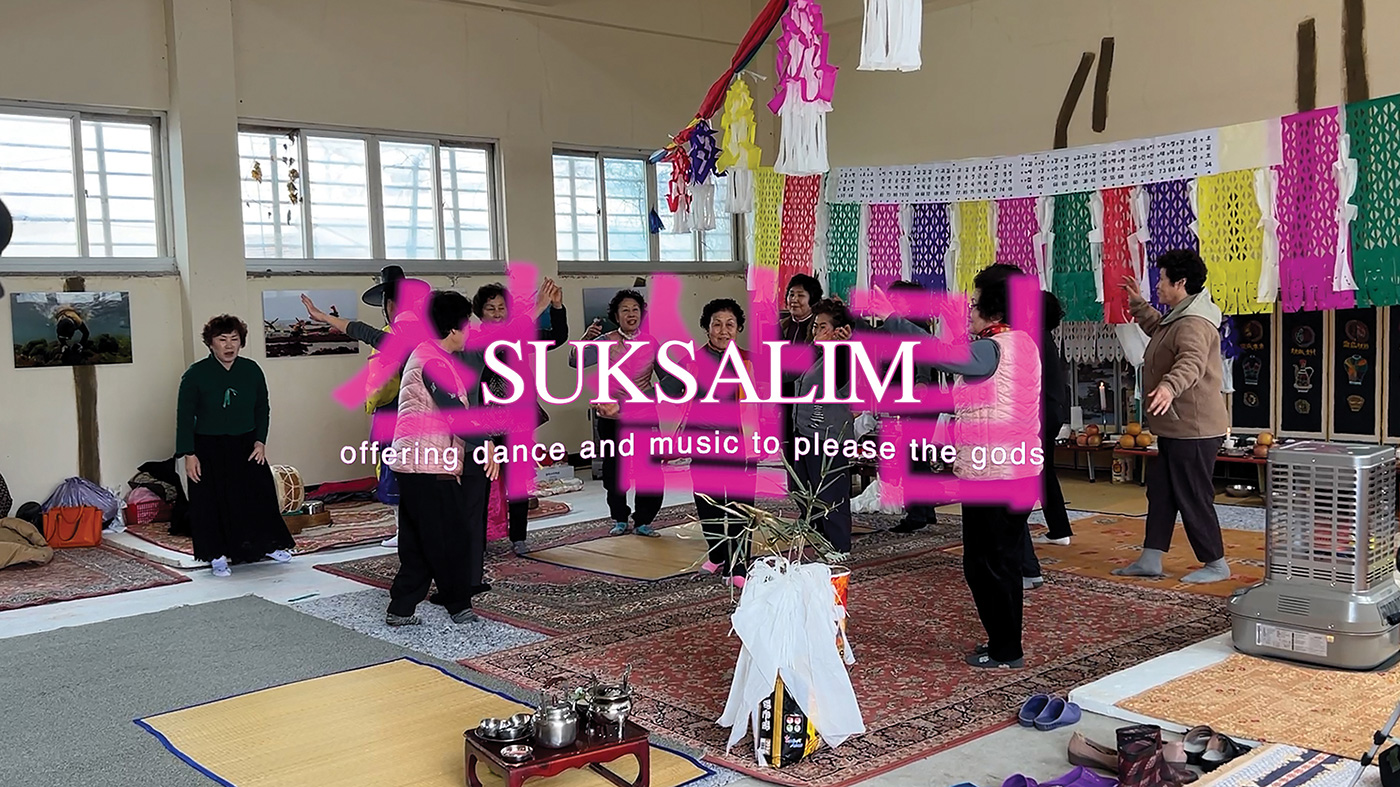
The feature film Simbang explores the process of spiritual recovery in the aftermath of the 4.3 Massacre by combining found footage taken by American military forces during the massacre with documentation of rituals held at various locations across the island. On Jeju island, “??” (Simbang; ??) refers to a shaman. “?” (sim) means spirit, and “?” (bang) means space or room, translating directly into a spirit room or spirit space, thereby evoking a spatial aspect of their beings in connection to the unseen world, yet powerfully sensible through the ritual. The camera follows all steps of the ritual; calling forth gods and spirits, welcoming them both on land and underwater, serving them with offerings, playing music and dancing, communicating with them, purging evil energies from the spirit and clients, and sending the spirits away back to their realm. During these rituals, the Jeju myth’s 18,000 gods and the life stories of the people who died in 1948 come together to weave a history of their sorrow and violence, enabling the processing of trauma. The physical, psychic, and emotional impacts of trauma go beyond the limits of the dominant historical archive and its knowledge.
Yunjoo Kwak is an artist and a lecturer at Willem de Kooning Academy in Rotterdam. She graduated from the Dutch Art Institute/ArtEZ (MFA, 2011) in Arnhem and the Korean National University of Arts (MFA, 2008). Yunjoo was an artist-in-residence at The Otolith Group (2015) in London and has participated in various exhibitions and collaborated with different institutes such as the Amsterdam Museum; Kuandu Biennale Taiwan; Makassar Biennale; the Korean Cultural Center, London; Studium Generale Rietveld Academy, Amsterdam; Seoul Museum of Art and The Museum of Photography Seoul. Her major video works include ‘Café Downey’s’ (2013), ‘Chronicle of Plan van Gool’ (2014), ‘The Defectors’ (2017) and ‘Only The Ports Are Loyal To Us’ (2020). Her practice is research-based and process-oriented, with a focus on architecture and history intersection with the filmmaking process. She works across the disciplines of ‘essay’ film, photography, digital montage, publication and archiving. She is interested in the blind spots of historical representation and seeks ways to haunt them through her artistic practice.
Catalogue : 2015A Chronicle of Plan van Gool | Documentaire | hdv | couleur | 20:0 | Pays-Bas, Corée du Sud | 2014
Yunjoo Kwak
A Chronicle of Plan van Gool
Documentaire | hdv | couleur | 20:0 | Pays-Bas, Corée du Sud | 2014
A Chronicle of Plan van Gool (20 mins, 2014) is a video essay by Yunjoo Kwak, developed during a conversation with an architect, Endry van Velzen, regarding his text ‘Over vanzelfsprekendheid, de 1138 van Gool in Amsterdam Noord’, (in: OASE nr. 49 1998, p. 44-65) The text presents a sophisticated analysis of Plan van Gool, designed by a State architect Frans van Gool (1929 – ) in 1968, and reflects upon van Gool’s fundamental critique of modernist concepts through the residential building. By appropriating his text, the essay attempts to re-examine the thoughts of the two architects, how they perceive of architectural performances – aesthetically, politically, and economically – and how each responds to environmental forces and crises.
Yunjoo Kwak (Seoul, South Korea, 1977) lives and works in Amsterdam. She studied and taught in MFA at the Korean National University of Art, Seoul, 2008 and Dutch Art Institute/ ArtEZ, Arnhem, 2011. Her works has exhibited in a number of different public venues such as French Cultural Centre, Reykjavik Museum of Photography and Seoul Museum of Art. Her works often deals within notion of ‘performativity’ as practicing political and aesthetical strategy in various mediums; film, lecture performance, text and publication.
Hayoun Kwon
Catalogue : 2017489 Years | Animation | hdv | couleur | 11:18 | Coree du Sud, 0 | 2016
Hayoun Kwon
489 Years
Animation | hdv | couleur | 11:18 | Coree du Sud, 0 | 2016
489 Years a pour sujet la Zone Coréenne Démilitarisée (DMZ), créée en 1953, qui sépare physiquement la Corée du Nord et la Corée du Sud. La bande de terre est longue de 248 km, large d’environ 4km. Selon les données du Ministère de la Défense de la Corée du Sud publiées en 2010, il faudrait 489 années pour enlever toutes les mines qui ont été placées sur cette frontière. Le film repose sur le témoignage d’un ancien soldat de Corée du Sud. Il est le narrateur qui donne accès à un endroit où « l’homme est interdit et où la nature a repris ses droits ».
Hayoun Kwon est née en 1981 à Séoul, en Corée du Sud. Elle vit et travaille à Châteauneuf-sur-Cher, Paris et Séoul.
Hayoun Kwon
Catalogue : 2015VILLAGE MODELE | Vidéo | hdv | couleur et n&b | 10:0 | Coree du Sud, Corée du Sud | 2014
Hayoun Kwon
VILLAGE MODELE
Vidéo | hdv | couleur et n&b | 10:0 | Coree du Sud, Corée du Sud | 2014
librement inspirée du village de propagande nord coréen, Kijong-dong, Hayoun KWON révèle un « lieu-décor » et nous plonge dans la fiction, accomplissant son voyage par procuration. Le film témoigne de ce village fantôme dans son véritable état : un mécanisme de fiction. La réalité d’une frontière face à sa mise en scène... Un village inatteignable autrement que par l’imagination.
Hayoun Kwon est née à Seoul (Corée du Sud) en 1981. Elle a commencé ses études d’art à l’Ecole des Beaux-Arts de Nantes, puis a été diplômée du Fresnoy – Studio national des Arts contemporains en 2011. Le travail de Hayoun Kwon traite principalement de la mémoire (individuelle comme collective) et des limites en ne cessant de brouiller les pistes. Elle confronte l’intention à son interprétation, la construction à la fiction, la remémoration à l’invention. Elle interroge les rapports ambivalents entre réalité et fiction, entre théatre et réel.
Makis Kyriakopoulos
Catalogue : 2021WHAT IS A MAN WITHOUT A SHADOW | Fiction expérimentale | 4k | couleur | 3:19 | Grèce | 2020
Makis Kyriakopoulos
WHAT IS A MAN WITHOUT A SHADOW
Fiction expérimentale | 4k | couleur | 3:19 | Grèce | 2020
Dans la vidéo "What is a Man Without a Shadow", une morphogenèse numérique par intelligence artificielle, comme méthode s'inspirant de la biologie, est utilisée pour décrire le processus de développement évolutif des organismes et des systèmes polymorphes. Dans la morphogenèse numérique, de nouvelles formes remplacent les anciennes, dans une logique d'optimisation, par l’intermédiaire d’un système ouvert d'états de constante interaction. Ces structures organisées se transforment radicalement en structures désorganisées, créant un désordre général. Les images se dégradent progressivement, pour révéler des êtres qui modifient la cohérence de l'espace et du temps avec une valeur d'entropie moyenne, permettant de tester de nouvelles réalités dans un espace virtuel. En conséquence, cela permet l'évolution d'êtres qui s'efforcent de marquer leur existence dans des séquences en interaction, passant d'une situation à une autre, générant le matériel génétique du projet.
Makis Kyriakopoulos est né à Patra (Grèce) en 1975. Il a obtenu un MFA avec distinction à la ASFA - Athens School of Fine Arts en 2004 et y a suivi un autre Master en arts numériques. Il travaille principalement dans le domaine des arts numériques et s'intéresse plus particulièrement à la nature du mouvement, à la matérialité et à l'immatérialité, interrogeant la relation entre l'homme et l'espace. Il a participé à de nombreux festivals internationaux, à des conférences, ainsi qu'à des expositions collectives et individuelles.