Catalogue > Faire une recherche
Résultats pour : Tout le catalogue

Soren Thilo Funder
First Citizen (House of the Deaf Man)
Fiction expérimentale | hdv | couleur | 12:30 | Danemark | 2013
First Citizen (House of the Deaf Man) opens in a small room, where a therapist is in consultation with a young man. Through the use of hypnosis, the young man is experiencing a ma¬nipulation of his unconscious motivation. A feeling of debt is implanted in him through psycho-suggestion. First Citizen (House of the Deaf Man) proposes the idea that the indebt¬edness of the citizen is not only a causality of a flawed eco¬nomic system, but also the last relation that connects the citizen to a community. The only sure way to be part of any power relation is to enter the creditor/debtor relationship. Debt might hence be something that the citizen uncontiously desires - as the only means of experiencing community. First Citizen (House of the Deaf Man) paints an awry portrait of the indebted man with a little help from Goya’s painting ‘Duel with Cudgels’.
Soren Thilo Funder’s works are formal investigations of the power relations of modern day society. Through the use of conceptual visual strategies, cinematic narratives and mise en scène, the works aim to expose the precariousness of contemporary society using fiction to generate new potential spaces for political contemplations and counter-memory. Soren Thilo Funder has an MA from the Royal Danish Academy of Fine Arts and The School of Art and Architecture at the University of Illinois at Chicago. He has been an artist-in-residence at Künstlerhaus Bethanien in Berlin, SOMA in Mexico City, Townhouse Gallery in Cairo, Frankfurter Kunstverein in Frankfurt and Platform Garanti in Istanbul. He was represented at the 19th Biennale of Sydney, 1st Copenhagen Art Festival, eva International Biennial of Visual Art - “After The Future”, 12th Istanbul Biennial, 2nd International Moscow Biennial for Young Art, Manifesta 8 – Parallel Events and 6th International Liverpool Biennial.

Soren Thilo Funder
Red Tape (Don't go into Tarlabasi)
Art vidéo | | couleur | 7:9 | Danemark, Turquie | 2010
Red Tape (Don`t go down into Tarlabasi) Video - HD AppleProRes Duration: 7:09 min. 2010 Coming to Istanbul I was told immediately that I should not go down into Tarlabasi. The ghettoized area Tarlabasi is, apart from not being all that dangerous, also the next poor area to be gentrified. Red Tape takes it outset in the Japanese horror film Kairo and in the mix between documentary and horror fiction it aims to distort the image of ghettoization.
Soren Thilo Funder is a visual artist based in Copenhagen, Denmark. His works are audio-visual productions dealing with diverse cultural fields and integrating aspects of critical theory, literature, theater, cinema, Sci-Fi, Horror, political activism and other counter-cultural disciplines. The works are formal investigations of the power relations of modern day society. Through the use of cinematic narratives, choreography and mise en scène, the works strive to expose the precariousness of contemporary society and the broken link between politics and the political. The works use the fictional and extra-real to pose new questions and generate a new potential space , a third place, for political contemplations and counter-memory. Soren Thilo Funder has exhibited his works in international galleries, film festivals, museum exhibitions and public space exhibitions. He has been an artist-in-residency at Frankfurter Kunstverein in Frankfurt Am Main, Platform Garanti Contemporary Art Center in Istanbul and Townhouse Gallery in Cairo. He was furthermore represented at the 2nd International Moscow Biennial for Young Art, the 6th International Liverpool Biennial and Manifesta 8.
Soren Thilo Funder
GAME Engine (Orange Bulletproof Kids)
Vidéo | hdv | couleur | 30:0 | Danemark | 2021
In GAME Engine (Orange Bulletproof Kids) we are invited to an exclusive press meeting at an undisclosed location. Here, the spokesperson of a notorious game developer, presents a brand new game engine. A game engine that promises revolutionary in-game experiences, the layout of which are never fully disclosed in protection of its intellectual property value. This oral evasive manoeuvre leads the spokesperson into complex landscapes in which game and reality, body and avatar, the sensorial and the informational, blend together. Parallel to this fiction scenario, a group of CS:GO athletes are recreating their game experiences, using their bodies as vehicles for motoric and visual memory.
Soren Thilo Funder is a visual artist working primarily with video and installation. His works are mash-ups of popular fictions, cultural tropes and socio-political situations, projections and histories. They are narrative constructions insisting on new meaning forming in the thin membrane negotiating fictions from realities. Invested in written and unwritten histories, the paradoxes of societal engagement, temporal displacements and a need for new nonlinear narratives, Thilo Funder proposes spaces for awry temporal, political and recollective encounters. Soren Thilo Funder’s previous exhibitions include solo presentations at Turku Museum of Art, Museum of Contemporary Art Zagreb, Tranen Contemporary Art Center, Overgaden – Institute for Contemporary Art and Den Frie - Centre for Contemporary Art, Copenhagen. He was furthermore represented at the 19th Biennale of Sydney, eva International Biennial of Visual Art - “After The Future”, 12th Istanbul Biennial, Manifesta 8 – Parallel Events and 6th International Liverpool Biennial. He is currently doing a PhD in Artistic Research at The Art Academy - Department of Contemporary Art, University of Bergen.

Soren Thilo Funder
Archipelago (No one is an island)
Fiction expérimentale | hdv | couleur | 37:5 | Danemark | 2023
Archipelago (No one is an island) splashes heedlessly into a fictional exploration of the high frequency trading firm Archipelago and its existence in the strange socio-political, socio-economical and psychological reality of the proliferating internet and lives lived in wireless connectivity. In this business realm, human activity, unfolding in virtual spaces and directed by algorithms, is mainly left to perform the rituals that gives the bodiless stream a body; performing the myths of human ingenuity and dominance; repeating the hierarchical patterns that represent human social activity. The dramatic structure of the two channel video work shapes an archipelago in itself. Every character inhabiting the depicted environment forms an island within herself, literally plugged into a closed circuit; AirPods in ear; screen glued to face. Islands that seem to react upon one another even across time particulars and image frames.
Soren Thilo Funder is a visual artist working primarily with video and installation. His works are mash-ups of popular fictions, cultural tropes and socio-political situations, projections and histories. They are narrative constructions insisting on new meaning forming in the thin membrane negotiating fictions from realities. Invested in written and unwritten histories, the paradoxes of societal engagement, temporal displacements and a need for new nonlinear narratives, Thilo Funder proposes spaces for awry temporal, political and recollective encounters. Soren Thilo Funder has an MA from the Royal Danish Academy of Fine Arts and The School of Art and Architecture at the University of Illinois at Chicago. He is Associate Professor at The Royal Danish Academy of the Arts. He has been artist-in-residence at ISCP in New York, Künstlerhaus Bethanien in Berlin, SOMA in Mexico City, Townhouse Gallery in Cairo, Frankfurter Kunstverein in Frankfurt and Platform Garanti in Istanbul. Previous exhibitions include solo presentations at Turku Museum of Art, Museum of Contemporary Art Zagreb, Tranen Contemporary Art Center, Overgaden – Institute for Contemporary Art and Den Frie - Centre for Contemporary Art, Copenhagen. He was furthermore represented at the 9th Bucharest Biennale, the 19th Biennale of Sydney, the 1st eva International Biennial of Visual Art, the 12th Istanbul Biennial, Manifesta 8 and the 6th International Liverpool Biennial. He recently finished his PhD in Artistic Research at The Art Academy - Department of Contemporary Art, University of Bergen, titled “Oceanic Horror - or How to Survive the Night in the Haunted Mansion of Absolute Capitalism”.
Soren Thilo Funder
Mirror Touch (Archipelago DLC_01)
Fiction | 4k | couleur | 19:21 | Danemark | 2024
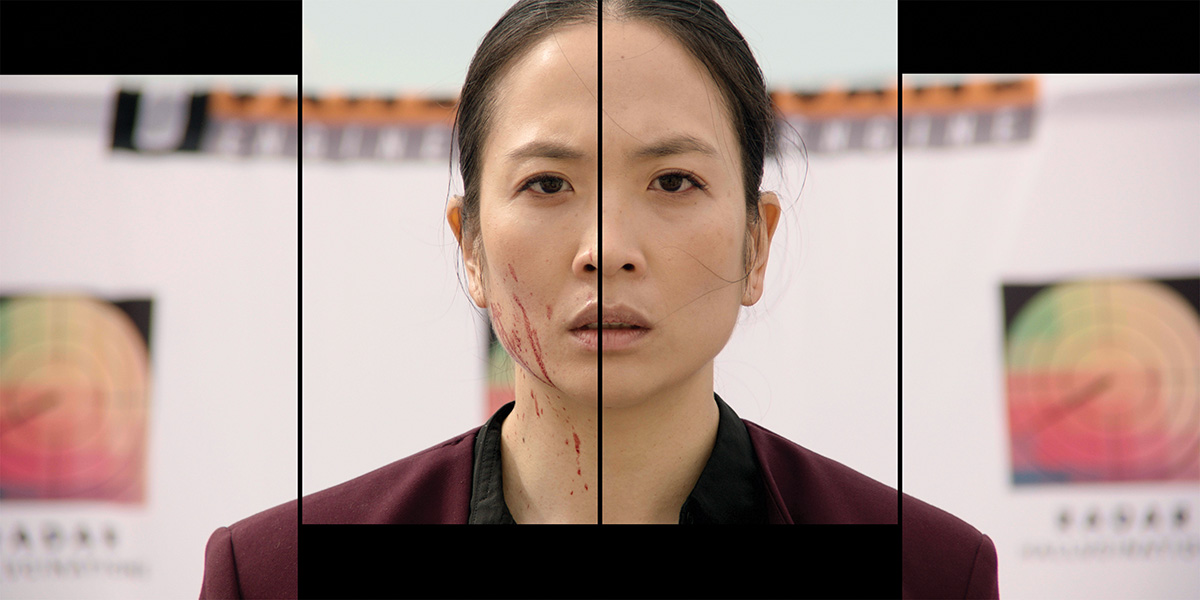
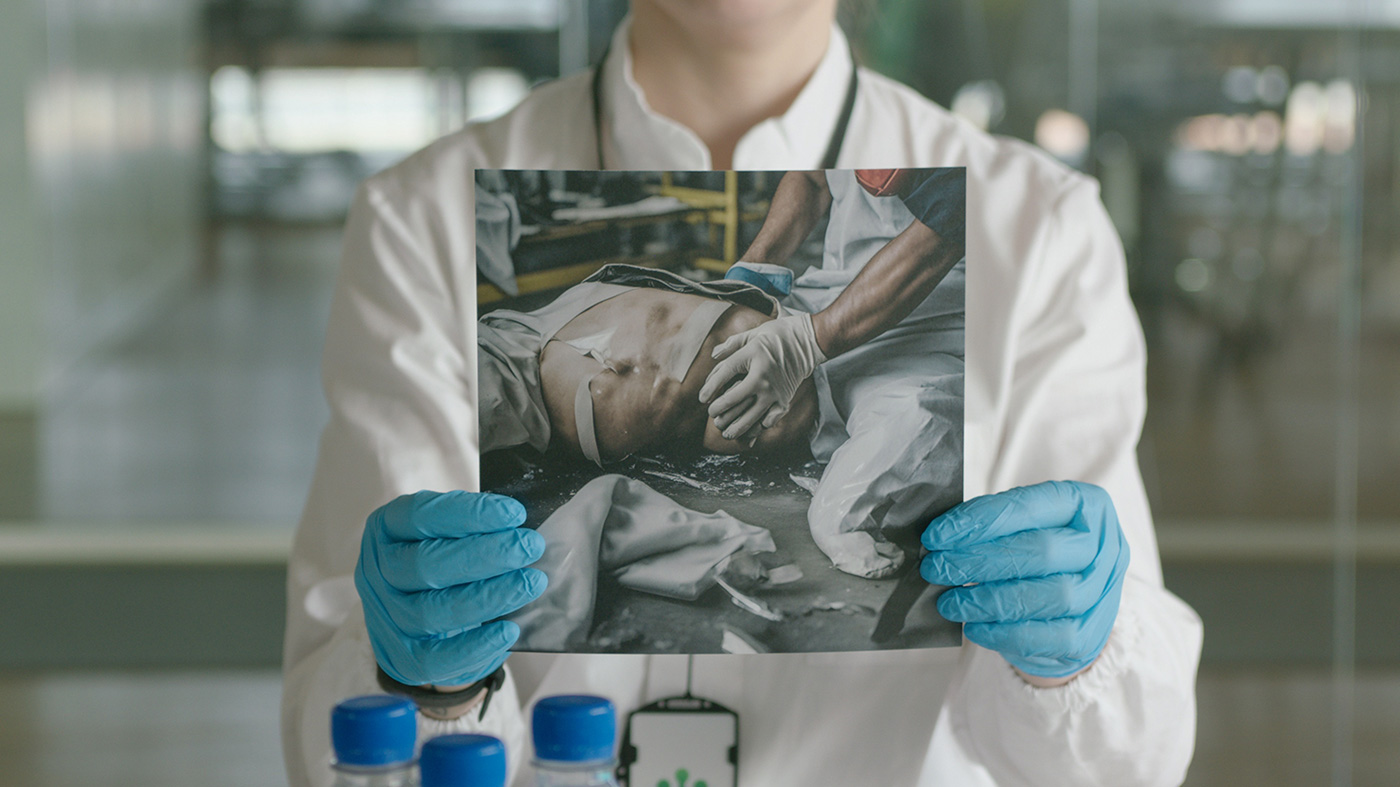
La synesthésie miroir-tactile est un phénomène neurologique dans lequel une personne ressent physiquement la même sensation de toucher que celle qu’elle voit éprouvée par quelqu’un d’autre. Un stimulus perçu par un sens déclenche ainsi une sensation dans un autre. Dans la vidéo Mirror Touch (Archipelago DLC_01), les employés de l’entreprise de trading à haute fréquence Archipelago™ sont soumis à une série de tests expérimentaux destinés à développer une forme d’empathie synthétique. Le processus vise à réunifier l’espace du corps et celui de la cognition ; le corporel et l’immatériel ; le réel et l’imaginaire. Accompagné par les acteur·ices du film, le spectateur est guidé par une voix autoritaire dans un voyage suggestif qui mène des terminaux de trading jusqu’à la réalité physique de l’usine. Là, la matérialité brute — et violente — du sol industriel revient en force : le corps du travailleur y demeure le témoin physique de l’empreinte, elle aussi violente, du progrès.
Søren Thilo Funder est un artiste visuel travaillant principalement la vidéo et l’installation. Ses œuvres fonctionnent comme des hybridations de fictions populaires, de tropes culturels et de situations socio-politiques, de projections et d’histoires. Elles sont des constructions narratives qui insistent sur la formation de nouveaux sens dans la fine membrane qui sépare les fictions des réalités. Attentif aux histoires écrites et non écrites, aux paradoxes de l’engagement social, aux glissements temporels et au besoin de récits non linéaires, Thilo Funder propose des espaces où peuvent se produire des rencontres temporelles, politiques et mémorielles à contre-courant.
Valentina Furian
Ciacco
Vidéo | hdv | couleur | 6:50 | Italie | 2021
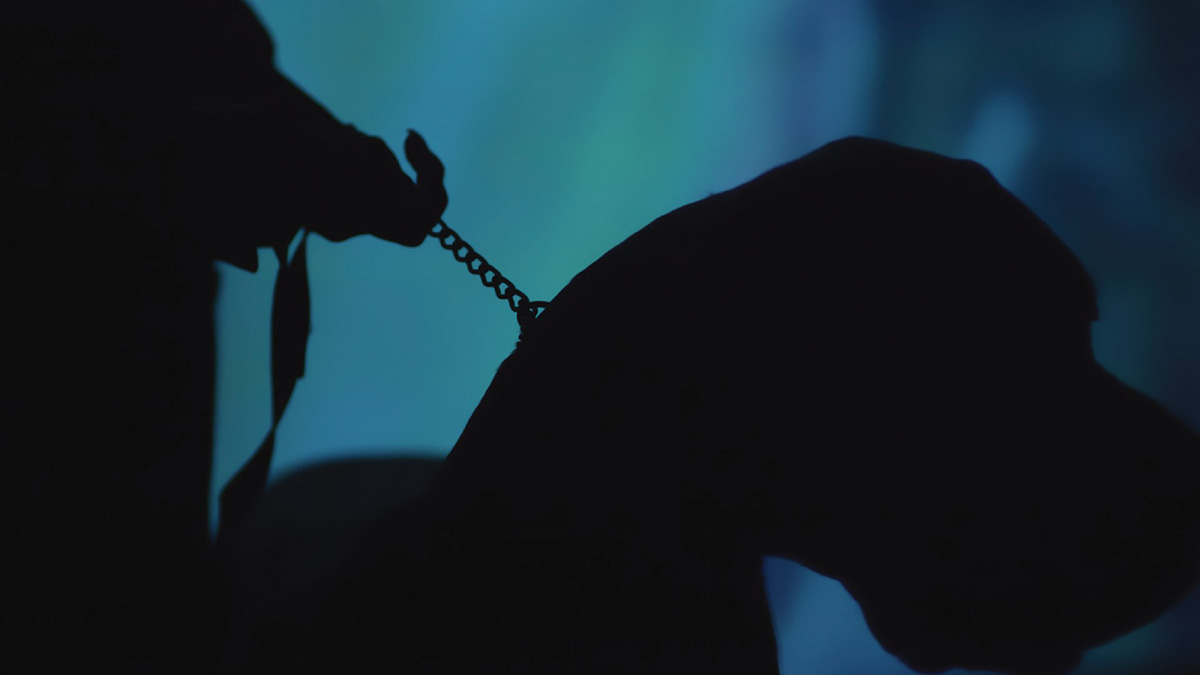
When the day has declined, the night overwhelms us. An unusual bestiality envelops us, it does not belong to us but attracts us to itself. Ciacco develops from a reinterpretation of the sixth canto of the Inferno of the Divine Comedy, where Dante and Virgilio enter the third circle. In the Tartarean circle gluttonous sinners are scourged by a violent rain and tormented by the gigantic and frightening dog Cerberus, feral triad. Ciacco is the gaze through which we are spectators and actors, as well as dogs: the eyes of a damned incessantly hit by a cyclical storm of images, instincts, rain. A damned who lies beneath the beastly torment inflicted by Cerberus, a gigantic, frightening three-headed dog. Three, the number is repeated: triple is the beast, triple the setting in which it navigates. As if we were in the amphitheatre of Dante’s hell, sitting on Ciacco’s lap, we observe the spectacle from the third tier of benches. On stage, the torture of the damned is revealed by the staging itself and by the epic character of the natural environment. The sequences in the film become the viewer’s exploration in “this long night of the world” that we are experiencing.
Valentina Furian (b. 1989, IT) is an Italian visual artist based in Milan, Italy. She is working mainly with moving images. She studied Visual Arts at University Iuav of Venice. Her research investigates the relationship between human and nature. She is particularly interested in exploring animal domestication as a form of human domination as well as human domestication in relation to social rules. Her films have been exhibited in institutional and indipendent spaces such as: Pearl Art Museum, Shanghai, CN; VISIO - European Programme on Artists’ Moving Images; Collezione FARNESINA, Mattatoio, MAXXI - Museo nazionale delle arti del XXI secolo, Rome; MUSE - Science Museum of Trento; UNA galleria, Piacenza; Fondazione Francesco Fabbri, Treviso; MAMbo - Museo d’Arte Moderna di Bologna; The Blank Contemporary Art, Bergamo; Museo Civico di Bassano del Grappa; Case chiuse, Careof and ViaFarini, Milan; Fondazione Bevilacqua la Masa and Microclima, Venice, IT; Sunaparanta Center for Contemporary Art, Goa; Italian Cultural Institute in Mumbai, IND; Goyki3 Art Incubator, Sopot, PL.
Coco Fusco
A/K/A Mrs. George Gilbert
Doc. expérimental | dv | noir et blanc | 31:0 | USA | 2004
This hybrid video blends fictional and documentary source material in an imaginative re-creation of a crucial political moment in U.S. history. Co-scripted by Rick Moody (The Ice Storm), it tells the story of an FBI agent who confesses to his involvement in the nationwide search for Angela Davis, the famous radical philosopher and black activist who was on the FBI`s "Ten Most Wanted" list in 1970 and an underground fugitive for two months.
"Coco Fusco is a New York-based interdisciplinary artist and writer. She has performed, lectured, exhibited and curated around the world since 1988. She is the author of "English is Broken Here" (The New Press,1995), "The Bodies That Were Not Ours and Other Writings" (Routledge/inIVA, 2001) and the editor of "Corpus Delecti: Performance Art of the Americas" (Routledge, 1999) and "Only Skin Deep: Changing Visions of the American Self" (Abrams, 2003). Fusco is a recipient of a 2003 Herb Alpert Award in the Arts. Fusco`s performances and videos have been included in such events as The Whitney Biennial, Sydney Biennale, The Johannesburg Biennial, The Kwangju Biennale, The London International Theatre Festival, and the National Review of Live Art. Her 1993 documentary about her caged Amerindian performance with Guillermo Gómez-Peña, The Couple in the Cage, has been screened at over two hundred venues around the world. She recently curated a comprehensive exhibition on racial taxonomy in American photography for the International Center for Photography, Only Skin Deep: Changing Visions of the American Self, that is currently on tour. Her latest video, a/k/a Mrs. George Gilbert, was selected for the 2004 Shanghai Biennale and will screen at the Museum of Modern Art in 2005. Her video, Els Segadors, commissioned by the Museum Boijmans in Rotterdam in 2001 was featured in the ICP`s first Triennial in 2003. Her video installation, Dolores from 10 to 10, received an honorable mention from the 2003 Transmediale Festival in Berlin. Fusco`s writings have appeared in a wide variety of publications, including The Village Voice, The Los Angeles Times, Art in America, The Nation, Ms., Frieze, Third Text, and Nka: Journal of African Art, as well as a number of anthologies. She is the co-founder and co-moderator of Undercurrents, an on-line discussion about feminism, new technologies and globalization. Fusco is an associate professor in the Visual Arts Division of Columbia University`s School of the Arts." Courtesy Video data bank
Thomas Fürhapter
Cleaning & Cleansing
Documentaire | 4k | couleur | 91:37 | Autriche | 2024
In Cleaning & Cleansing, director Thomas Fürhapter offers a meticulous and haunting meditation on modern society’s obsession with purity, order, and control. Through a series of observational vignettes, the film examines spaces and practices where physical cleanliness intersects with psychological and ideological cleansing. With precise cinematography and a minimalistic narrative approach, Fürhapter challenges viewers to reflect on the boundaries between hygiene, surveillance, and conformity. The film unfolds like a quiet, unsettling symphony of routines and regulations, inviting us to question what lies beneath the surface of our polished realities.
Thomas Fürhapter was born in Vienna, Austria. He studied philosophy at the University of Vienna and is now a writer, director and producer. His films have been screened and awarded at numerous festivals including Sarajevo, Zurich FF, CPH:DOX, DOK Leipzig, DOK.Munich, Sheffield, DOCVILLE Leuven, BAFICI, Anthology Film Archives NY, DOXA Vancouver, FID Marseille, etc.
Horacio G, Longina
OIDAR
Vidéo expérimentale | dv | couleur | 2:0 | Espagne | 2005
______
_____

Paul Gabel
For Safekeeping (Scissions, Sutures and Naming)
Doc. expérimental | dv | couleur | 44:22 | USA | 2006
Une collection d?images publiques est enregistrée au jour le jour pour attirer l?attention sur le fait que l?archiviste, l?acte d?archiver et les archives elles-mêmes s?affectent entre eux à travers les techniques et les pratiques qui développent et maintiennent le contenu archivé qui en résulte. En suspendant, au tout début de l?étude, la citation suivante de Jacques Derrida : « il n?y a pas d?archives sans un lieu, sans technique de répétition et sans une certaine extériorité. Il n?y a pas d?archives sans extérieur », commence une enquête sur les conditions grâce auxquelles l?archivage et les archives peuvent exister. Alors que la caméra se concentre sur des passants dans la rue et se concentre ensuite sur l?intérieur de la collection, on voit des archivistes chercher et choisir des images et des illustrations pour le catalogue et les séparer page par page de leur livre d?origine. Ces illustrations vont ensuite subir un certain nombre de procédures et vont être réorganisées, cataloguées et reclassées avant d?être finalement rangées pour pouvoir être feuilletées par le public. Alors qu?on déchire, recadre et écrit sur les illustrations au contenu astronautique, historique, archéologique et anthropologique vues sur l?enregistrement, le pouvoir historique du contenu est métaphoriquement réduit et retiré alors qu?il devient un objet transformé et assimilé dans la vaste histoire de la collection. Dans une scène qui nous montre les limites derrière les directives de la classification, le portrait d?un homme souriant est abandonné à la décision d?un archiviste de le classer dans la rubrique ?maladie? ou ?peau? puisque la photographie accentue le vitiligo du sujet. Dans la séquence finale, les images qui sont maintenant complètement intégrées dans la collection, subissent une nouvelle sélection dans les mains des patrons qui choisissent des images pour leurs propres objectifs. La boucle est bouclée lorsque l?on voit un patron quitter le bâtiment avec ses images et disparaître parmi les passants. Avec lui ne s?en va pas seulement une infime partie de la collection mais (comme la vidéo voulait l?enregistrer au départ) un testament d?actes performatifs mis en avant à travers des procédures, une partie vivante de la main de l?archiviste et une histoire vraiment unique.
Paul Gabel a obtenu un BFA (Bachelor of fine arts) pour son travail en dessin et gravure à l?université de Binghamton où il a étudié de 1994 à 1998. Pendant sa formation, Gabel a travaillé en tant qu?illustrateur au tribunal pour une chaîne de télévision locale à Binghamton et a couvert les affaires de meurtre Pennsylvania vs. Dr. Stephen Barry Scher en 1997 et New York vs. Giuseppe Cataldo en 1998. Gabel a ensuite travaillé pour le Metropolitan Museum of Art, The Drawing Center et the Whitney Museum of American Art. En 2001 il fut engagé afin d?aider à développer The New York Public Library Art Collection, et depuis 2005, The New York Public Library Picture Collection. Paul Gabel est né à Kingston en Pennsylvanie en 1976 et a été élevé à Binghamton dans l?état de New York. Il vit aujourd?hui dans la ville de New York. Les projets vidéo de Paul Gabel (qui ont étudié des thèmes concernant la connaissance, le souvenir, la foi, l?autorité, la présence et l?absence) s?est fait connaître à travers des publications, des expositions collectives et des festivals internationaux d?art vidéo. The Journal of Motion and Sound a sélectionné The Impossibility of Remaining (2003) pour leur première compilation sur DVD de 40 artistes internationaux. The Film-maker?s Cooperative, qui est la plus grande source d?archives de films indépendants et avant-gardistes du monde, détient les droits d?exploitation de The Impossibility of Remaining, de The Seen and the Unseen (2004) et de I will always wait, I twill never be, qui est la dernière vidéo de Gabel tournée en 2005 et qui parle de la possibilité de faire son deuil par rapport à l?état dans lequel était Ground Zero à l?époque. Gabel continue de chercher de nouveaux endroits susceptibles d?accueillir ces projets et sa dernière étude vidéo For Safekeeping (Scissions, Sutures and Naming). For Safekeeping est un documentaire expérimental qui enregistre jour après jour les procédures qui se cachent derrière des archives d?images pour proposer un point de vue sur la formation, la mise en ordre et la prolongation de l?origine, de l?histoire et de l?autorité. Après avoir été projeté pour la première fois à la Bibliothèque Nationale du Québec en Septembre 2006, la vidéo de Gabel, I will always wait (It will never be) est présentée actuellement au PULSAR CARACAS 2006, Encuentro Internacional de Multimedia, du 1er Octobre au 18 Novembre. Une sélection du travail de Gabel peut être consultée en ligne à l?adresse suivante : www.paulgabel.com

Paul Gabel
I will always wait (It will never be)
Vidéo | dv | couleur | 8:56 | USA | 2005
Un film qui parvient à saisir Wall Street en un point entre déconstruction (la Deutsche Bank enveloppée pour travaux), reconstruction (7 World Trade Center) et destruction (l'absence des tours jumelles). Les phrases "I will always wait" ("j'attendrai toujours") et "It will never be" ("cela n'arrivera jamais") rendent possibles une lamentation sur la journée tragique du 11 septembre, à un moment où ces indications physiques sont bouleversées par le progrès et le renouveau urbain.
Paul Gabel est né en 1976. Il vit et travaille à New-York. Dessinateur et vidéaste, il a également travaillé pour le Metropolitan Museum of Art, le Drawing Center et le Whitney Museum of American Art de New-York. Son travail explore les thèmes de la connaissance, la mémoire, la foi, l'autorité, la présence et l'absence. Sa vidéo, 'I will always wait, It will never be' trace la possibilité d'une complainte concernant l'état actuel de Ground Zero. Elle a été recemment montrée au 4è festival de courts métrages de Hull, a Royaume-Uni, et au festival de films de Luksuz en Slovénie.

Leo Gabin
No panic baby
Vidéo | hdv | couleur | 31:30 | Belgique | 2017
Une voix myste?rieuse et sussurante tente de re?conforter des esprits anxieux alors que le ciel est envahit de faux objets. Le personnage fe?minin ressemble à un agresseur scolaire type, mais avec les lèvres et les sourcils de Kylie Jenner. Un paysage ame?ricain peuple? de casinos en voie de faire faillite et les quartiers environnants sont de?serts. Chagrins d'amour et casquettes de baseball en feu. Un avion tient tout seul au milieu du ciel alors qu'une personne nous dit «Ne croyez pas ce que vous pensez» ... NO PANIC BABY, par le trio d'artistes Leo Gabin, e?voque une histoire d'amour baignant dans une ambiance d'extrême paranoïa et d'anxie?te?. Le film capture le sens inhe?rent à l'irre?el, comme l'emblème d'une e?poque qui prend alors son dernier souffle.
Leo Gabin est un trio d'artistes belges qui ont travaille? ensemble depuis 2000. Leur pratique artistique inclut à la fois la peinture, l'installation, la sculpture et le film. Ils tirent leur inspiration de la prolife?ration de contenu ge?ne?re? par les utilisateurs d'internet, ainsi que l'espace de rencontre encore inde?fini entre la sphère publique et personnelle. Les oeuvres des Leo Gabin ont e?te? pre?sente?es au museum Dhondt-Dhaenens (Deurle), au Schirn Kunsthalle (Frankfurt), à White Cube (London), au Museum M Woods (Beijing), au CPH:DOX (selected New:Vision award), au Nowe Horyzonty (selected Grand Prix), au IFFR (Critics' Choice), au Torino Film Festival et au CineMarfa, entre autres.
Gints Gabrans
SAN FOOOD office Towers Paris
0 | 0 | | 0:0 | Lettonie, 0 | 2019
The whole Paris is covered by a GPS-based large scale virtual object “SAN Foood office Paris”, that can be seen using the augmented reality app SAN (download - san.lv). At the center of the object, 25-kilometer-high SAN towers are located near the Eiffel Tower. Foood office based on the idea: UN estimates that by 2050 the number of world’s population will reach 9 billion, therefore it will be necessary to produce by 70 per cent more food. Unlike the tendency to think how to produce more and more, the FOOOD project proposes genetically modified human metabolic bacteria that have been endowed with the ability to synthesise enzymes that break down cellulose. Cellulose, a simple sugar glucose polymer, makes up a significant part of plant biomass. In the ordinary human metabolism, cellulose is indigestible and totally without nutritional value. That is why these enzymes that break down cellulose would allow the use of everyday food products from the vegetable world with almost a third more efficiency. They would also allow the more effective use of completely new types of food resources for example, cellulose rich wood and paper. If we managed to create a complete process to break down cellulose then humans would obtain 11% more kilocalories from 100 grams of paper than from 100 grams of bread (400 kilocalories from paper and 355 from bread).
Gints Gabr?ns (b. 1970, Valmiera, Latvia) works mainly with installations and new media art. From 2016 to 2020, he developed the augmented reality mobile application SAN. Solo exhibitions include: Transreality Zirgu Street, Riga (SAN, 2018); Out of Nowhere, Société d'encouragement pour l'industrie nationale, Paris (2015); The Bright Sky, Watermans New Media Gallery, London (2010); Paramirrors, Latvian Pavilion, 52nd Venice Biennale (2007); Invisible. Special Effects of a Parallel World, Contemporary Art Centre, Vilnius (2005); and STARIX, 26th Sao Paulo Biennial (2004). Group exhibitions include: 2019 "The Coming World: Ecology as the New Politics 2030–2100, Garage Museum, Moscow Obvious and Incredible, Gallery 427, Riga (2018); New Eden, Arctic Biennial, Sølvberget Galleri, Stavanger, Norvay (2016); Science Inspires Art: Food, New York Hall of Science, New York (2016); Visionary Structures. From Johansons to Johanson, Bozar Art Centre, Brussels (2015); and the 4th Moscow Biennale of Contemporary Art (2011). He lives and works in Riga.

Gints Gabrans
PARAHYPNOSIS
Vidéo expérimentale | dv | couleur | 6:0 | Lettonie | 2007
Cette vidéo montre une séance d?hypnose collective à la pleine lune. Au cours de la séance, l?hypnotiseur explique que la lumière du jour perce et qu?une manipulation permet de transformer la nuit en jour artificiel. Quand les gens hypnotisés se réveillent, ils ont réellement l?impression de voir la lumière du jour. Le spectateur peut choisir de suivre les transformations de l?espace et de la perception, ou de participer à cet événement imaginaire
Gints Gabrans est né en 1970. Il vit et travaille à Riga, en Lettonie. Son travail a été exposé au Musée d?art contemporain de Tallinn, au Baltic Art Center, à Stockholm, aux Rencontres internationales Paris/Berlin, à la Wolksbuhne, Berlin, à la 26ème Biennale de Sao Paulo, au Musée d?art contemporain Kiasma à Helsinki, au Musée d?art contemporain de Zagreb en Croatie, au Ludwig Museum de Budapest, à la Hamburger Bahnhoff, Berlin, au Moderna Museet, Stockholm, et lors de la 8ème triennale d?art baltique, au centre d?art contemporain de Vilnius (Lituanie).

Gints Gabrans
Starix
Doc. expérimental | betaSP | couleur | 26:0 | Lettonie | 2004
"En transformant un vagabond de la gare de Riga en star des médias, Gabrans a révélé les mécanismes inhérents aux stratégies des médias. Pour ce projet, Gabrans a fondé l'agence de publicité Néostar. Le mot "Starix" renvoit à la fois à l'anglais "Star" avec la culture populaire qui s'y rattache, et au terme russe signifiant "vieil homme". Dans ce cas précis, le vieil homme est un sans domicile fixe mais, dans un contexte de projet artistique, peut devenir une star." source : kiasma

Tonci Gacina
22:22 Split-Zagreb
Vidéo | dv | couleur | 4:8 | Croatie | 2008
Sur le côté Est de la station de chemin de fer dans la ville de Split, juste à côté des voies de chemin de fer, les gens vivent dans les maisons construites jadis pour le personnel de la gare. Ce court documentaire les suit dans un moment bref, qui condense toute leur vie.
Tonći Gaćina was born in Split in 1983. In 2007 he turned into the Academy of Fine Arts in Split, at the Film and Video department. He is currently working in visual arts and film. Since 2006 he made a couple of experimental films, and "22:22 Split - Zagreb" is his first documentary.

Kevin Gaffney
The mirror is dark and inky
Vidéo | hdv | couleur | 5:38 | Irlande, Iran | 2015
`The mirror is dark and inky` is comprised of images of daily life in Iran- driving through the city in the afternoon, playing board games with friends- alongside the narration of a neighbour concerned about a whale living in a bath in her apartment building. As the film progresses, we leave the city behind and move into the forest in northern Iran, where the narration turns inwards to a “feeling that does not come from my brain, it more erupts and descends like a fog, barely perceptible until it is enveloping, with a similar cold, dewy feeling.” The whale is the mirror and the mirror is dark and inky. Filmed on location in Tehran and northern Iran, two participants narrate the film and perform the roles.
Kevin Gaffney is a visual artist working in film and photography, living and working in Dublin. He graduated from the Royal College of Art`s MA Photography & Moving Image in 2011, and received an Honorary Mention from the Startpoint Prize for Emerging Artists. He was awarded a Sky Academy Arts Scholarship for the development of a new body of work (2015); was an UNESCO-Aschberg laureate artist in residence at the National Museum of Modern and Contemporary Art’s Changdong Residency in South Korea (2014); and received a Film Project Award from the Arts Council of Ireland for the creation of a new film while artist in residence at the Taipei Artist Village, Taiwan (2014). His work is part of the Irish Museum of Modern Art`s collection and has been shown in exhibitions and film festivals internationally, including: Out There, Thataway at CCA Derry~Londonderry (2015); the Alchemy Film & Moving Image Festival (Scotland, 2015); We at Catalyst Arts (Belfast, 2012); Abandon Normal Devices at Cornerhouse (Manchester, 2012); and solo exhibitions at the Contemporary Art Institute CAI02 (as part of the Sapporo International Art Festival, Japan, 2014); the Galway Arts Centre (2013); and RUA RED South Dublin Arts Centre (2011).

Dominic Gagnon
Space Down
Doc. expérimental | digital | couleur | 78:0 | Canada | 2023
Space Down is a feature-length collage film made with amateur footage retrieved on the Internet. It documents the bootstrap of an astronaut community here on Earth who migrates to space in the confines of their homes. The film is a detournement of the COVID-19 lockdowns that renders visible the Earth momentarily as one of the biggest space analogues in history.
In his ongoing quest to explode the film frame, Dominic Gagnon’s flurry of internet collage films not only cull the lonely, shocking margins of YouTube to captivate us with pixelated self-representations of despair, anger, and survivalism, they also challenge and question the definition of what constitutes cinema. (Text: J.P. Sniadecki)

Simon Gaillot
L'Affaire Bajazet
Fiction | hdv | couleur | 121:55 | France | 2024
L'Affaire Bajazet is an open-air, costumed adaptation of Racine's play of the same name, in which the passions of the heart and the stakes of power clash in early 17th-century Byzantium. Loving, suffering and dying are just words here.
Simon Gaillot est un jeune cinéaste. A l'âge de vingt ans, il décide de tourner chaque été un film en plein air à partir d'une pièce de théâtre. Fidèle à Jean Cocteau pour qui l'art cinématographique est avant tout un artisanat, il travaille, dans un souci constant de, à établir une relation de proximité et de nécessité entre un texte, un visage, un corps et un paysage. Il a ainsi pu adapter avec une grande liberté des œuvres de Julien Gracq (Le Roi pêcheur), Heinrich von Kleist (Penthesilea), Jean Racine (Bajazet), Robert Walser (Aschenbrödel), Oscar Wilde (Salomé), Fernando Pessoa (O Marinheiro), William Shakespeare (Le Conte d'hiver), Torquato Tasso (Aminta) et Charles Péguy (Ève).

Aslan Gaisumov
People of No Consequence
Vidéo | 4k | couleur | 8:34 | Russie | 2016
Aslan Gaisumov développe une œuvre qui se nourrit de mémoire personnelle et collective, mais les transforme et les transcende aussi. Son travail se situe entre l’immédiateté visuelle et le commentaire social, entre le momentané et le monumental. Si elle se compose surtout de vidéo et d’installations incluant des objets trouvés ou confectionnés spécifiquement pour la pièce, Gaisumov expose parfois des photographies et des œuvres sur papier aussi. People of No Consequence est le titre que Gaisumov a choisi pour cette installation vidéo : un plan séquence de la première rencontre d’un groupe de personnes âgées qui ont toutes vécu la déportation de la totalité du peuple tchétchène vers l’Asie centrale en 1944, il y a 72 ans. Il réutilise le titre pour sa constellation de trois œuvres récentes, incluant la vidéo Volga (2015) et l’œuvre tridimensionnelle Household (2016).
Aslan Gaisumov :son parcours relève presque du miracle : aujourd’hui âgé de 25 ans, l’artiste a grandi dans le nord du Caucase tchétchène, région marquée par la guerre civile et le terrorisme, et vécu sept ans dans un camp de réfugiés avec sa famille. A travers ses oeuvres marquantes, Aslan Gaisumov trouve le moyen de traiter son traumatisme et d’attirer l’attention sur la situation en Tchétchénie.

Aslan Gaisumov
Volga
Vidéo | 4k | couleur | 4:11 | Russie | 2015
Dans cette vidéo faisant preuve d’une simplicité des plus efficaces, l’artiste de 24 ans Aslan Gaisumov nous plonge dans le conflit tragique auquel est confrontée sa Tchétchénie natale. Ce document, en partie autobiographique, montre comment les familles tentent de fuir le pays en s’entassant par douzaines dans de minuscules voitures. Le langage intuitif et poétique de Gaisumov vise à signifier les conséquences de la guerre, associées à la perte des traditions et des repères d’identité. Lorsque la survie devient une nécessité, les constructions fragiles comme le langage, les contes de fée et les symboles disparaissent. La mémoire et les histoires familiales se font rares et sont la plupart du temps perdues à jamais. Mais ceux qui parviennent à fuir, tel Gaisumov, représentent une nouvelle génération. On observe alors un nouveau leitmotiv, où le passé et le présent s’entremêlent pour créer de nouveaux symboles et métaphores perpétuant la continuité d’un peuple.
Aslan Gaisumov son parcours relève presque du miracle : aujourd`hui âgé de 25 ans, l`artiste a grandi dans le nord du Caucase tchétchène, région marquée par la guerre civile et le terrorisme, et vécu sept ans dans un camp de réfugiés avec sa famille. A travers ses oeuvres marquantes, Aslan Gaisumov trouve le moyen de traiter son traumatisme et d`attirer l`attention sur la situation en Tchétchénie.