Catalogue > Liste par artiste
Parcourez la liste complète des artistes présentés dans le cadre des Rencontres Internationales depuis 2004. Utilisez le filtre alphabétique pour affiner vos recherches.
Knut Asdam Special
Catalogue : 2013 | | | | 90:0 | Norvège | 0
Knut Asdam Special
| | | 90:0 | Norvège | 0
.
.
Fred Koenig
Catalogue : 2007The truth of the deep colors of Kaspar Kameleon | Doc. expérimental | dv | couleur | 16:30 | France, Allemagne | 2004
Fred Koenig
The truth of the deep colors of Kaspar Kameleon
Doc. expérimental | dv | couleur | 16:30 | France, Allemagne | 2004
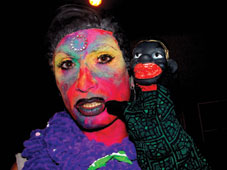
Portrait du performer berlinois Kaspar Kameleon. Nous le suivons durant ses répétitions, chez lui et dans le cabaret où il se produit. Il nous emmène dans son village natal, Stockhausen au centre de l'Allemagne, où nous rencontrons ses proches et voyons le bon accueil que lui font les gens . Ils sont heureux de voir son spectacle de Pâques. Nous rencontrons sa mère qui nous livre généreusement ses sentiments quant au fait que son fils soit un performer Drag. Kaspar est une légende de la nuit underground berlinoise. Ce film, le second que lui consacre Fred Koenig ( cf: "the colors of Kaspar Kameleon" 2003 ) est un véritable hommage à cet artiste géréreux et créatif, ainsi qu'une leçon de tolérance.
J'ai voyagé et vécu au Mexique, en Allemagne, à New york, en Haïti, en Afrique du Sud. Ces lieux ont destabilisé ma vision occidentale du monde. Mon inspiration me vient des gens que j'ai pu rencontré durant ces voyages. Leurs histoires et leurs comportements m'aident à développer mon travail. A travers leurs expériences et mes observations, je redéfinis ma personne et mes recherches selon ce que j'appelle "LE DÉSIR D'APPARTENANCE". Cela résume mon travail. Je ne suis ni un observateur ni un anthropologue, j'interagis, je vis, je participe et n'anticipe pas. Via la photographie, la vidéo, la danse, je n'apporte pas au public qu'un divertissement, mais aussi un sujet de réflexion.
Jan Koester
Catalogue : 2007Our Man In Nirvana | Animation | 35mm | couleur | 10:27 | Allemagne | 2005
Jan Koester
Our Man In Nirvana
Animation | 35mm | couleur | 10:27 | Allemagne | 2005
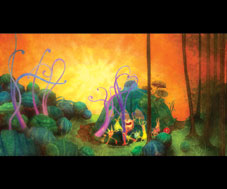
John, célèbre rock-star, meurt accidentellement lors d´un concert avec son groupe, et se réveille au Nirvana. C´est là qu´il doit faire face à ses voeux et à ses actes.
Jan Koester naît en 1978 à Berlin. Après une scolarité à Fribourg et Wilhelmshaven il retourne à Berlin pour étudier l´animation au HFF "Konrad Wolf". Il achève "Our Man In Nirvana", le film qu´il tourne pour son diplôme, en Novembre 2005, après trois ans de travail. Il travaille actuellement sur un nouveau court-métrage.
Uta Kogelsberger
Nathalie Koger
Niki Kohandel
Catalogue : 2022The Sparrow Is Free | Doc. expérimental | hdv | couleur | 14:6 | France, Royaume-Uni | 2021
Niki Kohandel
The Sparrow Is Free
Doc. expérimental | hdv | couleur | 14:6 | France, Royaume-Uni | 2021
In an empty house, a young woman hears a voice. The tales it evokes lead her to recreate scenes from her grandmother’s past life. Through objects found at home, Kohandel's short interview-film explores gender roles in early 20th-century Iran. As a young girl, marriage to her older cousin leads to years of control and frustration. Rebelling against her husband, she eventually relocates to France with her sons, building a new life. As she voices her own story, the film weaves her experiences together into a broader narrative of self-determination. She carves out her independence in Paris and finds comfort in the everyday. A simple kind of happiness follows, the sparrow is free.
Niki Kohandel (b. 2000, Paris) is an artist and filmmaker, in her third year of undergraduate studies at the Slade School of Fine Art, UCL. Niki films mothers and daughters, houses and flowers, and all sorts of things which, like relationships, can be nurtured, but also grow out of control. She uses obsolete recording devices and her imperfect knowledge of languages to document and tell stories, creating at the interplay between the analogue and the digital.
Kai Foong Kok
Catalogue : 2006Life is Elsewhere | Film expérimental | dv | couleur et n&b | 7:14 | Malaisie | 2004
Kai Foong Kok
Life is Elsewhere
Film expérimental | dv | couleur et n&b | 7:14 | Malaisie | 2004
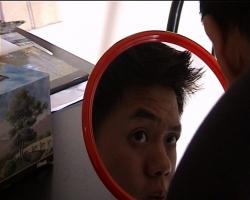
Avez-vous parfois l'impression d'être observé ? Qui observe qui ? La vie de qui sommes-nous en train de vivre en ce moment ? En regardant dans un miroir, qui voyons-nous ?
KOK Kai Foong a étudié les Sciences de l'Informatique à l'Université de Tamkang (Taïwan) et est devenu critique de films en 1996. Depuis 2002 il a réalisé plusieurs courts-métrages, en parallèle à son travail d'ingénieur informatique freelance.
Alice Kok, Pascal Lièvre
Siew-wai Kok
Catalogue : 2008In Solitude, A Camera-eye | Vidéo expérimentale | dv | couleur | 4:25 | Malaisie | 2006
Siew-wai Kok
In Solitude, A Camera-eye
Vidéo expérimentale | dv | couleur | 4:25 | Malaisie | 2006
La vidéo a été tournée dans deux endroits: à Buffalo, New York (Etats-Unis) et à Kuala Lumpur, en Malaisie. La caméra, portée à l'épaule, est comme l'extension des yeux de l'artiste. Une nuit ventée, avant la pluie, une caméra-oeil a saisi des aspirations, la solitude et le temps.
Née et élévée à Kuala Lumpur, en Malaisie, Siew-wai Kok est une artiste spécialisée dans la vidéo, qui travaille également sur le son et les représentations. Son oeuvre explore des thèmes intimes de la vie quotidienne tels que l'émotion, la solitude et les aspirations spirituelles. Siew-wai a obtenu son Bachelor of Arts dans le domaine des médias à l'Université de Buffalo, et son Master of Fine Art d'Arts appliqués à l'électronique à Alfred University. Elle a participé à des festivals internationaux tels que le 25hrs International Videoart Show 2003 (Espagne), Signal & Noise 2006 (Canada), le Festival International du Film de Rotterdam en 2007 (Pays-Bas). Siew-wai enseigne actuellement à la Multimedia University (MMU) en Malaisie.
Jaana Kokko
Catalogue : 2026Vihreä maa | Doc. expérimental | 4k | couleur | 30:0 | Finlande | 2024
Jaana Kokko
Vihreä maa
Doc. expérimental | 4k | couleur | 30:0 | Finlande | 2024
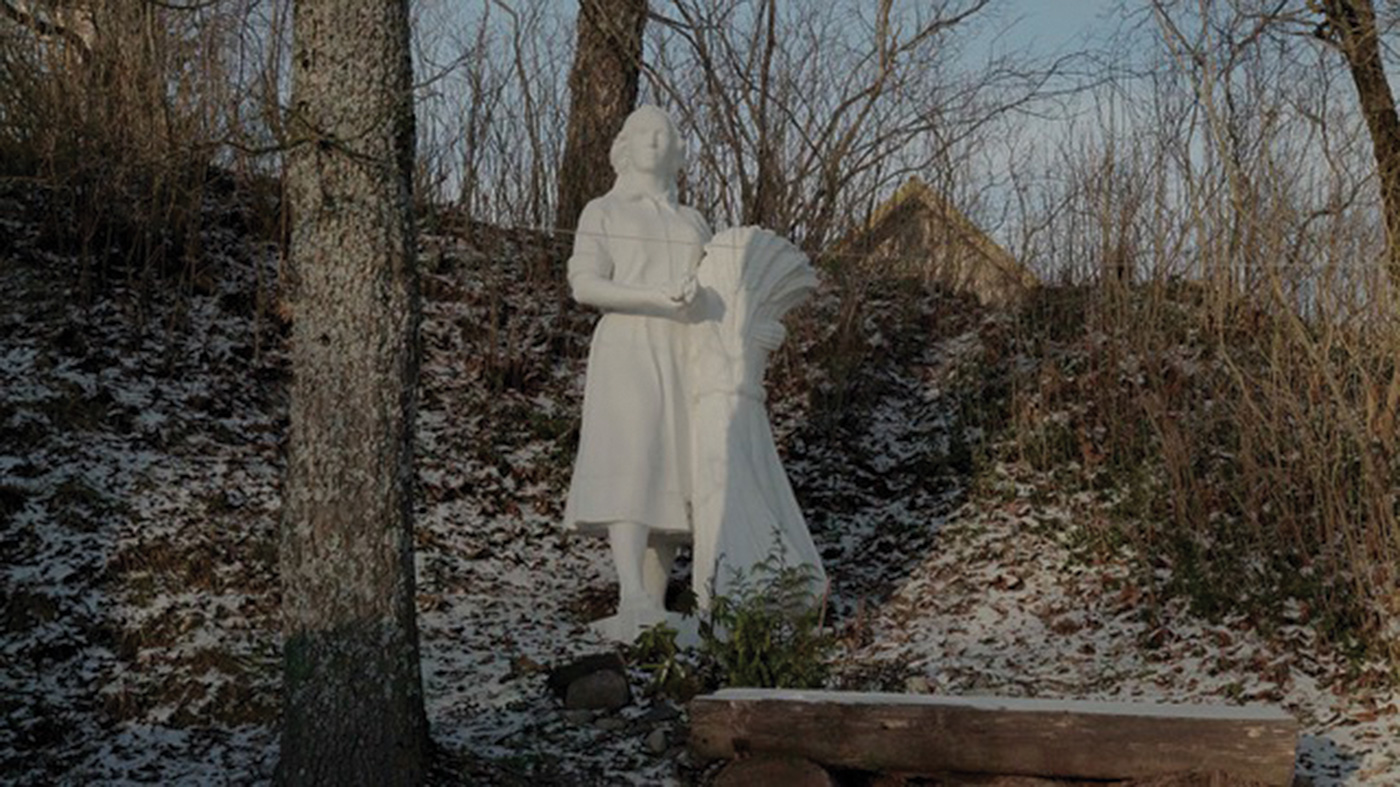
Green Land takes place in rural Latvia. Depicting a collective farm worker, it personifies both personal as well as state memory, in different ways. The main characters, former collective farm workers Ir?na, Veronika and L?cije, recount their experiences, offering us a glimpse of a bygone era and openly participating in the performance offered to them. Films key image – the gestalt of history – is a concrete sculpture by Rasma Bruz?te from 1952. The title of the film comes from the concept of a green, verdant land. It is also the title of a classic book by Latvian writer Andrejs Up?ts, a Soviet-era epic to which the young literary scholar Arnis, has devoted his life to.
Jaana Kokko is an artist, filmmaker, teacher and occasional curator based in Helsinki, having her background in arts and economics. She is interested in the languages and places/ spaces of individuals in which the singularity of experience opens onto the collective and its historicity in ways that allow us to reflect on the ethical, political, and aesthetic dimensions not only of self-representation but also of the life itself as shared. Lately Kokko has been finishing two bodies of films both located in the peripheries, trying to shift the gaze to the outskirts of the sight and hear. In her practice she is now in the search of the common: the emergent need for the change that is starting from our practices of art making, learning and being together. Her work has been exhibited f.ex. at the Lithuanian National Gallery in Vilnius, Latvian National Museum of Art in Riga, Tallinn Art Hall, Helsinki Art Hall, Moderna Museet in Stockholm, Botkyrka Konsthall, Joensuu Art Museum and Lappeenranta Art Museum in Finland, Bucharest International Experimental Film Festival, Tampere Film Festival and Tokyo Media Art Festival.
Jeanna Kolesova
Catalogue : 2025Memory is an Animal Which Barks with Various Mouths | Installation vidéo | mp4 | noir et blanc | 15:35 | Russie, Allemagne | 2023
Jeanna Kolesova
Memory is an Animal Which Barks with Various Mouths
Installation vidéo | mp4 | noir et blanc | 15:35 | Russie, Allemagne | 2023
The film explores the interplay between the real and the imagined, the collective and the personal, and raises the question: how has collective memory of the Second World War been manipulated? Public commemoration, the aggressive patriotic indoctrination of children, and the cult of victory have shaped a war-centered identity and national narrative in Russia. In contrast, individual memories of those who lived through the Second World War often reflect its violence and tragedy. Could this discrepancy between individual and collective memory offer a way to challenge and break free from the nationalist narrative of the past?
Jeanna Kolesova (b. 1988, Moorland Village, Russia) is an artist, filmmaker, and researcher. Working across moving image, performance, web, installation, and text, their work explores the manipulation of history, information, and the impact of imperial technologies on bodies and landscapes. Kolesova studied documentary film and photography in St. Petersburg, interactive media at CalArts, and experimental film at the Berlin University of Arts. Their works have been exhibited in Prague, Berlin, Dresden, Baden-Baden, LA, Tokyo, and St.Petersburg. Kolesova has received the KUNSTFONDS (2024) and Karl Hofer (2023) scholarships and participated in the Berlin Goldrausch artist program (2024).
Selene Kolman, Stef KOLMAN
Catalogue : 2006Tokyo Driver Caress | Fiction expérimentale | dv | couleur | 11:32 | Pays-Bas, Pays-bas | 2004
Selene Kolman, Stef KOLMAN
Tokyo Driver Caress
Fiction expérimentale | dv | couleur | 11:32 | Pays-Bas, Pays-bas | 2004
Taisuke conduit à travers les nuits d'un Tokyo futuriste. Des autoroutes lumineuses reflètent l'immensité et l'infini, avec des réseaux reliant les hommes, les véhicules et les visions. "Caress"... des images hypnotiques de voyages omniprésents de notre époque.
Selene KOLMAN est née en 1966, aux Pays-Bas. Depuis 2002, elle est enseignante à l'Université de Utrecht (Nouveaux Media et Culture Numérique) FORMATION 1994 - Maîtrise de Philosophie, Université d'Amsterdam 1993 - Licence à l'Art Academy Minerva, Groningen 1990 -Histoire de l'art propédeutique, Université de Groningen Stef KOLMAN est né en 1967 aux Pays-Bas. Depuis 2003, il est directeur artistique, MediaCatalyst, Amsterdam FORMATION 1993 - Maîtrise : M.A. History&Theory Architectural Association, Londres 1992 - Licence à la Design Academy, Eindhoven Stijn VAN SANTEN est né en 1965 à Amsterdam. Après avoir achevé ses études à la Sint Joost Academy of Art à Breda en 1992, il devient cameraman (16mm) pour "Miss Blanche" et "Leklicht" de Mark de Cloe, "Some Like It Hot" et "Can't U Hear me Singing" de Walter Stokman, "De Tijdreiziger" de Dick Tuinder et "Jannes de Film" de Rein Hazewinkel. En 1993, il reçoit le Grolsch Prize pour les nouveaux talents au cours du Festival du Film Hollandais (1993). Il réalise "Igitur, Act of Presence" et "Goud", pour lequel il remporte la Golden Flame. En 1995, il réalise "Downstairs", sélectionné pour le Golden Calf. Ses récents films sont : "Ichiko, Laatste woorden" (documentaire) et "Talmen" pour lequel il a remporté le Golden Calf et plus récemment "Profs" (Kort! 2004).
Sara Kolster, Pawel GRABOWSKI
Catalogue : 2006 | Vidéo expérimentale | dv | couleur | 2:0 | Pays-bas | 2005

Sara Kolster, Pawel GRABOWSKI
Vidéo expérimentale | dv | couleur | 2:0 | Pays-bas | 2005
En utilisant ma caméra comme projecteur, révélant silencieusement les textures, l'espace narratif se dévoile. Les images et sons saisis rappelleront des lieux dans nos propres souvenirs. Chaque moment déterminé est comme une capsule de temps, un rappel d'un futur oublié dans le passé.
Kolster (1978-...) est une plasticienne et a une formation en design. Récemment, son travail s'est plus orienté vers la vidéo et le film, s'attachant à des détails de paysages urbains et visualisant des fragments d'histoires de ces environnements. Elle a recours à différentes stratégies, de medias tels que la vidéo, le film et la photographie, à des méthodes de recherche appartenant à diverses disciplines d'observation (journalisme, documentaire et archéologie).
Rainer Komers
Catalogue : 2019BARSTOW, CALIFORNIA | Documentaire | 4k | couleur | 76:0 | Allemagne | 2018
Rainer Komers
BARSTOW, CALIFORNIA
Documentaire | 4k | couleur | 76:0 | Allemagne | 2018
Troisième volet de The American West Trilogy (les deux premiers volets étant Nome Road System et Milltown, Montana (VdR, 2010)), ce film est un portrait poignant et complexe de la vie et des paysages du désert de Mojave. Par sa structure désarticulée qui évoque presque le "fingerpicking" minimaliste de John Fahey, tel un blues décharné perdu dans le temps, le film observe la façon dont la vie s`imbrique et s`écarte de la trame d`un mode de vie américain complètement oublié par les politiques de l`idéologie néolibérale. On y entend le poète et détenu Stanley »Spoon« Jackson, condamné en 1977 à perpétuité sans possibilité de libération conditio-nnelle et qui a séjourné dans plus d`une demi-douzaine de prisons californiennes, lire des passages de son autobiographie By Heart. Des images d`un monde imprégné par la pure mythologie américaine sont entrecou-pées et noyées dans la réalité et les conséquences brutales de politiques financières implacables. »Barstow, California« incarne assurément l`autre côté du rêve américain. Giona A. Nazzaro
Geboren 1944 in Guben. Filmstudium an der Kunstakademie Düsseldorf, Meisterschüler. Filmprojekte in Alaska, Indien, Japan, Jemen, Kalifornien, Lettland und Montana. »Barstow, California« wurde mit dem ARTE Dokumentarfilmpreis 2018 ausgezeichnet, »Nome Road System« mit dem Deutschen Kurzfilmpreis 2004, »B 224« mit dem Hessischen Filmpreis 2001, »Zigeuner in Duisburg« mit dem Preis der Deutschen Filmkritik 1980. Ruhrpreis für Kunst und Wissenschaft 2006. Masterclass IDF / Prag (2012); Videonale.scope Retrospektive / Köln (2014) http://www.videonale.org/en/VideonaleScope-2014; Iasi-Installation (2015) https://vimeo.com/135471613; Villa Kamogawa / Goethe-Institut Kyoto (2015) https://www.goethe.de/ins/jp/de/kul/res/sti/s15/rko.html. Festival-Screenings in 35 Ländern; Preise in Kanada, Frankreich, Polen und USA. Regie, Kamera, Word Art, Gedicht. Lebt in Berlin und Mülheim an der Ruhr.
Dane Komljen
Catalogue : 2025The Garden Cadences | Documentaire | 4k | couleur | 62:0 | Bosnie-Herzégovine, Allemagne | 2024
Dane Komljen
The Garden Cadences
Documentaire | 4k | couleur | 62:0 | Bosnie-Herzégovine, Allemagne | 2024
Mollies is a queer-feminist collective that had been living at a trailer park next to Ostkreuz in Berlin for nearly a decade. The Garden Cadences documents their last summer there before being evicted. Jone is ready to fly. She finds herself at the beginning of something new, but before she moves on, there needs to be a closure. Jone is one of Mollies, the queer-feminist collective that had been living for a decade at a trailer park next to Ostkreuz, Berlin. The Garden Cadences traces their last summer before being evicted.
Dane Komljen, born in 1986 in Banja Luka. He made three feature films, THE GARDEN CADENCES, AFTERWATER and ALL THE CITIES OF THE NORTH, and numerous shorts exploring notions of body, space, utopia and being together. His films were awarded at Festival del Film Locarno, IFF Rotterdam, Festival de Cannes, Sarajevo FF, New Horizons IFF, Festival de Sevilla and shown at Berlinale, Cinéma du Réel, FID Marseille, Toronto IFF, New York FF, FIC Valdivia, VIENNALE, Mar del Plata IFF, FICUNAM, Hong Kong IFF, CPH:DOX, Jeonju IFF, Art of the Real, 25 FPS and others. His work has been presented at the ICA in London, Volksbühne in Berlin, Centre Pompidou in Paris, Union Docs in New York, Lagos Biennale and elsewhere. He lives and works in Berlin.
Vero Kompalic
Catalogue : 2025Plástico: O los Comandantes de un tirano | Fiction | 0 | couleur | 30:0 | Venezuela, 0 | 2023

Vero Kompalic
Plástico: O los Comandantes de un tirano
Fiction | 0 | couleur | 30:0 | Venezuela, 0 | 2023
A sadistic commander forces a group of actors pretending to be soldiers into acts of violence, while a film crew captures the chilling reality.
Vero Kompalic is a Venezuelan filmmaker, programmer and painter. She focuses her scholarship work on postcolonial feminist discourse, with publications on the sexual transgression of Breillat’s work and the radical cinema of Mariana Rondon. She served as an AP and writer on SUMMERTIME, which premiered at SUNDANCE and was theatrically released in 2021. In 2020 she founded DISCORDIA, an independent production company, with her longtime collaborators.
Kong-chang Kong
Catalogue : 2006Name of Wu Mei | Vidéo expérimentale | dv | couleur | 16:0 | Hong Kong | 2005
Kong-chang Kong
Name of Wu Mei
Vidéo expérimentale | dv | couleur | 16:0 | Hong Kong | 2005
L'histoire de cette vidéo est tirée d'une nouvelle, "The Name of Wu-mei", écrite par YUEN Siu-cheong. Yuen utilise une méthode de narration extraordinaire pour présenter l'histoire. Il pousse le lecteur à remettre en question son propre bon sens pendant la lecture. L'histoire parle du narrateur, Nin Kuen, qui nous raconte le procédé utilisé pour achever le roman "The Name of Wu-mei", tandis que nous découvrons, au cours de la narration, que l'intuition que l'on avait ne pourrait être qu'un mensonge de plus.
En 2000 et 2005, Kongkee est diplomé en arts plastiques à l'Université Chinoise et à la School of Creative Media, City University of Hong Kong. Il s'intéresse ensuite à la bande dessinée et aux vidéos, et crée notamment la bande dessinée en ligne : "Rice-Gas". En 2003, sa série de bandes dessinées "Imperfect Shoes" est publiée. Son récent film, réalisé en collaboration avec le romancier YUEN Siu-cheong, "Name of Wu Mei", vient d'être sélectionné par le Hong Kong Art Biennial 2005, le Musée d'Art de Hong Kong. Filmographie vidéo : "Negative Record"(2000), "Princess Cheung Ping"(2004).
Aglaia Konrad
Catalogue : 2015Das Haus | Film expérimental | 16mm | couleur | 21:40 | Autriche | 2014
Aglaia Konrad
Das Haus
Film expérimental | 16mm | couleur | 21:40 | Autriche | 2014
Das Haus deepens the exploration of sculptural architecture that Aglaia Konrad conducted with the series of 16mm films Concrete and Samples. Shot in a house designed by architect Juliaan Lampens in Sint-Martens-Latem (Belgium), the film resumes the artist’s interest on the possibilities of the cinematic medium to generate –rather than capture - an architectural experience. An experience which, in this film, surpasses the visual to mobilize bodily perception and even desire. Konrad’s editing carefully measures the doses of perceptual information it provides to our orientation drive in a process that departs from an initial willingness to orient oneself towards the pleasure of surrendering to disorientation and fragmentation. A disorientation that could be called “perverse” in the sense that Freud bestowed to the word –perverse pleasures are those which linger in the detour; in the resistance to result in a productive goal– insofar as the film replaces the production of a representation of space in favour of perceptive defamiliarization and tactile pleasure. Architecture and film are constantly looking at each other in a piece in which "angle", "transition", "cut", "sequence", "frame", " joint", " fold " and "rhythm" are notions that are spread from one discipline to the other as if the camera and editing would be reading the space as a composition score. There are two architectural comparisons that are often applied to filmmaking: the idea of cinema as a "window" and as “mirror". Das Haus, entangles and complicates those comparisons by treating windows as interfaces that blur the inside and outside and whose transparency acquires materiality, and by using mirrors as devices that disrupt form pushing it to a state of potentiality. In Das Haus the screen is no longer a window but rather a skin: for it is a body interface, a tactile surface and a membrane that is neither safe nor transparent because it reveals its inner cinematic compositional strategies.
Aglaia Konrad is a photography based artist living in Brussels whose work has focused mainly on metropolitan urban space. She has been advising researcher at the Jan Van Eyck Academy in Maastricht and is currently teaching at the Hogeschool Sint-Lukas in Brussels. She had presented her work in solo exhibitions in Siegen, Antwerp, Geneva, Graz, Cologne and New York, among other cities, as well as in international group shows such as Documenta X (1997), Cities on the Move (1998-1999) and Talking Cities (2006). Her work has been documented in several exhibitions catalogues and monographic publications such as 'Elasticity' (2002) and 'Iconocity' (2005). For her book 'Desert Cities' (2008) she received the Infinity award for the best photo book 2009 of the International Center for Photography, New York. The book 'Carrara' (2011) won the Fernand Baudin Prize 2011. Before the trilogy Concrete & Samples (2009-2010) she made the film Sculpture House (2008, 12'05") based on a house built in 1968 around Liège (BE) by Jacques Gillet, Felix Roulin and René Greisch.
Aglaia Konrad
Catalogue : 2017La Scala | Film expérimental | 16mm | couleur | 12:24 | Autriche, Belgique | 2016
Aglaia Konrad
La Scala
Film expérimental | 16mm | couleur | 12:24 | Autriche, Belgique | 2016
The subject of Aglaia Konrad’s 16mm films is modernist architecture but rather than a form of architecture on film, or film on architecture, her films investigate the potential for film to embody the experience of architecture as sculpture. The protagonist here is ‘La Scala’, a villa on Lake Garda, designed by Vittoriano Vigano for André Bloc in 1958. The ‘multiple projection’ (split-screen) of La Scala proposes a multiplicity of perspectives and, more significantly, a succession of combined images.
Aglaia Konrad (1960, Salzburg) criss-crosses urban spaces. Her photographs, films and installations zoom in on exceptional buildings and the transformation of cities. She focuses on the way architecture is visualised and exhibited. Aglaia Konrad lives in Brussels and teaches at LUCA School of Arts. She had presented her work in solo exhibitions in Siegen, Antwerp, Geneva, Graz, Cologne and New York, among other cities, as well as in international group shows such as Documenta X (1997), Cities on the Move (1998-1999) and Talking Cities (2006). Her work has been documented in several exhibitions catalogues and monographic publications such as ‘Elasticity’ (2002) and ‘Iconocity’ (2005). For her book ‘Desert Cities’ (2008) she received the Infinity award for the best photo book 2009 of the International Center for Photography, New York. The book ‘Carrara’ (2011) won the Fernand Baudin Prize 2011. In 2016 she published ‘From A to K’ (Buchhandlung Walther Konig).
Aglaia Konrad
Catalogue : 2015sequenza | Film expérimental | 16mm | couleur | 14:0 | Belgique | 2014
Manon De Boer, George van Dam
sequenza
Film expérimental | 16mm | couleur | 14:0 | Belgique | 2014
Sequenza is an experimental film project by Manon de Boer and George van Dam based on the composition Sequenza VIII for solo violin by Luciano Berio . From a long history of cooperation - to include the soundtrack of Manon de Boer's film trilogy Sylvia Kristel - Paris (2003), Resonating Surfaces (2005) and Think about Wood, Think about Metal (2011) and her portrait of George van Dam in Presto, Perfect Sound (2006) - came the desire to work together to make a movie based on Sequenza VIII . This piece is for its crystalline structure one of the most beloved compositions by George van Dam . Together with Manon de Boer, he wants to explore how rhythm and structure of this composition can be articulated in conjunction with moving images to penetrate. So even deeper into the composition Manon de Boer is fascinated by the image of the intimate contact of the chin, the ears, the face of the violinist with the violin, which extends in the movement of his arms and hands to the body and space, the instrument - body of the violin as a material, physical transition between two abstract elusive poles : that of the mental construction of the composition and experience of its sounds in space. Van Dam and de Boer have developed the following idea from these different interests. In several recordings of Dam filmed (and sound is recorded) when he performs Sequenza VIII . Emphasizing first half total, the body and the intimacy with the instrument. Then abstract details filmed, like his hands, his ear, details of the violin, strings and the like. In the editing is from the portrait / body of the violinist a more fragmented, abstract image created a physical, gives spatial experience in the tension between the music and the image rhythm. If the body and the violin in abstract details and solve dancing away in the (sound) space.
Manon de Boer (°1966 in Kodaicanal, India) completed her artistic education at the Akademie Van Beeldende Kunsten, Rotterdam, and at the Rijksakademie van Beeldende Kunsten in Amsterdam. Using personal narration and musical interpretation as both method and subject, de Boer explores the relationship between language, time, and truth claims to produce a series of portrait films in which the film medium itself is continuously interrogated. Her work has been exhibited internationally, at the Venice Biennial (2007), Berlin Biennial (2008), Sao Paolo Biennial (2010), Documenta (2012) and has also been included in numerous film festivals in Hong Kong, Marseille, Rotterdam and Vienna. Her work has been the subject of monographic exhibitions at Witte de With in Rotterdam (2008), Frankfurter Kunstverein (2008), London South Gallery (2010), Index in Stockholm (2011), Contemporary Art Museum of St Louis (2011) and Museum of Art Philadelphia (2012), among others. De Boer currently teaches at the School of Arts in Ghent and ERG in Brussels. She lives and works in Brussels.
Catalogue : 2011Concrete & Samples I Wotruba Wien | Doc. expérimental | 16mm | couleur | 16:30 | Belgique | 2009
Aglaia Konrad
Concrete & Samples I Wotruba Wien
Doc. expérimental | 16mm | couleur | 16:30 | Belgique | 2009
Concrete & Samples I, II, III is a series of 16mm films on sculptural architecture. What the buildings and site in all films have in common is the idea of ?architecture as sculpture? and a very distinct use of concrete that seem to depart from the free form of the whole in a sculptural manner. In the absence of a traditional narrative, it is the space itself, that takes the role of the protagonist, while the camera proposes a narration through its travel and observation. The church of Fritz Wotruba, in Vienna looks like an enlarged piece of abstract sculpture, a kind of three-dimensional synthetic cubist arrangement of 152 concrete blocks arranged vertically and horizontally, but asymmetrically, in which the narrow spaces produced in-between are made use of as windows and doors.
Aglaia Konrad is a photography based artist living in Brussels whose work has focused mainly on metropolitan urban space. She has been advising researcher at the Jan Van Eyck Academy in Maastricht and is currently teaching at the Hogeschool Sint-Lukas in Brussels. She had presented her work in solo exhibitions in Siegen, Antwerp, Geneva, Graz, Cologne and New York, among other cities, as well as in international group shows such as Documenta X (1997), Cities on the Move (1998-1999) and Talking Cities (2006). Her work has been documented in several exhibitions catalogues and monographic publications such as `Elasticity` (2002) and `Iconocity` (2005). For her latest book `Desert Cities` (2008) she received the Infinity award for the best photo book 2009 of the International Center for Photography, New York.
Catalogue : 2009Two Times 4'33 | Doc. expérimental | 35mm | couleur | 11:0 | Belgique | 2008
Herman Asselberghs
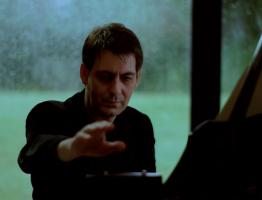
Two Times 4'33
Doc. expérimental | 35mm | couleur | 11:0 | Belgique | 2008
De Boer a invité le pianiste basé à Bruxelles Jean-Luc Fafchamps à jouer deux fois de suite la composition « 4?33?? » de John Cage devant un auditoire, dans un studio des P.A.R.T.S. (Performing Arts Research and Training Studios) de Bruxelles (Belgique). En une seule prise, la caméra filme l'exécution de cette composition musicale « silencieuse », avec les trois signes de ponctuation indiqués par Cage sur l?unique ligne de la partition à 1'40", 2'23" et 2?30", que Fafchamps, qui demeure le reste du temps toujours calme et absorbé, interprète en touchant un chronomètre. Tournée sur une pellicule 35 millimètres, ce qui assure la netteté des détails visuels, cette première partie est mariée à un son ambiant enregistré de façon synchrone, joué en surround Dolby lorsque l'?uvre est projetée. À la seconde interprétation, qui correspond à la deuxième partie du film, De Boer coupe tous les sons, à part les clics du chronomètre de l?exécution.
Manon de Boer est née en Inde, vit et travaille à Bruxelles (Belgique). Elle réalise des films, des vidéos, des installations, publie et enseigne à KASK. Elle fait partie de la plateforme de production-distribution Auguste Orts. Utilisant la narration personnelle comme une méthode, Manon de Boer explore la relation entre le langage, le temps et les revendications de vérité. Elle explore également la perception du temps par le biais d?un usage conscient du film en tant que médiateur artistique, et par l?analyse de ses effets sur le spectateur. La façon dont elle désincarne l?image, le son et la musique dans ses compositions, modifie subtilement le schéma classique de la perception du film.
Aglaia Konrad
Catalogue : 2019IL CRETTO | Vidéo expérimentale | 16mm | couleur | 11:21 | Autriche, Belgique | 2018
Aglaia Konrad
IL CRETTO
Vidéo expérimentale | 16mm | couleur | 11:21 | Autriche, Belgique | 2018
In 1968, the island of Sicily suffered a huge earthquake that completely devastated several villages, including Gibellina. Il Grande Cretto, the intervention projected by the Italian artist Alberto Burri for the ruins of Gibellina, a small village in the western part of the Island. This intervention - which took over thirty years to complete, after successive interruptions and recommences - is for me the most crystalline and powerful implementation of what may be described, in an apparent paradox, as a contemporary monument. The radical aspect of this place is that the monument coincides with the memory of the event. It is therefore, a performative piece - a living monument. The monument is the place, on a 1:1 scale. Aglaia Konrad’s films are careful and rigorous approximations to certain places or realities. In her films she works with matter (light, sound, memory and perception), on the one hand, and with language (editing, rhythm and repetition) on the other. The 16mm film IL CRETTO (transferred to video), uses of a split-screen (recorded in- camera) and dual projection.
AGLAIA KONRAD Austrian, self-taught as an artist, lives in Brussels and teaches at the LUCA School of Arts. She participated in numerous international exhibitions such as Dokumenta X, 1997 in Kassel; "Cities on the Move" 1998 and 1999 (Bordeaux, New York, London, Helsinki, Wien); Shanghai Biennale 2000, "Gazes of Architecture on the Body", Tokyo Wonder Site and Museum of Contemporary Art, Kumamoto, "In the First Circle", Tapies Foundation Barcelona, EMINENT DOMAINS (proper names), Robert Miller Gallery, New York City; Hollein, MAK Vienna; The Brutalism Appreciation Society, HMKV Dortmund, 2009 a soloshow at the Museum of Contemporary Art in Siegen; Sainsbury Gallery Norwich; Fotohof Salzburg; STUK und Netwerk Aalst; in 2016 M Museum, Leuven. "Aglaia Konrad. From A to K", kam bei Koenig Books heraus. Published books: Elasticity (2002); Iconocity (2005); Desert Cities (2008); Carrara (2011 ); Zweimal Belichtet (2013); Aglaia Konrad: From A to K ; SCHAUBUCH: Skulptur (2017).