Berlin 2026 Programme
Screening
silent green Kulturquartier | Betonhalle | Cinema 1
Gerichtstrasse 35, 13347 Berlin / Subway: Wedding station, U-Bahn line U6 / S-Bahn lines S41, S42, S46
Free admission
"A.I. Capital"
Aurèle Ferrier : Claws - Experimental doc. | 4k | color | 18:27 | Switzerland, China | 2025
Aurèle Ferrier
Claws
Experimental doc. | 4k | color | 18:27 | Switzerland, China | 2025
CLAWS is a moving-image essay of gliding takes through rapidly expanding cities, drifting from peripheral terrains into dense cores before opening back to the horizon. In largely unpopulated frames, architecture, materials and sound turn urban expansion into a field of perception—where geometry persists, intention falters, and the land remembers.
Aurèle Ferrier is a Swiss visual artist working with film, exploring built environments and urban peripheries. CLAWS concludes his trilogy on human-made landscapes. His moving-image works have been shown at the Hiroshima City Museum of Contemporary Art (Hiroshima), IDFA (Amsterdam), Rencontres Internationales (Paris/Berlin), Open City Documentary Festival (London), Anthology Film Archives (New York) and Image Forum (Tokyo).
Moritz Frei : Am I The Sleeping Bag Of My Soul? - Experimental film | mp4 | color | 3:53 | Germany | 2025
Moritz Frei
Am I the sleeping bag of my soul?
Experimental film | mp4 | color | 3:53 | Germany | 2025
Clowns at a flooded piano, eerie stockbrokers, cardboard fountains in urban spaces. Without a clear narrative structure, the boundaries between self, body and consciousness become blurred. Familiar signs appear alienated, spaces dissolve, meanings remain elusive. Despite its abstraction, the film seems strangely connected to our present. It is as if it were uncovering a deeper unease beneath the surface of everyday images, one that is difficult to name but remains palpable.
Moritz Frei is a visual artist who works with installation, video, text and sound. His practice moves between analysis and absurdity, using humour as a strategy to question social and media structures. Experimentation and possible failure are integral parts of his artistic process, allowing him to playfully explore control mechanisms and perception. Frei studied at the Academy of Visual Arts in Leipzig. For many years, he worked part-time in video stores, the Filmgalerie 451 Berlin and Alpha 60 Leipzig, both renowned centres for experimental and international cinema. This experience sharpened his eye for the materiality and power of moving images. The initial moment for his artistic and cinematic work was Moritz Frei's first cup of coffee with Bruno Ganz for his film ‘Meine erste Tasse Kaffee’ (My first Cup of Coffee).
Michael Dietrich : Zone Of Silence (scream Machine) - Experimental film | hdv | color | 9:30 | Austria | 2025
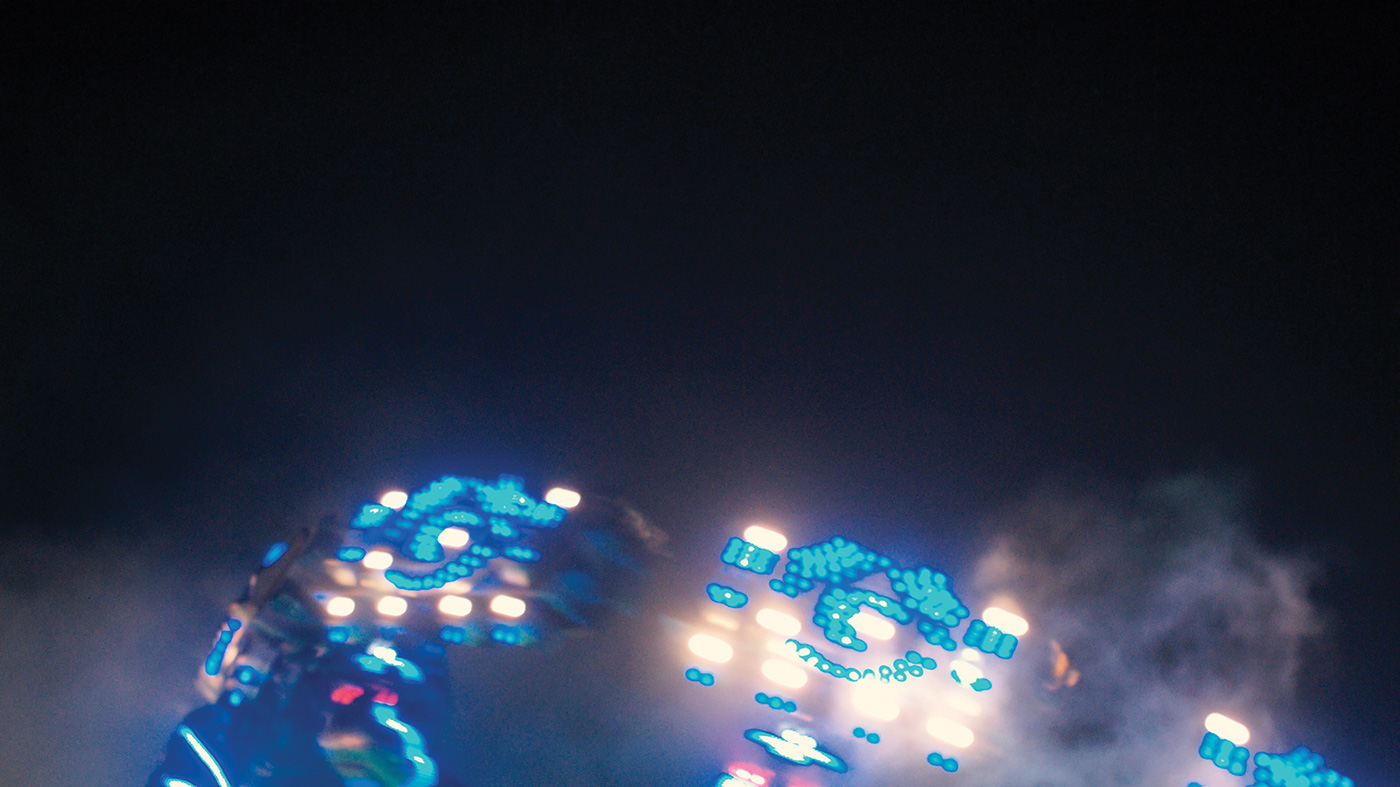
Michael Dietrich
zone of silence (scream machine)
Experimental film | hdv | color | 9:30 | Austria | 2025
The experimental film Zone of Silence (Scream Machine) explores the interplay between light, fog, and resonance to depict inner isolation and psychological disorientation. The city is enveloped in a dense atmosphere, while reflections of light and muffled sounds create a “zone of silence” in which orientation and communication begin to dissolve. Inspired by historical maritime navigation problems—where foghorns became inaudible under certain weather conditions—the film translates this phenomenon into the realm of the human unconscious. Theodor Reik’s psychoanalytic concept of the “zone of silence” serves as a central motif for repressed emotions and the difficulty of breaking through them. The closing sequence shows the fading inscription “EUROPA,” a bleak reflection on the continent’s political future. Through its dense atmosphere, a composition blending field recordings and synthesized sound, and the use of visual metaphors, the film offers a profound exploration of inner emptiness and the search for orientation.
Michael Dietrich (*1985, Vienna, Austria)studied social design at the HfbK Hamburg and Photography at the Academy of Fine Arts Vienna. His work explores the impact of human intervention on nature, often unfolding unsettling scenarios through video and acousmatic.
David Kelley : African Union - Experimental film | mp4 | color | 4:4 | USA | 2025
David Kelley
African Union
Experimental film | mp4 | color | 4:4 | USA | 2025
African Union responds to 2018 reports of Chinese surveillance at the African Union Headquarters in Addis Ababa. Made with generative AI, commercial stock imagery, and documentary footage, the film explores digital imperialism, data extraction, and the ideological entanglements of AI within the evolving dynamics of China–Africa political and technological relations.
David Kelley’s work traces the hidden ecologies of global infrastructure—from deep-sea mining and the Silk Road to Alberta’s oil sands and the extraction of rare earth elements in China. Working across film, photography, installation, and sculpture, he explores how technology, modernity, ecology, and memory operate as interwoven systems of mediation. His practice draws on essay film, experimental ethnography, and experimental theater, using form as a site for affective experience, ambiguity, and transgression. Kelley approaches research as an aesthetic process, privileging sensorial and speculative modes over purely discursive ones. His projects often involve site-specific production, archival research, and the integration of everyday objects and theatrical constructions within immersive environments. Scientific specimens—borrowed from natural history collections or reimagined in glass, ceramic, and stone—anchor his installations in material history while opening space for surreal and speculative encounters. His work has been exhibited internationally at the Museum of Modern Art, New York; Rencontres Internationales Paris/Berlin; and The Bank, Shanghai. Upcoming presentations include LACMA in Los Angeles and the Global Visions FotoFest Biennial 2026 in Houston. Kelley holds an MFA from UC Irvine and was a 2010–11 Whitney Independent Study Program fellow.
Stéphane Degoutin, Gwenola Wagon : Apple - Experimental film | mov | color | 4:0 | France | 2025
Stéphane Degoutin, Gwenola Wagon
Apple
Experimental film | mov | color | 4:0 | France | 2025
Everything is Real shows the reddest apples, the greenest call centers, the server rooms with the most cables, the smiliest employees, the delivery drivers with their most beautiful parcels, the most efficient volunteers, the biggest mountains of waste - but pushes them to the extreme of stereotyping: insensitively, stereotypes go to extremes.
Stéphane Degoutin is an artist and researcher. His work explores “dark systems,” the structures that often go unnoticed yet organize our lives: from air conditioning to international airports, from music for houseplants to urban infrastructures. He undertakes a form of reverse engineering of these hidden logics, in order to imagine other ways of thinking and acting. Gwenola Wagon is an artist and researcher. She is a University Professor and teaches at the Sorbonne School of Arts at Paris 1 University. Through installations, films, performances and books, she imagines alternative and paradoxical narratives for thinking about the contemporary digital world.
Soren Thilo Funder : Mirror Touch (archipelago Dlc_01) - Fiction | 4k | color | 19:21 | Denmark | 2024
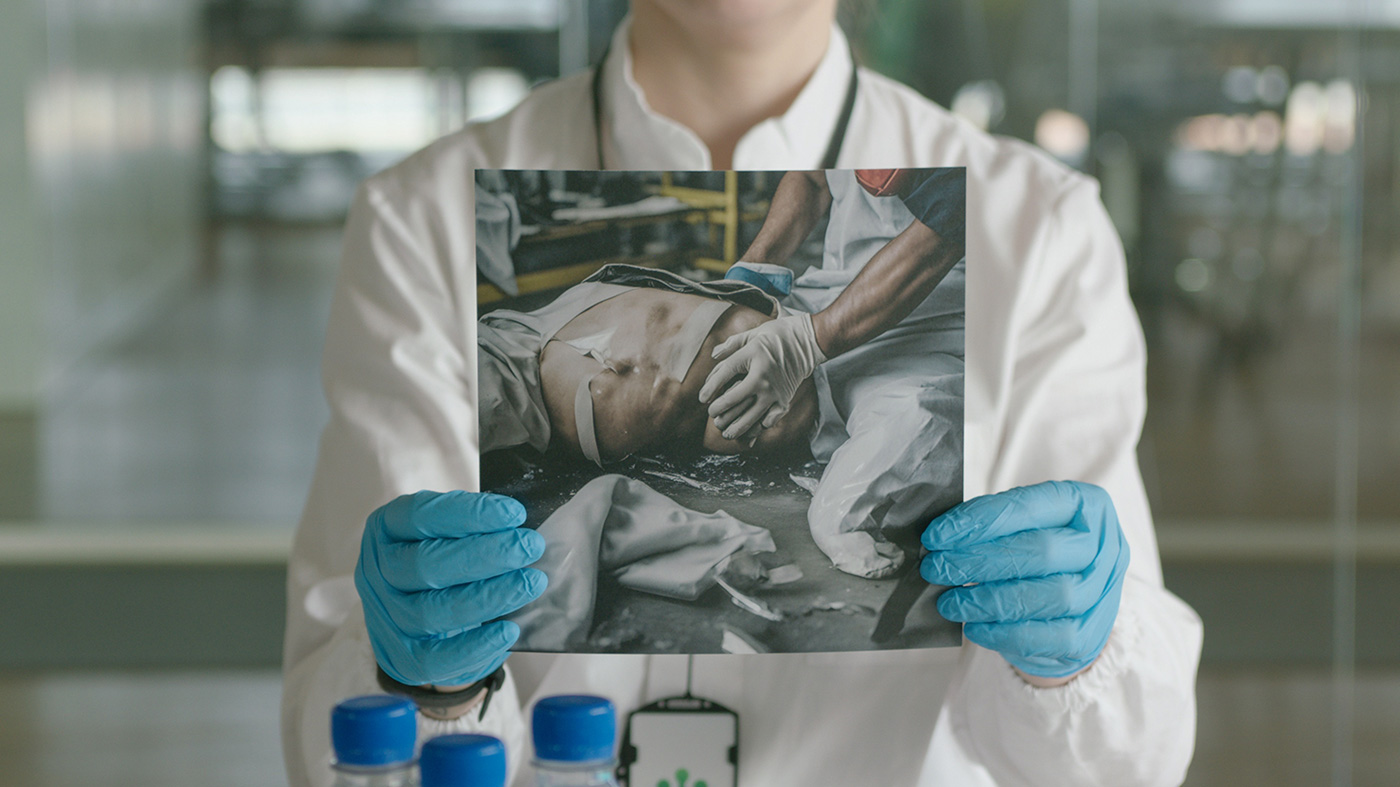
Soren Thilo Funder
Mirror Touch (Archipelago DLC_01)
Fiction | 4k | color | 19:21 | Denmark | 2024
Mirror-touch synesthesia" is a neurological phenomenon where a person feels the same touch as they see another person experiencing. Stimuli on one sense thus trigger a feeling in another. In the video work ’Mirror Touch (Archipelago DLC_01)’, employees at the high-frequency trading company Archipelago™ are subjected to a series of experimental tests in the development of synthetic empathy. The process aims to reunite the body's space with the cognitive; the corporeal with the immaterial; the real with the imaginary. Accompanied by the film's actors, the viewer is led by a commanding voice on a suggestive journey from the trading terminals to the physical reality of the factory. Here, we are reminded of the factory floor's still indisputable and violent physical reality and the worker's body as a physical witness to the violent imprint of progress.
Søren Thilo Funder is a visual artist working primarily with video and installation. His works are mash-ups of popular fictions, cultural tropes and socio-political situations, projections and histories. They are narrative constructions that insist on new meaning being formed in the thin membrane separating fictions from realities. Invested in written and unwritten histories, the paradoxes of societal engagement, temporal displacements and a need for new nonlinear narratives, Thilo Funder proposes spaces for awry temporal, political and recollective encounters.
Bart Groenendaal : Sensitivity - Fiction | hdv | color | 10:18 | Netherlands | 2024
Bart Groenendaal
Sensitivity
Fiction | hdv | color | 10:18 | Netherlands | 2024
A young woman wanders around a business district at night and at dawn meets seven lonely strangers, who each fall under the thrall of her energy. Inspired by the imagery of the Flemish Primitives and made in collaboration with a real-life quantum-healer, the film is a musing on the longing for connection in a neoliberal urban context.
In short narrative films, documentary and installation work, Bart Groenendaal (Amsterdam, 1975) explores how the cinema shapes our social subjectivity and the world around us as an ever fluctuating expression of ideology.
Zachary Epcar : Sinking Feeling - Experimental fiction | 16mm | color | 20:0 | USA | 2024
Zachary Epcar
Sinking Feeling
Experimental fiction | 16mm | color | 20:0 | USA | 2024
Three white collar commuters recall an experience of getting trapped on a train in San Francisco's transbay tunnel, each drifting into fantasies of sex, death, and other intimacies with strangers. "A beguiling, spacious, and transportive work of suspended tension, that looks for new forms of intimacy in the antiseptic. An urban office park becomes a reflecting pool for the erotic fantasies of a derailed train where we wait, shake and survive together.”
Zachary Epcar (b. San Francisco) is a filmmaker whose work has screened at the international film festivals of Toronto, New York, Rotterdam, San Francisco, Vancouver, Edinburgh, and Melbourne; Berkeley Art Museum & Pacific Film Archive, Media City, IndieLisboa, European Media Art Festival, EXiS, 25 FPS; and in solo screenings at the Museum of Contemporary Art Chicago, Museum of the Moving Image, and Black Hole Cinematheque. His films have been featured online on MUBI, Le Cinéma Club, and Ecstatic Static. Zachary lives in Oakland, California where he is a member of the film programming collective Light Field. His films are distributed by Light Cone (Paris).

Aurèle Ferrier traverses landscapes and investigates how human intention is inscribed in space. Moritz Frei explores the mechanisms of control in the staged turmoil of our era, in the age of artificial intelligence. The boundaries between the self, the body and consciousness become blurred. Michael Dietrich creates a zone of silence in a twilight landscape, inspired by maritime navigation. David Kelley revisits Chinese surveillance at the African Union headquarters in Addis Ababa and explores, via AI and archives, digital imperialism and geopolitical issues. Stéphane Degoutin and Gwenola Wagon offer a paroxysmal vision of stereotypes: imperceptibly, stereotypes are becoming extreme. Soren Thilo Funder films the employees of a high-frequency trading company, subjected to experimental tests aimed at developing synthetic empathy. Bart Groenendaal follows a young woman wandering through a business district at dawn. Zachary Epcar contrasts the human body with architecture in the non-places of contemporary offices to reveal an anxious post-modernity where repressed desires and invisible tensions emerge.
Special screening
silent green Kulturquartier | Betonhalle | Cinema 1
Gerichtstrasse 35, 13347 Berlin / Subway: Wedding station, U-Bahn line U6 / S-Bahn lines S41, S42, S46
Free admission
Carte blanche to Albert Serra
For this carte blanche, Albert Serra has selected various film excerpts and short films, which he will introduce and share with the audience, offering a unique perspective on his ongoing reflections and artistic practice.

Screening
silent green Kulturquartier | Betonhalle | Cinema 1
Gerichtstrasse 35, 13347 Berlin / Subway: Wedding station, U-Bahn line U6 / S-Bahn lines S41, S42, S46
Free admission
Closing screening
"Like a Utopia"
Eva Giolo : Memory Is An Animal, It Barks With Many Mouths - Experimental film | 16mm | color | 24:0 | Belgium | 2025
Eva Giolo
Memory Is an Animal, It Barks with Many Mouths
Experimental film | 16mm | color | 24:0 | Belgium | 2025
Eva Giolo’s latest work takes us to Val Gardena, where people still speak Ladin, a Rhaeto-Romance language. Giolo subverts the usual representation of mountain communities to deliver a portrait of a precious cultural heritage in constant evolution. Here, the inhabitants preserve and nurture their culture for future generations with awareness of the world and creativity. Shot on 16mm film sensitive to the grandeur and fragility of nature, Memory Is an Animal, It Barks with Many Mouths is an exquisite essay on the vital importance of linguistic diversity.
Eva GIOLO (1991, Belgium) is an artist working in film, video and installation. Her work places particular focus on the female experience, employing experimental and documentary strategies to explore themes of intimacy, permanence and memory, along with the analysis of language and semiotics. Her films, installations and other projects have been widely exhibited internationally at festivals, museums and galleries, including Sadie Coles HQ, Viennale, FIDMarseille, IFFR, New York Film Festival and many others. Her film Flowers blooming in our throats (2020) was nominated for The European Film Award and awarded the Top Prize at THIS IS SHORT 2021. She also received the National Award Special Mention at Lago Film Fest 2021, the Jury Special Mention at First Crossings Festival and the Critics’s Jury Award at 25FPS Festival. She is a laureate from HISK (2018-2020) and a former art resident at SeMA NANJI (2020), the year-long film–writing residency Conversation #4 (CVB, GSARA and Beursschouwburg), CASTRO studio program (2021), WIELS (2021), RU Unlimited New York and Fogo Island Arts (2022). Her films are distributed by elephy and Light Cone.
Jean-baptiste Perret : Le Quotidien - Video | hdv | color | 5:11 | France | 2025
Jean-baptiste Perret
Le quotidien
Video | hdv | color | 5:11 | France | 2025
Filmed in the gorges of the Haut-Allier, Le quotidien is the portrait of a man who has chosen to live alone and apart, in a cabin at the edge of a forest. The images record his everyday gestures, tied to the essential needs of human existence: drinking, eating, washing, mending, beginning again. “Like an anthropologist-filmmaker, Jean-Baptiste Perret chooses a site — often rural — and immerses himself in it for long periods. He builds relationships with the people he meets there, filming their living spaces and their knowledge. Shot in the gorges of the Haut-Allier, Le quotidien portrays a man who has chosen to live alone, removed from human society, in a cabin at the forest’s edge. The videomaker captures his daily gestures, linked to the essential needs of human life: drinking, eating, washing, repairing, starting again. The film forms part of a broader enquiry into marginal life paths within rural contexts, in which other relationships to the living world, to territory, and to ecology are invented.” (Work Method, Guillaume Désanges and Coline Davenne)
After studying ecology, Jean-Baptiste Perret worked for several years in environmental protection within local authorities. A 2018 graduate of the École des Beaux-Arts de Lyon, he has continued to pursue his interest in rural contexts through a filmmaking practice that takes the form of films and video installations. His work is driven by the question of care, which he understands as an attentiveness to vulnerability, inseparable from the regenerative capacities of individuals. His approach is grounded in documentary enquiry and draws on methods borrowed from anthropology that challenge conventional criteria of objectivity, placing affect at the very centre of the research process. He is also inspired by microhistory, which seeks to step away from official narratives of the many in order to focus on individuals and their own ways of understanding the world. Jean-Baptiste Perret films people he encounters in their everyday situations, engaging with their life paths, their surroundings, and their skills. Through varying degrees of staging — always leaving room for improvisation — subjective accounts and fictional strategies intermingle. His work has been shown at the Institut d’art contemporain (IAC) in Villeurbanne as part of the 15th Lyon Biennale, at the Musée d’art contemporain de Lyon, at Fondation d’entreprise Ricard (Paris), at the Musée de la Chasse et de la Nature (Paris), at the Chapelle Saint-Jacques (Saint-Gaudens), at the Institut national d’histoire de l’art (Paris), at FID Marseille, at the Festival Hors-Pistes at the Centre Pompidou, at the États généraux du documentaire in Lussas, and more recently at the 66th Salon de Montrouge. Jean-Baptiste Perret is represented by Galerie Salle Principale in Paris.
Uriel Orlow : Forest Futures - Experimental film | 4k | color | 28:0 | Switzerland, Italy | 2024
Uriel Orlow
Forest Futures
Experimental film | 4k | color | 28:0 | Switzerland, Italy | 2024
Forest Futures is a poetic and thought-provoking film that visits ancient forest ecosystems from the earth’s past, imagines future forests in the face of changing climate and shows the forest as a multi- species school, where children practice more-than-human co-existence. Forest Futures explores the forest as a site of deep time, ecological transformation, and interspecies learning. Set in the mountainous region of South Tyrol, the film traces a journey from ancient fossilized forests that thrived over 280 million years ago through to speculative visions of future forests in a rapidly warming world. Combining scientific research with imaginative storytelling, the film reimagine the forest as both a teacher and a protagonist.
Uriel Orlow is a Swiss-born artist who lives and works between Lisbon, London and Zurich. In 2023 he was the recipient of the prestigious Prix Meret Oppenheim/ Swiss Grand Prix of Art. Orlow’s work is presented widely in international survey shows including at Dunkerque Triennale, Kochi Biennale, 12th Berlin Biennale for Contemporary Art, Kathmandu Triennale, Manifesta 12, Palermo, 2nd Yinchuan Biennial, 13th Sharjah Biennial, 7th Moscow Biennial , EVA International, Limerick, 2nd Aichi Triennale, Nagoya , Bergen Assembly, Manifesta 9, 54th Venice Biennale and elsewhere. Recent solo exhibitions include Galeria Avenida da Índia, Lisbon (2025); MCBA, Lausanne (2024); Casa da Cerca, Alamada (2022); Kunsthalle Nairs, Scuol (2021); La Loge, Brussels (2020); Kunsthalle Mainz, Germany (2020); Privas Art Centre, France (2019); Les Laboratoires d’Aubervilliers, Paris (2018); Market Photo Workshop & Pool, Johannesburg (2018); Kunsthalle St Gallen (2018) and many others. Orlow’s films been screened at Tate Modern, London; the International Short Film Festival, Oberhausen; Tank.tv; Whitechapel Gallery, London; Locarno Film Festival; Videonale Kunstmuseum Bonn; BFI London; The BBC Big Screen, Manchester; Arnolfini Bristol; Espace Croisé CAC Roubaix; and at the Biennale of the Moving Image, Geneva, and others.
Susannah Sayler, Edward Morris : The Amazon Is Elsewhere - Experimental film | 4k | color and b&w | 12:0 | USA | 2025
Susannah Sayler, Edward Morris
The Amazon is Elsewhere
Experimental film | 4k | color and b&w | 12:0 | USA | 2025
Amazon is Elsewhere is a short film that mediates on the unknowability and power of the Amazon for those who do not live within it. For many, the Amazon symbolizes “the lungs of the earth” or “nature” itself. For the indigenous people of the region, many of whom have no separate word for jungle or forest, it is simply home. The film centers around a building on the edge of the jungle: a mélange of architectural styles where trees break through the concrete floors; plants grow in the faux Corinthian columns; and jaguars made from ceramic tiles guard the entrance. AI-generated images express forces at play in both the building and the jungle that are difficult to parse as being malevolent or redemptive. The film is part of a body of work that considers how to represent the Amazon in light of its multiplicity of refracted meanings.
Susannah Sayler and Edward Morris (Sayler/Morris) work with video, photography and installation to examine our changing notions of nature, culture, and ecology. Their work is often place-based and focused on historical research. They have been awarded numerous fellowships including the Guggenheim Fellowship (2023) New York Artist Fellowship (2016), the Smithsonian Artist Research Fellowship (2014), the Center for Art and Environment Research Fellowship (2013), and the Loeb Fellowship at Harvard Graduate School of Design (2008). Their work has been exhibited broadly in the U.S. and internationally, including at the Massachusetts Museum of Contemporary Art, the Kunsthal in Rotterdam, the North Carolina Museum of Art, the Belvedere Museum, and the Southeast Center for Contemporary Art. Sayler currently teaches in the Film and Media Arts Department at Syracuse University, while Morris is Executive Director of Marble House Project. Their archives are collected by the Nevada Museum of Art / Reno, Center for Art and Environment. In 2006, Sayler/Morris co-founded The Canary Project, a studio that produces visual media and artworks that deepen public understanding of climate change. In 2021, they founded Toolshed, a platform for connecting ecological thought and action.
Benjamin Balcom : The Phalanx - Experimental doc. | 16mm | color | 13:30 | USA | 2025
Benjamin Balcom
The Phalanx
Experimental doc. | 16mm | color | 13:30 | USA | 2025
Letters from the Ceresco community trace the fragility of harmony, the dream of life in association, the frictions that give way to fracture. Members of the phalanx drift apart, lingering in private corners, suspended in speculative time.
Ben is a filmmaker and educator based in Milwaukee, Wisconsin, where he is a professor of Film, Video, Animation, and New Genres at the University of Wisconsin–Milwaukee. His most recent films explore the histories and afterlives of radical social ideals and communal living. These projects combine archival research and various modes of filmmaking to reflect on alternative ways of living. Drawing from speculative fiction, critical theory, and utopian poetics, his work often revisits the sites of now-defunct experimental schools and intentional communities, using cinema as a space for both research and imagination. Featuring landscapes both real and imagined, these films engage collective memory while speculating on futures beyond the limits of capitalism. Earlier in his practice, Balcom worked with abstraction, introspection, and formal experimentation, exploring the tensions between perception and communication, and probing the materiality of film itself. These threads continue to inform his evolving approach to nonfiction and poetic cinema. Balcom’s films have screened internationally at venues and festivals including the Museum of the Moving Image, International Film Festival Rotterdam, European Media Arts Festival, IndieLisboa, Media City Film Festival, and Ann Arbor Film Festival. He has received awards from Onion City, Athens International Film + Video Festival, and Ann Arbor. In 2023, he was a research fellow at the Center for 21st Century Studies. He also co-founded Microlights Cinema, a microcinema that ran from 2013 to 2023, dedicated to bringing experimental film and video art to audiences in Milwaukee.

Screening
silent green Kulturquartier | Betonhalle | Cinema 2
Gerichtstrasse 35, 13347 Berlin / Subway: Wedding station, U-Bahn line U6 / S-Bahn lines S41, S42, S46
Free admission
"Strange Communities"
Kevin Sepp : Goodbye Regina - Experimental doc. | 16mm | color | 8:48 | Germany | 2025
Kevin Sepp
GOODBYE REGINA
Experimental doc. | 16mm | color | 8:48 | Germany | 2025
The Italian Alpine region of South Tyrol is not known for its tuning scene, but it does exist. A small group of young men have found each other to express their love of their home in their own way. Their Japanese sports cars glide oddly through historic villages, along the Alpine slopes and through breathtaking nature. GOODBYE REGINA is a farewell letter from the director to his grandmother, who grew up in these mountains. It explores the connection between the old and the new, without juxtaposing the two. In a landscape where seemingly nothing changes, the machines seem to be part of the creatures that emerge from this nature. The result is some kind of nature documentary, a collection of impressions away from the tourist postcard images.
Kevin Sepp is a director and editor based in Berlin. Coming from a humanities background, he is a self-taught filmmaker whose interest in short, visually rich storytelling led him to work in commercial film. Alongside commissioned projects, he continues to explore new possibilities through independent work. Collaborations with musicians and other artists strongly influence his sense of sound on screen and shape the atmosphere of his work. His films have been featured at festivals such as the Berlin Commercial and Berlin Music Video Awards, as well as on platforms like Directors’ Library, Sleek Magazine and Crack Magazine.
Steve Hawley, Steve Dutton : Midville - Experimental doc. | mp4 | color | 13:20 | United Kingdom, Slovenia | 2025
Steve Hawley, Steve Dutton
Midville
Experimental doc. | mp4 | color | 13:20 | United Kingdom, Slovenia | 2025
‘Midville’ was the pseudonymous name given to a Midlands Art School in the United Kingdom when it was studied over a period of three years from 1967 by two sociologists. The resulting book, ‘Art Students Observed’, published in 1973 has become a classic document within art teaching literature, the place where “romantic” and “conceptual” art first collided. 58 years later I traced the students in the book and interviewed them about their recollections and (sometimes traumatic) experiences. We have recreated ‘Midville’ as a 13-minute AI supported mini collage ‘opera’, where the students as they were then and now, pronounce their testimonies via AI voices, choirs, avatars, and real-world original footage.
Steve Hawley is a Ljubljana based artist who has been since 1981 part of the second wave of British video artists. His work deals with language, humour, and the nature of memory through archive film and video, and has been shown at video festivals and broadcast worldwide. Work on myth and the city includes Ghost made in Hong Kong, screened at the 2000 Cannes Director's Fortnight. War Memorial 2017 was nominated for best short documentary at the Sheffield DocFest and his book, Men, War and Film, about the Calling Blighty message films of WWII was published in 2022. Steve Dutton is an artist and occasional curator based in the South West of England. His practice spans drawing, sound, moving image and text, with a focus on exploring the intersections and overlaps of language, space, and time. He is currently developing a new solo body of work titled "The Phantom Industry." His work engages with the acts of reading, drawing, painting, speaking and writing and might be best described as a language-based practice.
Arthur Debert : La Conférence Des Instruments Savants - Experimental video | 4k | color | 9:1 | France | 2024
Arthur Debert
La Conférence des Instruments Savants
Experimental video | 4k | color | 9:1 | France | 2024
In a wooden amphitheatre built in 1933 for the study of animals and plants, a group of ancient tools attend a lecture. The talk seems to be about animals and their movements, but the tools gradually come to understand that it’s about the living beings that have given them their names and sometimes even their shapes.
Born in Paris in 1990, Arthur Debert lives and works between Nancy and Berlin. Arthur Debert’s protean practice is rooted in collective work and exchange. Anchored in a contextual approach, his work takes shape through travel, encounters and multiple collaborations. Central to these exchanges is the question of the transmission and survival of knowledge. Objects encountered in the field are seen as both witnesses and bearers of epistemological narratives to be deciphered. To reveal the different cultural layers sedimented within them, the artist disrupts their temporal linearity through shifting spatial settings and collective activations. Installations, videos and editions then fix the ephemeral, indeterminate state of the resulting lived experiences. Arthur Debert is a graduate of the École de l’Image in Épinal (2011), the École Supérieure d’Art de Lorraine in Metz (2013) and participated in the École Offshore in Shanghai (2014-2015), a research program of the École Nationale Supérieure d’Art et de Design in Nancy. His work has been shown at Centre Dürrenmatt Neuchâtel (2025), Triennale de la Jeune Création (Luxembourg, 2013 and 2021), Koraï (Cyprus, 2023), Ann Arbor Film Festival (Michigan, 2022), Berlin Art Prize (2018) and Berlin Independent Film Festival (2023).
Jinjoo Yang : Coming Home - Video installation | 4k | color | 12:57 | Canada | 2024
Jinjoo Yang
Coming Home
Video installation | 4k | color | 12:57 | Canada | 2024
The film moves through the hidden storage spaces of the Montreal Museum of Fine Arts, revealing artworks whose ownership records remain incomplete. Some bear traces of wartime displacement and intentional omissions; others have shifted in attribution, altering the narratives attached to them. It traces how institutional structures shape what becomes visible and what remains unresolved. As the camera moves through the storage rooms, “Coming Home” observes the museum as an active system of organization, where artworks are continually recontextualized. Viewers encounter the collection as an unseen archive and are asked to navigate a place where certainty is partial and orientation never fixed.
Jinjoo Yang is a Montreal-based artist and architect whose films emerge from direct engagement with specific sites. She works with institutional interiors, using controlled camera movement to trace how places hold and mediate their histories. Her practice moves between observation and construction, turning regulated environments into temporal landscapes where visibility, authorship, and memory subtly shift. Yang’s recent works include “Coming Home,” filmed in the collection storage of the Montreal Museum of Fine Arts, and “Occupied,” a forthcoming film shaped by Cold War infrastructures. Her projects have been presented internationally at institutions such as the Montreal Museum of Fine Arts, the Center for Architecture in New York, and the Royal Danish Academy of Fine Arts in Copenhagen.
Mladen Bundalo : Every Time You Leave, You Are Born Again - Documentary | mp4 | color | 25:0 | Bosnia & Herzegovina, Belgium | 2025
Mladen Bundalo
Every time you leave, you are born again
Documentary | mp4 | color | 25:0 | Bosnia & Herzegovina, Belgium | 2025
The hypnotic and purring sound of a bus engine resonates, accompanied by the rumble of the vehicle's interior. The voice, close and intimate, leads us into an inner monologue. We are on our way to Prijedor, the author's hometown in Bosnia and the place of his perpetual departures. Before arriving there, we must first learn to inhabit departure as a space in which we can grow and be reborn.
Mladen Bundalo (born in 1986, Prijedor) is an interdisciplinary artist, filmmaker, and author of Bosnian origin, currently based in Brussels. His essay-films explore themes of belonging and the human condition in the context of migration, diaspora, and periods of uncertainty and crisis.

Kevin Sepp films a group of young men in sports cars driving through the alpine landscapes of Tyrol. Steve Hawley and Steve Dutton interview former students of Midville, an art school in the United Kingdom that became the global centre of conceptual art in its early days. Arthur Debert films a 1930s wooden amphitheatre for the study of animals and plants, where a group of ancient tools attend a lecture. Jinjoo Yang reveals the hidden spaces of the Montreal Museum of Fine Arts' storage rooms, examines how institutional structures shape visibility, and questions how narratives around works of art are shaped by acts of omission and reclassification. Mladen Bundalo questions the archetype of separation—leaving home and native land, and the need to return and question from a new position, as a member of the diaspora.
Screening
silent green Kulturquartier | Betonhalle | Cinema 2
Gerichtstrasse 35, 13347 Berlin / Subway: Wedding station, U-Bahn line U6 / S-Bahn lines S41, S42, S46
Free admission
"Queer Spaces, Hybrid Bodies"
Lisa Freeman : Hook, Spill, Cry Your Eyes Out - Experimental film | mp4 | color | 2:26 | Ireland | 2024
Lisa Freeman
Hook, Spill, Cry Your Eyes Out
Experimental film | mp4 | color | 2:26 | Ireland | 2024
A headfirst rush into the capitalist, urban landscape, using dynamic camerawork and canny editing. Productivity, optimisation, constant forward motion. In this experimental short from artist and filmmaker Lisa Freeman, frenetic camerawork and quickfire editing convey the body’s lacklustre requirement to always be working in our capitalist society. Using glimpses of concrete environments, bodies on treadmills, crash-test dummies, and other ubiquitous urban images, and melding these with a soundscape of ragged breathing and disjointed conversations, Hook, Spill, Cry Your Eyes Out provides a cutting commentary on what our society inflates with importance.
Lisa Freeman is an artist and filmmaker based in Dublin, Ireland. Her work draws into question economic and power structures and explores how intimacy might be employed as a form of resistance. Recent works have examined the everyday, where the city’s sounds play in the dreams, nostalgias, or hopes of another and where small moments lead to more surreal events (Slipped, Fell and Smacked my Face on the Dance Floor), and social isolation in the public realm (Hook, Spill, Cry Your Eyes Out). Freeman is a studio member at Temple Bar Gallery + Studios, Dublin. She has received several Bursary and Project awards from the Arts Council of Ireland. Her work is held in the collection of the Arts Council of Ireland. Freeman has taken part in residencies in South Korea (BARIM Arts, 2016), and Cité Internationale des Arts Paris x Institut Francais, supported by Temple Bar Gallery + Studios Dublin and Bétonsalon, Paris (2025).
John Gillies : Scentdia - Video | 4k | color | 5:20 | Australia | 2025
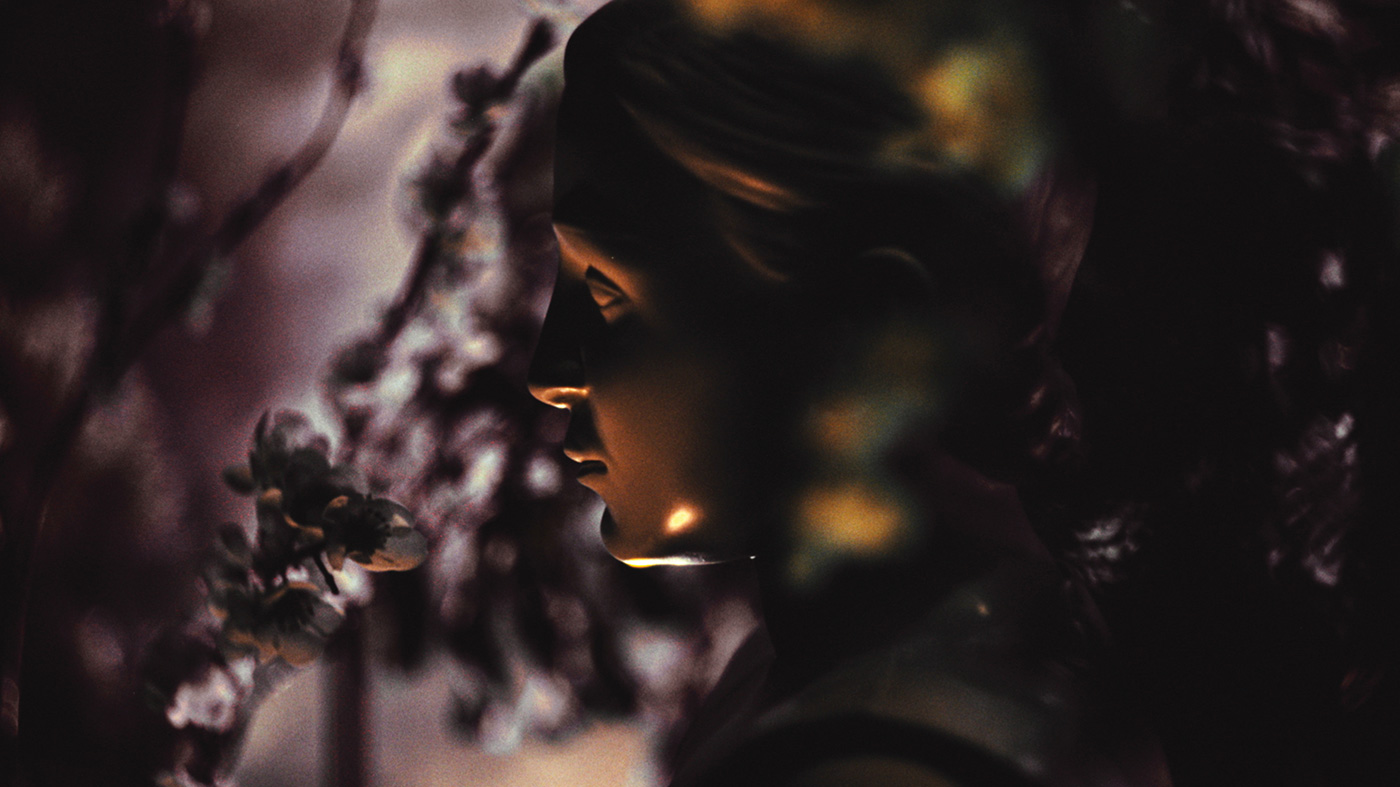
John Gillies
Scentdia
Video | 4k | color | 5:20 | Australia | 2025
During its wanderings in a nocturnal forest, a robot encounters various flowers and plants, confronting the natural world and attempting to smell the scent of a wild bloom.
John Gillies is a Sydney (Eora)-based artist who has been creating work with time-based media, including performance, moving image, installation, music and sound, since the 1980s. Drawing on the world of experimental theatre and the languages of video and cinema, his art practice is often improvisational and collaborative.
Kim Richard Adler Mejdahl : Glory 1 - Experimental video | 4k | color | 2:0 | Denmark | 2024
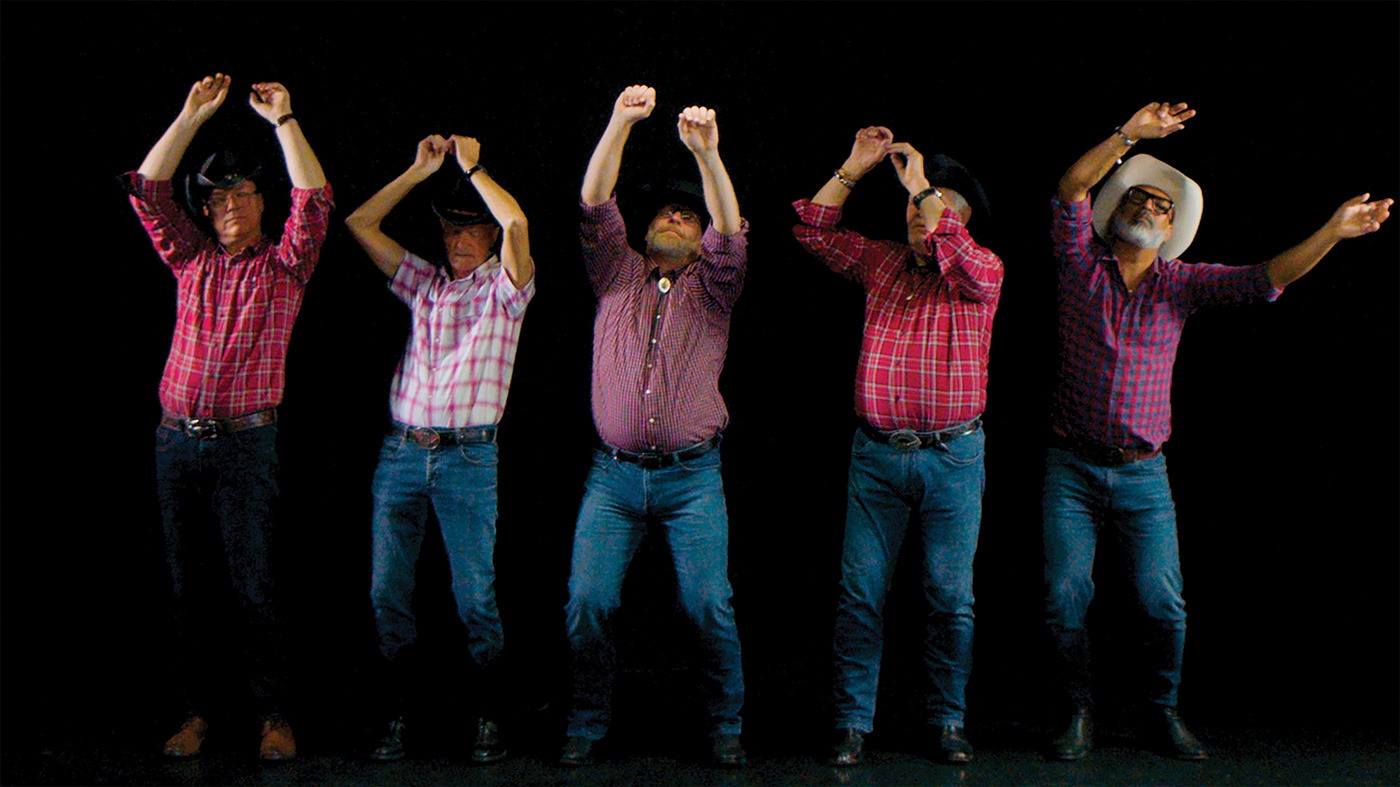
Kim Richard Adler Mejdahl
Glory 1
Experimental video | 4k | color | 2:0 | Denmark | 2024
Members of the gay linedance club ‘Outliners’ dance in a black room. ‘Glory 1’ is a video artwork conceived by Danish multidisciplinary artist Kim Richard Adler Mejdahl. The dreamy scenario presents a symbolic antidote to patriarchy and its destructive understandings of masculinity. In the mind of the artist, ‘Glory 1’ is a symbol of protest. Cowboys dancing together instead of shooting each other down is a subversive act against conventional understandings of man. It is a symbolic gesture of reversing the macho ideal within patriarchy, that weighs down and dictates the life of men.
Kim Richard Adler Mejdahl graduated from the Royal Danish Academy of Fine Arts in 2019. Slaptstick humour and gothic horror meet up in Mejdahl's multifaceted work that often has its starting point in the artist's personal life story. Be it music album releases, film productions or large solo exhibition projects, Mejdahl's practice explore the topics of trauma healing, our relationship to nature, spirituality, and gender identity. His video works have reached international audiences with screenings across Europe and Asia. Under the alias Kim Kim, Mejdahl has made numerous live performances and released music albums. Within few years Mejdahl has collaborated with a wide range of different institutions, counting Kunsthal Charlottenborg, Roskilde Festival, Danish theme park BonBon-Land, Theater Sort/Hvid, and most recently KØN - Gender Museum Denmark. In 2025 Mejdahl was awarded the three-year working grant by The Danish Arts Foundation. His work is part of The National Gallery's collection in Denmark.
Guerreiro Do Divino Amor : Roma Talismano - Experimental doc. | 4k | color | 9:38 | Brazil | 2024
Guerreiro Do Divino Amor
Roma Talismano
Experimental doc. | 4k | color | 9:38 | Brazil | 2024
Roma Talismano, seventh instalment of the ‘Superfictional World Atlas’, explores Rome as the moral and aesthetic talisman of the West. To the sound of opera hymns and arias, the allegorical animals the she-wolf, the eagle and the lamb narrate the endless recycling of Roman aesthetics to create an artificial and pale classical universality, from the Renaissance to fascism to the present day: Roma Talismano, eternal volcano of visual and spiritual bleach.
Guerreiro do Divino Amor holds a master’s degree in architecture from the School of Architecture of Grenoble (France). His since 20 years ongoing research “Superfictional world Atlas” explore the historical, media-related, religious and corporative mythologies that make up the collective imaginary of nations. He creates an universe of science fiction from fragments of reality in the shape of films, publications, and large-scale installations. Divino Amor represented Switzerland in the 2024 Venice biennial, was a fellow of the DAAD Artist-in-Berlin Program in 2021-2022, was awarded the PIPA Prize 2019. In 2022 he presented the retrospective solo show “Superficitional Sanctuaries” at the Centre d’Art Contemporain in Geneva. His work has been presented at the Frestas Trienal in Sorocaba (Brazil) Bangkok Biennale 2024, CAC Vilnius (Lithuania), Pinacoteca de São Paulo, among other institutions. His award-winning films have been screened at various national and international venues and festivals. Guerreiro do Divino Amor lives and works in Rio de Janeiro, Brazil.
Abri De Swardt : Kammakamma - Video installation | 4k | color | 16:54 | South Africa | 2024
Abri De Swardt
Kammakamma
Video installation | 4k | color | 16:54 | South Africa | 2024
If the river’s mouth could speak, what would it say? Enacting the possibility of river mouths as storytellers and historiographers, Kammakamma is the opening episode of the second work in a moving-image trilogy exploring the Eerste River in South Africa as witness and carrier of submerged narratives. Its title evokes slippages between the Khoekhoe terms for water (//amma) and similitude (khama), with 'kamma' absorbed into Afrikaans as 'make believe.' Through three interconnected chronicles by Abri de Swardt, poet Ronelda S. Kamfer, and historian Saarah Jappie, the river becomes a saturation point for understanding climate and catastrophe. In this episode, De Swardt probes a founding myth of Afrikanerdom through Hendrik Biebouw, a teenage idler who in 1707 attacked a Dutch East India Company watermill at the river, drunkenly declaring himself an “Africaander” – then a term reserved for enslaved, manumitted, or indigenous peoples. Biebouw’s declaration is inextricable from the river where it was spoken, from wine as settler-colonial agent, and from the instability of language itself. Recast in purgatory, he sifts sand from sandbags mined around the river mouth back into the blocked confluence of the Eerste and Plankenbrug Rivers, his delirious oratory jumbling Afrikaans, Dutch, German, and Malagasy. Interludes filmed after flooding show the river as both wild and engineered, while tableaux drawn from swimming and life-saving manuals foreground burden and suffocation. Through double synchronisation De Swardt frames perception itself as intoxicating disorientation.
Abri de Swardt (b. 1988, Johannesburg) is an artist based in Johannesburg, South Africa. Working across video, photography, sculpture, and performance, De Swardt’s practice challenges the ongoing effects of settler-colonial whiteness and masculinity in Southern Africa, and perceptions of queerness as ‘unnatural’ and ‘unAfrican’, through joining historiography with fiction, auto-ethnography, ecology, desire, and the fantastical. De Swardt’s work has been exhibited, performed, and screened at the Norval Foundation, Cape Town; Kunstverein Braunschweig; Goldsmiths Centre for Contemporary Art, London; Rupert Museum, Stellenbosch; National Gallery of Art, Vilnius; Institute of Contemporary Arts, London; and The Centre for the Less Good Idea, Johannesburg, amongst others. Solo exhibitions include POOL x Field Station, Cape Town (2024); POOL, Johannesburg (2018); MOT International Projects, London (2013); and blank projects, Cape Town (2011). De Swardt has undertaken residencies at Rupert, Vilnius; Hordaland Kunstsenter, Bergen; and the Nirox Foundation, Cradle of Humankind. In 2022, he was awarded a Social Impact Arts Prize and nominated for the Foam Paul Huf Award. He holds an MFA in Fine Art from Goldsmiths, University of London, and is currently a 2025–2026 artistic fellow at Braunschweig Projects, Hochschule für Bildende Künste Braunschweig.
Charlotte Dalia : Speechloss - Experimental film | 4K | color | 15:0 | France | 2023

Charlotte Dalia
Speechloss
Experimental film | 4K | color | 15:0 | France | 2023
SPEECHLOSS is a film inhabited by isolated characters, out of sync and searching for direction. In an eerie seaside atmosphere, we come across a jogger, a bodybuilder, dogs and a strange giant organ. Speechloss is a progression of four scenes in which both the wind and a powerful desire to feel alive blow. For each of them is an abandoned AI, waiting to be activated.
Charlotte Dalia was born in 1993. She graduated from the Institut Supérieur des Arts de Toulouse. A visual artist, video maker and film director, her research focuses on both the formal and narrative effects of cinema. Steeped in the principle of the “cinémonde” theorised by Jean-Luc Nancy, she uses cinema as a repertoire of signs that “opens the inside onto itself.” She has taken part in numerous group exhibitions and has been invited to produce two solo shows. Continuing her investigations into the writings of reality through the forms of fiction, she trained in documentary writing with Ty Films and Films en Bretagne. She is currently developing ALMERICA, a project combining climate crisis and film sets, as well as writing a medium-length film following on from SPEECHLOSS, in order to pursue and expand its universe.
Nicolas ThomÉ Zetune, Felipe André Silva : Minhas Férias - Experimental fiction | 0 | color | 16:36 | Brazil | 2025
Nicolas ThomÉ Zetune, Felipe André Silva
Minhas férias
Experimental fiction | 0 | color | 16:36 | Brazil | 2025
"I just arrived from the future, and there people still go to the movies. On second thought, maybe it's better to start like this: I just arrived from the future, and there people still go to the movies."
Nicolas THOMÉ ZETUNE (1993, Brazil) is a film director based in São Paulo. In 2012, he founded the production company FILMES DE AMOR. Nicolas' short films have been screened at some of the biggest film festivals, such as the Rotterdam International Film Festival. Nicolas' first feature film, “O Pequeno Mal”, was presented at FID Marseille in 2018. The second film, “O Tubérculo”, had its world premiere at the 27th Tiradentes Film Festival. In 2025, Nicolas was one of the selected participants for Berlinale Talents Buenos Aires, an international forum for discussion and project development organized in partnership with the Berlin Film Festival and BAFICI – Buenos Aires International Independent Film Festival. He is currently preparing his third feature film, "Invisible Tunnel," a project selected for FIDLab (Marseille, France). Filming is scheduled for November 2026. Felipe ANDRÉ SILVA (1991, Recife) is a filmmaker and poet. His film credits include the features Santa Mônica (2015) and Passado (2020), and the short Cinema Contemporâneo (2019). He regularly works as a curator for the Janela Internacional de Cinema do Recife festival. In literature, he has published the chapbooks o escritor Xerxenesky and o autocad de Britney Spears, and currently runs &legal edições, a digital micro-publishing house dedicated to contemporary poetry.
Gabriela LÖffel : We Do Not Have To Know Each Other In Advance - Video installation | hdv | color | 20:15 | Switzerland | 2024
Gabriela LÖffel
We do not have to know each other in advance
Video installation | hdv | color | 20:15 | Switzerland | 2024
« We do not have to know each other in advance » is a hybrid video work that alternates moments of dance performance with archive footage and textual quotations. Gabriela Löffel draws on the political aspect of public space to construct her thinking, developing a visual essay that stages the ‘performativity of bodies in this zone of political action’. Drawing on the written work of Judith Butler, an American philosopher and gender theorist who has worked on the question of the body and its normalised representativeness in contemporary society, Löffel gives corporeality to the issues raised by the author. Quotations from Butler's work are shown alongside the danced and archival elements of the video. The almost fixed camera allows us to examine in detail the slow, precise movements of the dancers. The camera's movements are almost imperceptible, so subtle are they. The artist and choreographer Cédric Gagneur worked closely together to define the various movements that make up the choreography: they propose an abstraction of gestures of resistance or revolt, drawn from archive images from the collection of the Archives contestataires de Genève. The piece is inhabited by slowness and silence, giving the body enough space to unfold individually or collectively. The work offers a dialectic of the potential for protest in the public space. Co-produced by the Fonds cantonal d'art contemporain and the Fonds d'art contemporain de la Ville de Genève for the Mire program.
Gabriela Löffel mainly works with time-based media and focuses on the zones of political and finance structures, and infrastructures. Shifting and translating from the documented immediate to the fields of interpretation and mise-en-scène are strategies she uses in her work process. A method that often results in long-term projects and enables her to create spaces for questions and to propose disruptions to linear narratives. She is interested in the obliquity of the subject and his context. It’s in this gap, brought about by her way of addressing subjects, that her work opens onto reflections on the sense of how we understand a world when we become conscious of the fragmentation of our knowledge. Her work has been presented at institutions and galleries including MAST Bologna, Aargauer Kunsthaus, EMAF Osnabrück, Galería Metropolitana Santiago, Dazibao Montreal, and the Kochi-Muziris Biennale among others. Gabriela Löffel is a recipient of the Swiss Art Award, the Lewis Baltz Research Fund, the Landis+Gyr Grant, as well as others.

Lisa Freeman translates the injunction imposed on the body to remain constantly active in our capitalist society. John Gillies creates a nocturnal landscape in which a robot attempts to smell the scent of a flower. Kim Richard Adler Mejdahl films the members of the gay line dancing club ‘Outliners’ to offer a dreamlike image, a symbolic antidote to patriarchy and its destructive vision of masculinity. Guerreiro Do Divino Amor explores Rome as the moral and aesthetic talisman of the West, an eternal volcano of visual and spiritual whitening. In South Africa, Abri De Swardt makes the Eerste River the witness to buried stories dating back to the annexation of land for settlers, who erased the names in indigenous languages in 1679. Charlotte Dalia presents solitary characters, figures out of step and in search of meaning, with a powerful desire to declare themselves alive. Nicolas Thomé Zetune and Felipe André Silva speak of a future time when people still go to the cinema, putting into practice Bresson's idea of minimalism in acting. Gabriela Löffel articulates the performativity of bodies in the street, the political space par excellence, a place of debate and visibility, protest and resistance.
Screening
silent green Kulturquartier | Betonhalle | Cinema 2
Gerichtstrasse 35, 13347 Berlin / Subway: Wedding station, U-Bahn line U6 / S-Bahn lines S41, S42, S46
Free admission
"De Natura"
Pink Twins : Firewalk - Animation | dcp | color | 9:35 | Finland | 2025
Pink Twins
Firewalk
Animation | dcp | color | 9:35 | Finland | 2025
A pre-apocalyptic midnight walk takes you through a burning forest to witness a looming destruction. A fire in the forest either marks an impending doom or serves as a metaphysical gateway between realities.
Helsinki based duo Pink Twins, Juha and Vesa Vehviläinen, have worked in the fields of media art, moving image and electronic music since 1997. The boundaries of human perception, immersion and physicality are central to their works. Pink Twins implement their complex animations through parametric design and programming. Their works are performed not only in exhibitions and festival screenings but also as live performances combining music and video projections. Pink Twins have been seen on all continents, and in all kinds of venues from concert halls, festivals, theaters to churches. In recent years, Pink Twins have also made audio and video works directly online, e.g. the sound piece Infinity for Kiasma’s online art collection.
Laurence Favre : Zerzura - Experimental doc. | 16mm | color | 11:0 | Switzerland | 2024
Laurence Favre
Zerzura
Experimental doc. | 16mm | color | 11:0 | Switzerland | 2024
Named after a mythical lost oasis, Zerzura addresses questions on our relations to the non human: How do we perceive 'nature'? Is it a 'thing' to which we humans are external? Or are we all part of a mesh where there is no centre nor periphery? Can an assemblage of sounds and images invite us to see 'nature' as living, sentient and endowed with agentivity? Following 'Resistance' (2017) and 'Osmosis' (2022), 'Zerzura' closes the trilogy 'Corpus Animale'.
Laurence Favre is an artist, filmmaker and researcher. Her practice revolves around analog images, sounds and writings. She makes experimental films, installations and film performances, looking for ways of triggering epistemic changes through sensory perception. Her films are shown internationally in film festivals (Locarno Film Festival, Visions du Réel, Rotterdam IFFR, Ann Arbor Film Festival and others), in art spaces as well as in informal spaces and in the frame of symposiums. She has been awarded several artist grants and residencies. Laurence is an active member of the artist-run filmlab LaborBerlin, and a co-funder of SPECTRAL, a platform for the creation and diffusion of Expanded Cinematic Arts.
Tianming Zhou : Gan Tang, The Lake - Experimental doc. | 4k | color | 13:48 | China, USA | 2024
Tianming Zhou
Gan Tang, The Lake
Experimental doc. | 4k | color | 13:48 | China, USA | 2024
In the summer of 2023, the government of Jiujiang launched the Gan Tang Lake Cleansing Project. Within weeks, this ancient lake with over two millennia of history was drained. Nearby in Gan Tang Park, a boy wakes up in the rain. There, the destiny of Gan Tang awaits.
Tianming Zhou (Alaric) works with lens-based media, sound, and installation. He explores the in-between of physical and conceptual landscapes. His works have been showcased at Antimatter, Mimesis, Interfilm, Experiments in Cinema, Non-Syntax, Leiden Shorts, RPM Festival, etc.
Mark Salvatus : Should The Source Of Fulfillment Be Seen With Our Eyes - Experimental video | hdv | color | 16:25 | Philippines | 2024
Mark Salvatus
Should the Source of Fulfillment Be Seen with Our Eyes
Experimental video | hdv | color | 16:25 | Philippines | 2024
Kung ang Makagiginhawa ay Matingnan ng Ating mga Mata (Should the Source of Fulfillment Be Seen with Our Eyes) 2024 Exploring the ethno-ecologies of Mt. Banahaw—how the surrounding more-than-human world shapes and are shaped by cultural imaginations. It weaves together Salvatus’s ongoing research on the vernacular histories of Mt. Banahaw and Lucban, convened from family archives, popular history, and mythical motifs. It looks at several trajectories of millenarian renewal that converge in Mt. Banahaw as mystical and ethno-ecological topos: from a revolution that aimed to encourage the native folk to find their own idiom of religious discernment, a history of marching bands and musicians and their place in a postcolonial regional modernity, to Salvatus’s very own practice of assembly and salvaging that situates us in this shared mystical world, animates in us a planetary political spirit.
Mark Salvatus, a Filipino artist hailing from Lucban and residing in Manila, defines his extensive artistic approach as ‘Salvage Projects.’ This concept, echoing his surname, serves as a framework for his diverse investigations into the remnants of urban politics, the layered narratives of national history, and the ceaseless motion of contemporary life. Working across various disciplines—from objects and photography to video, installations, and participatory art—Salvatus crafts direct and indirect engagements that illuminate the multifaceted outcomes of energies, meanings, and experiences.
Saurav Ghimire : Songs Of Love And Hate - Experimental fiction | hdv | black and white | 16:52 | Nepal | 2024

Saurav Ghimire
Songs Of Love And Hate
Experimental fiction | hdv | black and white | 16:52 | Nepal | 2024
Prem, the charismatic host of a popular radio show offering advice on matters of the heart, is himself plagued by heartache. He seeks solace in the rugged mountains. As he goes through his own emotional upheaval, desperate calls from listeners asking him for advice echo through the wilderness. Both Prem and his audience try to navigate their way through the treacherous terrain of love. A gripping tale of emotional turmoil and self-discovery.
Saurav Ghimire is a Nepali audiovisual artist whose work explores boundaries in storytelling between fiction and documentary. His projects are edited using a mix of archival and live action footage, personal interviews, and collection of songs & poetry. Ghimire has been awarded the Visiting Artist Fellowship from the Laxmi Mittal South Asia Institute at Harvard University His short film, Songs of Love and Hate (17 mins, 2024), had its world premiere at the 74th Berlin International Film Festival where it was awarded Special Jury Mention. Similarly, his first short film, Barking Dogs (14 mins, 2021), was awarded Best Experimental Film at Tasveer South Asian Film Festival (USA) and Best Student Film at Pame Film Festival (Nepal). In addition to this, he has attended training programmes including the Locarno Basecamp Academy (Switzerland), the Odense Talent Camp (Denmark) and the Fantastic Film School BIFAN (South Korea).
Ali Yahya : Beneath Which Rivers Flow - Experimental doc. | mov | color and b&w | 16:0 | Iraq | 2025
Ali Yahya
BENEATH WHICH RIVERS FLOW
Experimental doc. | mov | color and b&w | 16:0 | Iraq | 2025
In the marshlands of southern Iraq, Ibrahim and his family live isolated from the rest of the world, deeply intertwined with the river, the reeds and the animals they tend. The quiet and withdrawn Ibrahim finds solace only in his buffalo, his one true companion. As Ibrahim’s world collapses, he must confront forces beyond his control that threaten not only his way of life but also the one living creature he truly understands.
Ali Yahya is an Iraqi filmmaker, born in 1994 in Baghdad, where he has lived and worked his entire life. His journey began after studying Psychology at the bachelor’s level. He later moved into visual arts, first as a graphic designer and then as a Creative Director at Becorp, one of Iraq’s leading creative agencies, where he continues to lead visual storytelling and cultural-visual projects. He is currently pursuing a master’s degree in Film. He uses film to explore the human experience, capturing the beauty and complexities of everyday life. Through his work, he brings the stories of his homeland to the world. His debut short film Beneath Which Rivers Flow (2025), shot in the marshlands of southern Iraq, blends poetic observation with lived reality, exploring the fragile relationship between a community and its disappearing landscape. The film premiered at the 75th Berlin International Film Festival, where it received a Special Mention from the jury.

Pink Twins deconstructs our perception of images, starting with a night-time walk through a forest on fire, pre-apocalyptic, a sign of a coming catastrophe, or a bridge between several realities. Laurence Favre raises the question of the relationship between nature and perception, and our belonging to a world where nature is endowed with sensitivity. Tianming Zhou films Gan Tang Lake, which was drained in the summer of 2023 on the orders of the Jiujiang provincial government – in just a few weeks, this thousand-year-old lake was dried up. Mark Salvatus explores the ethno-ecologies of Mount Banahaw in the Philippines. Drawing on family archives, folk tales and mythical motifs, he examines postcolonial regional modernity, in trajectories that converge towards the volcano, a mystical and shared topos. Saurav Ghimire scrutinises the functioning of relationships in Nepalese society, following the host of a radio programme devoted to love advice, who, heartbroken, disappears. In the marshes of southern Iraq, on the brink of environmental collapse, Ali Yahya follows Ibrahim and his only companion, a buffalo.
Screening
silent green Kulturquartier | Betonhalle | Appendix
Gerichtstrasse 35, 13347 Berlin / Subway: Wedding station, U-Bahn line U6 / S-Bahn lines S41, S42, S46
Free admission
Each day, two screenings are offered in dedicated screening spaces throughout the day. On Sunday 7 June, these sessions take place at 2pm, 3.30pm and 5pm.
"On the Other Side"
Randa Maroufi : L’mina - Documentary | dcp | color | 26:0 | Morocco, France | 2025
Randa Maroufi
L’mina
Documentary | dcp | color | 26:0 | Morocco, France | 2025
Jerada is a mining town in Morocco where coal extraction, although officially halted in 2001, continues informally to this day. "L’mina" recreates the current work in informal mining pits using a set design created in collaboration with the town’s residents, who perform in their own roles.
Born in 1987 in Casablanca (Morocco), Randa Maroufi is a visual artist and filmmaker. She graduated from the Institut National des Beaux-Arts in Tétouan, the École Supérieure des Beaux-Arts d’Angers, and Le Fresnoy – Studio National des Arts Contemporains. In 2018, she became a fellow at the Académie de France à Madrid, Casa de Velázquez and the Villa Médicis in Rome in 2025. Her films Le Park (2015) and Bab Sebta (2019), awarded at several festivals, mark the beginning of a trilogy dedicated to three Moroccan cities. L’mina (2025) is the final chapter of this trilogy.
Woong Yong Kim : Gray Matter - Documentary | 4k | black and white | 16:42 | Korea, South | 2024
Woong Yong Kim
gray matter
Documentary | 4k | black and white | 16:42 | Korea, South | 2024
For Filipino migrant workers employed in factories on the outskirts of Seoul, home is both a place they have left behind and a paradoxical space of longing and fear—one that has been swept away by floods yet still haunts their memory. They are constantly being displaced, resettled, and set in motion, their sense of home inseparable from the movement of their own bodies.The sounds of factory machines, fragments of horror films, and mobile phone images intertwine into a narrative that unfolds within the migrant worker’s body itself. I began to imagine a home for those who are always drifting.
Woong Yong Kim studied film directing and contemporary art at the Geneva University of Art and Design (HEAD – Genève), Switzerland, and works across video installation and film. He has participated in several artist-in-residence programs, including the Digital Arts Studios in Belfast, CEEAC in Strasbourg, MMCA Goyang Residency, SeMA Nanji Studio, ACC, and as a visiting artist at the Rijksakademie. He completed the doctoral coursework in Film and Media Theory at Chung-Ang University’s Graduate School of Advanced Imaging Science. He also translated and published in Korean, Exhibiting the Moving Image (JRP|Ringier)
Mohamed Abdelkarim : Gazing...unseeing - Experimental fiction | mov | color | 7:50 | Egypt | 2021
Mohamed Abdelkarim
Gazing...Unseeing
Experimental fiction | mov | color | 7:50 | Egypt | 2021
The video speculates a future scenario demonstrated in a climate fiction narrative. The narrative is based on a pseudo interview with an imagined fugitive in a post-disaster era. Through different positions, ideological turns, and economic sovereignty, the interview imagines the future of the greens, governments, and private sectors in a post-flood city. The landscape and fiction narrative complicates the relationship between infrastructure, privatization, ecology, surveillance, and migration.
Abdelkarim is a visual artist, performer and cultural producer. After completing his M.A. at ECAV/Edhea, Switzerland, 2016 he turned towards producing text-based performances and became committed to performative practices based on multidisciplinary research, employing and reflecting on narrating, singing, detecting, doing, fictioning, and speculating. In Abdelkarim's performative works, the script bears witness to the research experience. The emphasis is on the process, as a reflection on production and cultural genealogy. This process is open-ended, and non-linear. His current umbrella project focuses on the agency of the landscape as a witness to "a history we missed and a future we have not yet attended" His performances have been included in Guild Master of Cabaret Voltaire, Manifesta 11, Zurich, 2016; Sofia Underground Performance Art Festival, Bulgaria, 2016; Photo Cairo 6th, Contemporary Image Collective (CIC), Egypt, 2017; Live Works Performance Act Award Vol. 5, 37° Edizione Drodesera, Trento, Italy, 2017; At the Crossroads of Different Pasts, Presents and Futures, Fondazione Sandretto Re Rebaudengo, Turin, Italy, 2018; Interazioni Festival, Rome, Italy, 2022; and Festival Internazionale della Performance, Performative 04, at MAXXI L'Aquila, 2024. As part of his performative practice, he established "Live Praxes", a performance encounter that includes workshops, seminars, and performance nights.
Resem Verkron, Marc Serena : As Aventuras Do Angosat - Fiction | mov | color | 35:0 | Angola | 2025
Resem Verkron, Marc Serena
AS AVENTURAS DO ANGOSAT
Fiction | mov | color | 35:0 | Angola | 2025
In 2017 Angola launched its first satellite into space… and it was shortly declared lost. As Aventuras do Angosat is thed dream born from that frustrated endeavour, in the form of a musical film written and performed by Isis Hembe, one of the leading names in Angolan urban music, here transformed into Man Ré. Filmed in a single take in the Cazenga district of Luanda with new emerging talents.
Resem Verkron (1999) is part of two leading prominent cultural movements in Luanda: the urban art collective Verkron Collective and Geração 80. His debut short, Lola & Mami (2021), explored toxic masculinity. Marc Serena (1983) codirected the award-winning documentary Tchindas (2015), broadcast on PBS in the United States. His feature El escritor de un país sin librerías premiered at l’Alternativa and won a DIG Award for outstanding European investigative journalism.

Randa Maroufi films Jerada, a mining town in Morocco where coal extraction, although officially halted in 2001, continues informally. She recreates the work in these mines, using a set created in collaboration with the town's inhabitants, who play themselves. In a workers' centre in Korea, Kim Woong-Yong translates the memories of Filipino migrant workers into gestures. Mohamed Abdelkarim imagines the futuristic scenario of a fictional climate story, based on a pseudo-interview with an imaginary fugitive in a post-apocalyptic world. In 2017, Angola launched Angosat, its first satellite, into space... which was lost. In a single sequence shot, Resem Verkron and Marc Serena reinterpret this dream with emerging artists from the streets of Luanda.
"Postcolonial"
Justin Randolph Thompson : From The Campidoglio To The Zoo - Experimental film | super8 | color | 26:0 | Italy | 2023
Justin Randolph Thompson
From the Campidoglio to the Zoo
Experimental film | super8 | color | 26:0 | Italy | 2023
From the Campidoglio to the Zoo is a film and sound work that examines the bridging of coloniality into a postwar Italy drawing upon the Ponte Flaminio, a bridge projected to celebrate fascist aspirations and to provide a ceremonious entry to the city, constructed based on the original proposal of Armando Brasini after WWII. The work borrows its title from an unpublished essay by author William Demby, written as a critique of the 1959 Second Congress of Black Artists and Writers which he attended. The congress, dedicated to the development of vision and solidarity amongst Afro-diasporic cultural producers existed in contrast to its hosting by the Istituto Italiano per l’Africa. The film is activated through a live sound performance recorded inside the Museo delle Civiltà in Rome, by Dudu Kouate and Justin Randolph Thompson drawing upon the essence of negritude advanced in relation to the congress and the fragmentary nature of global Black unity. The sound was performed using a range of instruments that are part of the ethnographic collection of the Pigorini Museum in Rome housed by the Museo delle Civiltà. This was the first time that these instruments have been played since their placement in the collection in some cases over one hundred years ago. The work was supported by the British School at Rome and the Museo delle Civiltà.
Justin Randolph Thompson is an artist, cultural facilitator and educator born in Peekskill, NY in ’79. Based between Italy and the US since 1999. Thompson is a recipient of a 2024 MAP Fund Award, a 2022 Creative Capital Award, a 2020 Italian Council Research Fellowship, a Louis Comfort Tiffany Award, a Franklin Furnace Fund Award, a Visual Artist Grant from the Fundacion Marcelino Botin and an Emerging Artist Fellowship from Socrates Sculpture Park amongst others. His work and performances have been exhibited widely in institutions including The Whitney Museum of American Art, the Centro de Arte Reina Sofia and The American Academy in Rome and are part of numerous collections including The Studio Museum in Harlem, and the Museo MADRE. His life and work seek to deepen the discussions around socio-cultural stratification and the arrogance of permanence by employing fleeting temporary communities as monuments and fostering projects that connect academic discourse, social activism and DIY networking strategies in annual and biennial gathering, sharing and gestures of collectivity.
Younes Ben Slimane : Images De Tunisie - Experimental doc. | mov | color and b&w | 14:39 | Tunisia | 2025

Younes Ben Slimane
Images de Tunisie
Experimental doc. | mov | color and b&w | 14:39 | Tunisia | 2025
Images de Tunisie reclaims and recontextualizes archival footage from 1940s newsreels produced by Les Actualités Françaises, and combines it with new footage filmed at the same vernacular architecture sites in the Berber villages of southern Tunisia. These 1940s black-and-white documentaries were created to serve French propaganda in and about the colonised countries of North Africa, including Tunisia. Ben Slimane explains: ‘The title of the film comes from the ethnographic documentary filmed by Georges Barrois, Images de Tunisie (1946), which interested me because of its ability to create images and shape narratives. I went back to the sites presented in the archive films to reappropriate the scenes from a personal point of view, using a hand-held camera to explore the ruined sites. " The film functions as a counter-ethnography. Navigating between archive documents and personal images, an interaction unfolds. This interaction becomes the keystone of the film, transforming it into a commentary on the evolution of the medium of cinema, illustrating its ability to redefine narratives.
Younès Ben Slimane is a Tunisian visual artist and filmmaker. He graduated in architecture from the National School of Architecture and Urbanism in Tunis before completing postgraduate studies at Le Fresnoy – Studio National des Arts Contemporains (FR). His work has been showcased at the Mucem in Marseille (FR), the Biennale de l’Art Africain Contemporain in Dakar (SN), the Museum of Contemporary Art in Skopje (MK), the Institut du Monde Arabe in Paris (FR), the Beirut Art Center (LB), ETH Zurich – gta exhibitions in Zurich (CH), the Versailles Architecture Biennale in Versailles (FR), the Art Explora Museum Boat, and the Wexner Center for the Arts in Ohio (US), the Zaha Hadid Foundation in London (UK) and the Galeria de Arte Cinemática in Vila do Conde (PT). His films have been selected for international festivals including the Locarno Film Festival (CH),CPH:DOX (DK), Black Star Film Festival (US), DokuFest (XK), EXiS Seoul, (KR) and Prismatic Ground New York (US), among others. He has received numerous awards, including Loop Barcelona Award (2022, ES). His work is part of art collections, including the Museum of Contemporary Art of Barcelona (MACBA) Print and Kadist Paris–San Francisco.
Yana Dombrowsky-m’baye : Saint Louis Saint Louis - Experimental film | mp4 | color | 26:45 | New Zealand, France | 2024
Yana Dombrowsky-m’baye
saint louis saint louis
Experimental film | mp4 | color | 26:45 | New Zealand, France | 2024
In the 21st century, you returned to the archipelagos Saint Louis of Sénégal, and Saint Louis of Paris to unearth vestiges of signares—women once at the centre of Occidental French West African commerce and society. Through the night, through the whispers of your aunts and nieces, through the institutions that house present-day French “patrimoine (cultural heritage),” you fell into a spiral between colonial presents and the past.
Yana Nafysa Dombrowsky-M’Baye is a pluridisciplinary researcher and educator from T?maki Makaurau, Aotearoa. Her matrilineal ancestry traces to Senegal and France, while her patrilineal lineage is of Polish and Czech descent. Through iterative and ritualistic processes, Yana’s practice is a poetic inquiry into the material and immaterial conditions of belonging, approaching artistic practice as archaeological gesture, unearthing the spectral, often erased presence of intercultural identities embedded in sites marked by colonial history and personal heritage. At present, Yana is at the Cité Internationale des Arts Paris, participating as one of ten internationally selected artists in the In Situ program, which will conclude March 2026.
Francisco Baquerizo Racines : La Quema (del Planeta “b”) - Video | 4k | color | 20:50 | Ecuador | 2025

Francisco Baquerizo Racines
La Quema (del Planeta “B”)
Video | 4k | color | 20:50 | Ecuador | 2025
La Quema (del Planeta “B”) is a video installation that reflects on the 1624 burning and sacking of Guayaquil by the Nassau Fleet through the lens of Ecuador’s current vernacular practices—most notably año viejo, a popular custom in which effigies are collectively burned during New Year’s celebrations. This mestizo ritual resists linear narratives, offering instead an Andean zig-zag perspective on renewal through repetition. The crafting of these effigies embodies Guayaquil’s vibrant popular culture and capitalist-driven desires, while paradoxically creating space for (political) protest. In a context where sustaining artistic practices remains precarious, this tradition has also given rise to informal economies. Artists Joshua Jurado and Diego Cuesta—both based in southern Guayaquil—were invited to construct a año viejo in the shape of a galleon, inspired by the Dutch East India Company (VOC) vessel Amsterdam. Paraded through the city before being set alight, the sculpture marked 400 years since the original event, confronting historical cycles through collective action and vernacular symbolism. Filmed during one of Guayaquil’s recent peaks in violence—tied to extractivist legacies—the project brings together two temporal perspectives shaped by the same hegemonic system. La Quema (del Planeta “B”) stands as a pointed question to that very system—one that has shaped our bodies, ethics, and desires in service of capital.
Francisco Baquerizo-Racines (b. 1993, Quito, Ecuador) Currently living and working in the Netherlands. Baquerizo-Racines holds an MA in Fine Arts from HKU University of the Arts Utrecht (2022) and a BA in Visual Arts from PUCE (2017). His work has been shown across Ecuador, South America, and the Netherlands, with projects held in the MACBA archive and supported by the Mondriaan Fonds. In 2025, his film installation La Quema (del Planeta “B”) premiered at the 54th International Film Festival Rotterdam (IFFR).

Justin Randolph Thompson examines post-war fascist Italy, starting with the Ponte Flaminio, built in Rome to celebrate nationalist aspirations and provide a prestigious entrance to the city. Younès Ben Slimane recontextualises newsreels from the 1940s produced in Tunisia by Les Actualités Françaises, offering a counter-ethnography by combining these images with those he shoots at the same sites in the Berber villages of the south. Yana Dombrowsky-M'Baye travels to Saint-Louis in Senegal and to the Île Saint-Louis in Paris to unearth the remains of signares – women who were once at the centre of trade and society in French West Senegal. Francisco Baquerizo Racines revisits the burning and looting of Guayaquil – an Ecuadorian port city – by Nassau's fleet in 1624 through the prism of current practices, such as the collective burning of effigies.
Exhibition
silent green Kulturquartier | Betonhalle
Gerichtstrasse 35, 13347 Berlin / Subway: Wedding station, U-Bahn line U6 / S-Bahn lines S41, S42, S46
Free admission
"Contemporary understatements"
Three works by Antoni Muntadas, a leading figure of contemporary art, are presented in exhibition for the first time in Berlin.
Antoni Muntadas: On Translation: Warning | Multimedia installation – stickers, video | Spain, USA | 1999–present
Antoni Muntadas: Life is Editing | Installation – stickers | Spain, USA | 2025
In their wake, whether in echo or counterpoint, the works of six other artists question, through the form of euphemism, our shared representations.
Philippe-aubert Gauthier, Tanya St-Pierre : Dans Une Sorte De Rêve éveillé - L'invitation - Experimental film | 4k | color | 75:0 | Canada | 2023
Philippe-aubert Gauthier, Tanya St-Pierre
Dans une sorte de rêve éveillé - L'invitation
Experimental film | 4k | color | 75:0 | Canada | 2023
"Dans une sorte de rêve éveillé - L'invitation" is a computer-generated animation about the domestication of nature in our homes, based on Tanya St-Pierre's handmade collages. The starting point for the project was the desire to transpose St-Pierre's handmade collage practice into computer-generated images, but not only by integrating collages into 3D scenes, but rather by approaching collage work as a method for creating 3D environments. The first influence for this work was the collage series "Espaces intérieurs" (2019 -2020): a reflection on the theatricality of nature in the interior spaces of our daily lives. The origin of this series of over 150 collages lies in the discovery of a stack of interior design magazines published in the 70s and 80s. To these magazine pages are added a few fragments of gardening magazines from the '80s, The Space Issue (National Geographic Society, 2017), the book En El Espacio (Time Life Editions, 1984) and the illustrated dictionary Natural Wonders of the World (Reader's Digest Selection, 1977). A strong feature in these interior design magazines was this constant narrative tension between the elements of nature and domestic, controlled, organized interior spaces. This series of collages takes an archaeological and architectural look at a theatrical era of interior decoration. An era that seems to desire the domestication of these natural elements through their representation in our homes. Like an attempt to convince ourselves that we dominate and possess these natural elements. An attempt that exposes an almost unresolved fictional tension between, on the one hand, the modern comforts constructed and edified by the thundering economy and, on the other, the muted threat of nature, the changing climate and their implied cataclysmic forces. ? ?
Tanya St-Pierre is a Graduate in visual arts from UQTR (Université du Québec à Trois-Rivières, Qc, Canada). Philippe-Aubert Gauthier is a digital and sound artist, musician, engineer, Ph.D. in acoustics, and a professor at the School of Visual and Media Arts at UQÀM. Both artists presently work and live in Montréal Québec, Canada. Each artists have a solo practice but they also combine their specializations for large-scale visual and sound installations. Gauthier and St-Pierre have been working as a duo since 2003. Their respective interests are addressed in exchanges that lead to hybrid artistic proposals, results of self-critical contests and inventions in tandem. Works have been supported by the CALQ and CAC and shown in divers contexts in Canada, the United States, Maroc, Mexico, United Kingdom, Germany, France and Japan.
Driessens & Verstappen : E-volved Formulae - Multimedia installation | 4k | black and white | 10:1 | Netherlands | 2024
Driessens & Verstappen
E-volved Formulae
Multimedia installation | 4k | black and white | 10:1 | Netherlands | 2024
The image generating Formulae E-volver software is developed by the artists. The building blocks of the software are all kinds of basic mathematical operators. The computer can compose an infinite amount of valid formulas out of these elements. Each time, a small set of formulas is composed and visualised on the screen. The viewer compares these animated images with each other and reviews them. In turn, the software responds on those reviews when it composes new formulas. Formulas that were displayed on the screen for a long time have more chance to crossbreed, whereby visual properties are mixed and passed on to future generations. The process begins with a "primordial soup" which yields relatively simple images. On the basis of personal preferences of the user, this gradually evolves into complex intriguing animations. The final results, the E-volved Formulae, are stored and are displayed on a large screen or projected. They show a wide variety of outcomes of the successive evolutionary processes.
The Amsterdam based artist couple Erwin Driessens (1963 Wessem) and Maria Verstappen (1964 Someren) have worked together since 1990. After their study at the Maastricht Academy of Fine Arts and the Rijksakademie Amsterdam, they jointly developed a multifaceted oeuvre of software, machines and objects. Their research focuses on the possibilities that physical, biological and computer algorithms can offer for image generating processes. An important source of inspiration are the self-organizing processes in nature. In the Morphoteques series (form collections), they show the form variations, which can be expressed within a specific generative process. In other works, the shape transformations are evoked in real time by means of a machine. In their software and AI projects, they develop an artificial nature, which is expressed in all kinds of variations. Driessens & Verstappen participated in numerous exhibitions in the Netherlands and abroad, a.o. Stedelijk Museum Amsterdam, Museum Boijmans van Beuningen Rotterdam, Centre Pompidou Paris, IVAM Institute Valencia, Museum Kröller-Müller Arnhem, Garage Museum Moscow, CaixaForum Barcelona, Eyebeam New York. The couple gives lectures and presentations at universities, art academies, festivals and conferences, a.o. Siggraph Los Angeles, Sonic Acts Amsterdam, Second Iteration Melbourne. In 1999 and 2001 their Tickle robot projects have been awarded first prize at VIDA Telefónica Madrid. In 2013 the couple received the Witteveen+Bos Art+technology Award for their entire oeuvre. The artists are represented by gallery DAM in Berlin.
Can Kurucu, Mariam Aslanishvili, Jack Hogan, Matthias Planitzer : The Measures Taken - Experimental video | hdv | color | 30:0 | Germany | 2023
Can Kurucu, Mariam Aslanishvili, Jack Hogan, Matthias Planitzer
The Measures Taken
Experimental video | hdv | color | 30:0 | Germany | 2023
Four communist agitators return from a successful mission in China to Moscow and are congratulated for their efforts by the Central Committee (The Control Chorus.) The four agitators, however, inform the committee that during their mission they were forced to kill a young comrade for their mission to succeed. The committee withholds its verdict until after the four agitators re-enact the events that led to the young comrade’s death. The agitators tell of how they were sent on a mission to educate and help organize the workers in China. The director of the party house (the last before the frontier) helps the four agitators and the young comrade in the obliteration of their true identities. They are told to keep concealed that they are communist, for their discovery would endanger the mission and their lives. However, once in China, the sights of injustice and oppression enrages the young comrade on several occasions, when he is time and time again not able to contain his passion, immediately acting to correct the wrongs he sees around him. As a result, he eventually exposes himself and proclaiming the teachings of the party. There, the agitators debate on what to do with him.
Can Kurucu is a filmmaker and artist focused on the sphere of the political image and its consequences. Can's work provides an insight into how digital images are made and what they represent, exploring the political and scientific elements that shape them, and reflecting on the image-making process and the deeper meanings behind the images within these broader contexts. Mariam Aslanishvili is an artist, photographer, and musician based in Berlin. Her artistic practice revolves around the exploration of human perception and the construction of realities, with a particular focus on translating personal experiences into the language of experimental cinema. Jack Hogan is a filmmaker from Waterford, Ireland. Their work focuses on the rich sociality of everyday life, foregrounding friendship and what constitutes good shared lives and places. Matthias Planitzer is a visual artist and doctor who explores scientific and political visual spheres and how they are rooted in their contexts.
Sebastián Diaz Morales : One Glass Eye Melting - Experimental video | mov | color | 13:0 | Argentina, Netherlands | 0
Sebastián Diaz Morales
One Glass Eye Melting
Experimental video | mov | color | 13:0 | Argentina, Netherlands | 0
One Glass Eye Melting conjures the common imaginary of dystopia to rearticulate it in search of new possibilities. A close-up of a rotating eye gazes back at the viewer, its pupil reflecting a montage of disasters—war, natural catastrophe, and mundane accidents—juxtaposed with scenes of regeneration: microbial life, cosmic expansion, and technological evolution. Filmed in a raw, single-shot sequence with minimal post-production, the eye becomes both a mirror and a fractured “memory container,” destabilised by glitches, scratches, and analogue/digital noise. The work interrogates the act of looking itself, transforming reality into something surreal yet unnervingly familiar. As the eye spins 360 degrees, the pupi’s reflection remains fixed, anchoring chaos and renewal as cyclical, interdependent forces. One Glass Eye Melting reframes disaster as inseparable from rebirth, arguing that collapse harbours the potential to reimagine—and rebuild—our narratives. Rather than revisiting catastrophe, the work asks: What do we do with these images of disaster? The work summons the collective imagination of dystopia, rearticulating its imagery in pursuit of uncharted possibilities. Part of the series Bajo el cielo cayendo (Under the Falling Sky), which explores the tension between systemic disaster and fragile hope.
Sebastián Díaz Morales was born in Comodoro Rivadavia, Argentina, in 1975 and lives and works in Amsterdam. He attended the Universidad del Cine de Antín in Argentina from 1993-1999, the Rijksakademie van Beeldende Kunsten in Amsterdam from 2000-2001, and Le Fresnoy Studio des Arts Contemporains in Roubaix, France from 2003-2004. Díaz Morales’s examination of perception and reality is based on the assumption that reality itself is by nature highly fictional. Thus, his films do not simply transport the viewer into another, surreal, or phantasmal realm, but they strip reality of its familiarity and distort it, making it seem like something else. With Diaz Morales, the viewer’s imagination does not function as a basic counterpart to the real. Rather, it operates as a force capable of evoking space and producing it diegetically, one that, beyond generating a direct visual impression, fills in the gaps in seeing and, as the film unfolds, gradually reveals to the viewer the constructedness of what we call reality. Reality is presented here as a phantasm, as something that always eludes its defining in images. It is therefore always “a little bit ahead” of the image and the viewer’s gaze. His work has been exhibited widely at venues—such as the Tate Modern, London; Centre Pompidou; Stedelijk Museum and De Appel, Amsterdam; Le Fresnoy, Roubaix; CAC, Vilnius; Art in General, New York City; Ludwig Museum, Budapest; Biennale Sao Pablo; Biennale of Sydney; Miro Foundation, Barcelona; MUDAM, Luxemburg; Calouste Gulbenkian Foundation, Lisbon; the Biennale di Venezia and Documenta Fifteen.
Lin Htet Aung : A Metamorphosis - Experimental fiction | 0 | color | 16:36 | Myanmar | 2024
Lin Htet Aung
A Metamorphosis
Experimental fiction | 0 | color | 16:36 | Myanmar | 2024
In the houses, after parting, Mothers were made up of tears. Sons were transformed into empty glass cups. And the lullabies became a curse. The film examines the suffering and resilience of the Burmese people by using the distinct political elements that have floated for several years on the ocean of political opera under repetitive military dictatorships in Myanmar. The visual composition draws on the colors of Myanmar’s national flag, adopted in 2010 during the country’s so-called transition period. This flag, rooted in the 2008 Constitution forced upon the country by a former military dictator, contrasts sharply with the earlier 1974 State Flag Law, as it includes a formal definition of the flag. The film deconstructs and questions the existing definition of the flag by playing with the colors, objects, and sequences, by using a form of Government Propaganda Television Footage showing different generations under repetitive military dictatorships, by mixing the chilling voice of the current dictator, Min Aung Hlaing, narrating haunting lullabies through AI technology. The film also revisits the song which was sung from the last footage of actual footage of a birthday party celebration for Myanmar’s former dictator, General Ne Win, held at Sedona Hotel in Yangon on March 21, 2001, one year before his death.
Lin Htet Aung (b. 1998) is a filmmaker from Myanmar. He began with avant-garde poetry before transitioning to filmmaking in 2017. His short films have been selected at several international film festivals, including New York Film Festival, Vancouver, Tirana, Karlovy Vary International Film Festival, International Film Festival Rotterdam and won several awards, including the TIGER SHORT AWARD at International Film Festival Rotterdam IFFR. An alumnus of TIFF Directors’ Lab, Berlinale Talents, Locarno Filmmakers Academy, Asian Film Academy, and a Prince Claus Seed Awardee 2023, he is now developing his debut feature, Making A Sea, which received the Asian Cinema Fund and Red Sea Award at Asian Project Market (APM). After the coup in 2021, he joined the CDM (Civil Disobedience Movement) for his Engineering study in Myanmar, and currently studying at Städelschule art School, Germany.
Utkarsh : Remote Occlusions - Experimental video | hdv | color and b&w | 15:38 | India | 2024
Utkarsh
Remote Occlusions
Experimental video | hdv | color and b&w | 15:38 | India | 2024
‘Remote Occlusions’ draws on excerpts from a camera manual, which details what the manufacturer expects from the camera, while the film presents cases where the camera rejects these intentions and expectations. The images that make up Remote Occlusions come from cameras that are not password-protected, available on internet directories that publish live feeds from these cameras. It is in this ethical grey area that directories act as mediators, making private feeds public. __ No flickering. No noise. No artefacts. No hard lights that cast shadows. No fog, clouds, trees or buildings. No conditions of slow-moving or stopped people for long periods. No moving objects whose appearance is similar to the target in the areas of interest. No waving objects that cause the continuous modification of the image in the area of interest, for example a meadow with tall grass. The target must have a minimum height of 30 pixels, which is at least 1/10 of the image height. The body of the target must be visible for at least 3/4 of its height. The target must have a minimum area of 100 pixels and stay in the interested area for a time of at least 1 second. The target must also maintain a sufficient dissimilarity from the background, which means at least a colour difference of 5% or a brightness difference of 10%. The image must have a resolution of 640x360, 640x480, 320x180 or 320x240 pixels and must be in landscape orientation with 16:9 aspect ratio. The camera must be mounted at a height between 3 and 5 metres and the camera lens must not be dirty, wet or steamy. The accuracy to be expected is under ideal environmental and installation conditions. Recall: 95%
Utkarsh is a filmmaker and writer from Delhi, India. His work has recently been programmed at EXiS, Seoul (Korea), 2024; Festival ECRÃ, Rio De Janeiro (Brazil), 2024; FICUNAM 14 - Umbrales/Threshold, Mexico City (Mexico), 2024; Berlinale - Forum Expanded, Distant Connections, Berlin (Germany), 2024.

In "Political Advertisement XI (1952-2024)", co-directed with Marshall Reese, Antoni Muntadas explores forty years of American presidential campaign spots, from Eisenhower to the 2024 Harris and Trump campaigns, in which is written, in negative, the making of a televised propaganda now inseparable from political discourse itself. With "On Translation: Warning", he declines in more than fifteen languages a single leitmotiv — "Warning: Perception requires involvement" —, disseminated on stickers, posters, postcards and press inserts, as a permanent alert on the invisible filters through which we perceive information. "Life Is Editing" extends this questioning into the intimate: if our lives are constructed in the manner of a cinematic montage, each decision, each move, each relationship becomes a cut, a selection, a fragment of the narrative we inhabit. Sebastián Diaz Morales films an eye slowly rotating 360 degrees, its pupil becoming the receptacle for a montage of disasters – war, natural catastrophes, everyday accidents – set against scenes of regeneration, where destruction and renewal appear as two cyclical and interdependent forces. Driessens & Verstappen design algorithms that mimic genetic evolution to "grow" moving images rather than hand-code them. Each work begins with a unique mathematical formula which, through successive operations of variation and selection, opens onto a multidimensional visual field. Philippe-Aubert Gauthier and Tanya St-Pierre start from a collage of decorating magazines from the 70s and 80s, in which a constant tension between natural elements and domesticated interiors is observed. Lin Htet Aung explores the suffering and resilience of the Burmese people through excerpts from broadcasts aired on national television. Can Kurucu deploys Bertholt Brecht's play "Die Maßnahme" (The Decision) in the Minecraft video game. Communist agitators attempt to spark a revolution in China, but are forced to kill one of their number to succeed in their mission. Utkarsh applies restrictions from a CCTV camera manual to images from surveillance cameras. He observes what remains of the image in cases where the camera refuses the instructions, and proposes a reflection on what is looked at, and what we're not supposed to look at.