Berlin 2026 Programme
Screening
silent green Kulturquartier | Betonhalle | Cinema 1
Gerichtstrasse 35, 13347 Berlin / Subway: Wedding station, U-Bahn line U6 / S-Bahn lines S41, S42, S46
Free admission
"Existential"
Andro Eradze : Flowering And Fading - Experimental video | 4k | color | 16:22 | Georgia, Italy | 2024
Andro Eradze
Flowering And Fading
Experimental video | 4k | color | 16:22 | Georgia, Italy | 2024
A dog and a human share sleep in the twilight of a calm house. Suddenly, the shapes of reality start to blur, and slowly, dream and fantasy take over. In his latest work, Andro Eradze shapes a new vision of surrealism, where impeccable image composition and a stunning sound work strike directly at the subconscious, submerging the senses in an ocean of absolute beauty.
Andro Eradze (b. 1993, Tbilisi, Georgia) is an artist and filmmaker whose multidisciplinary practice investigates the intersection of presence, memory, and spectrality. Through photography, installation, video, and experimental cinema, Eradze explores the agency of non-human entities within landscapes that blur the boundaries between human and non-human experiences. His projects often evoke liminal spaces, exploring the unexpected actions and relations among objects, plants, and animals. He took part in several solo and group exhibitions and screenings in international institutions including MoMA PS1, New York; The 59th Venice Biennale, Venice; The New Museum, New York; WIELS Contemporary Art Center, Brussels; GAMeC, Bergamo; 22nd Biennial Sesc_Videobrasil, Sao Paulo; 14th Kaunas Biennial, Lithuania; Fondation Vincent van Gogh Arles.
Claire Lance : A Homeward Bound - Experimental fiction | hdv | black and white | 9:9 | France | 2024
Claire Lance
A Homeward Bound
Experimental fiction | hdv | black and white | 9:9 | France | 2024
Through a hypnotic single-shot sequence, we are transported to the heart of a house, where negative black and white unveil an indefinite space between memory and bewilderment. Fluctuating beneath the social veneer, the gaze undergoes a metamorphosis as the house reveals its secrets; the walls themselves seem to whisper forgotten tales and unspeakable truths.
Claire Lance (born in 1987, France) is an artist who uses mediums closely related to human optics. Her projects explore cognition and the persistence of cultural images in perception through video, installation, and photography. Evolving over time, Lance's works often operate in a manner reminiscent of Rorschach tests, revealing what is generally invisible or described as intangible or non-objective. The global city, where scales and dimensions intersect in successive layers, creates virtual, intangible spaces accessible only to the eye. These indeterminate yet familiar places invoke the metaphor and persistence of images that we individually and culturally carry within us as viewers. Her works have been exhibited at the Ofr gallery in Paris, at the 39th FIFA in Montreal, Kurzfilmvoche Regesnburg, Germany, and have been featured multiple times in the British magazine Carpark. In 2023, she was invited by the CIRM (Centre International de Recherche Mathématiques) for a workshop titled 'Maths and Art: Common Creation'. She holds a master's degree in Practice and Theory of Contemporary Art from the Université Paris 8 Sorbonne. She has collaborated with various film directors as cinematographer on set, and commissioned works with press titles such as L’Obs, Trax, Technikart.
Denis CÔtÉ : Jours Avant La Mort De Nicky - Experimental fiction | dcp | color and b&w | 19:30 | Canada | 2024
Denis CÔtÉ
Jours avant la mort de Nicky
Experimental fiction | dcp | color and b&w | 19:30 | Canada | 2024
Hinter the wheel of his small car, Nicky seems to be on a mission. The roads fly by, but the thoughts in his head remain unfathomable and desperate. A meal, the discovery of a rifle, chance encounters: the mystery remains unsolved.
In the 1990s, he directed around fifteen short films, then worked as a journalist and film critic before directing his first feature film, Les états nordiques, in 2005. His fourth feature film, Carcasses (2009), was presented at the Directors' Fortnight in Cannes, while Curling won honours at the Locarno Festival in 2010. Vic+Flo Saw a Bear (2013) won the Silver Bear at the Berlinale in Germany for its innovation. He has presented four feature films in the Official Competition at the Berlinale. Denis Côté's unique films have been shown at hundreds of film events and have been the subject of some forty retrospectives around the world.
Cathy Lee Crane, John Di Stefano : Tra - Video | hdv | color | 5:35 | USA, Canada | 2024

Cathy Lee Crane, John Di Stefano
Tra
Video | hdv | color | 5:35 | USA, Canada | 2024
‘Tra' is an ode to Italian filmmaker Pier Paolo Pasolini. ‘Tra' synthesizes the narrative of his film ‘Teorema' (1968) by highlighting its interstitial moments. The act of running that appears throughout the film is isolated and deployed to expose the film’s subtextual currents.
John Di Stefano is an artist/filmmaker, writer, and curator whose work reconciles the personal with the social, the everyday with history through hybrid forms of documentary practices and the essayistic form. His work often deals with his immigrant past seen through a queer lens, including the feature-length 'You Are Here' (2009) which premiered at the Festival International du Documentaire (Marseille). His award-winning work has also been featured at the Videonale (Bonn), Whitechapel Gallery, Tensta Konsthall, Barcelona Museum of Modern Art, Para/Site (Hong Kong), and Anthology Film Archives. His critical writings appear in various international publications. He teaches at Concordia University (Montreal). Cathy Lee Crane is an experimental filmmaker whose work mines the historical archive to produce lyrical films of speculative history. She was a Guggenheim Fellow, and in 2015 her work enjoyed its first survey at the National Gallery of Art (Washington DC). Crane’s award-winning films –including 'Pasolini’s Last Words' (2012)– have screened at Viennale, Cinematheque Francais, BFI, and Arsenal/Berlin. Her interest in borders saw the release of 'Crossing Columbus' (2020) about the border town of Columbus, New Mexico which was supported by the Rockefeller Foundation and the Harun Farocki Institut in Berlin. She teaches at Ithaca College (New York).
Louis Rizzo Naudi : In Here - Experimental fiction | mov | color and b&w | 8:50 | United Kingdom | 2024
Louis Rizzo Naudi
In Here
Experimental fiction | mov | color and b&w | 8:50 | United Kingdom | 2024
“We dream of travelling through the universe… is the universe, however, not within us? We do not know the depths of our spirit. The mysterious path leads inwards. Eternity, with its worlds of past and future, is in us or nowhere. The outward world is the world of shadow; it throws its shadow into the realm of light. At present, it indeed appears so dark, lonely, formless inside; but how completely different it will seem to us when this eclipse has passed, and the body and shadow have moved away. We will enjoy more than ever, because our spirit has been deprived.” — Novalis, ‘Pollen’ (1798). Translated and adapted from the original German publication, with assistance from W. Hastie’s English translation in ‘Hymns and Thoughts on Religion’ (1888).
Louis Rizzo Naudi is a British-Maltese filmmaker. His practice explores the experience of the sublime and the constructed nature of visual perception, with his camera often focussed on natural phenomena, landscapes, and technology. He holds a B.A. in Film Studies from King’s College London, where he was awarded the Film Studies dissertation prize for his essay on the sublime in footage of the International Space Station, and an M.Sc. in Cognitive and Evolutionary Anthropology from the University of Oxford, where he researched how sublime experiences may lead to increased prosocial behaviours, such as generosity. His films have screened across Europe, including International Film Festival Rotterdam, Karlovy Vary International Film Festival, the British Film Institute, and the Tate St. Ives, and have also been used as relaxation aids in hospitals for patients undergoing medical procedures.
Stefan Koutzev : Restbestand - Documentary | 16mm | color | 19:24 | Bulgaria, Germany | 2025
Stefan Koutzev
Restbestand
Documentary | 16mm | color | 19:24 | Bulgaria, Germany | 2025
Within the haunting cycle of coffin mass production, human labor contrasts with the never-ending factory stock of coffins. In light of computer-aided manufacturing and the excessive overexploitation of natural resources, Unsold Copies longs for a moment of rest from the assembly line, while mankind continually buries itself in the remnants of a material world.
Stefan Koutzev is a Bulgarian filmmaker working and living in Cologne. His work focuses on narrative storytelling born between screenwriting and documentary practices, as well as the production of experimental films and sound design. His short films including RESTBESTAND (2025), HAUSPAUSEN (2024) or SCHWÄRMEN (2020), have been screened at DOK Leipzig, Odense International Film Festival, Beijing International Short Film Festival, Stockholm International Film Festival or Rencontres Internationales Paris/ Berlin. In 2026, he's about to present the world premier of his feature debut WHY HASN’T EVERYTHING DISAPPEARED YET, a hybrid, multilingual exploration of belonging, origin and migration.
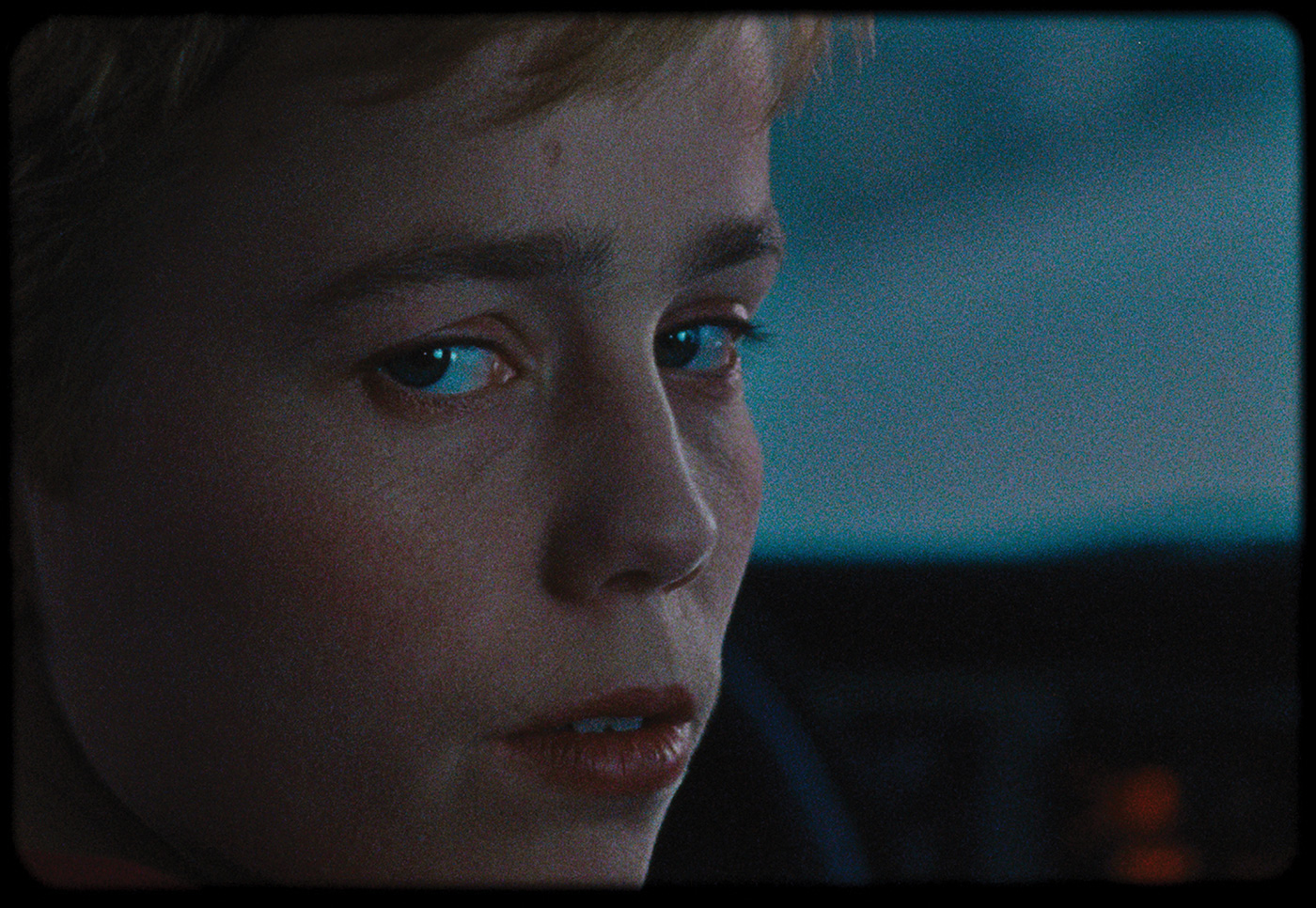
Anouk Chambaz : Di Notte - Experimental film | 16mm | color | 8:10 | Switzerland, Slovenia | 2025
Anouk Chambaz
Di Notte
Experimental film | 16mm | color | 8:10 | Switzerland, Slovenia | 2025
It’s almost night on the mountain. A solitary car moves along the road. At the wheel, someone starts singing a strange lullaby
Anouk Chambaz (Renens, 1993) works with moving images, exploring the thresholds between spaces, dreams, and individuals. She holds a degree in cinema from ECAL, Lausanne, and in philosophy from La Sapienza, Rome. She received the Combat Prize (video) in 2022, and special mentions at the Francesco Fabbri Prize in 2023 and the Rio de Janeiro International Film Festival in 2024. In 2025 she is finalist for The Talent Prize.

Andro Eradze offers a surreal vision of a peaceful house at dusk. Claire Lance traverses a house in a single shot, treating it as a cinematic space where an undefined space concealing unspeakable truths is revealed. Denis Côté follows Nicky, who seems to be on a mission behind the wheel of his car. The thoughts in his head remain unfathomable. Cathy Lee Crane pays tribute to Pier Paolo Pasolini and his film ‘Theorem’, based on interstitial moments from the film. Louis Rizzo Naudi is interested in the constructed nature of visual perception of nature. Stefan Koutzev films human labour at a time of excessive overexploitation of natural resources, while humanity continually buries itself in the remains of a material world. Anouk Chambaz follows a solitary car driving along a mountain road at night. The driver begins to sing a strange lullaby...
Screening
silent green Kulturquartier | Betonhalle | Cinema 1
Gerichtstrasse 35, 13347 Berlin / Subway: Wedding station, U-Bahn line U6 / S-Bahn lines S41, S42, S46
Free admission
"Mental Projections"
Peter Maybury : L’esprit De L’escalier - Experimental film | 4k | color | 5:50 | Ireland | 2025
Peter Maybury
L’esprit de l’escalier
Experimental film | 4k | color | 5:50 | Ireland | 2025
L’esprit de l’escalier, is the third in a trilogy of films surrounding Pálás, a cinema in Galway, Ireland, designed by Tom dePaor. Opening in 2018, the cinema closed to the public in February 2025, and I attended one of the last screenings at Pálás – Tsai Ming-Liang’s Goodbye Dragon Inn, itself a film about the closing of a cinema. I returned the following morning with thoughts of this in my head as I filmed the staircases throughout the building. These spaces are untempered, part indoor, part outdoor, while the cinemas with their plush red interiors are optimised for sound, temperature, and light. The title of my film refers to the expression (to think of the perfect reply too late) but moreover to the spirit of the staircase. Just like Goodbye Dragon Inn, so much life goes on in these spaces, where people, weather, light, and sound, intersect with, and even possess the movement or the stillness of the camera, the place itself becoming a film.
Peter Maybury is an Irish multidisciplinary artist. His practice-based research encompasses works as an artist, graphic designer, filmmaker, publisher, writer, editor, curator, musician, and educator. He is a graduate of Central Saint Martins, London, and a Doctoral Candidate at the Centre for Socially Engaged Practice-Based Research, TU Dublin. He has collaborated extensively with artists and institutions, editors and curators, on more than 200 art and architecture publications. Peter is a longstanding collaborator with Tom dePaor, making books, films, and works for exhibition. His film work includes On being there (2022/23, screened at Rencontre Internationale Paris/Berlin 2023/24), Landfall (2020), an hour-long dual-screen film installation, and with dePaor the Gall films Drape (2018), and A Study (2015) which was made for exhibition at ETH Zurich. Peter is author of Make Ready (2015), and co-author with dePaor of Reservoir (2010) and Of (2012).
Minne Kersten : Where I M Calling From - Video | 4k | color | 5:40 | Netherlands, France | 2025
Minne Kersten
Where I M Calling From
Video | 4k | color | 5:40 | Netherlands, France | 2025
Where I'm calling from was an exhibition of new work by Netherlands-based artist Minne Kersten. Working with the architecture of David Dale Gallery, Minne constructed a detailed and evocative environment exploring the narrative capacity of inanimate objects, and their role in triggering memory in a transportative way. Minne takes a literary approach to her work, blending installation, video, sculpture and drawing to craft the backdrop of a fictional world. Through her immersive installations, she reveals buildings to be receptive to stories and traumas, as she stages situations subjected to chaos, decay, and deconstruction. Minne explores the traces of events left behind and exposes them as witnesses of private stories retained by the walls that surround us. Her work considers the relationship between the real and imagined, the ordinary and the uncanny, and poses questions about memory and its reconstruction. Working across a range of media, she interweaves personal themes such as mourning, loss and memory with the collective domain of fiction, fables, and symbols.
Minne Kersten (1993, NL) is an artist based in Paris and Amsterdam, working with video, installation and paintings. Underneath these media lies a literary approach in which she combines several techniques to construct a world where objects and scenes hold traces of both facts and fiction. She speculates on how we can recall events, memories and stories, by tracing what is lost in what remains. Her work considers the relationship between the real and the imagined, the ordinary and the ephemeral, and poses questions about memory and reconstruction. By drawing attention to the act of construction in both our shared real and imagined world, her work offers a connection between intimate themes such as mourning, loss and desire, and the collective domain of fiction, fables and symbol making. Painting and drawings are continuously made during a process of introspection and research. They serve as a form of visual note taking, made alongside her spatial approaches. In recent years, she has used the method of crafting an architectural environment, which reveals itself as a scenography, a film set, and subsequent sculpture. Often informed by personal encounters with spaces, these sculptures provide a tangible terrain to explore how a space can witness or distort stories and events. By staging situations that embed symbolic elements such as the appearance of animals or phantom presences, she refers to ways of how the past can leave impressions on the present. Subjecting her scenes to chaos, decay and disruption, she suggests different outcomes of the familiar circumstance of feeling unstable, losing control and reaching a state of transition.
Appu Jasu : When Andromeda And Milky Way Embrace - Fiction | 4k | color | 22:32 | Finland | 2024
Appu Jasu
When Andromeda and Milky Way Embrace
Fiction | 4k | color | 22:32 | Finland | 2024
A lone airplane flies high over a dark landscape. Amid fields of untouched snow a rover is scanning both the ground and the stars, and is beginning to be troubled by the history it was once fed. People isolated inside the plane try to interpret the rover’s increasingly complex messages, while attempting to uncover the past and the future.
Appu Jasu (b.1987) is an artist living in Helsinki working with video, sound, photography and text. In his works fiction, documentary and the absurd meet and exchange ideas about life and society. His practice involves thinking through all the included mediums – picture, text and sound – each taking their turn leading the artwork into a new direction. Jasu’s video works can be found from the collections of Museum of Contemporary Art Kiasma and Helsinki Art Museum, and they have been shown e.g. in WNDX, Canada and in doclisboa, Portugal.
Leopold Emmen : Another Woman - Film Adaptation (work In Progress) - Video installation | mp4 | color | 13:6 | Netherlands | 2025

Leopold Emmen
Another Woman - film adaptation (work in progress)
Video installation | mp4 | color | 13:6 | Netherlands | 2025
'Another Woman - film adaptation' is a three channel film presenting intimate scenes of three characters, two women and a man, in the course of a breakup. The film explores a world of fiction and performance in a cinematographic and spatially designed narrative where three images are presented simultaneously. The visual style focusses both on the performing bodies and their surroundings. Subcutaneous emotions surface through tactile interaction, as the characters touch and feel their place amidst the physical properties of the space. Walls, ceiling, floor, curtains and furniture form obstacles, boundaries and voids that confront the protagonists with the situation and state of mind in which they find themselves. The interiors become mirrors for their inner worlds, surreal and intuitively recognisable at the same time. 'Another Woman - film adaptation', 2025, is a re-staging of the spatial installation 'Another Woman', 2022. We show an exerpt of 13 min 6 sec. of the final film that will have an estimated duration of 70 minutes.
Leopold Emmen is a collaboration between filmmaker Nanouk Leopold and visual artist Daan Emmen. In our work, we experiment with film as a spatial, cinematographic experience in which the visitor plays an active role. Through the characteristics of a place and the behaviour of our protagonists, we want to make tangible how a presence influences life and relationships with the other. An open invitation to explore the physical and mental world of the characters themselves. Creating awareness of the way in which space, sound and moving image can come together in a deepening, embodied experience, we want to stir up our conditioned gaze. Reflecting on how we see the world, how we see ourselves in that world and how we see each other.
Nelson Henricks : Stopping - Experimental video | mov | color | 4:25 | Canada | 2025
Nelson Henricks
STOPPING
Experimental video | mov | color | 4:25 | Canada | 2025
Night. The moon is a rock. The ears are stopped. A chair balances on the roof of a house. A silver box composes itself: a mysterious instrument. A marble rolls around in somebody’s head. Two rocks spin. Is it possible to stop the mind?
Nelson Henricks graduated from the Alberta College of Art in 1986. He moved to Montréal in 1991 and received a BFA from Concordia University. He recently completed a PhD at Université du Québec à Montréal. Henricks has taught art history and studio art at Concordia University, McGill University, UQAM and Université de Montréal. A curator and artist, Henricks is best known for his videotapes and video installations, which have been exhibited worldwide. A focus on his video work was presented at the Museum of Modern Art in New York, as part of the Video Viewpoints series in 2000. Henricks was the recipient of the Bell Canada Award in Video Art in 2002, the Prix Giverny Capital in 2015, and the Prix Louis-Comtois in 2023. An exhibition of his work was presented at the Musée d’art contemporain de Montréal in 2023. His work is in the collections of the National Gallery of Canada, the Museum of Modern Art (New York), the Montréal Museum of Fine Arts, the Musée national des beaux-arts du Québec, the Musée d’art contemporain de Montreal and others. He is represented by Paul Petro Contemporary Art in Toronto.
Salomé Lamas : Gold And Ashes | Redux - Fiction | 4k | color | 30:0 | Portugal | 2025
Salomé Lamas
Gold and Ashes | REDUX
Fiction | 4k | color | 30:0 | Portugal | 2025
Gold and Ashes is erected upon internal and external — ontological-epistemological — scaling dualities reflected in the characters but also in the time and space where the action is set or in the world they inhabit. It is structured around a concrete plane and an abstract plane as a reference to, human subjectivity. The project features two female actresses. The concrete plane plot is set in filming locations that provide a backdrop for the narrative with direct dialogues and action — mother-and-daughter, placed in the present time. It conveys a social sphere outlined by complex communication models and conventions — such as kinship and existential quests while underlining the artificiality of a constructed reality — an inhabited drawing. The abstract plane plot is set in a film studio that provides a backdrop for the para-philosophical narrative with monologues and no action — two disconnected entities (not sure if aware, of each other), placed in an unknown time. It conveys a mental labyrinth outlined by relational power dynamics and conflicting human emotions — such as humanity’s history and its relation to planet Earth while underlining the speculation of symbolic and imaginary articulations damaged by the loss of the social, political, and spiritual. Overall, the project unfolds around cognitive systems, societal models, and civilizational paradigms, and uses an approach that acknowledges human evolution, simultaneously outlining human limitations to follow the poetics and relational politics of two grand narratives — [a]naturalism, [anti]eco/[geo] constructivism — which usher the mythology of the human impact on Earth (Anthropocene); compelled by two timeless perspectives: progress and apocalypse — questioning our ability to rebuild and pilot the Earth away from the socio-ecological disasters and showing what it means to appreciate the Earth (but also humanity) as an irreplaceable becoming — a trajectory that cannot be replicated, remade or mastered. Gold and Ashes is a powerful exploration of the human condition in the face of devastation, reflecting Lamas’s ongoing commitment to addressing difficult and urgent themes through innovative techniques that often disrupt traditional narrative structures, creating films that are non-linear, fragmented, or that deliberately withhold key information. This technique enhances the parafictional quality of her work, as it mirrors the complexity and uncertainty of real-life events, where truth is often elusive. In the project she explores the idea of subjective memory and how personal and collective histories are constructed. By using parafiction, she highlights the fluidity of memory and the ways in which stories are shaped by the storyteller’s perspective, as well as by political and social contexts. Gold and Ashes symbolizes the duality of destruction and resilience—the “ashes” represent the remnants of war and loss, while the “gold” signifies the hope and strength that survivors cling to in their efforts to rebuild their lives. Lamas uses her distinctive style to blur the lines between reality and fiction, creating a layered and immersive experience that challenges viewers to question their understanding of truth and memory and its impact in both the private and public spheres.
Salomé Lamas has produced over thirty projects, which have been installed and screened internationally, both in cinema auditoriums and contemporary art galleries, and museums. Each of them gives way to a different social reality, usually characterized by its geographical and political inaccessibility. The artist’s interest in impenetrable, politically ambiguous contexts is guided by concerns and the need to problematize reality that otherwise would not be possible. The web of relations making up the socio-political fabric of her projects is made visible through representational strategies, for which she adopted the term parafiction. Rather than complying with a shapeless meaning of parafiction — for which there is no established terminology — she proposes its expansion and resignification. In her artistic practice, parafiction can be read in the light of its prefix “para-”, in which we encounter various disruptive effects that are vital for its comprehension. Derived from the Latin, “para-” indicates “alongside, adjacent to, beyond or distinct from, but analogous to”; in certain word combinations, it can also mean “wrong, irregular,” pointing towards an “alteration” or “modification”; further, “para-” implies “separate, defective, irregular, disordered, improper, incorrect, perversion or simulation.” In this way, parafiction would be something in which fiction has been perverted, altered, modified, or pushed beyond its point of reference, as opposed to remaining within the boundaries of the category of fiction. It can also be understood as a “simulation” of fiction, pointing to a distortion of the border around what is considered fiction, thus reaching what is on the other side of that border: that is, the world of non-fiction or seeking the “real” world. Thus, instead of fiction being used to blur the border with non-fiction, it is used as a way of expanding and transcending those boundaries. Salomé Lamas departs from the principle that we do not have access to a stable reality. Instead, we have an excess of meanings, interpretations, explanations, manipulations, (de)constructions, and evaluations that go into narratives and systems that sustain and occupy us. Consequently, the need for appropriating the idea of parafiction stems from the questioning of how human subjectivity is formed, drawing on psychoanalysis, with the aim of clarifying and expanding concepts such as real (something that is out of reach), reality, symbolic, and imaginary. Thus, she is led to operate at the border between fiction and non-fiction, employing representation and hypothesis generation through certain meditative criteria and a deontological code relative to what is plausible, assuming consciously the “task of the translator” —comparable to illusionism — and pushing its boundaries. In this context, she draws on distinct non-fictional strategies that include ethnographic research, as well as thought experiments, reflexivity, restaging and performativity, among others, to explore the limits of fiction. This is visible in the development of her working methodology, where we find various manifestations of parafiction, such as scenarios where characters and fictional stories intersect with the world as we are experiencing it. The combination of these strategies, to the detriment of other speculative aspects, forms a sort of hypothesis that maintains a level of accuracy with reality but also questions its authority. Through parafiction it is possible to take a convention and deconstruct it, distort it, expose the impossibility of providing evidence for the truth, to the point where doubts are raised about its validity, yet still producing reasons for understanding it as plausible. Salomé Lamas problematizes both sides of the border between historical and imaginary worlds, and records how they have changed over time, by understanding parafiction as a fundamental translation tool for defining identity, language and culture. Intensifying, exaggerating and speculating on how the world is made sensible, by triggering moments that reveal their fabrication, in a post-truth context heightened by the technological and globalized nature of our times. To reveal this transformation is a continuous and thorough undertaking, but also spiritual, having the ability to relate the individual sphere (private) with the social sphere (public) and so introducing new information and perspectives on our past, present and future. Thus, although conscious of its limits and apparent contradictions, parafiction helps give form to the chaos of life and endow it with significance, in a compromise between reality and its fictionalization.

Peter Maybury traces a path through a place that becomes a film. Minne Kersten films moths, which become a motif for questioning the assimilation of darkness with absence, secrecy or fear. Amidst ruins, Appu Jasu presents isolated individuals in an aeroplane, attempting to interpret increasingly complex messages. In three images presented simultaneously, Leopold Emmen explores a world of performance and fiction through a spatial narrative that presents intimate scenes of three characters during a break-up, played by Sandra Hüller, Meg Stuart and Gillis Biesheuvel. In a landscape where the moon is a rock, Nelson Henricks enters consciousness to ask whether it is possible to stop the mind. Salomé Lamas shows two women in an exercise of redemption — mother and daughter — who go beyond their limits to free themselves from their comfortable and suffocating lives.
Special screening
silent green Kulturquartier | Betonhalle | Cinema 1
Gerichtstrasse 35, 13347 Berlin / Subway: Wedding station, U-Bahn line U6 / S-Bahn lines S41, S42, S46
Free admission
"The Toxic Fields of Abundance"
Lukas Marxt, Vanja Smiljanic : Among The Palms The Bomb Or: Looking For Reflections In The Toxic Field Of Plenty - Experimental doc. | mov | color | 85:0 | Austria, Germany | 2024
Lukas Marxt, Vanja Smiljanic
AMONG THE PALMS THE BOMB or: Looking for reflections in the toxic field of plenty
Experimental doc. | mov | color | 85:0 | Austria, Germany | 2024
The Salton Sea in southern California is a unique ecosystem. In just four years, the water level has fallen by a good half a meter, and with a maximum depth of ten meters you can calculate when it is expected to dry out. And that’s just the global aspect, which has to do with global warming and changes in the local climate. The Salton Sea is also special because the United States tested numerous atomic bombs here in the final phases of World War II and the Cold War – initially in preparation for the Hiroshima and Nagasaki bombings, later as training for missions that fortunately never took place. In AMONG THE PALMS THE BOMB, Lukas Marxt and Vanja Smiljani? are particularly interested in this aspect of regional history. The film begins in Utah, where the planes took off and then found their destination in the supposedly secluded area around the Salton Sea. There is a museum in Wendover where you can also see models of “Fat Man” and “Little Boy”, the only two atomic bombs ever used in war, along with a loading pit where the planes were loaded, to which Marxt dedicated a shorter film in 2019. For many years he has been dealing with the situation in southern California, which can be described as extreme in many respects. Intensive agriculture, which relies radically on monocultures, has cast a spell over everything there. Marxt and Smiljani? find out that an alliance has been formed against this backdrop: illegal harvest workers from Latin America seek refuge in Native American reservations. AMONG THE PALMS THE BOMB has local experts explain the landscape and history, and the director is looking for dissenting voices, especially among the tribe of the Torres Martinez Desert Cahuilla Indians, who were victims of genocide in the 19th century. Their survivors now recall how many plants that had healing powers and were part of a life with nature once grew around the salty water of the Salton Sea. Now the area belongs to the salt bushes, and beneath the surface ticks the uranium of a Cold War that is about to return. Scary times, someone says. (Bert Rebhandl)
Lukas Marxt (*1983, Austria) is an artist and a filmmaker living and working between Cologne and Graz. Marxt´s interest in the dialogue between human and geological existence, and the impact of man upon nature was first explored in his studies of Geography and Environmental Science at the University of Graz, and was further developed through his audio visual studies at the Art University in Linz. He received his MFA from the Academy of Media Arts Cologne, and attended the postgraduate programme at the Academy of Fine Arts Leipzig. Marxt has been sharing his research in the visual art environment as well as in the cinema context. His works have been featured in numerous solo and group exhibitions, most recently at the Torrance Art Museum (Los Angeles, 2018), at The Biennial of Painting, Museum Dhondt-Dhaenens (Belgium, 2018), and at the Museum of Modern and Contemporary Art Rijeka (Croatia, 2018). His films have been presented in numerous International Film Festivals including Berlinale (Germany, 2017 and 2018), Curtas Vila do Conde (Portugal, 2018), and the Gijón International Film Festival where he receiced the Principado de Asturias prize for the best short film (Spain, 2018). Since 2017, Marxt has spent a considerable amount of time in Southern California, where he has researched the ecological and socio-political structures surrounding the Salton Sea. Vanja Smiljani? (Belgrade, 1986) is a visual and performance artist living and working between Lisbon and Cologne. She concluded the post-master in Artistic research at A.pass, Brussels (2015), MFA at the Dutch Art Institute (DAI), Arnhem (2012), and Kunsthochschule für Medien Köln (2019) and got a degree in Fine Arts at the Faculdade de Belas Artes de Lisboa (2009). In her practice she often utilizes the model of performance-lecture as a way to bridge fictitious and experiential universes, comprising technical apparatus, diagrams and sci-fi povera sculptures. Connecting otherwise unparalleled reality systems, Vanja's work attests the foundation of ideologies as alienated regimes, recurring to her own body as a vessel for narration, often shifting between the position of oracle and storyteller.

Lukas Marxt and Vanja Smiljanić explore the Salton Sea – California's largest lake, in a state of ecological collapse – and film the surrounding community struggling to survive in this dystopian reality. The film intertwines the narratives of the power that shaped history with those of tribal communities whose history has been erased over time – between memories of the genocide of Native American tribes, the Manhattan Project's military atomic bomb tests in the 1940s, and intensive agriculture that is killing wildlife.
Special screening
silent green Kulturquartier | Betonhalle | Cinema 1
Gerichtstrasse 35, 13347 Berlin / Subway: Wedding station, U-Bahn line U6 / S-Bahn lines S41, S42, S46
Free admission
"The Melancholy of Birds"
Christoph Girardet : One Hundred Years Later - Experimental film | mov | black and white | 7:55 | Germany | 2025
Christoph Girardet
One Hundred Years Later
Experimental film | mov | black and white | 7:55 | Germany | 2025
In 1939, a second unit with a double and extras filmed scenes for the Hollywood classic “Mr. Smith Goes to Washington” in the Lincoln Memorial. The succession of the long, sorted-out plan sequences undermines the classic cinematic narration; the plot does not seem to progress. The neoclassical architecture remains the setting for a recurring and questionable ritual, in which the protagonist is lost.
Christoph Girardet, born in 1966, is a German video artist and filmmaker. Girardet makes both the accidentally found and the extensively researched found footage from the archives of film history the subject of his art. Montage, omissions, and repetitions reveal the actual structures and inner mechanism of the depicted cinematic reality. Beyond the analysis of the material and its clichés, his work deals in essence with a melancholic state of absence, thus creating an individual pictorial world. From 1988 to 1994, Girardet studied Visual Arts at the Braunschweig University of Art (HBK) in the film class of Birgit Hein. Since 1989 he has produced films, videos and video installations, some of them in collaboration with video artist Volker Schreiner (1994 – 2004), and, more frequently, in collaboration with filmmaker Matthias Müller (1999 – ongoing). Girardet has participated in group shows at the Stedelijk Van Abbemuseum, Eindhoven, MoMA PS1, New York, Palais de Tokyo, Paris, Hirshhorn Museum, Washington, and Eye Filmmuseum, Amsterdam, among others. He had solo exhibitions at institutions such as FACT, Liverpool, Kunstverein Hannover and West, The Hague. He has taken part in major film festivals worldwide, including the festivals at Cannes, Venice, Berlin, Toronto, Locarno, Oberhausen and Rotterdam. His work is included in public and private collections. He has received numerous awards, among them a stipend for the International Studio and Curatorial Program in New York (2000) and a scholarship at Villa Massimo in Rome (2004). He lives and works in Hanover, Germany.
Carlos Irijalba : Wanderers - Experimental doc. | 4k | color | 3:38 | Spain, Netherlands | 2025
Carlos Irijalba
Wanderers
Experimental doc. | 4k | color | 3:38 | Spain, Netherlands | 2025
Wanderers is a film centered in the way that matter (and our bodies as a result) are driven by magnetism, pulse or rhythm carried by the earths inertia. A primal movement of mineral origin, pre-life and pre-human. To do so, the film casts a universal perspective on the dynamics of birds, migration of bodies, and humans fascination with flying as a challenge for those laws. The film covers this abstract notion with two different contemporary phenomena, modern falconry flown on commercial airplanes and the passion of RC Replica airliner pilots, depicting the dichotomy between natural evolution, our physical materiality and the detachment from mundane reality and general force and gravity, those.
Carlos Irijalba Pamplona (SP) 1979 Resident at the Rijksacademie Van Beeldende Kunsten (Amsterdam) in 2013/2014, and Graduated at the UDK University with Professor Lothat Baumgarten, Irijalba has been awarded multiple art prizes like in 2023 the NYC Culture Pair Program with the Department of Design and Construction DDC, the Mondriaan Fonds 2022 in Amsterdam, the Sifting Foundation Art Grant 2015 in San Francisco y Marcelino Botin 2007/08 among others. He exhibited internationally in the Shanghai Biennale 2021, CAB Art Center Brussels, Guangzhou Triennale 2017 or MUMA Melbourne in Australia. To the question “Does the world need this new object?”, most of the times the answer would be “no”. Therefor the work of Irijalba moves by the principle of pertinence, trying to remain context responsive. In projects like Skins (2013), Hiatus (2022) and Pannotia (2016-ongoing) he works with geology and industrial time sensitive materials that give us perspective on the dominant narratives in Western history. His work is present in public collections as Museo Nacional Reina Sofia, The Netherlands National Collection, Sammlung Wemhoener Foundation in Germany, the Taviloglu Art Collection in Istambul and Acciona Foundation in Spain. His presence on private collections internationally is extensive in both North and South America, Europe and Asia like collection Pilar Citoler, Kells Collection, David Breskin Collection among many others.
Sina Khani : Watch With The Weary Ones - Experimental doc. | 4k | color | 7:29 | Iran | 2025
Sina Khani
Watch With the Weary Ones
Experimental doc. | 4k | color | 7:29 | Iran | 2025
Watch with the Weary Ones is a short documentary that looks at the American urban landscape while the filmmaker quietly drifts back to memories of Iran. It places the surfaces of U.S. cities next to the feelings of someone living far from home, caught between two places. The film reflects on the sorrow carried by those who left Iran searching for another life, and those who stayed and continue to fight for theirs. It’s about holding two worlds at once, the one in front of you and the one that never leaves you, and trying to make sense of that weight
Sina Khani (aka Sina Ahmadkhani) is a Tehran-born, Los Angeles–based filmmaker, writer, and editor. His feature debut won Best International Experimental Feature at the Portoviejo Film Festival and earned awards, nominations, and selections at Regina IFF, Toronto International Nollywood FF, New York City Indie FF, and many other international festivals. He recently completed his MFA at Virginia Commonwealth University and continues to create bold, character-driven stories.
Margit Lukacs, Persijn Broersen : Lion's Court - Video | 4k | color | 20:0 | Netherlands | 2025

Margit Lukacs, Persijn Broersen
Lion's Court
Video | 4k | color | 20:0 | Netherlands | 2025
Lion’s Court is a cinematic short opera in which the Binnenhof—the seat of Dutch Parliament in The Hague—is reimagined as a virtual stage where history dissolves into myth. Inspired by the discovery of 14th-century lion bones at the site and by stranded whales as omens, Lukács & Broersen collaborated with composer and political scientist Bram Kortekaas to reinterpret Goethe’s Faust’s vision of redemption. At its center stands the lion Faust, sung by baritone Michael Wilmering—a despot in pursuit of a freedom that consumes itself, a mirror of imperial ambition on the verge of collapse. The artists also drew on the 1650 writings of Johan de Witt, the republican Grand Pensionary, whose words are voiced by the whale (alto-mezzo Carina Vinke), rising from beneath the flooded foundations of the Binnenhof. De Witt believed that a true republic is not ruled by the whims of a single individual, but rooted in the principles of freedom and equality—the very foundations of democracy. In Lion’s Court, a digital hortus conclusus unfolds: a fluid, enclosed world where power, morality, and prophecy converge, and where the myths of the past reverberate through the politics of the present.
Margit Lukács and Persijn Broersen are an Amsterdam-based artist duo exploring the entanglements between nature, culture, and technology. Their work includes films, digital animations, and spatial installations that investigate how media shapes our perception of the natural world. Graduates of Graphic Design at the Gerrit Rietveld Academie, they completed their MFA at the Sandberg Institute and were artists-in-residence at the Rijksakademie in Amsterdam. Broersen & Lukács’ practice is rooted in media theory, art history, and mythology. Drawing from cinematic, scientific, and historical sources, they reimagine landscapes and natural phenomena through digitally layered environments. Their work often reflects on the politics of representation and the appropriation of nature, reconfiguring dominant narratives through fragmented, multi-perspective storytelling. Their installations and films have been widely shown internationally, including at the Stedelijk Museum Amsterdam (NL), Centre Pompidou (FR), FOAM (NL), MUHKA (BE), Centraal Museum (NL), MacKenzie Art Gallery (CA), WRO Biennale (PL), Biennale of Sydney (AU), Rencontres Internationales (HKW Berlin, Louvre/Grand Palais/CWBP, Paris), and Wuzhen Biennale (CN). In 2024, they represented the Netherlands at the Gwangju Biennale. Their film I Wan’na Be Like You was nominated for the Tiger Award/IFFR 2024.
Antoine Chapon : Al Basateen - Documentary | dcp | color | 24:41 | France | 2025
Antoine Chapon
Al Basateen
Documentary | dcp | color | 24:41 | France | 2025
In 2015, the Basateen al-Razi district of Damascus was razed to the ground as punishment for the population’s uprising against Bashar al-Assad’s regime. This area is set to be replaced by Marota City, a modern and connected district featuring 80 skyscrapers. Ten years later, having lost everything, two former residents reflect on their neighborhood, where their homes and the oldest orchards in Damascus once stood. Through their testimonies and the repurposing of regime-produced 3D animations, memory is awakened and resists this deliberate erasure.
Antoine Chapon (b. 1990, France) is a filmmaker and multidisciplinary artist. His work creates hybrid forms using cinema, CGI animation and archives. His first short film "My Own Landscapes" premiered in Visions du Reel where it won the Best Short Film Award. It was then selected in more than 40 festivals, such as Sundance, Telluride, Palm Springs, Sarajevo and Premiers Plans. His work has been showcased at ZKM|Karlsruhe, Centre Pompidou, the 17th Venice Architecture Biennale and the Singapore Art Museum. He is a Berlinale Talents alumnus and he is currently writing his first feature documentary.
Dina Mimi : The Melancholy Of This Useless Afternoon Ii - Experimental film | mov | color | 13:0 | Palestine | 2022
Dina Mimi
The Melancholy of this useless afternoon II
Experimental film | mov | color | 13:0 | Palestine | 2022
The Melancholy of this Useless Afternoon, chapter 2 (2023, 11:25) explores the shared gestures between the fugitive and the smuggler, and their relationship to being seen. The melancholy of this useless afternoon researches the links between the fugitive and the smuggler, their shared gestures and relationships to being seen. By escape and flight, risking capture or death, the fugitive works to keep themself hidden. The smuggler, however, moves with stealth, using gestures to hide things, often close to their body.
Dina Mimi is a Palestinian visual artist and filmmaker who is based between Palestine and the Netherlands. Mimi works with experimental filmmaking and lecture performances that research the question of how and when bodies become sites of resistance. This question finds its material interest in moving images, especially found footage, that is discarded and therefore deemed invaluable. Understanding editing as a playground, Mimi plays with opacity in moving images by seeking to brush up against footage which desires to be ungraspable or is in the act of vanishing. This is a continuous attempt at non-linear narration as a way of disfiguring one’s.

Christoph Girardet subverts the conventional cinematic narrative of the classic Hollywood film Mr. Smith Goes to Washington. The plot does not progress; the neoclassical architecture of the Lincoln Memorial becomes the setting for a ritual in which the protagonist loses himself among the building’s pillars. Carlos Irijalba examines movements between animate and inanimate matter, and their shifts under the effect of gravity or through geological cycles. Broersen & Lukács depict the Dutch Parliament in The Hague as a digital ruin, and, at its centre, the lion Faust — a spectral figure in search of a freedom that devours itself, on the verge of collapse. Lin Htet Aung explores the suffering and resilience of the Burmese people through excerpts from broadcasts aired on national television. In 2015, in Damascus, the district of Basateen al-Razi and its orchards were razed to punish the population that had risen up against the regime. Antoine Chapon films two former residents recalling their lives in this neighbourhood. Dina Mimi, in her film shot in Palestine, Jordan and the Netherlands, explores gestures common to both the fugitive and the smuggler.
Forum
silent green Kulturquartier | Betonhalle | Cinema 2
Gerichtstrasse 35, 13347 Berlin / Subway: Wedding station, U-Bahn line U6 / S-Bahn lines S41, S42, S46
Free admission
Artist Talk
Following on from the Q&A sessions and discussions with the artists during the screenings, a special event is being held on 6 June at 2 pm.
The invited artists present their work and research, and bear witness to the state of their artistic practice in countries sometimes in transition or undergoing profound transformations

Screening
silent green Kulturquartier | Betonhalle | Cinema 2
Gerichtstrasse 35, 13347 Berlin / Subway: Wedding station, U-Bahn line U6 / S-Bahn lines S41, S42, S46
Free admission
"Wars. Part 1"
Franz Wanner : Berlin-lichtenberg - Documentary | mp4 | color and b&w | 7:20 | Germany | 2024
Franz Wanner
Berlin-Lichtenberg
Documentary | mp4 | color and b&w | 7:20 | Germany | 2024
The video Berlin-Lichtenberg uses footage from a home movie filmed in 1943. The apparent intention of the filmmaker – to capture peaceful moments of family life such as a wife and child on a walk or leisure time at a lakeside restaurant in the Berlin district of Lichtenberg – is disrupted by unintended visual content. In the background, everyday life in the forced labour system becomes visible: a group of female forced labourers on the way to their work site, and the barracks of a forced labour camp behind the excursion venue. These visual elements are not consciously chosen, but rather a casual documentation of the omnipresence of forced labour in Nazi Germany. The amateur footage has been re-edited for the video with intertitles that contextualise the silent images and add a fictional level.
In his artistic work, Franz Wanner (*1975 in Bad Tölz, Germany, lives in Zurich) addresses topics such as the European Union’s migration policy, the German secret service and the arms industry, as well as their history and current structures, and the effects of Nazism on the German imperative of prosperity. “In a conceptual practice whose consistency of research and artistic output, in the tradition of Hans Haacke, continues – by means of investigations and transmedia – to ask questions where no one has yet done so” (Nora Sternfeld, HFBK Hamburg), “he creates images of a collective cognitive dissonance and analytical poetry about the pathology of overlooking within the Germany of today and its idioms” (Stephanie Weber, Lenbachhaus Munich). As Artist in Residence at the Harun Farocki Institute, he developed the exhibition Mind the Memory Gap for the KINDL – Centre for Contemporary Art in Berlin. Under the title Eingestellte Gegenwarten, he realised his first solo exhibition in Italy at Merano Arte, which will be shown in modified form at the Lenbachhaus in Munich in 2026.
Feargal Ward, Jonathan Sammon : Ivanko The Bear's Child - Experimental doc. | dcp | color | 25:0 | Ireland | 2024
Feargal Ward, Jonathan Sammon
Ivanko the Bear's Child
Experimental doc. | dcp | color | 25:0 | Ireland | 2024
A peasant’s wife loses her way in the forest and stumbles into a bear’s den. The bear keeps her with him, and after a time, a half-bear, half-child is born. They long to escape. To this backdrop, we move through the corridors and streets of a deserted German military town, once the central headquarters of the Soviet army’s occupation of Eastern Europe. Sealed off to the public for decades, this obscure complex became known to outsiders as “the Forbidden City.” A primal Russian fairy tale is employed to navigate this labyrinthine site, which appears to speak to both the legacy of this contested past and the unsettling resonances of our present.
Feargal Ward and Jonathan Sammon are filmmaking artists from Ireland. Much of their work explores the boundaries and possibilities of the hybrid-documentary form, where tropes and devices of narrative cinema are often appropriated or subverted in an attempt to interrogate established truths. Previous films they have collaborated on include 'Tin City', which premiered at this year’s Berlinale (Forum Expanded) before screening at multiple festivals including Karlovy Vary, Cinéma du Réel, and Festival dei Popoli, where it was awarded the International Discoveries Prize. Other collaborations involving Adrian Duncan include the films 'Lowland' (Cork International Film Festival), 'Memory Room' (IDFA, EVA International, Dokufest Kosovo), and 'Tension Structures' (IDFA, Hot Docs, RIDM). Ward’s feature documentary 'The Lonely Battle of Thomas Reid' premiered in the main competition at IDFA and screened at multiple festivals before being broadcast on German, Irish, and Finnish television. His debut feature documentary 'Yximalloo' (co-directed with Tadhg O’Sullivan) premiered at FID Marseille, where it won the Prix Premier
Saskia Kessler : Das Gewicht Von Steinen - Documentary | 4k | color | 17:51 | Germany | 2025
Saskia Kessler
Das Gewicht Von Steinen
Documentary | 4k | color | 17:51 | Germany | 2025
The Zeppelin Grandstand on the former Nazi Party Rally Grounds in Nuremberg is one of the most well-known architectural remnants of the Nazi era. Where the masses once gathered to cheer Hitler, today car races and various leisure activities take place. The film explores the tension between remembrance and neglect, use and responsibility - and poses the question: in a time of rising right-wing extremism, how do we engage with a place built for a criminal ideology that nonetheless remains woven into the fabric of daily life?
Saskia Kessler studied European Studies at Maastricht University and Sociology at Friedrich-Alexander University Erlangen-Nuremberg before discovering her passion for filmmaking. Since October 2022, she has been studying documentary film directing at the University of Television and Film Munich.
Bojan Fajfric : Greetings From Kosovo 1989 - Experimental doc. | mov | color | 13:39 | Slovenia, Netherlands | 2025
Bojan Fajfric
Greetings from Kosovo 1989
Experimental doc. | mov | color | 13:39 | Slovenia, Netherlands | 2025
Greetings from Kosovo 1989 (2025) nSingle-channel video, (DV Pal 4:3), 13:39 min. Greetings from Kosovo 1989 deals with archive footage from the 1989 gathering in Kosovo, made famous by Slobodan Miloševi?’s speech. Addressing a crowd of over a million, he spoke amid rising ethnic tensions in Kosovo and growing political unrest in Yugoslavia. His mention of “armed battles” in Serbia’s future has made this speech infamous, often seen as foreshadowing the Yugoslav Wars. Reframing and subverting the format of a TV reportage, the work emphasizes the mass hysteria, madness, and banality of nationalistic and religious iconography. In light of recent world events, revisiting this episode—an inseparable part of the history that profoundly marked the end of the 20th century—is a crucial gesture, as this history remains very much alive.
Bojan Fajfri? (Belgrade, former Yugoslavia) is an artist and filmmaker based in the Netherlands since 1995. A graduate of the Royal Academy of Fine Arts in The Hague and former resident at the Rijksakademie in Amsterdam. Working primarily with moving images and photography, he creates layered narratives that reflect on history’s impact on individual lives. His interest lies in the porous relationship between memory and the moving image. His work has been presented at institutions such as Palais de Tokyo (Paris), Baltic Centre for Contemporary Art (Gateshead), San Telmo Museum (San Sebastián), De Appel (Amsterdam), the Belgrade October Salon, NGBK (Berlin), and the Center for Cultural Decontamination (Belgrade). His films have screened widely at international festivals including the International Film Festival Rotterdam, International Short Film Festival Oberhausen, Vienna International Film Festival, DOK Leipzig, Sharjah International Film Festival, Tempo Documentary Festival (Stockholm), Rencontres Internationales Paris/Berlin/Madrid, and Impakt Festival (Utrecht).
Astrid Ardagh : Ishavsringen - Documentary | dcp | color | 20:36 | Netherlands, Norway | 2024
Astrid Ardagh
Ishavsringen
Documentary | dcp | color | 20:36 | Netherlands, Norway | 2024
In 2022, a major Russian cyberattack left the Norwegian islands of Bjørnøya and Hopen cut off from the world. On Air traces how a small group of Norwegian radio amateurs stepped in to re-establish contact, revealing the vital role of analog technology in an increasingly fragile digital society. Seen through the curious eyes of extraterrestrial anthropologists, the film explores how Morse code and radio signals may one day safeguard our hyperconnected world.
Astrid Ardagh is an artist and filmmaker from Engeløya in Northern Norway, with a bachelor’s degree in moving images from Gerrit Rietveld Academy in Amsterdam. Her site-specific works delve into the interconnections between people and their environment in a rapidly changing world. By merging her interest in anthropology with aesthetic storytelling, her films become immersive and sensory experiences that transcend traditional human-centred perspectives. Ardagh's short films have been screened at acclaimed festivals such as Clermont-Ferrand and Kortfilmfestivalen in Grimstad, as well as galleries and art museums such as Kristiansand Kunsthall, the Eye Film Museum and the Stedelijk Museum in Amsterdam.

Based on amateur films from 1943, Franz Wanner observes the quiet life in a Berlin neighbourhood and the moments when the camera unintentionally captures what society hides. Near Berlin, Feargal Ward and Jonathan Sammon explore Wünsdorf, a former military camp that served successively as a fortified enclave for the Prussian, Nazi and Soviet powers. Built for control, it is now a decaying remnant of totalitarian ideology. Saskia Kessler films the Zeppelin Tribune, on the former site of Nazi party rallies in Nuremberg, now a tourist attraction and motor racing track. Highlighting mass hysteria, madness and the banality of nationalist iconography, Bojan Fajfric revisits archive footage of Slobodan Milošević in Kosovo, who in 1989 addressed a crowd of a million people against a backdrop of ethnic tensions and political unrest in Yugoslavia. His phrase ‘armed battles’ was perceived as heralding the Yugoslav wars. In the Arctic islands of Norway, Astrid Ardagh explores the role of radio amateurs during a Russian cyberattack that cut off all means of communication.
Screening
silent green Kulturquartier | Betonhalle | Cinema 2
Gerichtstrasse 35, 13347 Berlin / Subway: Wedding station, U-Bahn line U6 / S-Bahn lines S41, S42, S46
Free admission
"Wars. Part 2"
Sam Drake : Suspicions About The Hidden Realities Of Air - Experimental doc. | 16mm | color and b&w | 9:9 | USA | 2025
Sam Drake
Suspicions About the Hidden Realities of Air
Experimental doc. | 16mm | color and b&w | 9:9 | USA | 2025
Fragmented records of events almost too sinister to believe: Cold War era covert radiation testing performed by the United States government on its citizens. The film grapples with the challenges of documenting the invisible, and capturing what is merely waves and frequencies. Shot on expired film, it is through the contaminated image and a complex soundscape that the unseen becomes manifest. During the Cold War, the U.S. government developed a program of covert human radiation experiments, using its own citizens as test subjects. Suspicions About the Hidden Realities of Air is an elliptical exploration of this dark historical episode, operating across vast landscapes and individual human bodies. Fragments of archival and 16mm imagery – shot on expired film stock – evoke the locations of numerous test sites across the United States. Urban landscapes at night, bleached scenes of the American desert, and close-up details of rural America are interwoven with voice-over and on-screen text that reference testimony of the continuing impact of this period of covert testing.
Sam Drake (b. Dayton, OH) is a filmmaker based in Milwaukee, WI. Her work has been exhibited at film festivals and venues including The Museum of Modern Art, International Film Festival Rotterdam, Media City Film Festival, CROSSROADS, The Museum of the Moving Image, Alternative Film/Video, Collectif Jeune Cinéma, Non-Syntax Experimental Image, Winnipeg Underground Film Festival, Transient Visions Festival of the Moving Image, and Antimatter. She has programmed for the Union Cinema and Mini Microcinema and is currently a lecturer at the University of Wisconsin-Milwaukee.
Liina Siib : Nii Tuli Lõpp - Experimental doc. | 4k | color | 17:31 | Estonia | 2025
Liina Siib
Nii tuli lõpp
Experimental doc. | 4k | color | 17:31 | Estonia | 2025
"Nii tuli lõpp / And Then Came The End" is based on the experiences of a German Catholic priest, Magnus Frey, in prisoner of war camps in Narva, Estonia from 1945 to 1946. In this film, Siib depicts the locations of the story in Narva in their current state and without people, i.e. dilapidated buildings and winter landscapes. The soundtrack includes everyday life snippets from Frey’s memoirs, such as how prisoners of war were not paid the few rubles they had been promised and had their warm blankets taken away before winter came. And how religious prisoners managed to make communion bread despite the difficult conditions. And how hungry prisoners entertained themselves and each other by remembering their favourite dishes and writing down their favourite recipes. The excerpts of Frey’s diary are arranged on screen with a picture and on a soundtrack with music to create a prose poem of documentary material. The value of such micro-history, both as text and film, is not in revealing major developments or in interpreting historical turning points. Instead, the value is that individual anecdotes and fragments can be evidence that bring history to life and help us to take seriously the suffering and existence of others — past and present. By Teemu Mäki
Liina Siib is a visual artist, filmmaker and educator who lives and works in Tallinn, Estonia. The topic of her works ranges from femininity and social space to different manifestations of people’s everyday practices. She combines field observations with archival sources, historical accounts and various narratives circulating in the society as well as with psychoanalytic approaches and contemporary art and film theories. The characters, spaces and situations in her works tend to go unnoticed due to their ordinariness or are silenced or ignored. In her multidisciplinary approach she uses the means of film, video, photography, installation, performance, ready-mades, print media and artist’s books. Her experimental documentary videos and staged short films have been shown both at festivals of artists' films and at art exhibitions in the galleries, often using the format of expanded cinema. In 2011, the project A Woman Takes Little Space by Liina Siib represented Estonia at the 54th Venice Art Biennale. Her work has been included in several public and private collections (e.g., the Art Museum of Estonia in Tallinn, Neues Museum in Nürnberg and Moderna Museet in Stockholm).
Marcel Mrejen : Larry - Video | 4k | color | 10:0 | Algeria | 2024
Marcel Mrejen
Larry
Video | 4k | color | 10:0 | Algeria | 2024
Set against silent 16mm footage filmed by a French soldier in occupied Algeria, the film stages an encounter between colonial memory and the soundscape of contemporary warfare. As present-day militarism infiltrates the archive, time fractures and the images begin to echo with conflicts past and future. What emerges is a haunting meditation on the ways colonial violence continues to reverberate through today’s military imaginaries.
Marcel Mrejen (FR/DZ) born in 1994 (Paris, FR) is a visual artist and filmmaker exploring the articulation of technology within living and economic metabolisms. The form of his work spans various time-based media — installations, filmmaking, sound, and machine-learning. He graduated from the Gerrit Rietveld Academie in 2018, before being a resident of Le Fresnoy - Studio national des arts contemporains from 2021 to 2023. His work has been exhibited/screened in various cultural institutions, including the Stedelijk Museum (Amsterdam), the Institute of Contemporary Arts (London), or the Eye Filmmuseum (Amsterdam). Parallel to his artistic practice, he co-curated the first edition of REFRESH: Future-Proof in 2021. His debut film Memories of an Unborn Sun was awarded Best Short Film at Visions du Réel in 2024 and was screened and won awards in numerous festivals around the world. In 2025, it was awarded the Scam Prize for Best Experimental Film. In collaboration with Eliott Déchamboux, his book: L’Europe c’est Deutshland quand tu rate laba tu est foutue mon frère, le reste c’est du fouma-fouma, was published by Jungle Books in 2019.
Assaf Gruber : Miraculous Accident - Experimental fiction | dcp | color and b&w | 29:15 | Poland | 2025
Assaf Gruber
Miraculous Accident
Experimental fiction | dcp | color and b&w | 29:15 | Poland | 2025
Miraculous Accident is a transtemporal film that narrates the love story between Nadir, a Moroccan student at the ?ód? Film School in 1968, his Jewish editing teacher Edyta, and their shared relationship with Jarek, Nadir’s best friend and Edyta’s protégé. Nadir is among a group of North African students sent to study communist filmmaking techniques as part of the Eastern Bloc’s support for anti-imperialist struggles. Despite her opposition to Zionism, Edyta is forced to leave Poland due to the political rift between Poland and Israel following the Six-Day War or the Naksa (The Setback). In 2024, Nadir returns to the school to make a film after discovering a forgotten letter Edyta wrote to him from Haifa in 1989. The film mourns the cruelty of nations, birthing rare miracles—accidental loves—only to crush them before they breathe. Inspired by the life of former Moroccan student, poet, and filmmaker Abdelkader Lagtaâ, who also plays Nadir in the film, Miraculous Accident weaves its plot through original footage and extracts from 1960s student films by Lagtaâ and his peers.
Assaf Gruber (b. Jerusalem, 1980) is a sculptor and filmmaker living and working in Berlin. The dynamic relationship between individuals and institutions is at the center of his practice, which aims to explore both how the political orientation of legacy establishments impact the lives of individuals and how these organizations choose to represent and communicate facts and their attendant artifacts. The absurd biographies of the protagonists in his projects simultaneously reveal and obscure the reasons and motives that lead people to obey or rebel against their inner world or the society in which they live. His photography, sculpture, and installations place the materiality of objects in relation to narrative dimensions, which in turn create fictional spaces where movement and non-movement function as a medium. Gruber’s solo exhibitions include the Berlinische Galerie, Berlin (2018) and the Muzeum Sztuki,Assaf Gruber (b. Jerusalem, 1980) is a sculptor and filmmaker living and working in Berlin. The dynamic relationship between individuals and institutions is at the center of his practice, which aims to explore both how the political orientation of legacy establishments impact the lives of individuals and how these organizations choose to represent and communicate facts and their attendant artifacts. The absurd biographies of the protagonists in his projects simultaneously reveal and obscure the reasons and motives that lead people to obey or rebel against their inner world or the society in which they live. His photography, sculpture, and installations place the materiality of objects in relation to narrative dimensions, which in turn create fictional spaces where movement and non-movement function as a medium. Gruber’s solo exhibitions include the Berlinische Galerie, Berlin (2018) and the Muzeum Sztuki, ?ód? (2015). His films have been featured in festivals including the International Film Festival Rotterdam (2023) and FID Marseille (2022). He studied at Cooper Union in New York and is a graduate of the École Nationale Supérieure des Beaux-Arts in Paris and of the Higher Institute of Fine Arts (HISK) in Ghent. (2015). His films have been featured in festivals including the International Film Festival Rotterdam (2023) and FID Marseille (2022). He studied at Cooper Union in New York and is a graduate of the École Nationale Supérieure des Beaux-Arts in Paris and of the Higher Institute of Fine Arts (HISK) in Ghent.
Yuliya Tsviatkova : In The Animal's Skin - Experimental film | mov | color and b&w | 14:10 | Belarus, Poland | 2025
Yuliya Tsviatkova
In the animal's skin
Experimental film | mov | color and b&w | 14:10 | Belarus, Poland | 2025
I dreamed that I turned into an animal. I could cross the border freely, through the forest. I entered that land unnoticed — the land I miss and fear at the same time. I met my grandmother, whom I haven’t seen for several years. She didn’t recognize me, but we stood very close to each other, in silence. In the Animal’s Skin explores the Belarus-Poland border cutting through the ancient Bia?owie?a Forest — a protected sanctuary turned into a place of walls, detentions, and fear. The wall not only blocks refugees, but also divides animal habitats and disrupts ancient migration routes. In Bohoniki, a Tatar village near the border, the local tatar community buries refugees found in the forest with quiet dignity — a stark contrast to political neglect.The film reflects on borders, violence, and the fragile connections between humans, animals, and the forest that bears silent witness.
Yuliya Tsviatkova (b. 1993, Belarus) is a visual artist and filmmaker based in Germany. With a background in microbiology and fine arts, she approaches moving image as a space where scientific observation meets poetics. Her work explores ecology, memory, and political trauma through non-linear narratives, often centering on exile, environmental violence, and the entanglement of human and non-human lives.
Arjuna Neuman : Promise - Experimental doc. | 16mm | color | 2:30 | Canada, Germany | 2025
Arjuna Neuman
Promise
Experimental doc. | 16mm | color | 2:30 | Canada, Germany | 2025
What is the possibility, barbarism or folly of making art, poetry, film while a genocide is happening in front of our eyes?
Arjuna Neuman is an artist and writer. He has presented solo mid-career surveys at MACBA in Barcelona, Munch Museum in Oslo, and Belkin Gallery in Vancouver and forthcoming at Kunsthalle Bern. He has presented solo exhibitions at Kunsthalle Vienna; CCA Glasgow; Showroom Gallery, London; TPW Gallery, Toronto; Whitechapel Gallery, London; Istanbul Modern, Turkey; MAAT, Portugal amongst many others. He has participated in the Berlin Biennial, Sharjah Biennial, Bergen Assembly, the 56th Venice Biennial, Qalandia Biennial, Ural Industrial Biennial, Hacer Noche in Mexico and many other large group exhibitions. He has been included in film festivals such as Berlinale, Images Festival, Docsliboa, Third Horizon. In 2024 he won the Artist Moving Image prize at Les Rencontre International Festival; in 2024 he was a fellow at Villa Aurora and in 2022 a fellow at the Flaherty Seminar. His work is kept in the Belkin Collection, Kunsthalle Bern Collectors Circle; IAC Lyon and Platform UK. He has a forthcoming monograph published with Archive Books. As a writer, he has published essays in Relief Press, Into the Pines Press, The Journal for New Writing, VIA Magazine, Concord, Art Voices, Flaunt, LEAP, Hearings and e-flux. He is the founder of Archive of Belonging, a platform and resource list supporting migrants and refugees.
Juliette Corne : Izioum - Documentary | mov | color | 4:18 | France, Ukraine | 2025
Juliette Corne
Izioum
Documentary | mov | color | 4:18 | France, Ukraine | 2025
The central square of Izium, a few months after the city’s liberation. A hesitant camera pans over the traces of war, while residents resume their daily lives.
Juliette Corne holds a national higher diploma in visual arts from the Beaux-Arts de Paris. Her work navigates between contemporary art and cinema, exploring contemporary socio-political events and their consequences on representations and intimacy. Committed to revealing the mechanisms that lead to the normalization of violence, she captures, through her films, installations, and photographs, moments of life that continue despite horror and war. Zoé Monti

Sam Drake documents the invisible, with archives of secret radiological tests conducted by the US government on its own citizens during the Cold War. Liina Siib revisits the memories of her father Magnus Frey, who was imprisoned from 1945 to 1946 in a prison camp in Narva, an Estonian town on the eastern border. Marcel Mrejen assembles silent images of French soldiers in occupied Algeria, haunted by the ghosts of wars to come. Assaf Gruber draws inspiration from the life of Moroccan poet and filmmaker Abdelkader Lagtaâ, a former student at the Łódź Film School who also appears in the film, to weave a narrative through archive footage and excerpts from student films from the 1960s. In a dreamlike state, Yuliya Tsviatkova crosses the Białowieża Forest on the Belarusian-Polish border to enter a land she both misses and fears. Juliette Corne films the central square of Izoum, a Ukrainian city, in February 2023, five months after the city's liberation from Russian occupation.
Screening
silent green Kulturquartier | Betonhalle | Cinema 2
Gerichtstrasse 35, 13347 Berlin / Subway: Wedding station, U-Bahn line U6 / S-Bahn lines S41, S42, S46
Free admission
"Assignments"
Lucia Prancha : Charles - Experimental doc. | hdv | black and white | 2:38 | Portugal, USA | 2025
Lucia Prancha
CHARLES
Experimental doc. | hdv | black and white | 2:38 | Portugal, USA | 2025
Do you remember the scene in Killer of Sheep (1978) where the kids are playing on abandoned railroad tracks? The scene is set in the Watts neighborhood in California. Director Charles Burnett took the artist Lúcia Prancha to several filming locations from his works around Los Angeles.
Lúcia Prancha (1985, Lisboa) is an artist who lives and works in Barcelona. Lúcia graduated in Painting from FBAUL (2009, PT) and obtained her Masters in Arts from CalArts–California Institute of the Arts (2015, USA). Her work was exhibited at Pavilhão Branco, Museu da Cidade, Lisbon; 19 Crac de Montbéliard; Centro de Arte Oliva; Sesc-Pompeia, Sao Paulo; LACA – Los Angeles Contemporary Archives; Hordaland Kunstsenter, Bergen; Serralves Foundation, Porto; Galeria Dynamo, Porto; Galeria Leme, São Paulo; Berardo Museum and São Paulo Biennial. Her videos were screened at the Cinemateca Portuguesa; INTERSECCIÓN, Coruña; Curtas Vila do Conde; Rencontres Internationales Nouveau Cinéma et Art Contemporain de Paris and, Haus der Kulturen der Welt, Berlin. Currently, she is part of "El vértigo de las imágenes", XVIII Bienal Internacional de Fotografía–Fotonoviembre at TEA–Tenerife Espacio de las Artes and Centro de Fotografía Isla de Tenerife, ES. From September to November, she will be in artistic residency at the Cité Internationale des Arts in Paris.
Ewa Effiom : When One Door Opens - Experimental doc. | mp4 | color | 10:44 | United Kingdom, Belgium | 2024
Ewa Effiom
WHEN ONE DOOR OPENS
Experimental doc. | mp4 | color | 10:44 | United Kingdom, Belgium | 2024
WHEN ONE DOOR OPENS emerges as an exploration of the intricate dynamics between authorship, representation, and history. Drawing inspiration from the groundbreaking methodologies of Arthur Jafa and the evocative aesthetics of Christian Marclay. Eschewing from the conventional confines of mainstream cinema, the filmwork delves deep into the rich tapestry of found footage, excavating and appropriating the untold narratives embedded within race films predominantly from the period immediately after the pre-Code era. In this respect it presents itself as a counterpoint to established somewhat one-dimensional work of Marclay. Through a, seemingly circuitous, narrative lens, WHEN ONE DOOR OPENS challenges conventional notions of identity and belonging, inviting viewers to confront the complexities of historical representation. Each frame serves as a portal to a bygone era, where characters navigate through the architectural spaces of both literal and metaphorical significance. The film's exploration of movement within these spaces resonates with profound symbolism, illustrating the transformative power of cinematic storytelling. Ultimately, standing as a testament to the enduring allure of cinema and the implied spaces as a medium for capturing and reimagining the complexities of human experience.
EWA EFFIOM is a London-based Belgo-Nigerian architect, writer and producer. Image Culture, Futurism and Mythology are recurring themes in his work with a focus on their association to space. He was a member of the Architecture Foundation’s New Architecture Writers’ second cohort which culminated in a critically acclaimed public programme and has been published in the Architect’s Newspaper, Dwell, the AJ, ICON, Wallpaper, Frame, OnOffice, Architecture Aujourd'hui, the Modern House magazine, A Daily Dose and Ex Libris amongst others. His piece Architecture, Buildings and Conservation in MAJA was nominated for best piece in the 2022 Estonian Architecture Awards a year after he came second place in the Tallinn Architecture Biennale’s 2021 Curatorial Competition with a proposal entitled Adaptive Re-use. His film Eagle Mansions was premiered at the 2021 Urban Film Festival in Perth and screened at 2022 Melbourne Design Week, before he was awarded the 2022 How To Residency at the Canadian Centre for Architecture entitled “How Not To Be A Developer.” 2022 was also the year that his second film “Beck Road” premiered at the Open City festival before screening at the 18th Venice Architecture Biennale. He was a 2023 LINA Fellow and awarded both the Film Lab residency at the MAXXI Museum in Rome where he made “When One Door Opens” which screened at Demanio Marritimo-278 before being shown at restless architecture exhibition curated by Diller Scofidio and Renfro at the MAXXI Museum. He also took part in the Theatrum Mundi Staging Ground Residency with his collaborative exploration of infrastructural change in Paris in the aftermath of the Olympics. He later returned to LINA to give the State of Architecture Address in 2025 which was met with critical acclaim which was a plea for the archtiecture industry to return to imagination. Though he hasn’t been a lecturer at MA in Architecture + Urbanism at the Manchester School of Architecture since 2022, he is still a visiting critic at the Estonian Institute of Technology and London Metropolitan University.
Maryam Tafakory : Razeh-del - Experimental doc. | mov | color | 27:47 | Iran | 2024
Maryam Tafakory
Razeh-Del
Experimental doc. | mov | color | 27:47 | Iran | 2024
In 1998, two schoolgirls sent a letter to Iran's first-ever women’s newspaper. While they waited to be published, they considered making an impossible film. Using citations and image intervention, Razeh-del journeys through parallel histories of war on images of women.
Maryam Tafakory, born and raised in Iran, works with film and performance. Solo screenings of her work include MoMA, BOZAR, NGA, Washington DC, and Academy Museum, among others. Selected group events include Tate Modern, Cannes’ Directors Fortnight, New York Film Festival, Locarno Film Festival, Toronto International Film Festival. She was awarded the Gold Hugo at the 58th Chicago Int’l Film Festival, Tiger Short Award at the 51st IFFR, and Best Experimental Film at the 70th and 71st MIFF. She was the 2024 winner of the Film London Jarman Award.
Yana Osman, Anton Khamchishkin : Pwéra úsog - Experimental doc. | mov | color and b&w | 19:50 | Afghanistan, Russia | 2025
Yana Osman, Anton Khamchishkin
Pwéra úsog
Experimental doc. | mov | color and b&w | 19:50 | Afghanistan, Russia | 2025
Pwe?ra u?sog (2025). 19 min dir. Yana Osman, Anton Khamchishkin In 1945, in Paris, the Women’s International Democratic Federation (WIDF) was founded. According to historian Francisca de Haan, it was “the largest and probably the most influential international women’s organization of the post–World War II era.” Today, assessments of the organization’s legacy remain contested. Some scholars, citing reports from the FBI and the House Un-American Activities Committee, describe WIDF as a communist attempt to manipulate women. Others view it as a movement advocating for women’s rights, and researchers like Elizabeth Armstrong note WIDF’s role in anti-colonial and anti-racist struggles led by women in Asia, Africa, and Latin America. In 1987, during the Perestroika era, WIDF organized the World Congress of Women in Moscow, under the slogan: “Toward 2000 — Without Nuclear Weapons! For Peace, Equality, Development!” The congress brought together 2,800 women from 150 countries. Among them, there was the protagonist’s grandmother, an interpreter who collected words from global conversations that had no equivalents in other languages. Revisiting her notes, archival footage, and sites of official delegations, the protagonist is guided by these fragments to a question: what words can capture the present, when language itself slips away, dissolves, and borrowed slogans drown out one’s voice?
Yana Osman, Anton Khamchishkin (Afghanistan, Russia) — artists and filmmakers. Work with gaps in storytelling, filling in the unsaid and uncovering narratives suspended between real and imaginary, facts and speculation. Their films were selected at Hong Kong Film Festival, DOK Leipzig, Slamdance, Rencontres Internationales Paris/Berlin, as well as supported by CNC, Cité Internationale des Arts, Usage du Monde au 21ème siècle, Institut Français, among others.
Eline De Clercq, Anne Reijniers : Gesamthof / A Lesbian Garden - Experimental film | mov | color | 15:0 | Belgium | 2021
Eline De Clercq, Anne Reijniers
Gesamthof / A Lesbian Garden
Experimental film | mov | color | 15:0 | Belgium | 2021
This short film talks about the Gesamthof / A lesbian garden, an art-nature project in Antwerp between the walls of an old monastery. In this audiovisual time document, we follow a guided tour by Eline De Clercq, the driving force of the garden project. The garden provides an entry point to talk about diverse topics such as colonialism in botany, the ambiguity of naming, the social expectations of women and the search for a lesbian identity. This garden is inspired by the books of ecofeminists and other writers, like Donna Haraway, Robin Wall Kimmerer, Jamaica Kincaid, Virginia Woolf and many others. The collaboration between the two artists Anne and Eline started in the Gesamthof, where the two first met, and continues today in various gardens.
Anne Reijniers (1992, Belgium) is a filmmaker based in Antwerp. Her collaborative practice questions colonial history, the occupation of public space and the ethics of collaboration. Anne holds a Master's degree in Audiovisual Arts from LUCA School of Arts in Brussels and KASK in Ghent. Her collaborative films, made with Collectif Faire-Part, have been screened in several national and international film festivals and exhibitions. With the film Faire-part, she won several awards, including at the Montreal International Documentary Festival, the Congo International Film Festival, and the Brussels Art Film Festival. Eline De Clercq (1979, Belgium) in Antwerp I have a studio next to a monastery garden where I cared for the Gesamthof from 2019 to 2025. Trained as a painter I expand my practice in other mediums like gardening, film, writing, ceramics. I like to work in collaboration with other artists and often create community related events like the Homesick Tea Gathering. Several of my projects focus on antiracial and anti-misogynist topics, with extra care for intersectional realities. Since 2022 I work as an artistic researcher at the Royal Academy of Fine Arts Antwerp.
Erin Johnson : The Ferns - Experimental video | mov | color | 15:53 | USA | 2025
Erin Johnson
The Ferns
Experimental video | mov | color | 15:53 | USA | 2025
Set against the impending closure of Duke University’s century-old herbarium—home to over 825,000 dried plant specimens—The Ferns weaves together personal, political, and scientific narratives to explore the entangled histories of botany, identity, and resistance. At the film’s center are Kathleen Pryer, the herbarium’s director, and feminist theorist Banu Subramaniam. As one recounts naming a group of ferns after pop icon Lady Gaga—a decision rooted in queer identification—she opens deeper conversations about naming and categorization. The other traces how colonial sexual norms have long shaped botanical science, imposing binary gender onto plants and erasing more fluid, diverse reproductive systems. Woven between the two are drag performers who animate the herbarium’s archive, lip-syncing to Poker Face in glittering Gaga-inspired costumes among the rows of dried specimens. They become the Gaga ferns—blurring science and fantasy, taxonomy and play. Shot in North Carolina, where anti-LGBTQ+ legislation continues to threaten queer and trans lives, The Ferns situates the herbarium not just as a site of preservation, but as a stage for contesting dominant narratives. Special thanks to Dr. Banu Subramaniam and Dr. Kathleen Pryer for sharing their work, as well as performers Lotus Lolita, Portia Foxx, and Poison. Thank you to Assistant Director Vida Zamora and editor Rafe Scobey-tahl.
Erin Johnson is an artist and filmmaker based in New York, NY. Johnson received an MFA and a Certificate in New Media from the University of California, Berkeley in 2013, attended the Skowhegan School of Painting & Sculpture in 2019, and has participated in residencies at the Jan van Eyck Academie (Maastricht, NL), Lower Manhattan Cultural Council (New York, NY), Hidrante (San Juan, PR), Lighthouse Works (Fishers Island, NY), among others. She was a 2024 Working Artist Fellow at Pioneer Works (Brooklyn, NY). Her work has been exhibited or screened at venues including e-flux (New York, NY), BOAN1942 ARTSPACE (Seoul, KR), BOFFO (Fire Island, NY), Rencontres Internationales (Paris, FR / Berlin, DE), BIENALSUR (Buenos Aires, AR), MOCA (Toronto, CA), Munchmuseet (Oslo, NO), Sanatorium (Istanbul, TR), Times Square Arts (New York, NY), etc. galerie (Prague, CZ), Cinalfama (Lisbon, PT), deCordova Sculpture Park and Museum (Lincoln, MA), Billytown (The Hague, NL), Galleria Eugenia Delfini (Rome, IT), and REDCAT (Los Angeles, CA). Johnson is the Undergraduate Director and faculty member of the Studio Art Program at New York University.

Yana Osman and Anton Khamchishkin examine the legacy of the International Democratic Federation of Women, founded in Paris in 1945 and very active during the Cold War. In 1987, at the height of Perestroika, the FDIF organised a World Women's Congress for Disarmament in Moscow, which brought together 2,800 women from 150 countries. A translator noted down untranslatable words that conveyed a unique truth. Maryam Tafakory tells the story of Zan, Iran's first women's newspaper, whose brief publication in the late 1990s inspired two students to propose a film. Images of women appear and dissolve, stifled by inscriptions quoting angry responses from male readers and words of support from women dreaming of an impossible cinema. Erin Johnson uses the herbarium as a stage to challenge dominant narratives, in which sexual and colonial norms have long shaped botanical science. Eline De Clercq and Anne Reyniers present a garden that serves as a starting point for addressing colonialism in botany, the ambiguity of names, and the search for a lesbian identity. Ewa Effiom explores notions of identity and belonging based on American film sequences from the 1930s. Lucia Prancha is taken by Charles Burnett to the locations of his films in Los Angeles for a critical examination of railway lines as imagery of progress.
Screening
silent green Kulturquartier | Betonhalle | Appendix
Gerichtstrasse 35, 13347 Berlin / Subway: Wedding station, U-Bahn line U6 / S-Bahn lines S41, S42, S46
Free admission
Every day, two screenings are offered in dedicated screening spaces throughout the day, each with 10 seats and equipped with headphones. On Saturday 6 June, these sessions start at 2pm, 3.30pm, 5pm, 6.30pm and 8pm.
"Special Operation"
Alisa Berger : Rapture I - Visit - Experimental doc. | 4k | color | 18:22 | Germany, France | 2024
Alisa Berger
RAPTURE I - VISIT
Experimental doc. | 4k | color | 18:22 | Germany, France | 2024
RAPTURE I - VISIT piece follows Ukrainian Vogue dancer Marko as he emotionally confronts his abandoned and inaccessible apartment in Donbas, Ukraine, a region affected by ten years of war. The apartment is recreated using a 3D scan of original photographs, offering a digital reconquest of the space as Marko visits it through VR for the first time since 2018.
Alisa Berger was born 1987 in Makhachkala (Republic of Dagestan, Russia) and raised in Lviv (Ukraine) and Essen (Germany). She studied film and fine arts at the Academy of Media Art Cologne (KHM) and at the Universidad Nacional de Colombia Bogotá. With her 2017 KHM diploma film, she was nominated for the Max Ophüls Prize and for the FIRST STEPS Award of the Deutsche Filmakademie. She was also the recipient of the Best Film Award for New Directors at Int. Film Festival Uruguay and the Screenplay Award of H.W. Geißendörfer. 2018 - 2022 she lived in Tokyo and studied Butoh. Her work often deals with a search for the spiritual, non-rational drive in our world, cultures whose practices of knowledge acquisition are related to religious ideologies, mortuary cults or futuristic concepts of these beliefs.
Oleksiy Radynski : Special Operation - Documentary | mp4 | color and b&w | 65:0 | Ukraine | 2025
Oleksiy Radynski
Special Operation
Documentary | mp4 | color and b&w | 65:0 | Ukraine | 2025
The Chornobyl Zone - the site of the worst nuclear disaster in history - had been occupied by the Russian troops on February 24, 2022, in the very first hours of their all-out invasion of Ukraine. The Russians had turned the territory of the Chornobyl Nuclear Power Plant into a military base for their troops in an attempt to occupy the Ukrainian capital of Kyiv, located just a hundred miles away. They had captured the personnel of the nuclear plant who were forced to perform their duties without proper rest or sleep. The Russian plan was to stay in Chornobyl for just three days: this was their imagined time span for Ukraine’s downfall. Instead, the Russians were stuck at the radioactive site for five weeks, only to see their army collapse in the battle for Kyiv. Most of their illegal activities during these five weeks had been captured by the nuclear plant’s CCTV system, which the Russians had failed to prevent from filming. Special Operation is entirely based on these recordings. This film offers a unique perspective into the inner workings of the Russian military machine in Ukraine - and into one of its most grandiose failures. The CCTV cameras have recorded every aspect of Russian criminal presence at the contaminated Chornobyl Nuclear Power Plant - from the gross violations of nuclear safety to the staged visits by the Russian TV propagandists. We have obtained these unique materials - which had never been disclosed to the public before - from the Ukrainian law enforcement as part of our team’s long-term effort to document Russian war crimes in Chornobyl, and to help bring their perpetrators to justice. Each shot of this film is a piece of evidence representing a war crime of nuclear terror. With this film, we wish to make this evidence visible - and by doing so, to expose the profound, and frightening, incompetence of the Russian army.
Oleksiy Radynski is a filmmaker and writer based in Kyiv. His films experiment with documentary forms and practices of political cinema. They have been screened at film festivals and exhibitions worldwide including Berlinale, International Film Festival Rotterdam, Doclisboa, Thessaloniki IFF, Dokufest, the Institute of Contemporary Arts (London), e-flux (New York), Taipei Biennial, Docudays (Kyiv), Sheffield Doc Fest, Krakow IFF, DOK Leipzig etc. His films received multiple awards, including the Grand Prix at the Oberhausen International Short Film Festival for Chornobyl 22. Since the beginning of the full-scale Russian invasion of Ukraine, he has collaborated with The Reckoning Project.

Alisa Berger films Marko, a Ukrainian dancer, as he revisits – in virtual reality – the flat he had to abandon in the Donbass region, now frozen by war. Oleksiy Radynski offers a unique perspective on the inner workings of the Russian military machine in Ukraine. ‘Special Operation’ is made entirely from recordings from CCTV cameras at the Ukrainian nuclear power plant in Chernobyl during its occupation by Russian troops in February 2022, in the early hours of the invasion of Ukraine. The plant and its surroundings were then transformed into a Russian military base with the aim of reaching and occupying the Ukrainian capital, Kiev. The CCTV cameras recorded every aspect of this presence at the contaminated site of Chernobyl, from flagrant violations of nuclear safety to visits staged by Russian media propagandists.
"Collision, Crash, Impact"
Aidan Timmer : Tarik En Ik - Experimental doc. | 4k | color | 21:48 | Netherlands, Belgium | 2025
Aidan Timmer
Tarik en Ik
Experimental doc. | 4k | color | 21:48 | Netherlands, Belgium | 2025
Looking back on the footage of a hijacking at the Dutch national news broadcast, back in 2015. Aidan Timmer, who now shares the age of the culprit, reflects on the incident. While watching the young man struggle to recite a letter on live television, Aidan gets emotionally closer to the boy who took his father hostage.
Aidan Timmer (b. Amsterdam, The Netherlands) his work is mainly based in the audio-visual field. He has increasingly immersed himself in documentary, essayistic and hybrid filmmaking. Most of his films or works arise from this obsessive fascination for all that attempts to convey truth or verity. He sees his films as essayistic explorations of objectivity and the illusion of impartiality. ‘Tarik en Ik' portrays the emotional and obsessive relationship with a fear from the past.
Gael Peltier : Percussion Mécanique - Performance | mov | color | 2:2 | France | 2018
Gael Peltier
Percussion mécanique
Performance | mov | color | 2:2 | France | 2018
For Gaël Peltier, video is above all a means of recording a performance that cannot be repeated. It is an art of the instant which, as here, culminates in violent mechanical destruction. Its proximity to cinema lies in the procedures behind the actions he undertakes, willingly putting himself in danger and, like a stuntman, accepting the constraints and risks of an operation prepared with meticulous care. Beyond this technical kinship and the references that inevitably come to mind — Crash by David Cronenberg, after J. G. Ballard’s novel, for instance — everything in this work stands in opposition to cinema. There is no narrative: the focus rests on an accident, on the acceleration that leads to it, and on the brutal impact to which the performer submits himself. He places himself entirely within reality; only the driver’s protective gear and harness distinguish this deliberate crash from a fortuitous event of the kind that so often occurs on the road. This resemblance unsettles the viewer’s eye and reveals the presence of a latent desire — not only to watch, but to take part in something that is usually perceived solely as a dramatic event, frequently with fatal consequences.
Gaël Peltier develops a practice in which attitude takes precedence over the production of objects, ready-mades or films, placing his work in the lineage of artists without oeuvre. He describes himself as an “infra-conceptual artist by default,” adopting a lateral position in which a protocol applied to reality becomes the material itself. His projects involve precise forms of commitment: gaining 30 kg in New York for a role that did not exist (La Conjuration, 2010), a car crash staged as critical action (Percussion Mécanique, 2018), or interventions that subtly disturb an otherwise ordinary situation. Video records these processes not in order to produce an effect, but to render visible the conditions of their emergence within real-world circumstances. His work has been exhibited in France and abroad since 2002.
Clement Roussier : Myrninerest - Experimental doc. | hdcam | color | 14:16 | France | 2025
Clement Roussier
MYRNINEREST
Experimental doc. | hdcam | color | 14:16 | France | 2025
A woman performs Butoh alone in her bedroom; a foreigner wanders the buzzing streets of Tokyo; a poet speaks of rivers, pity and ghosts.
Clément Roussier was born in 1984. He is the author of two poetry collections (Now It Is Always Three O’Clock and Fondane), published in 2025 by Derrière la salle de bain, as well as a novel, Sullivan and the Fiery Skies of the Savannah Evenings, published in 2020 by L’École des Loisirs. In Silence and clamour, his first film, won the Grand Prize of the French Competition at FID Marseille 2023.
Ruth HÖflich : The Flood - Experimental film | 4k | color and b&w | 19:15 | Germany, Australia | 2024
Ruth HÖflich
The Flood
Experimental film | 4k | color and b&w | 19:15 | Germany, Australia | 2024
The Flood reframes a historic 1960s flooding event—one that submerged and partially destroyed a greenhouse nursery and adjacent property—within contemporary urban infrastructure and its ongoing debt to land intervention. As internal and external imagery collide, flooding takes on a double meaning: both physical inundation and psychic surfacing.
Ruth Höflich is a visual artist working in moving image and photography born in Munich and currently based in Naarm/Melbourne. Her work as been screened and exhibited internationally including at National Gallery of Victoria, Gertrude Contemporary, Rotterdam International Film Festival, Images Festival, Pravo Ljudski Film Festival and Art Gallery of NSW. She is currently a research fellow at Powerhouse Museum Sydney where she is developing a new film. She holds an MFA from Bard College, New York.
Mohamed Bourouissa : Généalogie De La Violence - Fiction | dcp | color | 15:15 | France | 2024
Mohamed Bourouissa
Généalogie de la violence
Fiction | dcp | color | 15:15 | France | 2024
Imagine a film about police brutality, with no brutality. A film where nothing happens, yet you’re left baffled. Invisible violence, disguised under lawful humiliation. Domination wrapped in polite protocols. I started talking about making this short film back in 2018, but the idea of it was haunting me probably since the late 90s, when I started being constantly stopped by the police for “random identity checks”. I felt a certain urgency to tell this very personal story. With the series of sculptures in cast aluminium that can be read as an esquisse to Généalogie de la Violence wider project, Mohamed Bourouissa aims to convey the intimate sensations that a formal procedure can induce, the traces that a systematic judicial practice can leave, both on and in the body. These sculptures represent moments of palpation during body searches. They evoke a tension between body parts and the hands that palpate it and reveal a point of contact between social bodies and a state body. The artist reveals an intimate experience of what the notion of control imposes in terms of bodily dispossession. The interiority of this experience is reflected by the void in the works. Through them, Mohamed Bourouissa represents an emotional dynamic that involves the enactment of two male bodies, highlighting the power dynamics and domination by one body over another.
Mohamed Bourouissa was born in 1978 in Blida (Algeria), and lives and works in Gennevilliers. He is represented by the Mennour, Paris and Blum Los Angeles galleries. Exhibited in 2010 by the Palais de Tokyo and the Musée d’Art Moderne on the occasion of Dynasty, an original association between the art center and the Musée de la Ville de Paris to highlight a new generation of French artists, Mohamed Bourouissa has since exhibited in numerous museums and international biennials (Rencontres internationales de la photographie d’Arles ; Musée d’Art Moderne de la Ville de Paris; Centre Pompidou, Paris; New Museum, New York; Barnes Foundation, Philadelphia; Stedelijk Museum, Amsterdam; Frankfurt am Main; Bal, Paris; Haus der Kunst, Munich; Biennales de Sydney, Sharjah, Havana, Lyon, Venice, Algiers, Liverpool, Berlin; Milan Triennale… ). Mohamed Bourouissa’s work is included in numerous public and private collections (Centre Pompidou, Paris; SF Moma, San Francisco; LACMA, Los Angeles; Pinault Collection; Fondation Louis Vuitton, Paris; The Israel Museum, Israel…).
Chun Wang : Budapest Is Grey And Blue, But Hell Is Purple - Experimental film | 4k | color and b&w | 16:10 | Taiwan, Hungary | 2023
Chun Wang
Budapest Is Grey And Blue, But Hell Is Purple
Experimental film | 4k | color and b&w | 16:10 | Taiwan, Hungary | 2023
These images appear in this world all because of an 18-year-old gypsy boy, Pisti. A chance encounter an existing gap in our chain of cause and effect. Like opening the door but realising there is no end, and now it cannot be closed no matter what. “I” is a place where events take place, an existential exploration.
WANG Chun (b. 1988, Taiwan) is a video production worker and film producer. His practice is based on transformations between different creative languages (those of image, text, sound, and body), searching for the limits of language and seeking to measure the distance in the act of viewing.

Aidan Timmer watches footage of an armed young man storming onto the set of a Dutch news programme in 2015 to read a letter. He is now the same age as the young man was at the time. Gael Peltier stages a performance without narrative, leading to violent mechanical destruction. Clément Roussier films a tourist wandering the bustling streets of Tokyo, a poet talking about rivers, pity and ghosts, and a woman dancing Butō alone in her room. Between different narrative threads, including a parked car, a bioscience laboratory and a garden, Ruth Höflich analyses an invisible flood that submerged a greenhouse nursery, with water acting both as an actor and a conceptual framework. Mohamed Bourouissa films a young man undergoing an identity check while in the car with his girlfriend. Chun Wang films apparitions in Hungary, an 18-year-old gypsy boy and Béla Tarr.
Exhibition
silent green Kulturquartier | Betonhalle
Gerichtstrasse 35, 13347 Berlin / Subway: Wedding station, U-Bahn line U6 / S-Bahn lines S41, S42, S46
Free admission
"Contemporary understatements"
Three works by Antoni Muntadas, a leading figure of contemporary art, are presented in exhibition for the first time in Berlin.
Antoni Muntadas: On Translation: Warning | Multimedia installation – stickers, video | Spain, USA | 1999–present
Antoni Muntadas: Life is Editing | Installation – stickers | Spain, USA | 2025
In their wake, whether in echo or counterpoint, the works of six other artists question, through the form of euphemism, our shared representations.
Philippe-aubert Gauthier, Tanya St-Pierre : Dans Une Sorte De Rêve éveillé - L'invitation - Experimental film | 4k | color | 75:0 | Canada | 2023
Philippe-aubert Gauthier, Tanya St-Pierre
Dans une sorte de rêve éveillé - L'invitation
Experimental film | 4k | color | 75:0 | Canada | 2023
"Dans une sorte de rêve éveillé - L'invitation" is a computer-generated animation about the domestication of nature in our homes, based on Tanya St-Pierre's handmade collages. The starting point for the project was the desire to transpose St-Pierre's handmade collage practice into computer-generated images, but not only by integrating collages into 3D scenes, but rather by approaching collage work as a method for creating 3D environments. The first influence for this work was the collage series "Espaces intérieurs" (2019 -2020): a reflection on the theatricality of nature in the interior spaces of our daily lives. The origin of this series of over 150 collages lies in the discovery of a stack of interior design magazines published in the 70s and 80s. To these magazine pages are added a few fragments of gardening magazines from the '80s, The Space Issue (National Geographic Society, 2017), the book En El Espacio (Time Life Editions, 1984) and the illustrated dictionary Natural Wonders of the World (Reader's Digest Selection, 1977). A strong feature in these interior design magazines was this constant narrative tension between the elements of nature and domestic, controlled, organized interior spaces. This series of collages takes an archaeological and architectural look at a theatrical era of interior decoration. An era that seems to desire the domestication of these natural elements through their representation in our homes. Like an attempt to convince ourselves that we dominate and possess these natural elements. An attempt that exposes an almost unresolved fictional tension between, on the one hand, the modern comforts constructed and edified by the thundering economy and, on the other, the muted threat of nature, the changing climate and their implied cataclysmic forces. ? ?
Tanya St-Pierre is a Graduate in visual arts from UQTR (Université du Québec à Trois-Rivières, Qc, Canada). Philippe-Aubert Gauthier is a digital and sound artist, musician, engineer, Ph.D. in acoustics, and a professor at the School of Visual and Media Arts at UQÀM. Both artists presently work and live in Montréal Québec, Canada. Each artists have a solo practice but they also combine their specializations for large-scale visual and sound installations. Gauthier and St-Pierre have been working as a duo since 2003. Their respective interests are addressed in exchanges that lead to hybrid artistic proposals, results of self-critical contests and inventions in tandem. Works have been supported by the CALQ and CAC and shown in divers contexts in Canada, the United States, Maroc, Mexico, United Kingdom, Germany, France and Japan.
Driessens & Verstappen : E-volved Formulae - Multimedia installation | 4k | black and white | 10:1 | Netherlands | 2024
Driessens & Verstappen
E-volved Formulae
Multimedia installation | 4k | black and white | 10:1 | Netherlands | 2024
The image generating Formulae E-volver software is developed by the artists. The building blocks of the software are all kinds of basic mathematical operators. The computer can compose an infinite amount of valid formulas out of these elements. Each time, a small set of formulas is composed and visualised on the screen. The viewer compares these animated images with each other and reviews them. In turn, the software responds on those reviews when it composes new formulas. Formulas that were displayed on the screen for a long time have more chance to crossbreed, whereby visual properties are mixed and passed on to future generations. The process begins with a "primordial soup" which yields relatively simple images. On the basis of personal preferences of the user, this gradually evolves into complex intriguing animations. The final results, the E-volved Formulae, are stored and are displayed on a large screen or projected. They show a wide variety of outcomes of the successive evolutionary processes.
The Amsterdam based artist couple Erwin Driessens (1963 Wessem) and Maria Verstappen (1964 Someren) have worked together since 1990. After their study at the Maastricht Academy of Fine Arts and the Rijksakademie Amsterdam, they jointly developed a multifaceted oeuvre of software, machines and objects. Their research focuses on the possibilities that physical, biological and computer algorithms can offer for image generating processes. An important source of inspiration are the self-organizing processes in nature. In the Morphoteques series (form collections), they show the form variations, which can be expressed within a specific generative process. In other works, the shape transformations are evoked in real time by means of a machine. In their software and AI projects, they develop an artificial nature, which is expressed in all kinds of variations. Driessens & Verstappen participated in numerous exhibitions in the Netherlands and abroad, a.o. Stedelijk Museum Amsterdam, Museum Boijmans van Beuningen Rotterdam, Centre Pompidou Paris, IVAM Institute Valencia, Museum Kröller-Müller Arnhem, Garage Museum Moscow, CaixaForum Barcelona, Eyebeam New York. The couple gives lectures and presentations at universities, art academies, festivals and conferences, a.o. Siggraph Los Angeles, Sonic Acts Amsterdam, Second Iteration Melbourne. In 1999 and 2001 their Tickle robot projects have been awarded first prize at VIDA Telefónica Madrid. In 2013 the couple received the Witteveen+Bos Art+technology Award for their entire oeuvre. The artists are represented by gallery DAM in Berlin.
Can Kurucu, Mariam Aslanishvili, Jack Hogan, Matthias Planitzer : The Measures Taken - Experimental video | hdv | color | 30:0 | Germany | 2023
Can Kurucu, Mariam Aslanishvili, Jack Hogan, Matthias Planitzer
The Measures Taken
Experimental video | hdv | color | 30:0 | Germany | 2023
Four communist agitators return from a successful mission in China to Moscow and are congratulated for their efforts by the Central Committee (The Control Chorus.) The four agitators, however, inform the committee that during their mission they were forced to kill a young comrade for their mission to succeed. The committee withholds its verdict until after the four agitators re-enact the events that led to the young comrade’s death. The agitators tell of how they were sent on a mission to educate and help organize the workers in China. The director of the party house (the last before the frontier) helps the four agitators and the young comrade in the obliteration of their true identities. They are told to keep concealed that they are communist, for their discovery would endanger the mission and their lives. However, once in China, the sights of injustice and oppression enrages the young comrade on several occasions, when he is time and time again not able to contain his passion, immediately acting to correct the wrongs he sees around him. As a result, he eventually exposes himself and proclaiming the teachings of the party. There, the agitators debate on what to do with him.
Can Kurucu is a filmmaker and artist focused on the sphere of the political image and its consequences. Can's work provides an insight into how digital images are made and what they represent, exploring the political and scientific elements that shape them, and reflecting on the image-making process and the deeper meanings behind the images within these broader contexts. Mariam Aslanishvili is an artist, photographer, and musician based in Berlin. Her artistic practice revolves around the exploration of human perception and the construction of realities, with a particular focus on translating personal experiences into the language of experimental cinema. Jack Hogan is a filmmaker from Waterford, Ireland. Their work focuses on the rich sociality of everyday life, foregrounding friendship and what constitutes good shared lives and places. Matthias Planitzer is a visual artist and doctor who explores scientific and political visual spheres and how they are rooted in their contexts.
Sebastián Diaz Morales : One Glass Eye Melting - Experimental video | mov | color | 13:0 | Argentina, Netherlands | 0
Sebastián Diaz Morales
One Glass Eye Melting
Experimental video | mov | color | 13:0 | Argentina, Netherlands | 0
One Glass Eye Melting conjures the common imaginary of dystopia to rearticulate it in search of new possibilities. A close-up of a rotating eye gazes back at the viewer, its pupil reflecting a montage of disasters—war, natural catastrophe, and mundane accidents—juxtaposed with scenes of regeneration: microbial life, cosmic expansion, and technological evolution. Filmed in a raw, single-shot sequence with minimal post-production, the eye becomes both a mirror and a fractured “memory container,” destabilised by glitches, scratches, and analogue/digital noise. The work interrogates the act of looking itself, transforming reality into something surreal yet unnervingly familiar. As the eye spins 360 degrees, the pupi’s reflection remains fixed, anchoring chaos and renewal as cyclical, interdependent forces. One Glass Eye Melting reframes disaster as inseparable from rebirth, arguing that collapse harbours the potential to reimagine—and rebuild—our narratives. Rather than revisiting catastrophe, the work asks: What do we do with these images of disaster? The work summons the collective imagination of dystopia, rearticulating its imagery in pursuit of uncharted possibilities. Part of the series Bajo el cielo cayendo (Under the Falling Sky), which explores the tension between systemic disaster and fragile hope.
Sebastián Díaz Morales was born in Comodoro Rivadavia, Argentina, in 1975 and lives and works in Amsterdam. He attended the Universidad del Cine de Antín in Argentina from 1993-1999, the Rijksakademie van Beeldende Kunsten in Amsterdam from 2000-2001, and Le Fresnoy Studio des Arts Contemporains in Roubaix, France from 2003-2004. Díaz Morales’s examination of perception and reality is based on the assumption that reality itself is by nature highly fictional. Thus, his films do not simply transport the viewer into another, surreal, or phantasmal realm, but they strip reality of its familiarity and distort it, making it seem like something else. With Diaz Morales, the viewer’s imagination does not function as a basic counterpart to the real. Rather, it operates as a force capable of evoking space and producing it diegetically, one that, beyond generating a direct visual impression, fills in the gaps in seeing and, as the film unfolds, gradually reveals to the viewer the constructedness of what we call reality. Reality is presented here as a phantasm, as something that always eludes its defining in images. It is therefore always “a little bit ahead” of the image and the viewer’s gaze. His work has been exhibited widely at venues—such as the Tate Modern, London; Centre Pompidou; Stedelijk Museum and De Appel, Amsterdam; Le Fresnoy, Roubaix; CAC, Vilnius; Art in General, New York City; Ludwig Museum, Budapest; Biennale Sao Pablo; Biennale of Sydney; Miro Foundation, Barcelona; MUDAM, Luxemburg; Calouste Gulbenkian Foundation, Lisbon; the Biennale di Venezia and Documenta Fifteen.
Lin Htet Aung : A Metamorphosis - Experimental fiction | 0 | color | 16:36 | Myanmar | 2024
Lin Htet Aung
A Metamorphosis
Experimental fiction | 0 | color | 16:36 | Myanmar | 2024
In the houses, after parting, Mothers were made up of tears. Sons were transformed into empty glass cups. And the lullabies became a curse. The film examines the suffering and resilience of the Burmese people by using the distinct political elements that have floated for several years on the ocean of political opera under repetitive military dictatorships in Myanmar. The visual composition draws on the colors of Myanmar’s national flag, adopted in 2010 during the country’s so-called transition period. This flag, rooted in the 2008 Constitution forced upon the country by a former military dictator, contrasts sharply with the earlier 1974 State Flag Law, as it includes a formal definition of the flag. The film deconstructs and questions the existing definition of the flag by playing with the colors, objects, and sequences, by using a form of Government Propaganda Television Footage showing different generations under repetitive military dictatorships, by mixing the chilling voice of the current dictator, Min Aung Hlaing, narrating haunting lullabies through AI technology. The film also revisits the song which was sung from the last footage of actual footage of a birthday party celebration for Myanmar’s former dictator, General Ne Win, held at Sedona Hotel in Yangon on March 21, 2001, one year before his death.
Lin Htet Aung (b. 1998) is a filmmaker from Myanmar. He began with avant-garde poetry before transitioning to filmmaking in 2017. His short films have been selected at several international film festivals, including New York Film Festival, Vancouver, Tirana, Karlovy Vary International Film Festival, International Film Festival Rotterdam and won several awards, including the TIGER SHORT AWARD at International Film Festival Rotterdam IFFR. An alumnus of TIFF Directors’ Lab, Berlinale Talents, Locarno Filmmakers Academy, Asian Film Academy, and a Prince Claus Seed Awardee 2023, he is now developing his debut feature, Making A Sea, which received the Asian Cinema Fund and Red Sea Award at Asian Project Market (APM). After the coup in 2021, he joined the CDM (Civil Disobedience Movement) for his Engineering study in Myanmar, and currently studying at Städelschule art School, Germany.
Utkarsh : Remote Occlusions - Experimental video | hdv | color and b&w | 15:38 | India | 2024
Utkarsh
Remote Occlusions
Experimental video | hdv | color and b&w | 15:38 | India | 2024
‘Remote Occlusions’ draws on excerpts from a camera manual, which details what the manufacturer expects from the camera, while the film presents cases where the camera rejects these intentions and expectations. The images that make up Remote Occlusions come from cameras that are not password-protected, available on internet directories that publish live feeds from these cameras. It is in this ethical grey area that directories act as mediators, making private feeds public. __ No flickering. No noise. No artefacts. No hard lights that cast shadows. No fog, clouds, trees or buildings. No conditions of slow-moving or stopped people for long periods. No moving objects whose appearance is similar to the target in the areas of interest. No waving objects that cause the continuous modification of the image in the area of interest, for example a meadow with tall grass. The target must have a minimum height of 30 pixels, which is at least 1/10 of the image height. The body of the target must be visible for at least 3/4 of its height. The target must have a minimum area of 100 pixels and stay in the interested area for a time of at least 1 second. The target must also maintain a sufficient dissimilarity from the background, which means at least a colour difference of 5% or a brightness difference of 10%. The image must have a resolution of 640x360, 640x480, 320x180 or 320x240 pixels and must be in landscape orientation with 16:9 aspect ratio. The camera must be mounted at a height between 3 and 5 metres and the camera lens must not be dirty, wet or steamy. The accuracy to be expected is under ideal environmental and installation conditions. Recall: 95%
Utkarsh is a filmmaker and writer from Delhi, India. His work has recently been programmed at EXiS, Seoul (Korea), 2024; Festival ECRÃ, Rio De Janeiro (Brazil), 2024; FICUNAM 14 - Umbrales/Threshold, Mexico City (Mexico), 2024; Berlinale - Forum Expanded, Distant Connections, Berlin (Germany), 2024.

In "Political Advertisement XI (1952-2024)", co-directed with Marshall Reese, Antoni Muntadas explores forty years of American presidential campaign spots, from Eisenhower to the 2024 Harris and Trump campaigns, in which is written, in negative, the making of a televised propaganda now inseparable from political discourse itself. With "On Translation: Warning", he declines in more than fifteen languages a single leitmotiv — "Warning: Perception requires involvement" —, disseminated on stickers, posters, postcards and press inserts, as a permanent alert on the invisible filters through which we perceive information. "Life Is Editing" extends this questioning into the intimate: if our lives are constructed in the manner of a cinematic montage, each decision, each move, each relationship becomes a cut, a selection, a fragment of the narrative we inhabit. Sebastián Diaz Morales films an eye slowly rotating 360 degrees, its pupil becoming the receptacle for a montage of disasters – war, natural catastrophes, everyday accidents – set against scenes of regeneration, where destruction and renewal appear as two cyclical and interdependent forces. Driessens & Verstappen design algorithms that mimic genetic evolution to "grow" moving images rather than hand-code them. Each work begins with a unique mathematical formula which, through successive operations of variation and selection, opens onto a multidimensional visual field. Philippe-Aubert Gauthier and Tanya St-Pierre start from a collage of decorating magazines from the 70s and 80s, in which a constant tension between natural elements and domesticated interiors is observed. Lin Htet Aung explores the suffering and resilience of the Burmese people through excerpts from broadcasts aired on national television. Can Kurucu deploys Bertholt Brecht's play "Die Maßnahme" (The Decision) in the Minecraft video game. Communist agitators attempt to spark a revolution in China, but are forced to kill one of their number to succeed in their mission. Utkarsh applies restrictions from a CCTV camera manual to images from surveillance cameras. He observes what remains of the image in cases where the camera refuses the instructions, and proposes a reflection on what is looked at, and what we're not supposed to look at.