Berlin 2026 Programme
Opening
silent green Kulturquartier | Betonhalle
Gerichtstrasse 35, 13347 Berlin / Subway: Wedding station, U-Bahn line U6 / S-Bahn lines S41, S42, S46
Free admission within the limit of available seats
Welcome to the Berlin 2026 edition!
We look forward to seeing you at the opening night on Friday 5 June 2026, with free admission. The inaugural session at 6.30pm and 8pm, five thematic screening sessions, the opening of the exhibition, a multimedia performance, and much more.

Opening
silent green Kulturquartier | Betonhalle | Cinema 1
Gerichtstrasse 35, 13347 Berlin / Subway: Wedding station, U-Bahn line U6 / S-Bahn lines S41, S42, S46
Free admission within the limit of available seats. You of course can come if you didn't book!
Inaugural session — at 6.30pm and 8pm
A wonderful surprise screening, with five rare films presented as German premieres, at 6.30pm for the early session, and at 8pm for the later one. Welcome to the Berlin 2026 edition!
Performance + Screening
silent green Kulturquartier | Betonhalle | Cinema 1
Gerichtstrasse 35, 13347 Berlin / Subway: Wedding station, U-Bahn line U6 / S-Bahn lines S41, S42, S46
Free admission within the limit of available seats. You of course can come if you didn't book!
"Landscape geometries"
An exceptional AV performance followed by a thematic session – experimental videos, hybrid and multimedia forms.
In reference to Donna Haraway, who in Staying with the Trouble reflects on the ways ideas, beings and worlds are interwoven, the duo TraumaZone explores possibilities of coexistence between humans and non-humans. The performance "Strings" combines live and pre-recorded images and sounds, drawn in particular from the electromagnetic radiation of solar panels and radio waves.
Traumazone : Strings - Multimedia concert | mov | color | 19:35 | Germany | 2025
Traumazone
Strings
Multimedia concert | mov | color | 19:35 | Germany | 2025
Project Strings is an audio-visual live performance and a video essay by TraumaZone art duo. The project is based on the book Staying with the Trouble by Donna Haraway, where the author reflects on how ideas, beings, and worlds are connected together like strings in the game of Cat’s cradle. Taking the string games as the main idea, the Strings talk about the concepts of human and non-human co-existing together in a social system. As the narrative moves forward, the audience sees the solid grid of connections gradually dissolving, and fluidity emerging as the core cooperation principle. The performance consists of reactive live and prerecorded visuals, and the live sound set, that includes a 20-second loop of electromagnetic radiation emitted by a solar panel, combined with fragments of AM broadcasts recorded during an art residency in rural Bavaria. The video essay also includes the shortened version of the material with more energetic pace of narration. Project Strings invites the audience into a meditative landscape where sound and visuals work together, destroying rigid structures and embracing a more fluid, interconnected modes of existence.
TraumaZone is a live-coding duo based in Berlin, consisting of Ksenia Sova, a video artist and Fyodor Stepanov, a sound designer. Their main focus is to politicize the art community by bringing to the spotlight important questions and creating a safe space for discussion. Ksenia Sova (they/them) is a media artist based in Germany. They studied media art at the Academy of Fine Arts Leipzig, Germany. They work are especially interested in exploring topics connected with alienation, isolation and anxiety of a queer body in digital environments. They use an expanded cinema approach to create time-based art-pieces for personal and group exhibitions. Fyodor Stepanov (he/they) is a sound artist and composer based in Berlin, Germany. He specialises on electro-acoustic works for interactive installations, audio-visual performances and video art. His creative output is driven by notions of transience, non-linearity, and ambiguity intrinsic to sound. The approach he has developed over the past decade combines generative algorithms with bits of radio broadcasts, field recordings, and electromagnetic listening to produce eerie acousmatic soundscapes that slowly develop over long periods of time.
The performance is followed by a short screening session, with the following works:
Driessens & Verstappen : E-volved Formulae - Multimedia installation | 4k | black and white | 10:1 | Netherlands | 2024
Driessens & Verstappen
E-volved Formulae
Multimedia installation | 4k | black and white | 10:1 | Netherlands | 2024
The image generating Formulae E-volver software is developed by the artists. The building blocks of the software are all kinds of basic mathematical operators. The computer can compose an infinite amount of valid formulas out of these elements. Each time, a small set of formulas is composed and visualised on the screen. The viewer compares these animated images with each other and reviews them. In turn, the software responds on those reviews when it composes new formulas. Formulas that were displayed on the screen for a long time have more chance to crossbreed, whereby visual properties are mixed and passed on to future generations. The process begins with a "primordial soup" which yields relatively simple images. On the basis of personal preferences of the user, this gradually evolves into complex intriguing animations. The final results, the E-volved Formulae, are stored and are displayed on a large screen or projected. They show a wide variety of outcomes of the successive evolutionary processes.
The Amsterdam based artist couple Erwin Driessens (1963 Wessem) and Maria Verstappen (1964 Someren) have worked together since 1990. After their study at the Maastricht Academy of Fine Arts and the Rijksakademie Amsterdam, they jointly developed a multifaceted oeuvre of software, machines and objects. Their research focuses on the possibilities that physical, biological and computer algorithms can offer for image generating processes. An important source of inspiration are the self-organizing processes in nature. In the Morphoteques series (form collections), they show the form variations, which can be expressed within a specific generative process. In other works, the shape transformations are evoked in real time by means of a machine. In their software and AI projects, they develop an artificial nature, which is expressed in all kinds of variations. Driessens & Verstappen participated in numerous exhibitions in the Netherlands and abroad, a.o. Stedelijk Museum Amsterdam, Museum Boijmans van Beuningen Rotterdam, Centre Pompidou Paris, IVAM Institute Valencia, Museum Kröller-Müller Arnhem, Garage Museum Moscow, CaixaForum Barcelona, Eyebeam New York. The couple gives lectures and presentations at universities, art academies, festivals and conferences, a.o. Siggraph Los Angeles, Sonic Acts Amsterdam, Second Iteration Melbourne. In 1999 and 2001 their Tickle robot projects have been awarded first prize at VIDA Telefónica Madrid. In 2013 the couple received the Witteveen+Bos Art+technology Award for their entire oeuvre. The artists are represented by gallery DAM in Berlin.
Andro Eradze : Flowering And Fading - Experimental video | 4k | color | 16:22 | Georgia, Italy | 2024
Andro Eradze
Flowering And Fading
Experimental video | 4k | color | 16:22 | Georgia, Italy | 2024
A dog and a human share sleep in the twilight of a calm house. Suddenly, the shapes of reality start to blur, and slowly, dream and fantasy take over. In his latest work, Andro Eradze shapes a new vision of surrealism, where impeccable image composition and a stunning sound work strike directly at the subconscious, submerging the senses in an ocean of absolute beauty.
Andro Eradze (b. 1993, Tbilisi, Georgia) is an artist and filmmaker whose multidisciplinary practice investigates the intersection of presence, memory, and spectrality. Through photography, installation, video, and experimental cinema, Eradze explores the agency of non-human entities within landscapes that blur the boundaries between human and non-human experiences. His projects often evoke liminal spaces, exploring the unexpected actions and relations among objects, plants, and animals. He took part in several solo and group exhibitions and screenings in international institutions including MoMA PS1, New York; The 59th Venice Biennale, Venice; The New Museum, New York; WIELS Contemporary Art Center, Brussels; GAMeC, Bergamo; 22nd Biennial Sesc_Videobrasil, Sao Paulo; 14th Kaunas Biennial, Lithuania; Fondation Vincent van Gogh Arles.
Sebastián Diaz Morales : One Glass Eye Melting - Experimental video | mov | color | 13:0 | Argentina, Netherlands | 0
Sebastián Diaz Morales
One Glass Eye Melting
Experimental video | mov | color | 13:0 | Argentina, Netherlands | 0
One Glass Eye Melting conjures the common imaginary of dystopia to rearticulate it in search of new possibilities. A close-up of a rotating eye gazes back at the viewer, its pupil reflecting a montage of disasters—war, natural catastrophe, and mundane accidents—juxtaposed with scenes of regeneration: microbial life, cosmic expansion, and technological evolution. Filmed in a raw, single-shot sequence with minimal post-production, the eye becomes both a mirror and a fractured “memory container,” destabilised by glitches, scratches, and analogue/digital noise. The work interrogates the act of looking itself, transforming reality into something surreal yet unnervingly familiar. As the eye spins 360 degrees, the pupi’s reflection remains fixed, anchoring chaos and renewal as cyclical, interdependent forces. One Glass Eye Melting reframes disaster as inseparable from rebirth, arguing that collapse harbours the potential to reimagine—and rebuild—our narratives. Rather than revisiting catastrophe, the work asks: What do we do with these images of disaster? The work summons the collective imagination of dystopia, rearticulating its imagery in pursuit of uncharted possibilities. Part of the series Bajo el cielo cayendo (Under the Falling Sky), which explores the tension between systemic disaster and fragile hope.
Sebastián Díaz Morales was born in Comodoro Rivadavia, Argentina, in 1975 and lives and works in Amsterdam. He attended the Universidad del Cine de Antín in Argentina from 1993-1999, the Rijksakademie van Beeldende Kunsten in Amsterdam from 2000-2001, and Le Fresnoy Studio des Arts Contemporains in Roubaix, France from 2003-2004. Díaz Morales’s examination of perception and reality is based on the assumption that reality itself is by nature highly fictional. Thus, his films do not simply transport the viewer into another, surreal, or phantasmal realm, but they strip reality of its familiarity and distort it, making it seem like something else. With Diaz Morales, the viewer’s imagination does not function as a basic counterpart to the real. Rather, it operates as a force capable of evoking space and producing it diegetically, one that, beyond generating a direct visual impression, fills in the gaps in seeing and, as the film unfolds, gradually reveals to the viewer the constructedness of what we call reality. Reality is presented here as a phantasm, as something that always eludes its defining in images. It is therefore always “a little bit ahead” of the image and the viewer’s gaze. His work has been exhibited widely at venues—such as the Tate Modern, London; Centre Pompidou; Stedelijk Museum and De Appel, Amsterdam; Le Fresnoy, Roubaix; CAC, Vilnius; Art in General, New York City; Ludwig Museum, Budapest; Biennale Sao Pablo; Biennale of Sydney; Miro Foundation, Barcelona; MUDAM, Luxemburg; Calouste Gulbenkian Foundation, Lisbon; the Biennale di Venezia and Documenta Fifteen.
Jan Locus : Intruders - Experimental film | 0 | black and white | 6:5 | Belgium | 2025

Jan Locus
Intruders
Experimental film | 0 | black and white | 6:5 | Belgium | 2025
Intruders explores the boundary between science fiction and reality, investigating themes of reverse colonization, ecology and human environmental impact. The film offers an introspective reflection on the Western fascination and fear of extraterrestrial entities. In an elongated pan, mountain landscapes and misty images of animals are presented in an ethereal, ghostly way. Locus does not use conventional film footage, but found footage online hunting videos and black and white photographs of UFO observations from the 1950s and 60s. Although these images reveal their origins through their grainy texture, Locus removed the UFOs from these photos to seamlessly merge the remaining landscapes. The phenomenon of unforeseen animal death, often reported in UFO sightings, serves as a metaphor for human influence on nature. Locus intertwines photography with video to create a complex narrative that emphasises the ambiguity of reality and fiction. The film reflects on ‘intruders’ in nature, inspired by dystopian visions of the future and challenges the viewer to consider the complex and often disturbing relationships between humans, technology and nature.
Spanning the mediums of film, photography, and sound, his work often addresses landscape as a tool for the creation of national and social identities, focusing on environments altered by extraction and industrialization. In his latest work, he explores the tension between found footage, still photography, and the moving image, emphasizing the ambiguity of our perception of reality and fiction. His films have been presented at numerous international festivals, including the International Film Festival Rotterdam (IFFR), the International Short Film Festival Oberhausen, Rencontres Internationales Paris/Berlin, Le FIFA – International Festival of Films on Art (Montreal), Kasseler Dokfest, Asolo Art Film Festival, Stuttgarter Filmwinter, CROSSROADS Film Festival (San Francisco), ANTIMATTER Media Art (Victoria), Festival ECRÃ (Rio de Janeiro), PROYECTOR Plataforma de Videoarte (Madrid), SPLIT Film Festival, ONION CITY Experimental Film Festival (Chicago), BISFF Beijing International Short Film Festival, and Flight / Mostra Internazionale del Cinema di Genova among others. Locus lives and works in Brussels.
Melanie Manchot : Line Of Sight (the Tower) - Video | 4k | color | 12:7 | Germany, Switzerland | 2025

Melanie Manchot
Line Of Sight (The Tower)
Video | 4k | color | 12:7 | Germany, Switzerland | 2025
Filmed in a decommissioned telecommunications tower, which used to house secret military equipment, this work returns to my ongoing investigation of mountains and their architectures as spaces of human-nature entanglements. It also returns more specifically to the alpine village of Engelberg, where I have been making work since 2010. In Line of Sight the camera investigates a deserted structure, a space left behind. As if everyone had vacated in mid-action, the environments bear traces of past life, long gone. Both inside and out, the camera observes this perplexing architecture in long panning and tracking shots, culminating in a moment of flight that reveals the structure – as if floating in space. When it was in operation, the tower fulfilled a host of functions, amongst them serving as a space of refuge and shelter during storms. A room full of old mattresses bears witness to such moments of danger. The title ‘Line of Sight’ refers to these towers standing atop mountain peaks with sight of each other, facilitating older forms of communication. With the advances of technology, these towers are now dinosaurs, standing solitary and defunct and as such become symbols of endurance, resistance and older forms of exchange. In 2025, this tower is being reshaped into a space for “mountain entertainment” – acerbating the dichotomy of mountain industries continually expanding footfall onto summits and glacier, hence contributing to the speed of climate change.
London-based visual artist and filmmaker Melanie Manchot employs photography, film, video and sound to form sustained enquiries into our individual and collective identities. The work interrogates and employs acts of care, resistance and communality to engage in discourses on social and political urgencies of our societies. Her films investigate innovative forms of storytelling with an acute understanding of the power of filmmaking to speak to urgent issues and have profound impact. Location-based research informs all her films and mountainous landscapes are a recurrent theme to address fragile environments in our care. Manchot’s artwork has featured in museum and gallery exhibitions internationally and she is currently working towards a large solo show in the UK in early 2026. Her first feature film, STEPHEN, commissioned by Liverpool Biennial, addresses gambling, substance misuse, recovery and mental health through both narrative fiction and documentary. It had its cinematic release through Modern Film in 2024 and continues to be shown in exhibitions as a multi-channel installation. Manchot is currently working towards her second film, Self Storage, with another feature, a fiction/doc hybrid, called One Day As A Tiger, in development.

Screening
silent green Kulturquartier | Betonhalle | Cinema 2
Gerichtstrasse 35, 13347 Berlin / Subway: Wedding station, U-Bahn line U6 / S-Bahn lines S41, S42, S46
Free admission within the limit of available seats. You of course can come if you didn't book!
"Vivid Nature"
Bea De Visser : The Sonic Gaze - Multimedia installation | 4k | color | 6:10 | Netherlands | 2025
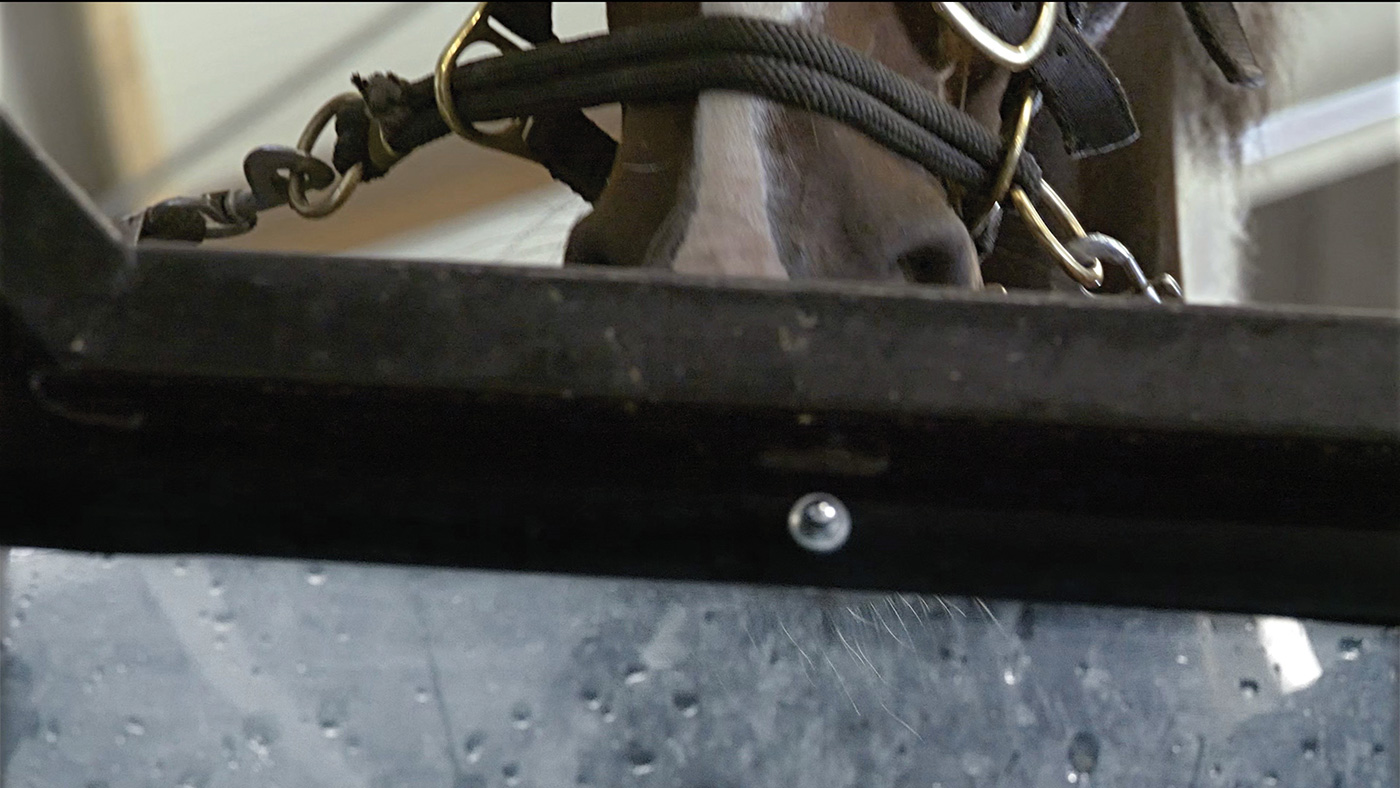
Bea De Visser
The Sonic Gaze
Multimedia installation | 4k | color | 6:10 | Netherlands | 2025
A horse is placed in an enclosed space on an aqua trainer treadmill, doubly enclosed by only the sound of splashing water. We hear much more than we see due to the recorded frequencies and the ambient range of the horse's hearing. Through pitch compression, specialized recording equipment and sound recordings far from the set, the horse's auditory experience has been made audible to humans. Its result is an acoustic representation of the animal's subjective perspective. Through the horse's sonic filter, we hear a different world, yet equally real, than the one we see on screen. While we watch with our human gaze, we hear the horse's complex sonic reality.
Bea de Visser is known for her film art, installation work and sound performances. Her work can best be described as a digital media-based practice -from the perspective of a painter and storyteller who sees the world through different lenses. AnimaIs are a recurring motif in her work. Her latest works focus on non-anthropocentric storytelling. She mixes fiction with the everyday and emphasizes structures of power, dominance and control. Her work seduces the viewer through a rich audiovisual language, exploratory in its narrative. Bea de Visser comes from a background of painting and a study electro acoustic sound. She initially began her career as a sound and performance artist in the trendy club scene and artist’s spaces, early 1980-ies. Bea de Visser attended the Rijksakademie van Beeldende Kunsten in Amsterdam (1993-1995).
Eginhartz Kanter : Misdirected Impulse - Experimental film | 16mm | color | 2:50 | Germany, Austria | 2025
Eginhartz Kanter
misdirected impulse
Experimental film | 16mm | color | 2:50 | Germany, Austria | 2025
Misdirected Impulse shows deserted natural and park landscapes in long, static shots. Picturesque arrangements of trees and bushes unfold quietly, until the sudden appearance of a smoking light ruptures the calm. The following staccato of short shots, in which the light is directed equally at the camera and the viewer, is an attack on gaze and perspective, dissolving romanticized notions of nature.
Eginhartz Kanter (*1984, Leipzig) studied Fine Arts, Cultural Studies and Photography at the University of Arts and Design Linz, the Academy of Fine Arts Vienna and the E?cole Nationale Superieure des Beaux-Arts in Lyon. In his artistic approach he questions the boundaries and conventions of everyday life and living environments. His (sub)urban interventions negotiate aspects of the public and often have a direct relation to architecture. Previous films: Conveyor (2025); Prelude (2022); Taking Away (2018); Aufstieg (2016); Transient II (2013) Downloads
Sonia Levy : We Marry You, O Sea, As A Sign Of True And Perpetual Dominion - Experimental doc. | 4k | color | 19:28 | United Kingdom, France | 2025
Sonia Levy
We Marry You, O Sea, as a Sign of True and Perpetual Dominion
Experimental doc. | 4k | color | 19:28 | United Kingdom, France | 2025
We Marry You, O Sea engages with Venice and its lagoon “from below,” with the aim of focusing attention on the city’s submerged, life-giving, and altered bio-geomorphological processes rather than on its often-recounted political and military histories. Underwater filmmaking opens new ways of knowing the materialities of the Venice Lagoon and exposes a fractured and troubled environment that complicates mainstream historical narratives that start above the water’s surface. By attuning to the ebb and flood of the lagoon, we start sensing the interplay between land and water, life and decay, and the intimate processes shaping this environment. Noticing the kinds of life made possible in this damaged watery space compels us to delve into the ways it has been profoundly transformed. We Marry You O Sea as a Sign of True and Perpetual Dominion takes its title from the words uttered during the Venetian ritual The Marriage of the Sea, which was held annually on Ascension Day between the eleventh and eighteenth century. During the event, the Doge, the patriarch of the Venetian Republic, would wed the lagoon by casting a golden ring into the water, declaring dominance over the sea. The artist reframes Venice’s enduring relationship with its permeating waters by reflecting on this ongoing legacy of quests for mastery over watery environments. How, this work asks, might we imagine different futures for Venice if we begin to experience the lagoon as a lively place populated by manifold ways of living and dying? In the lagoon, a space requiring continuous modifications for human settlement, wetlands and infrastructures have long been intertwined. Venice’s consolidation as a trading hub and epicenter of naval advancement during the Middle Ages prompted major hydrological engineering to maintain the lagoon’s shallow depths for defense purposes. However, in the twentieth century, harrowing modernization transformed parts of the wetland into petroleum refineries and one of Italy’s largest container terminals as part of an effort to turn the lagoon into an industrial frontier. Urban anthropologist Clara Zanardi has described how these transformations spatialized class divisions in a new way, while also causing irreversible ecological degradation that has profoundly altered the lagoon’s lifeways. The film presents these histories of modernization by interweaving rare historical photographs from Venice’s Giacomelli Photographic Archive with submerged perspectives of the present conditions of the lagoon. The historical significance of these photographs is emphasized by the negative black-and-white reversal of the submerged perspectives, connecting past and present and unfolding futures within the lagoon’s contaminated waters. An original score, created by a chorus of human voices and underwater sound recordings, further emphasizes the links between submerged spaces and human domains. The composition captures the lagoon’s pulses and the impact of industries—from aquatic sounds drowned out by boat noises to the rhythmic poundings of industrial activity amid surging tides—as it gestures toward the profound interplay between human activities and the lagoon’s shallows.
Sonia Levy is an artist filmmaker with a Berber-Polish background. Her work, marked by site-specific and interdisciplinary inquiries, delves into the implications of Western expansionist and extractive logics, exploring how these forces manifest in the transformation and governance of hydrosocial worlds. Her practice aims to probe the thresholds that have shaped and influenced the conditions necessary for life to flourish.
Martí Madaula : Tramuntana - Experimental film | dcp | black and white | 18:27 | Spain | 2025
Martí Madaula
Tramuntana
Experimental film | dcp | black and white | 18:27 | Spain | 2025
In a remote area of northern Spain, the wind has a name: Tramuntana. Tramuntana takes what it wants—clothes, trees, boats, and the people of the landscape who live with the endless threat of being carried away by its force. This film is a lyrical portrait of this furious wind, woven from the stories passed down by local villagers.
Martí Madaula is an artist and filmmaker based in Madrid. He holds a degree in Fine Arts from the University of Barcelona, a Master of Visual Arts from the LUCA School of Arts of Ghent (Belgium) and a Master of Fine Arts in Film, Video, New Media, and Animation from the School of the Art Institute of Chicago. In 2019, he received the Extraordinary Prize of Fine Arts (University of Barcelona). In 2021, he was awarded a prestigious “la Caixa” Foundation fellowship to pursue his studies in the United States. Madaula’s latest film, “Tramuntana,” had its World Premiere at the Museum of Modern Art (MoMA) in New York, as part of Doc Fortnight 2025, MoMA’s prestigious Festival of International Nonfiction Film and Media. His first film, “The Living Wardrobe,” had its World Premiere at the Opening Scenes section at Visions du Réel 2024, one of the most important documentary and nonfiction film festivals in the world. Madaula has participated in art residencies at prestigious institutions like Centre Pompidou in Paris or Haus der Kulturen der Welt in Berlin. He has exhibited his work in international solo and group shows.
Léonard Pongo : Tales From The Source - Experimental video | mov | color | 38:19 | Belgium, Congo (RDC) | 2024
Léonard Pongo
Tales From The Source
Experimental video | mov | color | 38:19 | Belgium, Congo (RDC) | 2024
Tales from the Source offers a gaze on the landscapes of the Democratic Republic of Congo to translate a sense of its unfathomable power, diversity and knowledge. The scenery is presented as a character acting as a living entity and inhabited by the symbolism of Congolese traditions. The visual approach borrows techniques from multispectral imaging, resulting in an otherworldly experience with surreal lights and colour. Combined with an original musical composition by Bear Bones, Lay Low, we enter into a sensory dialogue with the landscape, an intelligent, ageless being in constant transformation that challenges our perception.
Léonard Pongo (b. 1988, Liège, Belgium) is a visual artist and filmmaker who lives and works between Belgium and the Democratic Republic of Congo. Pongo's work explores the complexities of perception, and representation while challenging conventional portrayals of the DRC with a focus on traditional narratives and symbols, and their connection to the land. Initially trained as a photojournalist, Pongo's artistic journey began in 2011 when he traveled to the DRC to cover the presidential elections. This experience profoundly transformed his approach to photography, shifting from objective documentation to a more subjective and experiential mode of expression. His family and local communities challenged his initial perspective, encouraging him to develop a more nuanced and intimate portrayal of Congolese life. Pongo is renowned for his mixed-media installations that integrate textiles, photography, diverse printing techniques, and moving images. His work draws deeply from Congolese cosmologies and oral traditions, particularly embracing the concept that "not everything is visible." Using specialized techniques including full-spectrum photography that captures wavelengths beyond human vision, he reveals aspects of landscapes and experiences typically hidden from view. His long-term project "The Uncanny" (2011-2017) explores daily life in the DRC through evocative black-and-white imagery that creates a dreamlike atmosphere, while "Primordial Earth" (2017-ongoing) focuses on the land using color photography, textiles, and video installations to evoke a sense of spirituality and interconnectedness. His latest film, "Tales from the Source" (2021-2024), extends his focus on traditional narratives, focusing on the luba cultures and highlighting the intertwined nature of culture and environment. Pongo's collaborative approach involves working closely with communities across the DRC, drawing inspiration from their knowledge, stories, and traditions and creating visuals that align with the lineage of Luba traditions by creating contemporary forms connected to ancestral concepts and visions. His work has been exhibited internationally at prestigious venues including the Bozar Centre for Fine Arts in Brussels, the Tate Modern in London, the Dakar biennale in Senegal, and the Nasher Museum of Art at Duke University. In 2023, his first monograph "The Uncanny" was published by Gostbooks, and in 2025 he was selected as one of ArtReview's "Future Greats" by photographer Roger Ballen.

Bea De Visser films a horse in the enclosed environment of an aquatic training device and lets us hear what the horse hears. Eginhartz Kanter takes us on a journey through landscapes and challenges naturalistic and romantic representations of nature. Sonia Levy explores the Venice lagoon, which was kept shallow in the Middle Ages for defensive reasons and then transformed into an industrial frontier. Martí Madaula portrays the ‘Tramuntana’, a violent wind whose force is evident in the landscape: it bends tree trunks and erodes the vegetation that dares to grow under its influence. Arjuna Neuman films a landscape from which emerges an invocation of freedom. Léonard Pongo engages in a visual dialogue with the land of the Democratic Republic of Congo and its ancestral narratives, the landscape becoming a living entity, inhabited by the symbolism of traditions.
Screening
silent green Kulturquartier | Betonhalle | Cinema 2
Gerichtstrasse 35, 13347 Berlin / Subway: Wedding station, U-Bahn line U6 / S-Bahn lines S41, S42, S46
Free admission within the limit of available seats. You of course can come if you didn't book!
"The Spirits"
Zhu Renjie : Fare Thee Well - Fiction | mp4 | color | 25:0 | China | 2024
Zhu Renjie
Fare Thee Well
Fiction | mp4 | color | 25:0 | China | 2024
Under the butterfly effect triggered by the second wave of reform and opening up of China, a small family found itself caught in a continuous hurricane in life. Many years later, Yang Xiaolong received four letters from his long-unseen father. As a result, the textual clue of "country grows and family broke " unlocked the suppressed childhood memories within him...
Renjie ZHU, director and cinematographer, born in 1992, has lived in the ancient city of Anyang and the metropolis of Shenzhen due to family reasons since childhood. He currently resides in Hangzhou. He graduated from the China Academy of Art with both his bachelor's and master's degrees, and is currently pursuing a doctorate in film creation at the same institution. His work has won the New Wings Promotion Award in Golden Rooster Youth Short Film Season, and won the Qilin Outstanding short film in In Moment Film Festival, and has been selected for the Beijing International Short Film Festival and Light My Fire Youth Film Festival and so on.
Mauricio Saenz : Niño Halcon Duerme Entre Visiones De Un Incendio - Experimental fiction | 4k | color | 18:0 | Mexico | 2024
Mauricio Saenz
Niño halcon duerme entre visiones de un incendio
Experimental fiction | 4k | color | 18:0 | Mexico | 2024
Kamikaze bird that has embarked on a journey to a savage place of no return. A representation of the state of overflowing violence brought from drug trafficking through the oneiric vision of a marginal teenager recruited by a cartel.
Mauricio Sáenz (b. 1977, Matamoros, Mexico) is a visual artist with a practice spanning installation, sculpture, and video. His work explores the limits of impossibility as an active drive for transformation represented through notions as isolation, confinement, uncertainty and historical memory. He received a master’s degree from the Polytechnic University of Valencia in Spain and has displayed his work at the Museo de Arte Carrillo Gil and Foto Museo Cuatro Caminos in Mexico City, Galerie Art Virus in Frankfurt, and Jonathan Ferrara Gallery in New Orleans, as well as in video art festivals such as Proyector and MADATAC in Spain, Traverse and Instants Vidéo in France, and FIVA in Argentina, among others.
Helena GirÓn VÁzquez, Samuel M. Delgado : Un Dragón De Cien Cabezas - Experimental doc. | 16mm | color | 14:50 | Spain | 2025
Helena GirÓn VÁzquez, Samuel M. Delgado
Un dragón de cien cabezas
Experimental doc. | 16mm | color | 14:50 | Spain | 2025
In the Garden of Hesperides, a fruit, capable of granting immortality to whoever ate it, once grew. This garden, located somewhere off the coast of West Africa, was guarded by a dragon with one hundred heads. Through the use of bio-sonification of banana trees, a monoculture crop in the Canary Islands, we discover a tale of eternal life where this mythical garden used to exist.
Their work investigates the relationship between mythology, history and materialism. Their first feature film, Eles transportan a morte (2021), premiered at the Venice and San Sebastian festivals winning awards at both. It has subsequently been shown at international festivals such as Rotterdam, Cairo, Mar del Plata, Viennale, Hamburg and Sao Paulo. Their short films have been shown at festivals like Toronto, Locarno, New York, Ann Arbor and many others. They have made installations and performances in art centers like CCCB (Barcelona), BAM (New York), TEA (Tenerife) or Solar (Vila do Conde).
Wey Yinn Teo : Latex Labyrinth - Experimental video | mov | black and white | 12:38 | Malaysia | 2025
Wey Yinn Teo
latex labyrinth
Experimental video | mov | black and white | 12:38 | Malaysia | 2025
An old man awakens in a deforested rubber estate and finds himself in the colonial past. A distant old folk song ripples as he falls into the eternal loop of rubber tapping.
Wey Yinn Teo is a Kuala Lumpur based filmmaker. Her works often drift away from realms of reality and truth, exploring grief, alienation and the spectrum of the human experience. Aside from her work in sound and music, Yinn’s debut short ‘Enflightenment’ (2023) won the Audience Award in the Short Waves Festival in Poland, and has continued to screen in festivals including Leiden Shorts, EXPOSED Queer Film Festival Berlin and more. 'Latex Labyrinth' has recently internationally premiered at the Ji.hlava IDFF and won 'Best Dance Video' at Eye Catcher Global 2025, Hong Kong.
Carlos Pereira : Unruhe - Experimental film | 16mm | color | 11:50 | Portugal, Germany | 2024
Carlos Pereira
Unruhe
Experimental film | 16mm | color | 11:50 | Portugal, Germany | 2024
"There’s been a strange epidemic lately Going amongst the folk, So that many in their madness Began dancing. Which they kept up day and night, Without interruption, Until they fell unconscious. Many have died of it."
Carlos Pereira, born in Lisbon, is studying Film Directing at the Deutsche Film- und Fernsehakademie Berlin (DFFB). His films have been screened at festivals such as Locarno, San Sebastián and Rencontres Internationales Paris/Berlin. His film Slimane (2023) won the German Film Critics Award for Best Short Film. His first feature film, Remote Islands, written during a residency at The Bergman Estate on Fårö, is currently in pre-production.
Adam James Smith : Phantoms Of The Rising Sun - Experimental doc. | mov | color | 8:20 | United Kingdom, Japan | 2025
Adam James Smith
Phantoms Of The Rising Sun
Experimental doc. | mov | color | 8:20 | United Kingdom, Japan | 2025
The abandoned spaces of a Wild West theme-park, a love hotel, and a billionaire's mansion are brought to life with plant overgrowth and animals, late-summer rain, and the haunting remnants of past human habitation.
Adam James Smith is a British-American filmmaker based in New York. His filmmaking practice spans rural and urban environments across China, Japan, and the United States. Adam was educated in film at Stanford and anthropology at Cambridge, the latter of which he is currently affiliated with the university’s Visual Anthropology Lab.

Linking time and space, Zhu Renjie follows a man through his childhood memories. Through the dreamlike vision of a marginalised teenager recruited by a cartel, Mauricio Saenz offers a representation of the violence created by drug trafficking in Mexico. In a banana plantation in the Canary Islands, transposed into the mythical garden of the Hesperides guarded by a hundred-headed dragon, Helena Girón Vazquez and Samuel M. Delgado discover a tale of eternal life. In Malaysia, on a rubber tree plantation, Wey Yinn Teo films a man plunged back into a colonial past and evokes the invisible scars of labour. Carlos Pereira draws inspiration from the dancing epidemic of 1518 in Strasbourg, where people danced until they died of exhaustion. Adam James Smith films the abandoned spaces of a theme park. Western, Love Hotel and billionaire's mansion come to life thanks to invasive vegetation and the haunted remains of past occupations.
Screening
silent green Kulturquartier | Betonhalle | Appendix
Gerichtstrasse 35, 13347 Berlin / Subway: Wedding station, U-Bahn line U6 / S-Bahn lines S41, S42, S46
Free admission within the limit of available seats. Without booking
Each day, two screenings are offered in dedicated screening spaces throughout the day. On Friday 5 June, these sessions take place at 6pm, 7.30pm, 9pm and 10.30pm.
"Absence"
Yosr Ben Messaoud : Envol - Video | hdv | color | 4:12 | Tunisia, France | 2024
Yosr Ben Messaoud
Envol
Video | hdv | color | 4:12 | Tunisia, France | 2024
In the dim light, the hand emerges like a fragment of presence, suspended between appearance and disappearance. It becomes a sensitive territory, brushed by a silent intimacy, unfolding like an open landscape, a place that welcomes what passes through without ever fully allowing itself to be grasped. The video then becomes a space of slowing down, where the gaze encounters a partial yet inhabited presence, crossed by a world in motion.
Yosr Ben Messaoud is a visual artist working between France and Tunisia. She is currently studying at the École des Beaux-Arts de Paris, after completing a degree in contemporary art and the humanities at the University of Vincennes. Her work includes video, photography, drawing, and installations, as well as hybrid forms that move between these different modes of expression. The variety of operative forms conveys an aesthetics of openness and suspension, where one is called upon to become a bridge, to welcome alterity in order to allow a new form of communion to emerge. In her practice, she examines questions related to the displacement of narratives and their survival, beginning from the intimate, through the creation of dispositifs conceived both as systems of reception, containers of experience, and circuits of narration—structures that become inhabited by what surrounds them. The axes shift incessantly between lived experience and affective facts, collected images and those that persist, the intimate and the collective voice, in order to reflect on the human condition—understood not as humanity at the centre of the world, but as part of its sensitive order, material, and social
Sina Khani : Watch With The Weary Ones - Experimental doc. | 4k | color | 7:29 | Iran | 2025
Sina Khani
Watch With the Weary Ones
Experimental doc. | 4k | color | 7:29 | Iran | 2025
Watch with the Weary Ones is a short documentary that looks at the American urban landscape while the filmmaker quietly drifts back to memories of Iran. It places the surfaces of U.S. cities next to the feelings of someone living far from home, caught between two places. The film reflects on the sorrow carried by those who left Iran searching for another life, and those who stayed and continue to fight for theirs. It’s about holding two worlds at once, the one in front of you and the one that never leaves you, and trying to make sense of that weight
Sina Khani (aka Sina Ahmadkhani) is a Tehran-born, Los Angeles–based filmmaker, writer, and editor. His feature debut won Best International Experimental Feature at the Portoviejo Film Festival and earned awards, nominations, and selections at Regina IFF, Toronto International Nollywood FF, New York City Indie FF, and many other international festivals. He recently completed his MFA at Virginia Commonwealth University and continues to create bold, character-driven stories.
Samy Benammar, Mohamad Awad : Adieu Ugarit - Documentary | 16mm | black and white | 15:45 | Canada | 2024
Samy Benammar, Mohamad Awad
Adieu Ugarit
Documentary | 16mm | black and white | 15:45 | Canada | 2024
In 2012, Mohamed had seen his best friend shot dead by an armed militia on the outskirts of Damascus, Syria; the blood spilled in the lake contaminated his memory. Ten years on, the reflections on the Laurentian waters revive Mohamed's trauma. I ask him if he'd like to dredge up the memories, repair the pain by retreating for a few days to the most distressing calm he can find. He talks about death, immigration and anger. We wonder how and why we should recount this story.
Samy Benammar is a filmmaker, photographer, and art critic based between Montreal and Marseille. Drawing from his Algerian roots and working-class upbringing, his work blends a reflective documentary approach with tactile experimentation. He seeks a form of visual reconciliation while underscoring the irreparable fractures left by fantasies of the past. Often hovering on the edge of disappearance, his images explore the tension between physical and imagined space, between memory, identity, and stone. He has served on the editorial boards of Hors Champ, 24 images, and Panorama-cinéma, and is currently pursuing a PhD on colonial photography in the Aurès region of Algeria.
Mariam Ghani : There's A Hole In The World Where You Used To Be - Video | 35mm | color and b&w | 15:31 | USA, Afghanistan | 2025
Mariam Ghani
There's a Hole in the World Where You Used to Be
Video | 35mm | color and b&w | 15:31 | USA, Afghanistan | 2025
THERE'S A HOLE IN THE WORLD WHERE YOU USED TO BE is a short film about memory and mourning. It departs from the premise that both grief and black holes are so dense and intense that they bend space and time around their specific gravity - each absence both a wound in the heart and a hole in the world.
Mariam Ghani is an artist and filmmaker. Her films, public projects, and installations have been presented worldwide, notably in Times Square and LaGuardia Airport; the Tate Modern, Guggenheim, MoMA, Smithsonian, Secession, CCCB, and Metropolitan Museums; Documenta 13 and the Liverpool, Lahore, Yinchuan, and Sharjah Biennials; the Berlinale, Rotterdam, CPH:DOX, SFFILM, DOC NYC, Jih.lava, BlackStar, and Ann Arbor film festivals; theatrically and streaming on Ovid, Criterion and Docuseek.
Taiki Sakpisit : The Spirit Level - Experimental video | 4k | color and b&w | 20:30 | Thailand | 2024
Taiki Sakpisit
The Spirit Level
Experimental video | 4k | color and b&w | 20:30 | Thailand | 2024
The Spirit Level meditates on the trauma and violence in the troubled Thailand reflected through the artist’s road trips across the northeastern region of Thailand along the Mekong River. The film begins with a downstream river that descends from Than Thong waterfall and flows into the Mekong River and explores the mythic underground cave that according to legend was a subterranean kingdom below the Mekong River where the divine Naga resides in the netherworld. At the heart of The Spirit Level is a frantic sequence of a spirit medium in the midst of possession. This epileptic episode emulates the optic feedback eliciting the trancelike revenant images as the spirited entity registers the medium’s body. Gradually the hallucinatory double images are disrupted by a freeze frame. This suspension of time occurs to commemorate the dislocated spirits of the three anti-government activists whose mutilated bodies were found in Mekong River in December 2019. The three men had been in exile since the 2014 coup d'état, until they were kidnapped by an officially sanctioned death squad. Their bodies were found handcuffed, disemboweled and stuffed with concrete blocks, wrapped in brown rice sacks and dumped into the Mekong River. It is one of countless forced disappearances and assassinations of political dissidents by the state since the 1970s and still ongoing and unresolved. The Spirit Level alludes to the undercurrents of darkness that ripple beneath the surface of problematic Thailand.
Taiki Sakpisit (???? ?????????????) is a filmmaker and visual artist based in Bangkok, renowned for his innovative approach to storytelling and his profound exploration of Thailand’s complex history. Through the lens of cinema, Sakpisit unpacks the nation's turbulent past, infusing his experimental films with a subtle yet resounding political commitment. His works delve into the underlying tensions, conflicts, and anticipations of contemporary Thailand, meticulously crafted through precise and sensorially overwhelming audio-visual assemblage. Utilizing a diverse array of sounds and images, Sakpisit creates immersive experiences that challenge conventional narratives and provoke thought. His feature-length film The Edge of Daybreak won the FIPRESCI award at the International Film Festival Rotterdam for its for its “Mysterious atmosphere and rich imagery in depicting trauma and violence, for its capacity of dealing with 40 years of political turmoil through a powerful and hypnotic cinematic journey, and for its compromise with the past in order to confront the present and the next future.” His recent works have been showcased at the 14th Gwangju Biennale, the Museum of Contemporary Art Busan, the 2024 Bangkok Art Biennale, the 14th Mercosul Biennial and Thailand Biennale.
Haythem Zakaria : Interstices Op.iii - Experimental video | 4k | black and white | 23:5 | Tunisia | 2024
Haythem Zakaria
Interstices Op.III
Experimental video | 4k | black and white | 23:5 | Tunisia | 2024
Opus III explores the landscape of the Atlas Mountains as both a physical territory and a symbolic topos. Filmed between Tunisia and Morocco, the work expands the research initiated in Opus I and II by confronting the visible landscape with its mythological echoes. The piece considers the Atlas not only as a geographical massif but as an archetypal figure shaped by recurring narratives, beliefs and collective memories. Through a slow and contemplative visual language, Opus III becomes a passage between the material presence of the mountains and the intangible layers of meaning that inhabit them. The work invites the viewer to shift perspective and enter a space where landscape, myth and perception intertwine.
Haythem Zakaria is a transdisciplinary artist and sound performer born in 1983 in Tunisia and based in France. Working across video, installation, photography, drawing and sound, he explores how landscapes, myths and forms of memory shape perception, and how the visible can open onto more elusive dimensions of experience. His practice is grounded in field research, slow temporalities and a refined attention to the resonance of places. Since 2010, his work has been presented internationally in major exhibitions, biennials and independent art spaces across Europe, North Africa, the Middle East, Asia and North America, including documenta 15, the Venice Biennale, the Japan Media Arts Festival, Cairotronica, Dream City, Kunstraum Kreuzberg/Bethanien, Casa Árabe and numerous institutions in Paris, London, Berlin, Beijing, Rabat, Tokyo and San Francisco. Recipient of the Grand Prize at the Japan Media Arts Festival for Interstices, Zakaria continues to develop research-based projects where image, sound and matter intersect, forming a space of inquiry into archetypes, memory and the thresholds between the visible and the unseen.

Yosr Ben Messaoud scrutinises familiar spaces that seem haunted by disappearance. Sina Ahmadkhani explores an American urban landscape, reflecting on her native country, grappling with the weight of grief and responsibility linked to the collective anguish that has affected Iranians. Samy Benammar follows the story of Mohamad, who in 2012 saw his best friend shot dead by a militia near a lake in the suburbs of Damascus, Syria. The spilled blood contaminated his memory. Ten years later, in Canada, reflections on a lake rekindle the trauma. Mariam Ghani questions memory and mourning, starting from the premise that grief, like black holes, is so dense that it bends space and time around its specific gravity—each absence being both a wound in the heart and a hole in the world. Taiki Sakpisit explores a mythical underground cave on the banks of the Mekong River, which, according to legend, was an underground kingdom where the divine Naga resided in the underworld. There he meets a shaman who seems possessed by the spirits of dissidents who died violent deaths. Haythem Zakaria explores the landscape of the Atlas Mountains, both as a place and as a subject.
"Trembling Houses"
Pierre-jean Giloux : Biomimetic Stories # 3. Dholera - Experimental fiction | 4k | color | 7:0 | France | 2024
Pierre-jean Giloux
Biomimetic Stories # 3. Dholera
Experimental fiction | 4k | color | 7:0 | France | 2024
Dholera reveals the dystopian vision of this eponymous city, envisioned in the desert-like landscape of the Indian state of Gujarat. The city’s vast network of highways, elevated railways, electric pylons and water towers extend as far as the eye can see on an arid terrain devoid of vegetation, swept through by dust whirlwinds. This vast urban project— for which ground was broken over a decade ago—has now come to a virtual standstill. In-situ footage captured via drone reveals the enormity of this unfinished project through the virtual implantation of certain symbolic buildings featured in the initial project, through the use of point clouds. The ghost of Dholera city is brought forth through the film; a phantom construction site where future ruins create cracks in the very idea of utopia.
Pierre Jean Giloux, born in 1965, was awarded the Villa Kujoyama residency in Kyoto in 2015 and received the Grand Prix for Video Art at the Côté Court Festival in Pantin in 2016. Working in a form of augmented reality, he presents his installations in museums and art centres such as the Museum of Botany in Brussels, La Criée – Centre for Contemporary Art in Rennes, the Barbican in London, the Hiroshima MoMA and the National Museum of Osaka in Japan, as well as in galleries including DNA (Berlin), Sophie Scheidecker and Christophe Gaillard (Paris), Cristina Guerra (Lisbon) and Bank MABsociety (Shanghai). His works are held in private collections (in Paris, Rennes, Brussels and Tokyo, as well as the Pierre Darier Collection in Switzerland and the An-Sammlung in Munich) and in public collections (Fonds d’art contemporain – Paris Collection and the City of Marseille).
Thomas Leon : To Ashes - Video | 4k | color | 5:6 | France | 2025
Thomas Leon
To Ashes
Video | 4k | color | 5:6 | France | 2025
To Ashes explores the thresholds between reality and machinic hallucination, questioning contemporary image-generation technologies — particularly artificial intelligence — and their influence on our perception of the real. Created through a hybrid process combining 3D modeling and AI-based generation tools, the video unfolds as a continuous tracking shot through a brutalist megastructure in constant transformation. Architectural forms disintegrate and transform, while ash-like particles rise into the air. This disintegration is accompanied by an experimental soundscape, where analog synthesizers and transformed voices evoke a latent collapse. Gradually, the architecture gives way to unstable crystalline structures. Reality wavers. In the end, something gives way, shifts, disappears. Everything must burn.
Thomas Léon develops his practice by merging cinema, graphic arts and images from new technologies. He creates films, immersive video and sound installations, as well as large-format drawings. His work explores the interconnections between memory, sensuality, intimate experiences, and the imaginary, drawing on fictions, whether they be social, urban, climatic, etc. He is notably influenced by science fiction and utopian literature and frequently develops his projects using contemporary image creation tools (3D modeling, AI, etc.). He regularly participates in screenings or exhibitions in France and abroad: 'Listening to Transparency' at the Minsheng Art Museum in Shanghai (China, 2017), 'Cruces Sonoros: Mundos Posibles' at the MAC in Santiago de Chile (Chile, 2016), 'Rendez-vous 11' at the Institute of Contemporary Art in Villeurbanne (France, 2011), and at the South African National Gallery in Cape Town (South Africa, 2012). He notably took part in residencies : Drawing Factory organized by CNAP (National Center for Visual Arts) and the Drawing Lab (Paris) in 2021 ; a residency in Taiwan, organized by Grame, the National Center for Musical Creation (Lyon), and the Digital Art Center (Taipei) in 2011. His works can be found in the collections of CNAP (National Center for Visual Arts) and the Louis Vuitton Foundation. Thomas Léon lives and works in Montreuil.
Liliia Filina : Inner Immigration - Experimental film | 35mm | color | 3:36 | Russia | 2025
Liliia Filina
INNER IMMIGRATION
Experimental film | 35mm | color | 3:36 | Russia | 2025
In a nameless Eastern European city, few young people, finds themself trapped between silent resistance and passive complicity as their country descends into war. The city’s streets, once familiar, become a landscape of fear. Shot in stark, observational style, Inner emigration is a haunting portrait of a generation suspended in stillness, forced to navigate a crumbling reality that no longer offers clear choices.
Lily Filina is an artist and director, born in Kaluga, Russia, 1999. A graduate of the Rodchenko Art School, class of Sergei Bratkov, she works as an advertising director and develops independent projects at the intersection of cinema and video art. In 2024, Liliya's film participated in the program of the Rotterdam Film Festival. In 2024, Liliya's project "Internal Emigration” was supported by the Yandex360 program.
Melanie Manchot : Line Of Sight (the Tower) - Video | 4k | color | 12:7 | Germany, Switzerland | 2025
Melanie Manchot
Line Of Sight (The Tower)
Video | 4k | color | 12:7 | Germany, Switzerland | 2025
Filmed in a decommissioned telecommunications tower, which used to house secret military equipment, this work returns to my ongoing investigation of mountains and their architectures as spaces of human-nature entanglements. It also returns more specifically to the alpine village of Engelberg, where I have been making work since 2010. In Line of Sight the camera investigates a deserted structure, a space left behind. As if everyone had vacated in mid-action, the environments bear traces of past life, long gone. Both inside and out, the camera observes this perplexing architecture in long panning and tracking shots, culminating in a moment of flight that reveals the structure – as if floating in space. When it was in operation, the tower fulfilled a host of functions, amongst them serving as a space of refuge and shelter during storms. A room full of old mattresses bears witness to such moments of danger. The title ‘Line of Sight’ refers to these towers standing atop mountain peaks with sight of each other, facilitating older forms of communication. With the advances of technology, these towers are now dinosaurs, standing solitary and defunct and as such become symbols of endurance, resistance and older forms of exchange. In 2025, this tower is being reshaped into a space for “mountain entertainment” – acerbating the dichotomy of mountain industries continually expanding footfall onto summits and glacier, hence contributing to the speed of climate change.
London-based visual artist and filmmaker Melanie Manchot employs photography, film, video and sound to form sustained enquiries into our individual and collective identities. The work interrogates and employs acts of care, resistance and communality to engage in discourses on social and political urgencies of our societies. Her films investigate innovative forms of storytelling with an acute understanding of the power of filmmaking to speak to urgent issues and have profound impact. Location-based research informs all her films and mountainous landscapes are a recurrent theme to address fragile environments in our care. Manchot’s artwork has featured in museum and gallery exhibitions internationally and she is currently working towards a large solo show in the UK in early 2026. Her first feature film, STEPHEN, commissioned by Liverpool Biennial, addresses gambling, substance misuse, recovery and mental health through both narrative fiction and documentary. It had its cinematic release through Modern Film in 2024 and continues to be shown in exhibitions as a multi-channel installation. Manchot is currently working towards her second film, Self Storage, with another feature, a fiction/doc hybrid, called One Day As A Tiger, in development.
Susanna Wallin : Lizzy - Experimental doc. | 4k | color | 15:0 | Sweden, USA | 2024
Susanna Wallin
Lizzy
Experimental doc. | 4k | color | 15:0 | Sweden, USA | 2024
Lizzy is the result of the days spent in the aftermath of the death of a neighbour, who passed in the house where she had lived out her whole life on the Hillsborough River in Tampa, Florida and who left behind an electric organ addressed to the filmmaker, without a note. To receive it was like a wild riddle.How might one story continue in the hands of another? What powers organize the telling? Through weaving indoors with outdoors, dust with swamp, celebration with critique, the film traverses binary notions such as self-world, truth-fiction, witnessing-imagining and nature-experience among others.
Susanna Wallin is an artist and filmmaker engaged in questions regarding what to do with our time, our bodies and the tools we are given to live a life. She probes subject matter across diverse contexts, modalities and timescales, often immersing herself in a particular place over extended periods. She is attentive to what emerges in hesitation, together, through experimentation and open ended, lending an ear to the unspoken with fiction as practice. Born and raised in Sweden, she studied filmmaking and art practice/theory at Goldsmiths College and University of the Arts London in the UK. She has been the recipient of numerous awards including The Flamin London Artist Film and Video Award, New Approaches, Film London UK, Pure Fiction, Sweden and commissions from the UK Film Council, Channel 4, BBC, Arts Council England, Arte France/Germany, SVT, Sweden and the BFI in the UK. Her award-winning films are shown in cinema and gallery contexts and have appeared in venues such as MOCA LA, The American Cinematheque, The Barbican, Whitechapel Gallery, The London Underground, ICA and the British Film Institute. In recent years, Wallin has been developing several feature length film projects, one of which is set in Florida and now in post production. She is part of the Research School at University of the Arts London in the UK completing a PhD through practice and is Assistant Professor of Film and Video at University of South Florida in the US. She lives and works between Tampa and London.
Niklas Buescher : Center - Experimental fiction | 16mm | color | 20:0 | Germany | 2024
Niklas Buescher
Center
Experimental fiction | 16mm | color | 20:0 | Germany | 2024
A day at the Sony Center complex in Berlin. Two people meet in a chiropractor’s waiting room. They are both tired. Meanwhile, the building is under permanent construction.
Niklas Buescher studied fine arts at the Gerrit Rietveld Academie in Amsterdam. He graduated in 2019 with his first short film. In 2021, he began studying directing at the German Film and Television Academy in Berlin. Since then, he has made several fictional short films, each portraying a different site of the city.
Gerard & Kelly : E For Eileen - Fiction | 4k | color | 23:35 | USA, France | 2024
Gerard & Kelly
E for Eileen
Fiction | 4k | color | 23:35 | USA, France | 2024
An enigmatic character spends her last day in the house she designed and built. Her solitude is interrupted by the arrival of old friends who threaten to drown her in the past. A speculative fiction, E for Eileen is shot entirely at Eileen Gray’s villa E-1027 — one of three French national monuments of the modern era, and the only one built by a woman.
Gerard & Kelly are visual artists and filmmakers whose interdisciplinary practice spans film, performance, and installation, incorporating choreography, writing, printmaking, drawing, and sculpture. Based in Paris since 2018, they are known for conceptually rigorous and research-based projects that address questions of memory and history, sexuality and the formation of subjectivity. Gerard & Kelly have collaborated since the early 2000s to develop a distinctive body of work that situates movement, narrative, and critical theory in direct conversation with architecture and site. Their projects often unfold in iconic modernist spaces and have been presented by leading institutions across Europe and the United States. Hailing from the farms of Ohio and the coal country of Pennsylvania, Brennan Gerard and Ryan Kelly met in New York and launched a collaboration that led them to the Whitney Museum Independent Study Program, where they were Van Lier Fellows from 2009-2010, and then to the University of California, Los Angeles (UCLA), where they earned their MFAs in 2013 from the Interdisciplinary Studio under the direction of artist Mary Kelly. Ruins, their first solo show in a European institution, was presented by the Carré d’Art – Musée d’art contemporain de Nîmes in 2022–2023. Solo exhibitions and performances of their work have been presented by Marian Goodman Gallery, Paris (2025), Fondation Maeght, Saint-Paul de Vence (2024), Centre Pompidou, Paris (2023), Marian Goodman Gallery, New York (2022), MAMCO, Geneva (2020), MOCA, Los Angeles (2020), Festival d’Automne, Paris (2017 and 2019), The Getty Museum, Los Angeles (2019), Pioneer Works, New York (2018), Palais de Tokyo, Paris (2016), New Museum, New York (2014), and The Kitchen, New York (2014). They participated in the 2023 NGV Triennial at the National Gallery of Victoria, Melbourne, the 2023 and 2017 Chicago Architecture Biennials, and the 2014 Made in L.A. Biennial at the Hammer Museum, Los Angeles. Their work has been included in group exhibitions at Château La Coste, Le Puy?Sainte?Réparade (2025), Collection Lambert, Avignon (2024), Le Commun, Geneva (2024), High Line, New York (2023), FRAC Franche-Comté, Besançon (2022), and Solomon R. Guggenheim, New York (2015), among others. Gerard & Kelly have received numerous awards and grants, including the VIA Art Fund (2024), Mondes nouveaux program of the French Ministry of Culture (2023), Graham Foundation (2014), and Art Matters (2013). Their works are held in the permanent collections of the Carré d’Art, Nîmes; FRAC Franche-Comté, Besançon; Solomon R. Guggenheim Museum, New York; LACMA – Los Angeles County Museum of Art; Hammer Museum, Los Angeles; National Gallery of Victoria, Melbourne; Serralves Museum of Contemporary, Porto; and Whitney Museum of American Art, New York.

Pierre-Jean Giloux brings to life the spectre of the city of Dholera, the ghost of an abandoned urban project in a desert region of India. Thomas Léon explores the transition between reality and mechanical hallucination by generating an architecture of constantly changing concrete megastructures. Liliia Filina, in an unnamed Eastern European city where everything familiar becomes a landscape of fear, films young people in a state of despair, caught between silent resistance and passive complicity, as their country descends into war. Melanie Manchot films a disused tower that once housed secret military equipment and scrutinises the alpine landscape as a space of complex interactions between humans and nature. In a swampy region of Florida, Susanna Wallin explores an empty house, which becomes an unsolvable enigma. Niklas Buescher fictionalises Berlin's Sony Centre, which seems to be a perpetual construction site, already worn out, where exhausted people cross paths. Gerard & Kelly imagine Eileen Gray spending her last moments in the house she designed and built. Her solitude interrupted by the arrival of old friends, she struggles not to drown in the past.
Exhibition
silent green Kulturquartier | Betonhalle
Gerichtstrasse 35, 13347 Berlin / Subway: Wedding station, U-Bahn line U6 / S-Bahn lines S41, S42, S46
Free admission within the limit of available seats. Without booking
"Contemporary understatements"
Three works by Antoni Muntadas, a leading figure of contemporary art, are presented in exhibition for the first time in Berlin.
Antoni Muntadas: On Translation: Warning | Multimedia installation – stickers, video | Spain, USA | 1999–present
Antoni Muntadas: Life is Editing | Installation – stickers | Spain, USA | 2025
In their wake, whether in echo or counterpoint, the works of six other artists question, through the form of euphemism, our shared representations.
Philippe-aubert Gauthier, Tanya St-Pierre : Dans Une Sorte De Rêve éveillé - L'invitation - Experimental film | 4k | color | 75:0 | Canada | 2023
Philippe-aubert Gauthier, Tanya St-Pierre
Dans une sorte de rêve éveillé - L'invitation
Experimental film | 4k | color | 75:0 | Canada | 2023
"Dans une sorte de rêve éveillé - L'invitation" is a computer-generated animation about the domestication of nature in our homes, based on Tanya St-Pierre's handmade collages. The starting point for the project was the desire to transpose St-Pierre's handmade collage practice into computer-generated images, but not only by integrating collages into 3D scenes, but rather by approaching collage work as a method for creating 3D environments. The first influence for this work was the collage series "Espaces intérieurs" (2019 -2020): a reflection on the theatricality of nature in the interior spaces of our daily lives. The origin of this series of over 150 collages lies in the discovery of a stack of interior design magazines published in the 70s and 80s. To these magazine pages are added a few fragments of gardening magazines from the '80s, The Space Issue (National Geographic Society, 2017), the book En El Espacio (Time Life Editions, 1984) and the illustrated dictionary Natural Wonders of the World (Reader's Digest Selection, 1977). A strong feature in these interior design magazines was this constant narrative tension between the elements of nature and domestic, controlled, organized interior spaces. This series of collages takes an archaeological and architectural look at a theatrical era of interior decoration. An era that seems to desire the domestication of these natural elements through their representation in our homes. Like an attempt to convince ourselves that we dominate and possess these natural elements. An attempt that exposes an almost unresolved fictional tension between, on the one hand, the modern comforts constructed and edified by the thundering economy and, on the other, the muted threat of nature, the changing climate and their implied cataclysmic forces. ? ?
Tanya St-Pierre is a Graduate in visual arts from UQTR (Université du Québec à Trois-Rivières, Qc, Canada). Philippe-Aubert Gauthier is a digital and sound artist, musician, engineer, Ph.D. in acoustics, and a professor at the School of Visual and Media Arts at UQÀM. Both artists presently work and live in Montréal Québec, Canada. Each artists have a solo practice but they also combine their specializations for large-scale visual and sound installations. Gauthier and St-Pierre have been working as a duo since 2003. Their respective interests are addressed in exchanges that lead to hybrid artistic proposals, results of self-critical contests and inventions in tandem. Works have been supported by the CALQ and CAC and shown in divers contexts in Canada, the United States, Maroc, Mexico, United Kingdom, Germany, France and Japan.
Driessens & Verstappen : E-volved Formulae - Multimedia installation | 4k | black and white | 10:1 | Netherlands | 2024
Driessens & Verstappen
E-volved Formulae
Multimedia installation | 4k | black and white | 10:1 | Netherlands | 2024
The image generating Formulae E-volver software is developed by the artists. The building blocks of the software are all kinds of basic mathematical operators. The computer can compose an infinite amount of valid formulas out of these elements. Each time, a small set of formulas is composed and visualised on the screen. The viewer compares these animated images with each other and reviews them. In turn, the software responds on those reviews when it composes new formulas. Formulas that were displayed on the screen for a long time have more chance to crossbreed, whereby visual properties are mixed and passed on to future generations. The process begins with a "primordial soup" which yields relatively simple images. On the basis of personal preferences of the user, this gradually evolves into complex intriguing animations. The final results, the E-volved Formulae, are stored and are displayed on a large screen or projected. They show a wide variety of outcomes of the successive evolutionary processes.
The Amsterdam based artist couple Erwin Driessens (1963 Wessem) and Maria Verstappen (1964 Someren) have worked together since 1990. After their study at the Maastricht Academy of Fine Arts and the Rijksakademie Amsterdam, they jointly developed a multifaceted oeuvre of software, machines and objects. Their research focuses on the possibilities that physical, biological and computer algorithms can offer for image generating processes. An important source of inspiration are the self-organizing processes in nature. In the Morphoteques series (form collections), they show the form variations, which can be expressed within a specific generative process. In other works, the shape transformations are evoked in real time by means of a machine. In their software and AI projects, they develop an artificial nature, which is expressed in all kinds of variations. Driessens & Verstappen participated in numerous exhibitions in the Netherlands and abroad, a.o. Stedelijk Museum Amsterdam, Museum Boijmans van Beuningen Rotterdam, Centre Pompidou Paris, IVAM Institute Valencia, Museum Kröller-Müller Arnhem, Garage Museum Moscow, CaixaForum Barcelona, Eyebeam New York. The couple gives lectures and presentations at universities, art academies, festivals and conferences, a.o. Siggraph Los Angeles, Sonic Acts Amsterdam, Second Iteration Melbourne. In 1999 and 2001 their Tickle robot projects have been awarded first prize at VIDA Telefónica Madrid. In 2013 the couple received the Witteveen+Bos Art+technology Award for their entire oeuvre. The artists are represented by gallery DAM in Berlin.
Can Kurucu, Mariam Aslanishvili, Jack Hogan, Matthias Planitzer : The Measures Taken - Experimental video | hdv | color | 30:0 | Germany | 2023
Can Kurucu, Mariam Aslanishvili, Jack Hogan, Matthias Planitzer
The Measures Taken
Experimental video | hdv | color | 30:0 | Germany | 2023
Four communist agitators return from a successful mission in China to Moscow and are congratulated for their efforts by the Central Committee (The Control Chorus.) The four agitators, however, inform the committee that during their mission they were forced to kill a young comrade for their mission to succeed. The committee withholds its verdict until after the four agitators re-enact the events that led to the young comrade’s death. The agitators tell of how they were sent on a mission to educate and help organize the workers in China. The director of the party house (the last before the frontier) helps the four agitators and the young comrade in the obliteration of their true identities. They are told to keep concealed that they are communist, for their discovery would endanger the mission and their lives. However, once in China, the sights of injustice and oppression enrages the young comrade on several occasions, when he is time and time again not able to contain his passion, immediately acting to correct the wrongs he sees around him. As a result, he eventually exposes himself and proclaiming the teachings of the party. There, the agitators debate on what to do with him.
Can Kurucu is a filmmaker and artist focused on the sphere of the political image and its consequences. Can's work provides an insight into how digital images are made and what they represent, exploring the political and scientific elements that shape them, and reflecting on the image-making process and the deeper meanings behind the images within these broader contexts. Mariam Aslanishvili is an artist, photographer, and musician based in Berlin. Her artistic practice revolves around the exploration of human perception and the construction of realities, with a particular focus on translating personal experiences into the language of experimental cinema. Jack Hogan is a filmmaker from Waterford, Ireland. Their work focuses on the rich sociality of everyday life, foregrounding friendship and what constitutes good shared lives and places. Matthias Planitzer is a visual artist and doctor who explores scientific and political visual spheres and how they are rooted in their contexts.
Sebastián Diaz Morales : One Glass Eye Melting - Experimental video | mov | color | 13:0 | Argentina, Netherlands | 0
Sebastián Diaz Morales
One Glass Eye Melting
Experimental video | mov | color | 13:0 | Argentina, Netherlands | 0
One Glass Eye Melting conjures the common imaginary of dystopia to rearticulate it in search of new possibilities. A close-up of a rotating eye gazes back at the viewer, its pupil reflecting a montage of disasters—war, natural catastrophe, and mundane accidents—juxtaposed with scenes of regeneration: microbial life, cosmic expansion, and technological evolution. Filmed in a raw, single-shot sequence with minimal post-production, the eye becomes both a mirror and a fractured “memory container,” destabilised by glitches, scratches, and analogue/digital noise. The work interrogates the act of looking itself, transforming reality into something surreal yet unnervingly familiar. As the eye spins 360 degrees, the pupi’s reflection remains fixed, anchoring chaos and renewal as cyclical, interdependent forces. One Glass Eye Melting reframes disaster as inseparable from rebirth, arguing that collapse harbours the potential to reimagine—and rebuild—our narratives. Rather than revisiting catastrophe, the work asks: What do we do with these images of disaster? The work summons the collective imagination of dystopia, rearticulating its imagery in pursuit of uncharted possibilities. Part of the series Bajo el cielo cayendo (Under the Falling Sky), which explores the tension between systemic disaster and fragile hope.
Sebastián Díaz Morales was born in Comodoro Rivadavia, Argentina, in 1975 and lives and works in Amsterdam. He attended the Universidad del Cine de Antín in Argentina from 1993-1999, the Rijksakademie van Beeldende Kunsten in Amsterdam from 2000-2001, and Le Fresnoy Studio des Arts Contemporains in Roubaix, France from 2003-2004. Díaz Morales’s examination of perception and reality is based on the assumption that reality itself is by nature highly fictional. Thus, his films do not simply transport the viewer into another, surreal, or phantasmal realm, but they strip reality of its familiarity and distort it, making it seem like something else. With Diaz Morales, the viewer’s imagination does not function as a basic counterpart to the real. Rather, it operates as a force capable of evoking space and producing it diegetically, one that, beyond generating a direct visual impression, fills in the gaps in seeing and, as the film unfolds, gradually reveals to the viewer the constructedness of what we call reality. Reality is presented here as a phantasm, as something that always eludes its defining in images. It is therefore always “a little bit ahead” of the image and the viewer’s gaze. His work has been exhibited widely at venues—such as the Tate Modern, London; Centre Pompidou; Stedelijk Museum and De Appel, Amsterdam; Le Fresnoy, Roubaix; CAC, Vilnius; Art in General, New York City; Ludwig Museum, Budapest; Biennale Sao Pablo; Biennale of Sydney; Miro Foundation, Barcelona; MUDAM, Luxemburg; Calouste Gulbenkian Foundation, Lisbon; the Biennale di Venezia and Documenta Fifteen.
Lin Htet Aung : A Metamorphosis - Experimental fiction | 0 | color | 16:36 | Myanmar | 2024
Lin Htet Aung
A Metamorphosis
Experimental fiction | 0 | color | 16:36 | Myanmar | 2024
In the houses, after parting, Mothers were made up of tears. Sons were transformed into empty glass cups. And the lullabies became a curse. The film examines the suffering and resilience of the Burmese people by using the distinct political elements that have floated for several years on the ocean of political opera under repetitive military dictatorships in Myanmar. The visual composition draws on the colors of Myanmar’s national flag, adopted in 2010 during the country’s so-called transition period. This flag, rooted in the 2008 Constitution forced upon the country by a former military dictator, contrasts sharply with the earlier 1974 State Flag Law, as it includes a formal definition of the flag. The film deconstructs and questions the existing definition of the flag by playing with the colors, objects, and sequences, by using a form of Government Propaganda Television Footage showing different generations under repetitive military dictatorships, by mixing the chilling voice of the current dictator, Min Aung Hlaing, narrating haunting lullabies through AI technology. The film also revisits the song which was sung from the last footage of actual footage of a birthday party celebration for Myanmar’s former dictator, General Ne Win, held at Sedona Hotel in Yangon on March 21, 2001, one year before his death.
Lin Htet Aung (b. 1998) is a filmmaker from Myanmar. He began with avant-garde poetry before transitioning to filmmaking in 2017. His short films have been selected at several international film festivals, including New York Film Festival, Vancouver, Tirana, Karlovy Vary International Film Festival, International Film Festival Rotterdam and won several awards, including the TIGER SHORT AWARD at International Film Festival Rotterdam IFFR. An alumnus of TIFF Directors’ Lab, Berlinale Talents, Locarno Filmmakers Academy, Asian Film Academy, and a Prince Claus Seed Awardee 2023, he is now developing his debut feature, Making A Sea, which received the Asian Cinema Fund and Red Sea Award at Asian Project Market (APM). After the coup in 2021, he joined the CDM (Civil Disobedience Movement) for his Engineering study in Myanmar, and currently studying at Städelschule art School, Germany.
Utkarsh : Remote Occlusions - Experimental video | hdv | color and b&w | 15:38 | India | 2024
Utkarsh
Remote Occlusions
Experimental video | hdv | color and b&w | 15:38 | India | 2024
‘Remote Occlusions’ draws on excerpts from a camera manual, which details what the manufacturer expects from the camera, while the film presents cases where the camera rejects these intentions and expectations. The images that make up Remote Occlusions come from cameras that are not password-protected, available on internet directories that publish live feeds from these cameras. It is in this ethical grey area that directories act as mediators, making private feeds public. __ No flickering. No noise. No artefacts. No hard lights that cast shadows. No fog, clouds, trees or buildings. No conditions of slow-moving or stopped people for long periods. No moving objects whose appearance is similar to the target in the areas of interest. No waving objects that cause the continuous modification of the image in the area of interest, for example a meadow with tall grass. The target must have a minimum height of 30 pixels, which is at least 1/10 of the image height. The body of the target must be visible for at least 3/4 of its height. The target must have a minimum area of 100 pixels and stay in the interested area for a time of at least 1 second. The target must also maintain a sufficient dissimilarity from the background, which means at least a colour difference of 5% or a brightness difference of 10%. The image must have a resolution of 640x360, 640x480, 320x180 or 320x240 pixels and must be in landscape orientation with 16:9 aspect ratio. The camera must be mounted at a height between 3 and 5 metres and the camera lens must not be dirty, wet or steamy. The accuracy to be expected is under ideal environmental and installation conditions. Recall: 95%
Utkarsh is a filmmaker and writer from Delhi, India. His work has recently been programmed at EXiS, Seoul (Korea), 2024; Festival ECRÃ, Rio De Janeiro (Brazil), 2024; FICUNAM 14 - Umbrales/Threshold, Mexico City (Mexico), 2024; Berlinale - Forum Expanded, Distant Connections, Berlin (Germany), 2024.

In "Political Advertisement XI (1952-2024)", co-directed with Marshall Reese, Antoni Muntadas explores forty years of American presidential campaign spots, from Eisenhower to the 2024 Harris and Trump campaigns, in which is written, in negative, the making of a televised propaganda now inseparable from political discourse itself. With "On Translation: Warning", he declines in more than fifteen languages a single leitmotiv — "Warning: Perception requires involvement" —, disseminated on stickers, posters, postcards and press inserts, as a permanent alert on the invisible filters through which we perceive information. "Life Is Editing" extends this questioning into the intimate: if our lives are constructed in the manner of a cinematic montage, each decision, each move, each relationship becomes a cut, a selection, a fragment of the narrative we inhabit. Sebastián Diaz Morales films an eye slowly rotating 360 degrees, its pupil becoming the receptacle for a montage of disasters – war, natural catastrophes, everyday accidents – set against scenes of regeneration, where destruction and renewal appear as two cyclical and interdependent forces. Driessens & Verstappen design algorithms that mimic genetic evolution to "grow" moving images rather than hand-code them. Each work begins with a unique mathematical formula which, through successive operations of variation and selection, opens onto a multidimensional visual field. Philippe-Aubert Gauthier and Tanya St-Pierre start from a collage of decorating magazines from the 70s and 80s, in which a constant tension between natural elements and domesticated interiors is observed. Lin Htet Aung explores the suffering and resilience of the Burmese people through excerpts from broadcasts aired on national television. Can Kurucu deploys Bertholt Brecht's play "Die Maßnahme" (The Decision) in the Minecraft video game. Communist agitators attempt to spark a revolution in China, but are forced to kill one of their number to succeed in their mission. Utkarsh applies restrictions from a CCTV camera manual to images from surveillance cameras. He observes what remains of the image in cases where the camera refuses the instructions, and proposes a reflection on what is looked at, and what we're not supposed to look at.