Catalogue > Faire une recherche
Résultats pour : Tout le catalogue

Katarzyna Kozyra
Cheerleaderka
Art vidéo | dv | couleur | 4:30 | Pologne | 2006
Cette vidéo , qui fait partie de la série "In Art Dreams Come True", est une sorte de remake du clip de la chanson de Gwen Stefani "What Are You Waiting For?". Jouant avec les clichés de la féminité et de la masculinité, Kozyra endosse ici le rôle non d'une diva de l'opéra mais d'une popstar jouant une pompom girl dans un clip vidéo tourné dans les vestaires des hommes. Kozyra effectue le genre de danse et d'acrobatie de circonstances (la chorégraphie est de Anna Godowska), secouant ses pompons, vêtue d'une mini jupe blanche, et essayant d'attirer l'attention des athlètes masculins en train de se changer dans les vestiaires après l'entraînement. Parmi les chanteurs, on trouve des membres de l'équipe de la gallerie Zachêta. Dans ce bref clip vidéo, qui raconte une histoire de rébellion, Kozyra a inclus de nombreuses références à ces oeuvres précédentes.
Katarzyna Kozyra est née à Varsovie, en Pologne, en 1963. Elle a étudié les beaux-arts à l'université de Varsovie de 1988 à 1993. Elle travaille sur la réprésentation, la vidéo et l'installation vidéo. En 1999, elle a reçu la mention honorifique à la quarante-huitième biennale d'art visuel, à Venise. En 2003, elle a obtenu une bourse du Berlin artists program (DAAD). Elle vit à Varsovie, à Trente et à Berlin.

Uta Kögelsberger
Forest Complex/Clearance
Installation vidéo | 4K | couleur | 19:59 | Allemagne, Royaume-Uni | 2024
Uta Kögelsberger’s 4-channel video installation that brings together Clearance and Woddworks is part of new body of work Forest Complex that observes the complex social, political, and ecological entanglements surrounding the pressures Alpine forests have come under in the wake of the climate emergency. The work visualises into the relentless cycle of destruction that humanity has set up with the environment we occupy. This is juxtaposed with the astonishing drive to ‘fix’ the destruction we have caused. More specifically Clearance follows the two-month Sisyphean task of clearing up after the devastation in the 145-metre-deep Haselbach Gorge. The sides of the gorge are so steep that the fallen trees had to be plucked from the mountainside by helicopter. Too costly to be carried away in this manner, the trees were dropped to the bottom of the gorge, creating a a flood risk. A two-tonne cable had to be stretched across the gorge by helicopter to rope the trees out of the gorge one by one. The piles of tree trunks accumulating in the riverbed were so precarious that it was too dangerous to work with large crews. Dwarfed by the scale of the task, we see a man working on his own as he proceeds to clear out one log at a time. Juxtaposed with that sits the single channel work Woodworks. Woodworks follows the next stage of the trees as they arrives at one of the largest wood-manufacturing conglomerate in Europe. We see the trees as they are first collected by a machine with oversized claws that effortlessly picks up twenty to thirty logs at a time, removes the bark and drops them on a conveyor belt endlessly churns out one log after the other. Each region in Austria has an allowance of cubic metres of wood that can be cut per year. For the area surrounding Haselbach the annual allowance was exceeded by 80% due to the storms. The abundance of wood that has flooded the market as a result of this triggered a price drop of 25–35% per cubic metre of wood, with devastating financial outcomes for the small hold farmers. Woodworks visualises the machine that forest owners small and large are compelled to feed continually.
Uta Kögelsberger is a London based visual artist whose work articulates and engages with social and political concerns through the languages of photography, video, sculpture and sound. Her work has awarded the prestigious Royal Academy Wollaston Award, been awarded the Stanley Picker Fellowship, the Berwick Gymnasium Fellowship, the EAA Award for Art in Architecture and the SPD silver medal for editorial photography. Her photographic essays have been published in Wired, Esquire, GQ, and American Photography. It has been exhibited, at MOMus, Thessaloniki, the Vincent Price Museum, Los Angeles, Art Night, London, in collaboration with Whitechapel Art Galleries, Brighton Photo Biennial, Les Rencontres, Arles, at SPG, London, the Architectural Association London, the Barbican, London, and Laurence Miller Gallery, NYC, and the Glassell Project Space MFAH, Houston amongst others. Her work is held in public and private collections including the MFAH, Houston and LACMA, Los Angeles.

Uta Kögelsberger
Forest Complex/Clearance
Vidéo | 0 | couleur | 18:56 | Allemagne, Autriche | 2024
In 2023, climate-related extreme weather events devastated an estimated 2,000 hectares of forest and leaving millions of cubic meters of damaged wood in its trail. The three-channel video installation Clearance follows the Sisyphean task of post-storm recovery. Fallen timber had to be removed quickly to prevent the spread of beetle infestations and mitigate the risk of avalanches, mudslides, and flooding. Filmed over two months and edited down from hundreds of hours of footage, the work traces the relentless, almost ritualistic process of labour that follows environmental disaster. What begins as a logistical operation unfolds into a visual study of ecological disruption and human intervention; a meticulous observation of the incredible human drive to repair the damages done, as a single man as clears the wood away one log at a time.
Uta Kögelsberger, (born Brussels, Belgium) is a German/British artist based across London and California. Her predominantly lens-based practice engages with complex relationships between human and ecological systems in a time of environmental change. It has been recognised through exhibitions in leading national and international arts institutions including LACMA, Los Angeles, the Royal Academy, London, GR, Vincent Price Museum, Los Angeles, Les Rencontres, France, the Art Night programme in collaboration with Whitechapel and Hayward Art Galleries, London amongst others. It is held in public and private collections including the MFAH and LACMA. She has been awarded the Royal Academy Wollaston Award, the Stanley Picker Fellowship, and the EAA Award for Art in Architecture. Her photographic essays have been featured in Wired, Esquire, GQ, and American Photography. She is Professor of Practice, Fine Art at Newcastle University.

Steffen Köhn, Paola Calvo
Tell me when...
Documentaire | dv | couleur | 54:30 | Allemagne | 2011
Melilla is a small spanish exclave on the North-African coast. A piece of Europe in Africa, a remnant of colonialism. A huge 12 km long fence here seperates rich Europe from the global South in order to keep away migrants seeking their fortune in Europe. Our films tells the story of three migrants who have made it across the fence. One foot on European soil, they wait for their papers or their final deportation. Opara is from Nigeria. For two years, he lives in the CETI detention camp at the outskirts of the city. He doesn´t want to indemnify with his situation and fights for the respect of the spanish population. He is an active member of the city´s small pentecostal church. Shahbaz from Pakistan lives in the camp for three years. Through his mobile phone, he organises a complex network of relationships to his family at home and to friends who already have reached Europe. The pictures and Hindi-Pop-Songs he has saved on his phone provide him an emotional connection to home. Ilham is from Morocco. Like many other Moroccans, she lives illegally in the city. For years, she fights for a legal status, lives on the street or stays occasionally with friends and does small jobs to survive.
Steffen Köhn Born on the 1st of December1980 in Kirchheimbolanden. Studies of social anthropology and film studies in Mainz and Berlin. Fieldwork and thesis on the West-african Videofilm-Industry. Since 2006 study of film directing at German Film- and Television Academy in Berlin. Paola Calvo Born on the 22nd of May 1980 in Caracas/ Venezuela. Media studies at Universidad Complutense Madrid. Since 2006 study of camera at German Film- and Television Academy in Berlin.
Thomas Köner
Nuuk
Installation vidéo | dv | couleur | 6:0 | Allemagne | 2004
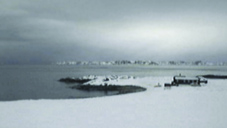
La vidéo entrecoupe deux vues prises par des caméras web, l'une d'une rue enneigée, filmée d'un immeuble adjacent, alors que l'autre est une vue similaire, mais d'une côte enneigée. Les deux scènes sont gelées et anonymes, le seul changement est celui de la lumière qui baisse, et d?une visibilité qui apparaît extrêmement graduellement, presque imperceptible au regard. En contraste, les sept pièces sonores semblent défiler trop rapidement. Si l?on n?y est pas attentif, ce son pourrait passer inaperçu ; minimaliste, il frappe le spectateur-auditeur comme étant trop simple. Cependant, NUUK récompense une écoute profonde, et offre des richesses magistrales à qui se concentre. L?idéal est de se donner la possibilité de descendre dans cette pièce comme en plongée les yeux ouverts, pour s?acclimater aux changements de pression, de lumière et de son.
1965 born in Bochum, Germany Education: 1985-1990 studying electronic music at CEM Studio, Arnhem 1987-1992 Conservatory of Music, Dortmund 1992-1994 Avid Operator, cutter- and soundassistant, Ruhr Sound Studios, Dortmund 1995 ? working as independant artist with sound, installation, film, music, video, theater and radio art Scholarships: 2001 Cité Internationale des Arts, Paris. 2006 Villa Aurora, Los Angeles Awards (selection): ARCO Award Best Young Artist at Arco, Feria International de Arte Contemporaneo Madrid 2005 Transmediale.05 Award, International Media Art Festival, Berlin 2005 TV5 Tiger Cub Award, International Filmfestival Rotterdam 2005 Golden Nica, Prix Ars Electronica, Linz 2004 German Sound Art Award Deutscher Klangkunst-Preis / Produktionspreis WDR, Marl 2004 Laureate, BBI Creation Contest, Fribourg 2004 Norman Award, Filmwinter Stuttgart 2004 New Media Prize, Montreal 2000 Nominations: 2004 MuVi Award, Short Film Festival Oberhausen 2004 Golden Cube, Monitoring Exhibition 21. Kasseler Dokumentarfilm- und Videofest 2004 & 2005 Viper Award, International Festival for Video and New Media, Basel Permanent installations: Musée Rimbaud / Maison Rimbaud, Charleville-Mézières Work in public collections: Centre Pompidou Musée national d`art moderne Paris, France Musée d`art contemporain Montreal, Canada Communidad Madrid Collection, Spain Ayuntamiento de Pamplona, Spain Exhibitions (selection): 2000 Sonic Boom Hayward Gallery London. 2004 Regarder, observer, surveiller Séquence Galerie Chicoutimi (Canada). Cyberarts Center for Contemporary Art, Linz. SoundART ArtCologne, Cologne. German Sound Art Award Skulpturenmuseum Marl. 2005 Gallery 44 Centre for Contemporary Photography, Toronto. Climax National Taiwan Museum of Fine Arts, Taichung. disappear Kunstpavillion Innsbruck. The Pantagruel Syndrome, Museo d`Arte Contemporanea Castello di Rivoli. Commissioned works: 1998 Musée National d`art moderne, Paris 2001 Centre d?art contemporain, Rennes 2004 Musée Rimbaud, Charleville-Mézières Remix (selection): 1999 Nine Inch Nails Remix for Nothing Records / Interscope 2002 Claude Debussy Remix for Universal Music 2003 ISIS Remix for Hydrahead Records Discography: since 1990 releases on more than 70 CD Live-Performance (selection): 1994 Louvre, Auditorium Paris. 1998 Spiral Hall Tokyo. 2001 New Zealand Film Festival. 2002 Kunsthalle Schirn Frankfurt. La Biennale Filmfestival Venice. Walker Art Center Minneapolis. 2003 Musée d?art contemporain Montreal. NYYD Festival for New Music Tallinn. 2004 Musée d?Orsay Paris. Festival de Carthage Tunis. 2005 La Biennale di Venezia, Teatro La Fenice. Palais des Beaux-Arts, Bruxelles. Serralves Museum, Porto. Radio art: 2001 Radio France 2004& 2005 Deutschlandradio Kultur 2006 Westdeutscher Rundfunk WDR Theatermusic: 1997 Krieg, Rainald Goetz, Schauspielhaus Dortmund Guest lectures & workshops (selection): 1998 Keio University Arts Center, Fujisawa. 2000 University of Traditional Music Theatre, Beijing. 2003 Musashino Art University, Tokyo. 2004 Dutch Art Institute, Enschede. 2004 Musrara School of Photography, Jerusalem. 2005 Hyperwerk, Basel.
Thomas Köner
Expanding Illuminance
Concert multimédia | 0 | | 35:0 | Allemagne, France | 2017
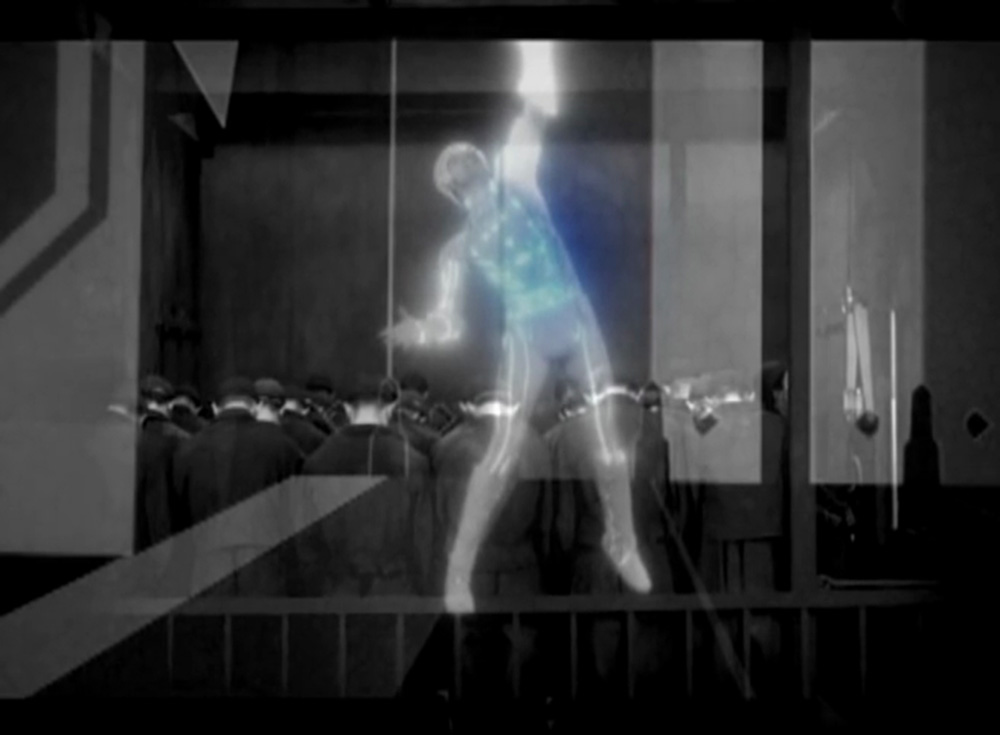
Une traversée hypnotique entre deux visions du futur et deux utopies, réalisée à partir de fragments du film monumental “Metropolis” (Fritz Lang, 1927) et du film culte des années 80 “Tron” (Steven Lisberger, 1982).
Thomas Köner a étudié à l’Académie de musique de Dortmund, et au CEM- Studio à Arnhem. Son travail s’intéresse principalement à la combinaison des expériences visuelles et auditives, et se développe sous forme d’installations, de concerts, de vidéos, de photographies et d’oeuvres multimédias. En 2000, il reçoit le “New Media Prize” du Montreal International Festival New Cinema New Media. En 2004, il reçoit le “Golden Nica” de Prix Ars Electronica, le “Produktionspreis WDR / Deutscher Klangkunst - Preis” (prix allemand d’art sonore). Son installation média “Suburb of The Void” a reçu le prix Transmediale 2005 à Berlin et a été présenté à la Biennale de Venise, au théâtre de La Fenice, en performance live. La vidéo “Nuuk” a reçu le Tiger Cub Award (meilleur court-métrage) au Festival International du Film de Rotterdam en 2005. Plusieurs musées importants ont acquis ses oeuvres audiovisuelles pour leur collection: notamment le Centre Pompidou, le Musée d’art contemporain de Montréal, la Comunidad de Madrid, le FRAC Limousin. En 2008, il participe à la Media Art Biennal de Séoul. En 2009, il reçoit le Prix MuVi au Festival international du film court d’Oberhausen. Thomas Köner est nominé pour le prix Nam June Paik en 2012.
Thomas Köner
Le manifeste du futurisme
Concert multimédia | dv | couleur | 50:0 | Allemagne | 2009

Thomas Köner
La Barca
Vidéo | dv | couleur | 6:40 | Allemagne | 2009
In a barque she sails across the high lands of the past. The barque heads shimmer and glow at stern and bow, and that lights her unseeable passage. She calls to the spirits of this hour, and that is how we come to even hear her voice. La Barca locates a radiance of memories by transforming the residues of recorded visual and sonic reality into imaginary music of urban spaces.
Thomas Köner
Pneuma Monoxyd
Vidéo expérimentale | dv | couleur | 10:30 | Allemagne | 2007
Dans la sa série d'oeuvres audiovisuelles "Pneuma Monoxyd", Thomas Köner cherche à détecter les fluctuations et frontières invisibles qui déterminent chaque instant. Dans la première partie, un plan fixe sur un marché des Balkans semble une fenêtre ouverte sur l?autre côté, révelant la frontière poreuse qu'est devenue le Hic et Nunc. Dissoute par un souffle léger, la banalité de la vie quotidienne est libérée pour embrasser le lugubre et la beauté dans une danse trouble.
Thomas Köner est né en 1968 en Allemagne. Après avoir suivi des cours au Conservatoire de musique de Dortmund et étudié la musique électronique au CEM-Studio d'Arnhem, il travaille comme monteur et ingénieur du son pour le cinéma jusqu'en 1994. Il obtient le prix New Media du Festival International du Nouveau Cinéma et des Nouveaux Médias de Montréal en 2000, le Golden Nica du Prix Ars Electronica en 2004 et le prix d'art sonore Produktionspreis WDR / Deutscher Klangkunst-Preis. Son installation "Suburbs of the Void" obtient le prix Transmediale 2005 et est présentée la même année à la Biennale de Venise sous la forme d'une performance au théâtre de La Fenice. Sa vidéo "Nuuk" obtient le Tiger Cub Award du meilleur court-métrage au Festival du Fim de Rotterdam en 2005. Il étudie la composition musicale et se consacre de manière intensive à la recherche sur le son en studio d'enregistrement, mettant de côté rythme et mélodie pour se concentrer sur le concept de couleur sonore. Il étend ses recherches à d'autres médias en collaborant avec l'artiste Jürgen Reble sur la performance Alchemie (1992), et compose des bandes originales de films et de la musique électronique pour accompagner en direct la présentation de films muets au Musée du Louvre et au Musée d'Orsay. En tant que producteur de techno progressive, il fonde le projet Porter Ricks en collaboration avec Andy Mellwig et remixe les musiques de Nine Inch Nails et Claude Debussy. Le Musée Rimbaud lui a commandé cinq installations sonores permanentes pour la Maison Rimbaud à Charleville-Mézières. Ses ?uvres audiovisuelles font partie des collections permanentes de musées d'art contemporain comme celui de Montréal.
Thomas Köner
Pasajeros Peregrinos Pilotos
Art vidéo | dv | couleur | 3:0 | Allemagne | 2008
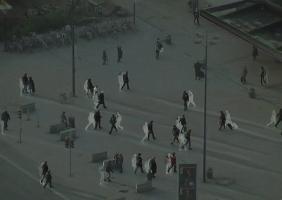
« Pasajeros Pelegrinos Pilotos » montre des piétons et des usagers des transports pendant leurs trajets quotidiens. Un Doppelgänger (double) imaginaire, accompagnant chacune des personnes, apparaît. Selon l'artiste, le Doppelgänger représente un soi-même idéal, qui sait tout, ne prend jamais de mauvaises décisions mais, bien sûr, arrive toujours trop tard.
Thomas Köner est né en 1965. Artiste médiatique, il travaille avec les installations audiovisuelles, le son, la vidéo, la photographie, le net art et les performances live. Ses ?uvres appartiennent aux collections de nombreux musées d'art prestigieux. Parmi les prix qui lui ont été décernés, citons notamment le Golden Nica au Prix Ars Electronica en 2004, le Transmediale Award en 2005, le Golden Tiger Cub au Festival du Film de Rotterdam (Pays-Bas) en 2005.
Thomas Köner
Périphériques
Installation vidéo | dv | couleur | 13:34 | Allemagne | 2006
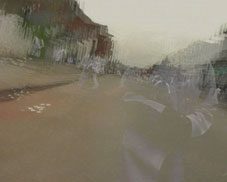
Trois scènes dans des lieux éloignés, incertains : second, tiers monde; des gens dans les rues de Harar, de Belgrade et dans une favela de Buenos Aires. La caméra effectue des mouvements fluides et aériens; nous voyons les visages devenir transparents, les images se désagréger obscurcissant les différents niveaux de la mémoire personnelle. Ce qui semblait à première vue être l'observation de trois fragments de vie distincts est rassemblé dans l'immense espace d'un moment donné, faisant surgir un microcosme temporel qu'on peut seulement pénétrer de loin, le côté insignifiant du monde. "Périphériques" la troisième section, montre des gens en train de marcher, zoomant sur le flottement des habits, figures fantômatiques sans être ni corps, comme si la personne et l'identité disparassaient quand on les convoque, révélant le vide agité qui habite la périphérie de leur centre.
Thomas Köner, né en 1965, a suivi les cours du Music college de Dortmund et a étudié la musique électronique au CEM-Studio de Arnhem. Jusqu'en 1994, il a travaillé sur des films en tant qu'ingénieur du son. Il a étendu son concept de son-couleur aux images en mouvement, à travers des installations vidéo et des films. En 2002, au Festival International du Nouveau Cinéma et des Nouveaux Médias de Montréal, il a reçu le "New Media Prize". En 2004, au Prix Ars Electronica, il a été récompensé par le "Golden Nica", et il a reçu le "Produktionspreis WDR" lors du "Deutsche Klangkunst-Preis" (prix d'art du son allemand). Son installation média "Suburbs Of The Void" a reçu le prix du Transmediale de 2005 à Berlin et la même année, a été présentée à la Biennale de Venise, au Théâtre La Fenice, comme une performance en direct. La vidéo de Thomas Köner, "Nuuk", a reçu le Tiger Cub Award (meilleur court-métrage) lors du Festival International de Cinéma de Rotterdam en 2005.

Daniel Kötter
A Composer
Doc. expérimental | hdv | couleur | 18:55 | Allemagne | 2014
Daniel Kötter’s single take film “A Composer” documents a car ride by Lebanese composer Zad Moultaka, re-imagining a story that happened 10 years ago, when Moultaka was threatened for using the word “Israel” in one of his compositions. The political situation of his home country, its psycho-geography and the conditions of artistic practice in the Middle East, all this superimposed in the protagonist’s imagination. A film documenting the assimilation of past and present reflected in the recording situation.
Daniel Kötter is a director and video artist whose work oscillates deliberately between different media and institutional contexts, combining techniques of structuralist film with documentary elements and experimental music theater. It was shown in numerous galleries, video festivals, concert halls and theatres all over the world. Between 2008 and 2011, he developed the video-performance trilogy Arbeit und Freizeit. His music theatre performances in collaboration with composer Hannes Seidl are shown at numerous international festivals. Kötter`s series of installations, films, and discursive work on urban and socio-political conditions of performativity has been under development since mid-2009 under the title state-theatre: Lagos/Teheran/Berlin/Detroit/Beirut/Mönchengladbach (with Constanze Fischbeck). His film and text work KATALOG was shot in twelve countries around the mediterranean sea portraying sites and practices related to the definition of the public sphere. It was presented at the Venice Biennal for Architecture.
Daniel Kötter
Aufschläge - Kanon
Vidéo expérimentale | dv | couleur | 2:27 | Allemagne | 2004
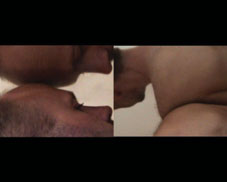
L'échange de coups entre deux adversaires commence par des Aufschläge (ici: services, de tennis ou de badminton), ce sont les Aufschläge (ici:chocs) qui arrivent au bout de la chute, et les Aufschläge (ici:le soulèvement des paupières)qui ouvrent le jeu de la séduction. Mais ici le corps ne rencontre et n'atteint que lui-même: verticalement (Aufschläge). Il se poursuit lui-même sans la perspective de se rattraper un jour: horizontalement (canon). Les bras, les jambes, la tête, le visage, la chair se font face et entrent en contact dans un coin de la pièce. L'installation vidéo à 2 canaux ?Aufschläge ? Kanon? a été présentée pour la première fois dans le cadre du projet audiovisuel ?In der Gnade der Strafe sein? de Christoph Ogiermann (composition) et Daniel Kötter (vidéo)
Daniel Kötter Né en 1975; ses travaux de réalisation et ses installations vidéo ont été présentées entre autres au Hebbel-Theater Berlin, aux sophiensaelen, au KW- institute for contemporaray art de Berlin, à la Künstlerhaus Bethanien, à TESLA Berlin, à la Festspielhaus Hellerau de Dresde, Casa da musica Porto et dans le cadre du Ultraschall-Festival de Berlin, de la Ostseebiennale für Klangkunst, Tanz en Août ainsi qu'au printemps des arts de Brême et Rohkunstbau; collaboration entre autres avec les compositeurs John Lely, Helmut Oehring, Thierry Blondeau, Christoph Ogiermann, Iris ter Schiphorst, l' Ensemble Apartment House London, les musiciens Boris Baltschun, Daniel Teige und les chorégraphes Sasha Waltz, Paul Gazzola et Petra Sabisch, mise en scène vidéo entre autres pour des musiques de Luigi Nono, Iannis Xenakis, Helmut Oehring et Franco Evangelisti, depuis 2000 directeur artistique du "labor für musik:theater berlin".

Daniel Kötter
Rift Finfinnee
Documentaire | 4k | couleur | 79:0 | Allemagne | 2020
The film Rift Finfinnee takes the viewer on a journey through the periphery of Ethiopian capital Addis Ababa. In strictly composed landscapes and architecture shots, and with a soundtrack that interweaves the original conversations in a complex way, the film travels along the Akaki river gorge, dissecting the more than symbolic rift between city and rural. It takes the concrete geography, architecture and the every day life of individual agricultural and construction workers in the east of Addis Ababa (in Oromo: Finfinnee) as the starting point for an allegorical narrative about the becoming urban of an African society on the edge of civil war.
Daniel Kötter is an international filmmaker and theater director. Visual research leads him again and again to the African continent and the Middle East. 2014-18 he worked with the curator Jochen Becker (metroZones) on the research, exhibition and film project CHINAFRIKA. Under Construction. In 2017-20 he worked on the documentary film trilogy Hashti Tehran (2017, 60 ’), Desert View (2018, 84’) and Rift Finfinnee (2020, 80 ’) about urban peripheries in Tehran, Cairo and Addis Ababa. Hashti Tehran won the special award of the German Short Film Award, Rift Finfinnee the DEFA Award at DOK Leipzig. Daniel Kötter is currently working on a series of spatial performances and 360° films on the landscape and social consequences of extractivism in Germany, West Papua, DR Congo and Estonia under the title landscapes and bodies.

Daniel Kötter
Landshaft
Documentaire | 4k | couleur | 96:42 | Allemagne | 2023
Landshaft sketches the psychogeography of a geopolitically charged landscape and its inhabitants between extractivism, war and displacement. In the form of a journey in eastern Armenia, the film follows human and non-human actors as they make their way through the landscape, from Lake Sevan to the Sotk gold mine, occupied by Azerbaijan since the Karabakh War in 2020.
Daniel Kötter (1975, Bergisch Gladbach, Germany) has been working for 20 years as a theatre and documentary film director. His documentary and performance practice regularly takes him to the African continent, but also to the Middle East, North America and Southeast Asia. His work, which has been presented at numerous international festivals, focuses on the study of spatial politics. In addition to numerous music theatre pieces with composer Hannes Seidl (2008-2020), he developed the documentary film series “State-theatre Lagos/Tehran/Berlin/Detroit/Beirut/Mönchengladbach” (2009-2014, with Constanze Fischbeck), the award-winning trilogy on urban peripheries Hashti Tehran, Desert View, Rift Finfinnee (2017-2020), the exhibition and film project “CHINAFRIKA” (2014-18, with Jochen Becker) and the series of virtual reality performances and films “landscapes and bodies” on the impact of mining on landscapes and communities in West Papua, Saxony, Ruhrgebiet, the Democratic Republic of the Congo and Estonia (2018-2021).

Daniel Kötter
communal retreat
Fiction expérimentale | hdv | couleur | 15:0 | Allemagne, Canada | 2012
Following the traces of Glenn Gould and his so-called ?Solitude-Trilogy? up north at Lake Superior seemed a welcome alibi for a middle-european to explore a little bit of what is called THE NORTH for Canadians, what it means to drive hours and hours without one single settlement, having the car radio and the camera as sole companions. And what community might mean under the circumstances of the periphery. What I brought back from there? The certainty that there is definitely no marxist in the White House! And that even in the most remote retreat: Beware of the dogs!
Daniel Kötter ist ein international tätiger Filmemacher und Musiktheater-Regisseur. Seine Arbeiten changieren zwischen verschiedenen medialen und institutionellen Kontexten. Sie wurden weltweit auf zahlreichen Film- und Videokunstfestivals, in Galerien, Theatern und Konzerthäusern gezeigt. Zu seinen Hauptwerken zählen neben experimentellen Videokonzertperformances (mit Hannes Seidl) die Mehrkanal-Trilogie Arbeit und Freizeit (2009-2011) sowie die Film-, Performance- und Diskursreihe state-theatre über die Bedingungen des Performativen in den Städten Lagos, Teheran, Berlin, Detroit, Beirut, Mönchengladbach (mit Constanze Fischbeck).
Daniel Kötter
checkpoint
Film expérimental | super8 | couleur | 7:13 | Allemagne | 2006
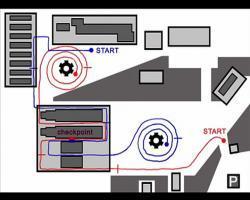
Checkpoint Grenzanlage a.D.: zwei Fahrzeuge, simultan, Start auf zwei Seiten einer Grenze. Aufeinandertreffen am Checkpoint. Spirale um zwei Wachtürme. Beschleunigung durch zunehmende Anzahl von Bildern pro Sekunde. Location: ehemalige deutsch-deutsche Grenzanlage Marienborn. Arbeitsweise: Rück-Übertragung von bevorzugten Methoden der DV-Technik wie Simultaneität, Splitscreen, Beschleunigung, Planseuquenz auf das nostalgische Medium Super8. Vermischung von Roadmovie, Dokumentarfilm, Experimentalfilm.
Daniel Kötter 1975 geboren; seine mehrkanaligen Videoinstallationen und Konzertinszenierungen wurden gezeigt u.a. am Hebbel-Theater Berlin, in den sophiensaelen, den KW- institute for contemporaray art Berlin, Künstlerhaus Bethanien, im tesla Berlin, im Festspielhaus Hellerau Dresden, Casa da musica Porto, Konzerthaus Wien, musica viva und im Rahmen des Ultraschall-Festivals Berlin, der Ostseebiennale für Klangkunst, Warschauer Herbst, Tanz im August sowie dem Kunstfrühling Bremen und Rohkunstbau; Zusammenarbeit u.a. mit den Komponisten John Lely, Helmut Oehring, Thierry Blondeau, Christoph Ogiermann, Iris ter Schiphorst, dem Ensemble Apartment House London, den Musikern Boris Baltschun, Daniel Teige und den Choreographen Sasha Waltz, Paul Gazzola und Petra Sabisch, Videoinszenierungen u.a. zu Musik von Luigi Nono, Iannis Xenakis, Helmut Oehring und Franco Evangelisti, seit 2000 Künstlerischer Leiter des labor für musik: Theater Berlin.

Daniel Kötter
HASHTI Tehran
Doc. expérimental | mov | couleur | 59:45 | Allemagne, Iran | 2016
Hashti, in most traditional houses in Iran, is a octagonal space of distribution and circulation to direct the person towards the various parts of the house, the private (andarouni) and semi-public (birouni) reserved for the reception from abroad and the access to spaces of service. Based on the idea that Tehran itself represents a house, so to speak the inner circle of The Islamic Republic of Iran, the outskirts of the city become the space of transition between inside and outside, between urban and non-urban. Thus the film and discursive project HASHTI Tehran looks at four very different areas in the outskirts of Tehran: the mountain of Tochal in the north, the area around the artificial lake Chitgar in the West, the construction of social housing called Pardis Town in the far east and the neighbourhood Nafar Abad at the southern edges of the city. By combining Road movie and architectural documentary and by inverting the techniques of inside and outside shots the film HASHTI Tehran portrays Tehran through its peripheral spaces. Background „Segregation“ and „privatization“, „security“ and „control“ are core terms of urban transformation in the developping cities of the 21st century around the globe. Its contested counterparts are „public“ or „open space“, „access“ and „citizenship“. All these concepts seem stuck in the negotiation between aspiration of new liberal economies trying to connect to a global construction and business boom on the one and a tendency of preserving a shared public sphere for all groups of society within the urban area on the other hand. HASHTI tries to shift this focus to areas where the controlling force of urban development seems to lose its influence, where definitions get blurry and fluid: the edges and peripheries, those contact zones, where city and landscape, nature and construction meet. Can a citizen who leaves the city for recreational or other purposes, still be called a citizen? Which societal function does he take on, which political role does he play in the moment where he enters or lives in the periphery of a city? Administrative aswell as geographical city borders divide space into inside and outside, into what belongs and what is beyond. The relation of those spaces on both sides of the border is therefore not symmetrical. The definitional authority is on the side of the city. The city would always determine the use and formation of space beyond its limits in a stronger way than the countryside would determine the urban space. One of the reasons for this is the fact that the city produces things, that it has to exclude from its centre, in order to guarantee the functionality of the living together: waste, dead corpses, criminals and socially marginalized. The space beyond the city limits therefore is predetermined for storage, settlement and disposal of what is socially peripheral. On the other hand the space beyond the boundaries of the city calls for this need for the city’s opposite: recreation, life in the green space, better air, less density and pollution. Living in the periphery therefore can be understood equally as Stigma and privilege. The Tehran case study Tehran’s peripheral geography shows a significant structural analogy with its social, environmental and psychological divisions: the northern periphery, reserved for the upper class in penthouse appartments and for recreation in the „clean air“ of the mountains, heavily contradicts the situation at the southern periphery, where smog and desert define the social life of the middle and low classes. While the geographical layout of the city with the mountains in the north and the desert in the south define a north-south axis, growth and development of the city are only possible on a west-east axis. HASHTI as a discursive project in collaboration with Shadnaz Azizi, Kaveh Rashidzadeh, Amir Tehrani and Pouya Sepehr and explored in four printed booklets, examines the different strategies of urban planners, architects and sociologists in these areas. How is traffic, how are meeting places, contact zones, gardening controlled and defined? And how do these spaces relate to the definition of interior spaces, the living room as a main forum in a society that regulates public space.
Daniel Kötter is a director and video artist whose work oscillates deliberately between different media and institutional contexts, combining techniques of structuralist film with documentary elements and experimental music theater. It was shown in numerous galleries, video festivals, concert halls and theatres all over the world. Between 2008 and 2011, he developed the video-performance trilogy Arbeit und Freizeit. His music theatre performances in collaboration with composer Hannes Seidl are shown at numerous international festivals. Between 2013 and 2016 they developped the trilogy Ökonomien des Handelns: KREDIT, RECHT, LIEBE. Kötter’s series of films, performative and discursive work on urban and socio-political conditions of theatre architecture and performativity has been under development between 2009 and 2015) under the title state-theatre: Lagos/Teheran/Berlin/Detroit/Beirut/Mönchengladbach (with Constanze Fischbeck). His film and text work KATALOG was shot in twelve countries around the mediterranean sea portraying sites and practices related to the definition of the public sphere. It was presented at the Venice Biennal for Architecture (2013/14). He is currently working with curator Jochen Becker (metroZones) on the research, exhibition and film project CHINAFRIKA. Under Construction. (2014-2018) www.danielkoetter.de www.state-theatre.de http://katalog.danielkoetter.de
Daniel Kötter
Neues Theater (Rahmenanalyse Warschau, 13. November 2011
Vidéo | hdv | couleur | 40:12 | Allemagne, Pologne | 2011
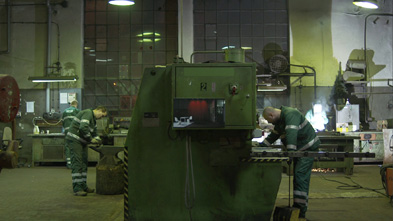
?You know what - this whole ?common ground? category scares me. It must be conceived from the position of someone? - I don?t know - an allegorical film director, an engineer ? someone outside the frame, designing the potential encounter.? Daniel Kötter?s single take film Neues Theater, based on a performance staged in November 2011, examines a moment of fundamental change in the understanding of public space in post-communist Poland. The workshop hall of the Warsaw city cleaning company MPO will turn into the new cultural centre for Poland?s most internationally renowned theatre company Nowy Teatr, the work of the workers will be replaced by the work of actors and viewers. While the camera slowly travels along the hall, the roles of viewers and actors, of labour and performance, practice and theory keep oscillating. The film stages the ?theatre? itself, not as yet another art form (with its specific institutional conditions, market rules and local aesthetic and historic limitations), but as a name for the allegoric space of encounter.
Daniel Kötter, born 1975, is a director and video artist whose work oscillates deliberately between different media and institutional contexts, combining techniques of structuralist film with documentary elements and experimental music theater. It was shown in numerous galleries, video festivals, concert halls and theatres all over Europe, in New York, Mexico, Tehran and Lagos. Between 2008 and 2011, he developed the video- and opera-performance trilogy Arbeit und Freizeit. His music theatre performances in collaboration with composer Hannes Seidl are shown at international festivals such as the Venice Biennale, Musica d?hoy Madrid and others. Kötter`s new series of installations, films, and discursive work on urban and socio-political conditions of performativity has been under development since mid-2010 under the title state-theatre: Lagos/Teheran/Berlin/Detroit/Beirut/Mönchengladbach (with Constanze Fischbeck). For galleries and dance performances, he developed multi-channel live video delay installations. His award-winning short-Film Film für übers Sofa (with Hannes Seidl) was shown at festivals worldwide. Between 2002 and 2008 Daniel Kötter, as artistic director of the labor für musik:theater, developed and produced numerous feature-length performative projects and multi-channel movies on the borderline between concert and musical theater. Daniel Kötter has been living and working in Berlin since 1996.
Daniel Kötter
Water & Coltan
VR vidéo 360 | 4k | couleur | 52:22 | Allemagne | 2021
“Water & Coltan” transports its viewer directly to the places of the struggle of women in artisanal coltan mining camps in South Kivu in Democratic Republic of Congo. Superimposed with a posthuman near-future scenario of the former coal mining Ruhr area in Germany the 360° documentary immersive experience combines two local sides of one and the same violent global phenomenon: the extractivist relation to natural and human resources with its long-term consequences for the environment and society.
Daniel Kötter (Germany, 1975) is a documentary filmmaker and theater director. His research based works alternate between media and institutional contexts. They have been shown worldwide at film festivals, in galleries and theaters. Since 2007 visual research on urbanization and political landscapes leads him to the African continent and the Middle East. His major works include the film and performance series “state-theatre” about urban conditions of performativity in the cities of Lagos, Tehran, Berlin, Detroit, Beirut, Mönchengladbach (2009-2014), the research, exhibition and film project “CHINAFRIKA” (2013-2019) and the film trilogy “Hashti Tehran” (2017, Special Award of the German Short Film Award), “Desert View” (2018) and “Rift Finfinnee” (2020, DEFA Award DOK Leipzig) about urban peripheries in Tehran, Cairo and Addis Ababa. Since 2019 Daniel Kötter was working on the series of spatial performances and 360° films “landscapes and bodies” on the consequences of extractivism in Germany, West Papua and Democratic Republic of Congo. His 360° film “Water & Coltan” (2021) is premiered at IDFA DocLab Competition.

Daniel Kötter
Chinafrika.mobile
Documentaire | hdv | couleur | 38:20 | Allemagne, Congo (RDC) | 2017
The documentary Chinafrika.mobile is tracking the life cycle of a mobile phone. From its birth in the mines in the Kolwezi, DR Congo, to its manufacturing in Chinese factories in the Pearl River Delta to its use and death in the markets and recycling dumps in Lagos, Nigeria, the mobile phone camera sends images of its global journey to the viewer`s mobile phone display. It was filmed by miners, factory employees, dealers and electronic scrap collectors at the original locations in Congo, China and Nigeria. Four short documentary films show the work on the device that shapes our everyday life. China and Africa act as driving forces for the economic, political and cultural future of globalization and the mobile phone is their important link. Since 2013 Jochen Becker and Daniel Kötter have done research on cultural effects of the economic and political connections between China and the African continent.
Daniel Kötter ist ein international tätiger Filmemacher und Musiktheater-Regisseur. Seine Arbeiten changieren zwischen verschiedenen medialen und institutionellen Kontexten und verbinden Techniken des strukturalistischen Experimentalfilms mit performativen und dokumentarischen Elementen. Sie wurden weltweit auf zahlreichen Film- und Videokunstfestivals, in Galerien, Theatern und Konzerthäusern gezeigt. Zu seinen Hauptwerken zählen die experimentellen Videokonzertperformances Falsche Freizeit (2010), Freizeitspektakel (2010), 'konomien des Handelns 1-3: KREDIT, RECHT, LIEBE (2013-16, alle mit Hannes Seidl), die Mehrkanal-Trilogie Arbeit und Freizeit (2009-2011) sowie die Film-, Performance- und Diskursreihe state-theatre über die Bedingungen des Performativen in den Städten Lagos, Teheran, Berlin, Detroit, Beirut, Mönchengladbach (2009-2014 mit Constanze Fischbeck). Seine umfangreiche Film- und Textarbeit KATALOG (2013) entstand in 13 Ländern rund um das Mittelmeer mit einem besonderen Interesse an Praktiken des Raums. Visuelle Recherchen führen ihn immer wieder auf den afrikanischen Kontinent sowie in den Mittleren Osten. 2014-18 arbeitete er u.a. mit dem Kurator Jochen Becker (metroZones) an dem Recherche-, Ausstellungs- und Filmprojekt CHINAFRIKA. Under Construction. Sein Film "Hashti Tehran" (2017, HD, 60") gewann u.a. den Sonderpreis des Deutschen Kurzfilmpreises.