Catalogue > Liste par artiste
Parcourez la liste complète des artistes présentés dans le cadre des Rencontres Internationales depuis 2004. Utilisez le filtre alphabétique pour affiner vos recherches.
Giulia Casalini, Casalini Giulia
Quimu Casalprim
Catalogue : 2019Out of the gardens | Doc. expérimental | dcp | couleur | 82:0 | Allemagne | 2018
Quimu Casalprim
Out of the gardens
Doc. expérimental | dcp | couleur | 82:0 | Allemagne | 2018
A paradise is emerging on earth. It is neither a dream nor a utopian delusion but an opportunity for a new kind of society. A step beyond the human as it has been known. A step we don't dare to consummate.
Born in Catalonia and based in Germany. Studies of philosophy, philology and media art in Barcelona and Cologne. Shorts selected and awarded in Clermont-Ferrand and Oberhausen among others. "Out of the gardens" is his first full-length film, premiered at the international competition of FID Marseille.
Catalogue : 2010ZEITRISS | Fiction expérimentale | 16mm | couleur et n&b | 11:0 | Allemagne | 2009
Quimu Casalprim
ZEITRISS
Fiction expérimentale | 16mm | couleur et n&b | 11:0 | Allemagne | 2009
L`immobilité physique bascule vers une fissure dans le temps. Tout s`effondre dans une expérience de lumière, de bruit et de mouvement.
Carlos Casas
Catalogue : 2018Faro (Lighthouse) | Vidéo | hdv | couleur | 20:0 | Espagne, Italie | 2016
Carlos Casas
Faro (Lighthouse)
Vidéo | hdv | couleur | 20:0 | Espagne, Italie | 2016
Faro is a portrait of the lighthouse of Santa Maria di Leuca (Italy), one of the last lighthouses in the south of the Mediterranean. The lighthouse illuminates the unknown, embraces the borders of the extreme lands. Every lighthouse possesses an identity, a light’s signature code that allows sailors to identify where they are: Santa Maria di Leuca has 3 light beams; its first beam offers half a second of light, followed by two and a half seconds of darkness, then half a second of light, followed by two and a half seconds of darkness, then once again half a second of light, and it finishes up with eight and a half seconds of darkness. And then the cycle starts all over again. Casas portrays its spirit, its behaviour and its evocative power. The artist studied the light, which in the Finis Terrae begins with the horizon and ends with a contrary rhythm regarding the lights switching on and off in the lighthouse in Santa Maria di Leuca.
Carlos Casas, Barcelona 1974, vit et travaille à Paris. Réalisateur de films et artiste visuel, ses oeuvres marient le film documentaire, le cinéma et les arts visuels et sonores contemporains. Ses trois derniers films ont remporté des prix dans des festivals du monde entier à Turin, Madrid, Buenos Aires, Mexico et certaines de ces réalisations en vidéo ont fait l’objet de présentations dans des expositions personnelles ou collectives. Casas a réalisé une trilogie filmique consacrée aux environnements les plus extrêmes de la planète: la Patagonie, la Mer d’Aral et la Sibérie. Avalanche, un projet en cours, a été présenté dans plusieurs musées et galeries en Europe. Il est le co-fondateur de Map Productions et du Label musical et vidéo Von Archives. Il a été directeur artistique de Colors Music and Films où il a développé des projets audiovisuels et de la recherche musicale dans diverses régions du monde. Il est professeur invité au Dartmouth College USA et ECAM Madrid. Ses oeuvres ont été présentées dans des musées et des espaces tels que La Tate Modern, Londres, le Palais de Tokyo a Paris, Hangar Bicocca a Milano, le Bozar a Bruxelles, l’Oi Futuro Rio de Janeiro, le MIS Sao Paolo, le Centre Pompidou, la Fondation Cartier, Paris, le Centre Cultura Contemporanea, Barcelone, Malba Buenos Aires, le GAM, Turin. Ses films ont été présentés dans des festivals comme le Festival du Film de Venise, le Festival du Film de Rotterdam, le FID Marseille, le BAFICI Buenos Aires, le Festival de Jeonju, la Corée du Sud, Documenta Madrid, FICCO Mexique et autres. En Mars 2017 il a presentee la Tate Modern son installation Sanctuary, part de sa recherche pour le film Cemetery.
Charley Case
Catalogue : 2007Friday, June 18, 1999, City of London | Documentaire | betaSP | noir et blanc | 8:12 | Belgique, Royaume-Uni | 1999

Charley Case
Friday, June 18, 1999, City of London
Documentaire | betaSP | noir et blanc | 8:12 | Belgique, Royaume-Uni | 1999
Alors que les groupes élitistes qui contrôlent l?Etat et le capital deviennent de plus en plus anonymes, leur peur des visages que prend la résistance quotidienne grandit. Et pourtant d?une certaine manière, les victimes du pouvoir qu?ils exercent ? les pauvres, les oppressés, les personnes ruinées et désespérées ? ne se font jamais entendre et sont toujours anonymes. Aujourd?hui nous allons donner un visage à cette résistance : car en revêtant nos masques nous révélons notre unité et en défilant ensemble dans les rues, nous exprimons notre colère face à l?anonymat du pouvoir.
Charley Case est né en 1969 et a étudié le graphisme à La Cambre de Bruxelles et s?est occupé des illustrations et de la conception de différents journaux internationaux et projets. Après avoir collaboré avec différents groupes activistes il a commencé à travailler indépendamment pour le collectif Sangam. Il choisit son moyen d?expression ? photographie, film, peinture, graphisme ou performance ? en fonction de ses objectifs. La plupart de ses thèmes sont marqués par une prise de conscience sociale et ancrés dans le conflit, entre images et sens, en contexte et parmi le peuple. Son travail a été présenté entre autres au Fifart Festival International du film sur l?art de Lausanne, au Dallas Video Festival et au MACBA museum de Barcelone.
Lucy Cash, Mark Jeffery
Catalogue : 2022Winterage: Last Milk | Vidéo | hdv | couleur | 21:0 | Royaume-Uni | 2021
Lucy Cash, Mark Jeffery
Winterage: Last Milk
Vidéo | hdv | couleur | 21:0 | Royaume-Uni | 2021
The thousand-year history of a farm in rural Doveridge, Derbyshire, UK, entangles with the singular life of queer Chicago-based artist, Mark Jeffery. Parsing the vernacular of Mark’s East Midlands childhood - hedge-laying, tending to cattle and land – within the vocabulary of expanded choreography, Winterage: Last Milk considers the film image itself as a collaborator as well as a material akin to fabric or clay. Returning to his childhood home in December 2019 to memorialise personal loss, and extending his body via the wearable sculptures of Grace Duval, Mark’s choreography brings forward the mineral and animal in all of us within a film composition that considers connections between place, language, loss and movement.
Mark Jeffery and Lucy Cash Mark and Lucy are both former members of Goat Island performance (Chicago) which is where they began collaborating. Mark Jeffery is a Chicago-based queer performance/installation artist, curator and Associate Professor at the School of the Art Institute of Chicago. Mark co - founded ATOM-r in 2012 a performance / technology group where he is a choreographer, and performer in the company. He is the organizer of IN>TIME, a Tri Annual performance festival hosted by multiple venues in Chicago. Mark was a former member of the internationally renowned Goat Island Performance Group from 1996 - 2009. Glasgow-based Lucy Cash in an interdisciplinary artist working within and through choreographic processes, and across form. Her commissioned work often involves social exchange and has taken place in galleries, museums, libraries, housing estates, on water and in the air. Her projects evolve ideas of collective practice which nurture interconnectedness between human and more than human, and across disciplines. Lucy has received funding and commissions from the BFI; Arts Council England; Creative Scotland; Gulbenkian Trust; BBC and Channel 4. Her works on film and video draw on choreography & movement to reveal the systems and patterns of the subjects considered and have shown in both cinema & installation contexts and in galleries including Sophiensaele and Haus der Kulturen der Welt, Berlin; Hyde Park Art Center; Cultural Center and Sullivan Galleries, Chicago, USA; Zahoor ul Akhal Gallery, Lahore, India; Bonington Gallery, Nottingham; Tramway, Glasgow and Whitechapel Gallery, Tate Modern, Siobhan Davies Studios, and the Natural History Museum, London, UK.
Natan Castay
Catalogue : 2023En attendant les robots | Doc. expérimental | mp4 | couleur | 39:17 | Belgique | 2022
Natan Castay
En attendant les robots
Doc. expérimental | mp4 | couleur | 39:17 | Belgique | 2022
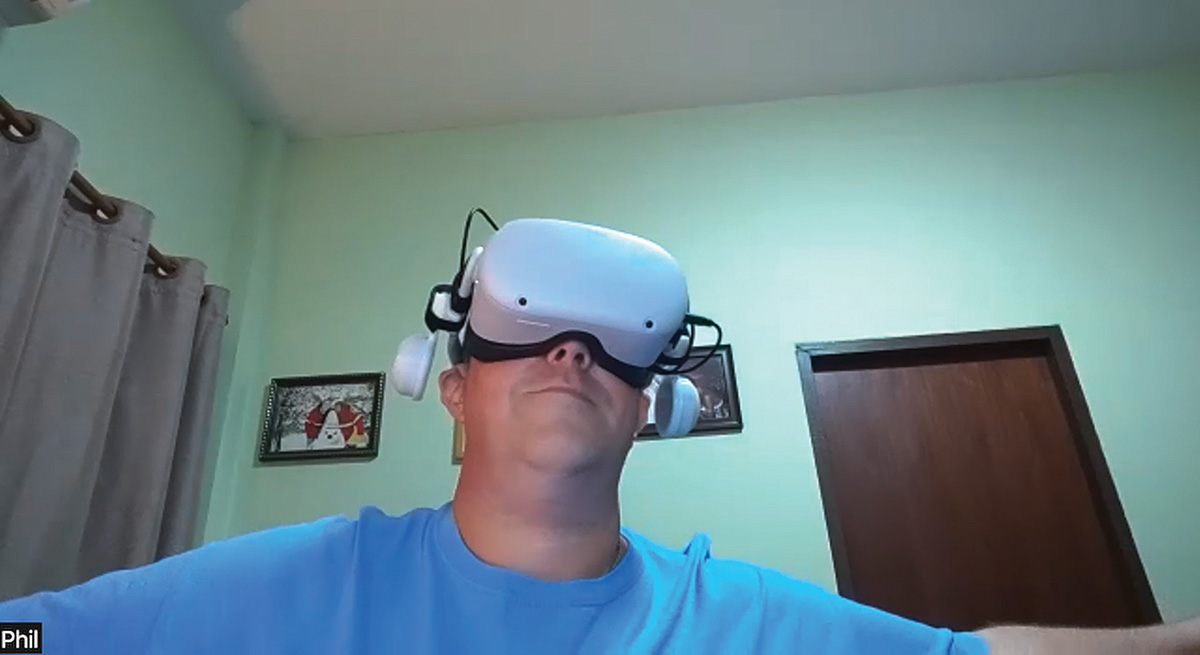
Nuits et jours, Otto efface pour un centime des visages sur Google StreetView. C'est l'une des tâches que lui et ses amis du monde entier réalisent sur Amazon Mechanical Turk, une plateforme de micro-tâches. Au côté de ses amis turkers, Otto plonge dans un monde robotique qui soulève la question de l'humanité.
Natan Castay a grandit à Bruxelles. Pour son film de fin d'étude à l'IAD il réalise En attendant les robots à la suite d'une expérience personnelle. Lors du confinement il a perdu son job d'étudiant dans un restaurant et s'est retrouvé à taper sur internet "comment se faire de l'argent en ligne". Il tombe sur Amazon Mechanical Turk, un site de micro-tâches. Son premier travail consiste à observer des photos satellites et répondre à la question Swimming pool/No Swimming pool pour un centime l'image. Très vite l'envie lui est venue de faire un film sur cette nouvelle forme de travail. Durant un an Natan a rencontré des centaines de Turkers dans le monde entier et a essayé de les inclure dans une écriture mêlant fiction, documentaire et expérimentation Amazon Mechanical Turk fait cyniquement référence à une légende au sujet d'un automate capable de jouer aux échecs et de battre Napoléon ou encore Benjamin Franklin. En réalité sous les mécanismes était caché un être humain.
Dani Castillo, Enrique Corrales
Catalogue : 2008Calle Leganés, por ejemplo | Doc. expérimental | dv | couleur | 17:0 | Espagne | 2007
Dani Castillo, Enrique Corrales
Calle Leganés, por ejemplo
Doc. expérimental | dv | couleur | 17:0 | Espagne | 2007
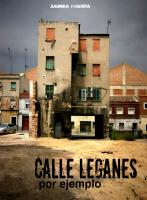
Rue Leganés, par exemple. La rue Leganés ne veut pas disparaître; dés que les maisons inhabitées se vident, les bâtiments vont être détruit pour continuer à construire. Avançant sans relâche, les bulldozers se moquent des souvenirs...ils ne demandent pas... n'hésitent pas.
ZAUNKA was founded in 2004 by Dani Castillo and Quique Corrales. Their work talk about the relationship between people and their enviroment in contemporary world. They try to explore our society, developing projects between Art and Documentary. Dani Castillo (Vitoria 1974). Photographer and filmmaker. Specialist in on-line image solution. Quique Corrales (Madrid 1969). Photographer and filmmaker. Teaching Art and Photography in Universidad Europea de Madrid.
Jeannette Castioni, Þúriður Jónsdóttir
Catalogue : 2020Sounds of doubt- wave behaviour | Installation vidéo | hdv | couleur | 6:6 | Islande | 2018
Jeannette Castioni, Þúriður Jónsdóttir
Sounds of doubt- wave behaviour
Installation vidéo | hdv | couleur | 6:6 | Islande | 2018
Can we investigate our character, role or self-image by observing everyday phenomena and by looking into and discussing simple esthetic symbols? Can the particular tonality or attribute of a certain nationality be discovered -a sort of national character in sound? Can people’s performances in everyday life be observed in a way that simple actions, which in our memory seem to be real, demonstrate to be the result of misremembering or even completely fictional? On Cycle in 2018 during Sounds of Doubts -Workshop the artists worked with three groups, each one with participants from a different Nordic country: Iceland, Faroe Islands and Greenland. Their behaviour was observed by introducing them to different roles and circumstances, either staged or real. This environment gave them the opportunity to examine how the inception of natural and cultural milieu influence the participants’ experience. During the development of the project, languages and the creative functions of our memory were elaborated with musical and visual means. The video and sound recordings from workshops were used for further analyses and elaborations for the multi-media work: Sounds of Doubts. The interdisciplinary collaboration between the artists constitutes a research project in itself as much as the final piece, where conventional ideas and beliefs about musical composition on the one hand and the aesthetic vision on the other, are reviewed and questioned.
My background lies, besides the field of fine arts in the conservation and restoration of paintings. Engaging with diversified collections and archives since the inception of my career enhanced my will to understand questions of time and space and the human ability to develop differentiated forms of cultures and knowledge. I collaborate with cultural mobility programs both in Europe and Asia, as well as receiving awards and prizes from several institutions: The Nordic Cultural Point, the Icelandic Visual Association alongside the Icelandic Patronage from “Amalie Engilberts Art trust” from The National Gallery of Iceland, and the Reykjavik Art Museum. The award for Postgraduate studies from the Guðmunda Andresdottir Foundation.
Catalogue : 2015everywhere´s local | Vidéo | hdv | couleur | 6:0 | Islande | 2014
Jeannette Castioni
everywhere´s local
Vidéo | hdv | couleur | 6:0 | Islande | 2014
Public and private spaces make people develop political and social questions reaching beyond localities, widening questions about their role in the formation of political subjectivity. "Everywhere´s local" intends to examine how conventions about mobility as counter resistance affects identities of individuals and small communities as well as in working places and private locations; how these conventions speak about subjectivity ; their way of quest political and social visibility, and whether actions of reciprocity might be the source of mutual support allowing civilians to activate endurance in the development of social structures. The piece investigates the role of the aesthetic vision within the process of objectification, juxtaposing documents of daily practices where individual actions become the apparatus that institutions use to master control and by doing so reducing civilians as objects. Spaces create distinctive features for subjectivity to be activated where meanings of defiance alongside civil resistance are deepened inside description of subjectivity within differentiation of forms. Where actions are endorsed by connotation and not by their visible value. Interpretation of actions are investigated as potential fields, where their manifestations compared coloured smokes, aim to empower people visibility and at the same time longing to dismiss a system.
education: 1989/9 Institute for Arts and Restoration, Palazzo Spinelli. MA(Diploma) in Painting Conservation and Restoration on wood and canvas, Florence Italy, 1999/02 Academy of Arts, Painting department Bologna, Italy. 2004/06 LHÍ University of Arts, BA in Fine Arts Reykjavík, Iceland. 2006/07 LHÍ University of Arts, MA (I grade) Art Education, Reykjavík, Iceland. 2012/14 Goldsmiths University of London MFA in Fine Art. awards: 2010- 1 Year Research Prize from the Visual Artists Foundation of Iceland 2010- Art Prize from the Guðmunða Andresdottir Cultural Foundation for Postgraduate studies in Art. 2012-“Visual Art Award” Icelandic Prize as the best artist of the year 2012. 2013- 6 Months Research Prize from the Visual Artist foundation of Iceland grants: 2007- Travel Grant from the Icelandic Ministry of Education and Culture, for cultural exchanges between Greenland, Iceland and Foræ Islands. 2010-Travel Grant from MUGGUR, Artist Foundation of Iceland 2011-CIA International Travel grant, from the Centre for Icelandic Art residency/ workshops: 2008 Kangerullussuak Atuarfiat, Nuuk, Greenland. Two weeks workshops with pupils from secondary local schools, deepening questions around issues on memories and cultural connotations. 2008 Silamiut Theatre Nuuk, Greenland/ Theatre rehearsals with students from schools 2010/11 Circle Scandinavo in Rome/ Hosted performances and seminars on the rhetoric of language. group exhibition: 2008 After Urban - University of Pennsylvania in Philadelphia, PA – USA. New Media & Video Festival at the Indiana University Art Gallery, USA. Art & Architecture event at Monkey town in Williamsburg Brooklyn, New York. The law of dialectic at The New Branch “Grassroots’ 2008”, the Icelandic emergent artist Exhibition in Hjalteyri, Iceland. The entropy of landscape /God words Municipal Art Museum of Akureyri. 2009 Communism didn´t happen /Solitude Landscape, Exhibition at the Kulturhaus in Ahrenshoop, North-east Germany. Sometimes they’ll return Exhibition at the Natural History Museum of Kopavogur in Reykjavik, Iceland. ATTITUDE Festival- Centre for Contemporary Public Arts - Bitola, Macedonia. 2010 Anamnesis/ be known to knowledge, at the Árnesinga Art Museum in Hveragerði, Iceland DRA the Dieter Roth Academy in Hjalteyri Iceland 2011 In between ,Hafnaborg Hafnafjörður, Iceland 2012 The painting site Akureyri Municipal Art Museum 2014 Big Screen/Latitude Festival Southwold , Suffolk UK. 2014 6th Cairo Video Festival. Medrar films Cairo, Egypth
Jeannette Castioni
Catalogue : 2020Sounds of doubt- wave behaviour | Installation vidéo | hdv | couleur | 6:6 | Islande | 2018
Jeannette Castioni, Þúriður Jónsdóttir
Sounds of doubt- wave behaviour
Installation vidéo | hdv | couleur | 6:6 | Islande | 2018
Can we investigate our character, role or self-image by observing everyday phenomena and by looking into and discussing simple esthetic symbols? Can the particular tonality or attribute of a certain nationality be discovered -a sort of national character in sound? Can people’s performances in everyday life be observed in a way that simple actions, which in our memory seem to be real, demonstrate to be the result of misremembering or even completely fictional? On Cycle in 2018 during Sounds of Doubts -Workshop the artists worked with three groups, each one with participants from a different Nordic country: Iceland, Faroe Islands and Greenland. Their behaviour was observed by introducing them to different roles and circumstances, either staged or real. This environment gave them the opportunity to examine how the inception of natural and cultural milieu influence the participants’ experience. During the development of the project, languages and the creative functions of our memory were elaborated with musical and visual means. The video and sound recordings from workshops were used for further analyses and elaborations for the multi-media work: Sounds of Doubts. The interdisciplinary collaboration between the artists constitutes a research project in itself as much as the final piece, where conventional ideas and beliefs about musical composition on the one hand and the aesthetic vision on the other, are reviewed and questioned.
My background lies, besides the field of fine arts in the conservation and restoration of paintings. Engaging with diversified collections and archives since the inception of my career enhanced my will to understand questions of time and space and the human ability to develop differentiated forms of cultures and knowledge. I collaborate with cultural mobility programs both in Europe and Asia, as well as receiving awards and prizes from several institutions: The Nordic Cultural Point, the Icelandic Visual Association alongside the Icelandic Patronage from “Amalie Engilberts Art trust” from The National Gallery of Iceland, and the Reykjavik Art Museum. The award for Postgraduate studies from the Guðmunda Andresdottir Foundation.
Catalogue : 2015everywhere´s local | Vidéo | hdv | couleur | 6:0 | Islande | 2014
Jeannette Castioni
everywhere´s local
Vidéo | hdv | couleur | 6:0 | Islande | 2014
Public and private spaces make people develop political and social questions reaching beyond localities, widening questions about their role in the formation of political subjectivity. "Everywhere´s local" intends to examine how conventions about mobility as counter resistance affects identities of individuals and small communities as well as in working places and private locations; how these conventions speak about subjectivity ; their way of quest political and social visibility, and whether actions of reciprocity might be the source of mutual support allowing civilians to activate endurance in the development of social structures. The piece investigates the role of the aesthetic vision within the process of objectification, juxtaposing documents of daily practices where individual actions become the apparatus that institutions use to master control and by doing so reducing civilians as objects. Spaces create distinctive features for subjectivity to be activated where meanings of defiance alongside civil resistance are deepened inside description of subjectivity within differentiation of forms. Where actions are endorsed by connotation and not by their visible value. Interpretation of actions are investigated as potential fields, where their manifestations compared coloured smokes, aim to empower people visibility and at the same time longing to dismiss a system.
education: 1989/9 Institute for Arts and Restoration, Palazzo Spinelli. MA(Diploma) in Painting Conservation and Restoration on wood and canvas, Florence Italy, 1999/02 Academy of Arts, Painting department Bologna, Italy. 2004/06 LHÍ University of Arts, BA in Fine Arts Reykjavík, Iceland. 2006/07 LHÍ University of Arts, MA (I grade) Art Education, Reykjavík, Iceland. 2012/14 Goldsmiths University of London MFA in Fine Art. awards: 2010- 1 Year Research Prize from the Visual Artists Foundation of Iceland 2010- Art Prize from the Guðmunða Andresdottir Cultural Foundation for Postgraduate studies in Art. 2012-“Visual Art Award” Icelandic Prize as the best artist of the year 2012. 2013- 6 Months Research Prize from the Visual Artist foundation of Iceland grants: 2007- Travel Grant from the Icelandic Ministry of Education and Culture, for cultural exchanges between Greenland, Iceland and Foræ Islands. 2010-Travel Grant from MUGGUR, Artist Foundation of Iceland 2011-CIA International Travel grant, from the Centre for Icelandic Art residency/ workshops: 2008 Kangerullussuak Atuarfiat, Nuuk, Greenland. Two weeks workshops with pupils from secondary local schools, deepening questions around issues on memories and cultural connotations. 2008 Silamiut Theatre Nuuk, Greenland/ Theatre rehearsals with students from schools 2010/11 Circle Scandinavo in Rome/ Hosted performances and seminars on the rhetoric of language. group exhibition: 2008 After Urban - University of Pennsylvania in Philadelphia, PA – USA. New Media & Video Festival at the Indiana University Art Gallery, USA. Art & Architecture event at Monkey town in Williamsburg Brooklyn, New York. The law of dialectic at The New Branch “Grassroots’ 2008”, the Icelandic emergent artist Exhibition in Hjalteyri, Iceland. The entropy of landscape /God words Municipal Art Museum of Akureyri. 2009 Communism didn´t happen /Solitude Landscape, Exhibition at the Kulturhaus in Ahrenshoop, North-east Germany. Sometimes they’ll return Exhibition at the Natural History Museum of Kopavogur in Reykjavik, Iceland. ATTITUDE Festival- Centre for Contemporary Public Arts - Bitola, Macedonia. 2010 Anamnesis/ be known to knowledge, at the Árnesinga Art Museum in Hveragerði, Iceland DRA the Dieter Roth Academy in Hjalteyri Iceland 2011 In between ,Hafnaborg Hafnafjörður, Iceland 2012 The painting site Akureyri Municipal Art Museum 2014 Big Screen/Latitude Festival Southwold , Suffolk UK. 2014 6th Cairo Video Festival. Medrar films Cairo, Egypth
Clemente Castor
Catalogue : 2020Príncipe de Paz | Fiction expérimentale | hdv | couleur | 84:0 | Mexique | 2019
Clemente Castor
Príncipe de Paz
Fiction expérimentale | hdv | couleur | 84:0 | Mexique | 2019
What divides us and what keeps us together? Maybe, both questions have the same answer. The body revealing itself to the mind. The mind to the space. The space, a place without walls which its inhabitants can’t get out of. Confinement in a place that seems open. People like the objects of a place. A place as a body they can’t get out of. The body, a group of membranes, the tissue that contains us. The fear that this tissue might not contain us anymore. A giant’s skeleton appears.
He received a grant from the National Fund for Culture and the Arts (FONCA) of Mexico to study at the Sarajevo Film Academy in Bosnia Herzegovina, founded by Hungarian director Béla Tarr. He studied Latin American literature at the Iberoamericana University (UIA, in Spanish). Also, he participated in the Mantarraya film workshop, in Mexico City. He is co-founder of the distribution and production company Salón de Belleza and was selected for the Berlinale Talents-Guadalajara 2019. He is currently studying a master's degree in contemporary art at SOMA, Mexico. He has directed short films, screening in several national and international film festivals in Colombia, Bosnia, Vienna, Argentina, Houston, France, Tijuana, etc. His feature film “Prince of Peace” received the award for best Mexican movie at FICUNAM and had its International premier at FidMarseille where it obtained the special mention of the international competition and special mention of Centre National des Artes Plastiques (CNAP). As well presented in festivals like Viennale, Mar del Plata Film Festival, Márgenes, etc. Also, he works as a contemporary artist and has presented his installations in some independent spaces and in contemporary art museums like Biquini Wax EPS, Queretaro Contemporary Art Museum, Baxter St, NY, Soma, and others.
Lorenzo Castore, Adam Cohen
Catalogue : 2013No Peace Without war | Doc. expérimental | dv | couleur | 38:0 | Italie, Allemagne | 2012
Lorenzo Castore, Adam Cohen
No Peace Without war
Doc. expérimental | dv | couleur | 38:0 | Italie, Allemagne | 2012
?No Peace Without War? is a film about Ewa and Piotr Sosnowski, brother and sister, living together since the death of their father. It is meant to be the story of a forgotten world that takes place behind the door of a two-room apartment in Krakow, Poland. Comprehending Ewa and Piotr?s past and present simply through facts is almost impossible. At a certain moment everything falls into a misty and mysterious cloud where real and invented memories become indistinct. The more we get to know them facts become trifling and unsubstantial. The only sure thing is that they live in extreme poverty but they never complain about it. Insight and unique access to this story is made possible through the eyes and understanding of Italian photographer-filmmaker Lorenzo Castore (Mario Giacomelli Prize 2003, Leica European Publisher Award 2005) and the visual approach of experimental documentary filmmaker Adam Cohen. In collaboration with Austrian composer and guitarist Christian Fennesz.
Lorenzo Castore / Director / Biography Lorenzo Castore was born in Florence in 1973. Since today he has worked in Europe (1997 ? 2011), New York (1997 ? 2001), Cuba (2000 ? 2002) and India (1997 ? 2001): he favours long term projects and special collaborations on the most different topics. His main interest is life and memory and their more mysterious and hidden aspects in relation with individual and personal stories and history. His work was published in many magazines such as Le Monde 2, Liberation, Sunday Telegraph, L?Espresso, Amica, Ventiquattro, D, Marie Claire, etc. He won the Mario Giacomelli Price (2003) and the Leica European Publishers? Award (2005) and published two books: Nero (2004) and Paradiso (2006). He?s represented by Agence/Galerie VU?. No Peace without War is his first film. Adam Cohen / Director / Biography Adam Cohen is a New York City born filmmaker and photographer. Working somewhere between film, painting and photography ? the city as a place to explore themes of memory and forgetting, history and entropy. Filmography: Blind Grace (1993), Fire of Time (2000). Christian Fennesz / Composer / Discography Fennesz uses guitar and computer to create shimmering, swirling electronic sound of enormous range and complex musicality. »Imagine the electric guitar severed from cliché and all of its physical limitations, shaping a bold new musical language.« (City Newspaper, USA). His lush and luminant compositions are anything but sterile computer experiments. They resemble sensitive, telescopic recordings of rainforest insect life or natural atmospheric occurrences, an inherent naturalism permeating each piece. Christian Fennesz is published by Touch Music. He lives and works in Vienna and Paris.
Libia Castro, Ólafsson, Ólafur
Libia Castro, Ólafur Ólafsson
Libia & ólafur Castro & ólafsson, Libia Castro & Ólafur Ólafsson
Catalogue : 2012Il Tuo Paese Non Esiste (Your Country Doesn't Exist), 2011 | Vidéo expérimentale | 0 | couleur | 16:0 | Espagne, Italie | 2011
Libia & Ólafur Castro & Ólafsson, Libia Castro & Ólafur Ólafsson
Il Tuo Paese Non Esiste (Your Country Doesn't Exist), 2011
Vidéo expérimentale | 0 | couleur | 16:0 | Espagne, Italie | 2011
"Il tuo paese non existe" est l?enregistrement d?une performance musicale et chantée, réalisée en public à Venise. Se réappropriant tout à la fois du cliché et de la réalité du gondolier, une mezzo soprano chante une sérénade contemporaine, accompagnée d?une trompette et d?une guitare, pendant que la gondole qui l?accueille vogue sur les canaux de la ville. Les paroles de la chanson, écrites par les artistes, se composent de la même phrase, répétée dans différentes langues : « ceci est un message de Libia et Ólafur : votre pays n?existe pas, votre pays n?existe pas ». Les artistes ont collaboré avec la compositrice islandaise Karólína Eiríksdóttir, qui a écrit la partition. La performance et le tournage ont été effectués au début du mois de mai dans différents lieux de la ville, à différents moments de la journée, dans les heures dorées des après-midi de ces jours de printemps. Au final, il s?agit d?un montage de plusieurs versions de la performance, toujours sous fond de la vie quotidienne de la ville, et de la réalité omniprésente du tourisme.
Libia Castro et Ólafur Ólafsson, respectivement de nationalité espagnole et islandaise, vivent et travaillent actuellement entre Berlin et Rotterdam. Ils se sont rencontrés aux Pays-Bas en 1997, où ils ont débuté leur collaboration artistique. Ils explorent les relations existantes entre l?art, la vie quotidienne, les problématiques sociopolitiques ou liées au croisement des cultures. Ils s?interrogent sur les manières dont la globalisation affecte les cultures locales, transforme les industries nationales, et a mené à une augmentation de la mobilité tout en creusant les injustices sociales. Castro et Ólafsson réalisent leurs projets en lien avec un lieu, une situation donnée, et travaillent souvent en collaboration, que ce soit avec d?autres artistes, des professionnels, des citoyens locaux, des décisionnaires, des activistes, ou avec des immigrants illégaux, qui servent alors de catalyseurs dans des contextes donnés. Ils opèrent par assemblage, par re-présentation, avec des éléments hétérogènes qui viennent déstabiliser une situation donnée, il peut s?agir de conflits spécifiques, ou de groupes sociaux qui passent inaperçus, et ils opèrent ensuite un mouvement de retour vers ces communautés de départ, avec des vidéos documentaires, des performances publiques, de la sculpture, des photographies, des interventions ou des installations multimédias. Castro et Ólafsson ont représenté l?Islande à la 54ème biennale de Venise. Leur travail est également montré dans expositions internationales, des musées, des centres d?art contemporain, des galeries, des biennales. En 2008 ils ont participé à la Manifesta 7. En 2009, ils reçoivent le troisième prix du prestigieux prix d?art hollandais, Prix de Rome, pour leur travail vidéo Lobbyists.
Anibal Catalan
Catalogue : 2010babel | Vidéo | dv | couleur | 3:10 | Mexique | 2009
Anibal Catalan
babel
Vidéo | dv | couleur | 3:10 | Mexique | 2009
Babel is a video taken with a cellphone camera. A scafolding its being constructed over the roof of some building without any apparent reason. The idea of contemplation its a fundamental principal in my video works , Babel its made from basic video tools, like cell pone cameras and photo digital cameras, the video was editing from this small cuts during a week, showing the process of construction as a methaphore of how the cities and its usuaries grows, get empowerment or loss everything in a second. The title Babel comes from the ancient history of the tower, in many ways big metrópolis and its biggest owners such as: enterprises, coorporations, goverments, and privates are represented trough the idea of high and big towers or construcrions to reflect their power, making this as a global and in some occasions a trendy effect.
Anibal Catalan was born in 1973 in the small Mexican village of Iguala. He attended the School of Architecture at Anahuac University, Mexico City (1993-1997) and earned his MFA from the National School of Painting, Sculpture and Engraving, La Esmeralda, Mexico City (2006). He has had solo exhibitions at Steve Turner Contemporary, Los Angeles (2008); Brasilea Kulturhaus, Switzerland (2006); Gallery 415, San Francisco (2007) and National Center for the Arts, Mexico City (2004). Catalan?s work has also been included in the group exhibitions Qui Vive? at I Moscow International Biennale for Young Art, Moscow Museum of Modern Art (2008); Festival Miden Kalamata, Grecce(2009), Its not Easy ,Exit Art. New York (2008); Draw In 00130 Gallery, Helsinki Finland (2008); VIII Biennial Monterrey FEMSA, San Idelfonso Museum, Mexico City (2007); Shangri L.A. Architecture as a State of Flux, 18th Street Arts Center, Santa Monica CA. (2009) and Mexi-Cali Biennial 09-10, Los Angeles (2009). His works are represented in collections such as: Artists Pension Trust APT (USA), Mexic-Arte Museum (USA), Sayago & Pardon Collection (USA), National Auditórium(MEX)
Wim Catrysse
Catalogue : 2018Outpost | Doc. expérimental | 4k | couleur | 34:41 | Belgique | 2018
Wim Catrysse
Outpost
Doc. expérimental | 4k | couleur | 34:41 | Belgique | 2018
“ A transfixing look at how Belgian artist filmmaker Wim Catrysse surveys the dynamics of self-constructed, architectural settings or the fictitious characteristics of phenomenal environments ? dissecting subjectivity and thereby also the illusion of control. His films and video installations challenge both participants and viewers in a primordial way through the evocation of vertigo. This precondition of boundaries operates to expose the observer to underlying motives. His artistic approach combines intuition with technical reasoning, which often leads to complex, cinematographic image constructions. ”
Born 1973 in Leuven (BEL) Lives and works in Antwerpen (BEL) Studied at ESA St-Luc Bruxelles (BEL), Higher Institute for Fine Arts, Anvers( BEL) and The Glasgow School of Art (GBR)
Wim Catrysse
Catalogue : 2015MSR | 0 | 0 | couleur | 14:58 | Belgique, Koweït | 2014
Wim Catrysse
MSR
0 | 0 | couleur | 14:58 | Belgique, Koweït | 2014
With 'MSR' we are set amidst the vast emptiness of the Kuwaiti desert where, to a great extent, the landscape has been claimed by two imperious industries, that is, the oil companies and the military machine that protects their interests. As they both make great effort to keep their stealthy activities concealed, the landscape, as we perceived it, is somehow being held hostage in a state of suspense… Located next to the 'Main Supply Route' (the route designated within an area of operations upon which the bulk of traffic flows — hauling beans, bullets and fuel — in support of military operations), we are confronted with a sequence of documentary footage that puts the focus on the travails and tactics of 'survivors', i.e. a pack of stray dogs that dwells within the boundaries of a dystopian world. In order to outlive an enraged desert storm, they seek shelter behind scattered pieces of waste and continuously dig holes in the sand, determined to withstand their antagonistic environment.
Wim Catrysse (°1973 born in Leuven, lives and works in Antwerp) gained a Masters degree in Visual Arts at the Higher Institute St-Lukas, Brussels in 1997. From 1997 to 2000, he followed a post-program course at the Higher Institute for Fine Arts (HISK) in Anvers followed by a one-year course at The Glasgow School of Art. Ever since the late 1990s Catrysse has been surveying the confines of visual constructions in his video installations, taking an architectural structure or the topographical features of a site as his starting point. He translates this investigation into cinematographic works in which the exposing and balancing of elementary forces play an essential role. The result is an accumulation of images that jerk us out of our comfort zone, that convey a physical threat, images that have about them something unheimlich and often unseat the obviousness of our most common perceptions. Moreover, Catrysse`s particular artistic method combines two apparently irreconcilable extremes: impulsiveness, physical directness, intuition and experimentation (almost nothing is worked out in detail beforehand) on the one hand and on the other an acute artistic and technical reasoning that can sometime lead to complex cinematographic image constructions.
Catalogue : 2006Catch-as-catch-can | Vidéo expérimentale | dv | couleur | 7:56 | Belgique | 2005
Wim Catrysse
Catch-as-catch-can
Vidéo expérimentale | dv | couleur | 7:56 | Belgique | 2005
Wim Catrysse est né en 1973 à Lovent en Belgique. Il a étudié à l?institut supérieur de Saint-Lukas de Brussel (1993 - 1997) et a obtenu un Master en arts visuels. En 1997 ? 2000, il a suivit le post-programme Higher Institute for Fine Arts (HISK), d?Anvers en Belgique. En 2000-2001, il a suivit le post-programme de la Glasgow School of Art, Glasgow, au Royaume-Uni.Son projet pour 2006-2007 : Künstlerhaus Bethaniën, Berlin, Allemagne.
Damien Cattinari
Catalogue : 2025Trois Rives | Doc. expérimental | mov | couleur | 41:45 | France | 2023
Damien Cattinari
Trois Rives
Doc. expérimental | mov | couleur | 41:45 | France | 2023
Trois Rives is a portrait of an imaginary river. Crossing it from east to west, or taking a detour to the south, from red to green, from undergrowth to the city, to its industrial zone: the film attempts to map the workings and organization of our civilization through the time of flowing water. In terms of filmmaking intentions, each shot is filmed on foot to the very limit of its narrative, until the image is exhausted. I'm interested in this approach because it allows me to work on the entrances and exits of the field, the micro-events that are usually invisible. I like to show the landscape as it thinks. In any case, this is the feeling that duration can give the viewer, when the different relationships and transformations that exist within a landscape are brought to the fore. And I think that's the great strength of digital, the beauty of relationships.
Damien Cattinari was born in 1993 and lives in Marseille. After studying geology for 5 years, he graduated from the Lussas documentary school in Ardèche. Through the prism of poetry, his films and photos seek to explore the fragility of the environment, landscapes and the world yet to come. As was the case during his geological mapping campaigns, his visual research is above all concerned with finding a “contact zone”, an image where several worlds worlds meet and interact. Recent screenings include: ÉTATS GÉNÉRAUX DU DOCUMENTAIRE (2019), FESTIVAL INTERNATIONAL JEAN ROUCH (2019), DOC EN COURTS (2019), PREMIÈRES OEUVRES (2019), VIDEODROME 2 (2022), DOBRA FESTIVAL (2022), Mesa Lendit exhibition at 6b (2022) As well as a photographic exhibition Où sont les arbres at the Centre Géographie in Paris as part of the territoire en images festival (2022).
Ergin Cavusoglu
Catalogue : 2008Fog Walking | Art vidéo | dv | couleur | 7:58 | Royaume-Uni | 2007
Ergin Cavusoglu
Fog Walking
Art vidéo | dv | couleur | 7:58 | Royaume-Uni | 2007
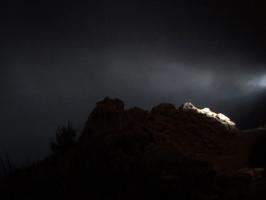
"Fog Walking" explore le thème du brouillard et de la nature de son inconsistence. Le brouillard défait la notion d'espace de ces coordonnées géographiques, de son histoire, et du temps. Le film décrit un voyage poétique sur le littoral de Biarritz, dans la baie de Biscay, lieu à caractère dramatique. Le personnage est invisible, mais on est conscient de sa présence grâce au bruit de ses pas. Le film est tourné de nuit et au petit matin, et présente un cycle d'images de vagues agitées rendues de façon abstraite par le brouillard, l'obscurité et les illuminations, les silouhettes d'immeubles et les monuments de la région de Biarritz. C'est là le décor qui a inspiré Igor Stravinsky, qui a vécu à Biarritz de 1921 à 1924. L'oeuvre emprunte sa bande-son à l'ouverture dramatique du ballet de Stravinsky "The Firebird Suite".
Ergin Cavusoglu est né en Bulgarie en 1968. Il a fait ses études à l'école nationale des beaux-arts "Iliya Petrov", à Sofia, dans les années 1980, puis il a obtenu un BA à l'université de Marmara, à Istanbul, et enfin un MA à Goldsmiths, à Londres, où il vit et travaille désormais. Il a représenté la Turquie à la cinquantième biennale de Venise en 2003 et a attiré l'attention d'un large public en 2004 en figurant sur la short list pour le Beck's Futures Prize. Parmi ses récentes expositions: Quintet Without Borders, Haunch of Venison, Zurich, Point of Departure, John Hansard Gallery, Southampton, Entanglement, Dundee Contemporary Arts, Dundee, huitième biennale d'Istanbul, British Art Show 6 et trosième biennale de Berlin. Cavusoglu fait partie des réalisateurs dont la proposition a été sélectionnée pour subvention pour développer le scénario d'un long métrage, sur une initiative du UK Film Council.
Viera Cákanyová
Catalogue : 2025Notes from Eremocene | Doc. expérimental | 0 | couleur | 78:0 | Slovaquie | 2023

Viera CÁkanyovÁ
Notes from Eremocene
Doc. expérimental | 0 | couleur | 78:0 | Slovaquie | 2023
Taking place in a future that does not yet exist, NOTES FROM EREMOCENE questions the ideal techno-optimistic model that lies ahead of us. From a curious, playful and critical standpoint, filmmaker Viera ?ákanyová explores the potential of blockchain technology and artificial intelligence in dealing with complex global problems we humans create – climate change and the crisis of representative democracy. Combining diaristic film footage with 3D scanner images, ?ákanyová poetically and forcefully stresses the inherent tension between the analogue and digital future of mankind.
Viera ?ákanyová (b. 1980) studied scriptwriting at the Academy of Performing Arts in Bratislava and documentary filmmaking at FAMU in Prague. Her early feature documentaries won a number of awards, such as Best First/Second film at Visions du Réel and Best Documentary at German Documentary FF in Kassel. Her visual storytelling can be found in the films GOTTLAND (2014) or SLOVAKIA 2.0 (2014). FREM (2019) and WHITE ON WHITE (2020) are currently her most successful films. Her feature debut FREM had its world premiere at the Ji.hlava IDFF 2019 followed by its international premiere at the Berlinale 2020, and won the Award for Best Debut at the ELBE DOCK festival. The film was screened at more than two dozen important international film festivals around the world. Her subsequent film WHITE ON WHITE won the main prize at the Ji.hlava IDFF in 2020. It also won the GreenDox Award at Dokufest in Kosovo, the Czech Competition at One World in Prague and was selected for the main competitions at the prestigious Sheffield DocFest and ZagrebDox.
Vincent Ceraudo, SC Ceraudo
Catalogue : 2019The Observatory | Vidéo expérimentale | mov | | 18:0 | France | 0
Vincent Ceraudo, SC Ceraudo
The Observatory
Vidéo expérimentale | mov | | 18:0 | France | 0
Il existe une manière de percevoir les choses ou de les observer qui n’implique pas les yeux. Quelque chose qui occulte le regard et qui va au-delà de la vision ordinaire. Le projet se déroule en une succession d’expériences filmées dans l’observatoire Camille Flammarion, à Juvisy-sur-Orge. L’idée conductrice du film repose sur les rapports entre la télépathie et l’astronomie, corrélat mystérieux qui hanta jusque la fin de sa vie les recherches du scientifique français Camille Flammarion (1842-1925). The Observatory est une exploration filmique qui fonctionne comme une tentative de réactivation du lieu. Les transmissions de pensées reflètent alors de manière métaphorique la structure du film, mais deviennent aussi au fur et à mesure son langage propre. La caméra enregistre et sonde au-delà du tangible, et le montage ne dépend pas d’un récit au sens strict mais plutôt des relations et des coïncidences qui se sont établies lors du passage de chacun dans cet observatoire. Il s’agit d’abord de faire éprouver à celui qui regarde le film, les tremblements et les incertitudes suscités par l’expérience télépathique, ou encore les vacillements du sentiment de réalité et d’identité qu’elle entraîne. Le spectateur est alors invité à pénétrer dans l’intimité du lieu et des personnages qui l’explorent, au travers de la synchronicité d’évènements qui les dépassent. Le 18 janvier 2016, un groupe composé d’une médium, de scientifiques et d’enquêteurs paranormaux est invité dans un observatoire en banlieue parisienne. Pendant plusieurs jours, ils tentent d’explorer le lieu au travers de leurs aptitudes spécifiques. Ignorant tout de cet observatoire, chacun réactive à sa manière l’histoire de ce lieu. Cet enregistrement vidéo constitue et documente cette expérience.
Vincent Ceraudo (1986, France) vit et travaille à Rotterdam. Son travail met en jeu la perception, la construction du réel, du rationalisme, de la culture et du capitalisme. A partir de divers enregistrements et images, videos, films, installations, photographies et textes, son travail est une tentative de révéler qui pourrais exister en dehors du dispositifs sensoriel humain. Son travail interroge un espace liminal qui existe dans l`écart qui sépare la perception et la réalité dite objective. Vincent a étudié à la Villa Arson à Nice, au Fresnoy Studio National des Arts Contemporains. Il est un résident de De Ateliers à Amsterdam (2016-2018) ainsi qu`un membre de la Skowhegan School of Painting and Sculpture, USA (2016) Son travail a été exposé à l`international comme récemment en 2018 Lo schermo Dell’Arte Film Festival à Florence en Italie, à la Fondazione Antonio Ratti à Como en Italie, à De Ateliers à Amsterdam, à la Station gare des mines à Paris, en 2017 à la faculté des sciences à Turin ( avec the institut of things to come et la Fondazione Sandretto Re Rebaudengo), à la Maison Européenne de la Photographie à Paris, au centre d`Art de la VIlla Arson à Nice, au Centre Pompidou à Paris, au Skoweghan program space a New York, comme artiste invité au 62 ème Salon de Montrouge, à la cité des Arts à Paris, au Fresnou Studi National des Arts Contemporains, en 2015 au Palais de Tokyo, à la Fabricca Del Vapore à Milan, comme artiste invité de la foire Art-O-Rama à Marseille, à la Fondation Botin à Santander en Espagne, au MUMA Monsah university Museum à Melbourne en Australie. Vincent est finaliste en 2016 du Fresnoy studio collector prize, un lauréat de la bourse des Mécènes du Sud à Marseille en 2015, lauréat de la bourse de la Caza De Velazquez à Madrid, un lauréat du premier prix du show-room à Marseille durant la foire Art-O-rama à Marseille. Son travail fait partie de prestigieuses collections publiques et privées en France, en Italie, en Belgique et aux Pays-Bas.