Catalogue > Liste par artiste
Parcourez la liste complète des artistes présentés dans le cadre des Rencontres Internationales depuis 2004. Utilisez le filtre alphabétique pour affiner vos recherches.
Alterazioni Video
Catalogue : 2023Notes for an Unfinished Park | Film expérimental | 4k | couleur | 25:15 | Italie | 2022
Alterazioni Video
Notes for an Unfinished Park
Film expérimental | 4k | couleur | 25:15 | Italie | 2022
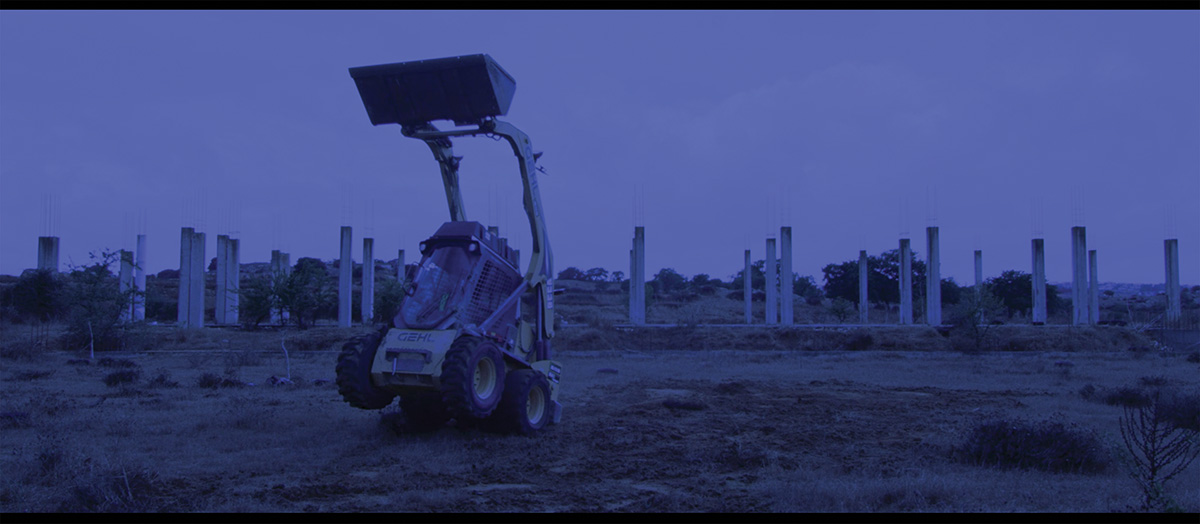
Nuoro's unfinished sports hall, a scenic ruin lost in the countryside beyond the last urban offshoots, is the film's protagonist. The undisputed star. Planned during the late 1990s, contracted out in 2012, the project was finally shelved in 2017: what remains is a forest of concrete hubbed pylons, with its mammoth entrance gate, a barren esplanade surrounded by piles of debris and wild vegetation. Through this movie, Alterazioni Video depicts the “Incompiuto” (Unfinished) through a new interpretative key which overturns the scornful conception surrounding Italian unfinished public works. The phenomenon is explored on all its complexity; thanks to a plurality of registers, references to ancient Greek mythology, youtube flavored neorealism, spaghetti western stereotypes with with Sci-Fi twists and turns which will eventually end up flirting with a meta-documentaristic approach. Among Nuoro’s Palasport, different characters roam freely; there is the grumpy guardian who time travels, a young tiktoker lost in the brambles, 4 red necks musician tourists, and a dowsing surveyor fond of monologues and digging. They all have different desires which lead them to different actions, almost as if they were willing characters driven around the concrete stage by that humoungus deus ex machina that is none other than the forgotten ruins of the unfinished sports hall.
Alterazioni Video is a group of five artists founded in Milan in 2004 and now based in New York, Berlin, Faro and Palermo. The members of the group are Paololuca Barbieri Marchi, Alberto Caffarelli, Matteo Erenbourg, Andrea Masu and Giacomo Porfiri. Their work has been exhibited internationally in museums and art institutions such as: Künstlerhaus Bethanien, Berlin 2005, 52nd International Art Exhibition Venice Biennale 2007, Manifesta 7 Rovereto 2008, Shenzhen & Hong Kong Bi-city Biennale of Urbanism\Architecture 2009, Fondazione Sandretto Re Rebaudengo Turin 2010, Museo Maxxi, Rome 2010, Performa 09 and 11 New York, MoMA PS1 Performance Dome New York 2012, Greene Naftali Gallery, New York 2013, PAC Milan 2014, Hamburger Bahnhof Museum Berlin 2015, Quadriennale di Roma 2016, Film Retrospective at Spazio Oberdan Milan 2016, Manifesta 12 Palermo 2018, Galleria Campoli Presti Paris 2019, VAC Foundation Venice 2019 and, Triennale Milan 2020, Museo Nivola Nuoro 2021 In 2007, for the 52nd Venice Biennale, in the main exhibition curated by Robert Storr, they presented "Painting" a work documenting the continuous layering of writing and erasures on the exterior walls of the San Vittore prison in Milan. Writings, images and attempts at censorship become the linguistic elements of one work, one large "painting" that documents, as it progresses, the life of a community. They are also known for creating "Unfinished." For more than 15 years, the art collective Alterazioni Video has been investigating the phenomenon of unfinished public works in Italy, documenting and mapping more than 750 buildings scattered throughout the country, works that were never completed and therefore had no function, becoming monuments to something that never existed. These unfinished works are the ruins of the contemporary era, the perfect interpretive paradigm for understanding our country's recent history. This study led to the definition of a new architectural style: Unfinished. In 2009 the group was invited together with Icelandic artist Ragnar Kjartansson to participate in the performing art biennial Performa 09 NY to perform Symphony No. 1. In 2015 for the exhibition "Dieter Roth und die Musik," curated by Gabriele Knapstein at the Hamburger Bahnhof museum in Berlin they presented Symphony No. 2 Since 2009, the collective has produced a series of 12 docu-films called TurboFilm. TurboFilm is a filmic system or methodology, which refers to the continuous reconfiguration of experience in everyday life and social relations, work, economics, and politics. It aims to raise questions about problematic issues through a cross-format multi-format production that can circulate through different media platforms. In 2016, Cineteca Italiana dedicated a retrospective at Spazio Oberdan in Milan. They have recently collaborated with renowned fashion designer Virgil Abloh as art directors for Off-White's fashion show in Paris for the 2019 menswear collection, as well as collaborating on works inspired by the Incompiuto project presented at the Campoli Presti Gallery. They have published two volumes: Turbo Film - the uncertain future of moving images published by Lupetti Editore Incompiuto - the birth of a style published by Humboldt Books
Videotage
Catalogue : 2006VideoTage - Focus Hongkong | Vidéo expérimentale | dv | couleur et n&b | 60:0 | Hong Kong | 2005

Videotage
VideoTage - Focus Hongkong
Vidéo expérimentale | dv | couleur et n&b | 60:0 | Hong Kong | 2005
Videotage (literally merging the two concepts of "Video" and "Montage") is a non-profit interdisciplinary artist collective, which focuses on the development of video and new media art in Hong Kong. Founded in 1985, Videotage began as a facilitator for collaborative time-based projects. In a small shared office with two chairs and table, Videotage`s support to artists came in the form of labour and equipment for production and post-production, and the exchange of ideas. Videotage has since expanded to include publications, education, exhibitions and screenings. Videotage is a vital link in presenting media arts to a broader community. Programming is guided by its Artistic Director and full-time staff, and governed by a Board of Directors. Videotage aims to boost awareness of Hong Kong video and new media art activities locally and internationally. Our artists members has participated in numerous cultural exchanges and art festivals. Including Asia-Pacific Triennial (Australia); European Media Art Festival (Germany); Experimenta (Australia); Hong Kong International Film Festival; Hong Kong Art Festival; Image Forum Festival (Japan); Kwangju Biennial (Korea); Multimedia Art Asia Pacific (Australia); Transmediale (Germany); Venice Biennale (Italy); and Videobrasil (Brazil). Videotage also invites internationally renowned artists and curators to present talks, seminars and workshop in Hong Kong. Previous guests include: Francesca da Rimini, cyber-feminist; Gary Hill, video artist; Barbara London, curator, Department of Film and Video, Museum of Modern Art, New York; Momentum, mixed electronic media performance group; Jun-jieh Wang, Taiwan-based video artist, among others.
Ecaterina Vidick, Sherban Vidick
Catalogue : 2011Dragalina | Documentaire | dv | couleur | 65:0 | Belgique, Roumanie | 2010
Ecaterina Vidick, Sherban Vidick
Dragalina
Documentaire | dv | couleur | 65:0 | Belgique, Roumanie | 2010
Dans le village roumain de Dragalina, Radu, 17 ans, ronge son ennui aux côtés de sa mère instable. Enfermé dans cet univers lourd et apathique, l?adolescent semble attendre un hypothétique changement de vie. Les réalisateurs partent à la rencontre de ce jeune homme, leur cousin, aux prises avec une quête d?identité et de sens qu?il a lui-même du mal à cerner.
"Ecaterina Vidick est née en 1981 à Bruxelles. Après des études de mise en scène à l?INSAS, elle se dirige vers le documentaire sonore. Elle réalise son premier travail en 2004, à l?accueil des urgences d?un hôpital bruxellois situé au c?ur de la ville, où indigents et étrangers cherchent autre chose que des soins. C?est cet « autre chose », justement, qu?elle recherche dans chacune de ses créations où les aspects social et humain occupent une place de choix. « Dragalina », pour une première collaboration fraternelle, est aussi sa première expérience cinématographique." Né le 10 novembre 1978 à Bruxelles, photographe de formation (INRACI, Académie des Beaux-Arts de Saint Gilles, le 75?), Sherban Vidick se tourne vers le cinéma pour le projet Dragalina, initié par sa s?ur Ecaterina. En parallèle, il entame la réalisation d?un projet photographique autour de ce même village et de ses habitants. Ses influences tant en photo qu?en cinéma se situent quelque part entre Raymond Depardon et Stephen Shore
João Vieira Torres, Tanawi Xucuru Kariri
Catalogue : 2017Crianças fantasmas | Doc. expérimental | hdv | couleur | 16:0 | Brésil | 2016
João Vieira Torres
Crianças fantasmas
Doc. expérimental | hdv | couleur | 16:0 | Brésil | 2016
Ghost Children, presents seven reminiscences of early childhood, read in seven different voices, as the camera presses close against the faded dye and exaggerated grain of family photographs from the early 1980s. Whose faces and memories are those The film encourages the audience to interrogate assumptions about gender, memory, performance, and death.
Joao Vieira Torres is a Brasilian-French artist/filmmaker, born in Recife, Brazil. Lives and works in between Brazil and France . He has shown his work among other places at: New York Film Festival 2016(US) / Kinoforum Sao Paulo (BR) / Edinburgh International Film Festival (UK) / Uniondocs New York (US) / Art of the Real Lincoln Center (US) / Ann Harbor Film Fest (US) / FIDMarseille(FR) / Olhar de Cinema (BR) / Rencontres Int. du Documentaire de Montreal (CA) / Rencontres Internationales Paris/Berlin (FR/DE) / Museu da Imagem e do som de Sao Paulo (BR) / Anthology Film Archives(US) / CentrePompidou(FR) / Palais de Tokyo (FR) / MIS Sao Paulo (BR) / LABoral (ESP) / IndieLisboa(PT) / Tampere Short Film Fest (FI) / Vilnius CAC(LT) / Alexandrina Arts Center (EG)’
Catalogue : 2016Toré | Doc. expérimental | hdv | couleur | 15:0 | Brésil | 2015
João Vieira Torres, Tanawi Xucuru Kariri
Toré
Doc. expérimental | hdv | couleur | 15:0 | Brésil | 2015
Il y a ce que je vois ce qui m`est montré ce que je ne vois pas ce que je ne peux pas voir On m`invite à filmer un rituel. Celui qu`on peut montrer aux étrangers. Un enfant de la tribu regarde Fantasia de Disney à la télé. On l`interrompt. Qu`est-ce qui habite l`enfant lorsqu`il danse ? Qu`est-ce que je peux voir de ce qu`on me montre ?*Filmé dans la Tribu Xucuru-Kariri, État d`Alagoas, Brésil
João Vieira Torres, artiste/cinéaste franco-brésilien est né à Recife, Brésil, en 1981. Il vit et travaille entre le Brésil et la France. Son travail a été présenté dans de nombreux festivals, galeries et musées, parmi lesquels FIDMarseille (FR) / RIDM (CA) / Olhar de Cinema (BR) / Anthology Film Archives(US) / CentrePompidou (FR) / Palais de Tokyo (FR) / Villa Arson(FR) / MIS São Paulo (BR) / LABoral (ESP) / CPH:Dox (DK), IndieLisboa (PT) / Tampere Short Film Fest (FI) / Vilnius CAC(LT) / Alexandrina Arts Center (EG), St Petersburg Mus. of Photo (RU), Pingyao Photo Fest. (CN). Tanawi Xucuru Kariri, l`un des leaders de la communauté, notamment en tant qu`éducateur, a co-réalisé Toré (2015), son premier film.
João Vieira Torres
Catalogue : 2017Crianças fantasmas | Doc. expérimental | hdv | couleur | 16:0 | Brésil | 2016
João Vieira Torres
Crianças fantasmas
Doc. expérimental | hdv | couleur | 16:0 | Brésil | 2016
Ghost Children, presents seven reminiscences of early childhood, read in seven different voices, as the camera presses close against the faded dye and exaggerated grain of family photographs from the early 1980s. Whose faces and memories are those The film encourages the audience to interrogate assumptions about gender, memory, performance, and death.
Joao Vieira Torres is a Brasilian-French artist/filmmaker, born in Recife, Brazil. Lives and works in between Brazil and France . He has shown his work among other places at: New York Film Festival 2016(US) / Kinoforum Sao Paulo (BR) / Edinburgh International Film Festival (UK) / Uniondocs New York (US) / Art of the Real Lincoln Center (US) / Ann Harbor Film Fest (US) / FIDMarseille(FR) / Olhar de Cinema (BR) / Rencontres Int. du Documentaire de Montreal (CA) / Rencontres Internationales Paris/Berlin (FR/DE) / Museu da Imagem e do som de Sao Paulo (BR) / Anthology Film Archives(US) / CentrePompidou(FR) / Palais de Tokyo (FR) / MIS Sao Paulo (BR) / LABoral (ESP) / IndieLisboa(PT) / Tampere Short Film Fest (FI) / Vilnius CAC(LT) / Alexandrina Arts Center (EG)’
Catalogue : 2016Toré | Doc. expérimental | hdv | couleur | 15:0 | Brésil | 2015
João Vieira Torres, Tanawi Xucuru Kariri
Toré
Doc. expérimental | hdv | couleur | 15:0 | Brésil | 2015
Il y a ce que je vois ce qui m`est montré ce que je ne vois pas ce que je ne peux pas voir On m`invite à filmer un rituel. Celui qu`on peut montrer aux étrangers. Un enfant de la tribu regarde Fantasia de Disney à la télé. On l`interrompt. Qu`est-ce qui habite l`enfant lorsqu`il danse ? Qu`est-ce que je peux voir de ce qu`on me montre ?*Filmé dans la Tribu Xucuru-Kariri, État d`Alagoas, Brésil
João Vieira Torres, artiste/cinéaste franco-brésilien est né à Recife, Brésil, en 1981. Il vit et travaille entre le Brésil et la France. Son travail a été présenté dans de nombreux festivals, galeries et musées, parmi lesquels FIDMarseille (FR) / RIDM (CA) / Olhar de Cinema (BR) / Anthology Film Archives(US) / CentrePompidou (FR) / Palais de Tokyo (FR) / Villa Arson(FR) / MIS São Paulo (BR) / LABoral (ESP) / CPH:Dox (DK), IndieLisboa (PT) / Tampere Short Film Fest (FI) / Vilnius CAC(LT) / Alexandrina Arts Center (EG), St Petersburg Mus. of Photo (RU), Pingyao Photo Fest. (CN). Tanawi Xucuru Kariri, l`un des leaders de la communauté, notamment en tant qu`éducateur, a co-réalisé Toré (2015), son premier film.
Michael Vienne
Catalogue : 2021Peripherien | Fiction expérimentale | 4k | couleur | 9:0 | Autriche | 2020
Michael Vienne
Peripherien
Fiction expérimentale | 4k | couleur | 9:0 | Autriche | 2020
Une étrange pandémie / Un écrivain de science-fiction en détresse / Une séquence hantée par des rêves lucides, de douces spéculations et des voix pourtant inaudibles dans l'air.
Michael Vienne est artiste visuel et réalisateur de films expérimentaux. Il habite à Vienne (Autriche). Son travail a été exposé et projeté à l'international.
Vladilen Vierny
Catalogue : 2013Traceurs | Doc. expérimental | hdv | couleur | 7:40 | Belgique, France | 2011
Vladilen Vierny
Traceurs
Doc. expérimental | hdv | couleur | 7:40 | Belgique, France | 2011
"Traceurs" est un film sur le Parkour, cette discipline sportive qui consiste à investir physiquement l?environnement urbain. Durant sept minutes, des traceurs se confrontent à l?architecture et s?intègrent au béton.
Né à Moscou, Vladilen Vierny découvre l?Europe par la Belgique où il vécut une dizaine d?années. Maintenant, il étudie la réalisation à la Fémis, à Paris.
Prokop Vignon
Catalogue : 2012sans titre | Vidéo | hdv | couleur | 3:36 | France | 2010
Prokop Vignon
sans titre
Vidéo | hdv | couleur | 3:36 | France | 2010
Dans la banlieue enneigée de Paris, des jeunes s?aventurent dans une friche industrielle. Leur passage dans ce tas de ruines redonne peu à peu un nouveau souffle de vie dans ce refuge.
Fernando Vilchez Rodriguez
Catalogue : 2015Solo te puedo mostrar el color | Doc. expérimental | hdv | couleur | 25:22 | Pérou | 2014
Fernando Vilchez Rodriguez
Solo te puedo mostrar el color
Doc. expérimental | hdv | couleur | 25:22 | Pérou | 2014
2009, in the high plateau of the Peruvian jungle, near the border to Ecuador, a mining company forces their way into the depths of the forest to search for mineral resources. They do this with the government`s permission, but without consent from the indigenous people, the Awajun natives who live there. Known for their fearlessness, the Awajun stand up to the invaders. But in the fight for their land they are brutally struck down by the government. Violence breeds counter-violence. Years later, young natives learn to use the videocameras and start to follow the trail of violence.
Fernando Vílchez Rodríguez (Perú, 1980). He studied Philosophy in Lima and Filmmaking in Madrid. His works are inquiries into the fractures of Peruvian society and the use of video archive, and have been selected in London, La Habana, Karlovy Vary, Buenos Aires, Tokyo, Montreal. Since last year, he is the Head of Programme of Lima Independiente International Film Festival. His last film, "I can only show you the color" had its premiere in the Berlinale Shorts Competition 2014.
Lucile Villanueva
Catalogue : 2025Sisyphe | Fiction | hdv | couleur | 10:8 | France, Grèce | 2023
Lucile Villanueva
Sisyphe
Fiction | hdv | couleur | 10:8 | France, Grèce | 2023
Failing to have found Homer, I met Sisyphus It is the search for something that does not exist or no longer exists. It’s a movement that brings you alive. It is the encounter with absurd and ephemeral repetition. This is a look at the ongoing construction sites on the island of Ios. It is an echo of Greek mythology, Homer and storytelling in the broad sense.
When I was little, I made films with playmobiles and plastic Indians. Today, I am at the Beaux-Arts de Bordeaux, in my second year and I specialize in video and writing. I also work with various materials including sculpture, ceramics and drawing. After my baccalaureate in Theater specialty, I did a year of hypokhâgne in Paris, then an artistic preparation, before moving for the first time, to Bordeaux. I've been making films for some time now, and I know that it's really in this area that I can express myself best. Show, make people travel, make people feel emotions. Choosing the aesthetic, the words of my actors, the framing of the shots, the editing of the rushes. All the stages give me a satisfaction and pleasure that I rarely find otherwise.
Jean-luc Vilmouth
Catalogue : 2007White Building | Doc. expérimental | dv | couleur | 25:0 | France, Cambodge | 2005
Jean-luc Vilmouth
White Building
Doc. expérimental | dv | couleur | 25:0 | France, Cambodge | 2005
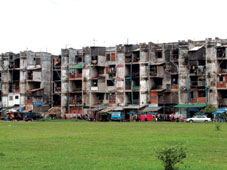
En passant par le front du Bassac, dans Phnom Penh, si l?on est un voyageur attentif, on sera surpris de voir surgir une construction qui pourrait avoir l?air d?un immeuble, mais qui ressemble davantage à un grouillement architectural étonnant. On ne perçoit tout d?abord qu?un enchevêtrement de lignes bleues, de points verts et d?étoffes colorées, en suspension sur ce qui devait être autrefois une façade blanche d?architecture moderne.On apprend alors que ce grand organisme vivant a été construit par l?architecte cambodgien Van Molyvann sur le modèle de l?utopie de la Cité radieuse...
Jean Luc Vilmouth was born in Moselle and is now living in Paris. Since 1978, he has been exhibiting his works throughout the world. He also works for art and architecture magazines and writes books on art. He realised several public works. As a director, he made several short films and video installations.
Sampsa Virkajärvi
Catalogue : 2007Keväällä | Doc. expérimental | dv | couleur | 5:42 | Finlande | 2005

Sampsa VirkajÄrvi
Keväällä
Doc. expérimental | dv | couleur | 5:42 | Finlande | 2005
Dans le film, un homme retourne dans sa ferme natale au printemps pour participer aus travaux des champs. Il découvre à la fois le travail physique et la poésie et il est l'objet d'un petit miracle inattendu.
Sampsa Virkajärvi est née Sampsa Kuorevesi en 1970 en Finlande. De 1992 à 1993, elle étudie à l'Académie des beaux-arts de Carrare en Italie. Puis de 1993 à 1999, elle étudie à l'Académie des beaux-arts de Helsinki. En 2001, elle obtient son diplôme de Bachelor of Art (licence en art). Et enfin, depuis 2001, elle étudie à l'Université des arts et du design de Helsinki dans le département "film et télvision."
Barbara Visser
Catalogue : 2019The End of Fear | Documentaire | mov | couleur et n&b | 69:9 | Pays-Bas | 2018
Barbara Visser
The End of Fear
Documentaire | mov | couleur et n&b | 69:9 | Pays-Bas | 2018
Who`s still afraid of red, yellow and blue? The most famous abstract painting of the twentieth century has invoked much more than just one response to this provocative question. Fifty years after `Who`s Afraid of Red , Yellow and Blue III`, we question the meaning of art over the life of this famous, celebrated and mourned work by Barnett Newman.
Barbara VISSER (1966, the Netherlands) studied Photography and Audiovisual Arts at the Gerrit Rietveld Academie in Amsterdam, the Cooper Union in New York and the Jan van Eyck Academie in Maastricht and is an awarded artist. She has also worked as the artistic director of IDFA. Her work focuses on cultural and historical narratives and how these become manifest through art, design, media and science. By challenging conventions in storytelling and image-making, and questioning our memory- and belief systems, Visser aims to provoke a new perception of what a normality has rendered invisible.
Catalogue : 2013C.K. | Documentaire | hdv | couleur | 51:0 | Pays-Bas, Thaïlande | 2012
Barbara Visser
C.K.
Documentaire | hdv | couleur | 51:0 | Pays-Bas, Thaïlande | 2012
? On the 3rd of March 2009, Clemens K. the head of finances of an Amsterdam arts fund, disappeared with 15.8 million Euros, his three children and two women, and they have not been seen ever since. The people in his former environment are left behind in shock: bewildered, angry, surprised and concerned. Strangely enough, it is not so much the massive amount he?s stolen: it is the treachery, which affects them most. Unexpected, and apparently out of nowhere, he?s broken all conventions, on a personal and professional level. The point of departure of the film is the paradoxical, almost mythical idea that the meticulous man of numbers, he, who has sent innumerable warnings and corrections to us artists, did what most artists want to do- but do so, only in a symbolic manner: crossing boundaries, putting his own needs and wants first with little need for a justification to the outside world. The cliché of the 'dull' world of the accountant versus the 'exciting' life of the artist is being turned upside down in the film. Why is it, that someone suddenly does something so extreme, so out of character? Where, when and how did it start with Clemens K., the good-looking, kind and helpful family man from the descriptions? Was he the nice guy they saw in him, or was he wearing a mask all along? What made Sammy run? The time before, the current situation, and the consequences of the fraud are being narrated by an actor speaking from the bookkeepers point of view and the people interviewed: the ones left behind. Next to the interviews that I will conduct, we hear a voice over which represents my own version of the truth, a second layer introducing another form of speculation. The man, Clemens is thus seen through a kaleidoscope, speculating on possible motives.
Born May 20th, 1966 in Haarlem, The Netherlands. 1998-99 Jan van Eyck Academie, Maastricht, NL. 1989 Cooper Union, New York U.S.A. exchange student. 1985-1991 Gerrit Rietveld Academie, Amsterdam, NL / Photography and Audiovisual Arts.
Barbara Visser
Catalogue : 2025Alreadymade | Documentaire | digital | couleur | 85:0 | Pays-Bas | 2023

Barbara Visser
Alreadymade
Documentaire | digital | couleur | 85:0 | Pays-Bas | 2023
Who is behind the most influential work of art of the 20th century? The answer to this question is highly debated. Is it by a celebrated male- or a forgotten female artist? Art experts tumble over each other to prove their version of the truth. The interests are great and the arguments numerous. But what is the value of their truth, if the artist him-/herself wishes to remain anonymous? Speculation about the work of art creates value, and that goes beyond the art market on which the many copies of the work circulate. When we try to get into the heads of the once so progressive artists themselves, the story takes an unexpected turn. From Dada to data: Alreadymade, like Fountain in 1917, radically challenges the idea of authorship and identity, and does so in a remarkable setting: the digital afterlife.
Barbara Visser (1966, the Netherlands) studied Photography and Audiovisual Arts at the Gerrit Rietveld Academie in Amsterdam, the Cooper Union in New York and the Jan van Eyck Academie in Maastricht and is an awarded artist. She has also worked as the artistic director of IDFA. Her work focuses on cultural and historical narratives and how these become manifest through art, design, media and science. By challenging conventions in storytelling and image-making, and questioning our memory- and belief systems, Visser aims to provoke a new perception of what a normality has rendered invisible.
Barbara Visser
Catalogue : 2014Herbarium | Doc. expérimental | hdv | couleur | 7:25 | Pays-Bas | 2013
Barbara Visser
Herbarium
Doc. expérimental | hdv | couleur | 7:25 | Pays-Bas | 2013
?Herbarium? is a cinematographic observation based on the changes in the classification of plants. Going from classical taxonomy to genetic data-storage, Visser wonders what is left when the plant its separated from its physical features. What is a plant to us, without the sensation of smell, texture and its visual appearance? In a long abandoned tropical greenhouse formerly used by the biology faculty of Wageningen University, during a full moon night, the dry plants are reanimated, in a visual language where nature is shown as an artefact, devoid of any natural context.
Barbara Visser researches the relationship between registration and dramatization. Her work is driven by fascinations around original and copy, historical narratives and constructed biographies, which she translates into subjective documentaries. By questioning the authenticity of images and their interpretation by the viewer, she influences the shape and the content of the work simultaneously. Projects are executed in an array of media: photography, film, video, text, printed matter and performance. Infiltrating into existing systems leads to a wide diversity of works. Visser has participated in the Bienal de Sao Paulo, Brazil (2006), Manifesta, Trento, Italy (2008), Architecture Biennale, Dutch Pavillion, Venice, Italy (2010), Art Biennale, Dutch Pavillion group show (2011). In 2011 and 12 she?s written and directed the film C.K. (2012). Awards for her work include the Dutch Cultural Media Fund Documentary Award (2010), the dr. A. H. Heineken Award for art and science (2008) , David Roell Prize 2007, Prins Bernhard Foundation (2007) Barbara Visser studied photography and audiovisual arts at the Gerrit Rietveld Academie in Amsterdam, the Cooper Union in New York and the Jan van Eyck Academie in Maastricht. Since 1992 her work is shown internationally. Her work is represented by Annet Gelink Gallery, Amsterdam.
Elena Vogman, Clemens von Wedemeyer
Catalogue : 2019Actors of Profane History | Vidéo | hdv | noir et blanc | 17:0 | Russie, Allemagne | 2017
Elena Vogman, Clemens von Wedemeyer
Actors of Profane History
Vidéo | hdv | noir et blanc | 17:0 | Russie, Allemagne | 2017
"Actors of Profane History" includes a series of recently discovered casting images from Sergei Eisenstein’s destroyed film "Bezhin Meadow," (1935-1937) preserved today at the Russian State Archive of Literature and Arts. It questions the interrelation between the cinematographic use of film extras, who usually appear only in the background of major cinema productions, and the possibility of acting in political history, in itself closely connected to the history of representation. In his films, Eisenstein worked almost entirely with non-professional actors, the so-called "tipazhes." Deriving from the French word "typage," the Russian “tipazh” was a concept for denoting a typical appearance, giving an immediate visual presence to the palpable characteristics of a social type. This reading of human appearance as evidence of social and political conditions elucidates parallels between cinema and criminalistic as well as physiognomic paradigms. Yet, in 1935, when Eisenstein was commissioned to shoot Bezhin Meadow, such “irregular types” were already banned from official screens. The censured and destroyed film tells the story of Pavlik Morozov, a fourteen year old pioneer who lived in the village of Gerasimovka and was killed in 1932 by his family after denouncing his father for being opposed to the collectivisation of the land. After the editing of the film went through at least two different versions, the production was definitively stopped in March 1937. The film was withdrawn and disappeared in the deposits of Mosfilm, where it was eventually destroyed in the bombing of Moscow during the Second World War. In 1967, Naum Kleiman and Sergei Jutkevic reconstructed a version of Bezhin Meadow based on a surviving sequence of individual frames.
Elena Vogman is an author, independent curator and postdoctoral fellow in the research project “Rhythm and Projection” at the Freie Universität in Berlin. Her book on "Sinnliches Denken: Eisensteins exzentrische Methode" (2018) has been published by diaphanes. Currently, she finishes her next book, "Dance of Values: Eisenstein’s Capital Project," which is forthcoming in the Fall of this year. Together with Marie Rebecchi and Till Gathmann she curated the exhibition “Sergei Eisenstein: The Anthropology of Rhythm” in 2017 at Nomas Foundation in Rome. In 2018, the trio curates the exhibition “Eccentric Values after Eisenstein” together at Espace Diaphanes in Berlin. Clemens von Wedemeyer, born in 1974 in Göttingen, Germany, currently lives and works in Berlin and holds a professorship for media art at the Academy of Fine Arts Leipzig. Solo exhibitions include: 2016 Hamburger Kunsthalle; P.O.V. - Neuer Berliner Kunstverein; 2015 MCA Chicago; 2013 MAXXI, Museo nazionale delle arti del XXI secolo, Rom with the project “The Cast”, curated by Giulia Ferracci
Pierre Voland
Catalogue : 2023Signal GPS perdu | Doc. expérimental | super8 | noir et blanc | 42:48 | France, Belgique | 2022
Pierre Voland
Signal GPS perdu
Doc. expérimental | super8 | noir et blanc | 42:48 | France, Belgique | 2022
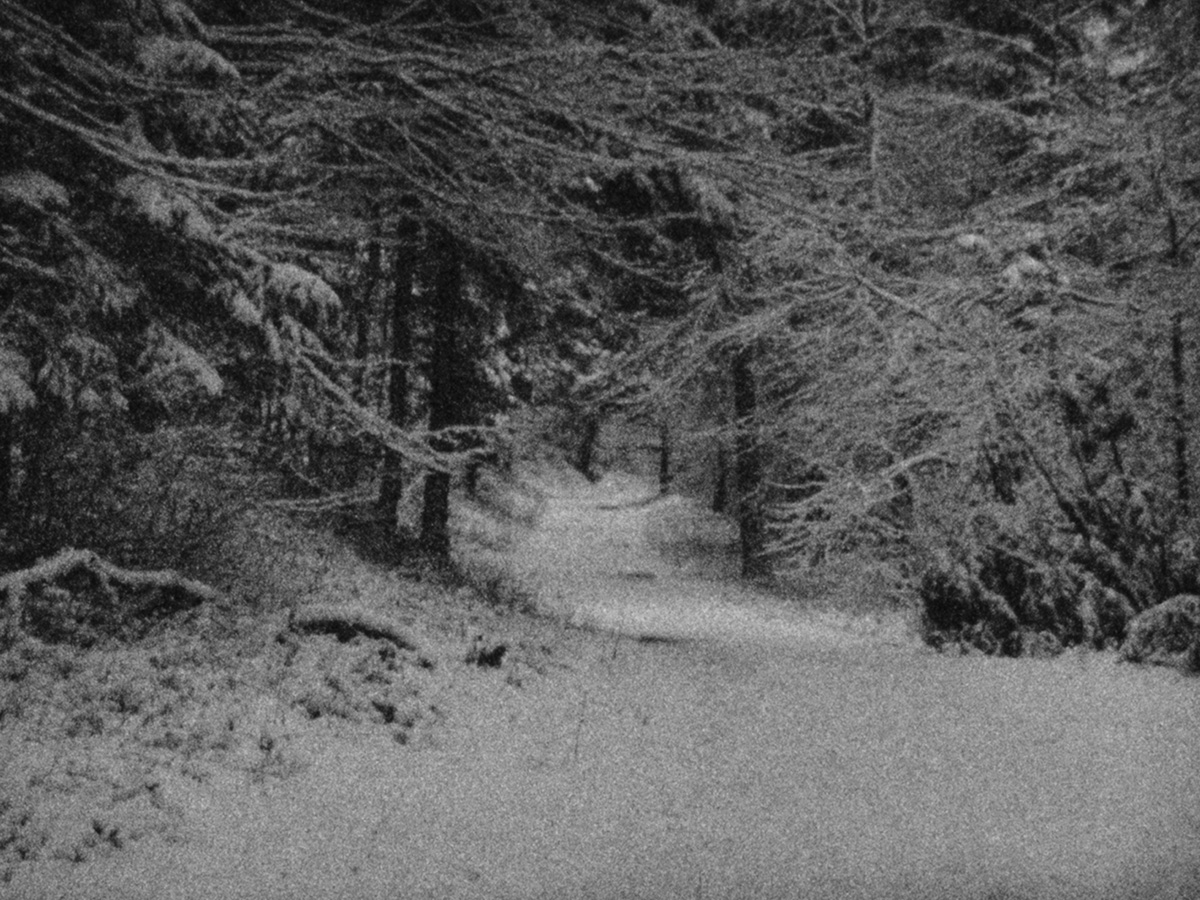
Un jeune homme marche dans l’hiver, pour tenter de dépasser ses propres interdits : une rencontre amoureuse avec un autre homme, et une rencontre avec l’absolu et la spiritualité chrétienne. Signal GPS Perdu raconte son voyage intérieur, en associant les paysages enneigés du Jura, un texte courtois du Moyen Âge, et une application de rencontres gay sur smartphone. Tourné en Super 8 noir et blanc, le film nous emmène dans une quête contemplative et ascétique, où le contemporain se mêle à des récits anciens.
Né en 1992 à Dole (FR), Pierre Voland est réalisateur et enseignant. Il a étudié la littérature et le cinéma, puis a fait un master artistique à l’École de Recherche Graphique à Bruxelles, où il vit actuellement. Marqué par le volet lyrique du cinéma expérimental français et américain, il intègre dans son travail des éléments autobiographiques et littéraires. Son premier film, Signal GPS perdu, a été présenté dans plusieurs festivals internationaux tels que le FIDMarseille (FR), le Bejing International Short Film Festival (CN), et EXiS (KR).
Mathias Volz, Bijan DAWALLU
Catalogue : 2006Ducks & Cars | Art vidéo | dv | noir et blanc | 142:23 | Allemagne | 2005
Mathias Volz, Bijan DAWALLU
Ducks & Cars
Art vidéo | dv | noir et blanc | 142:23 | Allemagne | 2005
Ducks & Cars joue de l'attente du spectateur. Lentement, comme une goutte de pluie qui se forme, une image se construit et disparaît dans le même instant. Doucement et calmement, de cette lenteur et de cette tension latente, nous apparaît un sujet enfantin : Ducks & Cars. La vidéo est pensée pour être projetée en arrière plan comme par exemple la prestation d'un groupe de musique ou lors de tout autre événement. Cela fait d'avantage référence à la conception classique de la peinture qu'à l'animation. Les symboles qui construisent l'image dérivent des caractères utilisées pour le tricot. Pas d'ASCII.
Bijan Dawallu termine en 2003 ses études de communications graphiques à l'UdK (Ecole des Beaux arts)de Berlin. Avec son collaborateur Andreas Eberlein, il intervient dans l'agence "Aroma", à Berlin. Mathias Volz: Mathias Volz achève ses études de multimédia en 2002. Après deux années d'activité pour une agence internet à Barcelone il travaille actuellement à Berlin en indépendant.
Friedl Vom Gröller
Catalogue : 2014Ich auch, auch, ich auch | Film expérimental | 16mm | noir et blanc | 2:0 | Autriche | 2012
Friedl Vom GrÖller
Ich auch, auch, ich auch
Film expérimental | 16mm | noir et blanc | 2:0 | Autriche | 2012
The three-minute film, a snapshot of an encounter, is based on concrete experience. In an accompanying note, the filmmaker writes: ?For years, weeks, I have had to visit my mother and am regularly overwhelmed by the purpose of life, compassion, and anticipation of my own passing.? This experience is condensed in the film.
*1946 in London. She spent her childhood in Vienna and Berlin. From 1965-1969 she studied photography at the School of Graphic Arts. 1971 Masters certificate and commercial atelier for photography. 2005 National award for photography. 1990 Founder and director of School for Artistic Photography, Vienna until 2010. 2006 Founder and director of School for Independent Film, Vienna. First films in 1968. Screenings/Exhibitions (Selection): Centre Pompidou, Paris; Frankfurter Kunstverein; Generali Foundation, Wien; Anthology Filmarchives, New York; documenta 12, Kassel; Österreichisches Filmmmuseum, Wien; International Film Festival Toronto; International Film Festival Hong Kong; Berlin Biennale; Diagonale, Graz; Viennale; Lentos, Linz; Media-City, Windsor, HGB-Leipzig, Mumok Wien.
Catalogue : 2014Meine psychoanalytischen Notizen | Film expérimental | 16mm | noir et blanc | 3:0 | Autriche | 2013

Friedl Vom GrÖller
Meine psychoanalytischen Notizen
Film expérimental | 16mm | noir et blanc | 3:0 | Autriche | 2013
Fire ravages relentlessly through paper. Individual words, ragged sentences, loose thoughts have broken free of their contexts and flare up once again before melting away forever: ?unfaithful,? father,? ?on 17 October, K. complained of overwork,? ?I also think about incest and wanting to save sister.? The clearly legible handwriting on white sheets of paper has given up its search for meaning and surrenders to the flames. Artist Friedl von Gröller hands over several-page-long psychoanalytical protocols from her professional practice as psychoanalyst to the funeral pyre flaring in the middle of a snow-covered landscape. The notes from hundreds of hours of ?talking cure? extinguish silently, almost blithely. They abdicate their cognizance of the long therapy sessions between analyst and patient. But the burning paper is not the only storage medium that knows of Groller?s notes. The short film My Psychoanalytic Notes begins with close-ups of people?s faces?psychoanalysts?reading, intently studying Gröller?s protocols. Only then does the camera turn away from the faces?with an increasingly faster pan?toward a snowy forest landscape and the pile of burning books: As though the filmmaker wanted to once again call up her own profession as witness, which will remember her work even after the cold fire destroys all traces. The camera moves in an extreme close-up across the pages, leafs through once again. Yet it is just as fascinated by the bizarre ash formations that arise from the act of burning as it is by the notes and sentences dying on them. In the end, the camera digresses once more, wanders across the snow and wood, and ultimately turns to the backlight of the sky. The image fades, becomes white like snow?or white like a clean sheet of paper, on which a new stage of life can be recorded. (Alexandra Seibel) Translation: Lisa Rosenblatt
1946 in London. She spent her childhood in Vienna and Berlin. From 1965-1969 she studied photography at the School of Graphic Arts. 1971 Masters certificate and commercial atelier for photography. 2005 National award for photography. 1990 Founder and director of School for Artistic Photography, Vienna until 2010. 2006 Founder and director of School for Independent Film, Vienna. First films in 1968. Screenings/Exhibitions (Selection): Centre Pompidou, Paris; Frankfurter Kunstverein; Generali Foundation, Wien; Anthology Filmarchives, New York; documenta 12, Kassel; Österreichisches Filmmmuseum, Wien; International Film Festival Toronto; International Film Festival Hong Kong; Berlin Biennale; Diagonale, Graz; Viennale; Lentos, Linz; Media-City, Windsor, HGB-Leipzig, Mumok Wien.
Christina Von Greve, C-SCHULZ
Catalogue : 2008Flicker | Film expérimental | 35mm | noir et blanc | 10:0 | Allemagne | 2006
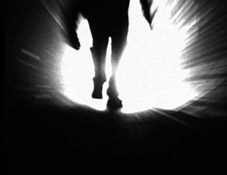
Christina Von Greve, C-SCHULZ
Flicker
Film expérimental | 35mm | noir et blanc | 10:0 | Allemagne | 2006
Ouvrez les yeux et continuez de regarder l'aveuglante source de lumière qui réduit, dans ce film, les personnages et les objets en minces silhouettes. Il y a seulement de la lumière ...
Christina von Greve est née est 1968 à Bonn. De 1996 jusqu'à ce qu'elle obtienne son diplôme en 2001, elle a étudié à l'Académie des Arts Médiatiques à Cologne. En 2002-2003 elle a été artiste résident au MAP, un programme mis en place par la Pépinières européennes pour jeune artistes à Madrid en Espagne. Elle vit et travaille à Cologne en Allemagne. C-Schulz est né en 1968 à Cologne. Il travaille en tant que musicien et réalisateur depuis 1990. De 1996 à 2001, année où il a obtenu son diplôme, il a étudié à l'Académie des Arts Médiatiques de Cologne. Depuis 2002, il travaille en tant qu'auteur, directeur et compositeur pour la WDR (Westdeutscher Rundfunk, une station de radio) dans le domaine du 'featuring', de l'Ars Acustica et de la musique expérimentale. Il vit et travaille à Cologne, en Allemagne.
Catalogue : 2006Swelan | Vidéo expérimentale | dv | couleur | 5:10 | Allemagne | 2005

Christina Von Greve
Swelan
Vidéo expérimentale | dv | couleur | 5:10 | Allemagne | 2005
Scènes familiales avec poisson.
Christina von Greve est née en 1968 à Bonn . 1996-2001 études à la Kunsthochschule für Medien Köln (école supérieure d'arts des médias) 2002/2003 résidence à la Pépinières européennes pour jeunes artistes (MAP), Madrid, Espagne. Travaille comme artiste indépendante et cinéaste à Cologne.
Christina Von Greve
Catalogue : 2008Flicker | Film expérimental | 35mm | noir et blanc | 10:0 | Allemagne | 2006
Christina Von Greve, C-SCHULZ
Flicker
Film expérimental | 35mm | noir et blanc | 10:0 | Allemagne | 2006
Ouvrez les yeux et continuez de regarder l'aveuglante source de lumière qui réduit, dans ce film, les personnages et les objets en minces silhouettes. Il y a seulement de la lumière ...
Christina von Greve est née est 1968 à Bonn. De 1996 jusqu'à ce qu'elle obtienne son diplôme en 2001, elle a étudié à l'Académie des Arts Médiatiques à Cologne. En 2002-2003 elle a été artiste résident au MAP, un programme mis en place par la Pépinières européennes pour jeune artistes à Madrid en Espagne. Elle vit et travaille à Cologne en Allemagne. C-Schulz est né en 1968 à Cologne. Il travaille en tant que musicien et réalisateur depuis 1990. De 1996 à 2001, année où il a obtenu son diplôme, il a étudié à l'Académie des Arts Médiatiques de Cologne. Depuis 2002, il travaille en tant qu'auteur, directeur et compositeur pour la WDR (Westdeutscher Rundfunk, une station de radio) dans le domaine du 'featuring', de l'Ars Acustica et de la musique expérimentale. Il vit et travaille à Cologne, en Allemagne.
Catalogue : 2006Swelan | Vidéo expérimentale | dv | couleur | 5:10 | Allemagne | 2005
Christina Von Greve
Swelan
Vidéo expérimentale | dv | couleur | 5:10 | Allemagne | 2005
Scènes familiales avec poisson.
Christina von Greve est née en 1968 à Bonn . 1996-2001 études à la Kunsthochschule für Medien Köln (école supérieure d'arts des médias) 2002/2003 résidence à la Pépinières européennes pour jeunes artistes (MAP), Madrid, Espagne. Travaille comme artiste indépendante et cinéaste à Cologne.